The office of Rep. Ilhan Omar slammed the Trump administration on Thursday over its reported plot to have the Minnesota Democrat stripped of her US citizenship.
On Wednesday, The Wall Street Journal reported that the raid on Omar’s home carried out earlier this week by Department of Homeland Security agents was part of and effort to build “a case to strip her of her US citizenship and ultimately deport her.”
“The multipronged effort is focused at least in part on how Omar obtained her citizenship after she arrived in the US from Somalia decades ago,” the Journal explained. “Investigators are focused both on the congresswoman and actions of her deceased father.”
Omar spokesperson Jackie Rogers responded to the report by accusing President Donald Trump of engaging in “desperate attempt to justify his extraordinary abuse of power.”
“This is politically motivated and an escalation of Trump’s personal vendetta against her lasting over a decade,” Rogers told HuffPost. “He has lied about her family, about her immigration history, and about her love of this country.”
Rogers also accused Trump of acting like a dictator by singling out a member of the opposition party for punishment.
“This isn’t a legitimate law enforcement action,” said Rogers, “it is an authoritarian move to silence an opponent right before an election where he and his party will be rejected by Americans in historic proportions… To Trump, no American value or principle is too important to be shredded for his own personal gain.”
Author John Ganz on Thursday published an analysis of the reported Omar deportation plot, which he said is “undoubtedly driven by racial and religious animus” and also “a serious assault on the constitutional order being carried out through the executive branch’s legal and bureaucratic machinery.”
Ganz argued that a serious attempt to strip Omar of her citizenship and remove her from the country would be a major escalation from the Trump administration toward establishing an outright totalitarian state.
“Authoritarian governments suppress political opposition and deprive their subjects of particular rights,” Ganz explained. “Totalitarian movements aspire to something much more radical: the destruction of the independent political and juridical personhood. They attack not merely the liberties of particular citizens they seek to repress, but the concept of citizenship itself—and then, ultimately, the concept of shared humanity.”
Ecuadorian fishing vessel “Conquista 2” after being bombed by US military [Photo: @MARFORSOUTH]
US federal agents announced Wednesday that they had seized 90 shipments of biodiesel bound for Cuba at Port Everglades, Florida, and the Port of Houston, Texas. It was the second seizure of fuel headed for the island announced in a week.
The roughly 620,000 gallons, valued at $2.8 million, were destined for ENETEC, a state-owned wholesaler in Havana that Washington sanctioned in July. Under the fuel blockade imposed in January, only Cuban private companies may receive fuel from the United States.
“An effort of this magnitude to undermine US sanctions does not occur by accident,” said José Figueroa, the Homeland Security Investigations agent in charge in Miami, warning that others “should be on notice.”
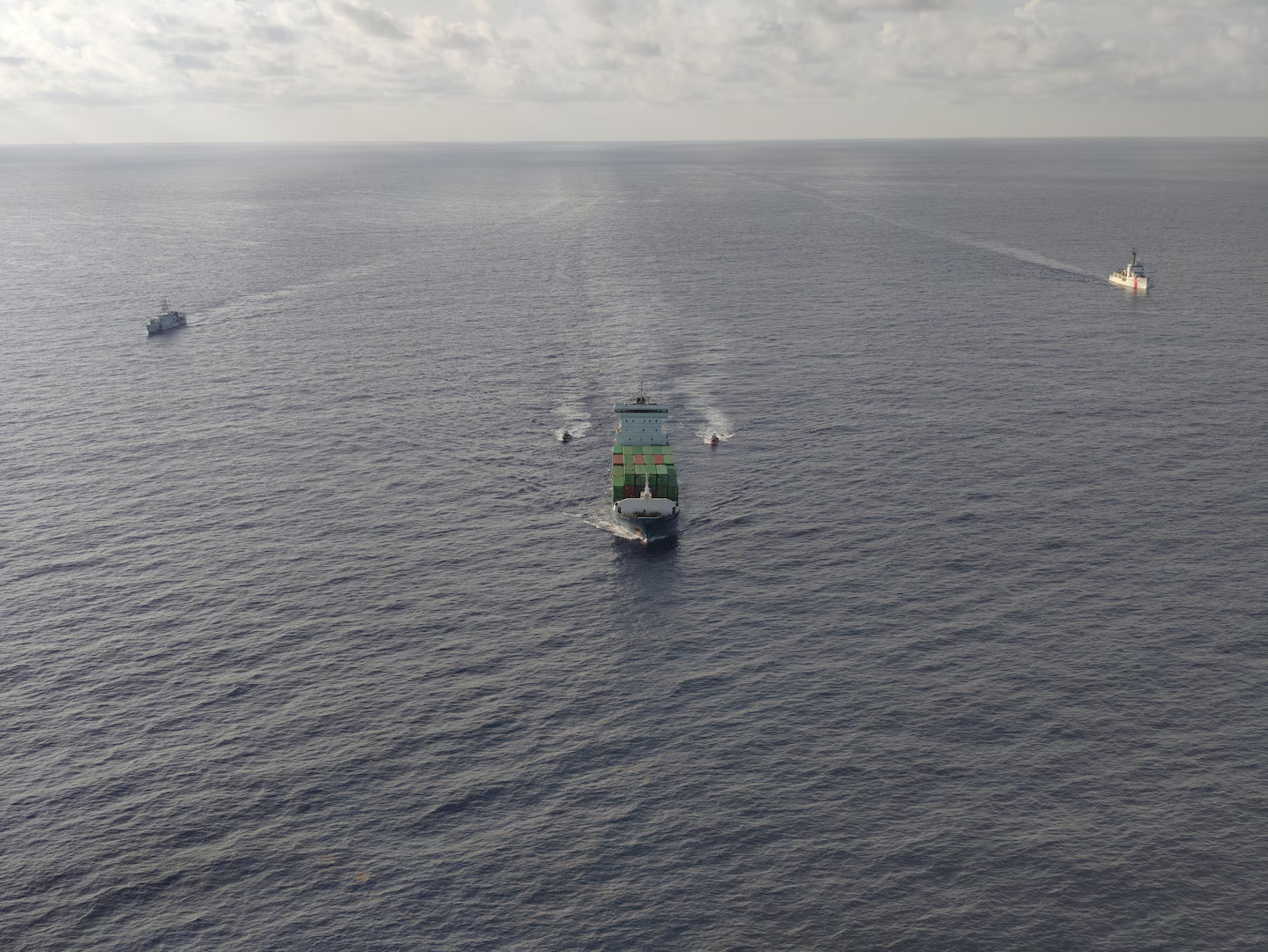
Five days earlier, the Coast Guard disclosed that a tactical team had boarded the Comoros-flagged freighter Grace with guns drawn on September 5, in international waters between Mexico and Cuba. The ship was escorted to the Mexican port of Progreso, where the Mexican Navy reported finding fuel in its ballast tanks.
“The high seas are not a sanctuary for lawlessness,” declared Coast Guard Commandant Adm. Kevin Lunday. When La Jornada asked what legal authority permitted the boarding, it received no answer.
Cuba’s Deputy Foreign Minister Carlos Fernández de Cossío called the seizures “piracy,” writing that it is “illegal, immoral and criminal to subject an entire people to economic asphyxiation as collective punishment for political ends.”
On October 4, US Southern Command (SOUTHCOM) blew up another small boat in the Caribbean, killing four people. It offered no evidence beyond the assertion that “confirmed intelligence revealed the vessel’s active involvement in narcotrafficking.” The attack brings the death toll of the campaign launched in September 2025 to at least 235 in 70 strikes.
The seizure of biodiesel, the boarding of a freighter at gunpoint and renewed boat strikes all advance US imperialism’s efforts to subjugate the entire hemisphere by means of military force, with Washington having long lost its economic competitive edge to Chinese and European interests.
The claim that the boat campaign is fighting drug trafficking has collapsed in the Ecuadorian courts. Between August 28 and September 16, US forces operating jointly with the Ecuadorian government boarded eight Ecuadorian fishing boats in the eastern Pacific, took off 160 crew members and sank the vessels. More than 140 of the men were handed to Ecuadorian authorities, and 90 are being prosecuted for “illicit association.”
SOUTHCOM called the boats “floating refueling stations” for the Los Choneros gang. Human Rights Watch interviewed 27 people, who described beatings, threats and pressure to confess.
On September 5, a judge in the port city of Manta freed 28 of the men. No fuel or drugs had been handed over by US authorities. The only evidence was 48 fishing credentials and one identity card, delivered by foreign personnel with no chain of custody, and the boats had been sunk without the prosecutor’s authorization, destroying the scene. “Twenty-eight fishermen on a boat is not an association, it is a crew,” the judge said.
On October 7, another Manta judge acquitted 32 crew members of the Conquista II and the María Candelaria. They were aged 19 to 64 and none had a criminal record. No drugs, weapons or fuel were found, and forensic searches of their phones turned up only family photographs.
The next day, the trial of 46 more crew members was suspended when the prosecution’s witnesses failed to appear.
No boardings have been reported since September 16. The two operations since then, on September 19 and October 4, were both in the Caribbean and left no one alive to testify. UN Special Rapporteur Ben Saul has called the campaign “serial extrajudicial killings” that “plausibly constitute crimes against humanity.”
In August, SOUTHCOM replaced Operation Southern Spear with a permanent Joint Task Force-Western Hemisphere (JTF-WHEM), commanded by Marine Maj. Gen. Kevin Jarrard. It works with an 18-nation “Americas Counter Cartel Coalition.”
SOUTHCOM commander Gen. Francis Donovan said that “we will locate, close with, and destroy the enemies that threaten our hemisphere.”
The fuel blockade against Cuba operates on the same principle. Executive Order 14380, signed January 29, threatens tariffs on any country that supplies oil to Cuba. Mexico, then the island’s main oil supplier, halted its shipments two days earlier. In February and May, two Russian tankers carrying fuel to Cuba turned back.
“What we’re trying to show them is that there are no escape valves,” Secretary of State Marco Rubio told Axios in August. “Every time they create a new mechanism to try and slip away, we simply close it off.”
European and Canadian investments were among the first casualties. Executive Order 14404, signed May 1, threatened sanctions on any foreign firm operating in Cuba’s energy, mining, financial and defense sectors. Within weeks, Canada’s Sherritt, the largest foreign investor on the island, announced it was ending its nickel and cobalt mining operations in Cuba. Spain’s Meliá and Iberostar stopped running 27 hotels between them, and Iberia suspended its flights from Madrid to Havana.
By May 20, Texas investor Ray Washburne’s Gillon Capital reached a preliminary agreement for 55 percent control of Sherritt, which is attempting to circumvent US sanctions through an American-led arrangement. Other US firms have offered competing bids to Sherritt. What US corporations could not win in economic competition is being secured for them by sanctions and gunboats.
The power grid has collapsed at least six times since January. In June, the UN human rights chief reported that infant mortality had risen to 9.9 per 1,000 births, food production had fallen 60 percent and medicine supplies stood at 30 percent of normal. UN experts warned in August that Cuba risks becoming a “silent Gaza.”
Meanwhile, the Pentagon is preparing an occupation. Last month, CBS News reported an internal Army Reserve message asking whether units could be provided to SOUTHCOM “possibly needed in 90-120 days.” They include logistics and engineering battalions, a medical brigade, a forward surgical detachment to treat casualties near the front, and a military police brigade, whose missions include detentions.
Pentagon planners have also drawn up options for an air assault on Cuba by several thousand troops of the 101st Airborne Division.
On October 5, the Pentagon released images of the 26th Marine Expeditionary Unit rehearsing night helicopter raids similar to the one that seized Venezuelan President Nicolás Maduro on January 3. The unit deploys this fall with the Kearsarge Amphibious Ready Group.
Trump’s advisers have told the New York Times that the Cuban government “could be gone by the time of the midterm election” on November 3.
None of the governments that claim to oppose Washington’s unprovoked war of aggression has defended the Cuban population. The Sheinbaum government in Mexico cut off oil shipments in January, and its navy has now inspected a ship seized by the US on the high seas. Moscow’s tankers turned around. China has offered limited humanitarian aid. The Cuban government itself has courted US companies and Miami investors in search of a deal.
Workers in the United States and internationally must oppose unconditionally and actively the blockade and any military attack on Cuba, uniting against the imperialist war on the basis of an international socialist program.
Trump has wrongly tried to blame the student-led movement on migrants and Islam. In reality, it is propelled by the gradual disappearance of any prospect of a stable future
A placard reads “The youth shouts, the state brings out its weapons” during a student protest in eastern France, on 8 October 2026 (Jean-Christophe Verhaegen/AFP)
Originating in a low-income suburb of Paris, the movement spread like wildfire across France, quickly expanding to encompass university students and union activists.
While the movement is mostly made up of teenagers who have overwhelmingly remained peaceful, state authorities have responded with disproportionate force.
Rather than insisting on moderation, Interior Minister Laurent Nunez called for police to use the full range of intermediate weapons, such as tear gas and rubber bullets, as necessary on protesters. More than 6,000 people, mostly minors, have been arrested in the crackdown.
Predictably, since day one, the mainstream media has worked hand-in-hand with the Macron government to discredit the movement, showing almost exclusively the more sensationalist, scary and spectacular images from the protests.
New MEE newsletter: Jerusalem Dispatch
Sign up to get the latest insights and analysis on Israel-Palestine, alongside Turkey Unpacked and other MEE newsletters
The coverage aims to create the false impression that “France is burning”, presenting the protests as “violent riots”, rather than as a largely peaceful student movement with legitimate and reasonable demands.
Deliberately ignored in such coverage is the fact that the vast majority of the countless protests, blockades, marches and actions in recent days, including the massive nationwide demonstration this week, remained non-violent.
Media coverage has also portrayed the students as being manipulated or instrumentalised by the France Unbowed party and its leader, Jean-Luc Melenchon, who is running in next year’s presidential election. They have presented no evidence for this claim, beyond the party’s support for the youth movement.
Enter Trump
Beating the French media and politicians – from the centre left to the far right – at their own Islamophobic and racist games, US President Donald Trump recently weighed in by publicly blaming the protests on uncontrolled mass migration and Islam.
Such outlandish accusations hardly deserve a response, and in France, they have essentially been ignored as the ravings of a despicable lunatic.
Students complain about severe underfunding of the public education system, even as the state spends billions of dollars in subsidies on private, usually Catholic schools
There are, however, two other explanations. Trump and others in his entourage might genuinely believe in the Great Replacement fantasy that “European civilisation” is being eclipsed by Muslims and Arabs, who want to build some sort of “Islamist caliphate”. Alternatively, he might simply be playing to his largely xenophobic Maga base, ahead of November midterms that his party is poised to lose.
But Trump’s grotesque posturing as a defender of “western civilisation” against invading hordes from the Global South does not seem to have swayed many people, even in the US, likely because few American voters have much interest in the politics of France.
Despite vast disparities across the nation, the primary grievances of students include the often appalling physical conditions of their crumbling schools; severe and systematic shortages of teachers and support staff; and overcrowded classrooms, where the numbers of students sometimes exceed available chairs.
In general, students complain about severe underfunding and governmental neglect of the public education system, even as the state spends billions of dollars in subsidies on private, usually Catholic schools – a cruel irony for a supposedly secular state whose elected officials constantly brag about the strictness of French laicite.
Restless generation
Another reason cited by student protesters is the strong and mounting anxiety they feel about their prospects for the future. This deep-seated fear crystallises around a state-run web portal called “Parcoursup”, which launched in 2018 with a goal of sorting out university applications.
Widely viewed as a failure, the automated selection system pits students against other students for their choice of universities and specialisations, in a process that has been criticised as opaque and discriminatory.
While France legally guarantees postsecondary access for students who have completed high school, 320,000 students were left without a place last year by the Parcoursup platform. In a nation of just 2.26 million high school students, many of whom will not even apply for higher education, the ratio is worrying.
And this is just the tip of the iceberg. History shows that behind concrete, practical and material demands, and beyond massive and spectacular popular demonstrations, larger problems often loom.
What we are hearing in France is an expression of generalised anxiety over the future, both individually and globally, and a rejection of the state of affairs at home after a decade of disastrous Macronism, which has broken the country and greatly aggravated inequalities, deepening the divide between rich and poor, and thrusting most of the population into ever-worsening precarity.
Researchers have suggested that young people in Generation Z will be worse off than their parents, facing a more difficult path to adulthood than any generation in half a century. Such is the future many of these student protesters see in front of them.
Add to this their emerging awareness that AI is killing and replacing many of the jobs that were supposed to be theirs, and there is no need to see the hands of shadowy “Islamists” behind this historic movement.
The views expressed in this article belong to the author and do not necessarily reflect the editorial policy of Middle East Eye.
Dr Alain Gabon is Associate Professor of French Studies and chair of the Department of Foreign Languages & Literatures at Virginia Wesleyan University in Virginia Beach, USA. He has written and lectured widely in the US, Europe and beyond on contemporary French culture, politics, literature and the arts and more recently on Islam and Muslims. His works have been published in several countries in academic journals, think tanks, and mainstream and specialized media such as Saphirnews, Milestones. Commentaries on the Islamic World, and Les Cahiers de l’Islam. His recent essay entitled “The Twin Myths of the Western ‘Jihadist Threat’ and ‘Islamic Radicalisation ‘” is available in French and English on the site of the UK Cordoba Foundation.
The US Coast Guard said Friday that its forces intercepted a ship that was attempting to bring fuel to Cuba, as the US continues to enforce a ramped-up oil embargo on the country, which has caused a devastating humanitarian crisis.
The Coast Guard said that the incident occurred in early September, when a “Coast Guard tactical team” boarded the M/V Grace, a 300-foot-long container ship, in the Caribbean Sea.
Photo of the interception released by the Coast Guard
The Coast Guard said it then escorted the ship to Mexico, where Mexican authorities found fuel stored in the ship’s ballast tanks. It said that earlier in the summer, US Coast Guard personnel stopped and boarded the M/V Jaira Provider, another vessel it accused of carrying fuel bound for Cuba.
The Trump administration ramped up the oil embargo on Cuba after it attacked Venezuela to abduct President Nicolas Maduro in January, which gave the US the power to cut off Venezuelan oil shipments to the island nation. The US also pressured Mexico to end its oil exports to Cuba.
The embargo has caused daily blackouts, which have been detrimental to the civilian population of Cuba. Cuban doctors told The New York Times back in March that patients were dying due to the US blockade, as the conditions at hospitals caused by the fuel shortages were leading to preventable deaths.
The escalated blockade has come with threats and preparations for military action against Cuba. CBS Newsrecently reported that the US Military has been working to establish “the groundwork for potential action around Cuba.”
The Pentagon is preparing to dramatically expand the American military presence in the Middle East as President Donald Trump weighs renewed attacks on Iran, with thousands of additional troops and a third aircraft carrier being readied for deployment, even as the conflict he has repeatedly declared “over” or “won” threatens to erupt into a new and potentially broader phase.
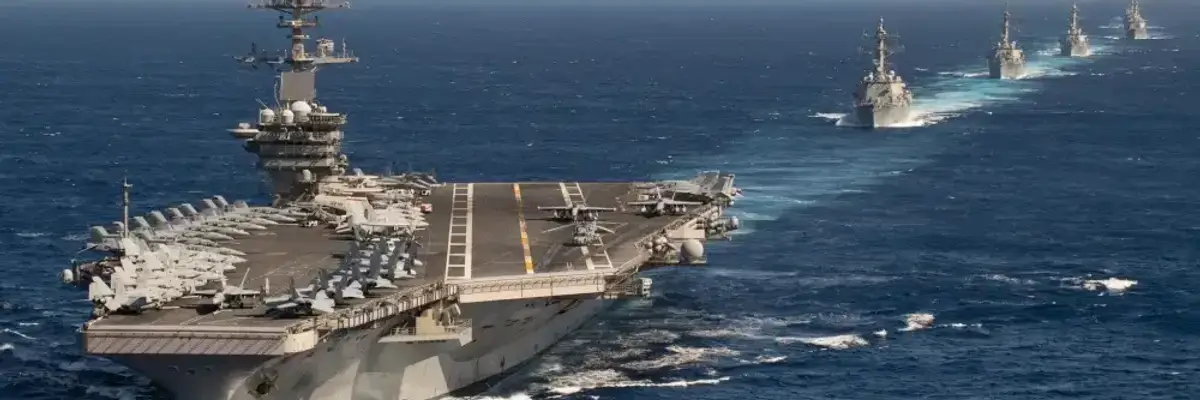
The Washington Postreported Thursday that the Pentagon is preparing options that could put as many as three US aircraft carriers and their accompanying warships in the Middle East.
According to The Associated Press, around 9,000 additional sailors and Marines are being dispatched aboard the USS Theodore Roosevelt carrier strike group and the USS Makin Island amphibious readiness group. The buildup could push the number of US personnel in the region above 20,000 by late October.
The Roosevelt is being sent to relieve the USS George Washington, while a third carrier, the USS George HW Bush, is also already in the region.
The new deployment plans come as diplomacy between Washington and Tehran remains stalled, and as Trump has repeatedly threatened to resume large-scale military action—including the total annihilation of the nation of over 90 million people—after the November midterm elections.
“Either they’ll do something very proper and smart, or they won’t be around very long,” Trump said of the Iranian government Thursday in Denton, Texas. “Frankly, I hate to see that, but they won’t be around very long.”
Iran, meanwhile, has reportedly begun preparing for a more expansive retaliation should the United States launch another major attack in the illegal US-Israeli war of choice against the Middle East nation.
Hamidreza Azizi, a senior Iran analyst at the International Crisis Group, told Reuters Thursday that the Iranian government seems “determined not to respond symbolically to a symbolic move and instead to escalate in the hope of reestablishing deterrence.”
Republican National Committee Co-Chair Lara Trump—the president’s daughter-in-law—warned during a Wednesday interview with British journalist Harry Cole that the increasingly protracted Iran War could not only tarnish Trump’s legacy, but could also cost Republicans next month’s midterm elections.
“Well, it’s possible,” Trump—who campaigned as the “peace president” on a promise of no new wars—said of the midterm risks Thursday on his way to Texas, before adding that “it should help because Iran will not have a nuclear weapon.”
The intelligence consensus of every US administration since former President George W. Bush—including during both of Trump’s terms—has been that Iran has not been trying to develop nuclear weapons.
US President Donald Trump gives his speech at the 81st session of the UN General Assembly, September 22, 2026. Photo: UN.
In his speech at the United Nations General Assembly, the president of the United States, Donald Trump, threatened Cuba, claiming that the country is under the highest level of pressure and that it will eventually fall.
In protest against Trump’s words, the Cuban delegation, led by Foreign Minister Bruno Rodríguez Parrilla, walked out of the room. Prior to the threats from the US president, which he often repeats, the president of Brazil, Luiz Inácio Lula da Silva, had expressed his condemnation of foreign interference in the region and criticized the measures imposed by the US against Cuba. Lula emphasized that the intensified blockade represents collective punishment against 10 million people.
Trump claimed that Cuba is a failed state, and backed up his claims by referring to the added pressure of the economic and energy blockade policy. “It is failing like never before, and it is going to fall,” the US president said in his usual bellicose tone. He also mentioned that US Secretary of State Marco Rubio is leading ongoing negotiations with the Cuban government, a claim that has been denied by Cuba.
In addition to his warlike tone against Cuba, the US president uttered warnings against Iran. Trump stated that he must decide between quickly annihilating Iran to supposedly prevent it from attacking other countries or allowing an agreement that favors the reconstruction of the country under Washington’s terms, although he toned down the bravado by adding that he expects to reach a pact after the US midterm elections. He also insisted that the Iranian government will never have a nuclear weapon, despite the fact that Iran has a declared policy of not making any nuclear weapons.
Earlier, upon his arrival at the UN headquarters in New York, Trump had an incident with the press, when he reproached a CNN reporter for covering his attendance, citing his ban on CNN.
Trump also boasted about the achievements of the US economy, calling it the envy of the world, although the country is experiencing high inflation, elevated fuel costs, and rising mortgage rates faced by the US population.
Cuba condemns Trump’s attacks The Cuban government responded to Trump’s attacks by reaffirming its right to sovereignty and condemning the economic and social impact of the intensified US blockade.
The president of Cuba, Miguel Díaz-Canel, decried on social media that the characterization of Cuba as a threat has the objective of justifying the genocidal US economic war against the Cuban population.
Díaz-Canel stated that Trump’s resorting to lies reflects a refusal to accept the self-determination of the Cuban people and reaffirmed that the country will maintain the defense of its sovereignty, working to overcome US imperialist aggression. He added that the blockade is the real threat.
Similarly, Foreign Minister Bruno Rodríguez said that the US government is incapable of recognizing Cuba as an independent and fully sovereign nation.
Rodríguez dismissed Trump’s accusations as falsehoods and slander, insisting that Cuba does not pose a danger to the United States or any other country, while the current economic restrictions and energy blockade do threaten Cuba and the rest of the world.
“The blockade is an act of genocide and collective punishment. We are a country of peace and we deserve peace,” emphasized the foreign minister, adding that the blockade has been systematically denounced by the majority of the international community.
A new poll from The Economist/YouGov found that a majority of registered US voters support impeaching US Secretary of War Pete Hegseth, after Rep. Thomas Massie (R-KY) of Kentucky introduced a resolution to remove him.
The poll, conducted from September 18 to September 21, found that 51% of registered voters surveyed support impeaching Hegseth for starting the war with Iran without congressional authorization, while 34% oppose it. Support for impeachment rises among likely voters to 54%, and opposition rises to 35%.
“This is why [House Speaker Mike Johnson] adjourned Congress to avoid the vote and why the President isn’t defending [Hegseth],” Massie wrote on X in response to the results.
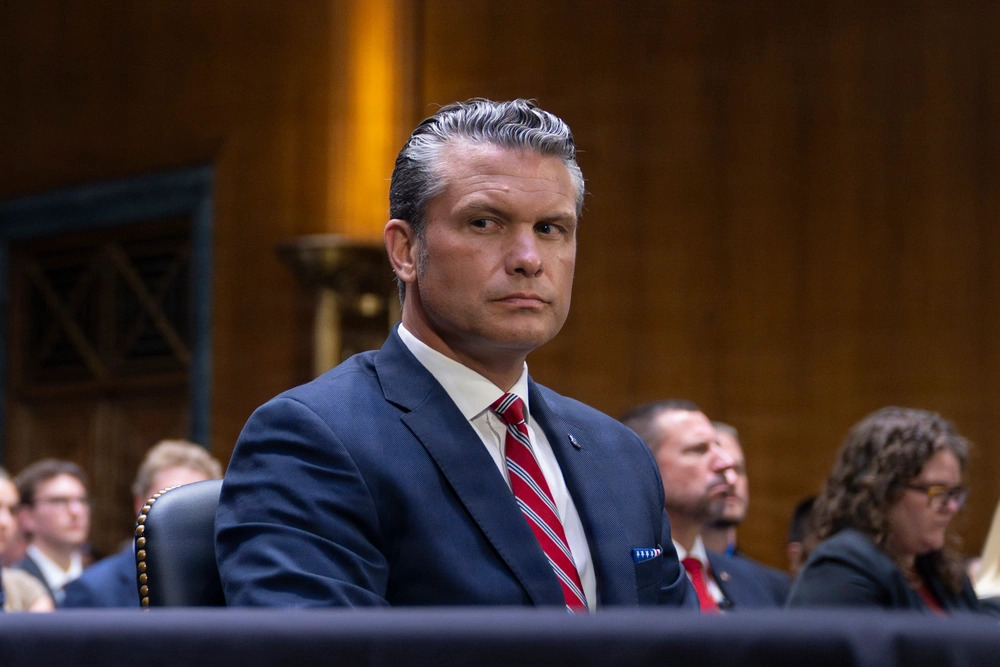
Hegseth before the Senate Appropriations Committee on July 21, 2026 (Pentagon photo)
Massie introduced the articles of impeachment on September 15, and because it was a privileged resolution, a vote had to happen within two days. But Johnson canceled the House’s voting session for September 17, sending lawmakers home early for a long recess that pushes the impeachment vote until after midterm elections.
Impeachment is much more popular among Democrats, with the YouGov poll showing 77% supporting it compared to just 22% of Republicans. But Massie only needs a few Republican votes to pass the impeachment resolution through the House, and seven House Republicans supported the latest War Powers Resolution calling for an end to the war with Iran, signaling that he may get enough.
While the poll asked only about Hegseth’s role in the Iran war, Massie’s eight articles of impeachment also address how Hegseth has ignored US laws designed to mitigate civilian casualties, his role in extrajudicial executions at sea (strikes on alleged drug-running boats), the attack on Venezuela to abduct President Maduro, the bombing campaign in Yemen last year, and his efforts to chill free speech.
In Gaza, thousands of children have been killed amid the genocide that’s being imposed by Israel with total impunity. Thousands of them are unaccounted for and buried beneath the rubble. In Cuba, millions of people have survived for years amid blackouts, shortages, difficulties accessing medicines, fuel scarcity, and a profound economic crisis imposed upon them by the United States.
These are different realities, but there is a question that connects them. One that should challenge the conscience of the international community: How much civilian suffering is the world willing to tolerate before taking action? It is an important question as the 81st session of the United Nations General Assembly approaches.
In Cuba, the government consistently denounces that U.S. sanctions and restrictions are worsening an already critical situation.
When fuel is scarce, the crisis ceases to be an abstraction. It enters people’s homes. It enters the room where a child tries to do homework during a blackout. It enters the home where a mother fans her baby because the heat becomes unbearable.
It also enters the kitchen, where food begins to spoil; the hospital, where a patient needs medicine that does not arrive; and the life of a worker who does not know how they will get to work because public transportation is nearly paralyzed.
An Island in the Dark
In mid-September, Cuban Foreign Minister Bruno Rodríguez Parrilla presented a report on the damage caused by the U.S. blockade between March 2025 and February 2026.
Rodríguez described months in which many families have lived with barely two or three hours of electricity a day, or even less.
Behind those hours of blackouts lies much more than an energy statistic: there is a child whose sleep is interrupted, a grandfather left without television or radio, a student trying to concentrate without light, and a mother struggling to find a way to preserve food.
Blackouts disrupt the entire life of a family. The Cuban government maintains that the lack of fuel is one of the main factors behind the energy crisis and denounces that U.S. measures make it difficult to obtain the fuel and diesel needed for electricity generation.
It also points out that the restrictions affect the acquisition of parts and equipment for thermoelectric power plants and hinder the expansion of renewable energy sources such as solar power.
When a Sanction Reaches a Hospital Bed
One of the most painful dimensions of any sanctions policy is the one that does not immediately appear in the headlines: the way it ultimately affects a patient.
Rodríguez stated that thousands of containers have been prevented from reaching Cuba because of the pressure and threats faced by shipping companies by the U.S. government. The figure cited by the foreign minister exceeds 7,000 containers.
To someone observing the situation from afar, a container may simply be a shipping unit.
For a family, it may contain medicine. For a hospital, it may mean essential supplies. For a patient, it may represent the difference between receiving treatment on time and continuing to wait. And when that patient is a child, that wait can become unbearable.
They Are Children, Not Numbers
Palestinian children in the rubble of their community. (Foto: UN)
Referring to the increase in infant mortality between 2018 and 2025, the Cuban foreign minister made a statement that should transcend any political debate:
They are children, not numbers.
The statement matters because behind every mortality statistic there is a life that ended and a family that will carry that loss forever.
The tragedy in Gaza and the Cuban crisis belong to different historical and political contexts; but they converge at their roots in a history of struggle and resistance against the imperial thirst of powerful nations.
The international community has condemned, debated, and voted for years on the U.S. blockade against Cuba. At the same time, the great powers have repeatedly demonstrated that their international decisions are shaped by political, economic, and strategic interests. And the same happens with the Palestinian cause and their constant outcry for their international recognition as a sovereign state.
Meanwhile, families continue to live with the consequences. Both in Gaza and Cuba, a child dies everyday due to bombs or invisible sanctions. May the deaths of those children never become something to which we grow indifferent to.
Monthly Review does not necessarily adhere to all of the views conveyed in articles republished at MR Online. Our goal is to share a variety of left perspectives that we think our readers will find interesting or useful. —Eds.
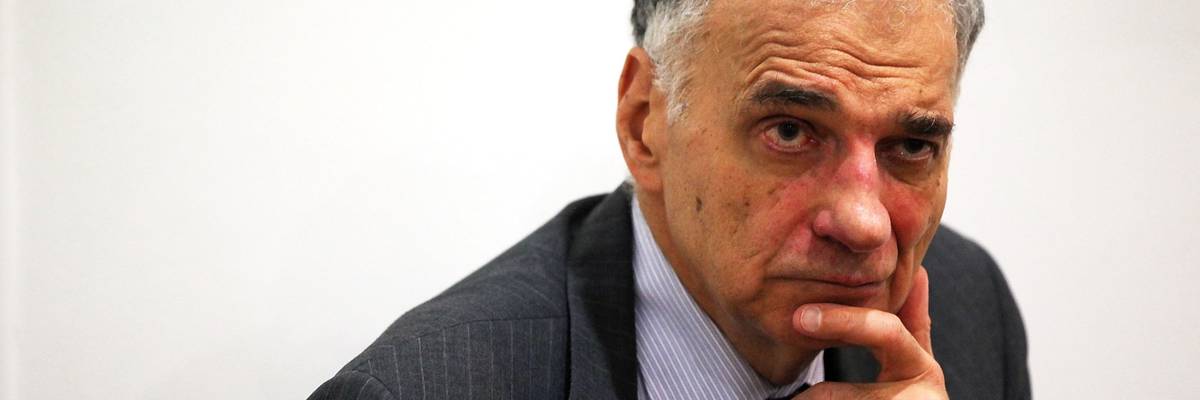
Former presidential candidate Ralph Nader listens during a news conference July 2, 2012 at Public Citizen in Washington, DC.
(Photo by Alex Wong/Getty Images)
“The Democrats and electorally frightened Republicans pushed Richard Nixon out in 1974 for far, far lesser transgressions than those committed by Trump in a week.”
As Democrats campaign for the November midterm elections after helping kill the latest congressional effort to impeach President Donald Trump, progressive consumer advocate and four-time presidential candidate Ralph Nader this week renewed attacks on the party’s leadership for abandoning their constitutional responsibility to hold the president accountable.
In a September 14 essay published by Current Affairs, Nader argued that Democratic leaders have effectively given up on impeachment even as Trump’s second administration faces continuing allegations of executive overreach and misconduct.
“The chronic prevaricator and delusionist Donald J. Trump knows that the worse his outlaw actions become, the less likely the Democrats in Congress are to impeach him,” the Public Citizen co-founder wrote. “The massive number of blatant, impeachable acts by the lawless, corrupt, violent, systemically racist, unstable, dangerous tyrant increases by the day.”
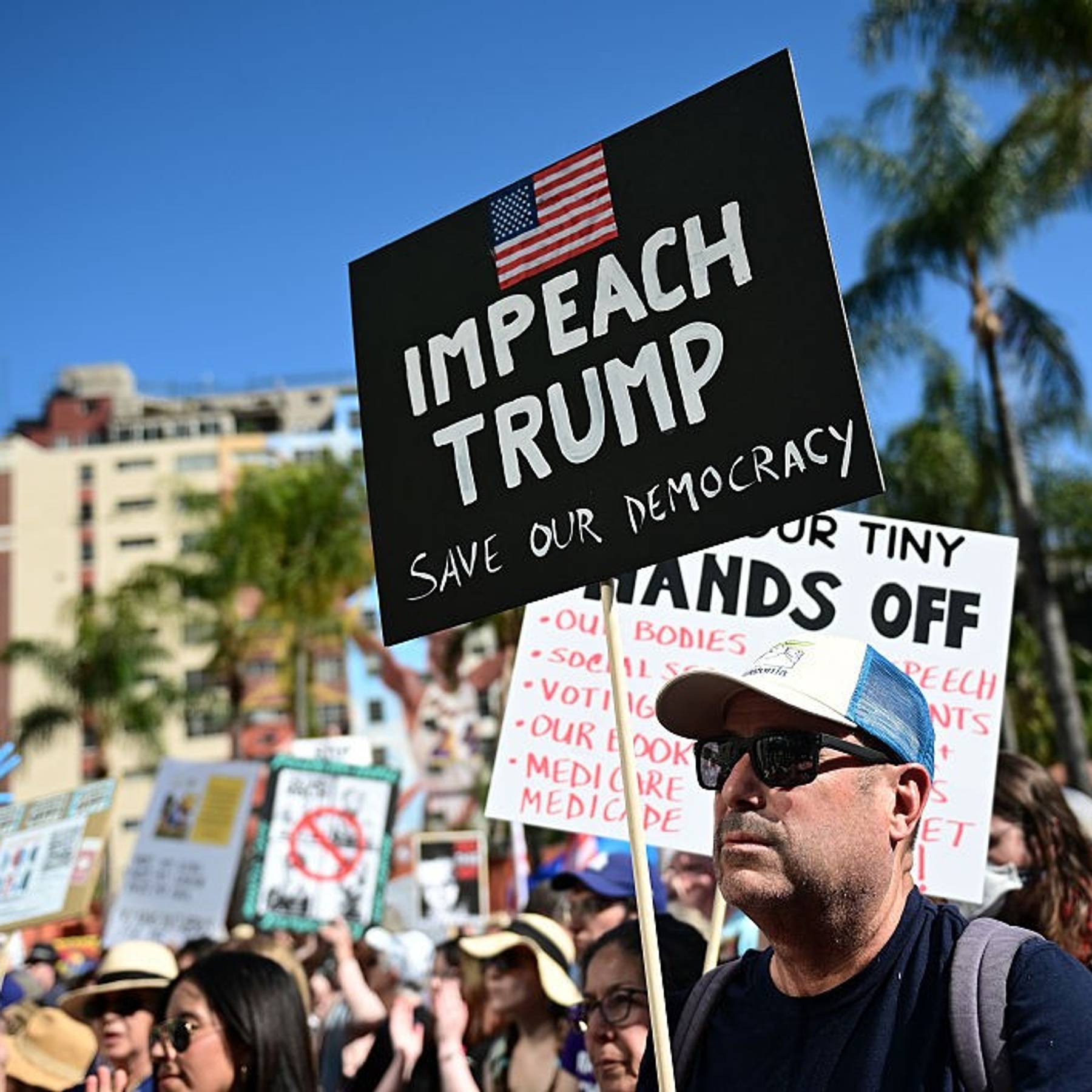
“The American public knows it,” Nader continued. “The majority of Americans favor impeaching Trump. Among Democrats, it’s 84% in favor, as well as a majority of independents. Polling even shows that most Americans think Trump is a ‘dangerous dictator whose power should be limited before he destroys American democracy.’”
Yet, “when asked about impeachment, House minority leader Hakeem Jeffries [D-NY] replied: ‘We haven’t ruled anything in and we haven’t ruled anything out,’” he noted. “What? Every day, the mega-arsonist is burning down our republic and its Constitution, with tens of millions of Americans suffering and endangered. Yet Jeffries has been noncommittal about whether Democrats would pursue impeachment even if they had a congressional majority.”
In a column republished by Common Dreams earlier this month, Nader wrote, “What must Tyrant Trump be thinking about his opponents’ feeble, weak, cowardly responses to his daily torrent of serious, impeachable offenses?”
“Even his egomaniacal narcissism cannot fully explain his amazing good luck,” he opined.
Earlier this week, the House of Representatives voted 232-147 to table an impeachment resolution introduced by Rep. Al Green (D-Texas), effectively ending the measure’s consideration. Eighteen Democrats joined Republicans in voting to table it, while 46 Democrats—including House Minority Leader Hakeem Jeffries—voted “present.”
Green’s resolution accused Trump of high crimes and misdemeanors arising from the administration’s deadly anti-immigrant crackdown, including alleged violations of civil liberties and due process. Green said before the vote that the Constitution contains no provision requiring Congress to wait before confronting impeachable conduct.
Democratic leaders have attempted to justify their decision not to support Green’s resolution by arguing that impeachment requires a substantial investigative record, hearings, witness testimony, and document review. Jeffries, along with Democratic leaders Katherine Clark of Massachusetts—the House minority whip—and Pete Aguilar of California, the House Democratic Caucus chair, said they would vote “present” because “none of that serious work has been done,” as they jointly explained.
Nader rejects that reasoning. In Current Affairs, he argued that saying Democrats “don’t have the votes” misses the purpose of a sustained impeachment campaign, which he described as a way of building public pressure and organizing voters.
“Impeachment is a mobilizer for get-out-the-vote efforts,” he wrote, as well as “for educating and energizing the people back home.”
Trump has already been impeached twice by the House, although the Senate failed to convict him either time. No other president has been impeached multiple times. Nader has pointed out that Trump’s high crimes and misdemeanors are more grave than those for which then-President Nixon resigned from office in 1974 rather than face impeachment, and that Democrats’ fear of the consequences for impeaching Trump again is no excuse for their cowardice.
“The Democrats and electorally frightened Republicans pushed Richard Nixon out in 1974 for far, far lesser transgressions than those committed by Trump in a week,” he wrote.
The move came after seven House Republicans voted in favor of a resolution to end the Iran war
by Dave DeCamp | September 16, 2026 at 12:54 pm ET
House Speaker Mike Johnson (R-LA) announced he has canceled a planned House session for Thursday, sending lawmakers for an early seven-week recess and pushing back a vote to impeach US Secretary of War Pete Hegseth until after the midterm elections.
Rep. Thomas Massie (R-KY), who introduced the resolution to impeach Hegseth, suspected Johnson might take drastic measures to avoid the vote, so he didn’t inform GOP leadership of his plan to introduce the resolution, which he did on the House floor on Tuesday.
“And there it is. Just as I predicted. They’re canceling Congress tomorrow to avoid the vote on IMPEACHING [Hegseth]. It will also make it harder for us to reach 218 signatures on the Epstein Discharge Petition before the election. We were at 190+ signatures last night,” Massie wrote on X after Johnson canceled the votes.
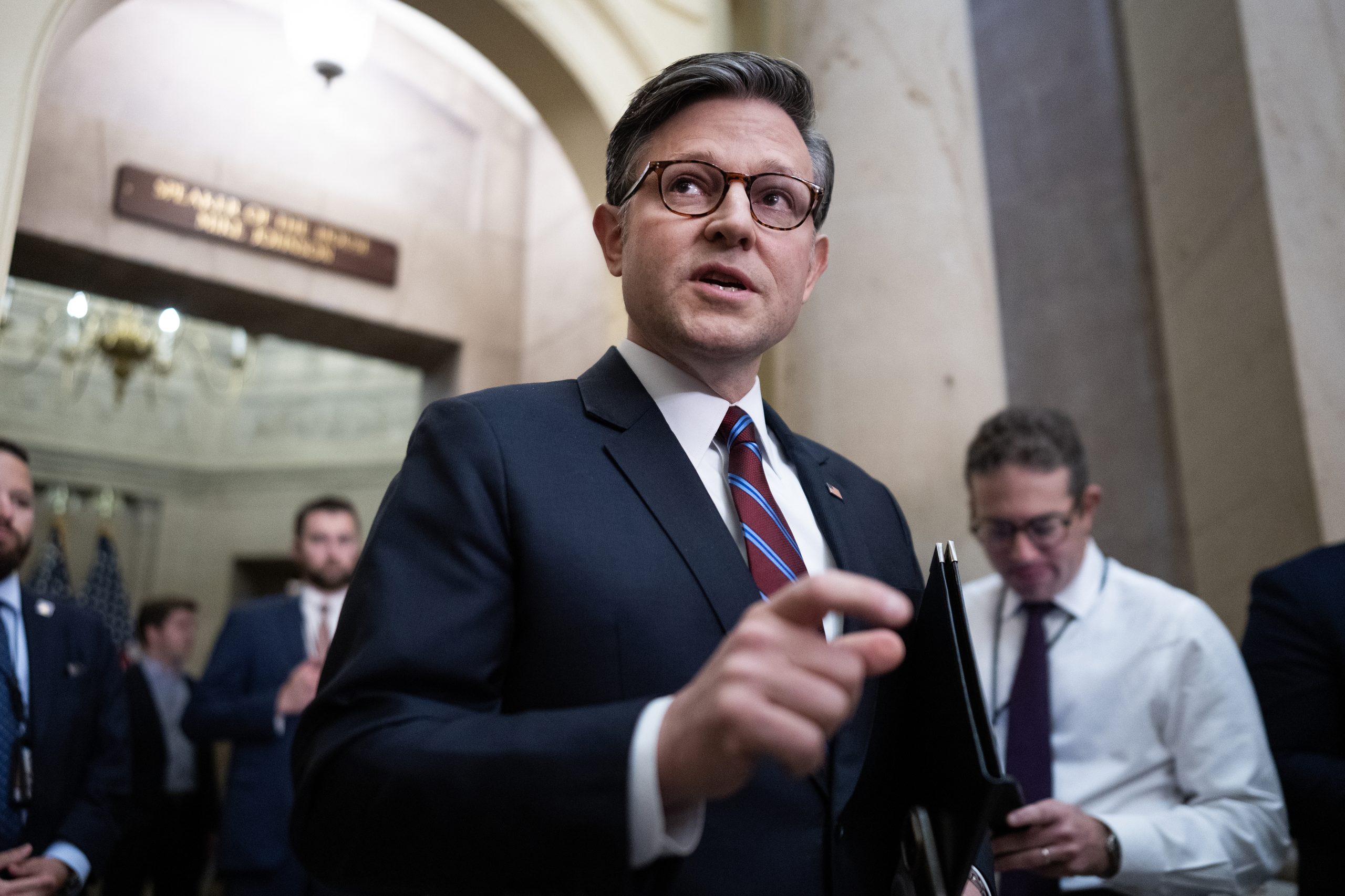
Speaker of the House Mike Johnson talks with reporters about the House finishing votes today instead of on Thursday, in the US Capitol on Wednesday, September 16, 2026. (Tom Williams/CQ Roll Call/Sipa USA via Reuters Connect)
While Johnson didn’t explicitly say the Hegseth impeachment was the reason for canceling Thursday’s votes, Reese Gorman, a reporter for The Washington Sun, reported right before the cancellation was official that some in House leadership “want to avoid a vote on the Hegseth impeachment set to come up tomorrow since it’s privileged.”
Johnson’s move also came after seven House Republicans voted against the Iran war by voting in favor of a War Powers Resolution that would direct President Trump to end the conflict. The bill passed 220-204, with all 213 Democrats present voting in favor.
The House has held multiple votes on the Iran war, but the Tuesday night vote had the highest number of Republicans supporting a resolution to end the conflict, signaling that Massie may get some Republican support over the Hegseth impeachment since it’s centered on the conflict with Iran.
Both the House and the Senate have already passed a concurrent Iran War Powers Resolution, which, under the 1973 War Powers Act, should direct the president to remove US forces from hostilities with Iran.
Massie argued in his eight articles of impeachment for Hegseth that passing the concurrent War Powers Resolution was one of the multiple ways Hegseth and the administration are breaking the law by continuing the Iran war.
The articles also address how Hegseth has ignored US laws designed to mitigate civilian casualties, his role in extrajudicial executions at sea (strikes on alleged drug-running boats), the attack on Venezuela to abduct President Maduro, the bombing campaign in Yemen last year, and his efforts to chill free speech.




 Havana, the author working in darkness. (Foto: Bill Hackwell)


You must be logged in to post a comment.