Posts Tagged ‘Palestine’

‘A War Crime’: UN Rights Chief Urges Immediate Repeal of Israel’s New Death Penalty

April 1, 2026

SWITZERLAND-ISRAEL-PALESTINIAN-UN-CONFLICT-DIPLOMACY

United Nations High Commissioner for Human Rights Volker Türk is seen at the UN Office in Geneva on September 16, 2025.

(Photo by Fabrice Coffrini/AFP via Getty Images)

UN High Commissioner for Human Rights Volker Türk said the new law “raises serious concerns about due process violations, is deeply discriminatory, and must be promptly repealed.”

Brett Wilkins, Common Dreams, Mar 31, 2026

The top United Nations human rights official was among those who on Tuesday urged Israel to repeal legislation it passed the previous day legalizing the hanging of Palestinians convicted of terrorism-related killing of Israelis—a law critics contend will not apply to Israelis who commit similar crimes.

The law passed by the Israeli Knesset states that Palestinians must be hanged within 90 days if convicted of nationalistic killings in a military court. While the legislation does not allow pardons, it gives judges discretionary power when it comes to sentencing Israeli citizens convicted of similar crimes, and observers say it’s highly unlikely that any jIsraeli would ever be hanged under the law.

RECOMMENDED…

A protester holds a placard reading "No to the Death Penalty"

Advocates Demand Repeal of Israeli Death Penalty Law Explicitly Targeting Palestinians

Israelis, Palestinians, and other people march in Bethlehem against the proposed Israeli death penalty bill

Critics Warn of Mass Executions as Israel Advances Death Penalty Bill for Palestinians

Experts argue the 90-day provision and lack of appellate process are violations of international humanitarian law.

“It is deeply disappointing that this bill has been approved by the Knesset,” UN High Commissioner for Human Rights Volker Türk said Tuesday. “It is patently inconsistent with Israel’s international law obligations, including in relation to the right to life. It raises serious concerns about due process violations, is deeply discriminatory, and must be promptly repealed.”

“The death penalty is profoundly difficult to reconcile with human dignity, and it raises the unacceptable risk of executing innocent people,” he added. “Its application in a discriminatory manner would constitute an additional, particularly egregious violation of international law. Its application to residents of the occupied Palestinian territory would constitute a war crime.”

While proponents of the law—some of whom, like Israeli National Security Minister Itamar Ben-Gvir, celebrated its passage—say they believe it will deter Palestinians from killing Israelis, studies in the United States, the only Western democracy that actively executes people, have repeatedly shown that the death penalty is not a deterrent to crime.

Palestinians and their defenders have also warned that the law could open the door to mass executions, including of anyone found to have killed Israelis during the October 7, 2023 Hamas-led attack, for which Israel retaliated with an ongoing assault and siege that has left more than 250,000 Palestinians dead, maimed, or missing.

“Trials for crimes related to October 7 are supremely important, but they must not be anchored in discrimination,” said Türk. “All victims are entitled to equal protection of the law, and all perpetrators must be held accountable without discrimination.”

Other human rights defenders also condemned the new Israeli law and called for its repeal.

https://www.instagram.com/p/DWhZyVAFI_F/embed/captioned/?cr=1&v=4&wp=1403&rd=https%3A%2F%2Fwww.commondreams.org&rp=%2Fnews%2Fun-israel-death-penalty#%7B%22ci%22%3A0%2C%22os%22%3A171967%7D

“The Israeli parliament’s adoption of a racist law authorizing the hanging of Palestinian prisoners is the very definition of apartheid,” the Washington, DC-based Council on American-Islamic Relations (CAIR) said in a statement Tuesday. “Even the South African apartheid government never adopted a death penalty law so explicitly racist.”

Taking aim at Israeli Prime Minister Benjamin Netanyahu—who is wanted by the International Criminal Court for alleged crimes against humanity and war crimes in Gaza—CAIR continued, “The Netanyahu regime is completely out of control because our nation continues to bankroll its crimes, from the de facto annexation of the West Bank to the genocide in Gaza, to the ethnic cleansing of southern Lebanon, to the occupation of Syria, to the illegal war with Iran that it triggered, to the closure of Christian and Muslim holy sites in Jerusalem.”

“Congress is not just failing to act, it is actively advancing more military support while treating that US taxpayer funding as automatic, even as these abuses escalate,” the group added. “Every member of Congress—especially Democratic leaders of the House and Senate—must condemn these crimes, including the racist execution law, and announce their opposition to any further military funding for the Israeli apartheid regime.”

A 2024 ruling by the International Court of Justice in The Hague—where Israel is also facing a genocide case brought by South Africa in response to the US-backed war on Gaza—affirmed that the Israeli occupation of Palestine is an illegal form of apartheid that must be ended.

More than 9,500 Palestinians are currently locked up in Israeli prisons, including 350 children and 73 women, according to advocacy groups. Palestinian and Israeli human rights defenders say detainees face torture, starvation, and medical neglect behind bars, causing many deaths.

Former prisoners as well as Israeli staff and medical personnel say they have witnessed torture at prisons including Sde Teiman, the most infamous of Israel’s lockups, with victims ranging from children to the elderly.

Israeli physicians who worked at Sde Teiman described widespread serious injuries caused by 24-hour shackling of hands and feet that sometimes required amputations. Palestinians taken by Israeli forces recounted rapes and sexually assaults by male and female soldiers, electrocution, maulings by dogs, denial of food and water, sleep deprivation, and other torture.

Palestine Action hunger striker arrested in dawn raid by masked police

March 31, 2026

Campaigners report that 21-year-old Qesser Zuhrah’s arrest came after she posted an Instagram story calling for ‘direct action’

Qesser Zuhrah went 46 days without food to protest her detention conditions while held on remand for 15 months (handout)

Qesser Zuhrah went 46 days without food to protest her detention conditions while held on remand for 15 months (handout)

By Katherine Hearst

Published date: 30 March 2026

A former Palestine Action-linked prisoner has been arrested under the Terrorism Act by masked police in a dawn raid on her home, weeks after she was released on bail.

Footage circulated online appeared to show 21-year-old Qesser Zuhrah, who had recently been granted bail after spending 15 months on remand, being arrested at her home by police officers at around 6:30am on Monday morning.

In the footage, a masked officer informs her that she is being arrested under Section 44 of the Serious Crimes Act, the offence of encouraging others to commit crimes, and Section 1 of the Terrorism Act, encouraging others to commit an act of terrorism.

In the video footage, officers inform her that she is being taken to Hatfield police station.

Zuhrah can be heard asking why the police officers are masked.

New MEE newsletter: Jerusalem Dispatch

Sign up to get the latest insights and analysis on Israel-Palestine, alongside Turkey Unpacked and other MEE newsletters

Counter Terrorism Policing told Middle East Eye: “Officers from Counter Terrorism Policing South East arrested a woman at her home address in Watford this morning.”

It said it was looking into why the arresting officers were wearing masks.

Zuhrah was already facing charges in connection with a raid on Israeli-owned arms factory in August 2024. She is part of a group of two dozen activists arrested over the incident known as the Filton 24.

Free the Filton 24, a campaign group supporting the defendants, reported that the arrest came after she allegedly posted an Instagram story calling for people to take “direct action”.

Met Police accused of reversing Palestine Action policy to fit previous arrests

Read More »

Palestine Action, a direct-action group protesting against Israeli war crimes, was proscribed by the British government in July 2025, months after Zuhrah’s first arrest. The government is appealing a Hugh Court ruling that the ban was unlawful.

Zuhrah was one of eight Palestine Action-linked prisoners who launched a 73-day hunger strike over their detention conditions. Zuhrah went 46 days without food and was hospitalised multiple times.

Last week, she spoke at a news conference with three other hunger strikers, alleging mistreatment in prison.

Zuhrah, who was also held HMP Bronzefield, said she was left immobile on her cell floor for 22 hours with worsening chest pains, 40 days into her hunger strike.

She also reported that throughout her imprisonment, she was subjected to prolonged periods of solitary confinement and segregated from other prisoners.

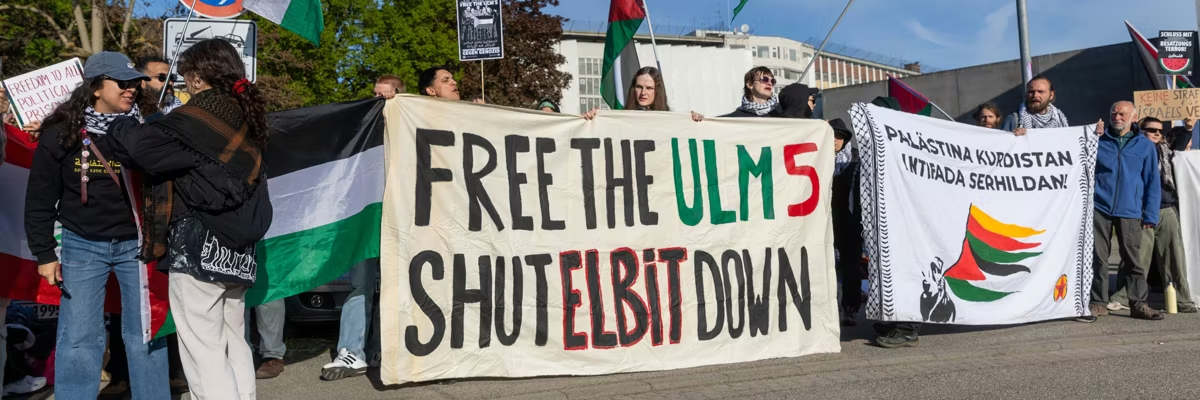
Zuhrah was released in February along with 22 co-defendants after charges of aggravated burglary in connection with the break-in at the Elbit Systems plant were dropped

Ending the Trump-Netanyahu War in the Middle East

March 17, 2026

If not stopped soon, this war could easily turn into a global conflagration, effectively into World War III.

by Jeffrey D. Sachs and Sybil Fares | Mar 17, 2026

The Israel-US war on Iran is engulfing the entire Middle East and could escalate to global war. The economic consequences are already severe and could become catastrophic. The Strait of Hormuz carries approximately one-fifth of all oil traded globally, and 30 percent of the world’s LNG. A sustained closure of the Strait would trigger an energy shock without modern precedent.

The conflict is likely to spiral out of control because the US and Israel are dead set on hegemony in the Arab world and West Asia – one that combines Israeli territorial expansion with American-backed regime control across the region. The ultimate goal is a Greater Israel that absorbs all historic Palestine, combined with compliant Arab and Islamic governments stripped of genuine sovereignty, including on choices as to how and where they export their oil and gas.

This is delusional. No country across the region wants Israel to run wild as it is doing, murdering civilians across the entire region, destroying Gaza and the West Bank, invading Lebanon, striking Iraq and Yemen, and carpet-bombing Tehran. No country wants its hydrocarbon exports under effective US control. The war will end if and only if global revulsion at US and Israeli aggression force these countries to stop. Short of that, we are likely to see the Middle East in flames and the world in an energy and economic crisis unprecedented in modern history. The war could easily turn into a global conflagration, effectively into World War III.

Yet, there exists an alternative. The war could stop on rational grounds if Israel and the US are decisively called to account by the rest of the world. Ending the war requires a set of interlinked steps to provide basic security for all parties, and indeed for the world. Iran needs a permanent end to the US-Israel aggression. The Gulf countries need an end to Iran’s retaliatory strikes. The Palestinians need an independent state. Israel needs lasting security and the disarmament of Hamas and Hezbollah. The whole world needs the opening of the Strait of Hormuz, and international monitoring of Iran’s nuclear program to ensure it abides by the Nuclear Non-Proliferation Treaty, as Iran says it wants to do. And all countries want, or should want, real sovereignty for themselves and their region.

Collective security could be achieved in five interconnected measures. First, the US and Israel would immediately end their armed aggression across the entire region and withdraw their forces. Second, Iran would stop its retaliatory strikes across the GCC and resubmit to monitoring by the International Atomic Energy Agency under a revised Joint Comprehensive Plan of Action (JCPOA), which President Trump recklessly abandoned in 2018. Third, the Strait of Hormuz would reopen with mutual agreement of Iran and the GCC. Fourth, the two-state solution would be immediately implemented by admitting Palestine as a full member state of the UN. Israel would be required to end its occupation of the West Bank and East Jerusalem and to withdraw its forces from Lebanon and Syria. Fifth, the UN recognition of the State of Palestine would form the basis for a comprehensive regional disarmament of all non-state actors, verified under international monitoring. The end result would be a return to international law and the UN Charter.

Who would win in this plan? The people of the region, of Israel, Palestine, Lebanon, Syria, Iraq, Iran, and the rest of the world. Who would lose? Only the backers of Greater Israel, led by Benjamin Netanyahu, Itamar Ben-Gvir, Bezalel Smotrich, and Mike Huckabee, who have brought the world to the brink of destruction.

Here are the five steps in more detail.

First: End the US-Israeli Armed Aggression.

Israel and the US would stop their aggression and withdraw their forces. In turn, Iran would cease its retaliatory strikes. This would not be a mere ceasefire. Rather, it would be the first step of an overall peace agreement and collective security arrangement.

Second: Return to the JCPOA.

The nuclear question would be resolved through strict monitoring by the International Atomic Energy Agency, not through bombing campaigns that merely put Iran’s enriched uranium beyond international monitoring. The UN Security Council would immediately reinstate the basic framework of the 2015 Joint Comprehensive Plan of Action (JCPOA), under which Iran must strictly comply with IAEA monitoring and agreed limits on its nuclear program, while economic sanctions on Iran would be lifted.

Third: Reopen the Strait of Hormuz in an Iran-GCC Framework

The Strait of Hormuz would be quickly reopened, with safe passage jointly guaranteed by Iran and the GCC. The GCC countries would assert sovereignty over the military bases in their countries to ensure that the bases would not be used as launchpads for renewed offensive strikes against Iran.

Fourth: The Two-State Solution.

The two-state solution would be implemented, by admitting Palestine into the UN as the 194th permanent member state. This requires nothing more than the US lifting its veto. Palestinian statehood is in accord with international law and with the Arab Peace Initiative, which has been on the table since 2002. In turn, the countries in the region would establish diplomatic relations with Israel, and the UN Security Council would introduce peacekeepers to ensure the security of both Palestine and Israel.

Fifth: An End to Armed Belligerency.

In conjunction with the two-state solution, all armed belligerency in the region would end forthwith, including the disarmament of Hamas, Hezbollah, and other armed non-state actors. In the case of Palestine, the disarmament of Hamas would underpin the authority of the Palestinian state. In the case of Lebanon, the disarmament of Hezbollah would restore Lebanon’s full sovereignty, with the Lebanese Armed Forces as the sole military authority in the country.

The disarmament would be verified by international monitors and guaranteed by the UN Security Council.

The key point is that the Israel-US war on Iran has not occurred in a vacuum. The Clean Break strategy, developed by Netanyahu and his American neocon backers in 1996, and implemented since then, calls for Israel to establish hegemony in the region through wars of regime change, with the US as the implementing partner. As NATO Supreme Commander Wesley Clark revealed after 9/11, the US drew up plans a quarter century ago to overthrow governments in seven countries: “starting with Iraq, and then Syria, Lebanon, Libya, Somalia, Sudan and, finishing off, Iran.” We are therefore living through the culmination of a long-standing plan by Israel and the US to dominate the Arab world and West Asia, create a Greater Israel, and permanently block Palestinian statehood.

We are not optimistic about the likelihood of our plan. The Israeli government is murderous and Trump is delusional about US power. We are perhaps already in the early days of WWIII. Yet because the stakes are so high, it’s worth laying out real solutions even if they are long shots. We do believe, however, that the non-Western world – the part that is not vassal states to US power – understands the urgency of peace and security.

Who, then, could champion a peace plan that the US and Israel will resist with every means at their disposal, until the weight of global opposition and economic catastrophe leaves them no choice but to accept it?

There is one main group, and that is the BRICS nations.

Brazil, Russia, India, China, South Africa, and the bloc’s expanded membership, which now includes the UAE, Iran, Egypt, Ethiopia, and Indonesia, represent approximately half of the world’s population and more than 40 percent of global GDP (compared to 28 percent for the vaunted but overblown G7 countries). The BRICS have the credibility, the economic weight, and the absence of the historical complicity in Middle East imperialism to bring the world to its senses. The BRICS should convene an emergency summit and present a unified framework incorporating the conditions for peace and security, which in turn would be pressed at the UN Security Council. There, world opinion would tell the US and Israel to stop pushing the world towards catastrophe, and would remind all countries to adhere to the UN Charter.

Reprinted from Common Dreams.

Jeffrey D. Sachs is a University Professor and Director of the Center for Sustainable Development at Columbia University, where he directed The Earth Institute from 2002 until 2016. He is also President of the UN Sustainable Development Solutions Network and a commissioner of the UN Broadband Commission for Development. He has been advisor to three United Nations Secretaries-General, and currently serves as an SDG Advocate under Secretary-General Antonio Guterres. Sachs is the author, most recently, of A New Foreign Policy: Beyond American Exceptionalism (2020). Other books include: Building the New American Economy: Smart, Fair, and Sustainable (2017), and The Age of Sustainable Development, (2015) with Ban Ki-moon.

Sybil Fares is a specialist and advisor in Middle East policy and sustainable development at SDSN.

The World According to Gaza

March 16, 2026

March 16, 2026 american foreign policy, Arjun Appadurai, authoritarian rule, authoritarianism, censorship, chris hedges, civil liberties, concentration camps, democratic collapse, detention centers, dystopia, economic inequality, empire decline, Eric Fromm, fascism, gaza, Gaza Destruction, genocide, genocide analysis, global elites, human rights, imperialism, international law, iran, JS, julian assange, lebanon, media criticism, militarism, oligarchy, orwell, pankaj mishra, police state, political corruption, political repression, propaganda, repression, resistance, state violence, surveillance state, us empire, war crimes, War on Iran

Share this:

A Bright Future – by Mr. Fish
In one of the scariest moments in modern history, we're doing our best at ScheerPost to pierce the fog of lies that conceal it but we need some help to pay our writers and staff. Please consider a tax-deductible donation.

Chris Hedges

Gaza is only the start. The new world order is one where the weak are obliterated by the strong, the rule of law does not exist, genocide is an instrument of control and barbarism is triumphant.

The war on Iran and the obliteration of Gaza is the beginning. Welcome to the new world order. The age of technologically-advanced barbarism. There are no rules for the strong, only for the weak. Oppose the strong, refuse to bow to its capricious demands and you are showered with missiles and bombs.

Hospitalselementary schoolsuniversities and apartment complexes are reduced to rubble. Doctorsstudentsjournalistspoetswritersscientistsartists and political leaders — including the heads of negotiating teams — are murdered in the tens of thousands by missiles and killer drones.

Resources – as the Venezuelans know – are openly stolen. Food, water and medicine, as in Palestine, are weaponized.

Let them eat dirt.

International bodies such as the United Nations are pantomime, useless appendages of another age. The sanctity of individual rights, open borders and international law have vanished. The most depraved leaders of human history, those who reduced cities to ashes, herded captive populations to execution sites and littered lands they occupied with mass graves and corpses, have returned with a vengeance.

They spew the same hypermasculine tropes. They spew the same vile, racist cant. They spew the same Manichaean vision of good and evil, black and white. They spew the same infantile language of total dominance and unrestrained violence.

Killer clowns. Buffoons. Idiots. They have seized the levers of power to carry out their demented and cartoonish visions as they pillage the state for their own enrichment.

“After witnessing savage mass murder over several months, with the knowledge that it was conceived, executed and endorsed by people much like themselves, who presented it as a collective necessity, legitimate and even humane, millions now feel less at home in the world,” writes Pankaj Mishra in “The World After Gaza.” “The shock of this renewed exposure to a peculiarly modern evil – the evil done in the pre-modern era only by psychopathic individuals and unleashed in the last century by rulers and citizens of rich and supposedly civilized societies – cannot be overstated. Nor can the moral abyss we confront.”

The subjugated are property, commodities to exploit for profit or pleasure. The Epstein Files expose the sickness and heartlessness of the ruling class. Liberals. Conservatives. University presidents. Academics. Philanthropists. Wall Street titans. Celebrities. Democrats. Republicans.

They wallow in unbridled hedonism. They go to private schools and have private health care. They are cocooned in self-referential bubbles by sycophants, publicists, financial advisers, lawyers, servants, chauffeurs, self-help gurus, plastic surgeons and personal trainers. They reside in heavily guarded estates and vacation on private islands. They travel on private jets and gargantuan yachts. They exist in another reality, what the Wall Street Journal reporter Robert Frank dubs the world of “Richistan,” a world of private Xanadus where they hold Nero-like bacchanalias, make their perfidious deals, amass their billions and cast aside those they use, including children, as if they are refuse. No one in this magic circle is accountable. No sin too depraved. They are human parasites. They disembowel the state for personal profit. They terrorize the “lesser breeds of the earth.” They shut down the last, anemic vestiges of our open society.

“There will be no curiosity, no enjoyment of the process of life,” as George Orwell writes in “1984.” “All competing pleasures will be destroyed. But always— do not forget this, Winston— always there will be the intoxication of power, constantly increasing and constantly growing subtler. Always, at every moment, there will be the thrill of victory, the sensation of trampling on an enemy who is helpless.
If you want a picture of the future, imagine a boot stamping on a human face— forever.”Subscribe

The law, despite a few valiant efforts by a handful of judges — who will soon be purged — is an instrument of repression. The judiciary exists to stage show trials. I spent a lot of time in the London courts covering the Dickensian farce during the persecution of Julian Assange. A Lubyanka-on-the-Thames. Our courts are no better. Our Department of Justice is a vengeance machine.

Masked, armed goons flood the streets of the United States and murder civilians, including citizens. The ruling mandarins are spending billions to convert warehouses into detention centers and concentration camps. They insist they will only house the undocumented, the criminals, but our global ruling class lies like it breathes. In their eyes, we are vermin, either blindly and unquestionably obedient or criminals. There is nothing in between.

These concentration camps, where there is no due process and people are disappeared, are designed for us. And by us, I mean the citizens of this dead republic. Yet we watch, stupefied, disbelieving, passively waiting for our own enslavement.

It won’t be long.

The savagery in Iran, Lebanon and Gaza is the same savagery we face at home. Those carrying out the genocide, mass slaughter and unprovoked war on Iran are the same people dismantling our democratic institutions.

The social anthropologist Arjun Appadurai calls what is happening “a vast worldwide Malthusian correction” that is “geared to preparing the world for the winners of globalization, minus the inconvenient noise of its losers.”

Oh, the critics say, don’t be so bleak. Don’t be so negative. Where is the hope? Really, it’s not that bad.

If you believe this you are part of the problem, an unwitting cog in the machinery of our rapidly consolidating fascist state.

Reality will eventually implode these “hopeful” fantasies, but by then it will be too late.

True despair is not a result of accurately reading reality. True despair comes from surrendering, either through fantasy or apathy, to malignant power. True despair is powerlessness. And resistance, meaningful resistance, even if it is almost certainly doomed, is empowerment. It confers self-worth. It confers dignity. It confers agency. It is the only action that allows us to use the word hope.

The Iranians, Lebanese and Palestinians know there is no appeasing these monsters. The global elites believe nothing. They feel nothing. They cannot be trusted. They exhibit the core traits of all psychopaths — superficial charm, grandiosity and self-importance, a need for constant stimulation, a penchant for lying, deception, manipulation and the inability to feel remorse or guilt. They disdain as weakness the virtues of empathy, honesty, compassion and self-sacrifice. They live by the creed of Me. Me. Me.

“The fact that millions of people share the same vices does not make these vices virtues, the fact that they share so many errors does not make the errors to be truths, and the fact that millions of people share the same forms of mental pathology does not make these people sane,” Eric Fromm writes in “The Sane Society.”

We have witnessed evil for nearly three years in Gaza. We watch it now in Lebanon and Iran. We see this evil excused or masked by political leaders and the media.

The New York Times, in a page out of Orwell, sent an internal memo telling reporters and editors to eschew the terms “refugee camps, “occupied territory,” “ethnic cleansing” and, of course, “genocide” when writing about Gaza. Those who name and denounce this evil are smeared, blacklisted and purged from university campuses and the public sphere. They are arrested and deported. A deadening silence is descending upon us, the silence of all authoritarian states. Fail to do your duty, fail to cheerlead the war on Iran, and see your broadcasting license revoked, as the Chair of the F.C.C. Brendan Carr has proposed.

We have enemies. They are not in Palestine. They are not in Lebanon. They are not in Iran. They are here. Among us. They dictate our lives. They are traitors to our ideals. They are traitors to our country. They envision a world of slaves and masters. Gaza is only the start. There are no internal mechanisms for reform. We can obstruct or surrender.

Those are the only choices left.

World Council of Churches calls on governments to hold Israel accountable for violations of international law

March 11, 2026

The World Council of Churches’ new campaign called “From Condemnation to Consequences” aims to pressure governments to hold Israel accountable for its deepening occupation of the West Bank and its accelerated program of genocide and ethnic cleansing.

By Jeff Wright, Mondoweiss, March 11, 2026

Scenes showing the widespread destruction of buildings and infrastructure caused by Israeli attacks during the Gaza genocide in Beit Lahia in the northern Gaza Strip. February 22, 2026. (Photo: Omar Ashtawy/APA Images) Scenes showing the widespread destruction of buildings and infrastructure caused by Israeli attacks during the Gaza genocide in Beit Lahia in the northern Gaza Strip. February 22, 2026. (Photo: Omar Ashtawy/APA Images)

Last week, the World Council of Churches (WCC), headquartered in Geneva, launched a month-long campaign titled “From Condemnation to Consequences.” The program calls its member churches—clergy leaders and lay alike—to hold Israel accountable for its failure to fulfill its obligations under international law.

George Sahhar, Advocacy Officer in the Jerusalem Liaison Office of the World Council of Churches, tells Mondoweiss. “When attention is focused on the war in the Middle East, we want the world to see that human rights violations by Israel against Palestinians continue, and that annexation is ongoing and deepened.” 

During a webinar introducing the March 4-31 campaign, Kenneth Mtata, WCC Program Director for Life, Justice and Peace, said, “[O]ur campaign needs to remain focused on the commitments that the churches have made together, with all their partners, to see how we move from the statements and condemnation of the occupation and annexation of Palestine, and to try to translate this into concrete changes and transformation.”

“When attention is focused on the war in the Middle East, we want the world to see that human rights violations by Israel against Palestinians continue, and that annexation is ongoing and deepened.” George Sahhar, Advocacy Officer in the Jerusalem Liaison Office of the World Council of Churches

In short, the World Council of Churches, comprised of 356 member churches representing more than half a billion Christians around the globe, has acknowledged that offering “thoughts and prayers” alone is not enough to address Israel’s decades-long occupation and its accelerated program of genocide and ethnic cleansing.

In an alert to be published by Kairos Palestine later this month, Dalia Qumsieh, human rights lawyer and Founder/Director of Balasan Initiative for Human Rights, insists, “Churches are called to realize their power and leverage in action, with a full understanding that statements don’t stop bulldozers, condemnations don’t restore stolen lands and resources, and prayers alone cannot restore families who were uprooted from their ancestral lands. Only solid action will.”

The WCC’s appeal to members in the pews—“reach out to your elected officials [and] your faith leaders to call for renewed efforts for a just and sustainable resolution of the Palestinian-Israeli conflict”—is an implied acknowledgement that with few exceptions heads of church around the globe have not yet responded to the pleas of Palestinian Christians to stand with them in solidarity, to act with courage and conviction in naming the realities that Palestinians are suffering: genocide, ethnic cleansing, and settler violence. 

The campaign, organized by the WCC’s Ecumenical Accompaniment Program in Palestine and Israel (EAPPI), grounds its advocacy in decisive finding by the WCC (such as this) and the International Court of Justice’s provisional findings regarding Israel’s violations of international law and the responsibility of states to prevent genocide and to punish states committing genocide.

“We call on states, churches, and international institutions,” campaign material reads, “to impose consequences for violations of international law, including targeted sanctions, divestment, and arms embargoes. Full support must be given to the International Criminal Court, the International Court of Justice, and UN mechanisms both regarding investigations of crimes on all sides as well as initiatives towards a just peace for Palestinians and Israelis.”

Campaign resources include stories from the field, factsheets, and talking points to prepare people to approach decision- and policy-makers with a clear explanation of the legal framework and explicit asks. 

Peter Makari, Global Relations Minister related to the Middle East and Europe for the Christian Church (Disciples of Christ) and the United Church of Christ, tells Mondoweiss, “After over two years of genocide, renewed U.S. and global efforts are needed to press our elected officials who support and enable Israel’s many years of denial of Palestinian rights. The consequence of a lack of accountability has resulted in devastating consequences for Palestinian lives and rights.”

In a further move, the World Council of Churches sent a delegate to the People’s Congress for The Hague Group meeting in Amsterdam last week. The group focused on widening the work of civil society to insist that states meet their legal obligation to end Israel’s program of genocide: instituting sanctions, closing ports to weapons, ending corporate and institutional complicity, and furthering accountability across courts, contracts, campuses and communities.

“The People’s Congress is an important space for civil society to collectively design its defense of international law and human dignity,” said WCC’s Mtata. “Churches and people of faith have an obligation to stand in solidarity with the suffering and resist impunity. Our presence here is part of a broader commitment to justice, accountability and, hopefully, to a just and peaceful coexistence of Palestinians and Israelis.”

While civil society organizations in the U.S. are bringing people out into the streets in the tens of thousands to resist the current administration, to advocate for Palestinians and, now, to end the U.S./Israeli war on Iran, it remains to be seen if this nascent program of the WCC moves an increasing number of church leaders and grassroots Christians to name the realities Palestinians are suffering and to make their voices heard.

With focus on Iran and Gaza, Israel is quietly annexing the West Bank

March 9, 2026

West Bank

It’s not official policy but Israeli leaders are allowing new ‘facts on the ground’

Analysis | Middle East

Paul R. Pillar, Mar 03, 2026

Israel’s new war with Iran coupled with slaughter in the Gaza Strip — where Israeli military operations have killed more than 600 Palestinians since a “ceasefire” supposedly went into effect last October, adding to the tens of thousands killed during the previous two years — has diverted attention from events in the West Bank.

That diversion is fine with those intent on cementing Israeli control there and continuing the subjugation or displacement of the 3.8 million Palestinians who live in the West Bank and East Jerusalem.

Among the measures that Israel has taken toward that objective during the past few months is legislation in the Knesset making it easier for Israelis to purchase land in the West Bank. More recent actions by the Israeli cabinet have furthered that same goal as well as extending Israeli control over certain holy sites and portions of the West Bank that, according to the Oslo Accords of 1993, the Palestinian Authority is supposed to administer.

At least as significant in creating facts on the ground has been violence by Israeli settlers against Palestinian residents. That violence has surged since the beginning of the assault on the Gaza Strip, with the perpetrators evidently taking advantage of the diversion of international attention to Gaza and now Iran. The increase in violence continues. Nearly 700 Palestinians were displaced by settler violence and intimidation this past January — the highest monthly figure since the Gaza offensive began in October 2023.

The Israeli government is an accessory to the settler violence. It has done little to discourage it and more often condones it. Units of the Israeli Defense Forces have even participated in it.

The Israeli activity in the West Bank is illegal and recognized as such by most of the international community. It is a violation of the Fourth Geneva Convention on the protection of civilian populations. By settling its own citizens in Palestinian territory that Israel conquered in a war that it initiated in 1967, it is especially violating Article 49 of that convention, which expressly prohibits the transfer of any of the conquering nation’s civilian population to the territory it occupies.

The United States, through multiple administrations of both parties, has paid lip service to the concept of a two-state solution to the Israeli-Palestinian conflict while doing little to impede Israeli actions in the West Bank that have been putting that solution out of reach. The Trump administration has carried these tendencies even farther. The administration’s posture is personified by the U.S. Ambassador to Israel Mike Huckabee, an outspoken Christian Zionist whose statements appear designed less to uphold U.S. interests in the face of Israeli actions than to support religious rationales for Israeli expansionism.

Newsletter

Subscribe now to our weekly round-up and don’t miss a beat with your favorite RS contributors and reporters, as well as staff analysis, opinion, and news promoting a positive, non-partisan vision of U.S. foreign policy.

Invalid emailEnter your email

In a further move along this line, the embassy that Huckabee heads announced last week that it will start opening “pop-up” consular offices in Israeli settlements in the West Bank. This move can be seen as part of the same policy that during Trump’s first term saw the closing of a U.S. consulate in Jerusalem that had long been one of the chief channels for U.S. relations with the Palestinians.

Notwithstanding the administration’s assertion that last week’s announcement does not represent a policy change, delighted Israeli officials and dismayed Palestinians each saw it as a significant statement that bestows a U.S. stamp of legitimacy on the settlements. It would be difficult to justify the move as merely a matter of administrative convenience. The first settlement to receive one of the pop-up consulates is only eight miles from the U.S. Embassy in Jerusalem, where consular services already are available.

The administration says it opposes Israeli annexation of the West Bank. The White House said so just last month. But that opposition refers only to formal, openly declared annexation. What matters more is the de facto annexation that has been going on for years. The administration policy toward that is not opposition but instead a condoning of it and, as the move regarding the consulates illustrates, active support for it.

Although some of the most extreme Israeli figures, such as Finance Minister Bezalel Smotrich, have called for formal annexation of most of the West Bank, the government of Prime Minister Benjamin Netanyahu is in no hurry to make such a declaration because it is getting almost everything it wants from the de facto annexation. A formal declaration would make it more difficult for that government to deflect international criticism of its actions in the West Bank. It would no longer be able to string along the international community with the fiction of a possible two-state solution and instead would have to defend its apartheid policies within what it says itself are its national boundaries.

With moves such as the opening of consulates in the settlements, the United States is associating itself ever more closely with the Israeli expansionist project and its inhumane treatment of the Palestinians. This is contrary to U.S interests, partly because it puts the United States ever more conspicuously on the wrong side of legality, morality, and international opinion.

Moreover, oppressed Palestinians will not forever be submissive. The long history of this conflict has already seen two intifadas, which have taken violent as well as nonviolent forms, and there could be more. The conflict will continue to be a prime source of instability in the Middle East. Besides inhibiting any U.S. effort to “pivot” away from the region, the close association of the United States with the oppressive policies of Israel makes the United States more of a target for terrorism or other reprisals.

Paul R. Pillar

Paul R. Pillar is Non-resident Senior Fellow at the Center for Security Studies of Georgetown University and a non-resident fellow at the Quincy Institute for Responsible Statecraft. He is also an Associate Fellow of the Geneva Center for Security Policy.

Biblical Bloodlust: Huckabee, Cyrus, and the Zionist Greater Israel Fantasy Fueling the Iran War

March 6, 2026
Biblical Bloodlust: Huckabee, Cyrus, and the Zionist Greater Israel Fantasy Fueling the Iran War

Michael Leonardi

An Irgun poster from 1931 showing a map labelled “Land of Israel” covering the borders of both Mandatory Palestine and the Emirate of Transjordan, which the Irgun claimed in their entirety for a future Jewish state – Public Domain

Israel and the United States have launched a war of aggression against Iran that has spread across the Persian Gulf and beyond, with Israel also attacking Lebanon and invading with ground troops. The brutal assassination of Iran’s supreme Shia religious leader, Ayatollah Khamenei, along with his wife, daughter and granddaughter set the stage for the unfolding zealotry. A coordinated assault that combines airstrikes on so-called military targets, though civilian targets have been hit causing widespread casualties.

The war has been framed by its architects as a defensive necessity, but the rhetoric reveals a deeper truth: this is biblical bloodlust dressed as geopolitics, with Zionist expansionism and Christian Zionist end-times zealotry driving the aggression toward the dream of Greater Israel. US Ambassador to Israel Mike Huckabee set the tone in a February podcast with Tucker Carlson, declaring that Israel has a “biblical right” to vast swaths of the Middle East—from the Nile to the Euphrates—and adding, “It would be fine if they took it all.” This is not fringe rhetoric; it is the ideological engine of a fascist international that sees the Iran war as Armageddon’s prelude, with Trump cast as a modern Cyrus the Great anointed to usher in the apocalypse.

The vision of Greater Israel has deep roots in Zionist thought, evolving from early nationalist aspirations into a militant territorial program. Theodor Herzl, the founder of modern political Zionism, sketched expansive territorial ambitions in his private diaries of the 1890s, envisioning a Jewish homeland in historic Palestine that could stretch from the “Brook of Egypt” to the Euphrates, encompassing parts of modern Egypt, Jordan, Lebanon, Syria, and Iraq. While Herzl’s public focus in “Der Judenstaat” (1896) was pragmatic—securing any viable territory as a refuge from European antisemitism—his private notes reveal a broader imperial dream shaped by the colonial spirit of the era.

Map of Greater Israel

Ze’ev Jabotinsky, founder of Revisionist Zionism in the 1920s, radicalized this vision. His “Iron Wall” doctrine called for a fortified Jewish state on both sides of the Jordan River, including Transjordan, rejecting partition and insisting on military strength to “colonize” the land. Jabotinsky’s followers, including Menachem Begin, laid the foundation for Israel’s Likud party, whose 1977 platform declared: “Between the Sea and the Jordan there will only be Israeli sovereignty.” The 1967 Six-Day War transformed this ideology into reality, with the conquest of the West Bank, Gaza, Sinai, and Golan Heights hailed by Religious Zionists as divine redemption.

Today, ultranationalists like Itamar Ben-Gvir and Bezalel Smotrich openly advocate full annexation and Palestinian expulsion, while Benjamin Netanyahu has repeatedly framed his political mission as “historic and spiritual,” declaring in multiple speeches that the land of Israel belongs to the Jewish people by divine right and that settling “Judea and Samaria” is a sacred duty to fulfill biblical promises. This is no mere political posture; it is a messianic commitment that drives the current war of aggression on Iran and the relentless push for territorial expansion.

Christian Zionism provides the theological rocket fuel for this expansionist project. Rooted in 19th-century dispensationalism—popularized by John Nelson Darby and later the Scofield Reference Bible—Christian Zionists believe the return of Jews to Palestine fulfills Old Testament prophecies that must precede the Rapture, Tribulation, Armageddon, and Christ’s return. The 1948 establishment of Israel was celebrated as the “super-sign” of prophecy; the 1967 capture of Jerusalem and the West Bank was seen as divine restoration of “Judea and Samaria.” Huckabee, a former Baptist pastor, embodies this fervor. His Carlson interview framed Israel’s claim to biblical lands as God-given, dismissing Arab objections as irrelevant. He and other evangelical leaders hail Trump as a modern Cyrus—the Persian king who freed Jews from Babylonian exile in 539 BCE, enabling temple rebuilding. Banners in Israel proclaim “Cyrus the Great is alive!” for Trump’s embassy move, Golan recognition, Gaza genocide, and Iran aggression. Netanyahu compared Trump to Cyrus in 2018; Huckabee echoes it today. For evangelicals, Cyrus-Trump fulfills prophecy: empowering Israel hastens Armageddon, where Jews convert or perish. This theology ignores Cyrus’ historical tolerance—his cylinder is hailed as the first human rights charter—twisting it into justification for conquest. Iran’s ambassador dismissed it: “Trump is no Cyrus,” but the fantasy drives policy, casting Iran as biblical foe.

This religious zeal infects the US military command. Over 200 complaints to the Military Religious Freedom Foundation reveal commanders telling troops the Iran war is “God’s divine plan” to trigger Armageddon and Jesus’ return. One NCO reported a briefing where the commander urged, “Tell your troops this is all part of God’s divine plan,” citing Revelation and proclaiming Trump “anointed by Jesus to light the signal fire in Iran.” Christian nationalists in uniform see the war as fulfilling end-times prophecy: Iran as biblical “Persia” in the final battle. With US forces now directly engaged, this zealotry risks turning tactical strikes into an apocalyptic holy war.

This all serves the warped Zionist concept of Greater Israel: biblical borders from the Nile to the Euphrates, encompassing “Judea and Samaria” and beyond. Huckabee’s “take it all” is no slip—it’s the dream of expansionists who reject Palestinian statehood as unbiblical and the existence of Palestinians outright. Greater Israel means ethnic cleansing, as seen in Gaza’s 75,000 dead and West Bank land grabs. The “ceasefire” is a farce: over 600 Palestinians killed since October 2025, famine weaponized. Israel’s aid ban on 37 groups (Oxfam, MSF, UNRWA) threatening no witnesses as further strangulation completes the genocide.

Europe’s complicity is sycophantic. In Munich, leaders gave Rubio a standing ovation for his “Western civilization” screed—ethnocentric drivel exalting whiteness while vowing no “moral equivalence” with the colonized. One by one EU governments are jumping the hurdles of international law to somehow hold Iran responsible for the lunatic aggression of Israel and the United States. EU governments are joining with Zionist zealots to codify IHRA laws criminalizing criticism of Israel. This is the fascist international: racism, crusader zeal, Zionist supremacy fused into one.

The Fourth Reich is here—in pulpits, Pentagon briefings, and boardrooms—wrapping aggression in scripture, conquest in prophecy, and genocide in “civilization.” Christian Zionism is its theological engine; Greater Israel its territorial goal. The zealots may pray for Armageddon, but the oppressed will outlast their prophecies. Empires fall. The people rise. United we can overcome.

Michael Leonardi lives in Italy and can be reached at michaeleleonardi@gmail.com

Modi in Israel: Strategic Partnership or Complicity in Genocide? – Analysis

February 26, 2026


By Palestine Chronicle Staff, February 26, 2026

Modi’s Israel visit strengthens military and tech ties, offering Netanyahu political cover amid Gaza genocide and regional tensions.

Key Takeaways

Modi’s two-day visit to Israel centers on defense, technology, and economic cooperation while Gaza remains under devastating assault.
The Knesset address functioned as a high-visibility endorsement of Israel during mounting genocide allegations.
India is one of Israel’s most important defense and trade partners, with bilateral trade reaching $3.62 billion in 2025.
Palestinian solidarity voices and Indian opposition figures condemned the visit as legitimizing Netanyahu’s wartime policies.
The trip carries broader geopolitical implications, intersecting with US-Iran tensions and emerging regional corridors.

The Optics

Indian Prime Minister Narendra Modi arrived in Israel to a warm public embrace from Benjamin Netanyahu, a carefully choreographed display underscoring the deepening alignment between New Delhi and Tel Aviv.

According to the Associated Press, the two-day visit is focused on strengthening “security, economic and technological cooperation,” including meetings with Netanyahu and President Isaac Herzog, an address to the Knesset, and the signing of multiple agreements.

India–Israel trade reached $3.62 billion in the 2025 fiscal year, reflecting the economic dimension of the partnership.

But the optics matter as much as the agreements. Modi’s speech to Israel’s parliament comes as Israel continues its genocidal war on Gaza — a campaign that has killed and wounded hundreds of thousands of Palestinians and devastated the besieged territory’s civilian infrastructure. In this context, a standing ovation in the Knesset is not merely a diplomatic ceremony; it is political messaging.

Israel’s government, facing growing international scrutiny over war crimes allegations, benefits enormously from high-profile visits by major powers. Modi’s appearance signals that Israel remains far from isolated, even as global outrage over Gaza intensifies.
The Speech

In his Knesset address, Modi emphasized that India and Israel are “trusted partners” whose relationship is “vital” for trade and security. He condemned the October 7, 2023 attacks and declared that “nothing can justify terrorism,” aligning himself closely with Israeli framing of the conflict.

Reuters reported that Modi reaffirmed India’s solidarity with Israel and its “firm stance against terrorism,” while Netanyahu highlighted what he called a “tremendous alliance” between the two countries. The Israeli prime minister praised India for “standing by” Israel.

Modi referenced support for a UN-backed Gaza peace initiative and spoke of dialogue and stability. Yet notably absent was any strong public criticism of Israel’s genocide in Gaza.

The speech’s structure reflects a broader shift in Indian foreign policy. Historically, India was among the strongest supporters of Palestinian self-determination in the Global South. Diplomatic relations with Israel were only formalized in 1992. Since Modi’s rise to power in 2014, however, relations with Israel have moved from cautious pragmatism to overt strategic alignment.

The ‘Partnership’

Behind the rhetoric lies the substance: arms and technology.

India has become one of Israel’s largest defense customers. Cooperation spans missile systems, surveillance technologies, air defense, drones, and cybersecurity platforms. Analysts widely recognize that Israeli defense exports to India have surged over the past decade, embedding the relationship in concrete military infrastructure.

The current visit is expected to further expand collaboration in artificial intelligence, quantum computing, cybersecurity, and joint defense production. Netanyahu has openly described the relationship as part of a broader axis of innovation and security.

For Palestinians, this is not abstract cooperation. Israel’s military technologies are developed, refined, and field-tested in the context of occupation and repeated wars on Gaza. Surveillance systems, drone capabilities, and precision-guided weaponry are inseparable from the architecture of control imposed on Palestinians.

Domestic Criticism

Modi’s visit has drawn criticism both within India and internationally. The Communist Party of India described the trip as legitimizing Netanyahu during a genocidal assault on Gaza, framing it as a betrayal of India’s anti-colonial legacy.

The critique extends beyond partisan politics. For many observers, the visit symbolizes a shift from India’s historic support for decolonization movements toward a pragmatic alignment with militarized nationalism.

Regionally, the trip unfolds amid rising US-Iran tensions and discussions around new economic corridors linking India to Europe via the Middle East. Israel’s leadership sees India as a crucial node in this emerging architecture.

But this architecture often sidelines Palestine. Trade corridors, AI partnerships, and defense agreements are negotiated at high levels, while Palestinian self-determination is treated as a peripheral issue.

Our Strategic Assessment

Modi’s visit must be understood not as a standalone diplomatic event but as part of a broader geopolitical recalibration.

First, it provides Israel with visible diplomatic reinforcement at a moment when accusations of genocide, ethnic cleansing, and systematic targeting of civilians dominate international discourse. Each high-level visit chips away at narratives of isolation.

Second, it reflects India’s long-term strategic priorities: diversification of defense partnerships, technological advancement, and regional positioning in a multipolar world. Israel offers advanced military technology and intelligence cooperation that New Delhi values deeply.

Third, the visit exposes the fragility of “balanced” diplomacy. While India continues to voice theoretical support for a two-state solution, its material alignment tells another story. Arms transfers, joint ventures, and high-profile endorsements during wartime weigh more heavily than carefully crafted statements at the United Nations.

For Palestinians, the message is sobering. Major powers may condemn settlement expansion in principle, but the structural partnerships that empower Israel’s military and technological dominance remain intact.

Finally, the regional context cannot be ignored. With US-Iran tensions mounting, Israel is eager to solidify alliances beyond Washington. India’s embrace signals that Tel Aviv retains powerful friends in Asia, even as European public opinion shifts.

In this environment, Palestinian rights risk becoming bargaining chips in larger geopolitical calculations.

Why Indian PM Modi’s Israel visit matters for Pakistan’s security

February 25, 2026

The tightening strategic embrace between New Delhi and Tel Aviv could test Pakistan’s security and diplomacy, say analysts.

India's Prime Minister Narendra Modi and Israel's Prime Minister Benjamin Netanyahu attend a welcome ceremony upon Modi's arrival at Ben Gurion International Airport in Lod, near Tel Aviv, Israel February 25, 2026. REUTERS/Shir Torem
India’s Prime Minister Narendra Modi and Israel’s Prime Minister Benjamin Netanyahu attend a welcome ceremony upon Modi’s arrival at Ben Gurion International Airport in Lod, near Tel Aviv, Israel, on February 25, 2026 [Shir Torem/Reuters]

By Abid Hussain

Published On 25 Feb 202625 Feb 2026

Share

Save

Islamabad, Pakistan – When Indian Prime Minister Narendra Modi stepped off the plane in Tel Aviv on Wednesday for his second visit to Israel, and the first by any Indian premier since his own landmark trip in 2017, the symbolism was unmistakable.

He was given a red-carpet welcome by Israeli Prime Minister Benjamin Netanyahu, a head of government who is facing an International Criminal Court arrest warrant and prosecuting a war in Gaza that much of the world has condemned as genocide.

Recommended Stories

list of 4 items

end of list

Yet Modi’s visit signalled not hesitation, but a wholehearted endorsement to expand India’s strategic embrace of Israel.

Days before his arrival, Netanyahu announced at a cabinet meeting what he described as a “hexagon of alliances”, a proposed regional framework placing India at its centre alongside Greece, Cyprus and unnamed Arab, African and Asian states.

Its declared purpose was to counter what he called “radical axes, both the radical Shia axis, which we have struck very hard, and the emerging radical Sunni axis”.

In a region where Turkiye’s President Recep Tayyip Erdogan has been among Israel’s most outspoken critics, and where Saudi Arabia and Pakistan formalised a Strategic Mutual Defence Agreement in September 2025 – all three Sunni-majority nations – the outline of what Tel Aviv may view as this “axis” is not difficult to discern.

Against that backdrop, India’s deepening alignment with Israel directly impacts – and could reshape – Islamabad’s strategic calculus in an already volatile region, say analysts.

Expanding defence and technology ties

The India-Israel relationship has accelerated sharply since Modi’s 2017 visit. India is now Israel’s largest arms customer, and the agenda this week spans defence, artificial intelligence, quantum computing and cybersecurity.

A new classified framework is expected to open exports from Israel of previously restricted military hardware to India. Among the systems reportedly under discussion is Israel’s Iron Beam, a 100kW-class high-energy laser weapon inducted into the Israeli army in December 2025. Cooperation on Iron Dome missile defence technology transfer for local manufacturing is also under consideration.

For Masood Khan, Pakistan’s former ambassador to both the United States and the United Nations, the visit marks a decisive moment.

“News coming out suggests they are going to sign a special strategic agreement, one that could be seen as a counterpart to the agreement signed by Pakistan and Saudi Arabia last year,” he said. “Israel already has such special agreements with countries like the US and Germany.”

Masood Khalid, a former Pakistani ambassador to China, pointed to this military dimension.

“We saw how Israeli drones worked in the India-Pakistan conflict against us last year,” he said, referring to India’s use of Israeli-origin platforms during the May 2025 strikes against Pakistan, when the South Asian neighbours waged an intense four-day aerial war. “Public statements from both sides speak of strengthening strategic cooperation – particularly in defence, counterterrorism, cybersecurity and AI.”

India’s defence ties with Israel are no one-way street any more. During Israel’s war on Gaza in 2024, Indian arms firms supplied rockets and explosives to Tel Aviv, an Al Jazeera investigation confirmed.

Umer Karim, an associate fellow at the Riyadh-based King Faisal Center for Research and Islamic Studies, sees the partnership as part of a wider recalibration.

“It is clear that India has entered into a strategic partnership with Israel, and at a time when both governments have been criticised for their actions, this bilateral relationship has become increasingly important for both,” he told Al Jazeera.

Netanyahu’s ‘hexagon’ and Pakistan

Netanyahu’s hexagon proposal remains undefined. He has promised an “organised presentation” at a later date.

While Israel believes it has weakened what the Israeli PM described as the “Shia axis” through its 2024-2025 campaign against Iran-aligned groups such as Hezbollah and Hamas, the “emerging radical Sunni axis” is less clearly articulated.

Analysts suggest it could refer to states and movements aligned with strands of political Islam and sharply critical of Israeli policy, including Turkiye and countries that have strengthened security ties with Riyadh and Ankara, as Pakistan has. Pakistan is also the only Muslim nation with nuclear weapons – something that has long worried Israel: In the 1980s, Israel tried to recruit India for a joint military operation against a nuclear facility in Pakistan, but backed off the plan after New Delhi abstained.

Karim was convinced about Pakistan’s place in Netanyahu’s crosshairs.

“Absolutely, Pakistan is part of this so-called radical Sunni axis,” he said, arguing that Pakistan’s strategic agreement with Riyadh and its close ties with Turkiye directly affect Israel’s calculations. “In order to counter this, Israel will increase its defence cooperation and intel sharing with Delhi.”

Khalid pointed to longstanding intelligence links.

“Intelligence sharing between Indian RAW and Israeli Mossad dates back to the sixties. So their strengthened interaction in this domain should be of serious concern for us,” he said, referring to the external intelligence agencies of India and Israel.

Others urge caution. Gokhan Ereli, an Ankara-based independent Gulf researcher, argued that Pakistan is unlikely to be an explicit target within Israel’s framing.

“In this context, Pakistan is more plausibly affected indirectly, through the alignment of Israeli, Indian and Western threat narratives, than being singled out as a destabilising actor in its own right,” he told Al Jazeera.

Khan, the former ambassador, agreed.

“I don’t perceive a direct threat, but the latent animosity is there. And when Modi is in Tel Aviv, he will try to poison Netanyahu and other leaders there to think about Pakistan in a hostile way,” he said.

Muhammad Shoaib, assistant professor of international relations at Quaid-i-Azam University, echoed that assessment.

“India’s close relations with Israel are likely to negatively impact Tel Aviv’s perception and statements on Pakistan,” he said.

The Gulf balancing act

Perhaps the most complex arena for Pakistan is the Gulf. For decades, it has relied on Gulf partners for financial support, including rolled-over loans and remittances that form a crucial pillar of its economy.

In this photo released by Pakistan's Press Information Department, Saudi Arabia's Crown Prince Mohammed bin Salman, second right, Saudi Arabia's Defence Minister Khalid bin Salman, left, Pakistan's Prime Minister Shehbaz Sharif, second left, and Pakistan's Army Chief Field Marshal Asim Munir, pose for photographs after signing a mutual defense pact, in Riyadh, Saudi Arabia, Wednesday, Sept. 17, 2025. (Press Information Department via AP)
Pakistan signed a mutual defence agreement with Saudi Arabia in September last year [File: Press Information Department via AP Photo]

After signing the Strategic Mutual Defence Agreement with Saudi Arabia last September, discussions have intensified about Turkiye joining a similar framework. Yet the United Arab Emirates, one of Pakistan’s closest Gulf partners, signed a strategic agreement with India in January 2026.

Khalid called for deeper economic integration to underpin these ties.

“Pakistan is doing well to strengthen its bilateral ties with key Middle East countries, Saudi Arabia, UAE, Qatar and Kuwait,” he said, “but apart from GCC, Pakistan also needs to promote regional cooperation, particularly with countries of Central Asia, Turkiye, Iran and Russia. Geoeconomics through greater trade and connectivity should be the basis of this regional cooperation.” The Gulf Cooperation Council consists of Bahrain, Kuwait, Oman, Qatar, Saudi Arabia and the UAE.

Complicating matters further is Iran’s central role in current regional tensions. With Washington threatening potential military action against Iran, and Israel pressing for regime change in Tehran, Pakistan has quietly sought to ease tensions by arguing for diplomacy.

“But there are two main parties – Iran and the US – and then, most importantly, Israel, which doesn’t just limit its demands to a nuclear deal,” Khan, the former diplomat said. “It wants to expand to Iran’s missile defence capabilities and regional alliances, and that may well be a sticking point. Pakistan’s aspiration is to contribute to efforts to find a diplomatic solution.”

Strategic contest

Ultimately, Pakistan’s policymakers must assess whether ties with Saudi Arabia and Turkiye are strong enough to offset the expanding India-Israel partnership.

Modi and Netanyahu frame their security doctrines around countering what they describe as “Islamic radicalism”. New Delhi has repeatedly accused Pakistan of fomenting violence against India.

Yet Khan argued that Islamabad is not without leverage.

“We have built a firewall around us by pushing back Indian aggression in May 2025, and by strengthening our ties with the US over the last year,” he said.


Francesca Albanese is a powerful voice for justice, which is why the Israel lobby is trying to silence her

February 24, 2026

Israel lobby groups have spread doctored quotes by UN Special Rapporteur for Human Rights Francesca Albanese to defame her. Their desperate campaign is a testament to her work and the threat she poses by holding Israel accountable for genocide.

By Michael Lynk, Mondoweiss, February 24, 2026

Francesca Albanese in Bogotá, Colombia, July 2025 (Photo: Andrea Puentes - Joel González/ Presidencia de la República de Columbia) Francesca Albanese in Bogotá, Colombia, July 2025 (Photo: Andrea Puentes – Joel González/ Presidencia de la República de Columbia)

Mark Twain and Winston Churchill are both purported to have once said that a lie can travel half-way around the world before truth has had a chance to put its pants on. 

On February 7, Francesca Albanese, the current UN Special Rapporteur for human rights in Palestine, gave a short presentation by video conference to a media forum in Doha, Qatar, organized by the Al Jazeera network. She was part of a panel, which included Fatou Bensouda, the former Prosecutor of the International Criminal Court, speaking about the role of international law in addressing serious human rights violations. 

In her remarks, Albanese spoke sharply about the Israeli genocide in Gaza since October 2023. In particular, she pointed out that many Western states and corporations had not only armed Israel, but had provided it with economic and diplomatic support throughout the genocide. She also criticized much of the Western media for amplifying the rhetoric of Israel’s pro-apartheid and genocidal narrative. In her presentation, Albanese went on to say that:

“…if international law has been stabbed in the heart, it is also true that never before has the global community seen the challenges that we all face. We, who do not control large amounts of financial capital, algorithms, and weapons, we now see that we, as a humanity, have a common enemy. And freedoms, the respect for fundamental freedoms, is the last peaceful avenue, the last peaceful toolbox that we have to regain our freedom.”

What happened next created a firestorm, based entirely on slander and deception for something she never said.

Albanese’s warning that humanity is facing a common enemy was clearly directed at the international system of finance capital, large tech corporations, and weapons manufacturers that had enabled the genocide in Gaza. She contrasted that system with the rights-based principles of international law, which are designed to protect and enhance our personal and collective freedoms. 

The following day, a doctored version of Albanese’s presentation was posted on the YouTube site of UN Watch, a notorious private organization headquartered in Geneva whose raison d’être is to attack the United Nations’ scrutiny of the many human rights violations committed through Israel’s occupation of the Palestinian territory. The truncated version by UN Watch had Albanese saying: “Instead of stopping Israel, most of the world has armed, given it political excuses, political sheltering, economic and financial support.” And then the video cuts to: “we now see that we as a humanity have a common enemy.” The clear implication in the edited video was that Albanese had called Israel “the common enemy of humanity”. 

This doctored UN Watch video spread like wildfire through the official politico-system of the Global North. French Foreign Minister Jean-Noël Barrot called for Albanese’s immediate resignation for her “outrageous and reprehensible remarks which target not the Israeli government, whose policies can be criticized, but Israel as a people and as a nation, which is absolutely unacceptable.” 

The German Foreign Minister Johann Wadephul piled on, stating that: “Ms. Albanese has already made numerous missteps in the past. I condemn her recent statements on Israel. She cannot hold her position.” Antonio Tajani, the Italian Foreign Minister, said that her “behavior, statements and initiatives aren’t appropriate for the position she holds.” Similar calls were issued by the foreign ministers of Czechia and Austria

Antonio Guterres, the United Nations Secretary General, offered no defence for Albanese, even after the revelation that her alleged comments on Israel had been doctored. During a press conference at the UN headquarters in New York on February 12, Stéphane Dujarric, the official spokesperson for the Secretary General, was asked about the call by the French Foreign Minister for Albanese’s resignation. Dujarric replied laconically that: “We don’t agree with much of what she says.” 

After this initial wave of denunciations, international civil society began to fight back. Albanese, who had been voted by PassBlue as one of the United Nations’ Persons of the Year for 2024, referred to the full transcript of her presentation, and remarked: “I have never, ever, ever said ‘Israel is the common enemy of humanity.’” She pointed to the ongoing campaign of attacks on her by pro-Israeli organizations following the release of her comprehensive recent report to the United Nations on the genocide in Gaza and, in a separate report, the naming of large corporations (including Microsoft and Amazon) as potentially complicit in aiding Israel’s atrocities. 

On February 13, Agnes Callamard, the Secretary General of Amnesty International, issued a public statement condemning the five European foreign ministers who had called for Albanese’s head based on “a deliberately truncated video to misrepresent and gravely misconstrue her messages.” Callamard then contrasted the vehemence of these ministers’ attacks on Albanese with their sotto voce approach to the Israeli genocide in Gaza:

“If only these minsters had been as loud and forceful in confronting a state committing genocide, unlawful occupation and apartheid as they have in attacking a UN expert. Their cowardice and refusal to hold Israel accountable stand in stark contrast to the Special Rapporteur’s unwavering commitment to speaking truth to power.”

Strong statements of support for Albanese have also been issued by Artists for Palestine (whose 100+ signatories included the actors Mark Ruffalo and Javier Bardem, the filmmaker Spike Lee, the British pop singer Annie Lennox, the Nobel Prize Laurate for Literature Annie Ernaux and the critic Judith Butler) and through an open letter signed by 150 former European ambassadors and diplomats and former United Nations officials. The United Nations Office of the High Commissioner for Human Rights also defended Albanese, stating that it was very worried about the rise in personal attacks, threats, and misinformation directed towards UN officials and independent human rights experts. 

United Nations special rapporteurs are unpaid human rights experts appointed by the Human Rights Council for six-year mandates to publicly report on human rights violations and trends worldwide. Former UN Secretary General Kofi Annan called this system of human rights experts, known as special procedures, the “crown jewel” of the UN human rights system. The Special Rapporteur position for human rights in occupied Palestinian territory is, arguably, the most challenging of the approximately 60 UN human rights expert mandates, given the intense attacks that the rapporteurs have recently faced from Israel, the United States, and a suite of pro-Israel organizations such as UN Watch and NGO Monitor. 

UN Watch, in particular, acts as a ventriloquist for Israel’s justification of its illegal occupation and its genocide in Gaza. While presenting itself as a non-governmental human rights organization with official status at the UN, UN Watch’s primary task is to ardently defend Israel, invariably in incendiary language, through a neo-conservative and Likudnik perspective. It has consistently refused to reveal who its funders are, although independent reporting has named the American Jewish Committee and the Newton and Rochelle Becker Foundation as major sources. UN Watch’s many targets — including the most recent UN special rapporteurs on Palestine, the UN Independent Commission of Inquiry on Palestine and Israel, Amnesty International, Human Rights Watch, UNRWA, and countries that are critical of Israel — are frequently labelled as antisemitic individuals and organizations or, slightly more kindly, as being ferociously biased against Israel.

Albanese has also been fiercely attacked by Israel. In 2024, it declared her to be persona non grata, banning her from visiting the occupied Palestinian territory, in part because of her UN reports concluding that Israel was committing genocide in Gaza. In 2025, Israel released a report — drawn largely from UN Watch — where it claimed that she was linked to terrorism (because she spoke at events organized by the Palestinian human rights organizations Al-Haq) and because she supposedly spread “antisemitic rhetoric. And last week, Israel issued an extraordinary tweet on X, claiming that she is a “mouthpiece for Hamas”. This latest smear was issued despite the many times that Albanese has condemned the Hamas’ attacks on October 7 2023 as serious violations of international law because Israel civilians were killed or taken hostage.

For Albanese’s courage in previously naming the Israeli genocide and warning American corporations that their weapons and hi-tech sales to Israel might expose them to criminal liability at the International Criminal Court, American Secretary of State Marco Rubio formally sanctioned her in July 2025. He claimed that: “We will not tolerate these campaigns of political and economic warfare, which threaten our national interests and sovereignty.” 

The American sanctions against a UN human rights expert are unprecedented. They essentially freeze Albanese out of the international banking system. The sanctions have also impounded the condo that she and her husband own in Washington, prevented her from receiving reimbursement for her medical expenses from American insurance companies, and prohibited her from traveling to the United Nations headquarters in New York to deliver her annual reports. Many of her fellow UN human rights experts have publicly condemned the sanctions, pointing out that they violate international law, including the 1946 Convention on the Privileges and Immunities of the United Nations. The human rights experts added that: 

“The targeting of the Special Rapporteur cannot be separated from the egregious international crimes and human rights abuses being perpetrated against Palestinians and the longstanding efforts to delegitimise those who defend their rights.”