In this photograph released by the U.S. Navy, military planes stand on the flight deck of the Nimitz-class aircraft carrier USS Theodore Roosevelt, July 4, 2024, in the South China Sea. [AP Photo/Seaman Ryan Holloway]
The events of the past week leave no doubt that the Trump administration, w complicity of the entire US political establishment, is preparing a major escalation of the Iran war. Having failed to achieve its objectives through a massive bombardment and then a blockade of the country, the White House is preparing a new and desperate gambit, potentially involving the deployment of ground troops or even the use of nuclear weapons.With the complicity of media and Democrats, Trump prepares major escalation of Iran war
The greatest danger is the chasm between the scale of what is being prepared and the public’s awareness of it. One month before the 2026 midterm elections, Trump’s conspiracy to escalate the war is being greeted with a wall of silence by the US media—which devoted just minutes to the war in this weekend’s Sunday talk shows—and by the Democratic Party, which has done nothing to alert the public to the renewed onslaught against Iran that the administration is preparing.
On September 22, US President Donald Trump threatened in his speech before the United Nations to “annihilate the Islamic Republic, and do it quickly.” His threat followed a secret White House meeting, reported by the journalist Seymour Hersh on June 10, at which Trump spoke “about a nuclear option that could perhaps bring a quicker end to the war.”
These threats cannot be dismissed as bluster. Trump is the president of the United States and has already killed thousands of people in the months-long bombardment of Iran. The forces now converging on the Persian Gulf give him the means to carry out his threats. Nothing would be more dangerous than complacency.
After seven months of war, US imperialism has failed to achieve its aims of dominating the Strait of Hormuz, militarily defeating Iran and overthrowing its government. The administration is improvising, desperately seeking a way out of the political disaster the war has produced. But its improvisation is driven by the logic of events. American imperialism cannot accept defeat in the Persian Gulf, and each failure becomes the basis for an ever-greater escalation.
Last week, the Wall Street Journal and the Associated Press reported that the White House had sent a third aircraft carrier to the Middle East. The USS Theodore Roosevelt left San Diego on September 27, followed the next day by the amphibious assault ship USS Makin Island with about 2,200 Marines. They will join the carrier USS George Washington and more than 50,000 US troops deployed across the region.
Trump “has told aides he expects to resume bombing Iran after the November midterms,” the Journal reported September 25. He was briefed in August on options including “sending in ground forces to seize Iranian islands near Hormuz,” the Journal reported last month.
The deployment of amphibious assault ships along with thousands of Marines is particularly ominous. They are the means of seizing territory, and the next phase of the war may include landings on the islands near Hormuz, at the Kharg Island oil terminal or at Iran’s nuclear sites.
The administration’s top national security officials met Friday at Camp David, the presidential retreat, “to discuss next steps in the Iran war and the Saudi-Houthi conflict in Yemen,” Axios reported that night. The last similar meeting, Axios noted, was in June 2025, just days before Israel and then the United States attacked Iran. The new US military deployments targeting Iran parallels a renewed offensive by Saudi Arabia, supported by the United States, in Yemen.
The Pentagon confirmed Sunday that all US bombers at Britain’s Fairford air base, used for strikes on Iran, had been flown back to the United States. The withdrawal followed British Prime Minister Andy Burnham’s claim on September 30 that Iran “played a part” in an alleged plot against the base. The unproven allegation provides a ready-made pretext for escalation.
The war against Iran is part of a broader global offensive by US imperialism, centrally targeting Russia and China. Significantly, the plans to expand the Iran war accompany a sharp intensification of NATO’s war on Russia in Ukraine, which threatens at any moment to erupt into direct warfare between nuclear-armed states.
Each president since the 1979 Iranian revolution, Democratic and Republican, has worked to bring Iran back under American domination. Trump’s war against Iran is the latest stage of a 35-year offensive to subjugate the Middle East and Central Asia: the Gulf War of 1991, the invasions of Afghanistan and Iraq, the destruction of Libya, the proxy war in Syria and Israel’s genocide in Gaza.
Amid overwhelming popular opposition to the war and the ensuing surge in the cost of living, particularly of energy, the Democratic Party is expected to make significant gains on November 3. It is determined, however, to ensure that any electoral repudiation of Trump does not lead to a let-up in the drive by US imperialism in the Middle East.
To examine the unyielding multi-billionaire dollar shield that the United States provides Israel is to confront the coarse mechanics of modern empire.
Washington has, for decades, maintained a posture of absolute defense, supplying advanced weaponry, providing diplomatic immunity, and rationalizing actions that human rights organizations and international courts characterize as war crimes, apartheid and genocide.
The mainstream narrative has relentlessly framed the U.S.-Israel alliance through the comforting lens of shared democratic values and mutual defense. This rendering, however, crumbles under the weight of reality. Nothing has dissuaded Washington from its entente with and acquiescence to Israel – not the regime’s racist policies; not even genocide.
Every U.S. administration has backed its brutal regimes, because they have buttressed American power and interests in the Middle East. This fatal alignment evokes the question: what exactly is Israel’s role, and whose interests are being served?
Israel has long functioned as an imperial agent for Western powers seeking regional dominance. Initially, the British Empire was crucial in helping its Zionist proxies secure a foothold in Palestine during and after World War I. In the mid-20th century, the United States seized the geopolitical mantle from Britain, taking control of the resource-rich region and becoming Israel’s primary benefactor.
Since the 1950s, Washington has viewed the Middle East – a vital nexus of global energy routes, trade corridors and geopolitical leverage – through the lens of dominance and resource control.
Lacking permanent colonial possessions in the heart of the Islamic world, Washington engineered an alternative: a heavily subsidized, fortified and technologically advanced military outpost. For the Pentagon and State Department, Israel has functioned as an unsinkable aircraft carrier; a military stronghold to project force, suppress independent anti-colonial movements, and to act as a counterweight to Iranian regional influence.
The Washington-Tel Aviv partnership is reinforced by the military-industrial economy of the United States that thrives on perpetual conflict to drive demand.
Defense spending fuels the domestic economy. The billions in military aid funneled to Israel are, in practice, massive subsidies paid directly to U.S defense conglomerates like Lockheed Martin, Boeing, Raytheon and Northrop Grumman. U.S.-Israeli wars have contributed substantially to the financial survival of these industries.
Occupied Gaza and the West Bank have long served as testing laboratories for advanced weaponry, surveillance technology and crowd-control systems.
Surveillance and weapons systems that have been battle-tested on captive civilian populations are subsequently marketed globally as “combat proven.”
This multi-billion-dollar defense network closely connects the interests of the U.S. military sector with the continuation of Israel’s military operations. It also ensures fierce bipartisan resistance in Washington to any meaningful arms embargo or policy shifts, since almost every congressional district in the country is tied in some way to the defense industry.
American politicians aggressively safeguard Israeli “exceptionalism” and fiercely buffer it from accountability. Robust networks of well-financed lobbying groups, political action committees and institutional gatekeepers ensure that unwavering support for Israel is a requisite for political survival in Washington.
When elected officials dissent from established foreign policy positions or condemn the slaughter of civilians, they become the targets of well-funded, organized efforts to end their political careers. As a result, domestic priorities are sidelined as Congress aligns itself with a powerful military lobby rather than the American public; a growing majority of whom oppose unconditional foreign military aid.
At its core, the relationship between Israel and the United States is rooted in a shared historical consciousness and legacy. Both countries developed as settler-colonial states built upon the systemic erasure, confinement and dispossession of native populations.
Allegations of apartheid, genocidal violence, and systemic racism leveled against Israel deeply resonate within the American political landscape, mirroring its own foundational legacy.
U.S. policymakers connect Israel’s regional supremacy directly to the preservation of Western influence and global dominance. Racism is not a mistake in the alliance; it is a core function. It ensures that non-Western, non-white casualties are viewed as dispensable; essentially acceptable “collateral damage” in the pursuit of geopolitical objectives.
America’s alignment with Israel is a product of strategic utility, not moral blindness. Washington’s defense of Tel Aviv’s brutal policies exposes the vacuity of Western rhetoric around human rights, international law and democracy. When imperial power, corporate profit and geopolitical dominance are threatened, universal human rights are treated as entirely disposable.
The “indispensable ally” narrative is foundering, as is the U.S. imperium. Israel’s U.S.-subsidized genocide and devastating wars on Gaza, the West Bank, Lebanon and Iran have sparked intense global outrage and blowback, signaling the beginning of the end of American global dominance.
History will record that when major powers rely on the blunt instrument of war to “manage” a complex world – rather than to live in it as one among equals – they ultimately subvert the stability they claim to protect.
Dr. Behnam is a political scientist who specializes in comparative politics with a focus on West Asia. His “Cultural Foundations of Iranian Politics,” published by University of Utah Press, and still in print, was recognized by Choice as Outstanding Academic Book for 1987–1988.
“We won,” President Donald Trump declared in March, less than two weeks after launching his war of choice against Iran. Claiming that nation was “very much destroyed and, even, obliterated,” Trump had already promised the conflict would bring peace to the region and, somehow, the globe. “The heavy and pinpoint bombing … will continue, uninterrupted … as long as necessary to achieve our objective of PEACE THROUGHOUT THE MIDDLE EAST AND, INDEED, THE WORLD!” Trump wrote. But more than six months and two failed ceasefires later, the floundering conflict sputters along. And you may have noticed that world peace has yet to be announced.
Having again been bested in battle — the latest loss in a long-running series of meaningless victories (like over lowly Grenada), stalemates (like the forever war in Somalia), and defeats (like conflicts in Vietnam, Laos, and Cambodia) — the U.S. military has slunk away from the fight in favor of an “economic D-Day” that so far seems to be little more than bluster.
Trump’s other stated war aims, like Iran’s unconditional surrender and seizing its oil infrastructure, have also fallen by the wayside. In the end, the major accomplishments of Trump’s war seem to be limited to death and destruction: hundreds of U.S. casualties that the Pentagon has sought to downplay and cover-up, and thousands of Iranian deaths that the Pentagon is loath to mention or investigate, including a family of eight — five of them children, one a 20-day-old infant.
But the almost 40,000 Iranians killed or wounded in the war may only scratch the surface of the true toll, as Ashley Gate writes in her latest piece for TomDispatch. The rough outlines of the ecological devastation are only just coming to light. And if history is any guide, the environmental fallout of the war may reach far into the future, affecting untold numbers of Iranians who survived the conflict and many others in generations to come.
Esmaeil Baqaei, the spokesperson for Iran’s Foreign Ministry, recently warned of the increasing environmental damage caused by the U.S. war, drawing attention to oil contamination in the Persian Gulf that has begun washing up on Iranian shores. “This incident is only one visible example of the extensive pollution — both overt and concealed — that has degraded the waters of the Persian Gulf and the Sea of Oman,” he wrote on X. “Who bears responsibility for compensating these damages? Is it the nations that consume the inexpensive energy exported from our region, the shipping insurers, or the aggressors and their partners who have transformed the Persian Gulf and the Sea of Oman into a theater for military operations and the testing of highly destructive weaponry?”
Alongside death and destruction that has killed or wounded tens of thousands of Iranians, the U.S.–Israeli war has caused massive environmental devastation. By March, attacks had already resulted in more than 300 incidents of potential environmental harm, documented across 12 countries in the region, according to a report by the Conflict and Environment Observatory. These toxic exposures threaten not only today’s war victims, but also future generations who will grapple with the knock-on effects.
The ongoing satellite blackout has hindered the work of those tracking the environmental devastation.
Major commercial satellite companies have restricted or delayed the publication of their Middle East data at the behest of the U.S. government. Likely intended to obscure the true extent of damage inflicted on U.S. military facilities across the region, the ongoing satellite blackout has also hindered the work of those tracking the environmental devastation that has accompanied the conflict since it began in February. Even with the limited data, the Conflict and Environment Observatory has concluded that “[a]ll parties to the conflict” have appeared to target “environmentally risky facilities,” including oil infrastructure and water desalination plants.
According to research by the Climate and Community Institute, U.S. and Israeli attacks on Iran in the first 14 days of the war emitted roughly 5 million metric cubic tons of greenhouse gases. Put another way: In two weeks, coalition strikes produced roughly the same amount of carbon emissions as the country of Iceland does over the course of a year. And as the war dragged on, missile facilities, weapons depots, oil infrastructure, nuclear facilities, dual-use and civilian infrastructure including power stations and desalination plants were also increasingly struck.
The environmental threats these targets pose is enormous. Damaged desalination plants jeopardize the civilian water supply and flood nearby land and marine environments with harmful chemicals like sulfuric acid. Bombed infrastructure fills urban streets with asbestos-contaminated rubble and dust, heightening the risk of respiratory illness and cancer among exposed populations. Damaged weapons facilities pollute surrounding areas with explosives, highly toxic liquid propellants, and heavy metals. And the targeting of nuclear facilities risks radiation exposure or worse, an uncontrolled nuclear disaster, like a meltdown.
Fossil fuel infrastructure has also remained a key military objective for all belligerents. Israeli strikes on more than two dozen Iranian oil depots in early March engulfed the capital city of Tehran in a cloud of toxic smoke that rained black carbon and sulfuric acid on the city’s 9 million residents. Attacks on oil tankers and other commercial vessels have leached oil and spilled fuel into myriad waterways from the Egyptian port of Damietta, where Iran struck two liquefied natural gas vessels, to the coast of Sri Lanka, where the U.S. sank an Iranian frigate. And such environmental damage is likely to increase as the conflict continues to sporadically flare up.
The U.S. has a long history of starting wars that leave deep environmental scars. And for decades, U.S. troops have paid for it with exposures to toxic substances, including defoliants like Agent Orange, an herbicide the U.S. sprayed across Southeast Asia in the 1960s and 1970s; smoke from oil depot fires that dotted the landscape in and around Iraq during the 1991 Gulf War; and the military base burn pits of the post-9/11 forever wars. The PACT Act of 2022 extended healthcare access to millions of veterans who served from the last half of the 20th century to today and now suffer from a wide range of conditions related to such wartime exposures, including cancer, chronic obstructive pulmonary disease, and reproductive issues likely caused or exacerbated by their military service.
Health problems among U.S. veterans often mirror those of local communities in war zones as they are exposed to the same toxic substances. Just as American troops returned home from Iraq with higher rates of diseases like urinary and blood cancers, doctors in the Iraqi city of Fallujah, for example, reported higher birth abnormalities and miscarriages among the local population.
Fallujah offers a glimpse of the environmental fallout that the people of neighboring Iran may face in the years to come. More than half of Fallujah was leveled in a U.S. Marine-led siege of the city in 2004. Hospitals, water systems and electrical grids were destroyed. A similar wave of destruction accompanied the ISIS takeover of the city in 2014. Fallujah was then besieged and heavily bombed in 2016 during the U.S.–Iraqi military operation that retook the city. Iraqis in Fallujah fled en masse in both 2004 and 2014. Those who returned were greeted by demolished homes, bomb craters, chemical spills, and houses with ash covered walls littered with bullet holes.
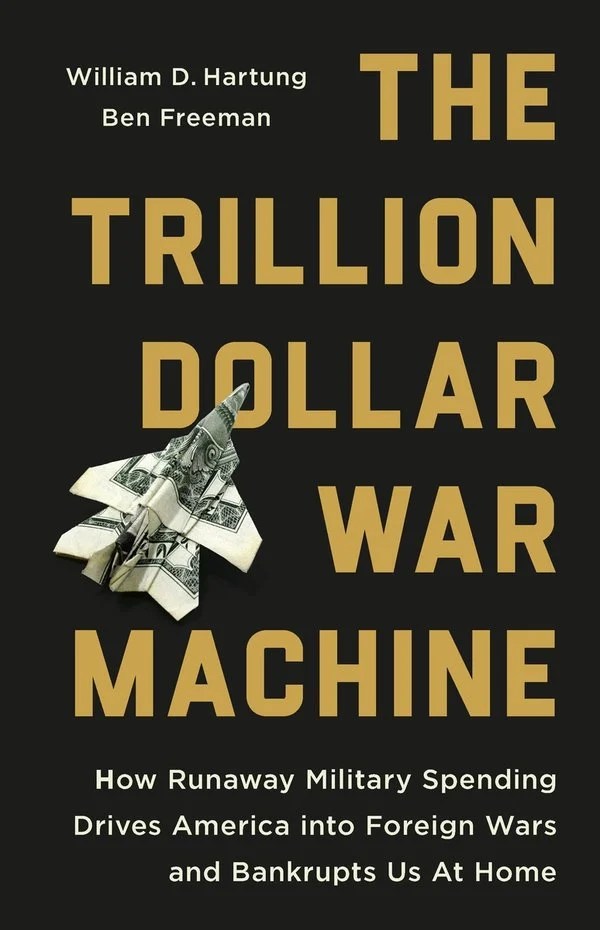
“The Trillion Dollar War Machine,” by William D. Hartung and Ben Freeman Available at Bookshop.org.
Since 2004, Fallujah has seen a 12-fold increase in childhood cancer rates and similar spikes in early onset cancer and respiratory diseases, according to a study co-authored by local physicians. Elevated rates of miscarriages and lethal birth defects that followed the initial U.S. invasion have never diminished. Reports on these poor health outcomes by doctors at Fallujah Women and Children’s Hospital led to the creation of a multidisciplinary study steered by researchers from Purdue University in the U.S. and Britain’s Newcastle University which tracked the intergenerational health effects of heavy metal exposure.
Depleted uranium munitions — which shatter and ignite on impact, allowing them to penetrate heavy armor plating — have been used by the U.S. in combat since the Gulf War. Spent rounds then release particles of radioactive uranium and other heavy metals, like titanium, into the surrounding earth, water, and air. Heavily bombarded areas in Fallujah were left with a greater percentage of heavy metals in their soil as a result.
Those who returned to the city after the battles, rebuilt their homes, reseeded contaminated farmlands, and drank and bathed in local waters now carry higher levels of radiation and heavy metals in their bodies. Indeed, uranium was found in the bones of one-third of study participants, all of whom were children during the 2004 siege — at levels roughly 300 times higher than their generational peers in America.
While highly toxic on its own, uranium levels are also often a marker for exposure to heavy metals including lead, arsenic, and mercury, which have been known to harm virtually every organ in the human body. Today, elevated rates of miscarriages and lethal congenital anomalies plague families in Fallujah.
“War itself is always about combustion,” explained Kali Rubaii, a cultural anthropologist and Purdue University assistant professor who led the study on Fallujah. “The combustion of generally toxic materials redistributes these toxicants into people’s air, water and food. Every time someone breathes in everything in the air, they are inheriting the pollutants of war.”
Post-war surges in birth defects, respiratory diseases, and cancers in Fallujah have now been directly linked with exposure to the weapons of war. As the pollutants of war are largely universal, the study’s implications lie far beyond Fallujah. Recommendations for those returning to bombarded areas are included in the study’s appendix in both Ukrainian and Arabic. When I spoke to Rubaii in March — two days after Tehran was drenched in black rain — she hoped the study’s finding, and its recommendations for returnees, could be of help to those living near the Persian Gulf.
The U.S–Israeli war on Iran has only exacerbated ongoing environmental crises in the Middle East, including a five-year-long drought, brought on by years of insufficient rainfall linked to human-induced climate change, that poses a severe threat to Tehran’s water supply. The Persian Gulf’s fragile coral reefs and mangrove forests have also, for years, suffered under rising water temperatures, intensive vessel activity, and growing industrial pollution.
“The most effective way to limit heavy metal toxicity from war is by not bombing cities.”
The Persian Gulf’s ecosystems still bear the scars of oil spills from the U.S. battles with Iraq during the 1991 Gulf War. Now, according to a recent study from the University of South Florida’s College of Marine Science, oil spills in the Gulf have increased dramatically since the beginning of the war to cover roughly four times the area in March 2026 as they did one year earlier. Though it is still too soon to calculate the full extent of the environmental harm imposed by the ongoing conflict, the toxic airborne pollutants, land contaminated with heavy metals, and oil-soaked waterways will pose a threat to life for decades to come. Read Our Complete Coverage TomDispatch
As Rubaii’s study concludes, “the most effective way to limit heavy metal toxicity from war is by not bombing cities.” While we live in an age where threats to civilian infrastructure are espoused and ordered by prime ministers and presidents alike, the illegality of these attacks — and their grave ecological consequences — cannot be ignored. The targeting of a country’s energy infrastructure, waterways, bridges, and homes makes it more likely that the attacked nation will respond with attacks on similar targets, placing civilians at risk in the present and, due to environmental contamination, for following generations.
People can’t be healthy if they live on sick lands.
The International Committee of the Red Cross — which works to uphold the laws of war — has repeatedly affirmed that the environment itself is a civilian object and must be protected. Under the 1998 Rome Statute, which established the International Criminal Court, to inflict disproportionate widespread and severe environmental damage is a war crime.
The Iran war has already sparked a global fuel crisis, threatened future harvests, and placed tens of millions of people at risk of hunger, imperiling this generation and the next. It has also subjected civilians to toxic smoke, black carbon rain, and other public health hazards. People can’t be healthy if they live on sick lands. Even after the final bomb of the Iran war has dropped, the ecological devastation and health hazards will haunt U.S. service members and local residents alike. Fallujah has shown that even long after the guns fall silent, war victims continue to suffer with the fallout of conflicts that have, quite literally, seeped into their bones. Share
The US-Iran war entered a new phase on Tuesday, with Washington and Tehran exchanging missile strikes that included attacks on shipping and threats of further escalation across the Middle East.
The US destroyed five Iranian oil tankers after Iran reportedly launched ballistic missiles at a US Navy warship. Iran responded with missile attacks on a US military installation in Jordan along with threats against American-linked shipping in the Persian Gulf.
This image from video released by U.S. Central Command shows an explosion at Bandar Abbas Naval Base, Iran, as three Corsair unmanned surface vessels, also called one-way attack surface drones, fired by the US military, hit the port, July 12, 2026. [AP Photo/U.S. Central Command]
The latest escalation demonstrates the collapse of every claim by the White House that the war is being wound up through limited military actions, economic sanctions or temporary ceasefires. The conflict is spreading geographically and increasingly targeting the infrastructure upon which the global economy depends.
On Tuesday, US Central Command said American forces struck five Iranian crude-oil carriers, four in the Gulf of Oman and one near Kharg Island. One tanker was sunk, while the remaining vessels were described by the Pentagon as disabled or rendered inoperable.
The attacks followed what Washington said were two Iranian ballistic-missile attacks against a US Navy warship over the previous two days. CENTCOM said the American vessel evaded the missiles and no US personnel were injured. Iranian state media and the Islamic Revolutionary Guard Corps (IRGC) gave a different account, claiming that Iranian forces had damaged US destroyers carrying cruise missiles and Aegis air-defense systems.
The US military’s action follows an increasingly explicit policy of reprisal against Iranian shipping. American officials have threatened to strike multiple Iranian vessels for every US ship attacked by Tehran. The policy amounts to a declaration that Washington will use military force to enforce its control over Iranian maritime trade, regardless of the consequences for global commercial shipping.
Iran has threatened to prevent vessels linked to the US and its allies from passing through the Strait of Hormuz. The IRGC urged crews to abandon tankers in waters near Kuwait and Bahrain and warned that additional ships could be attacked.
Roughly one-fifth of the world’s petroleum supply passes through the strait. Any sustained disruption will affect fuel prices, transportation, food production and industrial supply chains throughout the world.
Iran claimed that its missiles struck facilities used for aircraft maintenance, deployment and shelter. US officials said the attack was ineffective and that all American personnel were accounted for. Jordanian authorities reported that 20 ballistic missiles were fired toward the country. Eighteen were intercepted by Jordanian air defenses, while two fell in unpopulated areas. No casualties were reported.
Iran also claimed that it had targeted American warships and other military assets in the region. The competing accounts of events could not be independently confirmed.
The attack nevertheless marks a significant expansion of the war. Jordan has attempted to avoid becoming a direct combatant, but its hosting of US forces makes it a potential target in any confrontation between Washington and Tehran. The same is true of US bases and military facilities across Iraq, the Gulf monarchies and the eastern Mediterranean.
The US military installation is generally identified as Muwaffaq Salti Air Base, located near Al-Azraq in eastern Jordan. The base is a major Jordanian air facility that hosts US military personnel and supports American air operations.
Iranian officials said their missiles targeted aircraft-maintenance and preparation facilities, deployment areas and hardened shelters associated with US F-35, F-16 and F-15 fighter aircraft. Some reports also referred to the nearby Prince Hassan Air Base as a target, but the precise facilities struck remain unclear.
Iranian officials have warned that the Middle East is “practically on the brink of World War Three,” according to The Independent. The statement, made by Tehran parliamentarian Kamran Ghazanfari, cited the widening conflict involving the United States, Iran and other regional and international powers. The war is drawing in US allies, Iranian-backed forces, commercial shipping and the global energy market.
Speaking to reporters Wednesday before leaving for Dallas, President Donald Trump predicted that the war would end “immediately after” the US midterm elections in November. “I think war is going to end immediately after the election because they can’t hold out any longer,” Trump said.
The US President accused Tehran of being “desperate to try and affect the election,” while insisting that Iran was weakening under American economic pressure. Trump also indicated that Washington was not seeking to restart negotiations after the collapse of earlier ceasefires.
The timing of Trump’s prediction reveals some of the political calculations behind the war. The president is presenting the conflict simultaneously as a military campaign, an economic siege and an election issue. Claiming that Iran will soon capitulate, Trump offers no explanation for why a government supposedly on the verge of collapse has been able to continue missile attacks, threaten shipping and deny Washington its stated objectives after six months of bombing.
Earlier this week, Trump declared on social media that oil prices would “drop precipitously” when the United States “WIN[s] the war with Iran.” This statement connects the administration’s effort to portray military domination of the Strait of Hormuz and Iran’s energy exports with a claimed solution to the economic inflationary consequences of the war.
Oil markets have responded to each new military escalation with sharp price increases. Brent crude rose to about $99 a barrel Tuesday after reports of renewed attacks on US Navy vessels and the destruction of Iranian tankers. West Texas Intermediate crude reached approximately $94 a barrel. Brent had already climbed above $90 earlier in September after the fighting intensified, while prices in August reached their highest levels in nearly a month after Trump threatened retaliation against countries supporting Iran.
The impact of the war is being felt by the working class internationally through higher gasoline, heating and transportation costs. The Independent cited an estimate from Brown University that the war had added $100 billion to US energy costs, or roughly $763 per household, with the total increasing by about $1 million every two minutes.
The price surge has created opportunities for energy corporations and financial speculators, including those with direct connections in the White House, to cash in on the market instability. Trump’s nine largest disclosed oil and gas holdings reportedly gained between $1.5 million and $4.4 million during the first six months of the war. His investment accounts continued buying and selling shares in companies including ExxonMobil, Chevron and ConocoPhillips.
These disclosures show that the president is running a war that directly affects asset values held by him and his family. The White House denies that Trump or his relatives have any role in investment decisions, saying the holdings are managed independently through discretionary accounts and automated investment models.
This denial does not resolve the issue since the president need not personally place every trade for the financial interests of his family and the entire ruling oligarchy to benefit from the war. Energy companies, defense contractors, shipping firms and banks are all profiting from the destruction of productive resources and the militarization of economic life. This is a fundamental tendency of imperialism.
While the Trump administration claims that military pressure will force Tehran to surrender, the facts point in the opposite direction. After months of bombing and blockade, Iran has not capitulated, the Strait of Hormuz remains contested and American forces are increasingly exposed across the region.
The latest developments confirm the analysis of the World Socialist Web Site, which has described the war as part of a broader imperialist struggle for control of energy resources, strategic chokepoints and global economic power, particularly against China, which had been the principal buyer of Iranian oil.
The war will not be ended by Trump’s election timetable. Washington’s objective is not simply about shipping in the Strait of Hormuz but the strategic imperative that US imperialism must assert its domination over Iran and the entire Middle East.
Meanwhile, Tehran’s response is incapable of ending the conflict and reflects the dead end of bourgeois nationalism under conditions of an escalating imperialist military siege.
The alternative to this spiral toward a new world war is the independent mobilization of the working class in the United States, Iran and internationally against imperialist war and the capitalist system that produces it. The immediate demand must be the end of all US military operations, the withdrawal of American forces from the Middle East and the lifting of sanctions and the naval blockade.
Recent reports indicate a serious mutiny situation aboard the USS Abraham Lincoln. Seven U.S. Navy personnel have possibly been killed and several others injured in a violent clash among the crew, highlighting growing unrest and morale issues during an extended deployment.
Worried families vented their anxieties about loved ones onboard the Lincoln at an emotional town hall meeting with navy leaders in San Diego last Thursday, Stars and Stripes reported. One spouse among the 200 or so family members said that her husband had texted her that day saying “he hopes he doesn’t wake up tomorrow”.
A woman at the meeting told acting navy secretary, Hung Cao that the navy had “broken trust between us and the leadership”, the paper reported. The Navy Times gave details of thwarted suicide attempts onboard the aircraft carrier during the current deployment. Annabelle Loma told the outlet that her husband had tried to jump overboard after his spell at sea kept being extended. “He’s scared. He thinks he’ll get a dishonorable discharge, and just because he was burnt out his 13-year career is ruined, just like that,” she said.
Bonnie York, whose stepson is aboard the Lincoln, told MS NOW she had been told a doctor or therapist on the ship warned the crew needed to reach port before people started “losing their minds.” She voted for Trump—and partly because he promised not to start any new wars. She no longer believes the country is safer for it. “You’ve essentially stranded them out there,” she said of the crew.
Seven US Navy personnel have reportedly been killed and several others wounded in a violent clash aboard the USS Abraham Lincoln, as growing unrest among the carrier’s crew has exposed mounting pressure inside the US military amid a prolonged deployment.
The incident erupted after an adviser to US Central Command (CENTCOM) chief Brad Cooper boarded the carrier to address mounting complaints from crew members following protests by their families over the ship’s prolonged deployment, according to Tasnim News Agency, citing an informed military source. The adviser was reportedly met with boos and had water bottles thrown at him while addressing a gathering of personnel. The confrontation subsequently escalated into a fight among crew members involving knives and other bladed weapons, leaving seven personnel dead and several others wounded, according to the source.
Pistol Pete Hegseth, the defense secretary, dismissed the accounts as “more fake news”.
Deployment Context
The USS Abraham Lincoln has been deployed for over 260 days, which is a modern-era record for a U.S. aircraft carrier. This prolonged deployment has led to significant stress and mental health challenges among the crew
Conditions and Morale
Reports from military families describe poor living conditions, including food shortages and inadequate facilities, contributing to the deteriorating morale.
Response and Claims
In addition to internal conflicts, there are external tensions, with Iran claiming to have attacked the carrier, although U.S. officials have denied these allegations.
Editor’s Note: At a moment when the once vaunted model of responsible journalism is overwhelmingly the play thing of self-serving billionaires and their corporate scribes, alternatives of integrity are desperately needed, and ScheerPost is one of them. Please support our independent journalism by contributing to our online donation platform, Network for Good, or send a check to our new PO Box. We can’t thank you enough, and promise to keep bringing you this kind of vital news.
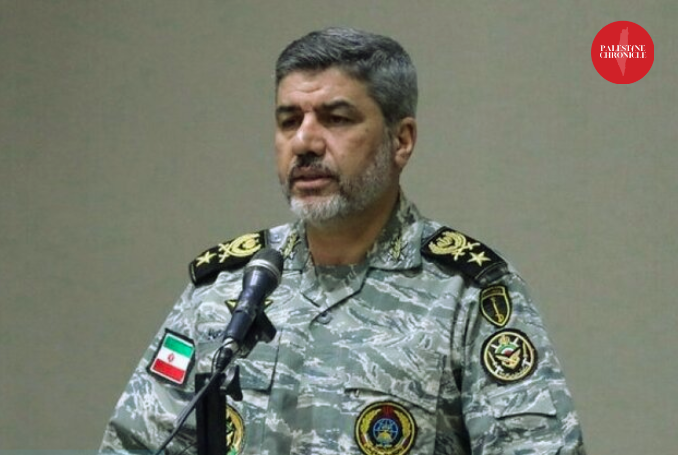
The Iranian army said nearly all US infrastructure in Erbil was destroyed and anti-Iran groups there have lost operational capability.
Key DevelopmentsThe Iranian army announced on Saturday that nearly all US military infrastructure in the Iraqi city of Erbil has been destroyed, saying anti-Iran groups operating there no longer possess the capability to carry out operations against the Islamic Republic.
Brig. Gen. Mohammad Reza Akraminia, spokesman for the Iranian army, said the damage inflicted during the recent fighting had effectively neutralized US infrastructure in Erbil and significantly reduced the operational capabilities of hostile groups based in the city.
‘No Longer Operational’
Speaking to Iranian state television, Akraminia said “almost all” US infrastructure in Erbil had been destroyed.
He added that anti-Iran groups previously operating from the Iraqi Kurdistan Region had been stripped of their ability to conduct operations against Iran.
According to Akraminia, the United States maintains extensive military capabilities throughout the region, southern Europe, and the Mediterranean, and is now attempting to replace equipment and assets lost during the recent conflict.
He stressed that Iran remains prepared to resume military operations should hostilities restart, saying the country’s armed forces would continue fighting until Washington realizes it cannot impose its will on Iran through military aggression.
America is destroying our moral credibility with threatening war crimes in Iran and having provided aid for war crimes in Gaza.
IRGC Details US Losses
Earlier on Saturday, IRGC spokesman Hossein Mohebi provided additional details regarding US military losses during the recent 15-day confrontation.
He said Iranian forces destroyed 11 US aircraft and helicopters while they were on the ground inside American military bases.
Mohebi also said Iranian forces destroyed 17 reconnaissance and operational drones, including eight newly introduced unmanned aircraft that had not previously been used.
According to the IRGC, destroyed US aircraft included an F-15 fighter jet, a P-8 maritime patrol aircraft, a C-17 military transport aircraft, and eight aerial refueling aircraft.
The figures form part of a series of updates released by Iranian military officials detailing the results of Iran’s operations against US military installations across the region.
Akraminia also said Iran has begun deploying attack drones more advanced than the Arash-2.
He explained that while the Arash-2 drone was used during the recent 40-day war, the Iranian armed forces are now operating a newer generation of drones with greater destructive power, longer range, improved accuracy, and enhanced operational capabilities.
He added that technical details about the new drones have not yet been made public.
The latest statements come amid continued tensions following the recent US military campaign against Iran, which centered largely on the country’s southern regions.
Iran responded with a series of military operations targeting US bases across the Gulf region, as well as installations in Syria and Jordan, while Iranian military officials continue to release assessments of the damage inflicted during the confrontation.
The New York Timesreported on Monday that the Pentagon didn’t disclose that US troops had been injured by Iranian attacks on Jordan in the week leading up to the missile strikes that killed at least two US soldiers and left one missing.
US officials told the Times that in the days before the deadly January 17 attack, Iranian strikes on US facilities in Jordan injured dozens of US service members and damaged multiple US military helicopters.
Throughout that same week, US Central Command released multiple statements on the US airstrikes against Iran and other military operations but made no mention of the injuries, following a pattern of the US hiding casualties throughout the war.
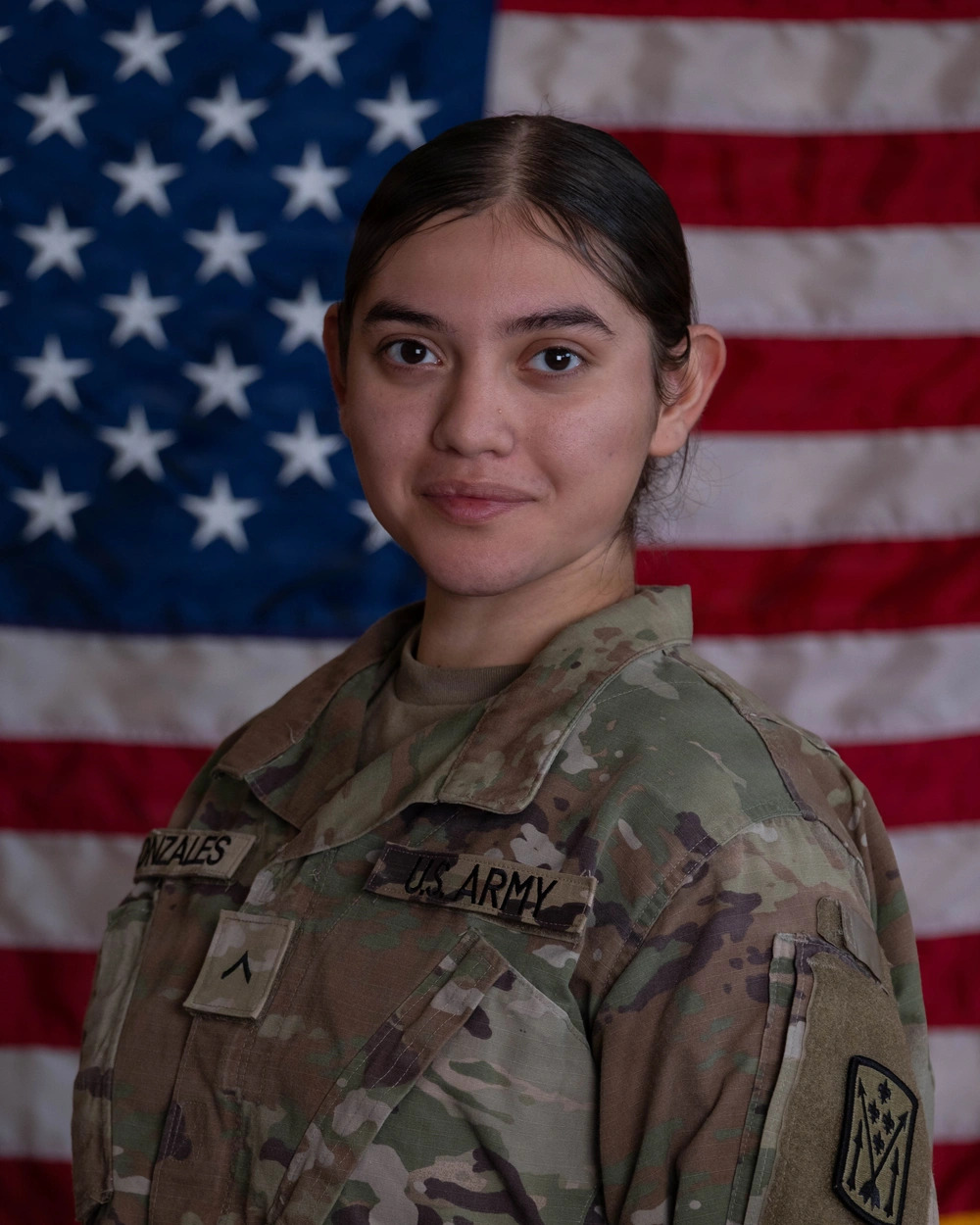
Pvt. Isabella Gonzales, 19, of Carrollton, Texas, was killed by an Iranian attack on Jordan on July 17, 2026
A day after the deadly attack in Jordan, another US soldier was killed in Iraq during what CENTCOM called “a controlled detonation of unexploded ordnance from a downed Iranian one-way attack drone,” bringing the total number of US troops killed in the war in recent days to at least four, a number that includes the soldier missing in Jordan as CENTCOM said it found remains it was working to identify.
The US military identified the other two US Army soldiers killed in Jordan, which included a 19-year-old woman, Pvt. Isabella Gonzales of Carrollton, Texas, who died on Friday. The other soldier, 1st Lt. Tyler James Feehan, 25, of Ewa Beach, Hawaii, died of his wounds on Saturday.
Pentagon spokesman Sean Parnell initially rejected the Times’ report as “baseless and malicious” but then acknowledged that nearly 100 US troops have been injured in the war since July 7, though he downplayed the injuries.
“While nearly 100 service members were deemed to have some degree of injury since July 7, 2026, 96% have returned duty. They are determined to get back in the fight,” Parnell wrote on X. “The vast majority of injuries experienced were minor concussions. Further updates will be posted on the Defense Casualty Analysis System.”
According to the Pentagon’s numbers, at least 18 US service members have been killed, and more than 500 have been wounded in the Iran war since President Trump launched it on February 28.
US and Israeli attacks on Iran in that time have killed around 3,500 Iranians, including more than 50 since the US renewed strikes several weeks ago. In April, Iranian officials said nearly half of those killed were civilians, including the 120 school children killed in the US bombing of an elementary school in Minab, southern Iran.
Around 10,000 people in Iran’s Hormozgan province are without drinking water following US strikes on a desalination plant in the coastal village of Bunji, Tasnim News Agencyreported on 18 July.
The CEO of the Hormozgan Water and Wastewater Company stated that the attack “completely disrupted the supply of drinking water to 20 villages with a population of about 10,000 people.”
“These villages are facing a water shortage crisis,” the official added.
The desalination plant was one of multiple targets struck by the US military starting on Friday night, the seventh straight night of airstrikes on Iran since US President Donald Trump declared an end to the Islamabad Memorandum of Understanding (MoU).
US Central Command (CENTCOM) announced its forces “hit surveillance sites, military logistics infrastructure, underground weapons storage, and maritime capabilities.”
US strikes also knocked out 100 telecommunications masts, disrupting landline, mobile and internet services in northern Hormozgan province.
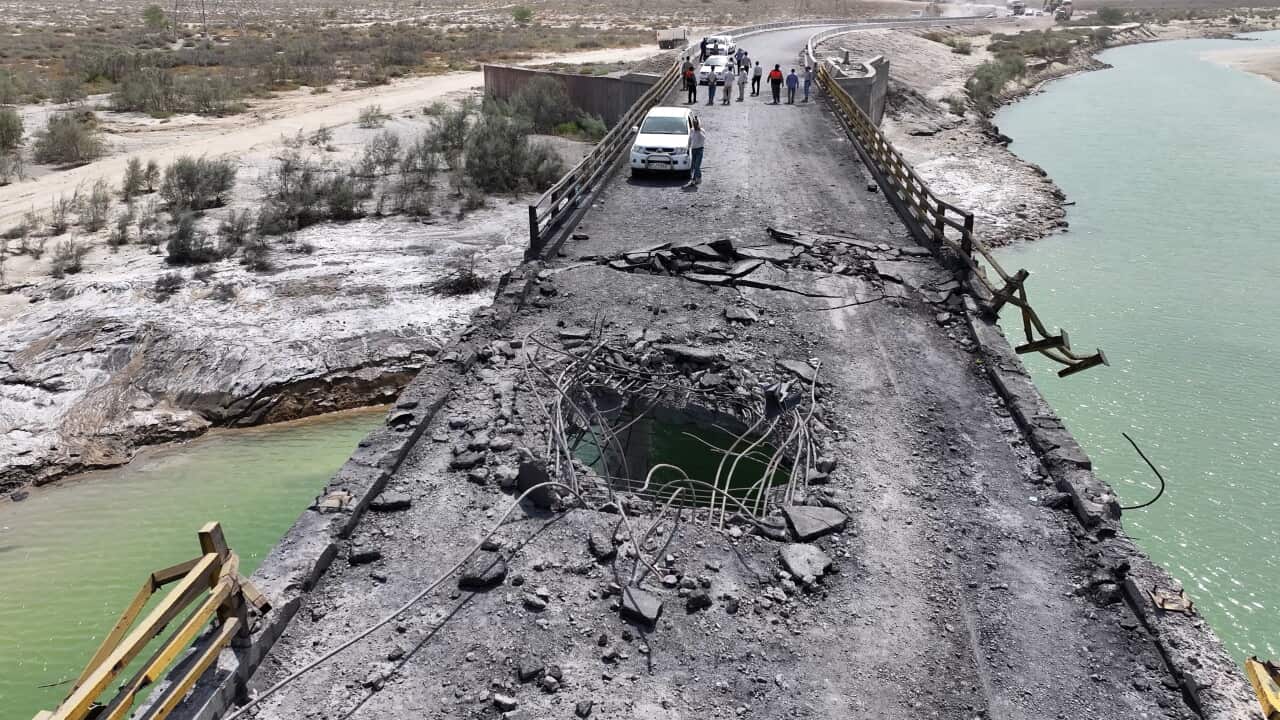
Photos circulated online showing multiple bridges destroyed by US warplanes in Hormozgan, which borders the Strait of Hormuz.
Local authorities said seven people were killed in US attacks across the province.
Since 27 June, US attacks have killed at least 50 people and injured 500, Iranian Health Ministry Spokesperson Hossein Kermanpour announced on Saturday.
“The fatalities include five women and two children under the age of 18, while there are 32 women and 18 minors among the injured,” he added.
Iran responded to the US escalation by striking strategic targets in Jordan, Kuwait, and Bahrain early Saturday as part of the 20th wave of Operation Nasr 2.
Iran’s Islamic Revolutionary Guard Corps (IRGC) announced that its Aerospace Force carried out a missile and drone attack on the US military base in Azraq, Jordan.
The IRGC said the operation targeted fighter jet shelters and a large runway at the base, destroying at least two US fighter jets and three other US aircraft.
“Your religious and humanitarian duty is to eliminate them by any means and cleanse the sacred land of Jordan of the killers of oppressed Muslims,” the IRGC statement urged.
Jordan’s military said it intercepted 10 Iranian missiles fired into its airspace overnight and that no damage resulted.
On Friday, CBS Newsreported that several US service members were injured during Iranian attacks on two Jordanian bases over the past week.
Tasnimreported further that IRGC naval forces launched drone and missile strikes successfully targeting a US fleet fuel support pier at Al-Ahmadi port in Kuwait, as well as a US signals and communications center in the country.
In Bahrain, Iran struck the Sheik Isa Air Base and destroyed a US intelligence data center, known as Batelco, Tasnim added.
Kuwait’s Ministry of Electricity and Water said on Saturday that Iran struck an electricity and water distillation plant, which led to a fire erupting in one of the plant’s components.
Iranian missiles also targeted an oil facility in Kuwait, causing significant damage and some injuries, according to Kuwait’s state news agency.
Tehran confirmed the suspension of the Memorandum of Understanding (MoU) with Washington in response to violations by the US.
“We have suspended our commitments under the Islamabad Memorandum of Understanding. The US has violated and suspended all of its commitments,” Deputy Foreign Minister Kazem Gharibabadi declared on Saturday.
“We have also suspended our commitments, are not currently implementing them, and are focused on defending the country.”
Even as frustrations mount over Israeli military campaigns across the Middle East, governments keep buying weapons from Israel — making it one of the world’s largest arms exporters.
As experts tell Responsible Statecraft, Tel Aviv uses these weapons sales to lock countries into long-term, strategic relationships that make recipients less likely to hold Israel accountable for their behavior in Gaza and Lebanon or in its West Bank policies. They stress that sustained U.S. support, including billions in military grant aid each year and the co-development of many Israeli weapons systems, helps make this all possible.
A weapons exports boom
Following October 7, Israel’s defense industry has exploded: the number of startups there nearly doubled, from 160 in July 2024 to 312 in April 2025. Its arms exports, which account for 75% to 80% of all Israeli weapons production, have grown in tandem. According to Stockholm International Peace Research Institute (SIPRI) data published in March, Israel was the world’s seventh-largest arms exporter between 2021 and 2025, surpassing the United Kingdom.
Tel Aviv raked in a record $19.2 billion from arms exports in 2025, a jump up from the $14.8 billion it made the previous year.
Subscribe now to our weekly round-up and don’t miss a beat with your favorite RS contributors and reporters, as well as staff analysis, opinion, and news promoting a positive, non-partisan vision of U.S. foreign policy.
Invalid emailEnter your email
Arms sales as political leverage
As Seth Binder of the American Committee for Middle East Rights (ACMER) told RS, “arms deals are expensive and often create a long tail to negotiate, complete, and fulfill over the life of [a given] contract.”
Over time, these contracts provide Israel a way to build relationships that other governments have strong incentives to preserve. Exports can “entrench relationships that constrain others’ ability to hold [Israel] accountable,” Daniel Levy, the president of the U.S./Middle East Project (USMEP), said.
A growing global demand for weapons is playing to Israel’s advantage. A case in point is Europe. Spurred by fears of Russia and U.S. pressure to increase defense spending, some European countries are buying Israeli weapons to supplement their fraught rearmament efforts. The purchases continue despite disquiet across the continent over Israel’s actions in the Middle East, which have led some European Union countries to pursue arms embargoes or suspend export licenses to Israel.
Germany signed multi-billion euro deals for the Israeli-made Arrow-3 missile defense system, Heron drones, and Spike anti-tank missiles last year. Greece spent about $740 million on 36 Precise & Universal Launching System (PULS) rocket artillery systems in December. Romania signed a deal worth about $2.3 billion for Spyder air defense systems earlier this week and is now set to acquire its own version of Israel’s Iron Dome air defense system.
Outside the EU, the value of U.K. arms- and ammunition-related imports from Israel skyrocketed from just $508,343 in 2020 to nearly $7.97 million in 2025 — a nearly 1,500% increase. A senior Israeli defense official told Reuters in early June that European countries are expected to order more air and missile defense systems soon.
But depending on Israel for critical defense needs may prove risky. “A government that might otherwise respond to public demands for sanctions or arms embargoes [against Israel] now faces the prospect of degrading its own air defense…if it does so,” Levy told RS.
Similar dynamics are playing out among Abraham Accords nations; Israeli exports to those countries jumped fivefold between 2023 and 2025.
“No one has any illusions that Israel is popular right now in [the Abraham Accords] countries,” an Israeli diplomat told The Economist last fall. “But their governments have made long-term investments in their defense ties with Israel, and they’re not about to change course.”
More broadly, continued prospects for arms sales turn Israel’s controversial military actions — in which Israeli defense technologies are being used against civilians — into a commercial selling point. As Omar Shakir, the executive director of DAWN, told AP last month, Israeli defense and technology companies have been “able to parlay the use of their products in Gaza to attract more business.”
Israel’s arms exports blitz: fueled by Washington
Israel’s weapons industry is booming in part because “the U.S. has long subsidized it,” Binder told RS.
Israel receives Foreign Military Financing from Washington, which provides funds for acquiring American weapons equipment, training, and adjacent services. The support is even more direct through what is called Off-Shore Procurement (OSP), which Binder said allows Israel to “use a portion of its Foreign Military Financing provided by the United States to pay for [its own] arms.”
Although OSP is set to phase out by 2028, Binder told RS that “Israel’s arms industry has arguably established itself as a competitor” to America’s weapons sector through the program.
Meanwhile, Israeli firms have gained a competitive edge, thanks to what former State Department official Josh Paul calls a “larcenous” approach toward U.S. intellectual property. “Many technologies developed by U.S. industry are [simply] re-developed and re-packaged by Israeli companies,” he told RS.
American support is often evident in the export deals themselves, where, for example, the Arrow-3 system Germany bought from Israel was co-developed with the U.S., which helped fund its development. Because of Washington’s role in the program, U.S. approval was required before the initial sale could proceed.
Altogether, the International Trade Administration observed that U.S. assistance has “turned the Israeli military industry and technology sector into one of the largest exporters of military capabilities worldwide.”
Currently, a series of congressional proposals under consideration — including one that Israeli Prime Minister Benjamin Netanyahu has endorsed as his “personal plan” — stands to give Israel’s defense sector a deeper foothold in the U.S. market.
Indeed, section 219 (previously section 224) of the National Defense Authorization Act (NDAA) for FY 2027 would move to more closely integrate the U.S. and Israeli militaries. The provision would further incorporate Israeli technologies and companies into U.S. supply chains, likely creating more opportunities to sell its weapons.
As Paul told RS, Israel being positioned “to become a supplier to the U.S. military is just a further example of [it] using [its arms] sector as a tool of influence.”
A small motorboat passes anchored vessels in the Strait of Hormuz off Bandar Abbas, Iran, Thursday, June 11, 2026. [AP Photo/Amirhosein Khorgooi]
The US launched a new round of strikes on Iran on Friday in the most explicit indication yet that the recently signed Memorandum of Understanding (MOU) has collapsed into an escalating and open conflict. U.S. Central Command (CENTCOM) said its aircraft struck Iranian missile and drone storage locations and coastal radar sites near the Strait of Hormuz.
A report by Al Jazeera said the US strikes were near the Iranian port of Sirik. Al Jazeera also reported that Iran said it had “succeeded in neutralizing” the attack and pledged to retaliate in a statement shared by the ISNA news agency. The statement said, “We emphasize that this aggression will not go unanswered, and our response will be swift and decisive at a time and place of our choosing.”
An Iranian parliamentary security official, Ebrahim Azizi, accused Washington of attacking “in the middle of negotiations once again” and said the US president had shown no commitment to negotiation or ceasefire principles.
According to other reports, the US strikes were carried out in response to Iran’s launching of at least four one-way attack drones at a commercial vessel on Thursday, with one drone striking the ship’s upper deck and damaging it before the vessel continued its course.
CENTCOM confirmed the targets and presented the strikes as a limited but forceful response meant to punish the Iranian attack and deter further action. The reports indicate that the US strikes were not random but targeted the command-and-control infrastructure surrounding Iran’s maritime reach.
The exact physical damage remained unclear, and both CENTCOM and the New York Times noted that the full extent of the damage had not yet been determined. The news reports said the choice of targets was intended to send a message that Washington could hit the systems enabling drone operations and surveillance in the Gulf without widening the war.
However, the response by President Trump and Vice President Vance was both threatening. Trump said Iran’s drone launch amounted to a violation of the ceasefire framework. He then portrayed the US strikes as responding to Iranian aggression rather than initiating escalation. JD Vance gave the direct warning, “… violence will be met with violence.”
Vance added that Iran had signed the ceasefire agreement and that if Tehran had disagreements over implementation, it could “pick up the phone,” but that military retaliation would follow if the agreement was challenged.
Iran said the drone strike was part of its effort to control passage through the Strait of Hormuz and warned that ships using routes outside Tehran’s approved framework would not be guaranteed safe passage or insurance coverage.
More specifically, the statement quoted by CBS said, “Any passage through routes outside the framework designated by PGSA [Persian Gulf Strait Authority] will not be covered by safe passage guarantees and will not be entitled to insurance coverage or related liabilities.”
Other reporting on the same incident says Iranian officials framed the move as a response to insecurity in the waterway and to what Tehran describes as continued US aggression, with Iran later warning vessels to use only routes authorized by Tehran.
Iran has once again rejected the American claim to maritime authority in the Strait of Hormuz. Reuters reported that Tehran insisted it had the right to control shipping there and warned Gulf states not to side with Washington after the cargo ship incident.
The Iranian line is that the strait lies within a contested security zone and that the US and its allies are using “freedom of navigation” language to mask coercive control over a vital strategic waterway. The dispute over the strait is a key issue over whether the MOU means anything in practice.
The reported drone attack itself centered on a commercial vessel, identified in some reporting as the Ever Lovely, which was struck in the Strait of Hormuz near Oman. Trump said three other drones were intercepted, and the ship, while damaged, remained able to continue. AP and Reuters reported that the event led maritime authorities to pause efforts to move ships out of the area, indicating the immediate consequences for commercial traffic.
The MOU, signed only a week earlier, has now shown itself to be a piece of paper with little meaning in a war that has not ended. The language of the deal, including the phrase that Iran would “make arrangements using its best efforts” to ensure safe passage, was ambiguous from the start and left room for interpretation, and it has now become a mechanism for the collapse of the entire MOU.
Reports over the last week have shown that, far from receding, the conflict is broadening with Israeli attacks continuing in Lebanon, and Gaza remains under near-constant assault despite talk about a ceasefire and peace agreements. Just as it has in Gaza, the ceasefire framework contained in the MOU is emerging as a formal cover for the continuation of the imperialist war by other means.
On Friday, Israeli Defense Forces continued ground and aerial operations in southern Lebanon. Actions included combing operations in the border town of Ain Arab, advancing military vehicles toward Haris, a drone strike near Qabrikha and airstrikes near Nabatieh. Israel also dropped leaflets over the town of Mansouri ordering residents to evacuate. The military described this as a “reminder” to keep out of the area for civilian safety.Available from Mehring BooksThe struggle against imperialism and for workers’ power in IranA pamphlet by Keith Jones
Despite US-led negotiations, Israeli warplanes launched two waves of airstrikes targeting the outskirts of Nabatieh al-Fawqa. Following talks in Washington D.C., Israel, Lebanon and the US signed an initial trilateral framework agreement on Friday for restoring sovereignty and establishing “pilot zones” in which the Lebanese Armed Forces will take control.
Prime Minister Benjamin Netanyahu and Defense Minister Israel Katz said Israel will not withdraw its forces from occupied security zones until Hezbollah is disarmed. Hezbollah leadership rejected prior US-brokered deals and maintained that Israel must fully withdraw unconditionally.
Taken together, Friday’s actions show that the ceasefire is highly fragile, if existing at all, and that Israel continued to use military force to pressure villages near the border. The result was continued civilian deaths, displacement and an ongoing clash between formal diplomacy and battlefield realities.
The situation in Gaza, which has been moved off the front page of the news since the war with Iran began on February 28, is even more catastrophic. Palestinian and UN-linked reports say Israel has killed roughly 1,000 Palestinians since the ceasefire was announced, while Gaza’s Government Media Office says Israel has carried out 3,269 violations, killed 992 Palestinians and wounded 3,144 others.
Aid delivery has remained far below what was promised, with only 52,740 trucks entering Gaza out of the 147,000 required, according to the same reporting. These numbers show that the “agreement” has disguised the sustained Israeli campaign of attrition against Palestinians.
The WSWS has explained that the Gaza arrangement was designed to turn the Mediterranean coast into a site for speculative reconstruction once Israel had reduced Gaza City and other towns to rubble.
In this respect, Trump’s “Board of Peace” has served as political theater intended to legitimize a plan of conquest, displacement and future real estate plunder. The same logic now appears in the US-Iran memorandum, which functions less as peace than as an unstable pause inside a larger war project.
The contradictions at the core of the Middle East conflict remain unresolved. The US and Israel are pursuing a strategy aimed at subjugating the region through siege, bombing and occupation. The events on Friday confirm that the military conflict is moving into another stage, not away from it.
Only the independent mobilization of the working class across the Middle East and within the imperialist centers in a unified struggle against war and for socialism can break the cycles that are leading to a Third World War.




 Read Our Complete Coverage TomDispatch
 (Photo credit: Getty / Morteza Akhoundi)


You must be logged in to post a comment.