The office of Rep. Ilhan Omar slammed the Trump administration on Thursday over its reported plot to have the Minnesota Democrat stripped of her US citizenship.
On Wednesday, The Wall Street Journal reported that the raid on Omar’s home carried out earlier this week by Department of Homeland Security agents was part of and effort to build “a case to strip her of her US citizenship and ultimately deport her.”
“The multipronged effort is focused at least in part on how Omar obtained her citizenship after she arrived in the US from Somalia decades ago,” the Journal explained. “Investigators are focused both on the congresswoman and actions of her deceased father.”
Omar spokesperson Jackie Rogers responded to the report by accusing President Donald Trump of engaging in “desperate attempt to justify his extraordinary abuse of power.”
“This is politically motivated and an escalation of Trump’s personal vendetta against her lasting over a decade,” Rogers told HuffPost. “He has lied about her family, about her immigration history, and about her love of this country.”
Rogers also accused Trump of acting like a dictator by singling out a member of the opposition party for punishment.
“This isn’t a legitimate law enforcement action,” said Rogers, “it is an authoritarian move to silence an opponent right before an election where he and his party will be rejected by Americans in historic proportions… To Trump, no American value or principle is too important to be shredded for his own personal gain.”
Author John Ganz on Thursday published an analysis of the reported Omar deportation plot, which he said is “undoubtedly driven by racial and religious animus” and also “a serious assault on the constitutional order being carried out through the executive branch’s legal and bureaucratic machinery.”
Ganz argued that a serious attempt to strip Omar of her citizenship and remove her from the country would be a major escalation from the Trump administration toward establishing an outright totalitarian state.
“Authoritarian governments suppress political opposition and deprive their subjects of particular rights,” Ganz explained. “Totalitarian movements aspire to something much more radical: the destruction of the independent political and juridical personhood. They attack not merely the liberties of particular citizens they seek to repress, but the concept of citizenship itself—and then, ultimately, the concept of shared humanity.”
President Donald Trump attempted to spin high oil prices as a boon for the United States at a rally in Arizona on Wednesday, just hours after new federal data showed that inflation reached its highest level in months in September.
“Because of the price of oil, Texas and Oklahoma and North Dakota and all these places, we’re making a fortune,” Trump declared, referring to states that produce large amounts of crude oil. Those states are home to major fossil fuel companies that have reported windfall profits amid Trump’s illegal war on Iran.
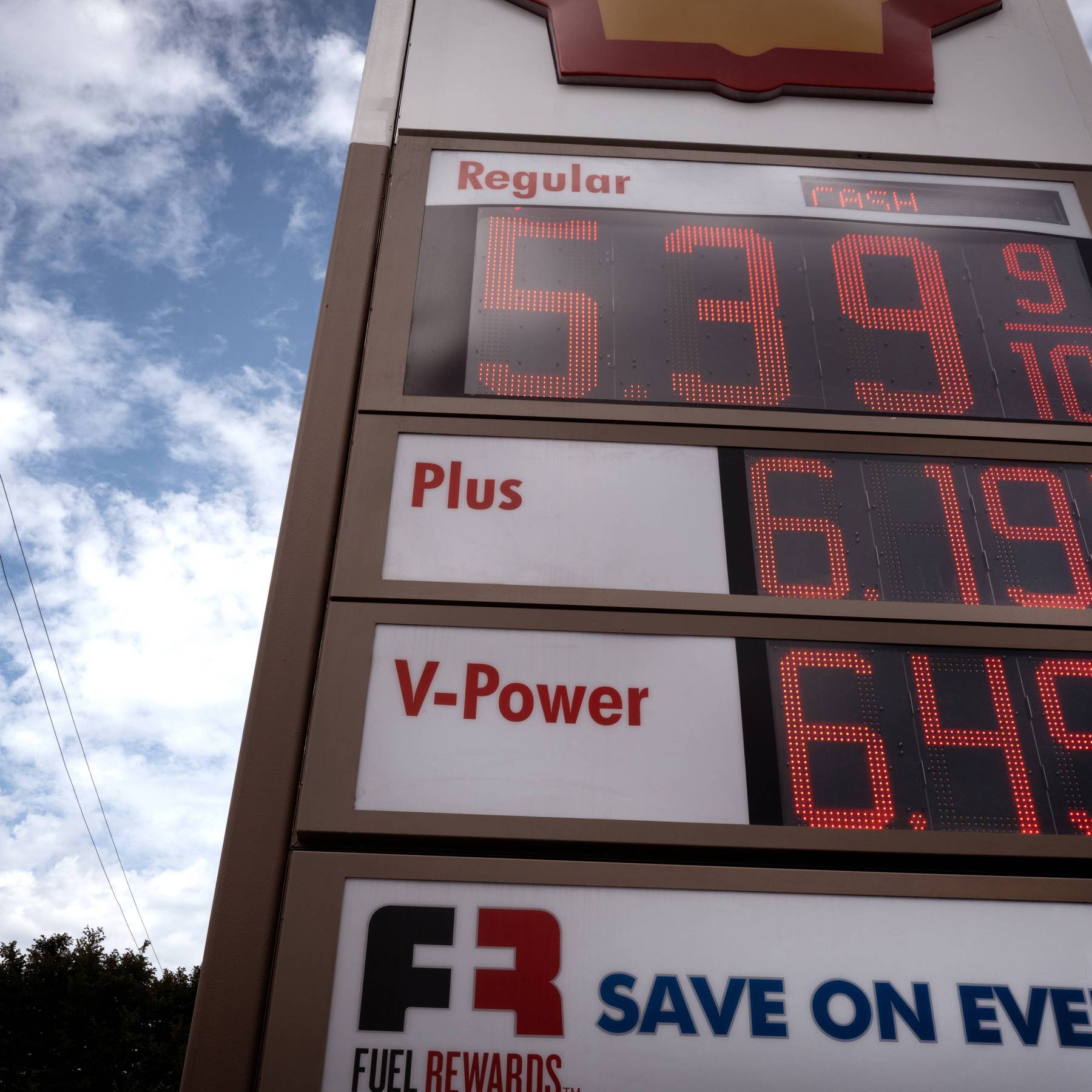
Trump insisted that gas prices—currently at an average of $4.33 per gallon for regular gas and $6.32 for diesel—would tumble once the Iran war ends, but his administration has repeatedly given false timelines for the deadly conflict and has shown no indication that it is willing to reach a lasting diplomatic agreement.
Trump, who has profited massively from his second term in the White House, is a major investor in oil and gas companies. According to one recent analysis, the president’s investments in fossil fuel stocks have boosted his net worth by up to $15.5 million since January.
Working-class Americans, meanwhile, are struggling to make ends meet as high gas prices compound a broader affordability crisis that extends to food, housing, and other necessities. A tracker maintained by the Watson School of International and Public Affairs estimates that American consumers have paid an extra $135 billion combined in fuel costs since the start of the Iran war—roughly $1,030 per household.
Wage growth has not kept up with inflation, which rose to an annualized rate of 3.7% last month.
“ Workers are losing the race between wages and prices,” Elise Gould, senior economist at the Economic Policy Institute, wrote on Wednesday. “Nominal wage growth continues to decelerate as workers lose bargaining power at work. Workers simply don’t have the leverage to bid up their wages. Reduced leverage and higher prices translated into falling [year-over-year] real wages for six months in a row.”
“Workers have seen zero progress on affordability compared to January 2025,” Gould added. “Real wages are essentially stagnant as workers’ leverage has declined and prices have risen. It’s no wonder workers feel left behind in the current economy.”
A Harris poll published by The Guardian on Thursday shows that three-quarters of US voters are concerned about a recession, and a “vast majority of Americans agreed that there is an affordability crisis, including 96% of Republicans.”
President Trump and Israeli Prime Minister Benjamin Netanyahu have discussed the possibility of resuming large-scale attacks against Iran before the US and Israeli elections, according to a report from Axios.
The report, which cited unnamed US and Israeli sources, said that the two leaders had held multiple calls over the past two weeks about the possibility of resuming “major combat operations” against the Islamic Republic, including the possibility of joint US and Israeli strikes on military and nuclear targets.
Restarting major attacks on Iran would likely hurt Republicans in the November 3 midterm elections, as it would worsen the energy crisis and raise gas prices in the US, while Netanyahu and his coalition may benefit in the October 27 Knesset elections.
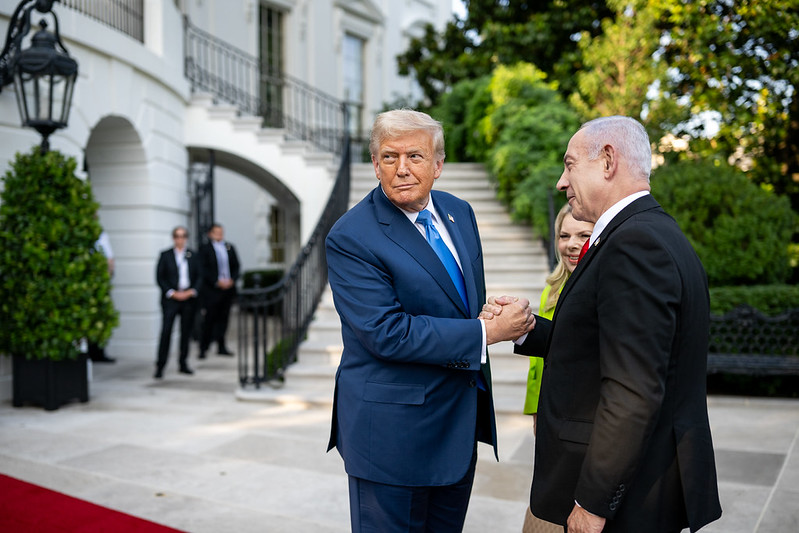
Trump and Netanyahu at the White House on July 7, 2025 (White House photo)
“Bibi’s got an election before the midterms. He believes his strength is being a wartime prime minister,” one US official told Axios reporter Barak Ravid, who is a former IDF intelligence officer.
The report also said that in meetings with his security officials, Netanyahu has claimed that it was Trump who brought up the possibility of striking Iran before the elections. Multiple US media outlets recently reported that the US president was considering launching a bombing campaign before the midterms, but he has said publicly that he won’t.
Ravid reported that in the conversations, Netanyahu has made his usual claims about concerns regarding Iran’s nuclear program. One source said US Secretary of War Pete Hegseth and US Central Command leadership were the strongest supporters of restarting strikes, while other officials prefer ramping up economic pressure.
The US is still enforcing a blockade of Iranian ports, and Iran has dramatically ramped up attacks on commercial shipping in the Strait of Hormuz after Trump had repeatedly claimed the US was in control of the strait since more oil was coming out, but the oil shipments are on the decline.
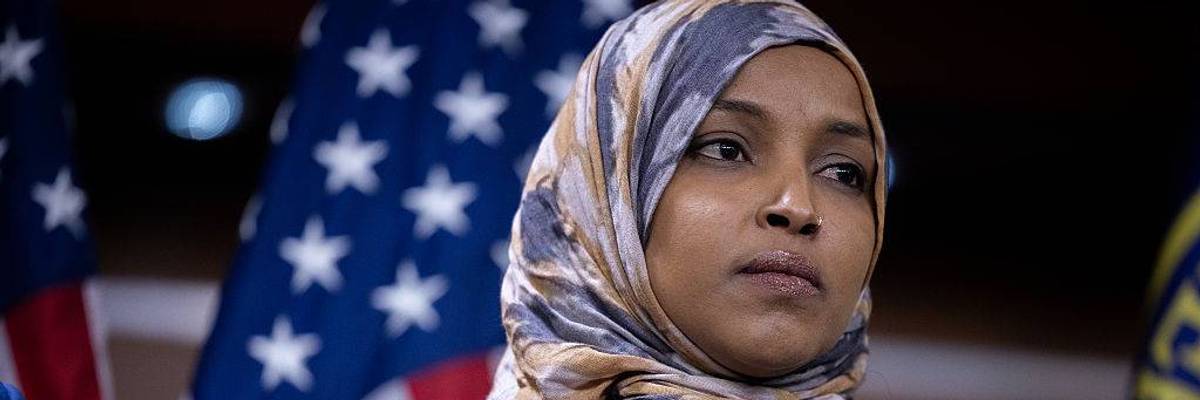
Rep. Ilhan Omar (D-Minn.) is seen at a press conference with other members of the Congressional Progressive Caucus on funding for and efforts to reform the Department of Homeland Security, in Washington, DC on, January 13, 2026.
(Photo by Nathan Posner/Anadolu via Getty Images)
Trump and other Republicans have called for Omar to be stripped of her citizenship and deported for years.
Following years of threats from President Donald Trump and other Republicans to deport Rep. Ilhan Omar, the Minnesota congresswoman’s Washington, DC home was raided on Monday morning by agents with the Department of Homeland Security.
The US Department of Justice (DOJ) has confirmed that the raid was carried out as part of a judicially authorized warrant, which it said was part of an ongoing criminal investigation.
Fox News, which first reported news of the raid, said it was part of a probe into the naturalization paperwork filed by Omar’s late father when she became a US citizen in 2000 after immigrating to the US as a refugee from Somalia in 1995.
In September, The New York Post reported that federal investigators were examining whether Omar may have been older than 17 when she obtained citizenship through her father as a minor in 2000. The allegation, which stems partly from a discrepancy in historical records of her birth year, has not been substantiated.
Aaron Reichlin-Melnick, a fellow at the American Immigration Council, argued that the case was “even weaker than it already seems,” since federal immigration law includes a waiver for people who obtain legal status through fraud they were unaware of.
Joyce Vance, who served as the US attorney for the Northern District of Alabama under President Barack Obama, noted that the raid took place just weeks before the November 3 midterms, inside the 60-day window where DOJ typically avoids such dramatic actions.
“To state what’s obvious to prosecutors here, we are within the period before an election where DOJ doesn’t take overt steps in an investigation that might influence its outcome,” she said, adding that it was “another hard norm out the window.”
Omar has not yet commented on the raid as of Monday morning, and the DOJ has not indicated what, if any, specific charges have been filed against her.
The search comes after years of demands from Trump and other Republicans for Omar—who has served in the US House of Representatives since 2019—to be deported, imprisoned, or otherwise removed from office.
In a statement Monday morning, Joel Payne, a spokesperson for the progressive advocacy group MoveOn condemned the raid on Omar as a political attack.
“Rep. Omar is a dedicated public servant and a true ally for working families, and Donald Trump has done nothing but use racist tropes and stereotypes to attack her,” he said. “Now, he’s abusing his power to physically intimidate and harass her.”
Last November, Trump remarked that Omar should be thrown out of the country because she is “always complaining” and referenced her religious attire, referring to it as a “swaddling hijab.” In another post that day, he called for the US to “denaturalize migrants who undermine domestic tranquility.”
He also said Rep. Rashida Tlaib (D-Mich.), the only Palestinian American member of Congress, should be “sent back” along with Omar after the two protested his state of the Union address in February.
Trump has often referenced Omar while calling for all Somali immigrants to be deported from the country—even though most are US citizens. Trump has referred to Somalis collectively as “garbage” and said they have “low IQs.”
Last week, Trump called for the people of Minnesota to “fight back” against Somalis living there in a post on Truth Social, which was widely interpreted as an incitement to violence.
In March, Vice President JD Vancesaid on a podcast that the administration believed Omar had “definitely committed immigration fraud against the United States of America” and that he’d discussed with senior Trump adviser Stephen Miller—who is not a federal prosecutor—how to “go after” her.
Beau Tremitiere, counsel and deputy director of impact programs for Protect Democracy, told Common Dreams that “raiding the home of a prominent critic and longtime target of President Trump’s racist attacks on the eve of an election is an obvious attempt to intimidate the opposition.”
“This administration already has a long track record of failed political prosecutions,” he said. “Each new one should both anger and stiffen the spine of those standing up for our democracy.”
Several Republican members of Congress have referenced Omar’s religion and political viewpoints as reasons for her to be stripped of citizenship and deported.
Rep. Randy Fine (R-Fla.), who introduced a resolution to expel Omar from Congress last year, referred to her as a “Muslim terrorist” because of her outspoken criticism of Israel’s genocide in Gaza and said she should not “be a citizen.”
Rep. Brandon Gill (R-Texas) has also called for her deportation, claiming she helped to facilitate the “invasion” of the US after she discussed informing Somali American residents of her district of their constitutional rights should they encounter immigration officers.
In a statement Monday, House Democratic leadership called the raid on Omar’s residence “deeply disturbing” and said it “raises serious questions about the continued corrupt weaponization of the federal government against Donald Trump’s adversaries.”
“For years, Donald Trump and far-right extremists have relentlessly targeted Congresswoman Omar with vile personal attacks and baseless accusations,” they said. “Now, less than 30 days until the midterm election, his violent mass deportation machine has descended upon the home of a duly elected Member of Congress and her family.”
They added that “the American people deserve transparency, and we will deliver full accountability for the rogue abuse of power from the Department of Homeland Security and Department of Justice.”
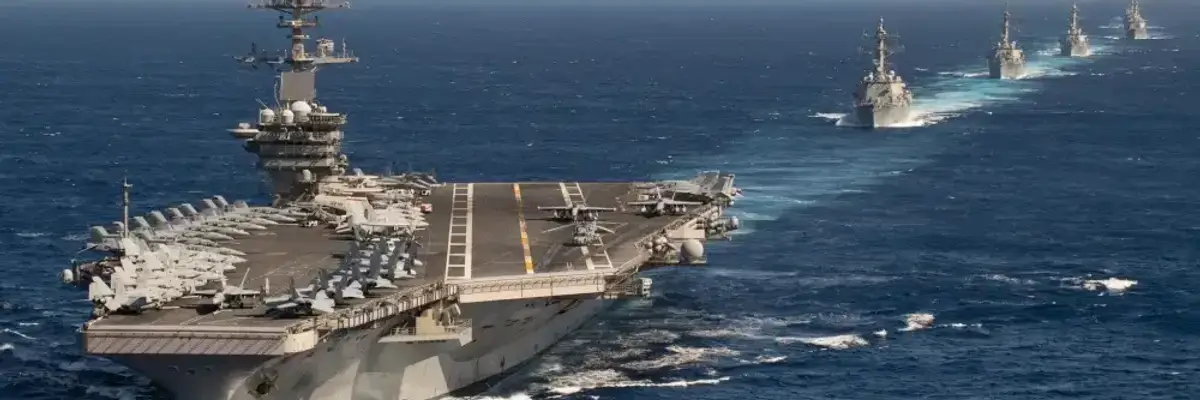
In this photograph released by the U.S. Navy, military planes stand on the flight deck of the Nimitz-class aircraft carrier USS Theodore Roosevelt, July 4, 2024, in the South China Sea. [AP Photo/Seaman Ryan Holloway
The Trump administration is preparing a major new bombing campaign against Iran, according to reports published Wednesday and Thursday by The Atlantic, Axios, NBC News, the Wall Street Journal and the New York Times.
While reports published in the last two weeks indicated that Trump was making plans to attack after the November 3 midterm elections, the latest reports indicate Trump could launch the attacks even sooner. “The White House has asked the Pentagon to develop strike options against Iranian targets that could be exercised ahead of the midterms,” The Atlantic magazine reported Wednesday afternoon, citing two administration officials.
Next month’s election takes place amid broad popular opposition to the war. Trump said in his September 22 address to the United Nations that Iran was “waiting to see how I do in the midterm election.” He added: “I gave absolutely no credence and will not give credence to the election when it comes to Iran. It doesn’t even enter my mind.”
Axios reported Wednesday evening that, according to US officials, the Pentagon had instructed the military command in charge of the war “several days ago to conclude preparations for resuming major combat operations in Iran.” If combat resumes, Axios wrote, it is “expected to include massive bombing of Iranian energy, infrastructure and nuclear targets” and would most likely involve the Israeli military.
Trump said of a deal with Iran at a rally in San Antonio, Texas, on Wednesday night: “I think the deal isn’t really something that I want to do, but they’re willing to offer us anything to stop.”
The new bombing would intensify the war of aggression that the United States and Israel opened against Iran on February 28. According to official figures cited by Al Jazeera, the US and Israeli militaries had killed 3,527 people inside Iran by August 28 without bringing down the government in Tehran or forcing it to accept Washington’s terms. Washington has answered each failure by preparing a larger assault.Available from Mehring BooksThe struggle against imperialism and for workers’ power in IranA pamphlet by Keith Jones
The New York Times wrote Thursday that the Pentagon, “on Mr. Trump’s orders,” had developed plans to strike “Iran’s drone and missile arsenal, energy facilities and other military sites.” The plans “center on a short, intense campaign lasting about three days,” the Times reported.
“U.S. military commanders are ready to begin larger operations in the coming days, in case the president shifts again,” according to the Times.
Axios reported Thursday that US officials had briefed the chief of staff of the Israeli military, Lt. Gen. Eyal Zamir, on Tuesday about preparations “for the possibility of resuming major combat operations against Iran within the next three weeks.”
“A fresh aircraft-carrier strike group and Marine expeditionary unit are steaming toward the Middle East, and the Pentagon is weighing sending additional air-defense equipment and munitions to bases in the region,” the Journal reported Thursday, citing officials familiar with the planning. The Associated Press reported October 1 that the United States was “dispatching roughly 9,000 troops aboard a group of ships.”
The assault on Iran is part of a worldwide offensive by American imperialism, aimed above all at Russia and China. Since the 1979 revolution that overthrew the US-backed Shah, Democratic and Republican administrations alike have sought to restore American control over Iran. The war is the latest in more than three decades of US wars, from the 1991 Persian Gulf War through the invasions of Afghanistan in 2001 and Iraq in 2003.
Vice President JD Vance led a discussion of the plans at the Camp David presidential retreat on October 2, the Times reported.
US forces have not struck inside Iran since September 1, but they have kept up the blockade of Iran’s ports. The US military said October 5 that it had turned back 130 commercial ships since reimposing the blockade on July 14, and that it had “destroyed 13 commercial vessels” over the previous 12 weeks.
The war has killed 19 US service members and wounded more than 800, the Associated Press reported Tuesday.
In an AP-NORC poll conducted September 24-28, 69 percent of Americans said the war in Iran “has not been worth fighting.”
All factions of the US political establishment support the aim of subjugating Iran to US domination. The Democratic Party has criticized Trump’s conduct of the war on the grounds that he has failed to secure the interests of American imperialism. Senator Mark Kelly, an Arizona Democrat, declared on ABC’s “This Week” on September 27: “We can’t leave the Strait in the hands of the Iranians.”
Senator Ruben Gallego, another Arizona Democrat, said Defense Secretary Pete Hegseth “is one of the most important reasons why we’re losing this war in Iran,” in a CNN interview his office released October 1.
These criticisms are accompanied by accusations that Trump has been insufficiently aggressive toward Russia and China. House Minority Leader Hakeem Jeffries said on the House floor on September 16, referring to Russian President Vladimir Putin: “Many of us wonder why the President has been so reluctant to aggressively confront the bully of Eastern Europe.” Senate Minority Leader Chuck Schumer and seven other Democratic senators said in a September 22 statement, ahead of a state visit by Chinese President Xi Jinping: “We can’t let President Xi leave stronger than when he arrived. That is not diplomacy, it’s weakness.”
Jeffries and 114 other House Democrats voted for the National Defense Authorization Act on December 10, 2025, and 149 House Democrats voted on January 22, five weeks before the war began, for an $839 billion military appropriations bill. On September 16, 58 House Democrats, including former House Speaker Nancy Pelosi, voted with the Republicans for a bill giving Trump new powers to impose tariffs aimed at Russia and extending sanctions on Iran through 2031.
The Pentagon on Thursday confirmed plans to livestream an execution by firing squad in December—a revelation that came amid fresh calls for the United States to end the death penalty after Tennesseebotched two attempts to kill Christa Pike with injections of pentobarbital.
The US Army announced Wednesday that Nidal Hasan—a former military psychiatrist convicted of killing 13 people and injuring 32 more in a 2009 mass shooting at Fort Hood—will be executed at the Texas base at 1:00 pm Central Standard Time on December 3.
Secretary of Defense Pete Hegseth told the right-wing outlet Real America’s Voice News that “we’ll make sure that people are able to watch it, that it’s public, because people need to understand that… there’s serious consequences for these types of things.”
Then, other outlets, including The Associated Press, reported that “officials in the Pentagon clarified Thursday that the execution would be livestreamed and that more details would follow.”
The Washington Postreported that “if Hasan’s execution is carried out, it would mark the first US military execution since April 13, 1961, when Army Pvt. John A. Bennett was hanged after being convicted of rape and attempted murder, according to the nonprofit Death Penalty Information Center, which monitors capital punishment. The military’s last known firing squad execution was carried out by ‘musketry’ on November 9, 1945.”
Hegseth’s comments and the subsequent confirmation from the US Department of Defense were met with disgust and outrage.
“What a sick man,” former National Nurses United communications director Charles Idelson said of the Pentagon chief on social media. “A. Executions have never been proven to be a deterrent to capital crimes. B. The spectacle of a public execution is morbid, it recalls the public lynchings so common during the Jim Crow era. C. If the shooter was white, I don’t believe this would be public.”
Hasan is a US citizen born to Palestinian immigrant parents. Just before he opened fire on soldiers who were set to deploy to Afghanistan, he shouted “Allahu akbar,” an Arabic phrase commonly used by Muslims that translates to “God is great!”
While some critics called out Hesgeth, Obama administration speechwriter-turned-podcaster Jon Favreau took aim at Vice President JD Vance, who recently published a book about his faith journey, including his conversion to Catholicism. Favreau said that “I would like to hear our Catholic vice president explain why they’re intentionally choosing to broadcast the death of a human being for the entire world to see, including children.”
Producer and journalist Simon Thompson wrote: on social media: “Just when I think this administration couldn’t get any worse. Livestreaming executions by firing squad? This administration, a Christian administration apparently, is making a snuff movie and treating it like a [pay-per-view] event.”
Journalist Séamus Malekafzali similarly said, “Content with having desensitized the American public by broadcasting faceless images of Iranian sailors dying and buildings full of people leveled to the soundtrack to Halo, the government is now moving to live-streaming snuff films, faces and all.”
“I know people hate when people make comparisons to American adversaries, but this is literally what ISIS did, save for the live aspect,” he added. “Those executions were also done on camera under the auspices of nominally government institutions, just a different kind of government.”
Although Trump left office the first time after overseeing a federal execution spree, American Immigration Council senior fellow Aaron Reichlin-Melnick said Thursday, “Jesus Christ, I didn’t think we’d actually get to the ‘public executions’ stage of Trump’s project to roll back the last 100 years of societal development.”
Corbin Trent, co-founder of Justice Democrats, suggested it could backfire for the Republican administration. He wrote: “I’m completely in favor of this. I think more of this would go a long way to ending the death penalty.”
In this photograph released by the U.S. Navy, military planes stand on the flight deck of the Nimitz-class aircraft carrier USS Theodore Roosevelt, July 4, 2024, in the South China Sea. [AP Photo/Seaman Ryan Holloway]
The events of the past week leave no doubt that the Trump administration, w complicity of the entire US political establishment, is preparing a major escalation of the Iran war. Having failed to achieve its objectives through a massive bombardment and then a blockade of the country, the White House is preparing a new and desperate gambit, potentially involving the deployment of ground troops or even the use of nuclear weapons.With the complicity of media and Democrats, Trump prepares major escalation of Iran war
The greatest danger is the chasm between the scale of what is being prepared and the public’s awareness of it. One month before the 2026 midterm elections, Trump’s conspiracy to escalate the war is being greeted with a wall of silence by the US media—which devoted just minutes to the war in this weekend’s Sunday talk shows—and by the Democratic Party, which has done nothing to alert the public to the renewed onslaught against Iran that the administration is preparing.
On September 22, US President Donald Trump threatened in his speech before the United Nations to “annihilate the Islamic Republic, and do it quickly.” His threat followed a secret White House meeting, reported by the journalist Seymour Hersh on June 10, at which Trump spoke “about a nuclear option that could perhaps bring a quicker end to the war.”
These threats cannot be dismissed as bluster. Trump is the president of the United States and has already killed thousands of people in the months-long bombardment of Iran. The forces now converging on the Persian Gulf give him the means to carry out his threats. Nothing would be more dangerous than complacency.
After seven months of war, US imperialism has failed to achieve its aims of dominating the Strait of Hormuz, militarily defeating Iran and overthrowing its government. The administration is improvising, desperately seeking a way out of the political disaster the war has produced. But its improvisation is driven by the logic of events. American imperialism cannot accept defeat in the Persian Gulf, and each failure becomes the basis for an ever-greater escalation.
Last week, the Wall Street Journal and the Associated Press reported that the White House had sent a third aircraft carrier to the Middle East. The USS Theodore Roosevelt left San Diego on September 27, followed the next day by the amphibious assault ship USS Makin Island with about 2,200 Marines. They will join the carrier USS George Washington and more than 50,000 US troops deployed across the region.
Trump “has told aides he expects to resume bombing Iran after the November midterms,” the Journal reported September 25. He was briefed in August on options including “sending in ground forces to seize Iranian islands near Hormuz,” the Journal reported last month.
The deployment of amphibious assault ships along with thousands of Marines is particularly ominous. They are the means of seizing territory, and the next phase of the war may include landings on the islands near Hormuz, at the Kharg Island oil terminal or at Iran’s nuclear sites.
The administration’s top national security officials met Friday at Camp David, the presidential retreat, “to discuss next steps in the Iran war and the Saudi-Houthi conflict in Yemen,” Axios reported that night. The last similar meeting, Axios noted, was in June 2025, just days before Israel and then the United States attacked Iran. The new US military deployments targeting Iran parallels a renewed offensive by Saudi Arabia, supported by the United States, in Yemen.
The Pentagon confirmed Sunday that all US bombers at Britain’s Fairford air base, used for strikes on Iran, had been flown back to the United States. The withdrawal followed British Prime Minister Andy Burnham’s claim on September 30 that Iran “played a part” in an alleged plot against the base. The unproven allegation provides a ready-made pretext for escalation.
The war against Iran is part of a broader global offensive by US imperialism, centrally targeting Russia and China. Significantly, the plans to expand the Iran war accompany a sharp intensification of NATO’s war on Russia in Ukraine, which threatens at any moment to erupt into direct warfare between nuclear-armed states.
Each president since the 1979 Iranian revolution, Democratic and Republican, has worked to bring Iran back under American domination. Trump’s war against Iran is the latest stage of a 35-year offensive to subjugate the Middle East and Central Asia: the Gulf War of 1991, the invasions of Afghanistan and Iraq, the destruction of Libya, the proxy war in Syria and Israel’s genocide in Gaza.
Amid overwhelming popular opposition to the war and the ensuing surge in the cost of living, particularly of energy, the Democratic Party is expected to make significant gains on November 3. It is determined, however, to ensure that any electoral repudiation of Trump does not lead to a let-up in the drive by US imperialism in the Middle East.
The USS Theodore Roosevelt, left, and the USS Carl M. Levin prepare for a refueling in the Pacific Ocean, Nov. 16, 2025. [Photo: Navy Petty Officer 3rd Class Aaron Haro Gonzalez ]
The Trump administration is sending the aircraft carrier USS Theodore Roosevelt and three amphibious warships carrying about 2,000 Marines to the Middle East. The ships will reinforce the US forces arrayed against Iran with as many as 10,000 sailors and Marines, the Wall Street Journal and Bloomberg News reported Thursday, citing US officials.
The deployment follows US President Donald Trump’s threat before the UN General Assembly on September 22 to “annihilate the Islamic Republic and do it quickly” and to “drive them into hell with no chance of survival and no hope of future greatness or generations.” Two days later, Israeli Prime Minister Benjamin Netanyahu told the General Assembly that Iran’s “murderous regime will be toppled,” declaring: “This evil regime will fall, and we will all celebrate that day.”
The buildup puts the White House on a course to massively accelerate the war following the US midterm elections on November 3, which are expected to reflect the overwhelming unpopularity of the war among workers and young people. But while the Democrats may be the beneficiaries of the elections, they have pledged, like Trump, to ensure the subjugation of Iran to American interests.
The Journal reported September 25 that Trump “has told aides he expects to resume bombing Iran after the November midterms.” The Journal wrote Thursday, citing US officials, that the ships would arrive by late November.
Bloomberg, citing a US official, wrote that the deployment “gives American commanders more options if President Donald Trump chooses to escalate attacks on Iran.”
Axios quoted a US official Thursday as saying the region “could potentially have up to three aircraft carrier strike groups. This is much more firepower.”
The Roosevelt sailed from San Diego on Sunday, and the USS Makin Island amphibious group followed on Monday. Whether the Roosevelt will add to the carriers already in the region or replace one of them has not been decided, Axios reported, citing a second official. The United States already has more than 50,000 troops in the region.
In recent weeks the Trump administration has also sent two more Patriot missile batteries to Saudi Arabia and Qatar, Axios reported Thursday, to protect energy facilities “in case President Trump decides to resume major combat operations against Iran.”
On Thursday, as he left the White House, Trump said: “They’ll either sign a very fair deal, or they won’t exist any longer,” The Hill reported.
In an interview with Time magazine conducted Monday and published Thursday, Trump was asked whether he would “ramp up bombing after the midterms.” He answered: “Possible.”
Pressed again, Trump said: “We have a lot of weapons. You know, we’ve been stocking up for the last six months.” Reminded of his threat at the UN to “annihilate” Iran, he said: “Yeah, I would do that. It’s possible.”
Dominant sections of the US media are agitating for an escalation of the war.
In an editorial headlined “The Battle of Hormuz Is Turning,” the Journal’s editors declared Thursday that the US military had “turned around the battle of the Strait of Hormuz.” They wrote: “This is what progress looks like: Iran’s oil is blocked while the world’s oil increasingly gets through.”
The editorial concluded: “The challenge now is to sustain the pressure and push the US tactical advantage to accomplish strategic objectives—finishing the nuclear program or the regime itself.”
At least five tankers have come under attack in or near the Strait since Monday, the shipping news site Riviera reported Friday. On Thursday the Kuwaiti supertanker Kazimah III caught fire after it was struck by what the UK Maritime Trade Operations center called “an unknown projectile.”
The US Navy has blockaded Iran’s ports since July. By Wednesday it had redirected 125 commercial ships, according to the US military, and on September 26 Trump boasted that the blockade was “a wall of steel.”
Reuters reported Thursday, citing three senior Iranian officials and an insider, that Iran is preparing “a broader and more forceful response if the United States resumes large-scale military attacks.” According to the news agency, “Senior commanders are reviewing plans to expand potential targets beyond US-linked assets to countries that support US military operations and possibly to locations outside the Middle East.”
Official figures compiled by Al Jazeera count at least 3,527 people killed in Iran by US and Israeli bombing between February 28, when the two powers launched the war, and August 28. By September 28, the US military had counted 19 American service members dead and 861 wounded.
Leading Democrats spent the past week attacking Trump for losing the war and for “weakness” toward China.
Democratic Senator Ruben Gallego of Arizona told CNN on Wednesday that Defense Secretary Pete Hegseth should be “figuring out how to win this war in Iran.”
Democratic Representative Jake Auchincloss of Massachusetts accused Trump of losing the war in an interview with CNN on September 25. Trump, he said, had sent Russian President Vladimir Putin and Chinese President Xi Jinping a message “of appeasement and weakness.”
In remarks on Capitol Hill about Xi’s state visit last week, aired Sunday on “Fox News Sunday,” Democratic Senator Richard Blumenthal of Connecticut denounced Trump for “feting and celebrating Xi while he is aiding Iran, which is trying to kill our sons and daughters.” He said he was “shocked and deeply alarmed that the president, in effect, is kowtowing to him and failing to release the money that Taiwan needs to defend itself.”
Democratic Senator Mark Kelly of Arizona, interviewed Sunday on ABC’s “This Week,” declared: “We can’t leave the Strait in the hands of the Iranians.”
The buildup against Iran is proceeding alongside the escalation of the US-NATO war against Russia, which Moscow has answered with the threat to use nuclear weapons if NATO moves to cut off Kaliningrad, the Russian exclave on the Baltic Sea between Poland and Lithuania.
“Russia would be ready to use all its arsenal, including nuclear weapons, to defend its territory if NATO countries try to isolate Kaliningrad region from the rest of the country,” the Russian embassy in Ireland wrote on September 29.
Russian President Vladimir Putin repeated the threat Thursday at the annual meeting of the Valdai Discussion Club, a Russian foreign-policy forum. “If it comes to a direct attack on the Russian Federation—in this case, Kaliningrad, although it could potentially involve other territories as well—the question of Russia using all the weapons at its disposal would inevitably and immediately arise,” he said.
Asked about Russia’s warning at a Euronews conference in Brussels on Wednesday, NATO Secretary General Mark Rutte responded: “We will defend every inch of NATO territory.”
The World Socialist Web Site is the voice of the working class and the leadership of the international socialist movement. We rely entirely on the support of our readers. Please donate today!
The Pentagon is preparing to dramatically expand the American military presence in the Middle East as President Donald Trump weighs renewed attacks on Iran, with thousands of additional troops and a third aircraft carrier being readied for deployment, even as the conflict he has repeatedly declared “over” or “won” threatens to erupt into a new and potentially broader phase.
The Washington Postreported Thursday that the Pentagon is preparing options that could put as many as three US aircraft carriers and their accompanying warships in the Middle East.
According to The Associated Press, around 9,000 additional sailors and Marines are being dispatched aboard the USS Theodore Roosevelt carrier strike group and the USS Makin Island amphibious readiness group. The buildup could push the number of US personnel in the region above 20,000 by late October.
The Roosevelt is being sent to relieve the USS George Washington, while a third carrier, the USS George HW Bush, is also already in the region.
The new deployment plans come as diplomacy between Washington and Tehran remains stalled, and as Trump has repeatedly threatened to resume large-scale military action—including the total annihilation of the nation of over 90 million people—after the November midterm elections.
“Either they’ll do something very proper and smart, or they won’t be around very long,” Trump said of the Iranian government Thursday in Denton, Texas. “Frankly, I hate to see that, but they won’t be around very long.”
Iran, meanwhile, has reportedly begun preparing for a more expansive retaliation should the United States launch another major attack in the illegal US-Israeli war of choice against the Middle East nation.
Hamidreza Azizi, a senior Iran analyst at the International Crisis Group, told Reuters Thursday that the Iranian government seems “determined not to respond symbolically to a symbolic move and instead to escalate in the hope of reestablishing deterrence.”
Republican National Committee Co-Chair Lara Trump—the president’s daughter-in-law—warned during a Wednesday interview with British journalist Harry Cole that the increasingly protracted Iran War could not only tarnish Trump’s legacy, but could also cost Republicans next month’s midterm elections.
“Well, it’s possible,” Trump—who campaigned as the “peace president” on a promise of no new wars—said of the midterm risks Thursday on his way to Texas, before adding that “it should help because Iran will not have a nuclear weapon.”
The intelligence consensus of every US administration since former President George W. Bush—including during both of Trump’s terms—has been that Iran has not been trying to develop nuclear weapons.
As the Trump administration fights to keep deporting immigrants to countries where they have no connections, we studied the system that profits from these grave abuses.
The Intercept, September 29, 2026, 11:00 a.m. ET Share
An ICE flight operates out of King County International Airport, also known as Boeing Field, on Aug. 23, 2025, in Seattle. Photo: Lindsey Wasson/AP
Tyler McBrien is the managing editor of Lawfare.
More than 25,000 people have had their lives upended and been forced into unfamiliar cultures, governments, and legal systems when the Department of Homeland Security deported them to so-called “third countries,” places where immigrants previously living in the United States have no connections and few rights — and where a deportation business booming under the second Trump administration finds its murky endpoints.
“The point is to scare people,” said one Trump administration official, according to a Senate Foreign Relations Committee minority report. “With countries like Palau or Eswatini, the point is that the Administration can threaten people that they will literally be dropped in the middle of nowhere.”
As is the case for many tools of its cruelty, the Trump administration did not invent third-country removals — it refashioned them to serve its own excesses. In the past, the U.S. used the obscure administrative compromise for people who could prove they would face persecution or harm if returned to their home country yet did not meet other requirements for asylum. The U.S. had to meet humanitarian and legal obligations, such as ensuring third countries would not turn around and deport migrants right back to their home countries. It was a last-resort tool that still left people displaced from their homes and communities in service of the country’s arcane immigration laws. But the current Trump administration’s policy, premised on agreements with at least 35 countries, has been anything but humane.
Nor has it been particularly legal. After the 1st U.S. Circuit Court of Appeals struck down the third-country deportation scheme, DHS scheduled a flight to deport migrants involved in a class-action lawsuit challenging the policy to Burundi, Rwanda, and the Central African Republic. Despite a successful emergency motion their lawyers filed last week, an Immigration and Customs Enforcement jet flew to two African countries that hold third-country removal agreements, according to the American Prospect. It is not yet clear who was on the plane or whether ICE carried out third-country removals in violation of a federal court order, and the Trump administration is now aiming to take the legal fight to the Supreme Court.
The saga illustrates the Trump administration’s proclivity for obfuscation, secret contracts, nondisclosure, and dealmaking of the backroom variety. Whether digitally disappearing people from ICE’s online detainee locator tool last week, or inking multimillion-dollar sole-source contracts with inexperienced companies of questionable provenance, the Trump administration has pursued its immigration goals under the cover of darkness, often justifying the secrecy with invocations of national security, all while attempting to shield itself from public scrutiny and accountability in the process.
“Deportation, Inc.: The Rise of the Immigration Enforcement Economy,” an ongoing investigative video series from Lawfare and SITU Research, in partnership with The Intercept, examines how U.S. immigration enforcement has evolved into a multibillion-dollar industry shaped by private profit and political power — where contracts, capital flows, and institutional incentives increasingly govern detention, deportation, and surveillance. The project joins other efforts to shed light on the often invisible economy of immigration enforcement, including the Berkeley Human Rights Center, Human Rights First, Third Country Deportation Watch, and others.
The first installment, released last December, focuses on the business of migrant detention and profit motive underpinning the brutality of privately run ICE detention facilities. The second chapter, out today, looks at the network of flights shuffling migrants between those facilities, as well as the shady deals brokered with the governments of deportation destinations.
Many details of these bilateral third-country removal agreements are not public, but the logic is transactional: Countries accept asylum-seekers and other immigrants from the United States in exchange for aid or other forms of financial compensation. Many of the countries involved in what The Intercept’s Nick Turse has called Trump’s “global gulag” are so dangerous that the State Department includes them on its “Level 4 Do Not Travel” list, “the highest advisory level due to life-threatening risks. And the very fact that these people are sent to a third country, rather than repatriated, means they have at least a viable asylum case.
Some but not all of the underlying texts of these agreements have come to light, often popping up in far-flung corners of the internet. This is not only a bad practice in government transparency, but a potentially illegal one as well. Lawfare, where I serve as managing editor, has argued as much in a federal district court in Washington, D.C., where the publication has sued the State Department over its failure to disclose international agreements into which the Trump administration has entered — in violation of the Case-Zablocki Act.
Though accelerated by the Trump administration, the secrecy that has enabled the growth of the vast, invisible economy of immigration enforcement traces back to at least 2001 with the creation of the Department of Homeland Security. Following the September 11 attacks, the new Cabinet-level department, along with other federal reforms, for the first time linked immigration with national security, which resulted in massive budget increases, new abilities to shield immigration information from the public, and general judicial deference to the executive branch that accompanies matters of foreign policy and national security.
Even the current Trump administration’s third-country deportation apparatus is beginning to build up its own record of cruel precedent. In the same class-action case last year, the Department of Homeland Security attempted to deport class members to Libya and South Sudan, in apparent violation of a temporary restraining order granted by a federal judge only weeks prior. During a hastily arranged hearing, a federal judge asked a Justice Department lawyer about the plane’s whereabouts, to which the government attorney responded, “I’m told that that information is classified, and I am told that the final destination is also classified.” Asked under what authority the government had classified the location, the Justice Department lawyer did not have an answer.















You must be logged in to post a comment.