Posts Tagged ‘war’

Europe’s leaders are preparing for war. Workers are organising to stop it

October 12, 2026

John Rees, MEE, 10 October 2026

Preparations for war with Russia and complicity in Israel’s genocide in Gaza have set off a struggle over jobs, wages and military production

A student holds a sign reading “Humans are not objects” at a school strike against conscription in Frankfurt on 25 September 2026 (Stien Hohn/Hans Lucas via Reuters Connect)

A student holds a sign reading ‘Humans are not objects’ at a school strike against conscription in Frankfurt on 25 September 2026 (Stien Hohn/Hans Lucas via Reuters Connect)

War preparation is now a reality across Europe. Within a single September week, Poland issued fresh warnings, Germany ran drills and national alerts, military exercises were held across the Baltic, and Lithuania published plans to evacuate residents of Vilnius in the event of an attack.

The Finnish government is in full cry over the prospect of war, reminding its citizens yet again that they should be ready, in mind and in practice, for the disruption it would bring.

On 18 September, French President Emmanuel Macron gathered party leaders and presidential hopefuls at the Elysee Palace to hear the heads of France’s intelligence services describe what his office called the rapid deterioration of the international situation.

Nato, meanwhile, talks ever more openly about Russian sabotage, cyber attacks, arson and drone attacks.

Many workers and citizens across the continent, though, are not convinced by the war fever.

New MEE newsletter: Jerusalem Dispatch

Sign up to get the latest insights and analysis on Israel-Palestine, alongside Turkey Unpacked and other MEE newsletters

Thousands of Airbus workers in Spain began strike action on 1 July after rejecting the company’s pay and conditions offer.

Representatives of the UGT and CGT unions said the stoppage had slowed military and commercial production and would make it harder for the company to meet its delivery target. Airbus’s eight sites in Spain produce military transport planes and parts for commercial aircraft and satellites.

As the Defence Matters website reported: “The industrial pressure is not confined to commercial aviation. Spain is central to Airbus Defence and Space, including military transport and satellite activity. European governments are asking manufacturers to increase output at the same time as companies compete for engineers, technicians and production workers.”

Many workers and citizens across the continent are not convinced by the war fever

Supply lines are so tight that Airbus has had to hire giant Antonov An-124 heavy-lift aircraft to ferry parts from one plant to another just to keep production running.

Air Data News reported that the strike “threatens key military aircraft programmes”, noting that the Eurofighter plant near Madrid and the military transport aircraft site near Seville were both affected.

Spanish unions said about 90 percent of eligible workers took part in the stoppage on 25 August, part of an indefinite strike. The strikes were called after workers voted at plant-level assemblies to reject the company’s offer.

French unions briefed on the dispute said the three striking Spanish unions represent about 40 percent of Airbus Spain’s roughly 14,000 employees. Workers were seeking inflation-linked pay rises, the restoration of previous remote-working arrangements and sick-leave benefits.

After the intervention of Industry Minister Jordi Hereu and concessions from Airbus, the strikers paused the stoppage on 10 September, but not the movement. Two days later, around 8,000 workers from Airbus sites across Spain marched through Madrid to keep the pressure on.

On 1 October, 77 percent of those voting backed an improved offer providing for the restoration of lost purchasing power, inflation-linked pay rises and the protection of remote-working rights, a settlement that months of industrial action had forced out of the company.

The Airbus dispute shows the leverage workers hold in the very industries on which Europe’s rearmament depends.

Trains and the TUC

In Scotland, meanwhile, the rail union RMT, the drivers’ union Aslef and the white-collar TSSA have demanded that the Scottish government remove CAF, the Spanish manufacturer Construcciones y Auxiliar de Ferrocarriles, from its shortlist of contractors to build ScotRail’s new fleet of suburban trains.

The company is included in the UN human rights database of businesses involved in Israeli settlements for its role in running the Jerusalem light rail and helping to extend it into territory illegally seized by Israel.

Aslef made clear that its members would refuse to drive CAF trains, a position echoed by TSSA general secretary Maryam Eslamdoust when she urged the Scottish government to “think again”.

Scottish Greens co-leader Gillian Mackay put the first minister on the spot, asking him directly: “So will the first minister agree that CAF should be blocked from this contract, and will he stand with the rail workers who have refused to drive trains produced by a company that they say profits from apartheid?”

In his response, the first minister confirmed that ScotRail was seeking advice on the contract.

For the second year running, delegates at the Trades Union Congress (TUC) backed a motion opposing increases in arms spending.

This year’s motion passed with even more support than last year’s, which reversed the TUC’s previous backing, advocated by the GMB and Unite unions, for higher defence spending.

Speaking in favour of the motion, Alex Gordon, a former RMT president and national officer of the Stop the War Coalition, said: “This movement is about fighting for jobs, for public services, for investment in the industries of the future that our young people, that our young workers need.

“Those industries are not military industries. The skills of the workers in the military sector are vital skills, vital skills that need to be used in civilian production.”

Ports and classrooms

Dockworkers’ unions in at least six countries are planning an international day of action and strikes on 30 October to protest against the war on Gaza and demand an immediate end to the genocide of the Palestinian people.

This coordinated mobilisation follows a strike on 6 February this year that shut down cargo operations at more than 20 Mediterranean and European ports to halt arms shipments bound for Israel.

“No to the war economy, government rearmament plans, and the project of militarisation of ports and strategic infrastructure from [the] EU,” the unions said in their statement. “Public resources must be used to meet people’s social needs, not to finance war.”

From docks to cities, Italians challenge Meloni’s complicity in Gaza genocide

Read More »

The signatories include CGT FNPD in France, Enedep in Greece, LAB in the Basque Country, Liman-Is in Turkey, ODT in Morocco, and Orsa Porti and USB in Italy.

The next generation, at least in Germany, seems even less enthusiastic about the prospect of a new European war. More than 45,000 school students across the country walked out of class in late September to protest against plans for compulsory military service, after hundreds of young men were summoned for medical examinations.

The School Strike Against Conscription initiative said demonstrations took place in more than 100 cities after the German defence ministry began calling in 18-year-old men for medical screening. Service itself remains voluntary for now, but the screening is compulsory.

Students took to the streets demanding a halt to the forced checks, the repeal of the new military service law and an end to what they call a step-by-step return to the draft.

This is now the ground on which European politics is being fought. It is a contest between a political establishment obsessed with war and preparations for war, and millions of workers across the continent unwilling to pay for rearmament with their wages, jobs and living standards.

These are the opening shots in that battle.

The views expressed in this article belong to the author and do not necessarily reflect the editorial policy of Middle East Eye.

John Rees is a Visiting Research Fellow at the University of Essex , and a co-founder of the Stop the War Coalition.

Trump administration announces it has placed weapons in orbit, in major step in the militarization of space

September 16, 2026

Andre Damon@Andre__Damon., WSWS, 16 Sep 2026

FILE – President Donald Trump speaks in the Oval Office of the White House on May 20, 2025, in Washington. (AP Photo/Alex Brandon, File)

The Trump administration has placed weapons in orbit around the earth, Air Force Secretary Troy Meink announced Monday. The United States “now has on-orbit space control weapons capable of defending the joint force against hostile adversary action,” Meink told the Air & Space Forces Association conference.

The announcement is a major step in the militarization of space and the escalation of war plans targeting nuclear-armed Russia and China. Meink spoke more than six months into the US-Israeli war on Iran, a day after Russian forces struck a passenger train near the Polish border and 10 days before Chinese President Xi Jinping is due at the White House.

The Wall Street Journal, praising the move in a Tuesday editorial, noted that it takes place ahead of Xi’s arrival: “The timing of the space announcement may be no accident coming ahead of Chinese President Xi Jinping’s visit to Washington next week.”

Meink refused to say what the weapons are, how many there are or when they were launched. The Space Force said in a statement to ABC News published Tuesday that the weapons “can be employed for offensive and defensive purposes at the direction of combatant commands.”

Victoria Samson, chief director of space security and stability at the Secure World Foundation, a research group, told Defense One on Monday: “I don’t think any US government official has ever said that before. The US also now has to accept the Chinese and Russians doing/saying the same.” She told Al Jazeera Tuesday, “What this does is normalise weaponising space.”

Chinese Foreign Ministry spokesman Guo Jiakun said Tuesday, “We urge the US side to stop expanding its military capabilities and preparing for war in outer space,” and Kremlin spokesman Dmitry Peskov said the same day that “space must be free of any weapon.”

In January 2025, US President Donald Trump ordered the Pentagon to build “proliferated space-based interceptors,” a program named Golden Dome that he priced at $175 billion that May. The Congressional Budget Office estimated this May that such a system would cost $1.2 trillion over 20 years, most of it for about 7,800 space-based interceptors.

The administration is asking $71.3 billion for the Space Force next fiscal year, nearly double the $40.1 billion requested a year earlier, inside the $1.5 trillion military budget it requested in April, a 44 percent increase over this year’s and the largest since World War II.

The 1967 Outer Space Treaty, to which 118 states, including the United States, are party, commits its signatories “not to place in orbit around the earth any objects carrying nuclear weapons or any other kinds of weapons of mass destruction.”

It reserves the moon and other celestial bodies “exclusively for peaceful purposes” but says nothing about conventional weapons in orbit, and the Space Force said Monday that its operations comply with it.

The 1972 Anti-Ballistic Missile Treaty between Washington and Moscow barred each side from developing, testing or deploying missile-defense systems that are “sea-based, air-based, space-based, or mobile land-based.” US President George W. Bush withdrew from it in 2002, and Golden Dome’s space-based interceptors are the type of weapons it barred.

The Trump administration has abandoned or bypassed a series of arms-control agreements. In 2018, Trump pulled out of the nuclear agreement with Iran, and in 2019, out of the Intermediate-Range Nuclear Forces Treaty, which had banned a class of US and Russian missiles. In 2020, he left the Open Skies Treaty, which had allowed unarmed surveillance flights.

New START, the last treaty limiting US and Russian strategic nuclear weapons, expired February 5; Trump had given no formal answer to Russian President Vladimir Putin’s offer to observe its limits for another year.

On October 30, 2025, Trump ordered the Pentagon “to start testing our Nuclear Weapons on an equal basis,” and the next day the United States cast, for the first time, the lone vote against the annual resolution of the UN disarmament committee backing the moratorium on nuclear testing. The United States has not set off a nuclear explosive test since 1992.

On November 4, Alison Storsve, the US delegate, told the committee that the United States “must vote NO on the resolution” titled “Prevention of an Arms Race in Outer Space.”

“I don’t want to tell Beijing and Moscow what I’ve done,” Lieutenant General Gregory Gagnon, head of Space Force Combat Forces Command, said of measures to protect US satellites in February. “We also need, as part of our joint force, the ability to attack.” In December 2025, the administration announced a record $11 billion arms package for Taiwan.

Socialism AI Logo

Socialism AI

by the WSWSSocialismAI.com

Questions about this article? Ask Socialism AI

What historical role has the Outer Space Treaty and other arms-control agreements played in the twentieth century’s balance of nuclear terror between the US and USSR?Why do both the Democratic and Republican parties in Congress support this massive expansion of military spending on space and nuclear weapons?How does the militarization of space by the US, alongside similar moves by France and Germany, connect to the broader inter-imperialist rivalry building toward a third world war?

Ask more questions at SocialismAI.com

Meink’s announcement takes place amid the uncontrolled escalation of the war in Ukraine. The Kyiv Post reported Monday, citing an internal German government planning document seen by Politico, that Germany’s Defense Ministry plans to spend nearly €3.4 billion on US Tomahawk cruise missiles, with a range of more than 1,500 kilometers, and on Typhon launchers to fire them. The purchase would give Germany its first ground-based long-range strike force, and a ministry spokesperson confirmed that “the procurement of the US Typhon system with Tomahawk cruise missiles remains intended.”

German Defense Minister Boris Pistorius announced in Kyiv on May 11 that Germany and Ukraine would jointly build unmanned weapons “at all distances, especially in the deep strike zone.”

On Sunday, the day before Meink spoke, Russian forces struck a stationary Kyiv-Warsaw passenger train with a drone at Yahodyn station, two kilometers from the Polish border. Ukraine had evacuated the 206 passengers about 15 minutes earlier, and nobody was injured. A train carrying former British Prime Minister Boris Johnson was already inside Poland, and a third, with former CIA Director David Petraeus aboard, stood at the station and was not struck. All had attended a conference in Kyiv.

The European powers answered the strike with calls for more weapons. Pistorius called the strike Monday “a calculated escalation by Russia intended to frighten Europe,” and NATO Secretary General Mark Rutte said of Putin, “He thinks that he can stop us from supporting Ukraine and that he can undermine our unity. He is wrong.”

Kaja Kallas, the European Union’s foreign policy chief, said Monday the strike was “a message to the Western world” and that “we should do exactly the opposite: we must show that we are there for Ukraine and we are not scared off.” On Tuesday, Poland and Romania scrambled fighter jets as Russian forces struck Ukraine with drones near their borders, and NATO fighters shot down a drone over Lithuania, Lithuanian President Gitanas Nausėda said.

Other imperialist powers are arming for space. French President Emmanuel Macron, opening the French military’s space command center in Toulouse in November 2025, said, “Space is no longer a sanctuary; it has become a battlefield.” Pistorius announced in September 2025 that Germany would spend €35 billion on military space over five years to “defend and deter in space.”

The space weapons the Journal credits with opening the door to the assault on Iran are now aimed at Russia and China.

Neither party in Washington opposes the program. The military spending bill that pays for the Space Force, $839 billion this year, passed the House in January with 149 Democratic votes. By Tuesday night no member of Congress had been quoted objecting to weapons in orbit.

The World Socialist Web Site is the voice of the working class and the leadership of the international socialist movement. We rely entirely on the support of our readers. Please donate today!

9/11: The day the ‘war on terror’ began

September 11, 2026

The attacks of September 2001 became the pretext for a new era of US-led intervention. Twenty-five years on, millions are dead and the promised ‘victories’ remain nowhere to be seen, says ANDREW MURRAY

Crowds in Manhattan watch smoke billowing from the World Trade Centre, September 11 2001

Andrew Murray

THE “war on terror” began 25 years ago today, when two hijacked passenger airliners were flown into the skyscrapers of the World Trade Centre in New York.

A third crashed into the Pentagon in Washington while a fourth, apparently targeting the US capitol, crashed in Pennsylvania after its passengers fought back.

It was immediately assumed that the hijackers — nearly all of them Saudi Arabian by nationality — were organised by al-Qaida, an Islamist militant group then headquartered in Afghanistan. Despite many subsequent conspiracy theories, it would seem that this was indeed the case.

Al-Qaida attributed their actions — which killed nearly 3,000 people, almost all civilian, in the first foreign attack on the US mainland since 1812 — to opposition to Israel’s US-supported oppression of the Palestinians, to the presence of US troops in the holy land of Saudi Arabia, and the sanctions-driven starvation of Iraqi children.

9/11 was thus an act of terror already sitting in a continuum of US-driven violence and oppression across the Middle East — an explanation but not a justification.

It was immediately clear that the attacks would be the basis for a further aggressive extension of US war, across the Middle East and south Asia in particular.

In fact, it led to a devastating series of wars which caused the effective collapse of several states, millions of deaths and millions more made refugees. Afghanistan, Iraq, Libya, Syria and Yemen have been the principal victims of this war, which has also extended to parts of Africa and, in its impact and influence, most of the world.

Some of these wars had not the slightest connection to terrorism or al-Qaida and — in particular the Bush attack on Iraq — had been meditated long before 9/11.

The “war on terror” began with boasts of military omnipotence from Washington, along with brazen calls for the introduction of a new colonialism to deal with “failed states.”
But nowhere has it ended with an outcome anything like that sought by the aggressors.

Most notoriously, the first theatre of war — Afghanistan — began with the ousting of the Taliban government in 2001 and ended with the return of the self-same regime 20 years, uncounted lives and massive destruction later.

However rightly it can be felt that the people of Afghanistan deserve a much better government, it cannot be denied that this outcome marked a historic defeat for US imperialism.

It scarcely fared better in Iraq, where the overthrow of Saddam Hussein led to a brutal occupation, sectarian civil conflict, economic despoliation and the wrecking of a state which George Bush had fancied turning into a “beacon of democracy.”

The occupation there was wound down in more-or-less ignominy — total in the case of the British forces deployed in Basra, driven out in humiliation.

Libya, the third major target, was turned into a failed state, split between rival governments and generating an immense refugee crisis, as a result of a Nato-sponsored intervention.

In Syria, Western interference in civil war not only sparked a massive refugee crisis but the rise of Isis and the eventual ascension of a jihadi-rooted government in Damascus.

Yemen, one of the world’s poorest countries, has been further degraded by a conflict to a large extent armed and directed from Britain, working alongside Gulf dictatorships. Yet the Houthis remain still standing and defiant.

The “war on terror” also spread further afield, to both west and east Africa in particular, with no better results for either the peoples there or the plans of the imperialists.

The full balance sheet for these wars remains yet to be calculated, but it does not seem to yield a single victory of the US and its allies, Britain first among them. The present war against Iran is a linear descendant of these conflicts, and does not look like changing that record.

Despite numerous contingent and specific factors, all these wars are rooted in the structuring of a world around US hegemony, in which Washington arrogates to itself the right to intervene where it wills in order to ensure subordination to its own strategic and commercial interests.

They are thus the main contemporary political expression of imperialism.

9/11 and these subsequent conflicts had the political consequence of restoring the concept of imperialism to the centre of public discourse.

After a generation in which it had been relegated to jargon as the world wallowed in the post-cold war “end of history,” the wars of aggression launched by the US, with British governments invariably at its side, whatever the views of the people, shone an unforgiving light on the realities of global power.

Imperialism has generally taken some care to present its depredations as being motivated by the most high-minded interests.

In the 19th century, colonial adventures were usually promoted as expediting the spread of Christian civilisation to peoples who had the audacity to get along without it.

In the 20th century, a more secular age, interventions were often explained as being necessary to stop the spread of communism, notwithstanding that communism, for all its global potency, was often entirely absent from the territories concerned.

In the present century the “war against terror” has stood duty, the first conflict even declared as being against an abstraction rather than a country or peoples.

This war elided with the developing notion of “liberal” or “humanitarian” intervention, which had been trialled, to its progenitors’ satisfaction, in the 1999 war against Yugoslavia.

It was ideologically amplified by Tony Blair, then still fairly popular, who went to Chicago to spell out the conditions in which great powers, or those with the approved political markers, could and should intervene in other countries’ affairs.

He spelt out five criteria. International law or United Nations approval were not among them, and the wars to follow did not meet all of them in any case. Blair’s political reputation is now collateral damage following his decision to lead Britain into the Iraq aggression alongside George Bush.

That decision, above all, gave rise to the largest anti-war movement in Britain’s history, indeed probably the strongest mass movement of the left since the high days of Chartism in the 1840s.

Its effects resonate to this day, not least in the enduring movement of solidarity with the Palestinian people.

At its core lay an alliance of most of the socialist left with Muslim communities, alongside trade unions, the mass of young people and sections, like military families, never previously drawn into mass anti-war campaigning.

That coalition was described by the New York Times as the “second superpower” in the world, at the time when the US believed itself to be effectively unchallengeable.

The movement also laid much of the foundation for Jeremy Corbyn’s ascension to the Labour Party leadership in 2015, something that was certainly not on Blair or Bush’s agenda when they embarked on their policy of open-ended war.

These developments have placed anti-imperialism at the heart of socialist politics in Britain, to the teeth-grinding rage of those savants and organs of the soi-disant left who embrace the international politics of the ruling class even as they pretend to a domestic radicalism.

9/11 also had more negative impacts in Britain — it led to a rising tide of Islamophobia, now reaching epidemic proportions, as well as occasioning one attack after another on our liberties, exemplified in the harassment of the Palestine solidarity movement and the mass arrests of peaceful sympathisers with Palestine Action.

Today, the “war on terror” has faded somewhat behind the darkening shadow of great power conflict. With the rise of China, it is clear that the US is no longer the sole superpower.

The proxy war being waged by Nato in Ukraine is the harbinger of still more devastating conflicts, as the anti-war movement warned from 9/11 onwards.

Today, 9/11 is best marked by the renewal of the anti-war movement in the face of impending neofascism and war, by the re-establishment of its broad fighting unity, and by absorbing the greatest single lesson of those terrible events a quarter of a century ago — that there can never be peace alongside imperialism.

Andrew Murray was the first chair of the Stop the War Coalition, serving from 2001 to 2011, and is now its deputy president

NATO warmongers meet in Ankara, Turkey

July 8, 2026
Andre Damon@Andre__Damon, WSWS, 8 July 2026

Representatives of the NATO military alliance met Tuesday in Ankara, pledging to escalate their rearmament and war-making across the globe. The 36th summit of the 32-member alliance, hosted by Turkish President Recep Tayyip Erdoğan at his presidential palace, opened with a wave of new arms contracts and fresh demands that every member spend 5 percent of national output on its military.

President Donald Trump, right, speaks with Turkish President Recep Tayyip Erdogan at the Bestepe Presidential Palace during a formal welcome for the NATO summit in Ankara, Turkey, Tuesday, July 7, 2026. [AP Photo/Francisco Seco]

Against the backdrop of the summit, the United States again bombed Iran on Tuesday. That evening the US military announced “a series of powerful strikes against Iran,” hitting air defenses, coastal radar and missile sites near the Strait of Hormuz, hours after the Treasury cut off Iran’s oil sales. It was the latest escalation of the war that began on February 28, when US and Israeli strikes killed Iran’s supreme leader, Ayatollah Ali Khamenei, and has now dragged on for more than four months.

The bombing fell as vast crowds mourned Khamenei in Qom and the Iraqi city of Najaf. Iranian state media reported explosions at Bandar Abbas, Qeshm and Sirik, where shrapnel wounded several people at a commercial pier. US President Donald Trump had declared on Monday, in the Oval Office: “We’re either going to make a deal, or we’re going to finish the job.” He added, “It won’t be tough to finish the job.”

The summit’s main business is the escalation of the US-NATO war against Russia in Ukraine. The opening of the summit followed a sustained barrage of long-range strikes by Ukraine deep inside Russian territory, which the assembled powers openly celebrated. “Ukraine has a window of opportunity and is changing the dynamics on the battlefield,” NATO Deputy Secretary General Radmila Shekerinska told the summit. “Russia, for the first time, is faced with the reality of war.”

Ukrainian President Volodymyr Zelensky told the summit’s defense-industry forum that Ukrainian drones had hit a refinery at Omsk, deep in Siberia, 2,700 kilometers beyond the front, and boasted, “We have completely eliminated the very idea of Russia having a strategic rear.” A senior NATO official said Ukraine had launched 10,000 long-range drones at Russia in May and knocked out a fifth of its oil refining.

NATO announced the arms deals Tuesday at the summit’s Defense Industry Forum, which it billed as its “big reveal,” staged to pounding techno music. “I’m coming straight from the NATO Summit Defence Industry Forum, where contracts were signed among Allied companies worth tens of billions of dollars,” Shekerinska said. Alliance members announced the joint purchase of Saab GlobalEye surveillance planes by 11 nations, up to five Northrop Grumman Triton drones by four more, and Airbus refueling and transport aircraft by fifteen.

Britain, France and Germany announced a $50 billion program on Tuesday to build long-range missiles, without US involvement, capable of striking targets more than 2,000 kilometers away—far enough to reach Moscow. Banks including Citigroup, Deutsche Bank and BNP Paribas had already “mobilized $217 billion” for the buildup, NATO said. By the Associated Press’s account, no prices were attached to the showcased weapons, and some of the deals had been signed long before. The contracts are guaranteed profit for Lockheed Martin, Saab, Northrop Grumman and Airbus, drawn from European treasuries.

NATO Secretary General Mark Rutte called the spending “money well spent.” Shekerinska pressed industry to keep up: “Cash is flowing… We need industry to rapidly produce capabilities and keep up with the increased demand for weapons and equipment.” Allies were spending on “core military requirements—troops, equipment, weapons,” she said, “but also on our collective resilience,” and “investing in our defense industrial base.”

The numbers are staggering. “In 2025 alone, European Allies and Canada increased defense investment by 139 billion US dollars,” Shekerinska said, “an increase of almost 20% compared to the previous year. And just one year into a 10-year project that is the Hague Defence Investment Plan.” European members and Canada will add a further 11 percent in 2026, bringing their total to $634 billion, against a US budget of $850 billion. European Commission President Ursula von der Leyen boasted of €800 billion in EU rearmament by 2030.

Shekerinska cast the summit’s aims as “enhanced deterrence and defense” and “defense industrial collaboration,” and said NATO would “breathe life into the concept of NATO 3.0: a stronger Europe in a stronger NATO.” The formula means Europe shouldering more of its own defense so that Washington can concentrate its forces against China; the United States is already pulling troops from Europe, 5,000 from Germany. “We have responsibilities elsewhere in the world, as the world’s only superpower,” the US ambassador to NATO, Matthew Whitaker, told reporters.

Even as they plotted war around the world, the imperialist gangsters quarreled among themselves. Trump renewed his threat to annex Greenland, the territory of NATO member Denmark, calling it “an important part for the United States” that “should be controlled by the United States, not by Denmark,” and warned that Washington could “remove all of our soldiers out of Europe.” Danish Prime Minister Mette Frederiksen answered that a US seizure of the island “is not going to happen.”

Trump opened his part of the summit with a stream of threats. Standing beside Erdoğan, he said he was “very disappointed with NATO” and berated the European powers for refusing to join the war on Iran. “Why are we spending hundreds of billions of dollars, and they’re not there for us? We’ve always been there for them,” he demanded.

Turkey locked down Ankara for the summit. In the weeks beforehand, Erdoğan’s government banned all demonstrations in the capital for thirteen days and detained 225 people—among them leftists, lawyers, a university professor, a gay-magazine editor and a comedian who had mocked the president—jailing 103 of them. On Sunday, police detained scores of anti-NATO protesters and fired tear gas to break up their march.

Trump says the US is “loading up the ships” with weapons during ceasefire talks

April 11, 2026

Kevin , wsws, 11 April 2026

Residents gather near charred cars and buildings, at the site of Wednesday’s Israeli airstrike, in Beirut, Lebanon, Friday, April 10, 2026. [AP Photo/Emilio Morenatti]

On Friday, during a phone interview with the New York Post, President Trump said US warships were being reloaded with weapons to be used against Iran in anticipation of a failure of the ceasefire talks taking place in Pakistan.

When asked if he thought the negotiations would be successful, he said, “We’re going to find out in about 24 hours. We’re going to know soon.” Trump’s remarks are an unmistakable indication that the two-week pause in the US air assault on Iran he announced on Tuesday has resolved nothing and is being used to prepare the next stage of the war.

Trump made clear that the Pentagon is replenishing its weaponry during the pause in the air assault. He said, “We have a reset going. We’re loading up the ships with the best ammunition, the best weapons ever made—even better than what we did previously, and we blew them apart.”

Emphasizing that a return to warfare was on the agenda, Trump repeated himself, “But we’re loading up the ships. We’re loading up the ships with the best weapons ever made, even at a higher level than we used to do a complete decimation. And if we don’t have a deal, we will be using them, and we will be using them very effectively.”

Reports from multiple outlets since Tuesday show that Iran retains control over the passage through the Strait of Hormuz, with shipping still restricted and, in some accounts, subject to Iranian oversight or tolling arrangements. Disturbed by Iran’s control of the strait and the fact that this is being reported widely by the corporate media, Trump posted on Truth Social at 12:30 p.m. on Friday, “The Iranians are better at handling the Fake News Media, and ‘Public Relations,’ than they are at fighting!” 

A report by CBS News said data compiled by MarineTraffic shows that only 22 ships have passed through the strait since Tuesday. Estimates of shipping traffic in the Persian Gulf indicate a significant bottleneck of over 600 total commercial vessels at a standstill, approximately 400 of which are oil tankers, and not moving through the strait.

A few minutes later, Trump escalated his threats against Iran, writing, “The Iranians don’t seem to realize they have no cards, other than a short term extortion of the World by using International Waterways. The only reason they are alive today is to negotiate!”

There are major conflicts within the US ruling establishment over whether the talks will produce any results because of Israel’s continued attacks on Lebanon. Iranian officials have warned that time is running out, while US officials are trying to preserve the ceasefire before it expires on April 22.

However, based on Trump’s comments to the New York Post, it is likely the Israeli attacks on Lebanon are being used to deliberately sabotage talks that function as a cover for preparations to restart the war on a far higher level.

The truce discussions are taking place in Islamabad, with Pakistan mediating and a large US delegation involved, including Vice President JD Vance, Steve Witkoff, Jared Kushner, Marco Rubio and Adm. Brad Cooper, alongside officials from the National Security Council, State Department and Pentagon.

On the Iranian side, reports say the delegation arrived in Islamabad and is headed by Parliament Speaker Mohammad Bagher Ghalibaf, with Foreign Minister Abbas Araghchi and other senior officials also included. Reuters described the meeting as “make-or-break,” and other reports say the two sides remain far apart on core issues.

The official line is that the talks are meant to translate the ceasefire into a longer standing arrangement, but there is no agreement over whether Lebanon is covered. Pakistan and Iran have said that the ceasefire framework includes Lebanon, while the White House and Israel have denied it. 

Iran’s position is tied to Israel’s continued expansion of the war in Lebanon. Iranian state-linked comments reported in the press have framed the Lebanese front as inseparable from Iran’s own security, with Revolutionary Guard commander Gen. Seyed Majid Mousavi warning that “Aggression towards Lebanon is aggression towards Iran,” and promising a “heavy response.” 

Israeli Prime Minister Benjamin Netanyahu, who previously said there is “no cease-fire in Lebanon,” agreed on Thursday to start direct negotiations with Lebanon after Trump urged restraint by Israel, and the European imperialist leaders warned that the attacks on Lebanon threatened to collapse the ceasefire with Iran.

Recent reporting says that more than 1.2 million people have been displaced since the beginning of the conflict, with the UN citing evacuation orders covering 14 percent of the country. On Wednesday, Israeli strikes killed at least 303 people and injured more than 1,000, the deadliest day so far in the war that began on March 2.

The scale of destruction is also being measured in infrastructure collapse. Reports cite strikes on roads, bridges, hospitals and commercial districts, with aid delivery badly disrupted and parts of the south rendered non-functional. Like the Gaza genocide, this is not a limited border operation; It is a systematic campaign to make areas of Lebanon uninhabitable.Available from Mehring BooksThe struggle against imperialism and for workers’ power in IranA pamphlet by Keith Jones

The correspondence of interests between Washington and Tel Aviv were expressed when Trump said on Wednesday that he had spoken with Netanyahu and that Israel would “tone it down” in Lebanon. Knowing full well the Iranian position on the Lebanon, Trump added, “I just think we need to be a bit more low-key,” and claimed Netanyahu would “ease up” and be “totally fine” on the Lebanon issue.

Meanwhile, Netanyahu’s latest statements make clear that Israel’s objective is not a pause but a political-military restructuring of Lebanon. He has said the talks with Lebanon will focus on “disarming Hezbollah” and establishing “peaceful relations” on Israeli terms, while also insisting that Israel will keep striking until its security conditions are met.

These remarks should be understood alongside the fact that the bombing of Lebanon continues. Israel is using negotiations as a cover to press its military campaign, not as a genuine path to de-escalation. Israeli strikes continued Thursday killing dozens more, with between 17 and 24 killed in specific strikes by Israel.

This is in fact the same modus operandi of the Trump administration itself. The “talks” in Islamabad are but a respite as the White House considers its next move to militarily impose the requirements of US imperialism onto the Iranian people.

The WSWS has consistently maintained that this war is part of the imperialist effort by Washington to subordinate the region to American interests. The US is pursuing “the obliteration of Iran as a state and a campaign of terror against the population,” and that the assault on Iran is tied to control over energy resources and preparation for wider a conflict, including against China and Russia.

As an anonymous senior defense official told Politico in March, “Iran is not the end. It’s the first test of a broader geopolitical reorientation. We’re rebuilding the capacity to project power simultaneously in multiple theaters—Eurasia, the Pacific, and the Middle East.”

This analysis identifies the present war as a warning of what is coming next. The aim of US imperialism is the domination of Iran as a major opening act in a broader global escalation. The Middle East war is the sharpest expression of the world crisis of capitalism.

The ceasefire talks in Islamabad cannot resolve a conflict rooted in imperialist strategy, Israeli expansionism and the drive of the US ruling class to redivide the region by force. With these objectives intact, the present truce will be unstable, and the threat of a far broader war will continue to hang over the region and the world.

US War Machine Is Built on Decades of Lies. The Assault on Iran Is No Exception.

April 6, 2026

Trump’s endless falsehoods about the Iran war build on a long history of US military mythmaking.

By Scott Kurashige , Truthout Published April 5, 2026

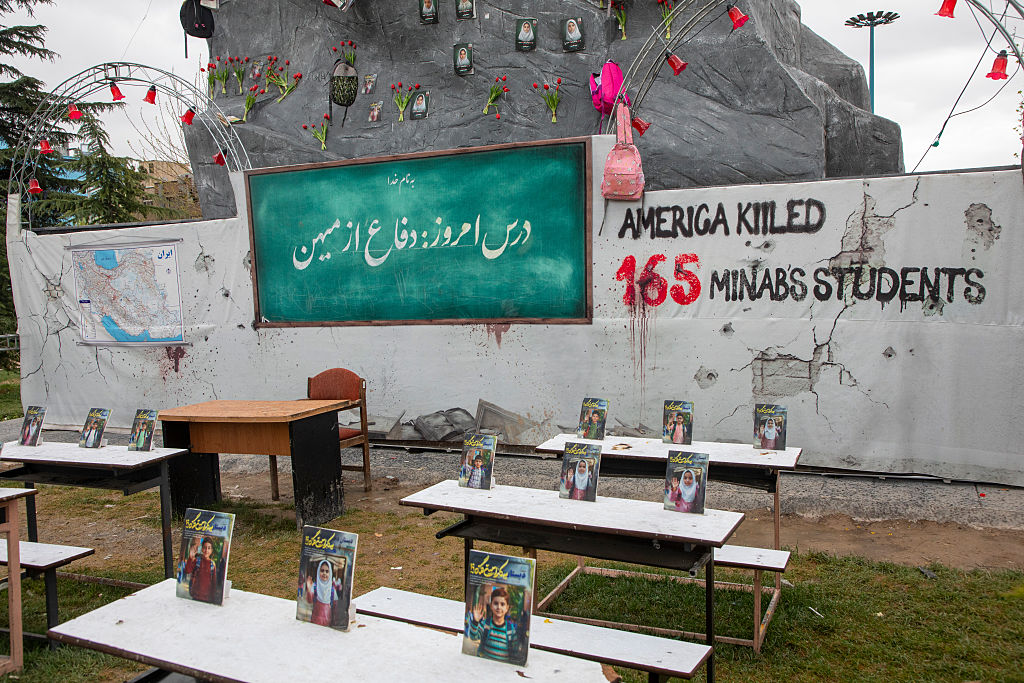
A memorial for the victims of the Shajareh Tayyebeh primary school bombing is on display on March 28, 2026, in Tehran, Iran.

Truthout is a vital news source and a living history of political struggle. If you think our work is valuable, support us with a donation of any size.

The first casualty of war is the truth.

This truism — understandably repeated at the outset of each new U.S. war — is proving itself once again.

With all evidence pointing toward U.S. responsibility for the February 28 bombing of Shajarah Tayyebeh elementary school, President Trump claimed that the attack “was done by Iran.” In spreading this blatant misinformation, Trump was not in fact shattering presidential norms — rather, he was continuing a White House tradition.

Back in 1945, in a public statement announcing the U.S.’s atomic bomb strike on Japan, President Harry Truman falsely described the city of Hiroshima as “an important Japanese Army base.” In fact, the overwhelming majority of those killed were civilians. The bomb targeted thousands of schoolchildren, including nearly 6,000 who died as part of a service patrol near the center of Hiroshima. In Nagasaki, more than 1,400 students and teachers at Shiroyama Elementary School were killed.

But like most students attending U.S. schools after World War II, I was taught that dropping the atomic bombs saved lives.

Related Story

A livestream shows Jerome Powell, chairman of the U.S. Federal Reserve, speaking after a Federal Open Market Committee meeting, on the floor of the New York Stock Exchange in New York City on March 18, 2026.

Interview

|

Politics & Elections

Trump’s Iran War May Mark the Beginning of the End for Dollar-Backed US Empire

Radical economist Costas Lapavitsas discusses the crumbling of the dollar-backed world system and what could be next. By C.J. Polychroniou , Truthout

March 25, 2026

Long before George W. Bush asserted that Saddam Hussein had WMDs, dubious claims and outright lies served as pretexts for the U.S. to launch major wars. A jingoistic fervor following an explosion on the battleship USS Maine prompted the Spanish-American War in 1898. In 1964, LBJ cited a “phantom battle” to push the Tonkin Gulf Resolution authorizing military intervention in Vietnam.

Trump stands out mostly because he made little effort to sell his lies before going to war. In his prime-time address on April 1, 2026, he retroactively offered his first attempt to justify the war, claiming without evidence that Obama’s nuclear deal made Iran a greater threat and that Iran was on the cusp of aiming missiles at “the American homeland.”

Long before George W. Bush asserted that Saddam Hussein had WMDs, dubious claims and outright lies served as pretexts for the U.S. to launch major wars.

Calling truth a casualty of war may imply, however, that truth survives between wars. But the reality is that militarism and the warfare state are sustained by lies which stretch over decades. The ideology of American exceptionalism is driven by the myth that U.S. intervention plays a unique role in spreading freedom and democracy around the globe. Keeping the public uninformed and miseducated has been a key tactic to tamp down dissent.

The most common and continuous form these lies take is omission, erasing the pattern of U.S. war crimes from military records, history textbooks, and public memory. This record of erasure has proven so effective that many of those speaking out against war crimes do not seem to understand the degree to which they, too, have been miseducated. Chastising the Trump administration’s response to the school bombing, The New York Times’s David Wallace-Wells recoiled at the notion of a mass civilian massacre being “treated by U.S. officials as the normal cost of waging war.”

That civilian massacres have been a regular feature of warfare under Democratic and Republican administrations throughout U.S. history has apparently been lost on Wallace-Wells and countless others. Racism and xenophobia play a crucial role in this erasure, as they are used to rally support for war while devaluing the millions of nonwhite lives lost in pursuit of U.S. interests. As General William Westmoreland said bluntly during the Vietnam War, “The Oriental doesn’t put the same high price on life as does a Westerner.”

In this way, war-related lies have been integral to the formation of our national identity.

Trump stands out mostly because he made little effort to sell his lies before going to war.

This is particularly true for the series of wars stretching across East, Central, and West Asia since the late 19th century that I researched for my book, American Peril: The Violent History of Anti-Asian Racism. Rudyard Kipling’s invocation of “the white man’s burden” in his 1899 call for the U.S. to colonize the Philippines was unmistakably racist. But in its time, it was meant to be instructive: Waging the “savage wars of peace” required Americans to shed their “childish” innocence and embrace the brutish nature of imperial power.

The message was sadly taken to heart by U.S. troops in the Philippines, where lynching, torture, concentration camps, and mass murder became all too common. Some atrocities continued long after the U.S. declared an end to combat. In 1906, American troops on Jolo Island in the southern Philippines killed 1,000 Moro people in what the U.S. recorded as a great military victory over Muslim fanatics in the “Battle of Bud Dajo.” Recounted by historian Kim A. Wagner, it was a horrific massacre, whose victims included women and children, as well as outgunned or unarmed men attempting to surrender.

Regarding the firebombing of Tokyo during World War II, Robert McNamara admitted, “In that single night, we burned to death 100,000 Japanese civilians in Tokyo: men, women, and children.” After WWII, McNamara served as secretary of defense, overseeing the escalation of the Vietnam War that resulted in over 3 million deaths. The My Lai massacre, which was marked by wanton slaughter and sexual assault — was initially recorded as a successful defeat of “enemy” combatants in March 1968, but more accurate news about it finally broke through decades of silence on U.S. war crimes. Most Americans quickly bracketed it off, a horrific exception rather than the culmination of a pattern.

But My Lai was a near replay of tragedies from the Korean War that the U.S. military systematically covered up. South Koreans had long memorialized the hundreds of unarmed and defenseless civilians, from babies to elders, massacred by U.S. soldiers at No Gun Ri. It was only brought to the attention of the U.S. public, however, by a Pulitzer Prize-winning team of Associated Press reporters nearly a half-century later. Even today, mainstream histories largely ignore U.S. military involvement in the brutal partition and occupation of Korea.

And My Lai was far from the only civilian massacre in Vietnam. Indeed, on the same day, dozens of Vietnamese civilians in My Khe were killed by U.S. troops. American soldiers commonly used the most vile, racist epithets and dehumanizing stereotypes to characterize Vietnamese people — both combatants and civilians, friends and foes alike. “Murder, torture, rape, abuse, forced displacement, home burnings, specious arrests, [and] imprisonment without due process,” as author Nick Turse documented in Kill Anything That Moves, “were virtually a daily fact of life” for Vietnamese people.

The most common and continuous form these lies take is omission, erasing the pattern of U.S. war crimes from military records, history textbooks, and public memory.

Although the U.S. defeat in Vietnam caused veterans like Colin Powell to adopt a more protective approach to the deployment of U.S. troops, the pattern of civilian massacres continued. On February 13, 1991, over 400 Iraqi civilians taking refuge in a shelter were killed in Amiriyah by two laser-guided “smart bombs” in the U.S.-led war on Iraq. Though in this case U.S. officials did acknowledge the civilian deaths, they were largely dismissed as “collateral damage” from a strike on a military target.

Amnesty International investigated 10 incidents involving at least 140 civilians, including at least 50 children, killed in the U.S.-led war on Afghanistan, for which there were no war crimes prosecutions of any kind. Retired Lieutenant General Douglas Lute, the former deputy national security advisor, acknowledged, “We virtually never held anyone accountable for civilian casualties.”

Whether actively or passively, our culture — just as it fails to value all American lives equally — has internalized the lies that elevate the value of American lives far above those who look like the enemy.

None of this is meant to imply that the U.S. always targets civilians deliberately or to deny that America’s enemies have committed atrocious crimes against humanity. Lies and dehumanization are a common tactic that all parties use in war. But with America’s unrivaled post-WWII military and economic superpower has come the concordant privilege to act with impunity, to disregard what the rest of the world thinks of us, and to dismiss the suffering of others.

Civilian massacres have been a regular feature of warfare under Democratic and Republican administrations throughout U.S. history.

When the Tokyo Trials were set up after World War II to prosecute Japanese war crimes, the U.S. ensured that the conduct of its military was barred from review, setting in motion a chain of disregard for equitable governance under international law. Since 2002, the U.S. has failed to endorse the International Criminal Court. The Trump administration has gone much further, attacking and placing sanctions on its judges, while waging war on Iran with Israel as Prime Minister Benjamin Netanyahu is wanted for arrest by the ICC for war crimes in Gaza.

The incremental steps our own government has taken have been rapidly reversed, as well. Pete Hegseth, the Fox News host turned self-proclaimed “Secretary of War,” bombastically declared that “We negotiate with bombs,” while expressing disdain for “stupid rules of engagement.” Signaling this intent last year, he dismantled Pentagon programs intended to mitigate civilian harm. Such actions complement the misinformation campaign to eliminate “controversial” and “unpatriotic” topics from our public schools and national monuments.

But as the latest wrongheaded war reveals another layer of the United States’s limitations and declining power, those imperial privileges are waning. Trump’s threat to obliterate Iran’s civilian infrastructure should be opposed because it is a war crime in the making against innocent people and because such attacks could boomerang into a global economic meltdown, intensifying suffering at home and abroad.

Holding the individuals responsible for these decisions accountable — at the ballot box and under international law — is just the first step that people in the U.S. can take to become responsible citizens of a global community and stop the next atrocities before they occur. But we cannot wait for change to come from those at the top.

Historian Judy Tzu-Chun Wu has chronicled the diverse U.S. activists who built transnational and multiracial solidarity through travels to Vietnam while it was under siege from the U.S. Since the 1990s, the International Women’s Network Against Militarism has brought U.S. educators, artists, and activists together with women in many of the places most impacted by war and the negative effects of permanent overseas U.S bases. Their multifaceted efforts to overcome militarism advance a decolonial model of solidarity crossing Asia, the Pacific Islands, and the Caribbean.

More recently, the humanitarian aid flotillas acting to alleviate starvation and death in Gaza and Cuba owing to Israel’s and the U.S.’s respective illegal blockades serve as important examples of the people-to-people relations necessary to break the chain of the lies that have torn us apart for too long. Reckoning with the legacy of empire ultimately requires a level of awareness that can best be achieved through these forms of solidarity from below.

Dennis Kucinich: How to Stop the War

April 3, 2026

Consortium News, April 2, 2026

The power of the purse is the surest way Congress can stop the Iran war, or any war. If Congress funds war, Congress authorizes it. If Congress cuts off funds, a war will end.
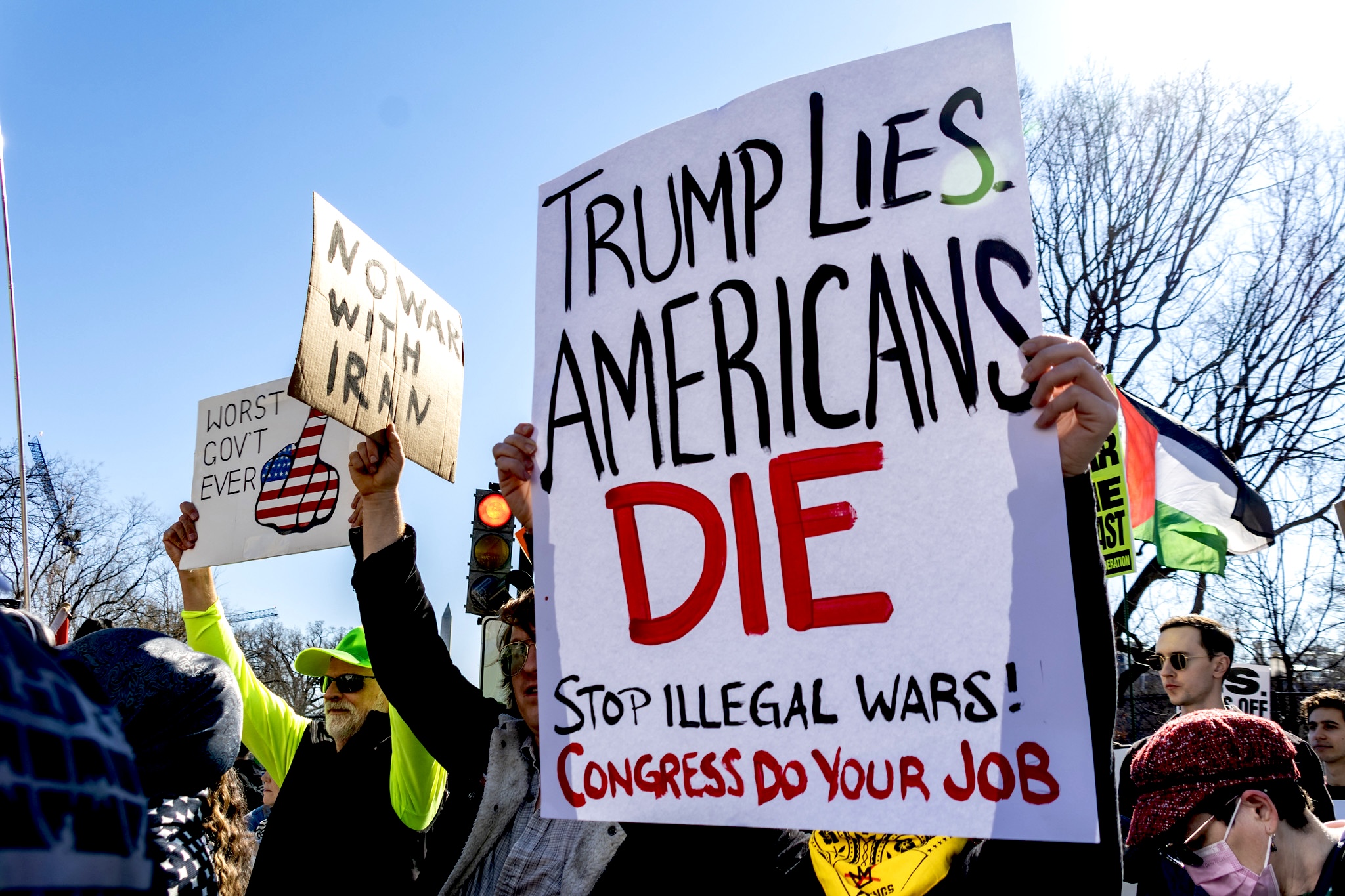
No War On Iran protest at the White House, Washington, D.C., Feb. 28. (Diane Krauthamer, Flickr, CC BY-NC-SA 2.0)

By Dennis Kucinich
Substack

Up to 15,000 of the 50,000 American troops in the Middle East region are being positioned to participate in an assault on Kharg Island, Iran’s critical oil export hub, with the aspiration that America, once in control of Kharg, will turn the tables and assume dominance, opening the Strait of Hormuz for the U.S. and allies, while cutting off Iran from its major source of oil revenue.

Marines and paratroopers, with air and naval support, are poised to invade Kharg’s heavily defended 25-mile coast which features rocky terrain, cliffs and in some places, flat limestone surfaces, each presenting its own strategic calculus and hazards. Special Operations may be tasked with the mission of capturing Iran’s enriched uranium, an equally perilous task.

The U.S. cannot invade and/or hold Kharg Island without taking heavy casualties. Iran has been preparing more than 20 years for an assault on the island and U.S. troops could face potential annihilation with counter-attack coming from all directions, air, land and sea, giving new meaning to Kharg Island’s nickname, ‘The Forbidden Island.’

Our political leaders and their military advisors, unless they have been so infected with the virus of war that they have gone mad, must know our troops are facing slaughter.

We could be witnessing the tragic unfolding of a 21st century version of Custer’s Last Stand, where, at the Battle of Little Big Horn in June of 1876, General George Custer and 215 troops in his command were killed, thoroughly routed by the spiritual and strategic wisdom of native Indian leaders, Sitting Bull and Crazy Horse and their followers.

Custer’s troops had been sent by the U.S. government to reclaim Dakota Sioux land in the Black Hills after the discovery of gold in 1874.

Hubris is not limited to time and space. Underestimation of the strength of the opposition, an aggressive battle doctrine which ignored risk to life, overconfidence and cultural bias were operative at Little Big Horn and are abundantly present today among the Trump Administration’s advisors.

There should be no ground invasion of Kharg or other Iranian islands. There should be no further bombing runs or missile attacks on Iran. It is time to de-escalate, and quickly, to avoid further loss of life, and the world-wide collapse of food, fertilizer, fuel and other basic necessities.
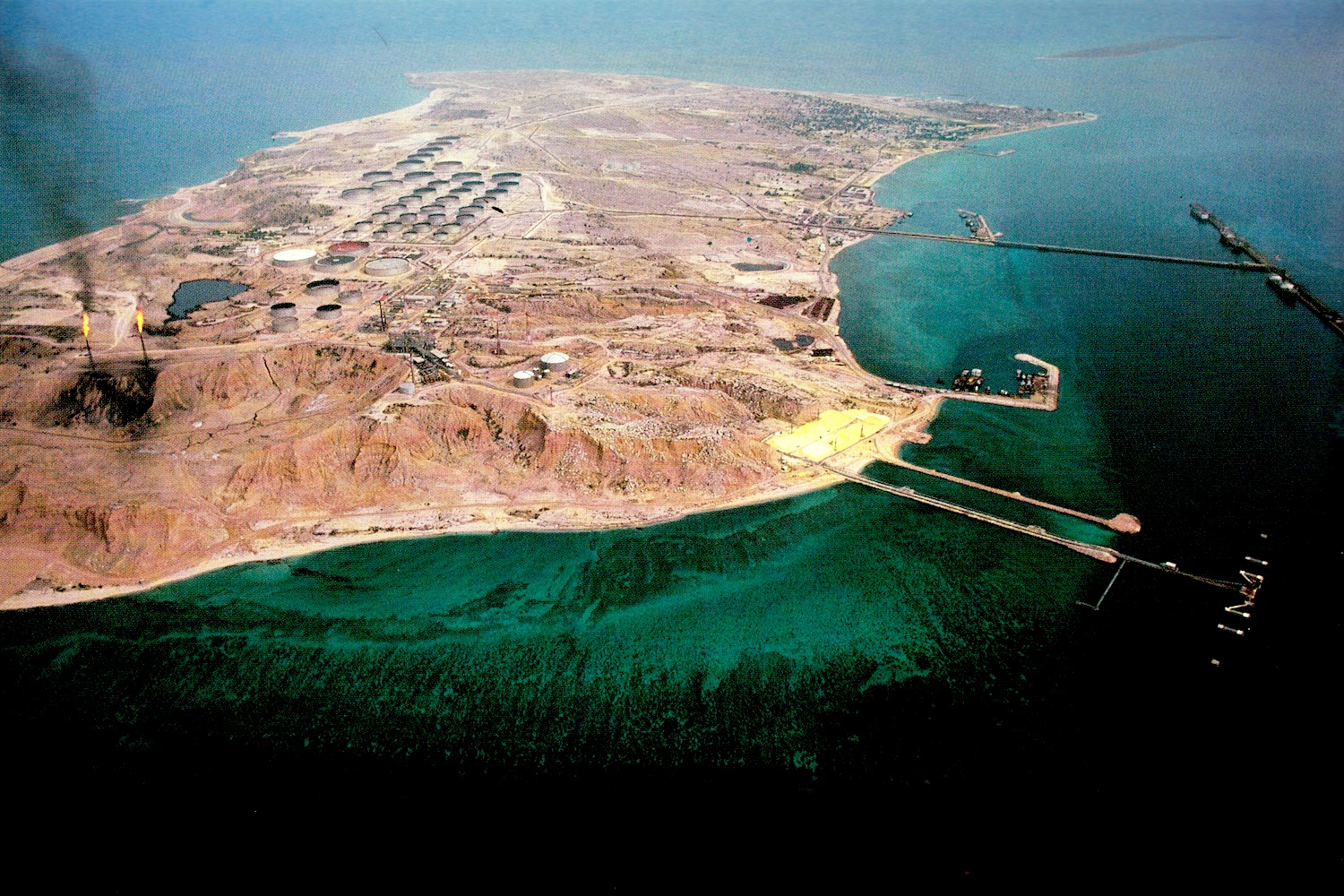
Iran’s Kharg Island, 1973. (Wikimedia Commons/Public Domain)

I am not new to the hazards of malignant U.S. foreign policy. As a member of Congress, I led the effort against the Iraq. War. Over several years, I made 155 speeches in the House of Representatives, specifically cautioning against an attack on Iran, and urging diplomacy.

President Trump has fumbled for explanations for this war. It was for Israel, for regime change, to get rid of enriched uranium, to get rid of Iran’s missiles, and yesterday, according to the Financial Times, the naked reason is blood for oil.

Quoting the president:

“to be honest with you, my favorite thing is to take the oil in Iran, but some stupid people back in the U.S. say: ‘Why are you doing that?’ But they’re stupid people.”

Donald Trump meet Forrest Gump: “Stupid is as stupid does.” (Like cancelling the JCPOA nuclear agreement with Iran in 2018 and then complaining the Iranians are not abiding by it, or killing Iran’s chief negotiator, Ali Larijani , and then grousing there is no one with whom to negotiate.)

In the alternative, perhaps the president and his cronies having recently seized control of $150 billion of oil in Venezuela, are criminal masterminds, using the U.S. military as enforcers for private gain.

The president explained his ‘Rule of (liquid) Gold to The New York Times: “We’re going to be using oil, and we’re going to be taking (Venezuela’s) oil.”

Favored administration insiders make billions through stock manipulations, with advance knowledge of president’s market-pacing blurbs, underscoring war as a gigantic grift.

Bipartisan Knavery & Duplicity

During my service as a member of Congress, I challenged bipartisan knavery and duplicity.

I sued three presidents for violating the Constitution’s war powers, Democrat and Republican alike: Bill Clinton over Serbia, George W. Bush over Iraq, and Barack Obama over Libya.

I presented Articles of Impeachment charging both President George W. Bush and Vice President Dick Cheney with violations of the Constitution. I did so as both parties repeatedly enabled war, not only through the vainglorious, corrupt actions of the Executive branch, but through Congressional nonfeasance.

Congress has failed to exercise its fundamental constitutional responsibilities relating to the War Power, as well as abandoned its preeminent role to curtail war through using the appropriations process.

Here is what I have witnessed as a member of Congress: The Democratic Party, aware of the public’s fatigue over the war in Iraq, ran its 2006 campaign on a promise to end that war.

The second the Democrats returned to power, leaders pledged to continue to fund the war, the very war they promised to end.

The bait and switch of the Democratic Party in the 2006 campaign, promising peace and delivering war, led me to run for president a second time, on a platform of Strength through Peace.

In 2024, Donald Trump promised peace. It was the cornerstone of his campaign. He excited a crossover vote, won the election and he, too, gave us the opposite, under the slogan “Peace through Strength,” followed by heavy military spending and imperial policies which either provoke or initiate war.

A Vote for War 
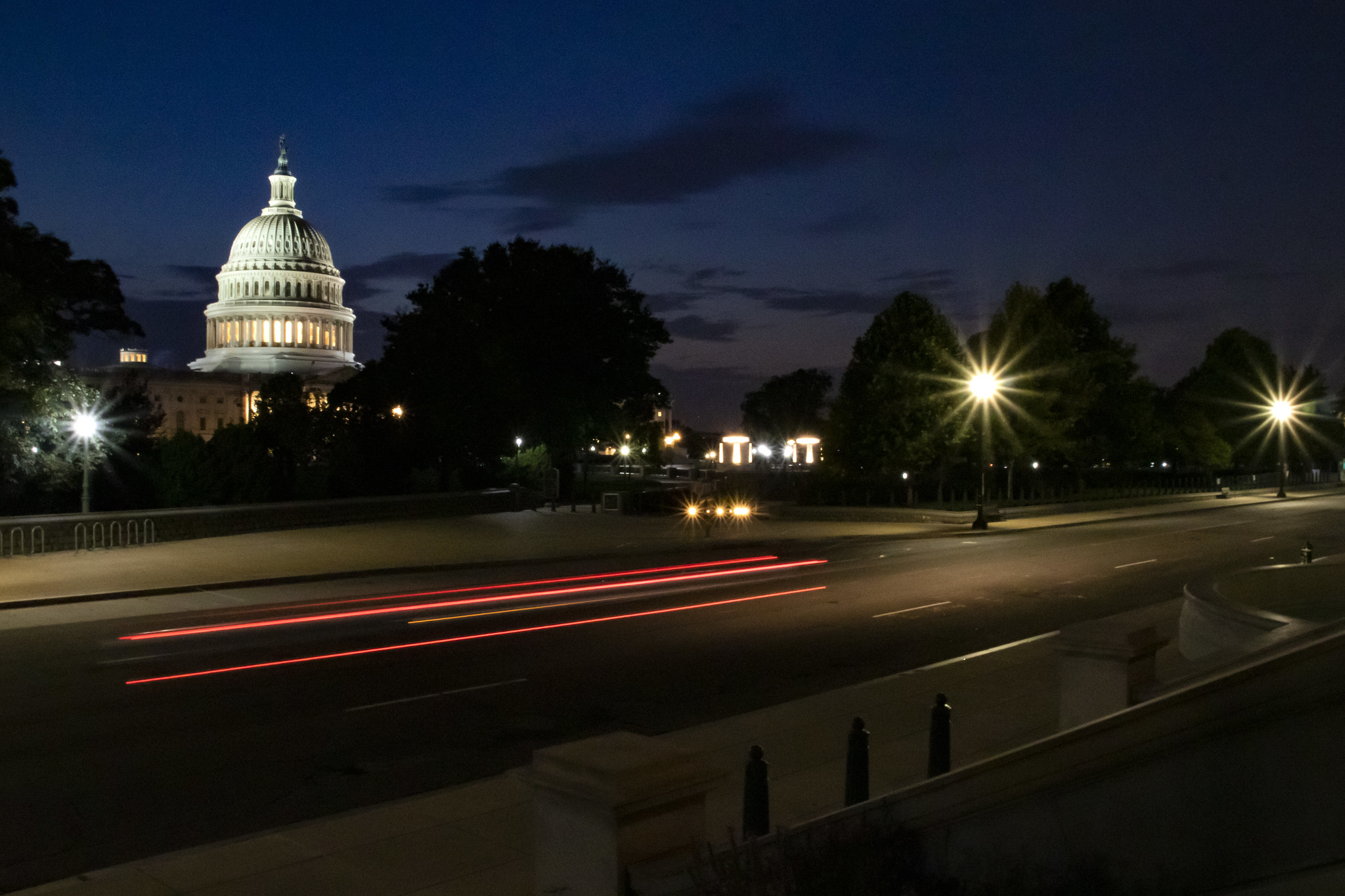
The U.S. Capitol at night from the Library of Congress, 2021. (Diane Krauthamer, Flickr, CC BY-NC-SA 2.0)

If you want to see this war brought to an end, remember this: An appropriations vote is a vote for war. If your congressional representative votes for the National Defense Authorization Act (NDAA), they vote for war.

This is not about disarming. It is about Congress deciding, on our behalf, limitations on aggression. If Congress votes for a supplemental appropriation to replenish missile stocks, and other armaments, they vote for war.

A congressperson cannot truthfully say they oppose war if they have voted to fund war.

The power of the purse is the surest means by which Congress can stop the Iran war, or any war. If Congress funds war, Congress authorizes it. If Congress cuts off funds, this war will be brought to an end.

The Democratic leader of the House, Hakeem Jeffries, has kept open the possibility of support for an additional $200 billion for the Iran War. This in advance of the 2027 annual war appropriation which the president has doubled, requesting $1.5 trillion, (about 80 percent of current discretionary spending).

The use of the power of the purse is the only means by which Congress can stop this war.

Members of Congress supporting a ground attack on Iran have failed to fulfill one of the most important constitutional responsibilities: Only Congress can legally take the American people from peace to a state of war and put America’s sons and daughters in harm’s way. Since Congress will not formally vote on a declaration of war, it enables war to be pursued through appropriations.

The economic costs of war against Iran, already approaching $40 billion, pale in consideration to the moral costs. The murder of 168 girls by a U.S. Tomahawk missile which struck the Shajareh Tayyebeh elementary school, in Minab, Iran on Feb. 28, will forever be a blot on our nation’s conscience.

The assassination of the Ayatollah Ali Khamenei, Iran’s chief of state and religious leader as horrifying as it was illegal. The ongoing loss of thousands of Iranian civilian lives due to U.S. and Israeli bombing similarly violates international law, as well as the U.S.’ own laws and cries out for justice.

And we must never forget the price which American military families have already paid in loss of life or injury to their loved ones.

The wanton devastation our own government inflicts upon others in distant lands, our detachment from the carnage visited upon innocent people abroad, will return home in more coffins, more fractured families and pile misery upon misery in other, incalculable ways.

We cannot escape the consequences of the wrongful decisions of our leaders who disregard the U.S. Constitution, violate international and humanitarian law and capriciously kill civilians in other nations, ultimately placing American lives, both military and civilian, at risk.

Another Crime Against Humanity
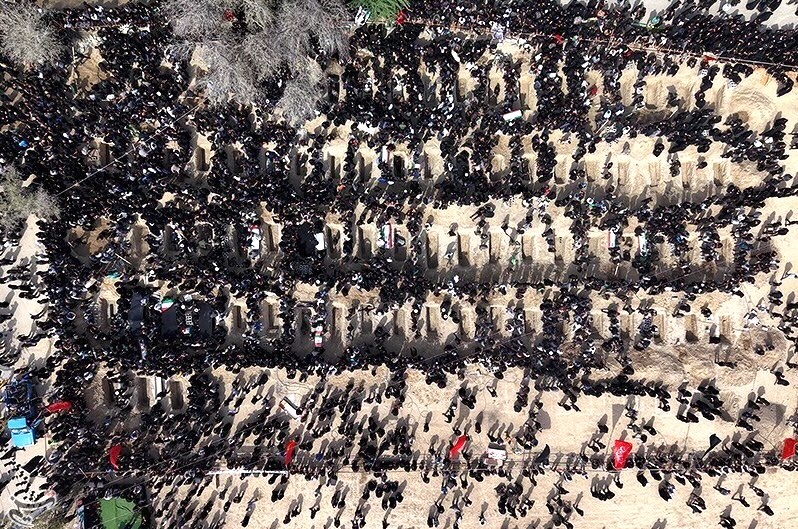
Funeral of the children of the primary girls’ school in Minab, Iran, who were killed in the U.S.-Israeli bombing on Feb. 28. (Tasnim News Agency/ Wikimedia Commons/ CC BY 4.0)

The Iran war is, much like the attacks against the people of Gaza, the West Bank, Lebanon, Syria, Iraq and Yemen, a crime against humanity, compounded by every bomb and missile strike paid for with our tax dollars. President Trump’s repeated threats to obliterate civilian Iranian energy and water infrastructure are textbook war crimes.

Throughout my career I had no hesitation to challenge the unconstitutional abuse of the war power. Federal courts have consistently declined to intervene in disputes between Congress and the president over war powers.

An appropriations vote is the prime political mechanism to start, continue, or to end a war. A “Yes” vote for a Pentagon appropriation is a vote for war. Period.

Exercising the power of the purse, voting “No” on appropriations which enable war, is the only means by which Congress can stop this war and any other war. If Congress funds war, Congress authorizes war.

Congress also has the War Powers Resolution, which can set a deadline for ending hostilities. Recently, Democratic leadership declined to force a War Powers vote, even as there was bipartisan support.

Ultimately, the financial support for war is not about Democrat versus Republican. Both parties have been captured by foreign and domestic interests that profit from endless war.

Our present leaders will continue to search for false justification was the Iran war, seeking to justify the unjustifiable profligate arms spending.

The cost of the Iran War will felt across the country, at the gas pump, and at the supermarket, while our government quibbles over feeding Americans through the SNAP program, as our farmers are go bankrupt. Is there any clearer demonstration that America has lost its way when its way is war?

A nation weakens itself, not through a single decision, but through a pattern of choices that place wars of choice above the well-being of its own people.

We the People Face a Choice
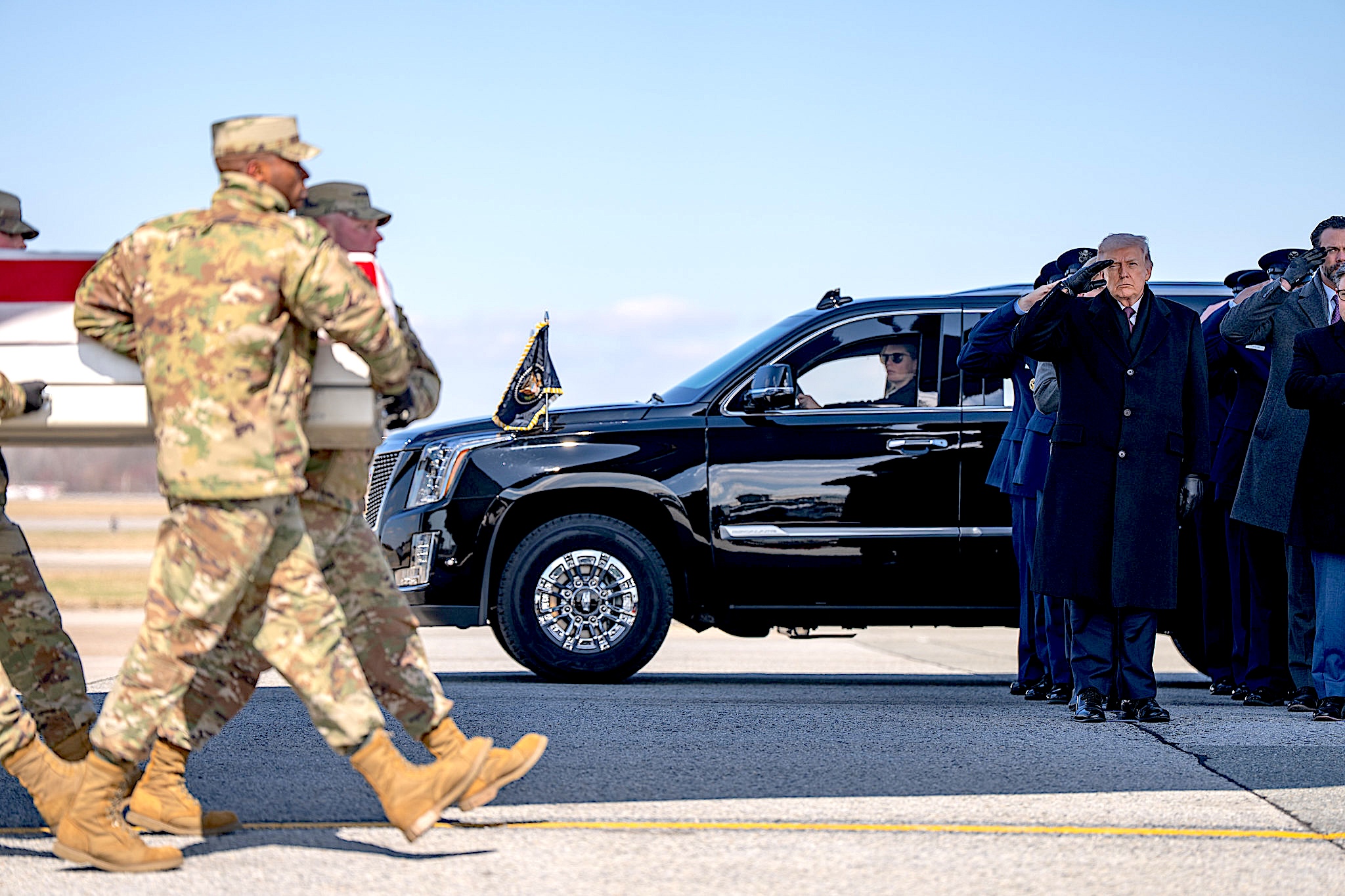
Trump saluting the transfer of six U.S. servicemembers killed in the Middle East on March 18 at Dover Air Force Base, Delaware. (White House / Abe McNatt)

We the People also face a choice. Continued militarization of the budget brings militarization of thought, word and deed, precipitating more conflict, more wars and fewer resources for the needs of the American people, for jobs, wages, health care, education, and retirement security.

It is time for America to come home from the wars.

The midterm elections are approaching. Democrats and Republicans alike must be held accountable.

You, dear reader, have a voice, and it must be heard. Tell your member of Congress, clearly and without ambiguity, that spending more money for war is not acceptable.

It is time for a new path, and that path begins with you.

Get involved in the elections. Show up. Organize. Support candidates who respect the Constitution, who understand the cost of war, and who will not vote to fund war.

Help ensure that those candidates who stand up for the Constitution and who believe in diplomacy and peace are the ones who prevail.

Only an active citizenry can change the outcome. A constitutional republic endures only when its citizens remain vigilant.

That responsibility now rests with you. With us. With We the People.

A Guide to Lobbying:

Find your member of Congress and both your senators:

Call their office directly (websites are linked from the directory above) or phone the Capitol Switchboard and politely ask to be transferred: 1 (202) 224-3121

Ask for your representative’s office. Politely speak to staff. They are usually very young so be nice to them. They are likely as intimidated as you may feel if this is your first time to lobby like this.

Say something like, “My name is XXX. I am a constituent and a primary voter. Please ensure that our representative votes NO on any WAR APPROPRIATIONS BILL.”

Please also write to your representatives. Contact makes a difference. You can also go to their District or D.C. offices in person. Schedule ahead of time if you want to have an official meeting. Bring your friends, family and community with you! Your engagement makes a difference.

Be respectful, polite and confident in what you are asking for.

Kucinich statement after Trump’s Wednesday night address to the nation on Iran:

“The President’s address to the nation was a tone-deaf sale pitch for more war, delivered on the first night of Passover.

Civilian and military casualties are mounting across the region. Lives are being extinguished while triumphalist and violent rhetoric is offered as justification. War is being escalated in the name of peace, a contradiction that demands moral clarity, not political acceptance.

Each life lost carries equal value. No nation’s suffering is expendable. No people exist as collateral.

Iran is not an abstraction, nor just a target on a map. It is one of the great cradles of civilization, a society whose cultural and intellectual contributions long predate the rise of the modern West.

To speak casually of bombing such a nation ‘back to the Stone Age’ reveals a colonial mindset that dehumanizes others and diminishes our own humanity in the process.

The extensive bombing of Iran by the United States and Israel, along with Iran’s counterstrikes, is already taking innocent lives. The global economy is destabilizing as a result.

Energy markets are being disrupted. Oil and gas production is constrained. Fertilizer supply chains are impaired. Critical materials are being cut off.

These consequences will be felt worldwide. Yet the deeper crisis is not economic, it is moral.

We have seen this before. The repeated invocation of a nuclear threat echoes the false claims of ‘Weapons of Mass Destruction’ used to justify the invasion of Iraq.

That war cost thousands of American lives, the lives of hundreds of thousands of Iraqis, and trillions of dollars, while leaving a legacy of instability and grief that endures to this day.

If the President truly sought to prevent a nuclear Iran, he would not have abandoned the JCPOA, an agreement that placed verifiable limits on Iran’s nuclear program. Instead, we are presented with a cycle of escalation that defies logic and invites catastrophe.

Political rhetoric is becoming increasingly radical and dangerous. This is not a question of partisan politics. It is a question of conscience with very real global and domestic consequences.

The American people are not called to accept this. They are called to stand against it.

Members of Congress must have the courage to exercise their constitutional authority and rein this in.

War framed as strength is destruction. Violence presented as necessity is gratuitous violence, with consequences already accelerating destabilizing shifts in the global order.

Congress must act. The Constitution vests in Congress the authority to bring this, and any war, to an end through the power of the purse.

The American people must immediately contact their representatives and demand a NO vote on any supplemental funding that would continue this war. Congress must VOTE NO.”

Dennis Kucinich is a former U.S. Congressman from Cleveland, Ohio, two-time presidential candidate, and founder of The Kucinich Report. Known for his unwavering commitment to peace, justice, and common sense, he has spent decades challenging war, corporate power, and political orthodoxy. Throughout his career, Kucinich led efforts to end U.S. military interventions abroad, championed domestic priorities like healthcare, workers’ rights and environmental protection, and promoted the creation of a Department of Peace. Today, through The Kucinich Report, he offers independent, insightful analysis of politics, foreign policy, and economic power — urging diplomacy, cooperation, and thoughtful leadership as a path toward a safer, more just world.

Oppose the US imperialist war on Iran!

March 1, 2026
David North@davidnorthwsws, 28 Feb 2026

The attack on Iran ordered by Donald Trump and his war-crazed cabal is a massive political crime, illegal under international law and in direct violation of the US Constitution. It has been launched, in collaboration with the genocidal Israeli regime, without even the figment of authorization from Congress, against a country which has not attacked the United States and poses no threat to it.

Within the first hours of this criminal attack, at least 24 students were killed in an air strike on a girls’ school in Minab in southern Iran. How many thousands, tens of thousands and hundreds of thousands will be killed in the days ahead?

Only four days ago, Trump appeared before Congress and the American people to deliver his State of the Union address. Even though he had obviously decided to launch the war, he concealed his decision and barely mentioned Iran in the course of his two-hour rant.

Now, Trump, baseball cap on his head, announced his decision in the dead of night, while most Americans were sleeping. He has set the United States and the entire world on a disastrous course. This war will not solve the internal social crisis of American society, nor will it reverse the protracted deterioration in the global position of US capitalism.

All these contradictions, domestic and international, will be intensified. The war itself will inevitably escalate and engulf the entire planet.

No amount of media propaganda can disguise the fact that the attack on Iran is precisely what was described at the Nuremberg trials of Nazi leaders back in 1945-46 as a “crime against peace.”

In the future, historians will compare Trump’s  February 28, 2026 attack on Iran to Hitler’s September 1, 1939 invasion of Poland. They are crimes of equal magnitude.

The Socialist Equality Party demands that the bloody assault on Iran be stopped immediately.

The working class and youth and all progressive and decent people must oppose this war, which has been launched in the interests of the financial-corporate oligarchy.Available from Mehring BooksThe struggle against imperialism and for workers’ power in IranA pamphlet by Keith Jones

The same administration that has deployed ICE agents to terrorize American cities and neighborhoods, that is violating the Bill of Rights, is the same government that has launched this criminal war.

Call meetings in your factories, workplaces, schools and neighborhoods demanding the immediate end of this war.

The world must know that the American people oppose this war and want no part of it.

Take a stand. Make your voices heard.

Trump Is the Symptom, U.S. Imperialism Is the Disease

May 5, 2025

admin — April 29, 2025

U.S. Peace Council Statement, April 29, 2025 —

Popular resistance to the Trump administration’s erratic, anti-people, and dangerous domestic and foreign policies is growing every day as seen with the massive demonstrations held throughout the country on and after April 5. We welcome these protests and the popular demands raised by them, but we must criticize significant flaws that block the political changes we desperately need.

Criticism is personalized against President Trump, Elon Musk, and the “billionaires” for actions that have been the hallmark of bipartisan policies for decades. Monied interests — not as individuals but as a class, and regardless of their political party — have always been in control of the U.S. government and have prioritized their interests over the interests of the majority, only limited by the organized people’s movements.

Personalizing the criticism and solely blaming the present administration for the problems created by both parties is tantamount to siding with one group of “billionaires” (Democrat) against the other (Republican). Such is the nature of the two-party duopoly as a system, regardless of personnel changes in the White House. Meanwhile, the entire U.S. body politic lurches from one administration to the next on a rightward trajectory toward fascism.

Largely organized by the Democratic party-based group Indivisible, the “Hands Off!” protests were silent about the U.S.’s bipartisan militaristic foreign policy and focused solely on domestic issues, except for “Hands Off NATO.” Revealingly, “Hands Off Palestine” was omitted from the official demands, though grassroots activists raised it.

This intentional silence on foreign policy, and its arbitrary separation from domestic issues, hide the fact that many domestic problems result from a militaristic foreign policy imposed on our country. Trillions of dollars of much needed funds are redirected from human needs to war mongering in Ukraine, West Asia, and Asia-Pacific. Achieving popular power can be most effectively galvanized if it is informed by politically and consciously recognizing the class basis of war and militarism. In contrast, official demands of the “Hands Off!” mobilization, with its embrace of NATO but silence on genocide in Gaza, obscures the class basis of war.

While official lawlessness did not start with Trump, the new president is bent on changing the present post-war imperialist order with another one that gives the empire even more impunity. The U.S. ruling class as a whole has been accelerating the tendency for the U.S. to operate outside the bounds of both national and international law, regardless of who is in office.

The West’s proxy war on Russia continues in Ukraine, while war clouds are gathering around creating another proxy war with the People’s Republic of China using Taiwan and South Korea. And, all the while, the U.S./Israel genocide continues against Palestine and its allies. The imminent war with Iran, supported by both parties, is yet another pressing issue that can best be explained within the framework of imperialism.

On top of all this, is a bipartisan commitment to enhance the repressive apparatus of the state domestically — from cop-cities to the repression on campuses, the criminalization of speech and assembly, restrictions on truthful education, and the further weaponization of the judicial system itself. Intensification of domestic austerity programs, deregulation and destruction of all government organizations that protect and enhance the lives of working people, and attacks on trade unions are the flip side for maintaining a militaristic empire.

All this should make clear that neither of the two billionaire-controlled parties will or can be the urgently needed opposition to imperialism. Current world conditions necessitate building an opposition movement to war and militarism that is even more materially focused on anti-imperialism. This requires understanding the clear link between the empire’s foreign and domestic policies and calling for an end to militarism and redirection of resources to human needs.

Instead of looking for the lesser of two evils, we urge joining people’s independent campaigns to cut the military budget, to close U.S. and NATO foreign military bases, to establish Zones of Peace in our region, and to stop the militarization of police and domestic repression. An anti-imperialist understanding is key to the success of our people’s struggle for peace and a more just society.

𝐓𝐨𝐩 𝐍𝐀𝐓𝐎 𝐎𝐟𝐟𝐢𝐜𝐢𝐚𝐥 𝐓𝐞𝐥𝐥𝐬 𝐄𝐮𝐫𝐨𝐩𝐞𝐚𝐧 𝐁𝐮𝐬𝐢𝐧𝐞𝐬𝐬𝐞𝐬 𝐓𝐨 𝐆𝐞𝐭 𝐑𝐞𝐚𝐝𝐲 𝐟𝐨𝐫 𝐖𝐚𝐫

November 26, 2024

Adm. Rob Bauer previously said NATO countries should consider shifting to a ‘war economy‘

by Dave DeCamp, Antiwar. com, November 25, 2024

The head of NATO’s Military Committee has called on European businesses to prepare for a “wartime scenario” amid soaring tensions between the Western military alliance and Russia.

Dutch Adm. Rob Bauer said Western businesses must adjust to become less vulnerable to both Russia and China. “If we can make sure that all crucial services and goods can be delivered no matter what, then that is a key part of our deterrence,” Bauer said at a European Policy Centre event in Brussels, according to Reuters.

Bauer said energy supplies could be targeted or used as weapons of war. “We’re seeing that with the growing number of sabotage acts, and Europe has seen that with energy supply,” he said. “We thought we had a deal with Gazprom, but we actually had a deal with Mr Putin. And the same goes for Chinese-owned infrastructure and goods. We actually have a deal with (Chinese President) Xi (Jinping).”

US and European officials have accused Russia of weaponizing energy, but Moscow began reducing gas shipments to Europe in 2022 in response to Western sanctions meant to destroy the Russian economy.

Bauer also said Western economies were too dependent on China. “We are naive if we think the Communist Party will never use that power. Business leaders in Europe and America need to realize that the commercial decisions they make have strategic consequences for the security of their nation,” he said. “Businesses need to be prepared for a wartime scenario and adjust their production and distribution lines accordingly. Because while it may be the military who wins battles, it’s the economies that win wars.”

Last year, Bauer called for NATO countries to consider shifting to a “war economy” where civilian factories would begin producing military goods, similar to what the US did during World War II. “Those priorities should be discussed about, partially, a war economy in peacetime,” he said in January 2023.

Bauer also said at the time that NATO was “ready” for a direct confrontation with Russia. Today, that confrontation is much more likely following the US authorization of long-range strikes on Russian territory with NATO missiles, a step Moscow has made clear risks a nuclear escalation.