Posts Tagged ‘History’

Jewish Americans and Allies Occupy Trump Tower Demanding Release of Mahmoud Khalil

March 15, 2025

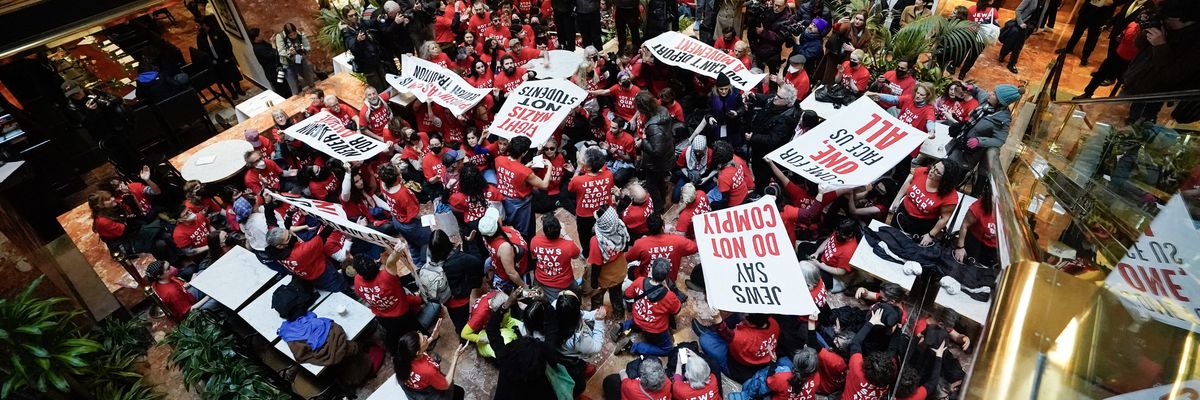
Demostrators from the human rights organization Jewish Voice for Peace hold a civil disobedience action

Demostrators from the human rights organization Jewish Voice for Peace hold a civil disobedience action inside Trump Tower in New York on March 13, 2025.

(Photo: Timothy A. Clary/AFP via Getty Images)

“We know what happens when an autocratic regime starts taking away our rights and scapegoating and we will not be silent.”

Julia Conley

Mar 13, 2025

This is a developing story… Please check back for possible updtes…

Nearly a year and a half after the advocacy group Jewish Voice for Peace began leading nationwide demonstrations against Israel’s U.S.-backed assault on Gaza, hundreds of organizers and supporters of the group risked arrest Thursday as they assembled in the lobby of Trump Tower in New York City, demanding the release of Columbia University graduate Mahmoud Khalil.

“Three hundred Jews and friends in Trump Tower, because we know what happens when an autocratic regime starts taking away our rights and scapegoating and we will not be silent,” said Sonya Meyerson-Knox, communications director for Jewish Voice for Peace (JVP). “Come for one—face us all.”

The latter phrase was emblazoned on banners that were displayed by campaigners, who chanted, “Never again for anyone, never again is now!” and, “Free Mahmoud, free them all!”

New York City police officers began arresting participants in the sit-in early in the afternoon.

Jane Hirschmann, a Jewish New York resident whose grandfather and uncle were abducted by the Nazis in Germany as Adolf Hitler rose to power, said Khalil’s detention “is further proof that we are on the brink of a full takeover by an authoritarian regime.”

“As Jews of conscience, we know our history and we know where this leads,” said Hirschmann. “This is what fascists do as they cement control. This moment requires all people of conscience to take bold action to resist state violence and repression. Free Mahmoud now.”

Actors Morgan Spector, Debra Winger, and Arliss Howard were in attendance at the sit-in, along with writer and artist Molly Crabapple and New York City Council member Alexa Aviles.

Khalil was abducted by plainclothes Immigration and Customs Enforcement (ICE) agents last Saturday night as he was returning home to his Columbia-owned apartment with his wife, who is eight months pregnant. He was a graduate student at the university until this past December, and took a central organizing role in student-led protests and negotiations against Columbia’s investment in companies that profit from Israel’s apartheid policy in Gaza, including the bombardment it began in October 2023 in retaliation for a Hamas-led attack.

Khalil, a legal U.S. resident and a citizen of Algeria, was detained under the State Department’s “catch and revoke” program, with the Trump administration revoking his green card and threatening to deport him. Administration officials have admitted that they are not accusing Khalil of breaking any laws by participating in Palestinian solidarity protests, but they said he is viewed as “adversarial to the foreign policy and national security interests of the United States of America.”

After a hearing Wednesday, a federal judge is considering whether Khalil should be sent back to New York, where he was detained, from the Louisiana ICE facility where he is being held. The same judge blocked Khalil’s deportation this week.

An Unconstitutional Rampage


Trump and Musk are on an unconstitutional rampage, aiming for virtually every corner of the federal government. These two right-wing billionaires are targeting nurses, scientists, teachers, daycare providers, judges, veterans, air traffic controllers, and nuclear safety inspectors. No one is safe. The food stamps program, Social Security, Medicare, and Medicaid are next.

It’s an unprecedented disaster and a five-alarm fire, but there will be a reckoning. The people did not vote for this. The American people do not want this dystopian hellscape that hides behind claims of “efficiency.” Still, in reality, it is all a giveaway to corporate interests and the libertarian dreams of far-right oligarchs like Musk.

Common Dreams is playing a vital role by reporting day and night on this orgy of corruption and greed, as well as what everyday people can do to organize and fight back. As a people-powered nonprofit news outlet, we cover issues the corporate media never will, but we can only continue with our readers’ support.
about:blank

about:blank

Our work is licensed under Creative Commons (CC BY-NC-ND 3.0). Feel free to republish and share widely.

Julia Conley

Julia Conley is a staff writer for Common Dreams.
Full Bio >

When anti-war protesters are called national security threats

March 13, 2025

Mahmoud Khalil

Is this what VP Vance meant by free speech ‘in retreat’? Case of detained green card holder shows how ‘brittle’ our rights are here, too.

Analysis | Washington Politics

  1. washington politics
  2. israel-palestine

Lora Lumpe

Mar 11, 2025

Vice President JD Vance stunned Europe at the Munich Security Conference in February by calling the continent out for serious backsliding on core democratic principles.

He cited annulled elections when the wrong candidate appeared slated to win, digital censorship of opinions that run afoul of the majority or established perspective, and the policing of silent thought (prayer) as exhibits A, B, and C. “In Britain, and across Europe, free speech, I fear, is in retreat.”

After acknowledging similar trends in President Biden’s America, Vance boasted that, “In Washington, there is a new sheriff in town. And under Donald Trump’s leadership, we may disagree with your views, but we will fight to defend your right to offer it in the public square, agree or disagree.”

Unless you are a green card holder talking about Israel.

At an Oval Office memo signing/media spray the day of Vance’s Munich speech, the New Sheriff said he completely agreed with Vance’s assessment about the importance of free speech. Less than a month later, though, President Trump dispatched Department of Homeland Security immigration agents to arrest and abduct Mahmoud Khalil, a permanent and lawful resident of the United States, married to an American citizen, when he and his wife returned home from dinner.

His “crime”: participating in the non-violent demonstrations at Columbia University that inspired students across the country to stand up and demand that the U.S. government stop aiding and abetting mass killing in Gaza, including of tens of thousands of women and children.

While anti-war demonstrations have almost always been viewed as — and are — squarely protected by the First Amendment’s free speech and right of assembly guarantees, Trump is painting demonstrations against the Gaza war as “pro-terrorist, anti-semitic, anti-American activity.”

The pro-Israel Free Press quoted an unnamed White House official as acknowledging that “the allegation here is not that he was breaking the law,” but that Khalil “is a threat to the foreign policy and national security interests of the United States.”

Newsletter

Subscribe now to our weekly round-up and don’t miss a beat with your favorite RS contributors and reporters, as well as staff analysis, opinion, and news promoting a positive, non-partisan vision of U.S. foreign policy.

Invalid emailEnter your email

This was echoed in remarks by White House spokeswoman Karoline Leavitt, who said Tuesday in an answer to a question about the administration’s basis for deporting Khalil that, “under the Immigration and Nationality Act, the Secretary of State has the right to revoke a green card or a visa for individuals who … are adversarial to the foreign policy and the national security interests of the United States of America.” She added then that Khalil “sided with terrorists” by organizing protests that disrupted classes and harassed Jewish-American students and made them “feel unsafe.” She also accused protesters of handing out fliers “with the logo of Hamas.”

Jewish groups were among those protesting in New York City against Khalil’s pending deportation on Tuesday. Reports dating back to last year indicate that Khalil was not an organizer, but had served as a negotiator on behalf of students who had erected an encampment on campus.

Quite the opposite of strengthening free speech and our democracy, Trump appears to be leading us into a new McCarthyism. The president blasted out on his Truth Social account that, “this is the first of more [arrests and deportations] to come…We know there are more students at Columbia and other Universities across the Country…We will find, apprehend, and deport these terrorist sympathizers from our country — never to return again.”

Leavitt also ominously foreshadowed a looming clash on Columbia’s campus, saying that university officials are refusing to help DHS identify a list of other individuals on campus the administration has identified — reportedly through a search of students’ social media accounts. “[A]s the president said very strongly in his statement yesterday, he is not going to tolerate that.”

Meanwhile, Khalil was whisked far away from his wife in New York, who is eight months pregnant, to the LaSalle Detention Facility in Jena, Louisiana, a private prison, according to reports. He would likely have been deported already if not for a fast-acting federal judge in New York who blocked his removal from the United States until after a hearing, expressly forbidding deportation without approval by the court. The initial hearing is slated for Wednesday. Critics worry the administration “shopped” for a judge more sympathetic to its case.

We still do not know what he has been charged with, if anything, or any of the evidence against him.

The prohibition of free speech by student visa holders and permanent citizen green card holders in the United States is a clear and fundamental assault on our democracy — an effort to squelch and chill freedom of speech. It sends the same signal to the rest of the world that Vance and Trump accused Europe of sending: weakness and fear. If peaceful protest by students against a policy poses such a threat to our “national security,” how strong can we really be?

Back at the Munich Security Conference, Vance said: “the good news is that I happen to think your democracies are substantially less brittle than many people apparently fear, and I really do believe that allowing our citizens to speak their mind will make them stronger still.” The Vice President was right. And now is the time for vehement and loud assertion that free speech is not in retreat in America.

Lora Lumpe

Lora Lumpe is the CEO of the Quincy Institute for Responsible Statecraft. 

The views expressed by authors on Responsible Statecraft do not necessarily reflect those of the Quincy Institute or its associates.

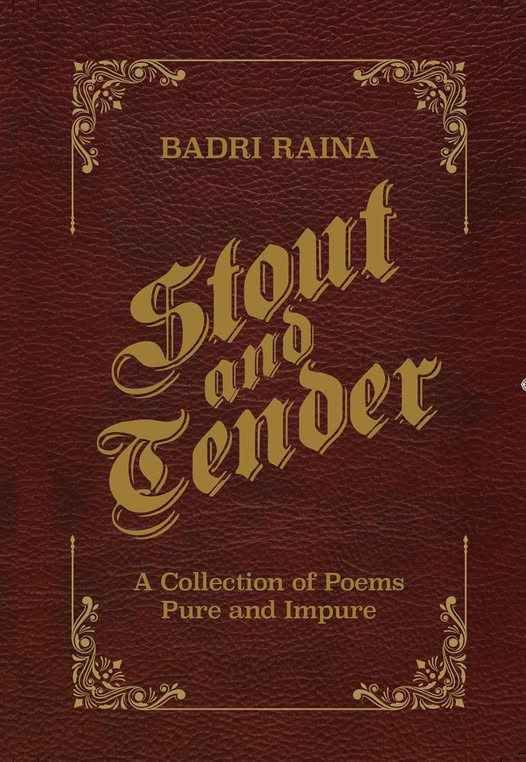
𝐑𝐞𝐯𝐢𝐞𝐰 𝐨𝐟 𝑆𝑡𝑜𝑢𝑡 𝑎𝑛𝑑 𝑇𝑒𝑛𝑑𝑒𝑟

February 21, 2025

by Nasir Khan

Indian academic Badri Raina’s book 𝑆𝑡𝑜𝑢𝑡 𝑎𝑛𝑑 𝑇𝑒𝑛𝑑𝑒𝑟 shows the poetic side of an imaginative and versatile poet, whose political articles and analyses mostly deal with Indian social and political developments which he witnessed since the horrid Partition of India in 1947, including the Princely State of Jammu and Kashmir where he had his ancestral home. As a young boy, those events and the subsequent history of Kashmir seem to have deeply impacted him and shaped his outlook.

Those who have read his political articles know he has stood stoically for the marginalised, socially and politically suppressed ethnic communities and religious minorities in a country where the far-right revanchist forces gradually got the upper hand. Raina’s work has been to defend the democratic norms of the Republic, and espouse the cause of the neglected and marginalised people. It is within this political and cultural context of the Indian subcontinent, that we can appraise his sympathies and concerns for many of his poems.

Most of his poems reflect a deep commitment to social and political causes, which he shares with many other social revolutionaries, reformers and humanists. His imagination is fertile and vivid and his vision unbound, always in tune with the realities that we all face. In his choice of words for the varying themes he writes about, he is direct and also appealing and persuasive.

In his poem, 𝑃𝑎𝑙𝑒𝑠𝑡𝑖𝑛𝑒, he touches our deep feelings as we witness what its people have faced for over a century, but are still resisting the oppressors. His two lines summarise volumes of what words can narrate:

No Atlas lifted a heavier load

than you, O Palestine!

Only a sensitive soul who knows the history and the alignment of dominant forces that control the present world order (or disorder) could have spoken in such a way. However, despite all the savagery and apathy of the ruling elites that people face globally, Raina remains true to his socialist outlook, by taking an optimistic view of the people’s struggles for freedom, equality, justice and humane values and their historical relevance.

This collection of poems in this beautifully produced paperback edition makes a substantial literary contribution for English-speaking readers to delve into. For all this, both Raina and the producer of the volume deserve our heartfelt thanks and admiration.

A brief personal note: Badri Raina and I were born in the same year and month in the Princely State of Jammu and Kashmir! He is from Srinagar, while I am from Poonch, which is now in the Pakistani-held part of Kashmir. For over two decades, we have been close comrades and brothers.

Badri Raina’s 𝑆𝑡𝑜𝑢𝑡 𝑎𝑛𝑑 𝑇𝑒𝑛𝑑𝑒𝑟: A Collection of Poems, is available on: Amazon USA and Amazon UK

𝕆𝕟 𝕂𝕒𝕣𝕝 𝕄𝕒𝕣𝕩’𝕤 𝕃𝕚𝕗𝕖 𝕒𝕟𝕕 𝕀𝕕𝕖𝕒𝕤

October 27, 2024

–Nasir Khan

“All mysteries which lead theory to mysticism find their rational solution in human practice and in the comprehension of this practice.”

― Karl Marx

Karl Marx was born on May 5, 1818, in the Prussian province of Rhine, and died in London in March 1883, at the age of 65. He was the most influential socialist philosopher and revolutionary thinker, whose ideas have deeply influenced the course of human history and human thought.

His writings cover philosophy, history, political economy, anthropology, social criticism, history, theory of revolutionary practice, and he himself participated in revolutionary activities. When he was a student at the university, he was deeply involved in the Young Hegelian movement. The members of this group in their articles and pamphlets criticized Christian culture. Feuerbach’s materialism was opposed to Hegel’s idealism. He reduced Hegel’s ‘Absolute Spirit’ to human ‘species being’.

Because of Marx’s critical articles in the Rheinische Zeitung, the government closed this paper. He went to Paris in 1843 where he made contacts with French socialist groups and emigre German workers. Here he met Frederick Engels and the two became friends for the rest of their lives. But his stay there was short. He was expelled from Paris in 1844.

After his expulsion from Paris, Marx, along with Engels, moved to Brussels, where they lived for three years. After an intensive study of history, he formulated the theory of history commonly known as historical materialism.

In his theory of history, Marx accepted Hegel’s idea that the world develops according to dialectical process. But the two had different ideas about what the dialectic process entails. For Hegel, historical developments take place through the mystical entity called Absolute Spirit. Marx rejected the notion of Absolute Spirit, and said what moved society was not the Absolute Spirit, but man’s relation to matter, of which the most important part was played by the mode of production.

In this way, Marx’s materialism becomes closely related to economics. Human labour shaped society, and material conditions determined the superstructures. The part played by labour, not some mystical Absolute Spirit, formed the basis of social life. Marx’s dialectal view of social change is shorn of Hegel’s idealist dialectics. The two stand on different levels, and their philosophies of history differ.

For Marx, man working on nature remakes the world and in doing so he also remakes himself by increasing his powers. Marx wrote in the German Ideology, ‘Men have history because they must produce their life.’

Marx went to Paris in 1848 where the revolution first took place and then to Germany. But the failure of the revolutions forced him to seek refuge in London in 1849, where he spent the rest of his life.

He and his family had to face many economic hardships in London. His friend Engels helped him economically and he himself wrote articles as a foreign correspondent for the New York Daily Tribune for which he was paid reasonably well. But he and his family had unending economic problems.

However, the revolutionary thinker devoted much time to the First International and its annual Congresses. The rest of the time, he spent in the British Museum library, collecting material and taking notes and analysing the material for studies of political economy. In 1867, he published the first volume of Capital, in which he discussed the capitalist mode of production. He explained his views on the labour theory of value, the conception of surplus value, accumulation of capital and the ‘so-called primitive accumulation’ in the final part of the book. He had completed the volumes II and II in the 1860s, which Engels published after the death of Marx in 1883.

The profound analysis of capital, Marx undertook in the nineteenth century, is still relevant to our understanding the global capitalism and the forces that control it. He had shown the tendency of capital under the general law of capitalist accumulation. A few own more wealth, but others have little to live on. A recent Oxfam report says that eight men own the same wealth as the 3.6 billion people, who form the poorest half of humanity. In the global economy, rich industrialists and producers take advantage of the global workforce that mostly lives in the global South. The abundant cheap labour from the poor countries is used to produce goods that are sold at high prices in the industrialized western countries.

The problem to end the exploitation of the working-class people was a core issue for Marx, and his theory to end this exploitation can only take place when a more equitable form of society is created that stands opposed to the accumulation of capital by a few and the poverty or meagre existence of the majority. That objective of a human society is not possible under capitalism.

UN demands prosecution of Bush-era CIA crimes

March 5, 2013
.
RT,  March 04, 2013
.
AFP Photo / Paul J. Richards

AFP Photo / Paul J. Richards

A United Nations investigator has demanded that the US publish classified documents regarding the CIA’s human rights violations under former President George W. Bush, with hopes that the documents will lead to the prosecution of public officials.

Documents about the CIA’s program of rendition and secret detention of suspected terrorists have remained classified, even though President Obama’s administration has publicly condemned the use of these “enhanced interrogation techniques”. The US has not prosecuted any of its agents for human rights violations.

UN investigator Ben Emmerson, the UN special rapporteur on the promotion and protection of human rights while countering terrorism, said that the classified documents protect the names of individuals who are responsible for serious human rights violations.

Continues >>

Top Ten Myths about the Israeli-Palestinian Conflict

June 19, 2010

Jeremy R. Hammond, Foreign Policy Journal, June 17, 2010

A Palestinian boy throws a stone at an Israeli  tank in the occupied West Bank.

Myth #1 – Jews and Arabs have always been in conflict in the region.

Although Arabs were a majority in Palestine prior to the creation of the state of Israel, there had always been a Jewish population, as well. For the most part, Jewish Palestinians got along with their Arab neighbors. This began to change with the onset of the Zionist movement, because the Zionists rejected the right of the Palestinians to self-determination and wanted Palestine for their own, to create a “Jewish State” in a region where Arabs were the majority and owned most of the land.

For instance, after a series of riots in Jaffa in 1921 resulting in the deaths of 47 Jews and 48 Arabs, the occupying British held a commission of inquiry, which reported their finding that “there is no inherent anti-Semitism in the country, racial or religious.” Rather, Arab attacks on Jewish communities were the result of Arab fears about the stated goal of the Zionists to take over the land.

Continues >>

The U.N. Partition Plan and Arab ‘Catastrophe’

April 14, 2010
by Jeremy R. Hammond, Foriegn Policy Journal, April 13, 2010

The following is excerpted from The Rejection of Arab Self-Determination: The Struggle for Palestine and the Roots of the Arab-Israeli Crisis.

In 1947, Great Britain, unable to reconcile its conflicting obligations to both Jews and Arabs, requested that the United Nations take up the question of Palestine. In May, the U.N. Special Committee on Palestine (UNSCOP) was created by a General Assembly resolution. UNSCOP’s purpose was to investigate the situation in Palestine and “submit such proposals as it may consider appropriate for the solution of the problem of Palestine”.

Continues >>

Democracy in America is a useful fiction

January 26, 2010

Chris Hedges, truthdig.com,  January 24, 2010

Original: AP / Charles Dharapak

Corporate forces, long before the Supreme Court’s decision in Citizens United v. Federal Election Commission, carried out a coup d’état in slow motion. The coup is over. We lost. The ruling is one more judicial effort to streamline mechanisms for corporate control. It exposes the myth of a functioning democracy and the triumph of corporate power. But it does not significantly alter the political landscape. The corporate state is firmly cemented in place.

Continues >>

Celebrating Slaughter: War and Collective Amnesia

October 7, 2009

by Chris Hedges, TruthDig.com, Oct 5, 2009

War memorials and museums are temples to the god of war. The hushed voices, the well-tended grass, the flapping of the flags allow us to ignore how and why our young died. They hide the futility and waste of war. They sanitize the savage instruments of death that turn young soldiers and Marines into killers, and small villages in Vietnam or Afghanistan or Iraq into hellish bonfires. There are no images in these memorials of men or women with their guts hanging out of their bellies, screaming pathetically for their mothers. We do not see mangled corpses being shoved in body bags. There are no sights of children burned beyond recognition or moaning in horrible pain. There are no blind and deformed wrecks of human beings limping through life. War, by the time it is collectively remembered, is glorified and heavily censored.

Continues >>

Christian Soldiers in Afghanistan

May 30, 2009

by Valerie Elverton Dixon | Sojourners.net, May 30, 2009

William Faulkner once said: “The past is not dead.  In fact, it’s not even past.”  We often think about time and history as a straight line leading from the past, running through the present, heading into the future. With this conceptualization, the past is past and gone.  However, there is another way to think about time.  Tree time.  When we cut down a tree, the rings of the stump are concentric circles of time. The first year exists at the center and each succeeding year surrounds it.

So it is with the meeting of Christianity and Islam on the battle fields of Afghanistan and Iraq.  The historical center of the present conflict is the history of the Crusades.  Many in the Muslim world consider the U.S. presence in Iraq and Afghanistan as another Crusade.  The Crusades were wars between Christians and Muslims, Christians and Pagans, Christians and Christians over four centuries.  It was a tragic time when armies of the state fought to promote a religious cause.  Crusaders travelled far from home as warriors and pilgrims, warriors and penitents, warriors as walls to stall the spread of Islam.  They won and lost battles.  They destroyed and plundered and raped. They were sometimes brutally massacred when the Muslims won on a particular day.

This historical core has not passed from the consciousness of some observers.  Enter the U.S. military.  The military is full of Christians.  Many of these men and women consider themselves as fundamentalist and evangelical.  An important part of their religious commitment is to witness to Jesus Christ as their personal Lord and savior and to win souls to Christ.  At the same time, the U.S. military has a strict rule against proselytizing.  And so the warriors must walk a fine line between obligations to faith and country.

However, in my opinion, at least one soldier has been unfairly characterized in this discussion.  From what I can tell from the four minute video of a group of Christian soldiers in Afghanistan, army chaplain Captain Emmitt Furner gave them sound advice.  He reminded them of the army regulation and he reminded them that to witness to and for Jesus was more a walk than a talk. It is what we as Christians do that is important.  He said:  “You share the word in a smart manner: love, respect, consideration for their culture and their religion.  That’s what a Christian does is appreciation for other human beings.”  Another soldier in the group spoke of love and respect for the people they meet.

Some observers see Captain Furner’s advice as a sly way to spread the gospel, an element of a 21st century Crusade.  In my opinion, this interpretation is incorrect.  He gave his fellow soldiers the instruction to be living epistles that can be known and read by all (2 Corinthians 3:2).  It is an instruction that we who are not on the front lines in Afghanistan and in Iraq can use.

Dr. Valerie Elverton Dixon is an independent scholar who publishes lectures and essays at JustPeaceTheory.com. She received her Ph.D. in religion and society from Temple University and taught Christian ethics at United Theological Seminary and Andover Newton Theological School.