https://substack.com/visited-surface-framehttps://substack.com/session-attribution-frame

Jonathan Larsen’s Substack
Advocacy group reports commanders giving similar messages at more than 30 installations in every branch of the military
Mar 03, 2026
To support my reporting and keep it free for everyone, you can become a paid subscriber. Thank you.
A combat-unit commander told non-commissioned officers at a briefing Monday that the Iran war is part of God’s plan and that Pres. Donald Trump was “anointed by Jesus to light the signal fire in Iran to cause Armageddon and mark his return to Earth,” according to a complaint by a non-commissioned officer.
From Saturday morning through Monday night, more than 110 similar complaints about commanders in every branch of the military had been logged by the Military Religious Freedom Foundation (MRFF).
The complaints came from more than 40 different units spread across at least 30 military installations, the MRFF told me Monday night.
The MRFF is keeping the complainants anonymous to prevent retribution by the Defense Department. The Pentagon did not immediately respond to my request for comment.
One complainant identified themselves as a non-commissioned officer (NCO) in a unit currently outside the Iran combat zone but in Ready-Support status, deployable at any time. The NCO said they were Christian and emailed the MRFF on behalf of 15 troops, including at least 11 Christians, one Muslim, and one Jew. (Full email printed below.)
The NCO wrote to the MRFF that their commander “urged us to tell our troops that this was ‘all part of God’s divine plan’ and he specifically referenced numerous citations out of the Book of Revelation referring to Armageddon and the imminent return of Jesus Christ.”
This is nota paywall. My reporting is free for everyone because some readers support my work by becoming paid subscribers. You can become a free or paid subscriber here:
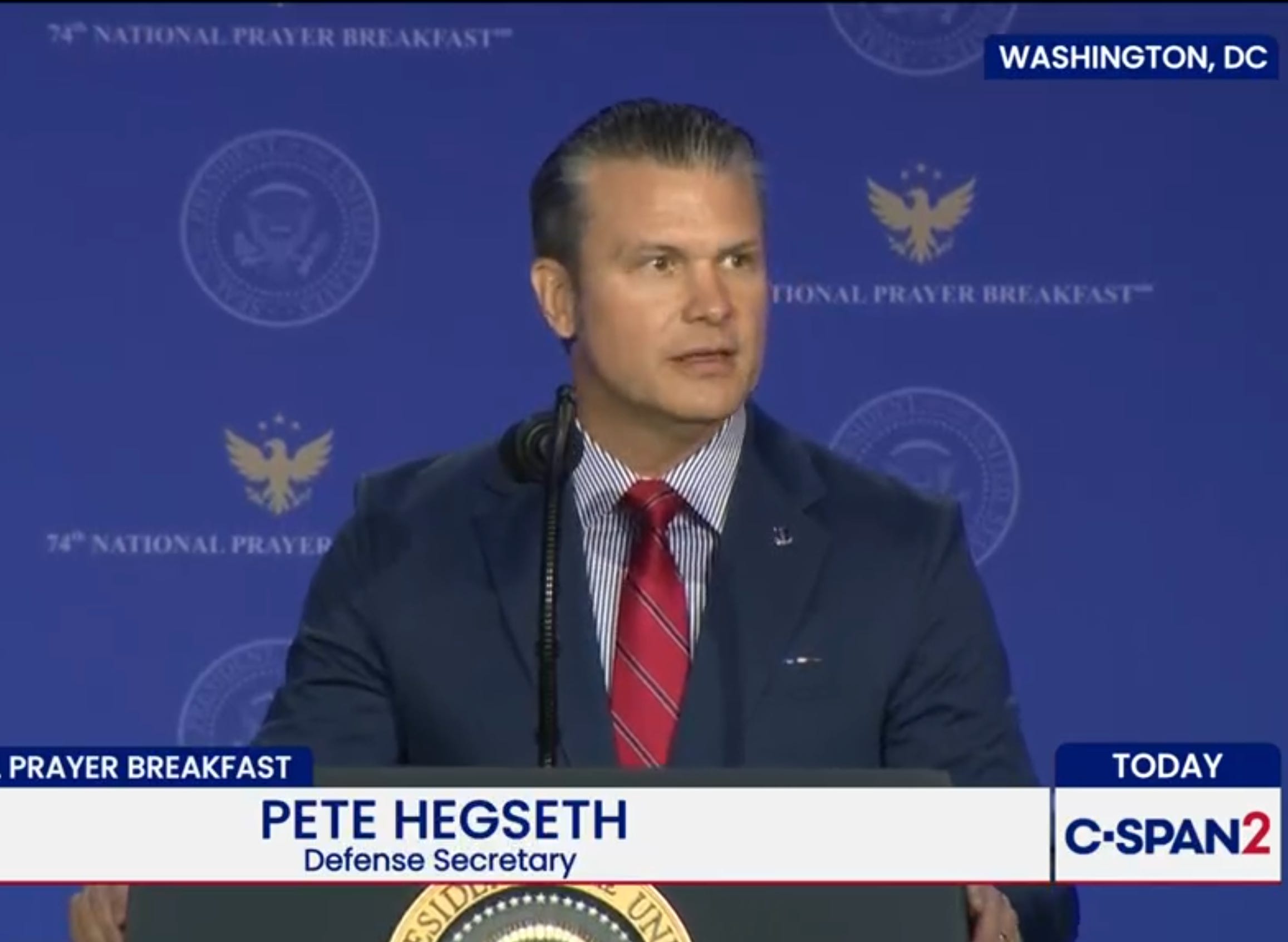
Defense Secretary Pete Hegseth has enshrined evangelical Christianity at the uppermost levels of the U.S. military, airing monthly prayer meetings throughout the Pentagon. Last year, the Pentagon confirmed to me that Hegseth attends a weekly White House Bible study. It’s led by a preacher who says God commands America to support Israel.
Monday’s email from the NCO said that their commander’s remarks “destroy morale and unit cohesion and are in violation of the oaths we swore to support the [C]onstitution.”
MRFF President and Founder Mikey Weinstein, a veteran of the Air Force and the Reagan White House, told me that since the U.S. and Israel attacked Iran early Saturday morning, the MRFF has been “inundated” with similar complaints:
These calls have one damn thing in freaking common; our MRFF clients [service members who seek MRFF aid] report the unrestricted euphoria of their commanders and command chains as to how this new “biblically-sanctioned” war is clearly the undeniable sign of the expeditious approach of the fundamentalist Christian “End Times” as vividly described in the New Testament Book of Revelation.
Many of their commanders are especially delighted with how graphic this battle will be zeroing in on how bloody all of this must become in order to fulfill and be in 100% accordance with fundamentalist Christian end of the world eschatology.
Weinstein cited constitutional and Uniform Code of Military Justice (UCMJ) prohibitions against injecting religious beliefs into official military instruction or messaging.
He said, “Any military members seeking to take advantage of their subordinates by advancing their blood-soaked, Christian nationalist wet dreams upon the flames of this latest non-Congressionally sanctioned attack against Iran, should be swiftly, aggressively and visibly prosecuted.”
Weinstein added that the MRFF receives similar complaints about Christian eschatology — end-of-the-world theology — “whenever this shit blows up with Israel in the Middle East.”
After the Oct. 7, 2023, Hamas attack on Israel, for instance, the MRFF reported a complaint about an Air Force commander who said at a briefing that, “[T]he war between Israel and Hamas has all been foretold by the Book of Revelation in the Gospel of Jesus Christ and no-one can do anything about that.”
After 9/11, Pres. George W. Bush referred to the American “crusade” against terrorism, evoking the ancient clashes between Christian crusaders and Muslims. Bush’s language was seen as potentially inspiring Muslims to take up arms against the U.S., if it proclaimed itself a Christian army waging war on Islam.
French foreign minister Hubert Vedrine said, “One has to avoid falling into this huge trap, this monstrous trap” set by al Qaeda with the 9/11 attacks. Bush dropped the term “crusade.”
While Christian nationalism has simmered in the military for decades, Hegseth has ended even the pretense of official intolerance for it. Trump, too, has cast himself as a champion of Christian exceptionalism, embedding it within divisions of the executive branch.
As I revealed last year, Hegseth sponsors the weekly White House Bible study that preaches support for Israel.
Some Christians claim biblical prophecy requires Israel to exist for Jesus to return. But Hegseth’s Bible study leader, preacher Ralph Drollinger, teaches that the reason to support Israel is that God still blesses Israel’s allies and curses Israel’s enemies, even though Israel killed Jesus (this smear, the historic root of antisemitism, has been rejected by every major religion).
After Israel’s attack on Iran last year, Drollinger dedicated two weeks of lessons to preaching support for Israel. His lessons went out to White House cabinet members and members of Congress even as Israel, too, was lobbying for U.S. engagement.
Hegseth has also initiated monthly prayer sessions, most recently featuring Doug Wilson, the far-right Christian nationalist. He has also brought in other preachers from his personal circle, rejecting any attempt at making the meetings ecumenical.
Hegseth himself also speaks at these meetings, proselytizing his personal religious beliefs. “This is … I think, exactly where we need to be as a nation, at this moment,” Hegseth reportedly said, “in prayer, on bended knee, recognizing the providence of our lord and savior Jesus Christ.”
While the MRFF historically has been able to get the Pentagon to swat down Christian incursions into the military, the Trump administration is openly disdainful of military norms and law. It remains to be seen whether and how wholesale Christianization of the Iran war will be opposed by officials inside the Pentagon, or political and legal advocates for secular values outside it.
NCO Email to MRFF
As redacted by MRFF:
From: (Active Duty Military NCO and MRFF Client’s email address withheld)
Subject: Unit combat readiness briefing and Armageddon
Date: March 2, 2026 at 1:02:53 PM MST
To: Information Weinstein <mikey@militaryreligiousfreedom.org>
Mr. Weinstein thank you for taking my calls and the calls of some of my colleagues as to what happened earlier this morning with our combat unit.
Please protect my identity and the identities of those I’m speaking for as we discussed.
Our unit is not currently in the combat zone AOR regarding the Iranian attacks but we are in a “Ready-Support” function where we could be deployed there at any moment to join and augment the combat operations as participants.
I am a (NCO rank withheld) in our unit. This morning our commander opened up the combat readiness status briefing by urging us to not be “afraid” as to what is happening with our combat operations in Iran right now. He urged us to tell our troops that this was “all part of God’s divine plan” and he specifically referenced numerous citations out of the Book of Revelation referring to Armageddon and the imminent return of Jesus Christ. He said that “President Trump has been anointed by Jesus to light the signal fire in Iran to cause Armageddon and mark his return to Earth”. He had a big grin on his face when he said all of this which made his message seem even more crazy. Our commander would probably be described as a “Christian First” supporter. He has been this way for a very long time and makes it clear that he desires all of us under him to become just like him as a Christian. But what he did this morning was so toxic and over the line that it shocked many of us in attendance at the ops readiness briefing. Besides myself I am reaching out to MRFF on behalf of 15 fellow troops. I know you asked me about the religious views of our group who has requested help from the MRFF. I can only tell you that I am Christian and at least 10 of the others are also Christians. One of the others is Jewish and one is Muslim. I don’t know the religious or non-religious status for the other three at this time.
I and my fellow troops know that it is completely wrong to have to suffer through what our commander said today. It’s not just the separation of church and state as we discussed Mr. Weinstein. It’s the fact that our commander feels as though he is fully supported and justified by the entire (combat unit’s name withheld) chain of command to inflict his Armageddon views of our attack on Iran on those of us beneath him in the chain of command.
I hope by sending this email to you that this will help expose these wrong actions which destroy morale and unit cohesion and are in violation of the oaths we swore to support the constitution.
Full Statement from MRFF President Mikey Weinstein
“Since the start of the unprovoked American and Israeli war on Iran, this past Saturday morning, the Military Religious Freedom Foundation has been literally inundated with desperate calls for help from military members across all branches, organizations and MOS/AFSC/SFSC designations (military occupational areas). Well over 100 calls have already come in and more keep coming.
These calls have one damn thing in freaking common; our MRFF clients report the unrestricted euphoria of their commanders and command chains as to how this new “biblically-sanctioned” war is clearly the undeniable sign of the expeditious approach of the fundamentalist Christian “End Times” as vividly described in the New Testament Book of Revelation.
Many of their commanders are especially delighted with how graphic this battle will be zeroing in on how bloody all of this must become in order to fulfill and be in 100% accordance with fundamentalist Christian end of the world eschatology.
The Military Religious Freedom Foundation demands that all personnel in the Department of Defense (not “War”) remember and fully internalize that the oaths they swear are not to the narcissistic, sociopathic, orange, POS tRump, nor to little Petey ‘Kegseth’ nor to Jesus Christ. On the contrary, their oath is SOLELY to the United States Constitution, which includes both a full separation of church and state mandate in the First Amendment and NO establishment of any sort of putrid ‘religious test’ in Clause 3 of Article VI.”
Any military members seeking to take advantage of their subordinates by advancing their blood-soaked, Christian nationalist wet dreams upon the flames of this latest non-Congressionally sanctioned attack against Iran, should be swiftly, aggressively and visibly prosecuted for numerous violations of the military criminal code known as the Uniform Code of Military Justice.
You know, that very same criminal code that Secretary ‘Kegseth’ is trying to prosecute Arizona Senator Mark Kelly under for simply advising military members not to obey illegal orders; you know like ordering otherwise helpless, military subordinates to acknowledge that the Iran war has been sanctioned by the fundamentalist Christian nationalist version of our Lord and Savior and the New Testament in specific order to bring about the end of the world and usher in the 1000 year reign of Jesus Christ.”
I’m an independent journalist whose reporting is made possible by reader support. As a former executive producer at MSNBC, I helped create Up w/ Chris Hayes and previously was a senior producer on Countdown w/ Keith Olbermann. Your paid subscription helps me keep reporting.
 Dr. Valerie Elverton Dixon is an independent scholar who publishes lectures and essays at


Pope Benedict’s version of God and Islam
April 23, 2010Nasir Khan, October 10, 2006
Pope Benedict XVI is the ruler of the Vatican City State and the spiritual head of more than one billion Christians across the world. What he says has an impact on political and religious thinking as well as on interfaith relations in the world. On 12 September, he delivered a well-prepared theological lecture before his home crowd of Bavarian academics and students in which he made a thinly veiled attack on the Prophet Muhammad and the notion of Holy War (Jihad). But instead of making a frontal attack on Islam, he used the derogatory remarks against Islam by a 14th century Byzantine emperor, Manuel II Paleologus, to convey his own message and thus to absolve himself of any responsibility for such remarks. Manuel II Paleologus had said:
‘Show me just what Muhammad brought that was new and there you will find things only evil and inhuman, such as his command to spread by sword the faith he preached.’
Now, before I say anything whether such a remark has any basis in historical fact or is a mere crude misrepresentation of Islam, we should turn our attention to the method the Pope has used. It is common knowledge that whenever we use a quotation from other sources in our written or spoken words, we seek support for the particular point we may be making or we reject the view advanced by such a quotation by challenging it. To use a quotation in the former case does not need our comment; our using it evinces our – either direct or tacit — approval.
It seems the Pope has used the emperor’s words in support of his own criticism of Islam and of his theological standpoint. It may be a clever device, but it was in reality an unhealthy and unfortunate thing for a number of reasons.
First, Manuel’s formulation and accusation belongs to a particular era and historical setting in which the emperor was a direct participant in military and political struggle against the expanding Ottomans; however, his views on the Prophet and Islam have no relation to historical facts.
Secondly, the Pope is an influential leader in world affairs and he has a moral and political responsibility to help reach out to other faiths, especially Islam, to promote better interfaith relations in a world where conflicts and violence seem to be increasing; gross violations of human rights are taking place, and we are living through a time when international law and the norms of civilised behaviour are being eroded and ignored by the powerful and mighty states.
Thirdly, behind the seemingly scholarly rhetoric lies the Pope’s theology according to which Christianity is compatible with rationality, thus negating a similar compatibility in the case of Islam.
I do not intend to go into the details of such a theology, but such exclusivist views about the divine are excessively capricious and uncalled for in this century. His provocative and historically untenable remarks about Islamic teachings have led only to negative results; his ill-chosen words have inflamed the passions of Muslims throughout the world. In no way do I condone such violent responses, but at the same time we should be aware of the religious sensitivities of believers and not provoke them without good cause. We need to keep in mind that most believers, ‘the flock’, believe in a Divine Being and hold their holy books in high esteem. Indeed, they take their faiths seriously; they should not be assumed to be a gathering of philosophers, historians or doctors of theology capable of entering into dispassionate academic discussions. There are far too many people who are certain of their traditional beliefs and the authorities they rely upon. The British philosopher Bertrand Russell rightly says that the whole problem with the world is that fools and fanatics are always so certain of themselves but wiser people so full of doubts.
The political objectives?
The Pope’s speech comes amidst the growing anarchy and destruction in Iraq. The American war of aggression against Iraq has not gone according to the wishes of the Bush Administration. As a result of the militaristic policies of America in Iraq and its so-called ‘war against terror’, there is growing anger and frustration throughout the Muslim world against the American wars and terrorist policies in the Middle East. Some observers see the Pope adding his voice to throw his support in favour of President Bush and his allies in what they call ‘Islamic terror’ and portray Islam as a violent religion.
Evidently much of the Islamic world is going through an extremely difficult phase at this stage. Two Muslim countries, Afghanistan and Iraq, have been invaded and occupied by the armies of the New Crusaders – Bush and Blair – and two puppet regimes have been installed in these countries to serve the imperial interests. Also among the Western allies is Pakistan, whose ruler General Musharraf has admitted that America had threatened to bomb Pakistan back into the Stone Age if he did not join the American ‘war against terror’. This he did. I addition to launching major military operations in the Frontier Province and Balochistan, Pakistan has rounded up any of its nationals who showed hostility towards American policies in the region. This has been carried out by the intelligence services of Pakistan in return for millions of American dollars and more than seven hundred such victims handed over to the CIA. Where and how are these prisoners being held or what has happened to them? The American government gives no information. Thus the crimes against humanity continue to mount and the only explanation is the flat statement that there is a ‘war against terror’.
We all know that the Christian Right, especially evangelical and born-again Christians, are open supporters of the American invasion of Iraq, the Israeli occupation of Palestinian lands and the systematic killings of Palestinians on a regular basis, not to mention the recent Israeli war against Lebanon.
The Pope is a learned theologian. He certainly knows what is happening in the Muslim world at the hands of the Christian Powers. But instead of siding with the victims, he attacks them by distorting Islam and its Prophet as well as the true message of Jesus. This is quite a sharp reversal of the path pursued by his predecessor, John Paul II, who had stood for interfaith dialogue and called for respect for other religions. It is well known that as a cardinal in the Holy See, Ratzinger (now Pope Benedict) was opposed to John Paul II’s pursuit of dialogue. But the Vatican Council II (1962-65) had already taken some important decisions in the Catholic approach towards Islam and other religious traditions. To undermine these decisions of the Second Vatican Council by anyone, by whatever means, will constitute a leap in the wrong direction.
Benedict has held Christianity to be the foundation of Europe and just a few months before he was elected, he had spoken out against the Muslim country, Turkey, joining the EU. He has argued that Christian Europe should be defended. Turkey should seek partners in Muslim countries, not in Christian Europe.
Now, a brief comment on the charge against Muhammad and his so-called use of the sword to spread his faith. The Christian polemic against Islam is almost thirteen centuries old and Christian apologists have said and written much about it. To situate the whole discussion in a historical context, I did research for more than seven years on the topic. It has resulted in the publication of my book Perceptions of Islam in the Christendoms: A Historical Survey (Oslo: Solum Forlag, 2006). (The Norwegian Research Council had paid the cost of production to the publisher, and thus I have no financial interest in the sale of the book!) I have tried to show the problematic nature of such distorted views in detail, whereas Professor Oddbjørn Leirvik in his new book Islam og kristendom, Konflikt eller dialog? has given a brilliant account of the interaction between the two faiths and explored the possibilities of dialogue and cooperation, instead of confrontation, crude misrepresentations and mutual recriminations. I believe all those who are interested in historical facts will find these two books useful for study and reflection.
The present attempt by the Pope to claim that ‘violence is incompatible with the nature of God and the nature of the soul’; in other words, that such a view of God cannot be extended to Islamic teachings because here ‘God is absolutely transcendent’. He is ‘not bound up with any of our categories, even that of rationality’. I find such a formulation and explication simply baffling. This reminds us of the Holosphyros Controversy during the reign of Byzantine Emperor Manuel I Comnenus (r. 1143-80), where the official Melkite theologians had held that ‘the God of Muhammad was said to be holosphyros [made of solid metal beaten to a spherical shape] who neither begat nor was begotten’. If the Pope needed a good source for inspiration then he did choose the right epoch and the right mentors!
Finally, I would add only a short comment on the old Christian cliché that Muhammad stood for war and violence while Jesus stood for love and peace. There are many Christian believers who still believe this. There is no historical or scriptural evidence that Muhammad at any time in his life advocated war or encouraged his followers to spread Islam by means of the sword. But what did Jesus say?
‘Do not think that I have come to bring peace to the world. No, I did not come to bring peace, but a sword. I came to set sons against their fathers, daughters against their mothers, daughters-in-law against their mothers-in-law; a man’s worst enemies will be the members of his own family’ (Matthew 10: 34-36).
I wonder if the Christian apologists by some strange mental confusion exchanged the roles of Muhammad and Jesus. But why do they still continue to ignore what the Bible says on the matter so clearly?
At the same time I want to emphasis that self-serving myths and dreams are not an alternative to historical facts. The question of forcible conversions in Islam is another big distortion because all the historical evidence points to the contrary. During the early period of Islamic Caliphate the Umayyad caliphs practically discouraged conversions to Islam. Far too many people had converted to Islam and that created administrative and financial problems for the State! In the Ottoman Empire, if any Muslim forced any Christian or Jew to convert to Islam, he was beheaded.
Share this:
Tags:American war in Iraq, attack on the Prophet Muhammad, Christian Right and U.S. invasion of Iraq, Islam, Jesus, Manuel II Paleologus, Pope Benedict XVI, Turkey
Posted in Commentary, Islam and Muslims, Uncategorized | Leave a Comment »