Posts Tagged ‘Syria’

Far Right Israeli Settler Movement Enters Syria in a Push for “Greater Israel”

April 29, 2026

The settlers are increasingly crossing the border into Syria, with at least tacit support from the Israeli military.

By Theia Chatelle , Truthout Published April 28, 2026
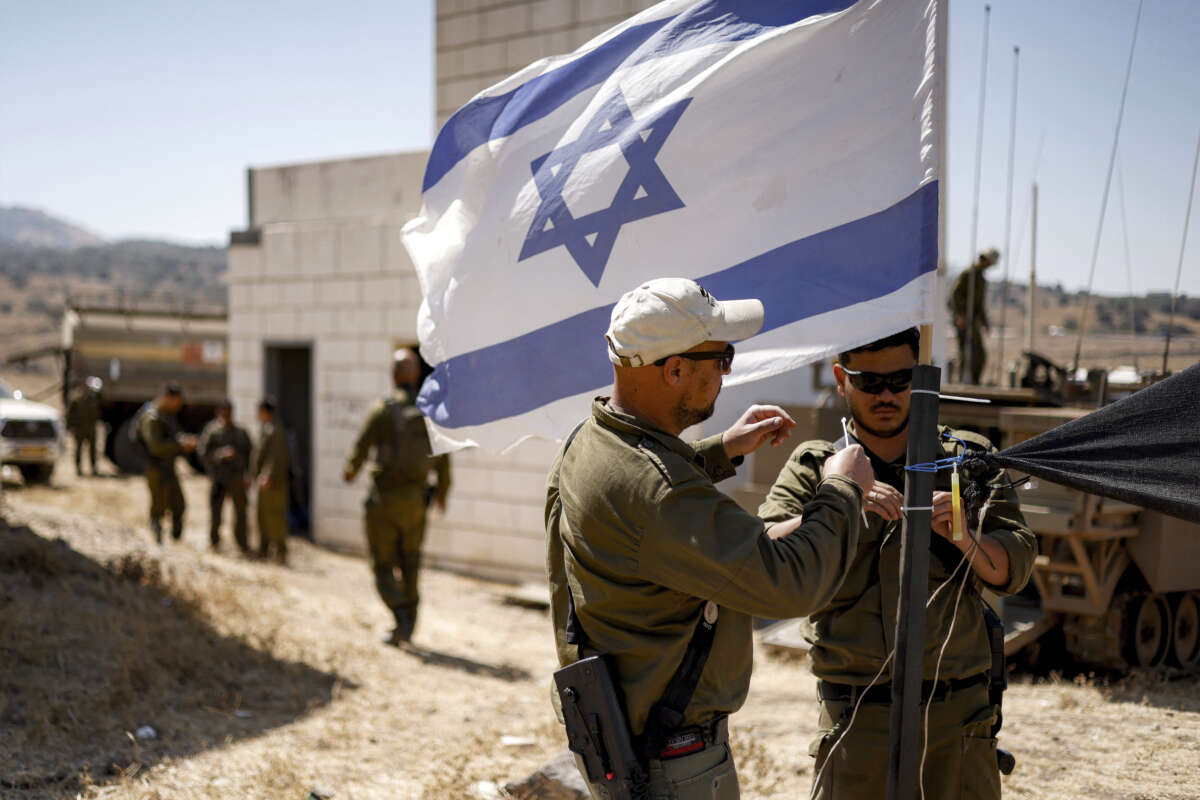
Israeli army soldiers add zip ties to the mast of an Israeli flag flying at a special area for exercises during a military drill in the Israeli-annexed Golan Heights on July 8, 2025.

Truthout is an indispensable resource for activists, movement leaders and workers everywhere. Please make this work possible with a quick donation.

Syrian journalist Oudai Efnikher is deeply familiar with life under Israeli occupation. He was born in Kafer Hareb, a village in Syria’s Golan Heights, from which he and his family were expelled after Israel seized the territory during the 1967 Six-Day War.

Now he is once again facing down Israeli forces, as they “take our land, kill our crops, and abduct our fathers.”

“This is a slow occupation, but soon, we will lose what they have not yet taken,” Efnikher told Truthout.

After Bashar al-Assad was ousted by Syrian rebels in December 2024, Israeli forces wasted no time before launching a massive aerial bombardment campaign on the country, destroying almost 80 percent of the military capacity left behind by the Assad regime.

Israeli forces also entered the demilitarized buffer zone established by a UN Security Council resolution in 1974 between the Israeli-occupied Golan Heights and the rest of Syria. They seized the territory and then established a “security buffer” beyond the last demarcation line administered by UN observer forces.

Related Story
News

|

Human Rights

“Price Tag” Attacks Part of Effort to Expand Israeli Settlements in West Bank

200 masked settlers descended on the West Bank on March 22, throwing Molotov cocktails and terrorizing Palestinians. By Theia Chatelle , Truthout

March 28, 2026

The area now under Israeli military control is off-limits to Syrian civilians and government forces. Farmers have been unable to tend to their land, and landowners have little hope they will ever be able to access it again

In total, Israel now occupies an additional 177 square miles of Syrian territory than it did before the fall of Assad.

“Maybe Israel will take it all. They already have a safe zone in southern Syria, so that could ultimately be the best option for Israel,” Syrian political analyst Issam Khoury told Truthout.

But what is most concerning for Efnikher is not the Israeli military’s presence in Syria, but what has become regular incursions by Israeli settlers.

On April 22, a group of roughly 40 settlers affiliated with the far right Halutzei HaBashan movement, or the Pioneers of Bashan — a reference to the name in the Torah for the fertile territory located northeast of the Sea of Galilee, which the Torah says was once ruled by the tyrant King Og before Moses defeated him — entered Syrian territory and asked the Israeli government to legalize settlement activity there.

According to Efnikher, who has been working to monitor Israeli settlement activity in Syrian territory since Assad’s fall in December 2024, this was the fifth such incursion by Israeli settlers into Syria.

According to Etkes, this is how the Israeli settlement movement functions: by “changing the facts on the ground” until what was once unthinkable becomes reality.

The settlers see themselves as fulfilling a biblical mandate. They consider this Syrian territory part of the ancient land of Israel. Still, the Israeli military condemned the incursion, calling it “a criminal offence that endangers civilians and IDF troops.” Dror Etkes, a longtime Israeli settlement monitor who led the advocacy group Peace Now’s Settlement Watch project and later founded Kerem Navot, an organization that tracks Israeli land seizures in the West Bank, says none of this comes as a surprise.

“Nothing is surprising anymore, not after Gaza,” he said. “Many things I didn’t think would happen have happened, so I think I should be pretty cautious when it comes to predicting what will happen in this country.”

Etkes watched settlers build their first outposts in the West Bank in the 1960s, and then, after the Second Intifada, the construction of the separation barrier. “If you had asked me 10 years ago, five years ago, two years ago, not to mention 50 years ago, whether half a million Jews would be living in the West Bank, whether we would have 350, 360, 370 outposts in the West Bank, of course nobody would have said yes,” he added.

According to Etkes, this is how the Israeli settlement movement functions: by “changing the facts on the ground” until what was once unthinkable becomes reality. And this, he says, is the goal of the settlement movement — whether it’s in Syria, Lebanon, Gaza, or the West Bank.

The Pioneers of Bashan is not the only settler organization entering closed military zones to pressure the Israeli government to legalize settlements in foreign territory.

In southern Lebanon, a group called Uri Tzafon has worked to build a movement to establish outposts in territory currently occupied by the Israeli military. The group has flown drones into Lebanese territory, urging residents to leave, and planted trees to cement a claim to the land.

It was the same in Gaza with the far right Tzav 9 movement, which on more than one occasion since October 7, 2023, attempted to enter the enclave and establish outposts.

Slowly, the borders of the Israeli imagination — much like the state’s own physical borders — are being expanded by the settlement movement.

Slowly, the borders of the Israeli imagination — much like the state’s own physical borders — are being expanded by the settlement movement. In many cases, these incursions have taken place with the implicit endorsement of the Israeli military.

According to both Etkes and Efnikher, it would have been impossible for the settlers to enter Syrian territory without at least the tacit approval of Israeli forces. There are hundreds of miles of fencing dividing the Israeli-controlled Golan from Syrian territory, reinforced by hundreds of thousands of mines.

Efnikher added that there are a number of gates in the fencing that allow the Israeli military to cross into and beyond the demilitarized buffer zone, which is how the Pioneers of Bashan were able to enter Syrian territory.

The Israeli military said in a statement after detaining and escorting the settlers back to Israeli-controlled territory that “settlement in Bashan is essential to preserve the achievements of the war.”

The push for these settlements is part of the project of Greater Israel, which seeks to expand Israel’s borders to what some settlers and religious nationalists claim were the boundaries of the ancient Israelite kingdom — a biblical vision, contested by mainstream archaeology, that imagines a realm stretching from the Euphrates to the Nile, encompassing parts of modern-day Saudi Arabia, Jordan, Iraq, and Egypt

But the expansionist drive is not only about land. It is also about water. Efnikher pointed to the Mantara Dam, the largest dam in Syria’s Quneitra Governorate. The dam controls water flow into the Yarmouk River, another critical water supply for southern Syria.

Before he was a journalist, Efnikher owned a restaurant overlooking the dam. It has been closed since Israeli forces expanded their occupation of the territory — a significant financial blow to him and his family, though he stressed that he is better off than most.

Israeli forces have destroyed thousands of dunams of farmland with pesticides in the process of building their outposts, and have established checkpoints — including aerial ones — to regulate the movement of Syrians near the buffer zone.

“There is a heavy psychological toll, falling heaviest on children and the elderly,” Efnikher said. “We’re talking about villages displaced since 1967 and families still affected across generations, now living through yet another occupation.”

He pointed to the West Bank as emblematic of what the Quneitra Governorate might soon become.

Israel has held control of the West Bank for so long that many Palestinians and Israelis in the territory, more than a third of whom are children, do not remember a time when it was free of Israeli outposts and settlements. Now, according to the UN’s High Commissioner for Human Rights, there are more than 279 illegal settlements and 700,000 settlers living in the West Bank.

“This is a model [they’re] trying to copy-paste in Syria and in Lebanon. It’s the same people, coming from the same places, from the same ideological greenhouses.”

The commitments of the settlement movement vary, but at its forefront are those who see it as their personal mission to restore Jewish sovereignty over the land they claim as Greater Israel, even if it must be paid for in blood.

“It’s been almost 58 years since this project started. And all of it started actually illegal[ly] or half-legal, started without official authorization. This is a model [they’re] trying to copy-paste in Syria and in Lebanon. It’s the same people, coming from the same places, from the same ideological greenhouses,” Etkes said.

Efnikher warned that Israeli forces are intensifying their incursions in the Quneitra region: They enter the villages, make arrests — by his tally, more than 70 Syrians from the Quneitra Governorate are currently held in Israeli prisons — set up checkpoints, and then withdraw.

But Efnikher fears it is only a matter of time before they stay. The presence of the Pioneers of Bashan is one troubling sign. “They are winning,” Efnikher said of the Israeli forces. Even for Etkes, there is little hope.

“Look at what they achieved in the last 58 years in the West Bank,” he said. “They have very good reasons to be very optimistic.”

Press freedom is under attack

As Trump cracks down on political speech, independent media is increasingly necessary.

Truthout produces reporting you won’t see in the mainstream: journalism from the frontlines of global conflict, interviews with grassroots movement leaders, high-quality legal analysis and more.

Our work is possible thanks to reader support. Help Truthout catalyze change and social justice — make a tax-deductible monthly or one-time donation today.

about:blank This article is licensed under Creative Commons (CC BY-NC-ND 4.0), and you are free to share and republish under the terms of the license.

Theia Chatelle

Theia Chatelle

Theia Chatelle is a freelance journalist and photographer covering conflict, human rights, and displacement across the Middle East, Europe, and the United States. Based in Jerusalem, she reports on war and social movements, with a focus on human-interest storytelling and investigations into state power. Her work has appeared in The Forward, The Nation, Haaretz, and the Jewish Telegraphic Agency, among other outlets. Her photography has been published by MS NOW and USA Today, among others. Chatelle holds bachelor’s and master’s degrees in American Studies from Yale University. She was a 2025 fellow at the International Women’s Media Foundation and is an alumna of the Rory Peck Trust and the Type Media Center.

Share

…Reading List

Human Rights

Far Right Israeli Settler Movement Enters Syria in a Push for “Greater Israel”

Prisons & Policing

I Will Choose Death Over Treatment Unless NY Changes Its Parole Laws

LGBTQ Rights

New HUD Proposal Targets Trans Housing Protections

Politics & Elections

UAE Says It’s Leaving OPEC, in Major Blow to the Cartel

War & Peace

Trump’s Genocidal Threats on Iran Are Enabled by a Vast Apparatus of Destruction

Politics & Elections
Inside the Grassroots Campaign That Pushed a Drone Company Out of Brooklyn

Washington Post: How Ukraine contributed to the fall of Assad’s rule

December 12, 2024

11 December 2024

The recent fall of President Bashar al-Assad’s regime in Damascus marked a turning point in Syria’s ongoing conflict, with new reports revealing a covert Ukrainian role in aiding Syrian rebels.

Ukrainian intelligence provided strategic support, including drone technology and experienced operators, to Hayat Tahrir al-Sham (HTS), the dominant rebel faction in Idlib, Caliber.Az reports via The Washington Post.

This effort underscores Ukraine’s broader strategy to undermine Russian influence on multiple fronts amid its ongoing war with Moscow.

Approximately four to five weeks prior to the HTS-led offensive, Ukrainian operatives delivered 150 first-person-view drones and deployed 20 experienced operators to assist the rebels. Although Western intelligence sources suggest this aid played a modest role in the regime’s downfall, it was a significant demonstration of Kyiv’s intent to counter Russia in unconventional theatres such as the Middle East, Africa, and even within Russia itself.

Ukraine’s intelligence agency, the GUR, has reportedly collaborated with opposition groups in Syria under a special unit known as “Khimik,” bolstering rebel capabilities against Russian-backed Syrian forces.

Ukraine’s motivations for such actions are clear. With its homeland under siege, Kyiv is actively opening secondary fronts to stretch Russian resources and influence. A June report in the Kyiv Post detailed strikes by Ukrainian-backed Syrian rebels on Russian military installations, accompanied by video evidence of these operations.

Russian officials have expressed growing concern, with statements from representatives such as Alexander Lavrentyev and Foreign Minister Sergei Lavrov accusing Ukrainian intelligence of conducting “dirty operations” in Idlib. Despite these claims, independent verification remains scarce.

While Russia has downplayed Ukraine’s involvement, pointing to HTS’s independent drone program and prior expertise, the rapid collapse of Assad’s regime caught Moscow off guard. Russian Telegram channels have sought to minimize Kyiv’s role, suggesting Ukrainian personnel were in Syria for too short a time to significantly influence operations. However, this narrative contrasts with Ukraine’s broader pattern of covert actions against Russian forces worldwide.

Beyond Syria, Ukraine has demonstrated its capability for overseas operations in other regions. In July 2023, Ukrainian intelligence reportedly supported Malian rebels in an ambush against Wagner Group mercenaries, resulting in significant losses for the Russian paramilitary group.

Such actions highlight the GUR’s aggressive strategy, with its head, Lt. Gen. Kyrylo Budanov, affirming Ukraine’s commitment to targeting Russian military assets globally. This approach has drawn concerns from Western allies, including the Biden administration, over potential escalations.

Ukraine’s actions in Syria align with its broader strategy to disrupt Russia’s influence and partnerships. By aiding HTS, Kyiv weakened a critical Russian ally in the Middle East, further isolating Moscow. Although the Ukrainian assistance may not have been decisive, it contributed to an environment where the Assad regime’s fall became inevitable.

The parallels to other intelligence failures, such as Russia’s inability to anticipate HTS’s offensive or Israel’s surprise during Hamas’s October 2023 attack, are striking. Both underscore the challenges nations face in responding to unconventional threats.

For Ukraine, these operations serve as a testament to its resilience and resourcefulness in a protracted struggle against a powerful adversary. While not the decisive factor in Damascus, Ukraine’s covert actions signal its intent to shape the global battlefield to its advantage.

By Aghakazim Guliyev 

Review of ‘The Russian and Syrian Alliance’

July 2, 2016

Nasir Khan, July 2, 2016

In his paper Luis Lazaro Tijerina fills in much-needed information to understand Russian and Syrian relationship. While discussing the salient aspects of the relationship, first, between the Soviet Union and Syria and, then, after the fall of the Soviet Union, between Russia and Syria, the author has provided a sound historical overview of the developments. To understand the present civil war in Syria in a broader historical context, his paper is of utmost importance.

 In his presentation, the author has referred to some impressive and  interesting material and pointed to many factors in analysing a complex political situation. Syria is an Arab country and its political and social culture is shaped by many factors. It has its ancient historical roots including the Roman rule but after the Arab conquest of Syria from the Byzantine emperor the country became a part of the expanding Arab Empire under the Caliphs. After the First World War the Ottoman Empire came to an end; its rule over the Arab provinces also ended. Western powers which  emerged victorious established their colonial domination over the Middle East under the fiction of the ‘Mandatory system’. France took its share: Syria and the Lebanon.

In 1917, the Bolshevik Revolution in Russia brought into existence a new political system. Under the leadership of Vladimir Lenin the right to self-determination of the colonized people and support to the struggling masses to liberate themselves from the Western colonial rule became important pillars of the Soviet state policy. It was in this context, that the Soviet relations with Syria grew during and after the Second World war. The author has quite fairly outlined the Soviet policies towards the Middle East under Stalin. He also shows the role of the present Russian leader Putin towards Syria and his objectives in supporting the Syrian government.

The present civil war has played havoc with this once-prosperous and an old-civilised country. There are numerous factors both national, regional and international involved in the imbroglio. The Assad family, first the father and now his son, are more like the hereditary kings of Syria. But again, here we are discussing an Arab country where democracy as understood in modern political thought and practice has no roots. For kings and despots in the Middle East, political power and luxurious life-styles are the most important  things; the rest is empty talk.

———–


http://katehon.com/article/russian-and-syrian-alliance

The Russian and Syrian Alliance

Facebook VK blogger LiveJournal Twitter Google+ Email Print Share

02.07.2016

Russia and Syria have a deep and long, political marriage that is one of necessity, one of connivance at times, but also a historical relationship based on a respect that is bonded by both adversity and creative, political struggle. Before, I attempt to describe or make what I hope is a serious commentary on the relationship between Russia and Syria in the present time that we live in, and which involves the civil war in Syria, itself, I would like to quote the Roman historian Polybius who noted about history and empires and their causes both in peace and war that “For it is history alone which without causing us harm enables us to judge what is the best course in any situation or circumstance.” We should remember these wise words on history and the best course to follow for empire or nation-states in the modern world. Also, let us take a calm look of factual clarity at the history of these two countries whose political and social fates are wedded now for better or for worse in a time of war against terrorism and the interest of certain nation-states who seek out world hegemon, regardless of the cost of humanity in terms of lives lost. The historical relationship between the nation-state of Russia, formally the Soviet Union, and the nation-state of Syria is one of genuine collaboration through periods of internal, Syrian political crises and regional conflicts within the Middle East. Three coup d’ etat occurred during the period 1949-1953, until the Ba’ath came to power in Syria in 1954, which was keenly observed by the political and military leadership in the Soviet Union, and was only enhanced by the Suez Crises in 1956 with the Tripartite Aggression by Israel, France and Britain. Although there have been cordial culture interests between the Russian and Syrian peoples, it is has always been a friendship forged by pragmatic needs, both being economic and military in terms of mutual interests.

Within the current civil war in Syria it should be historically understood that Russia, by its very history with the Syrian Government and the Syrian people, have a political and moral obligation to help defend the legitimate interests of Syria in its struggle against modern terrorists such as ISIS or nation-states that seek to overthrow the current president of Syria and create a hegemony that would only enhance more dangerous instability in the Middle East. War being what it is among modern nation-states creates a dangerous mass of miscalculations and contradictions among the Western powers which seek to impose their will upon the Syrian state in terms of commerce, the selling of arms and regional control over a population whose aspirations are not considered. On the other side, there are those nation-states like Russian, Syria, Iran and Iraq, for instance, who are more interested in promoting the independent economic, social and cultural interests of their nation-states which is part of the process towards a more pragmatic form of international order throughout the world. Therefore, the profound historical civil war that is taking place in Syria it is in fact a dialectical part of that process towards self-determination and independent national liberation movements among all nations in the Middle East.

As ancient Roman had deep political and military interests in Greater Syria so in fact does modern Russia would have a historical political, economic and cultural ties with modern Syria. In the modernist since, it has been the Soviet and Russian experience to seek out international norms regarding the balance of power in terms of global politics and the need that causes for military intervention. With this historical perception in mind, especially since the time of Lenin when internationalism and the thrust for revolutionary social change was part of Soviet-Russian foreign policy, there was a fundamental socialist and pragmatic view to the expansionism of International law and that ran counter to the Western perception of assessing and then forcing a hegemonic military paradigm as would be advocated by Western nation-states, with the United States being Its nominal leader for such political behavior. That these two different views on the accepted means of considering world political crises as they arose, would create not only a so-called “Cold War”, but would also be the demarcation line of rancor, distrust and proxy wars between the two views regarding the approach the use of military force. This international rivalry became a bien établi behavior regarding diplomacy and war. With these un-varnished perceptions of the inevitable harsh approach to both political and military friction between these two opposing camps, it was only natural that the Soviet Union and then post-Soviet Russia would readjust her strategic, not to mention her tactical approaches, towards confronting the Western powers. As the historian, Roy Allison would admit in his work Russia, the West, and Military Intervention “After the collapse of Soviet superpower did Russian positions on these issues continue to reverberate in the international community? Russia above all has continued to impact on global rule-making through its ‘top table’ presence as a permanent member of the UN Security Council. Russia has maintained a presence also in key groupings for regional crises management, such as the contact Group for the Middle East, the Four-Party talks on the Korean Peninsula and the Six Power talks on the Iranian nuclear programme”. It is interesting to note here in the long pageantry of human history that during the time of Soviet rule in Russia, there was never an invasion by a Soviet army into the Western regions of Europe. There was an occupation of Soviet troops in Hungry and Czechoslovakia due to the uprising of dissatisfied elements of the inteligencia, workers and communist party officials who naively thought that certain Western powers would support their idealism for democratic liberalism, but such dreams or fantasies where to be short live, for the armies of Western Europe or the United States did not come to their aid. Therefore during the middle period of the twentieth century, the Western European bourgeois powers with its ally the United States, although interested and preparing for world hegemony as their imperial quest, were still using rhetoric and subtle propaganda techniques in their own going ‘cold war’ with Russia and her allies. As with the Peace of Nicias, when Athens along with her allies of Greek city-states and Sparta, with her Lachmannian confederacy of allies, signed a peace treaty in 421 BC which terminated the first half of the Peloponnesian War, so to was there an undeclared truce between the Western capitalist powers and the Soviet Union and her satellite socialist allies of Eastern Europe after the end of World War II, known to the Soviet people as the Great Patriotic War. It was during this time of a cold peace in which proxy wars and wars of economic subversion were in acted by both parties, that the Soviet Union took a deep interest in its recognition of Syria as rising political power in the Middle East.

There were many stages in which Russia took a political interest in the Middle East, including Syria or the Levant area (territory know in the modern world as Syria and Lebanon). These interest were both territorial and political in their conceptions by the Russian monocracy, then the Soviet Union and the present Russian Federation. This process of political engagement and cultural recognition between both Russia and Syria were then of a dialectical political process that has lasted through the twenty-first century, and therefore such engagment diplomatique et polticalical are complex and even subtle in nature. What is seemingly viewed through a historical timeline of events between two countries does not account for the covert, even justifiable Machiavellian and warm interactions that two countries with various and even different political interests, will have in an international relationship. The historian, Rami Ginat, gives in the beginning of his work “Syria and Doctrine of Arab Neutralism” a very seemingly view of how the Russian State has viewed the Middle East through the last three centuries by stating thus:

The Middle East has always attracted the attention of Russia in its various historical phrases—Tsarist Russia, the Soviet Union, or the present Russian Federation, because the region is the southern gateway to Russia. The eighteenth and nineteenth centuries saw the expansion of Tsarist Russia southward asresult of colonial conflict with the Ottoman Empire and Persia.… Following the Bolshevik revolution of 1917, Russia opted out of the war [World War I] … In 1919 Lenin declared “pre-War frontiers will be respected, no Turkish territory will be given to Armenia, the Dardanelles will remain Turkish and Constantinople will remain the capital of the Muslim world”.

As we see the long standing interests with Russia and the Middle East are one of a long history, only the British and French have such a long memory of history regarding their own relationship with the Middle East, while the United States has a short history with the Middle East at best, however one that has long history of spreading its war machine in Tanium in the that region of the world in modern times.

To understand the interest that the Soviet Union had with the emerging nation state of Syria after World War II, it is important to know how Stalin viewed such a regional interest outside the natural territory of the Union of Soviet Socialist Republics. Although this essay does include primary Russian diplomatic resources on the eventual political alignment between Russia and Syria in the modern world, I will attempt to draw some conjectures on the rapprochement of economic and culture détente between the two countries. During these early years, it was understood through diplomatic signals and diplomatic embassy exchanges among the various parties who took an interest in Syria’s future, that Stalin, the leader of the USSR sought out a revolutionary approach to the Middle East, and therefore was more interested in the engagment of communist revolutions being nurtured, so it was only natural that he would be concern about the build-up and sponsorship of Middle Eastern communist parties that wanted socialist governments in that region of the world. It has been argued or mention by such Middle Eastern scholars like Ginat that there was no major diplomatic changes to the way the Soviet Union viewed its policy to the Middle East until the death of Stalin. It can be argued that with the onset of the Second World War, Stalin certainly had his intelligence agents in the field in the Middle East, especially in Egypt and Syria, not to mention Iraq. Already as early as 1944, the Syrian government had imitated a serious interest in having direct diplomatic contacts with USSR, during a time, when such a move could have had dire consequences had the course of the war for the Allies and the Soviet Union had turned into defeat on the battlefield. Fortunately such was not the case, and Syrian diplomats were able to meet the first Soviet minster to Egypt, Nikolai Novikov, and although the meeting did not turn out well for the Syrian delegation, it was the first crucial step towards the official rapprochement between the Soviet Union and the nation-state of Syria. After a series of through the summer of 1944, Novikov was informed from the Soviet Government that as of 19 July, that diplomatic relations with Syria had been attain, and that a Soviet diplomatic mission would open in Damascus of that year. It was on July 31, that the Soviet Union and Syria created formal diplomatic relations, but it was not until February 10, 1946 that official diplomatic missions between the two countries was cemented with diplomatic protocols. Thus we see that the road to diplomatic recognition between the two counties was not hurried nor seamless, as a world war had brought them together in the struggle for independence on the side of Syria, and the fight to the death against Nazi fascism by the Soviet Union. What should also be noted and not overlooked is how Stalin would play a major role in such a creation of healthier relationships between those countries of the Middle East and the Soviet Union. As Ginat commented his book on the subject, and it should be understood that he was not a communist was the measure of Soviet foreign change, when he wrote:

Soviet policymakers appealed to Middle East nationalist groups to concentrate on the task of putting an end to Western influence in the region. To achieve that end, the Soviets nurtured relations with governments that were already pursuing anti-Western policies. … Stalin begin to follow the line of realpolitik in his international Affairs program. Foreign policy was, first and foremost, based on Utilitarian considerations derived from the USSSR’s growing interests in certain parts of the world… what mattered more to him [Stalin] was that they pursued anti-Western policies.

In other words, Stalin was keenly intelligent to purse a more pragmatic course of diplomatic relationships with Middle Eastern countries, including the Middle East to protect not only the frontiers of the Soviet Union, but also to consolidate the victories already achieve on the battlefield. When a leader combines military achievements with diplomatic accords that bring about regional and global stability, then that leader is remembered for such a rare talent in history. In the twenty-first century, such talent by a world statesman is not be seen as yet. However, Vladimir Putin took a page from Stalin regarding knowing when to pursue war, when it came to directing the Russian Air Forces in their engagment with targeting Daesh, also known as ISIS, and the al Nursa Front in Syria, and when to reach out to the diplomatic table among all the parties involved in a regional conflict, as when Russia and the United States brokered a truce which took place in February of 2016 during the Syrian Civil War which had begun on March 15, 2011.

We see, therefore, that from the middle of World War II to the early years of the twenty-first century, the political historical era which this author writes about could remind one much like what took place with imperial Rome and Syria in ancient times. Except both regional forces, meaning Russia and Syria are neither hegemonic in outlook nor force a direct submissive behavior from their allies like those Roman leaders who used their Roman legions unsparingly against foe and friend alike, and those Syrian governors of Greater Syria who submitted to Roman rule without question. Modern Russia who is wedded to the revolutionary Soviet Union, is a nation that ultimately forges peace or is forced to play a role on the world’s stage in fighting modern fascism and American imperialism whether they are reluctant or not about their role. Syria is still going through its birth pangs of being a regional world power through the process of the classical civil wars that Thucydides and Tacitus wrote about so boldly.

Within the modern history of the Russian and Syrian alliance, there have been tensions that have worked themselves out through a pragmatic understanding, so as to continue the historical process of independence of not only Syria’s domestic and foreign policy agendas from outside interference, especially from Western hegemony, but to insure the security of other Arab countries as well. With this in mind, when it comes to the reactionary deeds of Daesh, we must understand where the seed of such a viscous terrorist organization emerged from, that is its’ root of growth. As Yevgeny Primakov, who was not only once the head of Russia’s Foreign Intelligence Service, but also was the Foreign Minister and Prime Minister of Russia, the terrorism that expanded in the Middle East and spread outside that regions should be understood as such:

But the terror inflicted by both sides in the Middle East conflict was not the breeding ground for the international terrorism seen at the end of the twentieth century and the beginning of the twenty-first. For starters, Middle Eastern terrorism was by its nature political, not religious.

Primakov’s succinct observation of the core of terrorism not only in the Middle East, but throughout the world, is a rational and understood historical understanding of how modern aggression and wars is not one of a spiritual nature, but conflicting ideologies that emerge from economic and class contradictions.

But Primakov goes further in his analysis of the “war against terrorism” in the twenty-first century by stating emphatically that “The network known as Al-Qaeda did not arise from the Palestinian movement. Al-Qaeda was religious extremist catalyst used the United States during the cold war—with, as it turns out, no thought to the consequences. It came into being with the aid of the Central Intelligence Agency (CIA) for the purposes of fighting the Soviet army in Afghanistan”. Now, in the times that I am writing this essay, we are reaping the terrible violence of the whirl wind we created, which in turn is creating the implosion of the Western world, including that of the United States as well.

It is known through various sources that the former USSR did not pander or always take sides with Syria regarding issues like the Lebanon civil war or the struggle of various political parties and military forces that desired to control the Palestinian struggle of statehood. In fact, it Yuri Andropov, then the general secretary of the Soviet Communist Party, who in 1983, attempted to bring about a more conciliatory relationship between Syria and the Palestinian ranks that were at odds with Syrian leadership regarding the tempestuous leadership of Arafat within the Palestinian enclave. Therefore, if one attempts to see the foreign policy of the Soviet and Russia alliance with Syria, throughout the decades of the modern era, one will notice that there was always an ebb and flow between the two nation-states. The underlying destructive force therefore can be seen elsewhere regarding the war in the Middle East and regional terrorism, in that like the Trotskyites during and after the Russian revolution, American foreign policy is mitigated by the various United States presidential regimes, who have a fanaticism to “export” its American view of democracy into the borders of nation-states throughout the world. Such a modern American manifest destiny includes Syria with its historic civil war in our time which could further enflame other regions of the Middle East or provoke World War III. It is in Syria that the people will manifest themselves in the battle against Islamic terrorism, and it is in Syria that the world’s fate will be decided regarding such a war.

It is with this short paper that I have attempted to show in a subtle way how history is not created by simply the whims of individuals or capriciousness of nation-states without consequences. If we do not understand the nature of alliances which are like a find and subtle thread from the beginning to the end, then we cannot create a political course of action that brings about a period of peace, but will only bring on the holocaust of war.

Causing genocide to protect us from terror

April 18, 2015

Neil Clark is a journalist, writer and broadcaster. His award winning blog can be found at www.neilclark66.blogspot.com. Follow him on Twitter

Published time: March 30, 2015 12:52

An Iraqi family watches U.S. soldiers in in Baquba early June 28, 2007.  (Reuters/Goran Tomasevic)

An Iraqi family watches U.S. soldiers in in Baquba early June 28, 2007. (Reuters/Goran Tomasevic)

A report called Body Count has revealed that at least 1.3 million people have lost their lives as a result of the US-led “war on terror” in Iraq, Afghanistan and Pakistan. It’s a report which should have made front page news across the world.

In the comprehensive 101 pagedocument ‘Body Count,’

Physicians for Social Responsibility, Physicians for Global Survival and International Physicians for the Prevention of Nuclear War, have produced figures for the number of people killed from September 11, 2001 until the end of 2013.

The findings are devastating: the in-depth investigation concludes that the ‘war on terror‘ has, directly or indirectly, killed around 1 million people in Iraq, 220,000 in Afghanistan and 80,000 in Pakistan. As awful as that sounds, the total of 1.3 million deaths does not take into account casualties in other war zones, such as Yemen – and the authors stress that the figure is a “conservative estimate”.

“The total number of deaths in the three countries named above could also be in excess of 2 million, whereas a figure below 1 million is extremely unlikely,” the executive summary says.

Continues >>

Top Ten Myths about the Israeli-Palestinian Conflict

June 19, 2010

Jeremy R. Hammond, Foreign Policy Journal, June 17, 2010

A Palestinian boy throws a stone at an Israeli  tank in the occupied West Bank.

Myth #1 – Jews and Arabs have always been in conflict in the region.

Although Arabs were a majority in Palestine prior to the creation of the state of Israel, there had always been a Jewish population, as well. For the most part, Jewish Palestinians got along with their Arab neighbors. This began to change with the onset of the Zionist movement, because the Zionists rejected the right of the Palestinians to self-determination and wanted Palestine for their own, to create a “Jewish State” in a region where Arabs were the majority and owned most of the land.

For instance, after a series of riots in Jaffa in 1921 resulting in the deaths of 47 Jews and 48 Arabs, the occupying British held a commission of inquiry, which reported their finding that “there is no inherent anti-Semitism in the country, racial or religious.” Rather, Arab attacks on Jewish communities were the result of Arab fears about the stated goal of the Zionists to take over the land.

Continues >>

Rumblings of new war in the Middle East

April 20, 2010

Keith Jones, wsws.org, April 20, 2010

Recent days have seen a spate of developments that point to the danger of a new military conflagration in the Middle East.

Israel has warned Syria that it will face an Israeli attack if Hezbollah, the Shiite-based Lebanese militia, fires Scud missiles at Israel, the London Times reported Sunday. The newspaper cites an unnamed Israeli cabinet minister as saying, “We’ll return Syria to the Stone Age by crippling its power stations, ports, fuel storage and every bit of strategic infrastructure if Hezbollah dare to launch ballistic missiles against us.”

Continues >>

HRW: West must press Syria on rights violations

March 12, 2010

Middle East Online, First Published 2010-03-11


Syrian security services have detained many human rights activists


Rights group accuses Syrian officials of jailing anyone who dares to utter critical word in their prison cells.

EW YORK – Western countries must press Syria on its continued repression of dissidents as part of their efforts to draw Damascus out of political isolation, Human Rights Watch (HRW) said on Thursday.

“Talking to Syria without putting its rights record on the table emboldens the government to believe that it can do whatever it wants to its people, without consequences,” said the US-based rights group’s Middle East director Sarah Whitson.

Continues >>

Israel Demands IAEA Action on Iran, Syria, Not Itself

June 8, 2009
Despite Refusing to Subject Their Own Program to International Scrutiny, Israel Demands “Firm” Action

by Jason Ditz, Antiwar.com, June 07, 2009

Addressing Friday’s reports from the International Atomic Energy Agency (IAEA), the Israeli Foreign Ministry today demanded that the group take “immediate and determined” action against Iran and Syria, two states over which certain questions remain unanswered.

Israel has accused both nations of pursuing covert nuclear weapons programs that the IAEA has not uncovered. The incredible thing is that Israel is not itself a signatory of the Non-Proliferation Treaty (NPT) and has developed its own massive nuclear weapons program, which it has refused to subject to international scrutiny.

In Syria in particular, the IAEA reported finding trace amounts of enriched uranium inside a nuclear reactor that runs on enriched uranium, but said the traces were absent from previous declarations. Israel has demanded that the IAEA publicly condemn Syria for the lapse.

In Iran, the IAEA confirmed that Iran’s uranium enrichment program continued to grow. Though perfectly legal and designed for use in tandem with a soon to be finished nuclear energy reactor at Bushehr, Israel has condemned the program. The IAEA once again affirmed that none of the low-enriched uranium had been diverted to any other use.

Last month, a US official suggested that every nation, even Israel, should join the NPT, and Israel reacted with shock and outrage. Yet with no real proof of wrong-doing, Israel would subject Syria (whom it illegally attacked in 2007, destroying the evidence it claims once existed of their covert program) and Iran to further international censure for falling somewhat short of perfection in answering questions Israel would’ve never allowed to be asked to begin with.

Shadow Wars

May 27, 2009

by Conn Hallinan | Foreign Policy In Focus, May 26, 2009

Sudan: The two F-16s caught the trucks deep in the northern desert. Within minutes, the column of vehicles was a string of shattered wrecks burning fiercely in the January sun. Surveillance drones spotted a few vehicles that had survived the storm of bombs and cannon shells, and the fighter-bombers returned to finish the job.

Syria: Four Blackhawk helicopters skimmed across the Iraqi border, landing at a small farmhouse near the town of al-Sukkariyeh. Black-clad soldiers poured from the choppers, laying down a withering hail of automatic weapons fire. When the shooting stopped, eight Syrians lay dead on the ground. Four others, cuffed and blindfolded, were dragged to the helicopters, which vanished back into Iraq.

Pakistan: a group of villagers were sipping tea in a courtyard when the world exploded. The Hellfire missiles seemed to come out of nowhere, scattering pieces of their victims across the village and demolishing several houses. Between January 14, 2006 and April 8, 2009, 60 such attacks took place. They killed 14 wanted al-Qaeda members along with 687 civilians.

In each of the above incidents, no country took responsibility or claimed credit. There were no sharp exchanges of diplomatic notes before the attacks, just sudden death and mayhem.
War without Declaration

The F-16s were Israeli, their target an alleged shipment of arms headed for the Gaza Strip. The Blackhawk soldiers were likely from Task Force 88, an ultra-secret U.S. Special Forces group. The Pakistanis were victims of a Predator drone directed from an airbase in southern Nevada.

Each attack was an act of war and drew angry responses from the country whose sovereignty was violated. But since no one admitted carrying them out, the diplomatic protests had no place to go.

Continued >>

Iran, Syria and Uncle Sam

October 8, 2008

Dr Abdul Ruff Colachal

Only USA has the right to categorize people and nations according to its imperialist formula. Thousands and thousands of Muslims have been killed so far by the US terror forces in the company of other “democratic” nations of the “secular” West. Declared by the USA, Uncle Sam, as the rogue states or axis of evils, Iran and Syrian have been under the Washington’s close watch. Condemned by Israel, Iran is on its final stage of developing nuclear facility and has declared it would share the technology with all Islamic nations interested in the nuclear technology. USA-led UNSC has slapped three rounds of sanctions and a “final warning” to drop its nuclear ambitions.

The US administration suspects Iran is trying to build a nuclear weapon and there are a number of competing views in Washington about what President Bush should do. Some Republican hawks are in favor of taking military action against the Islamic state. Iran denies that it has ambitions to build a nuclear bomb and says its nuclear program is for civilian purposes only. There has been much speculation that the US or Israel may try to bomb Iran’s nuclear facilities. But why is unnecessarily Washington concerned about Iran?

In this nuclear era, Tehran considers its right to have nuclear facility and other advanced technology and warned the USA against any attempts to deny Iran the benefits of advanced scientific and technological progress. USA and it western allied have been coercing Iran to fall in line and stay away from nuclear weapons. Iran says it will continue enriching uranium, which it says is for civilian purposes only, despite the latest UN resolution calling on it to stop.

As a usual stunt to bully the weak nations that disobey the dictates of the USA, the Bush administration also accuses Syria of sponsoring terrorism, by supporting the Palestinian elected Hamas and Islamic Jihad and letting “Islamic militants” enter Iraq from its territory. It also accuses Syria of backing the Lebanese Shia’s militant group Hezbollah, which fought Israel’s occupation of southern Lebanon and is still involved in border conflicts with Israel.

Many political leaders in the 1990s accepted the continued Syrian presence as a necessary counter-weight to the Israeli occupation of southern Lebanon. Syrian involvement in its neighbor was formalized by two treaties signed in 1991. Once the Israelis withdrew from Lebanon in 2000, pressure grew for the Syrians to pull out. Opinion in Lebanon is divided between those who support Syria ‘s presence in their country and those who do not. However, threat of Israel to Lebanon has been a major issue.

Iran’s pro-Islamic move

Not only Iran had a revolution to revitalize Islamic way of life, it has also made strenuous efforts to reach out to Islamic world, particularly the Arab nations in the “terrorism” era and under threats from the US-led anti-Islamic nations. After the fall of Saddam’s government in Iraq, it is Iranian president Mahmoud Ahmedinejad who has been keeping the Islamic torch up against the anti-Islamic looters, challenging in the process the world most important power, though currently under serious economic crisis.

Iran has been making efforts to make up with its Islamic neighbors and chart out an Islamic program for all Muslim nations so that the anti-Islamic block of nations cannot try to invade any of the Muslim nations in future. The International Atomic Energy Agency (IAEA) board comprises of 35 members elected annually by the body’s highest policy-making body, the General Conference of all member states. Syria and Iran had both been competing for the seat reserved for a Middle Eastern and South Asian country. Iran and Syria have both been accused by some countries of engaging in clandestine nuclear activity.

Recently, Damascus allowed IAEA inspectors to visit the site at al-Kibar in June but has refused any follow-up trips. Iran, also accused by some countries of clandestine nuclear activity, dropped its bid for a seat on the IAEA board, saying it wanted to make way for regional ally Syria to join instead. On Oct 03 Friday, Syria dropped its bid for a place on the IAEA board, leaving the post open to Western-backed Afghanistan. Both had been vying for the same seat on the board, representing the Middle East and South Asia (Mesa) group. The body had been facing a divisive and unprecedented vote on the issue.

Iran was keen to make Syria a member of IEAE, but opposed by Uncle Sam. “The Islamic Republic has officially refrained from pursuing its right to be nominated to the board to pave the way for the membership of Syria,” Tehran has dropped its bid for a seat on the board of the UN nuclear watchdog, the IAEA. Iran wanted to make way for its regional ally Syria to become a board member instead. Syria has the backing of the Arab League, which makes up a significant proportion of the regional group.

World moves according to US whims and fancies only. Only Russia opposes this nasty global pro-US and pro-imperialist trend. USA got Afghanistan into the IAEA, finally. Earlier, USA made Ban Ki-moon the UN Secretary General. Opposition to Syria’s election – and Iran’s before its withdrawal – is led by the US, which wants the seat to go to its close ally Afghanistan.

Iran and Syria have announced that they have formed a mutual self-defense pact to confront “threats” now facing them. Tension increased after former Lebanese Prime Minister Rafik Hariri, who had called for the withdrawal of Syrian troops from the country, was killed in a bomb attack in Beirut on 14 February. Iran is under pressure from the US over its nuclear program, while Syria has come back into sharp focus after the apparent assassination of former Lebanese Prime Minister Rafik Hariri. USA and many in the West accuse Syria of involvement in the attack, a charge Damascus denies.

What is Syria’s involvement in Lebanon? The Syrian troop presence in Lebanon dates back to 1976, when it intervened in Lebanon’s civil war to protect the Christian minority against what looked like the imminent victory of radical Palestinians and pan-Arabists. Syria saw that as a threat to its stability.

Syria

US-Israel combine has indeed taken the Iranian whistle quite uncomfortably and of late does not even give out any ultimatum to Iran scrapping its nuclear mission. The US has already imposed a number of sanctions against Syria as well. Last year, it banned US exports to Syria, apart from food and medicine. It also stopped Syrian aircraft from flying to and from the US and froze the assets of Syrians suspected of violating a law designed to “halt Syrian support for terrorism” passed in 2003.

USA has forced the International Atomic Energy Agency (IAEA) to probe Syria’s nuclear sites.  Syria has denied the allegations as “ridiculous and the government was “co-operating with the agency in full transparency. IAEA Director Mohamed ElBaradei said Syria’s co-operation had been “good”, but it needed to show “maximum co-operation” for the agency to draw any conclusions. A Syrian officer reported to have been in charge of facilitating the IAEA probe was killed in unexplained circumstances last summer, further delaying the proceedings.

The IAEA investigation follows US allegations that Damascus was close to completing a nuclear reactor at a secret location, which was bombed by Israel last year. The head of Syria’s nuclear program has said that the country’s military sites will remain off-limits to international nuclear inspectors. Damascus said it would co-operate with IAEA inquiry only if it did not threaten its national security. The watchdog is investigating claims of a secret Syrian nuclear program.

Israel destroyed a nuclear reactor site in an air strike in 2007. Syria denies any nuclear proliferation or hiding any activities from the watchdog. The International Atomic Energy Agency has been investigating Syria over US intelligence allegations that it was building a secret, plutonium-producing reactor. Preliminary inspections by an IAEA team have shown no evidence of the US allegations.

Syria is the power the USA sees behind the scenes in neighboring Lebanon and has some 15,000 troops stationed in the country. The US, supported by the UN Security Council, has for years demanded that those troops be withdrawn. Last year, the Security Council passed resolution 1559, which called for their withdrawal, and concern has been building in Washington over what it sees as Damascus’s foot-dragging in response to the resolution.

Syria’s President Bashar al-Assad has said recently it would be a catastrophe if a peaceful solution could not be found to the Iranian nuclear row. Assad was speaking after a meeting in Damascus with French President Nicolas Sarkozy aimed at improving bilateral ties. The leaders also held discussions on Syria’s relations with Israel.

In the 1980s, there was much animosity between the two rival Baathist leaders, President Hafez al-Assad and Saddam Hussein of Iraq. The US, while not blaming Syria directly for the assassination of Lebanon’s former Prime Minister Rafik Hariri has recalled its ambassador for consultations. This is a common way of displaying diplomatic displeasure. Syria was the only Arab country to support Tehran during the Iran-Iraq war of the 1980s. Syria and Iran also both provide support for Hezbollah.

France and Syria

At the beginning of February, President Bush showed support for the negotiations in his State of the Union speech. He also indicated that he would be working for regime change in Iran but not by force. On the other hand, Britain, France and Germany have been leading the international effort to negotiate with Iran.

Of late France has taken interest in resolving the crises in the region, on Palestine, Syria and Lebanon. French President Sarkozy’s two-day visit to Syria – which was formerly ruled by France under a mandate of the League of Nations – is the first by a Western head of state in five years. He hosted Assad in July and he appears determined to bring Syria, a long-time foe of the US and Israel, back into the international fold. Relations between Paris and Damascus had plummeted after the murder of former Lebanese PM Rafik Hariri in 2005. Syria’s critics accuse Damascus of being behind the assassination.

During the Paris summit, Syria and Lebanon, an important ally of France, agreed to open embassies in each other’s capitals for the first time since the 1940s. In a joint news conference with Sarkozy, Syrian President Assad said that any attack on Iran over its nuclear program would be a catastrophe. He said it was clear there was no trust between Iran and other countries but that Syria would continue to work towards a solution through conversations with both Iran and France. In a newspaper interview earlier, Sarkozy said that Syria could “provide an irreplaceable contribution to solving Middle East issues and it is important that Syria plays a positive role in the region, adding that peace in the Middle East “passes through” Syria and France.

Sarkozy has offered French support for direct peace talks between Israel and Lebanon, when the time was right. Assad said his country was “in the process of building foundations for the peace talks” and would need help from the US and others for direct negotiations to take place. Both parties have talked about a new era in relations but that Sarkozy will be under pressure from his Western allies to show that engagement with Syria can work. And Syria must decide how flexible they can be on the key contentious issues.

The two presidents will be joined by top officials from Turkey and Qatar for talks on Lebanon and Syria’s indirect peace talks with Israel. Ankara has been mediating for several months in the Israeli-Syrian talks, while Qatar brokered a deal in May to resolve Lebanon’s prolonged political crisis.

Meanwhile, Israeli officials have warned that Europe should be “very careful in its relationship with Syria “. Tel Aviv is unhappy over any better understanding among the West and Islamic world. “Except for a slight change in tone, Syrian policies have not changed,” said foreign ministry spokesman Yigal Palmor, criticizing Syria’s connections with the Palestinian movement Hamas and the Lebanese Shia’s “militant” group Hezbollah. On the strength of US support and armament, Israel wants to dictate its own term to Palestinians, Lebanese and other Arabs.

US game of Sunni vs. Shia

USA has been capitalizing the divide between Sunni and Shia. Western experts say the leaders of several Sunni countries in the region are worried about the rising influence of Shiite Iran. The two nations kept their wary relations until the U.S.-led invasion of Iraq in 2003 made them both nervous. Syria, feeling particularly vulnerable, pushed for a mutual defense pact with Iran that included parts of Lebanon, then under Syrian control.

USA is also keen to split the support from Islamic world for Iran. As if to appease Tehran, Washington has recently given rare approval for a research body to open an office in Iran, although it stressed United States policy had not changed. The American Iranian Council was given a license to establish a presence in Tehran by the US Treasury Department. The US state department, which guides the policy for issuing non-governmental organization (NGO) licenses to places under US sanctions, like Iran, Sudan and Cuba, said the move did not signal any change in policy. Iran also did not see any positive thinking in Washington, either.

Dr Abdul Ruff Colachal has been a university teacher, and has worked in various Indian institutions like JNU, Mysore University, Central Institute of English FL, etc. He is also a political commentator, researcher, and columnist. He has widely published in India and abroad, and has written about state terrorism.