Posts Tagged ‘media’

Distorted Lenses: Ethical Failures in Reporting Israel’s War on Palestine

September 11, 2026

by M. Reza Behnam | Sep 10, 2026

As Israel’s war on Gaza enters a grim third year, the prevailing narrative developed by mainstream Western media serves as a masterclass in institutional complicity; filtering genocide through a lens of manufactured neutrality.

Since October 2025, when the so-called ceasefire – which Israel has repeatedly violated – began, the tragedy in Gaza has been effectively erased from the news cycle.  The incredible suffering of the Palestinian people has been treated as if it were unworthy of attention.

Because of this severe marginalization, it is more important than ever to look critically at the media’s role in constructing and perpetuating the ongoing genocide, and restore the crisis to the public prominence it requires.

By adopting Israel’s security-centered narrative without question, major news outlets continue to legitimize state violence. Cloaking its atrocities in the sanitized language of “self-defense” does more than just distort a humanitarian crisis; it creates an ideological shield that hides the true human cost from the public.

Institutional media coverage of the catastrophe, however, cannot simply be dismissed as negligence or professional oversight; it represents a systemic structure of complicity that began eight decades ago.

Well before 7 October 2023, the media laid the ideological and narrative foundation that facilitated Israel’s immediate massive military retaliation and ongoing atrocities in Gaza.

From the beginning of the Zionist enclave, editorial frameworks have been shaped around a singular imperative: safeguard and legitimize, at all cost, Israel’s survival and expansion. By trading critical journalism for propaganda, they systematically manufactured public consent for state-sponsored violence.

To fully grasp the situation in Gaza – a 140-square-mile concentration camp blockaded by air, land and sea – requires historical context that Western editors have actively scrubbed from copy and airwaves.  Rarely, if ever, have they presented the current quagmire within the more than 80-year continuum of Israeli land theft, ethnic cleansing, military occupation and apartheid.

The institutional media almost never expose the public to the core ideology upon which the Zionist colony was built and on which it sustains its expansionist “logic.” To truly understand Israel, however, it is essential to know that it was founded on the supremacist belief in the expendability of the indigenous Palestinian population.

If journalists had simply examined the agenda and words of Israel’s Zionist founders and its strongest defenders – which abound – public perception would look radically different today:

  • “We should there [Palestine] form a portion of a rampart of Europe against Asia, an outpost of civilization as opposed to barbarism.” (Theodor Herzl, Austro-Hungarian political founder of modern Zionism; from his political tract, Der Judenstaat (The Jewish State), 1896.
  • “Zionist colonization must either stop, or else proceed regardless of the native population. Which means that it can proceed and develop only under the protection of a power that is independent of the native population – behind an iron wall, which the native population cannot breach… And we are…demanding that this outside Power should carry out this task vigorously and with determination.” (Ze’ev Vladimir Jabotinsky, founder of modern Likud Party; from his The Iron Wall), 1923.
  • “We must expel the Arabs and take their places… And, if we have to use force…then we have force at our disposal.” (David Ben-Gurion, Polish-born first Israeli prime minister; letter to his son), 1937.
  • It [Israel] is the best $3 billion investment we make. Were there not an Israel, the United States of America would have to invent an Israel to protect her interests in the region.” (then-Senator Joe Biden, U.S. Senate), 1986.
  • “Gaza won’t return to what it was before. We will eliminate everything.” (Yoav Gallant, Israeli Defense Minister; lecturing troops entering Gaza on 10 October), 2023.
  • “This is a struggle between the children of light and the children of darkness, between humanity and the law of the jungle.” (Prime Minister Benjamin Netanyahu, 16 October address to Knesset following the attack),

Furthermore, the media have skewed the reality of Palestine by continuing to characterize the Arab-Israeli struggle as a “conflict.” This terminology hides a violent history of Zionist colonization that began in 1948, and perverts the asymmetrical Palestinian response to dispossession.  A false equivalence is created that masks the fact that one party (the colonizer) holds absolute power over the lives of the colonized.

Isolating the daily brutality of the occupier from the foundational violence of the occupation warps public perception of the crisis.  It falsely casts indigenous resistance as unprovoked aggression, while normalizing an inherently brutal system of subjugation.

The media has also largely neglected to scrutinize diplomatic initiatives like the Oslo Agreements (1993 and 1995) and Abraham Accords (2020).  By overlooking their systemic faults, they essentially legitimized the occupation, and normalized the groundwork for ongoing Israeli military dominance and territorial expansion.

Consequently, over the years, Western outlets, including The New York Times, The Washington Post, CNN, BBC, and NPR, have consistently served as public relations agents for the Pentagon and Israeli Occupation Forces.

One of the media’s most insidious tools has been language manipulation. From the start of the Gaza war, news outlets have employed a form of linguistic apartheid that dictates how human life and death are valued; essentially who is worthy of mourning.

Hence, the Israeli assault on Gaza has relied on rhetoric calculated and structured to strip Palestinians of their humanity; effectively masking acts of mass violence behind the language of routine administrative tasks.

Such linguistic sleight of hand is mirrored in official, clinical euphemisms designed to shield Israel’s military from accountability – recasting mass atrocities as “operations,” intentional starvation as “logistical challenges,” and the erasure of entire families as mere “collateral damage.”  By design, this “functional framing” reduces human beings to mere casualty counts and transforms genocide into a sanitized tragedy.

The media has rendered Palestinian suffering an accidental byproduct, rather than the result of deliberate violence, through the use of the passive voice; in which verbs float free of actors, where lives “are lost,” hospitals “are destroyed,” and buildings “collapse.”

There have been a number of instances in which news outlets have issued directives explicitly instructing reporters to avoid using specific terms such as:  occupied territory, refugee camps, ethnic cleansing, and particularly genocide and Palestine.

Journalists and media personalities have understood that straying from the approved Israeli narrative or foreign policy consensus meant career stagnation, professional blacklisting or outright termination.

This starvation of empathy has done more than misrepresent, it has constructed a permissive semantic structure, that covertly shields and absolves perpetrators of their crimes.  It ensures that mass devastation is read not as a human catastrophe, but as an abstract, inevitable footnote of geopolitics.

The most damning indictment of the media’s failure is that the truth has survived not because of, but in spite of institutional journalism. The heavy burden of documenting the war has fallen on courageous Palestinian journalists, citizen chroniclers, and independent digital outlets reporting from inside the ruins, often at the cost of their lives.  As of mid-2026, international organizations and press watchdogs report that more than 260 journalists and media workers have been killed in Gaza.

It is now widely recognized that in the immediate aftermath of the October 7 attacks, numerous media outlets rushed to publish unverified and sensationalized accounts of atrocities. Particularly egregious was the fake, often repeated narrative of “40 beheaded babies.”  This fabrication, as well as the accusation of systematic mass rape—later debunked by independent journalists and international organizations – served a singular purpose: to generate the emotional and moral outrage necessary to justify Israel’s indiscriminate retaliation.

For decades, mainstream media has presented Palestinians as inherently menacing, less evolved and obstacles to U.S.-Israeli geopolitical ambitions. Consequently, they created the political conditions and domestic apathy that has allowed billions of dollars in weapons to flow unconditionally from Washington to Tel Aviv.

Following three years of unchecked Israeli devastation in Gaza and escalating violence in the occupied West Bank, some news organizations have finally begun to label Israel as the menace and core threat to regional peace.

Under the guise of objective neutrality, mainstream newsrooms have institutionalized a practice of “genocidal blindness” – the refusal to apply legal or historical definitions (as the International Court of Justice has) to the live-streamed destruction of a civilian population.

They have also prioritized official state denials over documented evidence gathered on the ground. By prioritizing political access and government-approved sourcing over accountability and truth, mainstream journalism has forfeited its ethical credibility.

True objectivity requires matching language to verified reality. Over time, however, the media have reduced an ancient-rooted society to a negligible footnote in a biblical or European romance.

The failure of the Fourth Estate to properly contextualize and to voice the outrage that the holocaust in Gaza deserves will be remembered as an historic betrayal of the public trust; a watershed moment signaling its eventual collapse.

© 2026, M. Reza Behnam, Ph.D.

Dr. Behnam is a political scientist who specializes in comparative politics with a focus on West Asia. His “Cultural Foundations of Iranian Politics,” published by University of Utah Press, and still in print, was recognized by Choice as Outstanding Academic Book for 1987–1988.

Chomsky: The U.S. behaves nothing like a democracy

August 18, 2013

The MIT professor lays out how the majority of U.S. policies are opposed to what wide swaths of the public want

Chomsky: The U.S. behaves nothing like a democracyNoam Chomsky (Credit: AP/Nader Daoud)
.
The following is a transcript of a recent speech delivered Noam Chomsky in Bonn, Germany, at DW Global Media Forum, Bonn, Germany. It was previously published at Alternet.

I’d like to comment on topics that I think should regularly be on the front pages but are not — and in many crucial cases are scarcely mentioned at all or are presented in ways that seem to me deceptive because they’re framed almost reflexively in terms of doctrines of the powerful.

In these comments I’ll focus primarily on the United States for several reasons: One, it’s the most important country in terms of its power and influence. Second, it’s the most advanced – not in its inherent character, but in the sense that because of its power, other societies tend to move in that direction. The third reason is just that I know it better. But I think what I say generalizes much more widely – at least to my knowledge, obviously there are some variations. So I’ll be concerned then with tendencies in American society and what they portend for the world, given American power.

American power is diminishing, as it has been in fact since its peak in 1945, but it’s still incomparable. And it’s dangerous. Obama’s remarkable global terror campaign and the limited, pathetic reaction to it in the West is one shocking example. And it is a campaign of international terrorism – by far the most extreme in the world. Those who harbor any doubts on that should read the report issued by Stanford University and New York University, and actually I’ll return to even more serious examples than international terrorism.

Continues >>

Joseph E. Stiglitz: Whose World Bank?

April 7, 2012

 05 April 2012 14:33 By Joseph E Stiglitz, Project Syndicate| truthout

New York – US President Barack Obama’s nomination of Jim Yong Kim for the presidency of the World Bank has been well received – and rightly so, especially given some of the other names that were bandied about. In Kim, a public-health professor who is now President of Dartmouth University and previously led the World Health Organization’s HIV/AIDS department, the United States has put forward a good candidate. But the candidate’s nationality, and the nominating country – whether small and poor or large and rich – should play no role in determining who gets the job.

Continues >>

“Liberating” the Women of Afghanistan

August 10, 2010

by Huda Jawad, Dissident Voice,  August 9th, 2010

Time magazine must be experiencing a severe case of amnesia, judging by the cover of this week’s issue which asks, “What Happens If We Leave Afghanistan .” At best, this effort by Time is irresponsible slick journalism; at worst, it is one of the most blatant pieces of pro-war propaganda seen in years. The world owes Afghanistan’s women an honest answer as to why we apathetically allow their condition to deteriorate from horrible to simply unspeakable. Instead, Time is willingly deceiving readers into thinking that the condition of Aisha – the woman pictured on the cover – is a product of the Taliban 10 years ago. It is not. Aisha’s scarred face is a heart-wrenching reflection of the state of Afghan women today in the year 2010, and under the absurd assertion of democracy and the presence of thousands of US and NATO troops in the country.

Continues >>


The Terror Card: Fear is the Key to Obedience

February 1, 2010

The Terrorism Industrial Complex (TIC)

By Rev. Richard Skaff

Global Research
, January 31, 2010

Webster’s dictionary defines terrorism as the systematic use of terror especially as a means of coercion. [1].

However, the United States code defined terrorism as “(An) act of terrorism means an activity that (A) involves a violent act or an act dangerous to human life that is a violation of the criminal laws of the United States or any State, or that would be a criminal violation if committed within the jurisdiction of the United States or of any state, and (B) appears to be intended (i) to intimidate or coerce a civilian population: (ii) to influence the policy of a government by intimidation or coercion; or (iii) to affect the conduct of a government by assassination or kidnapping.” [2].

Continued >>

Democracy in America is a useful fiction

January 26, 2010

Chris Hedges, truthdig.com,  January 24, 2010

Original: AP / Charles Dharapak

Corporate forces, long before the Supreme Court’s decision in Citizens United v. Federal Election Commission, carried out a coup d’état in slow motion. The coup is over. We lost. The ruling is one more judicial effort to streamline mechanisms for corporate control. It exposes the myth of a functioning democracy and the triumph of corporate power. But it does not significantly alter the political landscape. The corporate state is firmly cemented in place.

Continues >>

Is the Zionomedia Kingdom Invincible?

September 19, 2009
by Kourosh Ziabari, Foreign Policy Journal, Sep 18, 2009

The suggestion that Israelis might be involved in illegal organ harvesting has sparked considerable controversy.The suggestion that Israelis might be involved in illegal organ harvesting has sparked considerable controversy.
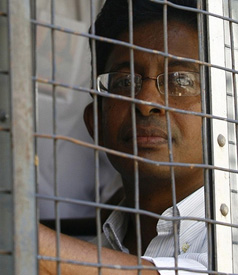
An August 17th article by Swedish photojournalist Donald Bostrom on longstanding suspicions amongst Palestinians that Israeli soldiers might have been involved in an illegal organ harvest conspiracy predictably sparked controversy and acrimony between the governments of Israel and Sweden.

With their exasperated and precipitate reactions, Israel officials once again underscored the accuracy and precision of an analogy made by the late founder of Iran’s Islamic Revolution, Ayatollah Ruhollah Khomeini, who likened the Israel’s stability to a “Spy Nest” some 30 years ago. A government whose very security and stability is threatened by the publication of a critical article should drastically review its policies to see what’s wrong with its trembling foundations. The same rule could be justly applied to Iranian authorities whose severe crackdown on the dissident media highlights major political shortages which the country suffers from; however, the Israeli lobby is so formidable and influential as to convince the “international community” to take its side in the face of such a “legitimacy crisis” while Iran has not ever nurtured such a network of lobbies worldwide.

Continues >>

Sri Lanka Continues War on Media

September 4, 2009

Thursday 03 September 2009

by: J. Sri Raman, t r u t h o u t | Perspective

photo
In a statement, President Barack Obama said journalist J.S. Tissainayagam was “guilty of nothing more than a passion for truth and a tenacious belief that a free society depends on an informed citizenry.” (Photo: Reuters)

Colombo’s war on the Liberation Tigers of Tamil Eelam may have ended. But its war on media freedom is far from over. Unlike the army offensive in the northeast of Sri Lanka, this is a war waged in disregard of the island-state’s ethnic divide.

The latest illustration of this years-long offensive has come with the Colombo High Court sentencing a Sri Lankan journalist to a 20-year prison term, with “hard labor,” on August 31 for his published comments on the armed conflict. Forty-five-year-old Jayaprakash Sittampalam Tissainayagam is a Sri Lankan Tamil, but has never been known to function as a member of the LTTE.

Continues >>

Threatening Iran

July 20, 2009

By Paul Craig Roberts | Counterpunch, July 20,  2009

When Japan attacked Pearl Harbor, Japan did not spend years preparing her public case and demonstrating her deployment of forces for the attack.  Japan did not make a world issue out of her view that the US was denying Japan her role in the Pacific by hindering Japan’s access to raw materials and energy.

Similarly, when Hitler attacked Russia, he did not preface his invasion with endless threats and a public case that blamed the war on England.

These events happened before the PSYOPS era.  Today, America and Israel’s wars of aggression are preceded by years of propaganda and international meetings, so that by the time the attack comes it is an expected event, not a monstrous surprise attack with its connotation of naked aggression.

The US, which has been threatening Iran with attack for years, has passed the job to Israel.  During the third week of July, the American vice president and secretary of state gave Israel the go-ahead.  Israel has made great public disclosure of its warships passing through the Suez Canal on their way to Iran.  “Muslim” Egypt is complicit, offering no objection to Israel’s naval forces on their way to a war crime under the Nuremberg standard that the US imposed on the world.

By the time the attack occurs, it will be old hat, an expected event, and, moreover, an event justified by years of propaganda asserting Iran’s perfidy.

Israel intends to dominate the Middle East.  Israel’s goal is to incorporate all of Palestine and southern Lebanon into “Greater Israel.”  The US intends to dominate the entire world, deciding who rules which countries and controlling resource flows.

The US and Israel are likely to succeed, because they have effective PSYOPS. For the most part, the world media follows the US media, which follows the US and Israeli governments’ lines.  Indeed, the American media is part of the PSYOPS of both countries.

According to Thierry Meyssan in the Swiss newspaper Zeit-Fragen, the CIA used SMS or text messaging and Twitter to spread disinformation about the Iranian election, including the false report that the Guardian Council had informed Mousavi that he had won the election.  When the real results were announced, Ahmadinejad’s reelection appeared to be fraudulent.

Iran’s fate awaits it.  A reasonable hypothesis to be entertained and examined is whether Iran’s Rafsanjani and Mousavi are in league with Washington to gain power in Iran. Both have lost out in the competition for government power in Iran.  Yet, both are egotistical and ambitious.  The Iranian Revolution of 1979 probably means nothing to them except an opportunity for personal power.  The way the West has always controlled the Middle East is by purchasing the politicians who are out of power and backing them in overthrowing the independent government.  We see this today in Sudan as well.

In the case of Iran, there is an additional factor that might align Rafsanjani with Washington. President Ahmadienijad attacked former President Rafsanjani, one of Iran’s most wealthy persons, as corrupt.  If Rafsanjani feels threatened by this attack, he has little choice but to try to overthrow the existing government.  This makes him the perfect person for Washington.

Perhaps there is a better explanation why Rafsanjani and Mousavi, two highly placed members of the Iranian elite, chose to persist in allegations of election fraud that have played into Washington’s hands by calling into question the legitimacy of the Iranian government. It cannot be that the office of president is worth such costs as the Iranian presidency is not endowed with decisive powers.

Without Rafsanjani and Mousavi, the US media could not have orchestrated the Iranian elections as “stolen,” an orchestration that the US government used to further isolate and discredit the Iranian government, making it easier for Iran to be attacked. Normally, well placed members of an elite do not help foreign enemies set their country up for attack.

An Israeli attack on Iran is likely to produce retaliation, which Washington will use to enter the conflict. Have the personal ambitions of Rafsanjani and Mousavi, and the naive youthful upper class Iranian protesters, set Iran up for destruction?

Consult a map and you will see that Iran is surrounded by a dozen countries that host US military bases. Why does anyone in Iran doubt that Iran is on her way to becoming another Iraq, Afghanistan, and Pakistan, in the end to be ruled by oil companies and an American puppet?

The Russians and Chinese are off balance because of successful American interventions in their spheres of influence, uncertain of the threat and the response. Russia could have prevented the coming attack on Iran, but, pressured by Washington,  Russia has not delivered the missile systems that Iran purchased.  China suffers from her own hubris as a rising economic power, and is about to lose her energy investments in Iran to US/Israeli aggression. China is funding America’s wars of aggression with loans, and  Russia is even helping the US to set up a puppet state in Afghanistan, thus opening up former Soviet central Asia to US hegemony.

The world is so impotent that even the bankrupt US can launch a new war of aggression and have it accepted as a glorious act of liberation in behalf of women’s rights, peace, and democracy.

Paul Craig Roberts was Assistant Secretary of the Treasury in the Reagan administration. He is coauthor of The Tyranny of Good Intentions.He can be reached at: PaulCraigRoberts@yahoo.com


Iran protesters to keep up pressure

June 17, 2009
Al Jazeera, June 17, 2009

Pro-Ahmadinejad supporters were out in force in Tehran on Tuesday [AFP]

Anti-government protesters appear set to keep up the pressure on the Iranian leadership, with a fifth day of rallies planned.

The plan by the demonstrators to hold more protests on Wednesday comes a day after the Guardian Council, Iran’s highest legislative body, said that it was prepared for a partial recount of last week’s vote.

Mahmoud Ahmadinejad, the incumbent president, was officially declared winner of Friday’s poll by a margin of two-to-one over his nearest rival Mir Hossein Mousavi.

Continued >>