Posts Tagged ‘Christianity’

Trump’s Divine War: How Christian Nationalists Are Running U.S. Policy in ISran and at Home

April 5, 2026

ScheerPost, April 3, 2026

ScheerPost Staff

As the Trump administration deepens U.S. military involvement in Iran alongside Israel, a new The Intercept briefing examines a dimension of the conflict often overlooked in mainstream war coverage: the growing influence of Christian nationalist ideology inside American foreign policy. In this episode, investigative journalist Sarah Posner joins host Jessica Washington to unpack how apocalyptic theology, evangelical political networks, and religious-right power structures are shaping decisions from the Pentagon to the campaign trail.

At the center of the discussion is Defense Secretary Pete Hegseth, whose public prayers for “overwhelming violence” and rhetoric about divine mission reveal how sections of the modern Christian right increasingly frame military conflict not simply as geopolitics, but as spiritual warfare. Posner argues that this worldview goes beyond symbolic religious language: it reflects a deeper ideological belief that biblical authority supersedes international law, civilian protections, and traditional diplomatic constraints.

The conversation also traces the role of influential evangelical figures such as John Hagee, whose decades-long advocacy for confrontation with Iran ties directly into end-times prophecy and Christian Zionist doctrine. Far from fringe theology, these ideas continue to shape large sections of Trump’s political base, reinforcing a foreign policy culture where war, prophecy, and domestic nationalism increasingly intersect.

Beyond Iran, the episode links these religious currents to broader domestic agendas—from anti-LGBTQ legislation to voting restrictions and immigration policy—showing how the same ideological infrastructure behind foreign intervention is also driving a wider effort to redefine American law, citizenship, and family life. The result is a portrait of a political movement that sees no separation between spiritual destiny, military power, and state authority.

What began as another presidential justification for war has rapidly opened a broader debate about the forces driving American power abroad. In its latest briefing, The Intercept turns attention away from battlefield headlines and toward a political current that has long operated beneath the surface of U.S. foreign policy: the growing fusion of Christian nationalist ideology, apocalyptic belief, and state power inside the second Donald Trump administration.

The episode arrives as Washington’s military partnership with Israel in its confrontation with Iran enters a more dangerous phase, with rising oil instability, domestic political backlash, and widening fractures inside both major parties. Yet the discussion presented by host Jessica Washington and investigative journalist Sarah Posner argues that strategic calculations alone do not explain the intensity of current rhetoric coming from senior U.S. officials. Instead, they suggest that parts of the administration increasingly frame war through a theological lens—one in which military action is not only justified politically, but sanctified spiritually.

That argument becomes most visible in the conduct of Defense Secretary Pete Hegseth, whose recent public prayer at the Pentagon asking for “overwhelming violence” against enemies drew renewed scrutiny. For Posner, the significance lies not merely in religious language but in the specific worldview behind it. Hegseth’s association with the Communion of Reformed Evangelical Churches reflects a current of Christian Reconstructionism that views biblical authority as the supreme legal framework governing both personal and public life. Under that framework, war can become more than a strategic instrument—it becomes part of a divine obligation to defend and expand what adherents see as a Christian nation.

The discussion carefully distinguishes this ideological current from more familiar evangelical support for Israel. Figures such as John Hagee, founder of Christians United for Israel, have spent decades promoting confrontation with Iran through a different theological narrative: one rooted in end-times prophecy, biblical signs, and the expectation that conflict in the Middle East may accelerate events leading to the return of Jesus. While Hegseth’s rhetoric reflects dominionist ideas about establishing God’s authority through state power, Hagee’s message speaks to a broader evangelical audience that sees Israel’s wars through prophetic fulfillment.

What makes the moment politically significant is that these belief systems are no longer confined to pulpits, television ministries, or religious conferences. According to Posner, they now intersect directly with executive power, military messaging, and legislative agendas. Trump’s long alliance with white evangelical leadership has often been described by mainstream media as transactional—religious conservatives deliver votes, and Trump delivers judges. But the interview argues that the relationship has matured into something far deeper: an ideological partnership in which both sides reinforce one another’s vision of national restoration, civilizational conflict, and cultural authority.

That framework also helps explain why debates over Iran cannot be separated from domestic policy. The same religious infrastructure influencing foreign policy is also deeply involved in campaigns against abortion rights, transgender rights, immigration protections, and secular legal norms. Posner points to new policy blueprints emerging from The Heritage Foundation, where “natural family” doctrine and anti-LGBTQ language form part of a broader project to reorder public life according to conservative Christian definitions of family, gender, and citizenship.

The conversation also highlights an important tension emerging inside Trump’s own coalition. While evangelical support for Israel remains strong, some Catholic and nationalist figures on the populist right have begun openly questioning Israeli influence in American politics and criticizing the war with Iran. Yet even this fracture is unstable. Posner notes that some of the loudest anti-war voices on the far right often blend legitimate foreign policy criticism with conspiratorial or openly antisemitic narratives, creating a volatile ideological split rather than a coherent anti-interventionist bloc.

Underlying all of this is a warning about infrastructure. The Christian right’s political power, Posner argues, was not built overnight and does not operate election to election. Over decades, it developed legal institutions, media ecosystems, activist training networks, educational pipelines, and political organizations capable of shaping courts, legislation, and public discourse across generations. From judicial appointments to school boards to foreign policy framing, the movement works through a layered system designed for permanence rather than short-term victory.

In that sense, the Iran war becomes more than a foreign crisis. It becomes another window into how religious nationalism increasingly shapes the language of American power—where military force, prophecy, electoral politics, and cultural conflict are no longer separate debates but parts of a single ideological project.

For more from the Intercept Trump’s Holy War Abroad and at Home

Journalist Sarah Posner on how the Christian right’s end times views are shaping U.S. foreign and domestic policies.

or listen to the full interview https://embed.acast.com/f5b64019-68c3-57d4-b70b-043e63e5cbf6/69ceea2b3a785fb94ba1ded6

Please share this story and help us grow our network!

U.S. Troops Were Told Iran War Is for “Armageddon,” Return of Jesus

March 4, 2026

https://substack.com/visited-surface-framehttps://substack.com/session-attribution-frame

Jonathan Larsen’s Substack

Jonathan Larsen’s Substack

Advocacy group reports commanders giving similar messages at more than 30 installations in every branch of the military

Jonathan Larsen

Mar 03, 2026

To support my reporting and keep it free for everyone, you can become a paid subscriber. Thank you.

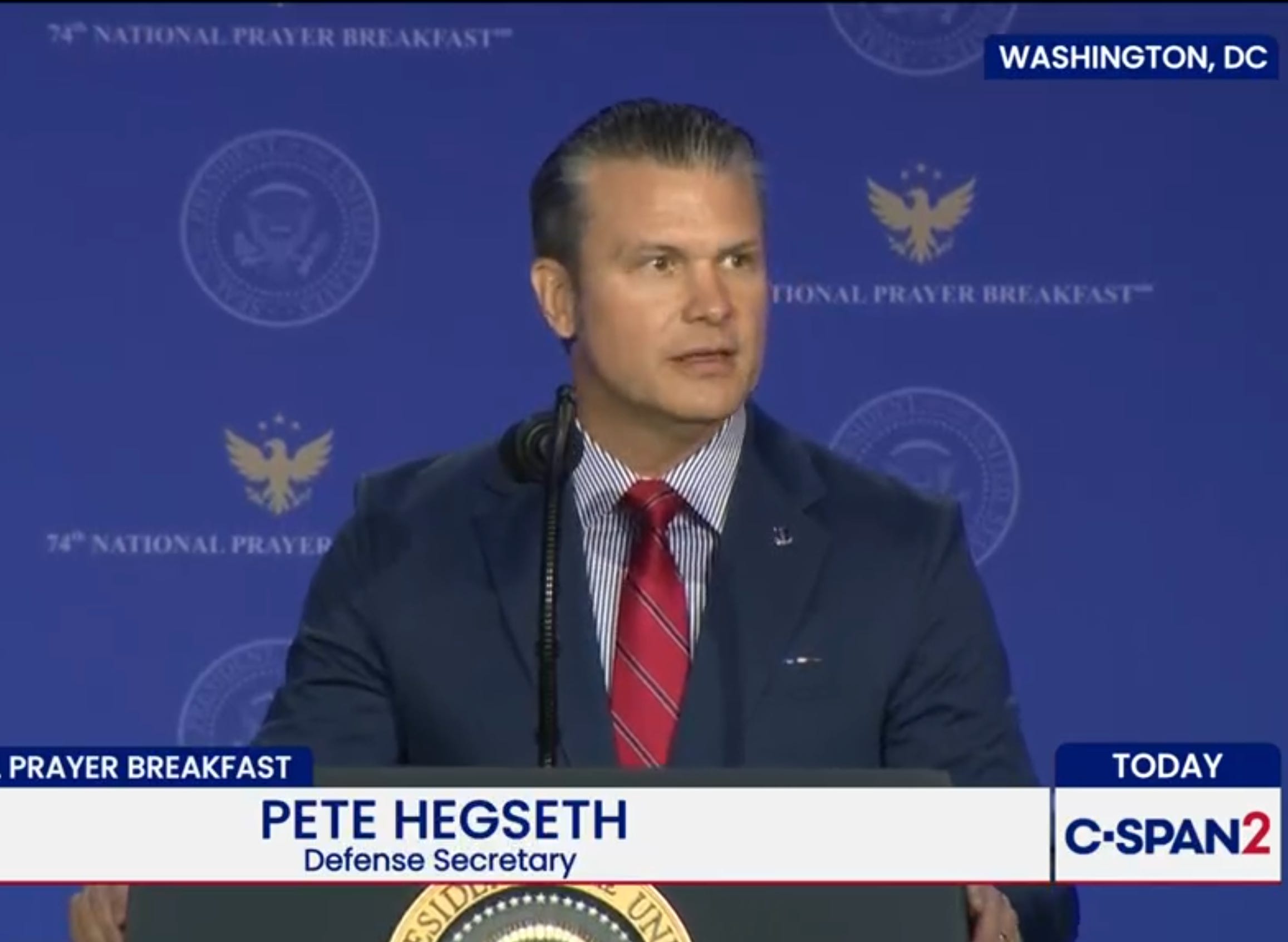
Defense Secretary Pete Hegseth at the Fellowship Foundation’s Feb. 5, 2026, prayer breakfast, falsely claimed that America was founded as a Christian nation. (Screengrab / C-SPAN video.)

A combat-unit commander told non-commissioned officers at a briefing Monday that the Iran war is part of God’s plan and that Pres. Donald Trump was “anointed by Jesus to light the signal fire in Iran to cause Armageddon and mark his return to Earth,” according to a complaint by a non-commissioned officer.

From Saturday morning through Monday night, more than 110 similar complaints about commanders in every branch of the military had been logged by the Military Religious Freedom Foundation (MRFF).

The complaints came from more than 40 different units spread across at least 30 military installations, the MRFF told me Monday night.

The MRFF is keeping the complainants anonymous to prevent retribution by the Defense Department. The Pentagon did not immediately respond to my request for comment.

One complainant identified themselves as a non-commissioned officer (NCO) in a unit currently outside the Iran combat zone but in Ready-Support status, deployable at any time. The NCO said they were Christian and emailed the MRFF on behalf of 15 troops, including at least 11 Christians, one Muslim, and one Jew. (Full email printed below.)

The NCO wrote to the MRFF that their commander “urged us to tell our troops that this was ‘all part of God’s divine plan’ and he specifically referenced numerous citations out of the Book of Revelation referring to Armageddon and the imminent return of Jesus Christ.”

This is nota paywall. My reporting is free for everyone because some readers support my work by becoming paid subscribers. You can become a free or paid subscriber here:

Defense Secretary Pete Hegseth has enshrined evangelical Christianity at the uppermost levels of the U.S. military, airing monthly prayer meetings throughout the Pentagon. Last year, the Pentagon confirmed to me that Hegseth attends a weekly White House Bible study. It’s led by a preacher who says God commands America to support Israel.

Monday’s email from the NCO said that their commander’s remarks “destroy morale and unit cohesion and are in violation of the oaths we swore to support the [C]onstitution.”

MRFF President and Founder Mikey Weinstein, a veteran of the Air Force and the Reagan White House, told me that since the U.S. and Israel attacked Iran early Saturday morning, the MRFF has been “inundated” with similar complaints:

These calls have one damn thing in freaking common; our MRFF clients [service members who seek MRFF aid] report the unrestricted euphoria of their commanders and command chains as to how this new “biblically-sanctioned” war is clearly the undeniable sign of the expeditious approach of the fundamentalist Christian “End Times” as vividly described in the New Testament Book of Revelation.

Many of their commanders are especially delighted with how graphic this battle will be zeroing in on how bloody all of this must become in order to fulfill and be in 100% accordance with fundamentalist Christian end of the world eschatology.

Weinstein cited constitutional and Uniform Code of Military Justice (UCMJ) prohibitions against injecting religious beliefs into official military instruction or messaging.

He said, “Any military members seeking to take advantage of their subordinates by advancing their blood-soaked, Christian nationalist wet dreams upon the flames of this latest non-Congressionally sanctioned attack against Iran, should be swiftly, aggressively and visibly prosecuted.”

Weinstein added that the MRFF receives similar complaints about Christian eschatology — end-of-the-world theology — “whenever this shit blows up with Israel in the Middle East.”

After the Oct. 7, 2023, Hamas attack on Israel, for instance, the MRFF reported a complaint about an Air Force commander who said at a briefing that, “[T]he war between Israel and Hamas has all been foretold by the Book of Revelation in the Gospel of Jesus Christ and no-one can do anything about that.”

After 9/11, Pres. George W. Bush referred to the American “crusade” against terrorism, evoking the ancient clashes between Christian crusaders and Muslims. Bush’s language was seen as potentially inspiring Muslims to take up arms against the U.S., if it proclaimed itself a Christian army waging war on Islam.

French foreign minister Hubert Vedrine said, “One has to avoid falling into this huge trap, this monstrous trap” set by al Qaeda with the 9/11 attacks. Bush dropped the term “crusade.”

While Christian nationalism has simmered in the military for decades, Hegseth has ended even the pretense of official intolerance for it. Trump, too, has cast himself as a champion of Christian exceptionalism, embedding it within divisions of the executive branch.

As I revealed last year, Hegseth sponsors the weekly White House Bible study that preaches support for Israel.

Some Christians claim biblical prophecy requires Israel to exist for Jesus to return. But Hegseth’s Bible study leader, preacher Ralph Drollinger, teaches that the reason to support Israel is that God still blesses Israel’s allies and curses Israel’s enemies, even though Israel killed Jesus (this smear, the historic root of antisemitism, has been rejected by every major religion).

After Israel’s attack on Iran last year, Drollinger dedicated two weeks of lessons to preaching support for Israel. His lessons went out to White House cabinet members and members of Congress even as Israel, too, was lobbying for U.S. engagement.

Hegseth has also initiated monthly prayer sessions, most recently featuring Doug Wilson, the far-right Christian nationalist. He has also brought in other preachers from his personal circle, rejecting any attempt at making the meetings ecumenical.

Hegseth himself also speaks at these meetings, proselytizing his personal religious beliefs. “This is … I think, exactly where we need to be as a nation, at this moment,” Hegseth reportedly said, “in prayer, on bended knee, recognizing the providence of our lord and savior Jesus Christ.”

While the MRFF historically has been able to get the Pentagon to swat down Christian incursions into the military, the Trump administration is openly disdainful of military norms and law. It remains to be seen whether and how wholesale Christianization of the Iran war will be opposed by officials inside the Pentagon, or political and legal advocates for secular values outside it.


NCO Email to MRFF

As redacted by MRFF:

From: (Active Duty Military NCO and MRFF Client’s email address withheld)
Subject: Unit combat readiness briefing and Armageddon
Date:
March 2, 2026 at 1:02:53 PM MST
To: Information Weinstein <mikey@militaryreligiousfreedom.org>

Mr. Weinstein thank you for taking my calls and the calls of some of my colleagues as to what happened earlier this morning with our combat unit.

Please protect my identity and the identities of those I’m speaking for as we discussed.

Our unit is not currently in the combat zone AOR regarding the Iranian attacks but we are in a “Ready-Support” function where we could be deployed there at any moment to join and augment the combat operations as participants.

I am a (NCO rank withheld) in our unit. This morning our commander opened up the combat readiness status briefing by urging us to not be “afraid” as to what is happening with our combat operations in Iran right now. He urged us to tell our troops that this was “all part of God’s divine plan” and he specifically referenced numerous citations out of the Book of Revelation referring to Armageddon and the imminent return of Jesus Christ. He said that “President Trump has been anointed by Jesus to light the signal fire in Iran to cause Armageddon and mark his return to Earth”. He had a big grin on his face when he said all of this which made his message seem even more crazy. Our commander would probably be described as a “Christian First” supporter. He has been this way for a very long time and makes it clear that he desires all of us under him to become just like him as a Christian. But what he did this morning was so toxic and over the line that it shocked many of us in attendance at the ops readiness briefing. Besides myself I am reaching out to MRFF on behalf of 15 fellow troops. I know you asked me about the religious views of our group who has requested help from the MRFF. I can only tell you that I am Christian and at least 10 of the others are also Christians. One of the others is Jewish and one is Muslim. I don’t know the religious or non-religious status for the other three at this time.

I and my fellow troops know that it is completely wrong to have to suffer through what our commander said today. It’s not just the separation of church and state as we discussed Mr. Weinstein. It’s the fact that our commander feels as though he is fully supported and justified by the entire (combat unit’s name withheld) chain of command to inflict his Armageddon views of our attack on Iran on those of us beneath him in the chain of command.

I hope by sending this email to you that this will help expose these wrong actions which destroy morale and unit cohesion and are in violation of the oaths we swore to support the constitution.


Full Statement from MRFF President Mikey Weinstein

“Since the start of the unprovoked American and Israeli war on Iran, this past Saturday morning, the Military Religious Freedom Foundation has been literally inundated with desperate calls for help from military members across all branches, organizations and MOS/AFSC/SFSC designations (military occupational areas). Well over 100 calls have already come in and more keep coming.

These calls have one damn thing in freaking common; our MRFF clients report the unrestricted euphoria of their commanders and command chains as to how this new “biblically-sanctioned” war is clearly the undeniable sign of the expeditious approach of the fundamentalist Christian “End Times” as vividly described in the New Testament Book of Revelation.

Many of their commanders are especially delighted with how graphic this battle will be zeroing in on how bloody all of this must become in order to fulfill and be in 100% accordance with fundamentalist Christian end of the world eschatology.

The Military Religious Freedom Foundation demands that all personnel in the Department of Defense (not “War”) remember and fully internalize that the oaths they swear are not to the narcissistic, sociopathic, orange, POS tRump, nor to little Petey ‘Kegseth’ nor to Jesus Christ. On the contrary, their oath is SOLELY to the United States Constitution, which includes both a full separation of church and state mandate in the First Amendment and NO establishment of any sort of putrid ‘religious test’ in Clause 3 of Article VI.”

Any military members seeking to take advantage of their subordinates by advancing their blood-soaked, Christian nationalist wet dreams upon the flames of this latest non-Congressionally sanctioned attack against Iran, should be swiftly, aggressively and visibly prosecuted for numerous violations of the military criminal code known as the Uniform Code of Military Justice.

You know, that very same criminal code that Secretary ‘Kegseth’ is trying to prosecute Arizona Senator Mark Kelly under for simply advising military members not to obey illegal orders; you know like ordering otherwise helpless, military subordinates to acknowledge that the Iran war has been sanctioned by the fundamentalist Christian nationalist version of our Lord and Savior and the New Testament in specific order to bring about the end of the world and usher in the 1000 year reign of Jesus Christ.”


I’m an independent journalist whose reporting is made possible by reader support. As a former executive producer at MSNBC, I helped create Up w/ Chris Hayes and previously was a senior producer on Countdown w/ Keith Olbermann. Your paid subscription helps me keep reporting.

Yes, Jews Killed Jesus, Too—The Bible Told Me So

July 20, 2010
Jeremy R. Hammond, Foreign Policy Journal, July 20. 2010

There is a considerable manufactured controversy regarding the assertion that Jews were responsible for the crucifixion of Yeshua the Messiah (a.k.a. Jesus the Christ). According to this narrative, anyone who suggests Jews had a role is implicitly an anti-Semite, and comparisons to the Nazis and invocation of the Holocaust are seemingly obligatory in such arguments.

Continues >>

Top Ten Myths about the Israeli-Palestinian Conflict

June 19, 2010

Jeremy R. Hammond, Foreign Policy Journal, June 17, 2010

A Palestinian boy throws a stone at an Israeli  tank in the occupied West Bank.

Myth #1 – Jews and Arabs have always been in conflict in the region.

Although Arabs were a majority in Palestine prior to the creation of the state of Israel, there had always been a Jewish population, as well. For the most part, Jewish Palestinians got along with their Arab neighbors. This began to change with the onset of the Zionist movement, because the Zionists rejected the right of the Palestinians to self-determination and wanted Palestine for their own, to create a “Jewish State” in a region where Arabs were the majority and owned most of the land.

For instance, after a series of riots in Jaffa in 1921 resulting in the deaths of 47 Jews and 48 Arabs, the occupying British held a commission of inquiry, which reported their finding that “there is no inherent anti-Semitism in the country, racial or religious.” Rather, Arab attacks on Jewish communities were the result of Arab fears about the stated goal of the Zionists to take over the land.

Continues >>

How Christianity Lost Jesus

April 11, 2010

By the Rev. Howard Bess
Consortiumnews.com, April 10, 2010

Editor’s Note: It is one of the conundrums of religious history: How did Christianity, a religion based on the teachings of a pacifist who said love your enemy and who defended the poor and vulnerable, become so twisted into nearly its opposite?

Why did dominant Christian institutions, like the Vatican, amass obscene wealth and immense power? How could individuals – the likes of George W. Bush – who claim to be devout followers of Jesus unleash the fearsome might of modern military technologies to slaughter peoples in faraway lands?

In this guest essay, Rev. Howard Bess traces this Christian mystery to the chronology of when the books of the New Testament were committed to writing and to whether the apostle Paul was even aware of Jesus’s Sermon on the Mount:

We call Chapters 5, 6 and 7 of the Matthew Gospel the Sermon on the Mount. It is without question our finest summary of the teachings of Jesus.

Continues >>

Foundations of Christianity

December 24, 2009
Written by John Pickard, In Defence of Marxism,  Wednesday, 23 December 2009

Many of us know that the origins of Christianity have nothing to do with silent nights or wise men. So what are its true origins? John Pickard looks at the reality of how this religion came about – from the standpoint of class forces and the material developments of society, rather than by the pious fictions fed from church pulpits.

Foundations of Christianity

My late father had a very wry sense of humour. At Christmas, whenever there was a reference to church services on the television, he would tut and shake his head. “Look at that”, he would say, “They try to bring religion into everything!”

I imagine much the same complaint may have been made by ancient celts, annoyed that the Christian priests were taking over their traditional Yule festival, celebrating the winter solstice. Or perhaps by Roman citizens, peeved at the Christians taking over their annual ‘Saturnalia’ festival in the last weeks of December.

Continues >>

Propagandist of the American Revolution

June 11, 2009

British socialist and author Mike Marqusee pays tribute to one of history’s great revolutionaries on the anniversary of his death 200 years ago.

Socialist Worker, June 11, 2009

Thomas Paine (Auguste Millière)

Thomas Paine (Auguste Millière)

“THIS INTERMENT was a scene to affect and to wound any sensible heart. Contemplating who it was, what man it was, that we were committing to an obscure grave on an open and disregarded bit of land, I could not help but feel most acutely.”

The occasion for this lament was the sparsely attended funeral of Thomas Paine, who died 200 years ago in June 1809, at the age of 72, and was buried in the small farm he owned in what was then the rural hamlet of New Rochelle, 20 miles north of New York City.

Not long before, New Rochelle’s bigwigs had barred Paine from voting, claiming he was not a U.S. citizen. Paine, who had virtually invented the idea of U.S. citizenship, was furious.

But this was not the end of his indignities. When he sought a place to be buried, even the Quakers would not oblige him. Hence, the muted funeral of the man who had inspired and guided revolutions in North America and France–and equally important, the revolution that did not happen in Britain.

Continued >>

Christian Soldiers in Afghanistan

May 30, 2009

by Valerie Elverton Dixon | Sojourners.net, May 30, 2009

William Faulkner once said: “The past is not dead.  In fact, it’s not even past.”  We often think about time and history as a straight line leading from the past, running through the present, heading into the future. With this conceptualization, the past is past and gone.  However, there is another way to think about time.  Tree time.  When we cut down a tree, the rings of the stump are concentric circles of time. The first year exists at the center and each succeeding year surrounds it.

So it is with the meeting of Christianity and Islam on the battle fields of Afghanistan and Iraq.  The historical center of the present conflict is the history of the Crusades.  Many in the Muslim world consider the U.S. presence in Iraq and Afghanistan as another Crusade.  The Crusades were wars between Christians and Muslims, Christians and Pagans, Christians and Christians over four centuries.  It was a tragic time when armies of the state fought to promote a religious cause.  Crusaders travelled far from home as warriors and pilgrims, warriors and penitents, warriors as walls to stall the spread of Islam.  They won and lost battles.  They destroyed and plundered and raped. They were sometimes brutally massacred when the Muslims won on a particular day.

This historical core has not passed from the consciousness of some observers.  Enter the U.S. military.  The military is full of Christians.  Many of these men and women consider themselves as fundamentalist and evangelical.  An important part of their religious commitment is to witness to Jesus Christ as their personal Lord and savior and to win souls to Christ.  At the same time, the U.S. military has a strict rule against proselytizing.  And so the warriors must walk a fine line between obligations to faith and country.

However, in my opinion, at least one soldier has been unfairly characterized in this discussion.  From what I can tell from the four minute video of a group of Christian soldiers in Afghanistan, army chaplain Captain Emmitt Furner gave them sound advice.  He reminded them of the army regulation and he reminded them that to witness to and for Jesus was more a walk than a talk. It is what we as Christians do that is important.  He said:  “You share the word in a smart manner: love, respect, consideration for their culture and their religion.  That’s what a Christian does is appreciation for other human beings.”  Another soldier in the group spoke of love and respect for the people they meet.

Some observers see Captain Furner’s advice as a sly way to spread the gospel, an element of a 21st century Crusade.  In my opinion, this interpretation is incorrect.  He gave his fellow soldiers the instruction to be living epistles that can be known and read by all (2 Corinthians 3:2).  It is an instruction that we who are not on the front lines in Afghanistan and in Iraq can use.

Dr. Valerie Elverton Dixon is an independent scholar who publishes lectures and essays at JustPeaceTheory.com. She received her Ph.D. in religion and society from Temple University and taught Christian ethics at United Theological Seminary and Andover Newton Theological School.

Review: Perceptions of Islam in the Christendoms

April 22, 2007

“Perceptions of Islam in the Christendoms” is a historical survey of centuries of distorted encounters between Christians and Muslims.

By Dr. Sahib Mustaqim Bleher

“Why then do you call him a prophet and a messenger of God, who was but a voluptuary, defiled to the very core, a brigand, a profligate, a murderer and a robber? Tell me, pray, what do you mean by prophecy and by apostle? God knows you would not be able to tell had you not been taught by the Christian!” But for its greater eloquence this late Byzantine polemic by Bartholomew of  Edessa differs little from today’s bile spat out against the prophet Muhammad and Muslims in general by the tabloid press in support of a wider political agenda. In Norway, a little further north from Denmark, where similar polemic was recently directed in pictorial form against the prophet in a series of cartoons, a Muslim historian, Dr Nasir Khan, has given us a very useful tool in understanding the mindset of the West when it comes to Muslims and their religion. His book “Perceptions of Islam in the Christendoms” is a historical survey of centuries of distorted encounters between Christians and Muslims.

Khan does not hide his own leanings, and to claim complete neutrality would imply a level of dishonesty even for a historian, but he desists from polemicising himself, quoting instead extensively from original sources. If his book causes embarrassment for Western readers it is simply because their history is embarrassing and to be reminded of it may prove painful. For example, Fulcher of Chartres gives the following eye witness account of the Crusades at the end of the 11th century: “This may seem strange to you. Our squires and footmen … split open the bellies of those they had just slain in order to extract from the intestines the gold coins which the Saracens had gulped down their loathsome throats while alive … With drawn swords our men ran through the city not sparing anyone, even those begging for mercy … They entered the houses of the citizens, seizing whatever they found in them … whoever first entered a house, whether he was rich or poor … was to occupy and own the house or palace and whatever he found in it as if it were entirely his own … in this way many poor people became very wealthy.”

Khan does not sensationalise. As a serious historian he tries to offer explanations for how the negative stereotypes of the other came about, including probing into the social and economic causes. He starts his survey by giving a background to the development of early Christianity and its numerous, competing, sects. When Islam started to spread as a new faith from Arabia, Christians mainly viewed it as just another heresy from the officially accepted dogma, like Gnosticism, Manichaeism, or Nestorianism. Until Islam became viewed as more of a serious political threat their efforts against their own co-religionists with differing interpretations of what it meant to be Christian were much more pronounced than those aimed at Islam of which they knew little. However, Islam did not simply collapse and go away as predicted, and with taking Constantinople and pushing Christendom out of much of its previous territory became a serious contender. It was at this time, between the 12th and 14th centuries, that the misrepresentative image of Islam was created which still dominates the European psyche today. At the same time, due to the status afforded to Christians in the Qur’an as people of the book, the Ottoman rulers tolerated the practice of Christianity amongst themselves to a degree that at times emboldened their Christian subjects to openly challenge them and test the waters.

A similar arrogance was displayed in the 9th century by the movement of the martyrs of Cordoba who purposefully tried to blaspheme against the prophet in order to be punished and put to death. Their aim in instigating conflict arose from the deep worry that many Christians were drawn to Islam and its culture and sciences in spite of the bigoted image their church elders painted of it. Paul Alvarus, for example, observes at the time: “My fellow Christians delight in the poems and romances of the Arabs; they study the works of Mohammedan theologians and philosophers, not in order to refute them, but to acquire a correct and elegant Arabic style. Where today can a layman be found who reads the Latin Commentaries on Holy Scriptures? Who is there that studies the Gospels, the Prophets, and the Apostles?” Again, this observation of more than a thousand years ago has surprisingly modern undertones in the fear of losing one’s own heritage to a more attractive, albeit misguided, culture.

Khan quotes Grunebaum summing up the Christian approach as follows: “When the Christian looked upon Islam, his primary task was not to study this phenomenon of an alien faith that seemed both akin to and apart from his own but rather to explain the unexplainable, to wit, the artful machinations by which Mohammed had won over his people to the acceptance of his absurd confabulations. There is always, evening the most aggressive and contemptuous discussions of Islam, an element of apologetic self-defence in the utterances of the Christian writers, almost a touch of the propaganda for the home front. It is as if only the most derogatory presentation of the despicable but powerful enemy could allay the suspicion that his case be stronger than it was wise to admit.” And he cites Southern describing their wilful ignorance of the religion of Islam: “They were ignorant of Islam, not because they were far removed from it like the Carolingian scholars, but for the contrary reason that they were in the middle of it. If they saw and understood little of what went on round them, and if they knew nothing of Islam as a religion, it was because they wished to know nothing … They were fleeing from Islam: it is not likely that they would turn to Islam to understand what they were fleeing from.”

Whilst criticising Islam for alleged loose sexual morals European capitals were awash with debauchery; whilst attacking Islam for its alleged warlike nature in contradiction to the peaceful teachings of Jesus, Christian rulers made ready for war against Islam. The reconquista was the beginning of the Christian counter-attack. The conquering Normans took Sicily and Malta back from the Muslims and the Spanish Catholics prepared for pushing the Muslims out of the Iberian peninsula. Meanwhile there were internal conflicts both in Europe and in the Muslim world. The Seljuk Turks pushed from the East into Byzantine and in their advance made inroads into the Christian Levante, eventually capturing Jerusalem. The Berbers of North Africa kept the Spanish attempts in check for some two centuries, but eventually had to recede back to Africa due to internal problems of dissension. When the Spaniards took full control under Ferdinand and Isabella they meted out merciless retribution to the infidels, the Jews and the Muslims. Those who escaped the decimation fled to North Africa and Turkey, which is how the famous Jewish city of Thessalonica became established within the Ottoman realm. The papacy in Rome started to press for the crusades with the purported objective of recapturing Jerusalem, but once stripped of the propagandistic justification, the real aims were mainly economic and political. When the first wave of Crusaders moved eastwards they were just as good at plundering the towns and villages of their own co-religionist allies as they were at destroying Muslim towns and villages in their path. Maybe today, we would call it “friendly fire”. The cruelty and barbarism of the crusaders contributed to a shift in the Muslim perception of Christianity and the goodwill previously afforded to the people of the scripture started to evaporate and be replaced by an enemy image.

Whilst the crusades proved highly profitable for the West, enriching cities like Venice, Paris and Turin, and provided the desired achievement of the conquest of Jerusalem, they remained very much a side show for the realm of Islam. The biggest threat to its existence came from the East in the form of the Mongol invasion begun under Genghis Khan. Initially they had marched through the Caucasus and southern Russia in their conquest of the world in which “all cities must be razed so that the world may once again become a great steppe in which Mongol mothers will suckle free and happy children.” They would have overrun Western Europe in the 13th century had it not been for the fact that Batu Khan, who had led the attack on Hungary, had to hurry back upon the news of the death of his uncle Ogodai (Genghis Khan’s son) in order to qualify as a potential successor. Europe was spared and the Middle East lay in the uninterrupted path of advance of the Mongols instead. The crusaders saw this as a divine sign and even tried to make alliances with the Mongols, but since they made such offers preconditional on their conversion to Christianity, they had limited effects. In the end the Mongols were checked by the Mamluks in Egypt and prevented the eradication of Islam, and over time the erstwhile enemy was converted and provided strength to the recovering Islamic caliphate.

With the failure of the crusades and the early beginnings of the Renaissances the Western hopes of conquering Islam gave way to a more conciliatory approach in the hope of converting Muslims to the gospel, placing emphasis, however, less on Church doctrine and scripture and relying more on philosophical arguments. Roger Bacon and St Thomas Aquinas, for example, represent this new methodology. For the centuries to come the Christian dominions remains fearful of the Turkish threat, and when Luther and Calvin led the revolt against Papal authority, they did, nonetheless inherit the same venomous antipathy for Islam. With the new intellectual freedoms gained in the reformation, however, Arabic learning also became popular in the West, and the early Western universities as well as the Western philosophers of the 17th and 18th centuries seriously engaged with Arabic literature and sciences. Gradually the image of Islam became a little more complete and less distorted. This respite, however, was short-lived, since European expansionism once more opted for the military solution during the period of imperialism and colonialism justified polemically by social Darwinism calling for the need to convert and civilise the savages of conquered lands. Missionary activity flourished in this political climate.

After two savage world wars, powered by Europe’s industrial killing machine and unprecedented in human cost, the imperialist project faltered and former colonies were given a level of independence, replacing direct with indirect rule. Khan ends his book on a positive note, pointing to serious attempts by Church and secular establishments during the 20th century to re-engage with Islam on the basis of mutual understanding. When looked at a year after the publication of the book, however, it seems that this interlude was as short-lived as previous ones, and power politics and economics once again dominate the relationships between the post-Christian and Islamic civilisations. In their rhetoric the new crusaders in the White House and their allies in Europe and Australia draw on the same old worn-out clichés of the past. Nasir Khan’s book is an excellent resource to enlighten these confusing times by providing a historic backdrop against which they can be evaluated, and to my knowledge it is the first such attempt. It is an excellent exposition both for Muslim and non-Muslim readers and helps them in understanding both of the origins of modern polemics against Islam as well as their ultimate futility.

Nasir Khan, Perceptions of Islam in the Christendoms – A Historical Survey, Oslo 2006: Solum Forlag, 487 pages.

Dr. Nasir Khan has his own blog at http://nasir-khan.blogspot.com through which he can be contacted.

Mathaba Author Dr. Sahib Mustaqim Bleher is a German living in England, a Muslim and a pilot – in the oppressive neo-fascist climate of today, this means walking a tight rope. And it requires speaking out. He has done so through articles, pamphlets and books, many of which are available via his FlyingImam web site.

Is this item offensive? Please click here to report it!

#

The short URL for this item is: www.mathaba.net/news/?x=553582

AddThis Social Bookmark Button var addthis_pub = ‘mathaba’; E-MAIL THIS PRINT THIS MAIN PAGE