Published date: 19 March 2025 17:22 GMT | Last update:3 hours 1 min ago
Something that separates Ramadan from other times of the year is a change of routine.
That includes waking up for suhoor, a pre-dawn meal which Muslims eat in preparation for fasting.
Families, sometimes including children, rise together during the holy month to eat suhoor and perform Fajrdawn prayers.
On Tuesday, hundreds of Palestinians in Gaza were killed by Israeli bombs in those early hours of suhoor.
Some had been awake eating with their families. Others were asleep in makeshift displacement camps as food was prepared.
New MEE newsletter: Jerusalem Dispatch
Sign up to get the latest insights and analysis on Israel-Palestine, alongside Turkey Unpacked and other MEE newsletters
Entire generations of families were wiped out together by Israel’s devastating strikes.
‘People were killed while they were sleeping. Women were killed whilst they were preparing meals’
– Rachel Cummings, Save the Children, Gaza
“People were killed while they were sleeping. Women were killed whilst they were preparing meals,” Save the Children’s Rachael Cummings, who is currently in Deir al-Balah in central Gaza, told Middle East Eye.
“There was no evacuation notice given,” Cummings said. “This was a complete bombardment across the whole of Gaza.”
The timing was reportedly deliberate: Israel launched a surprise attack in the early hours because it believed “Hamas members” would be present at suhoor meals.
Israeli officials continue to insist that Hamas commanders and infrastructure were the targets of the wave of attacks.
But of 436 massacred on Tuesday, over 180 were children.
“I do not spend too much time concerned with who the Israeli military says they targeted in attacks like this,” Miranda Cleland, of Defence for Children International Palestine (DCIP), told MEE.
“Instead, look at the evidence: 183 dead children, comprising almost half of yesterday’s death toll, tells me that this is a war on children,” she added.
“Eighteen thousand dead children since 7 October 2023 tells me this is a war on children, regardless of what the Israeli military says.”
Tuesday marked one of the largest one-day child death tolls in Gaza’s history, according to DCIP, which has documented such fatalities in the enclave since 2000.
Over the past 17 months of war, DCIP has monitored child death tolls provided by the Gaza health ministry and cannot recall a day as deadly as 18 March 2025.
‘Gaza is a graveyard for children’
Among the slain children were Omar al-Jamassi, 15, and his sister Layan, 16. They were killed alongside their mother and siblings.
Layan had been excited to start the new school year on Tuesday morning. She was killed by an Israeli air strike hours before it was due to begin.
The political calculations behind Israel’s decision to go back to war
She and Omar had attended a tent school set up as part of the Gaza Great Minds project.
“They were always smiling and share happiness everywhere they go,” said Ahmad Abu Rizik, who founded the project.
Cummings said that children and babies were more at risk of dying from air strikes.
“The risks for children in this context are extraordinary,” she said. “Because they’re so small, they have less blood, so they die much more frequently from blast injuries.”
Nearly half of Gaza’s population are children, making it one the youngest territories in the world.
“Gaza has become a graveyard for children,” Ammar Ammar of Unicef, the UN’s aid agency for children, told MEE.
“Children have been killed, injured, buried under rubble, frozen and starved to death, and many other horrors no child should be subjected to.”
‘Imprint of trauma’
For those children who have survived Israel’s 18-month war up to now, they have faced displacement and deprivation of basic needs.
Unicef estimates that all of Gaza’s one million children are in need of mental health and psychosocial support, too.
“No child will emerge from the horrors of months of relentless bombardment without the imprint of trauma,” said Ammar.
‘No child will emerge from the horrors of months of relentless bombardment without the imprint of trauma’
– Ammar Ammar, Unicef
For over two weeks, Israel has blocked all aid trucks from entering the enclave. Electricity has been cut for the past week.
Ammar said that has left many families struggling to provide enough food and safe water for their children.
“Children are dying of preventable conditions like malnutrition, dehydration, and hypothermia, due to Israel’s siege on Gaza and the mass destruction of homes and the healthcare system,” said Cleland.
She added that Israeli attacks had left minors with lifelong disabilities, without proper follow up care, prosthetics or physical therapy.
Regarding Tuesday’s attack, campaigners are clear that Israel has obligations to protect children.
“Children enjoy special protection under both international humanitarian law and international human rights law. They must never be a target,” said Ammar.
Cleland added: “Yesterday’s attacks were not only a violation of the negotiated truce agreement, but a violation of international humanitarian law, which prohibits indiscriminate attacks.
“Bombing densely populated civilian areas is, by definition, indiscriminate.”
Middle East Eye delivers independent and unrivalled coverage and analysis of the Middle East, North Africa and beyond. To learn more about republishing this content and the associated fees, please fill out this form. More about MEE can be found here.
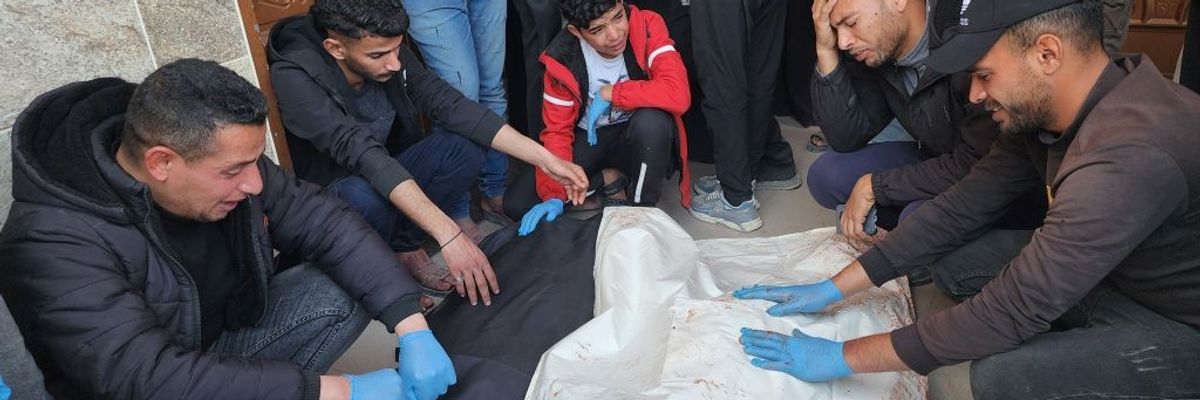
People mourn relatives killed by Israeli airstrikes in central Gaza on March 18, 2025.
(Photo: Hani Alshaer/Anadolu via Getty Images)
“This return to violence does not come as a surprise,” said one advocacy group. “Netanyahu has, from the beginning, signaled his intention to abandon the cease-fire process before it could become a lasting peace
A barrage of Israeli airstrikes across the Gaza Strip early Tuesday killed more than 400 people and left a fragile cease-fire agreement in tatters just over two months after it was reached, with Israel’s prime minister pledging “increasing military strength” in an enclave already decimated by more than a year of bombing.
White House Press Secretary Karoline Leavitt confirmed that the Netanyahu government consulted with the Trump administration ahead of the latest Gaza bombardment. Leavitt expressed the White House’s total support for Israel’s attacks.
While Israel had been carrying out more limited deadly attacks on Gaza despite the cease-fire deal—including strikes over the weekend that killed at least nine—Tuesday’s bombings were described as the “heaviest assault on the territory since the cease-fire took effect in January.”
The cease-fire was a multiphase agreement, with the first phase expiring earlier this month. Talks over the second phase of the agreement had stalled, and the government of Israeli Prime Minister Benjamin Netanyahu had attempted to impose an alternative deal on Hamas with the backing of the Trump White House. Israel imposed a total siege on the Gaza Strip earlier this month in an attempt to force acceptance of its alternative, leaving more than 1 million children in desperate conditions.
The New York Times reported that the Rafah crossing into Egypt “has been shuttered amid the renewed Israeli strikes. The border zone, the Times noted, “had been the main way for sick and wounded Gazans to leave the enclave during the cease-fire.”
Muhannad Hadi, humanitarian coordinator for the occupied Palestinian territory, said in a statement Tuesday that the fresh wave of Israeli airstrikes “is unconscionable” and that a cease-fire “must be reinstated immediately.”
“People in Gaza have endured unimaginable suffering,” said Hadi. “An end to hostilities, sustained humanitarian assistance, release of the hostages, and the restoration of basic services and people’s livelihoods, are the only way forward.”
“From before his first day in office, President Trump has endorsed the Netanyahu government’s return to war.”
Gaza health officials said the Israeli strikes killed at least 400 people, including women and children. Reutersreported that “in hospitals strained by 15 months of bombardment, piles of bodies in white plastic sheets smeared with blood could be seen stacked up as casualties were brought in.”
Netanyahu’s office said in a statement posted to social media that the Israeli military launched the large-scale strikes due to Hamas’ “repeated refusal to release our hostages, as well as its rejection of all of the proposals it has received from U.S. Presidential Envoy Steve Witkoff and from the mediators.”
Hamas responded that Israel is “fully responsible for violating and overturning the agreement.”
The Israeli strikes came over a month after the Trump administration approved a $7.4 billion sale of U.S. weaponry to Israel, which has repeatedly used American arms to commit war crimes in Gaza.
Sara Haghdoosti, executive director of the U.S.-based advocacy group Win Without War, said in a statement that “we are heartbroken and enraged at the Netanyahu government’s decision to break the cease-fire in Gaza and resume widespread, devastating bombing.”
“This return to violence does not come as a surprise, however,” said Haghdoosti. “Israeli Prime Minister Benjamin Netanyahu has, from the beginning, signaled his intention to abandon the cease-fire process before it could become a lasting peace. From before his first day in office, President Trump has endorsed the Netanyahu government’s return to war. Indeed, we fear that Trump’s vile plan for ethnic cleansing in Gaza, so welcomed by the far-right members of Netanyahu’s government, will become the blueprint for the war as it goes forward.”
“Both the blockade and the return to bombing appear designed to create conditions in which Palestinians can no longer live in the Gaza Strip,” Haghdoosti added. “We, and every person of conscience around the world, condemn this campaign of ethnic cleansing unequivocally.”
Trump and Musk are on an unconstitutional rampage, aiming for virtually every corner of the federal government. These two right-wing billionaires are targeting nurses, scientists, teachers, daycare providers, judges, veterans, air traffic controllers, and nuclear safety inspectors. No one is safe. The food stamps program, Social Security, Medicare, and Medicaid are next.
It’s an unprecedented disaster and a five-alarm fire, but there will be a reckoning. The people did not vote for this. The American people do not want this dystopian hellscape that hides behind claims of “efficiency.” Still, in reality, it is all a giveaway to corporate interests and the libertarian dreams of far-right oligarchs like Musk.
Common Dreams is playing a vital role by reporting day and night on this orgy of corruption and greed, as well as what everyday people can do to organize and fight back. As a people-powered nonprofit news outlet, we cover issues the corporate media never will, but we can only continue with our readers’ support.
about:blank
about:blank
Our work is licensed under Creative Commons (CC BY-NC-ND 3.0). Feel free to republish and share widely.
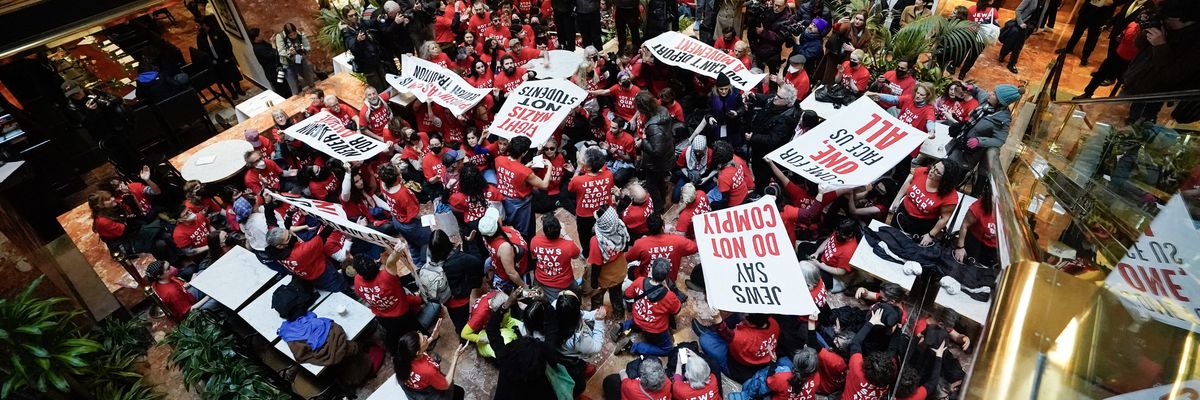
Demostrators from the human rights organization Jewish Voice for Peace hold a civil disobedience action inside Trump Tower in New York on March 13, 2025.
(Photo: Timothy A. Clary/AFP via Getty Images)
“We know what happens when an autocratic regime starts taking away our rights and scapegoating and we will not be silent.”
This is a developing story… Please check back for possible updtes…
Nearly a year and a half after the advocacy group Jewish Voice for Peace began leading nationwide demonstrations against Israel’s U.S.-backed assault on Gaza, hundreds of organizers and supporters of the group risked arrest Thursday as they assembled in the lobby of Trump Tower in New York City, demanding the release of Columbia University graduate Mahmoud Khalil.
“Three hundred Jews and friends in Trump Tower, because we know what happens when an autocratic regime starts taking away our rights and scapegoating and we will not be silent,” said Sonya Meyerson-Knox, communications director for Jewish Voice for Peace (JVP). “Come for one—face us all.”
The latter phrase was emblazoned on banners that were displayed by campaigners, who chanted, “Never again for anyone, never again is now!” and, “Free Mahmoud, free them all!”
New York City police officers began arresting participants in the sit-in early in the afternoon.
Jane Hirschmann, a Jewish New York resident whose grandfather and uncle were abducted by the Nazis in Germany as Adolf Hitler rose to power, said Khalil’s detention “is further proof that we are on the brink of a full takeover by an authoritarian regime.”
“As Jews of conscience, we know our history and we know where this leads,” said Hirschmann. “This is what fascists do as they cement control. This moment requires all people of conscience to take bold action to resist state violence and repression. Free Mahmoud now.”
Actors Morgan Spector, Debra Winger, and Arliss Howard were in attendance at the sit-in, along with writer and artist Molly Crabapple and New York City Council member Alexa Aviles.
Khalil was abducted by plainclothes Immigration and Customs Enforcement (ICE) agents last Saturday night as he was returning home to his Columbia-owned apartment with his wife, who is eight months pregnant. He was a graduate student at the university until this past December, and took a central organizing role in student-led protests and negotiations against Columbia’s investment in companies that profit from Israel’s apartheid policy in Gaza, including the bombardment it began in October 2023 in retaliation for a Hamas-led attack.
Khalil, a legal U.S. resident and a citizen of Algeria, was detained under the State Department’s “catch and revoke” program, with the Trump administration revoking his green card and threatening to deport him. Administration officials have admitted that they are not accusing Khalil of breaking any laws by participating in Palestinian solidarity protests, but they said he is viewed as “adversarial to the foreign policy and national security interests of the United States of America.”
After a hearing Wednesday, a federal judge is considering whether Khalil should be sent back to New York, where he was detained, from the Louisiana ICE facility where he is being held. The same judge blocked Khalil’s deportation this week.
Trump and Musk are on an unconstitutional rampage, aiming for virtually every corner of the federal government. These two right-wing billionaires are targeting nurses, scientists, teachers, daycare providers, judges, veterans, air traffic controllers, and nuclear safety inspectors. No one is safe. The food stamps program, Social Security, Medicare, and Medicaid are next.
It’s an unprecedented disaster and a five-alarm fire, but there will be a reckoning. The people did not vote for this. The American people do not want this dystopian hellscape that hides behind claims of “efficiency.” Still, in reality, it is all a giveaway to corporate interests and the libertarian dreams of far-right oligarchs like Musk.
Common Dreams is playing a vital role by reporting day and night on this orgy of corruption and greed, as well as what everyday people can do to organize and fight back. As a people-powered nonprofit news outlet, we cover issues the corporate media never will, but we can only continue with our readers’ support.
about:blank
about:blank
Our work is licensed under Creative Commons (CC BY-NC-ND 3.0). Feel free to republish and share widely.
There is a pressing reason to keep our attention focused on the role of the Hannibal directive, writes Jonathan Cook. It relates to what is happening right now.
Palestinians in Gaza on Jan. 29, after the ceasefire announced earlier in the month. (Jaber Jehad Badwan, Wikimedia Commons, CC BY-SA 4.0)
Those of us who keep banging on about Israel’s use of the so-called Hannibal directive on Oct. 7, 2023, — in which Israel killed its own citizens to stop them being taken captive by Hamas — have been smeared as excusing Hamas crimes that day.
That is not why we flag the issue.
In part, it is because some of the most horrifying images from Oct. 7 of charred bodies and wrecked cars and homes in Israel — adduced as evidence of an especial barbarism that is supposedly typical of Palestinians — were almost certainly caused by Israel invoking its scorched-earth directive that day.
Those images became central to the propaganda blitz launched by Israel and its apologists to justify the mass slaughter of Gaza’s children over the subsequent 17 months.
But there is also a far more urgent and pressing reason to keep our attention focused on the role of the Hannibal directive. And it relates to what is happening right now.
[President Donald Trump has issued military threats about the consequences of not handing over Israeli hostages that Hamas says, if carried out, break the terms of the ceasefire.]
Israel and the U.S. are still applying the Hannibal directive — against the Israeli captives held in Gaza.
The point of the directive has always been to stop the enemy being able to use Israeli hostages as leverage to draw Israel into negotiations — primarily to pressure it to hand over any of the thousands of Palestinian hostages it holds in its prison-torture camps. Many of them have never been charged or tried.
Israel and the U.S. tell us they need to carpet bomb Gaza — in what amounts to a “plausible” genocide, according to the world’s highest court — to force Hamas to return the Israeli captives. But in fact, Israel and the U.S. are recklessly killing those very same captives through their actions.
Why? So they don’t have to negotiate over a ceasefire. So they can carry on with the genocide, without pressure to deal with the fate of the Israelis held in Gaza.
“Bring Them Home” — a giant lights sign by artist Nadav Barnea at Charles Bronfman Auditorium, Heichal Hatarbut, Tel Aviv, Jan. 3, 2024. (Yossipik, Wikimedia Commons, CC BY-SA 4.0)
It was exactly the same reckless approach on Oct. 7, when Israel showed it was indifferent as to whether Israelis lived or died so long as they weren’t taken captive.
That’s why — in one instance we know about — the Israeli military fired into a home in Kibbutz Be’eri, knowing that there were a dozen or more Israelis inside, including children.
The army was completely indifferent as to whether those Israelis would be killed as a result. All but two were. Those witnesses are the main reason we know what really happened.
That’s why Israel’s Apache helicopters recklessly fired on hundreds of cars fleeing the Nova music festival, indifferent to whether the cars contained Hamas fighters or Israeli citizens.
Even the former defence minister, Yoav Gallant, admits the directive was invoked that day.
We’ll never know how many Israelis were killed – in part because Israel will never let us know. It’s even buried many of the destroyed cars to stop a forensic investigation.
But what we do know with certainty is that the Israeli military killed many Israelis on Oct. 7.
Western media have studiously refused to report on the issue of the Hannibal directive, even though it is all over the Israeli media. (See here, here, here and here.)
That is more than just a failure by Western media outlets. It is a crime against journalism — if not complicity in the genocide itself.
Western publics need to know that the Hannibal directive was invoked for a very simple reason: It is a crucial piece of information for assessing the credibility of Israeli and U.S. claims that they are trying to get the Israeli captives back alive and to properly weigh Israel’s motives in returning to the genocide in Gaza.
Notice how, in Trump’s latest deranged tweet, he accuses Hamas of “murdering” the Israelis held in Gaza. That’s pure, Israeli-inspired disinformation.
It is clear that most, if not all, of the dead captives were killed not by their Hamas captors but by Israel’s massive, reckless 15-month bombardment of the tiny territory of Gaza. That same bombardment, the equivalent of six Hiroshimas, has leveled Gaza and killed many tens of thousands — maybe hundreds of thousands — of Palestinians.
Why is Trump so eager to misdirect us?
Because he wants to win our support for Israel’s continuation of its slaughter of the people of Gaza and justify his own decision to supply, as his predecessor did, the weapons needed to continue that genocide.
After all, Trump makes his own genocidal intent expressly clear in addressing “the people of Gaza” and telling them that they will all be “DEAD” if the Israeli captives aren’t handed over. Yet “the people of Gaza” have no control over whether the captives are released.
Notice too that Trump calls Hamas “sick and twisted” for holding on to the bodies of dead Israeli captives, even though it is Israel that is violating the ceasefire agreement that would see those bodies returned.
This has become a further rationalisation by Israel and the U.S. for killing “the people of Gaza.” But Hamas learnt the value of using dead bodies as bargaining chips directly from Israel.
For years, the Israeli government has had a policy of refusing to return to their families the corpses of those Palestinians it has killed, including while in its torture camps. This violation of international law long predates Oct. 7. The Israeli courts have repeatedly approved the policy, accepting the government’s view that the bodies should be held as “bargaining chips.” It gave its backing again in January.
So if Hamas is “sick and twisted,” it is only because Israel is even more sick and twisted. If Trump thinks the people of Gaza deserve a genocide because of their leaders’ “sick and twisted” decisions, should he not be consistent and argue that the people of Israel deserve a similar fate for their own leaders’ “sick and twisted” decisions?
A campaign of lies and disinformation have helped to shred international law over the past year and half. And one of the biggest lies is the pretence that, in slaughtering Gaza’s children, Israel has been acting in the interests of Israelis held in the enclave.
Jonathan Cook is an award-winning British journalist. He was based in Nazareth, Israel, for 20 years. He returned to the U.K. in 2021. He is the author of three books on the Israel-Palestine conflict: Blood and Religion: The Unmasking of the Jewish State (2006), Israel and the Clash of Civilisations: Iraq, Iran and the Plan to Remake the Middle East (2008) and Disappearing Palestine: Israel’s Experiments in Human Despair (2008). If you appreciate his articles, please consider offering your financial support.
I am Israel. I came to a land without a people for a people without a land. Those people who happened to be here, had no right to be here, and my people showed them they had to leave or die, razing 400 Palestinian villages to the ground, erasing their history.
I am Israel. Some of my people committed massacres and later became Prime Ministers to represent me. In 1948, Menachem Begin was in charge of the unit that slaughtered the inhabitants of Deir Yassin, including 100 women, and children. In 1953, Ariel Sharon led the slaughter of the inhabitants of Qibya, and in 1982 arranged for our allies to butcher around 2,000 in the refugee camps of Sabra and Shatila.
I am Israel. Carved in 1948 out of 78% of the land of Palestine, dispossessing its inhabitants and replacing them with Jews from Europe and other parts of the world. While the natives whose families lived on this land for thousands of years are not allowed to return, Jews from all over the world are welcome to instant citizenship.
I am Israel. In 1967, I swallowed the remaining lands of Palestine – the West Bank and Gaza – and placed their inhabitants under an oppressive military rule, controlling and humiliating every aspect of their daily lives. Eventually, they should get the message that they are not welcome to stay, and join the millions of Palestinian refugees in the shanty camps of Lebanon and Jordan.
I am Israel. I have the power to control American policy. My American Israel Public Affairs Committee can make or break any politician of its choosing, and as you see, they all compete to please me. All the forces of the world are powerless against me, including the UN as I have the American veto to block any condemnation of my war crimes. As Sharon so eloquently phrased it, “We control America”.
I am Israel. I influence American mainstream media too, and you will always find the news tailored to my favor. I have invested millions of dollars into PR representation, and CNN, New York Times, and others have been doing an excellent job of promoting my propaganda. Look at other international news sources and you will see the difference.
I am Israel. You Palestinians want to negotiate “peace!?” But you are not as smart as me; I will negotiate, but will only let you have your municipalities while I control your borders, your water, your airspace and anything else of importance. While we “negotiate,” I will swallow your hilltops and fill them with settlements, populated by the most extremist of my extremists, armed to the teeth. These settlements will be connected with roads you cannot use, and you will be imprisoned in your little Bantustans between them, surrounded by checkpoints in every direction.
I am Israel. I have the fourth strongest army in the world, possessing nuclear weapons. How dare your children confront my oppression with stones, don’t you know my soldiers won’t hesitate to blow their heads off? In 17 months, I have killed 900 of you and injured 17,000, mostly civilians, and have the mandate to continue since the international community remains silent. Ignore, as I do, the hundreds of Israeli reserve officers who are now refusing to carry out my control over your lands and people; their voices of conscience will not protect you.
I am Israel. You want freedom? I have bullets, tanks, missiles, Apaches and F-16s to obliterate you. I have placed your towns under siege, confiscated your lands, uprooted your trees, demolished your homes, and you still demand freedom? Don’t you get the message? You will never have peace or freedom, because I am Israel.
Israeli officials have admitted to The New York Times that Hamas’s claims about Israel violating the Gaza ceasefire are accurate.
The report, which cited three Israeli officials and two officials from mediating countries who spoke on the condition of anonymity, said that Israel agreed to let in hundreds of thousands of tents as part of the ceasefire deal, which hasn’t happened.
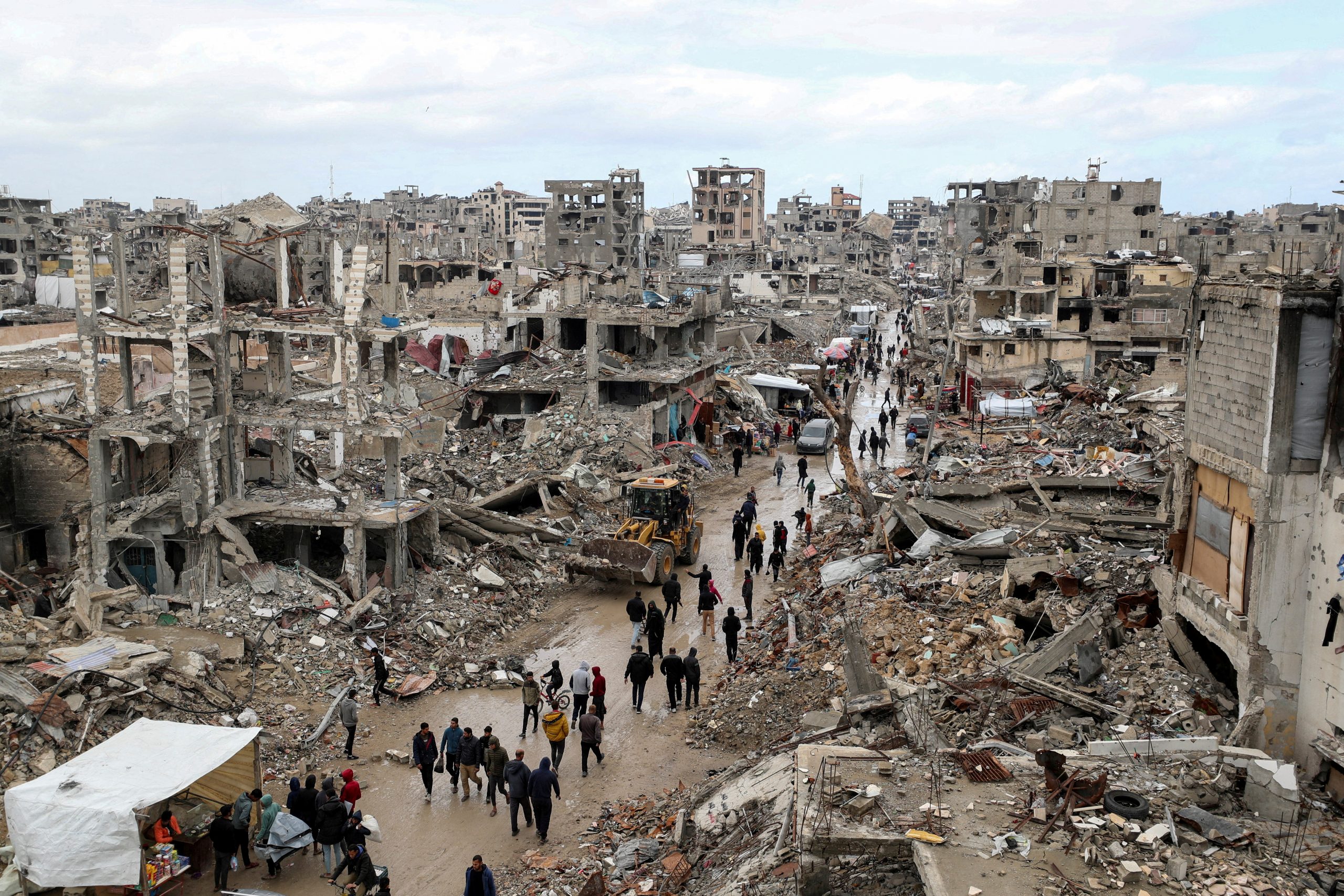
Palestinians walk past the rubble of buildings destroyed during the Israeli offensive on a rainy day amid a ceasefire between Israel and Hamas in Gaza City on February 6, 2025. REUTERS/Dawoud Abu Alkas/File Photo
Besides the blocking of promised aid, Israeli forces have also continued to kill Palestinians in Gaza. The Health Ministry said on Tuesday that since the ceasefire went into effect on January 19, Israeli forces have killed 92 Palestinians in Gaza and wounded 822.
Dr. Munir al-Barash, the director of the Health Ministry, also said that since January 19, 24 Palestinians have died of previously sustained wounds, meaning the total number of Palestinians that have died in Gaza due to Israeli aggression is at least 118. He said in the same time period, 641 bodies have been recovered from the rubble, and 197 remain unidentified.
Hamas had stayed relatively quiet about the Israeli ceasefire violations until after repeated calls by President Trump for all of the Palestinians in Gaza, which he says is about 1.9 million people (pre-war population was about 2.3 million), to be removed from the territory permanently as part of his plan for the US to take it over.
During Netanyahu’s visit, Trump dropped Washington’s sugar-coating of Israel’s 15-month genocidal destruction of Gaza. This was always about ethnic cleansing
US President Donald Trump and Israel’s Prime Minister Benjamin Netanyahu arrive at the White House in Washington, DC, on 4 February, 2025 (AFP)
3.7k Shares
Israeli Prime Minister Benjamin Netanyahu’s visit to the White House this week tore the mask off 16 months of gaslighting by western leaders and by the entirety of the western establishment media.
United States President Donald Trump finally dropped Washington’s sugar-coating of Israel’s genocidal destruction of Gaza.
This was always, he told us, a slaughter made in the US. In his words, Washington will now “take over” Gaza and be the one to develop it.
And the goal of the slaughter was always ethnic cleansing.
Palestinians, he said, would be “settled” in a place where they would not have to be “worried about dying every day” – that is, being murdered by Israel using US-supplied bombs.
New MEE newsletter: Jerusalem Dispatch
Sign up to get the latest insights and analysis on Israel-Palestine, alongside Turkey Unpacked and other MEE newsletters
Gaza, meanwhile, would become the “Riviera of the Middle East”, with the “world’s people” – he meant rich white people like himself – living in luxury beachfront properties in their stead.
If the US “owns” Gaza, as Trump insists, it will also own Gaza’s territorial waters, where there just happen to be fabulous quantities of untapped gas to enrich the enclave’s new “owner”. Palestinians have, of course, never been allowed to develop their gas fields.
Trump may even have let slip inadvertently the true death toll inflicted by Israel’s rampage. He referred to “all of them – there’s 1.7 million or maybe 1.8 million people” being forced out of Gaza.
The population count before 7 October 2023 was between 2.2 and 2.3 million. Where are the other half a million Palestinians? Under the rubble? In unmarked graves? Eaten by feral dogs? Vaporised by 2,000lb US bombs?
Wrecking spree
Trump presented his ethnic cleansing plan as if he had the best interests of the Palestinians at heart. As if he was saving them from a disaster-prone earthquake zone, not from a genocidal neighbour he counts as Washington’s closest ally.
His comments were greeted with shock and horror in western and Arab capitals. Everyone is distancing themselves from his blatant backing for the ethnic cleansing of Gaza’s population.
If Trump tries to take over Gaza, Palestinians will die where they stand
But these are the same leaders who kept silent through 15 months of Israel’s levelling of Gaza’s homes, hospitals, schools, universities, libraries, government buildings, mosques, churches and bakeries.
Then, they spoke of Israel’s right to “defend itself” even as Israel caused so much damage the United Nations warned it would take up to 80 years to rebuild the territory – that is, four generations.
What did they think would happen at the end of the wrecking spree they armed and fully supported? Did they imagine the people of Gaza could survive for years without homes, or hospitals, or schools, or water systems, or electricity?
They knew this was the outcome: destitute Palestinians would either risk death in the ruins or be forced to move out.
And western politicians not only let it happen, they told us it was “proportionate”, it was necessary. They smeared anyone who dissented, anyone who called for a ceasefire, anyone who went on a protest march as an antisemite and a Jew hater.
In the US and elsewhere, students – many of them Jewish – staged mass protests on their campuses. In response, university administrations sent in the riot police, beating them. Afterwards, the universities expelled the student organisers and denied them their degrees.
And yet western politicians and media outlets think now is the time to express shock at Trump’s statements?
Still dying
Trump’s appalling, savage honesty simply highlights the depths of mendacity over the preceding 16 months. After all, who did not understand that the three-phase Gaza ceasefire, which came into effect on 19 January, was a lie too.
It was a lie even before the ink dried on the page.
Trump presented his ethnic cleansing plan as if he had the best interests of the Palestinians at heart
It was a lie because the ceasefire was officially intended not just to create a pause in the bloodshed. It was also supposed to allow for the mitigation of harm to the civilian population, bring the hostilities to an end, and lead to the reconstruction of Gaza.
None of that will happen – at least not for the Palestinians, as Trump has made clear.
Despite its claims, Israel has clearly not ceased firing munitions into Gaza. It has continued killing and maiming Palestinians, including children, even if the carpet bombing has ended for the time being.
In media coverage, these deaths and injuries are never referred to as what they are: violations of the ceasefire. Israeli snipers may no longer be shooting Palestinian children in the head, as happened routinely for 15 months. But the young are still dying.
Without homes, without access to properly functioning hospitals and with only limited access to food and water, Gaza’s children are perishing – mostly out of view, mostly uncounted – from the cold, from disease, from starvation.
Even Steve Witkoff, Trump’s envoy to the Middle East, says it will likely take 10-15 years to rebuild Gaza.
But the people of Gaza don’t have that much time.
This month Israel instituted a ban on the activities of the United Nation’s aid agency, Unrwa, in all of the Palestinian territories it occupies illegally.
Unrwa is the only agency capable of alleviating the worst excesses of the hellscape Israel has created in Gaza. Without it, the recovery process will be further hampered – and more of Gaza’s people will die waiting for help.
A blind eye
But in truth, Netanyahu has no intention of maintaining the “ceasefire” beyond the first stage, the exchange of hostages. Afterwards, he has all but promised to restart the slaughter.
When Israel decides to “go back in”, there will be no price to pay from the Trump administration, any more than there was a price to pay from the previous Biden administration.
Gaza is a Palestinian homeland, not Trump’s luxury resort
Even now, as Israel breaks the ceasefire, shooting at civilian vehicles because the inhabitants are unaware of the tripwire restrictions on their movements imposed by Israel, western politicians and media turn a blind eye.
And when Israel finally tears up the agreement, as it will, the West will echo Israel in blaming Hamas for being the one to violate it.
The ceasefire is a lie too because, having made Gaza uninhabitable, a death camp, Israel has switched its primary genocidal focus to the Occupied West Bank, where it is gradually introducing the same tactics employed for 15 months in the tiny coastal enclave.
Note that Israel is now targeting the West Bank even though it is run not by Hamas but by Mahmoud Abbas, the Palestinian leader who refers to his security forces’ collaboration with Israel in repressing all resistance to its illegal occupation as “sacred”.
Note too that the West Bank had nothing to do with the Hamas attack on 7 October 2023. But none of this should surprise us. These were only ever pretexts for the slaughter in Gaza.
And it breathes life into a new round of lies such as Biden’s suggestion last month that the ceasefire would allow the people of Gaza to “return to their neighbourhoods”. Except those neighbourhoods are gone. They don’t exist because the Biden administration sent billions of dollars worth of munitions to level Gaza.
Why, one might wonder, is the Trump administration seeking to send an additional $1bn worth of munitions to Israel, if not so it can continue the destruction and slaughter?
Blushes spared
The ceasefire is a lie because everything about the past 16 months has been a lie. It is the latest lie in a chain of lies, each meant to support the other lies to create a mendacious overarching narrative: the giant lie.
The giant lie tells of a decades-old “conflict” with the Palestinians, of Israel’s “war of survival” in the region. The giant lie obscures what is really at stake: the West’s last settler-colonial project to eradicate a native people, in this case in the strategically important oil-rich Middle East.
The giant lie obscures what is really at stake: the West’s last settler-colonial project to eradicate a native people, in this case in the strategically important oil-rich Middle East
According to that giant lie, Hamas “started a war” on 7 October 2023 when it broke out of the concentration camp Palestinians in Gaza had been living in for at least 16 years, deprived of the essentials of life by their Israeli oppressors.
According to that giant lie, Hamas are the terrorists – not Israel, which has been illegally occupying, settling and besieging the Palestinians’ homeland for three-quarters of a century. According to that giant lie, Israel’s slaughter of many tens of thousands of men, women and children and its maiming of many times that figure were necessary to “eliminate Hamas” rather than evidence of Israel’s genocidal intent, as every major human rights organisation has concluded.
Even Antony Blinken, Biden’s secretary of state, admitted – only, of course, as he was stepping down – that Israel’s extended killing spree had been entirely self-sabotaging. “We assess that Hamas has recruited almost as many new militants as it has lost,” he said. “That is a recipe for an enduring insurgency and perpetual war.”
This week officials in Gaza used the lull in Israeli attacks to reassess the death toll. They have revised it to nearly 62,000 after adding the names of those missing, presumed dead under the oceans of rubble. Many more deaths have doubtless still not been identified.
In the giant lie, the International Court of Justice’s ruling more than a year ago that there were “plausible” grounds for believing Israel was carrying out a genocide were airbrushed out of the picture by western politicians and media.
Not only that, but the West hurried to supply Israel with the bombs needed to carry out the very massacres that has led the World Court to put Israel on trial for genocide.
In that giant lie, Britain’s now-prime minister Keir Starmer presented Israel’s starvation of Gaza’s population as lawful – as “self-defence”.
Meanwhile, journalists and other politicians collude in avoiding mention of Starmer’s comments to spare his blushes, even after the International Criminal Court (ICC) charged Netanyahu and his defence minister, Yoav Gallant, with crimes against humanity for that very same starvation policy.
Supine media
According to the giant lie, Hamas is holding hostages, while the many thousands of Palestinians abducted by Israel to be used as bargaining chips in the current swaps – including hundreds of doctors, aid workers and children – are “prisoners”, legitimately “arrested” as terror suspects.
According to the same giant lie, Israel’s government had to destroy Gaza to bring home the hostages, even as it spent the last days before the ceasefire went into effect intensifying its bombardment of the enclave, clearly indifferent as to whether it killed the hostages in the process.
How the West hides its Gaza genocide guilt behind Holocaust Day remembrance
In the giant lie, Israel’s levelling of Gaza, the aid blockade and starvation of 2.3 million people were somehow justified and “proportionate” rather intended to make the enclave uninhabitable, with the goal of forcing Palestinians out and into the neighbouring Egyptian territory of Sinai or other parts of the Arab world.
The “ceasefire” lie is perfectly of a piece with this giant lie.
The giant lie that claimed Biden had “worked tirelessly” for a ceasefire that he could have got days after 7 October 2023 with one call to Netanyahu. The “hard won” ceasefire that was available in exactly the same format last May, but had to be delayed because Israel needed longer to carry out its genocide.
The giant lie that hailed Biden and Trump for pulling off a diplomatic coup with the ceasefire when for more than a year millions of protesters in the West have been smeared, beaten by police and arrested as Jew haters for demanding precisely the same.
The giant lie that for decades has presented Washington as an “honest broker” when it is Israel’s biggest arms dealer, its most vociferous apologist, its most terrifying enforcer.
The grand lie that required physically hauling two reporters out of Blinken’s farewell press conference last month. Each tried to remind us that Emperor Biden had been naked all along.
For anyone wondering why the media have been so supine through the past 15 months – failing in the case of Gaza to summon up any of the passion and indignation they so readily evoked over Russia’s invasion of Ukraine – here was the answer.
The other journalists kept their heads down or looked away sheepishly, fearful that they might lose their access should they be tainted by any association with these rule-breakers. Decorum had to be maintained inside the royal court, even in the midst of a genocide.
The giant lie needed to be protected at all costs.
Snake-oil salesman
Whatever western politicians and the media claim, the ceasefire has brought nothing to an end. It offers only brief respite to the Palestinian people from their most immediate pain and misery.
We must not allow it to bolster the narrative of the giant lie. Which is exactly what Keir Starmer, Britain’s prime minister and the oiliest of snake-oil salesmen, sought to do.
The truth is everything we have been told about Israel is a lie. Nothing can be repaired, nothing can heal, until the lies stop
In a statement on the prospect of the ceasefire last month, Starmer suggested that it would allow the people of Gaza what he called “a better future”, including the creation of “a sovereign and viable Palestinian state”.
Really?
No one wants to think through what the very best-case scenario for Gaza would mean – Starmer’s claim is based on the entirely fanciful notion that Israel actually wants a permanent ceasefire .
The reality is that it would take us back to 6 October 2023, when Israel was blockading Gaza, holding its 2.3 million people hostage. It was denying them the import of essential items while keeping them on a privation diet.
It was refusing the sick an exit to life-saving treatments they could only receive abroad. It was crushing the economy by denying businesses an export market. It was allowing the people of Gaza only a few hours of power a day, and surveilling them 24/7 through an army of airborne drones.
‘Banality of evil’: Artist turns Gaza settler dream into disturbing installation
On the very best-case scenario, Gaza would return to this – plus all the devastation wrought by Israel since: no homes, schools, universities, hospitals, bakeries, mosques, churches, homes; oceans of rubble to traverse; wrecked water and sewage systems; and vast swaths of the population needing medical treatment for serious injuries and disease; and nearly 40,000 orphans to care for.
Is that the “better future” Starmer was referring to?
What are the chances that Gaza will receive even this best-case scenario from hell when Israel is losing no time extending its genocidal policies to the West Bank?
The ceasefire is a lie because everything else we have been told is a lie: that Israel is a normal western liberal democracy, that Israel wants peace with its neighbours, that Israel’s army is the most moral in the world.
Israel is not just a standard-issue settler-colonial state – the kind that seeks to eradicate the native population whose lands it covets. Israel is the most lavishly armed, the most indulged settler-colonial state in history, and one addicted to its scorched-earth approach to the region it inhabits.
The truth is everything we have been told about Israel is a lie. Nothing can be repaired, nothing can heal, until the lies stop.
The views expressed in this article belong to the author and do not necessarily reflect the editorial policy of Middle East Eye.
Jonathan Cook is the author of three books on the Israeli-Palestinian conflict, and a winner of the Martha Gellhorn Special Prize for Journalism. His website and blog can be found at http://www.jonathan-cook.net
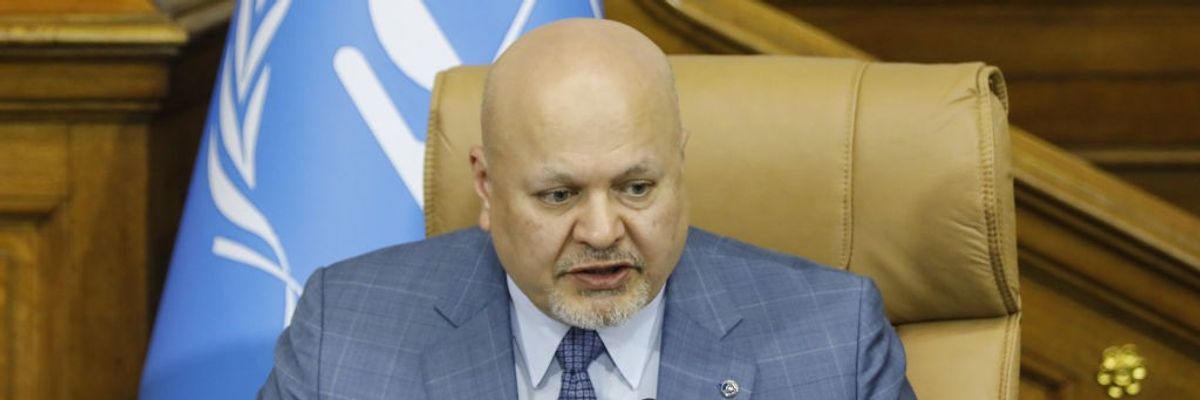
The International Criminal Court on Friday denounced U.S. President Donald Trump’s executive order sanctioning the ICC in response to arrest warrants issued for Israeli leaders over their devastating 15-month military assault on the Gaza Strip.
“The ICC condemns the issuance by the U.S. of an executive order seeking to impose sanctions on its officials and harm its independent and impartial judicial work,” the tribunal said in a statement. “The court stands firmly by its personnel and pledges to continue providing justice and hope to millions of innocent victims of atrocities across the world, in all situations before it.”
“We call on our 125 states parties, civil society, and all nations of the world to stand united for justice and fundamental human rights,” added the Hague-based ICC, which was established by a global treaty known as the Rome Statute to prosecute individuals for genocide, war crimes, crimes against humanity, and the crime of aggression.
A spokesperson for the United Nations’ Office of the High Commissioner for Human Rights (OHCHR), Ravina Shamdasani, also slammed Trump’s order targeting the ICC, which she called “a central institution of the international criminal justice system and fundamental to ensuring justice and achieving accountability for the most serious crimes.”
“We fully support the independent work of the court—across all situations within its jurisdiction,” Shamdasani said Friday. “We deeply regret the individual sanctions announced yesterday against court personnel, and call for this measure to be reversed.”
“The court should be fully able to undertake its independent work—where a state is unwilling or unable genuinely to carry out the investigation or prosecution, as stated in the Rome Statute. The court is an essential part of the human rights infrastructure,” she added. “The rule of law remains essential to our collective peace and security. Seeking accountability globally makes the world a safer place for everyone.”
Since Trump signed the order—which specifically cites the court’s November warrants for Israeli Prime Minister Benjamin Netanyahu and his former defense minister, Yoav Gallant—civil society groups around the world have also spoken out against the U.S. president, who previously targeted ICC officials with sanctions during his first term.
“This reckless action sends the message that Israel is above the law and the universal principles of international justice. It suggests that President Trump endorses the Israeli government’s crimes and is embracing impunity,” saidAmnesty International secretary general Agnès Callamard, a former U.N. special rapporteur, in a statement.
The “aggressive” and “vindictive” order, she continued, “is a brutal step that seeks to undermine and destroy what the international community has painstakingly constructed over decades, if not centuries: global rules that are applicable to everyone and aim to deliver justice for all. The sanctions constitute another betrayal of our common humanity.”
“At an historic moment when we are witnessing a genocide against Palestinians in Gaza, Russia’s aggression against Ukraine, and the global rule of law coming under threat from multiple fronts,” she argued, “institutions like the court are needed more than ever to advance human rights protections, prevent future atrocities and secure justice for victims.”
Trump’s sanctions will not only “embolden perpetrators,” Callamard warned, “they will negatively impact the interests of all victims globally and those who look to the court for justice in all the countries where it’s conducting investigations, including Darfur, Libya, the Philippines, Palestine, Ukraine, and Venezuela.”
“The sanctions are also an affront to 125 member states who have collectively resolved that the court must be able to effectively pursue justice—which means it must be able to undertake independent judicial functions, such as issuing arrest warrants, for example, against Benjamin Netanyahu or Vladimir Putin,” said added, referring to the Russian president.
“Governments around the world and regional organizations must do everything in their power to mitigate and block the effect of President Trump’s sanctions,” Callamard concluded. “Through collective and concerted actions, ICC member states can protect the court and its staff. Urgent action is needed, like never before.”
While some governments, such as Hungary, have backed Trump’s move, others have joined the chorus of condemnation and reiterated support for the ICC.
“We reaffirm our continued and unwavering support for the independence, impartiality, and integrity of the ICC,” 79 nations—including France, Germany, and the United Kingdom—said in a joint statement reported by Reuters. “The court serves as a vital pillar of the international justice system by ensuring accountability for the most serious international crimes, and justice for victims.”
President Trump on Thursday continued to push his idea of a US takeover of Gaza, claiming Israel would hand over the territory to the US at the “conclusion of fighting” and insisting the occupation wouldn’t require US troops.
“The Gaza Strip would be turned over to the United States by Israel at the conclusion of fighting,” the president wrote on Truth Social. The president’s comments suggest he expects Israel’s genocidal war to restart, which would be supported with US military aid.
After 15 months of heavy bombing and a ground campaign in Gaza, Israel failed to dismantle Hamas, and US intelligence believes the Palestinian group had even replaced most of the fighters it had lost in that time. That means even though Gaza has been reduced to rubble, Israel would still face stiff resistance if it attempts to conquer and ethnically cleanse the Strip.
In his post, Trump also called for the “resettlement” of Palestinians in Gaza and referred to Sen. Chuck Schumer (D-NY) as a “Palestinian,” something he first did while on the campaign trail over Schumer’s calls for elections in Israel.
“The Palestinians, people like Chuck Schumer, would have already been resettled in far safer and more beautiful communities, with new and modern homes, in the region. They would actually have a chance to be happy, safe, and free,” the president wrote.
“The US, working with great development teams from all over the World, would slowly and carefully begin the construction of what would become one of the greatest and most spectacular developments of its kind on Earth. No soldiers by the US would be needed! Stability for the region would reign!!!”
Trump’s post again suggests that his idea is for the permanent expulsion of Palestinians from Gaza, although the White House said the idea was a “temporary” relocation. But even a temporary displacement would be resisted since Palestinians wouldn’t expect Israel to let them return.
Trump’s proposal has been resoundingly rejected by the Arab states in the region and the Palestinians themselves, who don’t want to give up their homes even as they lie in ruin.
President Trump said on Tuesday that the US would “take over” the Gaza Strip, a surprise announcement he made while speaking with reporters at the White House during a press conference with Prime Minister Benjamin Netanyahu.
“The US will take over the Gaza Strip, and we will do a job with it, too. We’ll own it and be responsible for dismantling all of the dangerous unexploded bombs and other weapons on the site, level the site and get rid of the destroyed buildings, level it out, create an economic development that will supply unlimited numbers of jobs and housing for people of the area,” Trump said.
The president said earlier that the Palestinians must be removed from Gaza “permanently,” making it clear the plan will involve the ethnic cleansing of the territory despite strong resistance from neighboring Arab states. The plan also implies that the US would rebuild Gaza for Jewish settlers.
Trump was asked who would live in Gaza under his plan and replied, “The world’s people,” and suggested some Palestinians may also be allowed.
He said, “I think the entire world, representatives from all over the world, will be there, and they’ll live there. Palestinians, also, … will live there. Many people will live there.”
Trump also said he wouldn’t rule out deploying troops to Gaza. When asked if his plan meant he would send troops, Trump said, “If it’s necessary, we’ll do that. We’re gonna take over that piece and develop it, create thousands and thousands of jobs. It will be something the entire Middle East can be very proud of.”
The president suggested he had been considering the plan for a long time. “I see a long-term ownership position and bringing great stability to that part of the Middle East. Everybody I’ve spoken to — this was not a decision made lightly — everybody loves the idea of the US owning that piece of land, developing and creating thousands of jobs with something that will be magnificent in a magnificent area nobody would really know. They look, and all they see is death and destruction and rubble,” he said.
Netanyahu also commented on the plan, saying, “President Trump is taking it to a much higher level. He sees a different future for that piece of land that has been the focus of so much terrorism and attacks against us, so many trials and tribulations. He has a different idea and it’s worth paying attention to this. He’s exploring it and it’s something that could change history.”
Later on Tuesday, Trump’s Middle East envoy, Steve Witkoff, appeared on Fox News and endorsed the president’s plan, saying a better life for the Palestinians is “not necessarily tied to the physical space that you are in today.”
When asked what message Trump was trying to send by calling for a US takeover of Gaza, Witkoff said, “He’s telling the Middle East that the last 50 years of doing things was not the correct way of doing things, and he’s going to change it up.”
Secretary of State Marco Rubio also endorsed the US takeover and ethnic cleansing of Gaza. “Gaza MUST BE FREE from Hamas. As [Trump] shared today, the United States stands ready to lead and Make Gaza Beautiful Again. Our pursuit is one of lasting peace in the region for all people,” he wrote on X.
A US takeover of the Gaza Strip would require Israel to restart its genocidal war, and it could potentially involve direct US military action. Since coming into office, Trump has begun advancing billions of dollars worth of new weapons shipments for Israel funded by US military aid.
Hamas would fiercely resist a US takeover, and the group has replaced about all the fighters it has lost, according to US intelligence, despite Israel’s mass slaughter of Palestinians.









You must be logged in to post a comment.