Posts Tagged ‘Lebanon’

Biden is letting Israel trap the US into war with Iran

October 8, 2024

One year after Hamas’ Oct 7 attacks, regional conflict is raging with no end in sight

Analysis | Middle East

Paul R. Pillar, Oct 07, 2024

The Biden administration is not only endorsing but also on the verge of actively assisting a new Israeli armed attack on Iran. National security adviser Jake Sullivan says that the United States is working directly with Israel regarding such an attack. “The United States is fully, fully, fully supportive of Israel,” declares President Joe Biden.

The projected attack serves no U.S. interests. The attack perpetuates a broader pattern of escalating violence in the Middle East that also serves no U.S. interests. The Iranian missile salvo to which the coming Israeli attack is ostensible retaliation was itself retaliation for previous Israeli attacks. Retaliation for retaliation is a prescription for an unending cycle of violence.

The United States is facilitating an attack on a nation that does not want war and has been remarkably restrained in trying to avoid it, in the face of repeated Israeli provocations. A sustained Israeli bombing campaign against Iranian-related targets within Syria elicited a response only when it escalated to an attack on a diplomatic compound in Damascus, killing senior Iranian officials. Even then, the Iranian response, in the form of an earlier salvo of missiles and drones in April, was designed and telegraphed in a way to make a show of defiance but — with most of the projectiles certain to be shot down — to cause minimal damage and almost no casualties.

When Israel assassinated visiting Hamas political leader Ismail Haniyeh in a government guest house in Tehran in July — the sort of attack that would elicit a quick and forceful response by the U.S. or Israel if it happened in one of their capitals — Iran did nothing until last week. It finally acted only after yet another Israeli attack— this time an assault on residential buildings in a suburb of Beirut that killed a senior Iranian Revolutionary Guard officer along with Hezbollah secretary-general Hassan Nasrallah. Far from being motivated by any grandiose ambitions of regional dominance or desire to destabilize the region, Iranian leaders believed that they were getting killed by a thousand cuts from Israel and that they had to respond to the repeated Israeli attacks lest they lose the confidence not only of their own people but of regional allies. The missile firings that constituted Iran’s retaliation, like the ones in April, again caused minimal damage or casualties.

By cooperating with Israel in a new attack, the United States is assisting a state that has been responsible for most of the escalation and the vast majority of death and destruction in the Middle East for at least the past year. Although Hamas’ attack on southern Israel last October is commonly seen as the starting point of the subsequent mayhem in the Middle East, the question of who is responding to whom could go back farther than that. For example, the 1,200 deaths from that Hamas attack, horrible to be sure, were fewer than the number of Palestinians that Israel had killed in the occupied West Bank and the Gaza Strip just from the day-to-day operations of the occupying Israeli army, supplemented by settler violence in the West Bank, during the previous eight years.

Since the Hamas attack, the devastating Israeli operation in the Gaza Strip has gone far beyond anything that can be construed as defense, or even as a response to Hamas, and has brought suffering to innocent civilians that is orders of magnitude greater than anything Hamas or any other Palestinian group has ever done. The still-rising official death toll exceeds 41,000, with the actual number of Palestinian deaths probably much higher and likely into six figures. Much of the Strip has been reduced to rubble and rendered unlivable.

After Hezbollah fired rounds into Israel last October in a show of support for the Palestinians in Gaza, the story of conflict along the Israeli-Lebanese frontier has mainly been one of repeated Israeli escalations. Israeli attacks in Lebanon have far exceeded Hezbollah attacks on Israel, in number but especially in physical effects, with almost no casualties within Israel apart from a few military personnel at the border. The rapidly rising toll of deaths in Lebanon from Israeli attacks has now passed 2,000, with about 10,000 injured and about 1.2 million people displaced from their homes. As in the Gaza Strip, civilians constitute much and perhaps most of that toll, including as a result of Israeli airstrikes that have demolished residential buildings in densely populated neighborhoods.

As a growing Israeli ground assault in Lebanon accompanies the aerial bombardment, Israel has told people in almost the entire southern third of Lebanon to move north, even though Israel already has been conducting lethal aerial attacks throughout Lebanon, including as far north as Tripoli. This also is reminiscent of the pattern in Gaza, in which residents are told to move, only to be bombed again in their new location.

The offensive Israeli actions that figure into confrontation with Iran — including the aerial and clandestine assassination operations in Lebanon, Syria, and the heart of Tehran — also have each constituted escalation. Those operations appear designed at least in part to goad Iran into entering a wider war, preferably one that also involves the United States.

Other motives behind the Israeli escalation are multiple and vary with the specific target. The deadly assaults on the Palestinians — in the Gaza Strip and increasingly also in the West Bank— are part of a long-term effort to use force to somehow make Israel’s Palestinian problem go away, through a combination of outright killing, inducing exile by making a homeland unlivable, and intimidation of any who remain.

Israel’s officially declared objective for its attacks in Lebanon is to permit a return home of the 70,000 temporarily displaced residents of northern Israel — whose numbers constitute less than six percent of the Lebanese who have been driven from their homes so far by the Israel offensive. That objective is genuine, but an escalating war along Israel’s northern border only places the objective farther out of reach. The Israeli operations also clearly are designed to cripple Hezbollah as much as possible, although they sustain and heighten the sort of anger that led to Hezbollah’s establishment and growth in the first place.

An Israel that is the strongest military power in the Middle East and is throwing its armed might around in seemingly every direction but the Mediterranean Sea is a nation drunk on the use of force and stumbling into still more use of it with little or no apparent attention to any long-term strategy for achieving an end state, other than living forever by the sword. Each tactical success, including the killing of a prominent adversary such as Hezbollah’s Hassan Nasrallah, only seems to deepen the inebriation.

Beyond this, one gets into a mixture of motivations that are specific to Prime Minister Benjamin Netanyahu and ones shared with other Israeli policymakers. It is widely recognized, including by Netanyahu’s domestic opponents, that he has a personal stake in continuing and even escalating Israel’s wars. This is partly because of the usual rally-round-the-flag effect that attenuates the political problems of a wartime leader. It is also more specifically because Netanyahu is dependent on the support of the most extreme members of his right-wing ruling coalition to hold that coalition together, thereby keeping Netanyahu in power and delaying the day he has to confront fully the corruption charges against him.

Newsletter

Subscribe now to our weekly round-up and don’t miss a beat with your favorite RS contributors and reporters, as well as staff analysis, opinion, and news promoting a positive, non-partisan vision of U.S. foreign policy.

Invalid emailEnter your email

An armed attack on Iran would extend the Israeli policy— not unique to Netanyahu, although he has been its most prominent exponent — of stoking maximum hostility toward, and isolation of, Iran. That policy serves to weaken a rival for regional influence, to place blame for everything wrong with the region on someone other than Israel, to inhibit any engagement with Iran by Israel’s patron the United States, and to divert international attention away from Israel’s own actions.

The diversion seems to work. The international attention to what may come next in the confrontation with Iran, in addition to the escalating operations in Lebanon, has meant less attention than would otherwise have been given in newspapers and the airwaves to the continued carnage in the Gaza Strip that claims civilian lives, such as Israeli attacks within the last few days on a girls’ school and an orphanage that several hundred displaced persons were using as shelter.

The U.S. presidential election provides another motivation for the Israeli government to escalate regional warfare. Netanyahu certainly would like to see a second term for Donald Trump, who gave Israel just about anything it wanted during his previous time in office, with nothing in return except political support for Trump. This relationship is part of a broader political alliance between the Republican Party and Netanyahu’s Likud Party. To the extent an escalatory mess in the Middle East causes problems for the Biden administration and thereby hurts the election chances of Vice President Kamala Harris, that is a bonus from Netanyahu’s point of view.

Netanyahu is more likely to enjoy that bonus and the other fruits of ramping up conflict with Iran to the extent that the United States gets directly involved in that conflict. Such involvement not only makes the politically costly mess for the Biden administration all the messier, but also enables Netanyahu to claim credibly that he has the United States fully at his side in his government’s lethal activities.

None of these Israeli objectives are in the interest of the United States. Several of the objectives, such as hamstringing any U.S. diplomacy that involves Iran, are directly and manifestly opposed to U.S. interests.

Israel’s regional warfare — and more specifically a U.S.-backed attack on Iran — would harm U.S. interests in several additional ways.

Closer association with Israel’s lethal operations increases the chance of reprisals, including terrorist reprisals. It also worsens U.S. isolation in international politics.

Supporting or participating in an Israeli attack on Iran would further undermine U.S. claims to be in favor of peace and observance of a rules-based international order. It would mean attacking the country that in this confrontation has exercised restraint in the interest of avoiding war and is firmly in support of ceasefires on each of the fronts seeing combat. It would mean aiding further attacks by the country that in the same confrontation has inflicted far more death and destruction, and done more to promote escalation of the violence, than any other in the region.

An attack on Iran would roil the oil market and cause economic dislocations that would reach the United States, especially but not solely if such an attack targeted Iranian oil facilities.

An attack would set back any chance for fruitful diplomacy involving Iran on matters such as security in the Persian Gulf region.

An attack would increase the chance that the Iranian regime would choose to develop a nuclear weapon. Nothing would be better designed to strengthen the arguments of those in Tehran willing to take that step than armed attacks demonstrating that Iran does not now have a sufficient deterrent.

Israel has already entrapped the United States to a large degree in its lethal ways in the Middle East, and the entrapment threatens to become deeper with the anticipated new attack on Iran. The entrapment would not have been possible without mismanagement of the U.S.-Israeli relationship on the Washington end. President Biden’s approach of holding Netanyahu close in the hope of influencing his policies has failed. It also has been counterproductive. In the absence of any willingness to employ the leverage that U.S. material aid to Israel represents, all the bear-hugging and expressions of support have only reassured Netanyahu that he can continue to prosecute his wars and ignore American calls for restraint without losing that aid.

It is refreshing to see reports that at least within the Department of Defense there is some recognition that the policy has been counterproductive by emboldening Israel to escalate. It is perhaps unsurprising that the department whose personnel would be on the front line of any expanded warfare involving the United States is more willing than others to recognize the nature and sources of the violence plaguing the Middle East and the need to deter or restrain Israel rather than embolden it. One can only hope that this willingness will spread more widely in policymaking circles.

Paul R. Pillar

Paul R. Pillar is Non-resident Senior Fellow at the Center for Security Studies of Georgetown University and a non-resident fellow at the Quincy Institute for Responsible Statecraft. He is also an Associate Fellow of the Geneva Center for Security Policy.

The views expressed by authors on Responsible Statecraft do not necessarily reflect those of the Quincy Institute or its associates.
Congresswoman Tlaib Slams US-Funded ‘Bloodbath’ as Biden Calls Israel Bombing Lebanon ‘Justice’

September 29, 2024

Tlaib Slams US-Funded 'Bloodbath' as Biden Calls Israel Bombing Lebanon 'Justice'

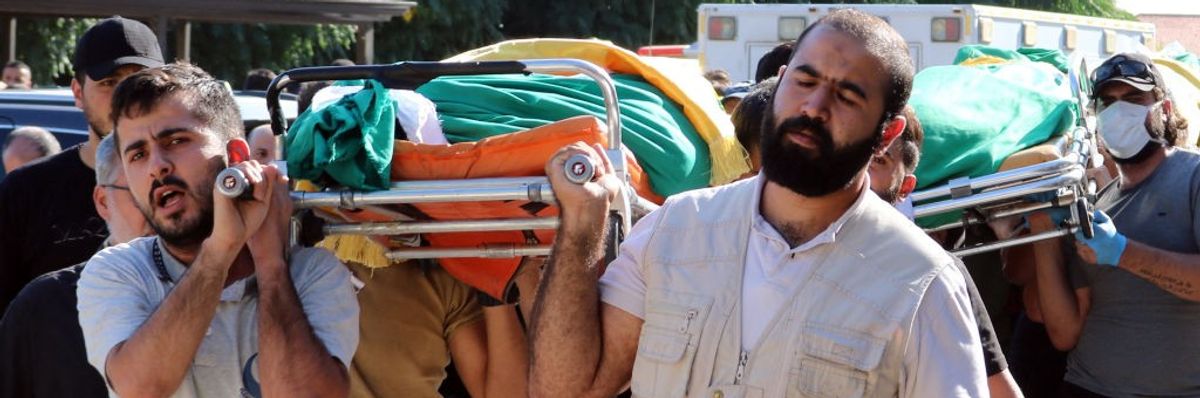
Mourners carry the bodies of people killed in Israeli airstrikes on el-Karak in Lebanon’s eastern Bekaa valley, during their funeral on September 27, 2024.

(Photo: Hassan Jarrah/AFP via Getty Images)

“The U.S. government are conspirators to the war criminal Netanyahu’s genocidal plan,” said the Michigan Democrat.

by Jessica Corbett, Common Dreams, Sep 28, 2024

U.S. President Joe Biden and Congresswoman Rashida Tlaib on Saturday had notably different responses to Israel’s intense bombing campaign in Lebanon over the past 24 hours, which killed hundreds of people including key Hezbollah leaders.

“Our country is funding this bloodbath,” Tlaib (D-Mich.) said on social media Saturday morning, sharing a post from Zeteo‘s Prem Thakker with videos of the Israeli assault on Lebanon that began Friday, as Israeli Prime Minister Benjamin Netanyahu was in New York City to address the United Nations General Assembly.

“Sending more of our troops and bombs to the region is not advancing peace,” added Tlaib, the only Palestinian American in Congress and a leading critic of Israel’s yearlong genocide in the Gaza Strip. “The U.S. government are conspirators to the war criminal Netanyahu’s genocidal plan.”

In the post shared by Tlaib, Thakker noted that “the U.S. was reportedly informed of this mass Israeli attack on Beirut in Lebanon shortly beforehand,” which “comes just one day after [the] U.S. released $8.7 billion more in aid to Israel.”

Tlaib also shared that her office is fielding “desperate calls” from U.S. citizens who are struggling to leave Lebanon. She declared that “the mission of the U.S. Department of State is to protect Americans, and they are failing AGAIN.”

Biden, meanwhile, began his Saturday afternoon statement by noting that Israel killed Hezbollah leader Hassan Nasrallah, which the Iran-backed Lebanese political and paramilitary group confirmed earlier in the day—a development that elevated fears of a broader regional war.

“Hassan Nasrallah and the terrorist group he led, Hezbollah, were responsible for killing hundreds of Americans over a four-decade reign of terror,” Biden said. “His death from an Israeli airstrike is a measure of justice for his many victims, including thousands of Americans, Israelis, and Lebanese civilians.”

The president continued:

The strike that killed Nasrallah took place in the broader context of the conflict that began with Hamas’ massacre on October 7, 2023. Nasrallah, the next day, made the fateful decision to join hands with Hamas and open what he called a “northern front” against Israel.

The United States fully supports Israel’s right to defend itself against Hezbollah, Hamas, the Houthis, and any other Iranian-supported terrorist groups. Just yesterday, I directed my secretary of defense to further enhance the defense posture of U.S. military forces in the Middle East region to deter aggression and reduce the risk of a broader regional war.

Ultimately, our aim is to de-escalate the ongoing conflicts in both Gaza and Lebanon through diplomatic means. In Gaza, we have been pursuing a deal backed by the U.N. Security Council for a ceasefire and the release of hostages. In Lebanon, we have been negotiating a deal that would return people safely to their homes in Israel and southern Lebanon. It is time for these deals to close, for the threats to Israel to be removed, and for the broader Middle East region to gain greater stability.

While the American Israel Public Affairs Committee (AIPAC) thanked Biden “for standing with our democratic ally Israel,” journalists from around the world and other critics highlighted that his statement “has not a word on civilian casualties.”

Ali Abunimah, director of The Electronic Intifada, was among those who pointed out that Biden said the “assassination of Nasrallah, in an Israeli massacre that killed hundreds, ‘is a measure of justice for his many victims.'”

“Utterly depraved, and by this twisted, criminal Biden logic, those who tried to assassinate Trump were also instruments of ‘justice,” Abunimah said, referring to former U.S. President Donald Trump, Republican nominee for the November election.

Middle East expert Assal Rad said: “Biden calls massive bombs in a densely-populated area that leveled six apartment buildings in Lebanon ‘a measure of justice.’ The torching of international law and the precedent that is being set should terrify us all.”

Rad also slammed Biden’s cease-fire call, saying: “This is nonsense. You can’t provide the funding and weapons to continue the conflict *without* conditions, twist humanitarian law to give Israel total impunity, and reject every international institution that seeks accountability, and then say your ‘aim is to de-escalate.'”

Others recalled Israel’s 2004 assassination of Hamas leader Ahmed Yassin, which also killed seven other people. The administration of former Republican U.S. President George W. Bush—who launched the global War on Terror in the wake of the September 11, 2001 attacks—didn’t issue a forceful condemnation like some European leaders, but a spokesperson for the State Department said at the time that “we are deeply troubled” by the attack.

As’ad Abukhalil, a Lebanese American professor at California State University, Stanislus, declared Saturday that “there has been no U.S. president EVER who has unconditionally allowed unrestrained Israeli savagery in the Middle East as Biden has done.”

Abukhalil warned that “the U.S. will suffer for years to come from the policies of Biden in the Middle East,” which he described as “more far-reaching [than] Bush’s.”

Biden, a Democrat, was initially seeking reelection in November, but after a disastrous summer debate performance against Trump, he passed the torch to Vice President Kamala Harris. After putting out Biden’s Saturday statement, the White House released a similar one from Harris—which was also lauded by AIPAC.

“Hassan Nasrallah was a terrorist with American blood on his hands. Across decades, his leadership of Hezbollah destabilized the Middle East and led to the killing of countless innocent people in Lebanon, Israel, Syria, and around the world. Today, Hezbollah’s victims have a measure of justice,” Harris said. “I have an unwavering commitment to the security of Israel. I will always support Israel’s right to defend itself against Iran and Iran-backed terrorist groups such as Hezbollah, Hamas, and the Houthis.”

“President Biden and I do not want to see conflict in the Middle East escalate into a broader regional war,” she added. “We have been working on a diplomatic solution along the Israel-Lebanon border so that people can safely return home on both sides of that border. Diplomacy remains the best path forward to protect civilians and achieve lasting stability in the region.”

In response, Margaret Zaknoen DeReus, executive director at the California-based Institute for Middle East Understanding, said: “Like Biden, not a word from the VP , from the candidate of joy & freedom, about the 1,000+ Lebanese men, women and children Israel obliterated. Not a word about hundreds of thousands of Lebanese displaced, entire city blocks destroyed. We don’t exist as human beings to this [administration].”

Responding to both statements on social media, the anti-war group CodePink said that the Biden-Harris administration “believes flattening a residential area with… bombs is ‘justice.'”

Biden Claims He’s Working for Peace in the Middle East But Continues to Back Israel

September 25, 2024

Biden made the claim in a speech at the UN General Assembly

by Dave DeCamp, Antiwar. com, September 24, 2024

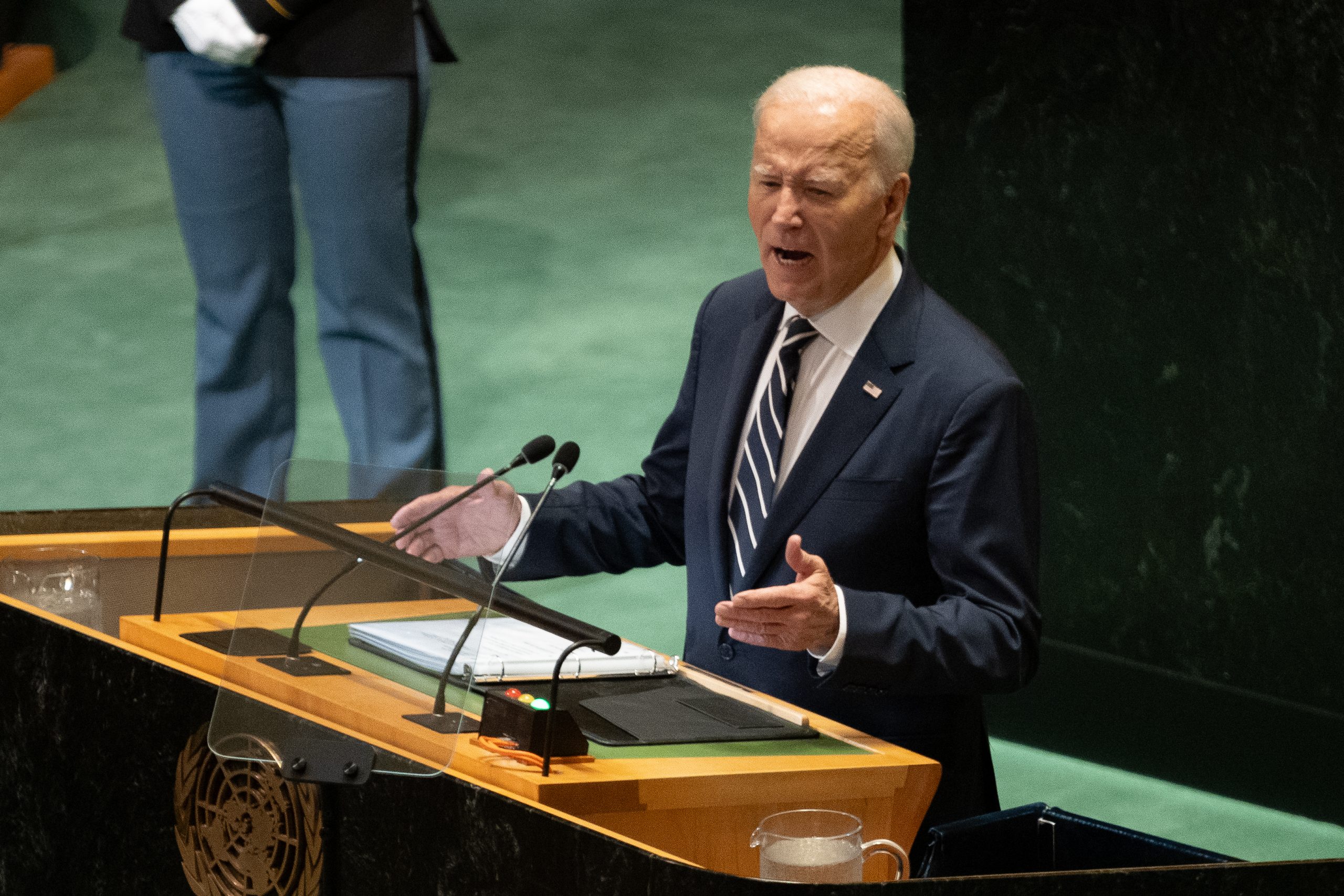
President Biden delivered a speech to the UN General Assembly in New York on Tuesday and claimed that he was working to bring a “greater measure of peace and stability to the Middle East” even though his administration continues to provide full-throated support for Israel’s genocidal war in Gaza and its escalations in Lebanon.

Biden acknowledged that “innocent civilians” in Gaza are “going through hell,” a situation he helped create by providing a constant flow of weapons to Israel since October 7, 2023. An Israeli Air Force official recently said that without US support, Israel could only sustain military operations in Gaza for a few months.

The president said it was time for Hamas and Israel to finalize the terms of a hostage and ceasefire deal, but US officials have admitted that there’s no chance of an agreement before Biden’s term ends on January 20, 2025. Biden could force Israel to accept a deal by withholding military aid, but there’s no sign he’s willing to take that step.

US President Joe Biden delivered remarks at the United Nations (John Wong/EYEPRESS)

Discussing the situation between Israel and Hezbollah, Biden said, “Full-scale war is not in anyone’s interest. Even as the situation has escalated, a diplomatic solution is still possible.” His comments came a day after Israel launched a massive bombardment against southern and eastern Lebanon, killing over 500 people, mostly civilians.

Biden claimed that his administration is “working tirelessly” to achieve a diplomatic solution between Israel and Hezbollah. But the US backed the latest Israeli escalation and is deploying more troops to the Middle East as a show of support. US military aid and promises to defend Israel in the event of a major regional war have emboldened Israel to escalate in Lebanon and elsewhere in the Middle East.

Lebanese Foreign Minister Abdallah Bou Habib expressed disappointment with Biden’s comments about Lebanon and said the US was the only country that could stop the escalations. “It was not strong. It is not promising and it would not solve this problem,” Bou Habib said. “I (am) still hoping. The United States is the only country that can really make a difference in the Middle East and with regard to Lebanon.”

In his address, Biden also called for countries to stop arming the opposing sides in the war in Sudan. “The world needs to stop arming the generals, to speak with one voice and tell them: Stop tearing your country apart. Stop blocking aid to the Sudanese people.  End this war now,” he said.

A day earlier, the Biden administration named the UAE a “major defense partner” as Abu Dhabi is funneling weapons into Sudan to arm the Rapid Support Forces and fuel the war. The designation will give the UAE access to more sophisticated US weapons and military technology.

Lebanon Health Minister: ‘Majority, If Not All’ of 558 Killed by Israel Were Civilians

September 24, 2024

Experts say the scale of the Israeli bombardment in Lebanon on Monday is unprecedented in 21st-century conflicts

by Dave DeCamp, Antiwar. com, September 24, 2024

Lebanese Health Minister Dr. Firass Abiad told The New York Times on Tuesday that the “overwhelming majority, if not all,” of the people killed and wounded by Israel’s bombardment in Lebanon on Monday were civilians.

The latest health toll from Lebanon’s Health Ministry puts the number of killed by the Monday bombing at 558, which includes 50 children and 94 women. Nearly 2,000 were wounded in the attack.

The Times notes that Lebanon’s Health Ministry’s figures have historically been viewed as reliable. The ministry is not run by Hezbollah but is overseen by the Lebanese government and collects its data using an emergency operations center that gathers casualty figures from private and state-run hospitals.

Israel targeted residential areas of southern and eastern Lebanon on Monday, claiming Hezbollah missiles were being hidden inside houses. The Israeli military said that it hit more than 1,600 targets, and experts say it’s one of the heaviest single-day bombings in modern warfare. The toll in Israel’s bombardment is about half of the toll for the entire 2006 Lebanon War, which lasted 34 days.

“Prior to the Gaza war, munitions deployed with this intensity and with this frequency would have been almost unheard-of,” Emily Tripp, director of the monitoring group Airwars, told the Times. “There is no comparison in terms of death toll or munitions use with previous 21st-century air campaigns of this nature, as far as we know.”

The US supported the Israeli bombardment despite previously claiming it opposed escalation and is sending more troops to the region as a show of support. Israeli strikes continue to hit Lebanon on Tuesday, and Hezbollah has fired hundreds of rockets into Israel in response.

Turning Back From the Point of No Return – Implications of the Threat to Bomb Iran

August 26, 2010
Jeremy R. Hammond, Foreign Policy Journal, August 26, 2010

The drums for war on Iran have been banging louder than ever lately, with a spate of articles by political commentators either directly encouraging the bombing of the Islamic Republic or otherwise offering a narrative in which this is effectively portrayed as the only option to prevent Iran from waging a nuclear holocaust against Israel. A prominent example of the latter is Jeffrey Goldberg’s article last month in the Atlantic magazine, “The Point of No Return”.[1] Goldberg’s lengthy piece essentially boils down to this: Iran’s pursuit of nuclear weapons poses an existential threat to Israel’s existence comparable to the Nazi Holocaust, and although the U.S. recognizes this threat, the Obama administration is weak, so Israel will have no choice but to act alone in bombing Iran to ensure its own survival.

Continues >>

Top Ten Myths about the Israeli-Palestinian Conflict

June 19, 2010

Jeremy R. Hammond, Foreign Policy Journal, June 17, 2010

A Palestinian boy throws a stone at an Israeli  tank in the occupied West Bank.

Myth #1 – Jews and Arabs have always been in conflict in the region.

Although Arabs were a majority in Palestine prior to the creation of the state of Israel, there had always been a Jewish population, as well. For the most part, Jewish Palestinians got along with their Arab neighbors. This began to change with the onset of the Zionist movement, because the Zionists rejected the right of the Palestinians to self-determination and wanted Palestine for their own, to create a “Jewish State” in a region where Arabs were the majority and owned most of the land.

For instance, after a series of riots in Jaffa in 1921 resulting in the deaths of 47 Jews and 48 Arabs, the occupying British held a commission of inquiry, which reported their finding that “there is no inherent anti-Semitism in the country, racial or religious.” Rather, Arab attacks on Jewish communities were the result of Arab fears about the stated goal of the Zionists to take over the land.

Continues >>

Lebanese PM warns of escalating Israeli war threats

February 10, 2010

Middle East Online,First Published 2010-02-10


‘We will stand against Israel. We will stand with our own people’


Hariri voices concern about ‘dangerous’ Israeli military maneuvers ‘day in and day out’.

LONDON – Lebanese Prime Minister Saad Hariri voiced concern about Israeli threats and escalating military activity in a BBC interview broadcast Wednesday.

“We hear a lot of Israeli threats day in and day out, and not only threats,” Hariri told the British broadcaster.

“We see what’s happening on the ground and in our airspace and what’s happening all the time during the past two months – every day we have Israeli planes entering Lebanese airspace.

“This is something that is escalating, and this is something that is really dangerous,” said the prime minister.

Hariri warned Israel not to count on Lebanon, whose politics is highly factious, remaining divided in case of an attack.

Continues >>

‘Israeli assassination of Nasrallah would set region ablaze’

May 22, 2009

By Jack Khoury, Haaretz Correspondent | Haaretz/Israel, May 22, 2009

Israel is planning to assassinate the head of the southern Lebanon-based Shi’ite militia Hezbollah, a development which would “set the region ablaze,” one of the group’s deputies told an Arab language newspaper on Friday.

Nawaf al-Moussawi, who was Hezbollah’s top foreign policy official and who is now running in Lebanon’s upcoming parliamentary elections, accused Israel of plotting to assassinate the Shi’ite group’s leader, Secretary-General Hassan Nasrallah.

Al-Moussawi, who is running for a seat representing the south Lebanese town of Tyre, said that Israel’s plan was hatched in concert with Arab governments.

In an interview with the pan-Arab London-based daily newspaper Asharq al-Awsat, al-Moussawi spoke in detail about the elections. He also told the newspaper that Israel’s planned large-scale military drill is really a simulation of the army’s plan to liquidate Nasrallah.

Al-Moussawi said an Israeli assassination of Nasrallah would “set the region ablaze” and that Hezbollah was preparing for such a scenario.

Gazans fear Israel using phosphorus

January 12, 2009
Al Jazeera, January 12, 2008

Human Rights Watch said it was clear Israel had fired shells containing white phopshorus[GALLO/GETTY]

Doctors in Gaza City have told Al Jazeera that people have been admitted suffering burns consistent with the use of the controversial chemical white phosphorus.

Human rights campaigners say that Israeli forces have used the munition, which can burn away human flesh to the bone, over Gaza City and Jabaliya in recent days.

Al Jazeera’s Ayman Mohyeldin, reporting from the Shifa hospital in Gaza City, said: “Doctors here say they are seeing unprecedented levels of deep burns.

“They cannot categorically say that white phosphorus is being used, they are saying that the munitions being dropped are unprecendented.”

Residents in densely-packed Jabaliya have described Israeli forces exploding shells that drop scores of burning fragments and spread suffocating smoke.

“Its the first time we see this type of weapon, it must be new and its seems like its phosphorous,” one resident told Al Jazeera.

“Its suffocating and has a deadly poisonous smell that I am sure will cause a lot of sickness and disease on all of the civilians here,” he said.

Another witness said she saw “… a bright flash and then all of these sparks fell on our area … landing all around us and in our homes. Our mattresses caught on fire”.

Law ‘violated’

The use of the munition in densely-populated areas violates the requirement under international humanitarian law for all feasible precautions to be taken to avoid civilian injury and loss of life, Human Rights Watch said.

IN DEPTH

Analysis and features from Gaza and Israel

Track the war and submit your own reports

Send us your views and eyewitness videos

Watch our coverage of the war on Gaza

International law permits the use of white phosphorus in order to cover troop movements and prevent enemies from using certain guided weapons.

Marc Garlasco, a senior military analyst at the human rights group told Al Jazeera on Saturday that he had watched Israeli ground forces using white phosphorus.

“Clearly it is [white phosphorus], we can tell by the explosions and the tendrils that go down [and] the fires that were burning,” he said.

“Today there were massive attacks in Jabaliya when we were there. We saw that there were numerous fires once the white phosphorus had gone in.

“We went by Israeli artillery units that had white phosphorus rounds with the fuses in them.”

Major Avital Leibovich, an Israeli military spokeswoman, told Al Jazeera that the Israeli army was “using munitions with accordance to international law”.

“The policy of the IDF [Israeli Defence Force] is to not specify the types of munition, we have not done it before and we will not do it now.”

Mark Regev, the Israeli government spokesman, said he was unable to confirm or deny whether the military was using the chemical, but that Israel did not use munitions that were banned under international law.

“I don’t have the knowledge of the detail of what ammunition we are using. I can only know for a fact that Israel uses no ammunition that is outlawed under conventions and that Nato forces would not use in a similar combat situation,” he told Al Jazeera.

Israel used white phosphorus during its 34-day war against Lebanon’s Hezbollah movement in 2006, while the United States used it during the controversial siege of the Iraqi city of Fallujah in 2004.