Posts Tagged ‘pete-hegseth’

‘Barbarity for the Sake of Barbarity’: Trump Pentagon Confirms Plan to Livestream Firing Squad Execution

October 9, 2026

Secretary Hegseth Hosts National POW/MIA Recognition Day Ceremony At The Pentagon

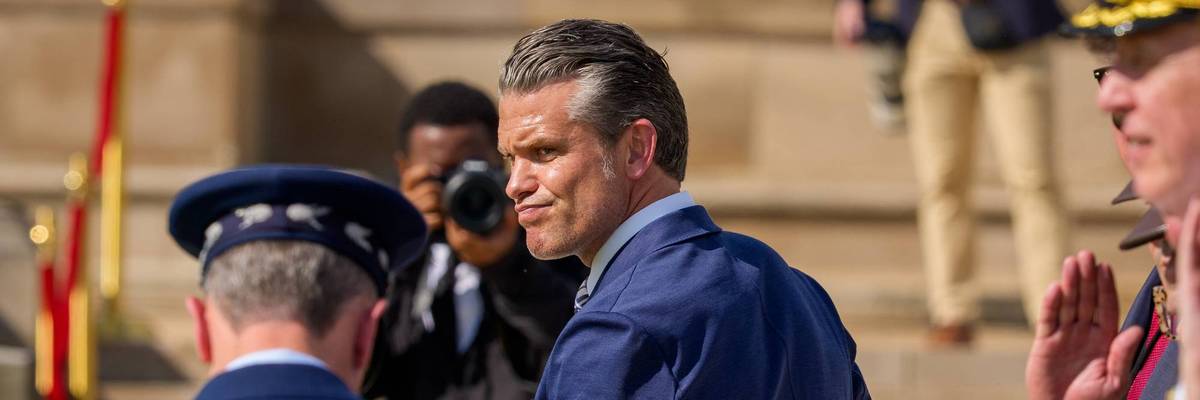
US Secretary of Defense Pete Hegseth departs a ceremony on the Pentagon River Terrace Parade Field on September 18, 2026 in Arlington, Virginia.

(Photo by Andrew Harnik/Getty Images)

“The death penalty on its own is morally indefensible,” said one critic. “Turning it into a public spectacle is an abomination.”

Jessica Corbett, Common Dreams, Oct 08, 2026

The Pentagon on Thursday confirmed plans to livestream an execution by firing squad in December—a revelation that came amid fresh calls for the United States to end the death penalty after Tennessee botched two attempts to kill Christa Pike with injections of pentobarbital.

The US Army announced Wednesday that Nidal Hasan—a former military psychiatrist convicted of killing 13 people and injuring 32 more in a 2009 mass shooting at Fort Hood—will be executed at the Texas base at 1:00 pm Central Standard Time on December 3.

RECOMMENDED…
Trump salutes as soldiers carry a flag-draped casket

‘Unforgivable Sin’: Pentagon Reportedly ‘Hiding’ US Deaths in Iran War
US-POLITICS-TRUMP

‘By Annihilating Iran, We’ve Created Peace’: Trump’s Genocidal Rhetoric Takes Orwellian Turn in Time Interview

Secretary of Defense Pete Hegseth told the right-wing outlet Real America’s Voice News that “we’ll make sure that people are able to watch it, that it’s public, because people need to understand that… there’s serious consequences for these types of things.”

Then, other outlets, including The Associated Press, reported that “officials in the Pentagon clarified Thursday that the execution would be livestreamed and that more details would follow.”

The Washington Post reported that “if Hasan’s execution is carried out, it would mark the first US military execution since April 13, 1961, when Army Pvt. John A. Bennett was hanged after being convicted of rape and attempted murder, according to the nonprofit Death Penalty Information Center, which monitors capital punishment. The military’s last known firing squad execution was carried out by ‘musketry’ on November 9, 1945.”

Hegseth’s comments and the subsequent confirmation from the US Department of Defense were met with disgust and outrage.

“What a sick man,” former National Nurses United communications director Charles Idelson said of the Pentagon chief on social media. “A. Executions have never been proven to be a deterrent to capital crimes. B. The spectacle of a public execution is morbid, it recalls the public lynchings so common during the Jim Crow era. C. If the shooter was white, I don’t believe this would be public.”

Hasan is a US citizen born to Palestinian immigrant parents. Just before he opened fire on soldiers who were set to deploy to Afghanistan, he shouted “Allahu akbar,” an Arabic phrase commonly used by Muslims that translates to “God is great!”

While some critics called out Hesgeth, Obama administration speechwriter-turned-podcaster Jon Favreau took aim at Vice President JD Vance, who recently published a book about his faith journey, including his conversion to Catholicism. Favreau said that “I would like to hear our Catholic vice president explain why they’re intentionally choosing to broadcast the death of a human being for the entire world to see, including children.”

Producer and journalist Simon Thompson wrote: on social media: “Just when I think this administration couldn’t get any worse. Livestreaming executions by firing squad? This administration, a Christian administration apparently, is making a snuff movie and treating it like a [pay-per-view] event.”

Journalist Séamus Malekafzali similarly said, “Content with having desensitized the American public by broadcasting faceless images of Iranian sailors dying and buildings full of people leveled to the soundtrack to Halo, the government is now moving to live-streaming snuff films, faces and all.”

“I know people hate when people make comparisons to American adversaries, but this is literally what ISIS did, save for the live aspect,” he added. “Those executions were also done on camera under the auspices of nominally government institutions, just a different kind of government.”

Although Trump left office the first time after overseeing a federal execution spree, American Immigration Council senior fellow Aaron Reichlin-Melnick said Thursday, “Jesus Christ, I didn’t think we’d actually get to the ‘public executions’ stage of Trump’s project to roll back the last 100 years of societal development.”

Corbin Trent, co-founder of Justice Democrats, suggested it could backfire for the Republican administration. He wrote: “I’m completely in favor of this. I think more of this would go a long way to ending the death penalty.”

Trump’s Divine War: How Christian Nationalists Are Running U.S. Policy in ISran and at Home

April 5, 2026

ScheerPost, April 3, 2026

ScheerPost Staff

As the Trump administration deepens U.S. military involvement in Iran alongside Israel, a new The Intercept briefing examines a dimension of the conflict often overlooked in mainstream war coverage: the growing influence of Christian nationalist ideology inside American foreign policy. In this episode, investigative journalist Sarah Posner joins host Jessica Washington to unpack how apocalyptic theology, evangelical political networks, and religious-right power structures are shaping decisions from the Pentagon to the campaign trail.

At the center of the discussion is Defense Secretary Pete Hegseth, whose public prayers for “overwhelming violence” and rhetoric about divine mission reveal how sections of the modern Christian right increasingly frame military conflict not simply as geopolitics, but as spiritual warfare. Posner argues that this worldview goes beyond symbolic religious language: it reflects a deeper ideological belief that biblical authority supersedes international law, civilian protections, and traditional diplomatic constraints.

The conversation also traces the role of influential evangelical figures such as John Hagee, whose decades-long advocacy for confrontation with Iran ties directly into end-times prophecy and Christian Zionist doctrine. Far from fringe theology, these ideas continue to shape large sections of Trump’s political base, reinforcing a foreign policy culture where war, prophecy, and domestic nationalism increasingly intersect.

Beyond Iran, the episode links these religious currents to broader domestic agendas—from anti-LGBTQ legislation to voting restrictions and immigration policy—showing how the same ideological infrastructure behind foreign intervention is also driving a wider effort to redefine American law, citizenship, and family life. The result is a portrait of a political movement that sees no separation between spiritual destiny, military power, and state authority.

What began as another presidential justification for war has rapidly opened a broader debate about the forces driving American power abroad. In its latest briefing, The Intercept turns attention away from battlefield headlines and toward a political current that has long operated beneath the surface of U.S. foreign policy: the growing fusion of Christian nationalist ideology, apocalyptic belief, and state power inside the second Donald Trump administration.

The episode arrives as Washington’s military partnership with Israel in its confrontation with Iran enters a more dangerous phase, with rising oil instability, domestic political backlash, and widening fractures inside both major parties. Yet the discussion presented by host Jessica Washington and investigative journalist Sarah Posner argues that strategic calculations alone do not explain the intensity of current rhetoric coming from senior U.S. officials. Instead, they suggest that parts of the administration increasingly frame war through a theological lens—one in which military action is not only justified politically, but sanctified spiritually.

That argument becomes most visible in the conduct of Defense Secretary Pete Hegseth, whose recent public prayer at the Pentagon asking for “overwhelming violence” against enemies drew renewed scrutiny. For Posner, the significance lies not merely in religious language but in the specific worldview behind it. Hegseth’s association with the Communion of Reformed Evangelical Churches reflects a current of Christian Reconstructionism that views biblical authority as the supreme legal framework governing both personal and public life. Under that framework, war can become more than a strategic instrument—it becomes part of a divine obligation to defend and expand what adherents see as a Christian nation.

The discussion carefully distinguishes this ideological current from more familiar evangelical support for Israel. Figures such as John Hagee, founder of Christians United for Israel, have spent decades promoting confrontation with Iran through a different theological narrative: one rooted in end-times prophecy, biblical signs, and the expectation that conflict in the Middle East may accelerate events leading to the return of Jesus. While Hegseth’s rhetoric reflects dominionist ideas about establishing God’s authority through state power, Hagee’s message speaks to a broader evangelical audience that sees Israel’s wars through prophetic fulfillment.

What makes the moment politically significant is that these belief systems are no longer confined to pulpits, television ministries, or religious conferences. According to Posner, they now intersect directly with executive power, military messaging, and legislative agendas. Trump’s long alliance with white evangelical leadership has often been described by mainstream media as transactional—religious conservatives deliver votes, and Trump delivers judges. But the interview argues that the relationship has matured into something far deeper: an ideological partnership in which both sides reinforce one another’s vision of national restoration, civilizational conflict, and cultural authority.

That framework also helps explain why debates over Iran cannot be separated from domestic policy. The same religious infrastructure influencing foreign policy is also deeply involved in campaigns against abortion rights, transgender rights, immigration protections, and secular legal norms. Posner points to new policy blueprints emerging from The Heritage Foundation, where “natural family” doctrine and anti-LGBTQ language form part of a broader project to reorder public life according to conservative Christian definitions of family, gender, and citizenship.

The conversation also highlights an important tension emerging inside Trump’s own coalition. While evangelical support for Israel remains strong, some Catholic and nationalist figures on the populist right have begun openly questioning Israeli influence in American politics and criticizing the war with Iran. Yet even this fracture is unstable. Posner notes that some of the loudest anti-war voices on the far right often blend legitimate foreign policy criticism with conspiratorial or openly antisemitic narratives, creating a volatile ideological split rather than a coherent anti-interventionist bloc.

Underlying all of this is a warning about infrastructure. The Christian right’s political power, Posner argues, was not built overnight and does not operate election to election. Over decades, it developed legal institutions, media ecosystems, activist training networks, educational pipelines, and political organizations capable of shaping courts, legislation, and public discourse across generations. From judicial appointments to school boards to foreign policy framing, the movement works through a layered system designed for permanence rather than short-term victory.

In that sense, the Iran war becomes more than a foreign crisis. It becomes another window into how religious nationalism increasingly shapes the language of American power—where military force, prophecy, electoral politics, and cultural conflict are no longer separate debates but parts of a single ideological project.

For more from the Intercept Trump’s Holy War Abroad and at Home

Journalist Sarah Posner on how the Christian right’s end times views are shaping U.S. foreign and domestic policies.

or listen to the full interview https://embed.acast.com/f5b64019-68c3-57d4-b70b-043e63e5cbf6/69ceea2b3a785fb94ba1ded6

Please share this story and help us grow our network!