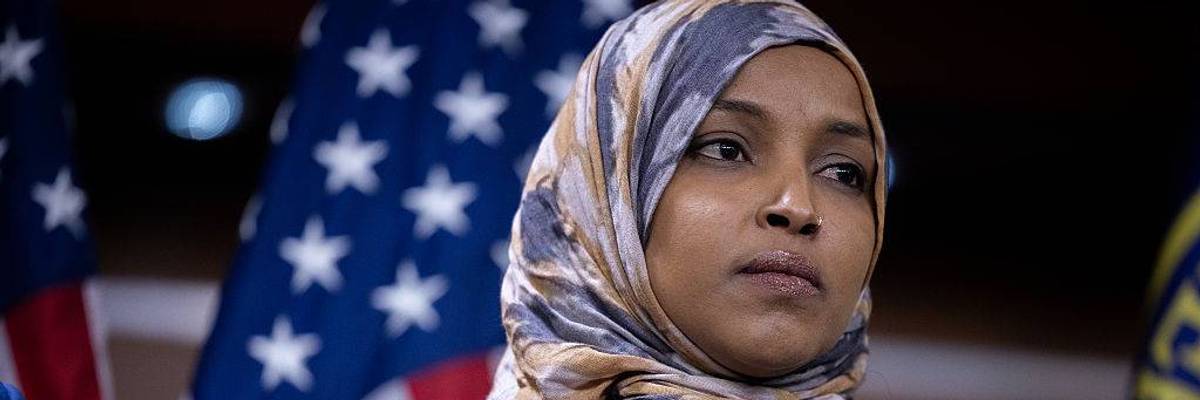
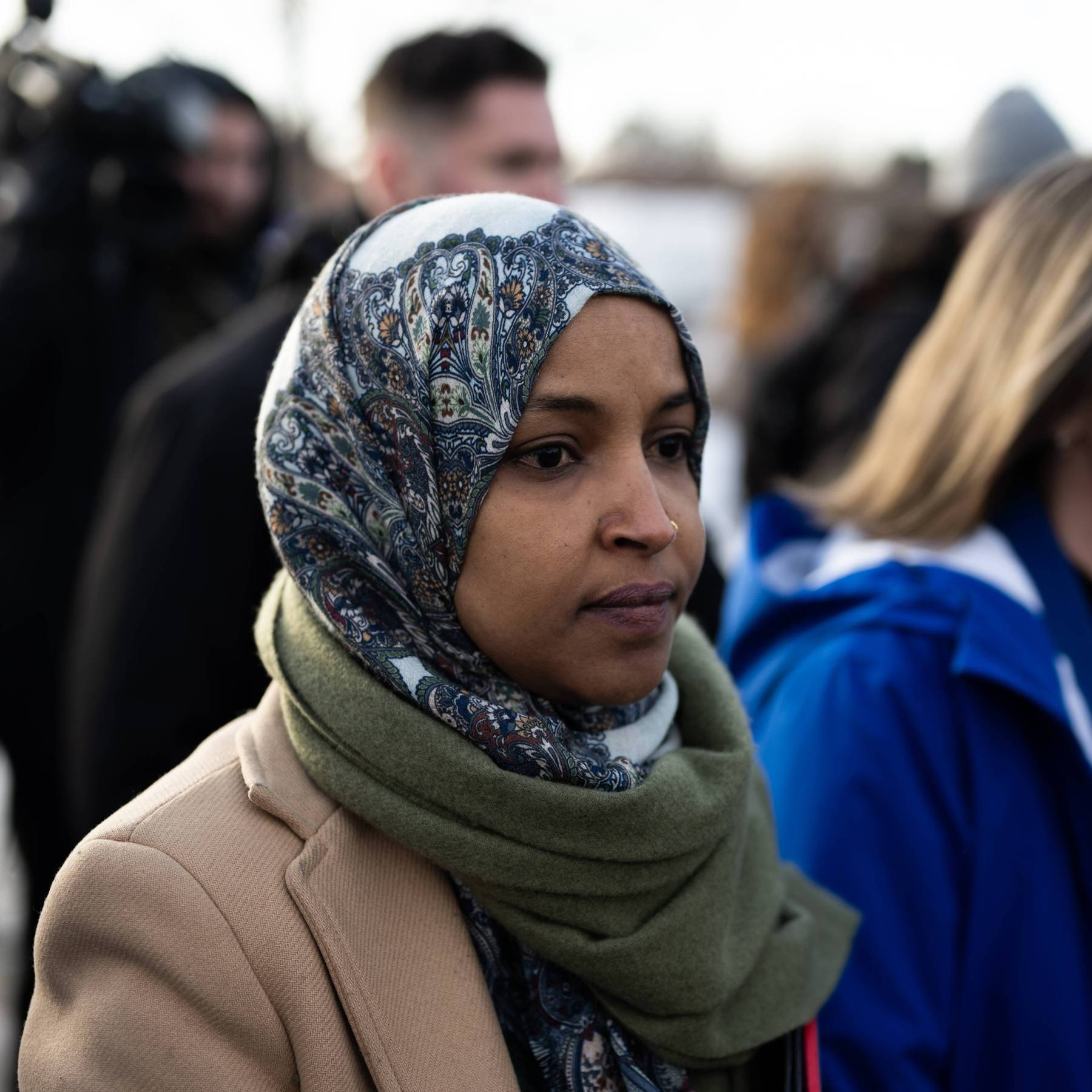
Ilhan Omar’s Office Slams Trump Deportation Plot as ‘Authoritarian Move to Silence an Opponent’

October 16, 2026

Ilhan Omar’s Office Slams Trump Deportation Plot as ‘Authoritarian Move to Silence an Opponent’

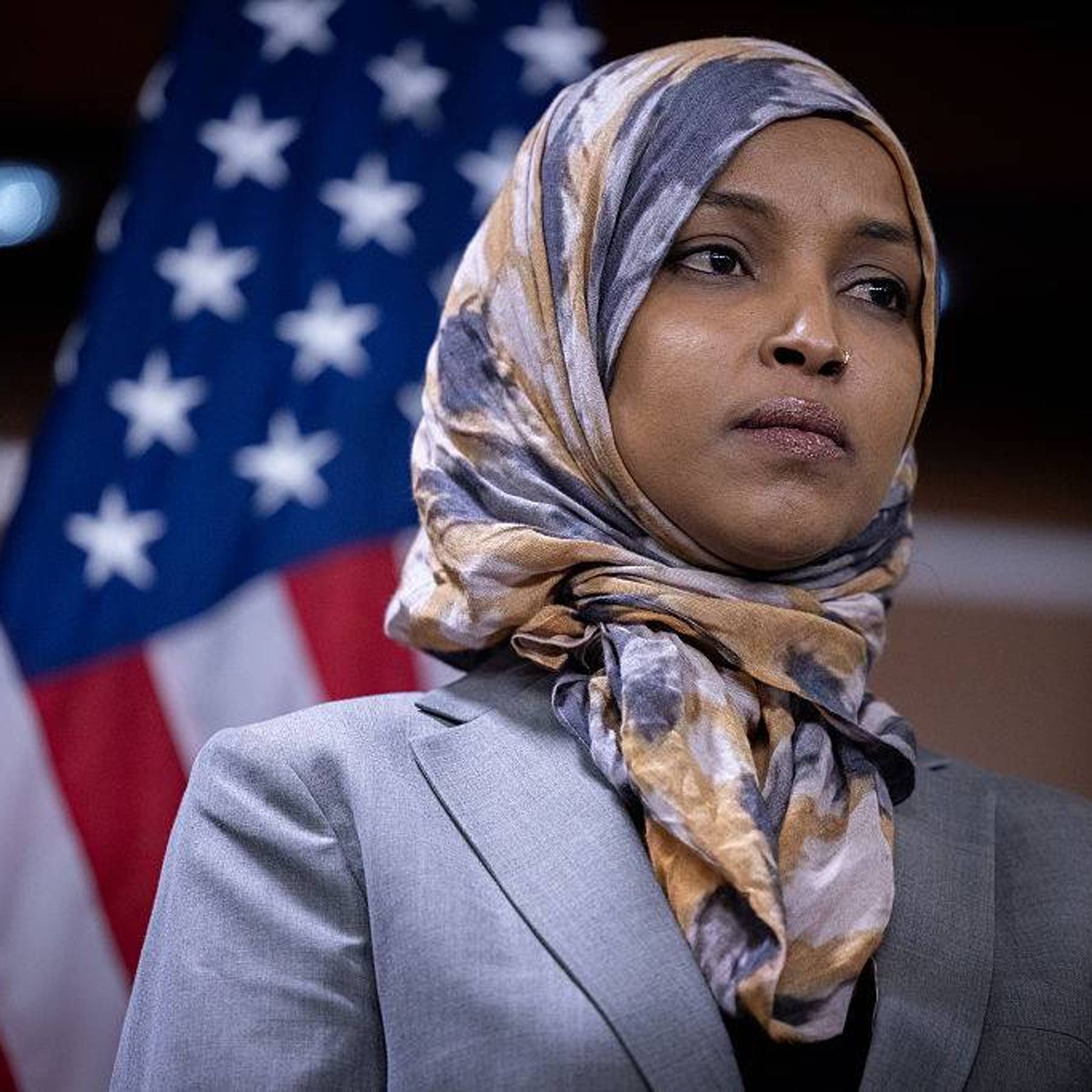
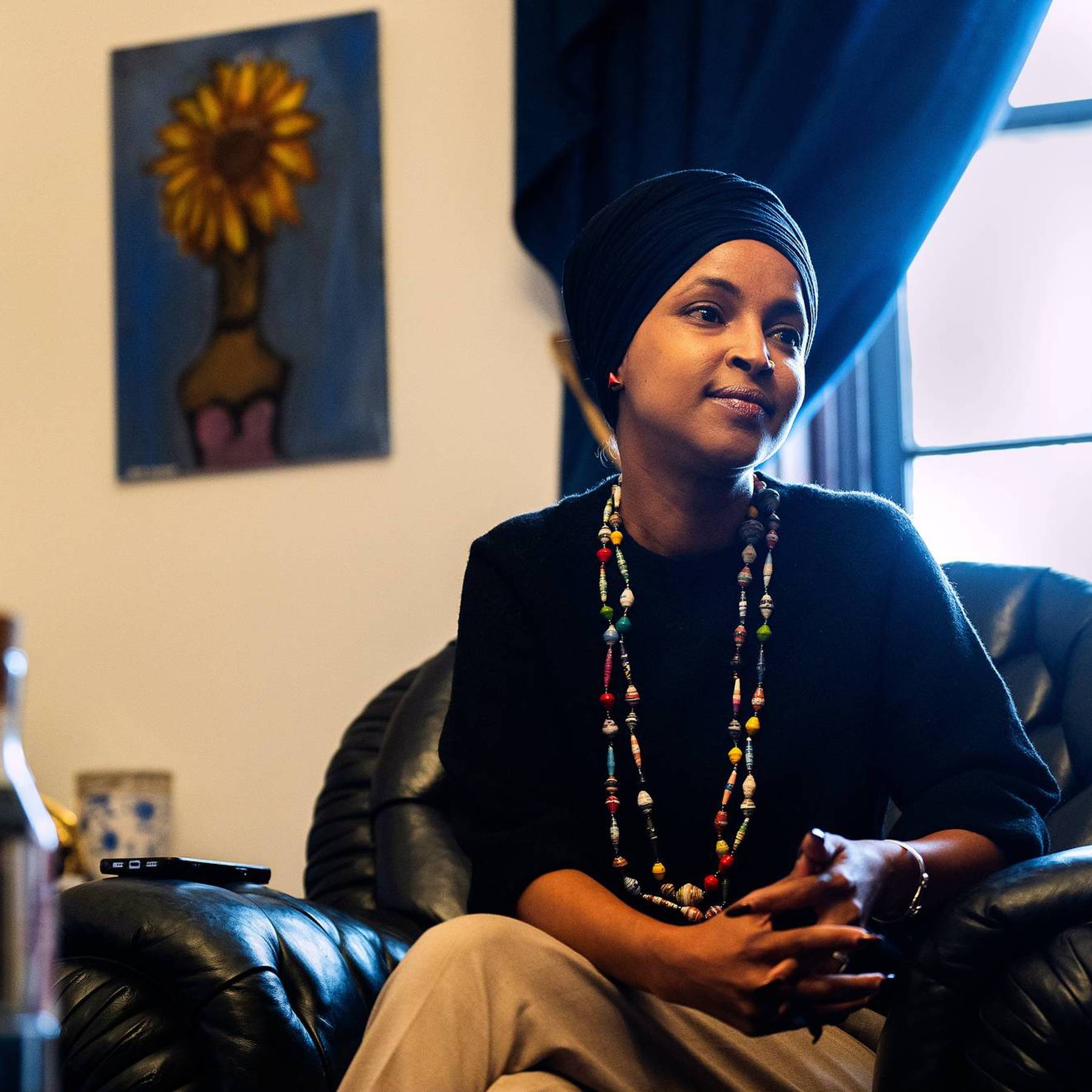
US Rep. Ilhan Omar (D-Minn.) poses for a portrait in her office on Capitol Hill on December 10, 2025.

(Photo by Demetrius Freeman/The Washington Post via Getty Images)

“To Trump, no American value or principle is too important to be shredded for his own personal gain.”

Brad Reed

Oct 15, 2026

The office of Rep. Ilhan Omar slammed the Trump administration on Thursday over its reported plot to have the Minnesota Democrat stripped of her US citizenship.

On Wednesday, The Wall Street Journal reported that the raid on Omar’s home carried out earlier this week by Department of Homeland Security agents was part of and effort to build “a case to strip her of her US citizenship and ultimately deport her.”

RECOMMENDED…

Capitol Hill U.S. Rep. Ilhan Omar

‘Part of the Fascist Playbook’: Ilhan Omar Condemns Trump DHS Raid on Her Home

Ilhan Omar’s Home Raided by DHS Following Trump-GOP Deportation Threats

Ilhan Omar’s Home Raided by DHS Following Trump-GOP Deportation Threats

“The multipronged effort is focused at least in part on how Omar obtained her citizenship after she arrived in the US from Somalia decades ago,” the Journal explained. “Investigators are focused both on the congresswoman and actions of her deceased father.”

Omar spokesperson Jackie Rogers responded to the report by accusing President Donald Trump of engaging in “desperate attempt to justify his extraordinary abuse of power.”

“This is politically motivated and an escalation of Trump’s personal vendetta against her lasting over a decade,” Rogers told HuffPost. “He has lied about her family, about her immigration history, and about her love of this country.”

Rogers also accused Trump of acting like a dictator by singling out a member of the opposition party for punishment.

“This isn’t a legitimate law enforcement action,” said Rogers, “it is an authoritarian move to silence an opponent right before an election where he and his party will be rejected by Americans in historic proportions… To Trump, no American value or principle is too important to be shredded for his own personal gain.”

Author John Ganz on Thursday published an analysis of the reported Omar deportation plot, which he said is “undoubtedly driven by racial and religious animus” and also “a serious assault on the constitutional order being carried out through the executive branch’s legal and bureaucratic machinery.”

Ganz argued that a serious attempt to strip Omar of her citizenship and remove her from the country would be a major escalation from the Trump administration toward establishing an outright totalitarian state.

“Authoritarian governments suppress political opposition and deprive their subjects of particular rights,” Ganz explained. “Totalitarian movements aspire to something much more radical: the destruction of the independent political and juridical personhood. They attack not merely the liberties of particular citizens they seek to repress, but the concept of citizenship itself—and then, ultimately, the concept of shared humanity.”

ICC took no steps to withdraw Netanyahu arrest warrant, deputy prosecutor says

October 16, 2026

Nazhat Shameem Khan says case remains active and work is continuing ‘unabated’ despite US sanctions

Deputy Prosecutor of the International Criminal Court (ICC), Nazhat Shameem Khan waits to hear the verdict of the ICC for Ali Muhammad Ali Abd al-Rahman, a Sudanese national, The Hague, on December 9, 2025.

Deputy Prosecutor of the International Criminal Court, Nazhat Shameem Khan attends a hearing in The Hague, on 9 December 2025 (AFP/file photo)

MEE staff

Published date: 22 September 2026 15:59 BST | Last update:3 weeks 2 days ago

The International Criminal Court (ICC) has taken no steps to withdraw arrest warrants or related applications concerning Israeli officials, despite mounting pressure and sanctions from the United States, Deputy Prosecutor Nazhat Shameem Khan has said.

“The case is still proceeding,” Khan told CNN in a weekend interview.

“We have taken no steps to try and withdraw any of those arrest warrant applications or the arrest warrants themselves, and the team continues to investigate in that situation.”

The ICC issued arrest warrants in November 2024 for Israeli Prime Minister Benjamin Netanyahu and his then defence minister, Yoav Gallant, over alleged war crimes and crimes against humanity committed in Gaza since October 2023.

Since then, the US has imposed sanctions on most of the court’s leadership, including the former chief prosecutor Karim Khan, the two deputy prosecutors, and nine judges including the court’s president.

New MEE newsletter: Jerusalem Dispatch

Sign up to get the latest insights and analysis on Israel-Palestine, alongside Turkey Unpacked and other MEE newsletters

Israel has also taken steps to challenge the warrants at the ICC. Two appeals remain in progress, including one challenging the court’s jurisdiction over Israeli nationals because Israel is not a member of the court.

Meanwhile, Middle East Eye has reported that the prosecutor’s office had pursued further cases against senior Israeli officials over the past two years.

In May, MEE reported that the prosecutor’s office had filed a confidential application seeking arrest for Israel’s Finance Minister Bezalal Smotrich over alleged crimes committed against Palestinians in the occupied West Bank.

The charges included forced displacement as both a war crime and crime against humanity, transferring Israel’s civilian population into occupied territory as a war crime, and persecution and apartheid as crimes against humanity.

An evidence review had also been held to consider two further applications, including one targeting National Security Minister Itamar Ben Gvir.

‘We have trials in court’

Khan’s comments came amid an escalating campaign by the administration of US President Donald Trump against the Hague-based court.

US Secretary of State Marco Rubio announced in July that Washington would use every tool at its disposal to “dismantle the ICC – brick by brick, if necessary”, while urging member states to withdraw their support for the institution.

In other press statements, Rubio also described the court as a “stupid organisation” run by “lunatics and crazies”, and warned that it would face consequences for attempting to exercise jurisdiction over American nationals.

Trump’s ‘sweeping’ ICC sanctions over Netanyahu arrest warrant are imminent: Reports

Read More »

Khan said the court remained grounded in the Rome Statute, its founding treaty, which was adopted through the sovereign decisions of its member states after decades of negotiations.

“The work of the court continues unabated,” she said.

“We have trials in court. We have a trial scheduled for November of this year and one for next year. We have, in the course of the last year, seen convictions in two major trials, and we continue to conduct our investigations and our prosecutions, and appear in court on a regular basis, regardless of these events.”

Established in 2002, the ICC is the only permanent international court with the jurisdiction to prosecute senior officials for war crimes, crimes against humanity, genocide and the crime of aggression.

In addition to the Palestine investigation, the court has more than a dozen active situations, including Ukraine, Darfur, Libya and Afghanistan.

Khan acknowledged that the court and its staff were operating under considerable pressure.

“The nature of the work that we do means that we inevitably will face pressure of all sorts to try and toe a political line, for instance, or to take a different position on the charging of accused persons, or to follow a path in investigation and prosecution,” she said.

“So, indeed, we do feel pressure, but, as I’ve said, the dedication of our staff is extraordinary, and they continue to do their work.”

Washington sanctioned Khan and fellow Deputy Prosecutor Mame Mandiaye Niang in August 2025, alongside two ICC judges. The sanctions froze any US-based assets they held and prohibited American individuals and companies from providing them with funds, goods or services.

Describing the personal consequences, Khan said sanctioned officials could lose access to banks and have their credit cards revoked, while financial transactions in Europe could be restricted to the Single Euro Payments Area.

‘We do feel pressure, but, as I’ve said, the dedication of our staff is extraordinary, and they continue to do their work’

– Nazhat Khan, ICC deputy prosecutor

Other service providers, including health insurance companies, might also sever ties, she said, while family members could be prevented from entering the US.

“I was never given any reasons for the sanctioning,” Khan said. “However, I believe it was because I am a deputy prosecutor at the Office of the Prosecutor.”

The Trump administration is now reportedly preparing broader sanctions against the ICC as an institution, potentially cutting it off from dollar transactions and hitting its access to banking, insurance and technology services.

Despite the pressure, Khan said she remained hopeful about the future of international law.

“The work that we do for victims, the fact that we continue to hear their voices stridently, with so much sincerity – they believe in this court,” she said.

“For them, this provides an avenue of justice that may not necessarily be provided in many courts around the world.

“Every single member of this court works for humanity,” she added, “and there can be nothing better than that.”

By pursuing a big ‘win’ in Iran, Trump is destined to lose

October 15, 2026

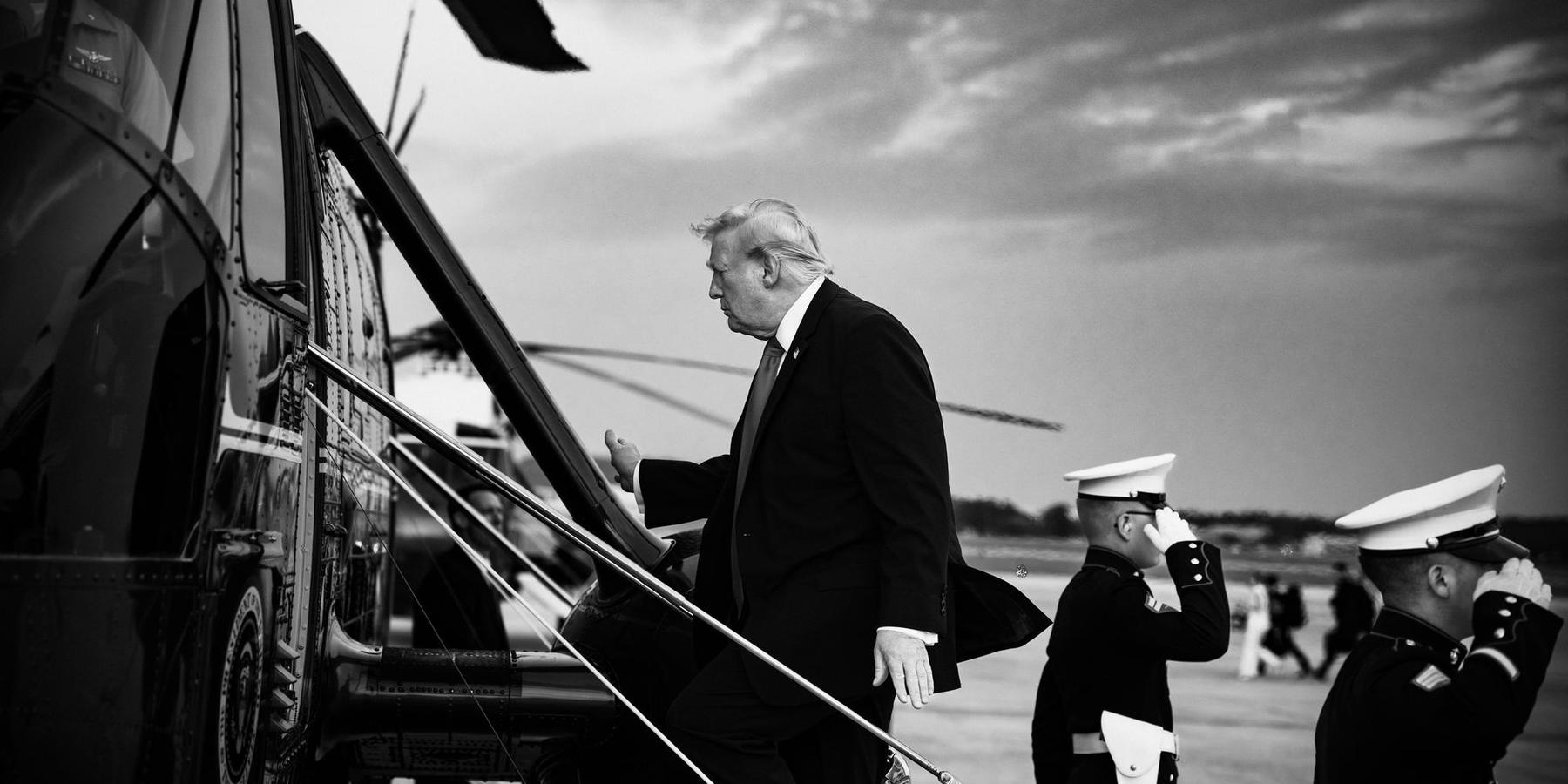
President Donal Trump boards a helicopter

The war is most likely to end through a minimalistic ceasefire that opens a path to a broader deal

Paul R. Pillar

Oct 15, 2026

President Donald Trump, seeing the success of the U.S. Navy’s operation in the Strait of Hormuz in blocking most of Iran’s imports and oil exports while restoring some of the non-Iranian oil trade through the strait, evidently does not regard the conflict with Iran as stalemated.

The current situation regarding the flow of oil and distribution of economic pain is actually more complicated and does not constitute a one-sided U.S. advantage, but Trump clearly believes that continuing to squeeze Iran through measures such as a naval blockade — an act of war — will increase U.S. leverage and yield a better result.

Trump always has viewed the world as a zero-sum game. Whether the subject is military conflict, trade agreements, or real estate deals, he regards most outcomes as having a winner and a loser. He also never admits a mistake and certainly will not do so publicly regarding the current war. Thus the conflict continues as a search for something Trump can claim as a “win.”

A book that I wrote more than four decades ago showed how the endings of wars are best understood as negotiated bargains. Even supposed unconditional surrenders are not entirely unconditional and involve bargains in which the surrendering side agrees not to use its continued capacity for resistance in exchange for the other side ending its assault. Other scholars have recently applied the same concept to contemporary conflicts. A lesson is that couching U.S. war-fighting strategy primarily in terms of wins and losses obscures the issues at stake, how those issues affect U.S. interests, and what will be required to end the war and implement a stable peace.

What Trump would welcome as a “win” could take one of two basic forms: either the Iranian regime somehow cries “uncle” and makes concessions that clearly and significantly go beyond anything it offered before, or the regime collapses. A tension between these two possibilities exists, because a regime that believes the U.S. is determined to destroy it has no incentive to make concessions and sees no alternative to continued fighting. Even considered separately, however, each of the two versions of a supposed “win” raises major questions.

For Iranian concessions to play that role, they would have to advance U.S. interests significantly and be what even an Iranian regime under severe pressure could realistically be expected to offer. One difficulty in assessing the value of Iranian concessions is that Trump and his administration never made its war aims clear. They have said different things at different times, including even a demand for “unconditional surrender,” which is unrealistic to expect from any Iranian regime.

Iran’s nuclear program gets mentioned most often, and Vice President JD Vance came closest to a specific demand by stating just last week that “meaningful” reduction in Iran’s enrichment of uranium would be necessary for peace. The Iranian nuclear program is relevant to U.S. interests insofar as it raises the possibility of an Iranian nuclear weapon, and in this regard further continuation of the war is not helpful. Previous attacks already largely disabled the Iranian program, and now intentions matter at least as much as capabilities. Being the target of continued attacks by a foreign power will strengthen voices in Tehran — where there already is talk about withdrawing from the Nuclear Non-Proliferation Treaty — that argue that Iran needs a nuclear deterrent.

An exhibit of what is necessary for a meaningful agreement on nuclear matters is the Joint Comprehensive Plan of Action, known colloquially as the Iran deal, which entered into force in 2015 and effectively closed all possible paths to an Iranian nuclear weapon until it was abandoned in 2018 by Trump, who was determined to destroy what was widely regarded as President Barack Obama’s most significant foreign policy achievement. The JCPOA is 159 pages long. It was the product of difficult and detailed negotiations that spanned several years and involved numerous nuclear experts and other specialists. It is not the sort of thing that Steve Witkoff and Jared Kushner could knock out in a couple of negotiating sessions.

Any new nuclear agreement between the United States and Iran would require comparable detail, partly to ensure that reductions would be meaningful, enforceable, and verifiable through international inspections. To make completion of such a comprehensive agreement a condition for ending the war — rather than coupling a ceasefire with a commitment to engage seriously in future negotiations — would mean continuing the war for months and possibly years.

The Trump administration has made the task of negotiating a new nuclear agreement with Iran even more difficult and complex by pursuing its recent nuclear deal with Saudi Arabia, which has justifiably raised concerns among nonproliferation experts because the deal does not require the most stringent form of international inspections and opens the door to Saudi enrichment of uranium, even to the 20% level. Any regime in Iran will resist restricting its own nuclear program to something less than what Iran’s rival on the other side of the Persian Gulf will enjoy, with U.S. approval and assistance.

Newsletter

Subscribe now to our weekly round-up and don’t miss a beat with your favorite RS contributors and reporters, as well as staff analysis, opinion, and news promoting a positive, non-partisan vision of U.S. foreign policy.

Invalid emailEnter your email Subscribe

As for a supposed “win” through regime change, the first thing to note is that Trump already claimed to have achieved such a change after the killings of senior Iranian leaders in the opening days of the war. What happened next is a lesson in being careful what you wish for: Iranian hardliners became more powerful than they were when Supreme Leader Ali Khamenei was still alive. Another wartime leadership change might move Iran even further in the hardline direction, such as to a military dictatorship that silences remaining moderate voices in the regime.

Even if a leadership change went in a direction appearing more favorable to the United States, securing wins for U.S. interests requires that whoever speaks for Iran can negotiate agreements that stick. A future government would have to deal internally with Iranian factions that have different views and would not vanish even with a leadership change. But the ability to influence those factions does not necessarily reside with those whose ideologies and orientation might seem friendliest to the U.S.

In this regard, a loss was the killing by an Israeli airstrike two weeks into the war of Ali Larijani, secretary of Iran’s Supreme National Security Council. Larijani was a creature of the Khamenei regime but also a pragmatist with the political chops and connections to make credible commitments on behalf of the entire power structure in Tehran.

Amid the economic hardship that the Iranian population is enduring, one cannot rule out a popular uprising leading to a more sweeping political upheaval, but several observations about this type of possible regime change are in order.

First, several popular uprisings have occurred during the history of the Islamic Republic but did not lead to regime change.

Second, there currently is no cohesive opposition movement comparable to the one Ruhollah Khomeini led during the revolution that overthrew the shah in 1979.

Third, a popular uprising is less likely during a continued war, which has generated a significant rally-around-the-flag effect among Iranians who unsurprisingly see U.S. military and economic assaults as aimed at Iran as a whole and not just at the regime.

Fourth and related to the previous point, the war will leave lingering and widespread resentment against the United States for the suffering it has imposed on Iranians. Such resentment will be stronger the longer the war lasts. No new regime can ignore this sentiment.

Fifth, policies under any new rulers will illustrate how past Iranian policy has reflected Iranian security concerns and nationalism at least as much as the ideological coloration of whatever regime happened to be in power.

A conclusion is that the United States should not count on major up-front concessions or regime change as the occasion for ending this war. The most feasible way out of the war is a skeletal ceasefire agreement that defers most substantive negotiations, like the Memorandum of Understanding that the parties agreed to in June, but without the ambiguous language concerning the Strait of Hormuz that led the MoU to break down. A president looking for a “win” will have to rely on his rhetorical ability to depict such a ceasefire and the destruction already inflicted on Iranian forces as a victory.

Paul R. Pillar

Paul R. Pillar is Non-resident Senior Fellow at the Center for Security Studies of Georgetown University and a non-resident fellow at the Quincy Institute for Responsible Statecraft. He is also an Associate Fellow of the Geneva Center for Security Policy.

The views expressed by authors on Responsible Statecraft do not necessarily reflect those of the Quincy Institute or its associates.

Palestinian Prisoners’ Club says Israel has detained over 2,000 children since October 2023

October 15, 2026

MEM, October 15, 2026 at 11:09 am

Israeli soldiers stand guard over Palestinian children arrested in the West Bank city of Hebron

Israeli soldiers stand guard over Palestinian children arrested in the West Bank city of Hebron

Israeli authorities have detained more than 2,000 Palestinian children since the start of the war in Gaza in October 2023, with at least 350 children remaining in custody, according to the Palestinian Prisoners’ Club.

In a statement issued on Wednesday, the independent Palestinian human rights organization said detained children face harsh conditions, including torture, food deprivation, isolation and denial of medical care.

The organisation reported that Israeli forces detained at least six Palestinian children in the occupied West Bank overnight, primarily in the towns of Sa’ir and Al-Shuyukh in the Hebron Governorate.

It said the arrests were part of an ongoing campaign of detentions targeting Palestinian minors.

READ: Israel arrests Palestinian man wanted for nearly 10 years in occupied West Bank

The Prisoners’ Club noted that its figures do not include all children detained from the Gaza Strip, citing cases of enforced disappearance and the unknown whereabouts of numerous detainees and missing persons, including children.

The organisation also raised concerns about the use of administrative detention, which allows individuals to be held without formal charges or a specified release date.

It said the practice deprives detained children of family stability and access to education while leaving them uncertain about the duration of their detention.

The Prisoners’ Club argued that violations against Palestinian children extend beyond detention conditions and interrogation practices to the broader custodial and judicial system.

It accused Israeli courts of facilitating these practices and criticized what it described as a lack of meaningful accountability for abuses against detained minors.

‘We’re Making a Fortune,’ Trump Says of High Oil Prices as Working Class Pays

October 15, 2026

President Trump Holds Midterm Election Rally In Bullhead City, Arizona

Attendees listen as US President Donald Trump speaks during a campaign rally on October 14, 2026 in Bullhead City, Arizona.

(Photo by Alex Wong/Getty Images)

“Workers are losing the race between wages and prices,” said one economist. “It’s no wonder workers feel left behind in the current economy.”

Jake Johnson

Oct 15, 2026

President Donald Trump attempted to spin high oil prices as a boon for the United States at a rally in Arizona on Wednesday, just hours after new federal data showed that inflation reached its highest level in months in September.

“Because of the price of oil, Texas and Oklahoma and North Dakota and all these places, we’re making a fortune,” Trump declared, referring to states that produce large amounts of crude oil. Those states are home to major fossil fuel companies that have reported windfall profits amid Trump’s illegal war on Iran.

RECOMMENDED…

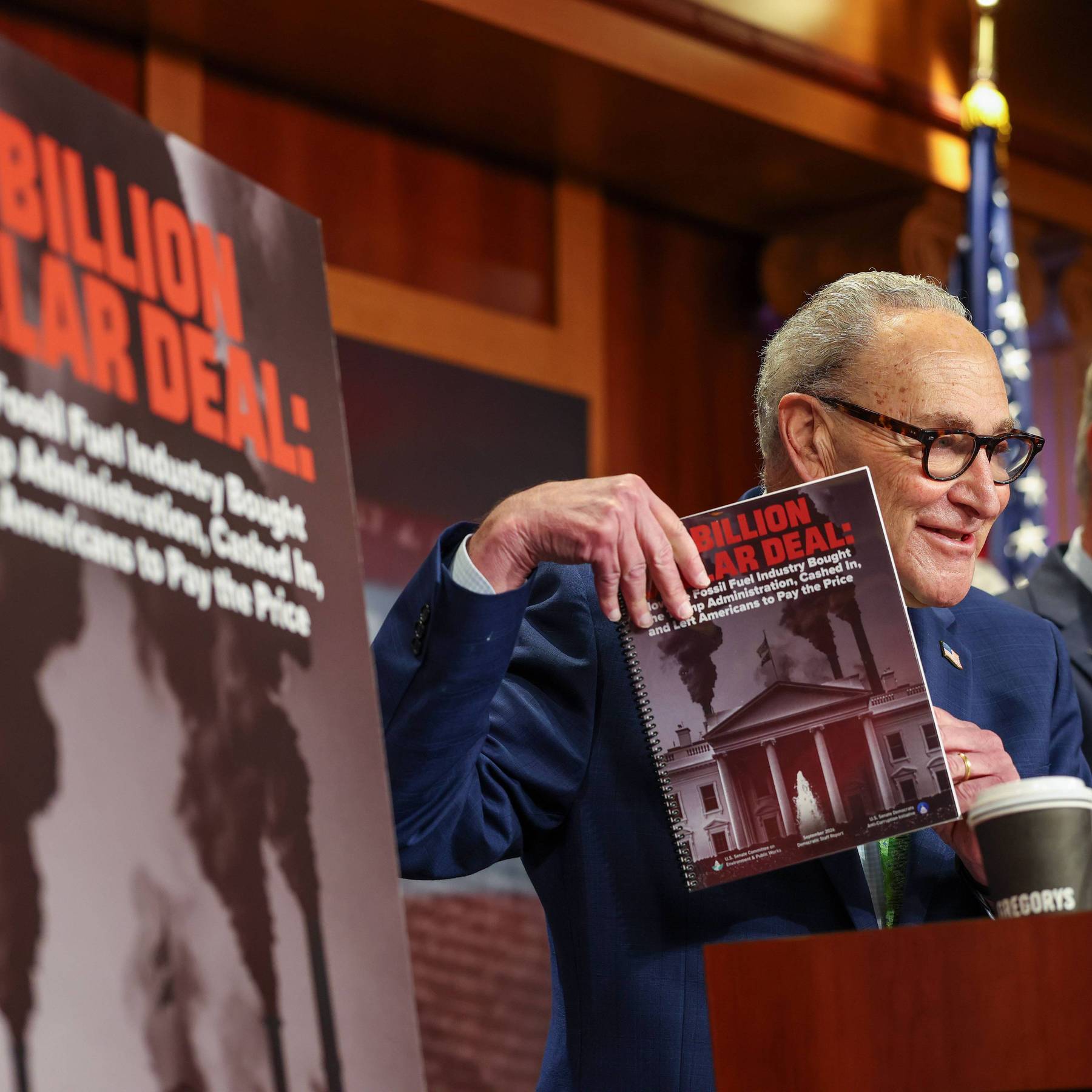
Senators Schumer And Whitehouse Unveil Report On Fossil Fuel Industry's Connections To Trump Administration

‘The Billion Dollar Deal’: Senate Democrats Detail How Trump Serves Fossil Fuel Industry

Inflation Hits Highest Level in Months as Costs From Trump's Illegal War Eat Workers' Paychecks

Inflation Hits Highest Level in Months as Costs From Trump’s Illegal War Eat Workers’ Paychecks

Trump insisted that gas prices—currently at an average of $4.33 per gallon for regular gas and $6.32 for diesel—would tumble once the Iran war ends, but his administration has repeatedly given false timelines for the deadly conflict and has shown no indication that it is willing to reach a lasting diplomatic agreement.

Trump, who has profited massively from his second term in the White House, is a major investor in oil and gas companies. According to one recent analysis, the president’s investments in fossil fuel stocks have boosted his net worth by up to $15.5 million since January.

Working-class Americans, meanwhile, are struggling to make ends meet as high gas prices compound a broader affordability crisis that extends to food, housing, and other necessities. A tracker maintained by the Watson School of International and Public Affairs estimates that American consumers have paid an extra $135 billion combined in fuel costs since the start of the Iran war—roughly $1,030 per household.

Wage growth has not kept up with inflation, which rose to an annualized rate of 3.7% last month.

“ Workers are losing the race between wages and prices,” Elise Gould, senior economist at the Economic Policy Institute, wrote on Wednesday. “Nominal wage growth continues to decelerate as workers lose bargaining power at work. Workers simply don’t have the leverage to bid up their wages. Reduced leverage and higher prices translated into falling [year-over-year] real wages for six months in a row.”

“Workers have seen zero progress on affordability compared to January 2025,” Gould added. “Real wages are essentially stagnant as workers’ leverage has declined and prices have risen. It’s no wonder workers feel left behind in the current economy.”

A Harris poll published by The Guardian on Thursday shows that three-quarters of US voters are concerned about a recession, and a “vast majority of Americans agreed that there is an affordability crisis, including 96% of Republicans.”

Axios: Trump and Netanyahu Discussed Possibility of Major Attacks on Iran Before US and Israeli Elections

October 14, 2026

by Dave DeCamp | October 13, 2026 at 8:34 pm ET | Iran

President Trump and Israeli Prime Minister Benjamin Netanyahu have discussed the possibility of resuming large-scale attacks against Iran before the US and Israeli elections, according to a report from Axios.

The report, which cited unnamed US and Israeli sources, said that the two leaders had held multiple calls over the past two weeks about the possibility of resuming “major combat operations” against the Islamic Republic, including the possibility of joint US and Israeli strikes on military and nuclear targets.

Restarting major attacks on Iran would likely hurt Republicans in the November 3 midterm elections, as it would worsen the energy crisis and raise gas prices in the US, while Netanyahu and his coalition may benefit in the October 27 Knesset elections.

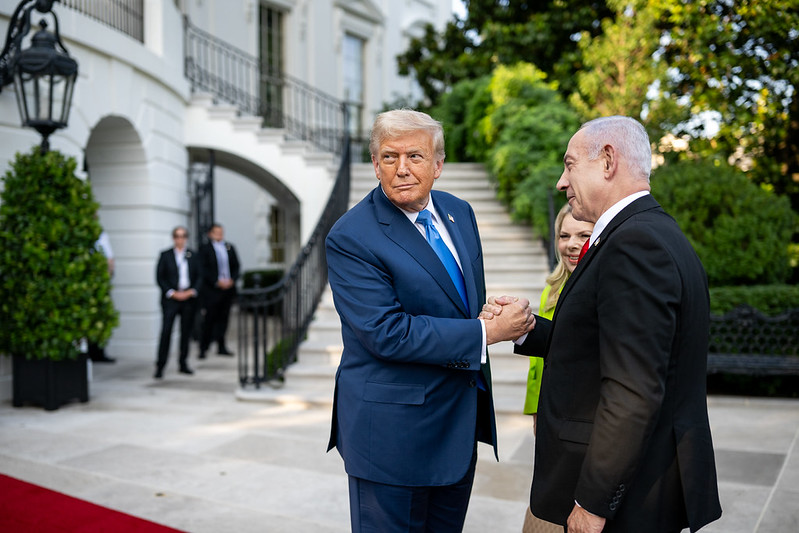
Trump and Netanyahu at the White House on July 7, 2025 (White House photo)

“Bibi’s got an election before the midterms. He believes his strength is being a wartime prime minister,” one US official told Axios reporter Barak Ravid, who is a former IDF intelligence officer.

The report also said that in meetings with his security officials, Netanyahu has claimed that it was Trump who brought up the possibility of striking Iran before the elections. Multiple US media outlets recently reported that the US president was considering launching a bombing campaign before the midterms, but he has said publicly that he won’t.

Ravid reported that in the conversations, Netanyahu has made his usual claims about concerns regarding Iran’s nuclear program. One source said US Secretary of War Pete Hegseth and US Central Command leadership were the strongest supporters of restarting strikes, while other officials prefer ramping up economic pressure.

The US is still enforcing a blockade of Iranian ports, and Iran has dramatically ramped up attacks on commercial shipping in the Strait of Hormuz after Trump had repeatedly claimed the US was in control of the strait since more oil was coming out, but the oil shipments are on the decline.

If you liked this article, please support Antiwar.com.
We are 100% reader-supported.

Dave DeCamp is the news editor of Antiwar.com, follow him on Twitter @decampdave.

UN and The Hague Confront Impunity for War Crimes

October 13, 2026

by Nicolas J. S. Davies, Antiwar. com, Oct 13, 2026

On October 9th, the 2026 Nobel Peace Prize Was awarded to Navi Pillay, the South African international lawyer who defended Nelson Mandela and the anti-apartheid political prisoners on Robben Island, and went on to serve as a judge on the UN International Criminal Tribunal for Rwanda and the International Criminal Court (ICC), then as UN High Commissioner for Human Rights. In 2025, Navi Pillay led the UN Commission of Inquiry that confirmed that Israel is committing genocide in Gaza.

With the world in the grip of seemingly intractable war and chaos, the Nobel Committee clearly wanted to honor someone who has worked against the tide of militarism and violence to uphold international law. And yet, on the same day, the United States unveiled unilateral, illegal coercive measures or “sanctions” against the ICC, where Navi Pillay served as a judge from 2003 to 2008.

The UN General Assembly’s 2026 general debate in September also set out to uphold the UN Charter and international law, and to confront the reality that the UN system is failing in its most basic responsibility, to maintain international peace and security.

The foundational rules of the UN Charter are that countries must resolve disputes peacefully and refrain from the threat or use of force. But in the General Assembly debate, even as leaders recognized the urgent need to finally enforce the UN Charter, after decades of impunity for aggression and war crimes, they were reluctant to explicitly address the central role of the United States in undermining the rule of international law.

Many US allies loyally condemned Russia’s violation of the UN Charter against Ukraine. But none of them even tried to square their singular focus on Russia with the inconvenient truth that their own ally, the United States, has systematically violated the UN Charter for decades, against Grenada, Nicaragua, Panama, Yugoslavia, Afghanistan, Iraq, Haiti, Libya, Somalia, Syria, Yemen, Venezuela, Cuba, Iran and other countries.

While US allies remain silent, US officials accept no responsibility or accountability for the violence and chaos they unleash, and instead keep doubling down on their failed imperial ambitions and military approach to international disputes, the very antithesis of what the UN Charter requires.

Many other leaders spoke out, but without explicitly naming the United States. Algeria’s foreign minister, the veteran diplomat Ahmed Attaf, pointedly asked,

“What sort of international order can function properly when principles are selected according to the identity of those who violate them? What confidence can remain in international law when the aggressor is granted the right to self-defense, while the victim is required to justify even the right to survive?”

So it is left to the officials of the countries the United States threatens or attacks to remind the world which country is illegally threatening them, as Cuba’s Foreign Minister Bruno Rodriguez Parrilla and Iran’s President Masoud Pezeshkian did clearly and accurately at the General Assembly.

Many other leaders made strong statements condemning Israel’s war crimes and genocide in Gaza, even as they neglected to condemn the essential US military and diplomatic role in them. King Abdullah of Jordan described Israel’s objective as “to make a viable Palestinian state impossible,” through “a system of subjugation… de facto annexation… forced displacement… (and) war crimes.”

“We have tools,” he reminded his colleagues, “Sanctions, asset freezes, embargoes, diplomatic isolation. And we have a record of using them elsewhere… The question now is: Will we act?”

Another of the UN’s tools is the power of the president of the UN General Assembly to convene Emergency Special Sessions (ESS) that can pass “uniting for peace” resolutions. This allows the General Assembly to act decisively on international problems when the Security Council fails to do so, wielding the kind of tools that King Abdullah outlined.

The General Assembly’s 10th Emergency Special Session on “Illegal Israeli Actions in Occupied East Jerusalem and the Rest of the Occupied Palestinian Territory” began in 1997, and has been reconvened more than twenty times.

In 2022, the 10th Emergency Special Session voted to ask the International Court of Justice (ICJ) some legal questions about the Israeli occupation, which the court answered in 2024, in a finding that the Israeli occupation is illegal and that Israel must “end its unlawful presence in the Occupied Palestinian Territory as rapidly as possible,” and “evacuate all settlers.”

The next meeting of the 10th ESS in September 2024 passed a resolution demanding that Israel comply with the ICJ ruling and withdraw from the occupied territories within a year.

However, the 2025-6 General Assembly president, Annalena Baerbock of Germany, allowed her entire year as president to pass without reconvening the 10th ESS even once.

This allowed Trump and Netanyahu to seize the initiative and subject the people of Gaza to a new phase of the genocide under Trump’s Orwellian “board of peace,” a smokescreen for a war of attrition to keep killing civilians and making life intolerable for the people of Gaza, as they struggle to survive in the rubble of their bombed and bulldozed homes.

Many leaders at the General Assembly spoke of the urgency of reforming the Security Council, but the greatest leverage they have to achieve that is the General Assembly’s ability to act in an Emergency Special Session when the dysfunctional, corrupted Security Council fails to do so. Nowhere in the world is such action more urgently needed than in Palestine. And yet the 10th Emergency Special Session has not met since June 2025.

Now that Bangladesh’s Dr. Khalilur Rahman has taken Baerbock’s place as President of the General Assembly, he should reconvene the 10th Emergency Special Session to take the concrete actions for Palestine that people all over the world are calling for.

South Africa’s genocide case against Israel at the ICJ is also important, but South Africa has slowed down the already tortuous pace of international justice by requesting 18 months to respond to Israel’s defense against genocide charges. Surely South Africa and the court can find a way to move faster, with the fate of an entire people in the balance. The Genocide Convention was intended to prevent and stop genocide, not just to pass judgment over mass graves and scattered refugee camps.

Many people justifiably fear that the United Nations and its institutions are simply too weak to enforce the laws of the UN Charter and the Geneva Conventions and hold the United States and Israel accountable for their crimes. But there was another event on September 16, 2026, which suggests that Benjamin Netanyahu and other US-allied war criminals might want to think twice before assuming that the United States will always shield them from accountability.

The week before the General Assembly met in New York, an international war crimes court in The Hague sentenced former Kosovo president Hashim Thaçi to 25 years in prison. The court found Thaçi and three other former leaders of the US-backed Kosovo Liberation Army (KLA) guilty of 96 murders, 303 charges of torture, 49 charges of criminal cruelty and 385 cases of arbitrary detention, committed during the US-NATO war on Yugoslavia in 1999.

The Kosovo Specialist Chambers, the court that tried Thaçi, was established in 2011, in response to a Council of Europe Parliamentary Report titled “Inhuman Treatment of People and Illicit Trafficking in Human Organs in Kosovo.”

That report detailed extraordinary allegations unearthed by Carla Del Ponte, who was the Chief Prosecutor of the International Criminal Tribunal for the former Yugoslavia (ICTY), which were then investigated for the Council of Europe by Swiss state prosecutor and member of parliament Dick Marty.

The report substantiated allegations that the KLA transported civilian prisoners from Kosovo to Albania and imprisoned them in a clinic known as the “Yellow House,” where they murdered them and extracted their internal organs to sell on the illicit organ transplant market.

As the court records show, these were only the most startling of Thaçi and the KLA’s crimes. The KLA also shot, tortured or beat to death dozens, or maybe hundreds, of civilian prisoners whom it labelled as “traitors” or “collaborators,” during and immediately after NATO’s illegal war to detach Kosovo from the remaining territory of Yugoslavia.

While no Americans were charged in these crimes, the CIA and other Western intelligence agencies had worked with the KLA since at least 1996, as it terrorized Serb civilians and attacked and killed Yugoslav police to provoke repression against the Kosovar Albanian population.

The escalating violence in Kosovo provided the pretext for a war in which the United States and NATO dropped 23,000 bombs and missiles on Yugoslavia, targeting and destroying vital civilian infrastructure as well as military targets. Then they invaded and occupied Kosovo and built a huge US military base, Camp Bondsteel, which the US also used as a secret prison during its “war on terror.”

US Secretary of State Madeleine Albright was so personally invested in the march to war in Kosovo that Time dubbed it “Madeleine’s War.” Albright shunned the traditional political leaders of Kosovo’s independence movement, and instead embraced Hashim Thaçi and the KLA as the United States’ and NATO’s main allies in Kosovo, despite their well-known links to organized crime and heroin smuggling.

With Thaçi at her side at the Rambouillet conference in France, Albright delivered her coup de grace to Yugoslav President Milosevich: an ultimatum that would have given NATO the right to militarily occupy all the remaining territory of the Federal Republic of Yugoslavia.

Milosevich’s refusal to surrender his country’s sovereignty served as the final pretext for the US and NATO to violate the UN Charter in an illegal war that set a precedent for US invasions of Afghanistan and Iraq and the endless wars and chaos that have followed.

At the UN General Assembly on September 23rd, Serbian President Aleksandar Vučić thanked the 107 countries that still refuse to recognize Kosovo’s unilateral declaration of independence from Serbia in 2008, and he placed NATO’s war on the remains of Yugoslavia in 1999 squarely at the root of the violence and chaos afflicting the UN and the world.

“…the order based on respect for the UN Charter and the law founded upon it no longer exists,” Vučić said. “It was destroyed by those who tore apart the territories of other countries for the sake of their own political and economic interests. They did so unscrupulously, recklessly, and shamelessly.”

So is it already too late to try to enforce the rules of the UN Charter?

Has the world simply failed to learn the lesson of 1945 that “might makes right,” coupled with the destructive power of modern weapons, can only create a world plagued by endless war and chaos?

Or, now that we are staring that world in the face, will we finally heed that lesson and make different choices?

It has taken 27 years for justice to catch up with Hashim Thaçi, but, as King Abdullah said, the world’s governments have the tools to enforce the rules of international law if and when they choose, and that is true even in the case of US allies like Thaçi and Netanyahu.

But Abdullah’s question remains: will the world’s leaders choose to use the tools at their disposal? First to free Palestine, but also to give our own children and grandchildren the chance to build a peaceful, sustainable world out of the militarism, war and chaos that is the global legacy of a generation of American leaders.

Nicolas J. S. Davies is an independent journalist, a researcher for CODEPINK and the author of Blood on Our Hands: The American Invasion and Destruction of Iraq and, with Medea Benjamin, of War In Ukraine: Making Sense of a Senseless Conflict, now in a revised, updated 2nd edition.

Israel demolishes 80 homes in Palestinian village in Negev, displaces around 400 people

October 13, 2026

MEM, October 12, 2026

Israeli security forces demolish buildings and mosque in the Bedouin village of Umm al-Hiran, where an evacuation and demolition order has been issued for the construction of Israeli settlements, in Negev Region, Israel on November 14, 2024 [Mostafa Alkharouf/Anadolu Agency]

Israeli security forces demolish buildings and mosque in the Bedouin village of Umm al-Hiran, where an evacuation and demolition order has been issued for the construction of Israeli settlements, in Negev Region, Israel on November 14, 2024 [Mostafa Alkharouf/Anadolu Agency]

Israeli authorities demolished around 80 homes in the Palestinian village of Al-Dhahiya in the Negev region of southern Israel on Monday, displacing around 400 people, amid accusations that extremist National Security Minister Itamar Ben-Gvir is using home demolitions as part of his election campaign.

Israel’s public broadcaster KAN said teams from the Israel Land Authority, accompanied by reinforced police forces under Ben-Gvir’s ministry, demolished around 80 homes on claims that they had been “built without permits” in Al-Dhahiya, an unrecognized village north of the city of Rahat.

The demolition came after the Beersheba District Court on Sunday rejected a petition seeking to postpone the demolitions, the broadcaster said, adding that around 400 people had been living in the homes.

In recent weeks, Ben-Gvir has publicly highlighted the demolition of hundreds of homes belonging to Palestinian citizens of Israel, or Israeli Arabs, over alleged construction without permits.

Last Tuesday, Ben-Gvir took part in the demolition of a five-story building housing 70 Palestinians in the At-Tur neighborhood of occupied East Jerusalem, an action the Jerusalem Governorate described as the “electoral exploitation of Jerusalem at the expense of Palestinians.”

The Joint List, an alliance of three Arab parties, denounced the home demolitions as “a blatant assault on the most basic human and national rights of our people.”

“The demolitions were a continuation of the successive Israeli governments’ policies of demolition, uprooting and displacement against residents of Arab villages in the Negev,” the alliance said.

Hassan al-Nasasra, deputy mayor of Rahat, also denounced the demolitions.

READ: Abduction of Palestinians by Israeli occupiers on rise in occupied West Bank: Officials

“The demolitions are not an implementation of the law in any way, but merely election propaganda for the racist Ben-Gvir and his group,” he said in a statement.

KAN also reported that United Arab List leader Mansour Abbas sent an urgent letter to Attorney General Gali Baharav-Miara demanding an immediate freeze on home demolition orders until the elections are over and a new government is formed.

Israel’s general elections are scheduled for Oct. 27.

Abbas warned against using home demolitions for “political and electoral purposes,” saying Ben-Gvir had publicly boasted about participating in demolitions “in a way that undermines the integrity of the election and the neutrality of law enforcement agencies.”

“Residents of unrecognized villages in the Negev are unable to obtain building permits because of a lack of planning for which the state bears responsibility,” he said, calling for a complete halt to demolitions of inhabited homes in such villages.

Dozens of Palestinian villages in the Negev are not recognized by Israeli authorities, which consider their homes unauthorized and do not connect them to water, electricity or road networks or provide schools, clinics and other basic services.

Last year, the daily Yedioth Ahronoth reported that demolition orders in the region had risen by as much as 400% since the beginning of that year, drawing fire from Israeli rights organizations, which described the campaign as “discriminatory” and specifically targeting the Bedouin community.

Palestinian Bedouins in the Negev are Arab tribes that have lived in the area for centuries and were there before the establishment of Israel in 1948.

Israel was established in 1948 on lands captured by Zionist armed groups, before occupying the remaining Palestinian territories in 1967, including the West Bank, Gaza Strip and East Jerusalem.

Ilhan Omar’s Home Raided by DHS Following Trump-GOP Deportation Threats

October 13, 2026

Ilhan Omar’s Home Raided by DHS Following Trump-GOP Deportation Threats

Rep. Ilhan Omar (D-Minn.) is seen at a press conference with other members of the Congressional Progressive Caucus on funding for and efforts to reform the Department of Homeland Security, in Washington, DC on, January 13, 2026.

(Photo by Nathan Posner/Anadolu via Getty Images)

Trump and other Republicans have called for Omar to be stripped of her citizenship and deported for years.

Stephen Prager

Oct 12, 2026

Following years of threats from President Donald Trump and other Republicans to deport Rep. Ilhan Omar, the Minnesota congresswoman’s Washington, DC home was raided on Monday morning by agents with the Department of Homeland Security.

The US Department of Justice (DOJ) has confirmed that the raid was carried out as part of a judicially authorized warrant, which it said was part of an ongoing criminal investigation.

RECOMMENDED…

Federal Agents Increase Immigration Enforcement In Minneapolis

Omar Introduces Bill to ‘Make ICE Pay’ for Destruction to US Cities

Construction in Los Angeles County

‘Huge Blow’ to ‘Lawless’ Practices of Trump DHS as Court Orders End to Warrantless Construction Site Raids

Fox News, which first reported news of the raid, said it was part of a probe into the naturalization paperwork filed by Omar’s late father when she became a US citizen in 2000 after immigrating to the US as a refugee from Somalia in 1995.

In September, The New York Post reported that federal investigators were examining whether Omar may have been older than 17 when she obtained citizenship through her father as a minor in 2000. The allegation, which stems partly from a discrepancy in historical records of her birth year, has not been substantiated.

Aaron Reichlin-Melnick, a fellow at the American Immigration Council, argued that the case was “even weaker than it already seems,” since federal immigration law includes a waiver for people who obtain legal status through fraud they were unaware of.

Joyce Vance, who served as the US attorney for the Northern District of Alabama under President Barack Obama, noted that the raid took place just weeks before the November 3 midterms, inside the 60-day window where DOJ typically avoids such dramatic actions.

“To state what’s obvious to prosecutors here, we are within the period before an election where DOJ doesn’t take overt steps in an investigation that might influence its outcome,” she said, adding that it was “another hard norm out the window.”

Omar has not yet commented on the raid as of Monday morning, and the DOJ has not indicated what, if any, specific charges have been filed against her.

The search comes after years of demands from Trump and other Republicans for Omar—who has served in the US House of Representatives since 2019—to be deported, imprisoned, or otherwise removed from office.

In a statement Monday morning, Joel Payne, a spokesperson for the progressive advocacy group MoveOn condemned the raid on Omar as a political attack.

“Rep. Omar is a dedicated public servant and a true ally for working families, and Donald Trump has done nothing but use racist tropes and stereotypes to attack her,” he said. “Now, he’s abusing his power to physically intimidate and harass her.”

Last November, Trump remarked that Omar should be thrown out of the country because she is “always complaining” and referenced her religious attire, referring to it as a “swaddling hijab.” In another post that day, he called for the US to “denaturalize migrants who undermine domestic tranquility.”

He also said Rep. Rashida Tlaib (D-Mich.), the only Palestinian American member of Congress, should be “sent back” along with Omar after the two protested his state of the Union address in February.

Trump has often referenced Omar while calling for all Somali immigrants to be deported from the country—even though most are US citizens. Trump has referred to Somalis collectively as “garbage” and said they have “low IQs.”

Last week, Trump called for the people of Minnesota to “fight back” against Somalis living there in a post on Truth Social, which was widely interpreted as an incitement to violence.

In March, Vice President JD Vance said on a podcast that the administration believed Omar had “definitely committed immigration fraud against the United States of America” and that he’d discussed with senior Trump adviser Stephen Miller—who is not a federal prosecutor—how to “go after” her.

Beau Tremitiere, counsel and deputy director of impact programs for Protect Democracy, told Common Dreams that “raiding the home of a prominent critic and longtime target of President Trump’s racist attacks on the eve of an election is an obvious attempt to intimidate the opposition.”

“This administration already has a long track record of failed political prosecutions,” he said. “Each new one should both anger and stiffen the spine of those standing up for our democracy.”

Several Republican members of Congress have referenced Omar’s religion and political viewpoints as reasons for her to be stripped of citizenship and deported.

Rep. Randy Fine (R-Fla.), who introduced a resolution to expel Omar from Congress last year, referred to her as a “Muslim terrorist” because of her outspoken criticism of Israel’s genocide in Gaza and said she should not “be a citizen.”

Rep. Brandon Gill (R-Texas) has also called for her deportation, claiming she helped to facilitate the “invasion” of the US after she discussed informing Somali American residents of her district of their constitutional rights should they encounter immigration officers.

In a statement Monday, House Democratic leadership called the raid on Omar’s residence “deeply disturbing” and said it “raises serious questions about the continued corrupt weaponization of the federal government against Donald Trump’s adversaries.”

“For years, Donald Trump and far-right extremists have relentlessly targeted Congresswoman Omar with vile personal attacks and baseless accusations,” they said. “Now, less than 30 days until the midterm election, his violent mass deportation machine has descended upon the home of a duly elected Member of Congress and her family.”

They added that “the American people deserve transparency, and we will deliver full accountability for the rogue abuse of power from the Department of Homeland Security and Department of Justice.”

Europe’s leaders are preparing for war. Workers are organising to stop it

October 12, 2026

John Rees, MEE, 10 October 2026

Preparations for war with Russia and complicity in Israel’s genocide in Gaza have set off a struggle over jobs, wages and military production

A student holds a sign reading “Humans are not objects” at a school strike against conscription in Frankfurt on 25 September 2026 (Stien Hohn/Hans Lucas via Reuters Connect)

A student holds a sign reading ‘Humans are not objects’ at a school strike against conscription in Frankfurt on 25 September 2026 (Stien Hohn/Hans Lucas via Reuters Connect)

War preparation is now a reality across Europe. Within a single September week, Poland issued fresh warnings, Germany ran drills and national alerts, military exercises were held across the Baltic, and Lithuania published plans to evacuate residents of Vilnius in the event of an attack.

The Finnish government is in full cry over the prospect of war, reminding its citizens yet again that they should be ready, in mind and in practice, for the disruption it would bring.

On 18 September, French President Emmanuel Macron gathered party leaders and presidential hopefuls at the Elysee Palace to hear the heads of France’s intelligence services describe what his office called the rapid deterioration of the international situation.

Nato, meanwhile, talks ever more openly about Russian sabotage, cyber attacks, arson and drone attacks.

Many workers and citizens across the continent, though, are not convinced by the war fever.

New MEE newsletter: Jerusalem Dispatch

Sign up to get the latest insights and analysis on Israel-Palestine, alongside Turkey Unpacked and other MEE newsletters

Thousands of Airbus workers in Spain began strike action on 1 July after rejecting the company’s pay and conditions offer.

Representatives of the UGT and CGT unions said the stoppage had slowed military and commercial production and would make it harder for the company to meet its delivery target. Airbus’s eight sites in Spain produce military transport planes and parts for commercial aircraft and satellites.

As the Defence Matters website reported: “The industrial pressure is not confined to commercial aviation. Spain is central to Airbus Defence and Space, including military transport and satellite activity. European governments are asking manufacturers to increase output at the same time as companies compete for engineers, technicians and production workers.”

Many workers and citizens across the continent are not convinced by the war fever

Supply lines are so tight that Airbus has had to hire giant Antonov An-124 heavy-lift aircraft to ferry parts from one plant to another just to keep production running.

Air Data News reported that the strike “threatens key military aircraft programmes”, noting that the Eurofighter plant near Madrid and the military transport aircraft site near Seville were both affected.

Spanish unions said about 90 percent of eligible workers took part in the stoppage on 25 August, part of an indefinite strike. The strikes were called after workers voted at plant-level assemblies to reject the company’s offer.

French unions briefed on the dispute said the three striking Spanish unions represent about 40 percent of Airbus Spain’s roughly 14,000 employees. Workers were seeking inflation-linked pay rises, the restoration of previous remote-working arrangements and sick-leave benefits.

After the intervention of Industry Minister Jordi Hereu and concessions from Airbus, the strikers paused the stoppage on 10 September, but not the movement. Two days later, around 8,000 workers from Airbus sites across Spain marched through Madrid to keep the pressure on.

On 1 October, 77 percent of those voting backed an improved offer providing for the restoration of lost purchasing power, inflation-linked pay rises and the protection of remote-working rights, a settlement that months of industrial action had forced out of the company.

The Airbus dispute shows the leverage workers hold in the very industries on which Europe’s rearmament depends.

Trains and the TUC

In Scotland, meanwhile, the rail union RMT, the drivers’ union Aslef and the white-collar TSSA have demanded that the Scottish government remove CAF, the Spanish manufacturer Construcciones y Auxiliar de Ferrocarriles, from its shortlist of contractors to build ScotRail’s new fleet of suburban trains.

The company is included in the UN human rights database of businesses involved in Israeli settlements for its role in running the Jerusalem light rail and helping to extend it into territory illegally seized by Israel.

Aslef made clear that its members would refuse to drive CAF trains, a position echoed by TSSA general secretary Maryam Eslamdoust when she urged the Scottish government to “think again”.

Scottish Greens co-leader Gillian Mackay put the first minister on the spot, asking him directly: “So will the first minister agree that CAF should be blocked from this contract, and will he stand with the rail workers who have refused to drive trains produced by a company that they say profits from apartheid?”

In his response, the first minister confirmed that ScotRail was seeking advice on the contract.

For the second year running, delegates at the Trades Union Congress (TUC) backed a motion opposing increases in arms spending.

This year’s motion passed with even more support than last year’s, which reversed the TUC’s previous backing, advocated by the GMB and Unite unions, for higher defence spending.

Speaking in favour of the motion, Alex Gordon, a former RMT president and national officer of the Stop the War Coalition, said: “This movement is about fighting for jobs, for public services, for investment in the industries of the future that our young people, that our young workers need.

“Those industries are not military industries. The skills of the workers in the military sector are vital skills, vital skills that need to be used in civilian production.”

Ports and classrooms

Dockworkers’ unions in at least six countries are planning an international day of action and strikes on 30 October to protest against the war on Gaza and demand an immediate end to the genocide of the Palestinian people.

This coordinated mobilisation follows a strike on 6 February this year that shut down cargo operations at more than 20 Mediterranean and European ports to halt arms shipments bound for Israel.

“No to the war economy, government rearmament plans, and the project of militarisation of ports and strategic infrastructure from [the] EU,” the unions said in their statement. “Public resources must be used to meet people’s social needs, not to finance war.”

From docks to cities, Italians challenge Meloni’s complicity in Gaza genocide

Read More »

The signatories include CGT FNPD in France, Enedep in Greece, LAB in the Basque Country, Liman-Is in Turkey, ODT in Morocco, and Orsa Porti and USB in Italy.

The next generation, at least in Germany, seems even less enthusiastic about the prospect of a new European war. More than 45,000 school students across the country walked out of class in late September to protest against plans for compulsory military service, after hundreds of young men were summoned for medical examinations.

The School Strike Against Conscription initiative said demonstrations took place in more than 100 cities after the German defence ministry began calling in 18-year-old men for medical screening. Service itself remains voluntary for now, but the screening is compulsory.

Students took to the streets demanding a halt to the forced checks, the repeal of the new military service law and an end to what they call a step-by-step return to the draft.

This is now the ground on which European politics is being fought. It is a contest between a political establishment obsessed with war and preparations for war, and millions of workers across the continent unwilling to pay for rearmament with their wages, jobs and living standards.

These are the opening shots in that battle.

The views expressed in this article belong to the author and do not necessarily reflect the editorial policy of Middle East Eye.

John Rees is a Visiting Research Fellow at the University of Essex , and a co-founder of the Stop the War Coalition.