In the wake of the US and Iran announcing a Memorandum of Understanding to end the conflict between the two nations that includes a ceasefire in Lebanon, Israeli ministers have said Israel isn’t bound by the agreement.
Israeli Defense Minister Israel Katz vowed that the IDF will not withdraw from its so-called “security zones” in southern Lebanon, which include a major swathe of Lebanese territory, and will also continue the occupation in southwest Syria and Gaza.
“Prime Minister Benjamin Netanyahu and I are leading a clear policy that determines that the IDF will remain in the security zones in Lebanon, Syria, and Gaza, without any time limit, to protect, from there, the border and Israeli communities against jihadist elements,” Katz said.
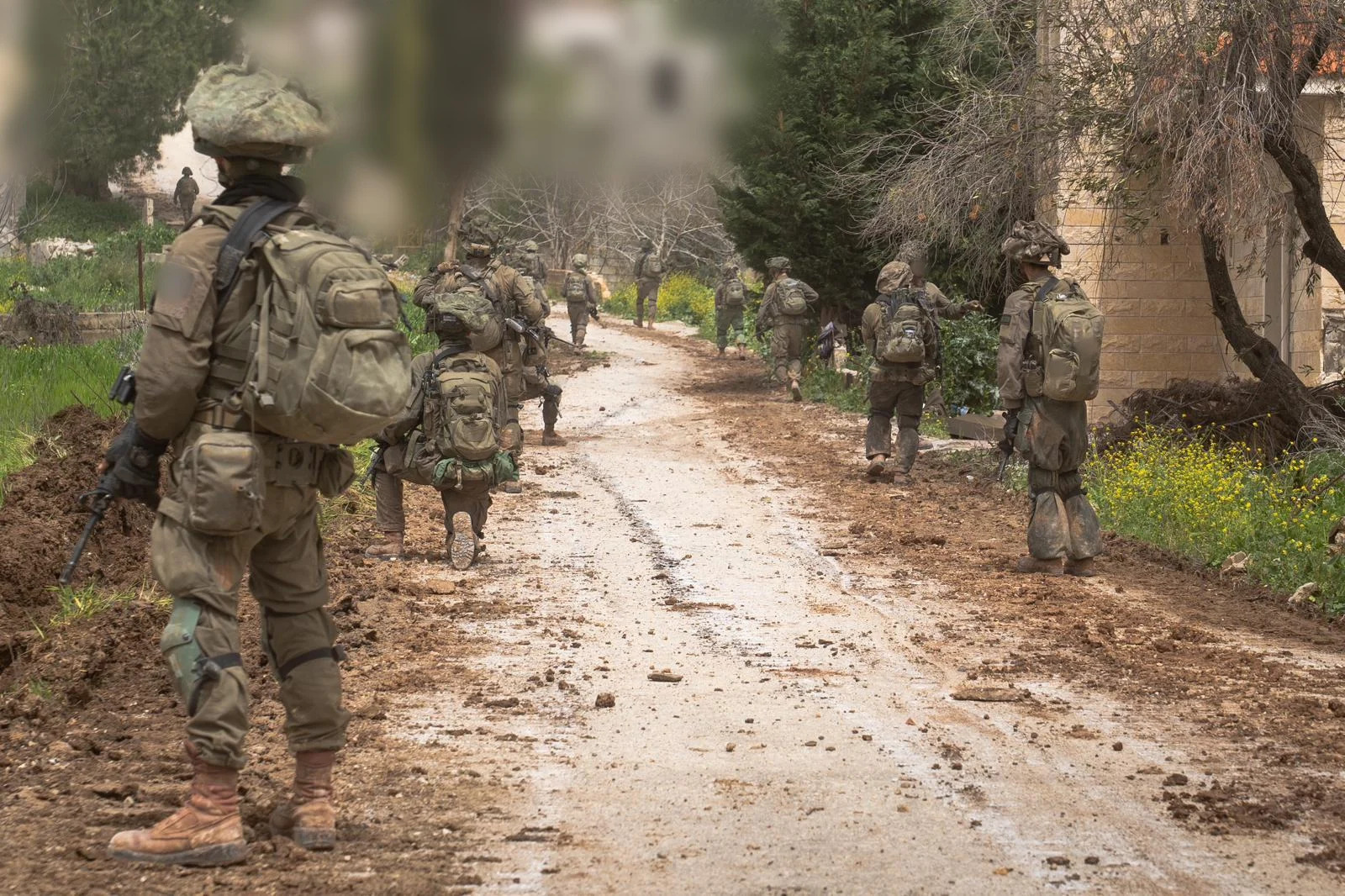
Israeli soldiers in southern Lebanon in April 2026 (IDF photo)
The Israeli defense minister said that the IDF will continue its destruction campaign in southern Lebanon and its forced displacement of Lebanese civilians. “We oppose an IDF withdrawal from Lebanon, despite all the existing pressures and those that will still come,” he said.
Katz added that Netanyahu “made these points clear to US President Trump and to other senior American officials,” which aligns with a report from Ynet that said Netanyahu told Trump that Israel is not bound by the Lebanon clause of the US-Iran MOU. Katz also said that if Iran strikes Israel over its continued war in Lebanon, Israel will hit Iran “with full force.”
Israeli Finance Minister Bezalel Smotrich slammed the agreement Trump reached with Iran, saying it is “bad for Israel and for the entire free world. Period.” Israeli opposition leaders also attacked Netanyahu, with former Prime Minister Yair Lapid saying there has “never, ever, been a more absolute failure than Netanyahu’s diplomatic failure on the Iranian front.”
Iranian officials on Monday reaffirmed that an end to Israel’s war in Lebanon was key to a lasting deal with the US. “Lebanon and the termination of the war in Lebanon are an inseparable part of the understanding on ending the [US-Israeli] war [on Iran]. We have shown that we are determined in this regard and have proven in practice that we are serious, and we will continue to monitor developments carefully in the future,” said Iranian Foreign Ministry spokesman Esmaeil Baghaei.
“The word Lebanon is used three times in the understanding. It is mentioned that ending the war includes Lebanon and respecting the country’s sovereignty and territorial integrity … The United States must honor its commitments and ensure that the Zionist regime fulfills its obligation not to attack Lebanon,” he added.
Workers clear debris near an apartment building damaged in an Israeli airstrike in Dahiyeh, Beirut’s southern suburbs, Lebanon, Sunday, June 14, 2026. [AP Photo/Bilal Hussein]
The United States and Iran announced a ceasefire agreement Sunday, suspending, for now, a war that the Trump administration began on February 28 and that has killed thousands of people. “The Deal with the Islamic Republic of Iran is now complete,” President Donald Trump wrote on Truth Social, ordering the lifting of the US naval blockade of Iran and the reopening of the Strait of Hormuz. “Ships of the World, start your engines,” he wrote. “Let the oil flow!”
While the terms of the settlement remain undisclosed, this much is already clear: The Trump administration achieved none of the aims for which it went to war. It set out to overthrow the Iranian government, destroy its nuclear program, break its military and seize the Strait of Hormuz. It accomplished none of this.
Trump responded to the failure by denying he had ever sought to overthrow the Iranian government. “As far as regime change, I never cared about regime change,” he told the Wall Street Journal on Sunday.
In reality, his administration had spent the entire year trying to bring the government down. Early on, it funded and armed protesters inside Iran. “We sent guns to the protesters, a lot of them,” Trump said in April.
When this failed, the United States and Israel turned to assassination. The opening strikes on February 28 killed Iranian Supreme Leader Ali Khamenei, Revolutionary Guard commander Mohammad Pakpour and Defense Minister Aziz Nasirzadeh, along with much of the military command. The government did not collapse. Khamenei’s son Mojtaba succeeded him, and it was the younger Khamenei’s national security council that approved Sunday’s deal.
There followed a bombing campaign across Iran that has killed at least 3,468 people, by the Iranian health ministry’s count, and a naval blockade imposed on April 13. American warplanes destroyed water reservoirs in Sirik that supplied more than 20,000 people and fired on oil tankers running through the blockade, killing three Indian sailors aboard the Settebello this week. After two months, the blockade failed to force Iran’s surrender, and the Strait of Hormuz remained shut by Tehran’s decree until Sunday.
No agreement with American imperialism is worth the paper it is written on. In 2015, the Obama administration signed the nuclear accord known as the Joint Comprehensive Plan of Action (JCPOA), under which Iran accepted strict limits on enrichment and intrusive inspections. Iran kept to its terms—the International Atomic Energy Agency certified as much in report after report—but in May 2018 Trump tore the agreement up anyway, calling it a “horrible, one-sided deal.” Obama, who signed that accord, said Sunday it was “doubtful that any agreement that arises is going to be significantly different or a significant improvement from the deal that we had in the first place… before we, the United States, pulled out of it.”
The pattern was repeated last year. Trump announced a “Complete and Total CEASEFIRE” in June 2025 to end the Twelve-Day War between Israel and Iran. That truce held until February 28, when the United States and Israel broke it, launching the war that has now been paused.
Even as he proclaimed peace on Sunday, Trump threatened to resume the war. The New York Times reported that in a phone call he said he would “restart military attacks on Tehran” if Iran failed to reach a final nuclear accord, or else make the United States “the guardian of the Middle East” in exchange for 20 percent of the region’s revenues.
Trump’s claims about the settlement were as hollow as his account of the war. He boasted that the Strait of Hormuz would be “permanently toll free,” but the memorandum suspends tolls for only 60 days. Iran charged no tolls before the war—the deal restores the prewar status quo. Trump said the inspection of Iran’s nuclear material could wait: “We’ll get the nuclear dust later on when we’re ready to go in and do it… there’s no rush.”
The agreement nominally covers Lebanon, where Israel has waged a parallel war that has killed more than 3,700 people. Hours before the announcement, Israel bombed the southern suburbs of Beirut, killing three, in a strike that nearly wrecked the deal. Trump said Israeli Prime Minister Benjamin Netanyahu had shown “no judgment” and told all sides to “stand down.” Israel, which was not a party to the talks, has not endorsed the agreement, and Israeli politicians across the spectrum denounced it.
The Democrats’ response to Trump’s moves toward an agreement with Iran centered on the accusation that he had failed to secure the interests of US imperialism. Democratic Representative Seth Moulton of Massachusetts called the emerging terms “basically a surrender document from Donald Trump to the supreme leader of Iran.”
House Minority Leader Hakeem Jeffries, on NBC’s “Meet the Press,” complained that the war had left the United States worse off: “Things aren’t better for us. They’re worse. In fact, Iran is stronger right now.”
A warning must be made. Whatever the failures and setbacks of the past four months, American imperialism will only redouble its efforts to dominate the Middle East and the world by military force.
The World Socialist Web Site is the voice of the working class and the leadership of the international socialist movement. We rely entirely on the support of our readers. Please donate today!
It’s important to understand that, contrary to Donald Trump’s quip to Barak Ravid that Netanyahu has “no f***ing judgment,” the Israeli Prime Minister knows exactly what he is doing: With a set of strikes at the Dahiyeh neighborhood in Beirut, he is trying to kill both the pending US-Iran peace deal and the fragile peace between Israel and Lebanon that would come with it.
There is a further strategic dividend. Netanyahu is also seeking to preempt Iran’s attempt to establish a new regional deterrence equation – one in which attacks on Beirut, and potentially on Lebanon more broadly, would trigger a direct Iranian response against Israel. By striking now, he is not merely targeting an adversary; he is challenging the emergence of a regional order that would constrain Israel’s freedom of military action.
Netanyahu even posted a video on his Twitter bragging about the attack:
תקפנו בדאחייה בביירות מטרות טרור של ארגון הטרור חיזבאללה. ישראל לא תסבול ירי לשטחה pic.twitter.com/wVARFCkDQe
— Benjamin Netanyahu – בנימין נתניהו (@netanyahu) June 14, 2026
The exchange of fire between Israel and Iran last week was about far more than retaliation. After Israel defied President Trump and struck Beirut’s Dahiyeh neighborhood, Iran responded by attacking Israel directly – the first time Tehran had launched strikes on Israel in response to an Israeli attack on Lebanon. Israel defied Trump once more and retaliated against Iran, prompting another Iranian response, after which Israel confined its next strike to southern Lebanon rather than Beirut.
The cycle reflected Iran’s attempt to establish a new regional equation: that attacks on Lebanon would no longer be cost-free for Israel, but would carry the risk of direct Iranian retaliation. For the first time in decades, a major regional power was seeking to place hard-power constraints on Israel’s freedom of military action beyond its borders.
Having reestablished its own deterrence, Tehran was now attempting to establish extended deterrence to its partners as part of a broader effort to rebuild its forward-defense posture. Israel, unsurprisingly, viewed this as a direct challenge to its long-standing freedom of maneuver and moved quickly to prevent the new doctrine from taking hold.
Of course, extended deterrence can not be established through a single exchange of fire. At a minimum, it would require several rounds of action and reaction before either side accepted it as a new reality. And even then, it would never be foolproof. Tehran understands that its purpose cannot simply be to eliminate Israeli strikes on Lebanon, but to force Israeli leaders to think twice before authorizing them by attaching a new and significant cost: the likelihood of direct Iranian retaliation.
It was therefore clear that Netanyahu had not abandoned the fight. Yet for several days, even as Hezbollah and Israel continued to exchange fire, he refrained from striking Beirut’s southern suburbs and testing Iran’s new red line.
But today, just hours before President Trump was expecting Iran to sign a memorandum that would end the U.S.-Iran war and reopen the Strait of Hormuz, Netanyahu crossed both Tehran’s and Trump’s red line: keeping Beirut out of the conflict.
Netanyahu clearly timed this for maximum impact. With a single set of strikes, Netanyahu may have advanced two goals at once – torpedoing Trump’s peace deal and preventing the emergence of a new deterrence equation that would impose meaningful constraints on Israel’s military operations in Lebanon.
A diplomat involved in the talks told Fox News that: “This is a clear attempt by Israel to sabotage the President’s deal and drag the United States back into war.”
Trump, meanwhile, is once again reportedly “pissed off” at Netanyahu. In a Truth Social post, the president declared that the strike on Beirut “should not have happened,” while pointedly questioning whether it was a proportionate response to Hezbollah’s latest attack on Israel.
“Israel has the right to defend itself against threats,” Trump wrote, “but the attack it was responding to was very small and meaningless. Nobody was hurt, injured, or killed, and it should not disrupt this important process.”
The statement was notable not merely for its criticism of Netanyahu, but for what it implied: that Israel’s strike was neither militarily necessary nor diplomatically prudent at a moment when a potential breakthrough with Iran appeared within reach.
Washington is frustrated by Tehran’s insistence that Trump rein in Israel, even as American officials believe Iran has failed to similarly restrain Hezbollah. It is equally frustrated that a deal it urgently wants with Iran is now being held hostage by Israel, ironically at the request of the Iranians, since it is Tehran that insists that any ceasefire must be region-wide and prevent Israel from having the ability to restart the war.
That frustration is understandable. But Washington must also recognize a basic reality: the only way to delink a U.S.-Iran agreement from the Israel-Lebanon conflict is to delink the United States itself from Israel’s recurring resort to military escalation.
As long as Israel retains the capacity to drag the United States back into conflict, Tehran will see little reason to separate diplomacy with Washington from the wars Israel chooses to start and pull the US into.
Indeed, the principal reason Tehran insists on a region-wide ceasefire is to deny Israel the ability to draw the United States into yet another war with Iran itself.
If Trump were to clearly establish that the United States would neither participate in nor defend an unjustified Israeli military escalation, Tehran might no longer see the need to link a U.S.-Iran accord to the Israel-Lebanon front.
Such a calculated distancing from Israel would serve American interests in any case. But the need for it has rarely been more apparent than it is today.
Trita Parsi is the Executive VP of the Quincy Institute for Responsible Statecraft and an award-winning author. Washingtonian Magazine has named him one of the 25 most influential voices on foreign policy. Noam Chomsky calls him “one of the most distinguished scholars on Iran”
While talks in Cairo center on disarming Hamas, Israel has kept killing hundreds of Palestinians without accountability and is expanding its control over the strip despite an alleged ‘ceasefire’
The US military has begun constructing a “huge base” on the Gaza envelope to implement US President Donald Trump’s plan to “take over” the strip, Israel Hayom reported on 13 June.
The US base, being built near the Israeli military base at Reim settlement, will function as both a military and civilian headquarters for the organizations and forces arriving in the area to implement the Trump plan.
In February 2025, Trump proposed a US “takeover” of the Gaza Strip.
The plan called for the forced displacement of approximately two million Palestinians to neighboring lands and redeveloping the territory as a high-tech business and tourism hub that Trump said would become the “Riviera of the Middle East.”
The new base will replace the US facility in the Israeli town of Kiryat Gat, established under the direction of Trump’s Board of Peace in the wake of the October 2025 “ceasefire.”
Representatives from more than 24 countries staffed the multinational headquarters and were tasked with overseeing the ceasefire and the entry of humanitarian aid.
The Kiryat Gat base was also meant to direct the operations of an International Stabilization Force (ISF) tasked with providing security in Gaza.
However, Israel has continued to severely restrict the entry of aid into Gaza, recently suspending all shipments, while the ISF has yet to be formed.
After the US and Israel launched a war on Iran on 28 February, the overwhelming majority of personnel left Kiryat Gat.
Israel Hayom noted that plans for the new US base include the construction of a tower intended for the command and control of forces in the field.
The US military has already begun issuing tenders to private contractors, including for the supply of mobile structures to house personnel and serve as a headquarters until permanent buildings are established at the site.
The new base will also host troops from the ISF if it is formed.
Five countries previously agreed to send forces to Gaza, namely Indonesia, Morocco, Kazakhstan, Kosovo, and Albania. Bangladesh, Pakistan, and Azerbaijan have expressed a willingness to participate but have made no firm commitment.
Currently, no countries are willing to send troops due to fears that their forces will be tasked with disarming the Palestinian resistance, as well as concerns about the ongoing US-Israeli conflict with Iran.
The construction of the new US base is being fully coordinated with the Israeli Defense Ministry. Military officials expect the base to be constructed and staffed within a few months.
The report comes as talks continue between Hamas and Israel via negotiators in Cairo.
Israel persists in demanding Hamas disarmament before progressing the ceasefire, while simultaneously continuing to kill Palestinians in Gaza without consequences and expanding its occupation rather than withdrawing from the territory seized during the genocide.
Israel has killed nearly 1,000 Palestinians in Gaza and expanded its control of the strip from 50 percent to at least 60 percent since the ceasefire.
One security source told Israel Hayom that the “chance of renewed fighting in the Gaza Strip is greater than the possibility that Hamas will actually be disarmed through a diplomatic agreement.”
“Demilitarizing Gaza became a bigger aim than stopping Israel’s genocide; such is the absurd truth,” wrote author Ramona Wadi.
While “colonial expansion as the reason behind Israel’s genocide in Gaza, utterly exposed for the entire world to see, [it] is never discussed by the international community. On the contrary, the Board of Peace promotes it and sets the conditions that justify colonialism instead of preventing it, using an extension of the same narrative Israel used to destroy Gaza,” Wadi added.
Lebanese security officers gather at the site where an Israeli airstrike hit a building in Dahiyeh, Beirut’s southern suburb, Lebanon, Sunday, June 7, 2026. [AP Photo/Hassan Ammar]
One hundred days ago, on February 28, the United States and Israel launched an illegal war of aggression against Iran. The war is being waged by the world’s most powerful imperialist powers against a historically oppressed nation.
The resistance of the Iranian people, notwithstanding the reactionary character of the clerical regime, is politically legitimate and of a heroic character. The working class internationally must defend Iran unconditionally against imperialist subjugation.
The “negotiations” currently being carried out by the Trump administration at gunpoint are a fraud. In an interview this weekend, Trump declared that if Iran does not accept his demands, “I’m going to blow the hell out of them.” Even if the Trump administration agrees to a “ceasefire,” any agreement with the gangsters in the White House will just be as meaningful as the “peace” deal in 2025 that set the stage for this year’s war.
On Sunday night, Israel attacked Tehran. In Lebanon, the Israeli bombardment, escalating even amid the supposed negotiations, has killed at least 3,593 people and driven over a million from their homes—a toll that exceeds the 3,468 Iranians killed, among them seven infants and 376 children, with more than 26,500 wounded.
In the course of the war, imperialism plumbed new depths of barbarism. Trump’s threats to extinguish “a whole civilization” and Hegseth’s vow to wage war with “no quarter, no mercy” will go down in history as expressions of an oligarchy that has abandoned all pretense to legality. The imperialist powers now wage wars of oppression and subjugation in the open, with methods pioneered by the Nazis.
Despite the brutal and murderous character of the US-Israeli onslaught, however, imperialism has failed to achieve a single one of its aims. It has not overthrown the Iranian government, broken Iran’s military or seized control of the Strait of Hormuz.
The war has had two major effects: a deepening of the global crisis of the capitalist system and an enormous escalation of the global class struggle, not least within the United States.
The US debacle in Iran has accelerated the crisis of the US-led economic order. The European Central Bank reported in June that central banks are fleeing US Treasury bonds for gold, which has overtaken the euro to become the second-largest reserve asset—27 percent of global reserves, up from 20 percent a year earlier. The US national debt has passed $39 trillion.
It is the working class—in the United States and internationally—that is bearing the cost of the war. The closure of the Strait of Hormuz has driven gas at the pump up by more than 50 percent, the price of staples like tomatoes by nearly 40 percent and inflation to 3.8 percent, its highest since 2023.
Trump has seized on the war to intensify his assault on social programs, declaring in April that “we’re fighting wars” and that it is therefore “not possible for us to take care of day care, Medicaid, Medicare, all these individual things.” The World Food Programme warned that the war could push an additional 45 million people into acute hunger, a record level, with the poorest, import-dependent countries of Africa and Asia hit hardest.
In response to the surge in prices and the escalating cost-of-living crisis, the working class has begun to fight back. The past three months have seen a significant growth of working-class struggle in the United States: the first strike on the Long Island Rail Road in more than three decades; a three-week walkout by 3,800 meatpacking workers at JBS in Greeley, Colorado, the first in the industry in more than 40 years; strikes by teachers in California and a statewide walkout in North Carolina; strikes by nurses in New Orleans and California against unsafe staffing; a strike by graduate students at Harvard University; and the rebellion now sweeping the auto parts industry.
The class struggle is erupting internationally—in the mass anti-government protests in Kenya, the rebellion of tens of thousands of workers in the industrial suburbs of Delhi and the hunger strike of coal miners in Turkey. In the first quarter of 2026, eight European countries recorded 458 strikes, among them national general strikes in Belgium and Italy, and regional general strikes in Spain’s Andalusia and Basque Country. Argentina mounted a national general strike against the Milei government in February, and 1.7 million government employees walked out across the Indian state of Maharashtra.
The contradictions that are driving imperialism to war are also driving the working class into struggle. The growth of the class struggle springs from the same crisis that produces the war. Out of that crisis emerges the only social force capable of putting an end to it. War and social revolution are two sides of the same historical process.
Enormous and growing opposition is developing in the United States and throughout the world to the US–Israeli war of aggression against Iran and to the broader drive toward war, austerity and dictatorship. But opposition, left to itself, is dissipated and diverted. It must be armed with a program, perspective and leadership.
The fight against war cannot be waged through appeals to the governments and parties that are waging it. In the US, the Democratic Party greeted the murder of Iran’s leaders with cheers and financed Trump’s military budget. The European imperialist powers have backed the war and politically justified it, while pouring €800 billion into rearmament as they escalate the proxy war against Russia, which they arm and direct.
Opposition to imperialism requires developing struggles of workers in the United States, Europe and across the world—against war, austerity and dictatorship—into a conscious political movement armed with a socialist program. To put an end to war and barbarism, the capitalist system must be abolished.
This is the perspective of the Socialist Equality Party and the International Committee of the Fourth International. We call on every worker and young person who opposes this war to take it up and to build the revolutionary leadership the working class needs.
Published date: 6 June 2026 19:49 BST | Last update:21 hours 49 mins ago
The Pentagon has raised Israel’s counterintelligence threat level to its highest category, amid growing alarm that Washington’s supposed closest Middle East ally is intensifying efforts to spy on senior US officials.
The warning, reported by NBC News and The New York Times on Saturday, exposes behind the scenes tensions in a relationship Washington often treats as untouchable.
The Pentagon’s Defense Intelligence Agency recently issued the new assessment as tensions grow between the Trump administration and Israel over the Israeli-US war on Iran.
US officials told NBC that the DIA posted an internal message raising Israel’s threat level to “critical”.
The designation signals alarm inside the Pentagon that Israel is working to monitor top US officials and obtain information about internal Trump administration deliberations on wars across the Middle East.
New MEE newsletter: Jerusalem Dispatch
Sign up to get the latest insights and analysis on Israel-Palestine, alongside Turkey Unpacked and other MEE newsletters
The New York Times reported that US intelligence has focused on Israeli efforts to eavesdrop on senior officials, including Steve Witkoff, Trump’s top negotiator, Elbridge A Colby, the Pentagon’s top policy official, and Michael P DiMino IV, one of Colby’s main deputies.
Colby has in the past called for a “reset” on the US relationship with Israel.
Israel’s counterintelligence threat level now stands higher than that of any other US ally and even higher than some adversarial states, the Times reported.
One senior official described Israel’s intelligence collection against top US officials during the second Trump administration as “unhinged”.
‘Critical threat’
The DIA assessment includes a seven-page document and a chart, one US official told NBC. The document says Israel’s ability to conduct human espionage and technical collection has reached a “critical level” and lists specific incidents that sharpened US concern.
Current and former US officials told NBC that Israel’s recent activity has moved far beyond routine espionage between allies.
Israeli spy Jonathan Pollard suggests Egypt and Turkey are next targets for war
The warning comes as Israel pushes for deeper military integration with the United States. A provision before Congress would bind the US and Israeli militaries more closely on weapons research, production and technology – a move expected to benefit Israel heavily.
The Pentagon’s assessment could now complicate efforts to expand war planning between US Central Command and Israel, especially if officials restrict the information shared with Israeli officers.
Since a ceasefire took effect in early April, Trump has pursued diplomacy with Iran to end the war the US and Israel launched on 28 February. Israel has openly pushed for Washington to restart the war.
Prime Minister Benjamin Netanyahu has pressed for renewed bombing of Iran and clashed with Trump, who has urged him to scale back attacks on Lebanon.
The episode revives a long-running concern in Washington. In the 1980s, US Navy intelligence analyst Jonathan Pollard spent 30 years in prison after selling suitcases of top-secret documents to Israel.
‘IT’S the tail that is wagging the dog’ aptly describes the ongoing conflict in the Middle East. The reality is that America is fighting Israel’s war. The Zionist state not only acts as a spoiler but also effectively dictates the terms of war and peace in the region. A recent example of this is Israel’s military escalation in Lebanon, which has not only complicated diplomatic efforts to resolve the US-Iran conflict, but has also broadened the theatre of war.
Despite President Donald Trump’s claims of having halted the conflict, the war continues. Israeli forces have occupied a significant portion of Lebanon, and relentless bombings have devastated Beirut, effectively undermining the US-brokered ceasefire.
Incensed by Israel’s blatant violation of the ceasefire, Iran has suspended its back-channel negotiations with the US and warned that it could “completely block” the Strait of Hormuz, aggravating tensions. Tehran asserts that any peace talks are directly linked to a ceasefire in Lebanon and Israel’s withdrawal from the region. Additionally, Iran has threatened to strike Israel if the war in Lebanon is not halted. Hours later, Trump stated that he had urged Israel to cease its offensive; however, there are no signs of an end to the hostilities.
Last week, Israel captured the 900-year-old Beaufort Castle and its strategic ridge in southern Lebanon. Israeli forces used the castle, also known as Qalaat al-Shaqif, as a base during their two-decade occupation of southern Lebanon that ended in 2000.
Israel’s latest military escalation is not limited to Lebanon; it extends to Gaza.
It marks Israel’s deepest incursion into the country in 26 years, and there appears to be no end to its aggression, which has received Washington’s approval. The conflict with Iran has now effectively been extended to the Levant. Israel entered Lebanon under the pretext of combating Hezbollah, the pro-Iran group based in southern Lebanon. Last year, Israel killed nearly all of the group’s senior leaders, including its head.
While Israel claimed to have completely dismantled Hezbollah’s structure, recent retaliatory attacks by the group indicate that, despite these setbacks, it remains capable of fighting back. Additionally, Israel has incurred significant casualties from its invasion, with reports indicating that 26 soldiers have been killed thus far.
Hezbollah was formed in 1982 in response to the Israeli invasion of Lebanon, which aimed to dismantle the Palestinian Liberation Organisation. The group quickly emerged as a powerful resistance movement and a dominant force in Lebanese politics. Its resistance efforts ultimately led to Israel’s withdrawal from Lebanon, ending Tel Aviv’s occupation of the southern region in 2000.
Although Hezbollah receives backing from Iran, it has maintained its political independence. The ongoing US-Israel conflict with Iran has involved Hezbollah militarily against Israel. A ceasefire in April temporarily halted hostilities, but Israel’s recent aggression has effectively ended this truce. Despite suffering losses among its commanders in recent weeks, Hezbollah remains capable of fighting back without external assistance.
Israel has issued displacement orders and evacuation warnings for approximately 14 to 15 per cent of Lebanon’s territory. Additionally, Israeli forces continue to occupy specific strategic locations in southern Lebanon. As a result of the ongoing conflict, more than one million people have been displaced within the country, including over 300,000 children, further aggravating the humanitarian crisis.
Israel’s latest military escalation is not limited to Lebanon; it extends to Gaza. Israel has not complied with the ceasefire agreement reached last year, nor has it withdrawn its forces to the designated area in the occupied territory. The Israeli military continues to conduct strikes and seize territory despite a ceasefire with Hamas. More than 1,000 people have been killed in ongoing Israeli bombings after the truce.
Last week, Israeli Prime Minister Benjamin Netanyahu ordered the military to extend its control to 70pc of the Gaza Strip. Under the ceasefire agreement reached last October, after two years of intense conflict, Israel was left with control over 53pc of the enclave until the time an administration was established under the Board of Peace, with the approval of the Security Council.
Netanyahu recently boasted at a conference that Israel had expanded its grip on Gaza, stating, “We are now in 60pc of the territory”. He said: “My directive is to move to — take it step by step — first of all 70. Let’s start with that.” The audience called for him to take over 100pc of the territory. Many of Netanyahu’s right-wing supporters view the current situation in Gaza as ‘mission incomplete’ or ‘mission failure’. Their preference is for Israel to expand its area of control, even resume military action in Gaza.
Netanyahu’s remarks come at a time when Gaza’s rehabilitation plan has stalled; in fact, it never started. According to media reports, there are no funds available for the Board of Peace’s (BoP) executive board to initiate rebuilding efforts. It is estimated that around $70 billion is needed to rehabilitate the enclave, which has been devastated by Israel’s two-year military campaign. The project was supposed to take 10 years to complete, but Israel’s plan for military occupation makes Gaza’s restoration impossible.
Earlier this year, Trump formally launched the BoP at the World Economic Forum in Davos, describing it as one of the “most consequential” international organisations ever created. Member states pledged $7 billion for its Gaza “relief package”, and Trump promised an additional $10bn in US funding. However, so far, the fund established by the World Bank has received no contributions. Israel’s recent move to re-establish military control over the war-ravaged enclave has rendered the entire project redundant.
Trump expanded the BoP’s scope beyond the Security Council’s authority, which had limited its jurisdiction to Gaza. Only 25 countries have signed on, while others refused to be a part of the board, suspecting it was an attempt to undermine the UN.
The war in Iran has not only effectively derailed the so-called Gaza rehabilitation plan but has also exposed the BoP as a cover for America’s imperialistic agenda. A critical question now is whether America can extricate itself from this war, which it initiated at Israel’s behest and has since become entangled in.
A BBC Verify investigation of satellite imagery and video analysis published on 1 June reveals that Iranian military strikes successfully damaged at least 20 US military sites across West Asia since the start of the US-Israeli war of aggression on the Islamic Republic.
Findings suggest that the scale and precision of Iranian retaliatory strikes had been significantly more extensive and accurate than US officials had previously acknowledged, with some independent analysts suggesting as many as 28 bases may have been affected.
The targeted facilities are spread across eight Gulf countries, namely Saudi Arabia, the UAE, Qatar, Kuwait, Iraq, Jordan, Bahrain, and Oman.
Material losses include three Terminal High Altitude Area Defense (THAAD) batteries, which cost approximately $1 billion each and are centerpieces of the regional defense network.
Expert analysis further identifies the destruction or damage of at least 42 aircraft, including F-35 fighter jets, MQ-9 Reaper drones, and a $700-million E-3 Sentry surveillance plane.
According to military analysts, Iran achieved these results by evolving its tactics from high-volume barrages to “smaller, more precisely targeted salvos” designed to concentrate fire on high-value infrastructure.
This shift reportedly exploited a degree of “early-war complacency” within the US military, which failed to relocate aircraft even after facilities like Prince Sultan Air Base in Saudi Arabia had already come under fire.
In a statement addressing the strikes, Iranian Supreme Leader Mojtaba Khamenei declared that West Asia is no longer a “safe place” for US bases.
While the White House previously claimed Iran’s military capabilities were nearly eliminated, the Pentagon’s own estimates now place the cost of the war at $29 billion, much of which is dedicated to equipment repair and replacement of the heavily depleted weapons stocks.
Former military officials warn that the damaged defense systems cannot be “quickly or easily replaced,” adding that the heavy consumption of air defense interceptors during the conflict has left remaining US facilities across the Gulf increasingly vulnerable to future Iranian precision strikes.
Although the US has attempted to limit public scrutiny by requesting restrictions on satellite imagery, the visible “smoking craters” and destroyed hangars shown in the BBC report tell a different story. On Sunday night, Iran said it had launched strikes on a US air base in Kuwait in retaliation for US attacks on Iranian military targets over the weekend in violation of the ceasefire.
The Kentucky congressman’s stand against US aid to Israel and the Iran war triggered a pro-Israel donor backlash that reveals how firmly the lobby still shapes Republican politics
US Congressman Thomas Massie speaks with supporters after his concession speech in Hebron, Kentucky, United States, 19 May 2026 (Jon Cherry/Getty Images/AFP)
In American politics, certain transgressions are tolerated. Challenging Israel is not among them. US Congressman Thomas Massie crossed that line – and on Tuesday, paid the price.
His defeat in Kentucky’s 4th Congressional District was widely portrayed as another demonstration of President Donald Trump‘s continued dominance over the Republican Party. That explanation is politically convenient but analytically incomplete.
What happened to Massie was not merely a clash of personalities or a dispute over loyalty to Trump. It was the enforcement of a political boundary deeply embedded within the structure of American power. Massie had violated one of the deepest taboos in American politics: alienating the Israel lobby.
Unlike many politicians accused of dissent, Massie’s divergence was not rhetorical or symbolic. It was documented through votes, public statements and a sustained critique of unconditional American support for Israel.
As the only member of Congress to vote against House Resolution 888 in November 2023, Massie committed a cardinal sin – rejecting the congressional resolution that affirms Israel’s “right to exist” and opposes calls for the dismantling of the Israeli state.
New MEE newsletter: Jerusalem Dispatch
Sign up to get the latest insights and analysis on Israel-Palestine, alongside Turkey Unpacked and other MEE newsletters
The resolution passed 412-1, with even progressive “Squad” members including Alexandria Ocasio-Cortez, Ilhan Omar and Ayanna Pressley voting in favour.
Massie was also among a small number of members of Congress who opposed emergency military aid packages and several pro-Israel resolutions after 7 October 2023.
He also consistently argued that all foreign aid – particularly aid to Israel – violated both constitutional principles and fiscal conservatism. At a moment when Israel was carrying out what numerous human rights organisations, UN experts, genocide scholars and even former Israeli officials described as genocidal acts in Gaza, Massie openly opposed using American taxpayer money to finance the war.
In Washington, such positions are treated as dangerous deviations from the consensus on Israel – defiance that must be politically punished.
Massie did not simply challenge a policy, but confronted an entrenched power structure that has shaped American foreign policy in the Middle East for decades
Support for Israel has been one of the most entrenched bipartisan pillars of American foreign policy. Since October 2023, the United States has poured tens of billions of dollars in military aid to Israel while shielding it at the United Nations.
The Costs of War Project at Brown University puts the direct figure at well over $22bn.
In Gaza, the health ministry and international observers documented more than 75,000 Palestinians killed and over 180,000 injured – countless left maimed – as entire neighbourhoods, hospitals, universities, schools, water facilities, electric grids and refugee camps have been systematically destroyed.
Massie did not simply challenge a policy, but confronted an entrenched power structure that has shaped American foreign policy in the Middle East for decades.
A familiar pattern
Washington has witnessed similar episodes before. Former Republican Congressman Paul Findley of Illinois lost his seat in 1982 after criticising Israeli policy and the growing influence of Aipac. Likewise, Republican Senator Charles Percy of Illinois suffered a similar fate in 1984 after tensions with pro-Israel lobbying networks.
In the past two decades, many Democratic members of Congress encountered the same fate. Cynthia McKinney in Georgia, Earl Hilliard in Alabama, Jamaal Bowman in New York and Cori Bush in Missouri all faced massive financial interventions after criticising Israeli policy or supporting Palestinian rights.
These cases are too numerous and too targeted to remain anecdotal. The system enforcing them is structural. Aipac’s super PAC, which labelled Massie “the most anti-Israel Republican in the House”, contributed $9m to the race alone. When the result came in, Aipac declared: “Pro-Israel Americans are proud to help defeat anti-Israel candidates.”
US: Anti-Aipac congressman Massie unseated in most expensive House primary ever
During the Cold War, questioning anti-communist orthodoxy carried political consequences. Today, questioning unconditional support for Israel carries the same weight of orthodoxy in Washington.
The Kentucky race became the most expensive House primary in modern American history, with spending exceeding $34m. Yet the significance lies as much in how the money was mobilised and coordinated as in the sheer amount spent.
Press reports indicate that millions in outside expenditures came from networks aligned with pro-Israel advocacy organisations and donor ecosystems that have increasingly intervened in congressional races nationwide.
The campaign against Massie followed a now-familiar model: massive independent expenditures, relentless advertising blitzes, coordinated media narratives and efforts to portray dissenting candidates as extremists or unreliable actors outside the accepted boundaries of Washington politics.
Massie was not merely outspent but politically marked and strategically targeted.
These campaigns are not simply about defeating one candidate. They are designed to create fear and send a message to every member of Congress that opposition to Israeli policy, especially during wartime, carries severe political costs regardless of seniority, popularity or ideological credentials.
A shifting public
American public opinion has shifted dramatically against Israel. Multiple polls conducted over the past two years show a stark erosion of support, particularly among younger Americans. A February Gallup poll showed that sympathy for Palestinians had surpassed sympathy for Israelis for the first time.
Pre-election polling found that older Republican voters in the district broke decisively for Ed Gallrein, while younger and middle-aged voters leaned towards Massie – a generational divide visible far beyond Kentucky.
Even among Republicans, support for unconditional military involvement abroad has weakened considerably, especially after the escalation towards the war on Iran. A growing number of Americans, above all young people, view Israel not as a strategic asset but as a source of regional instability capable of dragging the United States into wider wars that serve no American national interest.
Massie reflected this sentiment openly. During debates surrounding the possibility of direct military confrontation with Iran, he warned that Washington was being pushed towards another catastrophic Middle Eastern war driven primarily by Israeli regional interests rather than core American ones.
In one widely circulated statement, Massie argued that Congress should not authorise military escalation without direct constitutional approval and questioned why American taxpayers and soldiers should bear the burden of wars initiated by foreign policy priorities disconnected from domestic needs.
After decades of war, debt and the decline of basic services, those arguments now resonate with far more Americans than Washington elites care to admit.
Israel’s growing public relations crisis has intensified these tensions. Images from Gaza – where entire families have been erased, children buried beneath rubble and famine conditions imposed on a trapped civilian population – have transformed global public opinion.
South Africa’s genocide case before the International Court of Justice further amplified international scrutiny, while major human rights organisations accused Israel of committing war crimes and crimes against humanity. For millions around the world, Gaza destroyed the myth that western human rights discourse applies equally to all people.
Facing this crisis of legitimacy, Israel and its supporters have invested heavily in narrative control across media platforms, digital spaces, universities and political institutions. Israeli Prime Minister Benjamin Netanyahu, himself an indicted war criminal, has repeatedly boasted about Israel’s influence within western media networks and social media platforms. The struggle is increasingly one over information and perception.
In his concession speech, Massie remarked: “It took a while to find Ed Gallrein in Tel Aviv.”
Massie was not simply conceding defeat to his opponent. He was identifying the terrain on which the battle had been fought. This was not merely a Kentucky primary race. It was an election shaped by national donor networks, foreign policy alignments and political enforcement mechanisms extending far beyond the district itself.
The wider message
Some commentators tied to the Israeli lobby attribute Massie’s defeat solely to Donald Trump. But this narrative is both factually flawed and analytically superficial. Trump certainly played an important role – he endorsed former Navy SEAL Ed Gallrein and repeatedly attacked Massie as disloyal, transforming the primary into a referendum on allegiance to the Maga movement.
Yet Trump alone does not generate more than $30m in congressional primaries, nor does he independently mobilise a vast donor infrastructure against a single congressman among dozens who have disagreed with him over the years.
A more accurate reading is that Trump’s machinery converged with well-established Zionist donor networks and enforcement structures – what some critics now describe as the “Epstein Class”: a nexus of billionaire financiers, political operatives, media influence networks and intelligence-linked figures whose loyalties often appear more connected to preserving Israeli regional supremacy than defending coherent American national interests.
Trump did not create the target on Massie’s back – he just helped pull the trigger.
What happened to Massie exposes a structural reality long understood but rarely discussed openly: there are policy red lines within the American system, and Israel sits among the brightest. Crossing those lines carries consequences – coordinated funding flows, nationalised opposition campaigns, coordinated messaging portraying dissent as extremism, and political isolation.
Trump’s machinery converged with well-established Zionist donor networks and enforcement structures – what some critics now describe as the ‘Epstein Class’
But the implications extend far beyond Kentucky.
To Maga Republicans, it signals that “America First” has limits. One may challenge trade agreements, immigration policy, global institutions or even party leadership. But challenging Washington’s alignment with Israel remains extraordinarily dangerous.
To libertarian conservatives, the answer is equally stark: fiscal conservatism and scepticism towards foreign intervention remain acceptable only until they intersect with Israel.
And to the broader Republican Party, the lesson could not be clearer: party discipline increasingly requires adherence to Trumpism and to a foreign policy consensus in which Israeli priorities remain deeply embedded within the permanent foundations of American power.
Massie was defeated for one main reason: he challenged one of the most protected structures within American political life. Once that occurred, the Zionist machinery activated with remarkable speed: enormous funds mobilised, opposition networks unified overnight, media narratives deployed and political deterrence established.
These are not passing phenomena. They discipline political behaviour. And as public anger over Gaza deepens and younger Americans continue breaking with old political orthodoxies, it is no longer clear that these instruments of political discipline can hold indefinitely in a society already entering a deeper crisis of legitimacy.
Yet despite Massie’s defeat, the results of recent primary races suggest that Aipac’s long-standing dominance over American politics may be waning. On the same evening, Chris Rabb – a democratic socialist, vocal Palestine advocate and open Aipac critic – won the Democratic primary in Pennsylvania’s 3rd Congressional District against two Aipac-backed opponents.
Earlier this year, Aipac’s campaign against moderate Democrat Tom Malinowski in New Jersey backfired spectacularly, inadvertently propelling Analilia Mejia – the race’s most vocal Palestine advocate – to victory.
The ground is shifting and the lobby knows it.
The views expressed in this article belong to the author and do not necessarily reflect the editorial policy of Middle East Eye.
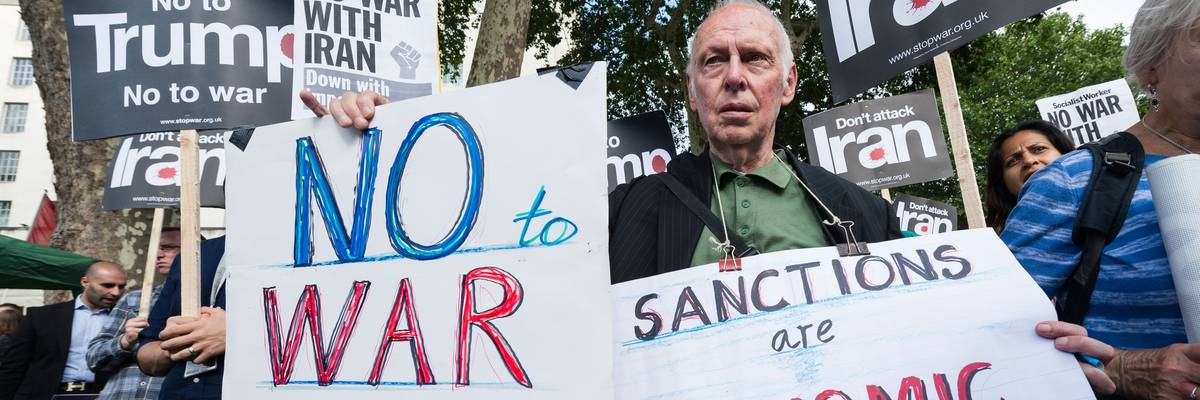
Anti-war demonstrators gather outside Downing Street on 26 June, 2019 in London, England, to call on the government to publicly oppose the escalation of conflict between Donald Trump’s administration and Iran and demand that military action is ruled out.
(Photo: Wiktor Szymanowicz / Barcroft Media via Getty Images)
The supposedly unlimited freedom of action attained by disdaining and trampling international law and institutions has proved to be a double-edged sword.
On May 24, Iran rejected President Trump’s latest fake peace deal, confirming that he had misrepresented what Iran had agreed to and that the two sides are still very far apart, on nuclear enrichment, on control of the Strait of Hormuz, on peace in Palestine and Lebanon, and on lifting US sanctions, paying war reparations, and Iran’s $100 billion in frozen assets.
Iran’s conditions for a peace agreement are necessarily uncompromising, in response to the US record of using negotiations as cover for sneak attacks, and the charade of one-sided “ceasefires with Israeli characteristics,” in which the US and Israel routinely ignore and violate every ceasefire they agree to, including the present ones in Gaza, Lebanon, and Iran.
Since no agreement with the United States or Israel is worth the paper it’s written on, it’s hard to imagine an agreement that would really protect Iran from future attacks. Without a more radical change in US policy, the United States and Israel will keep attacking Iran, in open violation of the UN Charter, no matter what they all agree to.
The only effective ways Iran has found to protect its land and its people are to build strong military defenses, including the capacity for devastating retaliation, and to retain control of the Strait of Hormuz, regardless of the impact on the world’s oil and gas supply and the global economy. By attacking Iran, the United States and Israel forced it to defend itself and triggered a war that is reshaping the Middle East and possibly the world.
The final sinking of the neocon dream in the troubled waters of the Persian Gulf provides the US and the world with a historic chance to recommit to a more peaceful and democratic international order.
Losing this war is forcing the United States to finally start reevaluating the neoconservative tactics it has blindly substituted for a rational US foreign and military policy since the 1990s: sanction; threaten; bomb; kill; destroy; occupy; escalate; leave countries mired in violence and chaos—in Afghanistan, Iraq, Haiti, Somalia, Libya, Syria, Yemen, Ukraine, Palestine and Lebanon—never admit defeat; never question American exceptionalism or superiority.
The systematic US disdain for the rule of international law that undergirds this policy appears to make peace impossible in today’s world. But the final sinking of the neocon dream in the troubled waters of the Persian Gulf provides the US and the world with a historic chance to recommit to a more peaceful and democratic international order.
Since the end of the Cold War, the United States has effectively exempted itself from the entire system of treaties, international laws and agreements that are supposed to govern international affairs, starting with the UN Charter, which prohibits the threat or use of force between countries, and the Geneva Conventions, which protect civilians, prisoners-of-war and wounded soldiers and sailors from the impacts of war.
These treaties were drawn up and universally adopted in the wake of the Second World War, to “save succeeding generations from the scourge of war,” as the UN Charter says in its preamble. President Roosevelt returned from his Yalta conference with Churchill and Stalin in 1945 to tell a joint session of Congress that they were designing the United Nations as a “permanent structure of peace.”
“It ought to spell the end of the system of unilateral action, the exclusive alliances, the spheres of influence, the balances of power, and all the other expedients that have been tried for centuries—and have always failed,” FDR told Congress. “We propose to substitute for all these, a universal organization in which all peace-loving Nations will finally have a chance to join.”
The UN Charter codified and strengthened the age-old common law prohibition against international aggression, and the renunciation of war as an instrument of national policy in the 1928 Kellogg Briand Pact, which German leaders tried at Nuremberg were sentenced to death forviolating.
However, amid overblown Western triumphalism after the end of the Cold War, a new generation of US leaders, like Madeleine Albright andDick Cheney, came to see the UN Charter and Geneva Conventions as obstacles to their ambitions to further expand US global power by more widespread and unrestricted use of military force.
Believing that the new imbalance in military power freed them from compliance with post-1945 treaties and conventions based on the hard-earned wisdom of past leaders in two world wars, the US and its allies unleashed their armed forces toattack andinvade other countries, torture, rape and kill prisoners, andmassacre civilians.
US officials assumed that the new military imbalance so greatly favored the United States that neither the UN, international courts, other powerful countries, nor even the entire people of the world could enforce the rules of international law and the laws of armed conflict on the United States if it chose to ignore them.
It is ironic, and deeply frustrating and confusing to US officials, to find out that what they hailed as a position of overwhelming power and impunity has led them to squander America’s day in the sun and waste the chance that its great good fortune provided to improve the quality of life for Americans and their neighbors.
The supposedly unlimited freedom of action attained by disdaining and trampling international law and institutions has proved to be a double-edged sword. There is no such thing as unlimited military power, short of the mass suicide of nuclear war. The idea that America’s virtually unlimited investment in weapons and war would give it the final word in every dispute was a mirage, as even Trump is now finding out.
As Americans reexamine the state of the world and the conflicts by which warmongering US leaders have tried to define it, it is obvious that war and military power do not lead to peace or prosperity, for Americans or anyone else. The more countries the Pentagon and the CIA take aim at, the more people they kill, and the more resources our leaders throw at them, the more other people all over the world rightly come to see the United States as a threat to their own lives and futures.
Governments around the world face difficult choices between meeting the needs and aspirations of their own people or complying with the hegemonic and undemocratic demands of the United States.
After holding itself up as the champion of democracy and freedom for 250 years, the United States is only accelerating its own decline by wasting trillions of dollars, and what little is left of the world’s good will, on this failed, ill-fated bid for global imperial power.
When the United States rose to great power in the first half of the 20th century, its leaders were wise enough to recognize that exercising naked imperial power would not succeed in a world still fighting to free itself from the ravages of European colonialism. So FDR and his colleagues based the UN system on sovereign equality between nations, and created a framework for international relations that the whole world could agree to.
While the United States and Israel commit systematic and barbaric war crimes, presuming themselves immune from accountability, the world is slowly—too slowly—coming to grips with the international cooperation needed to enforce the “permanent structure of peace” that all countries have agreed to live by.
Like all legal and political systems, the success or failure of the UN system rests on whether the most powerful countries will agree to live by the same rules as the others. The veto is a poison pill that corrupts the system, as Albert Camus predicted when it was unveiled in 1945.
“If this report is accurate, … it would effectively put an end to any idea of international democracy,” Camus wrote in Combat, the underground French Resistance newspaper he edited. “The world would be ruled by a directorate of five powers… The Five would thus retain forever the freedom of maneuver that would be forever denied the others.”
However, the UN has developed the “Uniting For Peace”process, which allows the General Assembly to hold Emergency Special Sessions (ESS) on international problems when a veto prevents the Security Council from acting to resolve them.The General Assembly used that process to resolve the Suez Crisis in 1956, and it has been using it, albeit intermittently and inadequately, to address the crisis inPalestine since 1997.
In response to a request from the General Assembly in its Emergency Special Session on Palestine, the International Court of Justiceruled that the Israeli occupation is illegal and must end without delay. And so, the General Assembly passed a resolution demanding that Israel must bring “to an end without delay its unlawful presence in the Occupied Palestinian Territories… and do so no later than” September 2025.
Israel did not comply, so the General Assembly must take further steps, such as an arms embargo and an economic boycott. But it does have the means to do so and just needs to muster the political will.
While the United States and Israel commit systematic and barbaric war crimes, presuming themselves immune from accountability, the world is slowly—too slowly—coming to grips with the international cooperation needed to enforce the “permanent structure of peace” that all countries have agreed to live by, and on which the lives of millions of vulnerable people and the future of humanity depend.
While US leaders are finally realizing that they do not have the power to intimidate and conquer the whole world, the American people are gradually understanding that we have an even greater power, the power to refuse to fight their criminal wars, and to insist on making peace and cooperating with all our neighbors on this small planet that we all share.
 (Photo credit: REUTERS/AMMAR AWAD)


 (Photo credit: Eliza Gkritsi)




You must be logged in to post a comment.