Posts Tagged ‘politics’

‘Do there what we did in Gaza’: Smotrich calls for full-scale war in occupied West Bank

September 28, 2026

Finance minister says Israel should dismantle the Palestinian Authority and expand Israeli territorial control of occupied territory

Israel’s Finance Minister Bezalel Smotrich is surrounded by Israeli settlers during a settlement ceremony of Sa-Nur, in the occupied West Bank, 19 April 2026 (Marco Longari/AFP)

Israel’s Finance Minister Bezalel Smotrich is surrounded by Israeli settlers during a settlement ceremony of Sa-Nur, in the occupied West Bank, on 19 April 2026 (Marco Longari/AFP)

MEE staff

Published date: 27 September 2026

Israeli Finance Minister Bezalel Smotrich has called for Israel to “go to war” in the occupied West Bank and “do there what we did in Gaza”, as the country heads towards general elections next month.

Smotrich, the leader of the far-right Religious Zionism party, in an interview with Ynet’s 120 and One political podcast, also reasserted his demand for dismantling the Palestinian Authority, which exercises limited self-rule in parts of the occupied West Bank.

The call for a full-scale Israeli war comes amid relentless settler violence and movement restrictions across the West Bank. 

On Sunday, Israeli authorities ordered a “comprehensive closure” of the crossings into the occupied territory for the Jewish holiday of Sukkot. 

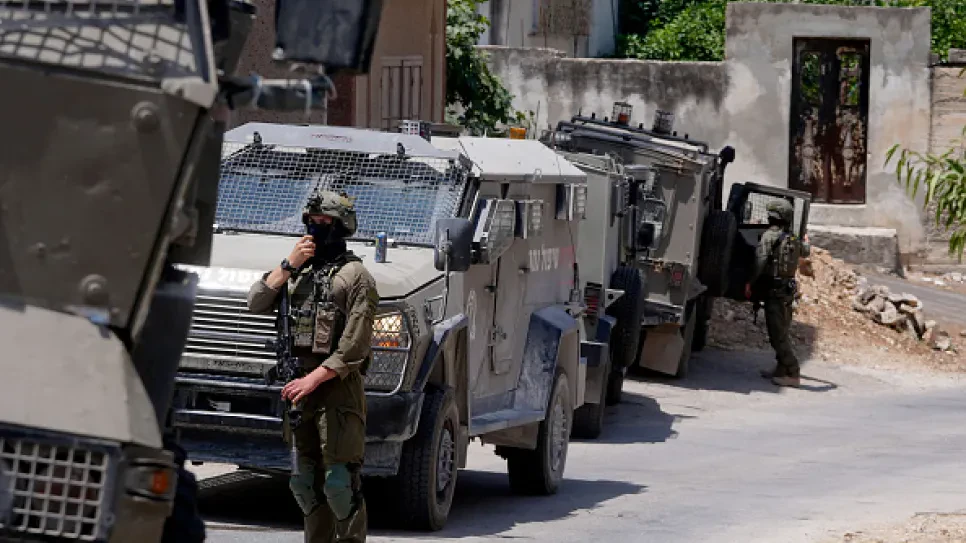
Israeli forces tightened restrictions around the West Bank city of Ramallah, closing roads and entrances to several towns and villages, the Palestinian news agency Wafa reported.

New MEE newsletter: Jerusalem Dispatch

Sign up to get the latest insights and analysis on Israel-Palestine, alongside Turkey Unpacked and other MEE newsletters

Local sources told Wafa that the entrance gate to Turmus Ayya, north of Ramallah, was closed and residents were “harassed”.

Wafa also reported that entrances to Aboud, Nabi Saleh, Atara and Taybeh were closed, while military checkpoints were set up at the entrances to Yabroud and Ein Sinyah. 

Smotrich, who is a leading advocate of expanding illegal Israeli settlements and extending Israeli sovereignty over the occupied West Bank, also defended his wider political agenda ahead of the 27 October elections.

“I don’t turn my back on my partners,” he said, rejecting the possibility of joining a unity government between rival political blocs.

Smotrich announces plan to judaise Negev and Galilee

Read More »

“I am part of the national camp, which shares a broad common denominator of Jewish identity, Zionism, love of the land, settlement and a distinct security doctrine.”

When asked about former Israeli military officer Ofer Winter, who is running a new political party, Smotrich accused him of taking an “irresponsible gamble” that could compromise Israel’s security.

“There is a 99.9 percent chance he won’t cross the threshold,” Smotrich said. “Anyone voting for him is throwing their vote in the trash, and that is what will bring the left to power, establish a Palestinian state and erode Israel’s Jewish identity.”

Amcha Yisrael, the group for which Winter is a spokesperson, rejected Smotrich’s assessment, accusing Israel’s political leadership of failing to win what it called a decisive victory in Gaza.

“Three years after October 7, there is no decisive victory in Gaza and no voluntary migration,” said the party. “The failed mindset persists.”

Smotrich also rejected the idea of working with Raam, an Arab-led party that has been part of Israeli coalition politics, saying in the interview that its leadership ultimately sought Israel’s destruction. 

Pressure in the West Bank 

Smotrich’s comments come as conditions deteriorate in the occupied West Bank. In an August report, the UN Office for the Coordination of Humanitarian Affairs (Ocha) said Israeli settlement outposts had increasingly encroached on areas of the West Bank over which the Palestinian Authority exercises limited administrative control.

Israeli settlement outposts, previously concentrated in Area C, were increasingly extending into Area B, the agency said, adding that violence and threats have been used to restrict Palestinian access to land. 

Israel displaces hundreds of Palestinians amid wave of demolitions in West Bank

Read More »

According to the Israeli organisation Peace Now, settlers have taken over more than 100,000 dunams (10,000 hectares) of land in Areas A and B of the West Bank.

As of July, the UN agency said some 850 Palestinians had been injured in settler attacks in the occupied West Bank since the start of 2026, with an average of more than three injuries a day attributed to settler attacks.

The UN says the West Bank is already criss-crossed by a vast array of Israeli checkpoints, gates, barriers and permit restrictions.

In December 2025, Ocha recorded 925 obstacles to movement, saying the system, along with the separation barrier, severely restricts Palestinian movement.

In July 2024, the International Court of Justice ruled that Israel’s continued presence in the occupied Palestinian territory is unlawful and that new settlement activity must cease. 

The court also found that measures almost entirely separating Israeli settlers from Palestinians in the West Bank and East Jerusalem violated the Convention on the Elimination of Racial Discrimination.

The UN has repeatedly stated that Israeli settlements in occupied Palestinian territory have no legal validity under international law. It has also warned that expansion of settlements and related measures risk further dispossession and displacement of Palestinians.


Iran stands firm on Hormuz plan after US rejection

September 27, 2026

AFP Published September 27, 2026

Add Dawn as a trusted source

Iran stood firm Sunday on its conditions for reopening the Strait of Hormuz, despite United States President Donald Trump’s rejection of the proposal that had created some optimism for breaking the Mideast war stalemate.

The waterway is key to the world’s energy supply and is now central to the conflict between Washington and Tehran, which was triggered nearly seven months ago with deadly strikes on Iran.

Iran’s plan called for a cessation of all hostilities in the Middle East, including in Lebanon, according to Foreign Minister Abbas Araghchi, and fulfilling conditions in the ceasefire deal that fell apart months ago.

That agreement, which dissolved during fighting over Hormuz, called for the release of frozen Iranian assets, the lifting of sanctions on Iranian oil and an end to the US naval blockade.

“Our conditions are clear, and any move toward reopening the Strait of Hormuz is contingent upon these conditions being fulfilled. We will not back down from them,” Araghchi said on Sunday, state broadcaster IRIB reported.

“We have never closed the door to diplomacy or negotiations, but at the same time, we have never backed down from our rights.”

But Trump said on Saturday that he rejected the truce deal.

“They want to make a deal where they open the Strait immediately because they’re losing so badly,” he told reporters. “They want to make a deal and I think that’s fine. I like making a deal too.”

Araghchi said on Sunday that the Iranians “saw the first reaction from the US president, but so far, nothing has been conveyed to us by the mediators”.

“We are waiting for the mediators to convey the definitive positions to us, and we will make a decision based on them,” the foreign minister added.

‘Tool for pressure’

Washington and Tehran signed a Pakistan-mediated memorandum of understanding (MoU) in June that aimed to end the war, to reopen the strait and to launch talks on Iran’s nuclear programme.

But the deal broke down shortly afterwards when Iran fired on commercial ships in Hormuz that it accused of deviating from its approved route through the waterway.

Iran requires ships to obtain authorisation before passage, citing security and sovereignty reasons.

Ships that refuse to comply are regularly targeted, while the United States sporadically bombs Iranian coastal areas in retaliation.

At the UN, Saudi Arabia’s Foreign Minister Faisal bin Farhan complained that the “international community has been absent” and is failing to live up to the responsibility to keep the Strait of Hormuz and the Bab al-Mandab open.

“The kingdom rejects any party’s use of these vital passages as a tool for pressure, threat, or harm to the interests of states,” he said, stressing the waterways’ importance to global energy security.

His Russian counterpart, Sergei Lavrov, told member states that “Russia, together with other responsible states, stands ready to constructively contribute to stabilising this strategically important region.”

In New York, Iranian President Masoud Pezeshkian met with UN Secretary-General Antonio Guterres, according to his office, and said: “Iran has not walked away from the negotiating table but, given past experiences, it no longer trusts the United States.”

Araghchi said at the UN: “Iran has conveyed to the United States, through Qatar, a concrete seven-day plan. If the necessary conditions are met, the strait can be reopened, and normal maritime passage restored within seven days.”

“The choice now rests with the United States. Iran does not accept coercion, threats or intimidation, and Iran will not surrender its sovereign rights under pressure,” he added.

Hossein Mohebi, a spokesman for Iran’s Revolutionary Guards, was quoted by Tasnim news agency as saying: “We will not cease punishing the US until Iran’s seven conditions are met.”

Mohebi had told AFP in an exclusive interview on Tuesday that ending hostilities in Yemen was also among Tehran’s demands.

Trump Threatens Cuba at UN General Assembly, Cuba Responds

September 26, 2026

US President Donald Trump gives his speech at the 81st session of the UN General Assembly, September 22, 2026. Photo: UN.

InternationalLatin America and ALBA-TCPNews

September 23, 2026, By Orinoco Tribune

US President Donald Trump gives his speech at the 81st session of the UN General Assembly, September 22, 2026. Photo: UN.

In his speech at the United Nations General Assembly, the president of the United States, Donald Trump, threatened Cuba, claiming that the country is under the highest level of pressure and that it will eventually fall.

In protest against Trump’s words, the Cuban delegation, led by Foreign Minister Bruno Rodríguez Parrilla, walked out of the room. Prior to the threats from the US president, which he often repeats, the president of Brazil, Luiz Inácio Lula da Silva, had expressed his condemnation of foreign interference in the region and criticized the measures imposed by the US against Cuba. Lula emphasized that the intensified blockade represents collective punishment against 10 million people.

Trump claimed that Cuba is a failed state, and backed up his claims by referring to the added pressure of the economic and energy blockade policy. “It is failing like never before, and it is going to fall,” the US president said in his usual bellicose tone. He also mentioned that US Secretary of State Marco Rubio is leading ongoing negotiations with the Cuban government, a claim that has been denied by Cuba.

In addition to his warlike tone against Cuba, the US president uttered warnings against Iran. Trump stated that he must decide between quickly annihilating Iran to supposedly prevent it from attacking other countries or allowing an agreement that favors the reconstruction of the country under Washington’s terms, although he toned down the bravado by adding that he expects to reach a pact after the US midterm elections. He also insisted that the Iranian government will never have a nuclear weapon, despite the fact that Iran has a declared policy of not making any nuclear weapons.

Earlier, upon his arrival at the UN headquarters in New York, Trump had an incident with the press, when he reproached a CNN reporter for covering his attendance, citing his ban on CNN.

Trump also boasted about the achievements of the US economy, calling it the envy of the world, although the country is experiencing high inflation, elevated fuel costs, and rising mortgage rates faced by the US population.

Cuba condemns Trump’s attacks
The Cuban government responded to Trump’s attacks by reaffirming its right to sovereignty and condemning the economic and social impact of the intensified US blockade.

The president of Cuba, Miguel Díaz-Canel, decried on social media that the characterization of Cuba as a threat has the objective of justifying the genocidal US economic war against the Cuban population.

Díaz-Canel stated that Trump’s resorting to lies reflects a refusal to accept the self-determination of the Cuban people and reaffirmed that the country will maintain the defense of its sovereignty, working to overcome US imperialist aggression. He added that the blockade is the real threat.

Similarly, Foreign Minister Bruno Rodríguez said that the US government is incapable of recognizing Cuba as an independent and fully sovereign nation.

Rodríguez dismissed Trump’s accusations as falsehoods and slander, insisting that Cuba does not pose a danger to the United States or any other country, while the current economic restrictions and energy blockade do threaten Cuba and the rest of the world.

“The blockade is an act of genocide and collective punishment. We are a country of peace and we deserve peace,” emphasized the foreign minister, adding that the blockade has been systematically denounced by the majority of the international community.

(Telesur) with Orinoco Tribune content

Translation: Orinoco Tribune

OT/SC/CD

Stop Mad King Donald’s Iran War: An Open Letter to Members of the US Congress

September 24, 2026

Stop Mad King Donald’s Iran War: An Open Letter to Members of the US Congress

The war with Iran is Trump’s folly but Congress’s disgrace for not stopping it.

Jeffrey D. Sachs

Sep 23, 2026 Common Dreams

Dear Members of Congress,

In truly deranged remarks to world leaders at the UN, Donald Trump declared that “I have a big decision to make,” whether to negotiate a deal with Iran or instead to “annihilate the Islamic Republic” and drive Iran “into hell with no chance of survival.”

RECOMMENDED…

U.S.-WASHINGTON, D.C.-TRUMP-ATTACK OF IRAN-SUSPENSION

‘We Are in a Constitutional Crisis’: Congress Urged to Sue Trump to End Iran War

Donald Trump speaks

‘Do I Blow the Entire Nation Up?’: Trump Says He’s in ‘Deciding Mode’ on Iran War

He posed it as his personal choice. The fact that the American people are dead set against Trump’s war means nothing. And as for the voters, he added that he gives “absolutely no credence” to the coming midterm elections in deciding on his actions and on Iran’s fate.

The President’s threat to annihilate a member state of the United Nations, delivered from the General Assembly podium, disgraced Trump in front of the world.

Nothing binds this President. He is not bound by law, the Constitution, the UN Charter, or public opinion at home and abroad. When asked at the start of the year whether he has any limits on his power, he said “Yeah, there is one thing. My own morality. My own mind. It’s the only thing that can stop me.”

Trump opened his speech with the 250th anniversary of the Declaration of Independence, hailing America’s freedom. The fact is that Trump’s authoritarianism far outdoes that of King George III, against whom the colonies rebelled. Among the founders’ indictments of Mad King George was that “He has affected to render the Military independent of and superior to the Civil power.” Yet our own mad king has decided that the survival of a whole civilization is in his hands alone.

Trump is emboldened in his contempt for Congress because the Republican members of Congress have abdicated their constitutional responsibilities, terrified of their own president, and forsaking their constituents for campaign lucre from AIPAC and the military-industrial complex.

The Constitution is unambiguous regarding Congress’s responsibility. Article I, Section 8 assigns Congress, not the President, the sole power to declare war. That is not a choice or an option. The Constitution doesn’t say that Congress can play dead and let the President declare war. The Framers made this choice deliberately, because they were explicitly rejecting the power of a king to take the nation to war.

In Federalist 69, Hamilton assured the public that the President’s war powers would be far less than the British monarch’s. Madison stated the principle plainly in a letter to Jefferson in 1798: “The constitution supposes, what the History of all Govts demonstrates, that the Ex. is the branch of power most interested in war, & most prone to it. It has accordingly with studied care vested the question of war in the Legislature.”

The founders’ careful design has been overturned because of the unconstitutional subservience of the Republican members of Congress to Trump and to the military-industrial-digital complex. And yes, under Democratic presidents, most Democratic members of Congress also looked the other way when those presidents chose to go to war.

The war with Iran is Trump’s folly but Congress’s disgrace for not stopping it. It is a war without a purpose that has created mass suffering in Iran, tens of billions of dollars of direct outlays, and staggering damage to American military bases in eight countries of the Middle East. The closure of the Strait of Hormuz has sent world and American prices soaring for oil, gas, fertilizers, and more. And the world has duly noted that Iran can hold its own against US aggression, albeit at great sacrifice to the people of Iran and the region.

America’s much vaunted AI battlefield has been exposed in the most horrifying way. On the first day of the war, an American missile struck the girls’ elementary school there, killing more than 150 people, most of them girls aged seven to twelve, and the military’s own inquiry reportedly found that overreliance on artificial intelligence contributed to the targeting. Trump blamed “Iran or somebody else,” and seven months later the administration has offered no findings, no apology and no compensation to the families.

The President’s threat to annihilate a member state of the United Nations, delivered from the General Assembly podium, disgraced Trump in front of the world. It also violated Article 2(4) of the UN Charter, which prohibits even the threat of force against another state. Nearly all the world stands aghast.

I write to you because you cannot simply walk away from Trump’s recklessness, shaking your heads silently. You have a job to do, so do it. The craven Republican Party has to find even a minimal level of guts to tell Trump, “No, you do not have the power to destroy Iran. Any war with Iran depends on us, and we don’t support you and our constituents want this war to stop.” A clear majority of Americans oppose this war, and poll after poll shows that the opposition to the war is growing. A few Republicans have found that courage. Last week three more Republicans broke ranks to support ending the war. Their colleagues should follow.

Many of you receive campaign contributions from military contractors and technology companies deeply involved in the war. Many of you take money from AIPAC, which champions the war that Netanyahu did so much to help launch. This has to stop, as it is a dereliction of your constitutional duty and a violation of your oath.

Congress holds the power of the purse. The fiscal year ends on September 30, and every bill that funds the Pentagon is your opportunity to prohibit funds for unauthorized offensive operations against Iran.

The right course for the US is simple. Congress should cut off funding, and the US should stop further attacks and go home. We need no agreement with Iran or anyone else to stop the war that we started. By ending the war you will immediately restore some sanity and safety to the world energy markets, food supplies, and prices faced by Americans and others around the world.

How America has declined from the glorious moment when John F. Kennedy stood at the same podium at the UN on September 20, 1963, after having negotiated the Partial Nuclear Test Ban Treaty with the Soviet Union. He told the assembled leaders that the treaty can be a lever, and Archimedes, in explaining the principles of the lever, was said to have declared to his friends: “Give me a place where I can stand—and I shall move the world.” My fellow inhabitants of this planet: Let us take our stand here in this Assembly of nations. And let us see if we, in our own time, can move the world to a just and lasting peace.

Members of Congress, to save our nation’s honor and our Constitution, you must do your duty to stop this war, and stop Trump’s brazen, destructive, and unconstitutional grab for power.

Respectfully,

Jeffrey D. Sachs

University Professor, Columbia University

An Urgent Message From Our Co-Founder


Dear Common Dreams reader,

It’s been nearly 30 years since I co-founded Common Dreams with my late wife, Lina Newhouser. We had the radical notion that journalism should serve the public good, not corporate profits.

It was clear to us from the outset what it would take to build such a project. No paid advertisements. No corporate sponsors. No millionaire publisher telling us what to think or do.

Many people said we wouldn’t last a year, but we proved those doubters wrong.

Together with a tremendous team of journalists and dedicated staff, we built an independent media outlet free from the constraints of profits and corporate control. Our mission has always been simple: To inform. To inspire. To ignite change for the common good.

Building Common Dreams was not easy. Our survival was never guaranteed. When you take on the most powerful forces—Wall Street greed, fossil fuel industry destruction, Big Tech lobbyists, and uber-rich oligarchs who have spent billions upon billions rigging the economy and democracy in their favor—the only bulwark you have is supporters who believe in your work.

But here’s the urgent message from me today. It’s never been this bad out there. And it’s never been this hard to keep us going. At the very moment Common Dreams is most needed, the threats we face are intensifying. We need your support now more than ever.

We don’t accept corporate advertising and never will. We don’t have a paywall because we don’t think people should be blocked from critical news based on their ability to pay. Everything we do is funded by the donations of readers like you.

When everyone does the little they can afford, we are strong. But if that support retreats or dries up, so do we.

Will you donate now to make sure Common Dreams not only survives but thrives?

—Craig Brown, Co-founder
about:blank

about:blank

Our work is licensed under Creative Commons (CC BY-NC-ND 3.0). Feel free to republish and share widely.

Jeffrey D. Sachs

Jeffrey D. Sachs is a University Professor and Director of the Center for Sustainable Development at Columbia University, where he directed The Earth Institute from 2002 until 2016. He is also President of the UN Sustainable Development Solutions Network and a commissioner of the UN Broadband Commission for Development. He has been advisor to three United Nations Secretaries-General, and currently serves as an SDG Advocate under Secretary-General Antonio Guterres. Sachs is the author, most recently, of “A New Foreign Policy: Beyond American Exceptionalism” (2020). Other books include: “Building the New American Economy: Smart, Fair, and Sustainable” (2017) and “The Age of Sustainable Development,” (2015) with Ban Ki-moon.

Full Bio >

Join the Conversation

Poll: Majority of US Voters Support Impeaching Hegseth Over Iran War

September 23, 2026

by Dave DeCamp | September 22, 2026 at 1:20 pm ET | Iran

A new poll from The Economist/YouGov found that a majority of registered US voters support impeaching US Secretary of War Pete Hegseth, after Rep. Thomas Massie (R-KY) of Kentucky introduced a resolution to remove him.

The poll, conducted from September 18 to September 21, found that 51% of registered voters surveyed support impeaching Hegseth for starting the war with Iran without congressional authorization, while 34% oppose it. Support for impeachment rises among likely voters to 54%, and opposition rises to 35%.

“This is why [House Speaker Mike Johnson] adjourned Congress to avoid the vote and why the President isn’t defending [Hegseth],” Massie wrote on X in response to the results.

Hegseth before the Senate Appropriations Committee on July 21, 2026 (Pentagon photo)

Massie introduced the articles of impeachment on September 15, and because it was a privileged resolution, a vote had to happen within two days. But Johnson canceled the House’s voting session for September 17, sending lawmakers home early for a long recess that pushes the impeachment vote until after midterm elections.

Impeachment is much more popular among Democrats, with the YouGov poll showing 77% supporting it compared to just 22% of Republicans. But Massie only needs a few Republican votes to pass the impeachment resolution through the House, and seven House Republicans supported the latest War Powers Resolution calling for an end to the war with Iran, signaling that he may get enough.

While the poll asked only about Hegseth’s role in the Iran war, Massie’s eight articles of impeachment also address how Hegseth has ignored US laws designed to mitigate civilian casualties, his role in extrajudicial executions at sea (strikes on alleged drug-running boats), the attack on Venezuela to abduct President Maduro, the bombing campaign in Yemen last year, and his efforts to chill free speech.

If you liked this article, please support Antiwar.com.
We are 100% reader-supported.

Dave DeCamp is the news editor of Antiwar.com, follow him on Twitter @decampdave.

Join the Discussion!

We welcome thoughtful and respectful comments. Hateful language, illegal content, or attacks against Antiwar.com will be removed.

For more details, please see our Comment Policy.

Trump’s threat to “annihilate” Iran: The criminalization of imperialist foreign policy

September 23, 2026
Andre Damon@Andre__Damon, WSWS, 23 Sep 2026

President Donald Trump speaks to the United Nations General Assembly, Tuesday, Sept. 22, 2026, at the UN headquarters. [AP Photo/Julia Demaree Nikhinson]

US President Donald Trump told the United Nations General Assembly on Tuesday that he is deciding whether to “annihilate the Islamic Republic” of Iran and “drive them into hell with no chance of survival.”

The American president asked: “Do I annihilate the Islamic Republic and do it quickly, never giving them a chance to kill and destroy people and countries again?”

Trump’s murderous language marks a new stage in the criminalization of imperialist foreign policy amid the eruption of global war. It is without precedent in modern politics outside the discourse of Adolf Hitler’s regime, which waged a Vernichtungskrieg, a war of annihilation, against the Soviet Union.

Unlike Trump, however, Hitler did not announce his war of extermination in public. He gave the order in private, to his generals. On March 30, 1941, in a closed meeting with some 200 senior officers, he told them the coming invasion would be a Vernichtungskampf, “a war of extermination,” according to the diary of his army chief of staff, Franz Halder.

The extermination of the population of Iran, which has resisted Trump’s efforts to subjugate the country through war, is in fact being actively discussed at the White House. The journalist Seymour Hersh reported on June 10 that Trump had raised using nuclear weapons against Iran, a country of 93 million people, in a secret meeting with his senior staff.

Trump’s criminal war of aggression against Iran had killed at least 3,468 people and wounded more than 26,500 by June 10, according to Iran’s Health Ministry. Last week, a UN fact-finding mission found “reasonable grounds to believe that the United States committed war crimes,” citing the US missile attack on February 28 on an elementary school in Minab that killed more than 150 people, 120 of them children.

The war against Iran is one component of the US-Israeli onslaught throughout the Middle East, whose highest expression is the genocide in Gaza, which has killed 73,919 Palestinians, according to Gaza’s Health Ministry.

The threat against Iran was one item in a series. Trump boasted that the US military had penetrated “deep into the Venezuelan capital” and “arrested” Maduro, and that the reward was “the largest oil deal in history,” 65 billion barrels. “To the victor belong the spoils,” Trump declared. Cuba “is an absolutely failed state … and it will fall.” Greenland is to pass under the “permanent control” of the United States, with two “very major military bases.”

During Trump’s speech, only the delegations of Iran and Cuba, whose government Trump threatened to overthrow, left the hall in protest. The representatives of the European imperialist powers, for all their constant talk of democracy and human rights, sat there and did nothing. Khalilur Rahman, the Bangladeshi foreign minister who presides over the Assembly, thanked the American president.

The UN Charter was signed in San Francisco on June 26, 1945, seven weeks after the surrender of Nazi Germany, “to save succeeding generations from the scourge of war, which twice in our lifetime has brought untold sorrow to mankind.”

Its Article 2 binds every member to “refrain in their international relations from the threat or use of force against the territorial integrity or political independence of any state.” Trump’s speech was such a threat, made in the building constructed to outlaw it by the leader of a state almost seven months into an illegal war of aggression. Trump’s speech itself is indictable as a violation of international law.

The European counterpoint to Trump was given Tuesday by French President Emmanuel Macron, who spoke of “the return of imperialism, of arrogance, the return of unrestrained force which knows no rules … A world in which some believe that they can undermine the international order so as to push their borders outwards.”

He added, “War crimes have been industrialized. We’ve seen the destruction of civilian infrastructure, human rights violations.”

But while some commentators took his remarks as a veiled critique of Trump, he never named the American president. Rather, his speech was a vocal and explicit denunciation of Russia and a declaration of intent to continue, alongside Trump, to fund and arm Ukraine.

Macron declared that “Russia has been waging a cruel war on civilians. It’s been occupying the territory of a sovereign state. France will continue providing unstinting support” for Ukraine in its war against Russia.

In Macron’s view, the appropriate response to Russia’s “imperialism” and “war crimes” is for the European imperialist powers to intensify their war against Russia. Macron made no effort to square his claims that the war against Russia is a war for democracy with the fact that Trump, his ally in that war, had just threatened to exterminate the population of an entire country.

In 1920 Lenin described the League of Nations, the UN’s predecessor, as “a league of mad dogs who are snatching each other’s bones.” The phrase is perhaps somewhat quaint. The UN General Assembly of 2026 is an active planning center for war.

After meeting Ukrainian President Volodymyr Zelensky the same day, Macron announced a contract to supply Ukraine with radars and air-defense missiles, the Kyiv Independent reported Tuesday. Trump, for his part, also met Zelensky on Tuesday and confirmed that the manufacture of Patriot air-defense missiles in Ukraine was under discussion.

As the Trump-Zelensky meeting opened, a British reporter told Trump that “a lot of people in the UK are very worried about the mood music from the UK and other European leaders about the inevitability of direct conflict between us and Russia,” and asked: “Can you stop that happening?” Trump refused to give a serious answer.

In fact, Trump’s blood-curdling threats against Iran, and the fact that they provoked no serious protest among the leaders of the imperialist powers, demonstrate the extent to which global war, and its corollary, the extermination of entire populations, has been normalized by world capitalism.

The Democrats are not an alternative to this warmongering. Just days earlier, they had given Trump a blank check to escalate the war not only against Russia but against Iran. On September 16, 58 House Democrats voted for the Lindsey O. Graham Sanctioning Russia and Iran Act, which authorizes the president to tax imports from China, India and the other largest purchasers of Russian oil at rates as high as 100 percent and extends for five years the sanctions on Iran’s energy and arms sectors. Thirty-six of the 45 Senate Democrats had voted for it on August 7.

House Minority Leader Hakeem Jeffries voted no because, he said, the bill did not go far enough against Russia: “You have to confront the bully, not appease the bully.” A Democratic majority in Congress after November 3 would take the war further and faster.

The day before his speech, Trump met New York Mayor Zohran Mamdani, a member of the Democratic Socialists of America (DSA), at Gracie Mansion. Mamdani said nothing about the war and told reporters: “We appreciate the president’s commitment to the city.”

Trump began his speech by boasting of “the golden age of America,” declaring, “The entire world is being lifted by the wealth, strength, spirit, and momentum of a newly energized and a very powerful United States of America.”

In fact, Trump presides over a social order and political system that is rotting on its feet—what Trotsky described on the eve of World War II as “the death agony of capitalism.” The same crisis is producing its opposite: the growth of social opposition, mass protests and global class struggle.

The opposition to Trump’s criminal warmongering will come neither from the European imperialist powers nor from the Democrats and their accomplices in the DSA. It will come from the international working class, armed with the program of international socialism.

Majority of Democratic Voters Want to Prosecute Both Biden and Trump Administration Officials Over Gaza

September 23, 2026

Pro-Palestinian protest in Washington DC

Protesters gathered in front of the US State Department demanding an immediate ceasefire in Gaza, an end to the US-backed Israeli military operations, and unrestricted humanitarian aid access on July 22, 2025, in Washington, DC.

(Photo by Yasin Ozturk/Anadolu via Getty Images)

The vast majority of Democratic voters believe Israel has committed a genocide in Gaza and want its supporters in both parties to face consequences.

Stephen Prager, Common Dreams, Sep 22, 2026

The majority of Democratic voters believe Israel has committed genocide in Gaza for the past three years. And they want the American politicians in both parties who supported it to pay.

In a poll released on Monday by the Center for Strategic Politics and commissioned by the magazine Liberal Currents, 683 Democratic voters were asked whether the next Democratic administration should “pursue criminal prosecution of members of the Trump and Biden administrations for actions taken related to Israel’s genocide in Gaza.”

RECOMMENDED…

World Leaders Speak At The 79th Session Of The United Nations General Assembly In New York

‘Drop the Genocide 20’: Activists Launch Campaign to Exclude Officials Behind Biden Gaza Policy From Democratic Politics

HELP Markup

‘Incredible Story of Corruption’: Bombshell Report Puts Susan Collins at Center of Massive Bribery Scheme

More than half, 57%, of the Democrats surveyed answered “yes,” while only 22% answered “no” and another 22% said they “don’t know.”

Self-described “socialists” and “progressives” were most bullish on Gaza-focused prosecutions. But so were 52% of “liberals” and even 48% of Democrats who called themselves “moderate” or “conservative.”

It is one of several questions in the poll about a hypothetical Democratic administration prosecuting its predecessors over policies considered deadly and destructive.

About two-thirds, 66%, said they wanted to see Trump administration officials prosecuted for actions taken during its aggressive war with Iran, which has led to the deaths of more than 1,700 civilians and wrought economic turmoil.

Nearly three-quarters, 72%, believed Trump officials should face similar accountability for their campaign of extrajudicial strikes on boats in the Caribbean and Pacific, which have killed more than 234 people in what a top United Nations official recently said may constitute “crimes against humanity.”

And more than three-quarters said they wanted to see Trump officials face legal penalties for actions committed by US Immigration and Customs Enforcement (ICE) and Customs and Border Protection (CBP), which have waged a violent mass deportation campaign that has entailed numerous documented due process violations, instances of racial profiling, and several shootings of immigrants and US citizens without clear justification.

The question about Gaza is the only one in the survey in which Democrats were asked about the prospect of prosecuting members of their own party as well as Republicans. And while fewer Democrats ultimately answered yes, it indicates that their ire toward the American politicians supporting the genocide transcends party loyalty.

The poll results come as some activists pursue accountability for the Biden administration in other ways. Last week, organizers launched a campaign to pressure universities and other prominent institutions to cut ties with what they called the “Genocide 20.”

These are officials like former Secretary of State Tony Blinken and former National Security Adviser Jake Sullivan who crafted and defended the administration’s policy of unrestricted military aid for Israel despite mounting evidence that it was killing scores of civilians and enacting a campaign of starvation against the people of Gaza.

The United States provided Israel with at least $17.9 billion in military assistance between October 7, 2023, and the end of former President Joe Biden’s term in January 2025, according to Brown University’s Costs of War project. During that period, more than 47,000 Palestinians were confirmed killed, according to the Gaza Ministry of Health.

Since President Donald Trump returned to office, the US has continued to provide Israel with billions of dollars in military assistance, including $3.8 billion in regular annual military aid, while the Trump administration has approved billions more in arms sales and expedited weapons deliveries. The death toll has risen to nearly 74,000, according to official figures, but independent experts have suggested this may be a significant undercount.

According to Monday’s poll, more than 4 in 5 Democrats said that “foreign policy (including Israel and Iran)” is important to them in deciding which candidates to support, compared with just 4% who said it is not.

Foreign policy has been a critical dividing line in several recent Democratic primaries, in which voters have revolted against candidates backed by the American Israel Public Affairs Committee (AIPAC).

This includes Democratic Michigan Congresswoman Haley Stevens, who was defeated by Abdul El-Sayed in a contest for the US Senate despite her more than $30 million in backing from AIPAC, which helped to turn it into the most expensive Democratic primary ever.

AIPAC-backed House candidates have similarly suffered high-profile defeats at the hands of progressives calling to cut off US funding for Israel. Some of the victors include Chris Rabb in Pennsylvania, Brad Lander and Darializa Avila Chevalier in New York, and Aisha Wahab, who won a special election in California.

An Urgent Message From Our Co-Founder


Dear Common Dreams reader,

It’s been nearly 30 years since I co-founded Common Dreams with my late wife, Lina Newhouser. We had the radical notion that journalism should serve the public good, not corporate profits.

It was clear to us from the outset what it would take to build such a project. No paid advertisements. No corporate sponsors. No millionaire publisher telling us what to think or do.

Many people said we wouldn’t last a year, but we proved those doubters wrong.

Together with a tremendous team of journalists and dedicated staff, we built an independent media outlet free from the constraints of profits and corporate control. Our mission has always been simple: To inform. To inspire. To ignite change for the common good.

Building Common Dreams was not easy. Our survival was never guaranteed. When you take on the most powerful forces—Wall Street greed, fossil fuel industry destruction, Big Tech lobbyists, and uber-rich oligarchs who have spent billions upon billions rigging the economy and democracy in their favor—the only bulwark you have is supporters who believe in your work.

But here’s the urgent message from me today. It’s never been this bad out there. And it’s never been this hard to keep us going. At the very moment Common Dreams is most needed, the threats we face are intensifying. We need your support now more than ever.

We don’t accept corporate advertising and never will. We don’t have a paywall because we don’t think people should be blocked from critical news based on their ability to pay. Everything we do is funded by the donations of readers like you.

When everyone does the little they can afford, we are strong. But if that support retreats or dries up, so do we.

Will you donate now to make sure Common Dreams not only survives but thrives?

—Craig Brown, Co-founder

Cuba, Gaza, and the human cost of imperial thirst

September 22, 2026

Havana, the author working in darkness. foto: Bill Hackwell Havana, the author working in darkness. (Foto: Bill Hackwell)

Empire, Human Rights, WarAmericas, Cuba, Gaza, Israel, Middle East, Palestine, United StatesNewswireBlockade Gaza, Blockade of Cuba, Israel’s war on Gaza, Sanctions

In Gaza, thousands of children have been killed amid the genocide that’s being imposed by Israel with total impunity. Thousands of them are unaccounted for and buried beneath the rubble. In Cuba, millions of people have survived for years amid blackouts, shortages, difficulties accessing medicines, fuel scarcity, and a profound economic crisis imposed upon them by the United States.

These are different realities, but there is a question that connects them. One that should challenge the conscience of the international community: How much civilian suffering is the world willing to tolerate before taking action? It is an important question as the 81st session of the United Nations General Assembly approaches.

In Cuba, the government consistently denounces that U.S. sanctions and restrictions are worsening an already critical situation.

When fuel is scarce, the crisis ceases to be an abstraction. It enters people’s homes. It enters the room where a child tries to do homework during a blackout. It enters the home where a mother fans her baby because the heat becomes unbearable.

It also enters the kitchen, where food begins to spoil; the hospital, where a patient needs medicine that does not arrive; and the life of a worker who does not know how they will get to work because public transportation is nearly paralyzed.

An Island in the Dark

In mid-September, Cuban Foreign Minister Bruno Rodríguez Parrilla presented a report on the damage caused by the U.S. blockade between March 2025 and February 2026.

Rodríguez described months in which many families have lived with barely two or three hours of electricity a day, or even less.

Behind those hours of blackouts lies much more than an energy statistic: there is a child whose sleep is interrupted, a grandfather left without television or radio, a student trying to concentrate without light, and a mother struggling to find a way to preserve food.

Blackouts disrupt the entire life of a family. The Cuban government maintains that the lack of fuel is one of the main factors behind the energy crisis and denounces that U.S. measures make it difficult to obtain the fuel and diesel needed for electricity generation.

It also points out that the restrictions affect the acquisition of parts and equipment for thermoelectric power plants and hinder the expansion of renewable energy sources such as solar power.

When a Sanction Reaches a Hospital Bed

One of the most painful dimensions of any sanctions policy is the one that does not immediately appear in the headlines: the way it ultimately affects a patient.

Rodríguez stated that thousands of containers have been prevented from reaching Cuba because of the pressure and threats faced by shipping companies by the U.S. government. The figure cited by the foreign minister exceeds 7,000 containers.

To someone observing the situation from afar, a container may simply be a shipping unit.

For a family, it may contain medicine. For a hospital, it may mean essential supplies. For a patient, it may represent the difference between receiving treatment on time and continuing to wait. And when that patient is a child, that wait can become unbearable.

They Are Children, Not Numbers

Palestinian children in the rubble of their community, foto: UN

Palestinian children in the rubble of their community. (Foto: UN)

Referring to the increase in infant mortality between 2018 and 2025, the Cuban foreign minister made a statement that should transcend any political debate:

They are children, not numbers.

The statement matters because behind every mortality statistic there is a life that ended and a family that will carry that loss forever.

The tragedy in Gaza and the Cuban crisis belong to different historical and political contexts; but they converge at their roots in a history of struggle and resistance against the imperial thirst of powerful nations.

The international community has condemned, debated, and voted for years on the U.S. blockade against Cuba. At the same time, the great powers have repeatedly demonstrated that their international decisions are shaped by political, economic, and strategic interests. And the same happens with the Palestinian cause and their constant outcry for their international recognition as a sovereign state.

Meanwhile, families continue to live with the consequences. Both in Gaza and Cuba, a child dies everyday due to bombs or invisible sanctions. May the deaths of those children never become something to which we grow indifferent to.

Monthly Review does not necessarily adhere to all of the views conveyed in articles republished at MR Online. Our goal is to share a variety of left perspectives that we think our readers will find interesting or useful. —Eds.

The Arab States and the US-Israeli War on Iran

September 21, 2026

September 20, 2026

Share this:

Ali Abootalebi Informed Comment

The Arab states have long suffered from weak political legitimacy and ineffective governance. Authoritarian rule remains pervasive. According to Freedom House, no Arab country is currently classified as “Free,” while Jordan, Lebanon, and Comoros are rated “Partly Free.” Kuwait, following the suspension of its elected parliament in 2024, is now classified as “Not Free.”

The Arab world’s contribution to global scientific and technological development also remains below its potential. Although UNESCO reports that scientific publications from Arab states increased by 64 percent between 2015 and 2019, research-and-development spending remains comparatively low, and much of the region continues to depend heavily on imported technology.

These political and developmental weaknesses cannot be explained by domestic authoritarianism alone. External powers have profoundly shaped state-society relations in the Middle East.

Colonialism, military intervention, foreign-sponsored coups, economic dependence, and patron-client security relationships have influenced both the distribution of political power and the capacity of states to pursue independent national development.

The Persian Gulf monarchies’ longstanding military dependence on the United States represents

perhaps the clearest contemporary example.

From the Sykes-Picot Agreement and Balfour Declaration through the Cold War and the Arab-Israeli wars, outside powers repeatedly shaped the regional order. After the 1990–91 Persian Gulf War, the expansion of American military bases further institutionalized the security relationship between Washington and the Gulf Cooperation Council states.

The post-Cold War period did not bring an end to external military intervention. The United States has intervened militarily in Iraq, Libya, Syria, Somalia and Yemen, among other countries, while Israel has repeatedly conducted major military operations in Lebanon and Gaza. The Military Intervention Project at Tufts University identifies almost 400 U.S. military interventions since 1776, with more than one-quarter occurring after the end of the Cold War.

The Iran War Changes the Equation

The ongoing U.S.-Israeli war against Iran exposes the limitations of the regional security system more dramatically than previous conflicts.

For decades, Washington’s Arab allies relied on American military superiority as the ultimate guarantee against external threats. Iran’s ability during the present war to impose substantial costs on American military installations has complicated that assumption.

A recent Pentagon inspector-general assessment found that Iranian strikes damaged or destroyed hundreds of structures at U.S. facilities across the Middle East and destroyed numerous American aircraft and drones. Meanwhile, the Congressional Budget Office estimated that direct

U.S. Defense Department costs had already exceeded $38 billion by August 2026, with potentially billions more being spent each month if the conflict continues.

The lesson for the Persian Gulf Arab states is not that Iran poses no threat. Tehran has supported armed non-state organizations, including Hezbollah, Hamas, and the Houthis, and Arab governments have legitimate concerns about Iranian power and regional ambitions.

But treating Iran exclusively as an enemy has not produced regional security either.

Iran is a large state of roughly 90 million people occupying one side of the Persian Gulf and possessing substantial military capabilities, energy resources, and geopolitical influence. No durable Persian Gulf security system can simply exclude it.

The war therefore creates an opportunity for the Gulf Arab states to reconsider their overwhelming security dependence on the United States and move toward a regional system in which neighboring states assume greater responsibility for their own collective security.

There are already signs of movement in this direction. At the 166th ministerial session of the Arab League Council in September 2026, Egyptian Foreign Minister Badr Abdelatty called for comprehensive Arab security arrangements involving greater defense coordination, crisis-response mechanisms, and implementation procedures. He proposed building on the 1950 Arab Treaty of Joint Defence while respecting the sovereignty of individual Arab states.

That proposal is important. But an exclusively Arab security architecture is insufficient.

From Arab Security to Regional Security

What the Persian Gulf ultimately requires is a regional, rather than merely Arab, security arrangement incorporating both the Gulf Cooperation Council states and Iran.

There are precedents for adversarial states negotiating institutional frameworks around shared interests. In August 2018, after two decades of negotiations, Azerbaijan, Iran, Kazakhstan, Russia, and Turkmenistan signed the Convention on the Legal Status of the Caspian Sea. The agreement did not resolve every dispute among the five governments, but it demonstrated that states with conflicting interests could nevertheless construct rules governing security, sovereignty, resources, and economic cooperation.

The same logic should apply to the Persian Gulf.

The GCC states and Iran share an overwhelming interest in avoiding perpetual warfare. China, Russia, India, Pakistan, Europe, and the United States likewise have enormous stakes in the stability of Gulf energy production and international shipping.

The institutional challenge is therefore to transform these overlapping interests into a security framework capable of restraining individual states—including Iran—from threatening their neighbors while simultaneously reducing incentives for external military domination.

In a 2013 study coauthored with Stephen Hill, I proposed a three-tiered diplomatic approach toward U.S.-Iranian rapprochement and the eventual establishment of a Persian Gulf Security Alliance (PGSA). The basic logic of that proposal remains relevant.

A PGSA could bring together Iran, the GCC states, and the United States around common security interests. China, Russia, India, and Pakistan could participate in negotiated roles as well. Their inclusion would help prevent such an organization from becoming—or being perceived as—another Western military alliance directed against Iran, China, or Russia.

Such an arrangement would not require Gulf states to trust Iran, nor Iran to trust the United States. Successful security institutions rarely begin with trust. They create procedures through which states possessing competing interests can communicate, negotiate, monitor commitments, and gradually reduce the danger of miscalculation.

The Persian Gulf at a Crossroads

The strategic environment of West Asia has changed dramatically since October 2023 and even more sharply since the outbreak of direct warfare involving Iran.

Iran cannot realistically be removed from the regional balance of power. Tehran considers recognition of its sovereignty, its civilian nuclear program, its missile capabilities, and an end to what it views as a continuing American-Western policy of coercion to be fundamental national-security issues. Washington and the Arab Gulf states, meanwhile, have their own security concerns about Iran that any negotiated regional architecture would have to address.


Doha, Qatar. © 2018 Juan Cole.

A regional security organization would also serve American interests. As Washington increasingly focuses strategic resources on competition with China and Russia, participation in an inclusive Persian Gulf arrangement could preserve an American role in regional security without requiring perpetual military primacy or exclusive reliance on bilateral patron-client relationships.

For the Arab Gulf states, the stakes are even greater.

They face the difficult transition from oil-dependent rentier economies, pressures for more responsive governance, dependence on foreign labor, limited domestic industrial and agricultural capacity, rapidly growing technological demands, and the transformative—and still uncertain—effects of artificial intelligence.

Perpetual regional warfare makes confronting these challenges vastly more difficult.

The current war should therefore be understood not simply as another episode in the long confrontation between Iran, Israel, and the United States. It should force a larger reconsideration of the political and security architecture of the Persian Gulf.

For decades, Gulf security has rested primarily on American military power and bilateral protection arrangements. The present conflict demonstrates the vulnerabilities of that system.

The alternative is neither Iranian domination nor American withdrawal. It is the gradual construction of a regional security framework in which Arab states, Iran, and major international stakeholders accept institutional restraints and recognize that their long-term security is ultimately interdependent.

The Persian Gulf states are at a crossroads. Another generation of militarization, intervention, and regional confrontation is possible. But so is a different security order built around diplomacy, regional responsibility, and negotiated coexistence.

The latter will be difficult to construct.

The alternative may prove considerably more costly.

Subscribe

Editor’s Note: At a moment when the once vaunted model of responsible journalism is overwhelmingly the play thing of self-serving billionaires and their corporate scribes, alternatives of integrity are desperately needed, and ScheerPost is one of them. Please support our independent journalism by contributing to our online donation platform, Network for Good, or send a check to our new PO Box. We can’t thank you enough, and promise to keep bringing you this kind of vital news.

Donate Online

Send a Check

You can also make a donation to our PayPal or subscribe to our Patreon.

Please share this story and help us grow our network!

Israeli army seals last road into West Bank village, trapping 47 Palestinian families

September 20, 2026

Residents say a trench dug across the final route into Khirbet Ras al-Ahmar seeks to forcibly displace the entire community

News Desk., The Cradle, SEP 19, 2026

(Photo credit: Issam Rimawi/Anadolu)

On 19 September, Israeli occupation forces trenched over the last remaining road into the Palestinian village of Khirbet Ras al-Ahmar, southeast of Tubas in the northern occupied West Bank, leaving 47 Palestinian families under total siege.

The trench cut off the last remaining route to the village, a single rough path only suitable for livestock and farm tractors, after the Israeli military had spent over two months blocking all other roads, according to resident Thaer Basharat.

Basharat said the stranglehold on the village has been tightening for roughly three years, and the latest closure has turned it into a “cage” hemmed in by trenches, walls, and military zones.

“The 47 families in the village rely on livestock farming and are now unable to bring in their basic necessities or sheep feed,” he said. 

Basharat said roughly 90 percent of the approximately 360,000 dunams that once served as grazing land for the village’s herders have been seized or declared off-limits, leaving its farmers in dire straits.

“The Israeli pressure aims to forcibly displace the entire community from the village,” he said.

The village’s enclosure comes as Israel presses ahead with the “Crimson Thread,” a military barrier of patrol roads, trenches, and earth embankments that wall off the eastern flank of the occupied West Bank, as part of its broader campaign of ethnic cleansing and forced displacement of Palestinians.

In August, Palestinian news agency WAFA reported that Israeli forces filled in three artesian wells in Ras al-Ahmar, wrecked about 300 meters of water pipeline, and demolished three livestock shelters, further strangling a community whose survival depends on water and grazing for its herds. 

Israeli army and settler pogroms against Palestinians and their property have escalated across the occupied West Bank since the start of Israel’s genocide in Gaza in October 2023.

Israeli War Minister Israel Katz has threatened to unleash an “all-out war” on the occupied West Bank, targeting not only resistance factions but also the Palestinian Authority (PA), its senior officials, and its affiliated bodies. 

Katz said he and Prime Minister Benjamin Netanyahu had ordered the Israeli military to prepare the campaign should PA security forces launch, or be about to launch, an attack similar to 7 October, vowing to “quickly bring about their complete defeat.”

Since the start of 2025, the Israeli army has forcibly displaced tens of thousands of Palestinians from West Bank refugee camps and demolished hundreds of homes, while illegal settlements expanded rapidly under Israeli government legislation as part of Israel’s campaign of annexation of the occupied territory.