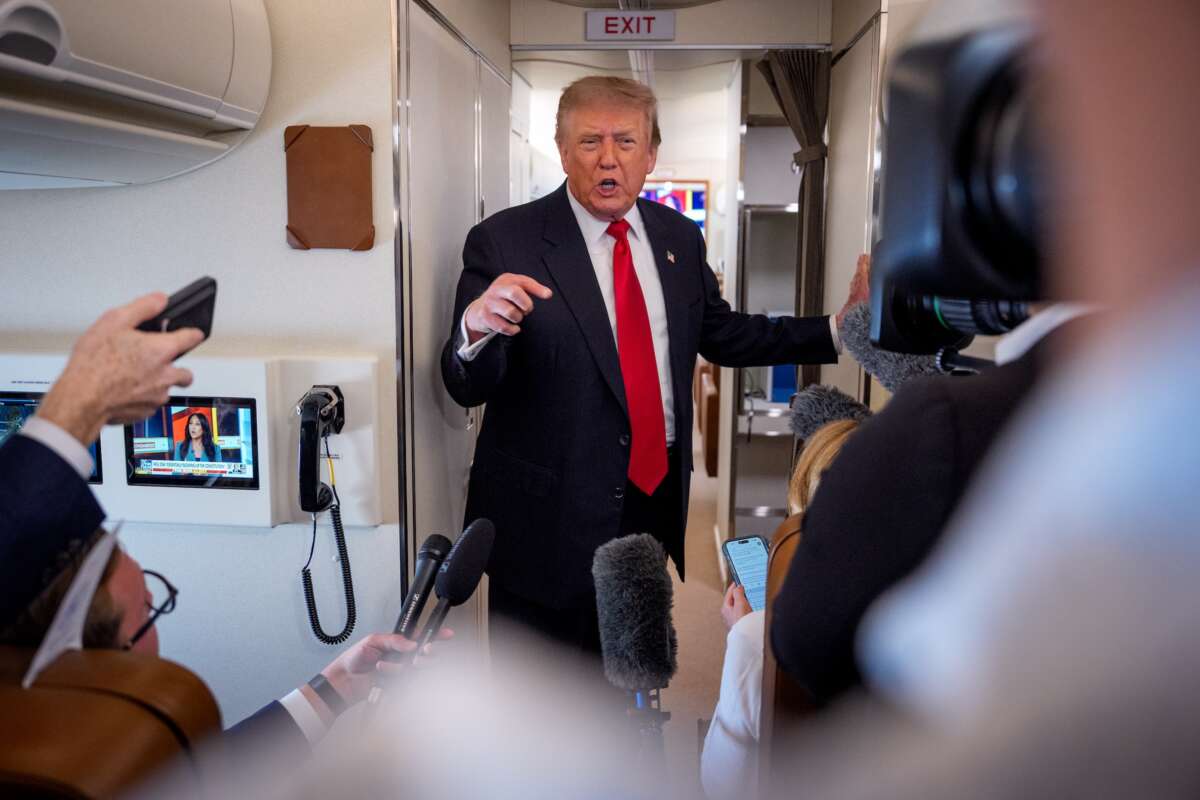
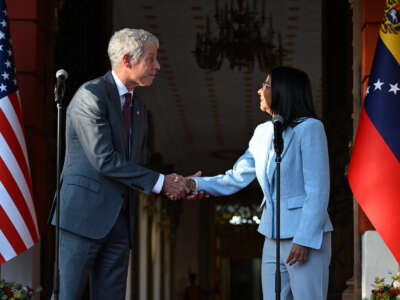
US President Donald Trump gives his speech at the 81st session of the UN General Assembly, September 22, 2026. Photo: UN.
In his speech at the United Nations General Assembly, the president of the United States, Donald Trump, threatened Cuba, claiming that the country is under the highest level of pressure and that it will eventually fall.
In protest against Trump’s words, the Cuban delegation, led by Foreign Minister Bruno Rodríguez Parrilla, walked out of the room. Prior to the threats from the US president, which he often repeats, the president of Brazil, Luiz Inácio Lula da Silva, had expressed his condemnation of foreign interference in the region and criticized the measures imposed by the US against Cuba. Lula emphasized that the intensified blockade represents collective punishment against 10 million people.
Trump claimed that Cuba is a failed state, and backed up his claims by referring to the added pressure of the economic and energy blockade policy. “It is failing like never before, and it is going to fall,” the US president said in his usual bellicose tone. He also mentioned that US Secretary of State Marco Rubio is leading ongoing negotiations with the Cuban government, a claim that has been denied by Cuba.
In addition to his warlike tone against Cuba, the US president uttered warnings against Iran. Trump stated that he must decide between quickly annihilating Iran to supposedly prevent it from attacking other countries or allowing an agreement that favors the reconstruction of the country under Washington’s terms, although he toned down the bravado by adding that he expects to reach a pact after the US midterm elections. He also insisted that the Iranian government will never have a nuclear weapon, despite the fact that Iran has a declared policy of not making any nuclear weapons.
Earlier, upon his arrival at the UN headquarters in New York, Trump had an incident with the press, when he reproached a CNN reporter for covering his attendance, citing his ban on CNN.
Trump also boasted about the achievements of the US economy, calling it the envy of the world, although the country is experiencing high inflation, elevated fuel costs, and rising mortgage rates faced by the US population.
Cuba condemns Trump’s attacks The Cuban government responded to Trump’s attacks by reaffirming its right to sovereignty and condemning the economic and social impact of the intensified US blockade.
The president of Cuba, Miguel Díaz-Canel, decried on social media that the characterization of Cuba as a threat has the objective of justifying the genocidal US economic war against the Cuban population.
Díaz-Canel stated that Trump’s resorting to lies reflects a refusal to accept the self-determination of the Cuban people and reaffirmed that the country will maintain the defense of its sovereignty, working to overcome US imperialist aggression. He added that the blockade is the real threat.
Similarly, Foreign Minister Bruno Rodríguez said that the US government is incapable of recognizing Cuba as an independent and fully sovereign nation.
Rodríguez dismissed Trump’s accusations as falsehoods and slander, insisting that Cuba does not pose a danger to the United States or any other country, while the current economic restrictions and energy blockade do threaten Cuba and the rest of the world.
“The blockade is an act of genocide and collective punishment. We are a country of peace and we deserve peace,” emphasized the foreign minister, adding that the blockade has been systematically denounced by the majority of the international community.
In Gaza, thousands of children have been killed amid the genocide that’s being imposed by Israel with total impunity. Thousands of them are unaccounted for and buried beneath the rubble. In Cuba, millions of people have survived for years amid blackouts, shortages, difficulties accessing medicines, fuel scarcity, and a profound economic crisis imposed upon them by the United States.
These are different realities, but there is a question that connects them. One that should challenge the conscience of the international community: How much civilian suffering is the world willing to tolerate before taking action? It is an important question as the 81st session of the United Nations General Assembly approaches.
In Cuba, the government consistently denounces that U.S. sanctions and restrictions are worsening an already critical situation.
When fuel is scarce, the crisis ceases to be an abstraction. It enters people’s homes. It enters the room where a child tries to do homework during a blackout. It enters the home where a mother fans her baby because the heat becomes unbearable.
It also enters the kitchen, where food begins to spoil; the hospital, where a patient needs medicine that does not arrive; and the life of a worker who does not know how they will get to work because public transportation is nearly paralyzed.
An Island in the Dark
In mid-September, Cuban Foreign Minister Bruno Rodríguez Parrilla presented a report on the damage caused by the U.S. blockade between March 2025 and February 2026.
Rodríguez described months in which many families have lived with barely two or three hours of electricity a day, or even less.
Behind those hours of blackouts lies much more than an energy statistic: there is a child whose sleep is interrupted, a grandfather left without television or radio, a student trying to concentrate without light, and a mother struggling to find a way to preserve food.
Blackouts disrupt the entire life of a family. The Cuban government maintains that the lack of fuel is one of the main factors behind the energy crisis and denounces that U.S. measures make it difficult to obtain the fuel and diesel needed for electricity generation.
It also points out that the restrictions affect the acquisition of parts and equipment for thermoelectric power plants and hinder the expansion of renewable energy sources such as solar power.
When a Sanction Reaches a Hospital Bed
One of the most painful dimensions of any sanctions policy is the one that does not immediately appear in the headlines: the way it ultimately affects a patient.
Rodríguez stated that thousands of containers have been prevented from reaching Cuba because of the pressure and threats faced by shipping companies by the U.S. government. The figure cited by the foreign minister exceeds 7,000 containers.
To someone observing the situation from afar, a container may simply be a shipping unit.
For a family, it may contain medicine. For a hospital, it may mean essential supplies. For a patient, it may represent the difference between receiving treatment on time and continuing to wait. And when that patient is a child, that wait can become unbearable.
They Are Children, Not Numbers
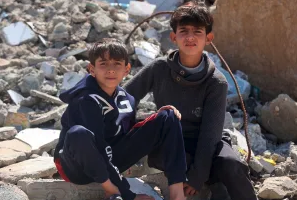
Palestinian children in the rubble of their community. (Foto: UN)
Referring to the increase in infant mortality between 2018 and 2025, the Cuban foreign minister made a statement that should transcend any political debate:
They are children, not numbers.
The statement matters because behind every mortality statistic there is a life that ended and a family that will carry that loss forever.
The tragedy in Gaza and the Cuban crisis belong to different historical and political contexts; but they converge at their roots in a history of struggle and resistance against the imperial thirst of powerful nations.
The international community has condemned, debated, and voted for years on the U.S. blockade against Cuba. At the same time, the great powers have repeatedly demonstrated that their international decisions are shaped by political, economic, and strategic interests. And the same happens with the Palestinian cause and their constant outcry for their international recognition as a sovereign state.
Meanwhile, families continue to live with the consequences. Both in Gaza and Cuba, a child dies everyday due to bombs or invisible sanctions. May the deaths of those children never become something to which we grow indifferent to.
Monthly Review does not necessarily adhere to all of the views conveyed in articles republished at MR Online. Our goal is to share a variety of left perspectives that we think our readers will find interesting or useful. —Eds.
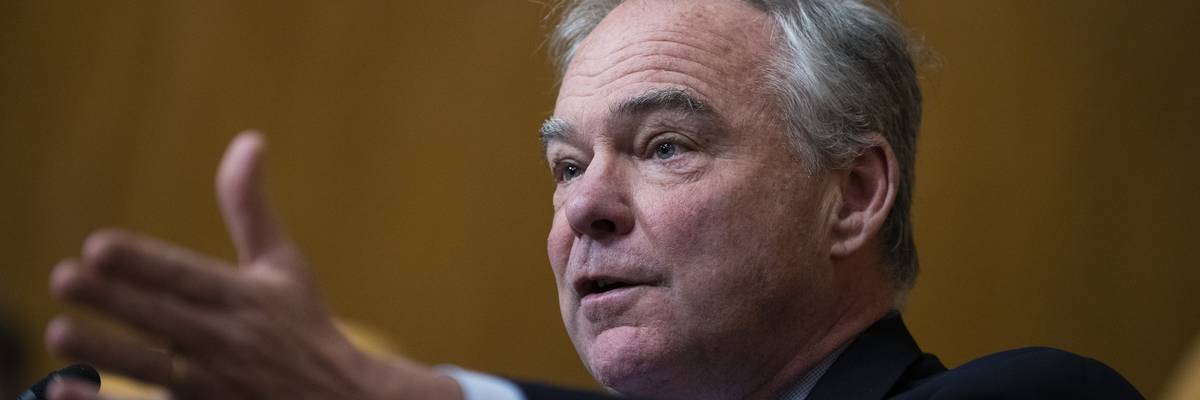
Sen. Tim Kaine (D-Va.) speaks during the Senate Budget Committee hearing titled Should Taxpayer Dollars Go to Companies that Violate Labor Laws?” in Dirksen Building on Thursday, May 5, 2022.
(Photo by Tom Williams/CQ-Roll Call, Inc via Getty Images)
We face an unprecedented fascist and imperialist threat from the Trump administration; mealy-mouthed centrist imperialism just won’t do the trick.
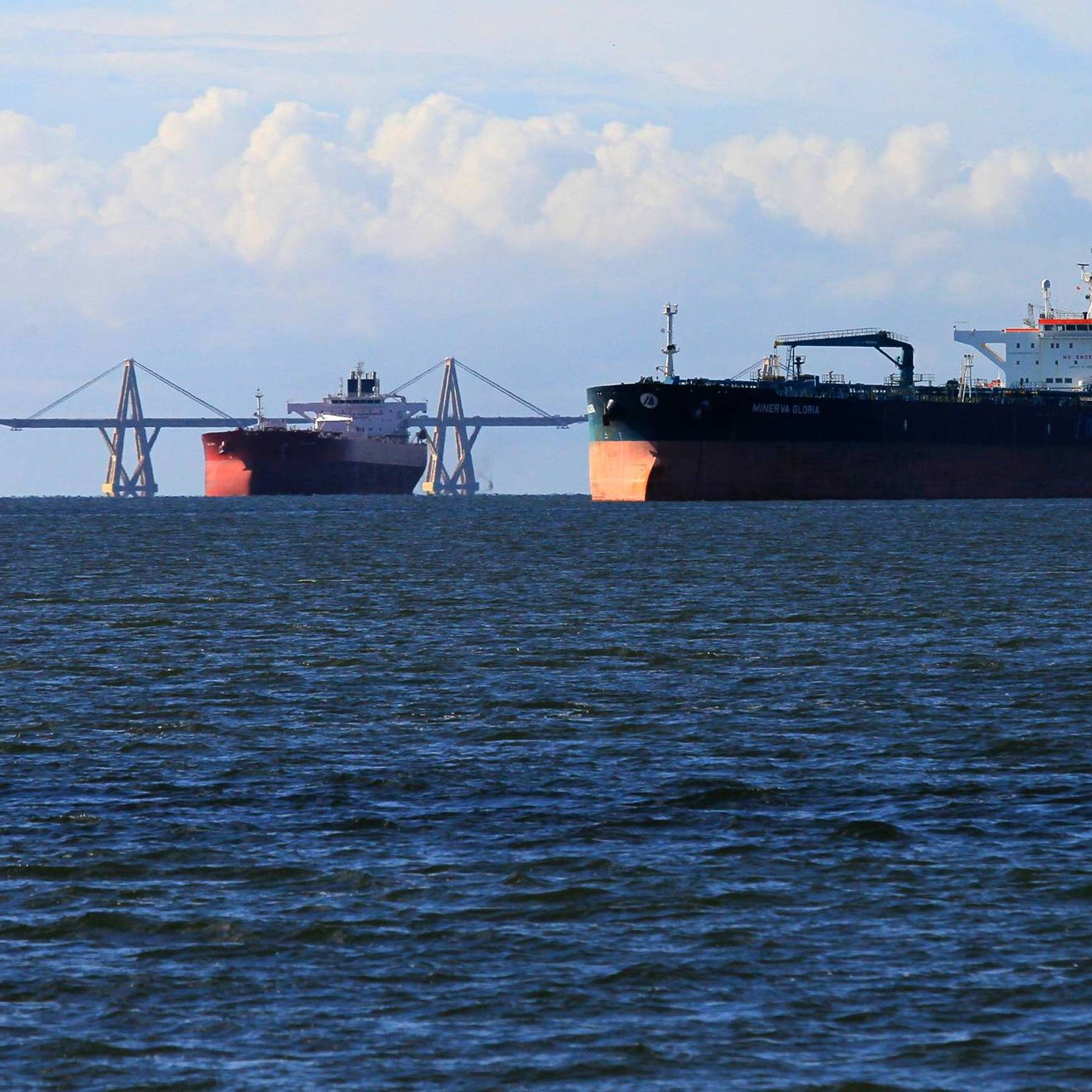
On Friday, the Trump administration announced a “deal” handing the United States65 billion barrels of Venezuelan crude oil, roughly a fifth of the country’s total reserves (the largest on Earth), on leases running up to 100 years. They would give $200 billion, or just about $3 a barrel (just 3% of market value) to Venezuela. If this was a fair “deal,” following market value, it should be over $6 trillion. That may be the biggest fraud in human history.
Marines have openly occupied the streets of Caracas since, doing numerous muscle-flexing helicopter raids across the city. The administration has said Venezuela is “not ready yet” for elections, despite running their own elections for decades—plus, why does the US get to dictate when and if countries can have elections, anyway?
The Pentagon itself reportedly holds a 35% stake in the venture set to extract the oil, and Secretary of State Marco Rubio runs the country as its de facto “viceroy,” according to The New York Times. The whole scheme was backed by neocons like the Vandenberg Coalition and the Florida lobby.
Would the US accept it if China, Russia, Iran, or Mexico kidnapped a US president, bombed American fishermen, seized American oil fields, and installed a puppet government because officials in Beijing or Tehran deemed it “in the national interest”?
I guess they’ve stopped pretending this was ever about democracy or drugs (the original bogus reason). It is now even being sold as the cure-all for a worsening recession and a pre-midterm buy-off, even as the affordability crisis worsens.
President Donald Trump and the neocons’ message seems to be: It’s fine to steal trillions from other countries, kidnap their leaders, kill civilians, and install puppet governments, for profit. We skipped the Cold War and went straight back to old-school imperialism.
As almost always, most of the windfall from this “deal” will go to the super rich. Gas prices keep climbing, but oil majors are hitting record highs on Wall Street. Chevron’s stock sits near an all-time high as it committed $7 billion to the new venture. Canada’s largest oil investor also hit an all-time high in the stock market the day of the news.
You may ask yourself, how have Democrats responded to all this depravity and barbarism? Well, would it shock you if I said most Democratic politicians have attacked Trump from the right, and legitimated his warmongering? Unfortunately, it probably won’t.
My home state’s senator, the ever-boring Tim Kaine (D-Va.), joined by Chuck Schumer (D-NY) and Adam Schiff (D-Calif.), filed a war-powers resolution to block what they called an “illegal war” with Venezuela. “Illegal” is the operative word. Their objection is that Congress never voted on this, not that invading, bombing, and looting a sovereign country is morally wrong.
In a Tweet, quoting the right-wing oil-funded Wall Street Journal, Kaine added that Trump had “Invaded Venezuela, Removed the dictator Maduro but… Kept his VP in power While blocking opposition leader and Nobel laureate Maria Corina Machado from returning home and delaying all talk of elections,” ending on “So the US could control Venezuelan oil in violation of its constitution!”
He’s basically saying, “We want to coup foreign governments to put in a far-right puppet and take their oil, LEGALLY.” We don’t need Mickey Mouse anti-imperialists.
If Congress had passed a resolution approving all of it, the way it did for the wars in Iraq, Libya, and Afghanistan, would that make it morally acceptable? Of course not. Torture under the Bush administration was legal, as was the US colonization of the Philippines, and even the Transatlantic Slave Trade, for that matter.
But for Democratic leadership, this was never about principle, or backing a truly progressive foreign policy vision; they just care about opposing Trump for its sake, and respecting the oh-so-perfect process. Though legislating morality is the purpose of law, legality and morality are not the same—and in this case, legal approval means nothing.
This is nothing new. Democrats have spent decades backing a hawkish, neoliberal Venezuela policy. During the 2002 coup that briefly ousted democratically elected president Hugo Chávez, then-Sen. Joe Biden dodged the question on television before pivoting, months later, to demand Washington “ratchet this up” against Chávez. By 2006 he was warning of an “axis of oil” led by Venezuela, echoing talking points from neoconservatives like Iraq War architect John Bolton.
Washington-aligned opposition forces also waged the 2002-2003 PDVSA oil lockout meant to strangle Chávez’s government economically. In 2019, when Trump anointed the unelected Juan Guaidó as president, Rep. Nancy Pelosi (D-Calif.) recognized him, and most congressional Democrats stayed silent or lined up behind her.
Now, with the Pentagon routinely bombing fishing boats off Venezuela’s coast for months, which it says, without evidence, are narco boats, killing hundreds of civilians, Democrats’ loudest objection was, again, that Congress hadn’t authorized it.
They wanted to see “proof” of these being narco boats, rather than focusing on the more important point: Are we okay with just murdering any suspected criminal? This is the kind of logic that leads to right-wing politicians arguing to kill thieves and petty drug peddlers, like in Brazil and the Philippines.
Hillary Clinton, of all people, said more than many elected Democrats would. Now Democrats are lining up behind Delcy’s far-right replacement-in-waiting, María Corina Machado. Even the Central Intelligence Agency thought she was too extreme and alienating to be Maduro’s replacement. Yet, Sens. Dick Durbin (D-Ill.) and Jeanne Shaheen (D-NH) met with Machado months before she shamefully won the 2025 Nobel Peace Prize (before giving it to Trump). Durbin later co-sponsored a resolution honoring her alongside far-right Republican Sens. Ted Cruz (Texas) and Rick Scott (Florida). Most Democrats have been backing her as the next president, calling her a “champion of democracy,” among other ridiculous stolen valor.
Machado, backed by the Bush administration and US intelligence agencies, backed the 2002 coup; relentlessly pushed for and defended the sanctions that starved her own country; wants to privatize PDVSA and hand away her country’s, in her own words, “trillions of dollars of natural resources” to the US on Donald Trump Jr.’s podcast; and has praised autocrats like Daniel Noboa, Javier Milei, and Nayib Bukele.
Machado is “completely aligned,” historian Greg Grandin told Democracy Now!, “with the most militarist and darkest face of US imperialism. She was the main force lobbying for the coup against Maduro, and has supported the boat strikes on fishermen, her own fellow citizens. She has been supported by neocon war criminals like John Bolton, Elliott Abrams, and Mike Pompeo—does that sound like someone the Democrats should be backing?
There are, still, some exceptions worth naming. Rep. Ro Khanna (D-Calif.) has made the actual moral case, not just the legal one, calling Trump’s approach a return to “the era of gunboat diplomacy where might makes right” and saying plainly, “It’s not just that it’s strategically wrong. It’s morally wrong.” Sen. Chris Van Hollen (D-Md.) has also warned against letting “control of the world’s most powerful military” rest in one man’s hands, and called out Trump’s imperialism plainly.
Expanding the anti-war coalition, libertarian Rep. Thomas Massie (R-Ky.) has repeatedly co-sponsored bipartisan war-powers resolutions with Democrats Rep. Jim McGovern (Mass.) and Joaquin Castro (Texas), arguing, “This is not about drugs; this is about oil and regime change… our troops are not pawns to be risked for the profits of oil companies and investment bankers.” A real transpartisan anti-war bloc is possible, it just needs bold politicians to lead it.
We face an unprecedented fascist and imperialist threat. Washington is using its world-bending power to expand its territory, remove leaders who won’t play ball with US crony and intelligence interests, and turn sovereign countries into de facto American possessions. Venezuela, as even the often-disappointing New York Times has reported, has effectively become a US colony.
Mealy-mouthed centrist imperialism just won’t do the trick. A legal invasion is still an invasion. Pursuing “US interests” doesn’t give any official carte blanche to roam the world like rogue thugs. Would the US accept it if China, Russia, Iran, or Mexico kidnapped a US president, bombed American fishermen, seized American oil fields, and installed a puppet government because officials in Beijing or Tehran deemed it “in the national interest”? They might nuke them within the hour.
All empires end at some point. When it does, no power will grant the US the mercy it denied the countries it pillaged.
Democrats, and American officials generally, should recognize their precarious position in a world increasingly turning toward rivals like China, and finally build that coalition in earnest. Thankfully, there are now constituencies challenging Washington’s neo-imperial consensus, in academia, in think tanks, at the State Department, and even in Congress, that are growing too significant to ignore.
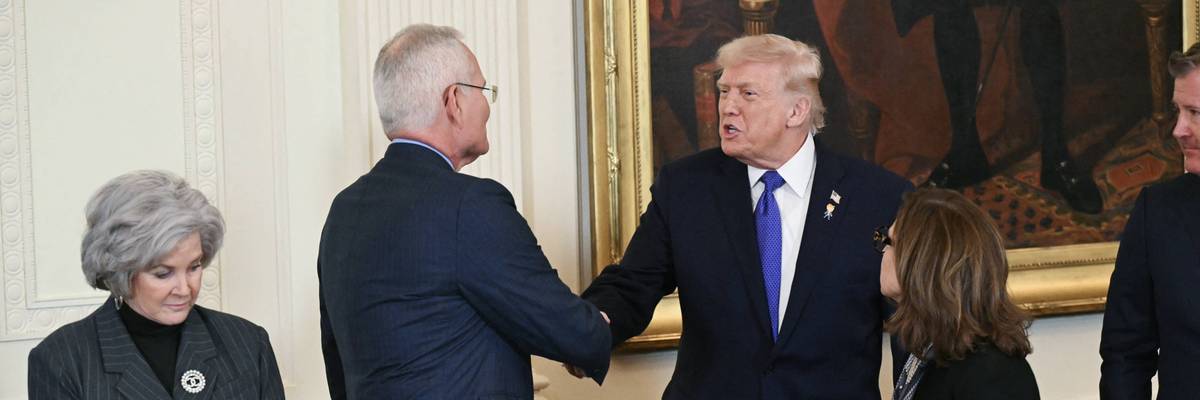
US President Donald Trump shakes hands with ExxonMobil CEO Darren Woods, during a meeting with US oil companies executives in the East Room of the White House in Washington, DC on January 9, 2026.
(Photo by Saul Loeb / AFP via Getty Images)
“This is proof Trump put our service members at risk to get Venezuelan oil for his billionaire buddies,” one Democratic senator said. “Putting our soldiers’ lives on the line for private profit is a gross dereliction of his constitutional duty.”
President Donald Trumpannounced on Truth Social on Friday that his government had “secured majority US control” of Venezuelan oil reserves containing 65 billion barrels of oil.
The announcement followed on reporting from Axios that a deal was in the works, prompting criticisms that such a move would be “colonial” and calls for Congress to reject any such proposal.
“Let’s be clear: This isn’t a win,” Sen. Chris Van Hollen (D-Md.) wrote on social media in response to the announcement. “This is proof Trump put our service members at risk to get Venezuelan oil for his billionaire buddies. Putting our soldiers’ lives on the line for private profit is a gross dereliction of his constitutional duty.”
When US forces invaded Caracas and kidnapped Venezuelan President Nicolás Maduro and his wife First Combatant Cilia Fores on January 3, Trump’s own words following the invasion confirmed suspicions that he acted largely to gain access to the country’s oil.
“These are some of the largest crimes of our lifetimes.”
“We’re going to get the oil flowing the way it should be,” he said in a press conference following the attack.
Friday’s deal, which seems like an attempt to make good on that promise, was also announced by Secretary of State Marco Rubio and acting Venezuelan President Delcy Rodriguez, who provided more details.
Rodríguez stated that the deal will involve private corporations developing 17 “strategic fields” with 65 billion barrels of proven reserves. She echoed Rubio’s $100 billion investment claim and pledged that the projects would yield $209 billion in tax revenues. According to the acting president, the announced agreement “ushers in a new era of growth and prosperity.”
However, economist Francisco Rodríguez, a senior research fellow at the Center for Economic and Policy Research, argued that the agreement was actually a bad deal for Venezuelans.
“President: According to your figures, this agreement will generate tax revenues of just $3.22 per barrel of Venezuelan oil. This represents 4.7% of the current price, and less than half of the royalty rate contemplated in concessions granted by Juan Vicente Gómez,” he wrote on social media, addressing the current Venezuelan leader and referring to a Venezuelan dictator from the early 20th century.
Joseph Bouchard, a journalist and researcher who focuses on Latin America, agreed with Rodriguez’s criticism of the deal, writing on social media that “Trump [was] ‘generously’ buying billions of barrels of Venezuelan oil at less than 5% its market price. He’s stealing their oil for his own family and cronies’ profit. Guessing this may be used as a chip to manipulate the midterms. These are some of the largest crimes of our lifetimes.”
Francisco Rodriguez had earlier pointed out that the deal violated the Venezuelan Constitution, which holds that all minerals and hydrocarbons are “inalienable public domain,” according to Venezuelanalysis. For the deal to go through, therefore, Venezula would have to alter its Constitution.
Former head of Human Rights Watch Kenneth Roth noted on social media that “senior Venezuelan officials, all fearing arrest, are hardly in a position to negotiate vigorously, making the whole thing seems like one big military theft.”
Trump is under pressure to lower gas prices that have spiked due to the fallout of his war on Iran, which entered its sixth month on Friday, and promised in his announcement, “This Historic Transaction MORE THAN DOUBLES American Oil Reserves, greatly increases our Oil Supply, and will substantially lower Gas Prices for all Americans, long into the future.”
However, The Associated Press pointed out: “A significant drop in US gas prices tied to the agreement should not be expected immediately. Experts have repeatedly warned that a substantial boost in Venezuelan oil production will not happen quickly as repairing and expanding infrastructure takes years and requires billions of dollars.”
Exploiting Venezuela’s oil reserves would also exacerbate the climate crisis, which just this summer intensified a deadly heatwave in Europe and is supercharging an El Niño that could contribute to a significant increase in food prices in 2026 and 2027.
It’s been nearly 30 years since I co-founded Common Dreams with my late wife, Lina Newhouser. We had the radical notion that journalism should serve the public good, not corporate profits.
It was clear to us from the outset what it would take to build such a project. No paid advertisements. No corporate sponsors. No millionaire publisher telling us what to think or do.
Many people said we wouldn’t last a year, but we proved those doubters wrong.
Together with a tremendous team of journalists and dedicated staff, we built an independent media outlet free from the constraints of profits and corporate control. Our mission has always been simple: To inform. To inspire. To ignite change for the common good.
Building Common Dreams was not easy. Our survival was never guaranteed. When you take on the most powerful forces—Wall Street greed, fossil fuel industry destruction, Big Tech lobbyists, and uber-rich oligarchs who have spent billions upon billions rigging the economy and democracy in their favor—the only bulwark you have is supporters who believe in your work.
But here’s the urgent message from me today. It’s never been this bad out there. And it’s never been this hard to keep us going. At the very moment Common Dreams is most needed, the threats we face are intensifying. We need your support now more than ever.
We don’t accept corporate advertising and never will. We don’t have a paywall because we don’t think people should be blocked from critical news based on their ability to pay. Everything we do is funded by the donations of readers like you.
When everyone does the little they can afford, we are strong. But if that support retreats or dries up, so do we. Will you donate now to make sure Common Dreams not only survives but thrives?
—Craig Brown, Co-founder
about:blank
about:blank
Our work is licensed under Creative Commons (CC BY-NC-ND 3.0). Feel free to republish and share widely.
Migrants being loaded into US Air Force C-17s, January 2025 [Photo: White House]
A US deportation flight carrying 20 people landed shortly before 1 p.m. local time Thursday at Roberts International Airport outside Monrovia, Liberia. The reported nationalities of those aboard included Venezuelans, Cubans and Colombians, according to Reuters.
Five men refused to leave the plane. The New York Times reported that American federal agents forced them off, and that all five were eventually returned to the aircraft. A video verified by the Times shows deportees sitting on the tarmac beside the plane, surrounded by roughly 20 agents. The Liberian government has not clarified their status.
This is the first flight under an agreement permitting Washington to transfer up to 1,200 people to Liberia over the next year. Liberia is the 26th country to receive them. Some 23,000 people have already been sent abroad under at least 35 bilateral arrangements, according to Third Country Deportation Watch.
The three nationalities named in Thursday’s flight are not incidental. Venezuela, Colombia and Cuba today face three of the greatest humanitarian catastrophes in the Western Hemisphere that have been greatly worsened by the recolonization drive by US imperialism.
In Venezuela, the confirmed death toll from the June 24 earthquakes stands at 6,438, with 86,358 injured. The site Venezuelareporta.org counts 41,334 still missing. In Colombia, the August 10 earthquake has killed 319, with 4,611 injured and 290 missing. In both countries, thousands of buildings collapsed and thousands more were structurally compromised—revealing that entire cities were built to engineering codes wholly inadequate to meet the known seismic risk.
In Cuba, UN officials have described the effects of the US economic and fuel blockade as a “silent Gaza.” In 2025, registered deaths reached double the births, even as millions have migrated in recent years. Infant mortality rose 148 percent between 2018 and 2025, from 4.0 to 9.9 per thousand.
These are not separate disasters. Venezuela’s economy was strangled by 15 years of US sanctions before Washington invaded outright on January 3, abducted the president and impounded its oil revenues. Colombia absorbed over $10 billion in US military aid across a quarter century of Plan Colombia, financing an ongoing civil war before helping install the President Abelardo de la Espriella, a lawyer associated with fascist paramilitaries. Cuba has been blockaded for six decades, and the Trump administration has cut off its oil supply and sanctioned investors across multiple sectors this year.
US imperialism manufactured the conditions that drove millions from these countries and caused the current devastation. It is now deporting those who escaped to US soil to one of the ten poorest countries in the world.
Liberia: the disposal ground
Liberia is not a random destination. It was founded in 1822 by freed American slaves and became a de facto US colony within decades—rich in minerals and heavily exploited by American capital after the Second World War and throughout the Cold War. When Cold War support ended, the country collapsed into civil war; the 1989–2003 conflicts alone killed some 300,000 people.
Its health system never recovered from the 2014–15 Ebola epidemic, and the US State Department currently maintains a Level 2 travel advisory for Liberia, citing crime, civil unrest and health infrastructure concerns.
The arrangement is completely venal. Following Liberia’s October 2025 agreement to accept Kilmar Abrego Garcia, who continues to fight his deportation in the US, Washington extended Liberian business and tourism visas from 12 to 36 months and signed a $124 million health sector memorandum. Reuters reports $5 million allocated for Liberian “immigration management.”
The conditions awaiting deportees across Africa follow a consistent pattern of indefinite confinement. In Congo, deportees told the Associated Press they were held behind locked gates, forbidden to leave alone, and permitted outside roughly once a week under IOM escort. In Equatorial Guinea, the AP found deportees confined in a hotel owned by the family of President Teodoro Obiang Nguema Mbasogo, barred from leaving, given uneven access to medical care, and subjected to repeated pressure to return to the countries they had fled—of at least 32 people held there, 25 had been sent home by May. An international coalition sued Ghana in June on behalf of 27 deportees, alleging that most were rapidly returned to their home countries in defiance of US protection orders, some having been held under armed guard.
Thousands of miles from any court with jurisdiction over their captivity, this amounts to indefinite imprisonment without charge, trial, or sentence—cruel and unusual punishment by any honest definition, permitted only because US law pretends immigration detention is “civil” rather than punitive.
The apparatus of disappearances
Third-country deportation flights are the end point of a machinery being built across the United States. Politico reports that in the past year, judges have ruled against ICE’s detention tactics more than 16,000 times, roughly two-thirds of those cases stemming from a single two-page memo reinterpreting a 1996 statute to permit the detention of people who had lived in the country for years.
Third-country deportation exists precisely to circumvent the courts. When a judge rules a person cannot be returned home because they face persecution or torture, they are stationed 7,000 kilometers away instead, where no US court has jurisdiction and no one is watching.
The precedent was set much earlier. Beginning February 4, 2025, the administration flew Venezuelan detainees to Guantánamo Bay—the site built expressly to hold prisoners where US constitutional protections were said not to apply. In March 2025, 238 Venezuelans were flown to El Salvador’s CECOT prison, 137 of them under the Alien Enemies Act of 1798, in open defiance of a federal court order to turn the planes around. They were imprisoned without charge, trial or sentence on allegations of Tren de Aragua membership that rested in many cases on nothing more than tattoos. Held incommunicado for four months, they were released only in a July 2025 prisoner exchange.
Asked in April 2025 about sending US citizens to the same prison, Trump told El Salvador’s Bukele that “homegrowns are next,” adding that he would need “five more places.” In other words, what is being tested on migrants—detention without charges, imprisonment abroad, defiance of the courts—is being prepared for citizens and political opponents.
These agreements are being challenged in U.T. v. Bondi, which contests whether the contracted third countries provide the “full and fair” asylum procedures US law requires.
Deportation flights continue to Venezuela, Colombia and Cuba
While Washington opens new routes to third countries, the flights going directly to Venezuela, Cuba and Colombia carry their own lethal consequences. On June 24, a flight carrying 146 Venezuelans deported from the United States landed hours before the earthquakes. Venezuelan authorities locked them inside the Hotel Sanitario Negra Hipólita in La Llanada—as they had thousands of others arriving on more than 160 flights coordinated between Washington and Caracas since 2025. When the building collapsed that evening, 134 of them died.
Oswadeliz Núñez, whose son Daniel died there, told El País: “They were locked in those rooms, under key. The night of the earthquake I wrote to the numbers on the Vuelta a la Patria page and nobody answered me.” Daniel had been stopped while driving in Jacksonville. “I fixed up his room as nicely as I could, but he never arrived. I received the little box with his ashes.”
The deportation flights have since resumed through an airport in eastern Venezuela while Maiquetía remains disabled, with two landing in August.
Colombia’s experience follows the same pattern. The country accepted 475 deportation flights from the United States between 2020 and 2024. When former President Gustavo Petro briefly suspended them last year after migrants arrived in chains, the pause lasted only days before Washington forced their resumption—and there has been no announcement suggesting they will be discontinued after the earthquake.
Whether a deportee is flown to Caracas, Bogotá, Havana or Monrovia, the underlying principle is the same and it is indefensible: workers are being forcibly removed from places where they had built lives and sent to places where their safety cannot be guaranteed. This reality is summed up by the 20 agents surrounding five men who refused to get off the plane, on a tarmac in a country none of them had chosen or to which they had the slightest connection.
The right of workers to live and work where they choose, without fear of persecution or deportation, is not a concession to be granted by any government. It requires the independent political mobilization of the international working class on a socialist program that abolishes the outmoded capitalist nation-state system.
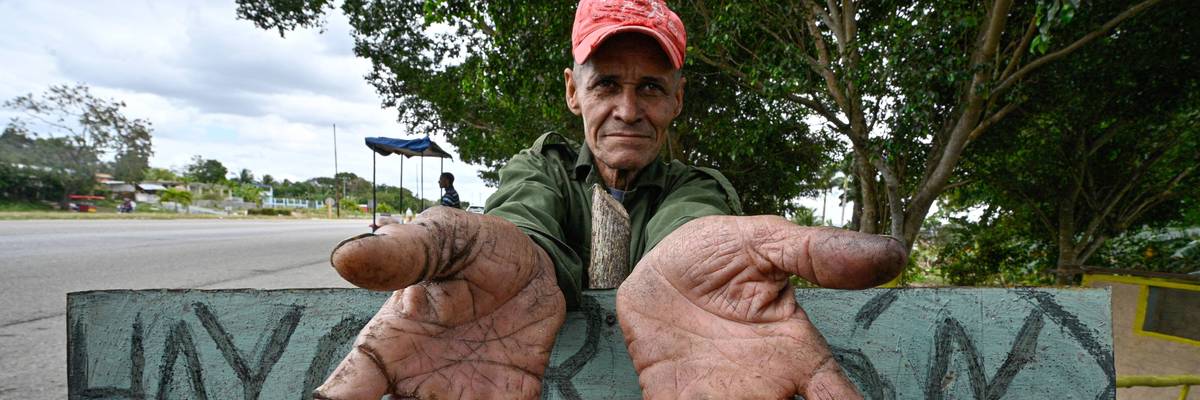
Charcoal seller Elio Galvan, 44, shows his hands as he waits for customers next to a sign advertising his product on a road in Havana on February 6, 2026. Across Cuba, families are scrambling to cope with relentless blackouts and shortages worsening under economic pressure from US President Donald Trump.
(Photo by Adalberto Roque / AFP via Getty Images)
Life in Cuba is full of suffering not because of socialism but because of a 67-year-long blockade by the world’s largest superpower.
Recently, while listening to an NPRinterview with Cuban-American musician Arturo Sandoval, I was reminded of the late political scientist Michael Parenti’s classic text, “Inventing Reality: The Politics of the Mass Media.”
In his 1986 book, Parenti described a situation that is still relevant 40 years later—when the US fears that another country’s non-capitalistic political model (and its attendant advances in social justice and quality of life) could cause US citizens to question their own system, it regularly imposes an embargo and sanctions against the country. Next, the news media reports on the suffering caused by these policies while, at the same time, avoiding any mention of the embargo and sanctions. Finally, when after years or decades of suffering, the people of this blockaded country take out their anger on the closest target and begin protesting against their government, the US steps in. It places a puppet president in power and pours into the country the money it had withheld throughout the embargo. Then, the media reports on how well everyone is now doing without, once more, acknowledging the oversized role the embargo played in the prior devastation.
In the aforementioned NPR interview, host Scott Simon perfectly perpetuated this model of media complicity by announcing towards the interview’s conclusion, “Arturo Sandoval, I’ve got to put you on the spot a little. You’ve been pretty quiet about politics over the years, but obviously you fled Cuba. When Fidel Castro died, you spoke out about your disdain for his regime. It was ten years ago.” Then, with no historical or even recent context, Simon concluded with, “Cuba seems to be almost worse than ever now.”
With this final declaration in which he erroneously implied a connection between Cuba’s current immiseration and Fidel Castro’s rule, Simon led Sandoval into his response: “Sixty-seven and a half years is way too long, man… The people in Cuba are desperate and hopeless.”
Citizens who are not given the context of the news cannot be engaged participants in the democratic process.
Simon allowed his guest to say this unchallenged as if these decades of desperation and hopelessness are the result of Cuba’s 1959 revolution. To the contrary, in addition to footing the bill for Sandoval’s musical education (he attended the free Cuban National Art School, founded by Fidel Castro), the Cuban Revolution redefined human rights as access for all to free education, free healthcare, low-cost daycare centers, and highly subsidized housing.
The desperation Sandoval referred to is the direct result of the 67-year-old embargo against Cuba imposed by the United States, the longest embargo in the history of the world. Combined with its multitude of supplementary sanctions (more than 200 of which were enacted during Trump’s first term in office), these punitive measures prohibit Cuba from purchasing products, including medicine, manufactured abroad if they contain more than 10% of US-origin components. They restrict US residents’ ability to travel to Cuba. They hinder Cubans residing in the US from wiring money to their families, a common way for immigrants from all parts of the world to supplement the income of relatives back home.
The Cuban embargo has received worldwide condemnation. For more than three decades now, the UN General Assembly has annually presented its members with a resolution to denounce the embargo. Year after year, its 193 member states cast a near-unanimous vote affirming the resolution. The only two countries that consistently vote against it—and in favor of the embargo— are, unsurprisingly, the US and Israel.
Unfortunately, the UN resolution, while a significant show of solidarity, has no authority to end the embargo. As codified by US law, only the US Congress has this power.
In addition and sadly, the suffering caused by the embargo is not a mere result of the blockade but the explicit objective of it as stated in a declassified 1960 government document posted on the National Security Archive’s website and abstracted as follows: “This memo, written by Deputy Assistant Secretary of State for Inter-American Affairs Lestor Mallory, provides the original, unvarnished, policy rationale for imposing trade restrictions on Cuba. Fidel Castro’s revolution is quite popular in Cuba, Mallory points out; since there is no effective opposition against him, the only way to undercut Castro’s support is ‘through disenchantment and disaffection based on economic dissatisfaction and hardship.’ Mallory advocates a set of punitive economic actions designed to deny ‘money and supplies to Cuba, to decrease monetary and real wages, to bring about hunger, desperation, and the overthrow of [the] government.’”
Beyond the embargo and its sanctions, the US designation of Cuba as a State Sponsor of Terrorism (SSOT) contributes to what Sandoval referred to as the Cuban people’s hopelessness and desperation. The partisan political boomerang of the SSOT was initiated by President Ronald Reagan in 1982 for Cuba’s support of Latin American leftist groups. It was removed by Obama in 2015, reinstated by Trump in 2021, symbolically removed by Biden on January 14th, 2025, at the end of his presidency, and again reinstated by Trump on January 20th, 2025, at the start of his second term.
Along with other restrictions, the sponsor-of-terrorism status forbids US international aid organizations, including Food for Peace and the Peace Corps, from offering humanitarian assistance to Cuba. It prohibits Cuba from receiving loans from the World Bank and other international financial institutions. These are loans which could be used for much-needed projects such as an overhaul of the island’s aging electrical grid, which has caused multiple nationwide blackouts over the past two years.
Furthermore, as described by the Washington Office on Latin America, the SSOT “has a chilling effect on businesses, including banking or telecommunications investments that are crucial to promoting the type of transformation essential to expanding freedom on the island.” Ironically, this freedom (ie: the opening of business and economic opportunities) is precisely what the US purports to desire for the Cuban people. And it is this lack of this freedom, which Sandoval said in the somber closing statement of his NPR interview, that prevents him from returning to Cuba and will leave him to “die dreaming” of a homecoming.
At this point in the interview, what Scott Simon didn’t say becomes as, if not more, significant than what he did. It is that, in Fidel Castro’s final two years of life, a sense of hope and a feeling of, yes, freedom pervaded Cuba.
Hope came to Cubans with Obama’s 2014 détente, which, while not a revocation of the embargo [only able to be repealed by Congress], still enabled the US Embassy in Cuba and the Cuban Embassy in the US to reopen for the first time in 50 years. Washington’s rapprochement permitted commercial and direct mail flights between the two countries to be reinstated and for restrictions on remittances to be loosened. This, in turn, allowed Cuban-Americans, like immigrants from other countries, to now easily send money to their families on the island.
Freedom came from an opening of the Cuban economy, from the government’s expanded opportunities for private businesses. Cubans responded enthusiastically, opening record numbers of cafés and restaurants and music and art venues, among other enterprises to which their new American friends, now able to travel freely to Cuba, flocked in record numbers.
It was a boon for both sides—and evidence that another way of engaging with Cuba was possible. Until, that is, Trump was elected at the end of 2016 and, soon thereafter, began systematically shutting everything down once more.
If not for the very real damage it inflicts on the country, the SSOT designation could be considered laughable, as, during all these decades as a supposed sponsor of terrorism, Cuba has remained steadfast in its commitment to a peaceful coexistence with its neighbors near and far. For the past quarter of a century, Cuba’s Latin American Medical School, esteemed for both its size (enrollment-wise, it is considered the largest medical school in the world) and its focus on preventative healthcare, has offered a full-ride, plus a monthly living stipend, for students from low-income communities around the world, including the US.
Additionally, in the wake of Hurricane Katrina, Cuba offered aid workers to the US, although President Bush rebuffed this overture. In the early days of COVID-19, Cuba sent medical brigades to help Italy contain its outbreak. And this was in addition to the doctors Cuba regularly sent to countries in need from Algeria to Honduras to Sri Lanka. Until, that is, in 2025 the US began threatening to deny visas to the leaders of countries accepting assistance from Cuban doctors; and the targeted countries, fearing retribution, terminated their contracts with Cuba.
This past March, as Jamaica’s Cuban doctors headed home following one such termination, hundreds of Jamaicans took to the streets for what they called a “Gratitude Walk.” For three miles, they marched wearing t-shirts reading, “Thank you Cuba for 50 years of medical service” and chanting, “We love Cuba” and “Bring back the doctors.”
Walk participant Rupert Walters, President of the Jamaica-Cuba Friendship Association’s St. Catherine’s chapter and a beneficiary of Cuban care for his prostate cancer, called his government’s decision to cave to US pressure “crazy.” Walters told the Jamaica Observer that he wished the government had “allowed the Cubans to support and give their services to the hundreds of thousands of Jamaicans who can’t afford it,” and warned that, as a result of the medical program termination, Jamaicans would die.
Rather than supporting terrorism, Cuba has long been the target of terrorist attacks by the US government. There was the CIA’s half-century of documented assassination attempts against Fidel Castro, involving everything from poison pens to exploding cigars.
Less comical and more lethal were terrorist attacks led by Luis Posada Carriles, a Cuban exile and CIA operative. In 1976, 35 years before September 11th, Posada Carriles masterminded the Western Hemisphere’s first act of political terrorism against a civilian flight. His bombing of a Cubana de Aviación airplane killed all 73 passengers, 24 of whom comprised the entirety of the Juvenile Cuban National Fencing team. In the summer of 1997, Posada Carrilles began another bombing campaign, this time targeting Havana hotels, restaurants, and discotheques—and killing an Italian tourist. Finally arrested in Panama in 2000 for attempting to assassinate Fidel Castro at a conference he was attending there, Posada Carrilles later fled to the US, where he was detained for illegal entry and then pardoned by President Bush. In 2018, he died a free man in Miami.
Although Scott Simon didn’t say this in his interview with Arturo Sandoval, the current “worse-than-ever” situation he referenced is due to the US’s oil blockade, initiated by an Executive Order from Trump in January. Under this latest act of economic warfare, tankers trying to deliver petroleum to the island are threatened with tariffs and, if they still attempt to do so, they are chased away by US Coast Guard vessels.
Like the embargo, like the sanctions, like the SSOT status, the fuel blockade has caused widespread suffering for the Cuban people. It impedes access to electricity and also to water, which arrives at most houses in Cuba via an electric pump. It prevents the preservation of not just food but also of medicines that need refrigeration.
Many Cubans now sleep outside, on rooftops or on the Malecón seawall, to escape the sweltering summer heat, made all the more unbearable without the electricity to run their fans. Because electricity (which has been prioritized for hospitals and schools) is now available in most houses for just two hours per day, Cubans must wake up whenever it arrives (even if it is at 3 AM) to do all they couldn’t without it—wash clothes and dishes, cook and bathe. And collect water for the next outage. So, sleep too, has become a casualty of this US-provoked humanitarian crisis, referred to by a group of US Representatives who visited the island in July as a “silent Gaza.”
By engaging in de-contextualized reporting rather than shedding light on the reasons why the current situation is as it is, mainstream US media outlets like NPR do their listeners a grave and dangerous disservice. For, as The Washington Post’s motto warns us, albeit a little more ironically after Jeff Bezos’ purchase of it, “Democracy dies in darkness.”
Citizens who are not given the context of the news cannot be engaged participants in the democratic process. Without the full story as to why what is happening in our world is happening, we are rendered powerless to change it. Without our consent, we become cogs in the bulldozer of US interventionism and imperialism.
Life in Cuba is full of suffering not because of socialism but because of a 67-year-long blockade by the world’s largest superpower. In a government now absent of checks and balances, we need to call out the offending media. We need to let them know that we’re paying attention, that we hold them accountable for their lies of omission— and that we demand better.
US Embassy in Havana [Photo: US Department of State]
Announcing a new round of sanctions against Cuba on Thursday, Secretary of State Marco Rubio declared that President Donald Trump’s “resolve is ironclad: the United States will not tolerate a rogue state harboring hostile foreign military, intelligence, and terror operations just 90 miles from the American homeland.”
The threat was issued against a country whose electrical grid collapsed twice within 24 hours this week, whose hospitals operate without reliable power and whose population is being deprived of food, medicine and fuel by a deliberate US energy blockade.
On Thursday, United Nations human rights rapporteurs condemned the US measures and warned of a “silent Gaza” unfolding on the island, declaring that food “must never be used as an instrument of political pressure,” and that measures knowingly depriving a population of the means to survive strike at the most basic guarantees of the right to life.
What the Trump administration is carrying out is an undeclared war of extermination against nearly 10 million people, criminal under international law and aimed at driving an entire society back a century in order to turn it into a colony.
The sanctions announced Thursday target five Cuban entities and eight individuals, including subsidiaries of the military conglomerate GAESA, Revolutionary Armed Forces Minister Álvaro López Miera, Chief of the General Staff Roberto Legrá Sotolongo and Cuba’s military attachés to Russia and China.
They came one day after the New York Times revealed that the CIA has secretly established a Cuba task force, adding case officers who recruit and manage spies, intelligence analysts, cyber-operations personnel and specialists in covert influence operations. According to the officials speaking anonymously to the Times, the task force seeks to create fissures among the Cuban political elite in the hope of replacing “hard-liners” with leaders more amenable to Trump’s demands.
The Times also revealed that the Trump administration has revised the National Intelligence Priorities Framework to designate Cuba a “Priority 1” target, alongside China, Iran and Russia. This has led the National Security Agency, the National Geospatial-Intelligence Agency and others to dedicate more intelligence collection assets, including satellites, toward the island.
The Times states plainly what this is for: the intelligence “will help the U.S. military update its options for potential military action against Cuba.”
These operations coincide with a sweeping reorganization of the US military across the hemisphere. At midnight on Monday, Southern Command retired Joint Task Force-Southern Spear—responsible for 63 strikes on fishing boats accused of carrying drugs in the Caribbean and Eastern Pacific that have killed 221 people in eleven months—and replaced it with Joint Task Force-Western Hemisphere.
SOUTHCOM commander Gen. Francis Donovan announced that the new command, “the action arm of US Southern Command,” would “apply total systemic friction on these networks,” operating alongside “our 18 other nations” in the Americas Counter Cartel Coalition. Its purpose is to extend joint strikes from international waters onto the sovereign territory of Latin American states. Cuba will figure among its principal targets, together with the coordination of repression against social opposition throughout the region.
With the debacle in the war against Iran and social anger mounting over ICE raids, healthcare cuts and the cost of living, an operation against Cuba is being contemplated as an “October surprise.” Some of Trump’s advisers believe the Cuban government “could be gone by the time of the midterm election in the United States in November,” according to the Times.
Such a move would not be aimed at boosting popularity for the Republican Party—only 15 percent of Americans support a war against Cuba. It would provide the pretext to manipulate or even cancel the 2026 elections and criminalize opposition.
The last time the CIA established a Cuba task force was 1960. Its members oversaw the April 1961 Bay of Pigs invasion, in which some 1,400 CIA-organized and financed exile mercenaries landed on the island. The operation was crushed by Cuban forces. When it failed, the Joint Chiefs of Staff drafted Operation Northwoods, a since-declassified proposal to stage false-flag terrorist bombings in American cities and hijackings of US aircraft to manufacture a pretext for invasion.
The Venezuelan precedent shows a more recent example. In October 2025, Trump publicly confirmed he had authorized the CIA to conduct covert and potentially lethal operations inside Venezuela. Three months later, on January 3, US Special Forces seized President Nicolás Maduro and his wife without suffering a single casualty—his location known, his defenses mapped, the political ground prepared for Delcy Rodríguez and her brother to preside over a US protectorate that has handed Washington control over Venezuelan oil, finances and foreign policy.
Who infiltrated whom
On July 20 the State Department published a 100-page report, “Cuba: the capital of 21st century communism,” which it has promoted on social media several times a week since. Its thesis is that Havana has spent six decades infiltrating agents into American social movements and the US state itself—that the civil rights movement, the opposition to the Vietnam War, the protests following the police murder of George Floyd and the present movements against ICE and the Gaza genocide were, in substantial measure, directed from Cuba.
Rubio told Fox News last week that Cuba is “a true superpower” of espionage and influence, and that of the recent protest movement, “there’s nothing organic about it.”
This week’s revelations establish the real direction of state penetration. American case officers, cyber-operatives and influence specialists are actively being inserted into Cuba, with satellites re-tasked overhead and military options under preparation.
The historical record admits of no ambiguity. Washington imposed its partial embargo in 1960, made comprehensive in 1962. In March 1960 the CIA bombed the La Coubre in Havana harbor, timing the charges in succession so that rescue workers responding to the first blast would be caught by the second; over 100 died. Cuban counterintelligence documented 638 separate schemes to kill Castro. Luis Posada Carriles, trained by the CIA at Fort Benning, organized the 1976 bombing of Cubana Flight 455, killing all 73 aboard, including the national junior fencing team. Researchers place the toll of US-directed and US-linked terrorism against Cuba since 1959 at more than 3,000 killed. Not one perpetrator has been prosecuted.
ince Trump’s declaration of a national emergency over Cuba in January, US aggression has turned genocidal. Washington has imposed an energy embargo threatening punitive tariffs against any country selling the island oil, along with successive sanctions packages freezing the assets of dozens of Cuban entities and officials.
In May, the US Department of Justice indicted the 94-year-old Raúl Castro on charges arising from the 1996 downing of two aircraft operated by CIA-linked provocateurs. Combined with a military buildup in the Caribbean and now covert operations on the ground, the indictment is a patently fabricated pretext to justify a military attack.
Havana’s answer: a country for sale
Confronted with this onslaught, the Cuban government has appealed not to the working class but to the American ruling elite.
On May 14, it received CIA Director John Ratcliffe in Havana, where he demanded “fundamental changes” in a meeting with senior Cuban officials, including Raúl Guillermo Rodríguez Castro, the former president’s grandson. Havana has since announced the most radical economic restructuring since 1959—privatizations, the stripping of labor protections and open-ended invitations to foreign capital.
The character of these appeals is unmistakable. Deputy Foreign Minister Carlos Fernández de Cossío told the New York Times that Havana would not oppose a Trump-branded resort on Cayo Santa María: “If he wants to do it peacefully, we see no specific reason to exclude him… If it is the Trump administration, in principle, we have no reason to refuse.”
Deputy Foreign Trade Minister Carlos Luis Jorge Méndez told The National: “We want American businesspeople to know and understand that Cuba is a country open to investment… in sectors ranging from mining and tourism to real estate, banking and finance.”
The regime that survived 66 years of CIA terror campaigns and provocations now negotiates the terms of its own submission with the CIA’s director and offers the island back to the US oligarchy that ran it as a casino and brothel under Batista.
This is the dead end of bourgeois nationalism. Neither Havana nor the “left” governments of Mexico, Brazil and Colombia—complicit throughout in the fuel blockade—will defend the Cuban people.
The only force capable of halting this crime is the international working class. Dockworkers, transport, oil and logistics workers in the United States and internationally must refuse to enforce the blockade and demand its immediate end, along with the delivery of the fuel, food and medicine Cuba requires. The threat of war against Cuba, the buildup of dictatorship at home and the persecution of socialists are a single process and must be answered by the industrial and political mobilization of workers everywhere against war and fascism, on the basis of a socialist program.
Secretary of State Marco Rubio attends the ASEAN Regional Forum in Manila on July 23, 2026Photo by Ezra Acayan/AFP via Getty Images
A report published this week by the State Department is the latest weapon employed by the Trump administration in its campaign for aggressive intervention in Cuba, according to members of Congress and experts on the beleaguered Caribbean island nation.
Despite Cuba being severely hobbled by in the throes of a humanitarian crisis engineered by U.S. sanctions and fuel blockades, the new report paints the country as a major threat.
The report appears to be the brainchild of Secretary of State Marco Rubio, a first-generation Cuban American who has made the overthrow of the Cuban government a top priority under the second Trump administration.
Published Monday without a listed author, the report says Cuba is the “capital of 21st century communism,” ideologically immovable, and a permanent enemy committed to the destruction not just of the U.S. but also of “Western civilization” through the spread of “Third Worldism.”
If that sounds like a throwback to the long-settled Cold War, that’s because it is — something critics of the report in Congress seized upon.
Whatever truths the report contains, they’re largely overshadowed by a feverish paranoia about the alleged reach of Cuban intelligence into American civil society, according to Rep. Mark Pocan, D-Wis., days after returning from a fact-finding trip to Cuba.
“It may be the stupidest, most fantastical, most biased thing I’ve ever read from a governmental agency,” Pocan said in a statement Tuesday. “This report focuses on the 1960s & 70s with no clear connection to today. Yet somehow, the State Department uses this report to say that this impoverished nation is responsible for everything from Black Lives Matter to Antifa, the anti-ICE protests and more.”
Rep. Delia Ramirez, D-Ill., who went on the fact-finding mission with Pocan, said the report was aimed at manufacturing consent for an invasion of the island — and to crack down on dissent at home.
“While criticizing the regime in Cuba, it instead attacks Americans’ constitutional rights to free speech and free assembly.”
“This report was intentionally designed to instill fear of the Cuban people and to justify a military attack on Cuba,” Ramirez told The Intercept. “It’s hypocrisy at its finest, because while criticizing the regime in Cuba, it instead attacks Americans’ constitutional rights to free speech and free assembly.”
In sketching a broad, anti-American conspiracy in nearly dozens of left-wing social movements, organizations, and educational institutions, the report also functions as a broadside on civil society in the U.S — and hardly for the first time.
“Cuba is not a new cudgel,” said Miriam Pensack, a historian at Princeton University specializing in Latin America and the Caribbean. “The Cuban revolution was a galvanizing event for the way that the United States thought about its national security, really until the end of the Cold War. And it still has an ideological utility, even as the country is limping along.”
Center of Global Conspiracy
Running 100 pages, the report lays out what its authors describe as a decadeslong effort by Cuba to foment revolutionary movements throughout the world and to build a latter-day “axis of evil” by allying with other governments opposed to U.S. interests, including the current-day governments of Iran, Russia, China, and North Korea.
“Even as it expands and revitalizes its network within the next generation of American left-wing activists, it has also forged new partnerships — or deepened and repurposed old ones — with other foreign governments and movements around the world,” the report warns. “The regime continues to act as a force multiplier for a much broader anti-American coalition, positioning itself as a staging ground for a wide range of foreign adversaries to conduct operations against the United States.”
Cuba, the authors allege, is “less a nation-state than an all-encompassing intelligence and subversion operation, focused around its existential revolution against the United States.”
The report goes on to list a slew of left-wing groups and individuals as accomplices, both witting and unwitting, of this intelligence operation, including the Democratic Socialists of America, Code Pink, Los Angeles Mayor Karen Bass, and leftwing streamer Hasan Piker.
In a section stretching nearly five full pages on the National Lawyers Guild, a long-standing right-wing bugaboo, the report’s authors describe the venerable progressive law association as “one of the most persistently relevant — and insidious — organizations in Cuba’s U.S. network.”
Posting to X for the first time since March, the organization quipped, “We have been called much worse, by much better.”
Academic Freedom at Home
The report took aim at universities in the U.S. for maintaining exchange programs and partnerships with Cuban universities, implying that such programs functioned as a feeding ground for Cuban agents looking to recruit spies and fellow travelers.
The report singled out Harvard University, pointing to trips by faculty to Cuba as recently as 2017.
The Cuban government “would probably argue that it was U.S. universities that were trying to penetrate Cuban institutions and to foment subversion there!”
If anything, however, the Cuban government has been wary of exchange programs with American schools, according to Alejandro de la Fuente, a professor of Latin American history and economics at Harvard who chairs the university’s Cuba Studies Program and took part in a trip to Cuba in 2017 that is mentioned in the report.
“They did their best to delimit those exchanges as much as possible because they understood that knowledge production requires freedom and a plurality of viewpoints — precisely what they do not allow,” de la Fuente told The Intercept in an email Wednesday. “Indeed, they would probably argue that it was U.S. universities that were trying to penetrate Cuban institutions and to foment subversion there!”
Born in Cuba, De la Fuente is hardly an apologist for the Cuban government, at whose feet he laid the blame for the country’s collapse. He acknowledged that Cuban intelligence may have targeted American students and academics in the past, but scoffed at the underlying thesis of the report that Cuba continues to pose a grave threat to the U.S.
“The ineptitude and corruption of the regime have destroyed the country’s economy and society, to the point that the very existence of the nation is in danger,” de la Fuente said. “Can a country like this pose a threat to the national security of the United States today? The answer, any reasonable observer would agree, is emphatically no.”
“War on the Cuban People”
Cuba has made no secret of its support for revolutionary movements throughout the 20th century. And it was a vital partner to left-wing governments in Latin America in the 21st century.
With Cuba today crippled by sanctions and fuel shortages, however, Ramirez, the member of Congress, said the report’s notion of the country as a central node in some threatening conspiracy was a “fiction.”
Accusations about Cuba’s extensive reach into protests against U.S. Immigration and Customs Enforcement, antifascist organizing, and Black Lives Matter don’t square with the reality of the severe crisis that has gripped Cuba. In early January, the Trump administration tightened its embargo of the country into a virtual blockade on all fuel arriving in Cuba.
Already weakened by internal tensions and by decades of economic sanctions imposed by the U.S., the island nation has in recent months been plunged into repeated, extended blackouts; its tourism-dependent economy has effectively collapsed; and its citizens face a daily question of where to find their next meal.
Her voice on the verge of tears as she described the humanitarian crisis she witnessed on the island, Ramirez forcefully rejected the notion that the U.S. has anything to fear from Cuba.
“Under no circumstances, at any moment during my trip, did I see anything to make me believe that Cuba poses an existential threat to the United States,” Ramirez said. “On the contrary, what I witnessed was a war on the Cuban people by the United States, and specifically by Donald Trump and Marco Rubio.”
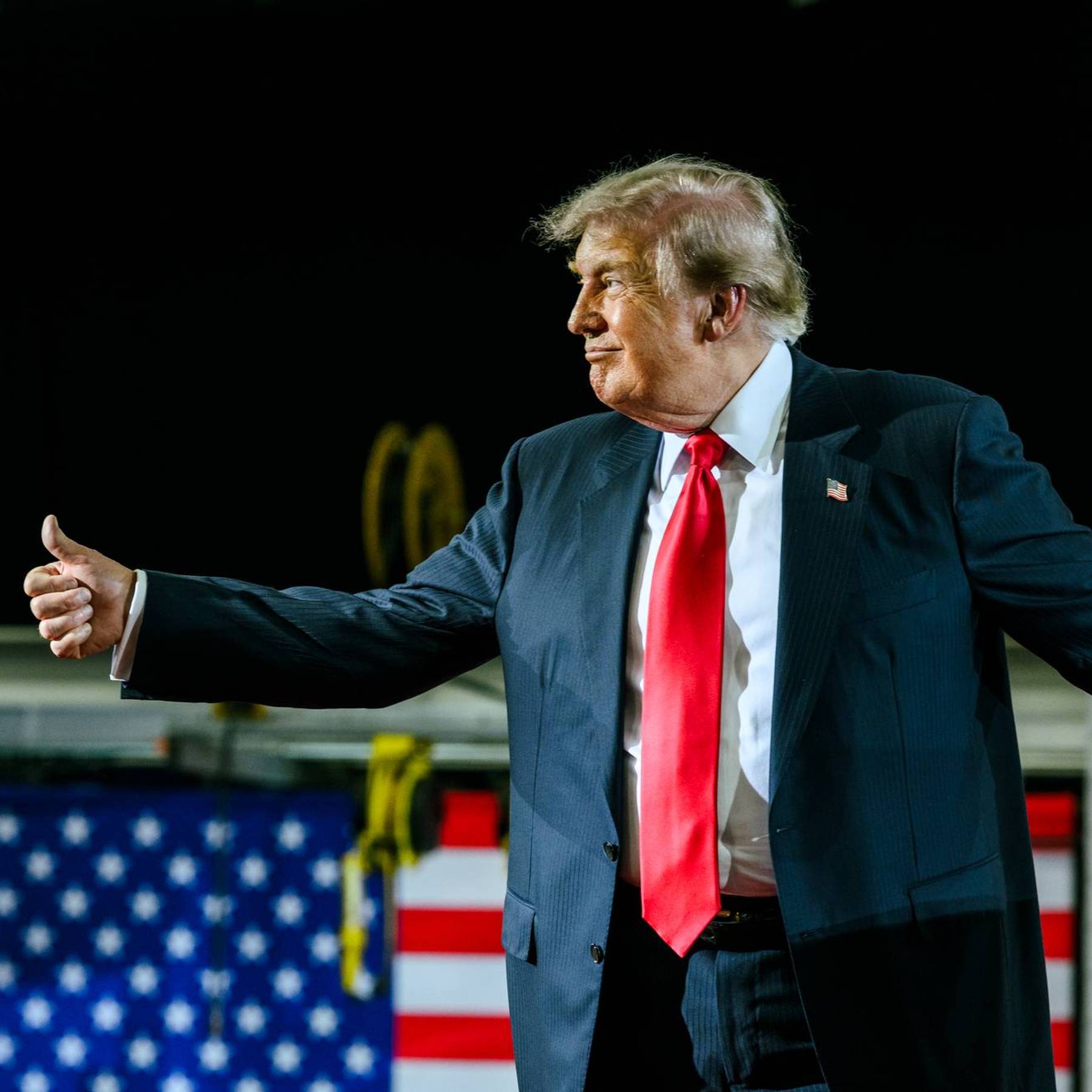
U.S. President Donald Trump speaks while aboard Air Force One for a trip to Michigan on July 27, 2026 in flight.
Truthout is an indispensable resource for activists, movement leaders and workers everywhere. Please make this work possible with aquick donation.
President Donald Trump claimed that the U.S. has seized over $13 billion in oil revenues from Venezuela and is using it for “running the country” in remarks on Monday in which he threatened to do the same to Iran.
Late last week, the Financial Times estimated that the U.S. has put roughly $13 billion of Venezuela’s oil revenues into a reported U.S. Treasury account ever since the Trump administration’s likely illegal coup operation in Venezuela in January. The report pointed out that the administration has said very little about the money it’s seized thus far, outside of claiming that it is being spent on helping the government.
The report also said that there are very few indications that it’s being spent to boost the ailing economy in Venezuela, which also suffered two devastating earthquakes last month, “a potential sign that the US has not sent all the revenues back to Caracas.”
Answering a question from a reporter on Air Force One on Monday, Trump claimed that the U.S. has actually seized more than $13 billion, and was tight-lipped in answering where the funds have gone. He suggested, however, that some of the revenues have gone toward paying the U.S. back for the strike operation on January 3 in which the U.S. abducted then-President Nicolás Maduro and killed dozens.
“Venezuela, we paid for that war many times over, and that’ll happen with Iran also,” Trump said.
As Delcy Rodríguez capitulates to US demands, the Venezuelan left is calling for resistance. By Rodrigo Acuña , Truthout
June 13, 2026
When pressed again on where the money has gone, Trump repeatedly said it’s going toward “running the country.” However, he suggested that Congress should pass legislation to allow the funds to be rerouted to the U.S. military.
“It can’t go to the military, Congress has to approve it. Congress doesn’t like approving money for the military, they like giving it to things that shouldn’t be done. But we’re taking in a lot of money — billions and billions of dollars from Venezuela,” he said. “That’ll be done to Iran, too.”
Trump administration officials have previously said that the U.S. is using Venezuela’s money to fund the country, an account that some within the country have disputed. In an interview with NBC in February, Energy Secretary Chris Wright said that Trump has “final say” over what funding is allowed to go back into Venezuela.
“The largest revenue source that funds the government … is now controlled by the United States,” Wright said at the time. “If they’re driving positive change that benefits Americans and is improving the life opportunities of people in Venezuela, that money will flow. If they steer off that path, we have, just simply, tremendous leverage.”
Meanwhile, Trump also threatened to use any potential funds seized from Iran to pay for damages that the country has done to American assets amid the U.S.-Israeli war on the country.
“We’re going to use Iran’s money to pay for the damage they did. The Iran money that we control,” he said.
Media that fights fascism
Truthout is funded almost entirely by readers — that’s why we can speak truth to power and cut against the mainstream narrative. But independent journalists at Truthout face mounting political repression under Trump.
We rely on your support to survive McCarthyist censorship. Please make a tax-deductible one-time or monthly donation.
by Dave DeCamp | June 10, 2026 at 5:22 pm ET | Cuba
US Secretary of War Pete Hegseth visited US troops at the US base in Guantanamo Bay, Cuba, on Wednesday and issued a threat to the Cuban government.
Hegseth said that it would be “unwise” for the Cuban government to acquire weapons that could reach the US, saying that it would “be inviting the kind of confrontation not only do they not want, but they could not stand.”
.@SECWAR “Then you look at Cuba…
That government has decisions to make about what kind of reforms it wants to pursue—it’s not my job to make that decision for them.
It’s our job at the WAR DEPARTMENT to be prepared for whatever our Commander in Chief asks us to do on behalf of… pic.twitter.com/sYZKYPGQZD
— DOW Rapid Response (@DOWResponse) June 10, 2026
The Pentagon chief also said that the Department of War was ready for anything that President Trump may order, and recent reports have said that the US military has placed enough assets in the region to be ready if the president orders an attack.
“What happens with the future of Cuba is in the hands of the president of the United States and the leadership of Cuba,” he said. “No matter what, the Department of War is going to be prepared and postured for any possible contingency.”
The Trump administration has set up potential pretexts for an attack on Cuba, including the indictment of the country’s 94-year-old former president, Raul Castro, suggesting the US may launch a similar operation to the one to abduct Venezuelan President Nicolas Maduro, which Hegseth referenced.
“[Maduro] thought he could flaunt the United States of America,” Hegseth said. “Then he found out [he could not], in about 45 minutes, in the middle of the night, in the most heavily fortified base inside their capital city.”
If you liked this article, please support Antiwar.com. We are 100% reader-supported.
Dave DeCamp is the news editor of Antiwar.com, follow him on Twitter @decampdave.

 Havana, the author working in darkness. (Foto: Bill Hackwell)