Israel is pressing the US to restart heavy airstrikes on Iran that would involve the targeted killing of Iranian Parliament Speaker Mohammad Bagher Ghalibaf, one of Tehran’s lead negotiators, and attacks on the country’s oil infrastructure, Capital & Empire reported on Thursday.
The report, which cited US sources familiar with a classified report circulating within the US intelligence community, said Israel is aggressively pushing for the US to abandon talks with Iran and insisting that destroying oil infrastructure in the country could bring about regime change while also downplaying the impact the renewed full-scale war will have on the global economy.
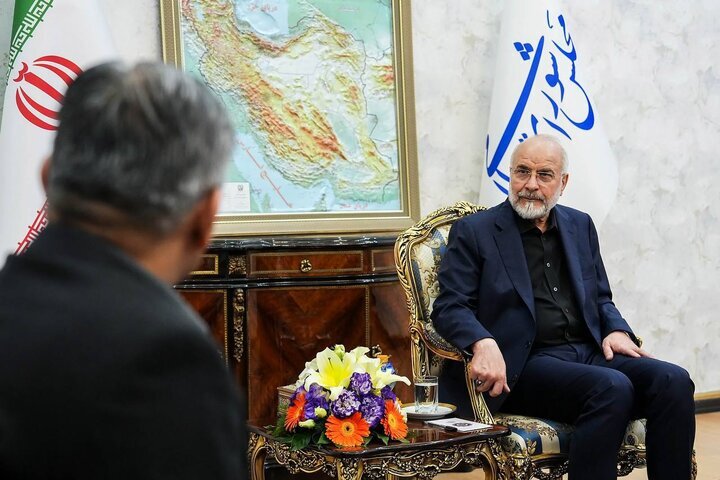
Iranian Parliament Speaker Mohammad Bagher Ghalibaf hosts Pakistani Interior Minister Mohsin Naqvi in Tehran on May 17, 2026 (Office of the Iranian Parliament Speaker)
The New York Timespreviously reported that Israeli Prime Minister Benjamin Netanyahu had pitched President Trump on launching the war back in early February by making a series of predictions that proved to be wrong, including the idea that Iran was ripe for regime change, that its ballistic missile program could be destroyed within weeks, and that it would be too weak to close the Strait of Hormuz.
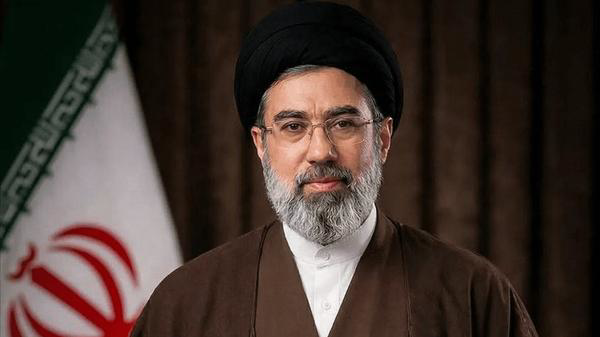
Israeli officials have been clear that they want to restart the US-Israeli bombing campaign and have threatened to kill Iranian Supreme Leader Ayatollah Mojtaba Khamenei, who replaced his father, Ali Khamenei, after he was killed by an Israeli strike on February 28, the first day of the war.
The Capital & Empire report said that Israel has made the case to kill Ghalibaf directly to the US Department of War, and has focused on him since Khamenei’s whereabouts are unknown. The US intelligence report also determined that Israel wouldn’t target Iranian Foreign Minister Abbas Araghchi.
Israel has a history of targeting officials involved in negotiations. In September 2025, Israel attempted to kill Hamas leader Khalil al-Hayya in Qatar as he was involved in negotiations on a Gaza ceasefire deal. The attack killed al-Hayya’s son, and an Israeli airstrike in Gaza recently killed another son of al-Hayya as he was involved in talks with the US-led so-called “Board of Peace.”
The Kentucky congressman’s stand against US aid to Israel and the Iran war triggered a pro-Israel donor backlash that reveals how firmly the lobby still shapes Republican politics
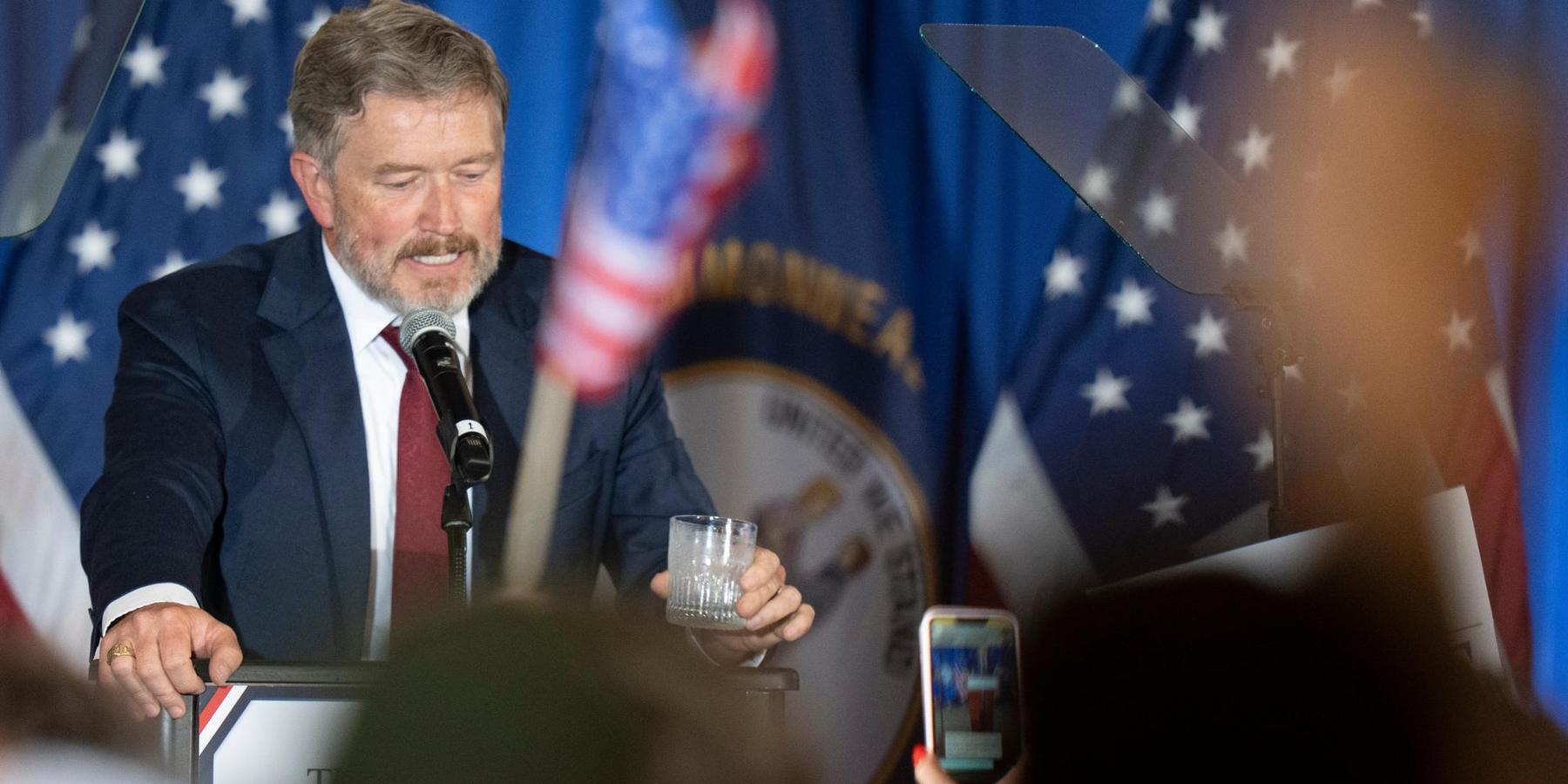
US Congressman Thomas Massie speaks with supporters after his concession speech in Hebron, Kentucky, United States, 19 May 2026 (Jon Cherry/Getty Images/AFP)
In American politics, certain transgressions are tolerated. Challenging Israel is not among them. US Congressman Thomas Massie crossed that line – and on Tuesday, paid the price.
His defeat in Kentucky’s 4th Congressional District was widely portrayed as another demonstration of President Donald Trump‘s continued dominance over the Republican Party. That explanation is politically convenient but analytically incomplete.
What happened to Massie was not merely a clash of personalities or a dispute over loyalty to Trump. It was the enforcement of a political boundary deeply embedded within the structure of American power. Massie had violated one of the deepest taboos in American politics: alienating the Israel lobby.
Unlike many politicians accused of dissent, Massie’s divergence was not rhetorical or symbolic. It was documented through votes, public statements and a sustained critique of unconditional American support for Israel.
As the only member of Congress to vote against House Resolution 888 in November 2023, Massie committed a cardinal sin – rejecting the congressional resolution that affirms Israel’s “right to exist” and opposes calls for the dismantling of the Israeli state.
New MEE newsletter: Jerusalem Dispatch
Sign up to get the latest insights and analysis on Israel-Palestine, alongside Turkey Unpacked and other MEE newsletters
The resolution passed 412-1, with even progressive “Squad” members including Alexandria Ocasio-Cortez, Ilhan Omar and Ayanna Pressley voting in favour.
Massie was also among a small number of members of Congress who opposed emergency military aid packages and several pro-Israel resolutions after 7 October 2023.
He also consistently argued that all foreign aid – particularly aid to Israel – violated both constitutional principles and fiscal conservatism. At a moment when Israel was carrying out what numerous human rights organisations, UN experts, genocide scholars and even former Israeli officials described as genocidal acts in Gaza, Massie openly opposed using American taxpayer money to finance the war.
In Washington, such positions are treated as dangerous deviations from the consensus on Israel – defiance that must be politically punished.
Massie did not simply challenge a policy, but confronted an entrenched power structure that has shaped American foreign policy in the Middle East for decades
Support for Israel has been one of the most entrenched bipartisan pillars of American foreign policy. Since October 2023, the United States has poured tens of billions of dollars in military aid to Israel while shielding it at the United Nations.
The Costs of War Project at Brown University puts the direct figure at well over $22bn.
In Gaza, the health ministry and international observers documented more than 75,000 Palestinians killed and over 180,000 injured – countless left maimed – as entire neighbourhoods, hospitals, universities, schools, water facilities, electric grids and refugee camps have been systematically destroyed.
Massie did not simply challenge a policy, but confronted an entrenched power structure that has shaped American foreign policy in the Middle East for decades.
A familiar pattern
Washington has witnessed similar episodes before. Former Republican Congressman Paul Findley of Illinois lost his seat in 1982 after criticising Israeli policy and the growing influence of Aipac. Likewise, Republican Senator Charles Percy of Illinois suffered a similar fate in 1984 after tensions with pro-Israel lobbying networks.
In the past two decades, many Democratic members of Congress encountered the same fate. Cynthia McKinney in Georgia, Earl Hilliard in Alabama, Jamaal Bowman in New York and Cori Bush in Missouri all faced massive financial interventions after criticising Israeli policy or supporting Palestinian rights.
These cases are too numerous and too targeted to remain anecdotal. The system enforcing them is structural. Aipac’s super PAC, which labelled Massie “the most anti-Israel Republican in the House”, contributed $9m to the race alone. When the result came in, Aipac declared: “Pro-Israel Americans are proud to help defeat anti-Israel candidates.”
US: Anti-Aipac congressman Massie unseated in most expensive House primary ever
During the Cold War, questioning anti-communist orthodoxy carried political consequences. Today, questioning unconditional support for Israel carries the same weight of orthodoxy in Washington.
The Kentucky race became the most expensive House primary in modern American history, with spending exceeding $34m. Yet the significance lies as much in how the money was mobilised and coordinated as in the sheer amount spent.
Press reports indicate that millions in outside expenditures came from networks aligned with pro-Israel advocacy organisations and donor ecosystems that have increasingly intervened in congressional races nationwide.
The campaign against Massie followed a now-familiar model: massive independent expenditures, relentless advertising blitzes, coordinated media narratives and efforts to portray dissenting candidates as extremists or unreliable actors outside the accepted boundaries of Washington politics.
Massie was not merely outspent but politically marked and strategically targeted.
These campaigns are not simply about defeating one candidate. They are designed to create fear and send a message to every member of Congress that opposition to Israeli policy, especially during wartime, carries severe political costs regardless of seniority, popularity or ideological credentials.
A shifting public
American public opinion has shifted dramatically against Israel. Multiple polls conducted over the past two years show a stark erosion of support, particularly among younger Americans. A February Gallup poll showed that sympathy for Palestinians had surpassed sympathy for Israelis for the first time.
Pre-election polling found that older Republican voters in the district broke decisively for Ed Gallrein, while younger and middle-aged voters leaned towards Massie – a generational divide visible far beyond Kentucky.
Even among Republicans, support for unconditional military involvement abroad has weakened considerably, especially after the escalation towards the war on Iran. A growing number of Americans, above all young people, view Israel not as a strategic asset but as a source of regional instability capable of dragging the United States into wider wars that serve no American national interest.
Massie reflected this sentiment openly. During debates surrounding the possibility of direct military confrontation with Iran, he warned that Washington was being pushed towards another catastrophic Middle Eastern war driven primarily by Israeli regional interests rather than core American ones.
In one widely circulated statement, Massie argued that Congress should not authorise military escalation without direct constitutional approval and questioned why American taxpayers and soldiers should bear the burden of wars initiated by foreign policy priorities disconnected from domestic needs.
After decades of war, debt and the decline of basic services, those arguments now resonate with far more Americans than Washington elites care to admit.
Israel’s growing public relations crisis has intensified these tensions. Images from Gaza – where entire families have been erased, children buried beneath rubble and famine conditions imposed on a trapped civilian population – have transformed global public opinion.
South Africa’s genocide case before the International Court of Justice further amplified international scrutiny, while major human rights organisations accused Israel of committing war crimes and crimes against humanity. For millions around the world, Gaza destroyed the myth that western human rights discourse applies equally to all people.
Facing this crisis of legitimacy, Israel and its supporters have invested heavily in narrative control across media platforms, digital spaces, universities and political institutions. Israeli Prime Minister Benjamin Netanyahu, himself an indicted war criminal, has repeatedly boasted about Israel’s influence within western media networks and social media platforms. The struggle is increasingly one over information and perception.
In his concession speech, Massie remarked: “It took a while to find Ed Gallrein in Tel Aviv.”
Massie was not simply conceding defeat to his opponent. He was identifying the terrain on which the battle had been fought. This was not merely a Kentucky primary race. It was an election shaped by national donor networks, foreign policy alignments and political enforcement mechanisms extending far beyond the district itself.
The wider message
Some commentators tied to the Israeli lobby attribute Massie’s defeat solely to Donald Trump. But this narrative is both factually flawed and analytically superficial. Trump certainly played an important role – he endorsed former Navy SEAL Ed Gallrein and repeatedly attacked Massie as disloyal, transforming the primary into a referendum on allegiance to the Maga movement.
Yet Trump alone does not generate more than $30m in congressional primaries, nor does he independently mobilise a vast donor infrastructure against a single congressman among dozens who have disagreed with him over the years.
A more accurate reading is that Trump’s machinery converged with well-established Zionist donor networks and enforcement structures – what some critics now describe as the “Epstein Class”: a nexus of billionaire financiers, political operatives, media influence networks and intelligence-linked figures whose loyalties often appear more connected to preserving Israeli regional supremacy than defending coherent American national interests.
Trump did not create the target on Massie’s back – he just helped pull the trigger.
What happened to Massie exposes a structural reality long understood but rarely discussed openly: there are policy red lines within the American system, and Israel sits among the brightest. Crossing those lines carries consequences – coordinated funding flows, nationalised opposition campaigns, coordinated messaging portraying dissent as extremism, and political isolation.
Trump’s machinery converged with well-established Zionist donor networks and enforcement structures – what some critics now describe as the ‘Epstein Class’
But the implications extend far beyond Kentucky.
To Maga Republicans, it signals that “America First” has limits. One may challenge trade agreements, immigration policy, global institutions or even party leadership. But challenging Washington’s alignment with Israel remains extraordinarily dangerous.
To libertarian conservatives, the answer is equally stark: fiscal conservatism and scepticism towards foreign intervention remain acceptable only until they intersect with Israel.
And to the broader Republican Party, the lesson could not be clearer: party discipline increasingly requires adherence to Trumpism and to a foreign policy consensus in which Israeli priorities remain deeply embedded within the permanent foundations of American power.
Massie was defeated for one main reason: he challenged one of the most protected structures within American political life. Once that occurred, the Zionist machinery activated with remarkable speed: enormous funds mobilised, opposition networks unified overnight, media narratives deployed and political deterrence established.
These are not passing phenomena. They discipline political behaviour. And as public anger over Gaza deepens and younger Americans continue breaking with old political orthodoxies, it is no longer clear that these instruments of political discipline can hold indefinitely in a society already entering a deeper crisis of legitimacy.
Yet despite Massie’s defeat, the results of recent primary races suggest that Aipac’s long-standing dominance over American politics may be waning. On the same evening, Chris Rabb – a democratic socialist, vocal Palestine advocate and open Aipac critic – won the Democratic primary in Pennsylvania’s 3rd Congressional District against two Aipac-backed opponents.
Earlier this year, Aipac’s campaign against moderate Democrat Tom Malinowski in New Jersey backfired spectacularly, inadvertently propelling Analilia Mejia – the race’s most vocal Palestine advocate – to victory.
The ground is shifting and the lobby knows it.
The views expressed in this article belong to the author and do not necessarily reflect the editorial policy of Middle East Eye.
Iranian Supreme Leader Ayatollah Mojtaba Khamenei said in a written statement on Tuesday that the US will no longer have a “safe haven” in the Middle East for its military bases, remarks that come after the Iranian military struck US bases across the region during the US-Israeli bombing campaign against Iran.
In the statement, released to mark the Hajj season, when Muslim pilgrims travel to Mecca, Saudi Arabia, Khamenei addressed other Muslim nations in comments that appeared to be directed at the Gulf Arab states that host US bases and were struck by Iranian missiles and drones.
Ayatollah Mojtaba Khamenei (PressTV)
“I, with sincerity and purity of intention, invite all Islamic countries and governments to friendship and cooperation in goodness, so that by working together we may take steps toward the advancement of the Islamic Ummah and the resolution of the Islamic world’s problems,” Khamenei said, according to an English translation of the statement posted on his website.
“What is certain in this regard is that the hands of time will not turn back, and the nations and lands of the region will no longer serve as shields for US bases. The United States not only will no longer have a safe haven for its mischief and for establishing military bases in the region but day by day, it is growing more distant from its former status,” he added.
The Iranian leader also referenced Israel, saying that the “shaken Zionist regime and the cancerous tumor of Israel are likewise approaching the final stages of their wretched existence.”
Khamenei has yet to make a public appearance since replacing his father, Ali Khamenei, who was killed by an Israeli strike alongside other members of his family on February 28, the first day of the joint US-Israeli bombing campaign. Western media reports have said that Mojtaba Khamenei was wounded in the strike but that he is still playing a critical role in shaping Iran’s war strategy.
Anwar Iqbal, Washington, May 23, 2026 Updated about 4 hours
WASHINGTON: A recent report by the Congressional Research Service (CRS) says the United States lost or damaged 42 military aircraft during Operation Epic Fury, the 40-day military campaign against Iran that began on February 28, 2026.
The report, released last week and circulated by several US media outlets on Friday, is believed to be the most detailed public accounting so far of US aircraft losses in the conflict. However, the Pentagon has not yet issued its own comprehensive assessment.
In the report, CRS researchers said they compiled the figures from news reports, official Pentagon statements, and announcements by US Central Command (Centcom).
The report notes that the Department of Defence — now also using the title “Department of War” under an executive order issued in September 2025 — has not publicly provided a full list of losses from the campaign.
During a congressional hearing on May 12, Acting Pentagon Comptroller Jules W. Hurst III said that the estimated cost of US military operations against Iran had risen to $29 billion. He said much of the increase came from “repair or replacement costs for equipment.”
The aircraft losses listed in the CRS report include fighter jets, refuelling aircraft, helicopters, surveillance planes, and drones.
Among the most serious incidents were the loss of four F-15E Strike Eagle fighter aircraft. Centcom said three of the aircraft were accidentally shot down by friendly fire over Kuwait on March 2. All six crew members survived after ejecting safely. A fourth F-15E was reportedly shot down during combat operations over Iran on April 5, although both crew members were later rescued.
The report also cited damage to an F-35A stealth fighter caused by Iranian ground fire during operations over Iran in March.
An A-10 Thunderbolt II attack aircraft was lost after being hit by enemy fire on April 3. According to Chairman of the Joint Chiefs of Staff Gen. Dan Caine, the pilot ejected safely before the aircraft crashed.
The CRS report also described significant losses among support aircraft.
Two KC-135 aerial refueling aircraft were involved in an incident over friendly airspace on March 12. One crashed in Iraq, killing all six crew members on board, while the second made an emergency landing. Five additional KC-135 tankers were damaged in an Iranian missile and drone strike on Prince Sultan Air Base in Saudi Arabia.
One E-3 Sentry airborne warning and control aircraft (AWACS) was also damaged during the same attack. Later reports said the aircraft had been parked on an unprotected taxiway.
Special operations forces also suffered losses. Two MC-130J Commando II aircraft supporting a rescue mission for a downed F-15E were reportedly intentionally destroyed on the ground in Iran after they became unable to leave the area. Their crews were evacuated safely.
An HH-60W Jolly Green II rescue helicopter was damaged by small-arms fire during rescue operations inside Iran.
The largest losses involved unmanned aircraft. According to the report, the US military lost 24 MQ-9 Reaper drones during the campaign. Another MQ-4C Triton surveillance drone crashed in what a US Navy document described as a mishap.
The CRS said the reported losses could raise major questions for Congress about military readiness, replacement costs, and the ability of the US defence industry to replace aircraft quickly during a prolonged conflict.
The report also warned that the losses may reveal growing risks for US aircraft operating in heavily contested airspace and could force the Pentagon to reconsider tactics, deployment strategies, and future procurement plans.
Rep. Thomas Massie (R-Ky.) lost his bid for re-election to primary opponent Ed Gallrein 54% to 45% with nearly all votes counted on Tuesday night.
Massie’s defeat will no doubt be seen as a triumph of both the continued durability of pro-Israel forces in the party, as well as the president’s own ability to dictate outcomes in intra-party races. Sen. Bill Cassidy (R-La.), who voted to impeach Donald Trump during his first term, lost his primary election over the weekend against a Trump-endorsed candidate.
Massie, who had served seven terms representing his state, is a fiscal conservative and libertarian. He had emerged during Trump’s first term as a rare Republican who stood up to the president, notably opposing Trump on his massive $2.2 trillion COVID spending bill. More recently he proposed and helped to pass a law in November opening the Epstein files, and then supported a series of war powers votes as a major critic of Trump’s war on Iran. Massie has also opposed bills that would provide aid to Israel for its own wars.
This drew Trump’s ire. The president called the Kentucky incumbent “Worst Congressman in the History of our Country,” in a series of social media posts hours before the primary. Trump has also called him a “moron,” “bum,” “obstructionist,” and a “fool.”
The race also attracted the attention of the Republican Jewish Coalition and the pro-Israel lobbying group the American Israel Public Affairs Committee (AIPAC). PACs associated with both, with multi-million dollar contributions from powerful pro-Israel GOP donors Miriam Adelson, Paul Singer, and John Paulson, helped it to become the most expensive primary election in the U.S. history. The two other most expensive primaries (in 2024) also featured AIPAC-backed candidates defeating incumbents (both Democrats) who were deemed to be too anti-Israel.
Professor Graham Allison’s concept has influenced the way scholars and leaders think about competition between global powers.
By Nora Delaney
Fall 2025
HOW SHOULD LEADERS AND POLICYMAKERS THINK about relative shifts in power between countries? Are there principles from history that countries can look back to that help understand geopolitical tensions when countries increase their political and economic power? These are the questions that help us navigate conflicts and understand prospects for peace.
Graham Allison, the Douglas Dillon Professor of Government and former Kennedy School dean, has argued that we can take a lesson from the ancient Greek historian Thucydides. Thucydides chronicled the Peloponnesian War in the 5th century BCE when the rising city-state of Athens challenged the dominant existing power of Sparta. Thucydides wrote, “It was the rise of Athens and the fear that this instilled in Sparta that made war inevitable.”
Allison has looked to Thucydides and his exploration of the tensions between a rising and established world power to understand the relationship between China and the United States. In his 2017 book “Destined for War: Can America and China Escape Thucydides’ Trap?,” Allison argues that history shows many instances where rising powers challenge established ones, and often these situations end in war—though not always. Allison’s Thucydides’ Trap has since become an influential metaphor in international relations as experts think about the friction between China and the United States—and ways that they might avoid devastating conflict. The Institute for National Strategic Studies and the National Defense University Press, for example, published analyses interpreting the Thucydides Trap in the context of U.S.–China dynamics. Allison’s analysis has also generated attention in China. President Xi Jinping frequently uses it to identify the challenge today’s two great powers face; for example, in his meeting with Senate majority leader Chuck Schumer in October 2023, he said “The ‘Thucydides Trap’ is not inevitable, and Planet Earth is vast enough to accommodate the respective development and common prosperity of China and the United States.” Indeed, during Allison’s quarterly visits to China, Xi and key members of his team have engaged him directly to explore opportunities for escaping the Thucydides Trap.
Allison chairs the Harvard China Working Group that includes faculty from across the university and is pursuing ongoing work at the Kennedy School that grapples with the nature and future of U.S.-China competition. The rivalry between the United States and China, Allison has argued, encompasses four key areas that he and his colleagues at the Kennedy School’s Belfer Center for Science and International Affairs have researched and reported on: rivalry in economics, technology, military power, and diplomacy. These reports were originally prepared as part of a package of transition memos for the Trump-Biden transition after the November 2020 election.
Allison and others at the Belfer Center and the Kennedy School continue to lead in our understanding of the ways the United States and China compete and cooperate as world powers.
With the US ceasefire announced on April 8 all but over, the conflict with Iran is intensifying with President Trump escalating threats of renewed military attacks against Tehran.
On Monday, Trump dismissed Iran’s latest reply to the US proposal as “totally unacceptable,” called it a “piece of garbage,” and said he “didn’t even finish reading it.” He said the ceasefire—which effectively ended last week when the US fired on Iranian military targets—was on “massive life support.”
On Tuesday, before departing for China, the president continued with the posture that the US is dictating terms to Iran. When asked if he was going to discuss the war with Beijing, Trump said he would talk to President Xi about the war but mostly about trade and added that Iran was not really one of the topics because the US had it “very much under control.”
He told reporters, “We’re only going to make a good deal,” and then said, “We’re either going to make a deal or they’re going to be decimated. One way or the other, we win.”
Trump continued to insist that the US has already “won” and that a deal with Iran has little significance. Along with the threat to “decimate” Iran, Trump warned on May 7 that the US would soon have to “look at one big glow coming out of Iran”—a comment widely understood as a threat to use nuclear weapons.
Iran’s latest confirmed position, as reported by state broadcaster and other outlets, is that any settlement must include war reparations, sanctions relief, release of frozen assets and recognition of Iranian sovereignty over the Strait of Hormuz. Iranian Foreign Ministry spokesman Esmail Baghaei said Tehran was “not asking for anything unusual” and that the country was demanding only its “legitimate rights.”
The Iranian proposal also reportedly included a willingness to dilute part of its enriched uranium and transfer the rest abroad, but not under terms that would amount to a complete capitulation to Washington.
The key political point is that Iran is refusing to accept the framework dictated by US imperialism which, with the support of Israel, has carried out the illegal war including targeting 13,000 sites with missiles strikes and murdering the entire political leadership of the country.
While the White House has portrayed Iran’s position as obstructive, Tehran has consistently and explicitly linked any peace agreement to compensation for damage done and an acknowledgment of its sovereign rights over the strategic waterway.
Over the past 48 hours, there has been no publicly confirmed report of an Iranian or US strike sinking boats in the Strait of Hormuz itself, but the waterway remains the central strategic flashpoint of the war. The US has maintained naval pressure and claimed it is working to reopen the strait, while Tehran has insisted it retains sovereign rights there.
In practical terms, the strait is not under “absolute control” by Washington despite the claim by US Treasury Secretary Scott Bessent on May 4. The ongoing disruption, militarized patrols and negotiations show the strait to be a contested chokepoint which is not under US control.
The fact that Washington is publicly appealing to China to help “open” the strait is an open admission that the US cannot simply command passage through the strait by fiat. Reports on Tuesday that the UAE carried out a covert strike on Iran’s Lavan Island refinery demonstrates that the conflict over the strait involves multiple regional actors operating as proxies for US imperialism.
Although Abu Dhabi has not publicly acknowledged involvement, the reported strike caused a major fire and is expected to disrupt refinery production for months. A report by Reuters also stated, based on accounts from anonymous sources, that Saudi Arabia has been involved in covert anti-Iran operations. These reports confirm that the war is being conducted by a network of state actors, proxies and covert actions across the Gulf, all managed by the US government.
Hurst’s testimony exposed Secretary of War Pete Hegseth’s effort to cover up the escalating cost of the war in testimony before both House and Senate appropriations committees by refusing to answer any questions about the total cost of the ten-week war. Hegseth’s appearance before Congress came amid a White House request for a 2027 military budget of roughly $1.5 trillion.
The Iranian Ministry of Health has reported 3,468 people killed in Iran, including more than 1,700 civilians, and over 26,500 injured. US casualties include roughly 200 wounded service members and 13 dead.
In a Truth Social post on Tuesday, Trump denounced media criticism of the war writing, “When the Fake News says that the Iranian enemy is doing well, Militarily, against us, it’s virtual TREASON in that it is such a false, and even preposterous, statement.” The administration’s attacks on public criticism are being paired with Pentagon restrictions that limit press access including credentials being revoked on “security” grounds.
Department of War policies have also targeted Pentagon reporters and, in the case of military publications, imposed tighter control over content and access. The aim is to silence criticism while expanding censorship and threats of legal action under wartime conditions.
Trump’s insistence that the US does not need any help from China clashes sharply with the fact that top US officials have been publicly urging Beijing to use its influence on Iran to help reopen the Strait of Hormuz. Secretary Bessent called on China to “step up” diplomatically, making clear that Washington is seeking Chinese assistance even while pretending otherwise.
In Lebanon, Israeli strikes continued, resulting in the killing of two paramedics in southern Lebanon on Sunday in strikes on health committee sites. The killing of medical workers—a strategic aim by the Zionist regime throughout the Gaza genocide—exposes the criminal character of the Lebanon campaign.
THE entire peace movement opposed the US/Israeli war against Iran. Opposition went well beyond those normally opposing US actions. It is widely understood that resistance by the peoples of Iran, Lebanon and Yemen, together with the war’s unpopularity in the US, led to Trump losing the first rounds of the conflict.
Even the Wall Street Journal, a fervent supporter of the war, admitted this: “Trump screamed at aides for hours. The Europeans aren’t helping, he said repeatedly. Gas prices averaged $4.09. Images of the 1979 Iranian hostage crisis… had been looming large in his mind, people who have spoken to him said. ‘If you look at what happened with Jimmy Carter…with the helicopters and the hostages, it cost them the election,’ Trump had said in March. ‘What a mess.’”
But it is a misjudgement to believe that because the US and Israel lost the first battle, therefore they have lost the war and are resigned to this. Instead, the peace movement must prepare for a prolonged struggle to defeat US and Israeli attacks on Iran.
Some genuinely taking the right side in this war have written that the US has already suffered its biggest defeat since Vietnam, or even that this is a bigger defeat.
Unfortunately, this is a misanalysis. To prepare for the prolonged anti-war tasks to come, the situation must be seen accurately.
Precisely because if the US loses the war against Iran it would be its biggest defeat since Vietnam, it has no intention of giving up because it lost the first battle.
US ruling circles understand perfectly that US loss of the war would mean significant erosion of the credibility of its international threats, significantly weakening its global position.
They therefore simply conclude that the wrong tactic was chosen, and the US must change this to win the struggle. Even some forces in the US who believe launching the war was a tactical mistake believe that now it has started it must be won.
The Institute for the Study of War put it specifically: “Any US settlement or resolution of the conflict that enables Iran to control traffic through the Strait of Hormuz would represent a major US defeat.” As the Wall Street Journal summarised: “As the president said in his first term, the US shouldn’t start a war it doesn’t intend to win. His challenge now is to prove to Iran’s regime he meant what he said.”
The new US tactics to attempt to win the war can be clearly grasped if it is understood why it lost the first battle. Prior to the first military attack on Iran in June 2025, and the widespread assault launched in February, US policy under Trump had been to force Iran to capitulate to US demands by prolonged economic sanctions.
The US has now intensified this attack, after its defeat in the first round of the war, via its blockade of Iranian ships, with Trump claiming: “Iran is collapsing financially! They want the Strait of Hormuz opened immediately… Starving for cash!”
Such sanctions genuinely damaged Iran’s economy, creating a priority for Iran to attempt to break out of them, while the US can return to bombing anytime it chooses.
Israel, and some in the US, considered sanctions strategically inadequate. Iran is a huge country, 80 times Israel’s size geographically, larger than the EU’s four largest countries put together. Iran’s population is 90 million, compared to Israel’s 10 million. In real economic terms, parity purchasing powers (PPPs), Iran’s GDP is three times Israel’s.
Faced with larger states, Israel’s policy has been, where it is unable to help create governments favourable to itself, to attempt to disintegrate and weaken them — as shown in Iraq and Syria. Israel, judging it unlikely there will be a compliant Iranian government, has long sought to disintegrate that country. Therefore, Iran faces an existential threat from Israel.
The US itself turned to a military assault on Iran, as opposed to sanctions, because of its and Israel’s victories in its genocidal attack on Gaza and also in Syria — where reactionary forces, which Israel and the US supported, came to power.
Israel and the US miscalculated that they could now achieve the same in Iran. The US supplied thousands of Starlink systems and, as Trump publicly admitted, guns to demonstrators in Iran in December and January.
But not only did this fail to overthrow Iran’s government but when the US and Israel launched their full-scale military attack on Iran in February, as even Western media admitted, there was a “rallying around the flag” in Iran — in political terms, the great majority of Iran’s population, whatever their differences on other issues, or their attitude to Iran’s government, united in opposition to the US attack. This was the basis of the US defeat in the first round of the war.
But the US cannot retreat from this conflict due to the role west Asia plays in its strategy. A mistaken analysis was put forward a few years ago that because, due to fracking, the US has become self-sufficient in oil, it would be less interested in controlling west Asia.
The facts show the opposite. The US has waged more wars in the region — against Iraq, Syria, Yemen, Lebanon and Iran.
The US is no longer being itself dependent on West Asia, but constantly waging wars there, has led some to claim that this is because Israel controls US foreign policy — that the tail wags the dog. Any analysis of the relation of forces between the two makes clear this is untrue. Israel cannot produce the weapons it relies on to carry out military terror; the US merely has to threaten to cut off arms and Israel would immediately be brought to heel.
This reality was made clear for all to see when Trump, for short-term tactical reasons, openly enforced an end to Israel’s bombing of Beirut, declaring: “Israel will not be bombing Lebanon any longer. They are PROHIBITED from doing so by the US.” The US does not support Israel because it is controlled by it but because the US finds Israel useful for its own strategy.
Although the US does not need west Asia’s oil for itself, its strategy is to be able to deny it to others, particularly China.
Because this is key for the US, it will not give up its attack on Iran, only the forms will change. Therefore, the peace movement must prepare for a prolonged struggle against US aggression against Iran.
John Ross is senior fellow at the Chongyang Institute for Financial Studies, Renmin University of China, and a member of No Cold War Britain.
US President Donald Trump, flanked by US Secretary of Homeland Security Markwayne Mullin, speaks with workers painting the Lincoln Memorial Reflecting Pool in Washington, DC, on May 7, 2026.
(Photo by Kent Nishimura/AFP via Getty Images)
“It again raises urgent questions: Is this president fit to lead and make consequential decisions that impact countless lives?” said the National Iranian-American Council.
As he struggles to force Iran’s capitulation, US President Donald Trump issued what seemed to be yet another threat to commit an act of mass destruction against the country through nuclear warfare.
When negotiations have faltered in recent weeks, Trump has on multiple occasions defaulted to genocidal threats—including that the “whole civilization” of Iran would “die,” and that the whole country would be “blown up“—which have only seemed to anger and galvanize his Iranian adversaries rather than make them quake with fear.
While the Trump administration has continued to insist that the ceasefire with Iran was still in effect, the two countries have exchanged significant fire this week.
On Thursday, the US launched what it said were “self-defense” strikes on military facilities it claimed were responsible for attempting to attack three US Navy ships in the Strait of Hormuz. Iran called the attacks a violation of the ceasefire and said its attacks on US ships were in response to American bombings of Iranian oil tankers the previous day.
Trump told reporters on Thursday that if the ceasefire were truly over, everyone would know. “If there’s no ceasefire, you’re just going to have to look at one big glow coming out of Iran,” he said. “They’d better sign the agreement fast… If they don’t sign, they’re going to have a lot of pain.”
To many observers, this sounded like a threat from Trump to carry out a nuclear holocaust, though it could also be a redux of Trump’s threats to attack civilian energy infrastructure, which would still be a war crime.
Kelley Beaucar Vlahos, the editor-in-chief of Responsible Statecraft, noted that if it were indeed a nuclear threat, it would be “ironic since the war today supposedly is to prevent Iran from getting… a nuclear weapon.”
The National Iranian-American Council (NIAC) said that “threatening to make Iran glow—with nuclear weapons or otherwise—is an almost unthinkable threat to commit a mass war crime against 92 million people. It must never be normalized.”
“It again raises urgent questions: Is this president fit to lead and make consequential decisions that impact countless lives?” the group said. “Would the chain of command refuse unlawful orders to make Iran ‘glow,’ killing millions of people?”
Trump’s pledge to wipe out Iranian civilization last month drew widespread condemnation and led dozens of Democratic members of Congress to call for his Cabinet to remove him from office using the powers of the 25th Amendment.
“Our leaders need to interrogate these questions seriously, and not write them off as the ramblings of a madman,” NIAC said. “Trump is the president, and may seek to act on these horrible, contemptible threats. This war needs to end, and so [does] Trump’s horrific threatening of war crimes.”
It has now emerged that Trump’s decision to pause the operation was driven by complaints by Saudi Arabia, two US officials told NBC News.
Saudi Arabia’s leaders had been angered by the announcement and the government told the US it would not allow American military forces to fly aircraft through Prince Sultan Airbase, located southeast of its capital, Riyadh.
Officials said the Kingdom denied access for any US aircraft to fly through Saudi airspace as part of Project Freedom.
A call is reported to have taken place between Trump and Saudi Crown Prince Mohammed bin Salman, but the pair were unable to reach a resolution – forcing the US president to axe the operation.
Trump has ruffled feathers across the Gulf with seemingly unilateral decisions (Reuters)
The leaders “have been in touch regularly” and officials are also in touch with vice president JD Vance, secretary of state Marco Rubio, a Saudi source told NBC News.
“The problem with that premise is that things are happening quickly in real time,” the source said about the announcement, adding that the country was “very supportive of the diplomatic efforts” by Pakistan to guide the countries towards an agreement.
A White House official told NBC News that “regional allies were notified in advance.”
The Independent has contacted the White House for comment.
A diplomat in the region said that the operation was not coordinated with Oman either. “The US made an announcement and then coordinated with us,” they said, adding, “We were not upset or angry.”
Trump’s project is said to have angered the Saudi leadership (Getty)
“Because of geography, you need cooperation from regional partners to utilise their airspace along their borders,” one US official explained about the success of the scheme.
The Strait of Hormuz is a vital shipping route for global supplies of oil, fertiliser and other commodities that has been virtually closed since the US and Israel attacked Iran on 28 February, causing global price rises.



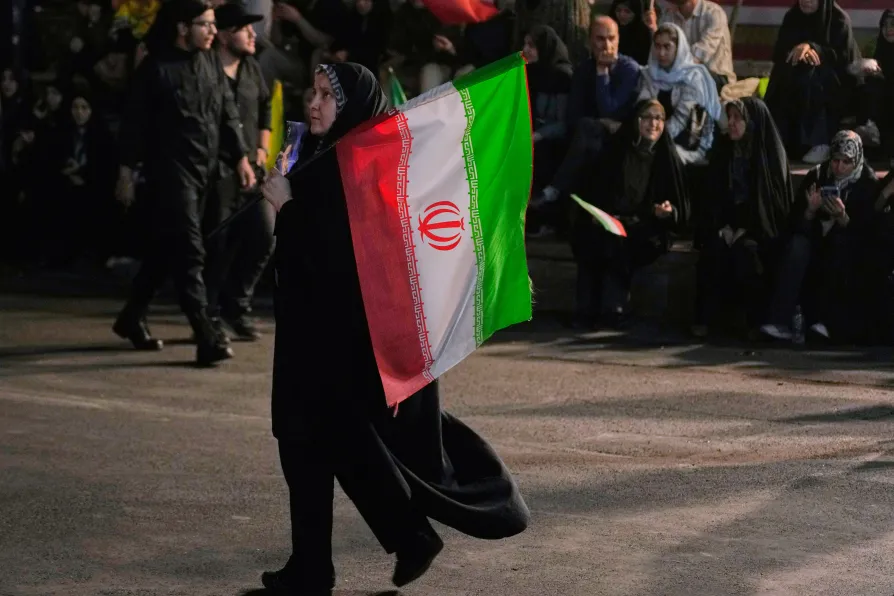
 A woman carries an Iranian flag during a pro-government gathering at Enqelab-e-Eslami, or Islamic Revolution, square in Tehran, Iran, May 4, 2026





You must be logged in to post a comment.