Posts Tagged ‘Middle East’

Defending Iran against US and Israeli aggression will be a prolonged struggle

May 9, 2026

It is too early to assume a US defeat in Iran — we must prepare for a long anti-war struggle, argues JOHN ROSS
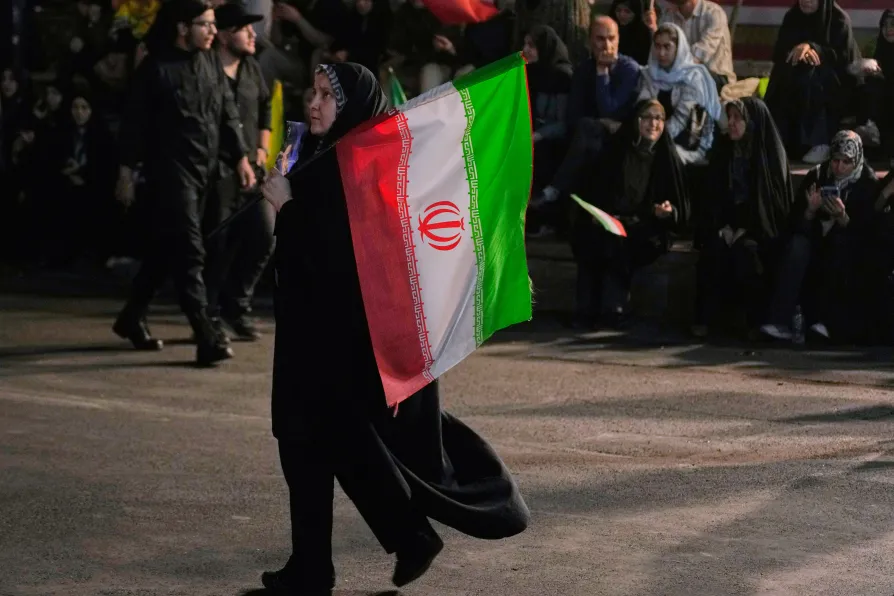
A woman carries an Iranian flag during a pro-government gathering at Enqelab-e-Eslami, or Islamic Revolution, square in Tehran, Iran, May 4, 2026

John Ross, Morning Star, 8 May 2026

THE entire peace movement opposed the US/Israeli war against Iran. Opposition went well beyond those normally opposing US actions. It is widely understood that resistance by the peoples of Iran, Lebanon and Yemen, together with the war’s unpopularity in the US, led to Trump losing the first rounds of the conflict.

Even the Wall Street Journal, a fervent supporter of the war, admitted this: “Trump screamed at aides for hours. The Europeans aren’t helping, he said repeatedly. Gas prices averaged $4.09. Images of the 1979 Iranian hostage crisis… had been looming large in his mind, people who have spoken to him said.  ‘If you look at what happened with Jimmy Carter…with the helicopters and the hostages, it cost them the election,’ Trump had said in March. ‘What a mess.’”

But it is a misjudgement to believe that because the US and Israel lost the first battle, therefore they have lost the war and are resigned to this. Instead, the peace movement must prepare for a prolonged struggle to defeat US and Israeli attacks on Iran.  

Some genuinely taking the right side in this war have written that the US has already suffered its biggest defeat since Vietnam, or even that this is a bigger defeat.

Unfortunately, this is a misanalysis. To prepare for the prolonged anti-war tasks to come, the situation must be seen accurately.

Precisely because if the US loses the war against Iran it would be its biggest defeat since Vietnam, it has no intention of giving up because it lost the first battle.

US ruling circles understand perfectly that US loss of the war would mean significant erosion of the credibility of its international threats, significantly weakening its global position.

They therefore simply conclude that the wrong tactic was chosen, and the US must change this to win the struggle. Even some forces in the US who believe launching the war was a tactical mistake believe that now it has started it must be won.

The Institute for the Study of War put it specifically: “Any US settlement or resolution of the conflict that enables Iran to control traffic through the Strait of Hormuz would represent a major US defeat.” As the Wall Street Journal summarised: “As the president said in his first term, the US shouldn’t start a war it doesn’t intend to win. His challenge now is to prove to Iran’s regime he meant what he said.”

The new US tactics to attempt to win the war can be clearly grasped if it is understood why it lost the first battle. Prior to the first military attack on Iran in June 2025, and the widespread assault launched in February, US policy under Trump had been to force Iran to capitulate to US demands by prolonged economic sanctions.

The US has now intensified this attack, after its defeat in the first round of the war, via its blockade of Iranian ships, with Trump claiming: “Iran is collapsing financially! They want the Strait of Hormuz opened immediately… Starving for cash!”

Such sanctions genuinely damaged Iran’s economy, creating a priority for Iran to attempt to break out of them, while the US can return to bombing anytime it chooses.

Israel, and some in the US, considered sanctions strategically inadequate. Iran is a huge country, 80 times Israel’s size geographically, larger than the EU’s four largest countries put together. Iran’s population is 90 million, compared to Israel’s 10 million. In real economic terms, parity purchasing powers (PPPs), Iran’s GDP is three times Israel’s.

Faced with larger states, Israel’s policy has been, where it is unable to help create governments favourable to itself, to attempt to disintegrate and weaken them — as shown in Iraq and Syria.   
Israel, judging it unlikely there will be a compliant Iranian government, has long sought to disintegrate that country. Therefore, Iran faces an existential threat from Israel.

The US itself turned to a military assault on Iran, as opposed to sanctions, because of its and Israel’s victories in its genocidal attack on Gaza and also in Syria — where reactionary forces, which Israel and the US supported, came to power.  

Israel and the US miscalculated that they could now achieve the same in Iran. The US supplied thousands of Starlink systems and, as Trump publicly admitted, guns to demonstrators in Iran in December and January.

But not only did this fail to overthrow Iran’s government but when the US and Israel launched their full-scale military attack on Iran in February, as even Western media admitted, there was a “rallying around the flag” in Iran — in political terms, the great majority of Iran’s population, whatever their differences on other issues, or their attitude to Iran’s government, united in opposition to the US attack. This was the basis of the US defeat in the first round of the war.

But the US cannot retreat from this conflict due to the role west Asia plays in its strategy. A mistaken analysis was put forward a few years ago that because, due to fracking, the US has become self-sufficient in oil, it would be less interested in controlling west Asia.

The facts show the opposite. The US has waged more wars in the region — against Iraq, Syria, Yemen, Lebanon and Iran.

The US is no longer being itself dependent on West Asia, but constantly waging wars there, has led some to claim that this is because Israel controls US foreign policy — that the tail wags the dog. Any analysis of the relation of forces between the two makes clear this is untrue. Israel cannot produce the weapons it relies on to carry out military terror; the US merely has to threaten to cut off arms and Israel would immediately be brought to heel.

This reality was made clear for all to see when Trump, for short-term tactical reasons, openly  enforced an end to Israel’s bombing of Beirut, declaring: “Israel will not be bombing Lebanon any longer. They are PROHIBITED from doing so by the US.” The US does not support Israel because it is controlled by it but because the US finds Israel useful for its own strategy.

Although the US does not need west Asia’s oil for itself, its strategy is to be able to deny it to others, particularly China.

Because this is key for the US, it will not give up its attack on Iran, only the forms will change. Therefore, the peace movement must prepare for a prolonged struggle against US aggression against Iran.

John Ross is senior fellow at the Chongyang Institute for Financial Studies, Renmin University of China, and a member of No Cold War Britain.

‘An Almost Unthinkable Threat’: Trump Warning That Iran Will ‘Glow’ Sparks Latest Fears of Nuclear Attack

May 8, 2026

US-POLITICS-TRUMP

US President Donald Trump, flanked by US Secretary of Homeland Security Markwayne Mullin, speaks with workers painting the Lincoln Memorial Reflecting Pool in Washington, DC, on May 7, 2026.

(Photo by Kent Nishimura/AFP via Getty Images)

“It again raises urgent questions: Is this president fit to lead and make consequential decisions that impact countless lives?” said the National Iranian-American Council.

Stephen Prager

Common Dreams, May 08, 2026

As he struggles to force Iran’s capitulation, US President Donald Trump issued what seemed to be yet another threat to commit an act of mass destruction against the country through nuclear warfare.

When negotiations have faltered in recent weeks, Trump has on multiple occasions defaulted to genocidal threats—including that the “whole civilization” of Iran would “die,” and that the whole country would be “blown up“—which have only seemed to anger and galvanize his Iranian adversaries rather than make them quake with fear.

RECOMMENDED…

US-POLITICS-TRUMP

‘The Whole Country’s Going to Get Blown Up’: Trump Renews Genocidal Threats to Iran as Ceasefire Collapses

Trump points his finger while speaking sitting in the Oval Office

‘Threats of War Crimes Cannot Be Normalized’: Trump Ripped for Renewed Iran Genocide Threats

While the Trump administration has continued to insist that the ceasefire with Iran was still in effect, the two countries have exchanged significant fire this week.

On Thursday, the US launched what it said were “self-defense” strikes on military facilities it claimed were responsible for attempting to attack three US Navy ships in the Strait of Hormuz. Iran called the attacks a violation of the ceasefire and said its attacks on US ships were in response to American bombings of Iranian oil tankers the previous day.

Trump told reporters on Thursday that if the ceasefire were truly over, everyone would know. “If there’s no ceasefire, you’re just going to have to look at one big glow coming out of Iran,” he said. “They’d better sign the agreement fast… If they don’t sign, they’re going to have a lot of pain.”

To many observers, this sounded like a threat from Trump to carry out a nuclear holocaust, though it could also be a redux of Trump’s threats to attack civilian energy infrastructure, which would still be a war crime.

Kelley Beaucar Vlahos, the editor-in-chief of Responsible Statecraft, noted that if it were indeed a nuclear threat, it would be “ironic since the war today supposedly is to prevent Iran from getting… a nuclear weapon.”

The National Iranian-American Council (NIAC) said that “threatening to make Iran glow—with nuclear weapons or otherwise—is an almost unthinkable threat to commit a mass war crime against 92 million people. It must never be normalized.”

“It again raises urgent questions: Is this president fit to lead and make consequential decisions that impact countless lives?” the group said. “Would the chain of command refuse unlawful orders to make Iran ‘glow,’ killing millions of people?”

Trump’s pledge to wipe out Iranian civilization last month drew widespread condemnation and led dozens of Democratic members of Congress to call for his Cabinet to remove him from office using the powers of the 25th Amendment.

“Our leaders need to interrogate these questions seriously, and not write them off as the ramblings of a madman,” NIAC said. “Trump is the president, and may seek to act on these horrible, contemptible threats. This war needs to end, and so [does] Trump’s horrific threatening of war crimes.”

Saudi Arabia forced Trump to pause Project Freedom after suspending US access to bases and airspace: report

May 7, 2026

The scheme is said to have angered Saudi leadership, who were not consulted in advance

Maira Butt, The Independent, Thursday 07 May 2026 15:09 BST

Trump says Iran strike ‘would’ve been worth it’ even if oil hit $200
On The Ground

President Donald Trump dramatically backtracked on Project Freedom after just two days because its Gulf ally, Saudi Arabia, blocked access to its military bases and airspace, according to reports.

Just 48 hours after announcing the operation to escort ships through the Strait of Hormuz, the US leader paused the initiative to enable negotiations between Washington and Tehran. Iran had attacked ships across the Gulf and struck a port in the UAE on Tuesday.

It has now emerged that Trump’s decision to pause the operation was driven by complaints by Saudi Arabia, two US officials told NBC News.

Saudi Arabia’s leaders had been angered by the announcement and the government told the US it would not allow American military forces to fly aircraft through Prince Sultan Airbase, located southeast of its capital, Riyadh.

Officials said the Kingdom denied access for any US aircraft to fly through Saudi airspace as part of Project Freedom.

Recommended

A call is reported to have taken place between Trump and Saudi Crown Prince Mohammed bin Salman, but the pair were unable to reach a resolution – forcing the US president to axe the operation.

Trump has ruffled feathers across the Gulf with seemingly unilateral decisions
Trump has ruffled feathers across the Gulf with seemingly unilateral decisions (Reuters)

The leaders “have been in touch regularly” and officials are also in touch with vice president JD Vance, secretary of state Marco Rubio, a Saudi source told NBC News.

“The problem with that premise is that things are happening quickly in real time,” the source said about the announcement, adding that the country was “very supportive of the diplomatic efforts” by Pakistan to guide the countries towards an agreement.

A White House official told NBC News that “regional allies were notified in advance.”

The Independent has contacted the White House for comment.

A diplomat in the region said that the operation was not coordinated with Oman either. “The US made an announcement and then coordinated with us,” they said, adding, “We were not upset or angry.”

Trump's project is said to have angered the Saudi leadership
Trump’s project is said to have angered the Saudi leadership (Getty)

“Because of geography, you need cooperation from regional partners to utilise their airspace along their borders,” one US official explained about the success of the scheme.

The Strait of Hormuz is a vital shipping route for global supplies of oil, fertiliser and other commodities that has been virtually closed since the US and Israel attacked Iran on 28 February, causing global price rises.

Recommended

Trump said the operation was a “humanitarian effort to rescue ships running low on essentials after more than two months trapped in the Persian Gulf”.

He said the mission would begin on Monday morning and warned that any interference would “have to be dealt with forcefully”.

From the 1953 Coup to Today: Jeffrey Sachs Explains America’s Endless War on Iran

April 28, 2026

Sheer Post, April 25, 2026

Share this:

In one of the scariest moments in modern history, we're doing our best at ScheerPost to pierce the fog of lies that conceal it but we need some help to pay our writers and staff. Please consider a tax-deductible donation.

Joshua Scheer

Jeffrey Sachs doesn’t raise his voice — he doesn’t have to. In this wide‑ranging conversation with Tucker Carlson, Sachs lays out a devastating, historically grounded indictment of U.S. foreign policy, the manufactured “Iran threat,” and the decades‑long fusion of American empire with Israel’s regional ambitions. What emerges is not a hot take but a cold, clinical autopsy of a war machine that has slipped beyond democratic control.

From the 1953 coup to the present blockade of the Strait of Hormuz, Sachs traces how Washington’s obsession with dominance — and Israel’s pursuit of permanent military supremacy — has pushed the world to the brink of a conflict that could collapse the global economy in weeks. He dismantles the nuclear‑weapons narrative, exposes the bipartisan addiction to sanctions and covert warfare, and warns that the U.S. is now trapped in a crisis of its own making.

This is one of Sachs’ clearest, most unflinching interviews to date — a map of how we got here, and a warning about what comes next if the “grown‑ups” don’t seize the wheel.

Jeffrey Sachs Warns: The U.S.–Israel War Path Toward Iran Is Leading the World Into Economic and Political Collapse

Jeffrey Sachs has spent decades advising governments, studying development, and watching empires rise and fall. In his latest interview, he delivers a stark message: the United States and Israel are steering the world toward a catastrophic confrontation with Iran — and the window for avoiding disaster is closing fast.

A Global Crisis Triggered by a Manufactured One

Sachs argues that the current crisis is not an accident but the predictable outcome of decades of U.S. interference in Iran, beginning with the 1953 CIA‑MI6 coup that toppled Iran’s elected prime minister. That single act — the theft of Iran’s sovereignty and its oil — set the stage for 70 years of hostility, sanctions, proxy wars, and regime‑change fantasies.

According to Sachs, the present escalation is driven less by Iranian behavior than by Washington’s refusal to accept that Iran slipped out of U.S. control in 1979. The “Iran menace,” he says, is a propaganda construct — a way to justify endless pressure on a country that has not invaded another nation in more than a century.

The Strait of Hormuz: A Choke Point for the World Economy

Sachs warns that the closure of the Strait of Hormuz — a direct consequence of the spiraling conflict — has already triggered a global economic emergency. Oil, gas, fertilizers, petrochemicals, and metals flow through this narrow waterway. With it blocked, the world economy is “reeling,” and the clock is ticking.

The off‑ramp exists, Sachs insists: de‑escalation, diplomacy, and reopening the strait. But it requires political maturity — something he argues is in short supply in both Washington and Jerusalem.

Israel’s Parallel Agenda: Regional Dominance at Any Cost

Sachs draws a sharp distinction between U.S. and Israeli motives. For Washington, Iran represents a rebellion against American empire. For Israel, Iran is the last major obstacle to full military dominance across the Middle East and North Africa.

He argues that Israel’s political leadership — backed by a powerful U.S. lobby — has long sought to neutralize Iran not because of nuclear fears, but because Iran resists Israeli hegemony. This, Sachs says, is the real engine behind the push for confrontation.

The Nuclear Lie

One of Sachs’ most forceful points is his dismantling of the nuclear narrative. U.S. intelligence agencies have repeatedly stated that Iran is not pursuing a nuclear weapon. Iran has sought international monitoring and compliance frameworks — including the JCPOA — only to see the U.S. sabotage its own agreements under pressure from domestic political forces aligned with Israel.

Calling the nuclear rhetoric “Orwellian,” Sachs argues that the real goal is regime change, not nonproliferation.

A War That Would Reshape the World in Weeks

Sachs warns that a U.S.–Israel attack on Iran would not be a limited strike. It would trigger a regional war, destroy infrastructure across the Gulf, and plunge the global economy into chaos. Within weeks, he says, the world would look “profoundly damaged,” with the risk of escalation into a global conflict.

This is not hyperbole, Sachs insists — it is the logical outcome of the current trajectory.

The Real Question: Who Is Steering U.S. Policy?

Throughout the interview, Sachs returns to a central theme: the absence of democratic control over U.S. foreign policy. Decisions of war and peace are being shaped by lobbies, political vanity, and imperial reflexes — not by the interests of the American public.

The result is a government that no longer serves its citizens, a political class insulated from consequences, and a foreign policy apparatus that treats global stability as collateral damage.

A Final Warning

Sachs’ message is clear: the U.S. and Israel are playing with forces they cannot control. The world is at a fork in the road — diplomacy or disaster — and the people making the decisions are the least equipped to choose wisely.

For Americans, the stakes are not abstract. Sachs argues that the economic, political, and moral costs of this conflict will fall squarely on the public, not on the leaders who helped create it.

Report: Iran Caused Far More Damage to US Bases Than the Trump Administration Has Acknowledged

April 27, 2026

US officials told NBC that a US base in Kuwait was bombed by an Iranian fighter jet

by Dave DeCamp | April 26, 2026 at 1:25 pm ET

Iranian attacks on US bases across the Middle East have caused far more damage than the Trump administration has publicly acknowledged, and an Iranian fighter jet was able to bomb at least one US base, NBC News reported on Saturday, citing unnamed US officials.

The administration has attempted to cover up the damage to US bases in the war, and has gone as far as requesting that Planet Labs and other satellite imagery companies black out war images, making it difficult to ascertain the damage.

The NBC report said that the Pentagon has also kept the information on the damage from Congress. “No one knows anything. And it’s not for lack of asking,” a Republican congressional aide told the outlet. “We have been asking for weeks and not getting specifics, even as the Pentagon is asking for a record high budget.”

Iranian missile and drone attacks have targeted US bases in seven Middle Eastern countries: Bahrain, Kuwait, Saudi Arabia, the UAE, Iraq, Jordan, and Qatar. US officials said that an Iranian F-5 fighter jet was able to bomb the US base at Camp Buehring in Kuwait despite it having air defenses, marking the first time in many years that an enemy fixed-wing aircraft struck a US military installation.

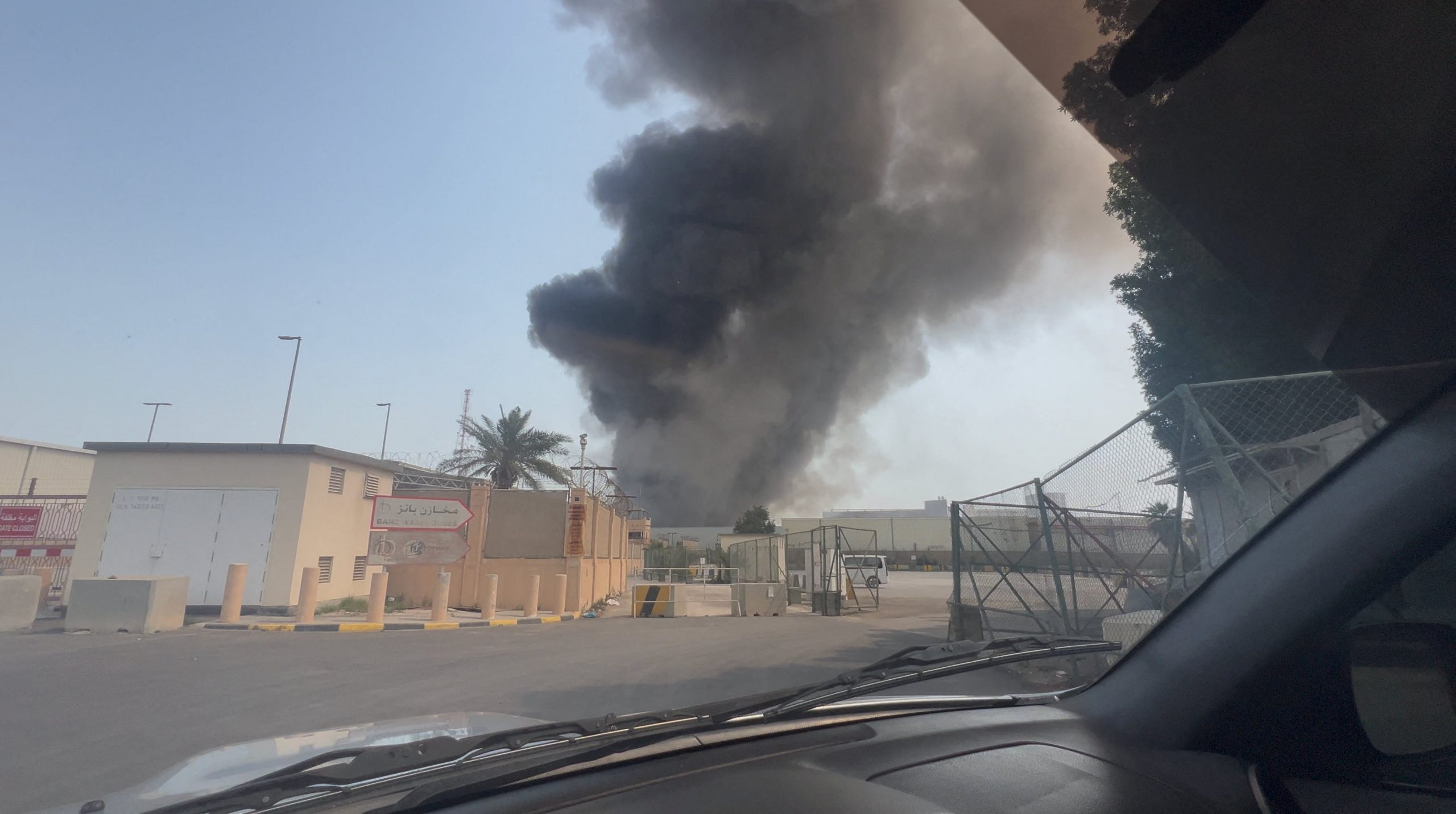
Smoke rises from the direction of a US naval base after a missile attack on the service center of the US Fifth Fleet in Manama, Bahrain, February 28, 2026 (screenshot of social media footage obtained by REUTERS)

The US armed Iran with Northrop Grumman-made F-5 fighter jets before the 1979 Islamic Revolution, and Iran has developed its own version of the aircraft, known as the HESA Kowsar.

Kuwait was also the site of a March 1 Iranian drone attack that killed six US Army Reserve soldiers and injured more than 20. The drone targeted a makeshift operations center in Port Shuaiba, and according to survivors of the attack who spoke to CBS News, the facility was unprotected despite claims from US War Secretary Pete Hegseth that the drone was able to “squirt” through air defenses.

The Pentagon has confirmed the deaths of at least 13 US soldiers and the injuries of more than 400 in the war. The bases across the region were mostly evacuated since they were so vulnerable to attack, something The New York Times previously reported. “Many of the 13 military bases in the region used by American troops are all but uninhabitable, with the ones in Kuwait, which is next door to Iran, suffering perhaps the most damage,” the Times reported on March 25.

The NBC report said that the headquarters of the US Navy’s Fifth Fleet in Bahrain “sustained serious damage” and that other US bases in the country also suffered serious damage that is likely repairable. The report also cited the American Enterprise Institute (AEI), a Washington-based think tank, which said it assessed Iran hit more than 100 targets across 11 bases, and that the repairs would cost at least $5 billion, though the number doesn’t account for some of the radars, weapons systems, and other equipment that was destroyed.

‘At the Request of Israel’: US Legal Memo Reveals Reason behind War on Iran

April 26, 2026

April 25, 2026 News

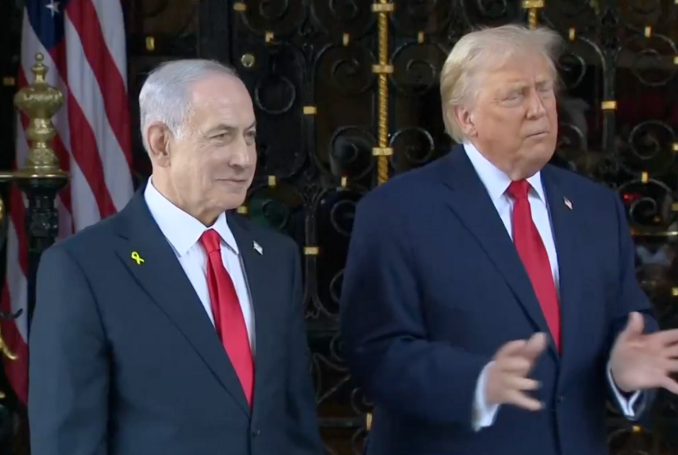
US President Donald Trump and Israeli Prime Minister Benjamin Netanyahu. (Photo: video grab)

By Palestine Chronicle Staff  

A US legal memo reveals Iran war was launched at Israel’s request, contradicting Trump’s repeated claims of independence.

Key Developments

  • US document states war was conducted in “collective self-defense of its Israeli ally.”
  • Admission contradicts Donald Trump’s claims that Washington acted independently.
  • Memo frames ongoing war as legally continuous conflict, removing need for renewed justification.

US Memo Contradicts Trump Narrative

A US State Department legal memorandum has revealed that the so-called Operation Epic Fury, launched on February 28, was carried out “at the request of and in the collective self-defense of its Israeli ally,” directly contradicting repeated public claims by US President Donald Trump that Washington acted independently in its war against Iran.

The document explicitly states that the United States is engaged in an armed conflict with Iran “at the request of” Israel, framing the military campaign not as a unilateral American decision, but as part of a coordinated war effort aligned with Israeli objectives.

This admission stands in clear contrast to Trump’s earlier assertions that the United States was acting on its own strategic calculations, without external influence, in launching the large-scale military operation.

The memo goes further by constructing a legal argument that the war did not begin with Operation Epic Fury, but is instead part of an ongoing, long-term armed conflict involving the United States, Israel, and Iran.

‘Collective Self-Defense’ of Israel

According to the document, US military action is justified both as collective self-defense of Israel and as an exercise of Washington’s “own inherent right of self-defense.”

It argues that hostilities have been continuous for years, citing repeated US communications to the United Nations Security Council and asserting that no formal end to the conflict ever occurred.

“The United States is engaged in this conflict at the request of and in the collective self-defense of its Israeli ally, as well as in the exercise of the United States’ own inherent right of self-defense,” the memo states.

By defining the war as “ongoing”, the document claims that Washington is not required to reassess legal justifications such as imminence or proportionality for each new military action.

(The Palestine Chronicle)

𝐓𝐫𝐮𝐦𝐩 𝐒𝐡𝐚𝐫𝐞𝐬 𝐏𝐨𝐬𝐭 𝐂𝐚𝐥𝐥𝐢𝐧𝐠 𝐟𝐨𝐫 𝐭𝐡𝐞 𝐊𝐢𝐥𝐥𝐢𝐧𝐠 𝐨𝐟 𝐈𝐫𝐚𝐧𝐢𝐚𝐧 𝐋𝐞𝐚𝐝𝐞𝐫𝐬 𝐖𝐡𝐨 𝐖𝐨𝐧’𝐭 𝐀𝐜𝐜𝐞𝐩𝐭 𝐔𝐒 𝐃𝐞𝐦𝐚𝐧𝐝𝐬

April 24, 2026

Trump Shares Post Calling for the Killing of Iranian Leaders Who Won’t Accept US Demands

by Dave DeCamp | April 23, 2026 at 12:27 pm ET | Iran

President Trump on Thursday shared a post calling for the killing of Iranian leaders who won’t accept US demands, ramping up his threats against the country amid a very fragile ceasefire.

The post Trump amplified was written by Marc Thiessen, who served as a speechwriter for the George W. Bush administration. “If there are two factions in Iran, one that wants a deal and one that doesn’t, let’s kill the ones who don’t want a deal,” Thiessen said in a post on X where he was quoting himself from an appearance on Fox News.

Thiessen also made the case to kill Iranian leaders in an op-ed published by The Washington Post on Wednesday titled “Trump Doesn’t Need a Deal to Get What He Wants From Iran,” which President Trump also shared on his Truth Social account.

In the piece, Thiessen argued that Trump should restart the bombing campaign against Iran. “Right now, the remnants of the Iranian regime are under the misimpression that Trump wants a deal more than they do,” he wrote.

“Trump needs to disabuse them of that notion. He has reportedly told Iran that it has three to five days to make a serious counteroffer. If it fails to do so, he should resume combat operations — starting with strikes targeting Iran’s recalcitrant leaders. If the Iranian regime is really ‘fractured’ between a faction that wants a deal and a faction that does not, there is a simple solution: Kill the faction that does not,” Thiessen said.

Thiessen said the US should maintain the blockade and claimed the US military could open the Strait of Hormuz by force and that it just needed 14 more days to “finish the job” against Iran.

The Trump administration has pushed the narrative that Iran’s military has essentially been obliterated, but Iran was able to continue missile and drone attacks throughout the entire war, and according to US officials speaking to The New York Times, US intelligence assesses that Tehran likely has access to the majority of its missiles and launchers.

Amal Khalil: The fearless journalist, killed by Israel, who embodied southern Lebanon

April 23, 2026

The veteran correspondent, remembered as generous and brave, documented Israeli occupation and crimes for decades

A photograph shows Amal Khalil, the veteran correspondent for the daily newspaper Al-Akhbar, in the southern Lebanese village of Jebbayn on 29 March 2024 (AFP)

Amal Khalil, the veteran correspondent for the daily newspaper Al-Akhbar, in the southern Lebanese village of Jebbayn on 29 March 2024 (AFP)

By Rayhan Uddin in London and MEE correspondent in Beirut

Published date: 23 April 2026 15:40 BST | Last update:1 hour 50 mins ago

Amal Khalil, the seasoned journalist, was born during a years-long Israeli occupation of southern Lebanon. She was killed there four decades later by invading Israeli forces. 

“Amal was present in every home. Every home in Lebanon has lost her,” Ali Khalil, her brother, said tearfully a day after she was targeted and killed by Israel.

“Amal resembles the south in all its details – its sweet breeze, its valleys, its mountains, and its old houses. She resembles all of that.”

Khalil is remembered fondly by her colleagues as generous, fearless and pioneering.

“I want to express gratitude for everything she did for us young journalists,” Hussein Chaabane, a Lebanese investigative and legal journalist, told Middle East Eye. 

New MEE newsletter: Jerusalem Dispatch

Sign up to get the latest insights and analysis on Israel-Palestine, alongside Turkey Unpacked and other MEE newsletters

“She was so generous even if we were competitors. She never hesitated in sharing a contact, a key – and she had all the keys in the south. 

“She knew it like the palm of her hand and she shared this love and dedication with everyone who needed it.”

Khalil, 42, was killed on Wednesday as she went to cover an earlier Israeli attack in the town of al-Tayri.

‘She knew [the south] like the palm of her hand and she shared this love and dedication with everyone who needed it’

– Hussein Chaabane, journalist

An initial strike hit a vehicle in front of Khalil and freelance photographer Zeinab Faraj, prompting the pair to take shelter in a nearby house. 

A second strike then hit the house, according to the health ministry. Rescuers retrieved Faraj, who sustained a head wound, but were fired on before they could reach Khalil. 

Hours later, they found Khalil dead under the rubble.

Lebanese Prime Minister Nawaf Salam described the killing as a war crime and said Lebanon would spare no efforts in pursuing the culprits internationally. 

“The killing of Amal was the killing of a woman of resistance,” Lebanese filmmaker Bachir Abou Zeid told MEE. 

“Israel killed her because she was a journalist of resistance, not simply because she was a journalist.” 

Writer shaped by occupation

Khalil was born in 1984 in al-Baisariyah, in the Saida district of southern Lebanon. 

She grew up during the civil war and Israel’s occupation of large parts of southern Lebanon, and recounted seeing occupied villages in the distance when she was a child. Her own town was retaken from Israeli forces shortly before her birth. 

Khalil grew up reading As-Safir, a now defunct popular Lebanese newspaper, through which she says she learnt about everyday people’s struggles, about prisoners and the forcibly disappeared, and about the civil war. 

A history of Israel’s invasions of Lebanon

Read More »

She studied Arabic literature in the city of Saida, and – without the knowledge of her parents – travelled to Beirut, where she became involved in communist activism. 

It was then that her writing career began to take off, and she wrote several pieces for al-Hasnaa magazine. 

“One story I particularly remember was for the Valentine’s Day special issue, about how queer people celebrated love in a conservative society,” she recalled in an interview in January with The Public Source, a Beirut-based outlet. 

Khalil joined the nascent Al-Akhbar newspaper in April 2006, a few months before the first issue went to print. She would go on to work there for 20 years.

Weeks after she joined, Israel launched a 33-day war on Lebanon – a moment which Khalil described as a turning point in her career. 

She had initially joined the paper to write about women’s and cultural issues. But amid the backdrop of war, she collected the stories of those displaced and bombarded by Israel. 

It was a theme that would continue throughout her professional life.

‘The pressure to break me was relentless, but I didn’t yield’

Amal Khalil

Khalil was largely based in the city of Sour, also known as Tyre, where she pursued public interest stories. 

“Going after corruption cases and social issues in the area, sparing no one – not even my family – led to confrontations,” she recounted.

“I was threatened, assaulted, and intimidated. The pressure to break me was relentless, but I didn’t yield.”

Although al-Akhbar has provided favourable coverage of Hezbollah and resistance against Israel, she said she did not write with limitations. 

She recalled al-Akhbar defying a request by Hassan Nasrallah, then Hezbollah’s leader, to not publish a WikiLeaks documents about Nabih Berri, the parliament’s speaker, back in 2011. 

Over time, she became al-Akhbar’s go-to field reporter for the whole of the south, covering Sour, Bint Jbeil and Nabatieh, among other areas. 

Face to face with Israeli troops

Khalil knew all too well that Israeli forces have a habit of targeting Lebanese journalists. 

In 2010, she wrote an obituary for her slain colleague Assaf Abu Rahhal, who was killed by Israeli shelling. 

She recalled a Lebanese soldier handing her Abu Rahhal’s blood-stained ID card. “It was all that remained of Assaf. I will never forget that day,” she said. 

Khalil was unwavering in her support for leftism and resistance against occupation.

In more recent years she began to produce more video content, learning to edit the films herself, even though she was insistent that she did not want to appear in them. 

‘I’m here to tell the stories of the people, not to become the story myself’

– Amal Khalil

“For me, it was simple: I’m here to tell the stories of the people, not to become the story myself,” she said. 

During Israel’s 2023-2024 war on Lebanon, which broke out when Hezbollah attacked Israel in solidarity with Palestinians being slaughtered in Gaza, she documented evidence of Israeli targeting of civilians and civilian infrastructure. 

“From the very first day of the genocide, Amal confronted Israel through her coverage,” said Abou Zeid. 

“Her documentation, her movement from one area to another, and her amplification of the story of the people in the land and the south.”

After a ceasefire was announced in February last year, she reported on Israel’s near-daily violations of the truce. 

Khalil was confronted by Israeli forces on a number of occasions during her career. The closest shave, she said, was in November 2024, when Israeli forces fired volleys to drive her and colleagues back from a bulldozer. 

‘Never accepted Israeli limitations’

Colleagues and friends remember that Amal refused to bow to Israeli orders or limitations on her movements. 

“Not for a single moment did Amal abide by Israeli instructions about where she could go,” said Abou Zeid. 

“Amal was not a journalist in the conventional sense of the profession. Her love for the land and for her people outweighed everything.”

Khalil said herself following the 2024 war that people had advised her to restrict her movements, but that her faith and her revolutionary upbringing taught her to stand “in the face of oppression”. 

‘Her love for the land and for her people outweighed everything’

– Bachir Abou Zeid, filmmaker

“My alignment with the people of the south, my presence among them since the July 2006 war, has always been the right choice. They have always lived up to that faith placed in them,” she said. 

“They will grow stronger, more steadfast, and more committed to this unwavering compass, toward truth, and toward Palestine.”

Chaabane said her death was a test for th

US imperialism’s war on Iran unleashes global economic and social catastrophe for the working class

April 23, 2026

 Jordan Shilton, WSWS, Apr 23 2026

Less than two months after fascist US President Donald Trump launched the criminal US/Israeli war against Iran in the dead of night on February 28, the conflict is having a devastating economic impact on tens of millions of workers around the globe.

American imperialism’s determination to consolidate its dominance over the Middle East, one of the world’s most critical energy-producing regions, has already claimed the lives of thousands of Iranians in six weeks of brutal and indiscriminate bombardment. But the economic fallout from the US-instigated war and blockade of the Strait of Hormuz could prove even more deadly.

Prior to the war’s outbreak, the Strait of Hormuz accounted for some 20 percent of global oil traffic and a significant portion of natural gas shipments. The consequences produced by the disruption of these energy supplies are already reverberating across the world economy. They include rising fuel costs, higher electricity prices and escalating transportation expenses for billions of people.

The Middle East is also a major producer of fertilisers, so prices have jumped amid the planting season for farmers in the northern hemisphere. The result is both increased production costs for crops and reduced harvests, as farmers plant less to cut costs or use less fertiliser, which will fuel a food-price spiral over the coming months and into 2027.

Shipping disruptions, compounded by heightened insurance premiums and rerouted trade flows, have further increased the price of food imports. The Containerised Freight Index rose 10 percent within a month of the war’s outbreak, underscoring that even traffic not directly impacted by the Strait of Hormuz blockade is affected. 

On top of the destruction of schools, hospitals and other civilian infrastructure by US and Israeli missiles, the working class in Iran is bearing the economic brunt of the war. A government spokesman admitted that approximately 2 million workers have lost their jobs as a direct consequence of the conflict.

The impact of the war has been particularly acute across the Asia-Pacific region, due to its heavy reliance on oil imports from the Middle East. Over 80 percent of crude and LNG normally transiting the Strait of Hormuz is destined for countries in the Asia-Pacific, including major industrial economies like China and Japan. Fuel prices have risen sharply in India’s major cities, with petrol and diesel costs increasing by roughly 10-15 percent within weeks.

In Indonesia, nickel producers have cut output by at least 10 percent due to shortages of natural gas and sulphur, which are required to produce the high temperatures necessary for extraction and refining of the metal. Severe disruptions to the garment factories of Bangladesh have also been reported due to a lack of polyester and nylon, fossil fuel byproducts used to make clothing.

Another critical channel of impact is the disruption of remittances. Millions of workers from South Asia and Africa are employed in the Gulf region, sending vital income back to their impoverished families. The war has disrupted these flows, as economic activity slows and employment opportunities shrink.

Motorists queue up to get fuel at a pump, fearing a possible fuel shortage due to the US Iran war, in Ahmedabad, India, Monday, March 23, 2026. [AP Photo/Ajit Solanki]

The United Nations Development Programme estimated in a recent report that the war on Iran could cost 36 countries in the Asia-Pacific nearly $300 billion and plunge up to 8.8 million people into poverty. Five million of these people live in Iran, where the human development index has already lost 1–1.5 years due to the war.

The New York Times worried in a lengthy analysis published April 20 that countries throughout the Asia-Pacific may face “shortages [that] could push several countries into convulsions of unrest, followed by recession,” if the Strait of Hormuz remains blocked for just a few more weeks. Even high-end production, including of semiconductors essential for producing chips built in Taiwan, faces problems. Prior to the war, Qatar produced a third of the world’s helium, a critical component of the semiconductor production process. But it stopped production on March 2 after an Iranian retaliatory attack hit its gas facilities. As the Times put it, cuts to chip production “would roll through everything from electronics to cars.”

In Africa, Nigeria has seen fuel prices rise by over 50 percent, despite the country being a massive oil producer and exporter. Since the country of some 240 million people is heavily dependent on imports of refined oil products, petrol prices have risen significantly, leading to increases in public transport costs and the price of staple foods. In Kenya, the fuel price regulator hiked petrol prices by over 16 percent and diesel prices by over 24 percent in mid April, following a 68 percent increase in the cost of oil imports.

Many African countries depend on imported fertilisers. The surge in natural gas prices has driven up costs for farmers, threatening lower crop yields and outright famine in areas where subsistence farming prevails. At the same time, currency depreciation in several countries is amplifying the impact of global price increases, making imports even more expensive, eroding real wages and pushing up already crippling debt repayment costs for financially strapped governments.

In Europe and North America, fuel prices have also risen sharply, placing yet another burden on working people’s budgets amid stagnant economic growth, mass layoffs and social attacks by the ruling elites in every country to pay for bloated military budgets and the enrichment of the financial oligarchy. In Germany, national airline Lufthansa announced the immediate closure of its CityLine subsidiary amid a strike by thousands of airline workers for job security and pay increases. The continent’s governments are investing trillions of euros in their own war machines to prosecute their predatory imperialist interests at the expense of workers’ livelihoods and social programmes.

Across the Atlantic, the Wall Street Journal has announced the era of the “mega layoff,” with job cuts in finance, technology, entertainment and manufacturing.

By contrast, the war is proving to be a bonanza for the corporations and financial oligarchy. According to one investigation, the world’s major oil conglomerates will pull in additional profits of over $230 billion in 2026 alone.

The World Socialist Web Site has insisted that US imperialism’s war on Iran is one front in the early stages of a third world war, which includes the US/NATO war on Russia in Ukraine and preparations for a military conflagration with China. As the imperialist powers in North America and Europe scramble for the upper hand in the redivision of the world, they are totally indifferent to the impact on billions of workers from the global economic and social disaster produced by crisis-ridden capitalism and their crazed policies. But this very disaster creates the material conditions for the development of a working class movement to end the war and the capitalist profit system which is its root cause.

The parallels to World War I are striking, when food riots across Europe during 1916 and 1917 gave an initial expression to growing popular opposition to the imperialist slaughter. The most consequential of these were protests that erupted demanding bread in Petrograd in early 1917, marking the beginning of Russia’s February Revolution. Eight months later, the Bolsheviks under Lenin and Trotsky led the working class to power on a socialist programme that would bring the world war to an end.

Today, the world economy is integrated to such a degree that initial expressions of social unrest provoked by the war have already erupted in its first weeks. Beginning on April 10, tens of thousands of industrial workers in India’s national capital region launched strikes and protests against price hikes triggered by the war. Workers demanded wage increases to cover higher rents, fuel costs, and food prices. Protests have also erupted in countries as diverse as the Philippines and Ireland.

Now, as in 1917, the decisive tasks are the fight to develop a conscious, unified movement of the international working class and build a mass revolutionary party capable of leading the struggle for workers’ political power.

The global nature of the crisis demands an international response, transcending national divisions and opposing militarism. Workers in Iran, the United States, Europe, Asia and Africa share a common interest in ending the war and the bankrupt capitalist order that gave rise to it. This requires the independent political mobilisation of the working class on a socialist programme to place the commanding heights of the economy under democratic workers’ control, ensuring that production is organised to meet human needs rather than private profit.

Under these conditions, the upcoming International May Day Online Rally 2026 assumes critical importance. It will articulate the revolutionary socialist programme and perspective workers around the world require to fight imperialist war and its barbaric consequences. Register today to participate, and encourage your work colleagues and friends to do the same.

Netanyahu, Trump: On Gaza and the Iran war, the parallels with World War Two are clear

April 21, 2026

Joe Gill MEE, 21 April 2026 09:07 BST | Last update:8 hours 4 mins ago

Comparisons between the US-Israeli war on Iran, the Gaza genocide, and Hitler’s attack on the Soviet Union are being made by scholars

A picture of US President Donald Trump and Israeli Prime Minister Benjamin Netanyahu on fire during a protest against the US-Israeli military action in Iran, near the US Embassy in Manila, Philippines, 9 April 2026 (AFP)

It has long been considered offensive and antisemitic to draw comparisons between Nazi Germany and Israel, but on the specific question of Israel’s genocide in Gaza and its wars of expansion, including the war on Iran, the dam has broken.

Norman Finkelstein, the eminent American Jewish scholar and son of Holocaust survivors, drew the direct comparison between Hitler’s war in the east and the war launched by Donald Trump and Benjamin Netanyahu on Iran on 28 February in a recent Middle East Eye interview.

I have long thought the comparison is merited, for a number of reasons, beginning in 2023 with the start of the war on Gaza.

Like Hitler’s Germany, Israel’s leaders made the fatal error of not knowing when to stop, and opening up several fronts – seven at one point. Each tactical victory – against Hamas, then Hezbollah, encouraged further audacious attacks. Having waged a genocidal campaign in Gaza, colonial expansion in the West Bank, and relentless attacks on Lebanon, Syria and Yemen, Prime Minister Netanyahu turned to Iran in 2025.

Why? A messianic ideology of Jewish supremacy that drives the prime minister and the settler politicians on whom he depends. The politics of ethnonationalism, territorial expansion and hyper militarism are similar, if not identical, to the ideology of the Second World War fascist axis led by Nazi Germany. And this ideology of ethnic supremacy leads to overreach.

New MEE newsletter: Jerusalem Dispatch

Sign up to get the latest insights and analysis on Israel-Palestine, alongside Turkey Unpacked and other MEE newsletters

Trump, as a white nationalist who believes in US exceptionalism, shares the same inflated belief in unlimited US power, but is less unequivocally bent on permanent war. (Trump bears some comparison with Italian fascist dictator Benito Mussolini, whose record of failed imperial adventures more closely resembles Trump’s.) 

Iran and the Soviet Union

Finkelstein, speaking of the Iran war, compared it to how the war of extermination waged by Hitler on the Soviet people inspired them to rally and defend the country. “This was the same mistake made by Trump. The more Trump turned it into a war of extermination like the Nazis did with Russia… the people rallied, it was the Soviet Union’s Great Patriotic war, a second time.”

Another parallel to the Second World War is that the West’s enemy is a revolutionary regime which is facing severe internal pressures. The Soviet Union in the 1930s was perceived as being weak due to violent internal upheaval; the similar position of Iran before the war encouraged Netanyahu and Trump to believe that a surprise attack would lead to a rapid victory.

The Soviet Union in the 1930s was perceived as being weak due to violent internal upheaval; similar to the position of Iran before the war

Both the Soviets and Iran lacked major global allies prepared to come to their defence. Like the Soviet Union, Iran had non-state groups in different countries that supported its international vision, but these groups pose a limited threat to the world’s most advanced military, and a nuclear-armed regional military power. 

Like Iran, the Soviet Union had sought to avoid war by making agreements with its chief enemy, Germany, in the Nazi-Soviet pact of 1939. In the case of Iran, the 2015 nuclear deal was supposed to end the threat of conflict. But Trump ripped it up in 2018. 

Both Iran and the Soviet Union had been through very difficult years preceding this frontal military attack. Iran had faced comprehensive sanctions, which helped to spark three major uprisings against the regime, in 2019, 2022 and lastly in January 2026. 

The Soviet regime, while in the process of rapidly industrialising, had waged a terror campaign against kulaks, national minority groups, and swathes of the Bolshevik administration, including the officer corp of the Red Army, in which millions died – a point explicitly made by Finkelstein (although he exaggerated by saying “tens of millions” died). As a result, Hitler saw Soviet Russia as weak and vulnerable. He predicted a sweeping victory over Stalin.

As Finkelstein explained: “The first months of the war were a cake walk, disaster for the Soviets… but the Germans made one big mistake: they wanted what was called living space, lebensraum, and [that] means they had to get rid of the people living there, and so they embarked on a war of extermination… Notwithstanding the brutality of Stalin’s regime, notwithstanding collectivisation and the purge trials, which eliminated the entire military and political leadership, the people embraced the “Great Patriotic War”.

Like the Israelis and the Trump White House, the Nazis had a racial contempt for their Slavic enemies who they considered to be inferior and not able to resist the advance of the German armed forces. Trump and Netanyahu likewise consistently belittle the capacity of their enemies, believed the Iranian regime would crumble under direct assault, and see their technological and military superiority as decisive over the “Arabs” and Iran. Trump called the Iranians “animals”.

These Iranians supported the US-Israeli war. Now they realise their mistake

Read More »

The killing of Supreme Leader Ali Khamenei on the first day of the war was supposed to be the knockout blow. It would be as if Hitler had a rocket system that could accurately target Stalin’s rooms in the Kremlin and wipe out the dictator and his politburo. Would that have caused the Soviet regime to collapse amid invasion? Unlikely.

The first year of the Nazis’ invasion saw a devastating series of retreats and defeats for the Soviets. The Wehrmacht rolled through Ukraine, where the famine and terror of the previous decade had drained support for the Soviets, allowing the Germans to march rapidly on to the Russian steppe; in the north the Nazis advanced through Belarus to the gates of Moscow and Leningrad, imposing a brutal siege on the latter. Hitler had every reason to think victory over the Communist regime in Russia was all but certain.

But to successfully overthrow a regime one needs to find new, pliable rulers who are able to replace the old ones. This has not proved possible in Iran, with Reza Pahlavi shown to be wholly inadequate to the task, lacking political skills and wide popular support in Iran.

Germany, and the US and Israel, overlooked the lack of strategic route to defeat their enemies in the long run. In the short to medium term, they win based on superior air power, intelligence, and destructive offensive forces, but in the longterm, the outlook is more problematic, as people constantly attacked in their own lands are certain to resist.

Iranians have come to realise that Trump and Netanyahu are not interested in their liberation – they wish to destroy the country’s independent existence and to fragment it along ethnic lines. 

Iran’s new leaders

Moreover, in the case of Iran, the wiping out of the older generation of leaders and commanders has changed the calculus of the regime, brought in new commanders, and if anything ended the restraint that was the policy under Khamenei. The attacks on Gulf states, the blockade of Hormuz, and the insistence that Lebanon must be part of a lasting ceasefire deal show how much Iran, post-February, is no longer afraid to directly confront the encirclement imposed by the US and its allies. 

The wiping out of the older generation of leaders has changed the calculus of the regime, ending the restraint that was the policy under Khamenei

Iran, like Russia, is a vast continental nation, and presents huge challenges for any foreign power wishing to conquer or dismember it. Hitler openly saw the Soviet Union as part of the future Third Reich, as a vast colonial territory providing resources and agricultural lands to feed the empire, while turning its people into little more than slaves. After the victories of the first year of the war in the east, things turned sour for the Nazis at Stalingrad in late 1942.

Netanyahu and other Israeli leaders long declared their intention to remove the Iranian regime, using agents on the ground, assassinations and sabotage, and imploring Iranians to rise up against the ayatollahs. But after the mass protests and brutal crackdown in January, these calls have not been heeded. Iranians have rallied to the nation.

If, however unlikely it seems, the latest US-Iran ceasefire somehow transitions to a more permanent agreement to end hostilities on Iran’s terms, it would be seen as a historic defeat for the US, on par with Vietnam. And a break with the total war that killed tens of millions in the 1940s.

As of now, the US is blockading Iran’s ports and seized an Iranian ship, while moving thousands of troops into the region. At home, Trump is on a war footing, putting the auto sector on notice to convert to weapons production, while asking Congress for a $1.5 trillion “defence” budget, the largest ever. This does not look like imminent peace, but with Trump, who knows?

When will it end?

And what about Gaza? The genocide is far from over. For the Palestinians, this question is existential.

History offers some clues. No modern genocide has lasted more than four years. Rwanda’s lasted 100 days – the fastest, most brutal, in history. Cambodia’s lasted over three years until Vietnam invaded and overthrew the Khmer Rouge. The Armenian genocide lasted just over one year. Stalin’s special operation against the Poles, Ukrainians and other national minorities lasted 16 months. The German siege of Leningrad lasted 872 days. The Holocaust, the worst of all, lasted four years. 

So far the Palestinians have endured 926 days of extermination and siege. According to a 2025 household survey and joint mortality study, the Gaza death toll had reached 84,000 by January 2025 and is likely now well over 100,000, on top of 6,500 killed by Israel in Lebanon, and thousands more in Iran.

The biggest defeat of all is not in Lebanon, or Iran, but in Washington. US voters have had enough of wars and Israel

Crucially, in most cases, genocide precedes the collapse or military defeat of the perpetrator.

Israel has always relied on unconditional US support, which culminated in Washington arming a genocide, then backing not one, but two unprovoked assaults on Iran, and a prolonged war against Hezbollah. All of them failed, at appalling human cost. And now that US weapons pipeline is in jeopardy.

The vote last week in the US Senate on supplying arms to Israel was historic. Even though it passed, 40 out of 47 Democratic senators voted for Bernie Sander’s resolution blocking a batch of military aid. By contrast, last April, only 15 of the Democratic caucus’s 47 members supported similar measures. This signals a dramatic shift against Israel in Washington. 

Democrats who want to be re-elected in November know they must now distance themselves, not just rhetorically, but also financially and politically, from Israel and its powerful US lobby. Aipac is still spending hundreds of millions to get its candidates elected, but the taint of lobby money is increasingly electoral poison.

Netanyahu had his golden time with Trump’s first term, then Joe Biden, and Trump two. That time is coming to an end. Most likely, he will look for a way to prolong Israel’s campaign for regional supremacy and remain in office as long as possible, but he is running out of road.

He now faces his biggest defeat of all; not in Lebanon, or Iran, but in Washington. US voters have had enough of forever wars and Israel.

In Israel, as Finkelstein warns, it is not just Netanyahu, but the whole of Israeli society that “has turned into homicidal maniacs” supporting war on Iran, ethnic cleansing in the West Bank and Lebanon, and genocide in Gaza.

The final lesson of World War Two was that fascism was defeated after its leaders’ disastrous military overreach and defeat at the hands of the Soviet Red Army and partisan resistance. Today’s fascist war leaders have learned nothing from this history.

The views expressed in this article belong to the author and do not necessarily reflect the editorial policy of Middle East Eye.

Joe Gill has worked as a journalist in London, Venezuela and Oman, for newspapers including Financial Times, Morning Star and Middle East Eye. His focus is on geopolitics, economic history, social movements, and the arts.