Iran’s Foreign Ministry on Thursday released a statement strongly condemning the latest US airstrikes in Iran and said the attacks that allegedly hit two railway bridges were a “blatant war crime.”
Iranian media also reported that a US attack disrupted passenger train traffic between Tehran and Mashhad, a city in eastern Iran that’s the hometown of Supreme Leader Ayatollah Ali Khamenei. Huge crowds have gathered in Mashhad as Khamenei’s body has arrived in the city for his burial.
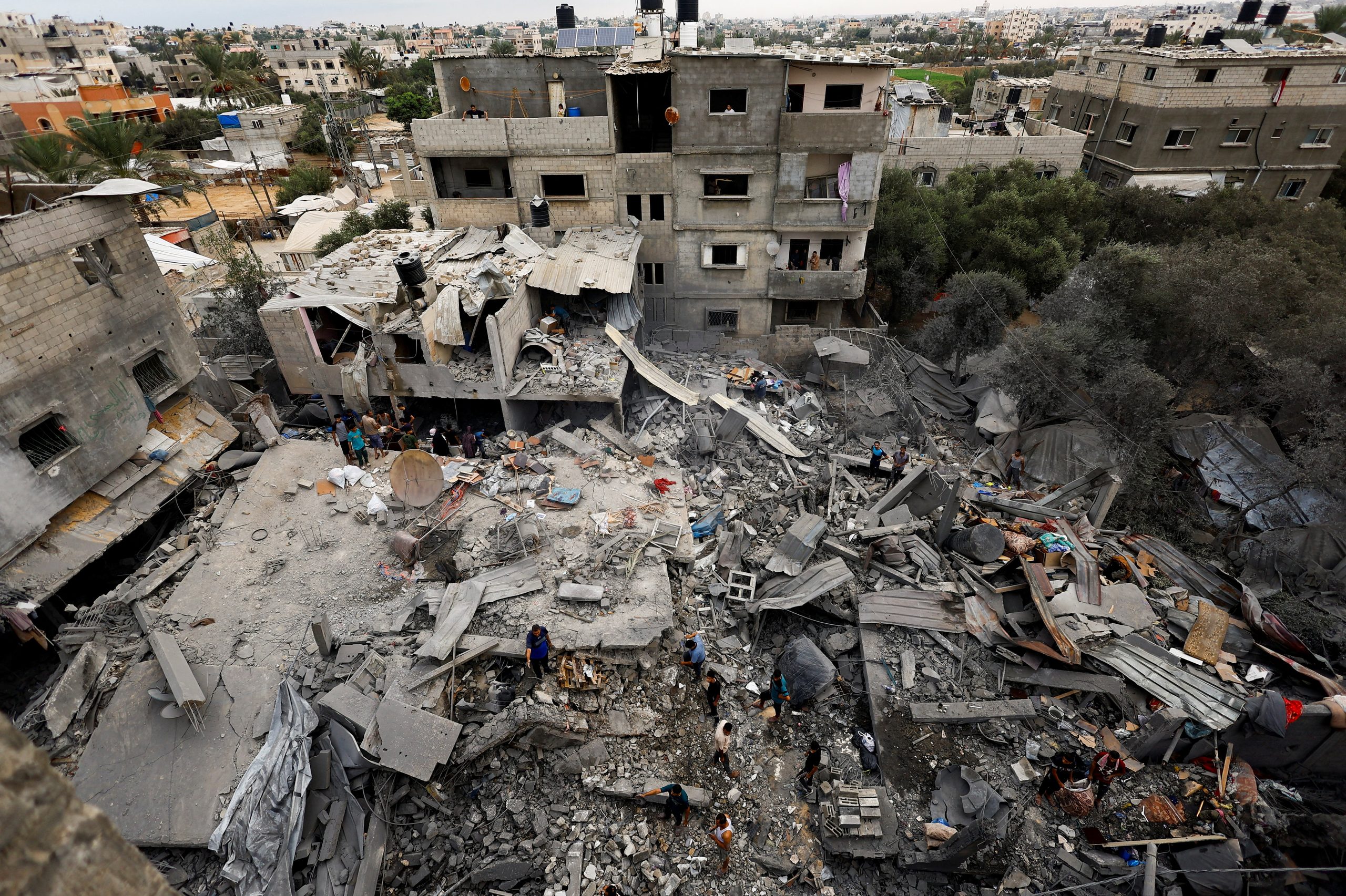
Photo published by Iran’s PressTV, purporting to show the aftermath of the attack in the northern province of Golestan on July 9, 2026.
The Iranian Foreign Ministry said that it strongly condemned “the aggressive attacks carried out by the US terrorist military in the early hours of Thursday, July 9, against several locations in the southern coastal provinces, as well as two bridges in the eastern provinces along the railway route to the holy city of Mashhad.”
The ministry said that the attacks “unquestionably constitute a grave war crime.” So far, the US military has neither confirmed nor denied targeting the railway bridges in northeastern Iran. US Central Command claimed that its forces hit 90 targets, including “air defense systems, coastal surveillance assets, missile and drone storage sites, naval capabilities, and military logistics infrastructure along Iran’s coastline.”
Iranian officials have said that the two days of US airstrikes killed 14 Iranian military personnel and civilians and wounded 78 others.
The attacks came after President Trump threatened that he could bomb bridges, energy infrastructure, and desalination plants in Iran. “I would say in one day we could knock down every single bridge in Iran, there’s not a thing they can do about it. Their electric manufacturing facilities … they have desalinization plants, we’ll take them out if we have to. I’d hate to do that. That’s probably the one I’d like to do least,” he said on Wednesday.
President Donald Trump, right, speaks with Turkish President Recep Tayyip Erdogan at the Bestepe Presidential Palace during a formal welcome for the NATO summit in Ankara, Turkey, Tuesday, July 7, 2026. [AP Photo/Francisco Seco]
US President Donald Trump has relaunched American imperialism’s illegal war of aggression against Iran, after repeatedly making Hitlerite threats in recent days to destroy the country’s basic infrastructure and rain death and destruction on its people.
Speaking Wednesday on the sidelines of the NATO summit in Ankara, Trump effectively repudiated the 60-day truce reached between Washington and Tehran last month. “As far as I’m concerned, it’s over,” he declared. He went on to vow that the US will continue the campaign of air strikes launched on Iran in the early hours of Wednesday morning. “We’re going to hit them hard tonight,” boasted the fascist would-be dictator president.
This was coupled with a flurry of other threats, including the possible resumption of the US blockade of Iranian ports and the “takeover” of Kharg Island, Iran’s principal Persian Gulf oil export hub.
On Tuesday, Washington canceled the oil export sanctions “waiver” that it had granted Tehran as part of the Memorandum of Understanding (MoU) that underpins the truce. Hours later, the US mounted air strikes on more than 80 targets in southern Iran, killing, according to Iranian authorities, eight military personnel.
In his characteristic gangster-style fashion, Trump denounced Iran’s leaders in his Wednesday remarks, reveling in his capacity as the head of the US imperialist war machine to order execution air strikes like that which killed Iran’s Supreme Leader Ayatollah Khamenei at the war’s outset. “I do not want to deal with them any more, they are scum. They are sick people,” he snorted.
Tehran, for its part, has warned that the US is in breach of the MoU. An Iranian Foreign Ministry statement issued Wednesday said America’s “repeated illegal attacks against Iran,” the re-imposition of sanctions on Iranian oil and Israel’s continuing aggression against Lebanon “have rendered important and fundamental parts” of the truce agreement “ineffective.”
Iran has responded to the Pentagon’s Tuesday night attack with counter-strikes on US military bases in Kuwait and Bahrain and by warning the region’s other oil sheikdoms that they will be similarly targeted if they continue to facilitate US aggression.
The truce has been hanging by a thread since it was formally signed by Trump and Iranian President Masoud Pezeshkian on June 17.
Trump has repeatedly threatened to renew hostilities even as more information has emerged about the depletion of US missile stocks and the damage Iran has inflicted on US bases across the region.
The truce, coming after a long stream of proclamations from Trump, his Secretary of War Pete Hegseth and other minions about an overwhelming US “victory,” represented a debacle and humiliation for Washington. While unleashing massive wanton violence and suffering, the Trump administration manifestly failed to achieve any of its stated objectives—regime change, the elimination of Iran’s nuclear program and ballistic missile arsenal, and the cessation of its support for Hezbollah and other regional allies. Moreover, Iran was quickly able to establish effective control over the Strait of Hormuz, choking off energy and other exports from and to US allies. Trump himself made reference to the devastating impact US imperialism’s illegal, unprovoked war has had on the world economy, when in justifying the truce he invoked the threat of an economic catastrophe akin to the Great Depression.
Yet some three weeks later Trump and the US oligarchy on whose behalf he rules have recklessly reopened hostilities, threatening to plunge the region and world into an even larger conflagration and economic morass.
They do so in the face of a massive show of popular opposition to US imperialism on the part of ordinary Iranians. Since July 4, millions of Iranians have joined what are to be six days of funeral observances for Ayatollah Khamenei and family members, including his 14-month-old granddaughter, who were killed in the February 28 decapitation strike with which the US and Israel launched their criminal war.
Even sections of the Western media have been forced to concede the popular character of the funeral observances and the palpable mass anger and mood of defiance, as well as genuine anguish, that have characterized them. They have mobilized what remains of the Islamic Republic’s traditional base among the urban and rural poor but also broad sections of working people with deep-rooted grievances against Iran’s bourgeois nationalist regime. They recognize that imperialism represents the greatest obstacle to realizing the social and democratic aspirations of Iran’s workers and toilers and are implacably opposed to the bipartisan drive of the US political establishment to reduce Iran to the type of neo-colonial bondage that existed under the bloody rule of the US-installed Shah prior to the 1979 revolution.
On Wednesday, the funeral possession passed over into Iraq, which like Iran has been the victim of decades of US imperialist aggression, including the invasion and occupation launched in 2003 under a web of lies about “weapons of mass destruction.” There it was similarly greeted with mass outpourings of popular anger against US imperialism and its Israeli attack dog
The Trump administration’s belligerence is born of crisis—a crisis that is itself rooted in the ever-accelerating decline in the world position of US imperialism and the basic contradictions of the capitalist social order. It faces mounting opposition and growing political radicalization at home as manifested in the mass participation in the “No Kings” protests and a wave of strikes involving broad sections of the working class across the country, from auto parts workers, to educators, healthcare workers and transit workers. Terrified of this growing threat from below, Trump rails against the danger of “communism” and accelerates his drive to impose a presidential dictatorship.
As for the ostensible opposition party, the Democrats, they work with the trade union bureaucracy to contain and suppress working class opposition. Their objections to Trump’s policies largely revolve around questions of US imperialist foreign policy and strategy. This has been exemplified in their response to the Iran war. The entire Democratic Party leadership, including Democratic Socialists of America (DSA) Congresswoman Ocasio-Cortez, supported the narrative used to justify their war—that Iran, a historically oppressed country, is an aggressor and a threat. Insofar as they have made criticisms, it has been over procedural issues (such as the administration’s failure to give Congress a role in planning and overseeing the war) and Trump’s maladroit conduct of it.
The Democrats joined with powerful sections of the military-security establishments and financial oligarchy in attacking Trump for agreeing to a truce with Iran that failed to achieve any of Washington’s war objectives. California Senator Adam Schiff called it “a thorough capitulation,” while his Connecticut colleague, Chris Murphy, termed it “essentially a surrender to Iran.”
Trump’s relaunching of the war on Iran unfolded against the background of a NATO summit dominated by the imperialist powers’ competing agendas in what is a developing global war for the control of resources, markets, production networks and strategic territories akin to the imperialist world wars of the last century—only on a far greater and more lethal scale.
The European powers, joined by Canada, used the summit to escalate the war on Russia, boasting of their accelerating rearmament drive and role in providing their Ukrainian proxy with the capabilities of striking deep inside nuclear-armed Russia. Trump, meanwhile, denounced them for not being more supportive of the US-Israeli war on Iran, demanded Greenland be ceded by Denmark to the US, reiterated his support for a US-Russia deal to end the Ukraine war at the expense of America’s NATO “allies” and threatened to cut off all US trade with Spain.
The imperialist powers and the capitalist system they lead are dragging humanity to the abyss. The only progressive answer to their rival predatory agendas for rearmament and war, austerity, and the evisceration of democratic rights is the revolutionary mobilization of the international working class. The World Socialist Web Site has long insisted that the same crisis of global capitalism that is fueling global war is intensifying class conflict, creating the objective conditions for the emergence of a mass movement of the working class for socialism.
The critical question is to politically arm the growing working class counter-offensive with a revolutionary socialist program, strategy and leadership. It is to this task that the International Committee of the Fourth International and its respective national Socialist Equality Parties are dedicated.
The failed Iran war presents costly proof that global dominance was always beyond Washington’s grasp
People wait to re-enter the event site after being evacuated due to storms during Independence Day celebrations in Washington, DC, on 4 July 2026 (Amid Farahi/AFP)
On the fourth of July, the United States turned 250 – an event that summoned the founders who spoke of a republic seeking “a decent respect to the opinions of mankind”, rather than dominion over them.
Yet the story that matters most for our own moment does not begin in 1776. It begins 35 years ago, with the collapse of the Soviet Union – the moment the US mistook the disappearance of its main rival for a mandate to remake the world in its own image.
What followed was an overdrive of hubris. Washington read the unipolar moment of 1991 as a global manifest destiny, and set about entrenching its primacy in every region of the globe.
The mood was captured with startling candour by political scientist and former American national security adviser Zbigniew Brzezinski in The Grand Chessboard (1997), a meditation on how the US might dominate the Eurasian landmass and forestall the rise of any power capable of challenging it.
Primacy ceased to be a momentary fact and hardened into a doctrine – and, for a generation of US policymakers, an obsession that no defeat seemed able to shake.
New MEE newsletter: Jerusalem Dispatch
Sign up to get the latest insights and analysis on Israel-Palestine, alongside Turkey Unpacked and other MEE newsletters
Strangely, much of the Arab world embraced it too. Time and again, Arab governments acceded to American designs on the premise that only the US could supply what they wanted: security above all, but also advanced weaponry, technology and finance.
The bargain seemed prudent, since the Arab world would accept US leadership and enjoy American protection. Nowhere was this clearer than in the network of US bases strung across the Gulf, from the Fifth Fleet in Bahrain and Al Udeid in Qatar, to Prince Sultan in Saudi Arabia, Al Dhafra in the UAE and Ali Al Salem in Kuwait.
All those bases, and yet the question remained: who were these bases really serving?
Myth demolished
Some governments went further, entering what became, in effect, a strategic alliance with the US and Israel, on the old assumption that one should always back the strongest side. The myth of the indispensable protector became the organising principle of the Arab region’s diplomacy.
The Iran war has demolished that myth. On 28 February, the US and Israel attacked Iran, assassinating the supreme leader and many senior officials, all in brazen defiance of the United Nations Charter and with the declared aim of regime change.
And then the mightiest military on earth ran headlong into the limits of its power, military and political alike. Iran did not collapse. It named a successor to the supreme leader, struck back across the region, and closed the Strait of Hormuz, triggering a fuel crisis and wrecking the global economy.
After months of US and Israeli bombardment, billions of dollars wasted, thousands of lives squandered, and a region set aflame – from Lebanon to the Gulf – Washington settled not for the regime change that it had promised, but for a fragile and repeatedly broken truce.
The only choice left for the US is whether to accommodate a world it can still help to shape but no longer command, or to spend its remaining strength resisting the irreversible
The American-Israeli war failed, conclusively. It neither toppled the Iranian state nor subdued it; it enriched the arms industries but no one else; and it left every Gulf capital that had sheltered under the American umbrella more exposed, not less.
In failing, it taught two lessons at once about the limits of American power, and the folly of the Arab states staking their national security upon it. Every government that built its strategy on the permanence of American dominance now has reason to think again.
On this national birthday, two awakenings are overdue: one in Washington, and one in the Arab capitals that trusted it.
For the US, the lesson is that the age of forcing American and Israeli solutions on the region is over. No arsenal can any longer impose the outcomes that American power once asserted.
The honest course for the US would be to pursue, at last, what international law and justice have always required, which is a genuine solution for Palestine. This can be a two-state solution, with Israel and Palestine living in peace side by side, or a single bi-national democratic state.
In either case, it must be the end of the Greater Israel project, which aims for Israel’s permanent occupation of Palestinian lands and territories in neighbouring countries. The Greater Israel project has been the main source of the region’s perpetual wars.
The path forward
For the Arab world, the subservience to US power should end as well. There is no rational reason for the Arab world to outsource its security to a distant, unreliable and biased patron.
The path forward is Arab unity, rather than competition for Washington’s favour; to make peace with Iran, recognising that Arabs and Iranians are permanent neighbours and not proxies in someone else’s contest; and to build genuine strategic autonomy in a multipolar world, dealing with the US, China, Russia, and every power on equal terms and according to the region’s own interests.
How a regional defence pact could deal the final blow to Israel’s violent expansionism
A security architecture designed in the region, rather than in Washington, is now both possible and necessary. The Gulf states in particular command the capital, the energy, and the human talent to shape their own future – and, in the coming age of clean power, to help lead it.
We live in the age of multipolarity, and that is the Arab world’s surest road to dignity, security and peace.
Two hundred and fifty years ago, the American republic announced itself to the world as a member of the human family, not as its master. The Iran war is the costly proof that global primacy was always beyond its grasp.
The unipolar moment that Washington mistook for a permanent world order has ended. The only choice left for the US is whether to accommodate a world it can still help to shape but no longer command, or to spend its remaining strength resisting the irreversible.
The wisest gift the US could give itself at 250 is to recognise multipolarity at last, and to rejoin the community of nations as one cooperative power among many.
The wisest gift the Arab world could give itself is to stop waiting for a patron – and to stand, at last, in unison, on its own feet.
Happy birthday to the United States, and for all of us, may this be a new birth of realism and peace.
The views expressed in this article belong to the author and do not necessarily reflect the editorial policy of Middle East Eye.
Jeffrey D. Sachs is University Professor and Director of the Center for Sustainable Development at Columbia University. He is President of the UN Sustainable Development Solutions Network, Co-Chair of the Council of Engineers for the Energy Transition, and Commissioner of the UN Broadband Commission for Development. He has been Special Advisor to three United Nations Secretaries-General, and currently serves as an SDG Advocate under Secretary General António Guterres. He spent over twenty years as a professor at Harvard University, where he received his B.A., M.A., and Ph.D. degrees
Even as frustrations mount over Israeli military campaigns across the Middle East, governments keep buying weapons from Israel — making it one of the world’s largest arms exporters.
As experts tell Responsible Statecraft, Tel Aviv uses these weapons sales to lock countries into long-term, strategic relationships that make recipients less likely to hold Israel accountable for their behavior in Gaza and Lebanon or in its West Bank policies. They stress that sustained U.S. support, including billions in military grant aid each year and the co-development of many Israeli weapons systems, helps make this all possible.
A weapons exports boom
Following October 7, Israel’s defense industry has exploded: the number of startups there nearly doubled, from 160 in July 2024 to 312 in April 2025. Its arms exports, which account for 75% to 80% of all Israeli weapons production, have grown in tandem. According to Stockholm International Peace Research Institute (SIPRI) data published in March, Israel was the world’s seventh-largest arms exporter between 2021 and 2025, surpassing the United Kingdom.
Tel Aviv raked in a record $19.2 billion from arms exports in 2025, a jump up from the $14.8 billion it made the previous year.
Subscribe now to our weekly round-up and don’t miss a beat with your favorite RS contributors and reporters, as well as staff analysis, opinion, and news promoting a positive, non-partisan vision of U.S. foreign policy.
Invalid emailEnter your email
Arms sales as political leverage
As Seth Binder of the American Committee for Middle East Rights (ACMER) told RS, “arms deals are expensive and often create a long tail to negotiate, complete, and fulfill over the life of [a given] contract.”
Over time, these contracts provide Israel a way to build relationships that other governments have strong incentives to preserve. Exports can “entrench relationships that constrain others’ ability to hold [Israel] accountable,” Daniel Levy, the president of the U.S./Middle East Project (USMEP), said.
A growing global demand for weapons is playing to Israel’s advantage. A case in point is Europe. Spurred by fears of Russia and U.S. pressure to increase defense spending, some European countries are buying Israeli weapons to supplement their fraught rearmament efforts. The purchases continue despite disquiet across the continent over Israel’s actions in the Middle East, which have led some European Union countries to pursue arms embargoes or suspend export licenses to Israel.
Germany signed multi-billion euro deals for the Israeli-made Arrow-3 missile defense system, Heron drones, and Spike anti-tank missiles last year. Greece spent about $740 million on 36 Precise & Universal Launching System (PULS) rocket artillery systems in December. Romania signed a deal worth about $2.3 billion for Spyder air defense systems earlier this week and is now set to acquire its own version of Israel’s Iron Dome air defense system.
Outside the EU, the value of U.K. arms- and ammunition-related imports from Israel skyrocketed from just $508,343 in 2020 to nearly $7.97 million in 2025 — a nearly 1,500% increase. A senior Israeli defense official told Reuters in early June that European countries are expected to order more air and missile defense systems soon.
But depending on Israel for critical defense needs may prove risky. “A government that might otherwise respond to public demands for sanctions or arms embargoes [against Israel] now faces the prospect of degrading its own air defense…if it does so,” Levy told RS.
Similar dynamics are playing out among Abraham Accords nations; Israeli exports to those countries jumped fivefold between 2023 and 2025.
“No one has any illusions that Israel is popular right now in [the Abraham Accords] countries,” an Israeli diplomat told The Economist last fall. “But their governments have made long-term investments in their defense ties with Israel, and they’re not about to change course.”
More broadly, continued prospects for arms sales turn Israel’s controversial military actions — in which Israeli defense technologies are being used against civilians — into a commercial selling point. As Omar Shakir, the executive director of DAWN, told AP last month, Israeli defense and technology companies have been “able to parlay the use of their products in Gaza to attract more business.”
Israel’s arms exports blitz: fueled by Washington
Israel’s weapons industry is booming in part because “the U.S. has long subsidized it,” Binder told RS.
Israel receives Foreign Military Financing from Washington, which provides funds for acquiring American weapons equipment, training, and adjacent services. The support is even more direct through what is called Off-Shore Procurement (OSP), which Binder said allows Israel to “use a portion of its Foreign Military Financing provided by the United States to pay for [its own] arms.”
Although OSP is set to phase out by 2028, Binder told RS that “Israel’s arms industry has arguably established itself as a competitor” to America’s weapons sector through the program.
Meanwhile, Israeli firms have gained a competitive edge, thanks to what former State Department official Josh Paul calls a “larcenous” approach toward U.S. intellectual property. “Many technologies developed by U.S. industry are [simply] re-developed and re-packaged by Israeli companies,” he told RS.
American support is often evident in the export deals themselves, where, for example, the Arrow-3 system Germany bought from Israel was co-developed with the U.S., which helped fund its development. Because of Washington’s role in the program, U.S. approval was required before the initial sale could proceed.
Altogether, the International Trade Administration observed that U.S. assistance has “turned the Israeli military industry and technology sector into one of the largest exporters of military capabilities worldwide.”
Currently, a series of congressional proposals under consideration — including one that Israeli Prime Minister Benjamin Netanyahu has endorsed as his “personal plan” — stands to give Israel’s defense sector a deeper foothold in the U.S. market.
Indeed, section 219 (previously section 224) of the National Defense Authorization Act (NDAA) for FY 2027 would move to more closely integrate the U.S. and Israeli militaries. The provision would further incorporate Israeli technologies and companies into U.S. supply chains, likely creating more opportunities to sell its weapons.
As Paul told RS, Israel being positioned “to become a supplier to the U.S. military is just a further example of [it] using [its arms] sector as a tool of influence.”
The country that once was the United States of America is now, in its 250th year, led by a president whose ignorance of history and policy is so profound that almost anything goes, including the initiation of wars fought for a foreign nation that is widely regarded as manifestly evil. I am of course speaking of the power that Israel has over US foreign policy in particular, though that leverage has been increasingly also impacting on the running of the economy and the elimination of fundamental liberties like freedom of speech. One has to ask, what kind of independence does America actually have when it allows another country, supported by domestic Jewish and Christian Zionists, to drain resources stolen from taxpayers through endless wars and a managed foreign policy that doesn’t benefit American citizens in any significant way. Above all, it is a “policy” driven by false religious beliefs that the former Palestine should become a wholly Jewish state that is “chosen” to expand and become “Greater” through wars initiated throughout the Middle East.
And pretty much the same elite Zionists that control the White House and Congress largely manage the other elements in the federal government while also controlling central banking through the Federal Reserve, which is privately operated and has less than 5% of money in “Reserve.” Most Americans are unaware that this financial runaway train will soon bring bankruptcy to the nation by way of a current $39.4 trillion in Federal government debt (122.1% of GDP), which amounts to $356,620 per taxpayer.
And there is more bad news! President Donald J Trump might rightly be regarded as the most pro-Israeli in the history of our nation, which is saying quite a lot, and it comes as no surprise that when one of his most ardent Jewish supporters Mark Levin recently described him as the “First Jewish president!” Trump responded “That’s true!” Whether that was confirmation of the reality of the assertion or merely agreement that Levin had said that can perhaps be in dispute, but it does reflect a certain reality. In a speech at Mount Rushmore on July 3rd Trump went on and on about purging the country of its “communists” but what he was really talking about was its liberals who are critics of Israel such as the New York Mayor Zohran Mamdani and Congressman Ilhan Omar!
Trump has been fighting a totally pointless and extremely unpopular war with a non-threatening Iran due to Israel convincing him to do so and he has tolerated a horrific genocide in what was once Palestine while also making the US complicit in the slaughter by providing the weapons, money and the political cover to permit Prime Minister Benjamin Netanyahu to get away with the war crimes. And now there are reports that Trump has ordered the US military to begin preparations to engage in Lebanon to destroy Hezbollah, which is no threat to American though an enemy of Israel.
That is the current reality. Our America, a victim of the powerful domestic Israel Lobby which has corrupted Congress with money and which controls most of the mainstream media, is truly a slave of what Israel regards as its national security policy. This has led some American critics of what is taking place to begin to refer to the USA as the “Zionization of America to create a Zionocracy” a name that has a certain resonance as it reflects a certain reality in that maintaining Jewish/Israeli dominance of the United States has stripped the nation of what once were basic constitutional rights.
Consider for example what already exists to favor Israel and what is impending that will make the US a virtual client state of the ruthless apartheid entity that has taken control of both the White House and Congress. It is often noted how the US Congress gave war criminal Netanyahu 58 standing ovations when he addressed that body in 2024. And there is already in the State Department a Bureau that exists to counter what it describes as antisemitism worldwide. It is called the Office of the Special Envoy to Monitor and Combat Antisemitism (SEAS), which was created to advance US efforts in addressing antisemitism globally. It was established by the Global Antisemitism Review Act of 2004 and is led by a special envoy with ambassador status who reports directly to the Secretary of State. It is currently headed by a Rabbi Yehuda Kaploun. It accepts the International Holocaust Remembrance Alliance (IHRA) definition of antisemitism to include verbal or written criticism of the behavior of Jewish groups or of Israel as ipso facto evidence of antisemitism, which it regards as a crime. By way of comparison, no other country except Israel has an office that goes around the world with a mission to root out what it chooses to regard as antisemites.
So all right, let us accept that it is really bad, but there are some new initiatives that have surfaced that are about to make things worse at a time when we have a president who is prepared to give the Israelis and the Jewish domestic lobby anything they ask for. Some of the legislation coming out of Congress will dramatically strengthen Israel’s ability to interfere directly with the policies that might be supported by the US government. There is in fact serious discussion going on concerning several bills passing through the House of Representatives and Senate that will dramatically reshape the relationship with “best friend and greatest ally” Israel. The debate relates to section 224 of the National Defense Appropriations Act (NDAA) for 2027, and section 622 of the National Intelligence Act for the same year. There is also a proposed re-configuration and granting of American military veteran benefits to citizens who choose to fight for the Israel Defense Force, requiring amendment of title 38 of the United States Code as well as of the Servicemembers Civil Relief Act. All the relevant bills are currently circulating in Congress including the questionable sections and, though there is growing resistance to them, they are at this time expected to pass.
NDAA Section 224, entitled the “United States-Israel Defense Technology Cooperation Initiative,” reads in part: “The Secretary of Defense shall designate an executive agent, as such term is defined in Department of Defense Directive 5101.01 (relating to 6 DoD Executive Agent, issued February 7, 2022), responsible for synchronizing cooperative efforts between the United States and Israel, to expand and accelerate bilateral defense technology research, development, testing, evaluation, integration, and industrial cooperation, by… identifying jointly developed or Israeli-origin technologies with operational utility for potential integration into United States systems and programs of record.”
As one can easily discern, the arrangement is very broadly conceived and exists to greatly benefit Israel. It is already being mooted that the “executive agent” of the program will be an Israeli. If all of the legislation passes into law, which is almost certain, and is signed on by Trump, who has been seeking a “new security cooperation framework” with Israel, it would bind Israel to the United States in a way that is unique. Its broad commitment is not one shared even by NATO allies, and is well-nigh irreversible, something that Israeli Prime Minister Benjamin Netanyahu clearly has been seeking to accomplish. When he is speaking in Hebrew to a Jewish audience, Netanyahu even grins and takes credit for having covertly manipulated an acquiescent White House and Congress to incorporate the sections of the bills on Defense and Intelligence. Netanyahu has said he wants America’s elected officials, whom he largely owns and has even thanked for their subjugation, to ram the broad new “partnership” arrangement through over the next two years before Trump leaves office.
And even worse is being contemplated! In May and June, a bipartisan coalition of 15 House Republicans and 14 Democrats led by Congressman Dan Goldman of New York formally sponsored the Jewish American Security Act (JASA), a piece of legislation that if passed would possible constitute one of the most devastating attacks on the First Amendment in American history. It would also, uniquely, make Jews as a group and the state of Israel deserving of special treatment and protection by the federal government. The bill is supported by nearly all Jewish non-profits and Zionist activist groups and is headed “To strengthen Federal efforts to counter antisemitism in the United States and protect the Jewish community.”
The bill includes the appointment of an Anti-Semitism commissar to run the Department of Education’s already existing program to eliminate pro-Palestinian activism on college campuses, a $1 billion dollar cash fund to “secure” Zionist and Jewish properties, mandatory government monitoring of online social media to compel the censorship of “anti-Semitic” political speech or writing on their platforms, and recasting the law enforcement missions of the FBI, Department of Homeland Security, and National Counterintelligence and Security Center to prioritize the targeting of critics of Jews and Israel as “foreign enemy actors and domestic terrorists.” Ironically, in addition to the $1 billion proposed in the bill to protect Jewish properties, those properties already get more than 90% of the discretionary security spending by the Department of Homeland, amounting to more than $300 million per year!
The act will also reinforce and make permanent Donald Trump’s Executive Order 14188 (“Additional Measures to Combat Antisemitism”), which included making Israelis a “protected class above criticism” under the 1964 Civil Rights Act. Eric Striker observes how “Under executive orders signed by Joe Biden and Donald Trump, this interpretation of the law has been used to weaponize access to federal subsidies to American higher learning institutions in order to shut down pro-Palestinian and anti-war activism among students. In addition to having an ‘Antisemitism Coordinator’ micro-manage this ongoing war on dissent, JASA calls for a ‘public awareness campaign’ that will plaster propaganda posters in ‘high-traffic public places, such as a cafeteria, gymnasium, or student center, and digital posting on 1 or more high-traffic institution web pages, such as a web page for a student services department’ warning students and professors about the consequences of partaking in speech and activism that offends Jews or singles out Israel.”
Interestingly, 37 states already have laws or rules that deny jobs or services to anyone who supports boycotts or otherwise seeks to damage Israeli interests, so the concept of punishing presumed “antisemites” is already on the table. But a federal mandate takes it to a new and much higher level. Striker comments how “Such a law, if passed, would treat figures as prominent as Tucker Carlson, Marjorie Taylor Greene, Megyn Kelly, Thomas Massie, Ana Kasparian, Ilhan Omar and Candace Owens, as well as many smaller critics that have arisen in recent years, as terrorists and enemies of the state.” The move to criminalize any criticism of Israel or the collective behavior of Jewish groups, if pursued aggressively at a national level, would have a devastating impact on the freedom of Americans to speak openly and honestly on issues like war and peace, for example. And of course that it what it is intended to do and you can count on the Jewish billionaires who have corrupted congress and bought the media to do what is wanted by monsters like Netanyahu to bring about that result. And it is all also just one part of the deliberate murder of American democracy. It is a major step to arrive at the “Zionocracy.”
Philip M. Giraldi, Ph.D., is Executive Director of the Council for the National Interest, a 501(c)3 tax deductible educational foundation (Federal ID Number #52-1739023) that seeks a more interests-based U.S. foreign policy in the Middle East. Website is https://councilforthenationalinterest.orgaddress is P.O. Box 2157, Purcellville VA 20134 and its email is inform@cnionline.org.
Successive United Nations investigations have documented Israel’s genocide, yet western regimes still refuse to name it or deliver the accountability their own institutions demand
Chris Sidoti of the UN Commission of Inquiry on the Occupied Palestinian Territory speaks at a press conference in Geneva on 16 September 2025 (Fabrice Coffrini/AFP)
Once again, the United Nations reminds us that genocide is taking place in the Gaza Strip.
A report issued on 23 June 2026 by the Independent International Commission of Inquiry on the Occupied Palestinian Territory documented what Israel has committed against the Palestinian people, especially children.
This followed an earlier report from the same commission on 16 September 2025, which found that genocide was taking place, as well as the report of the UN special rapporteur issued on 20 October 2025.
But what can meticulously documented international reports do in the face of those who have insisted on averting their eyes from declared Israeli intentions to commit genocide, ethnic cleansing, comprehensive destruction and horrific starvation – not to mention the torrent of live images transmitted around the clock to mobile devices from the field of atrocities over the course of two full years?
Specialised UN reports, testimonies by international rapporteurs and experts, assessments by the most prominent global human rights organisations, and even Israeli testimonies have followed one another, all confirming the reality of the genocide committed by Israel under the eyes of the world since October 2023.
New MEE newsletter: Jerusalem Dispatch
Sign up to get the latest insights and analysis on Israel-Palestine, alongside Turkey Unpacked and other MEE newsletters
In contrast, most European and western states have clung to a rigid position that ignores this glaring truth, despite genocidal intentions being openly expressed in advance by senior Israeli leaders, who continued to boast of what their army and authorities were doing on the ground.
Official western comments on those reports were often absent, unlike what would have happened in other cases
Official western comments on those published reports were often absent, unlike what would have happened in other cases.
Is it not worthy of condemnation that senior European and western officials have persistently avoided using the term “genocide” in relation to these systematic and horrific Israeli practices?
It is as though the word were a firmly established taboo in European and western political, media and cultural discourse whenever Israel is concerned.
This taboo exerts its power over those officials and commentators who, in this way, give reason to suspect that acknowledging genocide depends on the identity of the perpetrator and the status of the victims.
Double standards
It is entirely understandable that the allies of a regime of occupation and genocide, or those who consider themselves Israel’s partners and friends, would avoid issuing a clear condemnation of conduct they themselves helped support and encourage, directly or indirectly, even if only through silence and denial of its atrocities.
Throughout this prolonged season of horrors, the Israeli side has enjoyed military and political backing, as well as propagandistic cover, through carefully crafted formulas uttered by senior European and western officials.
These amounted to evasive justifications for whatever war crimes and grave violations an occupying authority and its military forces might commit against a population left utterly exposed to continuous bombardment.
Those who still deny the Gaza genocide are complicit in Israel’s atrocities
This may be inferred from the phrase that has become a staple of western speeches: “Israel has every right to defend itself” – words that Israeli leaders understand simply as advance legitimation for a policy of mass killing and comprehensive destruction on the ground.
Naturally, no mention is made in this context of any right of the Palestinian people to defend themselves, for example, or of their right under international humanitarian law to resist the military occupation entrenched on their land.
States, governments and political leaderships – joined by elites in the fields of thought, culture and media – insist on ignoring the reality of genocide against the Palestinian people, or conceal it through a tendency toward genocide denial, as though all the serious international efforts of documentation and investigation had no value for them.
Denying a genocide that has unfolded before everyone’s ears and eyes simply means minimising its confirmed atrocities. It also entails direct or indirect encouragement of this pattern of horrific violations, so long as they are met with such shocking laxity.
Moreover, clinging to outright denial encourages the perpetrators to resume committing appalling war crimes, so long as these crimes are not named as such. Which western leaders – apart from a handful, such as Spain – have described what the Israeli leadership and its army have committed as “genocide” or “war crimes”?
It must be recalled that the centres of western decision-making, including the European Union and its leading bodies crowned with slogans of noble values and human rights, became implicated in a sweeping display of bias when they chose very mild or evasive terms to describe Israeli war crimes that the entire world followed in images, sound and live broadcasts.
Leaders and spokespersons resorted to cold expressions such as the ploy of “expressing concern” and voicing “sorrow” over the victims, often without naming the perpetrator, because the perpetrator was the Israeli leadership and its army, whose brutal policies and measures were visible to all.
Observers around the world have noted how the charge of “double standards” clings to European and western political discourse.
This is precisely what the former vice-president of the European Commission, Josep Borrell, warned his EU colleagues against – in full view of a world that notices the grave moral gap between European positions on Ukraine and Palestine. He issued that warning days into the war, at a Foreign Affairs Council in Luxembourg on 23 October 2023.
One would not be exaggerating to conclude from these contradictory positions that they place some human beings above others in status, degree of concern and human dignity, so that the lives, safety and security of Palestinians are placed lower in rank than those of others.
Thus comes the tolerance of the crushing of children, mothers, the sick and the elderly in the Gaza Strip, without serious positions being taken to restrain the machinery of genocide.
The margins, not the centre
Those faltering positions gave the strong impression that they were conferring moral immunity on the perpetrator, namely the Israeli leadership and its regular army.
Prevailing European and western criticism was limited to only two reckless ministers from the Israeli government, which amounts to little, since Itamar Ben Gvir and Bezalel Smotrich are already constantly criticised within Israeli circles.
The narrative has been shifted into familiar terms about a ‘humanitarian crisis’, as though the programmed genocide were merely a natural disaster
Meanwhile, the government and the political leadership more broadly continue to escape direct criticism, even after the accumulation of filmed atrocities and the issuance of an International Criminal Court arrest warrant for Prime Minister Benjamin Netanyahu himself.
This evasion becomes even clearer when criticism, along with some sanctions of limited effect, has been confined to settler gangs and their leaders, without any verbal reproach or punitive gesture directed toward the Israeli army. The latter not only sponsors and protects settlers on the ground but also directly commits grave violations, appalling war crimes and campaigns of ethnic cleansing within the context of a horrific genocide.
This contradiction betrays a firmly rooted European and western position intent on exempting the state, its leadership and its regular military and security apparatuses from any clear criticism, explicit condemnation or accountability, while merely formal positions are issued concerning the margins rather than the centre: some settlers instead of the army, and only two ministers instead of the government.
Political Europe, and many elites in public life across western states, have even evaded confronting a simple question: does what Israel has committed against the Palestinian people constitute genocide?
Denying the genocide committed in Gaza requires wilful disregard.
It begins by brushing aside these war crimes and behaving as though they merit no attention. The adopted narrative has been shifted into familiar terms about a “humanitarian crisis” and “alarming” conditions, or a show of concern for “civilian suffering” – as though the programmed genocide, reinforced by declared intentions to commit it, were merely a natural disaster that befell the place.
Sanctioned ICC judges sue Trump in US over ‘attack on judicial independence’
The states and governments that boast of their commitment to moral positions, human values, international law and human rights were supposed to honour those commitments. They should have warned against the campaign of genocide in its earliest stages, stripped it of political and propagandistic cover, and supported the enforcement of international justice and the cases filed over genocide against the Palestinian people.
Foremost among these is the case brought by South Africa before the International Court of Justice, on the basis of Israel’s violation of the Convention on the Prevention and Punishment of the Crime of Genocide.
Instead, campaigns of moral targeting, incitement, intimidation and even the imposition of unjust sanctions on prosecutors have escalated, affecting international justice bodies and their personnel, as well as UN rapporteurs.
Thus, it becomes clear that complicity with the genocide committed against the Palestinian people goes ever further in undermining international law and threatening the foundations of international action and the protection afforded to its institutions and authorities.
The views expressed in this article belong to the author and do not necessarily reflect the editorial policy of Middle East Eye.
Hossam Shaker is a journalist and an author who has extensively covered the topic of migration in Europe.
From war crimes and genocide abroad to moral, constitutional, and debt crises at home: Why Congress must reject the NDAA’s U.S.-Israel military and intelligence merger.
Against the horrific high- and low-tech butchery of Palestinians and Lebanese by Israeli ethno-nationalist psychopathic killers, this week there will be an effort in Congress to formally merge or integrate the military of Israel and the United States at the most advanced levels.
Section 219 (formerly Section 224) of the 2027 National Defense Authorization Act of 2027, provides for an unprecedented unification. The nearly $4 billion in the NDAA for Israel’s offensive efforts pales next to Israel having direct access to determining use of $1.5 trillion in annual military resources of the United States.
Money can be appropriated one year and withdrawn the next. Institutional integration is permanent.
Section 219 creates permanent mechanisms through which military planning, intelligence sharing, weapons development, procurement, research, artificial intelligence, and strategic coordination become increasingly intertwined between the United States and Israel.
It is a proposal to embed another nation’s military establishment within the long-term planning and strategic architecture of the United States government.
Our own government – House, Senate and Administration – is in moral collapse, placing overwhelming emphasis on militarism instead of adequately funding America – housing, education, food, health, safety, and retirement security. Americans are standing at freeway exits, begging for food, while our tax dollars flow to weapons manufacturers.
While carrying a national debt approaching $40 Trillion, the Administration is increasing spending for its newly dedicated Department of War by 67% to upwards of $1.5 TRILLION per year. Simultaneously, with more than 42 million Americans unable to feed themselves, the administration is cutting federal food programs.
The practical implications extend far beyond dollars. With NDAA Section 219, Congress the legislation would create enduring institutional relationships affecting how those extraordinary military resources are developed, coordinated, and potentially employed.
No Congress has ever before considered legislation of this nature with any foreign nation.
If the Administration’s “America First” claim were to mean anything, it must first mean that America’s Constitution comes first. It must mean that American families, farmers, workers, veterans, and children come first. Section 219 turns that claim into a farce.
Section 219 of the NDAA would cause the United States to become dependent upon Israel making decisions about war, peace, military strategy, intelligence, and U. S. national security. This is the consequence of permanent institutional integration.
One week ago, a UN Commission of Inquiry determined that Israeli security forces deliberately targeted and killed Palestinian children, sometimes as a game, torturing them, subjecting children to sexual violence resulting in “unprecedented death, injury and trauma.”
Since Oct. 7, 2023, the IDF has been instrumental in the deaths of as many as 800,000 Palestinians, including children, emergency health care workers, doctors, nurses, journalists, and educators.
UN investigators and human rights observers have documented the killing of Palestinian children and have accused Israeli forces of deliberately targeting the children of Gaza.
These findings are reinforced by dehumanizing statements from Israeli political figures who have portrayed Palestinian children as future terrorists, so children are targets.
Essential civilian infrastructure has been devastated. Water systems, hospitals, schools, electrical networks, and sanitation facilities have been damaged or destroyed, eacerbating a man-made, humanitarian catastrophe.
In the occupied West Bank, armed “settlers” have been widely reported to have attacked Palestinian communities, burned homes, uprooted olive groves and other crops, destroyed property, and killed livestock, further displacing civilian populations.
Israel has used starvation as a weapon, setting food as a trap and, gunning down Gazans as they rush desperately to feed themselves and their children. Water supplies have been poisoned, wells filled with cement.
Gaza, the West Bank and Lebanon are testing ground sfor increasingly sophisticated military technologies, destroying entire villages with increasingly powerful munitions, and using precision, artificial intelligence-assisted targeting systems. Human rights organizations have raised serious concerns about the speed of targeting decisions, civilian casualty rates, and the implications of delegating life-and-death decisions to algorithmic systems.
White phosphorous and other weapons banned by international treaty are in use.
The conduct of the IDF has earned world-wide condemnation. Twenty-nine UN member states do not have diplomatic relations with Israel. The International Criminal Court (ICC) has issued arrest warrants for Israeli Prime Minister Benjamin Netanyahu and former defense Minister Yoav Gallant.
The Israel newspaper Haaretz recently reported that the ICC prosecutor is also seeking arrest warrants for Finance Minister Bezalel Smotrich: “Gaza must be destroyed entirely.” and National Security Minister Itamar Ben Givr, who has said: “All of Lebanon must burn.” Will these be our new partners? If so, the fundamental question becomes: Who are WE?
What is to be lost further in an Israel-U.S. military merger?
If the U.S. combines our military capabilities with the twisted occupation and expansionist ethic of Israel’s use of military technology against civilian populations, will it be long before our own government militarizes the high -tech surveillance infrastructure already in place to use state violence against our own citizens who protest abuse of basic rights?
The First Amendment has already been taken down on college campuses, and in cities and states where Israel critics are sanctioned.
U.S. Immigration and Custom Enforcement (ICE) officials have trained in Israel. The lessons learned there have come to America in terms of deportation, detention, and in some cases, physical abuse, injury and death at the hands of ICE government agents.
Israel kills Arab children so they will not commit crimes in the future. Will Americans, as in the movie Minority Report be pitched into a dystopian world where predictive algorithms enable Israel-U.S. collaborators to hunt down, prosecute and even punish Americans for crimes not committed?
As a Member of Congress, I questioned Benjamin Netanyahu during a hearing which took place prior to the 2003 Congressional vote on going to war against Iraq. He admitted he wanted not only Iraq to be attacked by the United States, but also Libya and Iran. It is widely known that the Israeli Prime Minister pushed President Trump into the disastrous war against Iran.
It is inevitable that as Israel’s aggression is maximally empowered, once placed inside the U.S. war-making establishment, the U.S. will be dragged into the Zionists’ expansionist designs on Iran, Turkey, Egypt and elsewhere. A greater Israel means a lesser United States. Congress, heavily influenced by the Israel lobby, is unable to reclaim its constitutionally based war power
Since the merger is to be voted on, this week, before America celebrates the 250th anniversary of our Declaration of Independence, let us be reminded by Thomas Jefferson’s July 4, 1776 characterization of George III, King of Great Britain: “He has affected to render the Military independent of and superior to the Civil power. He has combined with others to subject us to a jurisdiction foreign to our constitution, and unacknowledged by our laws….”
Our forefathers did not fight for freedom and for independence at Lexington and Concord, Bunker Hill, Trenton, Saratoga, and Yorktown, nor sacrifice American blood and treasure in battles in World War I and World War II to arrive at July 4, 2026, having willingly forfeited our sovereignty to a foreign nation, losing control of our future and putting in doubt “our lives, our fortunes, our sacred honor.”
Call your congressperson today and tell them to stand for America’s independence and vote for the Massie-Khanna Amendment to remove Section 219 from the NDAA.
Washington warned Tehran that Israel could target Araghchi as Ghalibaf’s plane made emergency landing
Iranian Parliament Speaker Mohammad Bagher Ghalibaf and Foreign Minister Abbas Araghchi aboard a flight to Zurich ahead of negotiations on 21 June 2026 (AFP)
Israeli fighter jets entered Iranian airspace as Tehran’s top negotiators were engaged in diplomatic efforts with the United States, according to a New York Times report that says American officials feared Israel was plotting to kill two senior Iranian officials involved in peace negotiations.
US officials became increasingly concerned that Israel could target Iranian foreign minister Abbas Araghchi and parliament speaker Mohammad Bagher Ghalibaf, on their return to Iran after peace negotiations between Washington and Tehran in Pakistan, the report published on Wednesday said.
According to the New York Times, Washington was concerned that an Israeli assassination attempt could derail the talks and it asked regional countries to warn Iran about the potential threat.
“Any attempt to kill the Iranian leaders would end the talks and reignite the fighting,” American officials told the newspaper.
While Washington increasingly focused on securing a ceasefire and a diplomatic framework, Israel remained sceptical of negotiations that fell short of its broader war aims.
New MEE newsletter: Jerusalem Dispatch
Sign up to get the latest insights and analysis on Israel-Palestine, alongside Turkey Unpacked and other MEE newsletters
The New York Times reported that concerns peaked during negotiations that began in earnest in April, when Araghchi and Ghalibaf emerged as key interlocutors in talks aimed at securing a ceasefire and laying the groundwork for a longer-term agreement.
A US official and a Middle East official told the newspaper that the Trump administration learned that Ghalibaf was on an Israeli targeting list and asked Israel to refrain from any action against him.
Iranian officials quoted by the newspaper said Tehran also sought assurances from Washington, through Pakistani and Qatari intermediaries, that Israel would not target members of the Iranian negotiating team.
The concerns were deepened during an April trip to Islamabad, where Ghalibaf was scheduled to meet US Vice President JD Vance.
According to the report, Pakistani fighter jets escorted the Iranian delegation’s aircraft to and from Islamabad because of fears that Israel could attempt to assassinate senior Iranian officials.
On the return journey, Iranian security services informed the aircraft carrying Ghalibaf that intelligence indicated Israel was preparing an attack and that two Israeli fighter jets had entered Iranian airspace from the western border near Iraq, the newspaper reported, citing Iranian officials.
Mahdi Mohammadi, a senior adviser to Ghalibaf who accompanied the delegation, confirmed the account on social media.
Iran turns to Pakistan land corridor as US naval pressure disrupts Gulf trade
The aircraft subsequently made an emergency landing in Mashhad, and members of the delegation completed the journey to Tehran by land, travelling for approximately eight hours, the newspaper said.
“Today Mr. Ghalibaf and Mr. Araghchi, and other members of the negotiating team, have put their lives on the line knowing the grave security risks and this is called a real sacrifice, not political manoeuvring,” Iranian lawmaker Mohsen Zanganeh told local media in April.
The newspaper reported that while the United States pursued negotiations that ultimately led to a framework agreement in June, Israeli officials viewed the emerging deal as insufficient because it did not achieve objectives such as regime change in Iran, dismantling Tehran’s regional allies and significantly degrading its missile capabilities.
A spokeswoman for the Israeli Embassy in Washington declined to comment to the newspaper on the allegations.
Asked about the reported warnings to Iran, a US official told the New York Times that President Donald Trump wanted the peace process “to play out” and noted that talks between American and Iranian delegations were continuing.
Despite the reported threats, Araghchi and Ghalibaf continued travelling for negotiations, including meetings in Qatar and a subsequent round of talks in Switzerland in June with Vance and other members of the US delegation, according to the report.
The Israeli military has intensified its military operations across Gaza, the Palestinian news agency WAFA reported on Tuesday, citing its correspondents in the Strip, as the IDF continues its constant violations of the US-backed ceasefire deal.
The report said that the ramped-up activity included the large-scale demolition of homes and civilian infrastructure in the eastern and northeastern areas of the southern city of Khan Younis. In the nearby city of Rafah, WAFA reported heavy artillery shelling and gunfire toward Khan Younis.
In Gaza City, the report said that “Israeli forces detonated a booby-trapped robot loaded with a large quantity of explosives, targeting homes in the Tuffah neighborhood in the northeast of the city” and that there was also “heavy gunfire from military vehicles” in the area and “sporadic explosions.”
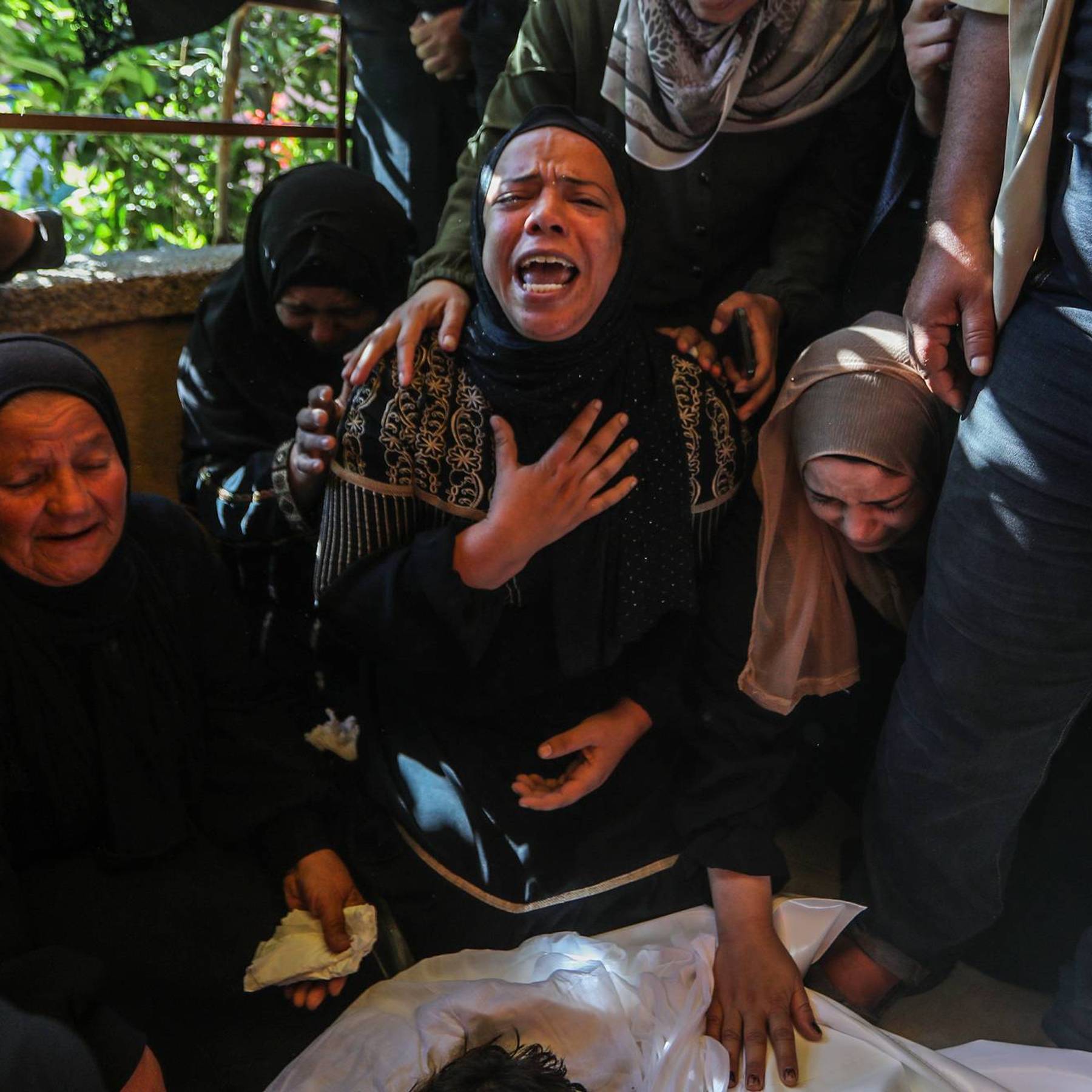
Mourners attend the funeral of Palestinian woman Diana Abu Daraz and her one-year-old daughter, Sewar, who were killed in an Israeli strike on tents, according to medics, outside Nasser Hospital in Khan Younis, in the southern Gaza Strip, June 30, 2026. REUTERS/Ramadan Abed
The news agency also reported that at least two people were killed by an Israeli airstrike near Khan Younis and multiple people were injured by Israeli attacks in Gaza City. Gaza’s Health Ministry said in its daily update that it recorded the Israeli killing of at least eight Palestinians and the injury of 26.
In recent days, Israeli forces have killed multiple children, including a one-year-old girl who was killed alongside her mother in an airstrike targeting a tent in southern Gaza. Palestinians held a funeral for the child and her mother at the Nasser Hospital in Khan Younis on Tuesday.
The escalation in Israeli attacks comes as the IDF has been taking more territory in Gaza, a clear violation of the ceasefire deal. Israeli Prime Minister Benjamin Netanyahu said last month that he ordered the Israeli military to take 70% of Gaza’s territory, up from 60%, and Israeli military officials said last week that the IDF has achieved that goal.
Since the so-called ceasefire deal was signed, the Health Ministry has recorded the Israeli killing of 1,053 Palestinians and the injury of 3,406. “A number of victims are still under the rubble and in the streets, as ambulance and civil defense crews have been unable to reach them so far,” the ministry wrote on Telegram.
Addressing the Second Jewish Anti-Zionist Congress, Ilan Pappé urged Jewish anti-Zionists to challenge Zionism while advancing Palestinian liberation.
‘Universal Voice for Palestine’
DUBLIN – Opening his keynote address at the Second Jewish Anti-Zionist Congress in Dublin, Israeli historian Ilan Pappé admitted that, after more than four decades of activism, he had often questioned whether a specifically Jewish anti-Zionist movement was necessary at all.
After all, he reflected, the struggle for Palestine should never depend on religious or ethnic identity.
“What we need is a universal voice for Palestine,” Pappé said during his address. “Who cares whether you are Jewish, Muslim or Christian? If you are a human being with even a modicum of decency, how can you remain indifferent to the suffering of the Palestinian people?”
Yet, he acknowledged, recent political developments had convinced him that a distinct Jewish anti-Zionist voice remains indispensable—not because Jews bear greater moral responsibility than others, but because Judaism continues to be invoked to justify Israel’s policies and silence criticism of them.
Referring to the appointment of a prominent pro-Israel lobbyist as chief adviser to Britain’s incoming prime minister, Pappé argued that whether such lobbying networks possess the extraordinary influence often attributed to them is almost secondary. What matters politically, he said, is that governments believe they do.
That perception, he argued, continues to shape Western policy, where accusations of antisemitism are routinely weaponized to shield Israel from accountability despite overwhelming evidence documenting occupation, apartheid and genocide.
“This is abnormal,” Pappé said. “It is unjust. It is immoral.”
For that reason, he argued, Jewish anti-Zionists carry a particular responsibility to dismantle the idea that Zionism represents Judaism itself.
“If we fail to challenge the idea that Zionism represents the only authentic expression of Judaism,” he warned, “we should not be surprised if others eventually conclude that this is what Judaism itself represents.”
Solidarity Begins by Listening
Although much of his address focused on challenging dominant political narratives, Pappé repeatedly returned to a simpler principle: solidarity begins by listening to Palestinians rather than speaking for them.
“This Congress is devoted to action,” he said, referring to its theme, From Words to Action. “Solidarity does not consist of telling Palestinians what they need.”
Instead, he argued, Palestinians themselves must define the priorities of the international solidarity movement.
“Our role is to listen,” Pappé said, expressing concern that even within progressive circles, authentic Palestinian voices are still too often marginalized by what he described as lingering colonial—and sometimes Islamophobic—assumptions.
“The stage belongs to Palestinians,” he insisted, “not only to describe their suffering—but to articulate their political vision.”
That responsibility, he argued, extends beyond immediate solidarity work.
Jewish anti-Zionists must also continue dismantling two narratives that remain deeply entrenched across Western societies: the claim that Zionism is the natural expression of Judaism, and the assertion that anti-Zionism is inherently antisemitic.
Both, he said, require sustained historical education rather than political slogans.
Those conversations, he argued, must move beyond audiences already sympathetic to Palestine and reach ordinary people whose understanding of the conflict has largely been shaped by decades of political mythmaking.
Europe’s Unfinished Reckoning
Moving beyond the present, Pappé devoted much of his address to what he described as Europe’s unresolved historical responsibility for Palestine.
The international order established after the Second World War, he argued, presented itself as universal through institutions such as the United Nations and the Universal Declaration of Human Rights. Yet the people designing that order were almost exclusively representatives of colonial powers, while the colonized world remained absent from the conversation.
That omission, he suggested, became decisive when Europe confronted what it called “the Jewish question.”
“When those same leaders confronted what they called ‘the Jewish question,’ almost none of them proposed the obvious solution,” Pappé said. “Almost nobody said: ‘Let us invite Europe’s Jews back into Europe.’”
Instead, he argued, European governments embraced Zionist colonization in Palestine, transferring the consequences of centuries of European antisemitism onto a people who bore no responsibility for those crimes.
Germany, he said, occupies a central place in that history.
Contrary to the dominant postwar narrative, Pappé argued that Germany “was not denazified” in any meaningful political sense. Instead, he said, the country’s relationship with Israel became a substitute for confronting the deeper structures that had produced Nazism and antisemitism.
According to Pappé, postwar reparations did more than compensate Holocaust survivors. They also helped build Israel’s military establishment, while subsequent German political and military support—including assistance that strengthened Israel’s strategic capabilities—cemented a relationship that continues to shape European policy today.
“This historical relationship still shapes contemporary politics,” he said, arguing that Europe has “never fully reckoned with the consequences of exporting its own historical crimes onto the Palestinian people.”
For Pappé, acknowledging that history does not mean imagining that Israeli Jews should somehow return to Europe. Rather, it requires Europe to recognize that Palestinians paid the price for crimes committed on another continent.
Recovering another forgotten history, he continued, is equally important.
Long before Zionism, Palestine formed part of a broader Arab world in which Muslims, Christians and Jews lived together despite inevitable tensions and inequalities.
“There was a Jewish presence in Palestine,” Pappé recalled. “There were Arab Jews.” Almost nobody, he said, believed that the future required an exclusively Jewish state.
That history of coexistence was fractured by colonialism and Zionism, yet it remains one of the strongest challenges to the ideological foundations of the Israeli state.
“Recovering the history of Arab Jewish life,” he argued, “is one of the most powerful ways of dismantling Zionist mythology,” because it demonstrates that coexistence existed before colonialism intervened—and therefore can exist again.
Returning to the central theme of his address, Pappé rejected the idea that nationalism or ethnic supremacy could ever constitute a meaningful response to centuries of antisemitism.
“The greatest response to antisemitism today,” he concluded, “is the decolonization of Palestine.”
That, he argued, requires dismantling Zionism “as a colonial political project” while allowing Palestinians to live as free people “on their own land.”
(The Palestine Chronicle)
– Romana Rubeo is an Italian writer and the managing editor of The Palestine Chronicle. Her articles appeared in many online newspapers and academic journals. She holds a Master’s Degree in Foreign Languages and Literature and specializes in audio-visual and journalism translation.
You must be logged in to post a comment.