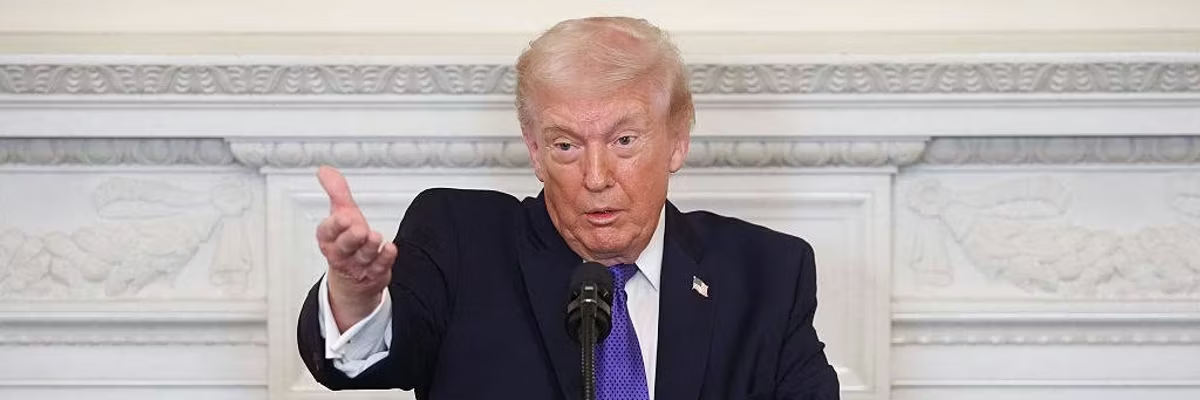
President Donald Trump delivers remarks during a working breakfast with governors in the State Dining Room at the White House on February 20, 2026 in Washington, DC.
(Photo by Kevin Dietsch/Getty Images)
One analyst predicted Iran would close the Strait of Hormuz and attack oil installations “in the hope of driving oil prices to record levels” should the US strike.
US President Donald Trump on Friday confirmed that he’s considering launching an unprovoked military strike against Iran.
According to the New York Times, Trump was asked by reporters on Friday if he was considering attacking Iran, and he replied, “I guess I can say I am considering that.”
The US has for weeks been sending fleets of warships, including the world’s largest aircraft carrier, to the Middle East in apparent preparation for a massive military operation against Iran.
According to a Friday report from Al Jazeera, the buildup is the largest by the US Air Force in the region since the 2003 Iraq War, and it includes deployments of E-3 Sentry Airborne Warning and Control System (AWACS) aircraft, F-35 stealth strike fighters and F-22 air superiority jets, and F-15 and F-16 fighter jets.
Trump has not given any justification for launching such an attack, nor has he asked the US Congress to approve it, even though the Constitution gives the legislative branch the power to declare war.
Reps. Ro Khanna (D-Calif.) and Thomas Massie (R-Ky.) have been pushing for a vote in the US House of Representatives on a war powers resolution that would require Congress to debate and approve any act of war with Iran.
It is also not clear what goals the president would hope to achieve with the attack. A Thursday CNN report indicated that Trump is now weighing several options ranging from “more targeted strikes to sustained operations that could potentially last for weeks,” including “plans to take out Tehran’s leaders.”
Trita Parsi, co-founder and executive vice president of the Quincy Institute for Responsible Statecraft, wrote in a Friday analysis of Trump’s reported attack plans that there is little chance that the president will be able to achieve a quick victory over Iran simply because the offers he has made to its government are nonstarters.
“Since the US strategy… is to escalate until Tehran caves, and since capitulation is a non-option for Iran, the Iranians are incentivized to strike back right away at the US,” explained Parsi. “The only exit Tehran sees is to fight back, inflict as much pain as possible on the US, and hope that this causes Trump to back off or accept a more equitable deal.”
Parsi acknowledged that there is no way Iran can defeat the US militarily, but could “get close to destroying Trump’s presidency before it loses the war” through a number of maneuvers intended to spike the price of oil, including “closing the Strait of Hormuz” and attacking “oil installations in the region in the hope of driving oil prices to record levels and by that inflation in the US.”
“This is an extremely risky option for Iran,” Parsi conceded, “but one that Tehran sees as less risky than the capitulation ‘deal’ Trump is seeking to force on Iran.”
This year’s Berlin International Film Festival (Berlinale) has witnessed a growing conflict between a layer of artists determined to speak out against the genocide that has taken place and continues until this day in Gaza, and the Berlin festival management, together with its backers in the German government, determined to keep genocide off the agenda.
Bae Doona, left, and Jury president Wim Wenders attend the press conference for the Jury of the International Film Festival, Berlinale, in Berlin, Thursday, Feb. 12, 2026. [AP Photo/Scott A Garfitt]
An open letter released February 17, and now signed by more than 100 film artists, all of whom have attended previous Berlinales, accuses the film festival of “censoring artists who oppose Israel’s ongoing genocide against Palestinians in Gaza and the German state’s key role in enabling it.”
The signatories include Tilda Swinton, Javier Bardem, Peter Mullan, Mike Leigh, Nan Goldin, Adam McKay, Alia Shawkat, Brian Cox, Hany Abu Assad, Joshua Oppenheimer, Ken Loach, Mahdi Fleifel, Mark Ruffalo, Saleh Bakri and Sarah Friedland.
The open letter raises a serious allegation made by the Palestine Film Institute to the effect that the festival has been “policing filmmakers alongside a continued commitment to collaborate with Federal Police on their investigations.”
The letter refers to those filmmakers who spoke out on behalf of Palestinians and their rights on the Berlinale stage at the 2025 festival being aggressively reprimanded by senior festival programmers. The letter cites one film worker who told Film Workers for Palestine: “there was a feeling of paranoia in the air, of not being protected and of being persecuted, which I had never felt before at a film festival.”
The open letter also deplores the statement made at the opening of the festival that artists should “stay out of politics”: The artists write:
We fervently disagree with the statement made by Berlinale 2026 jury president Wim Wenders that filmmaking is “the opposite of politics”. You cannot separate one from the other. We are deeply concerned that the German state-funded Berlinale is helping put into practice what Irene Khan, the UN Special Rapporteur on Freedom of Expression and Opinion recently condemned as Germany’s misuse of draconian legislation “to restrict advocacy for Palestinian rights, chilling public participation and shrinking discourse in academia and the arts.”
The letter quotes the Chinese artist and dissident Ai Weiwei who described what was happening in Germany as “doing what they did in the 1930s.”
The public appeal points to the joint role of the US and German governments in supplying Israel with the weapons (including internationally forbidden US-made thermal and thermobaric weapons) it requires to continue its campaign of ethnic cleansing and genocide.
Noting that previous Berlinales had publicly condemned “atrocities carried out against people in Iran and Ukraine,” the letter concludes:
We call on the Berlinale to fulfil its moral duty and clearly state its opposition to Israel’s genocide, crimes against humanity and war crimes against Palestinians, and completely end its involvement in shielding Israel from criticism and calls for accountability.
In another significant development, Kaouther Ben Hania, director of the award-winning film The Voice of Hind Rajab, refused to accept the “Most Valuable Film” award handed out at the Cinema for Peace ceremony in Berlin this week after an Israeli general was recognized at the same gathering. Also in attendance at the “peace” gathering was the former US Secretary of State and war criminal Hillary Clinton.
The Voice of Hind Rajab
While Cinema for Peace is not officially a part of the Berlinale, the gathering has been held since 2002 on a yearly basis to run parallel to the film festival and attract the same audience.
In refusing to take her award, Ben Hania said: “The Israeli army killed Hind Rajab; killed her family; killed the two paramedics who came to save her, with the complicity of the world’s most powerful governments and institutions.”
“I refuse to let their deaths become a backdrop for a polite speech about peace. Not while the structures that enabled them remain untouched,” she continued.
Ben Hania added that the death of the six-year-old Hind was “not an exception, it’s part of a genocide,” and she criticized those who described large-scale civilian killings as “self-defense” or “complex circumstances” while repressing all opposition.
“Peace requires justice and accountability, not glossy slogans,” she concluded.
In response to the artists’ open letter directed toward the Berlinale, its management and supporters in the German media have gone into overdrive to defend the festival’s stance.
Festival director Tricia Tuttle issued a statement, evasively declaring: “We are representing lots of people who have different views, including lots of people who live in Germany who want a more complex understanding of Israel’s positionality than maybe the rest of the world has right now.”
In one short paragraph, Tuttle repeats the phrase complex/complexity in relation to Israel three times—the very same words Kaouther Ben Hania criticised in her award rejection speech!
What is Tuttle talking about! There is no “complexity” when it comes to taking sides on the issue of genocide.
On the one side, are the broad masses of the world’s population who increasingly regard Israel as a pariah state responsible for one of the worst acts of genocidal violence since the Holocaust. This opposition, which has taken the form of numerous mass protests, demonstrations and strikes, also extends to those countries which are the closest allies of the state of Israel, the US, Germany, Great Britain and France.
Basel Sadra (left) and Yuval Abraham in 2025. [AP Photo/Markus Schreiber]
On the other side, are the governments listed above, together with bourgeois regimes and nominal opposition parties all over the world that continue to aid and maintain relations with the war criminals in Tel Aviv, thus making a continuation of the genocide possible.
In Germany, it should be noted, it was a Green Party Culture Minister Claudia Roth who in 2024 denounced a Berlinale jury team as antisemitic for awarding a prize to the film No Other Land, which documents the crimes of the Israeli army and government against the Palestinian population in the West Bank. More recently, a leading member of the Left Party, Andreas Büttner, raised false claims of antisemitism to close down an art exhibition held in Potsdam defending the rights of Palestinians.
The stirrings of opposition among film workers to the complicity of cultural institutions in supporting genocide is to be welcomed. At the same time, those engaged in the culture industry in Germany should take note. The comment made by a Palestine film worker cited in the open letter, “there was a feeling of paranoia in the air, of not being protected and of being persecuted, which I had never felt before at a film festival,” recalls a similar comment by UN Special Rapporteur Francesca Albanese.
A year ago, Albanese was prevented from holding lectures in Germany on the situation in Gaza. Responding to the threats and intimidation she had faced in Germany, Albanese commented: “I have to admit that about 75 hours in this country have made me pretty nervous and I cannot wait to get back to ‘peaceful’ Tunisia [where she is a resident]. I have never felt this sense of lacking oxygen that I feel here.”
This process is not restricted to Germany. Across the globe, governments and a host of official institutions are using police-state methods, recalling actions taken by fascist governments in the 1930s, to arrest, intimidate, imprison without due process and violently repress opposition to the mass slaughter in Gaza. Genocide is being normalised by these forces in order to justify new wars and new atrocities directed at the broadest layers of the world population.
The report said that the base would take up more than 350 acres of land in southern Gaza and is envisioned as a future base for the international force that may deploy to the Strip under President Trump’s plan for the Palestinian territory, though so far, only Indonesia has announced plans to commit troops to the force.
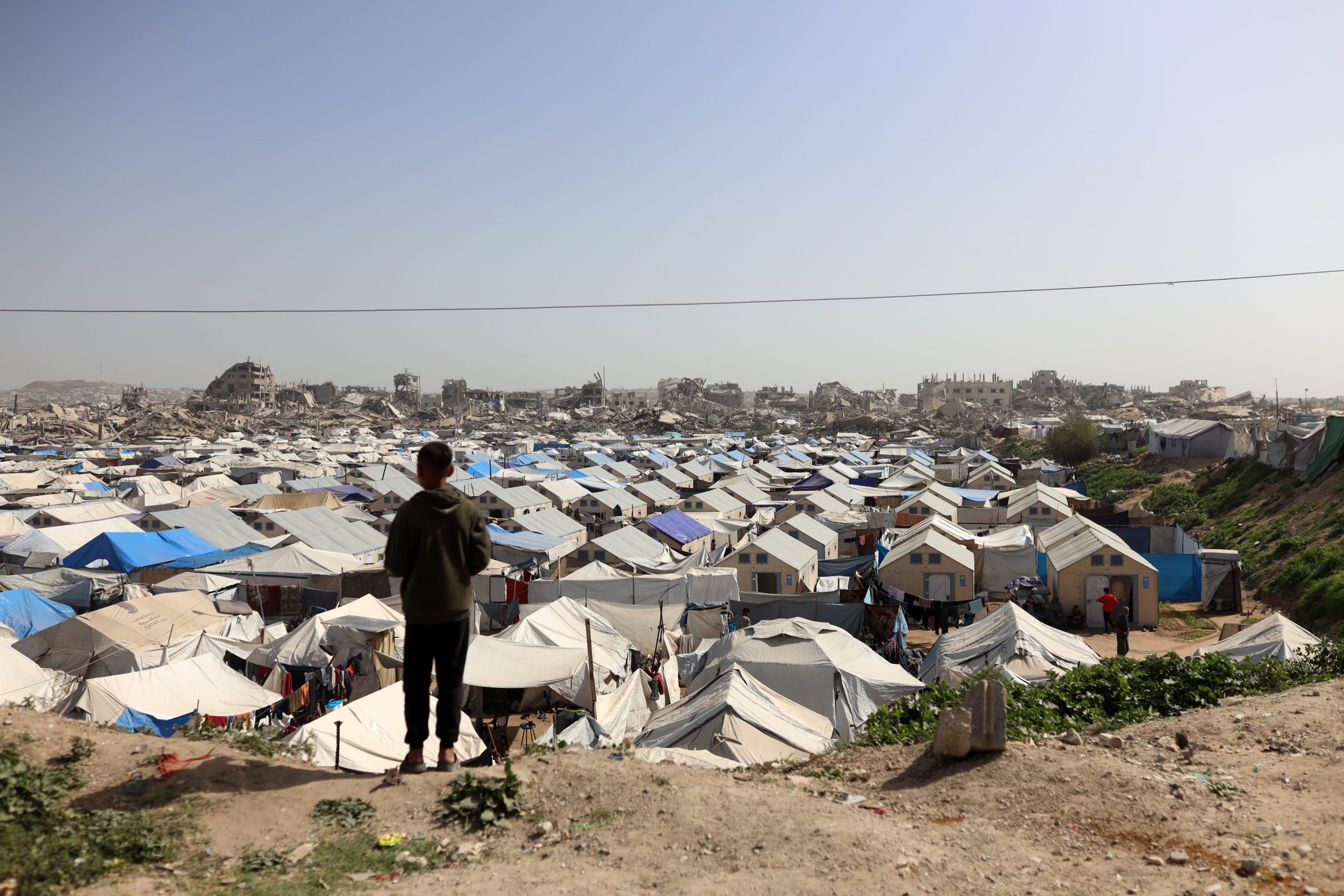
A photograph shows tents at a makeshift camp sheltering displaced Palestinians in the Zeitoun neighborhood of Gaza City, on February 16, 2026. (Photo by Majdi Fathi/NurPhoto)
The Guardian said that the plans it reviewed “call for the phased construction of a military outpost that will eventually have a footprint of 1,400 metres by 1,100 metres, ringed by 26 trailer-mounted armored watch towers, a small arms range, bunkers, and a warehouse for military equipment for operations. The entire base will be encircled with barbed wire.”
The contracting document includes protocol for what happens if construction teams come across human remains, since the bodies of at least 8,000 Palestinians are missing under the rubble. “If suspected human remains or cultural artifacts are discovered, all work in the immediate area must cease immediately, the area must be secured, and the Contracting Officer must be notified immediately for direction,” the document says.
It’s unclear how much the base would cost to build, but earlier reports suggested the US was planning to construct a major military facility on the Gaza border at a cost of between $500 million and $600 million.
Trump convened his first “Board of Peace” meeting in Washington on Thursday, which came as Israel continues to violate the ceasefire deal, killing more than 600 Palestinians in the Strip since it was signed. At the event, Trump pledged that the US would contribute $10 billion to the board.
Under Trump’s plan for Gaza, the international force is supposed to replace IDF soldiers, who continue to occupy more than 50% of the Strip. But there’s no timeline on when that would happen, and Israel is threatening to restart its full-scale genocidal war if Hamas doesn’t disarm.
A Trump advisor told Axios that there’s a 90% chance the US launches an attack in the coming weeks, while Israeli sources say it could happen within days
The Trump administration is close to launching a major attack on Iran as it continues a massive buildup of military forces in the Middle East, according to a report from Axios reporter Barak Ravid.
Sources told Ravid that the potential US attack on Iran would likely be a massive multi-week operation, much bigger than the US operation to abduct Venezuelan President Nicolas Maduro. They said it would also be much broader in scope than the 12-day US-Israeli war on Iran that was launched in June 2025. Reuters also recently reported that the US was preparing for a sustained, multi-week attack on Iran.
Israeli officials said that the Israeli government, which is pushing for the US to pursue regime change in Iran, is preparing for the possibility of the attack starting in the coming days, and CNN later reported that the US military is ready to start the war as soon as this weekend. Other sources put the timeline a little later, saying the war would likely start in a few weeks.
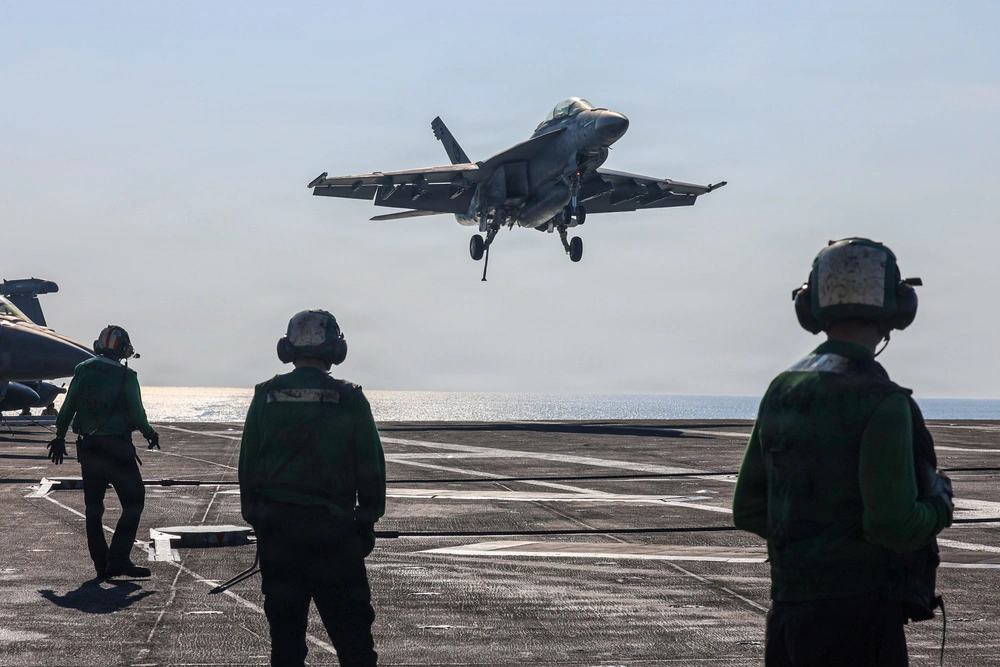
An F/A-18F Super Hornet makes an arrested landing on the flight deck ofthe aircraft carrier USS Abraham Lincoln in the Arabian Sea, January 30, 2026 (US Navy photo)
“The boss is getting fed up,” a Trump adviser told Ravid. “Some people around him warn him against going to war with Iran, but I think there is 90% chance we see kinetic action in the next few weeks.”
The Axios report noted that there has been little public debate about the potential war amid the major US military buildup and said that Americans will likely be surprised by the scale of the coming attack.
All signs indicate that if the US bombs Iran, Tehran will not hold back in its response and could target multiple US bases and warships in the region, leaving open the possibility that the war could result in hundreds or thousands of US casualties. The conflict could also have a major impact on the global economy, as Iran could close the Strait of Hormuz, through which 31% of seaborne crude oil shipments passed in 2025.
The US and Iran held talks on Tuesday, and while the Iranian side said there was a “clear path” toward a deal, US Vice President JD Vance said that Iran was not acknowledging President Trump’s “red lines.”
Vance claimed the main US demand was that Iran must not pursue a nuclear weapon, but for many months, the administration had insisted the June 2025 US strikes on Iran “obliterated” Iran’s nuclear facilities, and there’s no sign Tehran can enrich uranium at the moment. Iran has also made clear it’s willing to enter a deal that would involve a commitment to low enrichment levels, and Iranian officials maintain they don’t seek a nuclear bomb.
The real goal of any US attack on Iran will likely be regime change or taking out Iran’s ability to fire missiles at Israel. President Trump said back in December, when he met with Israeli Prime Minister Benjamin Netanyahu at his Mar-a-lago resort in Florida, that he would support another Israeli attack on Iran if the Islamic Republic “continued” its missile program.
The vicious and sustained campaign mounted against Francesca Albanese, the UN Special Rapporteur on the situation of human rights in the Palestinian Territory occupied since 1967, by Israel and the U.S. now includes the German, Italian, French, Austrian and Czech foreign ministers demanding her resignation. This campaign is part of an effort by industrial nations to at once sustain the genocide in Gaza — nearly 600 Palestinians have been killed in Gaza since the sham ceasefire took effect — and silence all those who demand the international community abide by the rule of law.
The latest assault on Francesca, part of a concerted effort to discredit international bodies such as the U.N., is based on a deliberately truncated video of a talk Francesca gave in Doha on February 7 that distorts and misconstrues her words. But truth, of course, is irrelevant. The goal is to silence her and all who stand up for Palestinian rights.
Francesca was placed by the Trump administration on the Office of Foreign Assets Control list of the U.S. Treasury Department — normally used to sanction those accused of money laundering or being involved with terrorist organizations — six days after the release of her report, “From economy of occupation to economy of genocide,” which documented the global corporations that make billions of dollars from the genocide in Gaza and occupation of Palestinians.
The Office of Foreign Assets Control list — weaponized by the Trump administration to persecute Francesca and in violation of the diplomatic immunity granted to U.N. officials — bans her from entering the U.S. It prohibits any financial institution from having her as a client. A bank that engages in financial transactions with Francesca is banned from operating in dollars, faces multimillion-dollar fines and is blocked from international payment systems. This has cut her off from global banking, leaving her unable to use credit cards or book a hotel in her name. Her assets in the U.S. are frozen. It has seen her medical insurance refuse to reimburse her for medical expenses. It has resulted in institutions, including U.S. universities, human rights groups and NGOs that once collaborated with her severing ties, fearing onerous U.S. penalties. The sanctions followed those imposed in February and June of last year on The International Criminal Court’s prosecutor Karim Khan along with two judges for issuing arrest warrants for Israeli Prime Minister Benjamin Netanyahu and former Defense Minister Yoav Gallant.
By making Francesca, who receives frequent death threats, the lightening rod, these governments seek to deflect attention from the ongoing slaughter and humanitarian disaster in Gaza. They seek to mask Israel’s system of apartheid and unlawful occupation of historic Palestine. They seek to hide, most of all, their complicity with their continuing weapons shipments that fuel Israel’s genocide.
The pace of the genocide has slowed, but it has not stopped. Israel has seized 60 percent of Gaza and blocks most humanitarian aid, including fuel, food and medicine. At the same time, Israel is accelerating its seizure of the occupied West Bank, where more than 1,100 Palestinians have been killed and tens of thousands have been displaced from their homes since October 2023.
The campaign against Francesca presages a terrifying world where Western industrial nations exploit and prey upon the weak, where the law is whatever powerful nations say it is, where those who dare to speak the truth and stand up for the rule of law are relentlessly persecuted, where genocide is another tool in the arsenal to crush the aspirations and rights of the vulnerable. This is a fight we must win. If we lose, if we let voices like Francesca’s be silenced, we will usher in an age of blood and terror.
The Chris Hedges Report is a reader-supported publication. To receive new posts and support my work, consider becoming a free or paid subscriber.
The US ambassador also said that at some point, Iran may experience the ‘second kick of a mule,’ referring to another US attack
by Dave DeCamp, Antiwar. com, February 16, 2026 at 7:08 pm ET | Iran
US Ambassador to Israel Mike Huckabee said on Monday that the US and Israel are “absolutely aligned” on the need to “deal” with Iran as Washington continues building up its forces in the Middle East to prepare for a potential attack on the Islamic Republic.
Huckabee made the comments when addressing the Conference of Presidents of Major American Jewish Organizations in Jerusalem, where he cast doubt on the idea that the US and Iran could reach a diplomatic deal and said that another US attack on the country is likely.
“At some point, the United States has to say, enough is enough,” Huckabee said, according to Haaretz. “Either Iran makes a radical change in direction, or it experiences what we call in the South the second kick of a mule. There is no education in the second kick. If you didn’t learn the first time, you won’t learn the second.”
The US and Iran are set to hold a second round of talks in Geneva on Tuesday. Israel wants any deal to involve restrictions on Iran’s ballistic missiles, a demand designed to collapse diplomacy since Tehran’s missiles are its only form of deterrence.
According to Iranian officials, the US has dropped the demand for an agreement that includes missiles, but President Trump and other Trump administration officials continue to push the issue. Huckabee said that the US and Israel have agreed that Iran cannot “continue building vast surpluses of ballistic missiles.”
President Trump has repeatedly threatened to attack Iran if a deal isn’t reached, echoing threats he made in the lead-up to the 12-day US-Israeli war against Iran that was launched in June 2025, just days before another round of negotiations between Washington and Tehran were scheduled to be held.
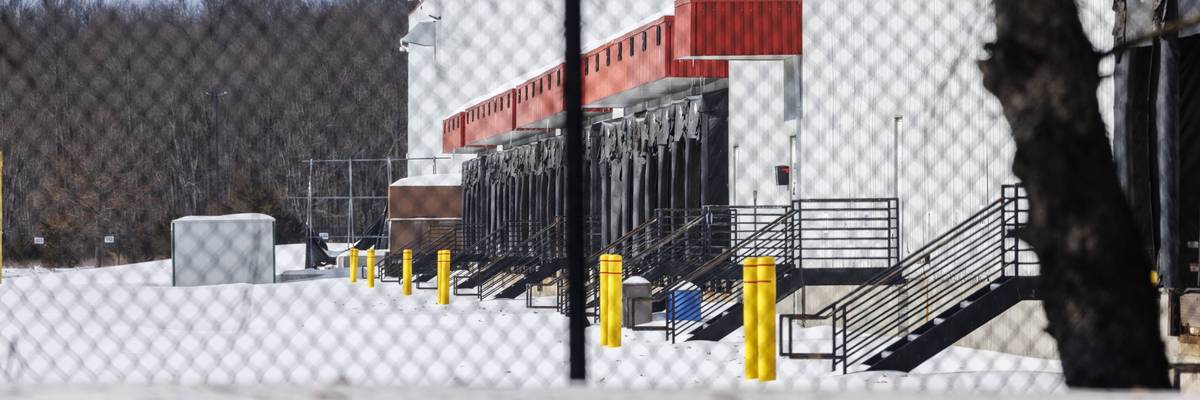
An empty warehouse is seen in Chester, New York on February 8, 2026. US Immigration and Customs Enforcement proposes a facility at a warehouse roughly two hours from New York City, but many locals and officials have objected to the plan.
(Photo by Matthew Hoen/NurPhoto via Getty Images)
“Germany’s concentration camps didn’t start as instruments of mass murder, and neither have ours,” wrote talk show host Thom Hartmann recently. “History isn’t whispering its warning: It’s shouting.”
President Donald Trump’s anti-immigration agenda has supercharged opposition in cities where he has deployed federal agents to conduct raids, and communities in states including New York and Missouri are already working to block the next step the Department of Homeland Security plans to take in its push for mass deportations: acquiring massive warehouses across the country to use as immigrant detention centers.
US immigration and Customs Enforcement documents that were provided to Republican Gov. Kelly Ayotte of New Hampshire—one of the states where ICE aims to acquire a building and retrofit it to house at least 1,000 people at a time—show that the administration plans to spend $38.3 billion on its mass detention plan.
It would buy 16 buildings across the country to use as “regional processing centers” that could hold 1,000-1,500 people. Another eight detention centers would hold as many as 10,000 people at a time, with the detainees awaiting deportation.
The Washington Postreported that a review of state budget data showed that the amount of money the White House intends to pour into the project over the next several months is larger than the total annual spending of 22 US states.
“Thirty-eight billion dollars,” said Rep. Seth Moulton (D-Mass.). “That’s what Trump is spending to turn warehouses into human holding facilities. Not on schools. Not on healthcare. Not on veterans. On warehousing humans.”
Moulton also condemned ICE’s claim that the new network of detention facilities will ensure the “safe and humane civil detention” of immigrants.
At least six people died in ICE detention centers in January, and one of the deaths, that of Geraldo Lunas Campos at Camp East Montana in El Paso, Texas, was ruled a homicide.
Medical neglect and abusive treatment—including some that amounts to torture—has been reported at multiple facilities.
ICE has already spent more than $690 million purchasing at least eight warehouses in Maryland, Arizona, Georgia, Texas, Pennsylvania, and Michigan in recent weeks. Documents posted on Ayotte’s website show the agency is pursuing additional acquisitions in New Hampshire, New York, New Jersey, and Georgia.
Communities are already rallying against the plan and questioning whether the small towns ICE has selected have sufficient water and sewer infrastructure to support thousands of people detained in a warehouse.
In New York, Rep. Pat Ryan (D-NY) said last week that 25,000 people in his district have signed a petition opposing the use of a local warehouse to house immigrants and pointed to the “major corruption and graft” evident in the plan to purchase and run the warehouses.
“The site in my district that’s proposed is owned by one of Trump’s multibillionaire donors, who would directly financially benefit from this site,” said Ryan, referring to former Trump adviser Carl Icahn.
As Common Dreamsreported Friday, private prison firm GEO Group raked in a record $254 million in profits last year as it secured contracts with the Trump administration to build new ICE facilities across the US.
ICE has attempted to make purchases in Oklahoma City; Kansas City, Missouri; and in Virginia, but those plans have fallen through, with the Kansas City Council passing a five-year ban on new nonmunicipal detention centers after the public learned that DHS was the potential buyer of a warehouse in the city.
Sen. Chris Van Hollen (D-Md.) has also joined his constituents in speaking out against ICE’s $100 million purchase of a warehouse in his state to house at least 1,000 people at a time.
“This administration is spitting in the face of communities from Minneapolis to Maryland and wasting our tax dollars. We won’t back down,” said Van Hollen late last month.
The details of the administration’s planned conversion of warehouses were reported less than two weeks after Pablo Manríquez of Migrant Insiderrevealed that a US Navy contract originally valued at $10 billion “has ballooned to a staggering $55 billion ceiling to expedite President Donald Trump’s ‘mass deportation’ agenda” and to help build “a sprawling network of migrant detention centers across the US.”
At Common Dreams last week, talk show host and author Thom Hartmannwrote that the warehouses Trump plans to use to hold people—purchased by an agency whose own data shows it has largely been detaining people with no criminal records—are best described as concentration camps like those used in Nazi Germany.
“By the end of his first year, [Adolf] Hitler had around 50,000 people held in his roughly 70 concentration camps, facilities that were often improvised in factories, prisons, castles, and other buildings,” wrote Hartmann. “By comparison, today ICE is holding over 70,000 people in 225 concentration camps across America,” with hopes to “more than double both numbers in the coming months.”
“Germany’s concentration camps didn’t start as instruments of mass murder, and neither have ours; both started as facilities for people the government’s leader said were a problem. And that’s exactly what ICE is building now,” he continued. “History isn’t whispering its warning: It’s shouting.”
Thousands of Western nationals joined the Israeli military in its genocidal war on Gaza that killed over 72,000 Palestinians.
At least 12,135 soldiers enlisted in the Israeli military hold United States passports [File: Nasser Ishtayeh/SOPA Images/LightRocket via Getty Images]
Thousands of Western nationals joined the Israeli military amid its genocidal war in Gaza, raising questions over international legal accountability for foreign nationals implicated in alleged war crimes against Palestinians.
More than 50,000 soldiers in the Israeli military hold at least one other citizenship, with a majority of them holding US or European passports, information obtained by the Israeli NGO Hatzlacha through Israel’s Freedom of Information Law has revealed.
Since October 7, 2023, Israel’s genocidal war on Gaza has killed at least 72,061 people in military actions that have been dubbed war crimes and crimes against humanity by rights groups.
Rights organisations around the world have been trying to identify and prosecute foreign nationals, many of whom have posted videos of their abuse on social media, for their involvement in war crimes, particularly in Gaza.
So, what does the first such data reveal about the Israeli military? And what could be the legal implications for dual-national soldiers?
An Israeli soldier pushes a Palestinian man while military bulldozers demolish three Palestinian-owned houses in Shuqba village, west of Ramallah in the Israeli-occupied West Bank on January 21, 2026 [Zain Jaafar/AFP]
Which foreign nationals enlist most in the Israeli military?
At least 12,135 soldiers enlisted in the Israeli military hold United States passports, topping the list by a huge margin. That is in addition to 1,207 soldiers who possess another passport in addition to their US and Israeli ones.
The data – shared with Al Jazeera by Israeli lawyer Elad Man, who serves as the legal counsel for Hatzlacha – shows that 6,127 French nationals serve in the Israeli military.
The Israeli military, which shared such data for the first time, noted that soldiers holding multiple citizenships are counted more than once in the breakdown.
The numbers show service members enlisted in the military as of March 2025, 17 months into Israel’s devastating war in Gaza.
Russia stands at third, with 5,067 nationals serving in the Israeli military, followed by 3,901 Ukrainians and 1,668 Germans.
The aircraft carrier USS Gerald R. Ford sails in formation with the guided missile destroyers USS Winston Churchill, USS Mitscher, USS Mahan, USS Bainbridge and USS Forrest Sherman in the Atlantic Ocean, Nov. 12, 2024. [Photo: Navy Petty Officer 2nd Class Jacob Mattingly ]
The US military is preparing for “sustained, weeks-long operations” against Iran if US President Donald Trump orders an attack, Reuters reported Friday, citing US officials. The planned campaign would mark a far larger US assault on Iran than anything previously carried out.
In a sustained campaign, the US military could hit “Iranian state and security facilities, not just nuclear infrastructure,” one of the officials said. The United States “fully expected Iran to retaliate, leading to back-and-forth strikes and reprisals over a period of time.”
Such a war could entail massive loss of life and have incalculable global consequences. It would be illegal under international law and take place in defiance of the popular will, with 85 percent of the American population opposed to a war against Iran, according to a YouGov poll.
Last June, the US launched “Midnight Hammer” in coordination with a 12-day Israeli bombing campaign that together killed over one thousand Iranians. Iran staged a limited retaliatory strike on a US base in Qatar. What is now being planned is qualitatively different—an air and missile campaign targeting the Iranian state itself, with the expectation of extended back-and-forth combat.
The buildup takes place just weeks after the USS Gerald R. Ford, the world’s largest and newest aircraft carrier, took part in the seizure of Venezuelan President Nicolás Maduro on January 3. The Ford, which has been at sea for more than 200 days, has now been ordered from the Caribbean to the Middle East, where it will join the USS Abraham Lincoln strike group already in the region. The same carrier used in the kidnapping of the president of Venezuela is being redeployed to wage war against Iran.
Trump, speaking to troops at Fort Bragg, North Carolina on Friday, said it had “been difficult to make a deal” with Iran. “Sometimes you have to have fear,” he declared. “That’s the only thing that really will get the situation taken care of.” Asked if he wanted regime change, Trump responded: “Seems like that would be the best thing that could happen.”
The Ford strike group includes the guided-missile cruiser Normandy and destroyers Thomas Hudner, Ramage, Carney and Roosevelt. The carrier holds more than 75 military aircraft, including F-18 Super Hornet fighters and E-2 Hawkeye early warning aircraft.
Satellite imagery analyzed by Reuters shows a massive buildup at US bases across the Middle East. At Al-Udeid air base in Qatar, the largest US facility in the region, Patriot missiles have been placed in mobile HEMTT truck launchers, giving them rapid mobility in case of an Iranian attack. The base houses an RC-135 reconnaissance aircraft, 18 KC-135 Stratotanker refueling aircraft, and seven C-17 transport planes.
At Muwaffaq Salti air base in Jordan, images from February 2 show 17 F-15E Strike Eagle fighter-bombers, eight A-10 Thunderbolt close air support aircraft, and four EA-18G Growler electronic warfare jets—where none had been visible weeks earlier. Additional forces have been deployed to Prince Sultan air base in Saudi Arabia, Diego Garcia in the Indian Ocean and Dukhan base in Oman. Approximately 112 C-17 Globemaster cargo planes have reportedly arrived or made their way toward the Gulf region.
Iran’s Revolutionary Guards have warned they could retaliate against any US military base in the region. The US maintains bases in Jordan, Kuwait, Saudi Arabia, Qatar, Bahrain, the United Arab Emirates, Oman, Turkey and on Diego Garcia. Ali Shamkhani, an adviser to Supreme Leader Ali Khamenei, warned: “We will respond decisively to any adventurism—our military readiness is high.”
The military buildup coincides with the Munich Security Conference, whose organizers titled their annual report “Under Destruction.” German Chancellor Friedrich Merz opened the conference by declaring: “This order, as flawed as it has been even in its heyday, no longer exists.” He warned that “a divide has opened up between Europe and the United States.”
But while European leaders condemned Trump’s tariffs and threats against allies, they have fully supported the US posture toward Iran. On January 29, the EU unanimously designated Iran’s Revolutionary Guards a terrorist organization—all 27 member states voting in lockstep with Washington’s escalation.
The Munich conference withdrew its invitation to Iranian Foreign Minister Abbas Araghchi, with Germany’s foreign ministry declaring his participation inappropriate. In his place, exiled Crown Prince Reza Pahlavi, son of the Shah overthrown in 1979, was given a platform. Pahlavi called for “humanitarian intervention” and an “equalizing factor”—that is, US military strikes to “neutralize the regime’s instrument of repression.” He told the conference that “help is on the way” from Trump and positioned himself as the leader of a post-regime transition.Available from Mehring BooksThe struggle against imperialism and for workers’ power in IranA pamphlet by Keith Jones
Democratic Socialists of America Congresswoman Alexandria Ocasio-Cortez spoke at the Munich Security Conference on the subject of “The Rise of Populism.” In her entire appearance at the conference, she did not say a single word about Trump’s preparations for war against Iran—the most significant military escalation of his presidency.
What she did say is revealing. She warned that Trump is “looking to withdraw the United States from the entire world so that we can turn into an age of authoritarianisms, of authoritarians… where Putin can saber rattle around Europe and try to bully around our own allies there.”
This is not opposition to war; rather Ocasio-Cortez condemned Trump as being insufficiently aggressive against “Putin”—i.e., being insufficiently committed to the war in Ukraine.
The Democrats have been silent as the administration amasses approximately 50,000 troops and the largest concentration of military firepower in the Middle East since the 2003 invasion of Iraq. Their earlier statements on Iran amounted to endorsements of regime change in response to the emergence of localized protests against the government last month. Senator Mark Warner declared on January 11, “The Iranian regime is awful, and I stand with the Iranian people.” Ocasio-Cortez tweeted that month, “The Iranian government’s violent crackdown on demonstrators is horrific.”
Far from opposing the war buildup, the Democrats have actively funded it. On January 30, the Senate passed the Consolidated Appropriations Act by a vote of 71 to 29, including $839 billion for the Pentagon—an $8.4 billion increase over the military’s own budget request. Twenty-three Democrats voted for the bill, including Senate Minority Leader Chuck Schumer, Minority Whip Dick Durbin and Vice Chair Mark Warner. In the House, the bill passed 341 to 88, with 149 Democrats voting yes and only 64 voting no. Republicans on the House Appropriations Committee hailed the legislation as “America First, Fully Funded.”
In the space of weeks, the Trump administration has kidnapped the president of Venezuela, threatened to annex Greenland, backed the Israeli genocide in Gaza and is now preparing a sustained bombing campaign against a country of 88 million people. Each of these operations targets nations whose resources Washington seeks to control as part of its escalating confrontation with China—Venezuela’s oil, Iran’s oil and natural gas and the Strait of Hormuz through which 20 percent of the world’s oil passes daily.
The working class cannot entrust the fight against imperialist war to any faction of the political establishment. The same administration threatening to devastate Iran is attacking immigrants, gutting social programs, and constructing a police state at home. Opposition to war must come from the independent mobilization of the international working class against the capitalist system that produces war, inequality and dictatorship.
A campaign of ethnic cleansing and ‘tectonic’ new legal measures are killing the two-state solution to which other governments pay lip serviceThu 12 Feb 2026 20.05 CET
Protecting archaeological sites. Preventing water theft. The streamlining of land purchases. If anyone doubted the real purpose of the motley collection of new administrative and enforcement measures for the illegally occupied West Bank, Israel’s defence minister spelt it out: “We will continue to kill the idea of a Palestinian state,” Israel Katz said in a joint statement with the finance minister, Bezalel Smotrich.
While the world’s attention was fixed upon the annihilation in Gaza, settlers in the West Bank intensified their campaign of ethnic cleansing. More than 1,000 Palestinians have been killed there since October 2023; a fifth of them were children. Many more have been driven from their homes by relentless harassment and the destruction of infrastructure, with entire Palestinian communities erased across vast swathes of land.
With Israel heading to elections in months, Benjamin Netanyahu’s far-right coalition partners are in a hurry. While they and their allies have changed the facts on the ground dramatically, and have steadily expanded Israel’s control, the bureaucratic measures adopted by the security cabinet last Sunday are “tectonic”, as one scholar notes. They ease land theft, stripping away the very limited constraints on purchase, and destroy the nominal authority of Palestinians in areas A and B.
The White House has reiterated Donald Trump’s opposition to annexation, but talks with Mr Netanyahu in Washington on Wednesday focused on Iran. To the extent that the US president thinks about Palestinians at all, he thinks about Gaza. Yet this cannot be treated separately from the West Bank. Arab and Islamic states central to his peace plan have warned that the new measures will “inflame violence, deepen the conflict and endanger regional stability and security”.
The declaration of a ceasefire in Gaza – which has not stopped the Israeli military killing Palestinians there either – has reduced the political pressure on other governments to act. There are no signs that the outrage at last Sunday’s decision will translate into action. The UK “strongly condemns” the measures. The EU said that sanctions were “still on the table” but is clearly in no hurry to act. Within Israel, only a handful dissent.
Hunger and desperation endure in Gaza while the Trump administration promotes fantastical visions of a glittering skyline. Israel has demolished the East Jerusalem headquarters of the United Nations Relief and Works Agency (Unrwa), the UN body which supports millions of Palestinian refugees, and is booting out NGOs, including Médecins Sans Frontières, from across occupied Palestine.
In 2024, the UN’s international court of justice ruled that Israel should end its illegal occupation as quickly as possible. Last year international outrage over Gaza forced multiple governments, including the UK, to recognise a Palestinian state, dragged by their publics. Those symbolic announcements look increasingly hollow. Real action cannot wait, for Israel’s government will not.


 Peace and Justice Post
You must be logged in to post a comment.