The strategy is being overseen by Elbridge Colby, the Pentagon’s policy chief, who has long called for the US to prepare to fight a “limited nuclear war”
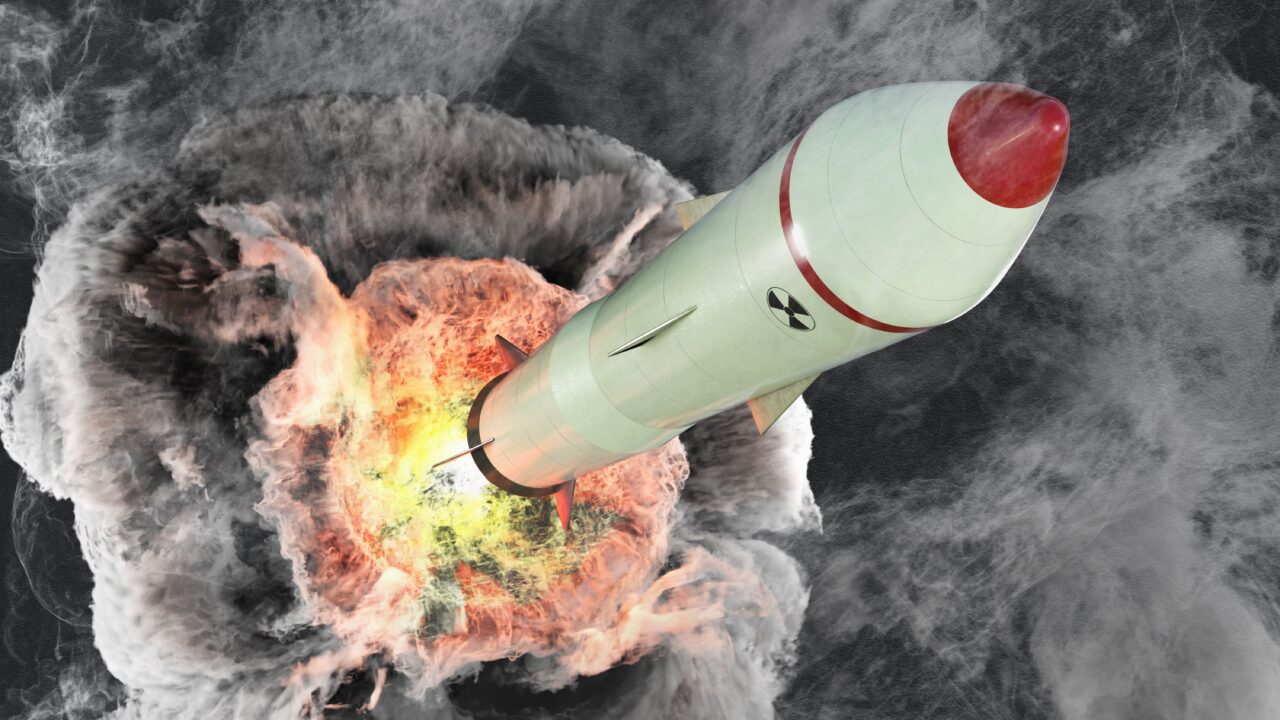
The Pentagon is reportedly drafting a new nuclear strategy that’s expected to emphasize the use of tactical nuclear weapons to give the president more “options” in a potential nuclear conflict.
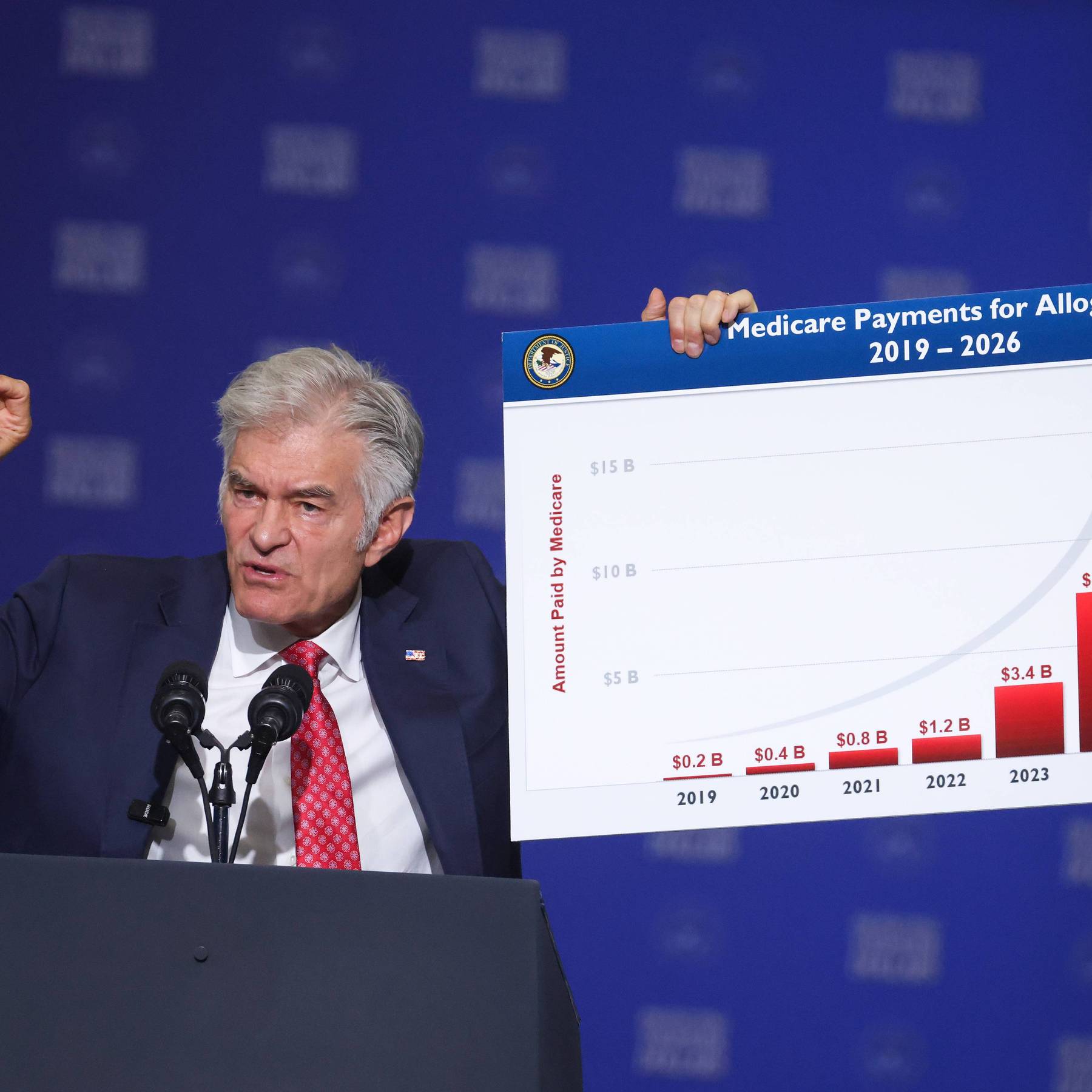
The strategy, first reported by NBC News, is being drafted by the Pentagon’s policy chief, Elbridge Colby, who has for more than a decade called for the US to develop additional capabilities to fight a “limited nuclear war.”
The idea would be to shift the US nuclear strategy away from the focus on using strategic nuclear weapons to wipe out an adversary’s nuclear capabilities and focus more on the possibility of using smaller, tactical nuclear weapons in a “regional” conflict.
Elbridge Colby, undersecretary of defense for policy, during a Senate Armed Services Committee hearing in Washington, DC, on March 3, 2026. (Photo by Craig Hudson/Sipa USA via Reuters Connect)
“If you actually want extended deterrence to be credible, you have to provide the nation’s political leadership with nuclear capabilities that common sense indicates you could actually use,” a source told NBC. “Otherwise you’re reducing our leadership’s options to extreme choices that the adversary won’t find credible.”
While the potential strategy would be carried out in the name of deterrence and preventing war, arms control advocates have strongly warned against the idea of developing more tactical nuclear weapons to prepare for a potential limited nuclear conflict over concerns that it would make nuclear war much more likely and that any nuclear exchange would likely lead to a global catastrophe.
“Without a firm rejection of the option to use nuclear weapons first in a conflict, by building and fielding more tactical nuclear weapons the administration is signaling its intention to use them against enemy forces and industrial infrastructure in a conflict,” the Arms Control Association said in response to the NBC report.
The ACA said that it “strongly opposes the administration’s decision to build more tactical nuclear weapons to supplement the options that exist” and pointed to the fact that the US already has at least two types of tactical nuclear weapons, including B61-12 gravity bombs, which are deployed in Europe, and the W76-2 low-yield warhead for the Trident II submarine-launched ballistic missile.
The ACA said the US Navy is also “acquiring a new nuclear-capable sea-launched cruise missile (SLCM-N) that may be available at the end of the decade for possible use in conflict with China.”
Breaking Defensereported that Colby announced on August 5 that the Pentagon was reviewing the US nuclear posture and repeatedly emphasized the term “options” in a speech he delivered that has not been made public.
Colby has been one of the leading voices in Washington’s policy circles advocating for the US to prepare for limited nuclear war. In a 2015 paper for the Center for a New American Security (CNAS) titled “A Nuclear Strategy and Posture for 2030,” Colby said the US “should make a special effort to develop the platforms and weapons, doctrine, planning capacity, and other capabilities needed to fight a limited nuclear war more effectively than plausible adversaries.”
He said that the ideal US nuclear force is “one that is not only highly survivable and able to issue a devastating blow against any adversary under any scenario but that is also capable of conducting effective limited nuclear operations in a controlled fashion while maintaining the ability to escalate to full-scale war if necessary.”
Colby made a similar argument in a 2018 piece written in Foreign Affairs titled “If You Want Peace, Prepare for Nuclear War,” published just a few months after he left the first Trump administration, where he led the development of the 2018 National Defense Strategy.
“Washington’s task is clear. It must demonstrate to Moscow and Beijing that any attempt to use force against US friends and allies would likely fail and would certainly result in costs and risks well out of proportion to whatever they might gain,” Colby wrote. “This requires conventional military power, but it also means having the right strategy and weapons to fight a limited nuclear war and come out on top.”
When we awaken from this trance and understand that these weapons do not make us safer, but rather are our greatest existential threat, we will be able to work together to lead an international effort to abolish them in a time-bound and verifiable manner.
On August 6, 1945 at 8:15 am local time, our world changed forever when the US dropped the first atomic bomb used in war over the Japanese city of Hiroshima. The immediate death toll was approximately 70,000 with ~140,000 to have died by year’s end. Three days later, the US would drop a plutonium bomb over the city of Nagasaki. The immediate death toll there was ~40,000 with ~70,000 to have died by year’s end with a combined total of ~210,000. Three weeks earlier, following the atomic bombing of New Mexico with the Trinity test, the nuclear age was thrust upon mankind. The nuclear legacies from victims and survivors of the atomic bombings, Hibakusha, and their history lingers to this day. The legacy extends from the mining for the nuclear materials and its impact on local communities to the processing, testing, use, storage, and waste management, as well as the impacts and risks of nuclear power to this day.
Amnesic of past history and events, the United States initiated a new arms race beginning in 2010 with then-President Barack Obama’s “grand bargain” to garner favor with the Republican Congress to ratify the New START Treaty. Following our lead, all of the remaining nine nuclear nations are working to modernize their stockpiles as well.
With the advent of artificial intelligence programs already utilized by President Donald Trump’s Department of War and the race to bring this technology to war, we move ever closer to the brink of nuclear war, either by intent, miscalculation, mistake, or cyber attack using disruptive technologies. This fact was recognized by the Bulletin of Atomic Scientists, moving their Doomsday Clock forward this past January to 85 seconds to midnight.
In order to survive, we must awaken from the myth of deterrence, realizing it for what it is, the greatest driver of the arms race. The unexamined assumptions that these weapons must exist is blatantly false. We know how to build these weapons, and we know how to disassemble them. From a height of roughly 64,000 weapons in 1986 we have reduced global stockpiles to approximately 12,187 currently. We also know that even a “limited nuclear war” in a remote region of the world, for example, between India and Pakistan, using less than one half of 1% of global stockpiles, will result in a global nuclear famine. This could potentially result in up to 2 billion deaths on the planet due to the catastrophic climate change that would follow.
The Hibakusha have a mantra of “never again.” We owe a debt to the Hibakusha, their memory, and future generations to demand the complete abolition of these weapons.
When we awaken from this trance and understand that these weapons do not make us safer, but rather are our greatest existential threat, we will be able to work together to lead an international effort to abolish them in a time-bound and verifiable manner.
What is required in this race to save ourselves is the political courage and will to do so. Thankfully, there is hope both internationally and nationally. The Treaty on the Prohibition of Nuclear Weapons has been ratified by 75 nations and signed by 25 additional nations representing a majority of the global population. Here at home the Back From the Brink grassroots movement currently has endorsing congressional resolutions. There are 70 members of Congress, who have endorsed House Resolution 317 and Senate Resolution 323.
The Hibakusha have a mantra of “never again.” We owe a debt to the Hibakusha, their memory, and future generations to demand the complete abolition of these weapons. We must demand our elected officials endorse this campaign or move out of the way for those who will.
It’s been nearly 30 years since I co-founded Common Dreams with my late wife, Lina Newhouser. We had the radical notion that journalism should serve the public good, not corporate profits.
It was clear to us from the outset what it would take to build such a project. No paid advertisements. No corporate sponsors. No millionaire publisher telling us what to think or do.
Many people said we wouldn’t last a year, but we proved those doubters wrong.
Together with a tremendous team of journalists and dedicated staff, we built an independent media outlet free from the constraints of profits and corporate control. Our mission has always been simple: To inform. To inspire. To ignite change for the common good.
Building Common Dreams was not easy. Our survival was never guaranteed. When you take on the most powerful forces—Wall Street greed, fossil fuel industry destruction, Big Tech lobbyists, and uber-rich oligarchs who have spent billions upon billions rigging the economy and democracy in their favor—the only bulwark you have is supporters who believe in your work.
But here’s the urgent message from me today. It’s never been this bad out there. And it’s never been this hard to keep us going. At the very moment Common Dreams is most needed, the threats we face are intensifying. We need your support now more than ever.
We don’t accept corporate advertising and never will. We don’t have a paywall because we don’t think people should be blocked from critical news based on their ability to pay. Everything we do is funded by the donations of readers like you.
When everyone does the little they can afford, we are strong. But if that support retreats or dries up, so do we. Will you donate now to make sure Common Dreams not only survives but thrives?
—Craig Brown, Co-founder
about:blank
about:blank
Our work is licensed under Creative Commons (CC BY-NC-ND 3.0). Feel free to republish and share widely.
Robert Dodge, MD, is a family physician practicing in Ventura, California. He serves on the board of Physicians for Social Responsibility Los Angeles (www.psr-la.org), and serves as the cochair of the Committee to Abolish Nuclear Weapons of National Physicians for Social Responsibility (www.psr.org). Physicians for Social Responsibility is the US Affiliate of the International Physicians for the Prevention of Nuclear War who received the 1985 Nobel Peace Prize and is a partner organization of ICAN, recipient of the 2017 Nobel Peace Prize. He also serves on the Back from the Brink (www.preventnuclearwar.org) steering committee.
Everything is at stake. Everything is at stake with nuclear weapons.
While working as a nuclear war planner for the Kennedy administration, Daniel Ellsberg was shown a document calculating that a U.S. nuclear attack on communist countries would result in 600 million dead. As he put it later: “A hundred Holocausts.”
That was in 1961.
Today, with nuclear arsenals vastly larger and more powerful, scientists know that a nuclear exchange would cause “nuclear winter.” And the nearly complete end of agriculture on the planet. Some estimates put the survival rate of humans on Earth at 1 or 2 percent.
No longer 100 Holocausts.
More than 1,000 Holocausts.
What might we Americans say about the actions and inaction of our leaders?
If such a nuclear war happens, of course we won’t be around for any retrospective analysis. Or regrets. So, candid introspection is in a category of now or never.
What if we did have the opportunity for hindsight? What if we could somehow hover over this planet and see what had become a global crematorium and unspeakable ordeal of human agony? Where, in words attributed to both Nikita Khrushchev and Winston Churchill, “the living would envy the dead.”
What might we Americans say about the actions and inaction of our leaders?
In 2023: The nine nuclear-armed countries spent $91 billion on their nuclear weapons. Most of that amount, $51 billion, was the United States. And our country accounted for 80 percent of the increase in nuclear weapons spending.
The United States is leading the way in the nuclear arms race. And we’re encouraged to see that as a good thing. “Escalation dominance.”
But escalation doesn’t remain unipolar. As time goes on, “Do as we say, not as we do” isn’t convincing to other nations.
China is now expanding its nuclear arsenal. That escalation does not exist in a vacuum. Official Washington pretends that Chinese policies are shifting without regard to the U.S. pursuit of “escalation dominance.” But that’s a disingenuous pretense. What the great critic of Vietnam War escalation during the 1960s, Sen. William Fulbright, called “the arrogance of power.”
Of course there’s plenty to deplore about Russia’s approach to nuclear weapons. Irresponsible threats about using “tactical” ones in Ukraine have come from Moscow. There’s now public discussion — by Russian military and political elites — of putting nuclear weapons in space.
We should face the realities of the U.S. government’s role in fueling such ominous trends, in part by dismantling key arms-control agreements. Among crucial steps, it’s long past time to restore three treaties that the United States abrogated — ABM, Intermediate-Range Nuclear Forces, and Open Skies.
On the non-proliferation front, opportunities are being spurned by Washington. For instance, as former CIA analyst Melvin Goodman wrote in September: “Iran’s Ayatollah has indicated a readiness to open discussions with the United States on nuclear matters, but the Biden administration has turned a deaf ear to such a possibility.”
That deaf ear greatly pleases Israel, the only nuclear-weapons state in the Middle East. On Sept. 22, former Defense Secretary Leon Panetta said unequivocally that Israel’s pager attack in Lebanon was “a form of terrorism.” The United States keeps arming Israel, but won’t negotiate with Iran.
The U.S. government has a responsibility to follow up on every lead, and respond to every overture. Without communication, we vastly increase the risk of devastation.
We can too easily forget what’s truly at stake.
We should face the realities of the U.S. government’s role in fueling ominous trends, in part by dismantling key arms-control agreements.
Despite diametrical differences in ideologies, in values, in ideals and systems — programs for extermination are in place at a magnitude dwarfing what occurred during the first half of the 1940s.
Today, Congress and the White House are in the grip of what Martin Luther King Jr. called “the madness of militarism.” In a toxic mix with the arrogance of power. Propelling a new and more dangerous Cold War.
And so, at the State Department, the leadership talks about a “rules-based order,” which all too often actually means: “We make the rules, we break the rules.”
Meanwhile, the Doomsday Clock set by the Bulletin of the Atomic Scientists is now just 90 seconds away from apocalyptic midnight.
Six decades ago, the Doomsday Clock was a full 12 minutes away. And President Lyndon Johnson was willing to approach Moscow with the kind of wisdom that is now absent at both ends of Pennsylvania Avenue.
Here’s what Johnson said at the end of his extensive summit meeting with Soviet Premier Alexei Kosygin in June 1967 in Glassboro, New Jersey: “We have made further progress in an effort to improve our understanding of each other’s thinking on a number of questions.”
Two decades later, President Ronald Reagan — formerly a supreme cold warrior — stood next to Soviet leader Mikhail Gorbachev and said: “We decided to talk to each other instead of about each other.”
But such attitudes would be heresy today.
As each day brings escalation toward a global nuclear inferno, standard-issue legislators on both sides of the aisle keep boosting the Pentagon budget. Huge new appropriations for nuclear weapons are voted under the euphemism of “modernization.”
And here’s a sad irony: The few members of Congress willing to urgently warn about the danger of nuclear war often stoke that danger with calls for “victory” in the Ukraine war. Instead, what’s urgently needed is a sober push for actual diplomacy to end it.
The United States should not use the Ukraine war as a rationale for pursuing a mutually destructive set of policies toward Russia. It’s an approach that maintains and worsens the daily reality on the knife-edge of nuclear war.
We don’t know how far negotiations with Russia could get on an array of pivotal issues. But refusing to negotiate is a catastrophic path.
Continuation of the war in Ukraine markedly increases the likelihood of spinning out from a regional to a Europe-wide to a nuclear war. Yet, calls for vigorously pursuing diplomacy to end the Ukraine war are dismissed out of hand as serving Vladimir Putin’s interests.
The world has gotten even closer to the precipice of a military clash between the nuclear superpowers, with a push to greenlight NATO-backed Ukrainian attacks heading deeper into Russia.
At the State Department, the leadership talks about a “rules-based order,” which all too often actually means: “We make the rules, we break the rules.”
Consider what President John Kennedy had to say, eight months after the Cuban Missile Crisis, in his historic speech at American University: “Above all, while defending our own vital interests, nuclear powers must avert those confrontations which bring an adversary to a choice of either a humiliating retreat or a nuclear war. To adopt that kind of course in the nuclear age would be evidence only of the bankruptcy of our policy, or of a collective death wish for the world.”
That crucial insight from Kennedy is currently in the dumpsters at the White House and on Capitol Hill.
And where is this all headed?
Ellsberg tried to alert members of Congress. Five years ago, in a letter that was hand-delivered to every office of Senate and House members, he wrote: “I am concerned that the public, most members of Congress, and possibly even high members of the Executive branch have remained in the dark, or in a state of denial, about the implications of rigorous studies by environmental scientists over the last dozen years.” Those studies “confirm that using even a large fraction of the existing U.S. or Russian nuclear weapons that are on high alert would bring about nuclear winter, leading to global famine and near extinction of humanity.”
In the quest for sanity and survival, isn’t it time for reconstruction of the nuclear arms-control infrastructure? Yes, the Russian war against Ukraine violates international law and “norms,” as did U.S. wars in Iraq and Afghanistan. But real diplomacy with Russia is in the interests of global security.
And some great options don’t depend on what happens at the negotiation table.
Many experts say that the most important initial step our country could take to reduce the chances of nuclear war would be a shutdown of all ICBMs.
The word “deterrence” is often heard. But the land-based part of the triad is actually the opposite of deterrence — it’s an invitation to be attacked. That’s the reality of the 400 intercontinental ballistic missiles that are on hair-trigger alert in five western states
Uniquely, ICBMs invite a counterforce attack. And they allow a president just minutes to determine whether what’s incoming is actually a set of missiles — or, as in the past, a flock of geese or a drill message that’s mistaken for the real thing.
The former Secretary of Defense William Perry wrote that ICBMs are “some of the most dangerous weapons in the world” and “they could even trigger an accidental nuclear war.”
And yet, so far, we can’t get anywhere with Congress in order to shut down ICBMs. “Oh no,” we’re told, “that would be unilateral disarmament.”
Imagine that you’re standing in a pool of gasoline, with your adversary. You’re lighting matches, and your adversary is lighting matches. If you stop lighting matches, that could be condemned as “unilateral disarmament.” It would also be a sane step to reduce the danger — whether or not the other side follows suit.
The ongoing refusal to shut down the ICBMs is akin to insisting that our side must keep lighting matches while standing in gasoline.
The chances of ICBMs starting a nuclear conflagration have increased with sky-high tensions between the world’s two nuclear superpowers. Mistaking a false alarm for a nuclear-missile attack becomes more likely amid the stresses, fatigue and paranoia that come with the protracted war in Ukraine and extending war into Russia.
Their unique vulnerability as land-based strategic weapons puts ICBMs in the unique category of “use them or lose them.” So, as Perry explained, “If our sensors indicate that enemy missiles are en route to the United States, the president would have to consider launching ICBMs before the enemy missiles could destroy them. Once they are launched, they cannot be recalled. The president would have less than 30 minutes to make that terrible decision.”
The United States should dismantle its entire ICBM force. Former ICBM launch officer Bruce Blair and Gen. James Cartwright, former vice chair of the Joint Chiefs of Staff, wrote in 2016: “By scrapping the vulnerable land-based missile force, any need for launching on warning disappears.”
The United States should dismantle its entire ICBM force.
In July, the Union of Concerned Scientists released a letter signed by more than 700 scientists. They not only called for cancelation of the Sentinel program for a new version of ICBMs — they also called for getting rid of the entire land-based arsenal.
Meanwhile, the current dispute in Congress about ICBMs has focused on whether it would be cheaper to build the cost-overrunning Sentinel system or upgrade the existing Minuteman III missiles. But either way, the matches keep being lit for a global holocaust.
During his Nobel Peace Prize speech, Martin Luther King Jr. declared: “I refuse to accept the cynical notion that nation after nation must spiral down a militaristic stairway into the hell of thermonuclear destruction.”
I want to close with some words from Ellsberg’s book “The Doomsday Machine: Confessions of a Nuclear War Planner,” summing up the preparations for nuclear war. He wrote:
“No policies in human history have more deserved to be recognized as immoral, or insane. The story of how this calamitous predicament came about, and how and why it has persisted for over half a century is a chronicle of human madness. Whether Americans, Russians and other humans can rise to the challenge of reversing these policies and eliminating the danger of near-term extinction caused by their own inventions and proclivities remains to be seen. I choose to join with others in acting as if that is still possible.”
This article is adapted from the keynote speech that the author gave at the annual conference of the Center for Arms Control and Non-Proliferation in Washington, D.C., on Sept. 24, 2024.
Even the most radical conservative can agree with Noam Chomsky on at least one thing. “No one in their right mind wants Iran to develop nuclear weapons.” But to Chomsky, nonproliferation requires reciprocal action, rather than international condemnation. Chomsky’s reputation as a prolific author of books on subjects including linguistics, philosophy, cognitive science, political science, and media might lead one to believe that his views stem from esoteric theoretical arguments, but Chomsky takes a pragmatic view of international relations. His conclusion is that Iran is developing nuclear weapons out of a rational fear for its national safety because of the systematically threatening posture of the United States and Israel.
On Sunday, February 14th, Secretary of State Hillary Clinton-speaking at the US-Islamic World Forum in Doha, Qatar-lambasted Iran for its continual development of its nuclear power program. Clinton accused Iran of “consistently (failing) to live up to its responsibilities.” According to Clinton “It has refused to demonstrate to the international community that its nuclear program is entirely peaceful.” The evidence sighted by Clinton of Iran’s callousness toward international laws and the United Nations system is Iran’s own action. The only reason Iran would establish a nuclear energy program, it is claimed, is to eventually use it to develop weapons and attack other nations. Therefore, any development of nuclear energy is ipso de facto a threat to security and assault on world peace.
Mordechai Vanunu — my friend, my hero, my brother — has again been arrested in Israel on “suspicion” of the “crime” of “meeting with foreigners.” I myself have been complicit in this offense, traveling twice to Israel for the express purpose of meeting with him, openly, and expressing support for the actions for which he was imprisoned for over eighteen years. His offense has been to defy openly and repeatedly ,conditions put on his freedom of movement and associations and speech after he had served his full sentence, restrictions on his human rights which were a direct carry-over from the British Mandate, colonial regulations in clear violation of the Universal Declaration of Human Rights. Such restrictions have no place in a nation evincing respect for a rule of law and fundamental human rights. His arrest and confinement are outrages and should be ended immediately.
Washington’s current debate over escalation in Afghanistan, the continuing war in Iraq, and the administration’s refusal, so far, to exert any serious pressure on Israel, do not bode well for Obama’s foreign policy. But in another key conflict area — Iran — President Obama appears to be implementing, at least for the moment, his campaign commitment to engage rather than threaten, to use diplomacy rather than force.
Once again I have turned to the Website of the only man who can save the world, Barack Obama who forty days ago amazed and delighted the world with his statement that he would abolish all nuclear weapons, but who since has reneged on that promise and today keeps the most warlike company of those who want to conquer Iraq and Afghanistan and other places for their oil, and precious metals while puppet governments in Asia and elsewhere are quite willing to give their assets to the Western Neo-Coms, but find it necessary to deceive their own people and the rest of the world by fulsome false promises that they are not serving their own material interests but are patriots serving the interests of their countries.
In the meantime Obama has his own problems with his ‘allies’ notably NATO and the European Union and the basic trio of Nuclear Maniacs – Bush, Blair and Brown are now desperately trying to defy the Human Rights authorities who are chasing them for Crimes against Humanity and they will eventually suffer the same fate as did the Nazi genocidists at Nuremburg in 1946.
Peace cannot be established in the Middle East when the suffering of the Palestinians continues and the Gaza Strip remains a wreck, Turkish Prime Minister Recep Tayyip Erdoğan said Monday.
Speaking at the Istanbul Forum organized by Stratim, Seta and the German Marshall Fund, Erdoğan said the Palestinian question is at the center of all problems in the Middle East. The prime minister recalled that Turkey vocalized its disapproval of the previous year’s bombing of the Gaza Strip, adding: “We criticized steps that were serving no purpose, but which increased suffering and sabotaged the peace process. We will continue to criticize it today, too. We will criticize anything similar taking place in other areas.”
Tomorrow, August 6th, marks 64 years since the atomic bombing of Hiroshima, Japan by the United States at the end of World War II. Targeted for military reasons and for its terrain (flat for easier assessment of the aftermath), Hiroshima was home to approximately 250,000 people at the time of the bombing. The U.S. B-29 Superfortress bomber “Enola Gay” took off from Tinian Island very early on the morning of August 6th, carrying a single 4,000 kg (8,900 lb) uranium bomb codenamed “Little Boy”. At 8:15 am, Little Boy was dropped from 9,400 m (31,000 ft) above the city, freefalling for 57 seconds while a complicated series of fuse triggers looked for a target height of 600 m (2,000 ft) above the ground. At the moment of detonation, a small explosive initiated a super-critical mass in 64 kg (141 lbs) of uranium. Of that 64 kg, only .7 kg (1.5 lbs) underwent fission, and of that mass, only 600 milligrams was converted into energy – an explosive energy that seared everything within a few miles, flattened the city below with a massive shockwave, set off a raging firestorm and bathed every living thing in deadly radiation. Nearly 70,000 people are believed to have been killed immediately, with possibly another 70,000 survivors dying of injuries and radiation exposure by 1950. Today, Hiroshima houses a Hiroshima Peace Memorial Museum near ground zero, promoting a hope to end the existence of all nuclear weapons. (34 photos total)


 "Photo: Haris Sair")


 Peace and Justice Post
The United States, Iran, and the Nuclear Hypocrisy
February 22, 2010by Marco Rosaire Rossi, CommonDreams.org, Feb 22, 2010
On Sunday, February 14th, Secretary of State Hillary Clinton-speaking at the US-Islamic World Forum in Doha, Qatar-lambasted Iran for its continual development of its nuclear power program. Clinton accused Iran of “consistently (failing) to live up to its responsibilities.” According to Clinton “It has refused to demonstrate to the international community that its nuclear program is entirely peaceful.” The evidence sighted by Clinton of Iran’s callousness toward international laws and the United Nations system is Iran’s own action. The only reason Iran would establish a nuclear energy program, it is claimed, is to eventually use it to develop weapons and attack other nations. Therefore, any development of nuclear energy is ipso de facto a threat to security and assault on world peace.
Continues >>
Share this:
Tags:Hillary Clinton, Ira, Israel, nuclear energy, nuclear weapons, President Obama, United States, US nuclear energy program
Posted in Commentary, Iran, President Barack Obama, Uncategorized, Zionist Israel | Leave a Comment »