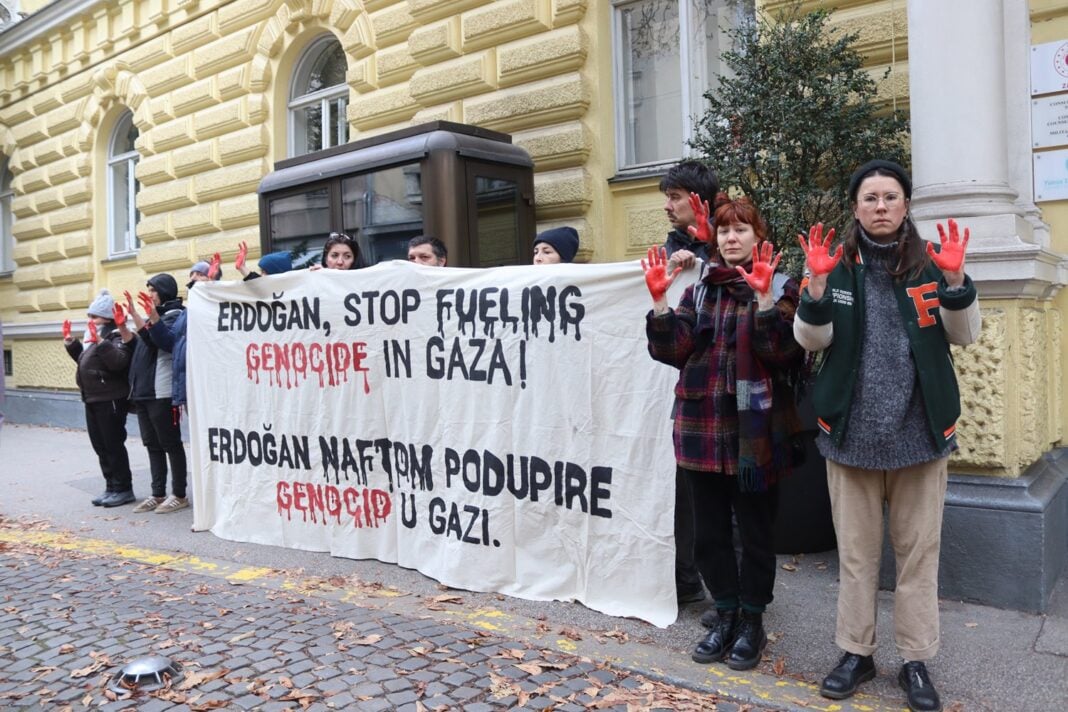
Protesters with hands painted red to symbolize blood stand outside the Turkish Embassy in Croatia on Nov. 11, 2024, holding signs in English and Croatian that read, “Erdoğan stop fueling genocide in Gaza.” The demonstration is part of a global campaign urging Turkey to cease its alleged role in oil shipments benefiting Israel.
A new report by the Stop Fueling Genocide campaign, supported by Progressive International, has revealed that 10 crude oil shipments were made from Turkey to Israel over the past year, eight of which violated Ankara’s embargo announced in May, according to the Gazete Duvar news website.
The report is the second from the group, which uses satellite imagery and shipping data to track the movement of tankers from Turkey’s Ceyhan port to Israel, providing evidence that Ankara’s crude oil shipments to Israel continued despite the trade ban.
In the first report researchers confirmed that a tanker, the Seavigour, loaded Azeri crude oil in Ceyhan on October 28, turned off its tracking signal in the eastern Mediterranean on October 30 and reappeared near Sicily a week later, having reportedly offloaded its cargo. Satellite imagery later showed the Seavigour docking at the EAPC terminal near Ashkelon, Israel, on November 5.
Ceyhan serves as the endpoint of the Baku-Tbilisi-Ceyhan (BTC) pipeline, which transports crude oil from Azerbaijan. This oil accounts for nearly 30 percent of Israel’s crude imports. Reports indicate that Azerbaijan’s oil exports to Israel have quadrupled this year, rising from 523,554 tons in January to 2,372,248 tons in September.
Researchers identified 10 journeys made since December 2023 by another crude oil tanker, the Kimolos, between Ceyhan and the EAPC Terminal in the second report, with eight occurring after Turkey’s trade blockade on Israel was announced.
The report said the Kimolos, similar to other vessels trading with Israel, was turning off its tracking signal in the middle of the eastern Mediterranean for several days to mask the trade between Turkey and Israel.
The two ships identified in the reports are Suezmax-size vessels, which are chartered specifically for the transfer of high volumes of crude oil.
The report said researchers “have reasonably concluded” from this evidence that the Kimolos has routinely shipped Azeri crude oil from Turkey to Israel throughout the past year.
The findings contradict statements by Turkey’s energy minister, who had denied any oil shipments to Israel since the embargo began.
The ongoing trade with Israel has drawn criticism from activists, who argue that crude oil from the BTC pipeline is refined and used to fuel Israeli military equipment. Advocacy groups have called on Turkey to enforce the embargo and align its policies with its stated support for Palestine.
Experts warn that if the International Court of Justice determines Israel is committing genocide in Gaza, those involved in supplying fuel could be found complicit in failing to prevent genocide.
Earlier this month nine activists, who had interrupted President Recep Tayyip Erdoğan’s November 29 speech at the TRT World Forum in İstanbul, accusing the president of hypocrisy for allegedly facilitating crude oil shipments to Israel despite Turkey’s public stance against Israeli military actions in Gaza, were detained and subsequently arrested by a court on December 2. They were released on December 6 after their lawyers filed an appeal contesting the arrests.
The arrests have sparked outrage among human rights groups and activists. Critics argue that Erdoğan’s government is suppressing dissent while enabling trade that contradicts its pro-Palestinian rhetoric.
On Sunday, Israeli Prime Minister Benjamin Netanyahu said that he spoke with President-elect Donald Trump about Israel’s need to achieve “victory” against Iran and its allies in the region.
“I unequivocally declare to Hezbollah and to Iran: In order to prevent you from attacking us, we will continue to take action against you as necessary, in every arena and at all times,” Netanyahu said.
“I discussed all of this last night with my friend, US President-elect Donald Trump. We had a very friendly, warm and important discussion. We discussed the need to complete Israel’s victory and we spoke at length about the efforts we are making to free our hostages,” the prime minister added.
The conversation between Netanyahu and Trump came after reports said Israel sees an opportunity to bomb Iran following the regime change in Syria that ousted former President Bashar al-Assad. The Wall Street Journal also reported that the Trump transition team is discussing the idea of strikes on Iran’s nuclear facilities.
The pretext for any Israeli or US action against Iranian nuclear facilities would be to stop Iran from building a bomb, but there’s no evidence that Tehran has decided to pursue nuclear weapons, something recently acknowledged by the CIA.
In his remarks on Sunday, Netanyahu also said Israel was changing the “face” of the Middle East. “Syria is not the same Syria. Lebanon is not the same Lebanon. Gaza is not the same Gaza. And the head of the axis, Iran, is not the same Iran; it has also felt the might of our arm.
The Israeli leader claimed Israel has “no interest in a conflict with Syria,” but Israel has unleashed a heavy air campaign against the country since the downfall of Syrian President Bashar al-Assad, launching over 800 strikes.
The recent fall of President Bashar al-Assad’s regime in Damascus marked a turning point in Syria’s ongoing conflict, with new reports revealing a covert Ukrainian role in aiding Syrian rebels.
Ukrainian intelligence provided strategic support, including drone technology and experienced operators, to Hayat Tahrir al-Sham (HTS), the dominant rebel faction in Idlib, Caliber.Az reports via The Washington Post.
This effort underscores Ukraine’s broader strategy to undermine Russian influence on multiple fronts amid its ongoing war with Moscow.
Approximately four to five weeks prior to the HTS-led offensive, Ukrainian operatives delivered 150 first-person-view drones and deployed 20 experienced operators to assist the rebels. Although Western intelligence sources suggest this aid played a modest role in the regime’s downfall, it was a significant demonstration of Kyiv’s intent to counter Russia in unconventional theatres such as the Middle East, Africa, and even within Russia itself.
Ukraine’s intelligence agency, the GUR, has reportedly collaborated with opposition groups in Syria under a special unit known as “Khimik,” bolstering rebel capabilities against Russian-backed Syrian forces.
Ukraine’s motivations for such actions are clear. With its homeland under siege, Kyiv is actively opening secondary fronts to stretch Russian resources and influence. A June report in the Kyiv Post detailed strikes by Ukrainian-backed Syrian rebels on Russian military installations, accompanied by video evidence of these operations.
Russian officials have expressed growing concern, with statements from representatives such as Alexander Lavrentyev and Foreign Minister Sergei Lavrov accusing Ukrainian intelligence of conducting “dirty operations” in Idlib. Despite these claims, independent verification remains scarce.
While Russia has downplayed Ukraine’s involvement, pointing to HTS’s independent drone program and prior expertise, the rapid collapse of Assad’s regime caught Moscow off guard. Russian Telegram channels have sought to minimize Kyiv’s role, suggesting Ukrainian personnel were in Syria for too short a time to significantly influence operations. However, this narrative contrasts with Ukraine’s broader pattern of covert actions against Russian forces worldwide.
Beyond Syria, Ukraine has demonstrated its capability for overseas operations in other regions. In July 2023, Ukrainian intelligence reportedly supported Malian rebels in an ambush against Wagner Group mercenaries, resulting in significant losses for the Russian paramilitary group.
Such actions highlight the GUR’s aggressive strategy, with its head, Lt. Gen. Kyrylo Budanov, affirming Ukraine’s commitment to targeting Russian military assets globally. This approach has drawn concerns from Western allies, including the Biden administration, over potential escalations.
Ukraine’s actions in Syria align with its broader strategy to disrupt Russia’s influence and partnerships. By aiding HTS, Kyiv weakened a critical Russian ally in the Middle East, further isolating Moscow. Although the Ukrainian assistance may not have been decisive, it contributed to an environment where the Assad regime’s fall became inevitable.
The parallels to other intelligence failures, such as Russia’s inability to anticipate HTS’s offensive or Israel’s surprise during Hamas’s October 2023 attack, are striking. Both underscore the challenges nations face in responding to unconventional threats.
For Ukraine, these operations serve as a testament to its resilience and resourcefulness in a protracted struggle against a powerful adversary. While not the decisive factor in Damascus, Ukraine’s covert actions signal its intent to shape the global battlefield to its advantage.
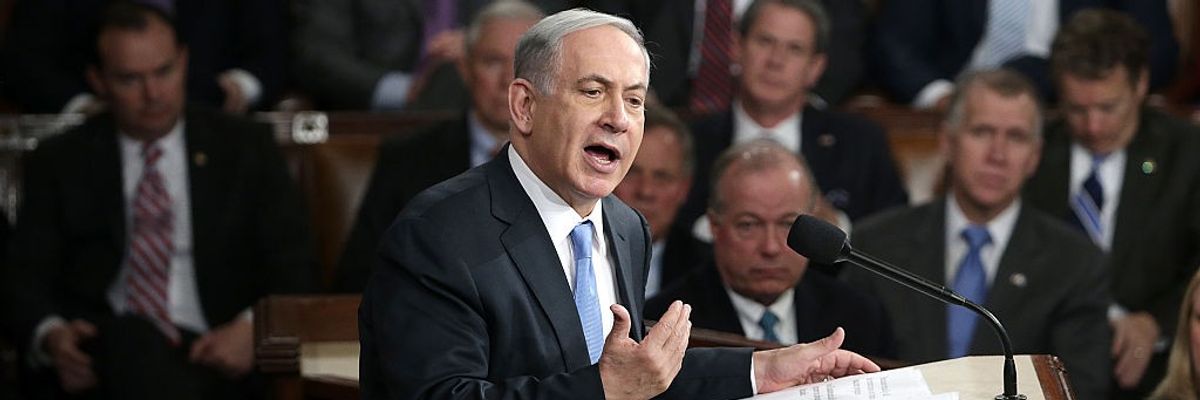
Israeli Prime Minister Benjamin Netanyahu addresses a joint meeting of the United States Congress in the House chamber at the U.S. Capitol March 3, 2015 in Washington, D.C.
(Photo: Win McNamee/Getty Images)
Ultimately, this is the story of how the Israel lobby undermined America, wrecked the Middle East, and set a series of international crimes against humanity in motion.
It’s official now. America’s closest ally, Israeli Prime Minister Benjamin Netanyahu, the one accorded more than 50 standing ovations in Congress just months ago, is under indictment by the International Criminal Court for crimes against humanity and war crimes. America must take note: the U.S. Government is complicit in Netanyahu’s war crimes and has fully partnered in Netanyahu’s violent rampage across the Middle East.
For 30 years the Israel Lobby has induced the U.S. to fight wars on Israel’s behalf designed to prevent the emergence of a Palestinian State. Netanyahu, who first came to power in 1996, and has been prime minister for 17 years since then, has been the main cheerleader for U.S.-backed wars in the Middle East. The result has been a disaster for the U.S. and a bloody catastrophe not only for the Palestinian people but for the entire Middle East.
These have not been wars to defend Israel, but rather wars to topple governments that oppose Israel’s oppression of the Palestinian people. Israel viciously opposes the two-state solution called for by international law, the Arab Peace Initiative, the G20, the BRICS, the OIC, and the UN General Assembly. Israel’s intransigence, and its brutal suppression of the Palestinian people, has given rise to several militant resistance movements since the beginning of the occupation. These movements are backed by several countries in the region.
The obvious solution to the Israel-Palestine crisis is to implement the two-state solution and to demilitarize the militant groups as part of the implementation process.
Israel’s approach, especially under Netanyahu, is to overthrow foreign governments that oppose Israel’s domination, and recreate the map of a “New Middle East” without a Palestinian State. Rather than making peace, Netanyahu makes endless war.
What is shocking is that Washington has turned the U.S. military and federal budget over to Netanyahu for his disastrous wars. The history of the Israel lobby’s complete takeover of Washington can be found in the remarkable new book by Ilan Pappé, Lobbying for Zionism on Both Sides of the Atlantic (2024).
Rather than making peace, Netanyahu makes endless war.
Netanyahu repeatedly told the American people that they would be the beneficiaries of his policies. In fact, Netanyahu has been an unmitigated disaster for the American people, bleeding the U.S. Treasury of trillions of dollars, squandering America’s standing in the world, making the U.S. complicit in his genocidal policies, and bringing the world closer to World War III.
If Trump wants to make America great again, the first thing he should do is to make America sovereign again, by ending Washington’s subservience to the Israel Lobby.
The Israel Lobby not only controls the votes in Congress but places hardline backers of Israel into key national security posts. These have included Madeleine Albright (Secretary of State for Clinton), Lewis Libby (Chief of Staff of Vice President Cheney), Victoria Nuland (Deputy National Security Advisor of Cheney, NATO Ambassador of Bush Jr., Assistant Secretary of State for Obama, Under-Secretary of State for Biden), Paul Wolfowitz (Under-Secretary of Defense for Bush Sr., Deputy Secretary of Defense for Bush Jr.), Douglas Feith (Under-Secretary of Defense for Bush Jr.), Abram Shulsky (Director of the Office of Special Plans, Department of Defense for Bush Jr.), Elliott Abrams (Deputy National Security Advisor for Bush Jr.), Richard Perle (Chairman of the Defense National Policy Board for Bush Jr.), Amos Hochstein (Senior Advisor to the Secretary of State for Biden), and Antony Blinken (Secretary of State for Biden).
Netanyahu has been an unmitigated disaster for the American people, bleeding the U.S. Treasury of trillions of dollars, squandering America’s standing in the world, making the U.S. complicit in his genocidal policies, and bringing the world closer to World War III.
In 1995, Netanyahu described his plan of action in his book Fighting Terrorism. To control terrorists (Netanyahu’s characterization of militant groups fighting Israel’s illegal rule over the Palestinians), it’s not enough to fight the terrorists. Instead, it’s necessary to fight the “terrorist regimes” that support such groups. And the U.S. must be the one to lead:
The cessation of terrorism must therefore be a clear-cut demand, backed up by sanctions and with no prizes attached. As with all international efforts, the vigorous application of sanctions to terrorist states must be led by the United States, whose leaders must choose the correct sequence, timing, and circumstances for these actions.
As Netanyahu told the American people in 2001 (reprinted as the 2001 foreword to Fighting Terrorism):
The first and most crucial thing to understand is this: There is no international terrorism without the support of sovereign states. International terrorism simply cannot be sustained for long without the regimes that aid and abet it… Take away all this state support, and the entire scaffolding of international terrorism will collapse into dust. The international terrorist network is thus based on regimes—Iran, Iraq, Syria, Taliban Afghanistan, Yasir Arafat’s Palestinian Authority, and several other Arab regimes, such as the Sudan.
All of this was music to the ears of the neocons in Washington, who similarly subscribed to U.S.-led regime change operations (through wars, covert subversion, U.S.-led color revolutions, violent coups, etc.) as the main way to deal with perceived U.S. adversaries.
After 9/11, the Bush Jr. neocons (led by Cheney and Rumsfeld) and the Bush Jr. insiders of the Israel Lobby (led by Wolfowitz and Feith), teamed up to remake the Middle East through a series of U.S.-led wars on Netanyahu’s targets in the Middle East (Lebanon, Iran, Iraq, Syria) and Islamic East Africa (Libya, Somalia, and Sudan). The role of the Israel Lobby in stoking these wars of choice is described in detail in Pappe’s new book.
The neocon-Israel Lobby war plan was shown to General Wesley Clark on a visit to the Pentagon soon after 9/11. An officer pulled a paper from his desk and told Clark: “I just got this memo from the Secretary of Defense’s office. It says we’re going to attack and destroy the governments in 7 countries in five years—we’re going to start with Iraq, and then we’re going to move to Syria, Lebanon, Libya, Somalia, Sudan and Iran.”
In 2002, Netanyahu pitched the war with Iraq to the American people and Congress by promising them that “If you take out Saddam, Saddam’s regime, I guarantee you that it will have enormous positive reverberations on the region[…] People sitting right next door in Iran, young people, and many others, will say the time of such regimes, of such despots is gone.”
A remarkable new insider account of Netanyahu’s role in spearheading the Iraq War also comes from retired Marine Command Chief Master Sargent Dennis Fritz, in his book Deadly Betrayal (2024). When Fritz was called to deploy to Iraq in early 2002, he asked senior military officials why the U.S. was deploying to Iraq, but he got no clear answer. Rather than lead soldiers into a battle he could not explain or justify, he left the service.
The neocon-Israel Lobby teamwork has marked one of the greatest global calamities of the 21st century.
In 2005, Fritz was invited back to the Pentagon, now as a civilian, to assist Under-Secretary Douglas Feith in the declassification of documents about the war, so that Feith could use them to write a book about the war. Fritz discovered in the process that the Iraq War had been spurred by Netanyahu in close coordination with Wolfowitz and Feith. He learned that the purported U.S. war aim, to counter Saddam’s weapons of mass destruction, was a cynical public relations gimmick led by an Israel Lobby insider, Abram Shulsky, to garner U.S. public support for the war.
Iraq was to be the first of the seven wars in five years, but as Fritz explains, that follow-up wars were delayed by the anti-U.S. Iraqi insurgency. Nonetheless, the U.S. eventually went to war or backed wars against Iraq, Syria, Libya, Somalia, Sudan, and Lebanon. In other words, the U.S. carried out Netanyahu’s plans—except for Iran. To this day, indeed to this hour, Netanyahu works to stoke a U.S. war on Iran, one that could open World War III, either by Iran making the breakthrough to nuclear weapons, or by Iran’s ally, Russia, joining such a war on Iran’s side.
The neocon-Israel Lobby teamwork has marked one of the greatest global calamities of the 21st century. All of the countries attacked by the U.S. or its proxies—Iraq, Lebanon, Libya, Somalia, Sudan, and Syria—now lie in ruins. Meanwhile, Netanyahu’s genocide in Gaza continues apace, and yet again the U.S. has opposed the unanimous will of the world (other than Israel) this week by vetoing a UN Security Council ceasefire resolution that was backed by the other 14 members of the U.N. Security Council.
The real issue facing the Trump Administration is not defending Israel from its neighbors, who call repeatedly, almost daily, for peace based on the two-state solution. The real issue is defending the U.S. from the Israel Lobby.
Common Dreams is powered by optimists who believe in the power of informed and engaged citizens to ignite and enact change to make the world a better place.
We’re hundreds of thousands strong, but every single supporter makes the difference.
Your contribution supports this bold media model—free, independent, and dedicated to reporting the facts every day. Stand with us in the fight for economic equality, social justice, human rights, and a more sustainable future. As a people-powered nonprofit news outlet, we cover the issues the corporate media never will.
about:blank
about:blank
Our work is licensed under Creative Commons (CC BY-NC-ND 3.0). Feel free to republish and share widely.
Jeffrey D. Sachs is a University Professor and Director of the Center for Sustainable Development at Columbia University, where he directed The Earth Institute from 2002 until 2016. He is also President of the UN Sustainable Development Solutions Network.
Defeating the Arab democracy movement left autocratic states hollowed out and often reliant on US and Israeli support to survive. Palestinians cannot expect help anytime soon
Egypt’s President Abdel Fattah el-Sisi (R) meets with US Secretary of State Antony Blinken in Alamein in northern Egypt on 20 August 2024 (AFP)
341 Shares
As Israel continues its genocidal war in Gaza, and expands it to Lebanon, most Arab countries appear to be mere observers or enablers of the massacre of Palestinian and Lebanese civilians on an unprecedented scale.
Even with the threat of a large-scale regional war looming, which could have extremely destabilising effects on the entire region, the ability and desire of Arab states to restrain Israeli imperial hubris appears to be non-existent.
There is good reason to argue that the main enabler of the current crisis engulfing the Middle East is none other than the United States, which has effectively funded the Israeli wars on Gaza and Lebanon, with aid topping $17.9bn since 7 October 2023. It has also provided diplomatic cover to Israel and given its far-right government the green light to expand the war into Lebanon.
This, however, misses an important aspect of the dynamic. Namely, Israel’s colonial hubris regards having the ability to reshape the Middle East through mass violence being fed by the autocratic nature of the Arab states and the failure of the democratic movement in the region.
More than a decade after the mass revolts that swept the region, the result is weak states, with contested legitimacy, only able to exercise power over their own citizens through mass violence – not dissimilar to the way that Israel is treating the Palestinians.
New MEE newsletter: Jerusalem Dispatch
Sign up to get the latest insights and analysis on Israel-Palestine, alongside Turkey Unpacked and other MEE newsletters
In many ways, the logic of regime survival at any cost has eroded the ability of these states to influence events in the region – and, in some cases, the social foundation of the national state itself.
Flow of US aid
A notable example of this is Egypt, the most populous Arab state and the only one to have a border with the Gaza Strip, making it, theoretically, one of the Arab states with the most potential to influence the conflict and restrain Israeli aggression.
Egypt is also a close ally of the US, receiving a whopping $183.5bn in aid since the end of the Second World War, positioning it as a possible interlocutor with Israel’s patron.
This strategic positioning, however, was overridden by the Sisi government’s obsession with survival, which placed it in a dependent relationship with Israel, even as Israel threatens the very stability that Sisi covets.
Indeed, Israel played a not insignificant role in the consolidation of the Sisi government after the 2013 coup, offering political support, security cooperation and deeper economic ties to the direct benefit of the Egyptian elites.
War on Gaza: Arab despots’ failure to stand up to Israel could fuel an explosion
For example, during the summer of 2013, after the coup that overthrew the elected president, Mohamed Morsi, the American Israel Public Affairs Committee (Aipac) was lobbying on behalf of the fledgling military autocracy to ensure the continued flow of American aid.
The close relationship between President Abdel Fattah el-Sisi and the Zionist lobbying groups continued, with reports emerging in February 2017 that Sisi met representatives of the most influential pro-Israel groups, including Aipac, Friends of the Israel Defense Forces (FIDF) and the Zionist Organization of America (Zoa) five times in 20 months.
The relationship between Sisi and Israeli Prime Minister Benjamin Netanyahu has been described as the closest between any leaders from the two nations since the peace treaty of 1979.
This apparent closeness was anchored in close security cooperation between the countries, with reports emerging in 2018 that, in the preceding two years, Israel had conducted over 100 air strikes against militants in Sinai, with Cairo’s approval.
This security cooperation was extended to include direct repression of peaceful dissent in Egypt, with the sale of Israeli spyware to Sisi’s government, which was used to hack into the phone of Ahmed Tantawy, a prominent member of the secular opposition.
The depth of the alliance extended to the energy sector, with a $15bn deal signed in 2018 between the two countries to import Israeli gas for re-export in liquid form.
An investigation by human rights campaigner Hossam Bahgat revealed that the Egyptian private company responsible for the deal was managed by Egypt’s General Intelligence Services (GIS), allowing the country’s security elites to profit from the deal directly.
Egypt’s debt crisis
These deep structural dependencies placed Sisi’s government in an extremely vulnerable position, unable to restrain Israel, even when the idea of the ethnic cleansing of Gaza was floated by Netanyahu, with its highly destabilising effects on the government and the country.
Indeed, beyond rhetorical condemnation, Egypt has done little to impact the dynamic on the ground. The most notable example of a critical public stance was the Egyptian declaration in May that it would join the International Court of Justice case against Israel.
At the time of writing, there is no evidence of it doing so. But there is evidence of deepening economic ties, with Egypt in September signing another deal with Israel, to increase its imports of natural gas by 20 percent.
More than a decade after the coup, with the Sisi government facing a grinding debt crisis and following a logic of power consolidation at any cost, it finds itself at the mercy of Israel and its colonial hubris, unable to exert influence on one of its closest allies.
Syria in shambles
The enabling of Israel’s colonial ambitions is not limited to Israel’s Arab allies, but also extends to Syria, where the logic of government survival above all else is at its most extreme.
More than a decade after the start of the Syrian uprising, the Assad government has survived, albeit at the cost of hundreds of thousands of lives, high levels of foreign interference and the loss of large swathes of territory. The Syrian economy is decimated, the state’s monopoly on violence is now completely eroded, and the social foundations of the state have been eviscerated.
The post-colonial state has failed to meet its raison d’etre, namely to empower the people of the Middle East, and confront the old imperial powers, including Israel
The Syrian government has reduced the country to a narco state, blackmailing the Gulf states into reintegrating it into the Arab fold in exchange for stopping the flow of illicit drugs.
In essence, Assad decided to sacrifice the Syrian state on the altar of his survival, leaving behind a state in shambles – unable to assert control within its own borders, let alone restrain Israeli aggression that could spiral to engulf Syria as well, whose territory it already occupies.
The horrors that we are witnessing in Gaza and Lebanon are as much the result of an Israeli colonist mania, and western support for it, as it is also a direct result of the nature of the Arab political landscape that emerged from the failed Arab spring.
The post-colonial state has failed to meet its raison d’etre, namely to empower the people of the Middle East, and confront the old imperial powers, including Israel. Any pretences of this have now completely disappeared, with a new raison d’etre emerging, namely the domination of their own citizens at any cost.
This is not to argue that these states were not repressive before, but there is not now even a pretence of confronting a dangerous external enemy, now that said enemy is internal.
The dissident has now come to replace colonists and the occupier as the number one enemy of the Arab states, with the mass slaughter of the Palestinians, Lebanese and whoever dares to challenge the Israeli vision of the new Middle East standing as a testament to a new Arab autocratic political order.
The views expressed in this article belong to the author and do not necessarily reflect the editorial policy of Middle East Eye.
Maged Mandour is a political analyst who is a regular contributor to the Arab Digest, Middle East Eye, and Open Democracy. He is the author of an upcoming book entitled Egypt Under Sisi, to be published by IB Tauris. The book will examine the social and political developments in Egypt since the 2013 coup.
In a major escalation of the imperialist military offensive throughout the Middle East, Israel launched three waves of airstrikes on Iran Saturday morning in coordination with the Biden administration.
A view of Tehran capital of Iran is seen, early Saturday, October 26, 2024. [AP Photo/Vahid Salemi]
The White House quickly endorsed Israel’s illegal attack on Iran, declaring, “We understand that Israel is conducting targeted strikes against military targets in Iran as an exercise of self-defense.”
A White House official further endorsed the illegal attack in a statement to Bloomberg, calling it “targeted and proportional.” The official told Bloomberg, “The president and his national security team, of course, worked with the Israelis over recent weeks” to plan the illegal act of war.
Rather than self-defense, the attack is a calculated provocation aimed at eliciting a military response by Iran that can be used to justify further US-Israeli aggression, including the deployment of even more combat troops to Israel and a further military build-up throughout the region.
The Iranian military confirmed that airstrikes targeted bases in Ilam, Khuzestan, and Tehran provinces, and commercial flights were suspended throughout the country.
The attack follows the October 9 discussion between US President Joe Biden and Israeli Prime Minister Benjamin Netanyahu in which the American president signed off on the strikes, along with a series of discussions with the Pentagon and White House Friday night.
The attack took place just days after US Secretary of Defense Lloyd Austin announced that US combat troops had arrived in Israel, in the role of air defense support for the operation.
The attack took place as US Secretary of State Antony Blinken arrived in the Middle East after extensive discussions with Netanyahu in which he reviewed both the planned attack on Iran and Israel’s so-called “generals’ plan” to starve, displace, or exterminate the remaining population of Northern Gaza.
The Israeli-US attack on Iran took place just 11 days before the November 5 US presidential election. Earlier this month, the World Socialist Web Site warned that the Biden administration was planning an “October conspiracy” to escalate the war with Iran. We wrote:
There is a long history of events taking place in October that have major effects on an upcoming US presidential election. By deploying US troops to Israel, the Biden administration is not so much seeking to impact Kamala Harris’s electoral prospects as to ensure that plans for military escalation are underway before the election takes place. Instead of an “October surprise,” it is an “October conspiracy” to massively expand US involvement in war throughout the Middle East.
These warnings have now been confirmed. While the scope of the Israeli attack is at this point unclear, it is evident that the Biden Administration is recklessly seeking to escalate war throughout the Middle East targeting Iran.
Israel’s attack on Iran is part of its rampage throughout the Middle East, supported by the imperialist powers, with the aim of reimposing colonial domination over the oil-rich region as part of their effort to dominate Russia and China.
The most horrific consequence of this imperialist offensive throughout the Middle East is the genocide in Gaza. The official death toll of the Gaza genocide stands at 42,847, with over 100,544 wounded. The real death toll is likely to be far higher, with an article in The Lancet estimating it at 186,000 or more in July.
This month, Reuters reported that Israel had suspended all commercial food shipments into Gaza, leading the availability to fall to the lowest level since the start of Israel’s onslaught, as human rights organizations warned of imminent mass starvation.
The attack on Iran follows a campaign of illegal assassinations targeting all of the leaders of Hamas and Hezbollah, as well as leading Iranian figures, as the US and Israel expand their military onslaught throughout the region. On October 16, Israel murdered Hamas leader Yahya Sinwar in Rafah. Hezbollah leader Hassan Nasrallah was killed by more than 80 Israeli 2,000-pound bombs in Lebanon last month, and Hamas political leader Ismail Haniyeh was assassinated by Israel in Tehran in July.
Israel simultaneously continued its ground invasion and daily bombardment of Lebanon Friday, with the Lebanese death toll rising to 2,634.
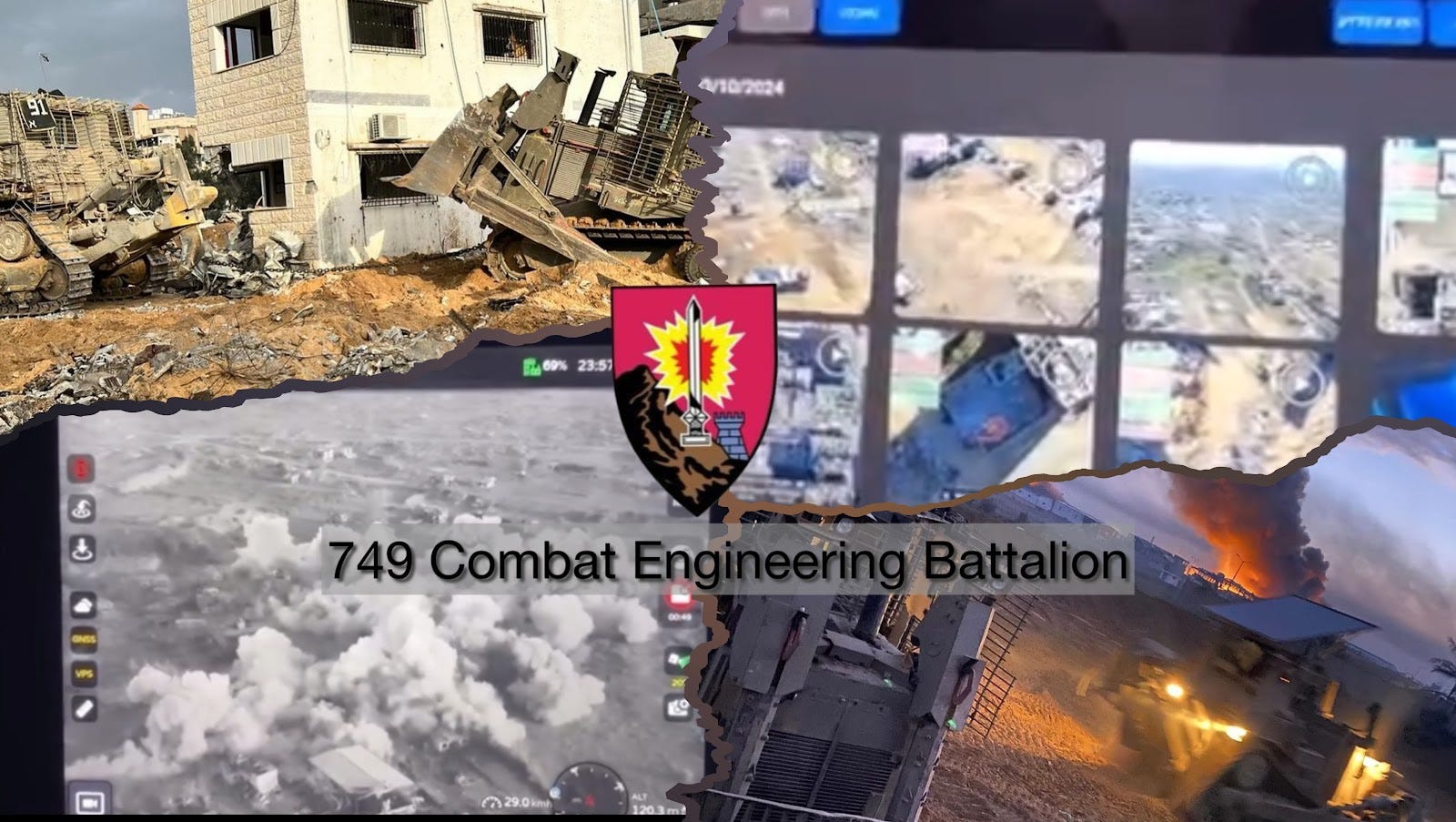
An investigation into 749 Combat Engineering Battalion’s mission to destroy “the symbols of Gaza’s future.”
Graphic: Younis Tirawi.
“Now go, attack the Amalekites and totally destroy everything that belongs to them. Do not spare them; put to death men and women, children and infants, cattle and sheep, camels and donkeys.”
This is what the deputy commander of Israel’s 749 Combat Engineering Battalion, Lieutenant Colonel Adi Bekore, posted on his personal Facebook account on October 9, 2023, just two days after the Hamas attacks of October 7. Numerous soldiers from the battalion he had command over liked the post. It is a quote from a biblical passage in which the biblical nation of Israel is commanded to attack the Amalekites, an ancient biblical nation that was a recurrent enemy of the Israelites. Israeli Prime Minister Benjamin Netanyahu also invoked this reference early in the war—a moment cited by South Africa in its case to the ICJ as a piece of genocidal rhetoric:
Lieutenant Colonel Adi Bekore’s post to Facebook on October 9, 2023.
Lieutenant Colonel Adi Bekore. Source: @gdud749 on Instagram
Like much of the rhetoric coming from all organs of the Israeli military since its assault on Gaza started, these words served as a stark warning of what was to come. One year later, countless homes, schools, hospitals, and residential buildings have been bombed and destroyed. 42,718 people have been killed, according to the most recent Gaza Health Ministry figures. The actual figure is certain to be a lot higher: An estimated 10,000 people are buried in the rubble, and the official count doesn’t include those indirectly killed by Israel’s assault on Gaza.
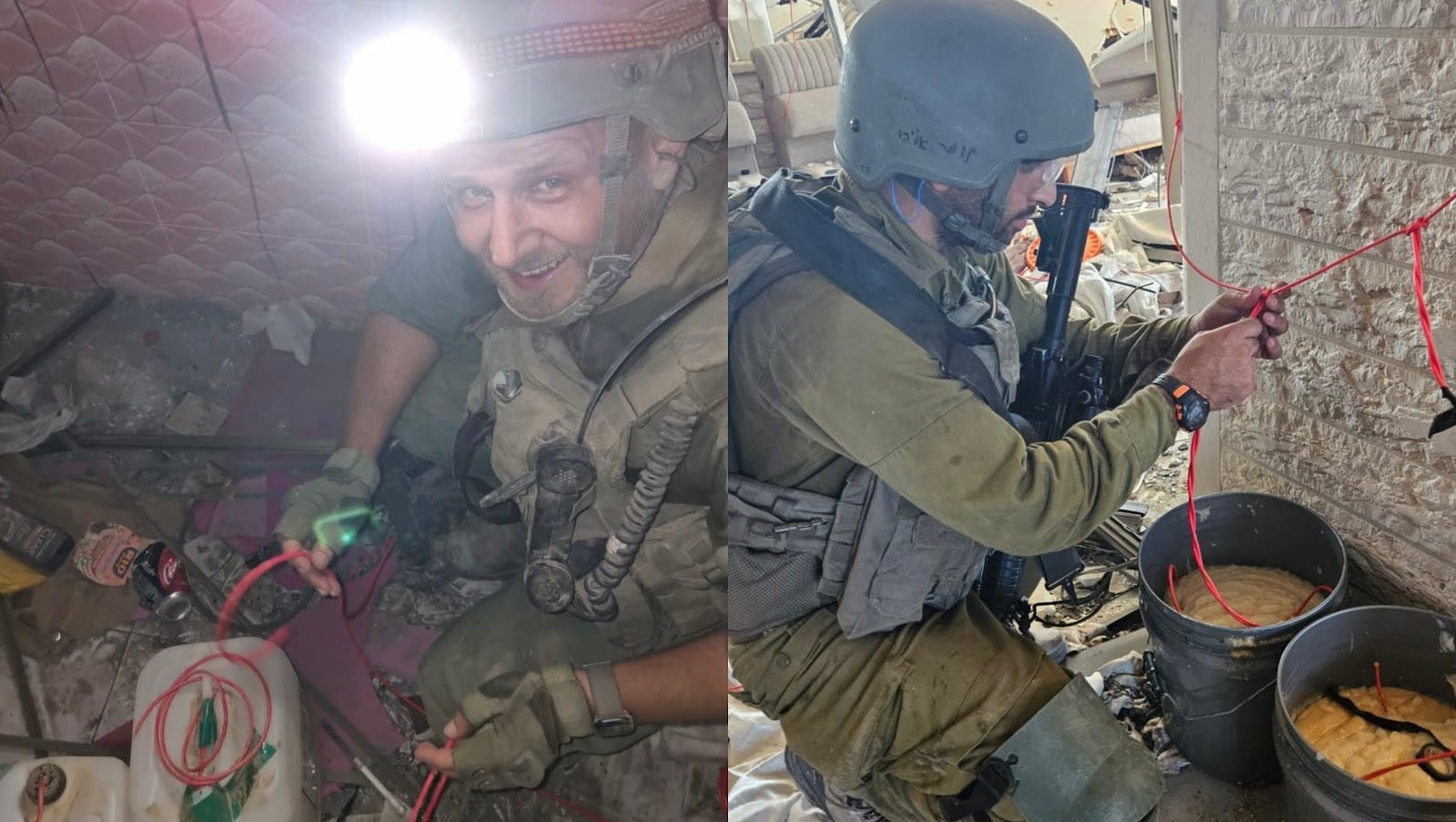
Soldiers from Israel’s 749 Battalion planting explosives, September 19, 2024 in south Gaza City. Source: @gdud749 on Instagram
Over the past year, the 749 Battalion has played an indispensable role in Gaza. Its soldiers are reservists—alumni of the combat engineering corps, which trains soldiers in demolition. The battalion comes in after combat units, toppling buildings and homes that managed to survive air strikes.
The 749 Battalion was among the first to enter the strip through the Netzarim corridor, the four-mile-long road separating Gaza City and Deir al-Balah that Israel occupied early in the war in order to divide the north and south of Gaza. After helping to cement control of south Gaza City, including the Netzarim corridor, the battalion later advanced into areas like Shuja’iya in Gaza City, the Bureij Refugee Camp in Central Gaza, and even Rafah.
At the time of writing, the 749 Battalion is operating in northern Gaza and Jabalia, where, even following Hamas leader Yahya Sinwar’s killing in southern Gaza, Israel’s campaign has intensified to the point of executions and depopulation. There, the battalion is seemingly racing to destroy as many buildings as possible. As one soldier put it, “We will leave them nothing!”
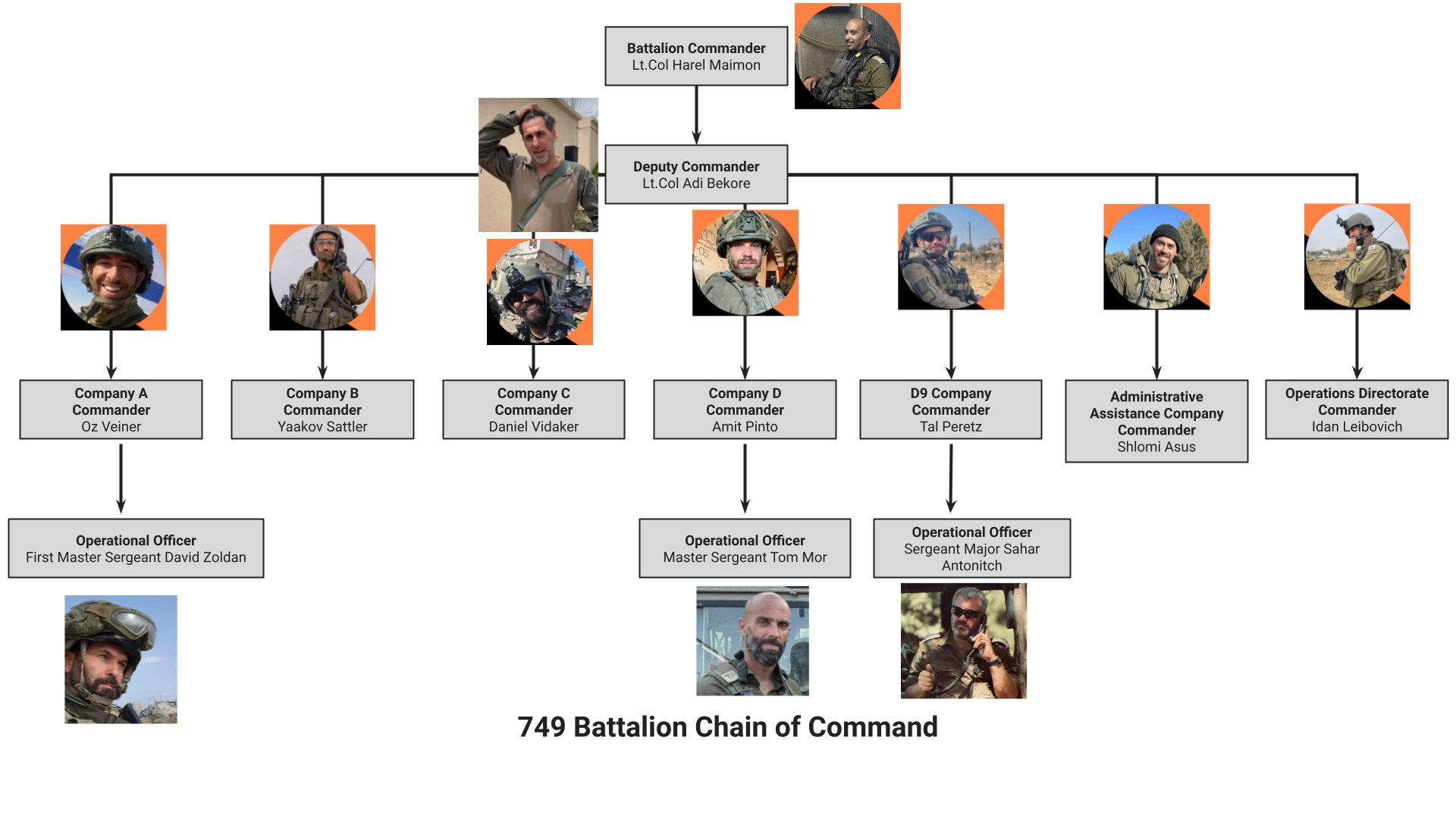
The images in this investigation come primarily from the group’s own social media page, which Drop Site News gained access to, as well as the personal accounts of dozens of soldiers from various companies within the battalion. By stitching together the information shared within the battalion, we were able to clearly map out the unit’s organizational structure and identify over a hundred of its members.
Drop Site News was also able to use the videos to determine the areas where the 749 Battalion was operating and document their activities in the Gaza Strip in detail. They are not the only battalion tasked specifically with demolitions—if it was, Gaza wouldn’t look the way it does—but a close examination of its daily activity offers a rare window into the Israeli operation on the ground in Gaza.
749 Battalion’s chain of command. Credit: Drop Site News
The so-called defense system will allow Israel to strike Iran without fear of retaliation, experts say.
By Sharon Zhang, Truthout, October 21, 2024
Lockheed Martin’s Terminal High Altitude Area Defense (THAAD) system is in place in only a few places around the world. Lockheed Martin’s Terminal High Altitude Area Defense (THAAD) system is in place in only a few places around the world. Lockheed Martin
A U.S. weapons system has landed and is “in place” in Israel, U.S. Defense Secretary Lloyd J. Austin said on Monday, as the Biden administration beefs up U.S. support of Israel and Israeli forces prepare to attack Iran and continue their bombardments of Lebanon and Gaza.
The Terminal High Altitude Area Defense (THAAD) system, worth between roughly $1 billion to $1.8 billion and made by Lockheed Martin, is an anti-missile system that can intercept ballistic missiles at high altitudes. The powerful weapon, deployed in only a few places around the world, will help bolster Israel’s ability to withstand air attacks after Iran’s missile attack on Israel earlier this month.
Austin said that the THAAD is expected to be operational soon. “We have the ability to put it into operation very quickly and we’re on pace with our expectations,” he said.
The U.S. announced last week that it was sending the THAAD as well as 100 U.S. troops to Israel. This is a significant escalation of the U.S.’s involvement in Israel’s aggression, marking the first time that U.S. troops have been directly deployed to Israel amid its genocide in Gaza and attacks across the Middle East. The U.S. announced last month that it is sending an additional 2,000 to 3,000 troops to the Middle East to bolster the 40,000 troops already stationed in the region.
U.S. officials said that the deployment of THAAD and the troops represent “another visible statement of our commitment” to Israel, per Army Secretary Christine Wormuth.
The deployment comes as a tranche of leaked classified documents reportedly prepared by the U.S. National Geospatial-Intelligence Agency and the National Security Agency, meant to be seen by the “Five Eyes” allies, shows that Israel is preparing to strike Iran. This includes plans to launch ballistic missiles and conduct drone operations.
U.S. officials have said that they are investigating the leak, which initially emerged on Telegram. Officials have reportedly acknowledged that the documents are legitimate, according to The New York Times.
The addition of yet more weapons systems like Israel’s Iron Dome that can intercept missile strikes will give more leeway to Israeli forces to strike other countries in the Middle East without fear of retaliation. These supposed “defensive” weapons, as anti-Zionist advocates have pointed out, make it far easier for Israel to conduct its offensive moves.
Indeed, Haaretz reports that Israel is clearly waiting for the THAAD system to be deployed before it carries out its attack on Israel. Harrison Mann, who resigned from his position as a U.S. Army intelligence officer because of Israel’s genocide, has said that, in fact, the THAAD and troop deployment will only help escalate tensions between Iran and Israel.
“To introduce troops into hostilities, per the 1973 War Powers Act, you either need an authorization from Congress, or there needs to be some urgent and imminent self-defense threat. In this case, the supposed self-defense threat is an Iranian missile attack. But the irony here is the Iranian missile attack is only going to happen if we help Israel strike Iran first,” Mann said to Democracy Now! last week. Join us in defending the truth before it’s too late
As we face a slew of right-wing attacks on democracy, the future of journalism is uncertain. To ensure Truthout remains fearless, tough, and 100 percent independent we need to raise $23,000 in the next 48 hours. Every dollar raised goes directly toward the costs of producing news you can trust.
Please give what you can — because by supporting us with a tax-deductible donation, you’re not just preserving a source of news, you’re helping to safeguard what’s left of our democracy.
This article is licensed under Creative Commons (CC BY-NC-ND 4.0), and you are free to share and republish under the terms of the license. Sharon Zhang
Sharon Zhang is a news writer at Truthout covering politics, climate and labor. Before coming to Truthout, Sharon had written stories for Pacific Standard, The New Republic, and more. She has a master’s degree in environmental studies. She can be found on Twitter: @zhang_sharon.
The latest violence brings the Health Ministry’s death toll to 42,409
by Dave DeCamp, Antiwar. com, October 16, 2024
Gaza’s Health Ministry said Wednesday that Israeli strikes across the Strip killed at least 65 Palestinians and wounded 140 in the previous 24-hour period.
The latest violence brings the ministry’s recorded death toll since October 7, 2023, to 42,409 and the number of wounded to 99,153. “There are still a number of victims under the rubble and on the streets, and ambulance and civil defense crews cannot reach them,” the ministry said.
Ninety-nine American healthcare workers who have volunteered in Gaza recently estimated in an open letter to President Biden and Vice President Harris that over 118,00 Palestinians have been killed in Gaza over the past year, a toll that includes indirect deaths caused by the Israeli siege, such as starvation and disease. People work to recover the dead body of a Palestinian boy from the rubble of a house hit in an Israeli strike in Gaza City on October 16, 2024. REUTERS/Dawoud Abu Alkas
Israeli attacks on Wednesday included a strike on a home in Gaza City that killed at least five Palestinians and injured seven. The Palestinian news agency WAFA also reported a strike on a car in central Gaza that killed at least two Palestinians and injured several others.
The Israeli military has continued its assault and siege on northern Gaza, where it’s attempting to carry out an ethnic cleansing plan to forcibly displace hundreds of thousands of Palestinian civilians.
Workers at hospitals in the north have refused Israeli orders to evacuate and say they’re running out of food and medicine due to the tightening of the siege. In 12 days, health officials say at least 350 Palestinians have been killed by Israeli forces in the Jabalia refugee camp, where Israel has focused its attack.
The death toll from Israel’s latest ground and aerial assault on northern Gaza continued to mount on Saturday as the U.S.-armed military targeted the Jabalia refugee camp and other parts of the region, trapping hundreds of thousands of people, firing on those who try to flee, and blocking deliveries of lifesaving humanitarian aid.
Israeli strikes on Jabalia homes and schools housing displaced people killed more than 20 Palestinians and wounded dozens more late Friday. Hours later, the Israeli military issued fresh evacuation orders for northern Gaza, instructing residents to move to a so-called humanitarian zone that Israel has repeatedly attacked.
Many have opted to remain in their homes as Israeli quadcopters and snipers target those attempting to escape the besieged and famine-stricken region. As Al Jazeera‘s Hind Khoudary explained Saturday, “Palestinians say they prefer dying in their homes because they believe that there is no place safe across the Gaza Strip, so even if they evacuate they might get killed on the way.”
Sarah Vuylsteke, project coordinator for Médecins Sans Frontières (MSF), said Friday that “nobody is allowed to get in or out, anyone who tries is getting shot.”
MSF said five of its staffers were trapped in Jabalia and “fearing for their lives.” An MSF driver said that they were “staying at the Al-Yemen Al-Saeed Hospital, but [Israeli forces] bombed it,” killing roughly 20 people.
“I don’t know what to do, at any moment we could die,” said the MSF driver, identified as Haydar. “People are starving. I am afraid to stay, and I am also afraid to leave.”
Video footage posted to social media shows the disturbing aftermath of an Israeli strike on a residential block in Jabalia:
One resident of northern Gaza told+972 Magazine that “quadcopter drones are hovering low over the streets, firing at anything that moves.”
“Snipers are positioned on rooftops, targeting anyone who steps outside,” said 27-year-old Mohammed Shehab. “At the same time, soldiers and tanks have pushed into the camp, demolishing homes and bulldozing roads and fields.”
The true death toll from Israel’s latest assault on northern Gaza is impossible to discern, given the difficulty of navigating the area amid relentless airstrikes and gunfire as well as fuel shortages caused by Israel’s siege.
“We are unable to count the number of massacres happening in Jabalia, and ambulances are unable to reach the calls due to the fuel shortage in northern Gaza,” wrote journalist Hossam Shabat, who is on the ground in northern Gaza.
One Palestinian trapped in northern Gaza said there are “dead bodies everywhere, and the wounded lie in the streets with no one able to help them.”
The Euro-Mediterranean Human Rights Monitor warned that as the international community looks on—and as U.S. military aid continues to flow—Israel is “accelerating the pace of its genocide against the Palestinians” by “carrying out mass and planned killings, as well as widespread forced displacements,” in northern Gaza.
“The Euro-Med Monitor field team received testimonies from citizens, who were able to reach Gaza City, about witnessing dead bodies lying in the streets,” the group said. “The Israeli army is systematically working to empty northern Gaza of its residents and force them to move to the south, recently issuing several evacuation orders and dropping leaflets demanding their evacuation.”
“The forcible deportation of a population is defined as a crime against humanity under the statute of the International Criminal Court, and the United Nations and the international community must intervene immediately to save tens of thousands of Palestinian residents in northern Gaza who face ethnic cleansing by Israel,” said Euro-Med. “Furthermore, the U.N. and international community have a legal and moral obligation to put an end to the horrific crime of genocide being committed by the Israeli occupation for the second year in a row now.”




 Peace and Justice Post
