Posts Tagged ‘Middle East’

𝐓𝐡𝐞 𝐬𝐢𝐥𝐞𝐧𝐜𝐞 𝐨𝐟 𝐭𝐡𝐞 𝐀𝐫𝐚𝐛 𝐰𝐨𝐫𝐥𝐝

August 29, 2025
 by Akram Belkaïd, Le Monde diplomatique, September 2025

The Arab states will not come to Gaza’s aid. None of them has launched any significant diplomatic initiative to prevent the reoccupation of the enclave or to end the Israeli bombardment it has endured for nearly two years. Despite the dreadful human toll — 70,000 dead, 70% of them women and children, according to some estimates — and a famine reminiscent of the worst medieval sieges, not a single capital across the Arab world is demanding sanctions against Tel Aviv or threatening its Western partners with retaliation for their unwavering support of Binyamin Netanyahu and his government (1).

Unlike in the October 1973 Arab-Israeli war, the Organisation of Arab Petroleum Exporting Countries (OAPEC) is not trying to persuade other oil producers to restrict deliveries so that Washington will put pressure on Israel. As an example of how things have changed, in May, as American weapons continued to flow into Israel and Congress approved credit after credit for Tel Aviv, the USS Forrest Sherman, a US Navy destroyer, made a routine port call at Algiers (2).

The communist activist Georges Ibrahim Abdallah, recently released after 41 years in a French prison, was just as critical of ordinary Arab people as of their leaders, if not more so: ‘Palestinian children are dying of hunger,’ he said when he arrived in Beirut. ‘It’s a source of shame for history. A source of shame for the Arab people, more than for their governments. The regimes, we know. [But] how many martyrs have died in demonstrations or attempting to cross Gaza’s borders? None. No one has fallen. Everything depends on the Egyptian people, more than on anyone else.’

Egypt’s leaders disagree. Far from breaking off diplomatic relations, they are strengthening their economic cooperation with Tel Aviv, even as dozens of Gazans die every day. True, 40,000 Egyptian soldiers are deployed in northern Sinai, but their mission is not to open a corridor for humanitarian aid, it’s to prevent an influx of refugees. Reasons aren’t hard to find…

In early August the Israeli company NewMed announced the signing of a ‘historic’ €35bn contract to supply Egypt with natural gas from the offshore Leviathan field starting in 2026. The deal — for 135 billion cubic metres over 15 years — will supply 20% of Egypt’s annual needs. Since 2019, when it concluded a first contract for 60 billion cubic metres, Cairo has accepted that it’s dependent on Israel for its energy security. This may explain why its security services prevented participants in the World March to Gaza from converging on Sinai in June, often by force.

The United Arab Emirates (UAE), for its part, normalised relations with Israel in 2020 under the Abraham accords. In January, Edge Group, a leading Emirati defence contractor, announced a $10m deal that will give it a 30% stake in the Israeli company Thirdeye Systems, which specialises in drone detection using AI. In Egypt, the UAE and Morocco — another signatory of the Abraham accords — normalisation with Israel goes hand in hand with business opportunities. It’s enough to inspire Syria and Saudi Arabia, which are stepping up their contacts with Israel too.

Akram Belkaïd is deputy director of Le Monde diplomatique.

Translated by George Miller

The IAEA’s MOSAIC weapon: Predictive espionage and the war on Iran

July 7, 2025

Backed by US funding and Palantir’s AI tools, the IAEA turned its Iran inspections into a surveillance regime that blurred the line between monitoring and military targeting.

Kit Klarenberg, The Cradle, July 2, 2025

Photo Credit: The Cradle

Ever since Israel launched its illegal war of aggression against Iran on 13 June, speculation has swirled around the role played by MOSAIC – a tool created by shadowy spy-tech firm Palantir. 

This software has been deeply embedded within the International Atomic Energy Agency’s (IAEA) operations, particularly its “safeguarding” mission: inspections and monitoring state compliance with non-proliferation agreements. 

MOSAIC has been central to this work for a decade and was quietly integrated by former US president Barack Obama’s administration into the July 2015 Joint Comprehensive Plan of Action (JCPOA) nuclear deal with Iran.

Espionage disguised as oversight

The deal granted IAEA inspectors unfettered access to Iran’s nuclear facilities to confirm the absence of a nuclear weapons program. In the process, the agency accumulated an immense trove of data: surveillance imagery, sensor measurements, facility documents – all of which were fed into MOSAIC’s predictive system.

Yet the software’s pivotal role in the deal remained concealed until a Bloomberg exposé in May 2018, just days before US President Donald Trump, during his first term, unilaterally tore up the agreement and launched Washington’s so-called “maximum pressure” campaign against Tehran.

Despite Trump tearing up the deal, inspections of Iranian nuclear facilities continued, as did MOSAIC’s monitoring of Tehran’s nuclear program. As Bloomberg noted, Palantir’s technology helped the IAEA scrutinize vast swaths of information from disparate sources, including 400 million “digital objects” globally, such as “social media feeds and satellite photographs inside Iran” – a capability that “raised concern the IAEA may overstep the boundary between nuclear monitoring and intelligence-gathering.” 

The Bloomberg piece also provided fodder for an oft-stated Iranian concern that Mosaic was helping Israelis track Iranian scientists for assassination:

“The tool is at the analytical core of the agency’s new $50 million MOSAIC platform, turning databases of classified information into maps that help inspectors visualize ties between the people, places and material involved in nuclear activities, IAEA documents show.”

Bloomberg quoted the head of a British company that “advises governments on verification issues” on the hazards of false data being fed into MOSAIC, “either by accident or design”:

“You will generate a false return if you add a false assumption into the system without making the appropriate qualifier …You’ll end up convincing yourself that shadows are real.”

The underlying and ongoing concern for Tehran is that MOSAIC is heavily influenced by Palantir’s “predictive-policing software.” Employed by many law enforcement agencies across the western world at enormous expense, this technology is highly controversial and has been found to exhibit dangerous, misleading biases, leading to erroneous “pre-crime” interventions. 

Indeed, MIT Technology Review has flat-out called for the dismantlement of predictive tech in a report that looks at how dangerous the technology has been in analyzing even domestic criminal data: 

“Lack of transparency and biased training data mean these tools are not fit for purpose. If we can’t fix them, we should ditch them.”

Given the inclusion of dubious intelligence – such as the Mossad-stolen Iranian nuclear archive, openly celebrated by the Israeli agency for its deception – it is highly probable that such corrupted data triggered unjustified inspections. Bloomberg quoted a negotiator who helped craft the 2015 deal, expressing concern over how “dirty or unstructured data” could lead to “a flurry of unnecessary snap inspections.” 

Palantir’s software specifically helped the IAEA “plan and justify unscheduled probes” – at least 60 of these conducted until US-Israeli strikes put an end to inspections. 

Data as a weapon 

On 31 May, the IAEA released a report suggesting Iran may still be developing nuclear weapons. Although it presented no new evidence, its dubious charges related “to activities dating back decades” at three sites where, purportedly, until the early 2000s, “undeclared nuclear material” was handled. 

Its findings prompted the UN nuclear watchdog’s Board of Governors to charge Iran as “in breach of its non-proliferation obligations” on 12 June, providing Tel Aviv with a propaganda pretext for its illegal attack the next day.

On 17 June, IAEA chief Rafael Grossi conceded that the agency had “no proof of a systematic effort to move into a nuclear weapon” by Tehran. Still, the damage was done. Iranian lawmakers, citing the IAEA’s secret sharing of sensitive data with Tel Aviv and Grossi’s covert collusion with Israeli officials, suspended all cooperation with the agency.

This may be the wisest course for other states under IAEA scrutiny. MOSAIC is now so entwined with the agency’s daily function that any country targeted for regime change could find itself accused of nuclear ambitions based on manufactured evidence. 

A 2017 IAEA document reveals MOSAIC is comprised of “over 20 different software development projects.” Launched in May 2015, it was hoped to revolutionize “safeguarding” the world over.

The report described MOSAIC as providing inspectors with “a suite of tools with which to face the challenges of tomorrow.” For instance, the Electronic Verification Package (EVP) enables field data – including planning, reporting, and review – to be automatically collected and processed. When inspectors visit a facility, they record vast amounts of information – instantly analyzed at headquarters via EVP.

Elsewhere, the Collaborative Analysis Platform (CAP) enables deep cross-referencing of internal and open-source data, including overhead imagery. It supports the IAEA’s core safeguarding processes: “planning, information collection and analysis, verification, and evaluation.”

CAP gives the IAEA “the capability to search, collect, and integrate multiple data and information sources to enable comprehensive analysis.” An IAEA official quoted in the document declared the platform represented “a major leap forward in analytics” and “a game changer”, allowing the IAEA to collect “a much greater amount of information, and also analyze that information in greater depth than before.”

Such analytical capacity grants inspectors “the ability to establish relationships between information from multiple sources, across time,” and “make sense out of huge amounts of data.”

CAP also assists in the collection and evaluation of open-source information. The document noted the platform could “process much more open-source information than the Department currently has capacity for,” and lets staff “search information across the entire repository; carefully cross-check different types of information; and utilize information in visual formats,” such as “overhead imagery.”

‘Extra-budgetary contributions’ from the US government

All of this intelligence is highly sensitive and would be a treasure trove for states intent on military action against nations in the IAEA’s crosshairs. According to the 2017 report, inspectors spent 13,248 days in the field in 2015 and inspected 709 nuclear facilities. Those figures have since grown. All the while, MOSAIC – a little-known tool for the “early detection of the misuse of nuclear material or technology” – has remained operational.

The report noted that MOSAIC was financed through the IAEA’s regular budget, the Major Capital Investment Fund, and “extra-budgetary contributions.” Its cost at the time was around €41 million (approximately $44.15 million) – almost 10 percent of the agency’s total annual budget. The source and size of those extra-budgetary contributions remain vague, perhaps deliberately, but a Congressional Research Service briefing note indicates Washington formally funds the IAEA to the tune of over $100 million annually.

Moreover, the US consistently provides in excess of $90 million in extra-budgetary contributions every year. In other words, almost half of the IAEA’s budget flows from Stateside, suggesting MOSAIC was created wholly on Washington’s dime. 

The timing of its rollout – two months prior to the Obama administration’s nuclear deal being agreed – could further indicate it was explicitly funded with Iran in mind. As then-IAEA director general Yukiya Amano revealed in March 2018, the association’s penetration of Tehran was unprecedented.

At a press conference, Amano referred to the IAEA’s nuclear “verification regime” in Iran as “the world’s most robust.” The organization’s inspectors spent “3,000 calendar days per year on the ground” in the country, capturing “hundreds of thousands of images captured daily by our sophisticated surveillance cameras,” which was “about half of the total number of such images that we collect throughout the world.” 

In all, “over one million pieces of open source information” were collected by the IAEA monthly.

The IAEA’s fixation on Iran, coupled with suspicions that it provided the names of nuclear scientists – later assassinated by Israel – raises the question: Was the 2015 deal always an industrial-scale espionage operation designed to prepare for war?

A wave of assassinations of nuclear scientists and IRGC commanders in the early stages of Tel Aviv’s failed war on Iran appears to support that conclusion.

Iranian officials not only suspended cooperation with the IAEA and ordered the dismantlement of inspection cameras, but also rejected Grossi’s request to visit bombed nuclear sites. Foreign Minister Abbas Araghchi branded the IAEA chief’s insistence on visiting under the pretext of safeguards “meaningless and possibly even malign in intent.”

What is clear is that any state still cooperating with the IAEA must now reckon with the possibility that it is not being monitored – it is being mapped for war.
President Trump Told Netanyahu To ‘Keep Going’ in Iran

June 19, 2025

 Trump said Netanyahu is a ‘good man’ who has been treated ‘unfairly’

by Dave DeCamp, Antiwar.com  | Jun 18, 2025

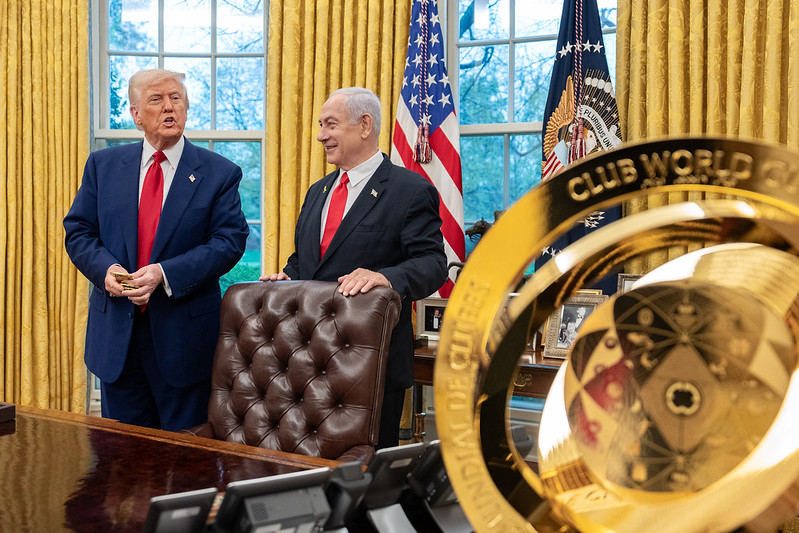
President Trump said on Wednesday that he told Israeli Prime Minister Benjamin Netanyahu in a phone call a day earlier to “keep going” with his attacks on Iran.

The president told reporters that Netanyahu, who is wanted by the International Criminal Court for his role in war crimes in Gaza, is a “good man” who has been treated “very unfairly” by his own country. “He’s a wartime president. Going through this nonsense — ridiculous,” Trump said.

Trump’s comments about Netanyahu come amid anticipation over whether or not the US will enter Israel’s war with Iran directly by launching airstrikes. The US has supported the assault by providing weapons and intelligence and intercepting Iranian missiles and drones, but so far hasn’t launched direct strikes of its own.

Trump and Netanyahu at the White House on April 7, 2025 (White House photo)

The president also said on Wednesday that “nobody knows” whether he’ll enter the war or not. When asked if he was moving closer on a decision to bomb Iranian nuclear facilities, Trump said, “You don’t know that I’m going to even do it. You don’t know. I may do it. I may not do it. I mean, nobody knows what I’m going to do. I can tell you this, that Iran’s got a lot of trouble.”

In other comments to the press, Trump said he wasn’t interested in an Israel-Iran ceasefire. “We’re not looking for a ceasefire. We’re looking for a total and complete victory. Again, you know what the victory is: no nuclear weapon,” he said.

Netanyahu launched his war of aggression against Iran under the pretext of preventing Iran from obtaining a nuclear weapon, but US intelligence assessed before the attacks that Tehran was not pursuing a nuclear bomb.

𝐈𝐫𝐚𝐧’𝐬 𝐊𝐡𝐚𝐦𝐞𝐧𝐞𝐢 𝐑𝐞𝐣𝐞𝐜𝐭𝐬 𝐓𝐫𝐮𝐦𝐩’𝐬 𝐃𝐞𝐦𝐚𝐧𝐝 𝐟𝐨𝐫 𝐒𝐮𝐫𝐫𝐞𝐧𝐝𝐞𝐫, 𝐖𝐚𝐫𝐧𝐬 𝐔𝐒 𝐀𝐠𝐚𝐢𝐧𝐬𝐭 𝐄𝐧𝐭𝐞𝐫𝐢𝐧𝐠 𝐖𝐚𝐫

June 18, 2025

𝑇ℎ𝑒 𝐼𝑟𝑎𝑛𝑖𝑎𝑛 𝑙𝑒𝑎𝑑𝑒𝑟 𝑠𝑎𝑖𝑑 𝑖𝑓 𝑡ℎ𝑒 𝑈𝑆 𝑎𝑡𝑡𝑎𝑐𝑘𝑠 𝐼𝑟𝑎𝑛 𝑖𝑡 𝑤𝑜𝑢𝑙𝑑 𝑠𝑢𝑓𝑓𝑒𝑟 ‘𝑖𝑟𝑟𝑒𝑝𝑎𝑟𝑎𝑏𝑙𝑒 ℎ𝑎𝑟𝑚’

by Dave DeCamp, Antiwar. com | Jun 18, 2025

Iranian Supreme Leader Ayatollah Ali Khamenei on Wednesday rejected President Trump’s demand for an “unconditional surrender” and warned the US against entering the war by launching strikes on Iran, saying the US would suffer “irreparable harm.”

Trump has also threatened Khamenei, claiming the US was aware of his location but wasn’t going to kill him for the time being. “[Trump] has threatened us. Not only does he make threats, but he also uses absurd, unacceptable rhetoric to openly demand that the Iranian people surrender to him. When a person hears such things, it’s truly surprising,” Khamenei said in a televised address.

“It isn’t wise to tell the Iranian nation to surrender. Wise people who know Iran, the Iranian people, and Iran’s history would never utter such words. What should the Iranian nation surrender to? The Iranian nation isn’t a nation that surrenders. We haven’t attacked anyone, and we definitely won’t tolerate anyone attacking us, and we will never surrender in response to the attacks of anyone,” Khamenei said.

Khamenei during his televised address (photo via his website)

The US has supported Israel’s war on Iran by providing weapons and intelligence and by intercepting Iranian missiles and drones. So far, the US hasn’t launched direct airstrikes on Iran, but Trump is considering doing so, especially against the Fordow nuclear plant, which is buried deep underground.

“Of course, the Americans who are familiar with the policies of this region know that the US entering in this matter [war] is 100% to its own detriment,” Khamenei said. “The damage it will suffer will be far greater than any harm that Iran may encounter. The harm the US will suffer will definitely be irreparable if they enter this conflict militarily.”

Iranian ballistic missiles are believed to be able to do significant damage to US bases in the region. Trump was asked on Wednesday if he would launch strikes on Iran’s nuclear program, but wouldn’t say. “I may do it. I may not do it. Nobody knows what I’m going to do,” he said.

Israeli Prime Minister Benjamin Netanyahu launched the war under the pretext of stopping Iran from advancing toward a nuclear bomb, but US intelligence agencies had assessed there was no evidence Tehran was working to make a nuclear weapon, and the US was unconvinced by new Israeli intelligence.

Israel’s attack also disrupted negotiations between the US and Iran. Trump said on Wednesday that Iran had asked for a meeting at the White House, but the claim was rejected by Tehran, as Iranian officials have said they won’t negotiate while Israel continues its attacks.

“No Iranian official has ever asked to grovel at the gates of the White House. The only thing more despicable than his lies is his cowardly threat to ‘take out’ Iran’s Supreme Leader,” Iran’s mission to the UN said. “Iran does NOT negotiate under duress, shall NOT accept peace under duress, and certainly NOT with a has-been warmonger clinging to relevance.”

Pure Orwell: Europe condemns Iran for attacks on its own territory

June 16, 2025

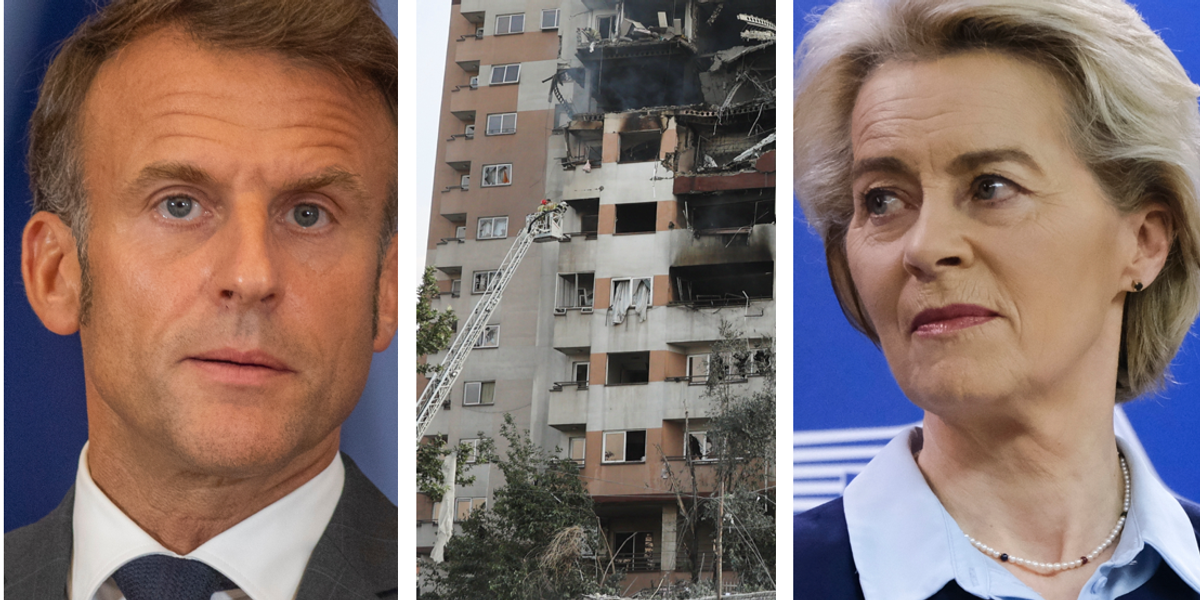
Europe Emmanuel Macron Ursula Von der Leyen Iran attacks

In their hypocrisy over Israel, EU elites once again expose the rotting corpse of the so-called ‘rules based order’

Europe

  1. regions europe
  2. israel-iran

Eldar Mamedov, Responsible Statecraft, Jun 14, 2025

When Israeli warplanes struck Iran this week — violating Iranian sovereignty in a brazen act of aggression, killing scores of civilians alongside top military commanders and nuclear scientists and inviting Iran’s equally indiscriminate retaliatory strikes — Europe’s leaders didn’t condemn the attack.

They perversely endorsed it and condemned Iran for the attacks on its own territory.

The president of France Emmanuel Macron set the tone by condemning Iran’s “ongoing nuclear program” and reaffirming “Israel’s right to defend itself and secure its security.” President of the European Commission Ursula von der Leyen seemed to have spoken from the same script “reiterating Israel’s right to defend itself,” embellished by some generic platitudes about the need for restraint and de-escalation.

The German foreign ministry went a step further and actually “strongly condemned” Iran for “an indiscriminate attack on Israeli territory” — even before Tehran launched its missiles in response for Israel’s attack on its territory — while fully endorsing Israel’s actions.

This Orwellian rhetoric isn’t just incompetence or ignorance. It’s the culmination of years of European diplomatic malpractice that helped to manufacture this crisis — and exposed the “rules-based order” as a corpse. Europe’s double standards killed its credibility.

Europe’s stance on Ukraine invoked Article 2(4) of the U.N. Charter with political clarity: “All members shall refrain from the threat or use of force against the territorial integrity of any state.” Yet when Israel attacked Iran — with no legal basis for self-defenseEurope de-facto reframed aggression as virtue, and condoned it.

Europe’s moral and diplomatic collapse hasn’t gone unnoticed. Two globally respected voices delivered particularly damning verdicts. Mohamed ElBaradei, Nobel Laureate and former head of the U.N.’s atomic energy watchdog, offered a humiliating crash course in international law to the German foreign ministry.

Reacting to Berlin’s endorsement of Israel’s “targeted strikes against Iranian nuclear facilities” (never mind the hundreds of civilians killed in these strikes), El Baradei reminded it that such strikes are prohibited under the Geneva Conventions to which Germany is a party, and that the use of force in international relations “is generally prohibited in the UN Charter with the exception of the right of self-defense in the case of armed attack or upon authorization by the Security Council in the case of collective security action.”

For her part, Francesca Albanese, U.N. special rapporteur on the occupied Palestinian territories, reacting to Macron’s statement, commented that “on the day Israel, unprovoked, has attacked Iran, the president of a major European power, finally admits that in the Middle East, Israel, and only Israel, has the right to defend itself.”

Newsletter

Subscribe now to our weekly round-up and don’t miss a beat with your favorite RS contributors and reporters, as well as staff analysis, opinion, and news promoting a positive, non-partisan vision of U.S. foreign policy.

Invalid emailEnter your email

The message of the likes of El Baradei and Albanese is unequivocal: when Europe applauds Israel’s strike while condemning Russia’s invasion, it doesn’t uphold universal rules — it enforces its tribalist identity: “rules” only apply to adversaries, not friends. This is fatal to Europe’s pretense of moral authority — it has been well noticed in the Global South, but also among many European citizens too.

This pretense looks even more detached from reality given that the crisis in the Middle East erupted on fertile ground prepared by serial European failure. First it was the E3 (Britain, France, Germany) failure to uphold the JCPOA following the U.S. withdrawal under Donald Trump’s presidency in 2018. While the EU offered rhetorical support for the nuclear deal, it buckled to U.S. sanctions and refused to shield EU firms willing to engage with Iran. It let the JCPOA die, de-facto creating a vacuum for escalation.

Further, while mediators like Oman and Qatar brokered talks on a new nuclear deal between the U.S. and Iran, the EU pushed for an IAEA resolution censoring Iran days before Israel’s strike, torpedoing de-escalation and contributing to creating a more menacing, dangerous security environment, with the U.N. Security Council sanctions snapback and potential Iran’s withdrawal from the Non-Proliferation Treaty (NPT) lurking in the background.

Each of these failures validated Tehran’s view that it is futile to negotiate with Europe. The E3/EU are now seen not just as a weak party unable to fulfil its commitments under the nuclear agreement, but also an actively destructive player undermining Iran’s security and regional stability.

European powers’ staggering descent into diplomatic irrelevance was starkly illustrated by Iranian foreign minister Abbas Araghchi’s categorical rejection of his British counterpart David Lammy’s pleas to de-escalate. Indeed, it is difficult to imagine why Tehran should heed these calls when they come from parties it sees as actively colluding with the aggressors.

The likely fallout from Europe’s diplomatic self-sabotage is that it incinerated whatever residual trust it still had in Iran and the broader Global South. It all but guaranteed proliferation by giving Iranians — now not just the hardliners — a powerful incentive to seek nuclear weaponization, an outcome that could have been avoided had Europe engaged in serious, good faith talks with Iran on reviving the nuclear deal. Iran’s withdrawal from the NPT is no longer a merely theoretical possibility.

All of these developments dramatically increase the likelihood of blowback against European interests: a regional war in the Middle East means more uncontrolled migration, heightened risks of terrorism on European soil or against European interests in the region, and energy shocks if Iran delivers on its threats to block the Hormuz Straight, the world’s principal oil trade artery.

Absent an urgent but unlikely course correction, such as holding Israel accountable for its regional aggression, Europe’s decay will accelerate. When Brussels exempts allies from rules imposed on rivals, it doesn’t preserve peace — it signs its own geopolitical suicide note.

Eldar Mamedov

Eldar Mamedov is a Brussels-based foreign policy expert and Non-resident Fellow at the Quincy Institute.

𝐒𝐨𝐮𝐫𝐜𝐞𝐬: 𝐔𝐒 𝐖𝐢𝐥𝐥 𝐄𝐧𝐭𝐞𝐫 𝐈𝐬𝐫𝐚𝐞𝐥’𝐬 𝐖𝐚𝐫 𝐖𝐢𝐭𝐡 𝐈𝐫𝐚𝐧

June 15, 2025


Call the White House and tell them you do not want any part of this disastrous war

by Dave DeCamp, Antiwar.com, Jun 15, 2025

Sources familiar with the matter have told Antiwar.com Editorial Director Scott Horton that the Trump administration is poised to enter Israel’s aggressive war against Iran directly. US airstrikes on Iran could begin as soon as Monday. Please contact the White House by calling (202-456-7041) or sending an email. Tell them that you do not want the US to enter this disastrous war, which could lead to heavy American casualties at US bases across the Middle East. The US has supported the war by reportedly providing Israel with intelligence and helping intercept Iranian missiles and drones, but so far, there have been no direct US attacks on Iran. Iranian officials have warned that Tehran would hit US bases in the region in response to any US strikes. Axios reported on Saturday that Israel is urging the US to join the war since Israel lacks the bunker-busting bombs necessary to do serious damage to Iran’s Fordow plant, which is buried deep underground. An Israeli official told Axios that President Trump had previously suggested the US could strike Fordow. Trump himself said on Sunday that it was “possible” that the US would get directly involved in the war, which Israel launched early Friday morning with airstrikes across Iran. Israeli Prime Minister Benjamin Netanyahu started the war under the pretext of preventing Iran from building a nuclear weapon. But it was the consensus of the US intelligence community that there was no evidence Iran was working toward a nuclear weapon, and Tehran made clear they were ready to make a deal with the US that would significantly lower uranium enrichment levels and increase oversight of its nuclear program in exchange for US sanctions relief. Ali Larijani, an aide to Iranian Supreme Leader Ayatollah Ali Khamenei, has previously said that the one thing that would make Tehran reconsider its prohibition on the development of nuclear weapons would be a US or Israeli attack. “We are not moving towards (nuclear) weapons, but if you do something wrong in the Iranian nuclear issue, you will force Iran to move towards that because it has to defend itself,” Larijani said on April 1. “Iran does not want to do this, but … (it) will have no choice,” he added. “If at some point you (the US) move towards bombing by yourself or through Israel, you will force Iran to make a different decision.”

Israel and US modified F-35s to enable Iran attack without refuelling, sources say

June 15, 2025

US official says Israel used drop tanks, denying that any mid-air or land refuelling took place

An Israeli Air Force F-35 Lightning II fighter aircraft flies over during an air show in Tel Aviv on April 26, 2023 (JACK GUEZ / AFP)

By Sean Mathews

Published date: 14 June 2025 19:34 BST | Last update:9 hours 49 mins ago

The US and Israel altered Israel’s F-35 warplanes to extend their range without the need for refuelling or compromising on stealth to help Israel’s attack on Iran, Middle East Eye can reveal. 

The modification is secret, but two US officials speaking to MEE on condition of anonymity confirmed that Israel did not use mid-air refuelling during its Friday attack on Iran or land their warplanes for refuelling at any nearby countries. 

Instead, the US officials told MEE that Israel and the US modified the F-35’s system to carry additional fuel that did not impact the F-35’s stealth features. The Israeli designation for their version of the F-35s is called the F-35I Adir.

The F-35 is the only long-range stealth fighter in the world, and its features make it difficult for radar or infrared sensors to track it. 

The scale of Israel’s Friday attack and the surprise nature of it mean the improvement is a sea change for the F-35, the US officials told MEE. 

New MEE newsletter: Jerusalem Dispatch

Sign up to get the latest insights and analysis on Israel-Palestine, alongside Turkey Unpacked and other MEE newsletters

The F-35s performance is going to be carefully studied by Middle Eastern countries looking to acquire them, as well as the US’s foes, China and Russia. 

“This is a game changer. Israel had our cooperation on this modification,” one US defence official told MEE, speaking on condition of anonymity. 

Both officials confirmed that Israel modified their F-35Is with US involvement. 

Exclusive: US quietly sent hundreds of Hellfire missiles to Israel before Iran attack

Read More »

One US official refused to share details on how the F-35 was altered to carry more fuel, but suggested an external feature was added.

The second US official said that Israel attached external drop tanks to the F-35s.

“It’s impressive. Period,” Richard Aboulafia, an aerospace expert at aerodynamic advisory told MEE when asked about the US officials’ statements. 

Aboulafia said that the only option Israel had in place of not refuelling was to use drop tanks. 

“The big challenge is devising the F-35s interface system with drop tanks that don’t compromise stealth. Not only do you have to design the fixtures, but some sort of in-line modification has to be done. The Israelis, with our cooperation, I assume, practically did surgery on an existing jet to make this modification.” 

The F-35 has a publicly stated combat range of roughly 700 miles. The shortest distance between Israel and Iran is roughly 620 miles one way. 

If mid-air refuelling wasn’t employed, then theoretically they could have used a US base in the Gulf or in Azerbaijan, but the officials MEE spoke to said land refuelling did not take place on any US bases in the region.

Azerbaijan today said it would not allow its airspace or territory to be utilised for launching attacks on Iran or any other country, Azerbaijani Foreign Minister Jeyhun Bayramov said in a call with his Iranian counterpart Abbas Araqchi.

Reports have emerged in recent years that Israel was working on such a project. 

In 2021, Israel’s Walla news reported that the Israeli Air Force was working on a drop tank for the F-35I Adirs. The report at the time said Israel could finish the modification in two years. 

Adding a drop tank that carries extra fuel sounds easy, but it is extremely sensitive and difficult, US officials and experts say.

The F-35 contains radar-absorbent materials and its entire engineering is designed to avoid detection. Any change to the body could compromise those features. 

One challenge noted by The Aviationist magazine in 2021 was that once the tank was dropped it could expose other parts of the aircraft to radar because the attachment points and fuel lines would not be covered by any Radar Absorbing Material (RAM). 

The US officials MEE spoke with refused to share details about the F-35s closely guarded engineering. 

18 March 2025: The day 183 children in Gaza were massacred by Israel

March 19, 2025

Entire generations of families wiped out during deadly attacks on Tuesday, as Israel appeared to deliberately target suhoor meal during Ramadan

Palestinian children look at the site of an Israeli strike on a residential building in Gaza City on 19 March 2025 (Reuters/Dawoud Abu Alkas)

Palestinian children look at the site of an Israeli strike on a residential building in Gaza City on 19 March 2025 (Reuters/Dawoud Abu Alkas)

By Rayhan Uddin

Published date: 19 March 2025 17:22 GMT | Last update:3 hours 1 min ago

Something that separates Ramadan from other times of the year is a change of routine.

That includes waking up for suhoor, a pre-dawn meal which Muslims eat in preparation for fasting.

Families, sometimes including children, rise together during the holy month to eat suhoor and perform Fajrdawn prayers. 

On Tuesday, hundreds of Palestinians in Gaza were killed by Israeli bombs in those early hours of suhoor. 

Some had been awake eating with their families. Others were asleep in makeshift displacement camps as food was prepared.

New MEE newsletter: Jerusalem Dispatch

Sign up to get the latest insights and analysis on Israel-Palestine, alongside Turkey Unpacked and other MEE newsletters

Entire generations of families were wiped out together by Israel’s devastating strikes.

‘People were killed while they were sleeping. Women were killed whilst they were preparing meals’

Rachel Cummings, Save the Children, Gaza

“People were killed while they were sleeping. Women were killed whilst they were preparing meals,” Save the Children’s Rachael Cummings, who is currently in Deir al-Balah in central Gaza, told Middle East Eye. 

“There was no evacuation notice given,” Cummings said. “This was a complete bombardment across the whole of Gaza.” 

The timing was reportedly deliberate: Israel launched a surprise attack in the early hours because it believed “Hamas members” would be present at suhoor meals. 

Israeli officials continue to insist that Hamas commanders and infrastructure were the targets of the wave of attacks. 

But of 436 massacred on Tuesday, over 180 were children. 

“I do not spend too much time concerned with who the Israeli military says they targeted in attacks like this,” Miranda Cleland, of Defence for Children International Palestine (DCIP), told MEE. 

“Instead, look at the evidence: 183 dead children, comprising almost half of yesterday’s death toll, tells me that this is a war on children,” she added.

“Eighteen thousand dead children since 7 October 2023 tells me this is a war on children, regardless of what the Israeli military says.” 

Tuesday marked one of the largest one-day child death tolls in Gaza’s history, according to DCIP, which has documented such fatalities in the enclave since 2000.

Over the past 17 months of war, DCIP has monitored child death tolls provided by the Gaza health ministry and cannot recall a day as deadly as 18 March 2025. 

‘Gaza is a graveyard for children’

Among the slain children were Omar al-Jamassi, 15, and his sister Layan, 16. They were killed alongside their mother and siblings. 

Layan had been excited to start the new school year on Tuesday morning. She was killed by an Israeli air strike hours before it was due to begin. 

The political calculations behind Israel’s decision to go back to war

Read More »

She and Omar had attended a tent school set up as part of the Gaza Great Minds project. 

“They were always smiling and share happiness everywhere they go,” said Ahmad Abu Rizik, who founded the project.

Cummings said that children and babies were more at risk of dying from air strikes. 

“The risks for children in this context are extraordinary,” she said. “Because they’re so small, they have less blood, so they die much more frequently from blast injuries.”

Nearly half of Gaza’s population are children, making it one the youngest territories in the world. 

“Gaza has become a graveyard for children,” Ammar Ammar of Unicef, the UN’s aid agency for children, told MEE. 

“Children have been killed, injured, buried under rubble, frozen and starved to death, and many other horrors no child should be subjected to.” 

‘Imprint of trauma’

For those children who have survived Israel’s 18-month war up to now, they have faced displacement and deprivation of basic needs. 

Unicef estimates that all of Gaza’s one million children are in need of mental health and psychosocial support, too.

“No child will emerge from the horrors of months of relentless bombardment without the imprint of trauma,” said Ammar. 

‘No child will emerge from the horrors of months of relentless bombardment without the imprint of trauma’

– Ammar Ammar, Unicef

For over two weeks, Israel has blocked all aid trucks from entering the enclave. Electricity has been cut for the past week. 

Ammar said that has left many families struggling to provide enough food and safe water for their children. 

“Children are dying of preventable conditions like malnutrition, dehydration, and hypothermia, due to Israel’s siege on Gaza and the mass destruction of homes and the healthcare system,” said Cleland. 

She added that Israeli attacks had left minors with lifelong disabilities, without proper follow up care, prosthetics or physical therapy. 

Regarding Tuesday’s attack, campaigners are clear that Israel has obligations to protect children. 

“Children enjoy special protection under both international humanitarian law and international human rights law. They must never be a target,” said Ammar. 

Cleland added: “Yesterday’s attacks were not only a violation of the negotiated truce agreement, but a violation of international humanitarian law, which prohibits indiscriminate attacks. 

“Bombing densely populated civilian areas is, by definition, indiscriminate.”

Middle East Eye delivers independent and unrivalled coverage and analysis of the Middle East, North Africa and beyond. To learn more about republishing this content and the associated fees, please fill out this form. More about MEE can be found here.

Trump Says the US Will ‘Take Over’ the Gaza Strip

February 5, 2025

The president said the US will ‘own’ Gaza and rebuild it and that Palestinians cannot return

by Dave DeCamp, Antiwar. com. February 4, 2025

President Trump said on Tuesday that the US would “take over” the Gaza Strip, a surprise announcement he made while speaking with reporters at the White House during a press conference with Prime Minister Benjamin Netanyahu.

“The US will take over the Gaza Strip, and we will do a job with it, too. We’ll own it and be responsible for dismantling all of the dangerous unexploded bombs and other weapons on the site, level the site and get rid of the destroyed buildings, level it out, create an economic development that will supply unlimited numbers of jobs and housing for people of the area,” Trump said.

The president said earlier that the Palestinians must be removed from Gaza “permanently,” making it clear the plan will involve the ethnic cleansing of the territory despite strong resistance from neighboring Arab states. The plan also implies that the US would rebuild Gaza for Jewish settlers.

Trump was asked who would live in Gaza under his plan and replied, “The world’s people,” and suggested some Palestinians may also be allowed.

He said, “I think the entire world, representatives from all over the world, will be there, and they’ll live there. Palestinians, also, … will live there. Many people will live there.”

Trump also said he wouldn’t rule out deploying troops to Gaza. When asked if his plan meant he would send troops, Trump said, “If it’s necessary, we’ll do that. We’re gonna take over that piece and develop it, create thousands and thousands of jobs. It will be something the entire Middle East can be very proud of.”

The president suggested he had been considering the plan for a long time. “I see a long-term ownership position and bringing great stability to that part of the Middle East. Everybody I’ve spoken to — this was not a decision made lightly — everybody loves the idea of the US owning that piece of land, developing and creating thousands of jobs with something that will be magnificent in a magnificent area nobody would really know. They look, and all they see is death and destruction and rubble,” he said.

Netanyahu also commented on the plan, saying, “President Trump is taking it to a much higher level. He sees a different future for that piece of land that has been the focus of so much terrorism and attacks against us, so many trials and tribulations. He has a different idea and it’s worth paying attention to this. He’s exploring it and it’s something that could change history.”

Later on Tuesday, Trump’s Middle East envoy, Steve Witkoff, appeared on Fox News and endorsed the president’s plan, saying a better life for the Palestinians is “not necessarily tied to the physical space that you are in today.”

When asked what message Trump was trying to send by calling for a US takeover of Gaza, Witkoff said, “He’s telling the Middle East that the last 50 years of doing things was not the correct way of doing things, and he’s going to change it up.”

Secretary of State Marco Rubio also endorsed the US takeover and ethnic cleansing of Gaza. “Gaza MUST BE FREE from Hamas. As [Trump] shared today, the United States stands ready to lead and Make Gaza Beautiful Again. Our pursuit is one of lasting peace in the region for all people,” he wrote on X.

A US takeover of the Gaza Strip would require Israel to restart its genocidal war, and it could potentially involve direct US military action. Since coming into office, Trump has begun advancing billions of dollars worth of new weapons shipments for Israel funded by US military aid.

Hamas would fiercely resist a US takeover, and the group has replaced about all the fighters it has lost, according to US intelligence, despite Israel’s mass slaughter of Palestinians.

New President of the ICJ — Plagiarism in Service of Zionism

February 2, 2025

ICJ Judge Sebutinde voted against all emergency measures issued as a result of South Africa’s case of genocide against Israel.

By Zachary FosterJanuary 31, 2025Z ArticleNo Comments8 Mins Read

Photo of Julia Sebutinde

The acting president of the International Court of Justice, Julia Sebutinde, plagiarized large parts of her dissenting opinion on the “Legal Consequences arising from the Policies and Practices of Israel in the Occupied Palestinian Territory, including East Jerusalem.”

Recall that, in January 2024, Judge Sebutinde was the only judge of the 17 judges on the panel to vote against all six provisional measures in the genocide case brought by South Africa against Israel, including the order that Israel needed “to take all measures within its power” to prevent acts of genocide in Gaza.

It was in her 36-page opinion on the legal status of Israel’s occupation, however, published in July 2024, where she plagiarized many sentences, including whole paragraphs. The legal opinion also includes lengthy historical discussions, in which she got basic facts wrong and painted a distorted picture of the past. In fact, rather than citing historians, and giving those historians credit for their work in her footnotes, Sebutinde plagiarized propagandists, themselves partisans, interested not in getting history right but in defending the Zionist cause.

In short, Judge Sebutinde has no shame in presenting other people’s work as her own. This makes her a dishonest person, someone who should not be trusted to adjudicate anything at all, let alone international law for the world’s highest court. Here are 9 of the most egregious instances of her plagiarism:

The Jewish Virtual Library

Sebutinde plagiarized many sentences from the “The Jewish Virtual Library” website, run by Mitchell G. Bard and Or Shaked, two individuals who have decades of expertise distorting history to present Israel in a positive light.

1. Sebutinde: “Prior to the establishment of “British Mandatory Palestine”, Palestinian Arabs viewed themselves as having a unified identity with the Arabs in the subregion until the twentieth century.” 

1. Jewish Virtual Library: “Prior to partition, Palestinian Arabs did not view themselves as having a separate identity.”

2. Sebutinde: “When the distinguished Arab American historian, Professor Philip Hitti, testified against the Partition of Mandatory Palestine before the Anglo-American Committee in 1946, he remarked: “There is no such thing as ‘Palestine’ in history; absolutely not.””

2. Jewish Virtual Library: “When the distinguished Arab-American historian, Princeton University Prof. Philip Hitti, testified against partition before the Anglo-American Committee in 1946, he said: “There is no such thing as ‘Palestine’ in history, absolutely not.”

3. Sebutinde: “In 1937, a local Arab leader, Auni Bey Abdul-Hadi, told the Peel Commission, which ultimately suggested the partition of Palestine: “There is no such country [as Palestine]! ‘Palestine’ is a term the Zionists invented! There is no Palestine in the Bible. Our country was for centuries part of Syria.”

3. Jewish Virtual Library: “In 1937, a local Arab leader, Auni Bey Abdul-Hadi, told the Peel Commission, which ultimately suggested the partition of Palestine: “There is no such country [as Palestine]! ‘Palestine’ is a term the Zionists invented! There is no Palestine in the Bible. Our country was for centuries part of Syria.””

4. Sebutinde: “The first Palestine-Arab Congress which convened in Jerusalem from 27 January to 10 February 1919 to choose Palestinian representatives for the Paris Peace Conference, adopted a resolution in which it, inter alia, considered Palestine as an integral part of Arab Syria.” 

4. Jewish Virtual Library: “When the First Congress of Muslim-Christian Associations met in Jerusalem in February 1919 to choose Palestinian representatives for the Paris Peace Conference, the following resolution was adopted: We consider Palestine as part of Arab Syria, as it has never been separated from it at any time.”

Prager U

She also plagiarized from Prager U, another organization with decades of expertise not in history, but in distorting history to present Israel in a positive light.

5. Sebutinde: “the British Government offered the Palestinian Arabs 80 per cent of Mandatory Palestine (Transjordan), and the Jews the remaining 20 per cent (Palestine) in a suggested split that was heavily in favour of the former. Despite the tiny size of their proposed State, the Jews voted to accept this offer, but the Arabs rejected it and resumed their violent rebellion against the British mandate.”

5. Prager U: “The British offered them 80 percent of the disputed territory; the Jews, the remaining 20 percent. Yet, despite the tiny size of their proposed state, the Jews voted to accept this offer. But the Arabs rejected it and resumed their violent rebellion.”

6. Sebutinde: “Israeli Prime Minister Ehud Barak met at Camp David, with Palestinian Liberation Organization (PLO) Chairman Yasser Arafat in 2000, to conclude a new two-State plan. Barak offered Arafat a Palestinian State in all of Gaza, and 94 per cent of the West Bank, with East Jerusalem as its capital. The Palestinian leader flatly rejected the offer. In the words of President Bill Clinton of the United States, “Arafat was here 14 days and said no to everything.” Instead, the Palestinians launched a bloody wave of suicide bombings that killed over 1,000 Israelis and maimed thousands more, on buses, in wedding halls, and in pizza parlours.”

6. Prager U: “In 2000, Israeli Prime Minister Ehud Barak met at Camp David with Palestinian Liberation Organization Chairman Yasser Arafat to conclude a new two-state plan. Barak offered Arafat a Palestinian state in all of Gaza and 94% of the West Bank with East Jerusalem as its capital. But the Palestinian leader rejected the offer. In the words of US President Bill Clinton, Arafat was “Here 14 days and said ‘no’ to everything.” Instead, the Palestinians launched a bloody wave of suicide bombings that killed over 1,000 Israelis and maimed thousands more – on buses, in wedding halls, and in pizza parlours.”

Douglas J. Feith

Sebutinde also plagiarized from a 2021 blog post by Douglas J. Feith published by the Hudson Institute, a conservative think tank. Feith is not a historian, but a war monger, serving as the Under Secretary of Defense for Policy under President George W. Bush administration from 2001-2005 where he helped guide strategy on two of the most disastrous wars in US history, the wars in Afghanistan and Iraq.

7. Sebutinde: ““Palestine” applied vaguely to a region that for the 400 years before World War I was part of the Ottoman empire.” 

7. Douglas J. Feith: ““Palestine” applied vaguely to a region that for the 400 years before World War I was part of the Ottoman empire.” 

8. Sebutinde: “In 135 CE, after stamping out the second Jewish insurrection of the province of Judea or Judah, the Romans renamed that province “Syria Palaestina” (or “Palestinian Syria”). The Romans did this as a punishment, to spite the “Y’hudim” (Jewish population) and to obliterate the link between them and their province (known in Hebrew as Y’hudah). The name “Palaestina” was used in relation to the people known as the Philistines and found along the Mediterranean coast.”

8. Douglas J. Feith “In 135 CE, after stamping out the province of Judea’s second insurrection, the Romans renamed the province Syria Palaestina—that is, “Palestinian Syria.” They did so resentfully, as a punishment, to obliterate the link between the Jews (in Hebrew, Y’hudim and in Latin Judaei) and the province (the Hebrew name of which was Y’hudah). “Palaestina” referred to the Philistines, whose home base had been on the Mediterranean coast.”

9. Sebutinde: “The line in the north emerged from Anglo-French negotiations in 1923. The one in the south was fixed by treaties in the mid-1920s between Britain and the new nation of Saudi Arabia. The border between the Mandate of Palestine and the Mandate of Mesopotamia (Iraq) was of little immediate importance, given that the line was in the middle of an uninhabited desert and Britain controlled both sides. That line was finally fixed through an exchange of letters in 1932.”

9. Douglas J. Feith: “The line in the north emerged from Anglo-French negotiations in 1923. The one in the south was fixed by treaties in the mid-1920s between Britain and the new nation of Saudi Arabia. The border between Mandate Palestine and Mandate Mesopotamia was of little immediate importance, given that it was in the middle of an uninhabited desert and Britain controlled both sides. That line was finally fixed through an exchange of letters in 1932.”

The plagiarism outlined above represents a clear breach of public trust. The ICJ needs honest judges, not judges who lie and present other people’s work as their own, not to mention work that is itself grounded not in historical research but in Zionist mythology and propaganda. Sebutinde is a disgrace to the court and its reputation, and every judge, lawyer and legal expert in the world should call for her immediate resignation.


ZNetwork is funded solely through the generosity of its readers.Donate

Related Posts

Donate Facebook Twitter Reddit Email

Zachary Foster

Zachary J. Foster is a historian of Palestine who received his Ph.D in Near Eastern Studies from Princeton University in 2017. (Newsletter, Academia, Google Scholar)