Published date: 14 June 2025 19:34 BST | Last update:9 hours 49 mins ago
The US and Israel altered Israel’s F-35 warplanes to extend their range without the need for refuelling or compromising on stealth to help Israel’s attack on Iran, Middle East Eye can reveal.
The modification is secret, but two US officials speaking to MEE on condition of anonymity confirmed that Israel did not use mid-air refuelling during its Friday attack on Iran or land their warplanes for refuelling at any nearby countries.
Instead, the US officials told MEE that Israel and the US modified the F-35’s system to carry additional fuel that did not impact the F-35’s stealth features. The Israeli designation for their version of the F-35s is called the F-35I Adir.
The F-35 is the only long-range stealth fighter in the world, and its features make it difficult for radar or infrared sensors to track it.
The scale of Israel’s Friday attack and the surprise nature of it mean the improvement is a sea change for the F-35, the US officials told MEE.
New MEE newsletter: Jerusalem Dispatch
Sign up to get the latest insights and analysis on Israel-Palestine, alongside Turkey Unpacked and other MEE newsletters
The F-35s performance is going to be carefully studied by Middle Eastern countries looking to acquire them, as well as the US’s foes, China and Russia.
“This is a game changer. Israel had our cooperation on this modification,” one US defence official told MEE, speaking on condition of anonymity.
Both officials confirmed that Israel modified their F-35Is with US involvement.
Exclusive: US quietly sent hundreds of Hellfire missiles to Israel before Iran attack
One US official refused to share details on how the F-35 was altered to carry more fuel, but suggested an external feature was added.
The second US official said that Israel attached external drop tanks to the F-35s.
“It’s impressive. Period,” Richard Aboulafia, an aerospace expert at aerodynamic advisory told MEE when asked about the US officials’ statements.
Aboulafia said that the only option Israel had in place of not refuelling was to use drop tanks.
“The big challenge is devising the F-35s interface system with drop tanks that don’t compromise stealth. Not only do you have to design the fixtures, but some sort of in-line modification has to be done. The Israelis, with our cooperation, I assume, practically did surgery on an existing jet to make this modification.”
The F-35 has a publicly stated combat range of roughly 700 miles. The shortest distance between Israel and Iran is roughly 620 miles one way.
If mid-air refuelling wasn’t employed, then theoretically they could have used a US base in the Gulf or in Azerbaijan, but the officials MEE spoke to said land refuelling did not take place on any US bases in the region.
Azerbaijan today said it would not allow its airspace or territory to be utilised for launching attacks on Iran or any other country, Azerbaijani Foreign Minister Jeyhun Bayramov said in a call with his Iranian counterpart Abbas Araqchi.
Reports have emerged in recent years that Israel was working on such a project.
In 2021, Israel’s Walla news reported that the Israeli Air Force was working on a drop tank for the F-35I Adirs. The report at the time said Israel could finish the modification in two years.
Adding a drop tank that carries extra fuel sounds easy, but it is extremely sensitive and difficult, US officials and experts say.
The F-35 contains radar-absorbent materials and its entire engineering is designed to avoid detection. Any change to the body could compromise those features.
One challenge noted by The Aviationist magazine in 2021 was that once the tank was dropped it could expose other parts of the aircraft to radar because the attachment points and fuel lines would not be covered by any Radar Absorbing Material (RAM).
The US officials MEE spoke with refused to share details about the F-35s closely guarded engineering.
On Sunday, Israeli Prime Minister Benjamin Netanyahu said that he spoke with President-elect Donald Trump about Israel’s need to achieve “victory” against Iran and its allies in the region.
“I unequivocally declare to Hezbollah and to Iran: In order to prevent you from attacking us, we will continue to take action against you as necessary, in every arena and at all times,” Netanyahu said.
“I discussed all of this last night with my friend, US President-elect Donald Trump. We had a very friendly, warm and important discussion. We discussed the need to complete Israel’s victory and we spoke at length about the efforts we are making to free our hostages,” the prime minister added.
The conversation between Netanyahu and Trump came after reports said Israel sees an opportunity to bomb Iran following the regime change in Syria that ousted former President Bashar al-Assad. The Wall Street Journal also reported that the Trump transition team is discussing the idea of strikes on Iran’s nuclear facilities.
The pretext for any Israeli or US action against Iranian nuclear facilities would be to stop Iran from building a bomb, but there’s no evidence that Tehran has decided to pursue nuclear weapons, something recently acknowledged by the CIA.
In his remarks on Sunday, Netanyahu also said Israel was changing the “face” of the Middle East. “Syria is not the same Syria. Lebanon is not the same Lebanon. Gaza is not the same Gaza. And the head of the axis, Iran, is not the same Iran; it has also felt the might of our arm.
The Israeli leader claimed Israel has “no interest in a conflict with Syria,” but Israel has unleashed a heavy air campaign against the country since the downfall of Syrian President Bashar al-Assad, launching over 800 strikes.
The recent fall of President Bashar al-Assad’s regime in Damascus marked a turning point in Syria’s ongoing conflict, with new reports revealing a covert Ukrainian role in aiding Syrian rebels.
Ukrainian intelligence provided strategic support, including drone technology and experienced operators, to Hayat Tahrir al-Sham (HTS), the dominant rebel faction in Idlib, Caliber.Az reports via The Washington Post.
This effort underscores Ukraine’s broader strategy to undermine Russian influence on multiple fronts amid its ongoing war with Moscow.
Approximately four to five weeks prior to the HTS-led offensive, Ukrainian operatives delivered 150 first-person-view drones and deployed 20 experienced operators to assist the rebels. Although Western intelligence sources suggest this aid played a modest role in the regime’s downfall, it was a significant demonstration of Kyiv’s intent to counter Russia in unconventional theatres such as the Middle East, Africa, and even within Russia itself.
Ukraine’s intelligence agency, the GUR, has reportedly collaborated with opposition groups in Syria under a special unit known as “Khimik,” bolstering rebel capabilities against Russian-backed Syrian forces.
Ukraine’s motivations for such actions are clear. With its homeland under siege, Kyiv is actively opening secondary fronts to stretch Russian resources and influence. A June report in the Kyiv Post detailed strikes by Ukrainian-backed Syrian rebels on Russian military installations, accompanied by video evidence of these operations.
Russian officials have expressed growing concern, with statements from representatives such as Alexander Lavrentyev and Foreign Minister Sergei Lavrov accusing Ukrainian intelligence of conducting “dirty operations” in Idlib. Despite these claims, independent verification remains scarce.
While Russia has downplayed Ukraine’s involvement, pointing to HTS’s independent drone program and prior expertise, the rapid collapse of Assad’s regime caught Moscow off guard. Russian Telegram channels have sought to minimize Kyiv’s role, suggesting Ukrainian personnel were in Syria for too short a time to significantly influence operations. However, this narrative contrasts with Ukraine’s broader pattern of covert actions against Russian forces worldwide.
Beyond Syria, Ukraine has demonstrated its capability for overseas operations in other regions. In July 2023, Ukrainian intelligence reportedly supported Malian rebels in an ambush against Wagner Group mercenaries, resulting in significant losses for the Russian paramilitary group.
Such actions highlight the GUR’s aggressive strategy, with its head, Lt. Gen. Kyrylo Budanov, affirming Ukraine’s commitment to targeting Russian military assets globally. This approach has drawn concerns from Western allies, including the Biden administration, over potential escalations.
Ukraine’s actions in Syria align with its broader strategy to disrupt Russia’s influence and partnerships. By aiding HTS, Kyiv weakened a critical Russian ally in the Middle East, further isolating Moscow. Although the Ukrainian assistance may not have been decisive, it contributed to an environment where the Assad regime’s fall became inevitable.
The parallels to other intelligence failures, such as Russia’s inability to anticipate HTS’s offensive or Israel’s surprise during Hamas’s October 2023 attack, are striking. Both underscore the challenges nations face in responding to unconventional threats.
For Ukraine, these operations serve as a testament to its resilience and resourcefulness in a protracted struggle against a powerful adversary. While not the decisive factor in Damascus, Ukraine’s covert actions signal its intent to shape the global battlefield to its advantage.
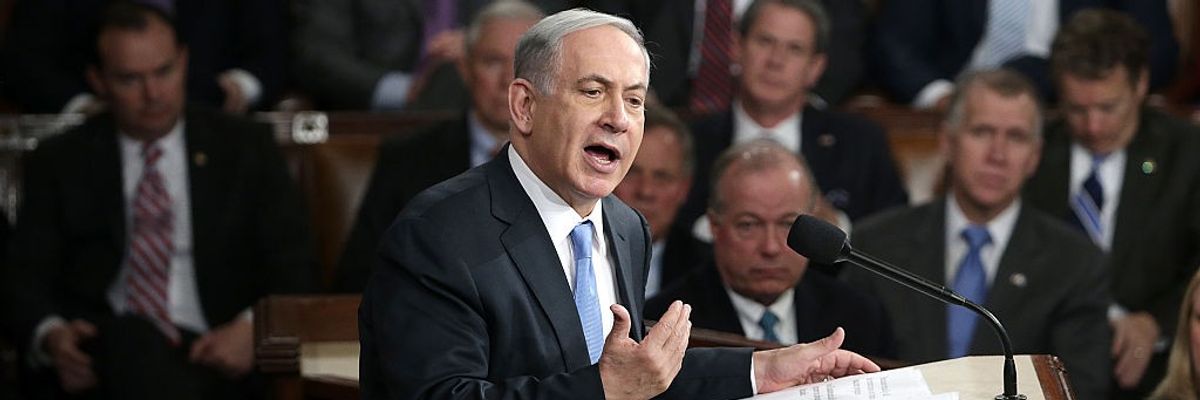
Israeli Prime Minister Benjamin Netanyahu addresses a joint meeting of the United States Congress in the House chamber at the U.S. Capitol March 3, 2015 in Washington, D.C.
(Photo: Win McNamee/Getty Images)
Ultimately, this is the story of how the Israel lobby undermined America, wrecked the Middle East, and set a series of international crimes against humanity in motion.
It’s official now. America’s closest ally, Israeli Prime Minister Benjamin Netanyahu, the one accorded more than 50 standing ovations in Congress just months ago, is under indictment by the International Criminal Court for crimes against humanity and war crimes. America must take note: the U.S. Government is complicit in Netanyahu’s war crimes and has fully partnered in Netanyahu’s violent rampage across the Middle East.
For 30 years the Israel Lobby has induced the U.S. to fight wars on Israel’s behalf designed to prevent the emergence of a Palestinian State. Netanyahu, who first came to power in 1996, and has been prime minister for 17 years since then, has been the main cheerleader for U.S.-backed wars in the Middle East. The result has been a disaster for the U.S. and a bloody catastrophe not only for the Palestinian people but for the entire Middle East.
These have not been wars to defend Israel, but rather wars to topple governments that oppose Israel’s oppression of the Palestinian people. Israel viciously opposes the two-state solution called for by international law, the Arab Peace Initiative, the G20, the BRICS, the OIC, and the UN General Assembly. Israel’s intransigence, and its brutal suppression of the Palestinian people, has given rise to several militant resistance movements since the beginning of the occupation. These movements are backed by several countries in the region.
The obvious solution to the Israel-Palestine crisis is to implement the two-state solution and to demilitarize the militant groups as part of the implementation process.
Israel’s approach, especially under Netanyahu, is to overthrow foreign governments that oppose Israel’s domination, and recreate the map of a “New Middle East” without a Palestinian State. Rather than making peace, Netanyahu makes endless war.
What is shocking is that Washington has turned the U.S. military and federal budget over to Netanyahu for his disastrous wars. The history of the Israel lobby’s complete takeover of Washington can be found in the remarkable new book by Ilan Pappé, Lobbying for Zionism on Both Sides of the Atlantic (2024).
Rather than making peace, Netanyahu makes endless war.
Netanyahu repeatedly told the American people that they would be the beneficiaries of his policies. In fact, Netanyahu has been an unmitigated disaster for the American people, bleeding the U.S. Treasury of trillions of dollars, squandering America’s standing in the world, making the U.S. complicit in his genocidal policies, and bringing the world closer to World War III.
If Trump wants to make America great again, the first thing he should do is to make America sovereign again, by ending Washington’s subservience to the Israel Lobby.
The Israel Lobby not only controls the votes in Congress but places hardline backers of Israel into key national security posts. These have included Madeleine Albright (Secretary of State for Clinton), Lewis Libby (Chief of Staff of Vice President Cheney), Victoria Nuland (Deputy National Security Advisor of Cheney, NATO Ambassador of Bush Jr., Assistant Secretary of State for Obama, Under-Secretary of State for Biden), Paul Wolfowitz (Under-Secretary of Defense for Bush Sr., Deputy Secretary of Defense for Bush Jr.), Douglas Feith (Under-Secretary of Defense for Bush Jr.), Abram Shulsky (Director of the Office of Special Plans, Department of Defense for Bush Jr.), Elliott Abrams (Deputy National Security Advisor for Bush Jr.), Richard Perle (Chairman of the Defense National Policy Board for Bush Jr.), Amos Hochstein (Senior Advisor to the Secretary of State for Biden), and Antony Blinken (Secretary of State for Biden).
Netanyahu has been an unmitigated disaster for the American people, bleeding the U.S. Treasury of trillions of dollars, squandering America’s standing in the world, making the U.S. complicit in his genocidal policies, and bringing the world closer to World War III.
In 1995, Netanyahu described his plan of action in his book Fighting Terrorism. To control terrorists (Netanyahu’s characterization of militant groups fighting Israel’s illegal rule over the Palestinians), it’s not enough to fight the terrorists. Instead, it’s necessary to fight the “terrorist regimes” that support such groups. And the U.S. must be the one to lead:
The cessation of terrorism must therefore be a clear-cut demand, backed up by sanctions and with no prizes attached. As with all international efforts, the vigorous application of sanctions to terrorist states must be led by the United States, whose leaders must choose the correct sequence, timing, and circumstances for these actions.
As Netanyahu told the American people in 2001 (reprinted as the 2001 foreword to Fighting Terrorism):
The first and most crucial thing to understand is this: There is no international terrorism without the support of sovereign states. International terrorism simply cannot be sustained for long without the regimes that aid and abet it… Take away all this state support, and the entire scaffolding of international terrorism will collapse into dust. The international terrorist network is thus based on regimes—Iran, Iraq, Syria, Taliban Afghanistan, Yasir Arafat’s Palestinian Authority, and several other Arab regimes, such as the Sudan.
All of this was music to the ears of the neocons in Washington, who similarly subscribed to U.S.-led regime change operations (through wars, covert subversion, U.S.-led color revolutions, violent coups, etc.) as the main way to deal with perceived U.S. adversaries.
After 9/11, the Bush Jr. neocons (led by Cheney and Rumsfeld) and the Bush Jr. insiders of the Israel Lobby (led by Wolfowitz and Feith), teamed up to remake the Middle East through a series of U.S.-led wars on Netanyahu’s targets in the Middle East (Lebanon, Iran, Iraq, Syria) and Islamic East Africa (Libya, Somalia, and Sudan). The role of the Israel Lobby in stoking these wars of choice is described in detail in Pappe’s new book.
The neocon-Israel Lobby war plan was shown to General Wesley Clark on a visit to the Pentagon soon after 9/11. An officer pulled a paper from his desk and told Clark: “I just got this memo from the Secretary of Defense’s office. It says we’re going to attack and destroy the governments in 7 countries in five years—we’re going to start with Iraq, and then we’re going to move to Syria, Lebanon, Libya, Somalia, Sudan and Iran.”
In 2002, Netanyahu pitched the war with Iraq to the American people and Congress by promising them that “If you take out Saddam, Saddam’s regime, I guarantee you that it will have enormous positive reverberations on the region[…] People sitting right next door in Iran, young people, and many others, will say the time of such regimes, of such despots is gone.”
A remarkable new insider account of Netanyahu’s role in spearheading the Iraq War also comes from retired Marine Command Chief Master Sargent Dennis Fritz, in his book Deadly Betrayal (2024). When Fritz was called to deploy to Iraq in early 2002, he asked senior military officials why the U.S. was deploying to Iraq, but he got no clear answer. Rather than lead soldiers into a battle he could not explain or justify, he left the service.
The neocon-Israel Lobby teamwork has marked one of the greatest global calamities of the 21st century.
In 2005, Fritz was invited back to the Pentagon, now as a civilian, to assist Under-Secretary Douglas Feith in the declassification of documents about the war, so that Feith could use them to write a book about the war. Fritz discovered in the process that the Iraq War had been spurred by Netanyahu in close coordination with Wolfowitz and Feith. He learned that the purported U.S. war aim, to counter Saddam’s weapons of mass destruction, was a cynical public relations gimmick led by an Israel Lobby insider, Abram Shulsky, to garner U.S. public support for the war.
Iraq was to be the first of the seven wars in five years, but as Fritz explains, that follow-up wars were delayed by the anti-U.S. Iraqi insurgency. Nonetheless, the U.S. eventually went to war or backed wars against Iraq, Syria, Libya, Somalia, Sudan, and Lebanon. In other words, the U.S. carried out Netanyahu’s plans—except for Iran. To this day, indeed to this hour, Netanyahu works to stoke a U.S. war on Iran, one that could open World War III, either by Iran making the breakthrough to nuclear weapons, or by Iran’s ally, Russia, joining such a war on Iran’s side.
The neocon-Israel Lobby teamwork has marked one of the greatest global calamities of the 21st century. All of the countries attacked by the U.S. or its proxies—Iraq, Lebanon, Libya, Somalia, Sudan, and Syria—now lie in ruins. Meanwhile, Netanyahu’s genocide in Gaza continues apace, and yet again the U.S. has opposed the unanimous will of the world (other than Israel) this week by vetoing a UN Security Council ceasefire resolution that was backed by the other 14 members of the U.N. Security Council.
The real issue facing the Trump Administration is not defending Israel from its neighbors, who call repeatedly, almost daily, for peace based on the two-state solution. The real issue is defending the U.S. from the Israel Lobby.
Common Dreams is powered by optimists who believe in the power of informed and engaged citizens to ignite and enact change to make the world a better place.
We’re hundreds of thousands strong, but every single supporter makes the difference.
Your contribution supports this bold media model—free, independent, and dedicated to reporting the facts every day. Stand with us in the fight for economic equality, social justice, human rights, and a more sustainable future. As a people-powered nonprofit news outlet, we cover the issues the corporate media never will.
about:blank
about:blank
Our work is licensed under Creative Commons (CC BY-NC-ND 3.0). Feel free to republish and share widely.
Jeffrey D. Sachs is a University Professor and Director of the Center for Sustainable Development at Columbia University, where he directed The Earth Institute from 2002 until 2016. He is also President of the UN Sustainable Development Solutions Network.
In a major escalation of the imperialist military offensive throughout the Middle East, Israel launched three waves of airstrikes on Iran Saturday morning in coordination with the Biden administration.
A view of Tehran capital of Iran is seen, early Saturday, October 26, 2024. [AP Photo/Vahid Salemi]
The White House quickly endorsed Israel’s illegal attack on Iran, declaring, “We understand that Israel is conducting targeted strikes against military targets in Iran as an exercise of self-defense.”
A White House official further endorsed the illegal attack in a statement to Bloomberg, calling it “targeted and proportional.” The official told Bloomberg, “The president and his national security team, of course, worked with the Israelis over recent weeks” to plan the illegal act of war.
Rather than self-defense, the attack is a calculated provocation aimed at eliciting a military response by Iran that can be used to justify further US-Israeli aggression, including the deployment of even more combat troops to Israel and a further military build-up throughout the region.
The Iranian military confirmed that airstrikes targeted bases in Ilam, Khuzestan, and Tehran provinces, and commercial flights were suspended throughout the country.
The attack follows the October 9 discussion between US President Joe Biden and Israeli Prime Minister Benjamin Netanyahu in which the American president signed off on the strikes, along with a series of discussions with the Pentagon and White House Friday night.
The attack took place just days after US Secretary of Defense Lloyd Austin announced that US combat troops had arrived in Israel, in the role of air defense support for the operation.
The attack took place as US Secretary of State Antony Blinken arrived in the Middle East after extensive discussions with Netanyahu in which he reviewed both the planned attack on Iran and Israel’s so-called “generals’ plan” to starve, displace, or exterminate the remaining population of Northern Gaza.
The Israeli-US attack on Iran took place just 11 days before the November 5 US presidential election. Earlier this month, the World Socialist Web Site warned that the Biden administration was planning an “October conspiracy” to escalate the war with Iran. We wrote:
There is a long history of events taking place in October that have major effects on an upcoming US presidential election. By deploying US troops to Israel, the Biden administration is not so much seeking to impact Kamala Harris’s electoral prospects as to ensure that plans for military escalation are underway before the election takes place. Instead of an “October surprise,” it is an “October conspiracy” to massively expand US involvement in war throughout the Middle East.
These warnings have now been confirmed. While the scope of the Israeli attack is at this point unclear, it is evident that the Biden Administration is recklessly seeking to escalate war throughout the Middle East targeting Iran.
Israel’s attack on Iran is part of its rampage throughout the Middle East, supported by the imperialist powers, with the aim of reimposing colonial domination over the oil-rich region as part of their effort to dominate Russia and China.
The most horrific consequence of this imperialist offensive throughout the Middle East is the genocide in Gaza. The official death toll of the Gaza genocide stands at 42,847, with over 100,544 wounded. The real death toll is likely to be far higher, with an article in The Lancet estimating it at 186,000 or more in July.
This month, Reuters reported that Israel had suspended all commercial food shipments into Gaza, leading the availability to fall to the lowest level since the start of Israel’s onslaught, as human rights organizations warned of imminent mass starvation.
The attack on Iran follows a campaign of illegal assassinations targeting all of the leaders of Hamas and Hezbollah, as well as leading Iranian figures, as the US and Israel expand their military onslaught throughout the region. On October 16, Israel murdered Hamas leader Yahya Sinwar in Rafah. Hezbollah leader Hassan Nasrallah was killed by more than 80 Israeli 2,000-pound bombs in Lebanon last month, and Hamas political leader Ismail Haniyeh was assassinated by Israel in Tehran in July.
Israel simultaneously continued its ground invasion and daily bombardment of Lebanon Friday, with the Lebanese death toll rising to 2,634.
The so-called defense system will allow Israel to strike Iran without fear of retaliation, experts say.
By Sharon Zhang, Truthout, October 21, 2024
Lockheed Martin’s Terminal High Altitude Area Defense (THAAD) system is in place in only a few places around the world. Lockheed Martin’s Terminal High Altitude Area Defense (THAAD) system is in place in only a few places around the world. Lockheed Martin
A U.S. weapons system has landed and is “in place” in Israel, U.S. Defense Secretary Lloyd J. Austin said on Monday, as the Biden administration beefs up U.S. support of Israel and Israeli forces prepare to attack Iran and continue their bombardments of Lebanon and Gaza.
The Terminal High Altitude Area Defense (THAAD) system, worth between roughly $1 billion to $1.8 billion and made by Lockheed Martin, is an anti-missile system that can intercept ballistic missiles at high altitudes. The powerful weapon, deployed in only a few places around the world, will help bolster Israel’s ability to withstand air attacks after Iran’s missile attack on Israel earlier this month.
Austin said that the THAAD is expected to be operational soon. “We have the ability to put it into operation very quickly and we’re on pace with our expectations,” he said.
The U.S. announced last week that it was sending the THAAD as well as 100 U.S. troops to Israel. This is a significant escalation of the U.S.’s involvement in Israel’s aggression, marking the first time that U.S. troops have been directly deployed to Israel amid its genocide in Gaza and attacks across the Middle East. The U.S. announced last month that it is sending an additional 2,000 to 3,000 troops to the Middle East to bolster the 40,000 troops already stationed in the region.
U.S. officials said that the deployment of THAAD and the troops represent “another visible statement of our commitment” to Israel, per Army Secretary Christine Wormuth.
The deployment comes as a tranche of leaked classified documents reportedly prepared by the U.S. National Geospatial-Intelligence Agency and the National Security Agency, meant to be seen by the “Five Eyes” allies, shows that Israel is preparing to strike Iran. This includes plans to launch ballistic missiles and conduct drone operations.
U.S. officials have said that they are investigating the leak, which initially emerged on Telegram. Officials have reportedly acknowledged that the documents are legitimate, according to The New York Times.
The addition of yet more weapons systems like Israel’s Iron Dome that can intercept missile strikes will give more leeway to Israeli forces to strike other countries in the Middle East without fear of retaliation. These supposed “defensive” weapons, as anti-Zionist advocates have pointed out, make it far easier for Israel to conduct its offensive moves.
Indeed, Haaretz reports that Israel is clearly waiting for the THAAD system to be deployed before it carries out its attack on Israel. Harrison Mann, who resigned from his position as a U.S. Army intelligence officer because of Israel’s genocide, has said that, in fact, the THAAD and troop deployment will only help escalate tensions between Iran and Israel.
“To introduce troops into hostilities, per the 1973 War Powers Act, you either need an authorization from Congress, or there needs to be some urgent and imminent self-defense threat. In this case, the supposed self-defense threat is an Iranian missile attack. But the irony here is the Iranian missile attack is only going to happen if we help Israel strike Iran first,” Mann said to Democracy Now! last week. Join us in defending the truth before it’s too late
As we face a slew of right-wing attacks on democracy, the future of journalism is uncertain. To ensure Truthout remains fearless, tough, and 100 percent independent we need to raise $23,000 in the next 48 hours. Every dollar raised goes directly toward the costs of producing news you can trust.
Please give what you can — because by supporting us with a tax-deductible donation, you’re not just preserving a source of news, you’re helping to safeguard what’s left of our democracy.
This article is licensed under Creative Commons (CC BY-NC-ND 4.0), and you are free to share and republish under the terms of the license. Sharon Zhang
Sharon Zhang is a news writer at Truthout covering politics, climate and labor. Before coming to Truthout, Sharon had written stories for Pacific Standard, The New Republic, and more. She has a master’s degree in environmental studies. She can be found on Twitter: @zhang_sharon.
The Biden administration is not only endorsing but also on the verge of actively assisting a new Israeli armed attack on Iran. National security adviser Jake Sullivan says that the United States is working directly with Israel regarding such an attack. “The United States is fully, fully, fully supportive of Israel,” declares President Joe Biden.
The projected attack serves no U.S. interests. The attack perpetuates a broader pattern of escalating violence in the Middle East that also serves no U.S. interests. The Iranian missile salvo to which the coming Israeli attack is ostensible retaliation was itself retaliation for previous Israeli attacks. Retaliation for retaliation is a prescription for an unending cycle of violence.
The United States is facilitating an attack on a nation that does not want war and has been remarkably restrained in trying to avoid it, in the face of repeated Israeli provocations. A sustained Israeli bombing campaign against Iranian-related targets within Syria elicited a response only when it escalated to an attack on a diplomatic compound in Damascus, killing senior Iranian officials. Even then, the Iranian response, in the form of an earlier salvo of missiles and drones in April, was designed and telegraphed in a way to make a show of defiance but — with most of the projectiles certain to be shot down — to cause minimal damage and almost no casualties.
When Israel assassinated visiting Hamas political leader Ismail Haniyeh in a government guest house in Tehran in July — the sort of attack that would elicit a quick and forceful response by the U.S. or Israel if it happened in one of their capitals — Iran did nothing until last week. It finally acted only after yet another Israeli attack— this time an assault on residential buildings in a suburb of Beirut that killed a senior Iranian Revolutionary Guard officer along with Hezbollah secretary-general Hassan Nasrallah. Far from being motivated by any grandiose ambitions of regional dominance or desire to destabilize the region, Iranian leaders believed that they were getting killed by a thousand cuts from Israel and that they had to respond to the repeated Israeli attacks lest they lose the confidence not only of their own people but of regional allies. The missile firings that constituted Iran’s retaliation, like the ones in April, again caused minimal damage or casualties.
By cooperating with Israel in a new attack, the United States is assisting a state that has been responsible for most of the escalation and the vast majority of death and destruction in the Middle East for at least the past year. Although Hamas’ attack on southern Israel last October is commonly seen as the starting point of the subsequent mayhem in the Middle East, the question of who is responding to whom could go back farther than that. For example, the 1,200 deaths from that Hamas attack, horrible to be sure, were fewer than the number of Palestinians that Israel had killed in the occupied West Bank and the Gaza Strip just from the day-to-day operations of the occupying Israeli army, supplemented by settler violence in the West Bank, during the previous eight years.
Since the Hamas attack, the devastating Israeli operation in the Gaza Strip has gone far beyond anything that can be construed as defense, or even as a response to Hamas, and has brought suffering to innocent civilians that is orders of magnitude greater than anything Hamas or any other Palestinian group has ever done. The still-rising official death toll exceeds 41,000, with the actual number of Palestinian deaths probably much higher and likely into six figures. Much of the Strip has been reduced to rubble and rendered unlivable.
After Hezbollah fired rounds into Israel last October in a show of support for the Palestinians in Gaza, the story of conflict along the Israeli-Lebanese frontier has mainly been one of repeated Israeli escalations. Israeli attacks in Lebanon have far exceeded Hezbollah attacks on Israel, in number but especially in physical effects, with almost no casualties within Israel apart from a few military personnel at the border. The rapidly rising toll of deaths in Lebanon from Israeli attacks has now passed 2,000, with about 10,000 injured and about 1.2 million people displaced from their homes. As in the Gaza Strip, civilians constitute much and perhaps most of that toll, including as a result of Israeli airstrikes that have demolished residential buildings in densely populated neighborhoods.
As a growing Israeli ground assault in Lebanon accompanies the aerial bombardment, Israel has told people in almost the entire southern third of Lebanon to move north, even though Israel already has been conducting lethal aerial attacks throughout Lebanon, including as far north as Tripoli. This also is reminiscent of the pattern in Gaza, in which residents are told to move, only to be bombed again in their new location.
The offensive Israeli actions that figure into confrontation with Iran — including the aerial and clandestine assassination operations in Lebanon, Syria, and the heart of Tehran — also have each constituted escalation. Those operations appear designed at least in part to goad Iran into entering a wider war, preferably one that also involves the United States.
Other motives behind the Israeli escalation are multiple and vary with the specific target. The deadly assaults on the Palestinians — in the Gaza Strip and increasingly also in the West Bank— are part of a long-term effort to use force to somehow make Israel’s Palestinian problem go away, through a combination of outright killing, inducing exile by making a homeland unlivable, and intimidation of any who remain.
Israel’s officially declared objective for its attacks in Lebanon is to permit a return home of the 70,000 temporarily displaced residents of northern Israel — whose numbers constitute less than six percent of the Lebanese who have been driven from their homes so far by the Israel offensive. That objective is genuine, but an escalating war along Israel’s northern border only places the objective farther out of reach. The Israeli operations also clearly are designed to cripple Hezbollah as much as possible, although they sustain and heighten the sort of anger that led to Hezbollah’s establishment and growth in the first place.
An Israel that is the strongest military power in the Middle East and is throwing its armed might around in seemingly every direction but the Mediterranean Sea is a nation drunk on the use of force and stumbling into still more use of it with little or no apparent attention to any long-term strategy for achieving an end state, other than living forever by the sword. Each tactical success, including the killing of a prominent adversary such as Hezbollah’s Hassan Nasrallah, only seems to deepen the inebriation.
Beyond this, one gets into a mixture of motivations that are specific to Prime Minister Benjamin Netanyahu and ones shared with other Israeli policymakers. It is widely recognized, including by Netanyahu’s domestic opponents, that he has a personal stake in continuing and even escalating Israel’s wars. This is partly because of the usual rally-round-the-flag effect that attenuates the political problems of a wartime leader. It is also more specifically because Netanyahu is dependent on the support of the most extreme members of his right-wing ruling coalition to hold that coalition together, thereby keeping Netanyahu in power and delaying the day he has to confront fully the corruption charges against him.
Subscribe now to our weekly round-up and don’t miss a beat with your favorite RS contributors and reporters, as well as staff analysis, opinion, and news promoting a positive, non-partisan vision of U.S. foreign policy.
Invalid emailEnter your email
An armed attack on Iran would extend the Israeli policy— not unique to Netanyahu, although he has been its most prominent exponent — of stoking maximum hostility toward, and isolation of, Iran. That policy serves to weaken a rival for regional influence, to place blame for everything wrong with the region on someone other than Israel, to inhibit any engagement with Iran by Israel’s patron the United States, and to divert international attention away from Israel’s own actions.
The diversion seems to work. The international attention to what may come next in the confrontation with Iran, in addition to the escalating operations in Lebanon, has meant less attention than would otherwise have been given in newspapers and the airwaves to the continued carnage in the Gaza Strip that claims civilian lives, such as Israeli attacks within the last few days on a girls’ school and an orphanage that several hundred displaced persons were using as shelter.
The U.S. presidential election provides another motivation for the Israeli government to escalate regional warfare. Netanyahu certainly would like to see a second term for Donald Trump, who gave Israel just about anything it wanted during his previous time in office, with nothing in return except political support for Trump. This relationship is part of a broader political alliance between the Republican Party and Netanyahu’s Likud Party. To the extent an escalatory mess in the Middle East causes problems for the Biden administration and thereby hurts the election chances of Vice President Kamala Harris, that is a bonus from Netanyahu’s point of view.
Netanyahu is more likely to enjoy that bonus and the other fruits of ramping up conflict with Iran to the extent that the United States gets directly involved in that conflict. Such involvement not only makes the politically costly mess for the Biden administration all the messier, but also enables Netanyahu to claim credibly that he has the United States fully at his side in his government’s lethal activities.
None of these Israeli objectives are in the interest of the United States. Several of the objectives, such as hamstringing any U.S. diplomacy that involves Iran, are directly and manifestly opposed to U.S. interests.
Israel’s regional warfare — and more specifically a U.S.-backed attack on Iran — would harm U.S. interests in several additional ways.
Closer association with Israel’s lethal operations increases the chance of reprisals, including terrorist reprisals. It also worsens U.S. isolation in international politics.
Supporting or participating in an Israeli attack on Iran would further undermine U.S. claims to be in favor of peace and observance of a rules-based international order. It would mean attacking the country that in this confrontation has exercised restraint in the interest of avoiding war and is firmly in support of ceasefires on each of the fronts seeing combat. It would mean aiding further attacks by the country that in the same confrontation has inflicted far more death and destruction, and done more to promote escalation of the violence, than any other in the region.
An attack on Iran would roil the oil market and cause economic dislocations that would reach the United States, especially but not solely if such an attack targeted Iranian oil facilities.
An attack would set back any chance for fruitful diplomacy involving Iran on matters such as security in the Persian Gulf region.
An attack would increase the chance that the Iranian regime would choose to develop a nuclear weapon. Nothing would be better designed to strengthen the arguments of those in Tehran willing to take that step than armed attacks demonstrating that Iran does not now have a sufficient deterrent.
Israel has already entrapped the United States to a large degree in its lethal ways in the Middle East, and the entrapment threatens to become deeper with the anticipated new attack on Iran. The entrapment would not have been possible without mismanagement of the U.S.-Israeli relationship on the Washington end. President Biden’s approach of holding Netanyahu close in the hope of influencing his policies has failed. It also has been counterproductive. In the absence of any willingness to employ the leverage that U.S. material aid to Israel represents, all the bear-hugging and expressions of support have only reassured Netanyahu that he can continue to prosecute his wars and ignore American calls for restraint without losing that aid.
It is refreshing to see reports that at least within the Department of Defense there is some recognition that the policy has been counterproductive by emboldening Israel to escalate. It is perhaps unsurprising that the department whose personnel would be on the front line of any expanded warfare involving the United States is more willing than others to recognize the nature and sources of the violence plaguing the Middle East and the need to deter or restrain Israel rather than embolden it. One can only hope that this willingness will spread more widely in policymaking circles.
Paul R. Pillar is Non-resident Senior Fellow at the Center for Security Studies of Georgetown University and a non-resident fellow at the Quincy Institute for Responsible Statecraft. He is also an Associate Fellow of the Geneva Center for Security Policy.
The views expressed by authors on Responsible Statecraft do not necessarily reflect those of the Quincy Institute or its associates.
The president previously said he wouldn’t support strikes on nuclear facilities
by Dave DeCamp, Antiwar. com, October 3, 2024
President Biden said Thursday that the US and Israel were discussing the possibility of striking Iran’s oil facilities in retaliation for the Iranian missile barrage that targeted Israel on Tuesday, which was a response to multiple Israeli escalations.
When asked by a reporter if he would support Israeli strikes on Iranian oil sites, Biden said, “We’re discussing that. I think that would be a little… anyway.” The comments sent oil prices spiking.
Striking Iran’s oil facilities is supported by the ultra-hawkish Sen. Lindsey Graham (R-SC). “These oil refineries need to be hit and hit hard because that is the source of cash for the regime to perpetrate their terror,” Graham said in a statement on Tuesday.
On Wednesday, Biden said he wouldn’t support Israeli strikes on Iranian nuclear sites, but the US is vowing to ensure Tehran faces “severe consequences.” Israeli officials have told Axios that they plan to hit Iran hard and believe their attack could lead to a major regional war.
Options being considered besides striking oil facilities are targeting Iran’s air defenses or carrying out a targeted assassination inside Iran. Israeli officials have said that if Iran responds to their next attack, then any option is on the table, including strikes on nuclear facilities.
Israel is coordinating its plans to attack Iran with the US because it wants the US to come to its defense in the event of another significant Iranian attack. If Israel wants to carry out a significant strike inside Iran, it may also need support from the US military.
Iran fired about 180 ballistic missiles at Israel in response to the Israeli assassination of Hamas political chief Ismail Haniyeh in Tehran and the Israeli killing of Hezbollah Secretary-General Hassan Nasrallah and Abbas Nilforoushan, an IRGC commander who was killed alongside Nasrallah.
Today, Iran launched a massive missile attack against Israel, which Tehran billed as a response to Israel’s recent assassinations of leaders of the IRGC, Hezbollah and Hamas. Israel now appears to be mulling a retaliation in turn that could push the sides into all-out war.
When Israel and Iran narrowly avoided a full-blown conflict in April, I warned that we shouldn’t let Biden’s help in averting escalation overshadow his broader, strategic failure to prevent such a dangerous moment from ever arising. Had the U.S. used its considerable leverage with Israel to end its war in Gaza, the region would not have found itself on the edge of a disastrous war in April; six months later, the Middle East is back at the brink of disaster.
Iran has made it clear that it does not want a regional conflict; Tehran doesn’t seem to believe it can afford such a war. But Netanyahu clearly thinks it’s in his interest to ramp up conflict right now, as Washington stands frozen — a month out from an election and with a lame duck president who seems incapable of telling Israel “no,” no matter the costs for American security.
One must hope that somehow, further escalation is avoided. But the risk of just such an outcome is enormous, and if the U.S. finds itself in a new forever war in the Middle East, the buck will stop with Biden. This White House has repeatedly chosen to keep the U.S. on the precipice of war, rather than restrain Israel’s military as its expanding wars killed more and more civilians in Gaza and now Lebanon. The Biden administration has helped bring about this extraordinarily dangerous moment by providing Israel with the weapons, political protection, diplomatic support, and money it requires to pursue the exact escalation that the Biden administration professes it does not want.
Subscribe now to our weekly round-up and don’t miss a beat with your favorite RS contributors and reporters, as well as staff analysis, opinion, and news promoting a positive, non-partisan vision of U.S. foreign policy.
Biden’s strategy has been to put enormous effort into deterring Iran and its partners from retaliating against Israel, while doing virtually nothing to discourage Israel from escalating in the first place. This lopsided approach has in fact been a recipe for escalation, repeatedly proving to Netanyahu that Washington has no intention of bringing pressure to bear on Israel, no matter its actions.
If Biden enables further escalation from Israel, this could very well lead to a direct U.S.-Iran military confrontation that would be profoundly destabilizing in the region. The consequences for U.S. national security of such a war are hard to quantify — but it’s easy to imagine consequences on par with the disastrous military adventurism that George W. Bush’s administration pursued in the Middle East.
If U.S. service members find themselves in the line of fire in an expanding Iran-Israel conflict, it will be a direct result of this administration’s failure to use U.S. leverage to pursue America’s most core security interest here — avoiding war.
Joe Biden came into office promising to end the era of forever wars and the quixotic, costly efforts to transform the Middle East. Now, Biden appears to have fallen into the trap of thinking that U.S. military force will transform the region for good. It is stunning that Washington appears not to have learned this lesson yet.
Maidhc Ó Cathail is a widely published Irish author and journalist. He has been living in Japan since 1999. Ó Cathail’s articles and commentaries have appeared on a number of media outlets and newspapers including Antiwar.com, Arab News, Foreign Policy Journal, Khaleej Times, Information Clearing House, Palestine Chronicle, Tehran Times and the Washington Report on Middle East Affairs.
Maidhc joined me in an exclusive interview and responded to my questions about the 9/11 attacks, the influence of the Israeli lobby over the U.S. administration, the prospect of the Israeli–Palestinian conflict, the prolonged controversy over Iran’s nuclear program, and the freedom of press in the United States.
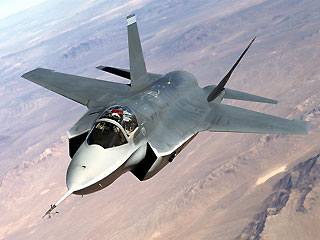
The U.S. recently agreed to sell Israel 20 F-35 jet fighters. (AP)
Kourosh Ziabari: The Iranian President’s recent proposal for the establishment of a fact-finding group to probe into the 9/11 attacks stirred up widespread controversy in the United States. American politicians reacted to Mr. Ahmadinejad’s plan with frustration. Is it because they are aware of some evidence which suggests that Israel was behind the attacks?
Maidhc Ó Cathail: I would say that most American politicians are totally unaware of the Israeli “art students,” the so-called “dancing Israelis,” the Odigo warnings and other facts that point to Israeli involvement in the 9/11 attacks. Therefore, they probably considered Ahmadinejad’s questioning of the official 9/11 narrative to be yet another unwarranted provocation of the United States by the Iranian leader.



 Peace and Justice Post