Posts Tagged ‘Iran’

There Is No Bigger Trump Lie Right Now Than Him Saying the Iran War Is Good for You—or the World

June 16, 2026

There is a popular view that this is a pointless war, being fought for nothing. But that is wrong—there is a purpose. Actually, there are several. You’re just never told what they are.

Phyllis Bennis, Common Dreams, Jun 14, 2026

On June 1st, despite a ceasefire ostensibly underway in the US-Israeli war on Iran, Israel’s prime minister launched a major escalation against Lebanon, including threatening airstrikes against the Lebanese capital. The US president called the Israeli leader, furiously demanding an end to Israel’s escalation. Six days later, Israel attacked Beirut’s southern suburbs, long understood to be a red line for Hezbollah. The Lebanese resistance organization launched a limited response, sending 11 rockets towards Israel, almost all of which were intercepted; no one was hurt or killed. Trump called Netanyahu again, telling him in a brief call that now that Iran and Israel had each “had their fun,” that Israel should stand down.

Commentators across the Middle East and beyond debated whether Netanyahu would abide by Trump’s demand. What virtually none of them mentioned was that Trump had refused to even mention his most important pressure point: that if Israel resisted his order to stand down, the US would simply stop sending tons of weapons and tens of billions of dollars to the Israeli military. The close but sometimes divergent interests of the Middle East’s two powers, the global and the regional, was on full display.

RECOMMENDED…

President Donald Trump sits for an interview with Lara Trump

Watch: Trump Admits ‘We Shouldn’t Have Been in Iran’

US President Donald Trump speaks during a Cabinet meeting

‘Sounds a Lot Like a Nuclear Threat’: Trump Floats ‘Ultimate Alternative’ If Iran Talks Collapse

It’s now been 106 days since Trump launched his preemptive and illegal military attack on Iran. On February 28, 2026, the world awoke to the fury of a new war in the Middle East after the United States and Israel had launched their joint assault against Iran, with President Trump and Prime Minister Netanyahu standing shoulder to shoulder against their common foe. Claiming unbridled hegemony was on the agenda for both.

The US-Israeli war on Iran is rooted in longstanding US imperialist strategy and Israel’s national goals.

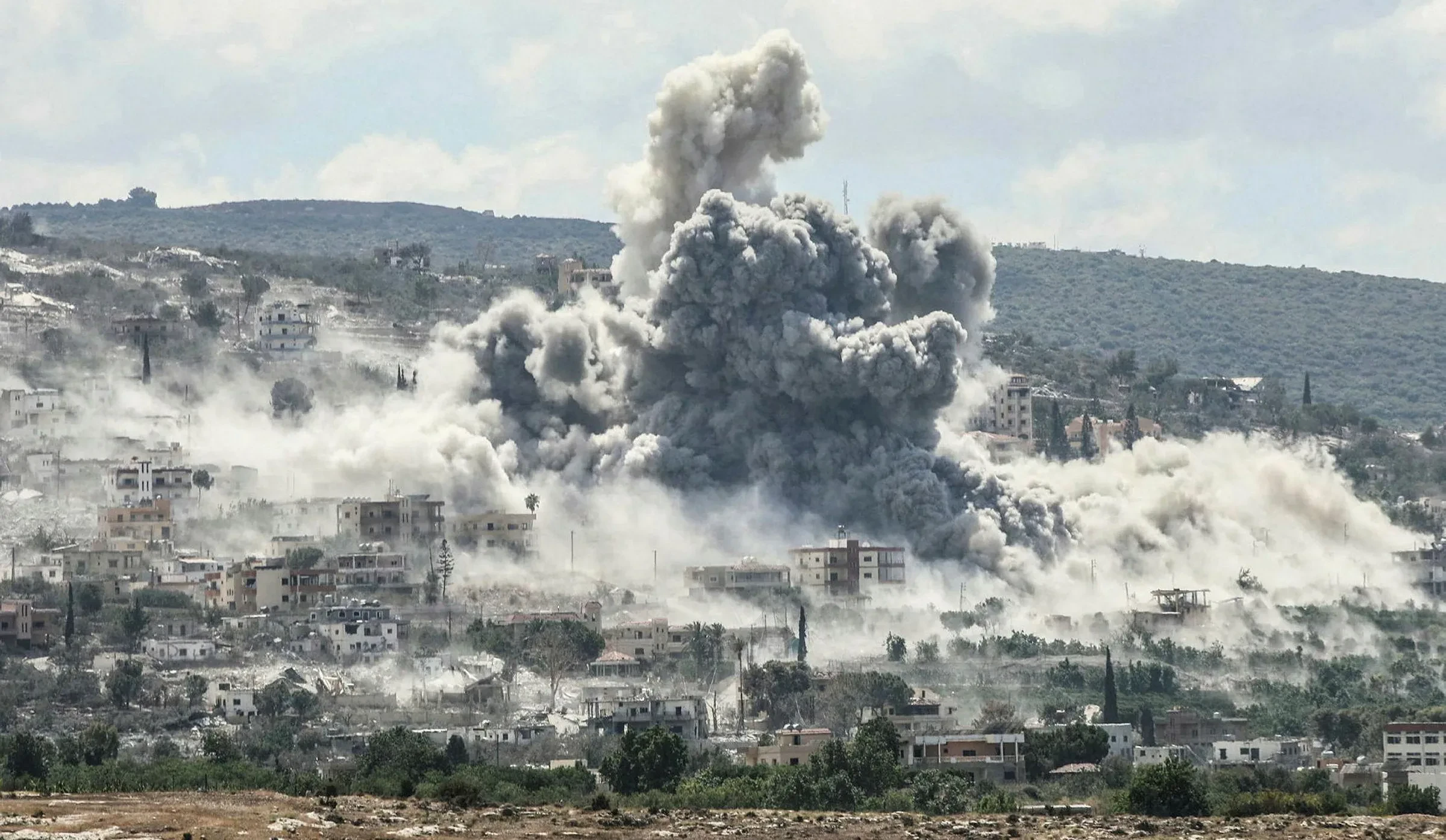
Today, with yet more fresh promises of a so-called “peace deal” that is nearly ready to be signed by Trump and Iranian leadership, the Israeli military is bombing the suburbs of Beirut despite ongoing claims of a “ceasefire.” Trying to understand the current doom loop, it’s vital we remember how we got here.

In the opening salvo of the US-Israeli attack, Iran’s supreme leader Ali Khamenei, along with an unknown number of other top military and political leaders, was assassinated with a ballistic missile. Just an hour later, the US fired a Tomahawk missile directly at the Shajareh Tayyebeh Elementary School in the northern Iranian city of Minab—killing 156 people, 120 of them children, and destroying the school. The war’s official reasons, initially, were to eliminate the ostensible threat of Iran creating a nuclear weapon, and to destroy its conventional military capacity. The no-daylight US-Israeli partnership, Trump and Netanyahu as BFFs, the collaboration between the US and Israeli warplanes, bombers, drones, missiles… all seemed seamless and perfect.

Three months later, and half a dozen or so “ceasefires” announced, renounced, ignored and denounced, headlines around the world gleefully recounted a Trump phone call with Netanyahu. Focused on Israel’s escalating bombing of Lebanon threatening to derail the latest US-Iran ceasefire, the June 1 call reportedly started with Trump telling Netanyahu “you’re fucking crazy—you’d be in prison if it weren’t for me.“ The US president then went on to his ”Everybody hates you now“ remark. ”Everybody hates Israel because of this,“ he reportedly said.

Trump acknowledged saying it, and then, as is his usual style, moved on, quickly reclaiming his friendship with the Israeli prime minister. As was true with so many earlier ceasefires, Israel continued its massive bombing and its brutal occupation of south Lebanon, making a US-Iran ceasefire impossible. In the meantime, throughout the months of the war, commentators, politicians of all stripes, journalists and analysts across the globe were struggling to figure out what that war was actually being fought for.

War for What?

Real fear of an actual nuclear bomb was certainly not the answer. After all, US intelligence agencies have agreed for years that “Iran is not building a nuclear weapon and that [Supreme Leader Ali] Khamenei has not reauthorized the nuclear weapons program he suspended in 2003.”

Despite that clear assessment, US B-2 stealth bombers still dropped 14 of their 30,000-pound “bunker-buster” bombs on Iran’s civilian centrifuges at Fordo, Isfahan and Natanz at the end of Israel’s 12-day war in June 2025. Trump and his supporters bragged of having “completely and totally obliterated” Iran’s nuclear facilities. And then, eight months after that, in the early days of the US-Israeli 2026 war, those B-2s were back in the air, dropping more 30,000-pound and some smaller versions of the bunker-busters on Iran. Seems they don’t believe even their own intelligence agents.

They thought they could impose imperialism on the cheap—but it turns out not everyone is playing that game.

Rationales for the sudden war in 2026 (launched in the midst of US negotiations with Iran for a long-term ceasefire) were tossed around like confetti, ranging from stopping a nuclear threat (which of course didn’t exist because Iran didn’t have, wasn’t trying to make, and hadn’t even made a decision to try to build a nuclear weapon), to ending Iran’s support for its regional allies, to destroying Iran’s navy, to crippling its missile capacity, to protecting Iranian civilians or maybe encouraging a popular uprising, or perhaps even full-scale regime change. Later, once Iran had responded to the attacks by closing the Strait of Hormuz, Trump shifted to trying to justify the war as a means of forcing the reopening of the Strait, in effect waging the new war to get back to the situation that had existed until the US and Israel launched the war in the first place.

Not a Senseless War

None were very convincing arguments. The popular view emerged that this was a pointless war, being fought for nothing. But that was wrong—there was a purpose. Actually, there were several. The Israeli prime minister has shaped his political career, for more than 35 years, around the claim that only he could bring down the Iranian regime, falsely claiming it as an “existential threat” to Israel. (In fact, even if Iran changed its internal decisions and decided to try to build a nuclear weapon some day, it would not represent an existential threat to Israelis but only to Israel’s 47-year-old nuclear weapons monopoly in the Middle East.) Netanyahu needed the war to continue—any ceasefire, under any conditions, would weaken him politically.

On the US side, some of the war’s goals had to do with the personal obsessions of the president and his minions. Trump’s fixation on expanding US power around the world, and more importantly being seen as presiding over a return to the glory days of unchallenged US global domination, remain a driving force—as does his determination to “get a better deal” than Obama did with the successful Iran nuclear deal in 2015. For his self-defined “secretary of war” Pete Hegseth, the pageantry of a powerful military—not only “the most lethal” force in the world but more white, more male, and even more slim than any other army—could compensate for Hegseth’s lack of experience. For Secretary of State Marco Rubio, all roads lead to regime change in Cuba—and supporting all of Trump’s military assaults, including attacks on fishing boats in the Caribbean, kidnapping the president and seizing the oil resources of Venezuela, bombing Yemen, Somalia and Nigeria, all help set the stage for his life-long goal of destroying the Cuban revolution.

The Search for Hegemony

All those personal obsessions likely played some roles. But the US-Israeli war on Iran is also rooted in longstanding US imperialist strategy and Israel’s national goals. While Trump has shown himself for years as far more committed to maximizing his own and his family’s wealth and power than he is accountable to any particular faction of US capital or US elite power (except perhaps “the billionaires,” writ large), the trajectory of imperial expansion, especially in an era of greater and rising powers around the world, continues to shape much of US policy.

That is where the search for hegemony comes to the fore. For Israel—and especially for its longstanding prime minister—the attack on Iran both demonstrates and reinforces its role as unchallenged regional hegemon. That means asserting its power—a derivative power, given its strategic dependence on the United States, but power nonetheless—to seize land, dispossess and expel whole populations, and exert permanent control over countries, economies, and people—whenever, wherever, and for however long it chooses. Without being held accountable.

For Israel—and especially for its longstanding prime minister—the attack on Iran both demonstrates and reinforces its role as unchallenged regional hegemon.

To be recognized as the regional hegemonic power in the Middle East, Israel needs to not only “mow the grass” in Lebanon and in Gaza (as well as arming and empowering ideologically driven settlers in the West Bank to escalate their violent seizure of Palestinian land and ethnic cleansing of its population), it needs to continue to weaken, threaten, and when possible (with US backing) go to war against Iran, its sole challenger for regional control.

Mowing the Grass

Israelis—military and government officials, academics, journalists and others—routinely use the term “mowing the grass” to describe Tel Aviv’s consistent attacks against Israel’s neighbors. The phrase was first coined to describe Israel’s brutal 22-day assault on Gaza, Operation Cast Lead, that began the day after Christmas 2008 and killed more than 1400 Palestinians, most of them civilians and including 300 children. Since then, it describes the frequent attacks on Gaza or Lebanon—ostensibly aimed at militant organizations but designed originally to kill massive numbers of civilians, displace hundreds of thousands or millions from their homes, and destroy huge swathes of homes, schools, churches, mosques, businesses—to remind everyone who it is who actually holds power.

Israel is saying that it will not allow Iran to remain an obstacle to Tel Aviv’s claim of full-blown dominance of the region. Netanyahu is making good of the threats he’s issued for the last 30 years.

Iran has historically been the main obstacle preventing Israel from consolidating that regional hegemonic role, and part of Netanyahu’s political power depends on his ability to keep the US-Israeli “special relationship” strong and to deal effectively with Iran. So going to war against Iran in complete and willing partnership with the United States serves to strengthen his still-shaky political position. What’s different now is that Israel is saying that it will not allow Iran to remain an obstacle to Tel Aviv’s claim of full-blown dominance of the region. Netanyahu is making good of the threats he’s issued for the last 30 years.

So Netanyahu remains committed to continuing this war against Iran, opposing ceasefires regardless of their terms—and most recently, escalating attacks against Lebanon precisely because they could prevent or shatter any ceasefire. Following the Israel-Hezbollah ceasefire in 2024, UN peacekeepers on the ground documented more than 10,000 Israeli violations of the agreement in just the first year. When a wobbly US-Iran ceasefire was announced on April 8, 2026, Israel responded with massive force against Beirut, launching more than 100 airstrikes within 10 minutes across the capital and killing 357 people, many of them civilians and at least 101 of them children and women.

Back in the USA….

For the United States, going to war against Iran could strengthen Washington’s longstanding commitment to maintaining global domination—a goal particularly relished by its power-obsessed and erratic president. The war was designed to both demonstrate and bolster the US role as unchallenged global hegemon. And doing so arm in arm with Israel, the regional version.

What a team they thought they would make. What they didn’t reckon with was the reality of Iran—its military, its government, its people. While there is no question US-Israeli military might massively outstrips that of Iran, it turned out that Tehran was able to use its not-insignificant drone and missile capacity in ways that maximized its power.

While there is no question US-Israeli military might massively outstrips that of Iran, it turned out that Tehran was able to use its not-insignificant drone and missile capacity in ways that maximized its power.

For example, Iran’s relatively few strikes on US bases and sometimes domestic facilities in the surrounding US-backed Gulf states had political consequences beyond their comparatively low levels of casualties. They showed how “protection” in the form of US military bases, weapons and troops in those countries did not keep their people safe, but rather laid a target on their backs. Most especially, Iran’s few direct attacks on ships attempting to cross the Strait of Hormuz early in the war, had the much broader effect of shutting down the vital waterway entirely, as shipowners and insurance companies refused to take the risk.

Miscalculations

When Israel carried out its guided missile attack on the first day of the war, killing the supreme leader and a number of other top officials, the cheering in Washington and Tel Aviv reflected the assumption that the decapitation of the government would lead to chaos and its inability to function. The cheerleaders were wrong. As Narges Bajoghli and Vali Nasr noted in Foreign Affairs, the US and Israel “expected a quick victory through targeted assassinations of Iran’s leadership. But decapitation did not produce regime collapse. Instead, it opened the door for a new generation to take over.” Not only did Khamenei’s son take over his father’s position, but younger military, political, and business leaders filled in the gaps across the structures of power.

And while the Iranian leadership had been significantly weakened by public mobilization against both governmental inability to solve the escalating economic crisis and its increasingly repressive attacks against protesters, it appears it was not further weakened by the US-Israeli assault. As Nasr and Bajoghli describe the situation, the public anger of January 2026 in response to escalating repression of the mass uprisings, didn’t disappear with the US-Israeli assault. They wrote:

The war’s destruction has been vast: public infrastructure, factories, schools, hospitals, historic monuments, and even entire neighborhoods lie in ruins. As Israeli and American bombs and missiles pummeled the landscape, Trump threatened to arm separatists, redraw Iran’s borders, crush its economy and annihilate its civilization. Together, these military and rhetorical assaults provoked a nationalist reaction that cut across political divisions. Public anger has not disappeared. The grief, frustration and accumulated resentment of decades of misrule and repression remain. What has changed is the political landscape in which those feelings find expression. Dissent is now refracted through a national struggle against a foreign enemy that Iranians compare to Alexander the Great, who conquered the Persian empire in the 4th century BC; the Arab armies that invaded in the 7th century AD; and the Mongols, who came six centuries after that.

Contrary to American and Israeli expectations, the war has not sparked street demonstrations. The longer it went on, the less the regime appeared threatened by public uprisings. Iranian society mobilized not against the state but alongside it, holding daily rallies across the country, forming human chains and gathering on bridges threatened by Trump. The sharp divide between state and society that had characterized Iran in January blurred—not through persuasion or repression, but through the shared experience of living through the bombing and witnessing its destruction.

Palestine

There was another reason for the US-Israeli war, that explains at least the timing, if not the overall rationale—Palestine. Israel has been committing genocide in Gaza for two years and eight months. There are now more than 73,000 known, identified, named Palestinians in Gaza who have been killed by Israeli bombs, tanks, bullets, drones, missiles, almost all paid for (and to a large degree produced) by US taxpayers. Thousands more lie dead under the rubble of what were once the cities, towns, refugee camps of the decimated Gaza Strip. The statistics belie the lives lost—babies, elders, children. Journalists and health workers in staggering numbers. And Israel’s genocide continues, people are still being killed by Israeli bombs, tanks and drones, as well as deliberately-imposed shortages of water, food, medical supplies, shelter.

The Gaza genocide is not unrelated or incidental to the US-Israeli war in Iran—it is a primary enabler. It is precisely the level of impunity, the absolute lack of accountability for any of the perpetrators of this crime against humanity, that has given Israeli and US leaders the confidence to go ahead with what many have called the “Gazafication of Iran” and the “Gazafication of Lebanon” without fearing there might be a price to be paid.

The Gaza genocide is not unrelated or incidental to the US-Israeli war in Iran—it is a primary enabler.

The international arrest warrants issued by the International Criminal Court against Israeli leaders (Israel assassinated the Hamas leaders who were similarly charged) are ignored in most of the US-allied countries that Netanyahu and his former defense minister might want to visit. South Africa’s unprecedented effort to hold Israel accountable at the International Court of Justice for its violations of the Genocide Convention resulted in a powerful preliminary ruling that Israel’s actions plausibly do constitute genocide. Israel was ordered to carry out specific actions—starting with an end to killing people in Gaza—but it has yet to face any consequences for ignoring those orders. And no one knows when the final ruling might be issued—or if it will lead to some level of enforcement, either in the United Nations, by a coalition of governments, or, most likely by a newly-enraged, newly-engaged global civil society ready to move with ever greater energy, strategic clarity and political power to impose serious consequences on the governments and individuals responsible for the first genocide in history to be carried out openly, proudly, and visible to the world.

War Over War

For now, while the war against Iran continues, it looks like both Israel and the United States are moving into a different phase. They are still looking to claim power, still working to reshape political relations and consolidate regional and global power across the middle east. But rather than simply escalating again, as Israel still is in Lebanon, or continuing a grinding daily assault as it still is in Gaza—both actions armed and paid for by the US—they are facing some changed circumstances. Just maybe Washington and Tel Aviv are finding that it’s harder than they thought to re-order the whole Middle East—and to do that in tandem is harder than ever.

Trump seemed to think he could accomplish something dramatic and “beautiful” in Iran—encourage a popular uprising, maybe seize the oil and replace the leadership’s political orientation as if it were Venezuela—but then found that wasn’t so likely. Turns out Iran is not Venezuela. Netanyahu has massive public support among Jewish Israelis for continuing the war in Iran, though support for the war in Lebanon is not so popular. (It should not be forgotten that after 18 years of occupying South Lebanon, Israeli troops were finally pulled out in 2000 primarily because the government could not survive the mobilization of Israeli mothers angry that their sons in the IDF were occasionally being killed by Hezbollah’s retaliation actions..)

Trump seemed to think he could accomplish something dramatic and “beautiful” in Iran—encourage a popular uprising, maybe seize the oil and replace the leadership’s political orientation as if it were Venezuela—but then found that wasn’t so likely.

At home Netanyahu may be able to get away with claiming victory over Iran even if a ceasefire is imposed, by continuing Israel’s longstanding practice of assassinating Iranian scientists and political/military leaders, and occasional bombing raids. But Israel’s plummeting losses in the war of global legitimacy are certainly not likely to be reversed any time soon. The most recent Pew survey indicates sky-high majorities holding negative views of Israel and Netanyahu around the world—up to 95% in Pakistan, 78% negative in Sweden and Spain.

The global Palestinian rights mobilizations and the even broader movements for ceasefire and an end to genocide of course play a major role. Social movements and civil society activists around the world will continue to hold up the ICJ decisions and the UN General Assembly resolutions requiring governments to impose arms embargoes, boycotts, divestment, and sanctions against Israel.

And as the Strait remains closed and food shortages mount in the poorest countries, as Arab governments fearing public opposition at home reduce their ties with Israel and reject expansion of the Abraham Accords, and as Israel continues to kill Lebanese and Palestinian families, Trump’s claims will be less likely to be believed. With the mid-terms only a few months off, his claims of “We’re the winner, we won” are already ringing increasingly hollow. It doesn’t mean he won’t make the claims, it just means they’re not going to work.

For Trump, given the unexpected level of resilience in Iran, Tehran’s access to a virtually unlimited supply of cheap drones that are doing real damage to Gulf Arab states hosting US bases and troops, and its willingness to close the Strait as a pressure point with global ramifications, it’s going to be difficult to claim this war as a victory.

The search to consolidate regional and global power continues. It’s a big part of the reason the US and Israel are launching new wars and escalating longstanding attacks. People are still losing lands and lives as these hegemons rely on war to consolidate their positions. But neither Israel in the Middle East nor the United States in the world are unchallenged. They thought they could impose imperialism on the cheap—but it turns out not everyone is playing that game. The search for hegemonic power is far from settled.

Israeli Ministers Say Israel Isn’t Bound by US-Iran Deal, Won’t Withdraw From Lebanon

June 15, 2026

Iran reaffirmed that any deal with the US hinges on an end to Israel’s war in Lebanon

by Dave DeCamp | June 15, 2026 at 12:41 pm ET | Iran, Lebanon

In the wake of the US and Iran announcing a Memorandum of Understanding to end the conflict between the two nations that includes a ceasefire in Lebanon, Israeli ministers have said Israel isn’t bound by the agreement.

Israeli Defense Minister Israel Katz vowed that the IDF will not withdraw from its so-called “security zones” in southern Lebanon, which include a major swathe of Lebanese territory, and will also continue the occupation in southwest Syria and Gaza.

“Prime Minister Benjamin Netanyahu and I are leading a clear policy that determines that the IDF will remain in the security zones in Lebanon, Syria, and Gaza, without any time limit, to protect, from there, the border and Israeli communities against jihadist elements,” Katz said.

Israeli soldiers in southern Lebanon in April 2026 (IDF photo)

The Israeli defense minister said that the IDF will continue its destruction campaign in southern Lebanon and its forced displacement of Lebanese civilians. “We oppose an IDF withdrawal from Lebanon, despite all the existing pressures and those that will still come,” he said.

Katz added that Netanyahu “made these points clear to US President Trump and to other senior American officials,” which aligns with a report from Ynet that said Netanyahu told Trump that Israel is not bound by the Lebanon clause of the US-Iran MOU. Katz also said that if Iran strikes Israel over its continued war in Lebanon, Israel will hit Iran “with full force.”

Israeli Finance Minister Bezalel Smotrich slammed the agreement Trump reached with Iran, saying it is “bad for Israel and for the entire free world. Period.” Israeli opposition leaders also attacked Netanyahu, with former Prime Minister Yair Lapid saying there has “never, ever, been a more absolute failure than Netanyahu’s diplomatic failure on the Iranian front.”

Iranian officials on Monday reaffirmed that an end to Israel’s war in Lebanon was key to a lasting deal with the US. “Lebanon and the termination of the war in Lebanon are an inseparable part of the understanding on ending the [US-Israeli] war [on Iran]. We have shown that we are determined in this regard and have proven in practice that we are serious, and we will continue to monitor developments carefully in the future,” said Iranian Foreign Ministry spokesman Esmaeil Baghaei.

“The word Lebanon is used three times in the understanding. It is mentioned that ending the war includes Lebanon and respecting the country’s sovereignty and territorial integrity … The United States must honor its commitments and ensure that the Zionist regime fulfills its obligation not to attack Lebanon,” he added.

If you liked this article, please support Antiwar.com.
We are 100% reader-supported.

Dave DeCamp is the news editor of Antiwar.com, follow him on Twitter @decampdave.

Trump, Iran announce ceasefire agreement

June 15, 2026

Andre Damon@Andre__Damon, 15 June 2026
Workers clear debris near an apartment building damaged in an Israeli airstrike in Dahiyeh, Beirut’s southern suburbs, Lebanon, Sunday, June 14, 2026. [AP Photo/Bilal Hussein]

The United States and Iran announced a ceasefire agreement Sunday, suspending, for now, a war that the Trump administration began on February 28 and that has killed thousands of people. “The Deal with the Islamic Republic of Iran is now complete,” President Donald Trump wrote on Truth Social, ordering the lifting of the US naval blockade of Iran and the reopening of the Strait of Hormuz. “Ships of the World, start your engines,” he wrote. “Let the oil flow!”

While the terms of the settlement remain undisclosed, this much is already clear: The Trump administration achieved none of the aims for which it went to war. It set out to overthrow the Iranian government, destroy its nuclear program, break its military and seize the Strait of Hormuz. It accomplished none of this.

Trump responded to the failure by denying he had ever sought to overthrow the Iranian government. “As far as regime change, I never cared about regime change,” he told the Wall Street Journal on Sunday.

In reality, his administration had spent the entire year trying to bring the government down. Early on, it funded and armed protesters inside Iran. “We sent guns to the protesters, a lot of them,” Trump said in April.

When this failed, the United States and Israel turned to assassination. The opening strikes on February 28 killed Iranian Supreme Leader Ali Khamenei, Revolutionary Guard commander Mohammad Pakpour and Defense Minister Aziz Nasirzadeh, along with much of the military command. The government did not collapse. Khamenei’s son Mojtaba succeeded him, and it was the younger Khamenei’s national security council that approved Sunday’s deal.

There followed a bombing campaign across Iran that has killed at least 3,468 people, by the Iranian health ministry’s count, and a naval blockade imposed on April 13. American warplanes destroyed water reservoirs in Sirik that supplied more than 20,000 people and fired on oil tankers running through the blockade, killing three Indian sailors aboard the Settebello this week. After two months, the blockade failed to force Iran’s surrender, and the Strait of Hormuz remained shut by Tehran’s decree until Sunday.

No agreement with American imperialism is worth the paper it is written on. In 2015, the Obama administration signed the nuclear accord known as the Joint Comprehensive Plan of Action (JCPOA), under which Iran accepted strict limits on enrichment and intrusive inspections. Iran kept to its terms—the International Atomic Energy Agency certified as much in report after report—but in May 2018 Trump tore the agreement up anyway, calling it a “horrible, one-sided deal.” Obama, who signed that accord, said Sunday it was “doubtful that any agreement that arises is going to be significantly different or a significant improvement from the deal that we had in the first place… before we, the United States, pulled out of it.”

The pattern was repeated last year. Trump announced a “Complete and Total CEASEFIRE” in June 2025 to end the Twelve-Day War between Israel and Iran. That truce held until February 28, when the United States and Israel broke it, launching the war that has now been paused.

Even as he proclaimed peace on Sunday, Trump threatened to resume the war. The New York Times reported that in a phone call he said he would “restart military attacks on Tehran” if Iran failed to reach a final nuclear accord, or else make the United States “the guardian of the Middle East” in exchange for 20 percent of the region’s revenues.

The agreement is a 60-day ceasefire, to be signed Friday in Geneva by Vice President JD Vance and Iranian officials. The future of Iran’s nuclear program and the lifting of US sanctions are left to negotiations over those 60 days, and the text has not been released.Available from Mehring BooksThe struggle against imperialism and for workers’ power in IranA pamphlet by Keith Jones

Trump’s claims about the settlement were as hollow as his account of the war. He boasted that the Strait of Hormuz would be “permanently toll free,” but the memorandum suspends tolls for only 60 days. Iran charged no tolls before the war—the deal restores the prewar status quo. Trump said the inspection of Iran’s nuclear material could wait: “We’ll get the nuclear dust later on when we’re ready to go in and do it… there’s no rush.”

The agreement nominally covers Lebanon, where Israel has waged a parallel war that has killed more than 3,700 people. Hours before the announcement, Israel bombed the southern suburbs of Beirut, killing three, in a strike that nearly wrecked the deal. Trump said Israeli Prime Minister Benjamin Netanyahu had shown “no judgment” and told all sides to “stand down.” Israel, which was not a party to the talks, has not endorsed the agreement, and Israeli politicians across the spectrum denounced it.

The Democrats’ response to Trump’s moves toward an agreement with Iran centered on the accusation that he had failed to secure the interests of US imperialism. Democratic Representative Seth Moulton of Massachusetts called the emerging terms “basically a surrender document from Donald Trump to the supreme leader of Iran.”

House Minority Leader Hakeem Jeffries, on NBC’s “Meet the Press,” complained that the war had left the United States worse off: “Things aren’t better for us. They’re worse. In fact, Iran is stronger right now.”

A warning must be made. Whatever the failures and setbacks of the past four months, American imperialism will only redouble its efforts to dominate the Middle East and the world by military force.

The World Socialist Web Site is the voice of the working class and the leadership of the international socialist movement. We rely entirely on the support of our readers. Please donate today!

With One Strike, Netanyahu Tries To Kill Two Peace Deals

June 15, 2026

Netanyahu knew exactly what he was doing when he defied Trump’s red line and struck Beirut this morning

by Trita Parsi | Jun 15, 2026 | 0 comments

Reprinted with permission from Trita Parsi’s Substack.

It’s important to understand that, contrary to Donald Trump’s quip to Barak Ravid that Netanyahu has “no f***ing judgment,” the Israeli Prime Minister knows exactly what he is doing: With a set of strikes at the Dahiyeh neighborhood in Beirut, he is trying to kill both the pending US-Iran peace deal and the fragile peace between Israel and Lebanon that would come with it.

There is a further strategic dividend. Netanyahu is also seeking to preempt Iran’s attempt to establish a new regional deterrence equation – one in which attacks on Beirut, and potentially on Lebanon more broadly, would trigger a direct Iranian response against Israel. By striking now, he is not merely targeting an adversary; he is challenging the emergence of a regional order that would constrain Israel’s freedom of military action.

Netanyahu even posted a video on his Twitter bragging about the attack:

תקפנו בדאחייה בביירות מטרות טרור של ארגון הטרור חיזבאללה. ישראל לא תסבול ירי לשטחה pic.twitter.com/wVARFCkDQe

— Benjamin Netanyahu – בנימין נתניהו (@netanyahu) June 14, 2026

The exchange of fire between Israel and Iran last week was about far more than retaliation. After Israel defied President Trump and struck Beirut’s Dahiyeh neighborhood, Iran responded by attacking Israel directly – the first time Tehran had launched strikes on Israel in response to an Israeli attack on Lebanon. Israel defied Trump once more and retaliated against Iran, prompting another Iranian response, after which Israel confined its next strike to southern Lebanon rather than Beirut.

The cycle reflected Iran’s attempt to establish a new regional equation: that attacks on Lebanon would no longer be cost-free for Israel, but would carry the risk of direct Iranian retaliation. For the first time in decades, a major regional power was seeking to place hard-power constraints on Israel’s freedom of military action beyond its borders.

Having reestablished its own deterrence, Tehran was now attempting to establish extended deterrence to its partners as part of a broader effort to rebuild its forward-defense posture. Israel, unsurprisingly, viewed this as a direct challenge to its long-standing freedom of maneuver and moved quickly to prevent the new doctrine from taking hold.

Of course, extended deterrence can not be established through a single exchange of fire. At a minimum, it would require several rounds of action and reaction before either side accepted it as a new reality. And even then, it would never be foolproof. Tehran understands that its purpose cannot simply be to eliminate Israeli strikes on Lebanon, but to force Israeli leaders to think twice before authorizing them by attaching a new and significant cost: the likelihood of direct Iranian retaliation.

It was therefore clear that Netanyahu had not abandoned the fight. Yet for several days, even as Hezbollah and Israel continued to exchange fire, he refrained from striking Beirut’s southern suburbs and testing Iran’s new red line.

But today, just hours before President Trump was expecting Iran to sign a memorandum that would end the U.S.-Iran war and reopen the Strait of Hormuz, Netanyahu crossed both Tehran’s and Trump’s red line: keeping Beirut out of the conflict.

Netanyahu clearly timed this for maximum impact. With a single set of strikes, Netanyahu may have advanced two goals at once – torpedoing Trump’s peace deal and preventing the emergence of a new deterrence equation that would impose meaningful constraints on Israel’s military operations in Lebanon.

A diplomat involved in the talks told Fox News that: “This is a clear attempt by Israel to sabotage the President’s deal and drag the United States back into war.”

Trump, meanwhile, is once again reportedly “pissed off” at Netanyahu. In a Truth Social post, the president declared that the strike on Beirut “should not have happened,” while pointedly questioning whether it was a proportionate response to Hezbollah’s latest attack on Israel.

“Israel has the right to defend itself against threats,” Trump wrote, “but the attack it was responding to was very small and meaningless. Nobody was hurt, injured, or killed, and it should not disrupt this important process.”

The statement was notable not merely for its criticism of Netanyahu, but for what it implied: that Israel’s strike was neither militarily necessary nor diplomatically prudent at a moment when a potential breakthrough with Iran appeared within reach.

Washington is frustrated by Tehran’s insistence that Trump rein in Israel, even as American officials believe Iran has failed to similarly restrain Hezbollah. It is equally frustrated that a deal it urgently wants with Iran is now being held hostage by Israel, ironically at the request of the Iranians, since it is Tehran that insists that any ceasefire must be region-wide and prevent Israel from having the ability to restart the war.

That frustration is understandable. But Washington must also recognize a basic reality: the only way to delink a U.S.-Iran agreement from the Israel-Lebanon conflict is to delink the United States itself from Israel’s recurring resort to military escalation.

As long as Israel retains the capacity to drag the United States back into conflict, Tehran will see little reason to separate diplomacy with Washington from the wars Israel chooses to start and pull the US into.

Indeed, the principal reason Tehran insists on a region-wide ceasefire is to deny Israel the ability to draw the United States into yet another war with Iran itself.

If Trump were to clearly establish that the United States would neither participate in nor defend an unjustified Israeli military escalation, Tehran might no longer see the need to link a U.S.-Iran accord to the Israel-Lebanon front.

Such a calculated distancing from Israel would serve American interests in any case. But the need for it has rarely been more apparent than it is today.

Trita Parsi is the Executive VP of the Quincy Institute for Responsible Statecraft and an award-winning author. Washingtonian Magazine has named him one of the 25 most influential voices on foreign policy. Noam Chomsky calls him “one of the most distinguished scholars on Iran”

Visit Trita Paris’s Substack and subscribe.

Who Is the Aggressor? Turning Obstacles into Threats

June 13, 2026

June 10, 2026

Obstacles to the aggressors’ expansion and occupation in the Middle East are Iran, Hamas, Hezbollah, the Houthis and Shia militia in Iraq. They are presented as “threats” rather than defenders of their dignity, sovereignty and land.

U.S.-Israel biennial command post simulation and training exercise, October 2010. Then IDF Deputy Chief of Staff Lt. Gen. Benny Gantz and Deputy EUCOM Commander U.S. Lt. Gen. John D. Gardner (IDF/Flickr)

By Joe Lauria
Special to Consortium News

If you understand who the aggressor is, you are on your way to understanding the mad and perilous times we live in.

Once you get that, what you’ve been taught all your life starts to lose its hold on you. 

Establishment education and media try to confuse you. Independent media like Consortium News try to clarify.

Establishment education and media portray the aggressor as the defender, and the victim as the threat. Consortium News endeavors to show you the “threat” is really an obstacle. An obstacle to aggression and occupation. An obstacle to expansion. Locally and globally.

Few would agree with aggression, paid for with your taxes in a so-called democracy. So obstacles to aggression become threats you’re supposed to be afraid of. Offensive action is made to appear as “defense” to protect you from the “threat.” 

There’s nothing new in this.  The Romans dressed up their imperial aggression as self-defense against fake threats. Rome provoked tribes, first in Italy and then Gaul and Germania, into forming alliances to protect the tribes’ sovereignty, and then Rome presented these alliances as “threats” that had to be destroyed, justifying war against them.

Rome would also provoke an adversary into invading or launching an attack to obtain the casus belli needed to start a pre-planned war. For instance, Roman ally Masinissa of Numidia repeatedly raided Carthage to provoke it into finally responding militarily in violation of a treaty it had with Rome. The empire used this as a pretext for total destruction and annexation — even though Carthage, an obstacle to Roman expansion, posed no realistic, existential threat.

In the earlier U.S. imperium, Mark Twain explained it this way:

“The statesmen will invent cheap lies, putting the blame upon the nation that is attacked, and every man will be glad of those conscience-soothing falsities, and will diligently study them, and refuse to examine any refutations of them; and thus he will by and by convince himself the war is just, and will thank God for the better sleep he enjoys after this process of grotesque self-deception.”

Today the obstacles to the aggressors’ expansion and occupation in the Middle East are Iran plus the legal, armed resistance to Greater Israel and Greater America: Hamas, Hezbollah, the Houthis and Shia militia in Iraq. They are presented as “threats”rather than defenders of their dignity, sovereignty and land. Nazi Germany portrayed resistance fighters in France, Italy, Greece, Yugoslavia and elsewhere as a “threat,” as “terrorists” and “bandits” to delegitimize legitimate obstacles to total domination.

In Asia the “threat” is China. Beijing protecting its sovereignty in its own region is somehow a threat to U.S. warships near China’s waters and to Taiwan, which the U.S. agrees is part of China.

In Europe years of NATO expansion, refusal to negotiate a mutual security treaty, rehabilitation of fascism, a coup, and civil war in Ukraine against ethnic Russian coup-resistors provoked Russia to intervene, much as the Romans provoked Carthage.

Getting Russia to invade Ukraine allows the portrayal of Moscow as the aggressor and a “threat” to all of Europe and not as an obstacle to the U.S. and Wall Street return to their 1990s dominance of Russia. (Now there is constant talk of direct NATO war with Russia. The fear is another provocation to get Russia to start it.)

All of these obstacles to U.S. global hegemony are presented to you as existential threats that only the mighty United States, NATO and Israel can protect you from. There’s nothing in it for them, of course, except saving your life, we’re expected to believe.  Except you don’t have to believe it. You have alternative media like Consortium News to expose the deceptions on a daily basis.

That’s why pro-establishment social media companies and so-called anti-disinformation services have tried to hurt us. And that’s why we need your help. So …

Senate wants to force US to share sensitive intel with Israel

June 12, 2026

Tom Cotton

A measure in a must-pass bill would dramatically increase Israeli access to American secrets

Responsible Statecraft, Paul R. Pillar, Jun 10, 2026

Buried deep inside a 192-page intelligence authorization bill is Section 622, titled “United States-Israel Intelligence Sharing Enhancement.” It would require the president, acting through the director of national intelligence and as necessary the secretary of defense, to “expand and enhance intelligence sharing with the Government of Israel” on a list of subjects that encompasses almost every topic of intelligence interest in the Middle East.

The bill, put forward by Sen. Tom Cotton (R-Ark.), the chairman of the Senate Intelligence Committee, would prohibit any suspension, reduction, or limitation of such sharing “except on the basis of a specific and identifiable national security concern determined by the President.” Any such exception would require a report to Congress within fifteen days detailing not only the reason for the change but also the categories of information involved. The same report would require an assessment of the anticipated impact on regional security and various other matters.

This proposal is one of several recent moves by those in Washington who carry the Israeli government’s water to keep the United States tied to Israel despite plummeting support for the country among the American public. The most salient form of U.S. support to Israel has been more than $300 billion in economic and especially military assistance. Israeli Prime Minister Benjamin Netanyahu has tried to get ahead of the declining public support and avoid embarrassing losses by suggesting it would be fine with him to phase out the military aid.

Israel’s strategy and that of its U.S. supporters is now to rely on ties with, and support from, the United States that are not as salient as the military aid with its prominent price tag. The strategy includes forms of military integration that are less visible than congressionally appropriated grant aid and therefore less publicly accountable. Section 224 of a defense authorization bill currently in the House of Representatives embodies this form of integration.

The mandating of intelligence sharing carries this strategy further by moving it into the shadowy world of relations between intelligence agencies. That world is even farther removed from public visibility and accountability than the defense integration, and even less likely to stimulate thoughts about American taxpayers’ money going to a foreign country. So far, Section 622 of the intelligence bill has received less attention than Section 224 of the defense bill.

The notion of legislating an intelligence liaison relationship in this way, with any foreign country, is bizarre. Liaison with counterpart foreign services, including exchanges of information, is an important but complex part of the intelligence business. The nature of a liaison relationship depends partly on the temperature of the overall political relationship with the country in question but also on other factors known mostly to intelligence officers. These include the collection requirements levied on them, their ability or inability to meet those requirements with national resources, their assessment of the foreign service’s ability and willingness to fill collection gaps, the role that any trading of information plays as quid pro quos in operational cooperation, and the risks of compromising intelligence sources and methods.

Moreover, no single liaison relationship exists in isolation. The U.S. intelligence services need to consider possible implications for their other foreign relationships. For example, one generally does not share with country A information about country B if the United States has a relationship with B that is about at the same level as it has with A. Intelligence liaison involves a hierarchy of relationships, ranging from extensive cooperation with close allies to carefully limited ad hoc exchanges with adversaries. The intelligence community has a staff with the full-time job of monitoring and managing this set of relationships to prevent crossed wires. A congressional mandate regarding a single relationship increases the chance of crossed wires.

An irony is that the Congress considering this mandate is the same Congress that has in effect surrendered to the president its powers under Article I of the Constitution to set tariff rates and to decide whether to wage war. And yet, Section 622 would involve congressional micromanagement of a matter that by its nature needs to be the business of the executive branch and especially the intelligence agencies.

In intelligence, Israel is more of an adversary than an ally. Being an adversary in intelligence means indulging in the hostile act of espionage. Israel has a long record of conducting that type of hostile act against the United States. The best-known case involves the spy Jonathan Pollard, who stole such an overwhelming volume of U.S. secrets that then-Secretary of Defense Caspar Weinberger stated to the court that sentenced Pollard that it was difficult “ to conceive of a greater harm to national security than that caused by the defendant in view of the breadth, the critical importance to the U.S., and the high sensitivity of the information he sold to Israel.”

Newsletter

Subscribe now to our weekly round-up and don’t miss a beat with your favorite RS contributors and reporters, as well as staff analysis, opinion, and news promoting a positive, non-partisan vision of U.S. foreign policy.

Invalid emailEnter your email

When Pollard completed his prison sentence and parole in 2020, he was given a hero’s welcome, led by Netanyahu himself, on his arrival at Ben Gurion Airport in Israel. There was nothing noble in Pollard’s actions. Although he liked to say he was motivated by concern about Israel’s security, before selling his espionage services to Israel he offered to sell U.S. secrets to three other countries and made the same offer to a fourth country even when spying for Israel.

The Israeli espionage threat to the United States has only intensified. Last week, NBC News reported that the Defense Intelligence Agency raised the threat level for such espionage, evidently a reflection mostly of U.S.-Israeli differences over the Iran war. The New York Times quotes an official saying that Israeli intelligence operations aimed at senior U.S. officials during the second Trump administration have become so aggressive as to be “unhinged.”

Any sensitive information, including intelligence secrets, shared with Israel entails a high risk of Israel passing it to other countries, including U.S. adversaries. Israel has a long record of that, too, and not just because Israel probably passed some of the secrets Pollard purloined to the USSR, in exchange for Moscow allowing Soviet Jews to emigrate. Israel’s sharing of U.S.-origin military technology with China has been an issue. That the partner may be a rogue state has not stopped Israel from military and technical cooperation, as demonstrated by its relationship with apartheid-era South Africa, which extended even to the development of nuclear weapons.

The risk of Israel passing sensitive U.S. information to other states continues partly because Israel is hungry for cordial relationships — and especially establishment of new formal diplomatic relations — with any country willing to have such relations despite Israel’s continued subjugation of the Palestinians. Secrets from U.S. intelligence would be very attractive to some of Israel’s partners or potential partners, and thus attractive to Israel as trading material. Those other countries may include China, with which Israel continues to have extensive technical cooperation, and Russia.

Even without any passing to third countries, Israel’s own use of much U.S. intelligence is apt to be contrary to U.S. interests and the interest of peace and security in the Middle East, and for many of the same reasons underlying the reduced popularity of Israel among the U.S. public. Israel has started more wars and attacked more nations than any other country in the Middle East. In recent years it has inflicted more death and destruction on civilians through military operations than any other Middle Eastern state. It uses violence to seek regional hegemony and destroy Palestinian nationhood in ways that are inconsistent with U.S. interests.

The current ill-advised war with Iran demonstrates the sharp divergence of U.S. and Israeli interests. After being the principal influence on President Donald Trump’s decision to launch the war, Netanyahu’s government has been sabotaging efforts to end it. It currently is doing so mainly with relentless attacks in Lebanon that have killed thousands and displaced over a million people. The divergence of objectives was reflected in an expletive-laden phone call last week between Trump and Netanyahu that was mainly about those attacks.

Attacks that sabotage diplomacy are among the Israeli operations that might use shared U.S. intelligence. The United States also will be blamed for aiding other violent Israeli operations because of the “enhanced” intelligence sharing, even if it were no longer paying for Israeli arms.

The supposed escape clause in Section 622 of the intelligence bill would in practice be so cumbersome as to be useless. The required report to Congress would dump the issue on Capitol Hill, where the Israel lobby would quickly depict it as a question of being for or against the security of Israel. The mandated intelligence sharing in the bill thus would tie the president’s hands and prevent any administration from using management of the intelligence liaison relationship as leverage to deter destructive conduct by Israel.

Paul R. Pillar

Paul R. Pillar is Non-resident Senior Fellow at the Center for Security Studies of Georgetown University and a non-resident fellow at the Quincy Institute for Responsible Statecraft. He is also an Associate Fellow of the Geneva Center for Security Policy.

Exodus From Lebanon’s Tyre as Israel Orders Locals Out of Christian Quarter

June 10, 2026

Lebanese church leaders appear for international intervention amid attacks

by Jason Ditz | June 9, 2026

For the first time since they invaded Lebanon in March, the Israeli military issued an explicit evacuation warning for the Christian quarter of the ancient city of Tyre, claiming there were Hezbollah secretly hiding amongst the Christians.

What followed was an attempt by the remaining Christian population to flee northward, an effort that would’ve been a lot easier if Israel hadn’t destroyed the bridge over the Litani River that is directly north of the city over a month ago. The locals are trying to reach Sidon and in some cases Beirut.

Meanwhile, attacks on Tyre continued apace, killing at least 9 and wounded dozens of others. At least 15 strikes were reported against Tyre on Tuesday morning alone, with no signs that the attacks are slowing, and no signs that any of the people hit in the airstrikes are actually anything to do with Hezbollah.

People inspect the damage in the aftermath of an Israeli strike that hit near Jabal Amel Hospital on Monday, in Tyre, Lebanon, June 2, 2026. REUTERS/Aziz Taher

Christian religious leaders from Tyre were quick to call for international intervention to protect their historic neighborhood, saying the targeting of the Christian quarter would amount to a humanitarian catastrophe.

Christian leaders further disputed the claim that Hezbollah was operating in the Christian neighborhood in the first place, saying it was a fabricated Israeli pretext to justify attacking that part of the city, which had previously been largely left alone.

Not that Tyre in general hasn’t been a constant target of the IDF. Jabal Amel Hospital, one of Tyre’s largest, has been hit no less than three times so far this month, most recently over the weekend. The hospital has been significantly damaged by the attacks, and a large number of health care workers wounded.

If you liked this article, please support Antiwar.com.
We are 100% reader-supported.

Jason Ditz is Senior Editor for Antiwar.com. He has 20 years of experience in foreign policy research and his work has appeared in The American Conservative, Responsible Statecraft, Forbes, Toronto Star, Minneapolis Star-Tribune, Providence Journal, Washington Times, and the Detroit Free Press.

Israeli health authorities reported 77 new casualties in 24 hours as resistance operations continue on multiple fronts.

June 9, 2026
77 Israeli Casualties in 24 Hours as Media Say Iran Changed the Regional Equation

June 9, 2026 News

Ebrahim Azizi, chairman of the Iranian parliament’s National Security and Foreign Policy Committee. (Photo: Iranian Media)

By Palestine Chronicle Staff  

Key Developments

  • Israel’s Health Ministry reported 77 new casualties in the past 24 hours, bringing the total since February to 9,119.
  • Israeli authorities acknowledged 1,219 casualties linked to the Lebanon front since the ceasefire with Iran took effect in April.
  • Iranian officials warned that any future attacks on Iran or the Resistance Axis would trigger a decisive and costly response.

Israeli Casualties

Israel’s Health Ministry announced on Monday that 77 new casualties had been recorded over the previous 24 hours, bringing the total number of casualties since the outbreak of the US-Israeli war against Iran in February to 9,119.

The figures were released as fighting and military operations continue across multiple fronts involving Iran, Lebanon and Yemen, following months of regional escalation.

According to the ministry’s latest update, casualty numbers have continued to rise despite repeated announcements of ceasefire arrangements.

The Lebanon Front

Israeli health authorities reported that 1,219 casualties have been recorded in connection with the Lebanon front alone since the ceasefire with Iran took effect on April 8.

The ministry also acknowledged that 803 casualties have entered Israeli hospitals since the ceasefire agreement with Lebanon was announced on April 17.

The figures come as the Lebanese resistance continues to carry out military operations against Israeli occupation forces in southern Lebanon, citing ongoing Israeli attacks and repeated violations of the ceasefire agreement.

Israeli attacks on Lebanon also continued on Monday.

According to Al Mayadeen correspondents, Israeli warplanes carried out strikes on Nabatieh, Deir Qanoun Ras al-Ain and areas around Tyre, while artillery shelling targeted towns in southern Lebanon.

100 days of the US-Israeli war of aggression against Iran

June 8, 2026
WSWS Editorial Board, 8 June 2026

Lebanese security officers gather at the site where an Israeli airstrike hit a building in Dahiyeh, Beirut’s southern suburb, Lebanon, Sunday, June 7, 2026. [AP Photo/Hassan Ammar]

One hundred days ago, on February 28, the United States and Israel launched an illegal war of aggression against Iran. The war is being waged by the world’s most powerful imperialist powers against a historically oppressed nation. 

The resistance of the Iranian people, notwithstanding the reactionary character of the clerical regime, is politically legitimate and of a heroic character. The working class internationally must defend Iran unconditionally against imperialist subjugation.

The “negotiations” currently being carried out by the Trump administration at gunpoint are a fraud. In an interview this weekend, Trump declared that if Iran does not accept his demands, “I’m going to blow the hell out of them.” Even if the Trump administration agrees to a “ceasefire,” any agreement with the gangsters in the White House will just be as meaningful as the “peace” deal in 2025 that set the stage for this year’s war.

On Sunday night, Israel attacked Tehran. In Lebanon, the Israeli bombardment, escalating even amid the supposed negotiations, has killed at least 3,593 people and driven over a million from their homes—a toll that exceeds the 3,468 Iranians killed, among them seven infants and 376 children, with more than 26,500 wounded.

In the course of the war, imperialism plumbed new depths of barbarism. Trump’s threats to extinguish “a whole civilization” and Hegseth’s vow to wage war with “no quarter, no mercy” will go down in history as expressions of an oligarchy that has abandoned all pretense to legality. The imperialist powers now wage wars of oppression and subjugation in the open, with methods pioneered by the Nazis.

Despite the brutal and murderous character of the US-Israeli onslaught, however, imperialism has failed to achieve a single one of its aims. It has not overthrown the Iranian government, broken Iran’s military or seized control of the Strait of Hormuz. 

The war has had two major effects: a deepening of the global crisis of the capitalist system and an enormous escalation of the global class struggle, not least within the United States.

The US debacle in Iran has accelerated the crisis of the US-led economic order. The European Central Bank reported in June that central banks are fleeing US Treasury bonds for gold, which has overtaken the euro to become the second-largest reserve asset—27 percent of global reserves, up from 20 percent a year earlier. The US national debt has passed $39 trillion.

It is the working class—in the United States and internationally—that is bearing the cost of the war. The closure of the Strait of Hormuz has driven gas at the pump up by more than 50 percent, the price of staples like tomatoes by nearly 40 percent and inflation to 3.8 percent, its highest since 2023. 

Trump has seized on the war to intensify his assault on social programs, declaring in April that “we’re fighting wars” and that it is therefore “not possible for us to take care of day care, Medicaid, Medicare, all these individual things.” The World Food Programme warned that the war could push an additional 45 million people into acute hunger, a record level, with the poorest, import-dependent countries of Africa and Asia hit hardest.

In response to the surge in prices and the escalating cost-of-living crisis, the working class has begun to fight back. The past three months have seen a significant growth of working-class struggle in the United States: the first strike on the Long Island Rail Road in more than three decades; a three-week walkout by 3,800 meatpacking workers at JBS in Greeley, Colorado, the first in the industry in more than 40 years; strikes by teachers in California and a statewide walkout in North Carolina; strikes by nurses in New Orleans and California against unsafe staffing; a strike by graduate students at Harvard University; and the rebellion now sweeping the auto parts industry.

The class struggle is erupting internationally—in the mass anti-government protests in Kenya, the rebellion of tens of thousands of workers in the industrial suburbs of Delhi and the hunger strike of coal miners in Turkey. In the first quarter of 2026, eight European countries recorded 458 strikes, among them national general strikes in Belgium and Italy, and regional general strikes in Spain’s Andalusia and Basque Country. Argentina mounted a national general strike against the Milei government in February, and 1.7 million government employees walked out across the Indian state of Maharashtra.

The contradictions that are driving imperialism to war are also driving the working class into struggle. The growth of the class struggle springs from the same crisis that produces the war. Out of that crisis emerges the only social force capable of putting an end to it. War and social revolution are two sides of the same historical process.

Enormous and growing opposition is developing in the United States and throughout the world to the US–Israeli war of aggression against Iran and to the broader drive toward war, austerity and dictatorship. But opposition, left to itself, is dissipated and diverted. It must be armed with a program, perspective and leadership.

The fight against war cannot be waged through appeals to the governments and parties that are waging it. In the US, the Democratic Party greeted the murder of Iran’s leaders with cheers and financed Trump’s military budget. The European imperialist powers have backed the war and politically justified it, while pouring €800 billion into rearmament as they escalate the proxy war against Russia, which they arm and direct.

Opposition to imperialism requires developing struggles of workers in the United States, Europe and across the world—against war, austerity and dictatorship—into a conscious political movement armed with a socialist program. To put an end to war and barbarism, the capitalist system must be abolished.

This is the perspective of the Socialist Equality Party and the International Committee of the Fourth International. We call on every worker and young person who opposes this war to take it up and to build the revolutionary leadership the working class needs.

Pentagon raises alarm over Israel’s ‘unhinged’ spying on US officials

June 8, 2026

US officials say Israeli spying on Washington has intensified during the war with Iran, NYT reports

Israeli Prime Minister Benjamin Netanyahu and US President Donald Trump (Brendan Smialowski, Ronen Zvulun/AFP)

By Elis Gjevori

Published date: 6 June 2026 19:49 BST | Last update:21 hours 49 mins ago

The Pentagon has raised Israel’s counterintelligence threat level to its highest category, amid growing alarm that Washington’s supposed closest Middle East ally is intensifying efforts to spy on senior US officials.

The warning, reported by NBC News and The New York Times on Saturday, exposes behind the scenes tensions in a relationship Washington often treats as untouchable.

The Pentagon’s Defense Intelligence Agency recently issued the new assessment as tensions grow between the Trump administration and Israel over the Israeli-US war on Iran.

US officials told NBC that the DIA posted an internal message raising Israel’s threat level to “critical”.

The designation signals alarm inside the Pentagon that Israel is working to monitor top US officials and obtain information about internal Trump administration deliberations on wars across the Middle East.

New MEE newsletter: Jerusalem Dispatch

Sign up to get the latest insights and analysis on Israel-Palestine, alongside Turkey Unpacked and other MEE newsletters

The New York Times reported that US intelligence has focused on Israeli efforts to eavesdrop on senior officials, including Steve Witkoff, Trump’s top negotiator, Elbridge A Colby, the Pentagon’s top policy official, and Michael P DiMino IV, one of Colby’s main deputies.

Colby has in the past called for a “reset” on the US relationship with Israel.

Israel’s counterintelligence threat level now stands higher than that of any other US ally and even higher than some adversarial states, the Times reported.

One senior official described Israel’s intelligence collection against top US officials during the second Trump administration as “unhinged”.

‘Critical threat’

The DIA assessment includes a seven-page document and a chart, one US official told NBC. The document says Israel’s ability to conduct human espionage and technical collection has reached a “critical level” and lists specific incidents that sharpened US concern.

Current and former US officials told NBC that Israel’s recent activity has moved far beyond routine espionage between allies.

Israeli spy Jonathan Pollard suggests Egypt and Turkey are next targets for war

Read More »

The warning comes as Israel pushes for deeper military integration with the United States. A provision before Congress would bind the US and Israeli militaries more closely on weapons research, production and technology – a move expected to benefit Israel heavily.

The Pentagon’s assessment could now complicate efforts to expand war planning between US Central Command and Israel, especially if officials restrict the information shared with Israeli officers.

Since a ceasefire took effect in early April, Trump has pursued diplomacy with Iran to end the war the US and Israel launched on 28 February. Israel has openly pushed for Washington to restart the war.

Prime Minister Benjamin Netanyahu has pressed for renewed bombing of Iran and clashed with Trump, who has urged him to scale back attacks on Lebanon.

The episode revives a long-running concern in Washington. In the 1980s, US Navy intelligence analyst Jonathan Pollard spent 30 years in prison after selling suitcases of top-secret documents to Israel.