Iran stood firm Sunday on its conditions for reopening the Strait of Hormuz, despite United States President Donald Trump’s rejection of the proposal that had created some optimism for breaking the Mideast war stalemate.
The waterway is key to the world’s energy supply and is now central to the conflict between Washington and Tehran, which was triggered nearly seven months ago with deadly strikes on Iran.
Iran’s plan called for a cessation of all hostilities in the Middle East, including in Lebanon, according to Foreign Minister Abbas Araghchi, and fulfilling conditions in the ceasefire deal that fell apart months ago.
That agreement, which dissolved during fighting over Hormuz, called for the release of frozen Iranian assets, the lifting of sanctions on Iranian oil and an end to the US naval blockade.
“Our conditions are clear, and any move toward reopening the Strait of Hormuz is contingent upon these conditions being fulfilled. We will not back down from them,” Araghchi said on Sunday, state broadcaster IRIB reported.
“We have never closed the door to diplomacy or negotiations, but at the same time, we have never backed down from our rights.”
But Trump said on Saturday that he rejected the truce deal.
“They want to make a deal where they open the Strait immediately because they’re losing so badly,” he told reporters. “They want to make a deal and I think that’s fine. I like making a deal too.”
Araghchi said on Sunday that the Iranians “saw the first reaction from the US president, but so far, nothing has been conveyed to us by the mediators”.
“We are waiting for the mediators to convey the definitive positions to us, and we will make a decision based on them,” the foreign minister added.
‘Tool for pressure’
Washington and Tehran signed a Pakistan-mediated memorandum of understanding (MoU) in June that aimed to end the war, to reopen the strait and to launch talks on Iran’s nuclear programme.
But the deal broke down shortly afterwards when Iran fired on commercial ships in Hormuz that it accused of deviating from its approved route through the waterway.
Iran requires ships to obtain authorisation before passage, citing security and sovereignty reasons.
Ships that refuse to comply are regularly targeted, while the United States sporadically bombs Iranian coastal areas in retaliation.
At the UN, Saudi Arabia’s Foreign Minister Faisal bin Farhan complained that the “international community has been absent” and is failing to live up to the responsibility to keep the Strait of Hormuz and the Bab al-Mandab open.
“The kingdom rejects any party’s use of these vital passages as a tool for pressure, threat, or harm to the interests of states,” he said, stressing the waterways’ importance to global energy security.
His Russian counterpart, Sergei Lavrov, told member states that “Russia, together with other responsible states, stands ready to constructively contribute to stabilising this strategically important region.”
In New York, Iranian President Masoud Pezeshkian met with UN Secretary-General Antonio Guterres, according to his office, and said: “Iran has not walked away from the negotiating table but, given past experiences, it no longer trusts the United States.”
Araghchi said at the UN: “Iran has conveyed to the United States, through Qatar, a concrete seven-day plan. If the necessary conditions are met, the strait can be reopened, and normal maritime passage restored within seven days.”
“The choice now rests with the United States. Iran does not accept coercion, threats or intimidation, and Iran will not surrender its sovereign rights under pressure,” he added.
Hossein Mohebi, a spokesman for Iran’s Revolutionary Guards, was quoted by Tasnim news agency as saying: “We will not cease punishing the US until Iran’s seven conditions are met.”
Mohebi had told AFP in an exclusive interview on Tuesday that ending hostilities in Yemen was also among Tehran’s demands.
In truly deranged remarks to world leaders at the UN, Donald Trump declared that “I have a big decision to make,” whether to negotiate a deal with Iran or instead to “annihilate the Islamic Republic” and drive Iran “into hell with no chance of survival.”
He posed it as his personal choice. The fact that the American people are dead set against Trump’s war means nothing. And as for the voters, he added that he gives “absolutely no credence” to the coming midterm elections in deciding on his actions and on Iran’s fate.
The President’s threat to annihilate a member state of the United Nations, delivered from the General Assembly podium, disgraced Trump in front of the world.
Nothing binds this President. He is not bound by law, the Constitution, the UN Charter, or public opinion at home and abroad. When asked at the start of the year whether he has any limits on his power, he said “Yeah, there is one thing. My own morality. My own mind. It’s the only thing that can stop me.”
Trump opened his speech with the 250th anniversary of the Declaration of Independence, hailing America’s freedom. The fact is that Trump’s authoritarianism far outdoes that of King George III, against whom the colonies rebelled. Among the founders’ indictments of Mad King George was that “He has affected to render the Military independent of and superior to the Civil power.” Yet our own mad king has decided that the survival of a whole civilization is in his hands alone.
Trump is emboldened in his contempt for Congress because the Republican members of Congress have abdicated their constitutional responsibilities, terrified of their own president, and forsaking their constituents for campaign lucre from AIPAC and the military-industrial complex.
The Constitution is unambiguous regarding Congress’s responsibility. Article I, Section 8 assigns Congress, not the President, the sole power to declare war. That is not a choice or an option. The Constitution doesn’t say that Congress can play dead and let the President declare war. The Framers made this choice deliberately, because they were explicitly rejecting the power of a king to take the nation to war.
In Federalist 69, Hamilton assured the public that the President’s war powers would be far less than the British monarch’s. Madison stated the principle plainly in a letter to Jefferson in 1798: “The constitution supposes, what the History of all Govts demonstrates, that the Ex. is the branch of power most interested in war, & most prone to it. It has accordingly with studied care vested the question of war in the Legislature.”
The founders’ careful design has been overturned because of the unconstitutional subservience of the Republican members of Congress to Trump and to the military-industrial-digital complex. And yes, under Democratic presidents, most Democratic members of Congress also looked the other way when those presidents chose to go to war.
The war with Iran is Trump’s folly but Congress’s disgrace for not stopping it. It is a war without a purpose that has created mass suffering in Iran, tens of billions of dollars of direct outlays, and staggering damage to American military bases in eight countries of the Middle East. The closure of the Strait of Hormuz has sent world and American prices soaring for oil, gas, fertilizers, and more. And the world has duly noted that Iran can hold its own against US aggression, albeit at great sacrifice to the people of Iran and the region.
America’s much vaunted AI battlefield has been exposed in the most horrifying way. On the first day of the war, an American missile struck the girls’ elementary school there, killing more than 150 people, most of them girls aged seven to twelve, and the military’s own inquiry reportedly found that overreliance on artificial intelligence contributed to the targeting. Trump blamed “Iran or somebody else,” and seven months later the administration has offered no findings, no apology and no compensation to the families.
The President’s threat to annihilate a member state of the United Nations, delivered from the General Assembly podium, disgraced Trump in front of the world. It also violated Article 2(4) of the UN Charter, which prohibits even the threat of force against another state. Nearly all the world stands aghast.
I write to you because you cannot simply walk away from Trump’s recklessness, shaking your heads silently. You have a job to do, so do it. The craven Republican Party has to find even a minimal level of guts to tell Trump, “No, you do not have the power to destroy Iran. Any war with Iran depends on us, and we don’t support you and our constituents want this war to stop.” A clear majority of Americans oppose this war, and poll after poll shows that the opposition to the war is growing. A few Republicans have found that courage. Last week three more Republicans broke ranks to support ending the war. Their colleagues should follow.
Many of you receive campaign contributions from military contractors and technology companies deeply involved in the war. Many of you take money from AIPAC, which champions the war that Netanyahu did so much to help launch. This has to stop, as it is a dereliction of your constitutional duty and a violation of your oath.
Congress holds the power of the purse. The fiscal year ends on September 30, and every bill that funds the Pentagon is your opportunity to prohibit funds for unauthorized offensive operations against Iran.
The right course for the US is simple. Congress should cut off funding, and the US should stop further attacks and go home. We need no agreement with Iran or anyone else to stop the war that we started. By ending the war you will immediately restore some sanity and safety to the world energy markets, food supplies, and prices faced by Americans and others around the world.
How America has declined from the glorious moment when John F. Kennedy stood at the same podium at the UN on September 20, 1963, after having negotiated the Partial Nuclear Test Ban Treaty with the Soviet Union. He told the assembled leaders that the treaty can be a lever, and Archimedes, in explaining the principles of the lever, was said to have declared to his friends: “Give me a place where I can stand—and I shall move the world.” My fellow inhabitants of this planet: Let us take our stand here in this Assembly of nations. And let us see if we, in our own time, can move the world to a just and lasting peace.
Members of Congress, to save our nation’s honor and our Constitution, you must do your duty to stop this war, and stop Trump’s brazen, destructive, and unconstitutional grab for power.
It’s been nearly 30 years since I co-founded Common Dreams with my late wife, Lina Newhouser. We had the radical notion that journalism should serve the public good, not corporate profits.
It was clear to us from the outset what it would take to build such a project. No paid advertisements. No corporate sponsors. No millionaire publisher telling us what to think or do.
Many people said we wouldn’t last a year, but we proved those doubters wrong.
Together with a tremendous team of journalists and dedicated staff, we built an independent media outlet free from the constraints of profits and corporate control. Our mission has always been simple: To inform. To inspire. To ignite change for the common good.
Building Common Dreams was not easy. Our survival was never guaranteed. When you take on the most powerful forces—Wall Street greed, fossil fuel industry destruction, Big Tech lobbyists, and uber-rich oligarchs who have spent billions upon billions rigging the economy and democracy in their favor—the only bulwark you have is supporters who believe in your work.
But here’s the urgent message from me today. It’s never been this bad out there. And it’s never been this hard to keep us going. At the very moment Common Dreams is most needed, the threats we face are intensifying. We need your support now more than ever.
We don’t accept corporate advertising and never will. We don’t have a paywall because we don’t think people should be blocked from critical news based on their ability to pay. Everything we do is funded by the donations of readers like you.
When everyone does the little they can afford, we are strong. But if that support retreats or dries up, so do we.
Will you donate now to make sure Common Dreams not only survives but thrives?
—Craig Brown, Co-founder
about:blank
about:blank
Our work is licensed under Creative Commons (CC BY-NC-ND 3.0). Feel free to republish and share widely.
Jeffrey D. Sachs is a University Professor and Director of the Center for Sustainable Development at Columbia University, where he directed The Earth Institute from 2002 until 2016. He is also President of the UN Sustainable Development Solutions Network and a commissioner of the UN Broadband Commission for Development. He has been advisor to three United Nations Secretaries-General, and currently serves as an SDG Advocate under Secretary-General Antonio Guterres. Sachs is the author, most recently, of “A New Foreign Policy: Beyond American Exceptionalism” (2020). Other books include: “Building the New American Economy: Smart, Fair, and Sustainable” (2017) and “The Age of Sustainable Development,” (2015) with Ban Ki-moon.
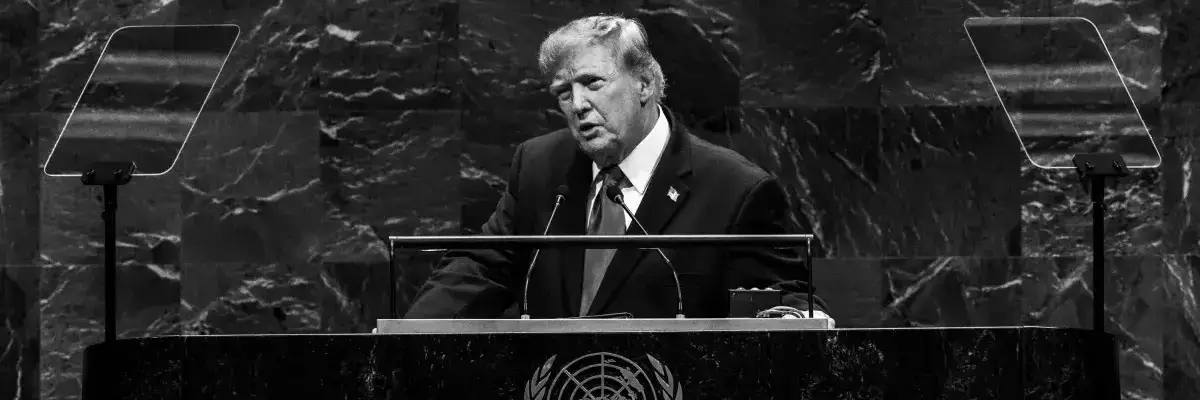
President Donald Trump speaks to the United Nations General Assembly, Tuesday, Sept. 22, 2026, at the UN headquarters. [AP Photo/Julia Demaree Nikhinson]
US President Donald Trump told the United Nations General Assembly on Tuesday that he is deciding whether to “annihilate the Islamic Republic” of Iran and “drive them into hell with no chance of survival.”
The American president asked: “Do I annihilate the Islamic Republic and do it quickly, never giving them a chance to kill and destroy people and countries again?”
Trump’s murderous language marks a new stage in the criminalization of imperialist foreign policy amid the eruption of global war. It is without precedent in modern politics outside the discourse of Adolf Hitler’s regime, which waged a Vernichtungskrieg, a war of annihilation, against the Soviet Union.
Unlike Trump, however, Hitler did not announce his war of extermination in public. He gave the order in private, to his generals. On March 30, 1941, in a closed meeting with some 200 senior officers, he told them the coming invasion would be a Vernichtungskampf, “a war of extermination,” according to the diary of his army chief of staff, Franz Halder.
The extermination of the population of Iran, which has resisted Trump’s efforts to subjugate the country through war, is in fact being actively discussed at the White House. The journalist Seymour Hersh reported on June 10 that Trump had raised using nuclear weapons against Iran, a country of 93 million people, in a secret meeting with his senior staff.
Trump’s criminal war of aggression against Iran had killed at least 3,468 people and wounded more than 26,500 by June 10, according to Iran’s Health Ministry. Last week, a UN fact-finding mission found “reasonable grounds to believe that the United States committed war crimes,” citing the US missile attack on February 28 on an elementary school in Minab that killed more than 150 people, 120 of them children.
The war against Iran is one component of the US-Israeli onslaught throughout the Middle East, whose highest expression is the genocide in Gaza, which has killed 73,919 Palestinians, according to Gaza’s Health Ministry.
The threat against Iran was one item in a series. Trump boasted that the US military had penetrated “deep into the Venezuelan capital” and “arrested” Maduro, and that the reward was “the largest oil deal in history,” 65 billion barrels. “To the victor belong the spoils,” Trump declared. Cuba “is an absolutely failed state … and it will fall.” Greenland is to pass under the “permanent control” of the United States, with two “very major military bases.”
During Trump’s speech, only the delegations of Iran and Cuba, whose government Trump threatened to overthrow, left the hall in protest. The representatives of the European imperialist powers, for all their constant talk of democracy and human rights, sat there and did nothing. Khalilur Rahman, the Bangladeshi foreign minister who presides over the Assembly, thanked the American president.
The UN Charter was signed in San Francisco on June 26, 1945, seven weeks after the surrender of Nazi Germany, “to save succeeding generations from the scourge of war, which twice in our lifetime has brought untold sorrow to mankind.”
Its Article 2 binds every member to “refrain in their international relations from the threat or use of force against the territorial integrity or political independence of any state.” Trump’s speech was such a threat, made in the building constructed to outlaw it by the leader of a state almost seven months into an illegal war of aggression. Trump’s speech itself is indictable as a violation of international law.
The European counterpoint to Trump was given Tuesday by French President Emmanuel Macron, who spoke of “the return of imperialism, of arrogance, the return of unrestrained force which knows no rules … A world in which some believe that they can undermine the international order so as to push their borders outwards.”
He added, “War crimes have been industrialized. We’ve seen the destruction of civilian infrastructure, human rights violations.”
But while some commentators took his remarks as a veiled critique of Trump, he never named the American president. Rather, his speech was a vocal and explicit denunciation of Russia and a declaration of intent to continue, alongside Trump, to fund and arm Ukraine.
Macron declared that “Russia has been waging a cruel war on civilians. It’s been occupying the territory of a sovereign state. France will continue providing unstinting support” for Ukraine in its war against Russia.
In Macron’s view, the appropriate response to Russia’s “imperialism” and “war crimes” is for the European imperialist powers to intensify their war against Russia. Macron made no effort to square his claims that the war against Russia is a war for democracy with the fact that Trump, his ally in that war, had just threatened to exterminate the population of an entire country.
In 1920 Lenin described the League of Nations, the UN’s predecessor, as “a league of mad dogs who are snatching each other’s bones.” The phrase is perhaps somewhat quaint. The UN General Assembly of 2026 is an active planning center for war.
After meeting Ukrainian President Volodymyr Zelensky the same day, Macron announced a contract to supply Ukraine with radars and air-defense missiles, the Kyiv Independent reported Tuesday. Trump, for his part, also met Zelensky on Tuesday and confirmed that the manufacture of Patriot air-defense missiles in Ukraine was under discussion.
As the Trump-Zelensky meeting opened, a British reporter told Trump that “a lot of people in the UK are very worried about the mood music from the UK and other European leaders about the inevitability of direct conflict between us and Russia,” and asked: “Can you stop that happening?” Trump refused to give a serious answer.
In fact, Trump’s blood-curdling threats against Iran, and the fact that they provoked no serious protest among the leaders of the imperialist powers, demonstrate the extent to which global war, and its corollary, the extermination of entire populations, has been normalized by world capitalism.
The Democrats are not an alternative to this warmongering. Just days earlier, they had given Trump a blank check to escalate the war not only against Russia but against Iran. On September 16, 58 House Democrats voted for the Lindsey O. Graham Sanctioning Russia and Iran Act, which authorizes the president to tax imports from China, India and the other largest purchasers of Russian oil at rates as high as 100 percent and extends for five years the sanctions on Iran’s energy and arms sectors. Thirty-six of the 45 Senate Democrats had voted for it on August 7.
House Minority Leader Hakeem Jeffries voted no because, he said, the bill did not go far enough against Russia: “You have to confront the bully, not appease the bully.” A Democratic majority in Congress after November 3 would take the war further and faster.
The day before his speech, Trump met New York Mayor Zohran Mamdani, a member of the Democratic Socialists of America (DSA), at Gracie Mansion. Mamdani said nothing about the war and told reporters: “We appreciate the president’s commitment to the city.”
Trump began his speech by boasting of “the golden age of America,” declaring, “The entire world is being lifted by the wealth, strength, spirit, and momentum of a newly energized and a very powerful United States of America.”
In fact, Trump presides over a social order and political system that is rotting on its feet—what Trotsky described on the eve of World War II as “the death agony of capitalism.” The same crisis is producing its opposite: the growth of social opposition, mass protests and global class struggle.
The opposition to Trump’s criminal warmongering will come neither from the European imperialist powers nor from the Democrats and their accomplices in the DSA. It will come from the international working class, armed with the program of international socialism.
The Arab states have long suffered from weak political legitimacy and ineffective governance. Authoritarian rule remains pervasive. According to Freedom House, no Arab country is currently classified as “Free,” while Jordan, Lebanon, and Comoros are rated “Partly Free.” Kuwait, following the suspension of its elected parliament in 2024, is now classified as “Not Free.”
The Arab world’s contribution to global scientific and technological development also remains below its potential. Although UNESCO reports that scientific publications from Arab states increased by 64 percent between 2015 and 2019, research-and-development spending remains comparatively low, and much of the region continues to depend heavily on imported technology.
These political and developmental weaknesses cannot be explained by domestic authoritarianism alone. External powers have profoundly shaped state-society relations in the Middle East.
Colonialism, military intervention, foreign-sponsored coups, economic dependence, and patron-client security relationships have influenced both the distribution of political power and the capacity of states to pursue independent national development.
The Persian Gulf monarchies’ longstanding military dependence on the United States represents
perhaps the clearest contemporary example.
From the Sykes-Picot Agreement and Balfour Declaration through the Cold War and the Arab-Israeli wars, outside powers repeatedly shaped the regional order. After the 1990–91 Persian Gulf War, the expansion of American military bases further institutionalized the security relationship between Washington and the Gulf Cooperation Council states.
The post-Cold War period did not bring an end to external military intervention. The United States has intervened militarily in Iraq, Libya, Syria, Somalia and Yemen, among other countries, while Israel has repeatedly conducted major military operations in Lebanon and Gaza. The Military Intervention Project at Tufts University identifies almost 400 U.S. military interventions since 1776, with more than one-quarter occurring after the end of the Cold War.
The Iran War Changes the Equation
The ongoing U.S.-Israeli war against Iran exposes the limitations of the regional security system more dramatically than previous conflicts.
For decades, Washington’s Arab allies relied on American military superiority as the ultimate guarantee against external threats. Iran’s ability during the present war to impose substantial costs on American military installations has complicated that assumption.
A recent Pentagon inspector-general assessment found that Iranian strikes damaged or destroyed hundreds of structures at U.S. facilities across the Middle East and destroyed numerous American aircraft and drones. Meanwhile, the Congressional Budget Office estimated that direct
U.S. Defense Department costs had already exceeded $38 billion by August 2026, with potentially billions more being spent each month if the conflict continues.
The lesson for the Persian Gulf Arab states is not that Iran poses no threat. Tehran has supported armed non-state organizations, including Hezbollah, Hamas, and the Houthis, and Arab governments have legitimate concerns about Iranian power and regional ambitions.
But treating Iran exclusively as an enemy has not produced regional security either.
Iran is a large state of roughly 90 million people occupying one side of the Persian Gulf and possessing substantial military capabilities, energy resources, and geopolitical influence. No durable Persian Gulf security system can simply exclude it.
The war therefore creates an opportunity for the Gulf Arab states to reconsider their overwhelming security dependence on the United States and move toward a regional system in which neighboring states assume greater responsibility for their own collective security.
There are already signs of movement in this direction. At the 166th ministerial session of theArab League Council in September 2026, Egyptian Foreign Minister Badr Abdelatty called for comprehensive Arab security arrangements involving greater defense coordination, crisis-response mechanisms, and implementation procedures. He proposed building on the 1950 Arab Treaty of Joint Defence while respecting the sovereignty of individual Arab states.
That proposal is important. But an exclusively Arab security architecture is insufficient.
From Arab Security to Regional Security
What the Persian Gulf ultimately requires is a regional, rather than merely Arab, security arrangement incorporating both the Gulf Cooperation Council states and Iran.
There are precedents for adversarial states negotiating institutional frameworks around shared interests. In August 2018, after two decades of negotiations, Azerbaijan, Iran, Kazakhstan, Russia, and Turkmenistan signed the Convention on the Legal Status of the Caspian Sea. The agreement did not resolve every dispute among the five governments, but it demonstrated that states with conflicting interests could nevertheless construct rules governing security, sovereignty, resources, and economic cooperation.
The same logic should apply to the Persian Gulf.
The GCC states and Iran share an overwhelming interest in avoiding perpetual warfare. China, Russia, India, Pakistan, Europe, and the United States likewise have enormous stakes in the stability of Gulf energy production and international shipping.
The institutional challenge is therefore to transform these overlapping interests into a security framework capable of restraining individual states—including Iran—from threatening their neighbors while simultaneously reducing incentives for external military domination.
In a 2013 study coauthored with Stephen Hill, I proposed a three-tiered diplomatic approach toward U.S.-Iranian rapprochement and the eventual establishment of a Persian Gulf Security Alliance (PGSA). The basic logic of that proposal remains relevant.
A PGSA could bring together Iran, the GCC states, and the United States around common security interests. China, Russia, India, and Pakistan could participate in negotiated roles as well. Their inclusion would help prevent such an organization from becoming—or being perceived as—another Western military alliance directed against Iran, China, or Russia.
Such an arrangement would not require Gulf states to trust Iran, nor Iran to trust the United States. Successful security institutions rarely begin with trust. They create procedures through which states possessing competing interests can communicate, negotiate, monitor commitments, and gradually reduce the danger of miscalculation.
The Persian Gulf at a Crossroads
The strategic environment of West Asia has changed dramatically since October 2023 and even more sharply since the outbreak of direct warfare involving Iran.
Iran cannot realistically be removed from the regional balance of power. Tehran considers recognition of its sovereignty, its civilian nuclear program, its missile capabilities, and an end to what it views as a continuing American-Western policy of coercion to be fundamental national-security issues. Washington and the Arab Gulf states, meanwhile, have their own security concerns about Iran that any negotiated regional architecture would have to address.
A regional security organization would also serve American interests. As Washington increasingly focuses strategic resources on competition with China and Russia, participation in an inclusive Persian Gulf arrangement could preserve an American role in regional security without requiring perpetual military primacy or exclusive reliance on bilateral patron-client relationships.
For the Arab Gulf states, the stakes are even greater.
They face the difficult transition from oil-dependent rentier economies, pressures for more responsive governance, dependence on foreign labor, limited domestic industrial and agricultural capacity, rapidly growing technological demands, and the transformative—and still uncertain—effects of artificial intelligence.
Perpetual regional warfare makes confronting these challenges vastly more difficult.
The current war should therefore be understood not simply as another episode in the long confrontation between Iran, Israel, and the United States. It should force a larger reconsideration of the political and security architecture of the Persian Gulf.
For decades, Gulf security has rested primarily on American military power and bilateral protection arrangements. The present conflict demonstrates the vulnerabilities of that system.
The alternative is neither Iranian domination nor American withdrawal. It is the gradual construction of a regional security framework in which Arab states, Iran, and major international stakeholders accept institutional restraints and recognize that their long-term security is ultimately interdependent.
The Persian Gulf states are at a crossroads. Another generation of militarization, intervention, and regional confrontation is possible. But so is a different security order built around diplomacy, regional responsibility, and negotiated coexistence.
The latter will be difficult to construct.
The alternative may prove considerably more costly.
Subscribe
Editor’s Note: At a moment when the once vaunted model of responsible journalism is overwhelmingly the play thing of self-serving billionaires and their corporate scribes, alternatives of integrity are desperately needed, and ScheerPost is one of them. Please support our independent journalism by contributing to our online donation platform, Network for Good, or send a check to our new PO Box. We can’t thank you enough, and promise to keep bringing you this kind of vital news.
Published date: 17 September 2026 19:31 BST | Last update:14 hours 29 mins ago
The United Nations has “reasonable grounds” to believe the US committed a war crime with its strikes on the Minab elementary school and a sports centre in the opening days of the US-Israeli war on Iran.
The US attack on the Minab school killed at least 150 people, including approximately 120 children. Another strike hit a “clearly identifiable sports complex and residential area” in the southern Iranian city of Lamerd.
“The Mission found reasonable grounds to believe the United States committed the war crime of launching indiscriminate attacks resulting in the loss of life or injury to civilians or damage to civilian objects,” a UN fact-finding mission wrote in a report released on Thursday.
The report is not a judicial ruling, but has been submitted to the UN Human Rights Council in Geneva.
The UN investigators noted that the Minab school was struck by a Tomahawk missile as part of ongoing strikes on an adjacent Islamic Revolutionary Guard Corps base. The researchers noted that the strike was not due to an errant missile.
New MEE newsletter: Jerusalem Dispatch
Sign up to get the latest insights and analysis on Israel-Palestine, alongside Turkey Unpacked and other MEE newsletters
“The nearest IRGC facility [was] located approximately 72 metres from the school building,” the authors said.
“The Mission concludes that the building of the school was the intended point of impact and that the damage did not result from an errant strike or collateral damage from the attack on the adjacent IRGC compound,” the report said.
The New York Times reported that officers at US Central Command had created the target coordinates for the strike using outdated data provided by the US Defense Intelligence Agency, citing people briefed on the investigation.
Exclusive: Iranian girls killed by ‘double-tap’ strikes on Minab school
The US investigators probing the attack said the US military was most likely responsible for the strike, but the Trump administration has deflected any responsibility.
The UN fact-finders said another US strike hit a “clearly identifiable sports complex and residential area” in the southern Iranian city of Lamerd.
The New York Times revealed in March that the US used a previously untested ballistic missile in combat to attack the sports hall. The Precision Strike Missile, or PrSM, detonates just above its target, launching thousands of tungsten pellets.
“The Mission concluded that the US by choosing to use the PrSM missile in a populated civilian area, under the prevailing circumstances, launched an attack that struck civilians and civilian objects reckless as to the likely extent of death or injury,” UN fact-finders said.
The UN said that the US’s attacks were “indiscriminate” and violated “the principle of distinction” in international humanitarian law.
The report noted that the US used a weapons system that distributed approximately 180,000 tungsten pellets in an area with many civilians. The attack “could not be directed at a specific military objective and its effects on civilian and civilian objects could not be limited,” the UN researchers said.
The Trump administration is planning to move forward with a massive military aid package for Israel that will include 40,000 2,000-pound bombs, The Washington Post reported on Tuesday, as the US continues to support Israel’s genocidal campaign in Gaza and its wars and occupations in the West Bank, Lebanon, and Syria.
The report said the sale, paid for with US taxpayer dollars, will include 20,000 MK-84s and 20,000 BLU-117s, each weighing 2,000 pounds. It will be funded by the State Department’s Foreign Military Finance program, under which the US provides foreign governments money to purchase US weapons.
Tucker Carlson first reported the massive transfer in a post on X minutes before the Post published the report.
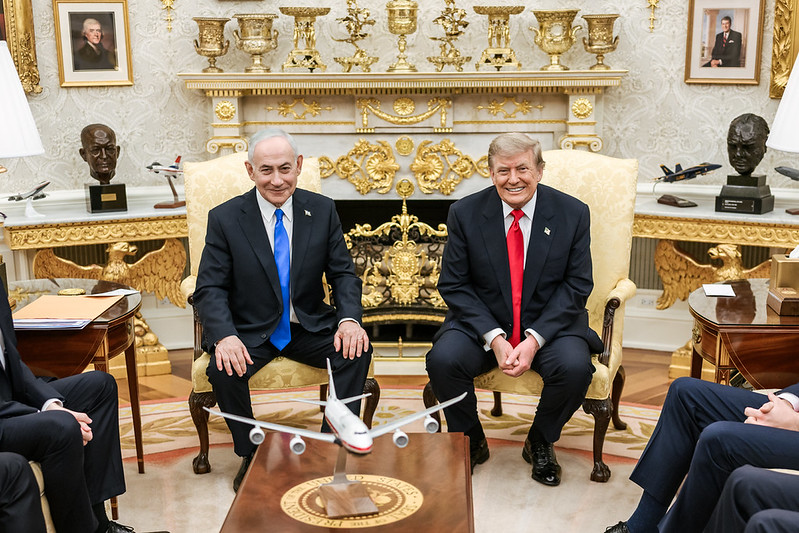
President Trump and Israeli Prime Minister Benjamin Netanyahu at the White House on July 28, 2026 (White House photo)
“An American-made Mark 84 has a destruction radius of half a mile. It releases a thermal wave the temperature of the surface of the sun. Within 100 feet of the explosion, rock melts and human flesh turns to vapor,” Carlson said.
“The bomb collapses apartment buildings and leaves craters thirty-five feet deep. Until the war with Iran, the US military generally avoided using the Mark 84 in urban areas. It kills too many civilians,” he added. A recent US strike in southern Iran that hit a house hosting a wedding, killing at least five civilians, was likely carried out with an MK-84, according to an investigation from The New York Times.
Carlson noted Israel’s extensive use of 2,000-pound bombs in Gaza. “In the weeks after October 7, the IDF dropped nearly six hundred 2,000-pound bombs on densely populated areas in Gaza, including on more than 100 officially designated civilian evacuation zones. The slaughter was so grotesque and embarrassing that for a moment the Biden administration paused a shipment of Mark 84s. Those shipments quickly resumed under Trump. Now they’ve accelerated,” he said.
According to Carlson, the Israeli request for the massive bomb shipment “originated at the US Embassy in Jerusalem, which is run by Christian Zionist Ambassador Mike Huckabee and his aide David Milstein, who is the stepson of Fox News host Mark Levin.” He said it was quickly approved by Secretary of State Marco Rubio and now needs the approval of Senate leaders, though the Trump administration has previously bypassed the normal congressional review process to arm Israel with 2,000-pound bombs.
To examine the unyielding multi-billionaire dollar shield that the United States provides Israel is to confront the coarse mechanics of modern empire.
Washington has, for decades, maintained a posture of absolute defense, supplying advanced weaponry, providing diplomatic immunity, and rationalizing actions that human rights organizations and international courts characterize as war crimes, apartheid and genocide.
The mainstream narrative has relentlessly framed the U.S.-Israel alliance through the comforting lens of shared democratic values and mutual defense. This rendering, however, crumbles under the weight of reality. Nothing has dissuaded Washington from its entente with and acquiescence to Israel – not the regime’s racist policies; not even genocide.
Every U.S. administration has backed its brutal regimes, because they have buttressed American power and interests in the Middle East. This fatal alignment evokes the question: what exactly is Israel’s role, and whose interests are being served?
Israel has long functioned as an imperial agent for Western powers seeking regional dominance. Initially, the British Empire was crucial in helping its Zionist proxies secure a foothold in Palestine during and after World War I. In the mid-20th century, the United States seized the geopolitical mantle from Britain, taking control of the resource-rich region and becoming Israel’s primary benefactor.
Since the 1950s, Washington has viewed the Middle East – a vital nexus of global energy routes, trade corridors and geopolitical leverage – through the lens of dominance and resource control.
Lacking permanent colonial possessions in the heart of the Islamic world, Washington engineered an alternative: a heavily subsidized, fortified and technologically advanced military outpost. For the Pentagon and State Department, Israel has functioned as an unsinkable aircraft carrier; a military stronghold to project force, suppress independent anti-colonial movements, and to act as a counterweight to Iranian regional influence.
The Washington-Tel Aviv partnership is reinforced by the military-industrial economy of the United States that thrives on perpetual conflict to drive demand.
Defense spending fuels the domestic economy. The billions in military aid funneled to Israel are, in practice, massive subsidies paid directly to U.S defense conglomerates like Lockheed Martin, Boeing, Raytheon and Northrop Grumman. U.S.-Israeli wars have contributed substantially to the financial survival of these industries.
Occupied Gaza and the West Bank have long served as testing laboratories for advanced weaponry, surveillance technology and crowd-control systems.
Surveillance and weapons systems that have been battle-tested on captive civilian populations are subsequently marketed globally as “combat proven.”
This multi-billion-dollar defense network closely connects the interests of the U.S. military sector with the continuation of Israel’s military operations. It also ensures fierce bipartisan resistance in Washington to any meaningful arms embargo or policy shifts, since almost every congressional district in the country is tied in some way to the defense industry.
American politicians aggressively safeguard Israeli “exceptionalism” and fiercely buffer it from accountability. Robust networks of well-financed lobbying groups, political action committees and institutional gatekeepers ensure that unwavering support for Israel is a requisite for political survival in Washington.
When elected officials dissent from established foreign policy positions or condemn the slaughter of civilians, they become the targets of well-funded, organized efforts to end their political careers. As a result, domestic priorities are sidelined as Congress aligns itself with a powerful military lobby rather than the American public; a growing majority of whom oppose unconditional foreign military aid.
At its core, the relationship between Israel and the United States is rooted in a shared historical consciousness and legacy. Both countries developed as settler-colonial states built upon the systemic erasure, confinement and dispossession of native populations.
Allegations of apartheid, genocidal violence, and systemic racism leveled against Israel deeply resonate within the American political landscape, mirroring its own foundational legacy.
U.S. policymakers connect Israel’s regional supremacy directly to the preservation of Western influence and global dominance. Racism is not a mistake in the alliance; it is a core function. It ensures that non-Western, non-white casualties are viewed as dispensable; essentially acceptable “collateral damage” in the pursuit of geopolitical objectives.
America’s alignment with Israel is a product of strategic utility, not moral blindness. Washington’s defense of Tel Aviv’s brutal policies exposes the vacuity of Western rhetoric around human rights, international law and democracy. When imperial power, corporate profit and geopolitical dominance are threatened, universal human rights are treated as entirely disposable.
The “indispensable ally” narrative is foundering, as is the U.S. imperium. Israel’s U.S.-subsidized genocide and devastating wars on Gaza, the West Bank, Lebanon and Iran have sparked intense global outrage and blowback, signaling the beginning of the end of American global dominance.
History will record that when major powers rely on the blunt instrument of war to “manage” a complex world – rather than to live in it as one among equals – they ultimately subvert the stability they claim to protect.
Dr. Behnam is a political scientist who specializes in comparative politics with a focus on West Asia. His “Cultural Foundations of Iranian Politics,” published by University of Utah Press, and still in print, was recognized by Choice as Outstanding Academic Book for 1987–1988.
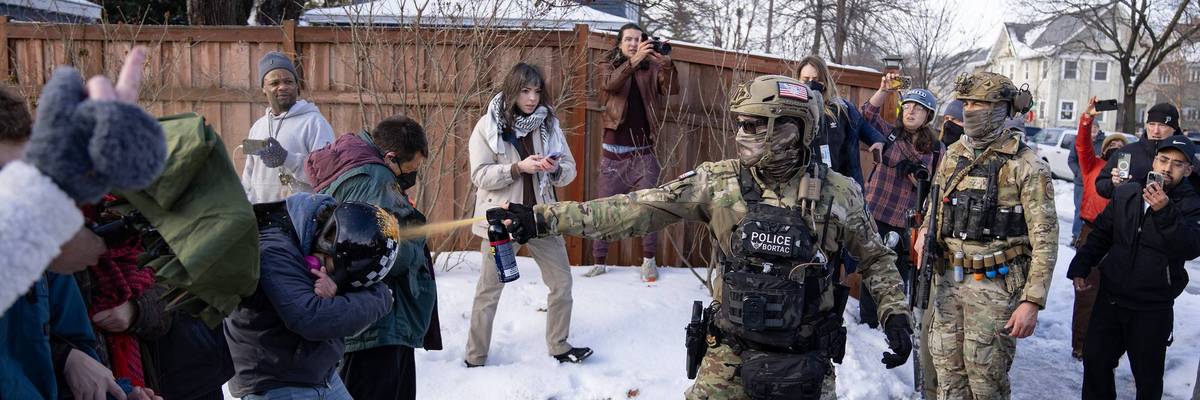
A Border Patrol Tactical Unit agent sprays pepper spray into the face of a protester attempting to block an immigration officer vehicle from leaving the scene where a woman was shot and killed by a federal agent earlier, in Minneapolis, Minnesota on Wednesday, January 7, 2026.
(Photo by Alex Kormann/The Minnesota Star Tribune via Getty Images)
The so-called “War on Terror” has revealed itself to be a war OF terror, one that is being waged by our own government on foreign soil as well as here in the United States.
On September 11, 2001, the world watched as the World Trade Center, the twin towers that represented US global dominance, were struck by hijacked US commercial jetliners and came crashing to the ground. Nearly 3,000 people were killed, from high-powered executive to clerical workers and immigrant kitchen workers. The hijackers were Middle Eastern men, primarily from Saudi Arabia.
Twenty-five years later, many questions remain about how the US military and security establishment could have allowed this to happen. Hardly anybody believes the official 9/11 story, which raises more questions than it answers, and there are many competing theories about who was behind this tragedy. Was this an incredible US security lapse or a highly coordinated false flag? Whatever the case, the neocons in George W. Bush’s administration immediately declared a “war on terrorism,” and put into motion their longstanding designs to conquer seven Muslim countries in the Middle East (as revealed by General Wesley Clark)—Iraq, Syria, Lebanon, Libya, Iran, Somalia, and Sudan. Over the last 25 years, the US has initiated wars against all of these countries, as well as Afghanistan.
US administrations under Presidents George W. Bush, Donald Trump, Barack Obama, and Donald Trump (again) are responsible for creating a hell on Earth throughout the Middle East, resulting in millions of deaths and millions more homeless refugees. Thousands of US soldiers also died in Iraq and Afghanistan, any thousands more carry the physical, mental, and spiritual wounds to this day.
These nations may never fully recover, but Iran still stands. It may be the only Middle Eastern country still strong enough to resist domination by Israel, the US, and the former European colonial powers. That is why it is being frantically targeted by militarists in Israel and the US And that is why the US peace movement must do all we can to end the escalating US on Iran.
Who Are the Real Terrorists?
Under the slogan of “the war on terror,” the US government has carried out an increasing campaign of terror worldwide and against its own people. Torture has been normalized as represented by the extralegal Guantánamo torture prison on occupied Cuban land. The US and NATO provoked Russia into a catastrophic war in Ukraine which they continue to fuel with billions of dollars, arms, and military advisers. Democratic and Republican administrations and Congresses have enabled an ongoing Israeli genocide in Gaza and the West Bank. In January of this year, the US made a brazen attack on Venezuela, kidnapped its president and first lady, and are holding the Venezuelan government hostage while they steal Venezuelan oil. The US has blocked all oil shipments to Cuba, greatly exacerbating the damage done by the 64-year-old US blockade of Cuba, even as they threaten to invade. President Trump and “Secretary of War” Pete Hegseth post “snuff videos” of their blatantly illegal bombing of boats in South American waters, where they have murdered hundreds of fisherman and alleged “narco-terrorists” without any evidence or judicial proceeding.
Trump’s War of Terror Comes Home
The stepped-up US aggression abroad is now being mirrored by state-sponsored terror in these United States. Armed gangs of Immigration and Customs Enforcement (ICE) agents routinely carry out racist attacks on immigrant communities and people of color, no matter their immigration or citizenship status. The mass incarceration of Black men is now matched by mass incarceration of brown men, women, and children in for-profit prisons, where abusive conditions have led to many deaths. White supremacism is out in the open as cruel fascist practices are being normalized. US peace activists and immigrant rights activists are being labeled as terrorists and prosecuted as terrorists for nonviolent resistance to the terror of the state.
Even as the US war on Iran continues and escalates, the Trump administration and Republican Party are openly seeking to undermine the midterm US elections by blatant last-minute gerrymandering of congressional districts, by trying to prevent mail-in voting, by reducing the number of polling places, by threatening to deploy intimidating ICE agents at polling places and even “joking” about canceling the elections altogether. Veterans For Peace has joined with other veterans’ groups and military families in the Veteran Against Fascism coalition to do all we can to defend the elections, for example by providing safe accompaniment to the polls.
The Terror of Nuclear War
Adding to the atmosphere of global terror is the ever-growing threat of nuclear war. Multiple sources have confirmed that the Trump administration has been discussing the possible use of tactical nuclear weapons in its war on Iran. Pentagon war-gaming of the US use of tactical nuclear weapons has consistently resulted in global nuclear war that leads to a nuclear winter in which billions of people would starve to death—those that survived the initial nuclear blasts and radiation illnesses. Seventy-five countries have ratified the UN Treaty on the Prohibition of Nuclear Weapons, which outlaws possessing sharing, transporting, using, or threatening to use nuclear weapons. Nonetheless, the Trump administration has ditched the last remaining nuclear arms treaty with Russia, while it carries out a series of wars that—if not checked—will inevitably lead to nuclear war. In fact, the US is actively planning to wage a war against China that would start with a US nuclear first strike on China. These policies only lead more countries to seek nuclear weapons, directly the opposite of the stated US policy and treaty obligations to seek nuclear non-proliferation and good-faith negotiations to eliminate all nuclear weapons.
The so-called “War on Terror” has revealed itself to be a war OF terror, one that is being waged by our own government on foreign soil as well as here in the United States. On the 25th anniversary of 9/11, we must rededicate ourselves to resisting US wars at home and abroad.
It’s been nearly 30 years since I co-founded Common Dreams with my late wife, Lina Newhouser. We had the radical notion that journalism should serve the public good, not corporate profits.
It was clear to us from the outset what it would take to build such a project. No paid advertisements. No corporate sponsors. No millionaire publisher telling us what to think or do.
Many people said we wouldn’t last a year, but we proved those doubters wrong.
Together with a tremendous team of journalists and dedicated staff, we built an independent media outlet free from the constraints of profits and corporate control. Our mission has always been simple: To inform. To inspire. To ignite change for the common good.
Building Common Dreams was not easy. Our survival was never guaranteed. When you take on the most powerful forces—Wall Street greed, fossil fuel industry destruction, Big Tech lobbyists, and uber-rich oligarchs who have spent billions upon billions rigging the economy and democracy in their favor—the only bulwark you have is supporters who believe in your work.
But here’s the urgent message from me today. It’s never been this bad out there. And it’s never been this hard to keep us going. At the very moment Common Dreams is most needed, the threats we face are intensifying. We need your support now more than ever.
We don’t accept corporate advertising and never will. We don’t have a paywall because we don’t think people should be blocked from critical news based on their ability to pay. Everything we do is funded by the donations of readers like you.
When everyone does the little they can afford, we are strong. But if that support retreats or dries up, so do we.
Will you donate now to make sure Common Dreams not only survives but thrives?
—Craig Brown, Co-founder
about:blank
about:blank
Our work is licensed under Creative Commons (CC BY-NC-ND 3.0). Feel free to republish and share widely.
The attacks of September 2001 became the pretext for a new era of US-led intervention. Twenty-five years on, millions are dead and the promised ‘victories’ remain nowhere to be seen, says ANDREW MURRAY
Crowds in Manhattan watch smoke billowing from the World Trade Centre, September 11 2001
THE “war on terror” began 25 years ago today, when two hijacked passenger airliners were flown into the skyscrapers of the World Trade Centre in New York.
A third crashed into the Pentagon in Washington while a fourth, apparently targeting the US capitol, crashed in Pennsylvania after its passengers fought back.
It was immediately assumed that the hijackers — nearly all of them Saudi Arabian by nationality — were organised by al-Qaida, an Islamist militant group then headquartered in Afghanistan. Despite many subsequent conspiracy theories, it would seem that this was indeed the case.
Al-Qaida attributed their actions — which killed nearly 3,000 people, almost all civilian, in the first foreign attack on the US mainland since 1812 — to opposition to Israel’s US-supported oppression of the Palestinians, to the presence of US troops in the holy land of Saudi Arabia, and the sanctions-driven starvation of Iraqi children.
9/11 was thus an act of terror already sitting in a continuum of US-driven violence and oppression across the Middle East — an explanation but not a justification.
It was immediately clear that the attacks would be the basis for a further aggressive extension of US war, across the Middle East and south Asia in particular.
In fact, it led to a devastating series of wars which caused the effective collapse of several states, millions of deaths and millions more made refugees. Afghanistan, Iraq, Libya, Syria and Yemen have been the principal victims of this war, which has also extended to parts of Africa and, in its impact and influence, most of the world.
Some of these wars had not the slightest connection to terrorism or al-Qaida and — in particular the Bush attack on Iraq — had been meditated long before 9/11.
The “war on terror” began with boasts of military omnipotence from Washington, along with brazen calls for the introduction of a new colonialism to deal with “failed states.” But nowhere has it ended with an outcome anything like that sought by the aggressors.
Most notoriously, the first theatre of war — Afghanistan — began with the ousting of the Taliban government in 2001 and ended with the return of the self-same regime 20 years, uncounted lives and massive destruction later.
However rightly it can be felt that the people of Afghanistan deserve a much better government, it cannot be denied that this outcome marked a historic defeat for US imperialism.
It scarcely fared better in Iraq, where the overthrow of Saddam Hussein led to a brutal occupation, sectarian civil conflict, economic despoliation and the wrecking of a state which George Bush had fancied turning into a “beacon of democracy.”
The occupation there was wound down in more-or-less ignominy — total in the case of the British forces deployed in Basra, driven out in humiliation.
Libya, the third major target, was turned into a failed state, split between rival governments and generating an immense refugee crisis, as a result of a Nato-sponsored intervention.
In Syria, Western interference in civil war not only sparked a massive refugee crisis but the rise of Isis and the eventual ascension of a jihadi-rooted government in Damascus.
Yemen, one of the world’s poorest countries, has been further degraded by a conflict to a large extent armed and directed from Britain, working alongside Gulf dictatorships. Yet the Houthis remain still standing and defiant.
The “war on terror” also spread further afield, to both west and east Africa in particular, with no better results for either the peoples there or the plans of the imperialists.
The full balance sheet for these wars remains yet to be calculated, but it does not seem to yield a single victory of the US and its allies, Britain first among them. The present war against Iran is a linear descendant of these conflicts, and does not look like changing that record.
Despite numerous contingent and specific factors, all these wars are rooted in the structuring of a world around US hegemony, in which Washington arrogates to itself the right to intervene where it wills in order to ensure subordination to its own strategic and commercial interests.
They are thus the main contemporary political expression of imperialism.
9/11 and these subsequent conflicts had the political consequence of restoring the concept of imperialism to the centre of public discourse.
After a generation in which it had been relegated to jargon as the world wallowed in the post-cold war “end of history,” the wars of aggression launched by the US, with British governments invariably at its side, whatever the views of the people, shone an unforgiving light on the realities of global power.
Imperialism has generally taken some care to present its depredations as being motivated by the most high-minded interests.
In the 19th century, colonial adventures were usually promoted as expediting the spread of Christian civilisation to peoples who had the audacity to get along without it.
In the 20th century, a more secular age, interventions were often explained as being necessary to stop the spread of communism, notwithstanding that communism, for all its global potency, was often entirely absent from the territories concerned.
In the present century the “war against terror” has stood duty, the first conflict even declared as being against an abstraction rather than a country or peoples.
This war elided with the developing notion of “liberal” or “humanitarian” intervention, which had been trialled, to its progenitors’ satisfaction, in the 1999 war against Yugoslavia.
It was ideologically amplified by Tony Blair, then still fairly popular, who went to Chicago to spell out the conditions in which great powers, or those with the approved political markers, could and should intervene in other countries’ affairs.
He spelt out five criteria. International law or United Nations approval were not among them, and the wars to follow did not meet all of them in any case. Blair’s political reputation is now collateral damage following his decision to lead Britain into the Iraq aggression alongside George Bush.
That decision, above all, gave rise to the largest anti-war movement in Britain’s history, indeed probably the strongest mass movement of the left since the high days of Chartism in the 1840s.
Its effects resonate to this day, not least in the enduring movement of solidarity with the Palestinian people.
At its core lay an alliance of most of the socialist left with Muslim communities, alongside trade unions, the mass of young people and sections, like military families, never previously drawn into mass anti-war campaigning.
That coalition was described by the New York Times as the “second superpower” in the world, at the time when the US believed itself to be effectively unchallengeable.
The movement also laid much of the foundation for Jeremy Corbyn’s ascension to the Labour Party leadership in 2015, something that was certainly not on Blair or Bush’s agenda when they embarked on their policy of open-ended war.
These developments have placed anti-imperialism at the heart of socialist politics in Britain, to the teeth-grinding rage of those savants and organs of the soi-disant left who embrace the international politics of the ruling class even as they pretend to a domestic radicalism.
9/11 also had more negative impacts in Britain — it led to a rising tide of Islamophobia, now reaching epidemic proportions, as well as occasioning one attack after another on our liberties, exemplified in the harassment of the Palestine solidarity movement and the mass arrests of peaceful sympathisers with Palestine Action.
Today, the “war on terror” has faded somewhat behind the darkening shadow of great power conflict. With the rise of China, it is clear that the US is no longer the sole superpower.
The proxy war being waged by Nato in Ukraine is the harbinger of still more devastating conflicts, as the anti-war movement warned from 9/11 onwards.
Today, 9/11 is best marked by the renewal of the anti-war movement in the face of impending neofascism and war, by the re-establishment of its broad fighting unity, and by absorbing the greatest single lesson of those terrible events a quarter of a century ago — that there can never be peace alongside imperialism.
Andrew Murray was the first chair of the Stop the War Coalition, serving from 2001 to 2011, and is now its deputy president
“We won,” President Donald Trump declared in March, less than two weeks after launching his war of choice against Iran. Claiming that nation was “very much destroyed and, even, obliterated,” Trump had already promised the conflict would bring peace to the region and, somehow, the globe. “The heavy and pinpoint bombing … will continue, uninterrupted … as long as necessary to achieve our objective of PEACE THROUGHOUT THE MIDDLE EAST AND, INDEED, THE WORLD!” Trump wrote. But more than six months and two failed ceasefires later, the floundering conflict sputters along. And you may have noticed that world peace has yet to be announced.
Having again been bested in battle — the latest loss in a long-running series of meaningless victories (like over lowly Grenada), stalemates (like the forever war in Somalia), and defeats (like conflicts in Vietnam, Laos, and Cambodia) — the U.S. military has slunk away from the fight in favor of an “economic D-Day” that so far seems to be little more than bluster.
Trump’s other stated war aims, like Iran’s unconditional surrender and seizing its oil infrastructure, have also fallen by the wayside. In the end, the major accomplishments of Trump’s war seem to be limited to death and destruction: hundreds of U.S. casualties that the Pentagon has sought to downplay and cover-up, and thousands of Iranian deaths that the Pentagon is loath to mention or investigate, including a family of eight — five of them children, one a 20-day-old infant.
But the almost 40,000 Iranians killed or wounded in the war may only scratch the surface of the true toll, as Ashley Gate writes in her latest piece for TomDispatch. The rough outlines of the ecological devastation are only just coming to light. And if history is any guide, the environmental fallout of the war may reach far into the future, affecting untold numbers of Iranians who survived the conflict and many others in generations to come.
Esmaeil Baqaei, the spokesperson for Iran’s Foreign Ministry, recently warned of the increasing environmental damage caused by the U.S. war, drawing attention to oil contamination in the Persian Gulf that has begun washing up on Iranian shores. “This incident is only one visible example of the extensive pollution — both overt and concealed — that has degraded the waters of the Persian Gulf and the Sea of Oman,” he wrote on X. “Who bears responsibility for compensating these damages? Is it the nations that consume the inexpensive energy exported from our region, the shipping insurers, or the aggressors and their partners who have transformed the Persian Gulf and the Sea of Oman into a theater for military operations and the testing of highly destructive weaponry?”
Alongside death and destruction that has killed or wounded tens of thousands of Iranians, the U.S.–Israeli war has caused massive environmental devastation. By March, attacks had already resulted in more than 300 incidents of potential environmental harm, documented across 12 countries in the region, according to a report by the Conflict and Environment Observatory. These toxic exposures threaten not only today’s war victims, but also future generations who will grapple with the knock-on effects.
The ongoing satellite blackout has hindered the work of those tracking the environmental devastation.
Major commercial satellite companies have restricted or delayed the publication of their Middle East data at the behest of the U.S. government. Likely intended to obscure the true extent of damage inflicted on U.S. military facilities across the region, the ongoing satellite blackout has also hindered the work of those tracking the environmental devastation that has accompanied the conflict since it began in February. Even with the limited data, the Conflict and Environment Observatory has concluded that “[a]ll parties to the conflict” have appeared to target “environmentally risky facilities,” including oil infrastructure and water desalination plants.
According to research by the Climate and Community Institute, U.S. and Israeli attacks on Iran in the first 14 days of the war emitted roughly 5 million metric cubic tons of greenhouse gases. Put another way: In two weeks, coalition strikes produced roughly the same amount of carbon emissions as the country of Iceland does over the course of a year. And as the war dragged on, missile facilities, weapons depots, oil infrastructure, nuclear facilities, dual-use and civilian infrastructure including power stations and desalination plants were also increasingly struck.
The environmental threats these targets pose is enormous. Damaged desalination plants jeopardize the civilian water supply and flood nearby land and marine environments with harmful chemicals like sulfuric acid. Bombed infrastructure fills urban streets with asbestos-contaminated rubble and dust, heightening the risk of respiratory illness and cancer among exposed populations. Damaged weapons facilities pollute surrounding areas with explosives, highly toxic liquid propellants, and heavy metals. And the targeting of nuclear facilities risks radiation exposure or worse, an uncontrolled nuclear disaster, like a meltdown.
Fossil fuel infrastructure has also remained a key military objective for all belligerents. Israeli strikes on more than two dozen Iranian oil depots in early March engulfed the capital city of Tehran in a cloud of toxic smoke that rained black carbon and sulfuric acid on the city’s 9 million residents. Attacks on oil tankers and other commercial vessels have leached oil and spilled fuel into myriad waterways from the Egyptian port of Damietta, where Iran struck two liquefied natural gas vessels, to the coast of Sri Lanka, where the U.S. sank an Iranian frigate. And such environmental damage is likely to increase as the conflict continues to sporadically flare up.
The U.S. has a long history of starting wars that leave deep environmental scars. And for decades, U.S. troops have paid for it with exposures to toxic substances, including defoliants like Agent Orange, an herbicide the U.S. sprayed across Southeast Asia in the 1960s and 1970s; smoke from oil depot fires that dotted the landscape in and around Iraq during the 1991 Gulf War; and the military base burn pits of the post-9/11 forever wars. The PACT Act of 2022 extended healthcare access to millions of veterans who served from the last half of the 20th century to today and now suffer from a wide range of conditions related to such wartime exposures, including cancer, chronic obstructive pulmonary disease, and reproductive issues likely caused or exacerbated by their military service.
Health problems among U.S. veterans often mirror those of local communities in war zones as they are exposed to the same toxic substances. Just as American troops returned home from Iraq with higher rates of diseases like urinary and blood cancers, doctors in the Iraqi city of Fallujah, for example, reported higher birth abnormalities and miscarriages among the local population.
Fallujah offers a glimpse of the environmental fallout that the people of neighboring Iran may face in the years to come. More than half of Fallujah was leveled in a U.S. Marine-led siege of the city in 2004. Hospitals, water systems and electrical grids were destroyed. A similar wave of destruction accompanied the ISIS takeover of the city in 2014. Fallujah was then besieged and heavily bombed in 2016 during the U.S.–Iraqi military operation that retook the city. Iraqis in Fallujah fled en masse in both 2004 and 2014. Those who returned were greeted by demolished homes, bomb craters, chemical spills, and houses with ash covered walls littered with bullet holes.
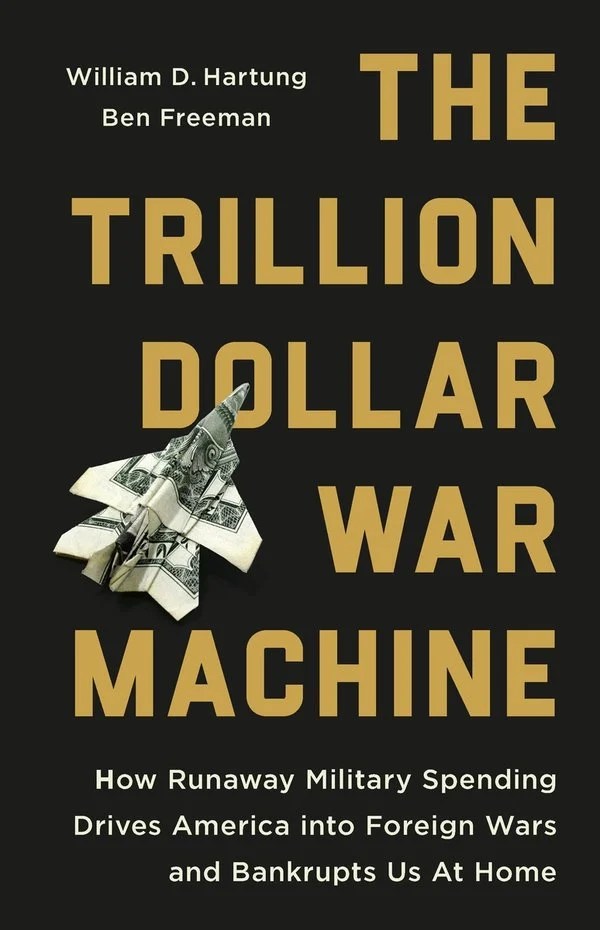
“The Trillion Dollar War Machine,” by William D. Hartung and Ben Freeman Available at Bookshop.org.
Since 2004, Fallujah has seen a 12-fold increase in childhood cancer rates and similar spikes in early onset cancer and respiratory diseases, according to a study co-authored by local physicians. Elevated rates of miscarriages and lethal birth defects that followed the initial U.S. invasion have never diminished. Reports on these poor health outcomes by doctors at Fallujah Women and Children’s Hospital led to the creation of a multidisciplinary study steered by researchers from Purdue University in the U.S. and Britain’s Newcastle University which tracked the intergenerational health effects of heavy metal exposure.
Depleted uranium munitions — which shatter and ignite on impact, allowing them to penetrate heavy armor plating — have been used by the U.S. in combat since the Gulf War. Spent rounds then release particles of radioactive uranium and other heavy metals, like titanium, into the surrounding earth, water, and air. Heavily bombarded areas in Fallujah were left with a greater percentage of heavy metals in their soil as a result.
Those who returned to the city after the battles, rebuilt their homes, reseeded contaminated farmlands, and drank and bathed in local waters now carry higher levels of radiation and heavy metals in their bodies. Indeed, uranium was found in the bones of one-third of study participants, all of whom were children during the 2004 siege — at levels roughly 300 times higher than their generational peers in America.
While highly toxic on its own, uranium levels are also often a marker for exposure to heavy metals including lead, arsenic, and mercury, which have been known to harm virtually every organ in the human body. Today, elevated rates of miscarriages and lethal congenital anomalies plague families in Fallujah.
“War itself is always about combustion,” explained Kali Rubaii, a cultural anthropologist and Purdue University assistant professor who led the study on Fallujah. “The combustion of generally toxic materials redistributes these toxicants into people’s air, water and food. Every time someone breathes in everything in the air, they are inheriting the pollutants of war.”
Post-war surges in birth defects, respiratory diseases, and cancers in Fallujah have now been directly linked with exposure to the weapons of war. As the pollutants of war are largely universal, the study’s implications lie far beyond Fallujah. Recommendations for those returning to bombarded areas are included in the study’s appendix in both Ukrainian and Arabic. When I spoke to Rubaii in March — two days after Tehran was drenched in black rain — she hoped the study’s finding, and its recommendations for returnees, could be of help to those living near the Persian Gulf.
The U.S–Israeli war on Iran has only exacerbated ongoing environmental crises in the Middle East, including a five-year-long drought, brought on by years of insufficient rainfall linked to human-induced climate change, that poses a severe threat to Tehran’s water supply. The Persian Gulf’s fragile coral reefs and mangrove forests have also, for years, suffered under rising water temperatures, intensive vessel activity, and growing industrial pollution.
“The most effective way to limit heavy metal toxicity from war is by not bombing cities.”
The Persian Gulf’s ecosystems still bear the scars of oil spills from the U.S. battles with Iraq during the 1991 Gulf War. Now, according to a recent study from the University of South Florida’s College of Marine Science, oil spills in the Gulf have increased dramatically since the beginning of the war to cover roughly four times the area in March 2026 as they did one year earlier. Though it is still too soon to calculate the full extent of the environmental harm imposed by the ongoing conflict, the toxic airborne pollutants, land contaminated with heavy metals, and oil-soaked waterways will pose a threat to life for decades to come. Read Our Complete Coverage TomDispatch
As Rubaii’s study concludes, “the most effective way to limit heavy metal toxicity from war is by not bombing cities.” While we live in an age where threats to civilian infrastructure are espoused and ordered by prime ministers and presidents alike, the illegality of these attacks — and their grave ecological consequences — cannot be ignored. The targeting of a country’s energy infrastructure, waterways, bridges, and homes makes it more likely that the attacked nation will respond with attacks on similar targets, placing civilians at risk in the present and, due to environmental contamination, for following generations.
People can’t be healthy if they live on sick lands.
The International Committee of the Red Cross — which works to uphold the laws of war — has repeatedly affirmed that the environment itself is a civilian object and must be protected. Under the 1998 Rome Statute, which established the International Criminal Court, to inflict disproportionate widespread and severe environmental damage is a war crime.
The Iran war has already sparked a global fuel crisis, threatened future harvests, and placed tens of millions of people at risk of hunger, imperiling this generation and the next. It has also subjected civilians to toxic smoke, black carbon rain, and other public health hazards. People can’t be healthy if they live on sick lands. Even after the final bomb of the Iran war has dropped, the ecological devastation and health hazards will haunt U.S. service members and local residents alike. Fallujah has shown that even long after the guns fall silent, war victims continue to suffer with the fallout of conflicts that have, quite literally, seeped into their bones. Share




 Crowds in Manhattan watch smoke billowing from the World Trade Centre, September 11 2001



 Read Our Complete Coverage TomDispatch


You must be logged in to post a comment.