Iranian attacks on US bases across the Middle East have caused far more damage than the Trump administration has publicly acknowledged, and an Iranian fighter jet was able to bomb at least one US base, NBC News reported on Saturday, citing unnamed US officials.
The administration has attempted to cover up the damage to US bases in the war, and has gone as far as requesting that Planet Labs and other satellite imagery companies black out war images, making it difficult to ascertain the damage.
The NBC report said that the Pentagon has also kept the information on the damage from Congress. “No one knows anything. And it’s not for lack of asking,” a Republican congressional aide told the outlet. “We have been asking for weeks and not getting specifics, even as the Pentagon is asking for a record high budget.”
Iranian missile and drone attacks have targeted US bases in seven Middle Eastern countries: Bahrain, Kuwait, Saudi Arabia, the UAE, Iraq, Jordan, and Qatar. US officials said that an Iranian F-5 fighter jet was able to bomb the US base at Camp Buehring in Kuwait despite it having air defenses, marking the first time in many years that an enemy fixed-wing aircraft struck a US military installation.
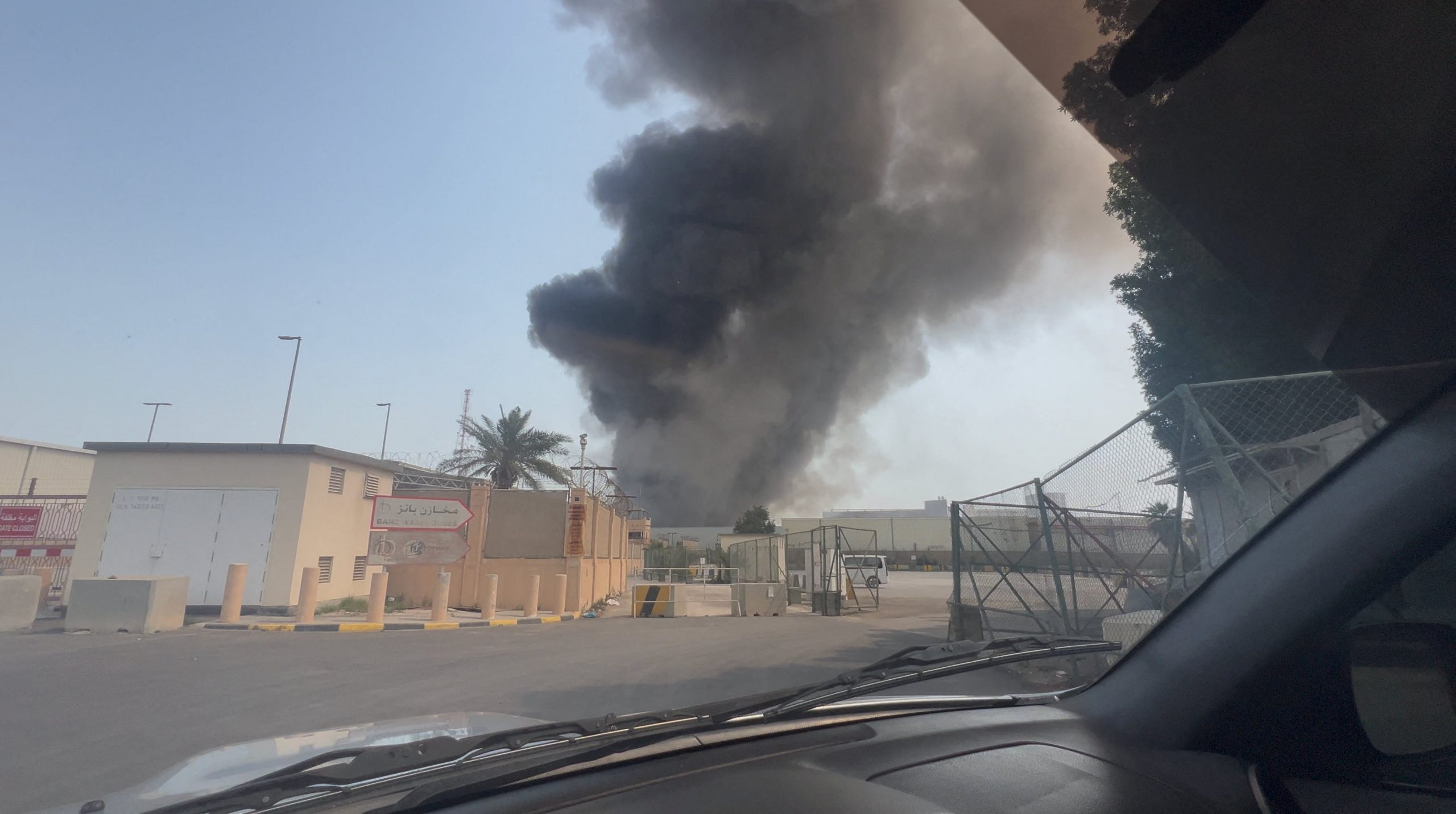
Smoke rises from the direction of a US naval base after a missile attack on the service center of the US Fifth Fleet in Manama, Bahrain, February 28, 2026 (screenshot of social media footage obtained by REUTERS)
The US armed Iran with Northrop Grumman-made F-5 fighter jets before the 1979 Islamic Revolution, and Iran has developed its own version of the aircraft, known as the HESA Kowsar.
Kuwait was also the site of a March 1 Iranian drone attack that killed six US Army Reserve soldiers and injured more than 20. The drone targeted a makeshift operations center in Port Shuaiba, and according to survivors of the attack who spoke to CBS News, the facility was unprotected despite claims from US War Secretary Pete Hegseth that the drone was able to “squirt” through air defenses.
The Pentagon has confirmed the deaths of at least 13 US soldiers and the injuries of more than 400 in the war. The bases across the region were mostly evacuated since they were so vulnerable to attack, something The New York Times previously reported. “Many of the 13 military bases in the region used by American troops are all but uninhabitable, with the ones in Kuwait, which is next door to Iran, suffering perhaps the most damage,” the Timesreported on March 25.
The NBC report said that the headquarters of the US Navy’s Fifth Fleet in Bahrain “sustained serious damage” and that other US bases in the country also suffered serious damage that is likely repairable. The report also cited the American Enterprise Institute (AEI), a Washington-based think tank, which said it assessed Iran hit more than 100 targets across 11 bases, and that the repairs would cost at least $5 billion, though the number doesn’t account for some of the radars, weapons systems, and other equipment that was destroyed.
The years 2024 and 2025 were the deadliest for reporters worldwide since records began. In those two years, Israeli attacks were responsible for 70% of the deaths
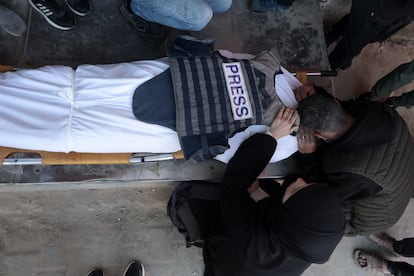
Funeral of Al Jazeera journalist Mohammad Weshah at Al Aqsa Martyrs Hospital in the central Gaza Strip on April 9.Majdi Fathi (NurPhoto/ Getty Images)
The death of Amal Khalil, 43, a Lebanese reporter for the media outlet Al Akhbar, brings up to nine the number of journalists killed by the Israeli army in seven weeks of offensive in Lebanon, according to the Committee to Protect Journalists (CPJ). The reporter’s killing occurred even though a ceasefire, which called for a 10-day cessation of hostilities by Israeli troops in Lebanon, was in effect since Thursday.
These figures add to the 264 other journalists killed in the line of duty in the context of the wars in Gaza and Iran since October 7, 2023. According to CPJ, 260 of these deaths were caused by Israel. The majority of the victims were Palestinian journalists in Gaza, although the count also includes 31 journalists killed in Yemen, 15 in Lebanon, and four in Iran in the last two and a half years. According to the Lebanese Press Editors Syndicate, the number of reporters killed in Lebanon since October 2023 stands at 27.
While Lebanon remains in shock over Khalil’s death, Beirut has announced it will seek international justice, considering the Israeli attack that killed her a war crime. The Lebanese government accuses Israel of deliberately targeting her and her colleague Zeinab Faraj. The two women had taken shelter in a house in the southern village of al-Tiri after an initial airstrike killed two people traveling in a vehicle. Shortly afterward, the building where they were located was also attacked. The Lebanese Red Cross rescued Faraj, who was taken to a hospital, but as teams searched for Khalil, an Israeli drone dropped another grenade on the building.
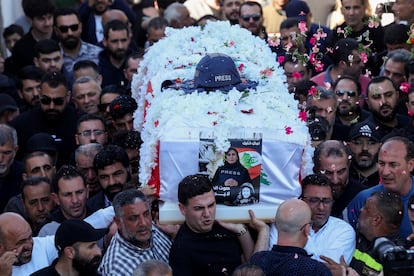
Funeral of journalist Amal Khalil, in Basariye (Lebanon), this Thursday.Aziz Taher (REUTERS)
“This is not the first time that Israel has prevented emergency services from reaching journalists injured in their strikes,” said CPJ CEO Jodie Ginsberg. “Journalists are civilians and protected under international law. Israel’s blatant disregard for such norms — and the international community’s failure to hold them accountable — is abhorrent.”
In many cases, Israeli troops justify the attacks by claiming the journalists have connections to Hamas or Hezbollah. In Khalil’s case, the Israeli army, without denying the Lebanese government’s version of events, maintains that the two journalists had just left a building used by Hezbollah for military purposes. According to a spokesperson, both vehicles had crossed the defensive line and approached Israeli troops, thus constituting “an imminent threat.”
“Targeted assassinations”
2024 and 2025 were the deadliest years for journalists worldwide since the Committee to Protect Journalists (CPJ) began documenting these cases in 1992. In both years, Israel was responsible for 70% of the recorded deaths, according to the organization. In addition to the 264 journalists who were killed, 174 were wounded and 106 imprisoned since the start of the war in Gaza.
The CPJ counts both journalists killed while carrying out their work and those whose deaths are linked to their professional activity, whether accidentally in conflict zones or as a result of deliberate attacks. According to the organization, Israeli troops have carried out more targeted killings of journalists than the military of any other government since records began. To date, the CPJ has documented 64 cases of journalists deliberately killed by Israeli forces between 2023 and 2025 in Gaza, Lebanon, Iran, and Yemen.
Among the dead was Anas Al Sharif, an Al Jazeera reporter and one of the most recognizable faces of the Gaza war. He was killed in August 2025 in an Israeli attack on the journalists’ tent where he lived with five other reporters, outside Al Shifa Hospital in Gaza City. Anticipating he might be targeted, Al Sharif had left a farewell message.
That same month, five other journalists were killed in a bombing of Nasser Hospital in Khan Younis, in the southern Gaza Strip. After an initial explosion at the building, where civilians and reporters had gathered to assess the damage, a second blast occurred and was broadcast live by several television stations.
The head of Al Jazeera’s Gaza bureau has also been targeted: he was wounded and lost several family members, including a son who was also a journalist. This April, Al Jazeera journalist Muhammad Washah was killed in an Israeli airstrike on the vehicle he and another Palestinian were driving on the coastal road in Gaza City, according to health officials cited by Reuters.
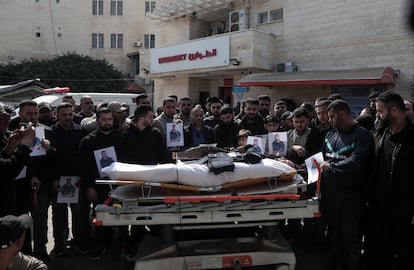
Funeral of Al Jazeera journalist Mohammad Weshah, in the center of the Gaza Strip, on April 9.Majdi Fathi (NurPhoto/ Getty Images)
In the last incident in Lebanon recorded by the CPJ before Khalil’s death, three other journalists were killed in the south of the country. An Israeli attack on a vehicle on the Jezzine road killed journalist Ali Shoaib of the Hezbollah-affiliated Al Manar TV; journalist Fatima Ftouni of Al Mayadeen TV; and her brother, freelance photojournalist Mohamad Ftouni.
War crimes
“The deliberate attacks and killings of journalists by Israeli forces constitute war crimes under international humanitarian law,” Amnesty International notes on its website.
Since October 2023, Reporters Without Borders has filed five complaints with the International Criminal Court against Israel for “war crimes against Palestinian journalists in Gaza.”
These actions are in addition to previous ones, such as the lawsuit filed by Al Jazeera in 2022 after the death of journalist Shireen Abu Akleh, who was killed in May of that year while covering a raid by Israeli troops on a refugee camp in Jenin, in the West Bank.
Sign up for our weekly newsletter to get more English-language news coverage from EL PAÍS USA Edition
A US legal memo reveals Iran war was launched at Israel’s request, contradicting Trump’s repeated claims of independence.
Key Developments
US document states war was conducted in “collective self-defense of its Israeli ally.”
Admission contradicts Donald Trump’s claims that Washington acted independently.
Memo frames ongoing war as legally continuous conflict, removing need for renewed justification.
US Memo Contradicts Trump Narrative
A US State Department legal memorandum has revealed that the so-called Operation Epic Fury, launched on February 28, was carried out “at the request of and in the collective self-defense of its Israeli ally,” directly contradicting repeated public claims by US President Donald Trump that Washington acted independently in its war against Iran.
The document explicitly states that the United States is engaged in an armed conflict with Iran “at the request of” Israel, framing the military campaign not as a unilateral American decision, but as part of a coordinated war effort aligned with Israeli objectives.
This admission stands in clear contrast to Trump’s earlier assertions that the United States was acting on its own strategic calculations, without external influence, in launching the large-scale military operation.
The memo goes further by constructing a legal argument that the war did not begin with Operation Epic Fury, but is instead part of an ongoing, long-term armed conflict involving the United States, Israel, and Iran.
‘Collective Self-Defense’ of Israel
According to the document, US military action is justified both as collective self-defense of Israel and as an exercise of Washington’s “own inherent right of self-defense.”
It argues that hostilities have been continuous for years, citing repeated US communications to the United Nations Security Council and asserting that no formal end to the conflict ever occurred.
“The United States is engaged in this conflict at the request of and in the collective self-defense of its Israeli ally, as well as in the exercise of the United States’ own inherent right of self-defense,” the memo states.
By defining the war as “ongoing”, the document claims that Washington is not required to reassess legal justifications such as imminence or proportionality for each new military action.
On 23 April 2026, I was on “Switzerland,” Tom Switzer’s new podcast, with the distinguished British historian and journalist, Max Hastings. It was a sobering conversation because Max is deeply concerned about President Trump’s state of mind and where he is taking not just the United States, but the rest of the world as well. Listening to Max, who is judicious, super knowledgeable about international politics, very smart, and deeply committed to the trans-Atlantic relationship, you realize how much damage President Trump has done to America’s standing around the world. And you realize we are living in dangerous tomes as both Israel and the US are forced to face up to the fact that they picked a fight with Iran that they cannot win.
President Trump on Thursday shared a post calling for the killing of Iranian leaders who won’t accept US demands, ramping up his threats against the country amid a very fragile ceasefire.
The post Trump amplified was written by Marc Thiessen, who served as a speechwriter for the George W. Bush administration. “If there are two factions in Iran, one that wants a deal and one that doesn’t, let’s kill the ones who don’t want a deal,” Thiessen said in a post on X where he was quoting himself from an appearance on Fox News.
In the piece, Thiessen argued that Trump should restart the bombing campaign against Iran. “Right now, the remnants of the Iranian regime are under the misimpression that Trump wants a deal more than they do,” he wrote.
“Trump needs to disabuse them of that notion. He has reportedly told Iran that it has three to five days to make a serious counteroffer. If it fails to do so, he should resume combat operations — starting with strikes targeting Iran’s recalcitrant leaders. If the Iranian regime is really ‘fractured’ between a faction that wants a deal and a faction that does not, there is a simple solution: Kill the faction that does not,” Thiessen said.
Thiessen said the US should maintain the blockade and claimed the US military could open the Strait of Hormuz by force and that it just needed 14 more days to “finish the job” against Iran.
The Trump administration has pushed the narrative that Iran’s military has essentially been obliterated, but Iran was able to continue missile and drone attacks throughout the entire war, and according to US officials speaking to The New York Times, US intelligence assesses that Tehran likely has access to the majority of its missiles and launchers.
Published date: 23 April 2026 15:40 BST | Last update:1 hour 50 mins ago
Amal Khalil, the seasoned journalist, was born during a years-long Israeli occupation of southern Lebanon. She was killed there four decades later by invading Israeli forces.
“Amal was present in every home. Every home in Lebanon has lost her,” Ali Khalil, her brother, said tearfully a day after she was targeted and killed by Israel.
“Amal resembles the south in all its details – its sweet breeze, its valleys, its mountains, and its old houses. She resembles all of that.”
Khalil is remembered fondly by her colleagues as generous, fearless and pioneering.
“I want to express gratitude for everything she did for us young journalists,” Hussein Chaabane, a Lebanese investigative and legal journalist, told Middle East Eye.
New MEE newsletter: Jerusalem Dispatch
Sign up to get the latest insights and analysis on Israel-Palestine, alongside Turkey Unpacked and other MEE newsletters
“She was so generous even if we were competitors. She never hesitated in sharing a contact, a key – and she had all the keys in the south.
“She knew it like the palm of her hand and she shared this love and dedication with everyone who needed it.”
Khalil, 42, was killed on Wednesday as she went to cover an earlier Israeli attack in the town of al-Tayri.
‘She knew [the south] like the palm of her hand and she shared this love and dedication with everyone who needed it’
– Hussein Chaabane, journalist
An initial strike hit a vehicle in front of Khalil and freelance photographer Zeinab Faraj, prompting the pair to take shelter in a nearby house.
A second strike then hit the house, according to the health ministry. Rescuers retrieved Faraj, who sustained a head wound, but were fired on before they could reach Khalil.
Hours later, they found Khalil dead under the rubble.
Lebanese Prime Minister Nawaf Salam described the killing as a war crime and said Lebanon would spare no efforts in pursuing the culprits internationally.
“The killing of Amal was the killing of a woman of resistance,” Lebanese filmmaker Bachir Abou Zeid told MEE.
“Israel killed her because she was a journalist of resistance, not simply because she was a journalist.”
Writer shaped by occupation
Khalil was born in 1984 in al-Baisariyah, in the Saida district of southern Lebanon.
She grew up during the civil war and Israel’s occupation of large parts of southern Lebanon, and recounted seeing occupied villages in the distance when she was a child. Her own town was retaken from Israeli forces shortly before her birth.
Khalil grew up reading As-Safir, a now defunct popular Lebanese newspaper, through which she says she learnt about everyday people’s struggles, about prisoners and the forcibly disappeared, and about the civil war.
She studied Arabic literature in the city of Saida, and – without the knowledge of her parents – travelled to Beirut, where she became involved in communist activism.
It was then that her writing career began to take off, and she wrote several pieces for al-Hasnaa magazine.
“One story I particularly remember was for the Valentine’s Day special issue, about how queer people celebrated love in a conservative society,” she recalled in an interview in January with The Public Source, a Beirut-based outlet.
Khalil joined the nascent Al-Akhbar newspaper in April 2006, a few months before the first issue went to print. She would go on to work there for 20 years.
Weeks after she joined, Israel launched a 33-day war on Lebanon – a moment which Khalil described as a turning point in her career.
She had initially joined the paper to write about women’s and cultural issues. But amid the backdrop of war, she collected the stories of those displaced and bombarded by Israel.
It was a theme that would continue throughout her professional life.
‘The pressure to break me was relentless, but I didn’t yield’
– Amal Khalil
Khalil was largely based in the city of Sour, also known as Tyre, where she pursued public interest stories.
“Going after corruption cases and social issues in the area, sparing no one – not even my family – led to confrontations,” she recounted.
“I was threatened, assaulted, and intimidated. The pressure to break me was relentless, but I didn’t yield.”
Although al-Akhbar has provided favourable coverage of Hezbollah and resistance against Israel, she said she did not write with limitations.
She recalled al-Akhbar defying a request by Hassan Nasrallah, then Hezbollah’s leader, to not publish a WikiLeaks documents about Nabih Berri, the parliament’s speaker, back in 2011.
Over time, she became al-Akhbar’s go-to field reporter for the whole of the south, covering Sour, Bint Jbeil and Nabatieh, among other areas.
Face to face with Israeli troops
Khalil knew all too well that Israeli forces have a habit of targeting Lebanese journalists.
In 2010, she wrote an obituary for her slain colleague Assaf Abu Rahhal, who was killed by Israeli shelling.
She recalled a Lebanese soldier handing her Abu Rahhal’s blood-stained ID card. “It was all that remained of Assaf. I will never forget that day,” she said.
Khalil was unwavering in her support for leftism and resistance against occupation.
In more recent years she began to produce more video content, learning to edit the films herself, even though she was insistent that she did not want to appear in them.
‘I’m here to tell the stories of the people, not to become the story myself’
– Amal Khalil
“For me, it was simple: I’m here to tell the stories of the people, not to become the story myself,” she said.
During Israel’s 2023-2024 war on Lebanon, which broke out when Hezbollah attacked Israel in solidarity with Palestinians being slaughtered in Gaza, she documented evidence of Israeli targeting of civilians and civilian infrastructure.
“From the very first day of the genocide, Amal confronted Israel through her coverage,” said Abou Zeid.
“Her documentation, her movement from one area to another, and her amplification of the story of the people in the land and the south.”
After a ceasefire was announced in February last year, she reported on Israel’s near-daily violations of the truce.
Khalil was confronted by Israeli forces on a number of occasions during her career. The closest shave, she said, was in November 2024, when Israeli forces fired volleys to drive her and colleagues back from a bulldozer.
‘Never accepted Israeli limitations’
Colleagues and friends remember that Amal refused to bow to Israeli orders or limitations on her movements.
“Not for a single moment did Amal abide by Israeli instructions about where she could go,” said Abou Zeid.
“Amal was not a journalist in the conventional sense of the profession. Her love for the land and for her people outweighed everything.”
Khalil said herself following the 2024 war that people had advised her to restrict her movements, but that her faith and her revolutionary upbringing taught her to stand “in the face of oppression”.
‘Her love for the land and for her people outweighed everything’
– Bachir Abou Zeid, filmmaker
“My alignment with the people of the south, my presence among them since the July 2006 war, has always been the right choice. They have always lived up to that faith placed in them,” she said.
“They will grow stronger, more steadfast, and more committed to this unwavering compass, toward truth, and toward Palestine.”
Rabbi Avraham Zarbiva operated a bulldozer in Gaza and has called for Israel to ‘flatten’ the Palestinian territory
by Dave DeCamp, Antiwar. com, April 22, 2026 at 4:52 pm ET | Gaza, Israel
During an independence day ceremony in Israel on Tuesday, the Israeli government honored an extremist rabbi known for bulldozing homes in Gaza and calling for Israel to “flatten” the Palestinian territory. According to The Guardian, Rabbi Avraham Zarbiv was one of fourteen people chosen by the Israeli government for their “extraordinary contribution to society and the state” to light a torch at the ceremony. Zarbiv serves as a rabbinical judge for an illegal Jewish settlement in the Israeli-occupied West Bank, and an Israeli state ombudsman recently ruled that he violated ethical guidelines by expressing “extremist views,” which included his call to flatten Gaza and boasting about the destruction of civilian homes and the IDF’s mass killing of Palestinians. “Israel, let me tell you, we have crushed them. There are tens of thousands of dead. The dogs and the cats ate them because no one collected them,” Zarbiv said in a TV interview last year. “Tens of thousands of families – they have not a piece of paper, no childhood photo, no IDs, they have nothing. No home, there is nothing. They come, they have no idea where their house is. It’s something unbelievable.” Zarbiv became well known in Israel for posting videos of himself destroying homes in Gaza, and his name has become slang for destruction. “We’re here in Beit Hanoun attacking this cursed village until we finish it,” Zarbiv said in one of his videos, which was shared by the Israeli rights group B’Tselem. “All the way to victory, to settlement. We will not give up until this village is erased.” B’Tselem strongly condemned the Israeli government’s move to honor Zarbiv. “Bestowing one of the highest civilian honors in Israel on a citizen who committed war crimes illustrates how deeply the dehumanization of Palestinians has taken root in the Israeli mainstream. It is yet another terrifying signal that genocide has officially become part of the national ethos,” the group said.
Less than two months after fascist US President Donald Trump launched the criminal US/Israeli war against Iran in the dead of night on February 28, the conflict is having a devastating economic impact on tens of millions of workers around the globe.
American imperialism’s determination to consolidate its dominance over the Middle East, one of the world’s most critical energy-producing regions, has already claimed the lives of thousands of Iranians in six weeks of brutal and indiscriminate bombardment. But the economic fallout from the US-instigated war and blockade of the Strait of Hormuz could prove even more deadly.
Prior to the war’s outbreak, the Strait of Hormuz accounted for some 20 percent of global oil traffic and a significant portion of natural gas shipments. The consequences produced by the disruption of these energy supplies are already reverberating across the world economy. They include rising fuel costs, higher electricity prices and escalating transportation expenses for billions of people.
The Middle East is also a major producer of fertilisers, so prices have jumped amid the planting season for farmers in the northern hemisphere. The result is both increased production costs for crops and reduced harvests, as farmers plant less to cut costs or use less fertiliser, which will fuel a food-price spiral over the coming months and into 2027.
Shipping disruptions, compounded by heightened insurance premiums and rerouted trade flows, have further increased the price of food imports. The Containerised Freight Index rose 10 percent within a month of the war’s outbreak, underscoring that even traffic not directly impacted by the Strait of Hormuz blockade is affected.
On top of the destruction of schools, hospitals and other civilian infrastructure by US and Israeli missiles, the working class in Iran is bearing the economic brunt of the war. A government spokesman admitted that approximately 2 million workers have lost their jobs as a direct consequence of the conflict.
The impact of the war has been particularly acute across the Asia-Pacific region, due to its heavy reliance on oil imports from the Middle East. Over 80 percent of crude and LNG normally transiting the Strait of Hormuz is destined for countries in the Asia-Pacific, including major industrial economies like China and Japan. Fuel prices have risen sharply in India’s major cities, with petrol and diesel costs increasing by roughly 10-15 percent within weeks.
In Indonesia, nickel producers have cut output by at least 10 percent due to shortages of natural gas and sulphur, which are required to produce the high temperatures necessary for extraction and refining of the metal. Severe disruptions to the garment factories of Bangladesh have also been reported due to a lack of polyester and nylon, fossil fuel byproducts used to make clothing.
Another critical channel of impact is the disruption of remittances. Millions of workers from South Asia and Africa are employed in the Gulf region, sending vital income back to their impoverished families. The war has disrupted these flows, as economic activity slows and employment opportunities shrink.
Motorists queue up to get fuel at a pump, fearing a possible fuel shortage due to the US Iran war, in Ahmedabad, India, Monday, March 23, 2026. [AP Photo/Ajit Solanki]
The United Nations Development Programme estimated in a recent report that the war on Iran could cost 36 countries in the Asia-Pacific nearly $300 billion and plunge up to 8.8 million people into poverty. Five million of these people live in Iran, where the human development index has already lost 1–1.5 years due to the war.
The New York Times worried in a lengthy analysis published April 20 that countries throughout the Asia-Pacific may face “shortages [that] could push several countries into convulsions of unrest, followed by recession,” if the Strait of Hormuz remains blocked for just a few more weeks. Even high-end production, including of semiconductors essential for producing chips built in Taiwan, faces problems. Prior to the war, Qatar produced a third of the world’s helium, a critical component of the semiconductor production process. But it stopped production on March 2 after an Iranian retaliatory attack hit its gas facilities. As the Times put it, cuts to chip production “would roll through everything from electronics to cars.”
In Africa, Nigeria has seen fuel prices rise by over 50 percent, despite the country being a massive oil producer and exporter. Since the country of some 240 million people is heavily dependent on imports of refined oil products, petrol prices have risen significantly, leading to increases in public transport costs and the price of staple foods. In Kenya, the fuel price regulator hiked petrol prices by over 16 percent and diesel prices by over 24 percent in mid April, following a 68 percent increase in the cost of oil imports.
Many African countries depend on imported fertilisers. The surge in natural gas prices has driven up costs for farmers, threatening lower crop yields and outright famine in areas where subsistence farming prevails. At the same time, currency depreciation in several countries is amplifying the impact of global price increases, making imports even more expensive, eroding real wages and pushing up already crippling debt repayment costs for financially strapped governments.
In Europe and North America, fuel prices have also risen sharply, placing yet another burden on working people’s budgets amid stagnant economic growth, mass layoffs and social attacks by the ruling elites in every country to pay for bloated military budgets and the enrichment of the financial oligarchy. In Germany, national airline Lufthansa announced the immediate closure of its CityLine subsidiary amid a strike by thousands of airline workers for job security and pay increases. The continent’s governments are investing trillions of euros in their own war machines to prosecute their predatory imperialist interests at the expense of workers’ livelihoods and social programmes.
Across the Atlantic, the Wall Street Journal has announced the era of the “mega layoff,” with job cuts in finance, technology, entertainment and manufacturing.
By contrast, the war is proving to be a bonanza for the corporations and financial oligarchy. According to one investigation, the world’s major oil conglomerates will pull in additional profits of over $230 billion in 2026 alone.
The World Socialist Web Site has insisted that US imperialism’s war on Iran is one front in the early stages of a third world war, which includes the US/NATO war on Russia in Ukraine and preparations for a military conflagration with China. As the imperialist powers in North America and Europe scramble for the upper hand in the redivision of the world, they are totally indifferent to the impact on billions of workers from the global economic and social disaster produced by crisis-ridden capitalism and their crazed policies. But this very disaster creates the material conditions for the development of a working class movement to end the war and the capitalist profit system which is its root cause.
The parallels to World War I are striking, when food riots across Europe during 1916 and 1917 gave an initial expression to growing popular opposition to the imperialist slaughter. The most consequential of these were protests that erupted demanding bread in Petrograd in early 1917, marking the beginning of Russia’s February Revolution. Eight months later, the Bolsheviks under Lenin and Trotsky led the working class to power on a socialist programme that would bring the world war to an end.
Today, the world economy is integrated to such a degree that initial expressions of social unrest provoked by the war have already erupted in its first weeks. Beginning on April 10, tens of thousands of industrial workers in India’s national capital region launched strikes and protests against price hikes triggered by the war. Workers demanded wage increases to cover higher rents, fuel costs, and food prices. Protests have also erupted in countries as diverse as the Philippines and Ireland.
Now, as in 1917, the decisive tasks are the fight to develop a conscious, unified movement of the international working class and build a mass revolutionary party capable of leading the struggle for workers’ political power.
The global nature of the crisis demands an international response, transcending national divisions and opposing militarism. Workers in Iran, the United States, Europe, Asia and Africa share a common interest in ending the war and the bankrupt capitalist order that gave rise to it. This requires the independent political mobilisation of the working class on a socialist programme to place the commanding heights of the economy under democratic workers’ control, ensuring that production is organised to meet human needs rather than private profit.
Under these conditions, the upcoming International May Day Online Rally 2026 assumes critical importance. It will articulate the revolutionary socialist programme and perspective workers around the world require to fight imperialist war and its barbaric consequences. Register today to participate, and encourage your work colleagues and friends to do the same.
On 20 April 2026, I was on “The Chris Hedges Report” talking about where the Iran war is headed. Chris and I mainly concentrated on trying to make sense of what President Trump is doing to end the conflict on favorable terms for the US. Although many believe that he will escalate after the two-week ceasefire expires on Wednesday (April 22), I made the case that I thought that was unlikely for two reasons. First, he cannot win a military victory if he goes up the escalation ladder as the Iranians hold most of the cards. Second, escalation would prolong the war and further reduce the oil and gas flowing out of the Persian Gulf (and probably the Red Sea), which is likely to take the world economy off the precipice.
Given this ominous prospect, Trump has a powerful incentive to cut a deal with Iran as soon as possible. But the chief problem he faces is that Israel does not want a deal. It wants the US to continue the war and try to beat Iran into submission. Given the stranglehold the Israel lobby has on Trump, he does not have much maneuver room. All of this is to say, even if he cuts some sort of deal with Iran, Israel and its minions in the US will work overtime to undermine it. Trump is boxed in and he knows it, which I think explains much of his erratic and outrageous behavior in recent weeks.
In short, Israel and its lobby bamboozled Trump into starting a losing war against Iran and now they won’t let him end it.
If the objective of the U.S. war upon Iran is to ensure that that country does not develop nuclear weapons, that goal was attained more than a decade ago through a far different approach than the one now being followed by the Trump administration.
Iran, as a signer of the Nuclear Nonproliferation Treaty of 1970, had agreed to forgo the development of nuclear weapons. Even so, fears grew during the early 21st century that Iran’s uranium enrichment program, used for peaceful purposes, might be diverted to the development of the Bomb, thereby throwing the volatile Middle East into yet another crisis, including a frenzied nuclear arms race.
As a result, the five permanent members of the UN Security Council (the United States, Russia, China, Britain, and France) and Germany began lengthy negotiations with Iran, offering it various incentives to halt uranium enrichment. A key incentive was the lifting of international sanctions, which were having a severe impact on sales of Iran’s oil and, thus, its economy. After the election in 2013 of an Iranian reformer, Hassan Rouhani, as president, the negotiators came to a preliminary accord to guide their talks toward a comprehensive nuclear agreement.
The final agreement, formally known as the Joint Comprehensive Plan of Action, was negotiated by the five permanent members of the UN Security Council, Germany, and the European Union. Signed in July 2015, it granted Iran sanctions relief in exchange for significant restrictions on its nuclear program. These included Iran’s agreement to ban production of highly enriched uranium or plutonium, ensure that its key nuclear facilities pursued only civilian work, and limit the numbers and types of centrifuges that it could operate. In addition, Iran agreed to allow inspectors from the International Atomic Energy Agency (IAEA), the UN’s nuclear watchdog, unfettered access to its nuclear facilities and undeclared sites.
In the United States, the Iran nuclear agreement was strongly supported by the Obama administration, which played a key role in securing it, and by Democrats, but denounced by Republicans. Jeb Bush, then a leading presidential contender, called it “dangerous, deeply flawed, and short-sighted,” while U.S. Senator Lindsey Graham claimed that it was a “death sentence for the state of Israel.” Indeed, Benjamin Netanyahu, Israel’s Prime Minister, lobbied ferociously against U.S. acceptance of the Iran agreement, furiously attacking it as a “historic mistake.”
Despite the opposition, the agreement went into effect in January 2016 and, initially, had smooth sailing. The IAEA certified that Iran was keeping its commitments, nations repealed or suspended their sanctions, Iran’s oil exports surged, and the United States and European nations unfroze about $100 billion of Iran’s frozen assets.
In May 2018, however, Donald Trump, Obama’s successor as President, breaking with America’s European allies, unilaterally withdrew the U.S. government from the Iran agreement and announced the reimposition of oil and banking sanctions. “It is clear to me that we cannot prevent an Iranian nuclear bomb under the decaying and rotten structure of this deal,” Trump announced. Assailing the Iran agreement as “defective to its core,” Trump condemned it for failing to deal with Iran’s ballistic missile program and its proxy warfare in the Middle East, as well as for the agreement’s 10-year sunset provision.
In response, Iranian President Rouhani, stating that the U.S. government had failed to “respect its commitment,” declared that he had “ordered the Atomic Energy Organization of Iran to be ready for action if needed, so that if necessary we can resume our enrichment on an industrial level without any limitations.” Even so, he promised, he would wait to speak about this with allies and the other signatories to the agreement.
Thereafter, things went downhill. Although France, Germany, and Britain sought to keep the agreement alive by evading the U.S. banking sanctions through a barter system, this effort eventually collapsed. Meanwhile, Trump got into a verbal brawl with Rouhani, threatening Iran with what he called “CONSEQUENCES THE LIKES OF WHICH FEW THROUGHOUT HISTORY HAVE EVER SUFFERED BEFORE.” Ultimately, Iran began exceeding the agreed-upon limits to its stockpile, enriching uranium to higher concentrations, and developing new centrifuges.
Although Joe Biden, as a 2020 presidential candidate, promised to rejoin the Iran nuclear agreement and “to work with our allies to strengthen and extend it,” by the time he was in office the relationship with Iran had deteriorated too far to make this feasible. Coming under a new, more reactionary leadership, the Iranian regime grew more repressive, as well as more distant from the United States and more politically toxic. As a result, a new agreement was increasingly out of reach.
In retrospect, are there any lessons that can be learned from these events?
One is that, to the degree that the development of nuclear weapons by Iran is a currently a problem, it is a problem of Trump’s making. Or as Biden put it years ago, Trump’s pullout from the 2015 Iran nuclear agreement was “a self-inflicted disaster.”
Another is that getting a country to forgo nuclear weapons development is easier to accomplish through international―and especially UN Security Council―action than through unilateral action. A threat from one nation to another can easily be viewed and dismissed as bullying. But pressure from a worldwide organization representing the community of nations has greater impact.
More generally, if nations are going to be asked (or pressured) to forgo development of nuclear weapons, it is useful to have a framework that treats nations equally. The Nuclear Nonproliferation Treaty fosters this equality through a bargain, in which the non-nuclear nations forgo building nuclear weapons in exchange for the nuclear nations eliminating their own nuclear arsenals. The next time Donald Trump and Benjamin Netanyahu threaten to annihilate Iranian civilization, someone might remind them of that.


 By
By 
 Peace and Justice Post

You must be logged in to post a comment.