Archive for the ‘Uncategorized’ Category

𝐈𝐬𝐫𝐚𝐞𝐥𝐢 𝐃𝐞𝐟𝐞𝐧𝐬𝐞 𝐌𝐢𝐧𝐢𝐬𝐭𝐞𝐫 𝐎𝐫𝐝𝐞𝐫𝐬 𝐏𝐥𝐚𝐧 𝐓𝐨 𝐁𝐮𝐢𝐥𝐝 𝐂𝐨𝐧𝐜𝐞𝐧𝐭𝐫𝐚𝐭𝐢𝐨𝐧 𝐂𝐚𝐦𝐩 𝐟𝐨𝐫 𝐆𝐚𝐳𝐚’𝐬 𝐂𝐢𝐯𝐢𝐥𝐢𝐚𝐧 𝐏𝐨𝐩𝐮𝐥𝐚𝐭𝐢𝐨𝐧

July 8, 2025

Israel Katz says the so-called ‘humanitarian city’ will be built on the ruins of Rafah

by Dave DeCamp, Antiwar. com, July 7, 2025

Israeli Defense Minister Israel Katz has ordered the IDF to prepare a plan to establish a camp to concentrate the entire civilian population of Gaza on the ruins of the southern Gaza city of Rafah.

According to Haaretz, Katz said that once Palestinian civilians are pushed into what he is calling a “humanitarian city,” they will not be allowed to leave. The idea is to first transfer 600,000 civilians from the al-Mawasi tent camp on the coast in southern Gaza, followed by the rest of the civilian population.

Katz said that if conditions permit, the “city” could be built during a potential 60-day ceasefire, comments that will make Hamas less likely to agree to a temporary truce. The Israeli defense minister also said that during the ceasefire, Israel will maintain control of the “Morag Corridor,” a strip of land between Rafah and Khan Younis.

Katz also suggested the camp can facilitate the government’s ultimate goal of ethnic cleansing, which it refers to as “voluntary migration,” telling reporters that Israel will implement “the emigration plan, which will happen.”

Israeli Finance Minister Bezalel Smotrich has previously said that the goal of Israel’s current military operation, dubbed Gideon’s Chariots, is to create a concentration camp south of the Morag Corridor and pressure the civilians forced into it to leave.

“The Gazan citizens will be concentrated in the south. They will be totally despairing, understanding that there is no hope and nothing to look for in Gaza, and will be looking for relocation to begin a new life in other places,” Smotrich said in May.

Katz’s comments come after Reuters reported that the controversial US-backed Gaza Humanitarian Foundation (GHF) had proposed to the US government the idea of creating camps it called “Humanitarian Transit Areas” inside Gaza or possibly outside Gaza.

The GHF plan describes the camps as “large-scale” and “voluntary” places where the Palestinian population could “temporarily reside, deradicalize, re-integrate and prepare to relocate if they wish to do so.”

Katz said Israel is seeking “international partners” to manage the zone and that four aid distribution sites would be set up inside the camp, suggesting the GHF will be involved in the plan. GHF aid sites are secured by American security contractors, who have been credibly accused of using live ammunition and stun grenades to disperse crowds of hungry Palestinian civilians.

The IAEA’s MOSAIC weapon: Predictive espionage and the war on Iran

July 7, 2025

Backed by US funding and Palantir’s AI tools, the IAEA turned its Iran inspections into a surveillance regime that blurred the line between monitoring and military targeting.

Kit Klarenberg, The Cradle, July 2, 2025

Photo Credit: The Cradle

Ever since Israel launched its illegal war of aggression against Iran on 13 June, speculation has swirled around the role played by MOSAIC – a tool created by shadowy spy-tech firm Palantir. 

This software has been deeply embedded within the International Atomic Energy Agency’s (IAEA) operations, particularly its “safeguarding” mission: inspections and monitoring state compliance with non-proliferation agreements. 

MOSAIC has been central to this work for a decade and was quietly integrated by former US president Barack Obama’s administration into the July 2015 Joint Comprehensive Plan of Action (JCPOA) nuclear deal with Iran.

Espionage disguised as oversight

The deal granted IAEA inspectors unfettered access to Iran’s nuclear facilities to confirm the absence of a nuclear weapons program. In the process, the agency accumulated an immense trove of data: surveillance imagery, sensor measurements, facility documents – all of which were fed into MOSAIC’s predictive system.

Yet the software’s pivotal role in the deal remained concealed until a Bloomberg exposé in May 2018, just days before US President Donald Trump, during his first term, unilaterally tore up the agreement and launched Washington’s so-called “maximum pressure” campaign against Tehran.

Despite Trump tearing up the deal, inspections of Iranian nuclear facilities continued, as did MOSAIC’s monitoring of Tehran’s nuclear program. As Bloomberg noted, Palantir’s technology helped the IAEA scrutinize vast swaths of information from disparate sources, including 400 million “digital objects” globally, such as “social media feeds and satellite photographs inside Iran” – a capability that “raised concern the IAEA may overstep the boundary between nuclear monitoring and intelligence-gathering.” 

The Bloomberg piece also provided fodder for an oft-stated Iranian concern that Mosaic was helping Israelis track Iranian scientists for assassination:

“The tool is at the analytical core of the agency’s new $50 million MOSAIC platform, turning databases of classified information into maps that help inspectors visualize ties between the people, places and material involved in nuclear activities, IAEA documents show.”

Bloomberg quoted the head of a British company that “advises governments on verification issues” on the hazards of false data being fed into MOSAIC, “either by accident or design”:

“You will generate a false return if you add a false assumption into the system without making the appropriate qualifier …You’ll end up convincing yourself that shadows are real.”

The underlying and ongoing concern for Tehran is that MOSAIC is heavily influenced by Palantir’s “predictive-policing software.” Employed by many law enforcement agencies across the western world at enormous expense, this technology is highly controversial and has been found to exhibit dangerous, misleading biases, leading to erroneous “pre-crime” interventions. 

Indeed, MIT Technology Review has flat-out called for the dismantlement of predictive tech in a report that looks at how dangerous the technology has been in analyzing even domestic criminal data: 

“Lack of transparency and biased training data mean these tools are not fit for purpose. If we can’t fix them, we should ditch them.”

Given the inclusion of dubious intelligence – such as the Mossad-stolen Iranian nuclear archive, openly celebrated by the Israeli agency for its deception – it is highly probable that such corrupted data triggered unjustified inspections. Bloomberg quoted a negotiator who helped craft the 2015 deal, expressing concern over how “dirty or unstructured data” could lead to “a flurry of unnecessary snap inspections.” 

Palantir’s software specifically helped the IAEA “plan and justify unscheduled probes” – at least 60 of these conducted until US-Israeli strikes put an end to inspections. 

Data as a weapon 

On 31 May, the IAEA released a report suggesting Iran may still be developing nuclear weapons. Although it presented no new evidence, its dubious charges related “to activities dating back decades” at three sites where, purportedly, until the early 2000s, “undeclared nuclear material” was handled. 

Its findings prompted the UN nuclear watchdog’s Board of Governors to charge Iran as “in breach of its non-proliferation obligations” on 12 June, providing Tel Aviv with a propaganda pretext for its illegal attack the next day.

On 17 June, IAEA chief Rafael Grossi conceded that the agency had “no proof of a systematic effort to move into a nuclear weapon” by Tehran. Still, the damage was done. Iranian lawmakers, citing the IAEA’s secret sharing of sensitive data with Tel Aviv and Grossi’s covert collusion with Israeli officials, suspended all cooperation with the agency.

This may be the wisest course for other states under IAEA scrutiny. MOSAIC is now so entwined with the agency’s daily function that any country targeted for regime change could find itself accused of nuclear ambitions based on manufactured evidence. 

A 2017 IAEA document reveals MOSAIC is comprised of “over 20 different software development projects.” Launched in May 2015, it was hoped to revolutionize “safeguarding” the world over.

The report described MOSAIC as providing inspectors with “a suite of tools with which to face the challenges of tomorrow.” For instance, the Electronic Verification Package (EVP) enables field data – including planning, reporting, and review – to be automatically collected and processed. When inspectors visit a facility, they record vast amounts of information – instantly analyzed at headquarters via EVP.

Elsewhere, the Collaborative Analysis Platform (CAP) enables deep cross-referencing of internal and open-source data, including overhead imagery. It supports the IAEA’s core safeguarding processes: “planning, information collection and analysis, verification, and evaluation.”

CAP gives the IAEA “the capability to search, collect, and integrate multiple data and information sources to enable comprehensive analysis.” An IAEA official quoted in the document declared the platform represented “a major leap forward in analytics” and “a game changer”, allowing the IAEA to collect “a much greater amount of information, and also analyze that information in greater depth than before.”

Such analytical capacity grants inspectors “the ability to establish relationships between information from multiple sources, across time,” and “make sense out of huge amounts of data.”

CAP also assists in the collection and evaluation of open-source information. The document noted the platform could “process much more open-source information than the Department currently has capacity for,” and lets staff “search information across the entire repository; carefully cross-check different types of information; and utilize information in visual formats,” such as “overhead imagery.”

‘Extra-budgetary contributions’ from the US government

All of this intelligence is highly sensitive and would be a treasure trove for states intent on military action against nations in the IAEA’s crosshairs. According to the 2017 report, inspectors spent 13,248 days in the field in 2015 and inspected 709 nuclear facilities. Those figures have since grown. All the while, MOSAIC – a little-known tool for the “early detection of the misuse of nuclear material or technology” – has remained operational.

The report noted that MOSAIC was financed through the IAEA’s regular budget, the Major Capital Investment Fund, and “extra-budgetary contributions.” Its cost at the time was around €41 million (approximately $44.15 million) – almost 10 percent of the agency’s total annual budget. The source and size of those extra-budgetary contributions remain vague, perhaps deliberately, but a Congressional Research Service briefing note indicates Washington formally funds the IAEA to the tune of over $100 million annually.

Moreover, the US consistently provides in excess of $90 million in extra-budgetary contributions every year. In other words, almost half of the IAEA’s budget flows from Stateside, suggesting MOSAIC was created wholly on Washington’s dime. 

The timing of its rollout – two months prior to the Obama administration’s nuclear deal being agreed – could further indicate it was explicitly funded with Iran in mind. As then-IAEA director general Yukiya Amano revealed in March 2018, the association’s penetration of Tehran was unprecedented.

At a press conference, Amano referred to the IAEA’s nuclear “verification regime” in Iran as “the world’s most robust.” The organization’s inspectors spent “3,000 calendar days per year on the ground” in the country, capturing “hundreds of thousands of images captured daily by our sophisticated surveillance cameras,” which was “about half of the total number of such images that we collect throughout the world.” 

In all, “over one million pieces of open source information” were collected by the IAEA monthly.

The IAEA’s fixation on Iran, coupled with suspicions that it provided the names of nuclear scientists – later assassinated by Israel – raises the question: Was the 2015 deal always an industrial-scale espionage operation designed to prepare for war?

A wave of assassinations of nuclear scientists and IRGC commanders in the early stages of Tel Aviv’s failed war on Iran appears to support that conclusion.

Iranian officials not only suspended cooperation with the IAEA and ordered the dismantlement of inspection cameras, but also rejected Grossi’s request to visit bombed nuclear sites. Foreign Minister Abbas Araghchi branded the IAEA chief’s insistence on visiting under the pretext of safeguards “meaningless and possibly even malign in intent.”

What is clear is that any state still cooperating with the IAEA must now reckon with the possibility that it is not being monitored – it is being mapped for war.
Israeli Forces Massacre 118 Palestinians in Gaza Over 24 Hours

July 5, 2025

More than 300 Palestinians have been killed in Gaza over the past three days

by Dave DeCamp, Antiwar. com, Jul 3, 2025

Gaza’s Health Ministry said on Thursday that Israeli forces killed at least 118 Palestinians and wounded 581 over the previous 24-hour period as heavy US-backed Israeli strikes continued across the Strip and Israeli troops continued to shoot people seeking aid.

Thursday marks the third day in a row that the Health Ministry reported a death toll of more than 100. Based on the ministry’s numbers, which studies have found are likely a significant undercount, Israeli forces killed 369 Palestinians over a 72 hours.

Israeli attacks on Thursday included massacres of children. According to The Associated Press, an overnight strike on tents sheltering displaced Palestinians killed 13 members of one family, including six children under the age of 12. Two children, including a six-year-old girl, were among eight people reported killed by an Israeli strike that hit near a stand selling falafel in central Gaza.

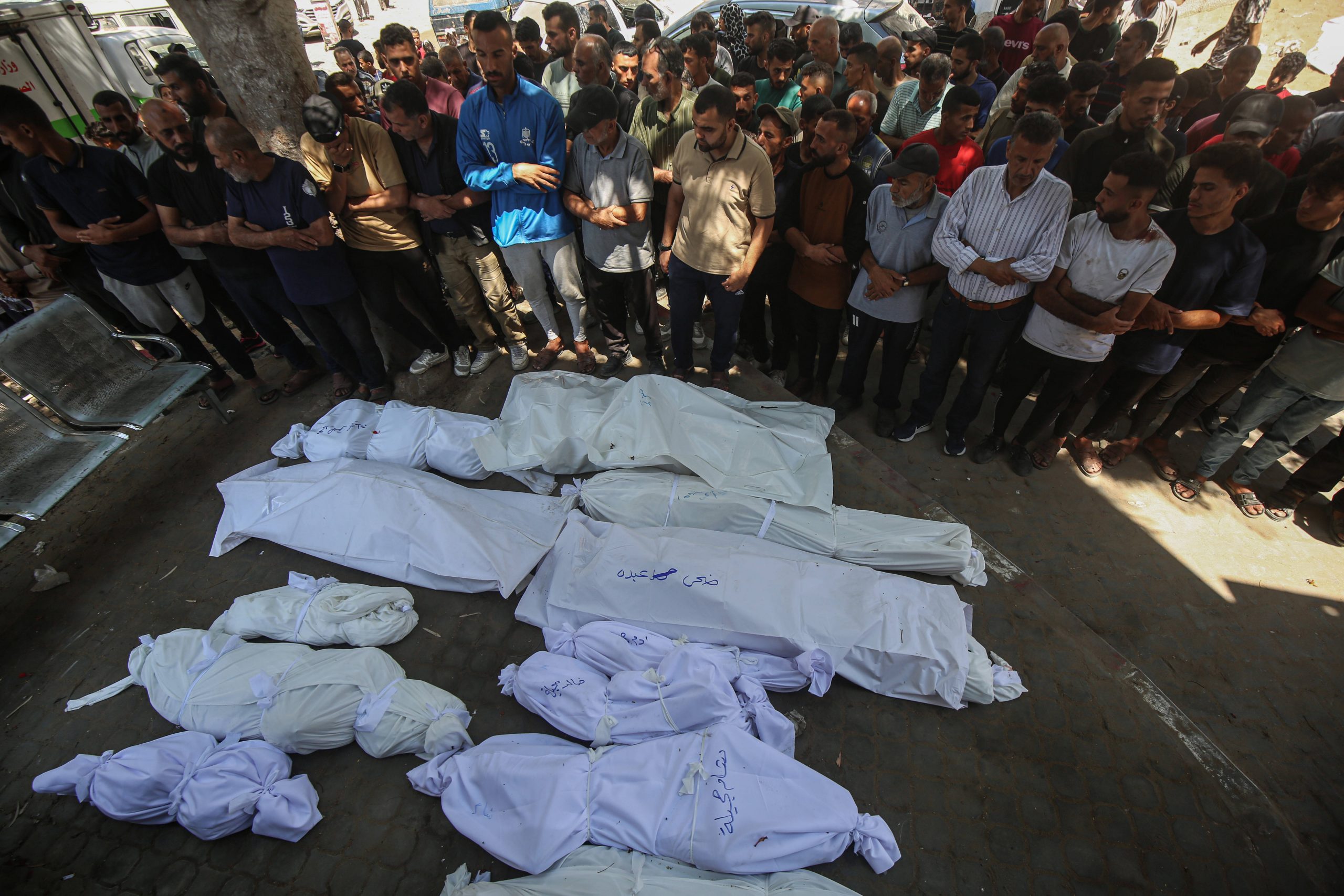
Mourners attend the funeral of Palestinians killed in Israeli attacks on a school sheltering displaced people at Al-Shifa Hospital in Gaza City, July 3, 2025 (IMAGO/APAimages via Reuters Connect)

An Israeli strike on a school sheltering displaced Palestinians in Gaza City killed 15 people. The breakdown of the casualties is unclear, but photos of the funeral for the victims at Al-Shifa Hospital show several tiny bodies wrapped in shrouds.

Medical sources told AP that five Palestinians were killed by Israeli forces along roads while attempting to reach distribution sites run by the US and Israeli-backed Gaza Humanitarian Foundation (GHF), and another 40 were killed while waiting for UN aid trucks in various parts of Gaza.

The Health Ministry said that since the GHF began operating in Gaza at the end of May, 652 Palestinians have been killed while seeking aid. The aid massacres have continued despite more attention on the issue following a report from Haaretz that revealed IDF troops had been given orders to fire on unarmed people near GHF sites.

The AP also reported that American contractors posted at the aid sites have also been using live ammunition and stun grenades to disperse civilians near the distribution sites. In at least one case, one of the contractors who spoke to AP said it appeared fire from the US contractors hit an unarmed Palestinian.

The revelations about the aid killings have not impacted US support for Israel or support for the aid mechanism that has proven to be deadly. The Trump administration recently announced it was providing $30 million to the GHF.

FacebookTwitterWhatsAppRedditLinkedInTumblr

UN rapporteur accuses Israel of ‘one of cruelest genocides’ in modern history; urges arms embargo, global disengagement

July 4, 2025

Francesca Albanese says Gaza has become laboratory for Israeli weapons, calling on states to suspend all trade, investment with Israel

Beyza Binnur Donmez, AA.COM  |03.07.2025 – Update : 04.07.2025

UN rapporteur accuses Israel of 'one of cruelest genocides' in modern history; urges arms embargo, global disengagement

– She names 48 corporate actors, including arms manufacturers, banks, tech companies, energy giants, academic institutions, alleging they are directly linked to broader ‘economy of occupation’ sustaining Israeli actions

GENEVA 

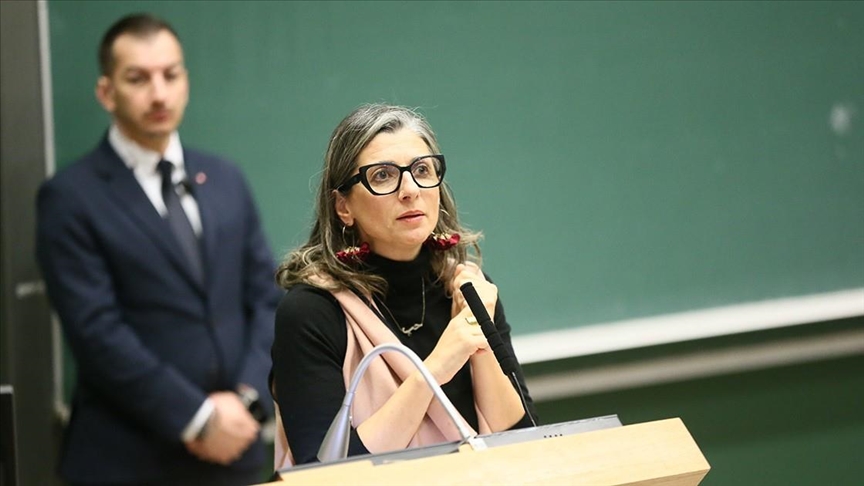
Israel is responsible for “one of the cruelest genocides in modern history,” the UN special rapporteur on the occupied Palestinian territory said on Thursday, accusing Tel Aviv of weaponizing Gaza as a testing ground and calling for sweeping international action, including a full international arms embargo and the suspension of trade and investment ties.

“The situation in the occupied Palestinian territory is apocalyptic,” Francesca Albanese told the UN Human Rights Council, presenting her latest report. “In Gaza, Palestinians continue to endure suffering beyond imagination. Israel is responsible for one of the cruelest genocides in modern history.”

Albanese said official figures count over 200,000 Palestinians killed or injured, but leading health experts estimate “the true toll is far higher.” She denounced the so-called Gaza Humanitarian Foundation – Israel’s new aid mechanism in Gaza, with hundreds of associated deaths to date – as “a death trap – engineered to kill or force the flight of a starved, bombarded, emaciated population marked for.”

Profits from genocide

She grimly highlighted the economic gains made during the war, noting that in the past 20 months, arms companies have reaped huge profits by supplying Israel with weapons used to bombard Gaza.

“Arms companies have turned near-record profits by equipping Israel with cutting-edge weaponry to unleash 85,000 tons of explosives – six times the power of Hiroshima – to destroy Gaza,” she said.

The report also pointed to 213% gains on the Tel Aviv Stock Exchange since October 2023, describing a stark contrast: “One people enriched, one people erased.”

Accusing Israel of using the war to “test new weapons, customized surveillance, lethal drones, (and) radar systems,” Albanese warned that Palestine’s defenselessness had made it “an ideal laboratory for the Israeli military-industrial complex.”

She named 48 corporate actors, including arms manufacturers, banks, tech companies, energy giants, and academic institutions, alleging that they are directly linked to a broader “economy of occupation” sustaining the Israeli state’s actions.

Among the most important firms mentioned in the report are Amazon, Microsoft, BNP Paribas, Booking, and Korean HD Hyundai, according to her report.

“Weapons and data systems brutalize and surveil Palestinians,” she said. “Colonies spread –financed by banks and insurers, powered by fossil fuels, and normalized by tourism platforms, supermarket chains, and academic institutions.”

Later in a press briefing in Geneva, Albanese said she had formally notified all companies named in her report, sharing with them “the facts that I found in violation of international law.”

She emphasized that her work went “beyond what has been done in other similar cases,” explaining: “For each of them, I have provided a detailed analysis, a case by case legal analysis, so where I found their nonconformity with international law translating into violation of the right of self-determination, other human rights violations and even war crimes or crimes against humanity, and to an extent, in which case it could be embroiled in the crime of genocide.”

According to Albanese, 18 companies responded to her findings, while the others did not. Of these 18, she said that “only a small number” engaged with her in good faith, while the rest denied their wrongdoings.

Referring to those in denial, she said: “They don’t understand international law clearly. They think that international law is there to make excuses.”

‘Responsibility to abstain’ or cut ties with ‘economy of occupation’

Under international law, she said, even a minimal connection to this system carries clear responsibility. “There is a prima facie responsibility on every state and corporate entity to completely abstain from or end their relationships with this economy of occupation.”

In a direct appeal to UN member states, Albanese called for bold steps: “Member states must impose a full arms embargo on Israel, suspend all trade agreements and investment relations, and enforce accountability, ensuring that corporate entities face legal consequences for their involvement in serious violations of international law.”

She also called on businesses to act, stressing: “Corporate entities must urgently cease all business activities and terminate relationships directly linked with, contributing to, and causing human rights violations and international crimes against the Palestinian people.”

Albanese said she no longer believed ignorance or ideology were sufficient explanations for global inaction. “In the face of genocide – so visible, so livestreamed – these explanations fall short.”

She concluded with a call for civil society to play its part, saying: “Trade unions, lawyers, civil society groups, and ordinary citizens should encourage such behavioral change from the side of businesses and governments by pressing for boycotts, divestments, sanctions, and accountability. What comes next depends on all of us.”

Anadolu Agency website contains only a portion of the news stories offered to subscribers in the AA News Broadcasting System (HAS), and in summarized form. Please contact us for subscription options.

𝐀𝐈 𝐑𝐞𝐯𝐢𝐞𝐰 𝐨𝐟 “𝐃𝐞𝐯𝐞𝐥𝐨𝐩𝐦𝐞𝐧𝐭 𝐨𝐟 𝐭𝐡𝐞 𝐂𝐨𝐧𝐜𝐞𝐩𝐭 𝐚𝐧𝐝 𝐓𝐡𝐞𝐨𝐫𝐲 𝐨𝐟 𝐀𝐥𝐢𝐞𝐧𝐚𝐭𝐢𝐨𝐧 𝐢𝐧 𝐌𝐚𝐫𝐱’𝐬 𝐖𝐫𝐢𝐭𝐢𝐧𝐠𝐬, 𝐌𝐚𝐫𝐜𝐡 𝟏𝟖𝟒𝟑 𝐭𝐨 𝐀𝐮𝐠𝐮𝐬𝐭 𝟏𝟖𝟒𝟒”

July 2, 2025

 Nasir Khan’s work on Marx’s theory of alienation presents a meticulous analysis of this critical period in Marx’s early thought. By narrowing the focus to just seventeen months, the study provides a detailed exploration of the evolution of Marx’s ideas on alienation, offering a nuanced understanding of Marx’s journey toward articulating a mature theory. Khan’s work situates Marx’s discussions on alienation within the broader intellectual movements of the time and evaluates Marx’s dialogue with his contemporaries, like Feuerbach and Hegel. This work stands out for its in-depth textual analysis and the clarity it brings to complex conceptual developments.

Overview

The main contribution of Nasir Khan’s study is a precise, historically situated analysis of Marx’s concept of alienation spanning March 1843 to August 1844, a crucial period in Marx’s intellectual development. The work meticulously traces the evolution of Marx’s thoughts on alienation against the backdrop of his engagement with the philosophical ideas of Feuerbach and Hegel and highlights the continuous thread of alienation throughout Marx’s oeuvre. The study further attempts to clarify the distinctions between Marx’s early and mature views, emphasizing the foundational role of alienation within Marxian theory.

Relevant References

Including a clear literature review helps reviewers quickly see what’s new and why it matters, which can speed up the review and improve acceptance chances. The following references were selected because they relate closely to the topics and ideas in your submission. They may provide helpful context, illustrate similar methods, or point to recent developments that can strengthen how your work is positioned within the existing literature.

Mészarós, István. Marx’s Theory of Alienation. 2000, https://ci.nii.ac.jp/ncid/BA18224533.

Yi-xia, Wei. “Alienation Theory and the Essence of the Philosophical Revolution of K.Marx.” Journal of Harbin Techers College, 2001, https://en.cnki.com.cn/Articl…/CJFDTOTAL-HEBS200101004.htm.

Galazova, Svetlana S. Chapter 14 Scientific Projections of K. Marx’s “Concept of Alienation.” 2018, doi:10.1108/s1569-375920180000100015.

Hui-yi, Yuan. “The Logical Evolution of Marx’s Theory of Alienation.” Journal of Guangdong Peizheng College, 2010, https://en.cnki.com.cn/Articl…/CJFDTOTAL-GDPZ201002009.htm.

Thompson, Lanny Ace. “The Development of Marx’s Concept of Alienation: An Introduction.” Social Thought & Research, University of Kansas, 1979, doi:10.17161/str.1808.6083.

Wandan, Xin. “Limitations of the Theory of Alienation Propounded by Marx in His Youth.” Chinese Studies in Philosophy, Taylor & Francis, 1984, doi:10.2753/csp1097-1467160190.

Chen, Dezhi. “THE EVOLUTION OF MARX ALIENATION THEORY AND SEVERAL PONDERS.” Journal of Chaohu College, Chaohu University, 2007, https://en.cnki.com.cn/Articl…/CJFDTOTAL-CHXY200701003.htm.

Qing-fa, Zeng. “On Marxs Alienation Theory.” Journal of Wuhan Institute of Shipbuilding Technology, Wuhan Vocational and Technical College of Shipbuilding, 2003, http://en.cnki.com.cn/Article_en/CJFDTOTAL-WHCB200304013.htm.

Xiao, Jin. “Marx’s Theory on Alienation.” Journal of Huanggang Normal Universirt, 2002, http://en.cnki.com.cn/Article_en/CJFDTOTAL-HGXB200204000.htm.

Gui, Zhou. “Marx’s Theory of Alienation: Unity of Humanity Solicitude Dimension and Science Guidance Dimension.” Journal of Southern Yangtze University, Jiangnan University, 2004, http://en.cnki.com.cn/Article_en/CJFDTOTAL-WXQS200403002.htm.

Strengths

Nasir Khan’s manuscript exhibits a high level of scholarly rigor, offering a deep dive into the historical and intellectual contexts that shaped Marx’s understanding of alienation. The focused timeline allows for a detailed examination of the progression of Marx’s thoughts and provides compelling evidence of the continuity of alienation as a central theme throughout Marx’s work. The study is notable for its thorough engagement with primary sources, complemented by an impressive command of the secondary literature, which enhances the reader’s comprehension of complex theoretical developments.

Major Comments

Methodology

The methodology employed in the manuscript is largely based on historical and textual analysis, which suits the research aim of tracking the evolution of a philosophical concept. However, it could benefit from a more explicit framework that would help in teasing out the comparative aspects between Marx’s early and later writings. A structured methodological explanation would strengthen the work’s overall coherence and would facilitate a clearer understanding for readers.

Clarity and Framing

While the manuscript excels in depth, some sections could be made more accessible. For example, explanations of key philosophical terms and clearer sub-sections within chapters could guide the reader through the dense theoretical material. Providing more context or summaries of discussions in the preface or introduction might also aid non-specialists in following Khan’s arguments more easily.

Minor Comments

Glossary Placement

Introducing a glossary of key terms at the beginning rather than the end might help readers less familiar with Marxian terminology better engage with the text. This change could facilitate a smoother reading experience, particularly for interdisciplinary audiences.

Figures and Diagrams

Considering the abstract nature of many points, inclusion of diagrams to represent the interconnections between different elements of Marx’s theory of alienation could be beneficial. Visual aids could provide readers with a concise overview of Khan’s sophisticated analyses.

Reviewer Commentary

Nasir Khan’s work prompts reflection on the relevance of Marx’s theory of alienation today, highlighting its enduring significance in understanding human nature and societal structures. The focus on an early period in Marx’s intellectual journey opens fresh avenues for interdisciplinary discourse, particularly in sociology, economics, and political science. Khan’s analysis reminds us that foundational philosophical theories continue to provide insightful frameworks for examining current socio-economic paradigms.

Summary Assessment

Overall, Nasir Khan’s manuscript offers a thorough and well-researched analysis of Marx’s theory of alienation during a pivotal period of his intellectual life. By tracing the development of Marx’s thoughts with precision and insight, the work contributes meaningfully to Marxist scholarship and invites further exploration of alienation within contemporary contexts. This study stands as a significant scholarly piece that engages both historical and philosophical dimensions, advancing the academic conversation on one of Marx’s most critical and still-relevant concepts.

Upon completion of this review, it becomes apparent that Nasir Khan’s contributions present a scholarly endeavor that enriches our comprehension of Marx’s concept of alienation, prompting continued dialogue and reflection across diverse intellectual traditions.

𝐀𝐭 𝐋𝐞𝐚𝐬𝐭 𝟗𝟓 𝐊𝐢𝐥𝐥𝐞𝐝 𝐢𝐧 𝐆𝐚𝐳𝐚 𝐚𝐬 𝐈𝐬𝐫𝐚𝐞𝐥𝐢 𝐅𝐨𝐫𝐜𝐞𝐬 𝐁𝐨𝐦𝐛 𝐂𝐚𝐟𝐞, 𝐒𝐡𝐨𝐨𝐭 𝐀𝐢𝐝 𝐒𝐞𝐞𝐤𝐞𝐫𝐬

July 1, 2025

At least one journalist was killed and another was injured

by Dave DeCamp, Antiwar. com, Jun 30, 2025

Medical sources told Al Jazeera on Monday that Israeli attacks killed at least 95 Palestinians in Gaza throughout the day as Israeli forces bombed a seaside cafe and gunned down more desperate people who were seeking aid.

According to the Palestinian news agency WAFA, an Israeli airstrike hit the Al-Baqa Cafe in Gaza City, killing 33 people and injuring 50 others. Among the dead was journalist Ismail Abu Hatab, bringing the total number of Palestinian journalists killed since October 7, 2023, to 227, according to WAFA’s count.

Another journalist, Bayan Abu Sultan, was wounded in the attack, and photos and videos of the aftermath show her standing outside the cafe covered in blood. Ali Abu Ateila, a survivor of the airstrike, told The Associated Press that the cafe was struck when it was crowded with women and children.

Journalist Bayan Abu Sultan, after the Israeli airstrike on the Al-Baqa Cafe in western Gaza City on June 30, 2025 (Majdi Fathi via Reuters Connect)

“Without a warning, all of a sudden, a warplane hit the place, shaking it like an earthquake,” Ateila said. The cafe was one of the few businesses that continued to operate in Gaza and was frequently crowded as Palestinians went there to charge their phones and use the internet.

The AP also reported that at least 22 people were killed by Israeli fire while attempting to get aid in different areas of Gaza. The Nasser Hospital in Khan Younis said it received 11 bodies of Palestinians who were killed while returning from an aid site operated by the US and Israeli-backed Gaza Humanitarian Foundation (GHF) in the area. Another Palestinian was killed near an aid site in Rafah.

Gaza’s Health Ministry said that another 10 people were killed at a UN warehouse in northern Gaza. The latest aid-related killings come after a report from the Israeli newspaper Haaretz revealed that Israeli troops are being ordered to fire on unarmed Palestinians attempting to reach GHF distribution sites to drive them away or disperse them, even though they pose no threat.

Israeli forces also launched heavy attacks on the Zeitoun neighborhood in Gaza City on Monday, with residents reporting that the IDF bombed four schools that were sheltering displaced people, and at least 10 Palestinians were killed in the area. “Explosions never stopped; they bombed schools and homes. It felt like earthquakes,” Salah, a 60-year-old father of five children from Gaza City, told Reuters. “In the news we hear a ceasefire is near, on the ground, we see death and we hear explosions.”

Unimpeded Mass Murder, Safari Style

June 30, 2025

Badri Raina

Badri Raina

The Wire, 27/Jun/2025

twitter

The genocidaires of the past gave no food packets; they only killed. Trump and Netanyahu do both at once.

Unimpeded Mass Murder, Safari Style

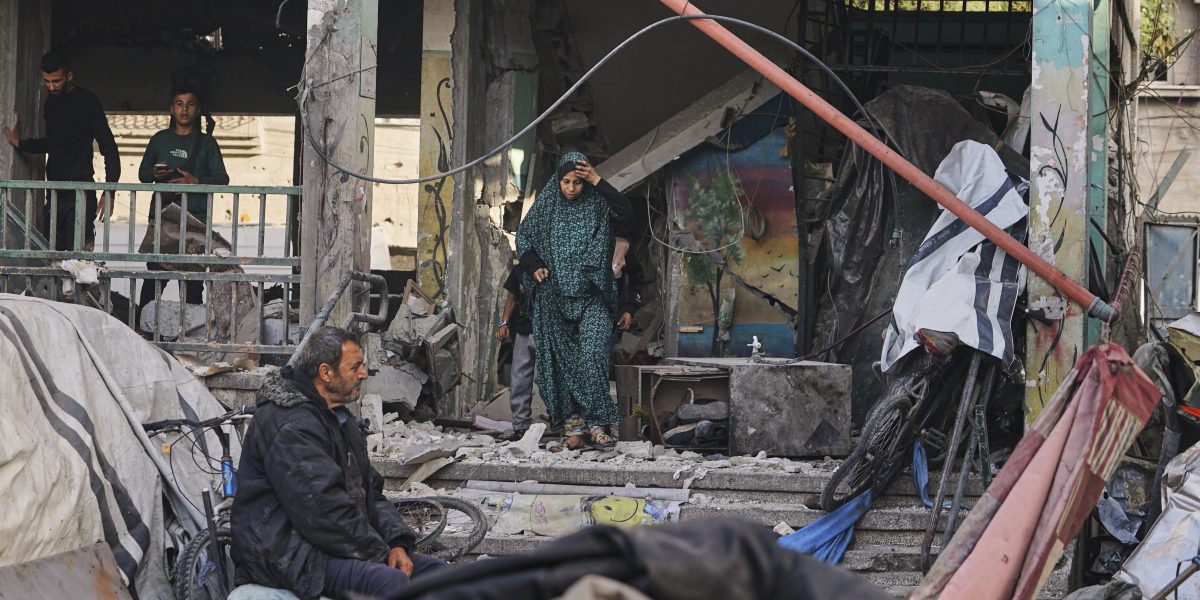
Palestinians inspect the damage at a school used as a shelter by displaced residents that was hit by Israeli military strike and killed at least 36 people, in Gaza City, on Monday, May 26, 2025. Photo: AP/PTI

You just may have noticed that a new ingenious modality of mass murder has been in operation in Gaza.

Call it game-hunting, safari style.

Recall how when some royals used to be taken on a tiger shoot, a bait would be tied to a tree so a big cat could be drawn to it for the dignitary’s  convenient aim.

So now, dangerously famished Palestinian children, women, old folk on spindly legs are got the better of by being drawn to the bait where ostensibly benevolent patrons are ready to hand out food packets.

As soon as they rush to the bait, the guns blaze. As most are eliminated, some manage to grab a packet or two, proving to the world  how the scheme remains such a success at both ends – some get to eat, salving the qualms of those upset at being accused of allowing genocide, others swell the ranks of the dead, facilitating the grand project of ethnic cleansing.

When did the world see so clever a two-timing enterprise?

The genocidaires of the past gave no food packets; they only killed. Trump and Netanyahu do both at once. What could be smarter? And how could anyone object, not that anyone is objecting.

You see, the killings in Gaza are game-hunting; in Ukraine it is people who get killed.

Which brings home another sad reality: Curse me if you will, but as a true follower of the Sanatan Dharma, I have been having trouble reconciling Dharma with ethical indifference to the mass murder of a whole innocent population.

Nothing is closer in exclusionary genius to Hindutva than Zionism

I am unable to swallow the trick that my noble nation’s so-noble government played in the United Nations General Assembly.

Where 149 countries voted in favour of demanding an immediate ceasefire in Gaza, and the resumption of humanitarian aid operated by the United Nations, Naya Bharat abstained from voting.

Perhaps we were setting up an example of how to eat the cake and have it too: after all, nothing is closer in exclusionary genius to Hindutva than Zionism, and nobody more consequential for ensuring Viksit Bharat than Trump, Musk, the Pentagon, Silicon Valley etc.

So, at one canny stroke of turning our face away from genocide, we accomplished the feat of not annoying either of our pals, not knowing how badly this Trump fellow would behave subsequently.

But these are risks great governments have to take in the larger national interest. After all, as Vishwa Guru, the worst we can do is to take sides.

Then, did we not also abandon our so-close friends in the SCO by abstaining there as well when the organisation to which India belongs issued a statement condemning Israel for attacking Iran?

Nobody may thus accuse us of inconsistency in our extraordinary  foreign policy towards the comity of nations.

Now that I am arguing the case, I say mea culpa  for  not being able to square these cunning decisions with my Sanatana Dharma.

So, give me time and I will follow the leader whose  finesse in these matters I have thus far been too incapable of absorbing.

In the meanwhile, the Mecca/Medina Islamic world more than matches us in their brand of sagacious cynicism towards the game-hunt in Gaza.

Also Read: If Trump Turns Tyrant, Can Others Be Far Behind?

As to the fussy International Criminal Court, their warrant of arrest against the conqueror of Palestine and the elimination of innocents remains a residual pinprick from a queasy but defeated world that no longer exists.

Why these judges and prosecutors in the Hague should be receiving either the world’s attention or their salaries from honest tax-payers is a conundrum that may also be up for resolution should Trump and Netanyahu go from strength to strength, should the grand nations of Europe continue to behave with  customary sophistication, and should rising stars like Narendra Modi  show the way to  moral  fusspots whose understanding of great events and great ideas remains atavistic.

So help us god, and so may  the Palestinian lambs-to-the-slaughter know that they serve a noble and mighty purpose in their canonical sacrifice.

Badri Raina taught at Delhi University.

The Wire is now on WhatsApp. Follow our channel for sharp analysis and opinions on the latest developments.

𝐓𝐫𝐮𝐦𝐩 𝐂𝐚𝐥𝐥𝐬 𝐟𝐨𝐫 𝐚𝐧 𝐄𝐧𝐝 𝐭𝐨 𝐍𝐞𝐭𝐚𝐧𝐲𝐚𝐡𝐮’𝐬 𝐂𝐨𝐫𝐫𝐮𝐩𝐭𝐢𝐨𝐧 𝐓𝐫𝐢𝐚𝐥

June 26, 2025

 𝑇ℎ𝑒 𝑝𝑟𝑒𝑠𝑖𝑑𝑒𝑛𝑡 𝑠𝑎𝑖𝑑 𝑡ℎ𝑒 𝑈𝑆 ℎ𝑎𝑠 ‘𝑠𝑎𝑣𝑒𝑑’ 𝐼𝑠𝑟𝑎𝑒𝑙 𝑎𝑛𝑑 𝑤𝑖𝑙𝑙 𝑛𝑜𝑤 ‘𝑠𝑎𝑣𝑒’ 𝑁𝑒𝑡𝑎𝑛𝑦𝑎ℎ𝑢

by Dave DeCampm Antiwar. com, Jun 26, 2025


In a long post on his Truth Social account on Wednesday night, President Trump called for Israeli Prime Minister Benjamin Netanyahu’s corruption trial to come to an end in a strong show of support for the Israeli leader, who is wanted by the International Criminal Court for his role in war crimes in Gaza.

Netanyahu is on trial for three charges of bribery, theft, and breach of trust. “I was shocked to hear that the State of Israel, which has just had one of its Greatest Moments in History, and is strongly led by Bibi Netanyahu, is continuing its ridiculous Witch Hunt against their Great War Time Prime Minister!” Trump said.

“Bibi and I just went through HELL together, fighting a very tough and brilliant longtime enemy of Israel, Iran, and Bibi could not have been better, sharper, or stronger in his LOVE for the incredible Holy Land,” the president added.
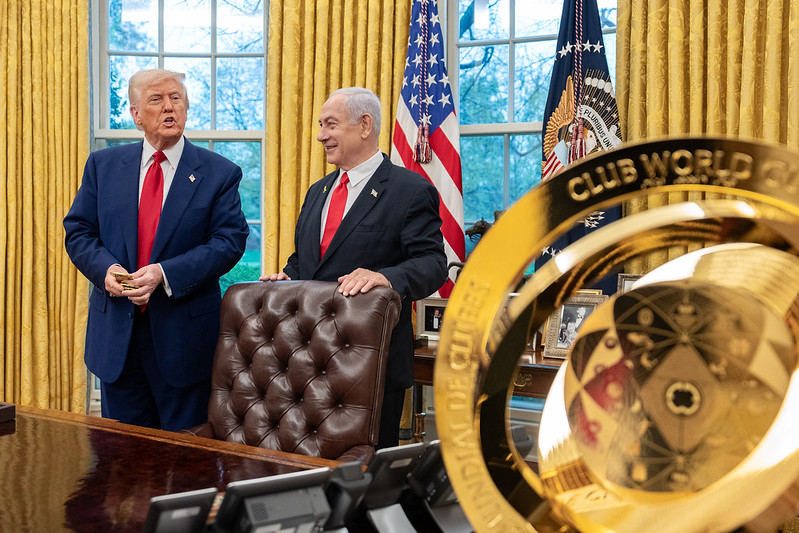
Trump and Netanyahu at the White House on April 7, 2025 (White House photo)

Trump said that he had just learned “that Bibi has been summoned to Court on Monday” and called for the trial to be “CANCELLED, IMMEDIATELY” or for Netanyahu to receive a pardon. “It was the United States of America that saved Israel, and now it is going to be the United States of America that saves Bibi Netanyahu,” he added.

On Thursday, Netanyahu requested that the court delay his testimony and criminal trial by two weeks. His lawyer pointed to Israel’s onslaught in Gaza and its recent war with Iran to justify delaying the trial, saying the Israeli leader must devote “all his time and energy to handling top-priority diplomatic, national, and security issues, including the management of the war in Gaza and dealing with the hostage crisis.”

In a post on X, Netanyahu thanked President Trump for calling for an end to the trial. “Thank You, [President Trump]. I was deeply moved by your heartfelt support for me and your incredible support for Israel and the Jewish people,” he wrote. “I look forward to continue working with you to defeat our common enemies, liberate our hostages and quickly expand the circle of peace.”

Many members of Netanyahu’s government also thanked Trump, while opposition leaders criticized the US president’s intervention in Israel’s affairs. The Trump administration also recently appeared to help Netanyahu resolve a political crisis that threatened his hold on power.

US Ambassador to Israel Mike Huckabee met with ultra-orthodox politicians who were threatening to dissolve the government over the lack of a draft exemption for Haredi Jews and told them that the US would see the move as destabilizing and pointed to Iran as a justification to keep the government together. The crisis was ultimately resolved, and less than a week later, the US backed Israel’s attack on Iran.

Netanyahu’s corruption trial and his desire to remain in power are seen as some of his main motivations for continuing the genocidal war in Gaza and waging other wars in the region.

𝐈𝐦𝐩𝐞𝐫𝐢𝐚𝐥 𝐚𝐠𝐠𝐫𝐞𝐬𝐬𝐢𝐨𝐧 𝐚𝐠𝐚𝐢𝐧𝐬𝐭 𝐈𝐫𝐚𝐧 𝐚𝐧𝐝 𝐢𝐦𝐩𝐞𝐫𝐢𝐚𝐥 𝐝𝐞𝐜𝐞𝐩𝐭𝐢𝐯𝐞 𝐬𝐭𝐚𝐭𝐞𝐦𝐞𝐧𝐭𝐬

June 22, 2025

–Nasir Khan,

BBC News: ‘Sir Keir Starmer has warned of a “risk of escalation” to the Middle East and beyond the region, as he calls for a return to the negotiating table after the US bombed Iranian nuclear sites overnight.’

Mr Starmer, open your eyes, if you can! Your Zionist friends in Tel Aviv attacked and carried out the most brazen aggression against Iran. Mr Trump has aided the criminal regime in Tel Aviv and attacked Iran. You should be telling your accomplices to stop the aggression against Iran and turn to peaceful resolution of whatever conflicts there might be. Iran is under attack. Iran has not turned away from negotiations. Under the cover of negotiations, Mr Trump has allowed and aided the attack on ran by Israel.
Now Mr Trump has used the military power of the mightiest war machine in the world to attack and destroy the nuclear sites in Iran. These sites were not used to produce any nuclear weapons, this was fully corroborated by the US intelligence services, as we all know. Don’t put imperial lies as the commandments of truth and respect for international law!

President Trump Told Netanyahu To ‘Keep Going’ in Iran

June 19, 2025

 Trump said Netanyahu is a ‘good man’ who has been treated ‘unfairly’

by Dave DeCamp, Antiwar.com  | Jun 18, 2025

President Trump said on Wednesday that he told Israeli Prime Minister Benjamin Netanyahu in a phone call a day earlier to “keep going” with his attacks on Iran.

The president told reporters that Netanyahu, who is wanted by the International Criminal Court for his role in war crimes in Gaza, is a “good man” who has been treated “very unfairly” by his own country. “He’s a wartime president. Going through this nonsense — ridiculous,” Trump said.

Trump’s comments about Netanyahu come amid anticipation over whether or not the US will enter Israel’s war with Iran directly by launching airstrikes. The US has supported the assault by providing weapons and intelligence and intercepting Iranian missiles and drones, but so far hasn’t launched direct strikes of its own.

Trump and Netanyahu at the White House on April 7, 2025 (White House photo)

The president also said on Wednesday that “nobody knows” whether he’ll enter the war or not. When asked if he was moving closer on a decision to bomb Iranian nuclear facilities, Trump said, “You don’t know that I’m going to even do it. You don’t know. I may do it. I may not do it. I mean, nobody knows what I’m going to do. I can tell you this, that Iran’s got a lot of trouble.”

In other comments to the press, Trump said he wasn’t interested in an Israel-Iran ceasefire. “We’re not looking for a ceasefire. We’re looking for a total and complete victory. Again, you know what the victory is: no nuclear weapon,” he said.

Netanyahu launched his war of aggression against Iran under the pretext of preventing Iran from obtaining a nuclear weapon, but US intelligence assessed before the attacks that Tehran was not pursuing a nuclear bomb.