A small motorboat passes anchored vessels in the Strait of Hormuz off Bandar Abbas, Iran, Thursday, June 11, 2026. [AP Photo/Amirhosein Khorgooi]
The US launched a new round of strikes on Iran on Friday in the most explicit indication yet that the recently signed Memorandum of Understanding (MOU) has collapsed into an escalating and open conflict. U.S. Central Command (CENTCOM) said its aircraft struck Iranian missile and drone storage locations and coastal radar sites near the Strait of Hormuz.
A report by Al Jazeera said the US strikes were near the Iranian port of Sirik. Al Jazeera also reported that Iran said it had “succeeded in neutralizing” the attack and pledged to retaliate in a statement shared by the ISNA news agency. The statement said, “We emphasize that this aggression will not go unanswered, and our response will be swift and decisive at a time and place of our choosing.”
An Iranian parliamentary security official, Ebrahim Azizi, accused Washington of attacking “in the middle of negotiations once again” and said the US president had shown no commitment to negotiation or ceasefire principles.
According to other reports, the US strikes were carried out in response to Iran’s launching of at least four one-way attack drones at a commercial vessel on Thursday, with one drone striking the ship’s upper deck and damaging it before the vessel continued its course.
CENTCOM confirmed the targets and presented the strikes as a limited but forceful response meant to punish the Iranian attack and deter further action. The reports indicate that the US strikes were not random but targeted the command-and-control infrastructure surrounding Iran’s maritime reach.
The exact physical damage remained unclear, and both CENTCOM and the New York Times noted that the full extent of the damage had not yet been determined. The news reports said the choice of targets was intended to send a message that Washington could hit the systems enabling drone operations and surveillance in the Gulf without widening the war.
However, the response by President Trump and Vice President Vance was both threatening. Trump said Iran’s drone launch amounted to a violation of the ceasefire framework. He then portrayed the US strikes as responding to Iranian aggression rather than initiating escalation. JD Vance gave the direct warning, “… violence will be met with violence.”
Vance added that Iran had signed the ceasefire agreement and that if Tehran had disagreements over implementation, it could “pick up the phone,” but that military retaliation would follow if the agreement was challenged.
Iran said the drone strike was part of its effort to control passage through the Strait of Hormuz and warned that ships using routes outside Tehran’s approved framework would not be guaranteed safe passage or insurance coverage.
More specifically, the statement quoted by CBS said, “Any passage through routes outside the framework designated by PGSA [Persian Gulf Strait Authority] will not be covered by safe passage guarantees and will not be entitled to insurance coverage or related liabilities.”
Other reporting on the same incident says Iranian officials framed the move as a response to insecurity in the waterway and to what Tehran describes as continued US aggression, with Iran later warning vessels to use only routes authorized by Tehran.
Iran has once again rejected the American claim to maritime authority in the Strait of Hormuz. Reuters reported that Tehran insisted it had the right to control shipping there and warned Gulf states not to side with Washington after the cargo ship incident.
The Iranian line is that the strait lies within a contested security zone and that the US and its allies are using “freedom of navigation” language to mask coercive control over a vital strategic waterway. The dispute over the strait is a key issue over whether the MOU means anything in practice.
The reported drone attack itself centered on a commercial vessel, identified in some reporting as the Ever Lovely, which was struck in the Strait of Hormuz near Oman. Trump said three other drones were intercepted, and the ship, while damaged, remained able to continue. AP and Reuters reported that the event led maritime authorities to pause efforts to move ships out of the area, indicating the immediate consequences for commercial traffic.
The MOU, signed only a week earlier, has now shown itself to be a piece of paper with little meaning in a war that has not ended. The language of the deal, including the phrase that Iran would “make arrangements using its best efforts” to ensure safe passage, was ambiguous from the start and left room for interpretation, and it has now become a mechanism for the collapse of the entire MOU.
Reports over the last week have shown that, far from receding, the conflict is broadening with Israeli attacks continuing in Lebanon, and Gaza remains under near-constant assault despite talk about a ceasefire and peace agreements. Just as it has in Gaza, the ceasefire framework contained in the MOU is emerging as a formal cover for the continuation of the imperialist war by other means.
On Friday, Israeli Defense Forces continued ground and aerial operations in southern Lebanon. Actions included combing operations in the border town of Ain Arab, advancing military vehicles toward Haris, a drone strike near Qabrikha and airstrikes near Nabatieh. Israel also dropped leaflets over the town of Mansouri ordering residents to evacuate. The military described this as a “reminder” to keep out of the area for civilian safety.Available from Mehring BooksThe struggle against imperialism and for workers’ power in IranA pamphlet by Keith Jones
Despite US-led negotiations, Israeli warplanes launched two waves of airstrikes targeting the outskirts of Nabatieh al-Fawqa. Following talks in Washington D.C., Israel, Lebanon and the US signed an initial trilateral framework agreement on Friday for restoring sovereignty and establishing “pilot zones” in which the Lebanese Armed Forces will take control.
Prime Minister Benjamin Netanyahu and Defense Minister Israel Katz said Israel will not withdraw its forces from occupied security zones until Hezbollah is disarmed. Hezbollah leadership rejected prior US-brokered deals and maintained that Israel must fully withdraw unconditionally.
Taken together, Friday’s actions show that the ceasefire is highly fragile, if existing at all, and that Israel continued to use military force to pressure villages near the border. The result was continued civilian deaths, displacement and an ongoing clash between formal diplomacy and battlefield realities.
The situation in Gaza, which has been moved off the front page of the news since the war with Iran began on February 28, is even more catastrophic. Palestinian and UN-linked reports say Israel has killed roughly 1,000 Palestinians since the ceasefire was announced, while Gaza’s Government Media Office says Israel has carried out 3,269 violations, killed 992 Palestinians and wounded 3,144 others.
Aid delivery has remained far below what was promised, with only 52,740 trucks entering Gaza out of the 147,000 required, according to the same reporting. These numbers show that the “agreement” has disguised the sustained Israeli campaign of attrition against Palestinians.
The WSWS has explained that the Gaza arrangement was designed to turn the Mediterranean coast into a site for speculative reconstruction once Israel had reduced Gaza City and other towns to rubble.
In this respect, Trump’s “Board of Peace” has served as political theater intended to legitimize a plan of conquest, displacement and future real estate plunder. The same logic now appears in the US-Iran memorandum, which functions less as peace than as an unstable pause inside a larger war project.
The contradictions at the core of the Middle East conflict remain unresolved. The US and Israel are pursuing a strategy aimed at subjugating the region through siege, bombing and occupation. The events on Friday confirm that the military conflict is moving into another stage, not away from it.
Only the independent mobilization of the working class across the Middle East and within the imperialist centers in a unified struggle against war and for socialism can break the cycles that are leading to a Third World War.
Israel has killed over 20,000 Palestinian children since 7 October 2023. The UN has detailed instances of torture, rape and murder in a landmark report
Wounded children wait for medical care at Nasser Medical Complex in Khan Younis in the southern Gaza Strip on 25 May 2026 (AFP)
Published date: 25 June 2026 13:23 BST | Last update:19 hours 50 mins ago
Israeli forces deliberately targeted Palestinian children as a central element of their genocide in Gaza, the UN’s top investigative body on Palestine and Israel concluded this week.
The finding comes in an 88-page report examining the full scope of harm inflicted on children since 7 October 2023, from precision shootings by snipers and drones to torture in detention, reproductive violence and the destruction of schools and hospitals.
“The evidence shows that Palestinian children have been deliberately targeted and killed by the Israeli security forces,” said Srinivasan Muralidhar, chair of the Independent International Commission of Inquiry on the Occupied Palestinian Territory, including East Jerusalem and Israel.
“Even after the October 2025 ceasefire, children continue to be killed and seriously injured, with continued disregard by Israel for the ceasefire and for the protection owed to Palestinian children under international law,” the Indian lawyer and judge said.
The commission, which previously concluded that Israel bore responsibility for genocide in Gaza, found that children were targeted in two ways: directly, through precision weapons including quadcopters and sniper rifles, and indirectly, through the systematic destruction of the conditions necessary for their survival.
New MEE newsletter: Jerusalem Dispatch
Sign up to get the latest insights and analysis on Israel-Palestine, alongside Turkey Unpacked and other MEE newsletters
It named specific Israeli military units responsible for killings and urged the International Criminal Court (ICC) to prioritise crimes against children in its ongoing investigation.
Below, we highlight the report’s key findings.
At least 20,179 children killed
Between the Hamas-led attack of 7 October 2023 and 7 October 2025, Israeli military operations killed at least 20,179 children and wounded 44,143 others in Gaza, representing 30 percent of those killed and 26 percent of those injured.
Children under five accounted for at least 5,031 of the deaths, including 1,029 under the age of one and around 420 newborns.
A further 5,160 children are estimated to be buried under rubble.
The commission noted that the true figure is certainly higher, as many deaths went unrecorded.
Children shot in a deliberate pattern
The commission investigated and documented a consistent pattern of Israeli forces deliberately targeting children using precision weapons.
Seventeen medical practitioners who worked across different hospitals in Gaza described treating large numbers of children with single gunshot wounds to the head and upper body, fired by Israeli snipers or quadcopters.
One doctor said the pattern suggested Israeli soldiers were “deliberately shooting teenage boys in a game of target practice”.
The commission forensically analysed 15 out of 17 cases brought by doctors. In 12 of those cases, the wounds were consistent with a single gunshot.
Among the specific cases documented:
On 29 January 2024, Israeli forces shot and killed five-year-old girl Hind Rajab in Tal al-Hawa, Gaza City, along with six of her family members.
Five-year-old Palestinian girl Hind Rajab was shot and killed by Israeli forces (Supplied)
When two Palestinian Red Crescent paramedics drove to rescue her, Israeli forces shelled their ambulance and killed them too. The commission concluded the 401st Brigade of the 162nd Division deliberately shot the family and obstructed the medical rescue.
On 24 January 2024, Israeli soldiers shot dead a 15-year-old boy in Khan Younis while he held a white flag, stepping out of his family home following an Israeli evacuation order. When his 20-year-old brother ran to help him, Israeli soldiers shot him too. The commission found the 98th Division was operating in the area and concluded the shooting was deliberate.
An Israeli quadcopter operator shot a 10-day-old baby boy in the head while his mother was breastfeeding
On 12 April 2024, an Israeli quadcopter operator shot a 10-day-old baby boy in the head while his mother was breastfeeding him inside a tent in Nuseirat camp. The baby survived but now suffers from seizures. The commission concluded the operator had a clear view inside the tent before firing.
On 24 August 2024, an Israeli quadcopter operator shot a four-year-old girl in the head while she was eating with her family in their tent in Khan Younis. She survived but her left side was paralysed. The commission concluded she was deliberately targeted.
On 10 December 2024, an Israeli sniper shot an eight-year-old boy in the buttock while he was playing outside in the Bureij refugee camp. The bullet lodged in his abdomen wall. Surgeons removed a 3cm bullet. The commission found the 99th Division was operating in the area and assessed the boy was hit by an Israeli sniper rifle.
Several doctors told the commission they treated children with gunshot wounds sustained there.
A GHF truck driver who spent seven weeks in Gaza told investigators he witnessed two teenagers shot in the head by Israeli soldiers while sprinting away. One soldier was overheard remarking that “fingers are light on the trigger”.
Children killed after ceasefire
The October 2025 ceasefire did not stop Israeli forces from killing children. The commission documented more than 100 children killed and hundreds more wounded in the weeks that followed.
Israeli forces redeployed to a newly established demarcation line inside Gaza known as the yellow line, shooting civilians including children who crossed it while trying to return to their homes or collect firewood.
Death toll in Gaza surpasses 73,000 as Israel continues post-ceasefire killings
On 29 November 2025, Israeli forces from the Kfir Brigade fired a drone strike that killed two brothers aged nine and ten near Bani Suheila in southern Gaza while they were gathering firewood for their wheelchair-bound father.
Israeli forces claimed the boys were suspects crossing the yellow line. The commission found the claim baseless: the boys were more than 300 metres from Israeli soldiers, were visibly children collecting wood, and the drone operator had an unobstructed view of them before firing.
On 10 December 2025, Israeli soldiers shot a 16-year-old boy from Jabalia camp and an Israeli tank then ran over his body.
213 children killed in West Bank
Israeli forces killed 213 Palestinian children in the West Bank, including East Jerusalem, between 7 October 2023 and 20 October 2025. The commission found that Israeli forces systematically targeted boys there as a distinct group, labelling them as “terrorists” or “future terrorists”.
On 25 January 2025, soldiers from the Israeli Menashe Brigade shot a two-year-old girl in the back of the head while she was having dinner with her family in south Jenin. She died immediately and is the youngest child killed by Israeli forces in the West Bank since 7 October 2023.
Palestinian children near Ramallah in the occupied West Bank, 22 April 2026 (Mohammed Torokman/Reuters)
On 28 January 2025, soldiers from the Israeli Ephraim Brigade shot a 10-year-old boy at his father’s house during a military incursion in Tulkarm.
CCTV footage showed the boy was unarmed. Israeli soldiers delayed the ambulance taking him to hospital for 30 minutes. One soldier told the boy’s father: “I am the one who shot your son. God willing, he will die.” The boy died of his wounds on 7 February 2025.
‘I am the one who shot your son. God willing, he will die’
– Israeli Ephraim Brigade soldier
On 16 November 2025, soldiers from the Israeli Paratrooper Battalion, operating under the Menashe Brigade, shot a 14-year-old boy during a military raid on the Al-Faraa refugee camp in Tubas.
Israeli soldiers then left him bleeding on the ground for 45 minutes while standing around him. One soldier filmed him on his phone while another placed a stone next to him, in what the commission assessed was an attempt to frame the shooting as a response to stone throwing. Israeli soldiers also pointed gun laser sights at the heads of paramedics to prevent them from reaching the boy, who died.
Israeli authorities withheld his body.
Settlers attacked and abducted children
In the first half of 2025, Israeli settlers carried out more than 1,000 attacks across 230 Palestinian communities.
In April 2025, two settlers abducted two siblings under five years old at knifepoint while they were playing outside their home, dragged them to an olive grove and tied them to a tree.
In August 2024, armed settlers abducted two 15-year-old boys herding cattle, beat them, blindfolded them, stripped them, and sexually assaulted them. A settler urinated on one of the boys and fractured his leg.
Children tortured and sexually abused
Israeli forces have detained over 1,655 children in the West Bank since 7 October 2023, 600 of them in 2025 alone.
As of 31 December 2025, 51 percent of child detainees were held under administrative detention, meaning imprisonment without charge, a record number.
Israeli soldiers subjected the detained children to beatings, blindfolding, handcuffing, stress positions on gravel, and terror by dogs from the moment of arrest. Israeli prison authorities denied children food, water and medical care.
‘I wished for death’: Sexual violence in Israel’s prisons is an ‘organised state policy’
One 15-year-old boy held at the Sde Teiman facility told the commission he was the only child among 70 adults in his cell. Israeli soldiers entered the cell with dogs and ordered detainees to lie on their stomachs before releasing the animals on them. He described his 23 days there as “the worst days of my life”.
Another 15-year-old, detained during mass arrests in Gaza in December 2023, told the commission that Israeli interrogators electrocuted him through a needle inserted into his shoulder, denied him food and water, and forced him into painful positions for up to 12 hours at a time over 54 days before releasing him at the Kerem Shalom crossing with no medical care and no means of reaching his family.
The commission also received testimony that Israeli prison guards raped boys in detention and subjected them to other forms of sexual violence as a systematic component of the detention regime.
On 22 March 2025, a 17-year-old boy from Ramallah died in Megiddo Prison, the commission said. Israeli prison authorities had been aware since December 2024 that he was suffering from head trauma, inadequate food and severe weight loss, but failed to provide proper care.
A post-mortem found he died from severe prolonged malnutrition. Israeli authorities withheld his body from his family for months. The commission found that Israeli prison authorities caused his death and that it amounted to the war crimes of torture, inhuman treatment and wilful killing.
Hospitals and neonatal units destroyed
Israeli forces attacked and forced the closure of all three major paediatric hospitals in Gaza within the first two months of hostilities.
Before October 2023, Gaza had 178 incubators across eight neonatal intensive care units. Israeli attacks and the siege reduced that number to 54 by November 2024. Medical staff described placing three or four infants in a single incubator.
At Al-Nasr Paediatric Hospital, Israeli forces cut electricity and prevented staff from evacuating patients, giving them only 30 minutes to leave. When a ceasefire allowed access weeks later, investigators found four babies decomposing in the neonatal unit, still attached to defunct life-support machines.
The grandmother of baby Idres Al-Dbari, who was killed in an Israeli strike, holds his body at Abu Yousef al-Najjar hospital, Rafah, on 12 December 2023 (Reuters/Mohammed Salem)
At least 15 newborns died of preventable hypothermia between December 2024 and February 2025 as a direct result of conditions imposed by the Israeli siege.
Israel’s blockade and attacks on reproductive healthcare caused miscarriage rates to increase by up to 300 percent after October 2023.
By October 2024, women in Gaza were three times more likely to die in childbirth than before the war.
By March 2026, 70 percent of newborns were classified as premature or underweight.
Schools bombed, demolished and occupied
Israeli forces directly hit 459 of Gaza’s 564 school buildings between 7 October 2023 and October 2025.
Over 97 percent of schools were damaged or destroyed.
‘In my childhood, I’ve always dreamed of blowing up my school. Today I’m blowing up a school. Wow’
– Israeli soldier
Children in Gaza have missed three full school years, and more than 668,000 school-age children were denied access to formal education.
Israeli soldiers filmed themselves demolishing schools and posted the videos online. In one video, a soldier says before blowing up a school: “In my childhood, I’ve always dreamed of blowing up my school. Today I’m blowing up a school. Wow.”
In another, a soldier mocks Palestinian students, saying they will “not be engineers any more”.
The commission found that Israeli forces from the 252nd Division carried out controlled demolitions of at least two UN schools in Beit Hanoun in November 2023.
Israeli forces also seized schools and used them as military bases, weapons stores and barracks.
In the West Bank, Israeli authorities issued demolition orders against 85 schools. Israeli forces raided and expelled more than 550 children from three UN schools in Shu’fat Camp in May 2025.
Siege starved children and brought back polio
By October 2025, Unicef reported 151 child deaths from malnutrition caused by Israel’s siege and blockade. July 2025 was the deadliest month, with 24 children under five dying from malnutrition.
Israel’s blockade also halted a fourth round of polio vaccinations for 600,000 children planned for April 2025. Polio returned to Gaza in August 2024 after 25 years of eradication. It was confirmed in a 10-month-old baby who, a year later, was still unable to stand or move his legs.
Soldiers destroyed children’s belongings
The commission documented at least 35 instances of Israeli soldiers filming themselves in Palestinian homes, schools and public spaces destroying or mocking children’s toys, trophies and belongings, and posting the footage online.
In one video, an Israeli soldier rides a child’s wooden toy horse in a wrecked apartment. In another, Israeli soldiers hang a teddy bear by its neck from a tank barrel.
The commission concluded these acts were not isolated but reflected a deliberate culture of dehumanisation across different units and time periods, with no disciplinary action taken by Israeli military commanders.
The legal findings
The commission concluded on reasonable grounds that Israeli authorities and security forces have continued to commit genocide, crimes against humanity and war crimes in Gaza, and war crimes in the West Bank.
On genocide, the commission found that Israeli forces’ deliberate targeting of children is one of the key elements establishing genocidal intent. Children embody the biological and social continuity of the Palestinian group. The commission found that Israeli forces killed children, caused them serious bodily and mental harm, and deliberately imposed conditions of life calculated to destroy them as part of the broader Palestinian group in Gaza.
She survived an Israeli raid that left babies decomposing. Now she awaits treatment
On crimes against humanity, the commission found that Israeli forces’ killings and maiming of children amount to extermination and murder. Their mistreatment of children in detention amounts to torture and other inhumane acts.
On war crimes, the commission found wilful killing, torture and inhuman treatment, sexual violence, intentional attacks on civilian objects including hospitals, schools and orphanages, and the use of starvation as a method of warfare.
The commission named specific Israeli military units responsible for killings in individual cases and called for accountability for those with command responsibility. Israel did not respond to any of the commission’s 13 requests for information or access.
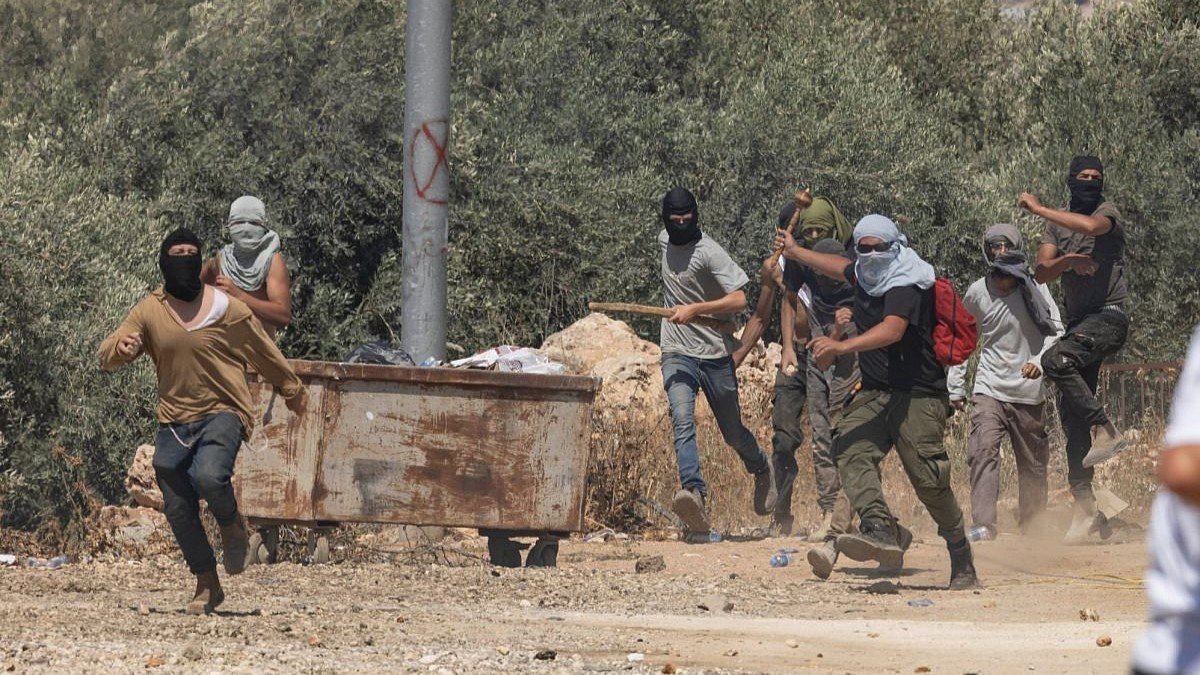
Illegal Israeli settlers launched a coordinated assault against Palestinians and their property in multiple areas of the occupied West Bank over the past 24 hours.
The assault began on 18 June and continued into the early hours of 19 June, with settler attacks persisting on Friday.
Settlers attacked homes in Khirbet al-Himsa, south of occupied Hebron, while also storming the town of Awarta, southeast of Nablus.
The illegal settlers also assaulted shepherds in the Anata plains east of occupied Jerusalem and targeted farmers near Jamala, east of Ramallah.
During the widespread attack, two new illegal settler outposts were established – one on the outskirts of the village of Burqa and one on the outskirts of Deir Abu Mashaal, near Ramallah.
Palestinian media reports said severe damage was inflicted on civilian infrastructure and economic assets in an effort to force Palestinians off their land.
In Al-Taybeh, a Palestinian family was assaulted inside their home before settlers severed their water and electricity lines.
Multiple vehicles were set ablaze or stolen. Later on Friday, settlers destroyed an electricity pole in Beita, south of Nablus.
Several cars and a house were also smashed by settlers in Kifl Haris, north of Salfit.
These massive attacks and pogroms take place on a regular basis.
Perpetrators are rarely prosecuted, and most of the pogroms take place with direct backing from or in coordination with Israeli military forces.
Former Israeli Prime Minister Ehud Olmert wrote in an opinion piece for Haaretz on 19 June that the settler attacks in the occupied West Bank “can no longer be tolerated,” while referring to it as a “systematic campaign of ethnic cleansing and crimes against humanity.”
In his Haaretz piece, the former premier wrote that the settler attacks are “managed, directed, encouraged and supported by the Israeli government.”
“The fight against Jewish terrorism in the West Bank must advance to the next stage and be waged with greater determination,” he added.
Olmert himself was responsible for war crimes during the 2006 Israeli war against Lebanon.
Since Israeli Prime Minister Benjamin Netanyahu’s most recent government took office in late 2022, authorities have accelerated plans for the de facto annexation of the West Bank and East Jerusalem.
In February, the Israeli government approved a land registration process allowing Israel to claim territory in the occupied West Bank as “state property” if Palestinians cannot prove ownership
Since then, scores of new illegal settlements have been approved.
The Iranian delegation led by Mohammad Baqer Ghalibaf, speaker of the Iranian Parliament, arrives to meet with the Pakistani delegation led by Prime Minister Shehbaz Sharif on June 21, 2026 in Obbuergen, Switzerland.
(Photo by Hamed Malekpour/Getty Images)
Abbas Araghchi, Iran’s top diplomat, specifically welcomed the announcement of a “deconfliction cell” aimed at “ensuring the termination of military operations in Lebanon.”
Iran’s top diplomat said late Sunday that peace negotiations in Switzerland have produced “major progress” despite US President Donald Trump’s belligerent military threats and Israel’s continued assault on Lebanon, both of which have risked derailing the high-stakes talks.
Abbas Araghchi, Iran’s foreign minister, credited “tireless Pakistani and Qatari mediation” with securing commitments to establish a “deconfliction cell” to ensure “the termination of military operations in Lebanon,” as required under the recently signed memorandum of understanding (MOU).
Araghchi added that negotiators agreed to an end to the US blockade on Iran, the release of some of Iran’s frozen assets, and a “major reconstruction and development plan” for Iran, whose delegation reportedly left the Swiss negotiating venue on Sunday in response to Trump’s threat to assassinate Iranian diplomats and “take over” the Middle East country. The threats violated the terms of the MOU, which requires parties to “refrain from the threat or use of force against each other.”
In a joint statement late Sunday, the governments of Pakistan and Qatar said that negotiators agreed on “a roadmap towards reaching a final deal within 60 days, laying the foundation for the immediate commencement of further technical talks.
“In addition, a communication line between the parties has been formed… to avoid incidents and miscommunication with the aim of safe passage for commercial vessels through the Strait of Hormuz,” the statement continued. “The mediating parties will continue to do their utmost to ensure that the negotiations continue to be conducted in a constructive atmosphere with the aim of reaching a final deal.”
No paywall. No ads. No billionaire owner. Just you.
Common Dreams is funded exclusively by readers tired of news beholden to corporate interests. Our monthly supporters are the backbone of what makes that possible. Help us reach our Mid-Year Campaign goal of 450 new monthly supporters by July 1.
about:blank
🔊PR No: 1️⃣5️⃣1️⃣/2️⃣0️⃣2️⃣6️⃣
Joint Statement by the State of Qatar and the Islamic Republic of Pakistan Regarding the Conclusion of Lake Lucerne Summit, First High-Level Committee Meeting with Participation of the United States of America and the Islamic Republic of Iran pic.twitter.com/2G3PAf7LVY — Ministry of Foreign Affairs – Pakistan (@ForeignOfficePk) June 22, 2026
The optimistic comments from Iran’s foreign minister and mediators came after the first round of formal talks in Switzerland got off to a shaky start, with Iran’s delegation postponing its arrival due to a deadly barrage of Israeli airstrikes in southern Lebanon late last week.
Israel’s leadership, which is not a party to the peace negotiations, has refused to end its occupation of Lebanon, a major obstacle in the way of a final deal to end the war on Iran that the US and Israel launched in late February. Iran has said the Trump administration must force the Israeli government to end its assault on Lebanon.
In a social media post on Sunday amid the negotiations in Switzerland, Israeli Defense Minister Israel Katz declared that “Israel has no intention of withdrawing from the Beaufort, which is an integral part of the security zone in Lebanon and essential for the defense of the Galilee settlements and IDF forces.”
“As Prime Minister [Benjamin] Netanyahu and I have clarified—Israel will not withdraw from the security zone in Lebanon,” Katz added.
THE fate of Lebanon could determine whether the recently signed MoU between the US and Iran survives.
True to form, Israel is doing all possible to ensure the nascent peace deal is destroyed before the proverbial ink dries, as it continues to mercilessly pound Lebanon. While a supposed ceasefire was announced on Friday, Israeli attacks in Lebanon continued yesterday, with a large number of casualties reported, as the Zionist state hit both the southern and eastern parts of the Arab state in apparent pursuit of its arch-foe Hezbollah.
Tragically, a large number of non-combatants have also been killed in Tel Aviv’s murderous forays, with even steadfast supporters like US President Donald Trump expressing displeasure over its bloodstained tactics.
But the Israeli leadership seems very clear on what it wants to do. For example, the Israeli prime minister has refused to end the occupation of southern Lebanon, while the extremist national security minister has said that “Lebanon must burn”. If this happens, the Iran-US MoU — and the entire region including Israel— may also burn.
At one end of the spectrum, the signatories of the MoU, as well as nations such as Pakistan, which have played key roles in finding a diplomatic off-ramp, are again actively trying to take the negotiation process forward. At the other end, Israel is hell-bent on sabotaging the process.
The international community, principally the US and Europe, must be firm with their friends in Tel Aviv and tell them that their destabilising behaviour must end. The past few months have proven that the biggest threat to Middle East peace is not Iran, but Israel, which has attacked one sovereign state after the other, along with carrying out the Gaza genocide. It must be stopped before it destroys a hard-won chance at peace.
While nearly all US administrations in the past — as well as European states — have mollycoddled Israel and ignored its atrocious behaviour, this time the tone in Washington seems to be hardening. For example, US Vice President J.D. Vance has told Israel to “wake up and smell the reality of the situation”, with reference to Tel Aviv’s displeasure with the Iran deal.
But tough words will not be enough. If the US wants Israel to change its bad behaviour, it must withhold the funds and weapons that are needed by the Zionist war machine to keep functioning. Israel has hardly any friends left in the world, and if the US starts asserting itself, Tel Aviv should listen.
The MoU is unambiguous: the ceasefire must apply to all fronts, including Lebanon. Either Israel must silence its guns and withdraw from all of Lebanon, or face isolation and boycott from the international community until it mends its ways.
Benjamin Netanyahu, Israel’s prime minister in Washington, DC, US, on Monday, Sept. 29, 2025. [Will Oliver/EPA/Bloomberg via Getty Images]
US intelligence agencies have warned the Trump administration that Israeli Prime Minister Benjamin Netanyahu is likely to take actions that could undermine President Donald Trump’s efforts to secure a lasting peace agreement with Iran, according to a report on Friday.
Citing current and former US officials familiar with intelligence assessments, The Washington Post reported that Israel appears determined to continue military operations against Hezbollah in Lebanon despite provisions in the recently signed US-Iran memorandum of understanding calling for an end to military operations on all fronts, including Lebanon.
Even short of escalation, Israel’s refusal to withdraw troops from southern Lebanon is likely to doom the fragile accord, a US official told the Post.
“Continuing to occupy part of Lebanon is a recipe for disaster,” the official said. “Without a full Israeli withdrawal, the likelihood of resumed hostilities between the (Israeli military) and Hezbollah is all but certain.”
Vice President JD Vance on Thursday warned Israel against alienating its “only powerful ally,” saying Trump “is the only head of state in the entire world who is sympathetic to the nation of Israel at this moment in time.”
Separately, a US official confirmed to Anadolu Agency that Israel and Hezbollah agreed to a ceasefire to take effect at 4 pm local time (1300GMT) Friday.
Earlier Friday, at least 31 people were killed and several others injured in a series of Israeli attacks on southern and eastern Lebanon, according to Lebanon’s official National News Agency.
According to the latest official figures, Israel’s military offensive in Lebanon, which began on March 2, has killed 3,912 people, injured 11,873 others, and displaced more than one million residents.
U.S. and Iran flags frame a symbolic diplomatic handshake. [Photo/AA]
Iran postponed the technical-level talks with the US, which were slated for Friday in Switzerland, in protest against “continued” Israeli ceasefire violations, mainly in southern Lebanon, Pakistani government sources told Anadolu Agency.
The sources said that Tehran’s chief negotiator Bagher Qalibaf and Foreign Minister Abbas Araghchi were “all set” to leave for Switzerland to hold direct talks with Washington, but they pulled out of their scheduled trip at the last minute following “directives” from the “top Iranian leadership.”
They did not specify whether the directives came directly from Supreme Leader Seyyed Mojtaba Khamenei, who has already said he has a “different view” on the US-Iran deal to end the war.
No new date or venue for the talks has been decided, the sources added.
“Pakistan is in touch with both sides to set a new date for the technical-level talks to reach a final agreement,” a source close to mediation said.
The signing of the Islamabad Memorandum of Understanding (Islamabad MoU) by US President Donald Trump and Iranian President Masoud Pezeshkian had set the stage for direct talks between Washington and Tehran in Switzerland on Friday.
The source said that US Vice President JD Vance canceled his trip to Switzerland after Islamabad conveyed Tehran’s decision to Washington.
“The logistics of these negotiations have never been simple or predictable. As of now, the Vice President is not departing tonight,” a White House spokesperson said.
“We look forward to beginning technical talks as soon as possible.”
The Swiss Foreign Ministry, in a statement, said that the Friday talks on implementing the agreement to end the war will not take place.
The Islamabad MoU gives officials and experts from the two sides the next 60 days to chalk out a final agreement, which is particularly focused on the Iranian nuclear program, as Trump declared that Tehran cannot have a nuclear weapon.
Pakistani Prime Minister Shehbaz Sharif declared that the Islamabad MoU was effective immediately after signing and said Iran and the US would take measures to open the Strait of Hormuz for full international passage.
Sharif also signed the pact as “mediator.”
The pact calls for immediate and permanent cessation of military operations on all fronts, including in Lebanon, with commitments not to resort to force and to guarantee Lebanon’s sovereignty.
Soon after the US and Israel initiated war on Feb. 28, Iran closed the Hormuz and later, on April 13, American forces imposed their blockade on Iranian ports – making passage of commercial ships nearly impossible through the critical waterway.
Israel has also waged attacks on Lebanon, killing nearly 3800, including civilians and soldiers, since the war began.
Over 3,300 people, including civilians and soldiers, have been killed in Iran, while the US has confirmed the death of 14 personnel, in addition to the loss of armed weaponry and aircraft.
After securing a ceasefire on April 08, Pakistan hosted the highest-level direct talks between the two nations on April 12 and 13 since they severed diplomatic ties in 1979.
Senate Minority Leader Chuck Schumer, Democrat-New York, right, and House Minority Leader Hakeem Jeffries, Democrat-New York, outside the White House in Washington, September 29, 2025. [AP Photo/Evan Vucci]
There are moments that expose the fundamental character of the political system in the United States, that notwithstanding the daily infighting between the Democrats and Republicans, when it comes to the basic interests of American imperialism, the two parties of American capitalism are united.
The publication Thursday of the terms of the memorandum of understanding between the Trump administration and Iran is such a moment. It has triggered an outpouring of criticism from both the Democratic and Republican parties on the grounds that the war US President Donald Trump launched against Iran in February failed to secure American imperialism’s objectives in dominating the Middle East.
Republican former Vice President Mike Pence called the deal “appeasement” this week and demanded that, short of a harsher settlement, “we should let our Armed Forces finish the job on our terms.”
The Democrats joined the Republican condemnation of the agreement, criticizing it in much the same language. Senator Adam Schiff of California called it “a thorough capitulation,” writing that “Iran gets sanctions relief… and a $300 billion reconstruction fund.” Senator Chris Murphy of Connecticut called it “essentially a surrender to Iran.” House Minority Leader Hakeem Jeffries declared that “Iran is stronger and America is less safe” as a result of the agreement.
The New York Times, in an editorial headlined “President Trump Lost This War,” called the agreement “a humiliating comedown” and named Iran “the strategic winner of the four-month war.”
Jacobin magazine, the semi-official publication of the Democratic Socialists of America, criticized Trump’s deal with Iran in language indistinguishable from that of the Republicans and the Democratic leadership.
Jacobin’s article, titled “Donald Trump Has Nothing to Show for His War With Iran,” took the form of an interview with Andreas Krieg, a professor of “defense studies” at King’s College London. The article states that Trump “has ended up in a weaker strategic position than when he started.”
Krieg told the magazine the war had produced “tactical degradation but strategic regression.” Iran, he noted, had not surrendered its enrichment program, its government had not collapsed and “its ability to close Hormuz has been proven rather than deterred.” It offers neither a word of condemnation of the war itself nor any call to oppose it.
The Trump administration waged an illegal war of aggression against Iran, in violation of international law. The war opened with a series of assassinations, including Iran’s supreme leader, Ayatollah Ali Khamenei and much of the country’s military and political leadership. This act of murder and perfidy under cover of negotiations met with approval from both parties. Senate Minority Leader Chuck Schumer said at the time, “I will not shed a tear for Ali Khamenei,” while Jeffries called Iran “a bad actor” that “must be aggressively confronted.”
Throughout the war, the Democrats sought to stifle broad popular opposition to it through a series of meaningless procedural votes, intended to fail. In the massive demonstrations of millions of people under the banner of “No Kings,” Democratic Party organizers worked to deliberately exclude any reference to the war.
But now that the war has failed to achieve Trump’s objectives, the Democrats have found their voice, condemning his “capitulation” to Iran. This is the same party that spent the last year and a half presenting Trump as a colossus whose social and economic policies could not be opposed because he had a “mandate” from the electorate.
In reality, the Democrats, who speak for the same ruling class as Trump, agree with broad sections of Trump’s domestic agenda. Whatever their rhetoric, they believe, together with Trump, that fundamental social programs must be slashed to fund the expansion of the military and the enrichment of the financial oligarchy.
It is in defense of the interests of American imperialism that they are intractable. During his first term, the Democrats chose to impeach Trump not over his assault on democratic rights, but, in 2019, for his insufficient commitment to war with Russia and his withholding of military aid to Ukraine.
Trump’s deal has settled nothing. It is a temporary retreat, and the war could erupt again at any moment. The logic of the Democrats’ position is that were Trump to resume bombing Iran, they would support it.
The Democratic response to the agreement makes clear that their claim to represent any sort of “progressive” opposition to the fascist Trump is a lie. They are ferocious defenders of American imperialism, and should they come to power, there would be no fundamental change in foreign policy.
A world separates the working class from these parties. From the first day of the war, the World Socialist Web Site, the organ of the International Committee of the Fourth International, defined the war by its social character, calling it “a criminal war of aggression by an imperialist power against an oppressed former colony, aimed at plundering its oil wealth and establishing control of the Persian Gulf.” The Socialist Equality Party declared in a statement that it “condemns this war unconditionally and calls on the working class of every country to oppose it,” insisting that “the main enemy is at home” and that American workers “have no interest in a war against the people of Iran.”
The war against Iran is the product of the crisis of American imperialism, which sees no escape from its impasse except war. Every American war since 1991—against Iraq, Afghanistan, Libya and now Iran—has ended in failure, and each defeat has prepared the ground for the next. There is every reason to believe that the debacle in Iran, which has only deepened that crisis, will propel new wars.
But the war has also detonated a social crisis at home. It drove inflation to 4.2 percent in May, the highest in three years, gutting real wages and setting off a rebellion across American industry. Thousands of auto parts workers at Nexteer, Dana and Bridgewater have rejected one concession contract after another—the Dana local in Paris, Tennessee, voting one down by 288 to one—while 1,000 American Axle workers walked out on June 1 in their first strike in 18 years, 1,700 railroad workers across 11 states tore up a nine-year contract and nurses from Boston to Chicago voted to strike.
The movement is not confined to the United States. In Spain, 78,000 teachers in Valencia walked out this spring; Italy and Portugal have each been stopped by a nationwide general strike.
It is this growing eruption of social struggle, centered in the working class that has been made to pay for the war, that is the means to oppose the global offensive of American imperialism. The development of this movement requires a break with both capitalist parties and the building of the Socialist Equality Party, the United States section of the International Committee of the Fourth International.
Israeli attacks in Gaza since the so-called ceasefire deal was signed in October 2025 have now killed more than 1,000 Palestinians, according to Gaza’s Health Ministry, as the IDF has continued its constant violations of the agreement.
The Health Ministry said that over the previous 24 hours, Israeli attacks killed two Palestinians in Gaza, and six Palestinians who succumbed to wounds from previous strikes were added to the death toll, bringing the total number of Palestinians killed since the deal was signed to 1,005.
Another 3,157 Palestinians have been wounded in the time, meaning there have been more than 4,000 Palestinian casualties in the eight-month period.
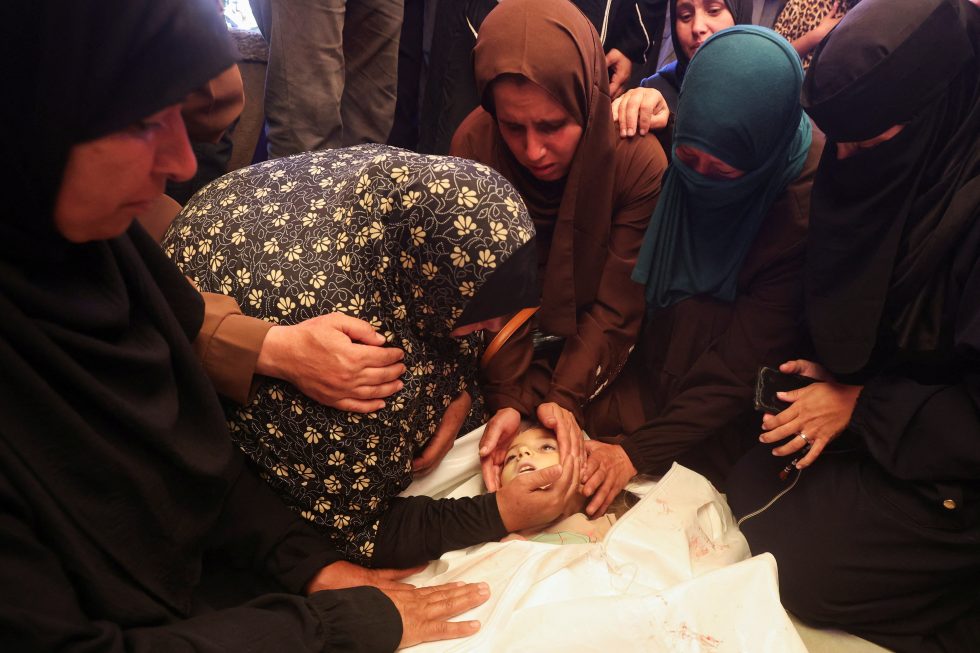
Mourners react during the funeral of six-year-old Palestinian girl Mennatallah Abu Libda, who was killed in an Israeli strike on a tent encampment for displaced families, according to medics, in Khan Younis in the southern Gaza Strip, May 25, 2026. REUTERS/Ramadan Abed
Israeli attacks continued in Gaza on Wednesday, with witnesses telling the Anadolu Agency that an Israeli strike hit beachgoers in the al-Mawasi tent camp in southern Gaza. At least two Palestinians were killed, and six were wounded.
The report said that the area that was bombed was “crowded with beachgoers and displaced families, many of whom had sought refuge by the sea as their only escape from soaring temperatures and deteriorating living conditions in displacement camps.”
Besides the constant strikes, Israel has also violated the deal by taking more territory in Gaza. After the ceasefire agreement was signed, IDF troops occupied about 53% of Gaza, but that has increased to about 60%, and Israeli Prime Minister Benjamin Netanyahu has said that he ordered the military to expand it to 70%.
In recent days, Palestinians have reported IDF troops advancing the “yellow line,” the vague boundary that separates the IDF-occupied side of Gaza from the rest of the Strip, and several families were reportedly displaced in Gaza City on Tuesday as Israeli troops pushed tanks into the area.
The US and Israeli officials have accused Hamas of violating the ceasefire deal by not laying down its weapons, but the agreement that was actually signed didn’t commit Hamas to disarmament.
The two sides agreed to a US proposal that called for the “demilitarization” of Gaza as a framework for negotiations, but the issue of disarmament was meant to be worked out in follow-up negotiations. Hamas has also maintained that it won’t disarm unless there is movement toward the establishment of a Palestinian state. Negotiations on implementing the US plan for Gaza have been ongoing, but there’s been no sign of progress.
A thick plume of smoke rises from an oil storage facility hit by a U.S.-Israeli strike in Tehran, Iran, Sunday, March 8, 2026. [AP Photo/Vahid Salemi]
On Sunday, the United States and Iran announced a ceasefire agreement in the war that the Trump administration launched on February 28. Despite killing more than 3,000 Iranians and triggering a global food and energy crisis, the United States has failed to achieve the objectives for which it went to war.
A “memorandum of understanding” was digitally signed on Sunday, and a formal signing ceremony is scheduled for Friday in Switzerland. The 60-day framework reportedly provides for the reopening of the Strait of Hormuz, the removal of the US naval blockade and the immediate suspension of military operations, including in Lebanon. It commits both sides to subsequent negotiations on Iran’s nuclear program, sanctions and regional security.
Whether the agreement actually holds remains uncertain. The actual text has not been released. Iran has claimed that some $25 billion in frozen Iranian assets have been unfrozen, which the US has disputed. Trump has reiterated that “Iran will never have a nuclear weapon” and warned that the United States “could attack Iran again if negotiations fail.” Israel, not a party to the agreement, has rejected it and continued strikes on Lebanon the same day.
Regardless, the outcome represents an unqualified debacle for American imperialism. It is a case of a schoolyard bully picking a fight and winding up with a black eye. The Iranian government remains in power. Its nuclear program is intact. The most concrete deliverable is the reopening of the Strait of Hormuz, a reversion to the prewar status quo.
There is a staggering chasm between the braggadocio with which the war was launched and the reality of its outcome. Trump promised the war would end with Iran’s “unconditional surrender.” Defense Secretary Pete Hegseth declared on March 2 that the United States was waging “the most lethal … air power campaign in history” with “no stupid rules of engagement.” Days later he promised reporters “death and destruction from the sky, all day long.”
Having spent the year trying to bring the Iranian government down and calling on Iranians in February to “take over your government,” Trump told the Wall Street Journal on Sunday: “I never cared about regime change.”
The media is filled with commentary about the defeat of American imperialism. The Wall Street Journal has called it “a strategic retreat short of achieving his war aims.” It is the operational demonstration, before the world, that the period of unchallenged American dominance that began with the dissolution of the USSR in 1991 has come to an end.
The political character of the American ruling class’s response is captured in the editorial published by the New York Times, speaking for the Democratic Party, under the headline “President Trump Lost This War.” The Times’ concern is not that the war was waged through mass murder and assassination, but that it failed.
“Mr. Trump made a terrible mistake starting this war,” the editorial declares. “He prosecuted it recklessly and in open defiance of the law. The United States is emerging weaker—militarily, diplomatically and economically—and will pay strategic costs for years to come.” The Times bemoans the fact that “On balance, Iran emerges the strategic winner of the four-month war.” The American military “has shown itself unable to quash a much smaller opponent even as it burned through many of its long-range precision missiles and interceptors. The outcome damages this country’s ability to deter other potential adversaries.”
The editorial’s prescription boils down to the statement: “The Pentagon will also need to modernize and prepare for the wars of the future.”
The wars of the future. The Times takes for granted the framework of permanent imperial confrontation, above all, with China and Russia, for which the Pentagon must “modernize and prepare.” What is in question is only the competence with which the framework is administered.
The Democratic congressional response operates within the same framework. Senator Chris Murphy called the deal “essentially surrender to Iran.” Representative Seth Moulton called it “basically a surrender document from Donald Trump to the supreme leader of Iran.” Senator Jack Reed complained that the United States was getting “less than what we had under the JCPOA,” the Obama-era nuclear deal. The Democrats endorsed the war when it was launched. They complain about it now only because it ended without Iran being destroyed.
There was enormous popular opposition to the war, but this found absolutely no expression within the framework of official politics.
The end of this stage of the war does not mean the end of the war. American imperialism will prepare new wars to recover its position. The 2015 JCPOA framework established under Obama was ended by Trump in 2018 and paved the way for the 2026 war. The 2026 ceasefire framework will pave the way for the war that follows.
The most significant consequences of the debacle, however, will be the consequences within the United States.
The war was launched, in part, in an attempt to stop the structural decline of American capitalism. The European Central Bank reported this month that gold has overtaken the euro to become the world’s second-largest reserve asset, at 27 percent of global reserves, up from 20 percent a year earlier. The federal debt crossed 100 percent of GDP in March for the first time since 1946. The failure of the war has accelerated the dollar’s decline and deepened the structural crisis the war was meant to resolve.
The war was launched against the backdrop of escalating social conflict. In the weeks before the war began, mass demonstrations against ICE intensified after the murder of Renée Nicole Good, a 37-year-old poet, and Alex Pretti, a 37-year-old nurse, by federal agents in Minneapolis. The Trump administration’s launching of the war was, among other things, an attempt to deflect this mounting opposition into the channels of patriotic war fever.
Social opposition will now escalate, and it will be increasingly centered in the working class. Auto parts workers at American Axle struck this month. Railroaders, meatpackers, teachers and nurses have walked out. Wall Street rose on news of the deal Sunday, but fuel and food prices remain far above their prewar levels. PCE (Personal Consumption Expenditures) inflation has hit 3.8 percent, the fastest pace since 2021. Consumer sentiment is at all-time lows, worse than during the Great Recession or the pandemic.
Workers have absorbed the costs of the war through rising prices while the corporations profited. The economic impact will provide fuel for class conflict for years to come, in the United States and internationally. The same crisis that produces the war is producing a global movement of the working class against it.
The Trump administration will respond to deepening social opposition with the methods it has demonstrated: ICE raids, mass detention infrastructure, the deployment of the National Guard against domestic protest, the criminalization of political opposition and the consolidation of authoritarian state power. The defeat in Iran will not moderate this trajectory. It will intensify it. The American ruling class, confronted with the failure of its imperialist offensive abroad, will turn with renewed savagery against the working class at home.
The task is the construction of an independent political movement of the working class that is international in scope, socialist in program and politically conscious in its objectives.




 (Photo credit: X)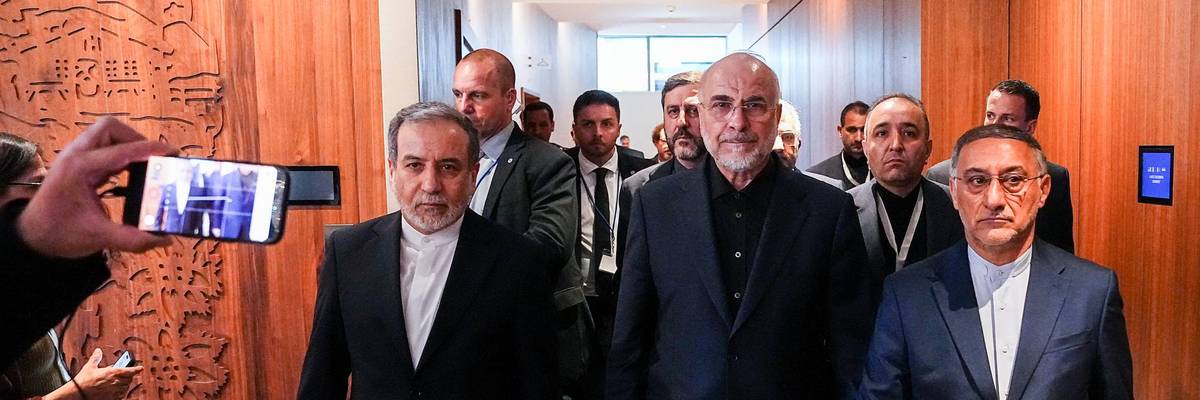
![Benjamin Netanyahu, Israel's prime minister in Washington, DC, US, on Monday, Sept. 29, 2025. [Will Oliver/EPA/Bloomberg via Getty Images]](https://i0.wp.com/www.middleeastmonitor.com/wp-content/uploads/2025/10/GettyImages-2237769324-1-scaled-e1761033629729.jpg?fit=920%2C613&ssl=1)
![U.S. and Iran flags frame a symbolic diplomatic handshake. [Photo/AA]](https://i0.wp.com/www.middleeastmonitor.com/wp-content/uploads/2026/06/thumbs_b_c_83fbfd954e6d536e95e52f191c0df54b-1-1.jpg?fit=920%2C613&ssl=1)


You must be logged in to post a comment.