Posts Tagged ‘Palestine’

Palestinians Report Intensified Israeli Military Operations in the Gaza Strip

July 1, 2026

Gaza’s Health Ministry said Tuesday that at least eight Palestinians were killed over the previous 24 hour period

by Dave DeCamp , Antiwar. com, | June 30, 2026 at 1:30 pm ET | Gaza, Israel

The Israeli military has intensified its military operations across Gaza, the Palestinian news agency WAFA reported on Tuesday, citing its correspondents in the Strip, as the IDF continues its constant violations of the US-backed ceasefire deal.

The report said that the ramped-up activity included the large-scale demolition of homes and civilian infrastructure in the eastern and northeastern areas of the southern city of Khan Younis. In the nearby city of Rafah, WAFA reported heavy artillery shelling and gunfire toward Khan Younis.

In Gaza City, the report said that “Israeli forces detonated a booby-trapped robot loaded with a large quantity of explosives, targeting homes in the Tuffah neighborhood in the northeast of the city” and that there was also “heavy gunfire from military vehicles” in the area and “sporadic explosions.”

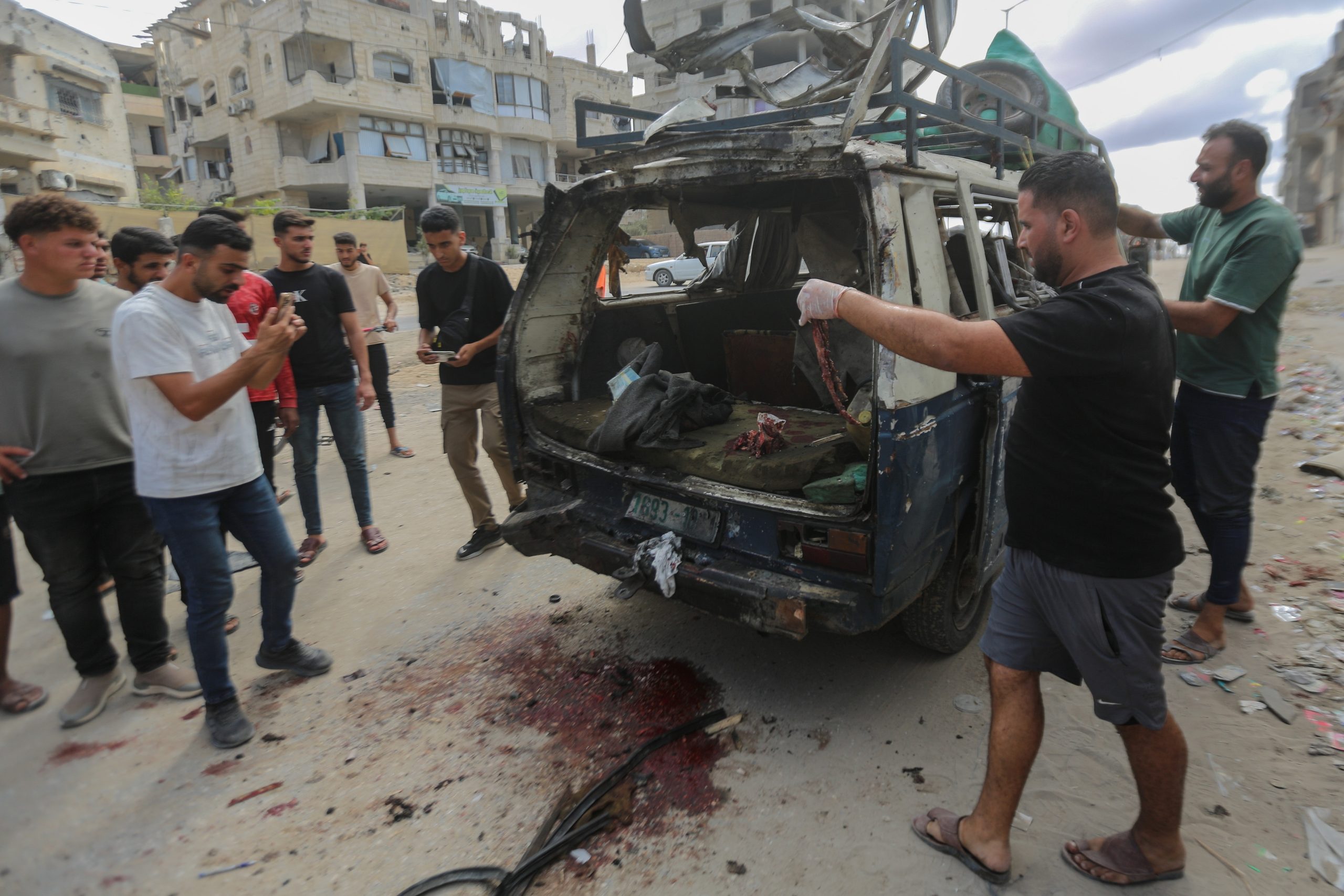
Mourners attend the funeral of Palestinian woman Diana Abu Daraz and her one-year-old daughter, Sewar, who were killed in an Israeli strike on tents, according to medics, outside Nasser Hospital in Khan Younis, in the southern Gaza Strip, June 30, 2026. REUTERS/Ramadan Abed

The news agency also reported that at least two people were killed by an Israeli airstrike near Khan Younis and multiple people were injured by Israeli attacks in Gaza City. Gaza’s Health Ministry said in its daily update that it recorded the Israeli killing of at least eight Palestinians and the injury of 26.

In recent days, Israeli forces have killed multiple children, including a one-year-old girl who was killed alongside her mother in an airstrike targeting a tent in southern Gaza. Palestinians held a funeral for the child and her mother at the Nasser Hospital in Khan Younis on Tuesday.

The escalation in Israeli attacks comes as the IDF has been taking more territory in Gaza, a clear violation of the ceasefire deal. Israeli Prime Minister Benjamin Netanyahu said last month that he ordered the Israeli military to take 70% of Gaza’s territory, up from 60%, and Israeli military officials said last week that the IDF has achieved that goal.

Since the so-called ceasefire deal was signed, the Health Ministry has recorded the Israeli killing of 1,053 Palestinians and the injury of 3,406. “A number of victims are still under the rubble and in the streets, as ambulance and civil defense crews have been unable to reach them so far,” the ministry wrote on Telegram.

‘Response to Antisemitism is Decolonization of Palestine’: Pappé on Zionism and Europe

June 30, 2026

The Palestine Chronicle, June 27, 2026

Ilan Pappé addressed the Second Jewish Anti-Zionist Congress. (Photo: The Palestine Chronicle)

By Romana Rubeo  

Addressing the Second Jewish Anti-Zionist Congress, Ilan Pappé urged Jewish anti-Zionists to challenge Zionism while advancing Palestinian liberation.

‘Universal Voice for Palestine’

DUBLIN – Opening his keynote address at the Second Jewish Anti-Zionist Congress in Dublin, Israeli historian Ilan Pappé admitted that, after more than four decades of activism, he had often questioned whether a specifically Jewish anti-Zionist movement was necessary at all.

After all, he reflected, the struggle for Palestine should never depend on religious or ethnic identity.

“What we need is a universal voice for Palestine,” Pappé said during his address. “Who cares whether you are Jewish, Muslim or Christian? If you are a human being with even a modicum of decency, how can you remain indifferent to the suffering of the Palestinian people?”

Yet, he acknowledged, recent political developments had convinced him that a distinct Jewish anti-Zionist voice remains indispensable—not because Jews bear greater moral responsibility than others, but because Judaism continues to be invoked to justify Israel’s policies and silence criticism of them.

Referring to the appointment of a prominent pro-Israel lobbyist as chief adviser to Britain’s incoming prime minister, Pappé argued that whether such lobbying networks possess the extraordinary influence often attributed to them is almost secondary. What matters politically, he said, is that governments believe they do.

That perception, he argued, continues to shape Western policy, where accusations of antisemitism are routinely weaponized to shield Israel from accountability despite overwhelming evidence documenting occupation, apartheid and genocide.

“This is abnormal,” Pappé said. “It is unjust. It is immoral.”

For that reason, he argued, Jewish anti-Zionists carry a particular responsibility to dismantle the idea that Zionism represents Judaism itself.

“If we fail to challenge the idea that Zionism represents the only authentic expression of Judaism,” he warned, “we should not be surprised if others eventually conclude that this is what Judaism itself represents.”

Solidarity Begins by Listening

Although much of his address focused on challenging dominant political narratives, Pappé repeatedly returned to a simpler principle: solidarity begins by listening to Palestinians rather than speaking for them.

“This Congress is devoted to action,” he said, referring to its theme, From Words to Action. “Solidarity does not consist of telling Palestinians what they need.”

Instead, he argued, Palestinians themselves must define the priorities of the international solidarity movement.

“Our role is to listen,” Pappé said, expressing concern that even within progressive circles, authentic Palestinian voices are still too often marginalized by what he described as lingering colonial—and sometimes Islamophobic—assumptions.

“The stage belongs to Palestinians,” he insisted, “not only to describe their suffering—but to articulate their political vision.”

That responsibility, he argued, extends beyond immediate solidarity work.

Jewish anti-Zionists must also continue dismantling two narratives that remain deeply entrenched across Western societies: the claim that Zionism is the natural expression of Judaism, and the assertion that anti-Zionism is inherently antisemitic.

Both, he said, require sustained historical education rather than political slogans.

“This requires patience,” Pappé observed. “It requires education. It requires historical work.”

Those conversations, he argued, must move beyond audiences already sympathetic to Palestine and reach ordinary people whose understanding of the conflict has largely been shaped by decades of political mythmaking.

Europe’s Unfinished Reckoning

Moving beyond the present, Pappé devoted much of his address to what he described as Europe’s unresolved historical responsibility for Palestine.

The international order established after the Second World War, he argued, presented itself as universal through institutions such as the United Nations and the Universal Declaration of Human Rights. Yet the people designing that order were almost exclusively representatives of colonial powers, while the colonized world remained absent from the conversation.

That omission, he suggested, became decisive when Europe confronted what it called “the Jewish question.”

“When those same leaders confronted what they called ‘the Jewish question,’ almost none of them proposed the obvious solution,” Pappé said. “Almost nobody said: ‘Let us invite Europe’s Jews back into Europe.’”

Instead, he argued, European governments embraced Zionist colonization in Palestine, transferring the consequences of centuries of European antisemitism onto a people who bore no responsibility for those crimes.

Germany, he said, occupies a central place in that history.

Contrary to the dominant postwar narrative, Pappé argued that Germany “was not denazified” in any meaningful political sense. Instead, he said, the country’s relationship with Israel became a substitute for confronting the deeper structures that had produced Nazism and antisemitism.

According to Pappé, postwar reparations did more than compensate Holocaust survivors. They also helped build Israel’s military establishment, while subsequent German political and military support—including assistance that strengthened Israel’s strategic capabilities—cemented a relationship that continues to shape European policy today.

“This historical relationship still shapes contemporary politics,” he said, arguing that Europe has “never fully reckoned with the consequences of exporting its own historical crimes onto the Palestinian people.”

For Pappé, acknowledging that history does not mean imagining that Israeli Jews should somehow return to Europe. Rather, it requires Europe to recognize that Palestinians paid the price for crimes committed on another continent.

Recovering another forgotten history, he continued, is equally important.

Long before Zionism, Palestine formed part of a broader Arab world in which Muslims, Christians and Jews lived together despite inevitable tensions and inequalities.

“There was a Jewish presence in Palestine,” Pappé recalled. “There were Arab Jews.” Almost nobody, he said, believed that the future required an exclusively Jewish state.

That history of coexistence was fractured by colonialism and Zionism, yet it remains one of the strongest challenges to the ideological foundations of the Israeli state.

“Recovering the history of Arab Jewish life,” he argued, “is one of the most powerful ways of dismantling Zionist mythology,” because it demonstrates that coexistence existed before colonialism intervened—and therefore can exist again.

Returning to the central theme of his address, Pappé rejected the idea that nationalism or ethnic supremacy could ever constitute a meaningful response to centuries of antisemitism.

“The greatest response to antisemitism today,” he concluded, “is the decolonization of Palestine.”

That, he argued, requires dismantling Zionism “as a colonial political project” while allowing Palestinians to live as free people “on their own land.”

(The Palestine Chronicle)

– Romana Rubeo is an Italian writer and the managing editor of The Palestine Chronicle. Her articles appeared in many online newspapers and academic journals. She holds a Master’s Degree in Foreign Languages and Literature and specializes in audio-visual and journalism translation.

Israel continues to commit genocide and other atrocity crimes by deliberately targeting Palestinian children

June 27, 2026

United Nations Human Rights, 23 June 2026

Share

Related

Press releases Sudan: Arbitrary detention, torture and enforced disappearances fueling civilian protection crisis, UN Fact-Finding Mission says

Press releases Palestinian civilians are victims of all sides, trapped between the mass atrocities of Israeli forces and settlers and the fear-based rule of Hamas

Press releases Joint Declaration on Sudan – Adopted by the Joint Fact-Finding Mission of the African Commission on Human and Peoples’ Rights on the Human Rights Situation in the Sudan and the United Nations Independent International Fact-Finding Mission for the Sudan

GENEVA – Israeli authorities and security forces have deliberately targeted Palestinian children resulting in genocide, crimes against humanity and war crimes in the Gaza Strip and war crimes in the West Bank, the UN Independent International Commission of Inquiry on the Occupied Palestinian Territory, including East Jerusalem, and Israel said in a new report today.

The Commission, which concluded last year that Israel had committed genocide against the Palestinian group in the Gaza Strip, found that the intense scale and systematic nature of the Israeli military operations have continued – resulting in unprecedented death, injury and trauma of Palestinian children.

The Commission reiterates that the deliberate targeting of children is one of the key elements establishing genocidal intent of the Israeli authorities and security forces to destroy the Palestinian group, in whole or in part, in Gaza.

“The evidence shows that Palestinian children have been deliberately targeted and killed by the Israeli security forces,” said Srinivasan Muralidhar, Chair of the Commission. “Even after the October 2025 ceasefire, children continue to be killed and seriously injured, with continued disregard by Israel for the ceasefire and for the protection owed to Palestinian children under international law.”

Severe physical and mental injuries, mass trauma, orphanhood, separation, disability, repeated displacements, starvation, and the collapse of education and healthcare have erased childhood and will continue to affect children in Gaza throughout their lives.

Palestinian children have been arrested and subjected to torture and other severe forms of mistreatment in Israeli prisons and detention facilities, with no information on their whereabouts. Israeli security forces have also used sexual violence against children as part of the collective shaming and oppression, entrenched within a prolonged, ethnic, gendered, and intergenerational pattern of Israeli occupation and hostilities.

Israel’s targeting of neonatal and maternity care centers in Gaza have directly harmed the survival of newborns and Palestinians’ reproductive future, including rises in miscarriages, birth defects and lasting vulnerabilities among newborns, resulting in the destruction of Palestinian newborn life and the population’s continuity. Starvation imposed by Israel through blockade and siege have further caused the death of Palestinian children and severely impacted the health of many others, depriving them of essential nutrition and increasing disease risks amid reduced immunization, food insecurity and destroyed health services.

In parallel, the dismantling and destruction of orphanages and education facilities in Gaza and the West Bank, including East Jerusalem, have obstructed children’s cognitive, social and emotional care and development and disrupted the foundations of Palestinian society.

“Even if the bombs and guns fall silent in Gaza and West Bank, Palestinian children will not simply recover overnight,” said Muralidhar. “The destruction of their health, education and development is irreversible.”

Palestinian children have suffered immense psychological harm, having been stripped of any sense of safety and future. Mental harm is an intergenerational condition, producing a distinctive “occupied psyche” in which the freedom to play, imagine, hope, and develop an identity has been eroded.

By targeting children, Israel is eroding the foundational structure of Palestinian society, weakening the demographic vitality, and overall capacity of the Palestinian people to sustain and exercise its right to determine its future as a people.

“The protection, care and survival of Palestinian children are inseparable from the Palestinian people’s right to self-determination,” said Muralidhar. “By targeting children, Israel is attacking the very capacity of the Palestinian people to exist and to determine their future.”

The Commission calls for Israel to cease committing violations and crimes against and affecting Palestinian children. The Commission further calls for the end of Israel’s continuing presence in the occupied West Bank, including East Jerusalem, in compliance with the advisory opinion of the International Court of Justice.

The Commission has identified military units within the Israeli security forces responsible for killing and injuring of Palestinian children and makes recommendations to Israel and to all Member States to ensure accountability for such crimes.

The international community as a whole must uphold their international legal obligations and call for an end to the hostilities, for Israel to end its occupation and to prioritize accountability and access to justice for victims as an integral component of any political process, grounded in the meaningful participation of Palestinians, including children.

Read the full report in English.

ENDS

Background: The UN Independent International Commission of Inquiry on the Occupied Palestinian Territory, including East Jerusalem, and Israel was established by the UN Human Rights Council on 27 May 2021 to “investigate, in the Occupied Palestinian Territory, including East Jerusalem, and in Israel, all alleged violations of international humanitarian law and all alleged violations and abuses of international human rights law leading up to and since 13 April 2021.” Resolution A/HRC/RES/S-30/1 further requested the commission of inquiry to “investigate all underlying root causes of recurrent tensions, instability and protraction of conflict, including systematic discrimination and repression based on national, ethnic, racial or religious identity.”

For media queries, please contact: Todd Pitman, Media Adviser for the UN Human Rights Council’s Investigative Bodies: todd.pitman@un.org / +41766911761; or Pascal sim, Human Rights Council Media Officer: simp@un.org.

Drones and decomposing babies: What’s in UN report on Israel’s genocide of Palestinian children

June 26, 2026

Israel has killed over 20,000 Palestinian children since 7 October 2023. The UN has detailed instances of torture, rape and murder in a landmark report

Wounded children wait for medical care at Nasser Medical Complex in Khan Younis in the southern Gaza Strip on 25 May 2026 (AFP)

By Sondos Asem

Published date: 25 June 2026 13:23 BST | Last update:19 hours 50 mins ago

Israeli forces deliberately targeted Palestinian children as a central element of their genocide in Gaza, the UN’s top investigative body on Palestine and Israel concluded this week.

The finding comes in an 88-page report examining the full scope of harm inflicted on children since 7 October 2023, from precision shootings by snipers and drones to torture in detention, reproductive violence and the destruction of schools and hospitals.

“The evidence shows that Palestinian children have been deliberately targeted and killed by the Israeli security forces,” said Srinivasan Muralidhar, chair of the Independent International Commission of Inquiry on the Occupied Palestinian Territory, including East Jerusalem and Israel.

“Even after the October 2025 ceasefire, children continue to be killed and seriously injured, with continued disregard by Israel for the ceasefire and for the protection owed to Palestinian children under international law,” the Indian lawyer and judge said.

The commission, which previously concluded that Israel bore responsibility for genocide in Gaza, found that children were targeted in two ways: directly, through precision weapons including quadcopters and sniper rifles, and indirectly, through the systematic destruction of the conditions necessary for their survival.

New MEE newsletter: Jerusalem Dispatch

Sign up to get the latest insights and analysis on Israel-Palestine, alongside Turkey Unpacked and other MEE newsletters

It named specific Israeli military units responsible for killings and urged the International Criminal Court (ICC) to prioritise crimes against children in its ongoing investigation.

Below, we highlight the report’s key findings.

At least 20,179 children killed

Between the Hamas-led attack of 7 October 2023 and 7 October 2025, Israeli military operations killed at least 20,179 children and wounded 44,143 others in Gaza, representing 30 percent of those killed and 26 percent of those injured.

Children under five accounted for at least 5,031 of the deaths, including 1,029 under the age of one and around 420 newborns.

A further 5,160 children are estimated to be buried under rubble.

The commission noted that the true figure is certainly higher, as many deaths went unrecorded.

Children shot in a deliberate pattern

The commission investigated and documented a consistent pattern of Israeli forces deliberately targeting children using precision weapons.

Seventeen medical practitioners who worked across different hospitals in Gaza described treating large numbers of children with single gunshot wounds to the head and upper body, fired by Israeli snipers or quadcopters.

One doctor said the pattern suggested Israeli soldiers were “deliberately shooting teenage boys in a game of target practice”.

The commission forensically analysed 15 out of 17 cases brought by doctors. In 12 of those cases, the wounds were consistent with a single gunshot.

Among the specific cases documented:

On 29 January 2024, Israeli forces shot and killed five-year-old girl Hind Rajab in Tal al-Hawa, Gaza City, along with six of her family members. 

Hind Rajab
Five-year-old Palestinian girl Hind Rajab was shot and killed by Israeli forces (Supplied)

When two Palestinian Red Crescent paramedics drove to rescue her, Israeli forces shelled their ambulance and killed them too. The commission concluded the 401st Brigade of the 162nd Division deliberately shot the family and obstructed the medical rescue.

On 24 January 2024, Israeli soldiers shot dead a 15-year-old boy in Khan Younis while he held a white flag, stepping out of his family home following an Israeli evacuation order. When his 20-year-old brother ran to help him, Israeli soldiers shot him too. The commission found the 98th Division was operating in the area and concluded the shooting was deliberate.

An Israeli quadcopter operator shot a 10-day-old baby boy in the head while his mother was breastfeeding

On 12 April 2024, an Israeli quadcopter operator shot a 10-day-old baby boy in the head while his mother was breastfeeding him inside a tent in Nuseirat camp. The baby survived but now suffers from seizures. The commission concluded the operator had a clear view inside the tent before firing.

On 24 August 2024, an Israeli quadcopter operator shot a four-year-old girl in the head while she was eating with her family in their tent in Khan Younis. She survived but her left side was paralysed. The commission concluded she was deliberately targeted.

On 10 December 2024, an Israeli sniper shot an eight-year-old boy in the buttock while he was playing outside in the Bureij refugee camp. The bullet lodged in his abdomen wall. Surgeons removed a 3cm bullet. The commission found the 99th Division was operating in the area and assessed the boy was hit by an Israeli sniper rifle.

Children shot at food distribution sites

From May 2025, Israeli soldiers shot children at or near Gaza Humanitarian Foundation (GHF) aid sites.

Several doctors told the commission they treated children with gunshot wounds sustained there.

A GHF truck driver who spent seven weeks in Gaza told investigators he witnessed two teenagers shot in the head by Israeli soldiers while sprinting away. One soldier was overheard remarking that “fingers are light on the trigger”.

Children killed after ceasefire

The October 2025 ceasefire did not stop Israeli forces from killing children. The commission documented more than 100 children killed and hundreds more wounded in the weeks that followed.

Israeli forces redeployed to a newly established demarcation line inside Gaza known as the yellow line, shooting civilians including children who crossed it while trying to return to their homes or collect firewood.

Death toll in Gaza surpasses 73,000 as Israel continues post-ceasefire killings

Read More »

On 29 November 2025, Israeli forces from the Kfir Brigade fired a drone strike that killed two brothers aged nine and ten near Bani Suheila in southern Gaza while they were gathering firewood for their wheelchair-bound father.

Israeli forces claimed the boys were suspects crossing the yellow line. The commission found the claim baseless: the boys were more than 300 metres from Israeli soldiers, were visibly children collecting wood, and the drone operator had an unobstructed view of them before firing.

On 10 December 2025, Israeli soldiers shot a 16-year-old boy from Jabalia camp and an Israeli tank then ran over his body.

213 children killed in West Bank

Israeli forces killed 213 Palestinian children in the West Bank, including East Jerusalem, between 7 October 2023 and 20 October 2025. The commission found that Israeli forces systematically targeted boys there as a distinct group, labelling them as “terrorists” or “future terrorists”.

On 25 January 2025, soldiers from the Israeli Menashe Brigade shot a two-year-old girl in the back of the head while she was having dinner with her family in south Jenin. She died immediately and is the youngest child killed by Israeli forces in the West Bank since 7 October 2023.

Children near Ramallah
Palestinian children near Ramallah in the occupied West Bank, 22 April 2026 (Mohammed Torokman/Reuters)

On 28 January 2025, soldiers from the Israeli Ephraim Brigade shot a 10-year-old boy at his father’s house during a military incursion in Tulkarm.

CCTV footage showed the boy was unarmed. Israeli soldiers delayed the ambulance taking him to hospital for 30 minutes. One soldier told the boy’s father: “I am the one who shot your son. God willing, he will die.” The boy died of his wounds on 7 February 2025.

‘I am the one who shot your son. God willing, he will die’

Israeli Ephraim Brigade soldier

On 16 November 2025, soldiers from the Israeli Paratrooper Battalion, operating under the Menashe Brigade, shot a 14-year-old boy during a military raid on the Al-Faraa refugee camp in Tubas.

Israeli soldiers then left him bleeding on the ground for 45 minutes while standing around him. One soldier filmed him on his phone while another placed a stone next to him, in what the commission assessed was an attempt to frame the shooting as a response to stone throwing. Israeli soldiers also pointed gun laser sights at the heads of paramedics to prevent them from reaching the boy, who died.

Israeli authorities withheld his body.

Settlers attacked and abducted children

In the first half of 2025, Israeli settlers carried out more than 1,000 attacks across 230 Palestinian communities.

In April 2025, two settlers abducted two siblings under five years old at knifepoint while they were playing outside their home, dragged them to an olive grove and tied them to a tree.

In August 2024, armed settlers abducted two 15-year-old boys herding cattle, beat them, blindfolded them, stripped them, and sexually assaulted them. A settler urinated on one of the boys and fractured his leg.

Children tortured and sexually abused 

Israeli forces have detained over 1,655 children in the West Bank since 7 October 2023, 600 of them in 2025 alone.

As of 31 December 2025, 51 percent of child detainees were held under administrative detention, meaning imprisonment without charge, a record number.

Israeli soldiers subjected the detained children to beatings, blindfolding, handcuffing, stress positions on gravel, and terror by dogs from the moment of arrest. Israeli prison authorities denied children food, water and medical care. 

‘I wished for death’: Sexual violence in Israel’s prisons is an ‘organised state policy’

Read More »

One 15-year-old boy held at the Sde Teiman facility told the commission he was the only child among 70 adults in his cell. Israeli soldiers entered the cell with dogs and ordered detainees to lie on their stomachs before releasing the animals on them. He described his 23 days there as “the worst days of my life”.

Another 15-year-old, detained during mass arrests in Gaza in December 2023, told the commission that Israeli interrogators electrocuted him through a needle inserted into his shoulder, denied him food and water, and forced him into painful positions for up to 12 hours at a time over 54 days before releasing him at the Kerem Shalom crossing with no medical care and no means of reaching his family.

The commission also received testimony that Israeli prison guards raped boys in detention and subjected them to other forms of sexual violence as a systematic component of the detention regime.

On 22 March 2025, a 17-year-old boy from Ramallah died in Megiddo Prison, the commission said. Israeli prison authorities had been aware since December 2024 that he was suffering from head trauma, inadequate food and severe weight loss, but failed to provide proper care.

A post-mortem found he died from severe prolonged malnutrition. Israeli authorities withheld his body from his family for months. The commission found that Israeli prison authorities caused his death and that it amounted to the war crimes of torture, inhuman treatment and wilful killing.

Hospitals and neonatal units destroyed

Israeli forces attacked and forced the closure of all three major paediatric hospitals in Gaza within the first two months of hostilities.

Before October 2023, Gaza had 178 incubators across eight neonatal intensive care units. Israeli attacks and the siege reduced that number to 54 by November 2024. Medical staff described placing three or four infants in a single incubator.

At Al-Nasr Paediatric Hospital, Israeli forces cut electricity and prevented staff from evacuating patients, giving them only 30 minutes to leave. When a ceasefire allowed access weeks later, investigators found four babies decomposing in the neonatal unit, still attached to defunct life-support machines. 

The grandmother of Palestinian baby Idres Al-Dbari, who was born during the war and killed in an Israeli strike, reacts at Abu Yousef al-Najjar hospital in Rafah in the southern Gaza Strip 12 December 2023 (Reuters/Mohammed Salem)
The grandmother of baby Idres Al-Dbari, who was killed in an Israeli strike, holds his body at Abu Yousef al-Najjar hospital, Rafah, on 12 December 2023 (Reuters/Mohammed Salem)

At least 15 newborns died of preventable hypothermia between December 2024 and February 2025 as a direct result of conditions imposed by the Israeli siege.

Israel’s blockade and attacks on reproductive healthcare caused miscarriage rates to increase by up to 300 percent after October 2023.

By October 2024, women in Gaza were three times more likely to die in childbirth than before the war.

By March 2026, 70 percent of newborns were classified as premature or underweight.

Schools bombed, demolished and occupied

Israeli forces directly hit 459 of Gaza’s 564 school buildings between 7 October 2023 and October 2025.

Over 97 percent of schools were damaged or destroyed.

‘In my childhood, I’ve always dreamed of blowing up my school. Today I’m blowing up a school. Wow’

Israeli soldier

Children in Gaza have missed three full school years, and more than 668,000 school-age children were denied access to formal education.

Israeli soldiers filmed themselves demolishing schools and posted the videos online. In one video, a soldier says before blowing up a school: “In my childhood, I’ve always dreamed of blowing up my school. Today I’m blowing up a school. Wow.”

In another, a soldier mocks Palestinian students, saying they will “not be engineers any more”.

The commission found that Israeli forces from the 252nd Division carried out controlled demolitions of at least two UN schools in Beit Hanoun in November 2023.

Israeli forces also seized schools and used them as military bases, weapons stores and barracks.

In the West Bank, Israeli authorities issued demolition orders against 85 schools. Israeli forces raided and expelled more than 550 children from three UN schools in Shu’fat Camp in May 2025.

Siege starved children and brought back polio

By October 2025, Unicef reported 151 child deaths from malnutrition caused by Israel’s siege and blockade. July 2025 was the deadliest month, with 24 children under five dying from malnutrition.

Israel’s blockade also halted a fourth round of polio vaccinations for 600,000 children planned for April 2025. Polio returned to Gaza in August 2024 after 25 years of eradication. It was confirmed in a 10-month-old baby who, a year later, was still unable to stand or move his legs.

Soldiers destroyed children’s belongings

The commission documented at least 35 instances of Israeli soldiers filming themselves in Palestinian homes, schools and public spaces destroying or mocking children’s toys, trophies and belongings, and posting the footage online.

In one video, an Israeli soldier rides a child’s wooden toy horse in a wrecked apartment. In another, Israeli soldiers hang a teddy bear by its neck from a tank barrel.

The commission concluded these acts were not isolated but reflected a deliberate culture of dehumanisation across different units and time periods, with no disciplinary action taken by Israeli military commanders.

The legal findings

The commission concluded on reasonable grounds that Israeli authorities and security forces have continued to commit genocide, crimes against humanity and war crimes in Gaza, and war crimes in the West Bank.

On genocide, the commission found that Israeli forces’ deliberate targeting of children is one of the key elements establishing genocidal intent. Children embody the biological and social continuity of the Palestinian group. The commission found that Israeli forces killed children, caused them serious bodily and mental harm, and deliberately imposed conditions of life calculated to destroy them as part of the broader Palestinian group in Gaza.

She survived an Israeli raid that left babies decomposing. Now she awaits treatment

Read More »

On crimes against humanity, the commission found that Israeli forces’ killings and maiming of children amount to extermination and murder. Their mistreatment of children in detention amounts to torture and other inhumane acts. 

On war crimes, the commission found wilful killing, torture and inhuman treatment, sexual violence, intentional attacks on civilian objects including hospitals, schools and orphanages, and the use of starvation as a method of warfare.

The commission named specific Israeli military units responsible for killings in individual cases and called for accountability for those with command responsibility. Israel did not respond to any of the commission’s 13 requests for information or access.

Israeli settlers launch coordinated 24-hour rampage across occupied West Bank

June 22, 2026

Former Israeli premier Ehud Olmert has called the ongoing pogroms in the occupied West Bank a ‘systematic campaign’ of ‘Jewish terrorism’

News Desk, The Cradle, JUN 19, 2026

(Photo credit: X)

Illegal Israeli settlers launched a coordinated assault against Palestinians and their property in multiple areas of the occupied West Bank over the past 24 hours.

The assault began on 18 June and continued into the early hours of 19 June, with settler attacks persisting on Friday. 

Settlers attacked homes in Khirbet al-Himsa, south of occupied Hebron, while also storming the town of Awarta, southeast of Nablus.

The illegal settlers also assaulted shepherds in the Anata plains east of occupied Jerusalem and targeted farmers near Jamala, east of Ramallah. 

During the widespread attack, two new illegal settler outposts were established – one on the outskirts of the village of Burqa and one on the outskirts of Deir Abu Mashaal, near Ramallah. 

Palestinian media reports said severe damage was inflicted on civilian infrastructure and economic assets in an effort to force Palestinians off their land.

In Al-Taybeh, a Palestinian family was assaulted inside their home before settlers severed their water and electricity lines.

Multiple vehicles were set ablaze or stolen. Later on Friday, settlers destroyed an electricity pole in Beita, south of Nablus. 

Several cars and a house were also smashed by settlers in Kifl Haris, north of Salfit. 

These massive attacks and pogroms take place on a regular basis. 

Perpetrators are rarely prosecuted, and most of the pogroms take place with direct backing from or in coordination with Israeli military forces.

Former Israeli Prime Minister Ehud Olmert wrote in an opinion piece for Haaretz on 19 June that the settler attacks in the occupied West Bank “can no longer be tolerated,” while referring to it as a “systematic campaign of ethnic cleansing and crimes against humanity.”

In his Haaretz piece, the former premier wrote that the settler attacks are “managed, directed, encouraged and supported by the Israeli government.”

“The fight against Jewish terrorism in the West Bank must advance to the next stage and be waged with greater determination,” he added.

Olmert himself was responsible for war crimes during the 2006 Israeli war against Lebanon.

Since Israeli Prime Minister Benjamin Netanyahu’s most recent government took office in late 2022, authorities have accelerated plans for the de facto annexation of the West Bank and East Jerusalem. 

In February, the Israeli government approved a land registration process allowing Israel to claim territory in the occupied West Bank as “state property” if Palestinians cannot prove ownership

Since then, scores of new illegal settlements have been approved. 

Israel Has Killed More Than 1,000 Palestinians in Gaza Since So-Called Ceasefire Deal Was Signed in October 2025

June 18, 2026

by Dave DeCamp | June 17, 2026

Israeli attacks in Gaza since the so-called ceasefire deal was signed in October 2025 have now killed more than 1,000 Palestinians, according to Gaza’s Health Ministry, as the IDF has continued its constant violations of the agreement.

The Health Ministry said that over the previous 24 hours, Israeli attacks killed two Palestinians in Gaza, and six Palestinians who succumbed to wounds from previous strikes were added to the death toll, bringing the total number of Palestinians killed since the deal was signed to 1,005.

Another 3,157 Palestinians have been wounded in the time, meaning there have been more than 4,000 Palestinian casualties in the eight-month period.

Mourners react during the funeral of six-year-old Palestinian girl Mennatallah Abu Libda, who was killed in an Israeli strike on a tent encampment for displaced families, according to medics, in Khan Younis in the southern Gaza Strip, May 25, 2026. REUTERS/Ramadan Abed

Israeli attacks continued in Gaza on Wednesday, with witnesses telling the Anadolu Agency that an Israeli strike hit beachgoers in the al-Mawasi tent camp in southern Gaza. At least two Palestinians were killed, and six were wounded.

The report said that the area that was bombed was “crowded with beachgoers and displaced families, many of whom had sought refuge by the sea as their only escape from soaring temperatures and deteriorating living conditions in displacement camps.”

Besides the constant strikes, Israel has also violated the deal by taking more territory in Gaza. After the ceasefire agreement was signed, IDF troops occupied about 53% of Gaza, but that has increased to about 60%, and Israeli Prime Minister Benjamin Netanyahu has said that he ordered the military to expand it to 70%.

In recent days, Palestinians have reported IDF troops advancing the “yellow line,” the vague boundary that separates the IDF-occupied side of Gaza from the rest of the Strip, and several families were reportedly displaced in Gaza City on Tuesday as Israeli troops pushed tanks into the area.

The US and Israeli officials have accused Hamas of violating the ceasefire deal by not laying down its weapons, but the agreement that was actually signed didn’t commit Hamas to disarmament.

The two sides agreed to a US proposal that called for the “demilitarization” of Gaza as a framework for negotiations, but the issue of disarmament was meant to be worked out in follow-up negotiations. Hamas has also maintained that it won’t disarm unless there is movement toward the establishment of a Palestinian state. Negotiations on implementing the US plan for Gaza have been ongoing, but there’s been no sign of progress.

If you liked this article, please support Antiwar.com.
We are 100% reader-supported.

Dave DeCamp is the news editor of Antiwar.com, follow him on Twitter @decampdave.

US military begins construction of ‘huge base’ outside Gaza to oversee Trump’s colonization plan

June 14, 2026

While talks in Cairo center on disarming Hamas, Israel has kept killing hundreds of Palestinians without accountability and is expanding its control over the strip despite an alleged ‘ceasefire’

News Desk, The Cradle, JUN 13, 2026

(Photo credit: REUTERS/AMMAR AWAD)

The US military has begun constructing a “huge base” on the Gaza envelope to implement US President Donald Trump’s plan to “take over” the strip, Israel Hayom reported on 13 June.

The US base, being built near the Israeli military base at Reim settlement, will function as both a military and civilian headquarters for the organizations and forces arriving in the area to implement the Trump plan.

In February 2025, Trump proposed a US “takeover” of the Gaza Strip. 

The plan called for the forced displacement of approximately two million Palestinians to neighboring lands and redeveloping the territory as a high-tech business and tourism hub that Trump said would become the “Riviera of the Middle East.”

The new base will replace the US facility in the Israeli town of Kiryat Gat, established under the direction of Trump’s Board of Peace in the wake of the October 2025 “ceasefire.”

Representatives from more than 24 countries staffed the multinational headquarters and were tasked with overseeing the ceasefire and the entry of humanitarian aid.

The Kiryat Gat base was also meant to direct the operations of an International Stabilization Force (ISF) tasked with providing security in Gaza.

However, Israel has continued to severely restrict the entry of aid into Gaza, recently suspending all shipments, while the ISF has yet to be formed.

After the US and Israel launched a war on Iran on 28 February, the overwhelming majority of personnel left Kiryat Gat.

Israel Hayom noted that plans for the new US base include the construction of a tower intended for the command and control of forces in the field. 

The US military has already begun issuing tenders to private contractors, including for the supply of mobile structures to house personnel and serve as a headquarters until permanent buildings are established at the site.

The new base will also host troops from the ISF if it is formed. 

Five countries previously agreed to send forces to Gaza, namely Indonesia, Morocco, Kazakhstan, Kosovo, and Albania. Bangladesh, Pakistan, and Azerbaijan have expressed a willingness to participate but have made no firm commitment.

Currently, no countries are willing to send troops due to fears that their forces will be tasked with disarming the Palestinian resistance, as well as concerns about the ongoing US-Israeli conflict with Iran.

The construction of the new US base is being fully coordinated with the Israeli Defense Ministry. Military officials expect the base to be constructed and staffed within a few months.

The report comes as talks continue between Hamas and Israel via negotiators in Cairo. 

Israel persists in demanding Hamas disarmament before progressing the ceasefire, while simultaneously continuing to kill Palestinians in Gaza without consequences and expanding its occupation rather than withdrawing from the territory seized during the genocide.

Israel has killed nearly 1,000 Palestinians in Gaza and expanded its control of the strip from 50 percent to at least 60 percent since the ceasefire.

One security source told Israel Hayom that the “chance of renewed fighting in the Gaza Strip is greater than the possibility that Hamas will actually be disarmed through a diplomatic agreement.”

“Demilitarizing Gaza became a bigger aim than stopping Israel’s genocide; such is the absurd truth,” wrote author Ramona Wadi.

While “colonial expansion as the reason behind Israel’s genocide in Gaza, utterly exposed for the entire world to see, [it] is never discussed by the international community. On the contrary, the Board of Peace promotes it and sets the conditions that justify colonialism instead of preventing it, using an extension of the same narrative Israel used to destroy Gaza,” Wadi added.

Palestinian elites have been collaborating against the resistance for a century

June 14, 2026

Joseph Massad

MEE, 12 June 2026

The Palestinian Authority’s war on the resistance is the continuation of a collaboration with colonialism that Palestinian elites have practised for more than a century

A member of the Palestinian Authority security forces fires tear gas towards a protest against their security operation in Jenin in the occupied West Bank on 16 December 2024 (Jaafar Ashtiyeh/AFP)

A member of the Palestinian Authority security forces fires tear gas towards a protest against their security operation in Jenin in the occupied West Bank on 16 December 2024 (Jaafar Ashtiyeh/AFP)

Amid the ongoing Israeli genocide in Gaza and its terror in the West Bank and Lebanon, the Palestinian and Lebanese resistance must confront not only their Israeli enemy, but also their own elites who are collaborating with that enemy.

The historical reaction to colonial conquest and imperial control across much of the world has been threefold.

First, radical resistance by the majority of poor peasants and workers, and by a substantial sector of the urban middle class.

Second, cooperation and compromise by much of the wealthy elite and some sectors of the middle class, justified by the belief that such cooperation would lead to colonial concessions and avert an outright confrontation in which the colonised would surely be the losers.

Third, complete subservience and collaboration by another sector of the wealthy, hoping to receive preferential treatment over rival elite cooperators and compromisers, based on the logic that the persistence of colonial control benefits the elite as local agents of colonialism.

New MEE newsletter: Jerusalem Dispatch

Sign up to get the latest insights and analysis on Israel-Palestine, alongside Turkey Unpacked and other MEE newsletters

These responses have been recorded across the colonised and post-colonial world – from Asia to Africa.

The Arab world – including the Palestinians – has been no exception.

Pre-Nakba Palestinian society responded to British colonialism and Zionist settler-colonialism by following this script exactly

Indeed, pre-Nakba Palestinian society responded to British colonialism and Zionist settler-colonialism by following this script exactly, as it would after the Nakba.

Since the early 1920s, while divided among themselves, wealthy Palestinian elites broadly agreed that resisting Zionist colonialism required cooperation with the British occupiers.

The strategy was led by the Arab Executive and the Supreme Muslim Council, both dominated by major wealthy Jerusalem, Jaffa and other urban Palestinian families.

They were opposed by other elites, mainly a rival Jerusalem family and other families marginalised within these two bodies, who supported full collaboration with the British and the Zionists.

The latter, with Zionist funding and support, established the “Agricultural Party” (al-Hizb al-Zirai), the National Muslim Society and later al-Hizb al-Watani (the National Party).

The majority of peasants and workers chose resistance, with substantial support from the urban middle classes.

The independence movement

Middle-class intellectuals were so dismayed by Palestinian elites – whether the outright smaller group of collaborators or the larger group of “cooperators” – that they formed Hizb al-Istiqlal (the party of “independence”) in 1932.

The party supported peasant and worker resistance and launched a civil rights movement of demonstrations, boycotts and civil disobedience.

A story of a 1930s uprising against British colonialism is key to understanding Gaza today

Read More »

Hamdi al-Husayni of Gaza (unrelated to the elite Jerusalem Husayni family) and other young Istiqlal leaders were inspired by other anti-colonial struggles, especially Gandhi’s activities in India.

Emulating Gandhi, the Istiqlal Party leadership, including Husayni and Akram Zuaytar, a young schoolteacher from Nablus, Izzat Darwazah, a nationalist publicist and teacher, and the lawyer Awni Abd al-Hadi, who was also a secretary of the elite-controlled Arab Executive after 1928, called for non-cooperation with the British rulers of Palestine.

They borrowed tactics, including Gandhi’s March 1930 month-long Salt March across India, as well as boycott and civil disobedience.

Soon after forming the party, Istiqlal leaders openly criticised elite Palestinians for complicity with British rule.

At the party’s first mass meeting in December 1932, its leaders called for independence, denounced Britain and Zionism, and called for cooperation with newly independent Iraq, Saudi Arabia and Egypt.

Accusing the Arab Executive of passivity, they demanded its leaders refuse cooperation with the British Mandatory authorities.

The following year, Istiqlal’s capacity for mobilisation peaked, as British suppression, Zionist apartheid, evictions of Palestinian peasants and Jewish immigration to Palestine reached unprecedented levels.

Resistance and repression

Failing to persuade the Arab Executive to adopt non-cooperation, the Istiqlal Party mobilised demonstrations in October 1933, protesting British policy and Jewish colonisation.

The executive eventually relented and backed calls for demonstrations, despite “opposition” from the collaborationist elite faction.

Thousands marched across Palestine, including 8,000 in Jaffa alone – among them 600 Palestinians from Wadi al-Hawarith whose lands were taken over by Zionist colonists a few months earlier. Rampaging British police killed 26 unarmed demonstrators in Jaffa and Haifa and injured dozens more.

Palestinian elites began to organise political parties that competed for British favour and to curry favour with the Zionists

British authorities, wealthy elite Palestinians of both camps and Zionists all saw a common interest in suppressing the Istiqlal Party.

Their combined efforts succeeded in all but destroying what had become the most popular Palestinian anti-colonial party by 1934-1935.

Still, younger Palestinian activists, including former members of Istiqlal and the Congress for Youth, intensified their calls on Palestinian elites to abandon their futile efforts to win British support against Zionism and adopt non-cooperation instead.

By 1936, Palestinian workers launched multiple strikes that elite leaders opposed, costing them further support among the youth movement, the rump of the Istiqlal Party and its working-class supporters.

As elite politicians continued talks with the High Commissioner about establishing a legislative assembly, new meetings – led by Istiqlalists such as Hamdi al-Husayni and joined by urban workers – culminated in a major general strike declared on 19 April 1936.

Lasting for six months, it remains the world’s longest general strike to date.

Highly mobilised Palestinians, led by Istiqlalists and youth groups, including the Young Muslim Men’s Association, moved to the forefront of political life.

Their momentum compelled elite politicians – among them the Mufti Amin al-Husayni, who had initially opposed the strike – to establish the Arab Higher Committee a week later as a coalition to replace the defunct Arab Executive, which had been dissolved in August 1934 amid elite factionalism.

The Higher Committee sought to moderate demands for civil disobedience, while the British High Commissioner reminded the elite leadership of their role in restraining the masses.

The 1936 Palestine strike: A history of Palestinian revolt

Read More »

The mufti’s reticence to support the general strike and the broader Palestinian revolt lasted well into the summer of 1936.

Meanwhile, Palestinian elites began to organise political parties that competed for British favour and, in the case of the collaborationist National Defence Party, to curry favour with the Zionists.

Amid the commitment to resistance among peasants, workers and middle-class youth and intellectuals, and the elite’s continued cooperation and collaboration, the Palestinians’ Great Revolt erupted and lasted until its final brutal suppression by the British and their Zionist colonial settlers in 1939, with more than 8,000 Palestinians killed.

Palestinian elite collaborators formed a counter-revolutionary militia called the “peace bands” to kill Palestinian revolutionaries.

The defeat of the Revolt led to the 1948 Nakba nine years later.

Oslo’s heirs

These dynamics re-emerged in the post-Nakba period.

The children of expelled Palestinian peasants and workers, alongside some of the middle classes, launched a new political struggle in the late 1950s, which transformed into an armed resistance movement by the late 1960s.

Elite Palestinians would soon co-opt the movement, ostensibly to help it gain “international” legitimacy, first by interceding with Arab regimes to recognise the Palestine Liberation Organization (PLO) in 1974 as “the sole legitimate representative of the Palestinian people”.


Follow Middle East Eye’s live coverage of Israel’s genocide in Gaza


Funding from Arab regimes soon domesticated the PLO.

Replicating the strategy of the pre-Nakba Palestinian elite, the PLO sought to cooperate with the US and Europe by “moderating” its demands for Palestinian liberation from Zionist settler-colonialism to calling instead for a “two-state solution”.

Secret channels with the US and open channels with Europe ultimately diminished the erstwhile PLO agenda from total liberation to demanding a mini-state on a fraction of Palestine’s territory.

But if the PLO after 1974 replicated the role of elite Palestinian cooperators and compromisers between the 1920s and 1940s, the signing of the 1993 Oslo accords transformed the PLO yet again into that other part of the 1920s-1940s elite – including the Agricultural Party and the National Defence Party – who collaborated outright with the Zionists and their colonial sponsors.

The Palestinian Authority (PA) today is a mirror image of these collaborator forces.

Meanwhile, Yasser Arafat’s PLO and the successor PA have tried to extinguish all attempts to reinvigorate the struggle championed by the Istiqlal Party and the peasant revolutionaries, which was initially espoused by the PLO’s “rejectionist front” since the mid-1970s, as well as by Hamas, Islamic Jihad and what remained of the PLO left since the late 1980s and early 1990s.

This culminated in the coup against the elected Hamas government in 2007, organised by the US, Israel and the PA, echoing how a similar coalition ganged up against the Istiqlal Party in the 1930s.

The PA security forces played the role of the 1930s “peace bands”. This is the situation that the Palestinian people have found themselves in since 1993. 

Their struggle today continues to be one between a collaborationist PA and a pro-liberation resistance intent on ending settler-colonialism.

The Gaza genocide is how Israel and its western sponsors have responded to the Palestinian resistance, while their PA proxy has intensified its war and repression against the resistance in the PA-controlled West Bank areas during the genocide.

The PA is aided in its efforts by the Israeli occupation army and armed Jewish colonial settlers.

But just as the collaborating and cooperating Palestinian elites of the 1920s to 1940s were unable to halt the resistance, the current PA collaborators are failing at their assigned task of vanquishing the spirit of resistance among Palestinians.

It is this ongoing resistance to Israel and its western sponsors, and the collaborating PA and the wealthy Palestinian elites who support it, that will ultimately decide the future of the Palestinian people.

After more than a century of collaboration and resistance, and Israel’s refusal to halt its genocide, the scales continue to tip persistently in favour of the resistance.

Israel Is Emptying Lebanon of Its People

June 12, 2026

In Lebanon, Israel is reusing the same strategy as in Gaza and the West Bank. Demanding the “evacuation” of the population and destroying civilian architecture, it wants to make it impossible for residents ever to return.

By Ahlam Chemlali, June 6, 2026

Source: Jacobin

Facebook Twitter Reddit Bluesky Email

People carry their luggage as they cross on foot into Syria through a crater caused by an Israeli air strike to cut the road between the Lebanese and the Syrian checkpoints, at the Masnaa crossing, in the eastern Bekaa Valley, Lebanon, October 4, 2024

In 1895, Theodor Herzl wrote in his diary that the penniless population of Palestine must be “spirited across the border,” discreetly and circumspectly. In 1948, that vision became policy. With the Nakba, approximately 750,000 Palestinians were forcibly displaced, their land absorbed by the newly declared state of Israel. In 1967 came the Naksa. In 1978, 1982, 1993, 1996, 2006, it happened to southern Lebanon. Each time the world called it a “crisis”; each time it was Israeli strategy.

Since Israel’s latest assault on Lebanon began this March 2, more than 1.3 million people — nearly one in four of the entire Lebanese population — have been displaced. More than three hundred thousand of them are children. In the first weeks of the assault alone, UNICEF recorded at least nineteen thousand girls and boys forced from their homes every single day. More than 3,400 Lebanese have been killed and over ten thousand wounded, a toll that surged dramatically when Israel launched Operation Eternal Darkness — over a hundred strikes across the country in a single ten-minute window, killing at least 357 people and wounding over 1,200, with many more believed buried beneath the rubble. At least nine bridges over the Litani River have been struck, seven destroyed, fifty-five primary health care centers and hospitals have been forced to shut down, fuel depots, water stations and schools have been targeted, a systematic severing of the south from the rest of the country, cutting tens of thousands of people off from humanitarian aid.

Israel’s own Defense Minister Israel Katz explicitly described this as the “Beit Hanoun and Rafah model,” invoking the ongoing destruction of Gaza. This is not collateral damage but the same playbook; Israel is not even hiding it. And still it continues: on June 1, Israeli forces struck Tyre — the ancient Mediterranean port city and UNESCO World Heritage Site — triggering a fresh wave of mass displacement as families fled north. A ceasefire, extended for forty-five days and currently being renegotiated in Washington, has stopped nothing.

What is unfolding in Lebanon today is neither new nor an escalation but in continuity with these past offensives. Displacement is not a by-product of this war. It has always been the point. To understand what is happening today in Lebanon, we must understand Gaza. And to understand Gaza, we must go further back.

The Gaza Playbook

Displacement has been a deliberate instrument of Israeli governance since 1948. The historian Patrick Wolfe put it plainly: “Settler colonizers come to stay: invasion is a structure not an event.” Elimination, he argued, is “an organizing principle of settler-colonial society rather than a one-off occurrence,” pursued through the annexation of land, the renaming of places, the demolition of buildings and the erasure of historical heritage, all in service of building an entirely new civilization on expropriated ground. “Settler colonialism,” he wrote, “destroys to replace.”

Following the October 7, 2023, attacks, Israel’s military campaign in Gaza produced near-total displacement. By early 2024, Israel had dropped more than twenty-five thousand tons of explosives on Gaza, the equivalent, the United Nations confirmed, of two nuclear bombs. By April 2024, the total had surpassed seventy thousand tons, exceeding the combined tonnage dropped on Dresden, Hamburg, and London during World War II. By May 2024, more than 90 percent of Gaza’s population, around 1.9 million people, had been displaced at least once. Many had been displaced ten times or more.

Israel boasted of its evacuation orders as evidence of its humanitarian conduct, distributed by leaflet, SMS, QR code, and radio broadcast, and cited repeatedly at the International Court of Justice as proof that it was protecting civilians. In reality, the orders directed entire districts to relocate within impossibly short time frames, often into areas without food, water, or shelter, and often into areas that were then deliberately bombed. Forensic Architecture’s landmark investigation found that the evacuation system had produced not safety but “mass displacement and forced transfer,” with Palestinians “being bombed, shot at, executed, arrested and tortured” along the very corridors Israel designated as safe. The areas Israel told people to flee to were attacked immediately after they arrived. On July 13, 2024, Israel dropped eight two-thousand-pound bombs on the Al-Mawasi humanitarian zone it had itself created, killing at least ninety people, many of them burned alive in their tents.

Human Rights Watch concluded that these evacuations constituted the war crime of forcible transfer. B’Tselem, the Israeli human rights organization, reached the same conclusion in its report “No Place Under Heaven,” documenting that displacement was a central tool of the assault on Gaza. The report’s title comes from Finance Minister Bezalel Smotrich’s own words, spoken at a government security cabinet meeting in April 2024, calling for the “total annihilation” of Gaza’s cities: “You will blot out the remembrance of Amalek from under heaven — there’s no place under heaven.” The reference to Amalek, the nation the Hebrew Bible commands the Israelites to exterminate entirely, man, woman, and child, was not incidental. Benjamin Netanyahu had used the same comparison in the first days of the war, and it was cited by South Africa in its genocide case at the International Court of Justice as evidence of genocidal intent. Smotrich also described Gaza City as a “real estate bonanza,” stating: “The demolition, the first stage in its renewal, we have already done. Now we need to build.” This bluntly posed Israel’s agenda in the language of colonial dispossession.

From the West Bank to Lebanon

The same logic has spread beyond Gaza. Since October 2023, scholars and analysts have described the “Gazafication” of the West Bank: the extension of governance practices long characteristic of Gaza — military siege, aerial bombardment, the systematic targeting of civilian infrastructure — into the occupied territory. Armed drones carry out targeted killings, fighter jets strike densely populated areas, and homes are demolished.

More than forty thousand Palestinians were internally displaced in the West Bank in 2025, the highest annual figure since 1967. Senior Israeli ministers have called openly for annexation and the “voluntary migration” of Palestinians, language that legal scholars identify as a euphemism for ethnic cleansing. Leading Zionist figures explicitly discussed demographic transfer in the 1920s and 1930s, using terms like “transfer,” “relocation,” and “voluntary migration” — the same vocabulary in use today.

Settler violence has risen sharply alongside this rhetoric. According to data recorded jointly by the Israeli army and the Shin Bet, settler attacks increased by 27 percent in 2025, while severe attacks — shootings, arson, violent assault — rose by more than 50 percent. Accountability remains almost nonexistent. Settlement expansion has accelerated to unprecedented levels, with outposts legalized retroactively and construction advancing deep inside Palestinian territory.

In this, Lebanon is not a new front but an old one, today reopened with new ferocity.

The people in southern Lebanon have been displaced before: in 1978, when Israel first invaded; in 1982, when it laid siege to Beirut and its Palestinian refugee camps, a siege that culminated in the Sabra and Shatila massacre; in 1993, during Operation Accountability; in 1996, during Operation Grapes of Wrath, which culminated in the Qana massacre; and in 2006, when nearly one million people fled, most returning within weeks of a ceasefire. Today, those same communities are being uprooted again.

What we are witnessing is the same architecture of control applied more extensively. Evacuation orders are being issued with the same design as in Gaza, and civilian infrastructure targeted to prevent people ever returning. This means deliberately making the population precarious, unable to settle, unable to rebuild, unable to plan. Here, we see that Gaza, the West Bank, and Lebanon are not three separate crises.

European Blind Spot

And what has the international community’s response been? The International Court of Justice, in its landmark advisory opinion of July 19, 2024, concluded that Israel’s occupation of the Palestinian territories — the West Bank, East Jerusalem, and Gaza — is unlawful under international law and must be brought to an end as rapidly as possible. It has separately ruled that there is a plausible risk of genocide in Gaza. The UN General Assembly followed in September 2024, demanding Israel end its unlawful presence within twelve months. Israel has ignored both. The United Nations Security Council has been rendered structurally incapable of acting: the United States has now vetoed ceasefire resolutions seven times, each time casting the sole vote against resolutions supported by fourteen other members of the council.

Meanwhile, the United States has provided at least $21.7 billion in military aid to Israel since October 7, 2023, according to Brown University’s Costs of War project — the highest annual total of military aid to Israel ever recorded. Arms transfers from several European states have continued alongside this. The weapons that have flattened Gaza’s neighborhoods, bombed its hospitals, and burned civilians alive in tent camps have been supplied, in large part, by those same governments now expressing concern about humanitarian conditions in Lebanon.

I have spent years researching migration, borders, and displacement across the Mediterranean region. Since March, journalists across Europe have been asking me some version of the same question: Will we face a new refugee crisis? Should Europe be worried about the flows?

The question reveals everything. For most European publics and their governments, the primary concern is not what is happening to the people of Lebanon. It is how to keep those people away. How to avoid a repeat of the aftermath of the Syrian civil war and the so-called refugee crisis of 2015. During the carpet bombing of Gaza since October 2023, this anxiety was all but absent, for Gazans had nowhere to flee: they were contained inside the Strip. For some European governments, even medically evacuating critically ill children was not on the table. Denmark refused to do so despite a formal World Health Organization appeal to EU member states, and despite evacuating and treating over two hundred Ukrainian patients — citing, in a written reply to Parliament, migration concerns. In Britain, Prime Minister Keir Starmer had to reassure the public that Palestinian refugees wouldn’t be welcome in Britain under a scheme for war refugees. Europe’s fear of displacement only activates when movement becomes possible.

In May 2024, the European Commission pledged €1 billion in support to Lebanon for the period up to 2027. This package included funding for border management and anti-smuggling operations, with the first €500 million explicitly linked to reducing irregular sea departures toward Cyprus and to exploring “voluntary return” frameworks. Lebanon was positioned not only as a host country in crisis but as a frontline partner in Europe’s own strategy to contain migration flows. This is the increasingly common practice of externalization: the outsourcing of displacement management to third countries outside Europe, while the conditions producing displacement go unchallenged.

Lebanon already hosts one of the highest numbers of refugees per capita in the world, with long-standing Palestinian communities and over a million Syrians displaced since 2011. Funding this state to police its own borders in the middle of an Israeli assault that is actively producing new displacement is the same containment logic that operates in Gaza and the West Bank.

What is unfolding across Gaza, the West Bank, and southern Lebanon is not a sequence of emergencies. It is a deliberate and recurring strategy of Israeli governance, rooted in decades of settler-colonial and military control. Evacuation orders, cycles of flight and forced return, and the systematic destruction of civilian infrastructure, are today the instruments of war and Israeli expansionism.

The displacement created in Gaza and in Lebanon has been normalized precisely because the international community has consistently chosen migration management over accountability. What looks like crisis is the effect of deliberate policies, and what looks like a humanitarian response is, too often, the infrastructure of containment dressed in the language of protection.

The question is not whether Europe will face a refugee crisis. The question is whether the world will finally treat the deliberate production of displacement as what it has always been, a strategy of governance, and respond with the recognition, accountability, and rights-based redress it demands.


Arab states condemned Israel publicly, but quietly moved on from Gaza

June 11, 2026

MEM, June 11, 2026 at 8:00 am

An aerial view of destruction in Sheikh Ridwan neighborhood following the Israeli forces' withdrawal with the ceasefire agreement in Gaza City, Gaza on October 17, 2025. [Mohammed Abu Samra - Anadolu Agency]

An aerial view of destruction in Sheikh Ridwan neighborhood following the Israeli forces’ withdrawal with the ceasefire agreement in Gaza City, Gaza on October 17, 2025. [Mohammed Abu Samra – Anadolu Agency]

Listen

0:00/11:32

1.0x

Ready

Since the launch of Israel’s devastating war on Gaza, Tel Aviv—heavily shielded by Western political pressure and strategic intimidation against any state rejecting its actions—has faced widespread regional rhetorical backlash. Almost all Arab states, including those with formal ties to Israel, have issued varying forms of public condemnation. Yet behind the theatre of diplomatic outrage, a far more cynical reality has solidified: the core normalizers—including the Abraham Accords signatories, alongside Jordan and Egypt—have fiercely protected their foundational ties to Tel Aviv, ensuring that the machinery of state relations remains fundamentally uninterrupted. 

In other words, business continued as usual, albeit with varying degrees of public caution. Shockingly, not a single normaliser country took concrete diplomatic or legal steps that could amount to the actions taken by non-Arab European nations.

While European governments like Spain and Norway formally recognised the State of Palestine, and Madrid officially intervened in the genocide case against Israel at the International Court of Justice, Arab capitals remained entirely absent from these legal mechanisms.

Even the United Kingdom, a staunch Western ally of Tel Aviv, moved to partially suspend arms export licenses over international humanitarian law concerns. By contrast, the Arab normalizers refrained from any punitive measures—whether legal, economic, or diplomatic—that could fundamentally disrupt their bilateral frameworks with Israel.

READ: Israel plans wide Gaza operation amid ceasefires elsewhere

The profound irony lies in the stark divergence between rhetoric and responsibility. From the constituent members of the League of Arab States (LAS), the regional public naturally expected serious, immediate, and material reactions to the catastrophe in Gaza. After all, the Palestinian struggle is explicitly enshrined in almost every single LAS document as the supreme, ‘central cause’ of the Arab world—a boilerplate phrase mechanically inserted into nearly every summit declaration, including those ostensibly dedicated to economic reform or environmental cooperation. Yet, despite the immense, unyielding public rage boiling across the Arab streets, these governments stood their ground.

Instead of translating their institutional mandates into punitive diplomatic, legal and economic actions against Israel, they chose to hide behind empty rhetoric and meaningless communiqués, weaponising the Palestinian cause as a convenient distraction to pacify local populations while ensuring that their actual state policies remained entirely unchanged.

Even the official media apparatuses of the LAS countries actively collude in disillusioning the Arab audience. They tirelessly repeat empty government slogans and safe debates on Israeli aggression—though even this minimal coverage is heavily sanitized or absent in the UAE and Bahrain, and strictly curtailed in Morocco. Crucially, these networks enforce an absolute embargo on debating their own governments’ shameful positions. As a frequent guest on these regional talk shows, I have witnessed this systemic paralysis firsthand. I repeatedly pleaded with a Libyan TV station to dedicate a few episodes of its flagship program to analysing these regional diplomatic failures. They never did. The explanation they gave me was chillingly simple: ‘We are based in Jordan, and doing anything like that is highly likely to generate severe problems for us with the host authorities. The same happened with another one based in Istanbul. 

Nowhere is the disconnect between moral posturing and material reality more visible than in the ledger of regional trade. As I have previously argued  in these pages, Arab capitals possess immense economic and financial levers—ranging from sovereign wealth divestments to the suspension of market access—that could exert genuine pressure on Tel Aviv. Yet, they have deliberately chosen not to leverage them. Instead, the economic machinery has hummingly defied all expectations.

The UAE-Israel Comprehensive Economic Partnership Agreement (CEPA), which systematically removed tariffs on 96 percent of goods and was signed just months before October 2023, went into full force implementation within months as if nothing was happening, and it remains so today.

According to the  UN Comtrade Israel-UAE Registry Israel-UAE Registry, bilateral commerce did not freeze nor even slow; it thrived. The UAE alone exported over $1.6 billion worth of goods to Israel. Most damningly, this transactional pipeline included hundreds of millions of dollars in refined petroleum—highly needed to keep Israel’s killing machine turning—beside vital industrial metals. While the streets of Amman, Cairo, and Casablanca burned with indignation, the normalisers ensured that the fuel, funds, and supply lines keeping the Israeli economy resilient were never compromised. 

READ: Former European leaders urge tougher EU action against Israel over Gaza and West Bank

This absolute insulation of state policy from popular will exposes the grim effectiveness of the modern Arab security state. Historically, authoritarian regimes across the region approached the Palestinian cause very cautiously, fearing that a failure to project nominal solidarity had the potential to become a lightning rod for domestic uprisings. Today, that calculus has fundamentally shifted. Through sophisticated digital surveillance networks—frequently utilising Israel’s own advanced cyber-intelligence and surveillance products—intense policing, and a strategic pivoting toward hyper-nationalistic or purely transactional domestic development projects, such as the UAE’s tech-driven economic models, these ruling elites have effectively decoupled public sentiment from executive state actions. In countries like Egypt and Jordan, security apparatuses are highly adept at acting as pressure valves. They systematically permit tightly controlled, heavily policed street protests within designated perimeters, allowing the public to exhaust its emotional fury and chant anti-normalisation slogans for the cameras. Yet, the moment that popular outrage attempts to cross the line from performative condemnation to demanding actual structural policy changes—such as the blockage of transit corridors or the total severance of treaties—the state security fist clamps down instantly. The message written into this enforcement strategy is as clear as it is cynical: public rage is tolerated as an emotional outlet, but it will never be permitted to interfere with the permanent geostrategic and economic architecture of the state. Even a country like Libya, despite its long history of unyielding ideological, financial, and military support for Palestine under the late Muammar Gaddafi, has been neutralised by internal division; today, its fragmented authorities are no more active or effective in confronting Tel Aviv than, say, Egypt.

Ultimately, the ongoing tragedy in Gaza has pulled back the curtain on a profound structural mutation in Middle Eastern geopolitics.

The era in which the Palestinian struggle served as the ultimate litmus test for Arab state legitimacy is effectively over, replaced by cold, hyper-transactional policies.

Even the LAS’ usually empty statements now hardly criticise Israel more openly than some of its individual members do, showcasing a total institutional breakdown. By protecting the underlying architecture of normalization, keeping the trade pipelines operational, and managing domestic anger as a security threat rather than a political mandate, the region’s leaders have sent an unmistakable signal to the global community: business as usual is outlasting a genocide. While the modern security apparatus can successfully suppress the rage of the Arab street today, building a regional order on such a cavernous moral vacuum is a dangerous gamble. In their desperate bid to secure immediate geostrategic alignments, the Arab normalisers may have preserved their treaties, but they have undeniably sown the seeds of deep, systemic instability for generations to come.