Democratic Congressman Ro Khanna on Sunday reiterated his position that new bombings of Iran by the US military over the weekend are a direct violation of a War Powers Resolution passed by Congress earlier this month and said legal action was in the works to challenge the president’s ability to carry on with the unprovoked war he first launched alongside Israel in February.
“These strikes are a blatant violation of the War Powers Resolution that we passed,” Khanna said in a social media post Saturday after Trump acknowledged strikes on numerous Iranian targets. “Trump must stop this war now—or we will take him to court to compel him to do so.”
In a Saturday statement on his Truth Social platform, Trump said the US had “struck Iranian missile and drone storage locations, and coastal radar sites, for violating the Cease Fire Agreement, AGAIN!”
“It is very possible that they will never learn!” the president exclaimed. “There may come a point when we are no longer able to be reasonable, and will be forced to militarily complete the job that we very successfully started. If that happens, the Islamic Republic of Iran will no longer exist!”
The latest direct exchange of hostilities—that began with US bombings of Iranian targets Friday and included Iran targeting US allies in Bahrain and Kuwait on Sunday—come over lingering disagreements about how vessels will or will not pass through the Strait of Hormuz.
No paywall. No ads. No billionaire owner. Just you.
Common Dreams is funded exclusively by readers tired of news beholden to corporate interests. Our monthly supporters are the backbone of what makes that possible. Help us reach our Mid-Year Campaign goal of 450 new monthly supporters by July 1.
about:blank
“Congress passed the first War Powers Resolution in history, legally compeling an end to war on Iran,” the anti-war group Just Foreign Policy said following Friday’s strikes. “This means Trump’s strikes today are an unprecedented Constitutional violation **Trump must be taken to court** to honor the American people’s demand that we exit this war — NOW.”
Iran Foreign Minister Abbas Araghchi said Sunday that “interference in [the Strait], any attempt to establish new or separate arrangements from those currently being carried out by the Islamic Republic of Iran, will only lead to further complications, delay the reopening of the strait of Hormuz, and increase the level of tension.”
Araghchi called for a regional agreement to settle the issue of passage through the Strait, but indicated the US should have no role in determining the outcome of the settlement. On Saturday, the Islamic Revolution Guard Corps (IRGC) said that the US—“whose very nature is characterized by breaking commitments and violating agreements”—was guilty of firing on coastal targets but that such attacks would not deter the Iranian military from exerting control over the Strait.
“Henceforth,” said the IRGC, “vessels found to be in violation will be dealt with more firmly than before.”
On June 23, a 50-48 vote in the Senate saw a war powers resolution pass the upper chamber after the House also passed a similar resolution on June 3 to bring an end to the war started by the US and Israel on February 28. But as Khanna explained Sunday, speaking with journalist David Sirota, these votes have not been enough to curb the president’s actions.
🚨NEW: Congress just passed resolutions to block Trump from continuing the Iran War. The resolutions carry the force of law under the text of the 1973 War Powers Act. Now, @RoKhanna tells me he is working to organize lawmakers to bring an historic court case to enforce the law. pic.twitter.com/IBH7dbKcxG — David Sirota (@davidsirota) June 28, 2026
Asked by Sirota what he would be doing to compel Trump to adhere to the congressional opposition to Trump’s ongoing aggression against Iran, Khanna said, “we should go to court.”
Noting that former Republican Congressman Tom Campbell, back in 1999, had taken former President Bill Clinton to court for violating a War Powers Resolution during the US-backed NATO bombing of Yugoslavia, Khanna said he is preparing to follow a similar course.
“This is something that we should try to enforce,” Khanna said. “And I’m working with my colleagues to see how we can get a group to take this case to the courts.”
The Iranian-led Axis of Resistance has used its joint power in order to successfully confront all the challenges before it.
The goal of the war on Iran was to pave the way towards “Greater Israel” and total US-Israeli dominance through achieving regime change, yet the outcome of the war may have just buried this project forever.
Hezbollah’s unprecedented comeback, combined with Iran’s impressive performance, has shifted the balance of power so dramatically that the Israelis are being cut back to size.
From the outset of the attack on Iran, it was clear that the goal was to overthrow the Islamic Republic and, by default, achieve the “total victory” across “seven fronts” that Israeli Prime Minister Benjamin Netanyahu has been pledging to reach for over two years. Very quickly, Iran’s military response, followed by its carefully calibrated strategy involving its regional allies, threw the goal of regime change into the meat grinder.
In a recent opinion poll conducted by the Israeli public, roughly 92% of the population said they believe that Iran has emerged as the winner of the war. When we compare this to the various opinion polls conducted following Israel’s initial 12-day war in June of 2025, the outcome couldn’t be more stark. The majority of Israelis not only supported the war on Iran last year, but were also satisfied with the way it was managed.
This time around, Iran is using the threat of continued hostilities and the closure of the Strait of Hormuz as its weapons to secure a victory that has become a political nightmare for the Israelis.
Under the current Memorandum of Understanding (MoU), the US has ceded to Iran on countless points– Tehran will rake in billions in fees collected from those transiting the Strait of Hormuz, it will get its frozen assets, have all the sanctions lifted, and even get access to a $300 billion reconstruction fund.
If these pledges were to be met by the United States, then Iran would be able to thrive economically for the first time since its Islamic Revolution in 1979. However, the economic benefits are not even the biggest achievement.
While the Israelis managed to ride on the wave of delusion, in using their blows dealt to Hezbollah back in 2024 as evidence of a historic victory against the Iranian-led Axis of Resistance, this narrative has now collapsed. Iran’s Islamic Revolutionary Guard Corps (IRGC) has managed over the past months to effectively deter Israeli actions inside Lebanon through the threat of force. Even if the Israelis seek to challenge this, it has for now successfully achieved a deterrence equation whereby Tel Aviv fears bombing the Lebanese Capital.
On the ground, Hezbollah has managed to deal devastating blows to the Israeli military, dragging it deep into southern Lebanon and using asymmetric warfare tactics that have left the Israeli public disgusted with its leadership and led to a loss of confidence in the army’s ability to defend the northern settlements.
A reality that has now started to set in, as Israel repeatedly fails to capture areas such as the Ali Al-Taher Hills, instead resorting to figuring out a method that will allow them to extract the charred remains of their soldiers, trapped inside destroyed tanks that still remain inside Hezbollah-controlled territory.
The Iranian-led Axis of Resistance has used its joint power in order to successfully confront all the challenges before it. This includes the coordination with Yemen’s Ansarallah to close the Bab al-Mandab Strait to Israeli shipping, even threatening to blockade it completely in the event of the war escalating once again.
Arab Gulf States have also taken notice of the changes in regional power dynamics, with the neighboring nations attempting to repair their relations with Tehran. This even appears to be including the UAE, which was actively bombing Iran only months ago. Now the model of Oman, which remained somewhat neutral – some may say they leaned towards Iran – during the conflict, appears to be the most favorable one amongst the GCC States.
Israel had hoped that the war would collapse, or at the very least severely weaken the Iranian State, which would lead to all of the Arab States lining up to normalize and build closer relations with it. Instead, this war appears to be deterring future normalisation efforts.
The Greater Israel Project, of expanding the borders of the Israeli regime, depended upon the collapse of the Iranian-led Axis of Resistance, or at the very least its weakening. The only real option that could help Israel survive today is securing a Two-State Solution, but even that could lead to internal chaos because of how radicalized Israeli society has become.
The Two-State Solution is the pro-Israel outcome. The only other option is that they continue to fight endless wars they cannot win, until they reach the point of total collapse, whether that be at the hands of resistance forces or their own public. Any sane nation would see the writing on the wall and embrace diplomacy, but we are not dealing with a sane nation.
– Robert Inlakesh is a journalist, writer, and documentary filmmaker. He focuses on the Middle East, specializing in Palestine. He contributed this article to The Palestine Chronicle.
A small motorboat passes anchored vessels in the Strait of Hormuz off Bandar Abbas, Iran, Thursday, June 11, 2026. [AP Photo/Amirhosein Khorgooi]
The US launched a new round of strikes on Iran on Friday in the most explicit indication yet that the recently signed Memorandum of Understanding (MOU) has collapsed into an escalating and open conflict. U.S. Central Command (CENTCOM) said its aircraft struck Iranian missile and drone storage locations and coastal radar sites near the Strait of Hormuz.
A report by Al Jazeera said the US strikes were near the Iranian port of Sirik. Al Jazeera also reported that Iran said it had “succeeded in neutralizing” the attack and pledged to retaliate in a statement shared by the ISNA news agency. The statement said, “We emphasize that this aggression will not go unanswered, and our response will be swift and decisive at a time and place of our choosing.”
An Iranian parliamentary security official, Ebrahim Azizi, accused Washington of attacking “in the middle of negotiations once again” and said the US president had shown no commitment to negotiation or ceasefire principles.
According to other reports, the US strikes were carried out in response to Iran’s launching of at least four one-way attack drones at a commercial vessel on Thursday, with one drone striking the ship’s upper deck and damaging it before the vessel continued its course.
CENTCOM confirmed the targets and presented the strikes as a limited but forceful response meant to punish the Iranian attack and deter further action. The reports indicate that the US strikes were not random but targeted the command-and-control infrastructure surrounding Iran’s maritime reach.
The exact physical damage remained unclear, and both CENTCOM and the New York Times noted that the full extent of the damage had not yet been determined. The news reports said the choice of targets was intended to send a message that Washington could hit the systems enabling drone operations and surveillance in the Gulf without widening the war.
However, the response by President Trump and Vice President Vance was both threatening. Trump said Iran’s drone launch amounted to a violation of the ceasefire framework. He then portrayed the US strikes as responding to Iranian aggression rather than initiating escalation. JD Vance gave the direct warning, “… violence will be met with violence.”
Vance added that Iran had signed the ceasefire agreement and that if Tehran had disagreements over implementation, it could “pick up the phone,” but that military retaliation would follow if the agreement was challenged.
Iran said the drone strike was part of its effort to control passage through the Strait of Hormuz and warned that ships using routes outside Tehran’s approved framework would not be guaranteed safe passage or insurance coverage.
More specifically, the statement quoted by CBS said, “Any passage through routes outside the framework designated by PGSA [Persian Gulf Strait Authority] will not be covered by safe passage guarantees and will not be entitled to insurance coverage or related liabilities.”
Other reporting on the same incident says Iranian officials framed the move as a response to insecurity in the waterway and to what Tehran describes as continued US aggression, with Iran later warning vessels to use only routes authorized by Tehran.
Iran has once again rejected the American claim to maritime authority in the Strait of Hormuz. Reuters reported that Tehran insisted it had the right to control shipping there and warned Gulf states not to side with Washington after the cargo ship incident.
The Iranian line is that the strait lies within a contested security zone and that the US and its allies are using “freedom of navigation” language to mask coercive control over a vital strategic waterway. The dispute over the strait is a key issue over whether the MOU means anything in practice.
The reported drone attack itself centered on a commercial vessel, identified in some reporting as the Ever Lovely, which was struck in the Strait of Hormuz near Oman. Trump said three other drones were intercepted, and the ship, while damaged, remained able to continue. AP and Reuters reported that the event led maritime authorities to pause efforts to move ships out of the area, indicating the immediate consequences for commercial traffic.
The MOU, signed only a week earlier, has now shown itself to be a piece of paper with little meaning in a war that has not ended. The language of the deal, including the phrase that Iran would “make arrangements using its best efforts” to ensure safe passage, was ambiguous from the start and left room for interpretation, and it has now become a mechanism for the collapse of the entire MOU.
Reports over the last week have shown that, far from receding, the conflict is broadening with Israeli attacks continuing in Lebanon, and Gaza remains under near-constant assault despite talk about a ceasefire and peace agreements. Just as it has in Gaza, the ceasefire framework contained in the MOU is emerging as a formal cover for the continuation of the imperialist war by other means.
On Friday, Israeli Defense Forces continued ground and aerial operations in southern Lebanon. Actions included combing operations in the border town of Ain Arab, advancing military vehicles toward Haris, a drone strike near Qabrikha and airstrikes near Nabatieh. Israel also dropped leaflets over the town of Mansouri ordering residents to evacuate. The military described this as a “reminder” to keep out of the area for civilian safety.Available from Mehring BooksThe struggle against imperialism and for workers’ power in IranA pamphlet by Keith Jones
Despite US-led negotiations, Israeli warplanes launched two waves of airstrikes targeting the outskirts of Nabatieh al-Fawqa. Following talks in Washington D.C., Israel, Lebanon and the US signed an initial trilateral framework agreement on Friday for restoring sovereignty and establishing “pilot zones” in which the Lebanese Armed Forces will take control.
Prime Minister Benjamin Netanyahu and Defense Minister Israel Katz said Israel will not withdraw its forces from occupied security zones until Hezbollah is disarmed. Hezbollah leadership rejected prior US-brokered deals and maintained that Israel must fully withdraw unconditionally.
Taken together, Friday’s actions show that the ceasefire is highly fragile, if existing at all, and that Israel continued to use military force to pressure villages near the border. The result was continued civilian deaths, displacement and an ongoing clash between formal diplomacy and battlefield realities.
The situation in Gaza, which has been moved off the front page of the news since the war with Iran began on February 28, is even more catastrophic. Palestinian and UN-linked reports say Israel has killed roughly 1,000 Palestinians since the ceasefire was announced, while Gaza’s Government Media Office says Israel has carried out 3,269 violations, killed 992 Palestinians and wounded 3,144 others.
Aid delivery has remained far below what was promised, with only 52,740 trucks entering Gaza out of the 147,000 required, according to the same reporting. These numbers show that the “agreement” has disguised the sustained Israeli campaign of attrition against Palestinians.
The WSWS has explained that the Gaza arrangement was designed to turn the Mediterranean coast into a site for speculative reconstruction once Israel had reduced Gaza City and other towns to rubble.
In this respect, Trump’s “Board of Peace” has served as political theater intended to legitimize a plan of conquest, displacement and future real estate plunder. The same logic now appears in the US-Iran memorandum, which functions less as peace than as an unstable pause inside a larger war project.
The contradictions at the core of the Middle East conflict remain unresolved. The US and Israel are pursuing a strategy aimed at subjugating the region through siege, bombing and occupation. The events on Friday confirm that the military conflict is moving into another stage, not away from it.
Only the independent mobilization of the working class across the Middle East and within the imperialist centers in a unified struggle against war and for socialism can break the cycles that are leading to a Third World War.
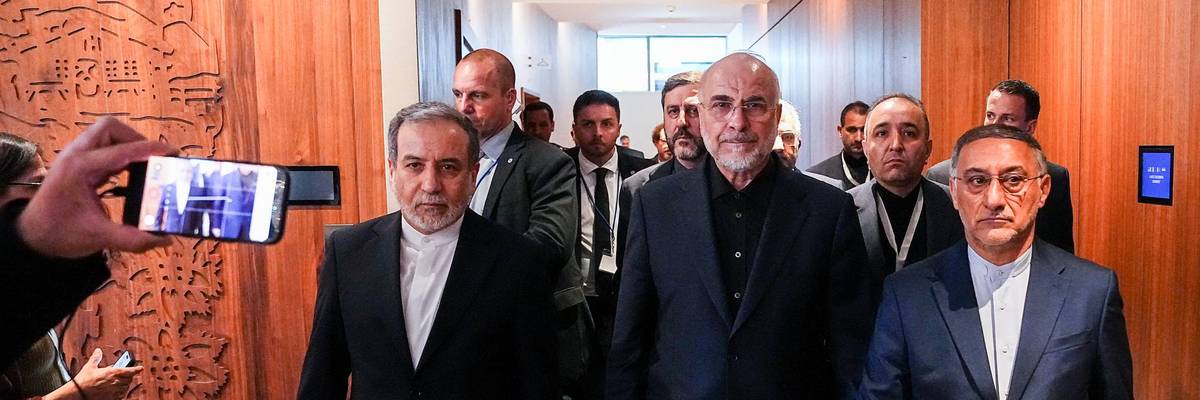
The Iranian delegation led by Mohammad Baqer Ghalibaf, speaker of the Iranian Parliament, arrives to meet with the Pakistani delegation led by Prime Minister Shehbaz Sharif on June 21, 2026 in Obbuergen, Switzerland.
(Photo by Hamed Malekpour/Getty Images)
Abbas Araghchi, Iran’s top diplomat, specifically welcomed the announcement of a “deconfliction cell” aimed at “ensuring the termination of military operations in Lebanon.”
Iran’s top diplomat said late Sunday that peace negotiations in Switzerland have produced “major progress” despite US President Donald Trump’s belligerent military threats and Israel’s continued assault on Lebanon, both of which have risked derailing the high-stakes talks.
Abbas Araghchi, Iran’s foreign minister, credited “tireless Pakistani and Qatari mediation” with securing commitments to establish a “deconfliction cell” to ensure “the termination of military operations in Lebanon,” as required under the recently signed memorandum of understanding (MOU).
Araghchi added that negotiators agreed to an end to the US blockade on Iran, the release of some of Iran’s frozen assets, and a “major reconstruction and development plan” for Iran, whose delegation reportedly left the Swiss negotiating venue on Sunday in response to Trump’s threat to assassinate Iranian diplomats and “take over” the Middle East country. The threats violated the terms of the MOU, which requires parties to “refrain from the threat or use of force against each other.”
In a joint statement late Sunday, the governments of Pakistan and Qatar said that negotiators agreed on “a roadmap towards reaching a final deal within 60 days, laying the foundation for the immediate commencement of further technical talks.
“In addition, a communication line between the parties has been formed… to avoid incidents and miscommunication with the aim of safe passage for commercial vessels through the Strait of Hormuz,” the statement continued. “The mediating parties will continue to do their utmost to ensure that the negotiations continue to be conducted in a constructive atmosphere with the aim of reaching a final deal.”
No paywall. No ads. No billionaire owner. Just you.
Common Dreams is funded exclusively by readers tired of news beholden to corporate interests. Our monthly supporters are the backbone of what makes that possible. Help us reach our Mid-Year Campaign goal of 450 new monthly supporters by July 1.
about:blank
🔊PR No: 1️⃣5️⃣1️⃣/2️⃣0️⃣2️⃣6️⃣
Joint Statement by the State of Qatar and the Islamic Republic of Pakistan Regarding the Conclusion of Lake Lucerne Summit, First High-Level Committee Meeting with Participation of the United States of America and the Islamic Republic of Iran pic.twitter.com/2G3PAf7LVY — Ministry of Foreign Affairs – Pakistan (@ForeignOfficePk) June 22, 2026
The optimistic comments from Iran’s foreign minister and mediators came after the first round of formal talks in Switzerland got off to a shaky start, with Iran’s delegation postponing its arrival due to a deadly barrage of Israeli airstrikes in southern Lebanon late last week.
Israel’s leadership, which is not a party to the peace negotiations, has refused to end its occupation of Lebanon, a major obstacle in the way of a final deal to end the war on Iran that the US and Israel launched in late February. Iran has said the Trump administration must force the Israeli government to end its assault on Lebanon.
In a social media post on Sunday amid the negotiations in Switzerland, Israeli Defense Minister Israel Katz declared that “Israel has no intention of withdrawing from the Beaufort, which is an integral part of the security zone in Lebanon and essential for the defense of the Galilee settlements and IDF forces.”
“As Prime Minister [Benjamin] Netanyahu and I have clarified—Israel will not withdraw from the security zone in Lebanon,” Katz added.
THE fate of Lebanon could determine whether the recently signed MoU between the US and Iran survives.
True to form, Israel is doing all possible to ensure the nascent peace deal is destroyed before the proverbial ink dries, as it continues to mercilessly pound Lebanon. While a supposed ceasefire was announced on Friday, Israeli attacks in Lebanon continued yesterday, with a large number of casualties reported, as the Zionist state hit both the southern and eastern parts of the Arab state in apparent pursuit of its arch-foe Hezbollah.
Tragically, a large number of non-combatants have also been killed in Tel Aviv’s murderous forays, with even steadfast supporters like US President Donald Trump expressing displeasure over its bloodstained tactics.
But the Israeli leadership seems very clear on what it wants to do. For example, the Israeli prime minister has refused to end the occupation of southern Lebanon, while the extremist national security minister has said that “Lebanon must burn”. If this happens, the Iran-US MoU — and the entire region including Israel— may also burn.
At one end of the spectrum, the signatories of the MoU, as well as nations such as Pakistan, which have played key roles in finding a diplomatic off-ramp, are again actively trying to take the negotiation process forward. At the other end, Israel is hell-bent on sabotaging the process.
The international community, principally the US and Europe, must be firm with their friends in Tel Aviv and tell them that their destabilising behaviour must end. The past few months have proven that the biggest threat to Middle East peace is not Iran, but Israel, which has attacked one sovereign state after the other, along with carrying out the Gaza genocide. It must be stopped before it destroys a hard-won chance at peace.
While nearly all US administrations in the past — as well as European states — have mollycoddled Israel and ignored its atrocious behaviour, this time the tone in Washington seems to be hardening. For example, US Vice President J.D. Vance has told Israel to “wake up and smell the reality of the situation”, with reference to Tel Aviv’s displeasure with the Iran deal.
But tough words will not be enough. If the US wants Israel to change its bad behaviour, it must withhold the funds and weapons that are needed by the Zionist war machine to keep functioning. Israel has hardly any friends left in the world, and if the US starts asserting itself, Tel Aviv should listen.
The MoU is unambiguous: the ceasefire must apply to all fronts, including Lebanon. Either Israel must silence its guns and withdraw from all of Lebanon, or face isolation and boycott from the international community until it mends its ways.
Benjamin Netanyahu, Israel’s prime minister in Washington, DC, US, on Monday, Sept. 29, 2025. [Will Oliver/EPA/Bloomberg via Getty Images]
US intelligence agencies have warned the Trump administration that Israeli Prime Minister Benjamin Netanyahu is likely to take actions that could undermine President Donald Trump’s efforts to secure a lasting peace agreement with Iran, according to a report on Friday.
Citing current and former US officials familiar with intelligence assessments, The Washington Post reported that Israel appears determined to continue military operations against Hezbollah in Lebanon despite provisions in the recently signed US-Iran memorandum of understanding calling for an end to military operations on all fronts, including Lebanon.
Even short of escalation, Israel’s refusal to withdraw troops from southern Lebanon is likely to doom the fragile accord, a US official told the Post.
“Continuing to occupy part of Lebanon is a recipe for disaster,” the official said. “Without a full Israeli withdrawal, the likelihood of resumed hostilities between the (Israeli military) and Hezbollah is all but certain.”
Vice President JD Vance on Thursday warned Israel against alienating its “only powerful ally,” saying Trump “is the only head of state in the entire world who is sympathetic to the nation of Israel at this moment in time.”
Separately, a US official confirmed to Anadolu Agency that Israel and Hezbollah agreed to a ceasefire to take effect at 4 pm local time (1300GMT) Friday.
Earlier Friday, at least 31 people were killed and several others injured in a series of Israeli attacks on southern and eastern Lebanon, according to Lebanon’s official National News Agency.
According to the latest official figures, Israel’s military offensive in Lebanon, which began on March 2, has killed 3,912 people, injured 11,873 others, and displaced more than one million residents.
U.S. and Iran flags frame a symbolic diplomatic handshake. [Photo/AA]
Iran postponed the technical-level talks with the US, which were slated for Friday in Switzerland, in protest against “continued” Israeli ceasefire violations, mainly in southern Lebanon, Pakistani government sources told Anadolu Agency.
The sources said that Tehran’s chief negotiator Bagher Qalibaf and Foreign Minister Abbas Araghchi were “all set” to leave for Switzerland to hold direct talks with Washington, but they pulled out of their scheduled trip at the last minute following “directives” from the “top Iranian leadership.”
They did not specify whether the directives came directly from Supreme Leader Seyyed Mojtaba Khamenei, who has already said he has a “different view” on the US-Iran deal to end the war.
No new date or venue for the talks has been decided, the sources added.
“Pakistan is in touch with both sides to set a new date for the technical-level talks to reach a final agreement,” a source close to mediation said.
The signing of the Islamabad Memorandum of Understanding (Islamabad MoU) by US President Donald Trump and Iranian President Masoud Pezeshkian had set the stage for direct talks between Washington and Tehran in Switzerland on Friday.
The source said that US Vice President JD Vance canceled his trip to Switzerland after Islamabad conveyed Tehran’s decision to Washington.
“The logistics of these negotiations have never been simple or predictable. As of now, the Vice President is not departing tonight,” a White House spokesperson said.
“We look forward to beginning technical talks as soon as possible.”
The Swiss Foreign Ministry, in a statement, said that the Friday talks on implementing the agreement to end the war will not take place.
The Islamabad MoU gives officials and experts from the two sides the next 60 days to chalk out a final agreement, which is particularly focused on the Iranian nuclear program, as Trump declared that Tehran cannot have a nuclear weapon.
Pakistani Prime Minister Shehbaz Sharif declared that the Islamabad MoU was effective immediately after signing and said Iran and the US would take measures to open the Strait of Hormuz for full international passage.
Sharif also signed the pact as “mediator.”
The pact calls for immediate and permanent cessation of military operations on all fronts, including in Lebanon, with commitments not to resort to force and to guarantee Lebanon’s sovereignty.
Soon after the US and Israel initiated war on Feb. 28, Iran closed the Hormuz and later, on April 13, American forces imposed their blockade on Iranian ports – making passage of commercial ships nearly impossible through the critical waterway.
Israel has also waged attacks on Lebanon, killing nearly 3800, including civilians and soldiers, since the war began.
Over 3,300 people, including civilians and soldiers, have been killed in Iran, while the US has confirmed the death of 14 personnel, in addition to the loss of armed weaponry and aircraft.
After securing a ceasefire on April 08, Pakistan hosted the highest-level direct talks between the two nations on April 12 and 13 since they severed diplomatic ties in 1979.
Senate Minority Leader Chuck Schumer, Democrat-New York, right, and House Minority Leader Hakeem Jeffries, Democrat-New York, outside the White House in Washington, September 29, 2025. [AP Photo/Evan Vucci]
There are moments that expose the fundamental character of the political system in the United States, that notwithstanding the daily infighting between the Democrats and Republicans, when it comes to the basic interests of American imperialism, the two parties of American capitalism are united.
The publication Thursday of the terms of the memorandum of understanding between the Trump administration and Iran is such a moment. It has triggered an outpouring of criticism from both the Democratic and Republican parties on the grounds that the war US President Donald Trump launched against Iran in February failed to secure American imperialism’s objectives in dominating the Middle East.
Republican former Vice President Mike Pence called the deal “appeasement” this week and demanded that, short of a harsher settlement, “we should let our Armed Forces finish the job on our terms.”
The Democrats joined the Republican condemnation of the agreement, criticizing it in much the same language. Senator Adam Schiff of California called it “a thorough capitulation,” writing that “Iran gets sanctions relief… and a $300 billion reconstruction fund.” Senator Chris Murphy of Connecticut called it “essentially a surrender to Iran.” House Minority Leader Hakeem Jeffries declared that “Iran is stronger and America is less safe” as a result of the agreement.
The New York Times, in an editorial headlined “President Trump Lost This War,” called the agreement “a humiliating comedown” and named Iran “the strategic winner of the four-month war.”
Jacobin magazine, the semi-official publication of the Democratic Socialists of America, criticized Trump’s deal with Iran in language indistinguishable from that of the Republicans and the Democratic leadership.
Jacobin’s article, titled “Donald Trump Has Nothing to Show for His War With Iran,” took the form of an interview with Andreas Krieg, a professor of “defense studies” at King’s College London. The article states that Trump “has ended up in a weaker strategic position than when he started.”
Krieg told the magazine the war had produced “tactical degradation but strategic regression.” Iran, he noted, had not surrendered its enrichment program, its government had not collapsed and “its ability to close Hormuz has been proven rather than deterred.” It offers neither a word of condemnation of the war itself nor any call to oppose it.
The Trump administration waged an illegal war of aggression against Iran, in violation of international law. The war opened with a series of assassinations, including Iran’s supreme leader, Ayatollah Ali Khamenei and much of the country’s military and political leadership. This act of murder and perfidy under cover of negotiations met with approval from both parties. Senate Minority Leader Chuck Schumer said at the time, “I will not shed a tear for Ali Khamenei,” while Jeffries called Iran “a bad actor” that “must be aggressively confronted.”
Throughout the war, the Democrats sought to stifle broad popular opposition to it through a series of meaningless procedural votes, intended to fail. In the massive demonstrations of millions of people under the banner of “No Kings,” Democratic Party organizers worked to deliberately exclude any reference to the war.
But now that the war has failed to achieve Trump’s objectives, the Democrats have found their voice, condemning his “capitulation” to Iran. This is the same party that spent the last year and a half presenting Trump as a colossus whose social and economic policies could not be opposed because he had a “mandate” from the electorate.
In reality, the Democrats, who speak for the same ruling class as Trump, agree with broad sections of Trump’s domestic agenda. Whatever their rhetoric, they believe, together with Trump, that fundamental social programs must be slashed to fund the expansion of the military and the enrichment of the financial oligarchy.
It is in defense of the interests of American imperialism that they are intractable. During his first term, the Democrats chose to impeach Trump not over his assault on democratic rights, but, in 2019, for his insufficient commitment to war with Russia and his withholding of military aid to Ukraine.
Trump’s deal has settled nothing. It is a temporary retreat, and the war could erupt again at any moment. The logic of the Democrats’ position is that were Trump to resume bombing Iran, they would support it.
The Democratic response to the agreement makes clear that their claim to represent any sort of “progressive” opposition to the fascist Trump is a lie. They are ferocious defenders of American imperialism, and should they come to power, there would be no fundamental change in foreign policy.
A world separates the working class from these parties. From the first day of the war, the World Socialist Web Site, the organ of the International Committee of the Fourth International, defined the war by its social character, calling it “a criminal war of aggression by an imperialist power against an oppressed former colony, aimed at plundering its oil wealth and establishing control of the Persian Gulf.” The Socialist Equality Party declared in a statement that it “condemns this war unconditionally and calls on the working class of every country to oppose it,” insisting that “the main enemy is at home” and that American workers “have no interest in a war against the people of Iran.”
The war against Iran is the product of the crisis of American imperialism, which sees no escape from its impasse except war. Every American war since 1991—against Iraq, Afghanistan, Libya and now Iran—has ended in failure, and each defeat has prepared the ground for the next. There is every reason to believe that the debacle in Iran, which has only deepened that crisis, will propel new wars.
But the war has also detonated a social crisis at home. It drove inflation to 4.2 percent in May, the highest in three years, gutting real wages and setting off a rebellion across American industry. Thousands of auto parts workers at Nexteer, Dana and Bridgewater have rejected one concession contract after another—the Dana local in Paris, Tennessee, voting one down by 288 to one—while 1,000 American Axle workers walked out on June 1 in their first strike in 18 years, 1,700 railroad workers across 11 states tore up a nine-year contract and nurses from Boston to Chicago voted to strike.
The movement is not confined to the United States. In Spain, 78,000 teachers in Valencia walked out this spring; Italy and Portugal have each been stopped by a nationwide general strike.
It is this growing eruption of social struggle, centered in the working class that has been made to pay for the war, that is the means to oppose the global offensive of American imperialism. The development of this movement requires a break with both capitalist parties and the building of the Socialist Equality Party, the United States section of the International Committee of the Fourth International.
A thick plume of smoke rises from an oil storage facility hit by a U.S.-Israeli strike in Tehran, Iran, Sunday, March 8, 2026. [AP Photo/Vahid Salemi]
On Sunday, the United States and Iran announced a ceasefire agreement in the war that the Trump administration launched on February 28. Despite killing more than 3,000 Iranians and triggering a global food and energy crisis, the United States has failed to achieve the objectives for which it went to war.
A “memorandum of understanding” was digitally signed on Sunday, and a formal signing ceremony is scheduled for Friday in Switzerland. The 60-day framework reportedly provides for the reopening of the Strait of Hormuz, the removal of the US naval blockade and the immediate suspension of military operations, including in Lebanon. It commits both sides to subsequent negotiations on Iran’s nuclear program, sanctions and regional security.
Whether the agreement actually holds remains uncertain. The actual text has not been released. Iran has claimed that some $25 billion in frozen Iranian assets have been unfrozen, which the US has disputed. Trump has reiterated that “Iran will never have a nuclear weapon” and warned that the United States “could attack Iran again if negotiations fail.” Israel, not a party to the agreement, has rejected it and continued strikes on Lebanon the same day.
Regardless, the outcome represents an unqualified debacle for American imperialism. It is a case of a schoolyard bully picking a fight and winding up with a black eye. The Iranian government remains in power. Its nuclear program is intact. The most concrete deliverable is the reopening of the Strait of Hormuz, a reversion to the prewar status quo.
There is a staggering chasm between the braggadocio with which the war was launched and the reality of its outcome. Trump promised the war would end with Iran’s “unconditional surrender.” Defense Secretary Pete Hegseth declared on March 2 that the United States was waging “the most lethal … air power campaign in history” with “no stupid rules of engagement.” Days later he promised reporters “death and destruction from the sky, all day long.”
Having spent the year trying to bring the Iranian government down and calling on Iranians in February to “take over your government,” Trump told the Wall Street Journal on Sunday: “I never cared about regime change.”
The media is filled with commentary about the defeat of American imperialism. The Wall Street Journal has called it “a strategic retreat short of achieving his war aims.” It is the operational demonstration, before the world, that the period of unchallenged American dominance that began with the dissolution of the USSR in 1991 has come to an end.
The political character of the American ruling class’s response is captured in the editorial published by the New York Times, speaking for the Democratic Party, under the headline “President Trump Lost This War.” The Times’ concern is not that the war was waged through mass murder and assassination, but that it failed.
“Mr. Trump made a terrible mistake starting this war,” the editorial declares. “He prosecuted it recklessly and in open defiance of the law. The United States is emerging weaker—militarily, diplomatically and economically—and will pay strategic costs for years to come.” The Times bemoans the fact that “On balance, Iran emerges the strategic winner of the four-month war.” The American military “has shown itself unable to quash a much smaller opponent even as it burned through many of its long-range precision missiles and interceptors. The outcome damages this country’s ability to deter other potential adversaries.”
The editorial’s prescription boils down to the statement: “The Pentagon will also need to modernize and prepare for the wars of the future.”
The wars of the future. The Times takes for granted the framework of permanent imperial confrontation, above all, with China and Russia, for which the Pentagon must “modernize and prepare.” What is in question is only the competence with which the framework is administered.
The Democratic congressional response operates within the same framework. Senator Chris Murphy called the deal “essentially surrender to Iran.” Representative Seth Moulton called it “basically a surrender document from Donald Trump to the supreme leader of Iran.” Senator Jack Reed complained that the United States was getting “less than what we had under the JCPOA,” the Obama-era nuclear deal. The Democrats endorsed the war when it was launched. They complain about it now only because it ended without Iran being destroyed.
There was enormous popular opposition to the war, but this found absolutely no expression within the framework of official politics.
The end of this stage of the war does not mean the end of the war. American imperialism will prepare new wars to recover its position. The 2015 JCPOA framework established under Obama was ended by Trump in 2018 and paved the way for the 2026 war. The 2026 ceasefire framework will pave the way for the war that follows.
The most significant consequences of the debacle, however, will be the consequences within the United States.
The war was launched, in part, in an attempt to stop the structural decline of American capitalism. The European Central Bank reported this month that gold has overtaken the euro to become the world’s second-largest reserve asset, at 27 percent of global reserves, up from 20 percent a year earlier. The federal debt crossed 100 percent of GDP in March for the first time since 1946. The failure of the war has accelerated the dollar’s decline and deepened the structural crisis the war was meant to resolve.
The war was launched against the backdrop of escalating social conflict. In the weeks before the war began, mass demonstrations against ICE intensified after the murder of Renée Nicole Good, a 37-year-old poet, and Alex Pretti, a 37-year-old nurse, by federal agents in Minneapolis. The Trump administration’s launching of the war was, among other things, an attempt to deflect this mounting opposition into the channels of patriotic war fever.
Social opposition will now escalate, and it will be increasingly centered in the working class. Auto parts workers at American Axle struck this month. Railroaders, meatpackers, teachers and nurses have walked out. Wall Street rose on news of the deal Sunday, but fuel and food prices remain far above their prewar levels. PCE (Personal Consumption Expenditures) inflation has hit 3.8 percent, the fastest pace since 2021. Consumer sentiment is at all-time lows, worse than during the Great Recession or the pandemic.
Workers have absorbed the costs of the war through rising prices while the corporations profited. The economic impact will provide fuel for class conflict for years to come, in the United States and internationally. The same crisis that produces the war is producing a global movement of the working class against it.
The Trump administration will respond to deepening social opposition with the methods it has demonstrated: ICE raids, mass detention infrastructure, the deployment of the National Guard against domestic protest, the criminalization of political opposition and the consolidation of authoritarian state power. The defeat in Iran will not moderate this trajectory. It will intensify it. The American ruling class, confronted with the failure of its imperialist offensive abroad, will turn with renewed savagery against the working class at home.
The task is the construction of an independent political movement of the working class that is international in scope, socialist in program and politically conscious in its objectives.
There is a popular view that this is a pointless war, being fought for nothing. But that is wrong—there is a purpose. Actually, there are several. You’re just never told what they are.
On June 1st, despite a ceasefire ostensibly underway in the US-Israeli war on Iran, Israel’s prime minister launched a major escalation against Lebanon, including threatening airstrikes against the Lebanese capital. The US president called the Israeli leader, furiously demanding an end to Israel’s escalation. Six days later, Israel attacked Beirut’s southern suburbs, long understood to be a red line for Hezbollah. The Lebanese resistance organization launched a limited response, sending 11 rockets towards Israel, almost all of which were intercepted; no one was hurt or killed. Trump called Netanyahu again, telling him in a brief call that now that Iran and Israel had each “had their fun,” that Israel should stand down.
Commentators across the Middle East and beyond debated whether Netanyahu would abide by Trump’s demand. What virtually none of them mentioned was that Trump had refused to even mention his most important pressure point: that if Israel resisted his order to stand down, the US would simply stop sending tons of weapons and tens of billions of dollars to the Israeli military. The close but sometimes divergent interests of the Middle East’s two powers, the global and the regional, was on full display.
It’s now been 106 days since Trump launched his preemptive and illegal military attack on Iran. On February 28, 2026, the world awoke to the fury of a new war in the Middle East after the United States and Israel had launched their joint assault against Iran, with President Trump and Prime Minister Netanyahu standing shoulder to shoulder against their common foe. Claiming unbridled hegemony was on the agenda for both.
The US-Israeli war on Iran is rooted in longstanding US imperialist strategy and Israel’s national goals.
Today, with yet more fresh promises of a so-called “peace deal” that is nearly ready to be signed by Trump and Iranian leadership, the Israeli military is bombing the suburbs of Beirut despite ongoing claims of a “ceasefire.” Trying to understand the current doom loop, it’s vital we remember how we got here.
In the opening salvo of the US-Israeli attack, Iran’s supreme leader Ali Khamenei, along with an unknown number of other top military and political leaders, was assassinated with a ballistic missile. Just an hour later, the US fired a Tomahawk missile directly at the Shajareh Tayyebeh Elementary School in the northern Iranian city of Minab—killing 156 people, 120 of them children, and destroying the school. The war’s official reasons, initially, were to eliminate the ostensible threat of Iran creating a nuclear weapon, and to destroy its conventional military capacity. The no-daylight US-Israeli partnership, Trump and Netanyahu as BFFs, the collaboration between the US and Israeli warplanes, bombers, drones, missiles… all seemed seamless and perfect.
Three months later, and half a dozen or so “ceasefires” announced, renounced, ignored and denounced, headlines around the world gleefully recounted a Trump phone call with Netanyahu. Focused on Israel’s escalating bombing of Lebanon threatening to derail the latest US-Iran ceasefire, the June 1 call reportedly started with Trump telling Netanyahu “you’re fucking crazy—you’d be in prison if it weren’t for me.“ The US president then went on to his ”Everybody hates you now“ remark. ”Everybody hates Israel because of this,“ he reportedly said.
Trump acknowledged saying it, and then, as is his usual style, moved on, quickly reclaiming his friendship with the Israeli prime minister. As was true with so many earlier ceasefires, Israel continued its massive bombing and its brutal occupation of south Lebanon, making a US-Iran ceasefire impossible. In the meantime, throughout the months of the war, commentators, politicians of all stripes, journalists and analysts across the globe were struggling to figure out what that war was actually being fought for.
War for What?
Real fear of an actual nuclear bomb was certainly not the answer. After all, US intelligence agencies have agreed for years that “Iran is not building a nuclear weapon and that [Supreme Leader Ali] Khamenei has not reauthorized the nuclear weapons program he suspended in 2003.”
Despite that clear assessment, US B-2 stealth bombers still dropped 14 of their 30,000-pound “bunker-buster” bombs on Iran’s civilian centrifuges at Fordo, Isfahan and Natanz at the end of Israel’s 12-day war in June 2025. Trump and his supporters bragged of having “completely and totally obliterated” Iran’s nuclear facilities. And then, eight months after that, in the early days of the US-Israeli 2026 war, those B-2s were back in the air, dropping more 30,000-pound and some smaller versions of the bunker-busters on Iran. Seems they don’t believe even their own intelligence agents.
They thought they could impose imperialism on the cheap—but it turns out not everyone is playing that game.
Rationales for the sudden war in 2026 (launched in the midst of US negotiations with Iran for a long-term ceasefire) were tossed around like confetti, ranging from stopping a nuclear threat (which of course didn’t exist because Iran didn’t have, wasn’t trying to make, and hadn’t even made a decision to try to build a nuclear weapon), to ending Iran’s support for its regional allies, to destroying Iran’s navy, to crippling its missile capacity, to protecting Iranian civilians or maybe encouraging a popular uprising, or perhaps even full-scale regime change. Later, once Iran had responded to the attacks by closing the Strait of Hormuz, Trump shifted to trying to justify the war as a means of forcing the reopening of the Strait, in effect waging the new war to get back to the situation that had existed until the US and Israel launched the war in the first place.
Not a Senseless War
None were very convincing arguments. The popular view emerged that this was a pointless war, being fought for nothing. But that was wrong—there was a purpose. Actually, there were several. The Israeli prime minister has shaped his political career, for more than 35 years, around the claim that only he could bring down the Iranian regime, falsely claiming it as an “existential threat” to Israel. (In fact, even if Iran changed its internal decisions and decided to try to build a nuclear weapon some day, it would not represent an existential threat to Israelis but only to Israel’s 47-year-old nuclear weapons monopoly in the Middle East.) Netanyahu needed the war to continue—any ceasefire, under any conditions, would weaken him politically.
On the US side, some of the war’s goals had to do with the personal obsessions of the president and his minions. Trump’s fixation on expanding US power around the world, and more importantly being seen as presiding over a return to the glory days of unchallenged US global domination, remain a driving force—as does his determination to “get a better deal” than Obama did with the successful Iran nuclear deal in 2015. For his self-defined “secretary of war” Pete Hegseth, the pageantry of a powerful military—not only “the most lethal” force in the world but more white, more male, and even more slim than any other army—could compensate for Hegseth’s lack of experience. For Secretary of State Marco Rubio, all roads lead to regime change in Cuba—and supporting all of Trump’s military assaults, including attacks on fishing boats in the Caribbean, kidnapping the president and seizing the oil resources of Venezuela, bombing Yemen, Somalia and Nigeria, all help set the stage for his life-long goal of destroying the Cuban revolution.
The Search for Hegemony
All those personal obsessions likely played some roles. But the US-Israeli war on Iran is also rooted in longstanding US imperialist strategy and Israel’s national goals. While Trump has shown himself for years as far more committed to maximizing his own and his family’s wealth and power than he is accountable to any particular faction of US capital or US elite power (except perhaps “the billionaires,” writ large), the trajectory of imperial expansion, especially in an era of greater and rising powers around the world, continues to shape much of US policy.
That is where the search for hegemony comes to the fore. For Israel—and especially for its longstanding prime minister—the attack on Iran both demonstrates and reinforces its role as unchallenged regional hegemon. That means asserting its power—a derivative power, given its strategic dependence on the United States, but power nonetheless—to seize land, dispossess and expel whole populations, and exert permanent control over countries, economies, and people—whenever, wherever, and for however long it chooses. Without being held accountable.
For Israel—and especially for its longstanding prime minister—the attack on Iran both demonstrates and reinforces its role as unchallenged regional hegemon.
To be recognized as the regional hegemonic power in the Middle East, Israel needs to not only “mow the grass” in Lebanon and in Gaza (as well as arming and empowering ideologically driven settlers in the West Bank to escalate their violent seizure of Palestinian land and ethnic cleansing of its population), it needs to continue to weaken, threaten, and when possible (with US backing) go to war against Iran, its sole challenger for regional control.
Mowing the Grass
Israelis—military and government officials, academics, journalists and others—routinely use the term “mowing the grass” to describe Tel Aviv’s consistent attacks against Israel’s neighbors. The phrase was first coined to describe Israel’s brutal 22-day assault on Gaza, Operation Cast Lead, that began the day after Christmas 2008 and killed more than 1400 Palestinians, most of them civilians and including 300 children. Since then, it describes the frequent attacks on Gaza or Lebanon—ostensibly aimed at militant organizations but designed originally to kill massive numbers of civilians, displace hundreds of thousands or millions from their homes, and destroy huge swathes of homes, schools, churches, mosques, businesses—to remind everyone who it is who actually holds power.
Israel is saying that it will not allow Iran to remain an obstacle to Tel Aviv’s claim of full-blown dominance of the region. Netanyahu is making good of the threats he’s issued for the last 30 years.
Iran has historically been the main obstacle preventing Israel from consolidating that regional hegemonic role, and part of Netanyahu’s political power depends on his ability to keep the US-Israeli “special relationship” strong and to deal effectively with Iran. So going to war against Iran in complete and willing partnership with the United States serves to strengthen his still-shaky political position. What’s different now is that Israel is saying that it will not allow Iran to remain an obstacle to Tel Aviv’s claim of full-blown dominance of the region. Netanyahu is making good of the threats he’s issued for the last 30 years.
So Netanyahu remains committed to continuing this war against Iran, opposing ceasefires regardless of their terms—and most recently, escalating attacks against Lebanon precisely because they could prevent or shatter any ceasefire. Following the Israel-Hezbollah ceasefire in 2024, UN peacekeepers on the ground documented more than 10,000 Israeli violations of the agreement in just the first year. When a wobbly US-Iran ceasefire was announced on April 8, 2026, Israel responded with massive force against Beirut, launching more than 100 airstrikes within 10 minutes across the capital and killing 357 people, many of them civilians and at least 101 of them children and women.
Back in the USA….
For the United States, going to war against Iran could strengthen Washington’s longstanding commitment to maintaining global domination—a goal particularly relished by its power-obsessed and erratic president. The war was designed to both demonstrate and bolster the US role as unchallenged global hegemon. And doing so arm in arm with Israel, the regional version.
What a team they thought they would make. What they didn’t reckon with was the reality of Iran—its military, its government, its people. While there is no question US-Israeli military might massively outstrips that of Iran, it turned out that Tehran was able to use its not-insignificant drone and missile capacity in ways that maximized its power.
While there is no question US-Israeli military might massively outstrips that of Iran, it turned out that Tehran was able to use its not-insignificant drone and missile capacity in ways that maximized its power.
For example, Iran’s relatively few strikes on US bases and sometimes domestic facilities in the surrounding US-backed Gulf states had political consequences beyond their comparatively low levels of casualties. They showed how “protection” in the form of US military bases, weapons and troops in those countries did not keep their people safe, but rather laid a target on their backs. Most especially, Iran’s few direct attacks on ships attempting to cross the Strait of Hormuz early in the war, had the much broader effect of shutting down the vital waterway entirely, as shipowners and insurance companies refused to take the risk.
Miscalculations
When Israel carried out its guided missile attack on the first day of the war, killing the supreme leader and a number of other top officials, the cheering in Washington and Tel Aviv reflected the assumption that the decapitation of the government would lead to chaos and its inability to function. The cheerleaders were wrong. As Narges Bajoghli and Vali Nasr noted in Foreign Affairs, the US and Israel “expected a quick victory through targeted assassinations of Iran’s leadership. But decapitation did not produce regime collapse. Instead, it opened the door for a new generation to take over.” Not only did Khamenei’s son take over his father’s position, but younger military, political, and business leaders filled in the gaps across the structures of power.
And while the Iranian leadership had been significantly weakened by public mobilization against both governmental inability to solve the escalating economic crisis and its increasingly repressive attacks against protesters, it appears it was not further weakened by the US-Israeli assault. As Nasr and Bajoghli describe the situation, the public anger of January 2026 in response to escalating repression of the mass uprisings, didn’t disappear with the US-Israeli assault. They wrote:
The war’s destruction has been vast: public infrastructure, factories, schools, hospitals, historic monuments, and even entire neighborhoods lie in ruins. As Israeli and American bombs and missiles pummeled the landscape, Trump threatened to arm separatists, redraw Iran’s borders, crush its economy and annihilate its civilization. Together, these military and rhetorical assaults provoked a nationalist reaction that cut across political divisions. Public anger has not disappeared. The grief, frustration and accumulated resentment of decades of misrule and repression remain. What has changed is the political landscape in which those feelings find expression. Dissent is now refracted through a national struggle against a foreign enemy that Iranians compare to Alexander the Great, who conquered the Persian empire in the 4th century BC; the Arab armies that invaded in the 7th century AD; and the Mongols, who came six centuries after that.
Contrary to American and Israeli expectations, the war has not sparked street demonstrations. The longer it went on, the less the regime appeared threatened by public uprisings. Iranian society mobilized not against the state but alongside it, holding daily rallies across the country, forming human chains and gathering on bridges threatened by Trump. The sharp divide between state and society that had characterized Iran in January blurred—not through persuasion or repression, but through the shared experience of living through the bombing and witnessing its destruction.
Palestine
There was another reason for the US-Israeli war, that explains at least the timing, if not the overall rationale—Palestine. Israel has been committing genocide in Gaza for two years and eight months. There are now more than 73,000 known, identified, named Palestinians in Gaza who have been killed by Israeli bombs, tanks, bullets, drones, missiles, almost all paid for (and to a large degree produced) by US taxpayers. Thousands more lie dead under the rubble of what were once the cities, towns, refugee camps of the decimated Gaza Strip. The statistics belie the lives lost—babies, elders, children. Journalists and health workers in staggering numbers. And Israel’s genocide continues, people are still being killed by Israeli bombs, tanks and drones, as well as deliberately-imposed shortages of water, food, medical supplies, shelter.
The Gaza genocide is not unrelated or incidental to the US-Israeli war in Iran—it is a primary enabler. It is precisely the level of impunity, the absolute lack of accountability for any of the perpetrators of this crime against humanity, that has given Israeli and US leaders the confidence to go ahead with what many have called the “Gazafication of Iran” and the “Gazafication of Lebanon” without fearing there might be a price to be paid.
The Gaza genocide is not unrelated or incidental to the US-Israeli war in Iran—it is a primary enabler.
The international arrest warrants issued by the International Criminal Court against Israeli leaders (Israel assassinated the Hamas leaders who were similarly charged) are ignored in most of the US-allied countries that Netanyahu and his former defense minister might want to visit. South Africa’s unprecedented effort to hold Israel accountable at the International Court of Justice for its violations of the Genocide Convention resulted in a powerful preliminary ruling that Israel’s actions plausibly do constitute genocide. Israel was ordered to carry out specific actions—starting with an end to killing people in Gaza—but it has yet to face any consequences for ignoring those orders. And no one knows when the final ruling might be issued—or if it will lead to some level of enforcement, either in the United Nations, by a coalition of governments, or, most likely by a newly-enraged, newly-engaged global civil society ready to move with ever greater energy, strategic clarity and political power to impose serious consequences on the governments and individuals responsible for the first genocide in history to be carried out openly, proudly, and visible to the world.
War Over War
For now, while the war against Iran continues, it looks like both Israel and the United States are moving into a different phase. They are still looking to claim power, still working to reshape political relations and consolidate regional and global power across the middle east. But rather than simply escalating again, as Israel still is in Lebanon, or continuing a grinding daily assault as it still is in Gaza—both actions armed and paid for by the US—they are facing some changed circumstances. Just maybe Washington and Tel Aviv are finding that it’s harder than they thought to re-order the whole Middle East—and to do that in tandem is harder than ever.
Trump seemed to think he could accomplish something dramatic and “beautiful” in Iran—encourage a popular uprising, maybe seize the oil and replace the leadership’s political orientation as if it were Venezuela—but then found that wasn’t so likely. Turns out Iran is not Venezuela. Netanyahu has massive public support among Jewish Israelis for continuing the war in Iran, though support for the war in Lebanon is not so popular. (It should not be forgotten that after 18 years of occupying South Lebanon, Israeli troops were finally pulled out in 2000 primarily because the government could not survive the mobilization of Israeli mothers angry that their sons in the IDF were occasionally being killed by Hezbollah’s retaliation actions..)
Trump seemed to think he could accomplish something dramatic and “beautiful” in Iran—encourage a popular uprising, maybe seize the oil and replace the leadership’s political orientation as if it were Venezuela—but then found that wasn’t so likely.
At home Netanyahu may be able to get away with claiming victory over Iran even if a ceasefire is imposed, by continuing Israel’s longstanding practice of assassinating Iranian scientists and political/military leaders, and occasional bombing raids. But Israel’s plummeting losses in the war of global legitimacy are certainly not likely to be reversed any time soon. The most recent Pew survey indicates sky-high majorities holding negative views of Israel and Netanyahu around the world—up to 95% in Pakistan, 78% negative in Sweden and Spain.
The global Palestinian rights mobilizations and the even broader movements for ceasefire and an end to genocide of course play a major role. Social movements and civil society activists around the world will continue to hold up the ICJ decisions and the UN General Assembly resolutions requiring governments to impose arms embargoes, boycotts, divestment, and sanctions against Israel.
And as the Strait remains closed and food shortages mount in the poorest countries, as Arab governments fearing public opposition at home reduce their ties with Israel and reject expansion of the Abraham Accords, and as Israel continues to kill Lebanese and Palestinian families, Trump’s claims will be less likely to be believed. With the mid-terms only a few months off, his claims of “We’re the winner, we won” are already ringing increasingly hollow. It doesn’t mean he won’t make the claims, it just means they’re not going to work.
For Trump, given the unexpected level of resilience in Iran, Tehran’s access to a virtually unlimited supply of cheap drones that are doing real damage to Gulf Arab states hosting US bases and troops, and its willingness to close the Strait as a pressure point with global ramifications, it’s going to be difficult to claim this war as a victory.
The search to consolidate regional and global power continues. It’s a big part of the reason the US and Israel are launching new wars and escalating longstanding attacks. People are still losing lands and lives as these hegemons rely on war to consolidate their positions. But neither Israel in the Middle East nor the United States in the world are unchallenged. They thought they could impose imperialism on the cheap—but it turns out not everyone is playing that game. The search for hegemonic power is far from settled.



![Benjamin Netanyahu, Israel's prime minister in Washington, DC, US, on Monday, Sept. 29, 2025. [Will Oliver/EPA/Bloomberg via Getty Images]](https://i0.wp.com/www.middleeastmonitor.com/wp-content/uploads/2025/10/GettyImages-2237769324-1-scaled-e1761033629729.jpg?fit=920%2C613&ssl=1)
![U.S. and Iran flags frame a symbolic diplomatic handshake. [Photo/AA]](https://i0.wp.com/www.middleeastmonitor.com/wp-content/uploads/2026/06/thumbs_b_c_83fbfd954e6d536e95e52f191c0df54b-1-1.jpg?fit=920%2C613&ssl=1)

 Peace and Justice Post