Columbia University has suspended more than 65 students for their role in a pro-Palestinian demonstration that forced the shutdown of the main campus library, a school official said on Friday.
Placed on interim suspension, the students will be prohibited from taking their final exams or entering campus except to access their dormitories, the university official said.
Columbia also barred 33 other people from campus, including students from other colleges and alumni who took part in the protest, according to the official.
“When rules are violated and when our academic community is purposefully disrupted, that is a considered choice one with real consequences,” the Columbia official said.
Scores of students were arrested after seizing part of the school’s main library on Wednesday in one of the biggest pro-Palestinian demonstrations on campus since last year’s wave of protests against Israel’s war in Gaza.
Officers of the New York Police Department were called to campus to quell the protest at the request of university officials.
The demonstration came amid negotiations between Columbia’s board of trustees and the Trump administration, which announced in March it was penalizing the university over previous pro-Palestinian protests by cancelling hundreds of millions of dollars in research grants.
There was no immediate reaction to news of the suspensions from student activists representing the protesters.
Organisers of Wednesday’s demonstration repeated their long-standing demands that the university cease investing any of its $14.8 billion endowment in weapons makers and other companies that support Israel’s military occupation of Palestinian territories.
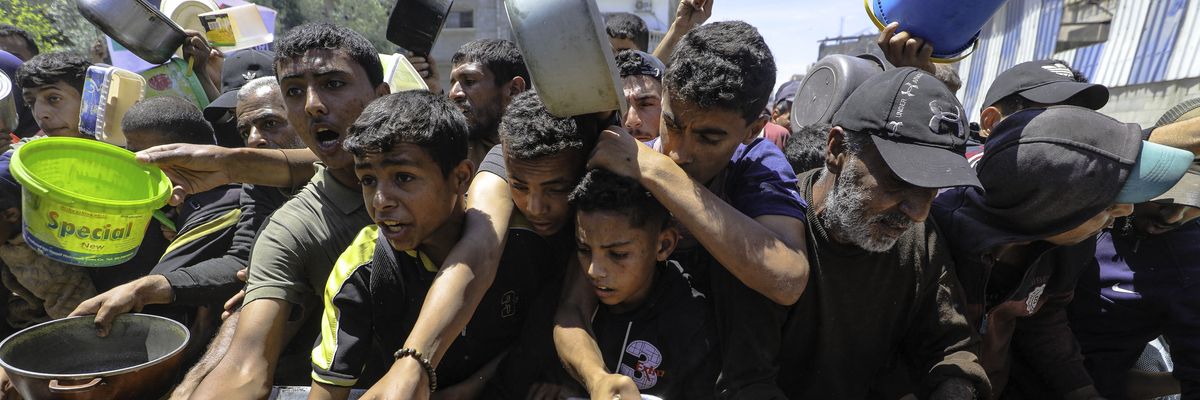
United Nations aid officials have rejected a U.S. and Israel-backed plan for aid delivery in Gaza that reportedly involves the use of a private foundation and U.S. military security contractors to deliver far less humanitarian assistance than the besieged enclave needs.
Jens Laerke, a spokesperson for the U.N.’s Office for the Coordination of Humanitarian Affairs (OCHA), warned Friday that the agency “will not participate.”
“There is no reason to put in place a system that is at odds with the DNA of any principled humanitarian organization,” Laerke told the BBC.
Since early March, Israel has blocked aid from entering Gaza, compounding widespread misery and hunger in the besieged enclave as Israel continues to mount a deadly military campaign there. U.N. officials have decried the fact that aid is close at hand but is not being allowed in.
Speaking in Jerusalem on Friday, U.S. Ambassador to Israel Mike Huckabee said that the plan involves a private U.S.-backed foundation, which will distribute aid from a set number of distribution sites, according to CNN. Huckabee said the idea is to create a system that prevents Hamas from obtaining the aid.
The private entity, called the Gaza Humanitarian Foundation, would administer those distribution sites using private U.S. military contractors and aid workers, according to CNN.
The plan reportedlyentails only allowing 60 aid trucks a day, a sliver of what was allowed to enter the enclave during the two-month cease-fire that Israel ended in March. A document from the Gaza Humanitarian Foundation states that there will initially be four distribution sites aimed at providing 1.2 million Palestinians in its first phase, or 60% of Gaza’s population.
According to the The New YorkTimes, under the current aid distribution system, the U.N. says there are 400 distribution points.
Huckabee said that Israel would not be involved in delivering aid, but that Israeli forces would handle security around the distribution sites.
The Times of Israel, citing officials familiar with the plan, reported that the Israeli government and military have been involved in putting the plan together, even if the Gaza Humanitarian Foundation is the entity that is slated to distribute the aid.
Reporting from The Washington Postpublished Monday, which cited unnamed Israeli officials and aid workers, framed the emerging plan as an Israeli initiative to take control of aid distribution in Gaza. The Post‘s reporting also stated that the distribution centers would be all be located in the south of Gaza.
The Post spoke with officials from a dozen international aid groups working in Gaza, who expressed concerns that restricting aid to a few locations would force more displacement and be discriminatory.
James Elder, spokesperson for the U.N.’s children’s agency UNICEF, echoed this, according to the BBC, saying on Friday that the proposed plan would lead to more children suffering and that the decision to locate all the distribution centers in the south appeared designed to weaponize aid as “bait” to force Palestinians to be displaced once again.
The plan “contravenes basic humanitarian principles” and appears designed to “reinforce control over life-sustaining items as a pressure tactic,” Elder said, according to U.N. News.
Trump and Musk are on an unconstitutional rampage, aiming for virtually every corner of the federal government. These two right-wing billionaires are targeting nurses, scientists, teachers, daycare providers, judges, veterans, air traffic controllers, and nuclear safety inspectors. No one is safe. The food stamps program, Social Security, Medicare, and Medicaid are next.
It’s an unprecedented disaster and a five-alarm fire, but there will be a reckoning. The people did not vote for this. The American people do not want this dystopian hellscape that hides behind claims of “efficiency.” Still, in reality, it is all a giveaway to corporate interests and the libertarian dreams of far-right oligarchs like Musk.
Common Dreams is playing a vital role by reporting day and night on this orgy of corruption and greed, as well as what everyday people can do to organize and fight back. As a people-powered nonprofit news outlet, we cover issues the corporate media never will, but we can only continue with our readers’ support.
about:blank
about:blank
Our work is licensed under Creative Commons (CC BY-NC-ND 3.0). Feel free to republish and share widely.
Published date: 31 October 2023 11:41 GMT | Last update:1 year 6 months ago
Governments have failed to condemn Israel’s disproportionate retaliation and the collective punishment of Gaza’s civilian population
Protesters hold up a sign condemning French President Emmanuel Macron at a rally in Paris on 22 October 2023 (AFP)
The latest stage of the Israel-Palestine conflict in Gaza has revealed an unexpected moral bankruptcy on the part of the European Union’s institutions and almost all of its member states.
In the past, Europe used to make efforts to mitigate Washington’s blind pro-Israel stance and to advance the Palestinian cause, such as during the drafting of the 2003 Road Map to Peace. Two decades later, the EU and its top shareholders are barely recognisable.
The last 20 years of the Israel-Palestine conflict have included the Second Intifada, Israel’s destructive wars on Gaza with massive Palestinian civilian casualties, thousands of home demolitions, and creeping annexation through settlement growth in the occupied West Bank and East Jerusalem. Gaza has also been subject to a harsh blockade since 2007.
Under these circumstances, logic would dictate that European support for Palestinians should have increased. Instead, Europe has become increasingly pro-Israel, or in the best case, indifferent to the Palestinian cause.
It speaks volumes that in the last two decades, the only significant EU measure has been – brace yourselves – to request a change in the labelling of Israeli products, ensuring that goods produced in illegal settlements are labelled as such. This was less than a slap on the wrist, but it still sparked Israeli indignation.
New MEE newsletter: Jerusalem Dispatch
Sign up to get the latest insights and analysis on Israel-Palestine, alongside Turkey Unpacked and other MEE newsletters
The EU’s political discourse on Palestinian rights has slowly adjusted to Israel’s increasingly far-right narrative, with dissent and different opinions silenced or strongly criticised by mainstream media.
The mere use of the word “occupation”, or any objection to Israeli violence, is equated with antisemitism. This charge is systematically used for character assassinations of pro-Palestinian politicians and activists through complacent media. Jeremy Corbyn, the former British Labour leader, is a prime example.
Today, the Labour leadership’s stance on Israel-Palestine is barely distinguishable from Likud’s, and Muslim voters are fleeing the party in droves.
One-sided solidarity
Other European parties across the political spectrum have followed the same path. A complete metamorphosis has taken place. Many explanations could be provided, but ultimately, European politicians stand with Israel because they seem to get in less trouble that way.
Still, no one could have imagined what European leaders would do after the events of 7 October. This is not to criticise their strong condemnations of the 7 October attacks by Palestinian fighters, nor the support they extended to Israel.
Rather, my criticism is addressed towards the past two decades of European passivity towards the roots of the Israel-Palestine conflict, and their continuing reluctance to deal with the issue of the Israeli occupation.
This conflict did not begin on 7 October.
UN Secretary-General Antonio Guterres had to shake the Europeans from their guilty torpor by reminding them this week that “the attacks by Hamas did not happen in a vacuum”. He said: “The Palestinian people have been subjected to 56 years of suffocating occupation. They have seen their land steadily devoured by settlements and plagued by violence; their economy stifled; their people displaced and their homes demolished. Their hopes for a political solution to their plight have been vanishing.”
On the European moral scale, Israeli pain is rated higher than Palestinian pain
For these common-sense words, Israel demanded Guterres’s resignation.
Meanwhile, a procession of European leaders have rightly travelled to Israel to express their solidarity, including the presidents of the European Commission and European Parliament, the German chancellor, the French president, the British prime minister, and the Italian prime minister. But we have not seen a similar procession of visits to Ramallah as Israeli bombs continue to rain down on Gaza.
On the European moral scale, Israeli pain is rated higher than Palestinian pain – and it appears nothing is going to change that. The European position is that Hamas committed an unprovoked act of terrorism, while Israel is just exercising its legitimate right to self-defence.
Bland exhortations
However, Israel’s right to self-defence must be contextualised within its role as an occupying power for more than five decades, during which it has harassed, humiliated and killed countless Palestinians. This is the point Guterres was attempting to convey in his heavily criticised remark, especially to western democracies, those champions of the rules-based world order.
It is worth remembering that when Palestinians last held a mass peaceful protest, the 2018 Great March of Return, which followed the provocative US decision to move its embassy to Jerusalem, the Israeli army fired upon thousands of Palestinians gathered at the Gaza fence. Israeli snipers killed more than 200 Palestinians, including medics and journalists, and wounded thousands more.
Israel-Palestine war: Will the West choose genocide or peace?
This was a despicable act, a crime – but no condemnation came from western democracies.
Today, European leaders have remained silent amid Israel’s disproportionate bombardment of Gaza, while implicitly condoning the murderous language being used by Israeli officials – including President Isaac Herzog, who has said there are no innocent civilians in Gaza. “It is an entire nation out there that is responsible,” he said, tacitly justifying their collective punishment.
This is an especially outrageous statement coming from a descendant of the same people who suffered the most horrific collective victimisation of the 20th century: the Holocaust. It is equally outrageous for European leaders to have remained silent at Herzog’s words.
After 1,400 Israelis were killed in the 7 October attack, the Israeli flag was projected on European building facades as a legitimate show of solidarity. But despite the ongoing slaughter of Palestinians, with more than 8,000 already killed, we have seen no similar official gestures.
Of course, thousands of Palestinian flags are being hoisted by European citizens, largely unreported by mainstream media, across European capitals. People are doing what their governments will not: condemning Israel’s disproportionate retaliation and the collective punishment of Gaza’s Palestinian population through indiscriminate bombing and the cutting off of water, electricity, fuel and food deliveries.
All European institutions have been able to utter, amid heavy public pressure, are bland exhortations for Israel to abide by international law. This is too little, too late – and too hypocritical.
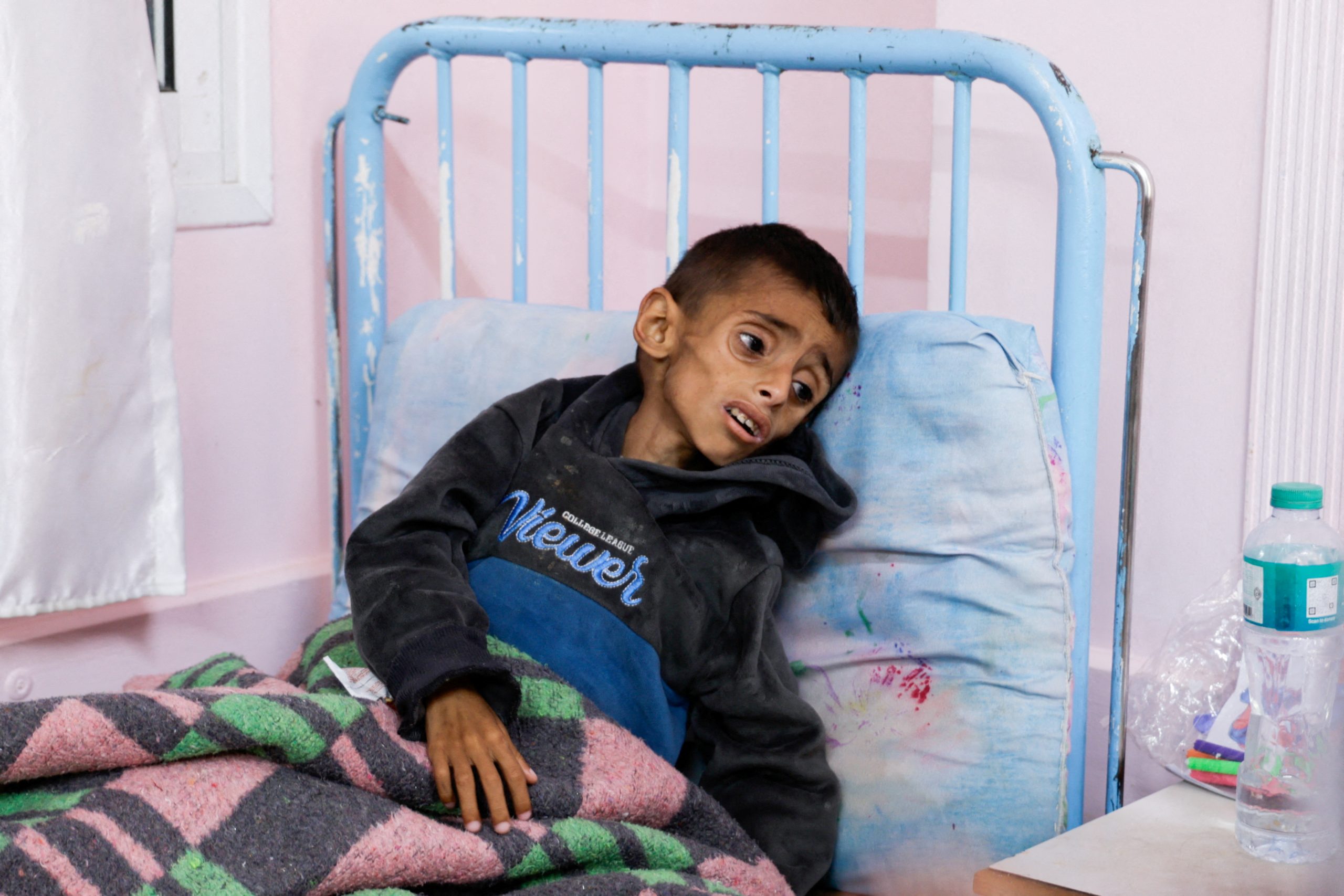
The World Central Kitchen (WCK), a US-based charity, said on Wednesday that it was forced to shut down aid operations in Gaza due to the total Israeli blockade on the Palestinian territory.
“After serving more than 130 million total meals and 26 million loaves of bread over the past 18 months, World Central Kitchen no longer has the supplies to cook meals or bake bread in Gaza,” the WCK said in a statement on its website.
“Since Israel closed border crossings in early March, WCK has been unable to replenish the stocks of food that we use to feed hundreds of thousands of Gazans daily,” the statement said.
Palestinian boy Osama Al-Reqep, 5, lies on a bed at Nasser Hospital where he receives treatment, in Khan Younis, in the southern Gaza Strip, May 1, 2025. REUTERS/Hatem Khaled
The charity said that in recent weeks, its team in Gaza “stretched every remaining ingredient and fuel source using creativity and determination” but has now “reached the limits of what is possible.”
WCK field kitchens in Gaza have run out of ingredients, and its mobile bakery has run out of flour. The charity said that it has trucks loaded with food and cooking fuel ready to enter Gaza, but they are being blocked by Israel.
“Our trucks—loaded with food and supplies—are waiting in Egypt, Jordan and Israel, ready to enter Gaza,” said José Andrés, a celebrity chef who founded WCK. “But they cannot move without permission. Humanitarian aid must be allowed to flow.”
At least 11 WCK workers have been killed by Israeli attacks since October 7, 2023. The most notorious attack occurred on April 1, 2024, when an Israeli drone fired missiles at three clearly-marked cars carrying WCK employees, who were traveling on a route previously approved by the IDF. The attack killed seven WCK workers, including three British nationals and an American, 33-year-old Jacob Flickinger, a dual US-Canadian citizen who left behind a one-year-old son.
In November 2024, an Israeli attack on a car in Gaza killed three WCK workers. On March 27 of this year, the WCK said one of its volunteers was killed by a strike near a WCK kitchen in Gaza.
Within hours, Israeli forces demolished homes, wells, and even caves in the West Bank hamlet of Khilet al-Dabe’, leaving families with nowhere to shelter.
Israeli forces demolish buildings in Khirbet Khilet al-Dabe, in Masafer Yatta, the West Bank, May 5, 2025. (Wisam Hashlamoun/Flash90)
In the early hours of Monday morning, two massive Hyundai excavators and two Caterpillar bulldozers roared out of the gates of the Ma’on settlement in the South Hebron Hills — illegally built on Palestinian land belonging to the village of At-Tuwani. For residents living in the area, the sight of these “yellow monsters,” as they call them, is an omen: the day will be filled with destruction, and families will lose homes they woke up in just hours earlier.
Roughly 90 minutes later, the full force of the operation became clear. Military jeeps, soldiers from the Israeli army, Border Patrol units, Civil Administration officials, and a group of workers assembled and then moved as a unit toward Khirbet Khilet al-Dabe’, a small but resilient village nestled between the higher lands of Shafa Yatta and the lower hills of Masafer Yatta. I rushed there with other local activists to document what we feared was coming.
We were stopped by a group of masked soldiers about 80 meters from the village’s homes. “You are not allowed to move forward,” one soldier barked, dropping a rusty old bucket on the ground and declaring, “This is the boundary of a closed military zone: whoever crosses it will be arrested.”
Subscribe to The Landline
+972’s weekly newsletter
We asked if there was an official military order establishing the area as restricted. One soldier responded, “It will arrive in a few minutes.” But the demolition dragged on for hours, and no such order ever appeared. This wasn’t enforcement of a legal ruling, but rather an exercise of sheer military power. In truth, the soldiers didn’t even pretend to be upholding Israel’s own discriminatory laws. They simply threatened us with weapons and arrests.
As soldiers held us back, one excavator tore through two water wells, while others stormed into the community itself. Families were forcefully removed from their homes. Among them was 80-year-old Amna Dababseh and her husband Ali, 87.
Ali Dababseh stands near soldiers as Israeli forces demolish buildings in the West Bank village of Khilet al-Dabe’, May 5, 2025. (Wisam Hashlamoun/Flash90)
“My daughter brought us breakfast and we were just about to eat, when she said the army had entered the village,” Amna recounted. “Suddenly, soldiers were at our door. One pointed at our home and said, ‘Get out. We’re going to demolish this house.’ I told him: ‘My husband had a stroke and can barely walk. I have diabetes. Where do you expect us to go?’ He just said, ‘Go to the mountain. Move!’”
Amna’s voice cracked as she described the chaos. Border police walked around the homes, evicting family after family. Men, women, and children were pushed up a hill overlooking the destruction of their community. “This village has suffered demolitions for 20 years,” Amna said, “but never like this.”
She stood crying among dozens of others, watching her life’s work reduced to rubble. Despite the trauma and shock, she kept repeating: “I will never leave this village — not until my last day.” Her husband and others echoed the same sentiment, determined to defy and resist a system designed to erase them.
A Palestinian woman walks by as Israeli forces demolish buildings in the West Bank village of Khilet al-Dabe’, May 5, 2025. (Wisam Hashlamoun/Flash90)
“They want to erase us”
What took place in Khilet al-Dabe’ was not merely a demolition — it was a sweeping erasure. In total, nine homes were destroyed, along with six caves, seven wells, four livestock shelters, 10 water tanks, and the village’s only solar energy system and internet infrastructure.
Khirbet Khilet al-Dabe’ is one of the main communities featured in our documentary “No Other Land.” The village is known for its natural greenery and agricultural life, and unlike many others in Masafer Yatta, its residents focus less on livestock and more on cultivating almond, grape, and olive trees. They maintain traditional stone terraces and till the land year-round. The village’s elevated position and lush vegetation make it one of the most visually stunning in the area.
But geography is no protection. Over the past 18 months, four new settler outposts have been established to the east and west of Khilet al-Dabe’. Less than three months ago, on Feb. 10, Israeli forces had entered Khilet al-Dabe’ and destroyed seven homes and two caves. Amer Dababseh, Amna and Ali’s son, had his home and cave demolished that day. Since 2018, his property has been destroyed at least seven times. After the February attack, he and his family sought refuge with his elderly parents; now, that home has also been destroyed.
This time, Israeli forces left Amer and many others with literally nothing. Even the caves — historically used as emergency shelters for displaced families — were demolished. Now, many villagers, including children, have no choice but to sleep in the open.
The aftermath of Israeli demolitions in the West Bank village of Khirbet Khilet al-Dabe’, May 5, 2025. (Wisam Hashlamoun/Flash90)
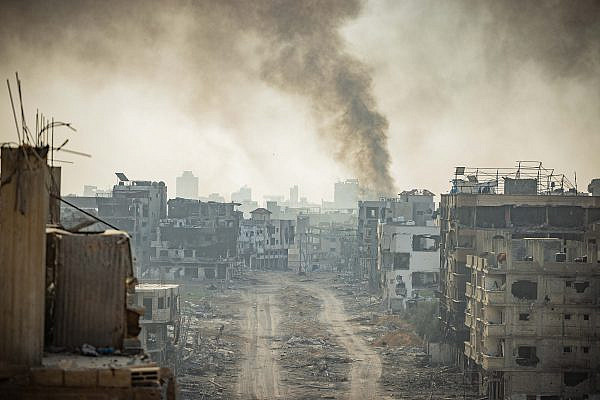
Once the army withdrew, villagers returned to the site, digging through the rubble for anything salvageable: clothing, kitchenware, personal belongings. The scene resembled a natural disaster, as if an earthquake had flattened their homes, wells, and lives.
The goal of Monday’s demolition, locals believe, is part of a broader effort: to push Palestinian residents off their land and clear the way for further illegal settlement expansion. “They want to erase us — not just our homes, but our presence, our history, and our future,” Amer said. For the families of Khilet al-Dabe’, the rubble is not just debris — it is a reminder that they are standing in the way of an expanding occupation. And despite it all, they are refusing to leave.
In response to +972’s inquiry, Israel’s Coordinator of Government Activities in the Territories (COGAT) stated that its personnel “conducted enforcement activity against several illegal structures built without permits in Firing Zone 918, in violation of both planning regulations and military access restrictions,” and that “the operation was carried out in full compliance with legal procedures and approved enforcement priorities.”
An Israeli army spokesperson said that “the enforcement actions were carried out after the completion of all required administrative procedures and in accordance with the enforcement priority framework previously presented to the Supreme Court.” It further claimed that “a closure order was issued in the adjacent area, and the general order which applied to the location in question was known to the residents as well. The temporary order issued was presented upon request.”
Popular resistance to the Trump administration’s erratic, anti-people, and dangerous domestic and foreign policies is growing every day as seen with the massive demonstrations held throughout the country on and after April 5. We welcome these protests and the popular demands raised by them, but we must criticize significant flaws that block the political changes we desperately need.
Criticism is personalized against President Trump, Elon Musk, and the “billionaires” for actions that have been the hallmark of bipartisan policies for decades. Monied interests — not as individuals but as a class, and regardless of their political party — have always been in control of the U.S. government and have prioritized their interests over the interests of the majority, only limited by the organized people’s movements.
Personalizing the criticism and solely blaming the present administration for the problems created by both parties is tantamount to siding with one group of “billionaires” (Democrat) against the other (Republican). Such is the nature of the two-party duopoly as a system, regardless of personnel changes in the White House. Meanwhile, the entire U.S. body politic lurches from one administration to the next on a rightward trajectory toward fascism.
Largely organized by the Democratic party-based group Indivisible, the “Hands Off!” protests were silent about the U.S.’s bipartisan militaristic foreign policy and focused solely on domestic issues, except for “Hands Off NATO.” Revealingly, “Hands Off Palestine” was omitted from the official demands, though grassroots activists raised it.
This intentional silence on foreign policy, and its arbitrary separation from domestic issues, hide the fact that many domestic problems result from a militaristic foreign policy imposed on our country. Trillions of dollars of much needed funds are redirected from human needs to war mongering in Ukraine, West Asia, and Asia-Pacific. Achieving popular power can be most effectively galvanized if it is informed by politically and consciously recognizing the class basis of war and militarism. In contrast, official demands of the “Hands Off!” mobilization, with its embrace of NATO but silence on genocide in Gaza, obscures the class basis of war.
While official lawlessness did not start with Trump, the new president is bent on changing the present post-war imperialist order with another one that gives the empire even more impunity. The U.S. ruling class as a whole has been accelerating the tendency for the U.S. to operate outside the bounds of both national and international law, regardless of who is in office.
The West’s proxy war on Russia continues in Ukraine, while war clouds are gathering around creating another proxy war with the People’s Republic of China using Taiwan and South Korea. And, all the while, the U.S./Israel genocide continues against Palestine and its allies. The imminent war with Iran, supported by both parties, is yet another pressing issue that can best be explained within the framework of imperialism.
On top of all this, is a bipartisan commitment to enhance the repressive apparatus of the state domestically — from cop-cities to the repression on campuses, the criminalization of speech and assembly, restrictions on truthful education, and the further weaponization of the judicial system itself. Intensification of domestic austerity programs, deregulation and destruction of all government organizations that protect and enhance the lives of working people, and attacks on trade unions are the flip side for maintaining a militaristic empire.
All this should make clear that neither of the two billionaire-controlled parties will or can be the urgently needed opposition to imperialism. Current world conditions necessitate building an opposition movement to war and militarism that is even more materially focused on anti-imperialism. This requires understanding the clear link between the empire’s foreign and domestic policies and calling for an end to militarism and redirection of resources to human needs.
Instead of looking for the lesser of two evils, we urge joining people’s independent campaigns to cut the military budget, to close U.S. and NATO foreign military bases, to establish Zones of Peace in our region, and to stop the militarization of police and domestic repression. An anti-imperialist understanding is key to the success of our people’s struggle for peace and a more just society.
Norwegian Foreign Minister Espen Barth Eide speaks to the press at UN headquarters in New York on January 23, 2024. [Photo by CHARLY TRIBALLEAU/AFP via Getty Images]
Norwegian Foreign Minister Espen Barth Eide has voiced deep concern over the silence of some countries regarding Israel’s genocide of the Palestinians in Gaza and denounced the reluctance of foreign ministers to issue statements of condemnation, Anadolu reported.
This came during a joint press conference with his Turkish counterpart, Hakan Fidan, yesterday, following a meeting at the Turkish Foreign Ministry in the capital, Ankara.
“The silence of others on what is happening in Gaza worries me,” Eide said, adding: “Many of my Western counterparts are making a grave mistake by not clarifying their views.”
Regarding Israel’s genocide in Gaza and its global impact, Eide said Norway has not remained silent on the Palestinian-Israeli conflict and was among the first countries to call for a ceasefire in the Gaza Strip.
“We were among the first countries to say that Israel’s response to the attacks of October 7 went far beyond international human rights law or the principle of proportionality,” he said, emphasising that consistency in this position is crucial.
“We must defend human rights and international legal laws and principles, and we believe that these rules must be applied in all circumstances,” he added.
Israel has killed more than 51,400 Palestinians in Gaza since October 2023, most of them women and children.
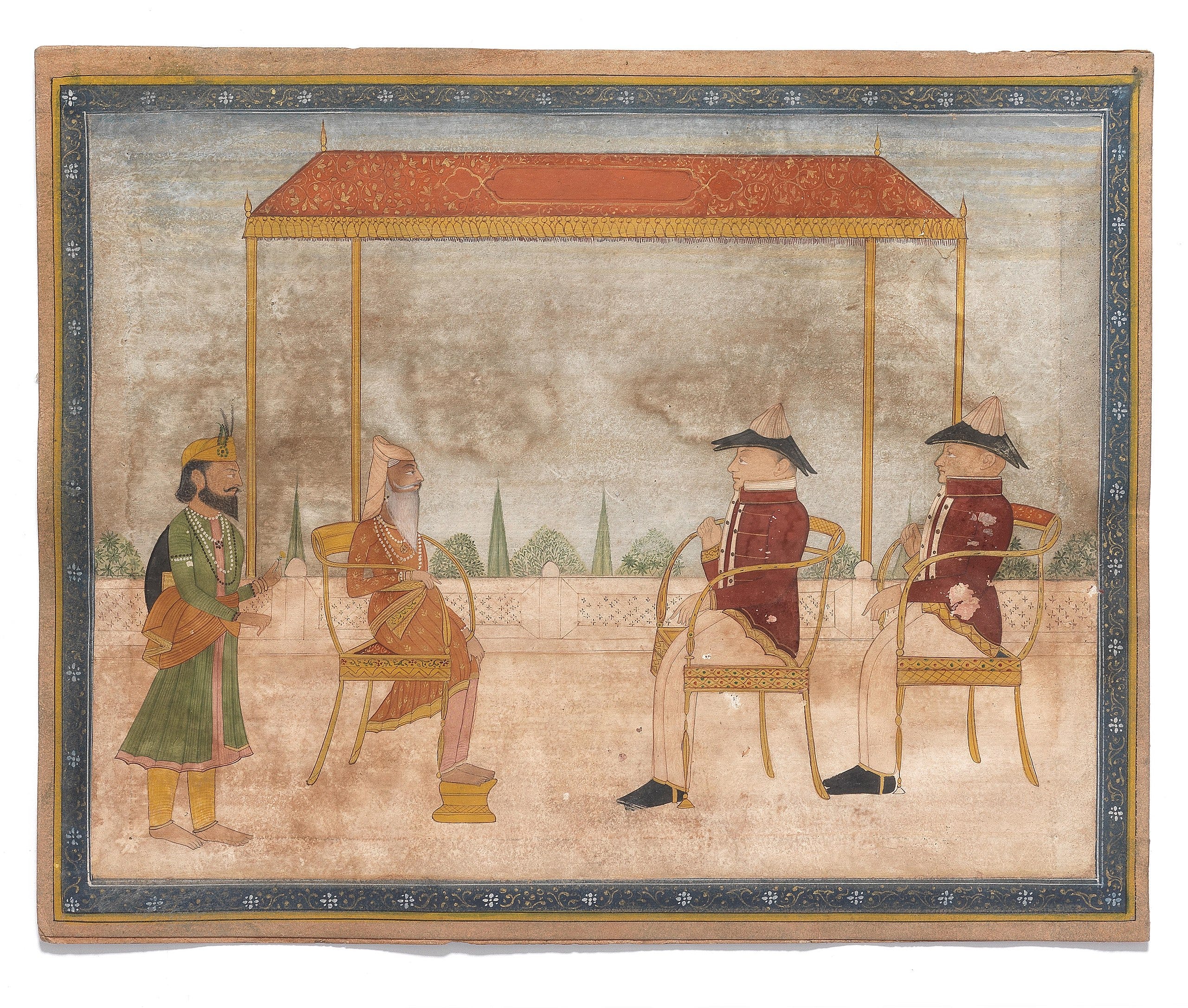
Maharaja Ranjit Singh with two British officers, artist unknown, 19th century, gouache and gold on paper.
India’s Hindutva Prime Minister, Narendra Modi, has used the Kashmir terrorism incident to abrogate the 1960s Indus Waters Treaty—a longstanding goal of Modi. The Indian version of the “terrorist attack,” most of whose victims were Muslim, has largely been accepted by Western governments without evidence.
False flags abound nowadays. You may recall that we were told that the most deadly rocket ever fired by Hamas killed only Palestinians in a hospital compound, while the most deadly rocket ever fired by Hezbollah killed only Druze children. I have at present an open mind about what occurred in Kashmir.
It is however certain that tearing up the Indus Waters Treaty is a long term Modi goal. The Indus supplies 80% of Pakistan’s agricultural water, and the supply is already insufficient, with disastrous salination of the lower reaches of the river as the sea creeps into the areas once occupied by the mighty flow. I visited the area of lower Sind five years ago and witnessed the fields encrused with white salt.
India controls the upstream flow into Pakistan of approximately 70% of the total water of the Indus, about 55% of all of Pakistan’s agricultural water.
In September 2016 in response to earlier violence in Kashmir, Modi initiated his slogan “Blood and water cannot flow together” and threatened to cut the Indus supply. He increased India’s out-take from the Ravi, Beas and Sutlej tributaries and restarted the Tulbul canal project. In both 2019 and 2022 while campaigning in Haryana, Modi made strong speeches threatening to cut off the water “wasted on Pakistan.”
In 2023 Modi issued formal notice to Pakistan of India’s desire to renegotiate the Indus Waters Treaty and repeated this in 2024 when Pakistan did not respond. On both occasions India cited “counter-terrorism” as one of three reasons for review (the others being environmental protection and hydro-electric generation). As counter-terrorism can scarcely be linked to agricultural water allocation, this illustrates Modi’s grandstanding approach.
Modi does not have the physical power to stop the Indus, but does have the ability short term to divert more of the river to Indian irrigation and storage, sufficient to cause some immediate distress in Pakistan. Indian media are already thrilled with the idea. But long term major reblancing of the river water allocation would require substantive new infrastructure in India. Such projects however would be both economically viable and likely wildly popular with Modi’s Hindutva base both for promoting Indian development and for damaging Pakistan.
In 2019, Modi revoked Article 270 of the Indian constitution which gave special autonomous status to Jammu and Kashmir, incorporating them into India proper. He did this despite the Constitution stating it could only be done with the support of the “Constituent Assembly of the State.” That body no longer existed, having been replaced by a “legislative Assembly.” Modi used another Constitutional provision to replace “Constituent Assembly” with “Legislative Assembly,” which seems fair enough. But having suspended the Legislative Assembly, he then claimed that its powers were now vested in the Governor, a Modi appointee.
Modi then agreed with himself to remove the autonomy of Indian Kashmir—a move that had no significant support among its 97% Muslim inhabitants and was accompanied by a ferocious crackdown, indeed lockdown, and the destruction of its once thriving tourism industry. He simultaneously repealed another provision preventing non Kashmiris from buying property in the region. Modi himself is therefore very much the cause of heightened ethnic, political and religious tension in Kashmir.
It is generally recognised that the situation of Kashmir, partly in India and partly in Pakistan with a small portion in China, and the Indian part occupied by deeply dissatisfied Muslims, is a result of the disastrous British partition of India of 1947. But in fact British responsibility for the disaster of modern Kashmir goes back a hundred years further than that, to 1846.
Kashmir was part of the Dourrani Afghan Empire from 1758 until 1819, when it was captured by the Sikh Empire of Maharajah Ranjit Singh. Singh was always careful to place Muslim Governors over Muslim lands, including from the Dourrani family itself. He allied with the British during the First Afghan War, and sent troops, including Kashmiri levies, to aid the British invasion in 1839. However after Ranjit Singh’s death and civil war over the succession, the British attacked the Sikh Empire to “restore stability.” Following the battle of Sobraon, the British annexed the land between the Beas and Ravi rivers, while by the Treaty of Amritsar of 1846 the British sold Jammu and Kashmir to the former Sikh wazir, Gulab Singh, for 50 lakhs of rupees.
Gulab Singh was a particularly murderous character who had played an extraordinarily Machiavellian role in the Sikh court of Ranjit Singh and his immediate successors, and had of course looted from the Sikh treaury the money he paid to the British. So he paid the British with stolen money for land the British had just stolen.
This is how the extraordinary situation arose that the Muslim territories of Kahmir and Jammu had a Hindu ruler (Gulab Singh was a Hindu Dogra). That anomaly was the direct cause of the disastrous division of the territory by the British in the Partition 100 years later.
It is extremely frequent that today’s conflicts are caused by the actions of the British Empire reverberating down and continuing their evil over generations. It is equally frequent that it is very hard to find analyses that explain the truth behind the conflicts.
The Palestinians do not have the luxury for Western moral panic to have its say or impact. Not caving in to this panic is one small but important step in building a global Palestine network that is urgently needed.
The responses in the Western world to the situation in the Gaza Strip and the West Bank raise a troubling question: why is the official West, and official Western Europe in particular, so indifferent to the suffering of the Palestinians?
Why is the Democratic Party in the US complicit, directly and indirectly, in sustaining the daily inhumanity in Palestine—a complicity so visible that it probably was one of the reasons they lost the election, as the Arab American and progressive vote in key states could, and justifiably so, not forgive the Biden administration for its part in the genocide in the Gaza Strip?
This is a pertinent question, given that we are dealing with a televised genocide that has now been renewed on the ground. It is different from previous periods in which Western indifference and complicity were displayed, either during the Nakba or the long years of occupation since 1967.
During the Nakba and up to 1967, it was not easy to get hold of information, and the oppression after 1967 was mostly incremental and, as such, was ignored by the Western media and politics, which refused to acknowledge its cumulative effect on the Palestinians.
But these last eighteen months are very different. Ignoring the genocide in the Gaza Strip and the ethnic cleansing in the West Bank can only be described as intentional and not out of ignorance. Both the Israelis’ actions and the discourse that accompanies them are too visible to be ignored, unless politicians, academics, and journalists choose to do so.
This kind of ignorance is, first and foremost, the result of successful Israeli lobbying that thrived on the fertile ground of European guilt complex, racism and Islamophobia. In the case of the US, it is also the outcome of many years of an effective and ruthless lobbying machine that very few in academia, media, and, in particular, politics dare to disobey.
This phenomenon is known in recent scholarship as moral panic, very characteristic of the more conscientious sections of Western societies: intellectuals, journalists, and artists.
Moral panic is a situation in which a person is afraid of adhering to his or her own moral convictions because this would demand some courage that might have consequences. We are not always tested in situations that require courage, or at least integrity. When it does happen, it is in situations where morality is not an abstract idea but a call for action.
This is why so many Germans were silent when Jews were sent to extermination camps, and this is why white Americans stood by when African Americans were lynched or earlier on enslaved and abused.
What is the price that leading Western journalists, veteran politicians, tenured professors, or CEOs of well-known companies would have to pay if they were to blame Israel for committing a genocide in the Gaza Strip?
It seems that they are worried about two possible outcomes. The first is being condemned as antisemites or Holocaust deniers, and secondly, they fear that their honest response would trigger a discussion that will include the complicity of their country, or Europe, or the West in general, in enabling the genocide and all the criminal policies against the Palestinians that preceded it.
This moral panic leads to some astonishing phenomena. In general, it transforms educated, highly articulate, and knowledgeable persons into total imbeciles when they talk about Palestine. It disallows the more perceptive and thoughtful members of the security services from examining the Israeli demands to include all Palestinian resistance on a terrorist list, and it dehumanizes the Palestinian victims in the mainstream media.
The lack of compassion and basic solidarity with the victims of genocide was exposed by the double standards shown by mainstream media in the West, and in particular by the more established newspapers in the US, such as The New York Times and The Washington Post. When the editor of Palestine Chronicle, Dr. Ramzy Baroud, lost 56 members of his family—killed by the Israeli genocidal campaign in the Gaza Strip—not one of his colleagues in American journalism bothered to talk to him or show any interest in hearing about this atrocity. On the other hand, a fabricated Israeli allegation of a connection between the Chronicle and a family in whose block of flats hostages were held triggered a huge interest by these outlets and attracted their attention.
This imbalance in humanity and solidarity is just one example of the distortions that moral panic brings with it. I have little doubt that the actions against Palestinian or pro-Palestinian students in the US, or against known activists in Britain and France, as well as the arrest of the editor of the Electronic Intifada, Ali Abunimah, in Switzerland, are all manifestations of this distorted moral behavior.
A similar case unfolded just recently in Australia. Mary Kostakidis, a famous Australian journalist and former prime-time weeknight SBS World News Australia presenter, has been taken to the federal court over her—one should say quite tame—reporting on the situation in the Gaza Strip. The very fact that the court has not dismissed this allegation upon its arrival shows you how deeply rooted moral panic is in the Global North.
But there is another side to it. Thankfully, there is a much larger group of people who are not afraid of taking the risks involved in clearly stating their support for the Palestinians, and who do show this solidarity while knowing it may lead to suspension, deportation, or even jail time. They are not easily found among the mainstream academia, media, or politics, but they are the authentic voice of their societies in many parts of the Western world.
The Palestinians do not have the luxury for Western moral panic to have its say or impact. Not caving in to this panic is one small but important step in building a global Palestine network that is urgently needed—firstly to stop the destruction of Palestine and its people, and second, to create the conditions for a decolonized and liberated Palestine in the future.
ZNetwork is funded solely through the generosity of its readers.
The death of Pope Francis today in Rome is a sad event for all those who knew of his concern for the weak and poor. He opposed wars and bloodshed of fellow humans. Even yesterday, on Easter Sunday, he pleaded for a ceasefire in Gaza and the end of the humanitarian catastrophe there by those who are waging war on Gaza and destroying its people in the most brutal ways.
Will Israel and its major patrons of war and destruction in the Middle East pay any attention to the dying religious leader’s words?
We, who stand for truth, justice, and respect for international and humanitarian laws, offer our respect to the departed leader and send condolences to the followers of the Catholic Church.


 By
By 

![Norwegian Foreign Minister Espen Barth Eide speaks to the press at UN headquarters in New York on January 23, 2024. [Photo by CHARLY TRIBALLEAU/AFP via Getty Images]](https://i0.wp.com/www.middleeastmonitor.com/wp-content/uploads/2024/03/GettyImages-1948399281-scaled-e1745578906855.jpg?fit=1200%2C800&ssl=1)
 By
By 
 Peace and Justice Post


You must be logged in to post a comment.