Archive for the ‘Uncategorized’ Category

Over 2,000 Britons served for Israel amid Gaza genocide

February 12, 2026

Exclusive: Declassified obtained data on the number of UK nationals in the IDF. We are publishing it for the first time

JOHN McEVOY and Alex Morris
11 February 2026

Israeli soldiers repair a tank near Gaza in April 2025, when thousands of British nationals were serving in the IDF, new data (left) reveals. (Photo: Jim Hollander / Alamy)

1x

0:00 / 7:15

More than 2,000 Britons served in the Israel Defence Forces (IDF) during the Gaza genocide, it can be revealed.

The information was obtained by Declassified via a Freedom of Information request issued to the IDF by lawyer Elad Man from the NGO Hatzlacha.

The data outlines the number of people with dual and multiple nationalities who were IDF service members as of March 2025.

It shows how 1,686 British-Israelis and a further 383 people with British, Israeli, and another nationality served in the IDF amid the annihilation of Gaza.

They were among over 50,000 IDF soldiers with Israeli and at least one other nationality. 

The largest cohorts come from the US, Russia, Ukraine, France, and Germany.

Prior to this, data was only available on the number of Britons without Israeli citizenship serving in the IDF, so-called lone soldiers, a figure that was as low as 54.

‘Authorities must investigate’

The revelation that far more UK passport holders served in the IDF will raise serious legal questions for the British authorities, which have thus far failed to prosecute any citizens returning home after fighting in Gaza.

Paul Heron, a lawyer with the Public Interest Law Centre (PILC), told Declassified: “There must be no impunity where credible evidence links British nationals to grave breaches of international law.

“The UK has clear duties to prevent genocide and avoid assisting unlawful military action. 

“Where dual nationals have served in units implicated in atrocities, the authorities must investigate promptly and, where the evidence meets the threshold, pursue arrest and prosecution like any other serious crime”.

Declassified contributor Hamza Yusuf previously exposed how Britons were serving in some of Israel’s “craziest” combat units in Gaza where they viewed Palestinian fighters as “rats” and “animals”.

Among the Britons identified by Yusuf was Levi Simon, who was seen “rummaging through the underwear drawers of Palestinian women forced to flee their homes” in Gaza.

Another was master sergeant Sam Sank from London, who filmed himself fighting in Gaza between December 2023 and January 2024.

Sank had told The Times that “based on the number of his friends in the IDF, which includes a Scot in his own small unit, [he] believes there are hundreds, if not thousands, more Britons fighting in Israel.”

His estimates match with the data Hatzlacha has now obtained from Israeli authorities.

The UK Foreign Office declined to comment on the new data but confirmed that it does not collect information on the number of Britons in the IDF.

RELATED
British fighters in Israel’s military: Is it legal?

READ MORE 

‘No one is above the law’

The Metropolitan police’s war crimes unit was handed a complaint against ten Britons serving in the IDF last year.

Although their names were not made public, the 240-page dossier accused the British suspects of “targeted killing of civilians and aid workers, including by sniper fire, and indiscriminate attacks on civilian areas”.

It was submitted by the Public Interest Law Centre (PILC) and the Gaza-based Palestinian Centre for Human Rights.

“British nationals are under a legal obligation not to collude with crimes committed in Palestine. No one is above the law”, said Michael Mansfield, one of the lawyers who issued the complaint.

Heron told Declassified: “In our report to the Metropolitan Police, we set out credible evidence that 10 British nationals served in the Israeli Defence Forces and were involved in war crimes and acts giving rise to genocide.”

He said our findings showed “the issue is far deeper than we could ever believe.”

The Metropolitan Police did not respond when Declassified asked last year whether the people referred by PILC would be investigated for potential involvement in war crimes.

Lone soldiers

In addition to dual nationals, over 50 “lone soldiers” from Britain – defined as IDF members without family in Israel to support them – have served for Israel amid the genocide.

That data was released last year in a report on “lone soldiers” published by the Knesset Research and Information Center within Israel’s parliament.

“Lone soldiers” also include immigrants who arrive in Israel alone and volunteers from abroad.

The Knesset report detailed how 54 Britons were among around 3,000 lone soldiers serving in the IDF in August 2024.

Thirty-three of those Britons joined through the Tzabar programme, which is an Israeli support system for young Jewish adults to “make Aliyah” (emigrate to Israel) and serve in the IDF.

In the past, the UK government itself has offered support to “lone soldiers” in Israel.

Chaim Schryer, originally from Manchester, served in Netzah Yehuda, an Israeli military unit which the US considered sanctioning in 2024 over evidence of gross human rights violations.

Schryer was invited onto a British Royal Navy ship in 2021 alongside other British ‘lone soldiers’ who joined the IDF without family in Israel to support them.

He was pictured walking onto the HMS Richmond wearing his Netzah Yehuda uniform, before being given a tour of the boat and meeting Britain’s defence attaché in Israel, Colonel Jim Priest.

Schryer is among at least three Britons identified by Declassified, using open-source data and facial recognition software, who served with Netzah Yehuda over recent years.

Chaim Schryer (right) boards HMS Richmond in 2021. (Photo: Royal Navy / X)

Legal concerns

In July 2024, the International Court of Justice handed down its advisory opinion on the legal consequences of Israel’s occupation of Palestine.

The court advised that all UN member states – including the United Kingdom – were obligated to refrain from assisting Israel in maintaining its occupation.

In January 2024, the ICJ also put all member states on notice of the serious risk that genocide was being committed by Israel in Gaza.

“The duty to prevent genocide was triggered due to the actual or constructive knowledge of the immediate plausiblity that genocide was being or was about to be committed”, the UN commission of inquiry subsequently wrote.

To this end, the UK government’s failure to investigate or even monitor the activities of Britons serving in the IDF could be interpreted as tacit support for Israel’s military campaign.

Britain’s recent recognition of a Palestinian state might also mean that British nationals serving in the IDF could be in breach of the Foreign Enlistment Act.

This law, passed in 1870, makes it an offence for Britons “to fight for a foreign state at war with another state with which the UK is at peace”

A spokesperson for the International Centre of Justice for Palestinians (ICJP) said: “No one in the UK wants to live next door to a potential war criminal. 

“And yet, British people who fought in the IDF are allowed to return to this country and live freely amongst us, despite fighting for an army that is committing genocide.

“It is utterly inexcusable that the UK government is failing to take action to hold citizens accountable for potential violations of international and domestic law”.

TAGGED:

ABOUT THE AUTHOR

John McEvoy is Chief Reporter for Declassified UK. John is an historian and filmmaker whose work focuses on British foreign policy and Latin America. His PhD was on Britain’s Secret Wars in Colombia between 1948 and 2009, and he is currently working on a documentary about Britain’s role in the rise of Augusto Pinochet.

Mexico Sends Shipment of Humanitarian Aid to Cuba

February 11, 2026

Scheerpost, February 11, 2026 cuba, DR, international, mexico, pablo meriguet, peoples dispatch, robert scheer, scheerpost

Share this:

Claudia Sheinbaum. Eneas De Troya, CC BY 4.0 https://creativecommons.org/licenses/by/4.0, via Wikimedia Commons
In one of the scariest moments in modern history, we're doing our best at ScheerPost to pierce the fog of lies that conceal it but we need some help to pay our writers and staff. Please consider a tax-deductible donation.

By Pablo Meriguet / Peoples Dispatch

The government of Mexican President Claudia Sheinbaum announced the shipment of 814 tons of milk, meat, beans, rice, and other foodstuffs to Cuba on Sunday, February 8. The move came days after Cuban President Miguel Díaz-Canel presented a series of emergency measures being adopted by his government to mitigate the impact of the severe fuel shortage facing the island.

Cuba is currently facing a serious crisis, provoked by recent maneuvers from the US government which, emboldened by its massive military build up in the Caribbean and its recent bombing of Caracas, has sought to further tighten the blockade on the island, hoping to finally force the overthrow of the government. On January 29, Trump announced an executive order under which any country that trades hydrocarbons with Havana will see a 10% increase in tariffs on its products exported to the United States. The executive order was said to have targeted Cuba’s main energy suppliers: Venezuela, Mexico, and Russia. 

Venezuela was already effectively forced to halt oil shipments to Cuba due to the naval blockade imposed by the US against Venezuela, which already resulted in the illegal seizure of a Cuba-bound Venezuelan oil tanker.

Russia, a country which, due to heavy sanctions, is the most decoupled from the US economy, has declared that it will continue supplying fuel to Cuba. The government has said that “the situation in Cuba is truly critical” and top government spokesperson Dimitry Peskov, said “We are in close contact with our Cuban friends through diplomatic and other channels.”

Mexico, for its part, announced that it was engaged in negotiations with the US over oil shipments. President Claudia Sheinbaum has openly declared her rejection of the Trump measure: “You can’t suffocate people like that. It is very unfair.”

She also promised that Mexico would continue to help Cuba in any way possible: “We will continue to support Cuba and take all necessary diplomatic action to resume oil shipments.” In recent days, after learning of the Trump administration’s “threat”. Mexico, one of the few countries that sent oil to Cuba, said it would consult with Washington to determine the extent of possible retaliation.

According to Cuban President Miguel Díaz-Canel, not a single drop of oil has entered the island in 2026, posing a serious threat to a country that depends heavily on fuel for its power grid and to keep transportation, health, education, and other key systems functioning. Government officials and political analysts have claimed that the recent measure seeks to annihilate the Cuban people.

Former Colombian President Ernesto Samper shared this opinion in a post: “SOS for Cuba. The genocide of the Cuban people is being prepared by suffocating their vital conditions for survival. A United Nations humanitarian mission could lead a deployment of humanitarian ships loaded with the fuel that the island needs today, like the oxygen we breathe every day to stay alive.”

Mexican solidarity with Cuba

For his part, the Cuban president said, regarding the Mexican shipment that departed in two ships from the port of Veracruz: “Thank you, Mexico. For your solidarity, affection, and always warm embrace of Cuba.”

Cuban Foreign Minister Bruno Rodríguez wrote on X: “We thank the Government of Mexico, under the leadership of President Claudia Sheinbaum, for sending more than 800 tons of aid to Cuba, amid the intensification of the blockade following the recent Executive Order by the US government. While some try to suffocate our population, sister nations extend their hand in solidarity.”

Editor’s Note: At a moment when the once vaunted model of responsible journalism is overwhelmingly the play thing of self-serving billionaires and their corporate scribes, alternatives of integrity are desperately needed, and ScheerPost is one of them. Please support our independent journalism by contributing to our online donation platform, Network for Good, or send a check to our new PO Box. We can’t thank you enough, and promise to keep bringing you this kind of vital news.

Donate Online

Send a Check

You can also make a donation to our PayPal or subscribe to our Patreon.

Pablo Meriguet

Pablo Meriguet is a writer for Peoples Dispatch.

Iran tells US not to let Netanyahu thwart nuclear talks before Trump meeting

February 11, 2026

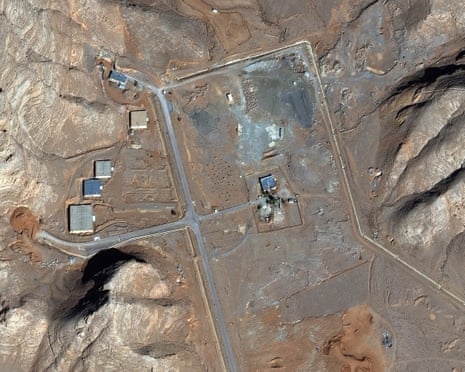
Satellite image courtesy shows Iran's Isfahan nuclear facility site.

Iran nuclear programme

Tehran’s intervention comes as the Israeli prime minister heads to a hastily arranged White House encounter

The Guardian, Patrick Wintour Diplomatic editor 10 Feb 2026 20.34 CET

Tehran has told the US not to allow Israel to destroy the chance of reaching an agreement over Iran’s nuclear programme amid speculation that Benjamin Netanyahu intends to use a hastily arranged White House meeting with Donald Trump on Wednesday to divert negotiations.

Iran’s intervention came as the Israeli prime minister flew to Washington to plead with Trump not to negotiate a deal with Tehran if it excludes limiting the country’s ballistic missile programme, dropping its support for proxy forces in the region and curtailing human rights abuses at home.

Netanyahu is deeply concerned that Trump’s son-in-law Jared Kushner and his special envoy, Steve Witkoff, are prepared to strike a deal confined to limiting the scope of Iran’s nuclear programme, which in Israel’s view would do nothing to rein in the long-term threat Tehran poses to the region.

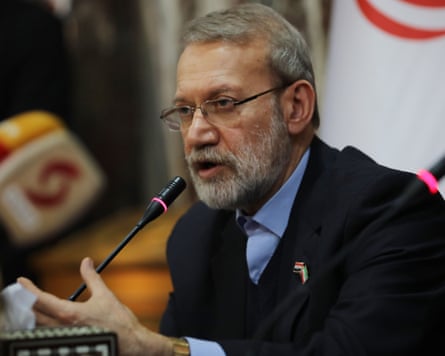
Iran’s security chief, Ali Larijani, said Washington ‘must remain vigilant regarding Israel’s destructive role’.
Iran’s security chief, Ali Larijani, said Washington ‘must remain vigilant regarding Israel’s destructive role’. Photograph: Louai Beshara/AFP/Getty Images

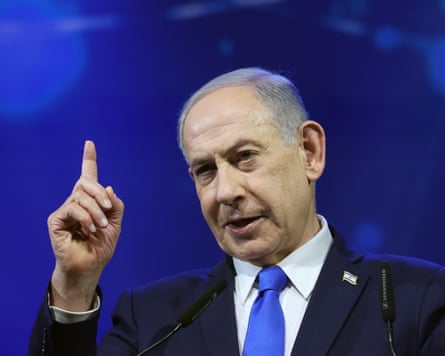
Speaking before leaving for Washington, Netanyahu said he would “present to the president our approach around our principles on the negotiations”. He is expected to provide Trump with fresh intelligence about Iran’s military capabilities, including new long-range ballistic missiles.

Netanyahu faces a delicate task in setting out his stall because he risks being seen as challenging two of Trump’s most respected aides by mapping out a set of demands that could force the US into prolonged conflict with Iran.

He also risks angering Trump by opening up divisions in the Republican party, especially if he reminds the US president that he made repeated unfulfilled promises to come to the help of Iranian protesters.

Netanyahu’s turbulent relationship with Trump was already entering another rough patch as he continues to stall on his Gaza peace plan by barring a Palestinian technocratic body from entering the strip, and seeking in effect to annex the West Bank.

Benjamin Netanyahu
Benjamin Netanyahu. Photograph: Abir Sultan/EPA

In a sign that he knows he is treading on thin ice, Netanyahu agreed to take the US ambassador to Israel, Mike Huckabee, with him. Before heading to Washington, Huckabee said there was “an extraordinary alignment between US and Israel on Iran”, and that as far as he knew the two sides shared the same red lines.

Iran expressed its anger at Israel’s intervention. Ali Larijani, the the head of the Supreme National Security Council, the body overseeing Tehran’s negotiating strategy, said: “The Americans should think wisely and not allow him, with his posturing, to create the impression before his flight that he is going to the United States to set the framework of nuclear negotiations. They must remain vigilant regarding Israel’s destructive role.”

Larijani met the mediators between Washington and Tehran in Muscat to discuss the agenda for further talks.

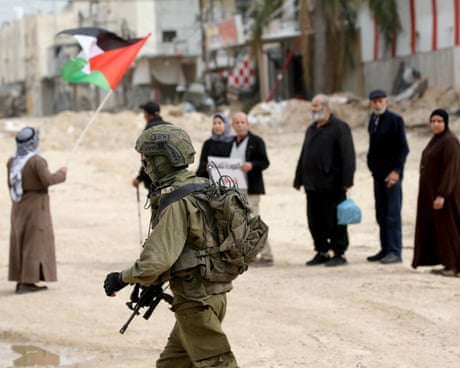
An Israeli soldier walks past displaced Palestinians protesting to demand the right to return to their homes, in the Nur Shams refugee camp in Tulkarm, West Bank.

Iran’s foreign ministry spokesperson, Esmail Baghaei, said in his weekly press briefing: “Our negotiating party is America. It is up to America to decide to act independently of the pressures and destructive influences that are detrimental to the region.”

Israel’s alarm about a potential deal that undercuts its ambitions for regime change in Tehran has grown ever since the US agreed to reopen indirect talks with Iran, which started in Oman on Friday.

The Iranian government also still faces political challenges at home, with more reformist groups and academics issuing statements protesting against the suppression of dissent and, in particular, the arrest of leaders of the Reformist Front.

The front issued a further statement expressing its shock, and warning that the regime’s exclusionary approach and baseless accusations would worsen the political deadlock and “strengthen the violent and war-mongering factions supporting Israel”. It called on Iran’s president, Masoud Pezeshkian, to intervene urgently to secure the release of its leadership.

Even if the planned second round of talks are confined to Iran’s nuclear programme, as Tehran wants, there is no guarantee of success because it insists on maintaining its right to enrich uranium as fuel for nuclear power plants, something the US permitted under the 2015 deal but Trump has appeared to rule out.

Trump has sent the aircraft carrier Abraham Lincoln and three accompanying warships to the region, which are capable of hitting a huge range of Iranian military and economic sties. The US has also buttressed the air defences of US bases across the region.

The head of Iran’s atomic energy authority has said Tehran may be prepared to dilute its stock of highly enriched uranium to 60% purity, a limited concession given the 2015 deal limited it to enriching to 3.75% purity.

Ehud Olmert accuses Israel of backing violent ethnic cleansing in the West Bank

February 11, 2026

Wafa News Agency, Feb 5, 2026

TEL AVIV, February 5, 2026 (WAFA) — Former Israeli prime minister Ehud Olmert said a “violent and criminal attempt at ethnic cleansing” is taking place in the occupied West Bank, accusing Israeli police, the army and the Shin Bet security service of involvement and support for attacks carried out by extremist settlers.

In an article published in the Israeli daily Haaretz, Olmert said that armed and violent settler groups are persecuting, injuring and killing Palestinians living in the area. He said the attacks include burning olive groves, homes and vehicles, breaking into houses, physically assaulting residents, harming livestock, dispersing sheep herds and attempting to steal them.

Olmert stated that “Jewish terrorists” are attacking Palestinians with hatred and violence for a single purpose: forcing them to flee their homes in order to prepare the area for Jewish settlement and advance a dream of annexing all the land.

He said the attacks are taking place in front of the closed eyes of police officers and soldiers, arguing that hundreds of violent youths would not have been able to carry out such acts had they not been equipped with weapons through the initiative and encouragement of far-right National Security Minister Itamar Ben-Gvir.

According to Olmert, militias operating in the West Bank are acting with direct backing and assistance from Israeli government officials, adding that the Israeli police also serve as a source of encouragement for “Jewish terrorism.”

He further argued that the Shin Bet does not employ against Jewish extremists the same tools it uses effectively against Palestinians, and fails to act decisively to prevent attacks, identify rioters, or locate and arrest the leaders of these groups.

Olmert said the issue goes beyond the Israeli army’s failure to prevent unrest in the occupied territories, suggesting that in many cases soldiers cooperate with rioters or remain nearby, watching events unfold without intervention.

He called on the international community to take political measures to compel the Israeli government to activate mechanisms to stop what he described as crimes against humanity committed under its sponsorship, protection and support.

Olmert concluded by saying there may be no option other than expecting the International Criminal Court to become the inevitable address for investigation, exposure of those responsible, and steps that could ultimately lead to their arrest and prosecution.

M.N

Epstein files: Western media must stop burying the Israel connection

February 11, 2026

Mohamad Elmasry

Middle East Eye, 9 February 2026 18:14 GMT

For all the obsessive coverage of the disgraced financier’s political dealings, mainstream outlets have skimmed past one of the biggest stories

Independent media reporting has highlighted former Israeli Prime Minister Ehud Barak's past dealings with Jeffrey Epstein (Jack Guez/AFP)

Independent media reporting has highlighted former Israeli Prime Minister Ehud Barak’s past dealings with Jeffrey Epstein (Jack Guez/AFP)

Since the release late last month of millions more files in the Jeffrey Epstein saga, western media outlets have provided nonstop coverage. Yet despite an extensive focus on the disgraced financier’s relationships with powerful figures, his links to Israeli political and intelligence circles have been largely ignored, marking a conspicuous omission.

Searches across online news archives turn up thousands of recent stories on legitimate issues of public concern, highlighting victims of Epstein’s abuse and the alleged involvement of prominent persons and groups in that abuse. 

The New York Times, PBS, NBC and CNN, among other notable outlets, have drawn from the files to publish exhaustive accounts of powerful men with ties to Epstein.

In addition to naming business, academic and sports figures, much reporting has focused on political figures, such as US President Donald Trump, former Norwegian Prime Minister Thorbjorn Jagland, and the UK’s Prince Andrew and politician Peter Mandelson.

Media coverage has also emphasised Epstein’s relationships with foreign countries, with Reuters and the Washington Post running stories about his alleged ties to Russia. Other pieces have documented Epstein’s purported links to Norway and Slovakia. 

New MEE newsletter: Jerusalem Dispatch

Sign up to get the latest insights and analysis on Israel-Palestine, alongside Turkey Unpacked and other MEE newsletters

But despite Epstein’s ties to Israel having been known for months – an ongoing Drop Site News investigation suggests that Epstein worked closely with former Israeli Prime Minister Ehud Barak and participated in initiatives connected to Israeli intelligence – there has been little mainstream coverage of this aspect.

Even as sites such as Middle East Eye, Al Jazeera, Mondoweiss and TRT World, among others, have devoted significant coverage to the Epstein-Israel connections, there appears to be a glaring gap in western mainstream media.

Strategic omission

There are, of course, exceptions, such as the CNN interview last November with Marjorie Taylor Greene, in which the then-US congresswoman broached Epstein’s alleged ties to Israel. But the response from CNN presenter Dana Bash was telling: she became visibly irritated, and swiftly pivoted to the topic of antisemitism. 

Journalism studies scholarship routinely emphasises the importance of omission. The inclusion and exclusion of information are among the primary mechanisms through which members of the media create meaning. 

So why does it seem that mainstream western media outlets are bending over backwards to avoid the Israeli elephant in the room? This dovetails with broader questions on why western media tends to sympathise with Israeli narratives. 

In the current moment, the biggest danger for journalists is not getting a story wrong – it is appearing unwilling to tell it at all

Some outlets – or at least some powerful editors and producers – might have a direct interest in shielding Israel. It is also possible that news managers are afraid of the consequences of maligning Israel, or of being perceived to be “antisemitic”. 

Scholars John Mearsheimer and Stephen Walt famously described the power of pro-Israel lobbying groups, which have long exerted considerable sway over American politics and media, helping to generate favourable coverage. Reporting that is critical of Israel often triggers pressure campaigns from these groups.

In such an environment, omission functions as a type of risk management. News editors know that even the perception of unfairness towards Israel can trigger accusations of antisemitism.

Media institutions operate within the broader sociopolitical climate. Since the start of the Gaza war in October 2023, American and British universities have come under fire for actively suppressing pro-Palestine speech and student protests critical of Israel. 

In 2024, an American university took the extraordinary step of firing a tenured professor over speech critical of Zionism, confirming how Israel-related criticism carries an unusually high professional risk – a reality that news outlets know well. 

Pivotal moment

Western journalists have long had to be careful about covering Israel. In 2018, contributor Marc Lamont Hill was fired by CNN for speaking in favour of Palestinian liberation. But sensitivities were heightened after 7 October 2023, when Hamas attacked Israeli communities and Israel launched its genocide in Gaza. 

Since the start of the violence, media figures have faced intense backlash, including firings, over speech critical of Israel’s actions in Gaza. Journalist Mehdi Hasan’s show on MSNBC was cancelled following his criticisms of Israel. 

Direct pressure is often applied by media owners, who are increasingly vocal about the need to protect Israel as it faces unprecedented global disapproval. Businessmen Larry and David Ellison have strategically acquired media assets – including TikTok’s US operations and CBS News – in an apparent bid to influence narratives about Israel. 

What were Jeffrey Epstein’s ties to Israeli intelligence? | Murtaza Hussain

Read More »

Since the acquisitions, TikTok has aggressively censored pro-Palestinian content, and CBS has shifted to a more overt pro-Israel stance. Zvika Klein, editor-in-chief of the Jerusalem Post, recently praised CBS’s new editor, Bari Weiss, for “doing more for Israel than most of us”. 

In the meantime, the Epstein files have created a public obsession, with every new detail generating a firestorm of interest, clicks, likes and shares. Serious independent news organisations and popular podcasts have reported extensively on Epstein’s ties to Israel, so the issue is unlikely to fade from the public conversation. Mainstream outlets may ultimately be forced to join in, if for no other reason than to maintain some semblance of credibility. 

After all, news audiences will soon wonder – if they do not already – why journalists readily report on Epstein’s alleged ties to Slovakia and Norway, but ignore his connections to a key western ally entangled in major conflicts with far-reaching implications. 

This is an important moment for western, and especially American, news organisations. Journalism derives its authority from its willingness to pursue uncomfortable facts that matter to the public. A growing number of observers in North America and Europe already believe that a double standard shapes how Israel is treated across western capitals. 

Media outlets should avoid feeding this suspicion, especially now, when public trust in media is at an all-time low. In the current moment, the biggest danger for journalists is not getting a story wrong – it is appearing unwilling to tell it at all.

The views expressed in this article belong to the author and do not necessarily reflect the editorial policy of Middle East Eye.

Mohamad Elmasry is Professor of Media Studies at the Doha Institute for Graduate Studies.

Israeli minister calls West Bank measures ‘de facto sovereignty,’ says no future Palestinian state

February 10, 2026
 Thursday, July 13, 2023, in      .The latest battle over Western public lands and fossil fuels is simmering in the Rockies where a proposed multi-billion dollar, 88-mile railway would cut through Utah wilderness and streamline the movement of crude oil to Colorado and throughout the country. Initial approvals for the project by the U.S. Department of Transportation are raising questions about the Biden administration’s stated commitment to wean the country off fossil fuels and could become a campaign issue in next year’s election. (AP Photo/Rick Bowmer)

By  SAM METZ, AP News, February 10, 2026

Leer en español

RAMALLAH, West Bank (AP) — A top Israeli official said Tuesday that measures adopted by the government that deepen Israeli control in the occupied West Bank amounted to implementing “de facto sovereignty,” using language that mirrors critics’ warnings about the intent behind the moves.

The steps “actually establish a fact on the ground that there will not be a Palestinian state,” Energy Minister Eli Cohen told Israel’s Army Radio.

Palestinians, Arab countries and human rights groups have called the moves announced Sunday an annexation of the territory, home to roughly 3.4 million Palestinians who seek it for a future state.

Cohen’s comments followed similar remarks by other members of Prime Minister Benjamin Netanyahu’s government, including Finance Minister Bezalel Smotrich and Defense Minister Israel Katz.

The moves — and Israeli officials’ own descriptions of them — put the country at odds with both regional allies and previous statements from U.S. President Donald Trump. Netanyahu has traveled to Washington to meet with him later this week.

Last year, Trump said he wouldn’t allow Israel to annex the West Bank. The U.S.-brokered ceasefire between Israel and Hamas that aimed to stop the war in Gaza also acknowledged Palestinian aspirations for statehood.

Widespread condemnation

The measures further erode the Palestinian Authority’s limited powers, and it’s unclear the extent to which it can oppose them.

In a statement on Tuesday, President Mahmoud Abbas’ cabinet “instructed all public and private Palestinian institutions not to engage with these Israeli measures and to strictly adhere to Palestinian laws and regulations in force.”

A group of eight Arab and Muslim-majority countries expressed their “absolute rejection” of the measures, calling them in a joint statement Monday illegal and warning they would “fuel violence and conflict in the region.”

Related Stories

Israel's security cabinet approves measures to strengthen control over the West Bank

Israel’s security cabinet approves measures to strengthen control over the West Bank

Israeli strikes kill 3 people in Gaza, hospital says

Israeli strikes kill 3 people in Gaza, hospital says

Palestinians wait at border between Gaza and Egypt as uncertainty clouds reopening of Rafah crossing

Palestinians wait at border between Gaza and Egypt as uncertainty clouds reopening of Rafah crossing

Israel’s pledge not to annex the West Bank is embedded in its diplomatic agreements with some of those countries and renewed warnings that it was a “red line” for the Emirates led Israel to shelve some high-level discussions on the matter last year.

United Nations Secretary General Antonio Guterres said he was “gravely concerned” by the measures.

“They are driving us further and further away from a two-State solution and from the ability of the Palestinian authority and the Palestinian people to control their own destiny,” his spokesperson, Stephane Dujarric, said on Monday.

What the measures mean

The measures, approved by Netanyahu’s Security Cabinet on Sunday, expand Israel’s enforcement authority over land use and planning in areas run by the Palestinian Authority, making it easier for Jewish settlers to force Palestinians to give up land.

Smotrich and Katz on Sunday said they would lift long-standing restrictions on land sales to Israeli Jews in the West Bank, shift some control over sensitive holy sites — including Hebron’s Ibrahimi Mosque, also known as the Tomb of the Patriarchs — and declassify land registry records to ease property acquisitions.

They also revive a government committee empowered to make what officials described as “proactive” land purchases in the territory, a step intended to reserve land for future settlement expansion.

Taken together, the moves add an official stamp to Israel’s accelerating expansion and would override parts of decades-old agreements that split the West Bank between areas under Israeli control and areas where the Palestinian Authority exercises limited autonomy.

Israel has increasingly legalized settler outposts built on land Palestinians say documents show they have long owned, evicted Palestinian communities from areas declared state land, firing zones or nature reserves.

More than 700,000 Israelis live in the occupied West Bank and east Jerusalem, territories captured by Israel in 1967 and sought by the Palestinians for an independent state along with the Gaza Strip.

Palestinians are not permitted to sell land privately to Israelis. Settlers can buy homes on land controlled by Israel’s government.

The international community overwhelmingly considers Israeli settlement construction to be illegal and an obstacle to peace.

“These decisions constitute a direct violation of the international agreements to which Israel is committed and are steps toward the annexation of Areas A and B,” anti-settlement watchdog group Peace Now said on Sunday, referring to parts of the West Bank where the Palestinian Authority exercised some autonomy.

__ Natalie Melzer contributed reporting from Nahariya, Israel.

SAM METZ

SAM METZ

Metz covers Morocco, Algeria, Tunisia and points beyond for The Associated Press.

Israeli weapons ‘evaporate’ thousands of Palestinians in Gaza: Investigation

February 10, 2026

Civil defence teams in Gaza documented over 2,800 cases of Palestinians who were ‘vaporised’ by US-made bombs

A Palestinian mourns those killed by an Israeli strike, at Nasser Hospital in Khan Younis, south Gaza, on 4 December, 2025 (AFP/Bashar Taleb)

A Palestinian mourns those killed by an Israeli strike, at Nasser Hospital in Khan Younis, south Gaza, on 4 December 2025 (AFP/Bashar Taleb)

By Mera Aladam

Published date: 10 February 2026 15:34 GMT | Last update:1 hour 43 mins ago

Israel used internationally prohibited thermal and thermobaric weapons, leaving thousands of Palestinian bodies “evaporated” as a result, an investigation by Al Jazeera revealed. 

Civil defence teams in Gaza documented over 2,800 cases of Palestinians who just vanished since the beginning of Israel’s genocidal war, the Al Jazeera Arabic programme, The Rest of the Story, reported.

What is left of these bodies is only pieces of flesh, specks of blood or even ash.

Since the start of the war on Gaza in October 2023, Israel has obliterated most of the Gaza Strip, reducing entire neighbourhoods, including schools, businesses and medical facilities, to rubble.

Israeli soldiers and combat engineers have laid explosives and triggered controlled demolitions inside countless homes, while armoured bulldozers have systematically levelled building after building.

New MEE newsletter: Jerusalem Dispatch

Sign up to get the latest insights and analysis on Israel-Palestine, alongside Turkey Unpacked and other MEE newsletters

More than mere explosives, experts and testimonies have attributed the vaporisation of people to Israel’s use of US-supplied thermal and thermobaric weapons, referred to as vacuum or aerosol bombs, capable of generating temperatures exceeding 3,500 degrees Celsius (6,332 degrees Fahrenheit).

To put into perspective, the boiling point of water is 100 degrees Celsius (212 degrees Fahrenheit). 

The intense heat is often generated by tritonal, which is a mixture of TNT and aluminium powder used in American-made bombs.

Civil defence spokesperson Mahmoud Basal told Al Jazeera that teams cross reference the known number of inhabitants in a house with the recovered bodies.  

“If a family tells us there were five people inside, and we only recover three intact bodies, we treat the remaining two as ‘evaporated’ only after an exhaustive search yields nothing but biological traces – blood spray on walls or small fragments like scalps,” he explained.

The director general of the Palestinian Ministry of Health in Gaza, Munir al-Bursh, noted that it is “chemically inevitable” when a human body is exposed to high temperatures to “vaporise and turn to ash” as we are made up of 80 percent water. 

The investigation identified several US-manufactured munitions used in Gaza, including the MK-84 “Hammer”, BLU-109 bunker buster, and GBU-39 small diameter bomb.

The BLU-109 bunker buster was reportedly used in an attack on al-Mawasi, an area Israel previously declared a “safe zone” for forcibly displaced Palestinians in September 2024, evaporating 22 Palestinians. 

Meanwhile the GBU-39 is said to have been used in an attack on al-Tabin school in eastern Gaza City. Basal confirmed finding fragments of the weaponry at sites where bodies had vanished.

In late November, Hamas called on an international committee to investigate Israel’s use of certain weapons, alleging that bodies are being “vaporised” in Gaza.

“The horrific testimonies provided by citizens and doctors in northern Gaza following the air strikes and massacres carried out against innocent civilians, and the confirmation of cases of targeting with weapons and ammunition that lead to the vaporisation of bodies strongly point to the use of internationally banned weapons by the terrorist occupation army,” the Palestinian movement said.

So far, Israel has killed more than 72,037 people and destroyed nearly 90 percent of the territory’s infrastructure.

li attacks and killings in Gaza continue despite the “ceasefire”

February 10, 2026

https://www.aljazeera.com/news/liveblog/2026/2/10/live-israeli-attack-on-gaza-building-kills-four-palestinians?update=4302936

Israel’s new West Bank measures ‘accelerate annexation and end Oslo Accords’

February 10, 2026

Analysts say Israeli changes have cornered Palestinian Authority and will pave way for ethnic cleansing

A large Star of David is mounted atop a building near a watchtower in a new Israeli settlement near Beita, close to Nablus, in the occupied West Bank, 9 February 2026 (Reuters/Ammar Awad)

A large Star of David is mounted atop a building near a watchtower in a new Israeli settlement near Beita, close to Nablus, in the occupied West Bank, 9 February 2026 (Reuters/Ammar Awad)

By Lubna Masarwa in Jerusalem and Huthifa Fayyad

Published date: 9 February 2026 17:29 GMT | Last update:18 hours 4 mins ago

New Israeli measures in the occupied West Bank will cement de facto annexation and bring an end to the Oslo Accords, analysts say, dashing hopes for a Palestinian state.

Announced on Sunday, the sweeping changes expand Israel’s civil control in Areas A and B – where all major Palestinian cities and towns are located – which since the Oslo Accords of 1993 have officially been under Palestinian Authority (PA) jurisdiction. 

The measures also make it easier for Jewish Israelis to privately own land in the West Bank, potentially accelerating settlement expansion. 

This is achieved by scrapping a law preventing the sale of Palestinian-owned land to Jewish Israelis, easing sales regulations, and lifting the confidentiality of land registration records – a move that could facilitate forgery of land purchase documents, a tactic commonly used by settlers.

“The decision is among the most direct and dangerous steps taken [against Palestinians],” Jamal Juma, a Palestinian coordinator at the Stop the Wall campaign, told Middle East Eye. 

New MEE newsletter: Jerusalem Dispatch

Sign up to get the latest insights and analysis on Israel-Palestine, alongside Turkey Unpacked and other MEE newsletters

“In effect, it signals the end of everything introduced by the Oslo Accords and strips the Palestinian Authority of its powers.”

‘The new measures effectively reduce the PA to little more than a security agent for Israel’

– Jamal Juma, coordinator at Stop the Wall campaign

Under the new unilaterally imposed arrangements, building licensing and construction in the southern West Bank city of Hebron will also be transferred from Palestinian authorities to the Israeli military. 

The transfer would allow Israeli changes in the Old City of Hebron, including the Ibrahimi Mosque, which violates the 1997 Hebron Protocol agreements between Israel and the PA. 

Israeli ministers and settler groups hailed the changes. 

Bezalel Smotrich, the far-right minister overseeing civilian affairs in the West Bank, vowed after the changes were announced to “continue to kill the idea of a Palestinian state”.

Regavim, a pro-settler group, said the new measures “mark a clear break from the Oslo framework”. 

The PA and nearly all Palestinian factions condemned the measures, calling them illegal steps aimed at deepening annexation and expanding settlements. 

Eight Muslim-majority countries – Egypt, Indonesia, Jordan, Pakistan, Qatar, Saudi Arabia, Turkey and the United Arab Emirates – denounced the changes, saying they aim to “impose unlawful Israeli sovereignty” in the West Bank.

De facto annexation 

For years, Israel has sought to annex the occupied West Bank, with officials and ministers publicly expressing support for such a move.

In July, Israel’s parliament passed a non-binding resolution calling for the annexation of the territory. 

While the proposal carries no legal weight and does not alter the official status of the West Bank, it is widely seen as a symbolic step designed to build momentum towards future unilateral action.

Trump, the West Bank and annexation: Israel in the driver’s seat

Read More »

However, facing international pressure – especially from its ally, the United States – to avoid official annexation, the current Israeli government has taken several measures that make annexation a de facto reality.

In September, Smotrich unveiled a plan to annex 82 percent of the West Bank and incorporate it into Israel. 

He said the plan was prepared by the Settlement Administration within the Ministry of Defence. 

The principle behind the plan is to take control of “maximum land with minimum [Palestinian] population,” gradually dismantling the PA, which serves as the internationally recognised governing body in parts of the West Bank.

Juma, a long-time campaigner against settlement expansion, said Israel is advancing annexation on the ground through three parallel and mutually reinforcing tracks: settlement expansion, Palestinian displacement, and legal and administrative restructuring.

Under the current government, which took office in early 2023, settlement expansion has reached its highest level since the UN began tracking such data in 2017. 

In 2025 alone, nearly 47,390 housing units were advanced, approved, or tendered, up from around 26,170 in 2024. 

By comparison, an average of 12,815 housing units were added annually between 2017 and 2022. 

UN Secretary-General Antonio Guterres has described the expansion as “relentless”.

Daniella Weiss, Israel’s ‘settler godmother’, has a hotline to Netanyahu – and plans for Gaza

Read More »

Juma highlighted that settlement growth is supported by an “enormous” expansion of settler-only infrastructure across the West Bank, including roads, bridges and other projects linking settlements directly to Israel proper.

The West Bank is also experiencing the largest wave of forced displacement in years, driven by military assaults in the north and settler violence.

The changes to legal and administrative frameworks are only part of the broader Israeli policy to create a de facto reality of annexation, according to Juma.

“Settlement expansion, Palestinian displacement, and legal restructuring are advancing in parallel, accelerating the annexation of the West Bank,” he said. 

“The latest measures take it further by targeting the future of the Palestinian Authority and governance in the territory.”

PA ‘cornered’  

One of the most significant measures introduced on Sunday is the expansion of Israeli civil control into Areas A and B of the West Bank.

Under the stated aims of protecting ancient sites, preventing water-related offences, and addressing environmental hazards, Israeli authorities would now be able to manage civilian affairs directly in major Palestinian cities. 

As Israel devours the West Bank, Abbas clings on to a sinking PA

David Hearst

Read More »

Services such as waste management and sewage are set to be coordinated directly with the Israeli military in some cities, bypassing the PA. 

“The new measures effectively reduce the PA to little more than a security agent for Israel, stripping it of virtually all administrative powers,” said Juma. 

He warned that the Palestinian Authority now faces an existential crisis, although it remains unclear what steps it will take.

Following the announcement, Hussein al-Sheikh, deputy president of the PA, called on the Arab League, the Organisation of Islamic Cooperation (OIC) and the UN Security Council to hold emergency sessions to “discuss and condemn” the Israeli decision and demand its reversal.

“These decisions have cornered the PA,” Juma said. 

“It now has no real options: either it continues as a security agent for the occupation in every sense of the word, or it shifts towards a new Palestinian resistance plan to confront these measures.”

Hebron targeted 

The new measures specifically target Hebron, introducing far-reaching changes to the city. 

The city is home to approximately 200,000 Palestinians and 700 Israeli settlers. 

For decades, it has been a focal point of Israeli settlement activity and is the only Palestinian city outside of East Jerusalem where settlers live within the urban centre.

Most West Bank settlers live in outlying areas, away from major Palestinian towns.

Hebron also contains the Ibrahimi Mosque, an ancient site revered by Muslims, Christians and Jews, and has long been the site of settler raids and takeover attempts.

Following a 1994 massacre at the mosque by an Israeli settler, the city was divided into two areas under the Hebron Protocol agreements: H1, controlled by Palestinians, covering roughly 80 percent of the city; and H2, controlled by the Israeli military, covering 20 percent.

‘For many years, the occupation ‘managed the conflict’ with Palestinians – but today they are moving toward resolving it through outright ethnic cleansing’ 

– Hisham Sharabati, researcher 

The new measures transfer municipal powers in Hebron from the PA to Israeli authorities and place planning and service provision around the Ibrahimi Mosque under Israeli control, effectively dismantling the Hebron Protocol arrangements.

Hisham Sharabati, a Hebron-based researcher with the Jerusalem Legal Aid and Human Rights Centre (JLAC), told MEE that the latest move is part of a decades-long Israeli policy to ethnically cleanse the city.

“The new changes mean the settlement planning council would oversee public spaces, road construction, and services in Hebron,” he said. 

“This will inevitably prioritise Israeli settlers over Palestinians, giving them legal control over areas that have long been Palestinian.”

Sharabati warned that around 35,000 Palestinians living in H2, who have long endured heavy military restrictions, are likely to be the first affected. 

He also cautioned that similar measures could soon be extended to other Palestinian cities.

“There is a campaign targeting the entire Palestinian presence in the West Bank,” he said.

“This long-standing policy continues, but at an accelerated pace. 

“For many years, the occupation ‘managed the conflict’ with Palestinians – but today they are moving toward resolving it through outright ethnic cleansing, paving the way for annexation.”

EXCLUSIVE: Marco Rubio Is Deliberately Blocking Trump From Cuba Talks

February 10, 2026

The Secretary of State has told the president that talks are happening with high-level Cuban officials. No such talks exist. Purported negotiations in Mexico? Actual fake news.

Ryan Grim, Noah Kulwin, and José Luis Granados Ceja

Feb 09, 2026

A crisis is rapidly developing in Cuba, as the Trump administration’s efforts to block fuel from reaching the island have become increasingly effective since an executive order threatened tariffs on any country trading with Cuba. Mexican President Claudia Sheinbaum has buckled under the pressure and halted oil deliveries to Cuba. Drop Site’s José Luis Granados Ceja reports on the catastrophic consequences of the energy starvation.

Read his dispatch here.

Meanwhile, back in Washington, President Trump claims that negotiations are underway to resolve the standoff. That, it turns out, is simply false—a lie being told to him by Secretary of State Marco Rubio as part of his ambitious play to overthrow the Cuban government.

The story below is written by Noah Kulwin, who reported from Havana; Granados Ceja, who reported from Mexico City; and myself. This kind of reporting isn’t cheap, but is made available to the public for free thanks to readers who fund Drop Site News.

Help us keep pushing by making a tax-deductible donation today.

Support Drop Site News

If you haven’t upgraded your subscription, please consider doing so.

Secretary of State Marco Rubio hands a note to President Donald Trump during a meeting with U.S. oil companies executives at the White House on January 9, 2026. Photo by SAUL LOEB / AFP via Getty Images.

To hear President Donald Trump tell it, the United States is deep in negotiations with Cuban government officials as the U.S. applies maximum pressure to the island. “We’re talking to the people from Cuba, the highest people in Cuba, to see what happens,” Trump told reporters at his Mar-a-Lago resort on Sunday, February 1. “I think we’re going to make a deal with Cuba.”

Cuban leaders, meanwhile, have said they are open to negotiations on everything from human rights to democracy to tourism and direct foreign investment. Cuban President Miguel Díaz-Canel said in a recent press conference that Cuba is willing to engage in dialogue with the United States on any issue, provided talks take place without pressure or preconditions, on the basis of respect for Cuban sovereignty. Senior Cuban leaders reiterated to Drop Site that the government is serious about being open to wide-ranging talks. And Trump is no stranger to the island’s potential for American companies, having himself long held a registered trademark for a Trump Havana property that he has annually renewed.

All the evidence would seem to suggest that the opportunity for Trump to strike a historic deal is at hand. But, despite the president’s claims, there are and have been no negotiations involving high-level officials between Havana and Washington, according to five Cuban and American officials, all of whom asked for anonymity given the sensitivity of the Cuba-U.S. relationship.

When it comes to Trump’s claims of those talks, it turns out he isn’t lying. Instead, sources tell Drop Site, he’s being lied to. “He’s saying that because that’s what Marco is telling him,” said a senior Trump official, referring to an internal effort by Secretary of State Marco Rubio to make Trump believe that the U.S. and Cuba are engaged in serious negotiations without ever doing so. The idea, the source said, is that in a few weeks or months, Rubio will be able to claim that the talks were futile because of Cuban intransigence. With diplomatic off-ramps being blocked, this would make Rubio’s vision of regime change the only path forward for an administration loath to reverse course on anything.

Asked about the fact that Rubio is misleading Trump about talks that aren’t going on, the State Department’s press office stood by the claim that such negotiations are indeed happening, forwarding along comment from an administration official: “As the President stated, we are talking to Cuba, whose leaders should make a deal. Cuba is a failing nation whose rulers have had a major setback with the loss of support from Venezuela and with Mexico ceasing to send them oil.” The statement offered no evidence the talks are taking place, named no officials participating, no dates of any meetings, nor did it identify a location where the supposed talks are happening.

Trump, meanwhile, has indicated he isn’t interested in an ideological confrontation with Cuba. This, sources suggest, is one way to understand why, after kidnapping Venezuelan President Nicolás Maduro, the U.S. has made Venezuela roll back key Chávez-era oil legislation via a reform that opens up the country to foreign investment instead of changing its regime. Rubio, meanwhile, pushed hard internally for a full regime change in Venezuela, but had to settle for merely removing Maduro. Ultimately, though, for Rubio, the real prize has always been Cuba.

The Cuban-American Rubio answers to a political base in south Florida that would revolt if he struck any deal normalizing relations with the communist government—and who, ultimately, would have the power to undo him. Rubio’s rise through Florida and national politics — which now has him on the cusp of the Oval Office — has been accompanied by a string of corruption scandals, yet with unified support back home, he has managed to emerge with a relatively clean reputation nationally. If Trump successfully lands a deal with the Cuban government that Rubio would have to sign off on, Rubio would be left to either betray his life’s cause and that of his backers in Miami, or resign in protest.

For Rubio’s opponents inside the administration, the moment represents an opportunity to make Cuba into his Waterloo.

No Dialogue

In the wake of Trump’s claims of high-level talks, confused Cuban officials insisted to Drop Site that no such talks were then underway, but that they were eager for them to start. Misinformation in the media, however, has muddied the situation.

On February 2, the day after Trump’s comments, Politico highlighted a report that the son of Raúl Castro had traveled to Mexico City for talks with the Central Intelligence Agency and asked in a headline: “Could a Castro become our man in Havana?”

The article, however, is sourced to 14YMedio, a news outlet run by Havana-based dissident blogger Yoani Sánchez, which itself based its reporting on a single, fantastical Facebook post made by a Spain-based Cuban journalist. Yet the Politico report began circulating in Washington and has been accepted as fact. Senior Cuban officials tell Drop Site there are no talks going on in Mexico or anywhere else.

“At the moment, we’ve had some exchanges of messages, but we cannot say we have set a bilateral dialogue at this moment,” Cuba’s Deputy Minister of Foreign Affairs Carlos Fernandez de Cossio affirmed in a CNN interview this past Wednesday. “Most things in Cuba dealing with the United States are linked to the highest level. It’s a large issue for us, so there’s no decision, no action taken that doesn’t involve the high level of government in Cuba.”

A “senior State Department official” told the New York Times recently that contact between the Cuban and U.S. government was “not substantive” and merely discussed migrant repatriation. Elaborating, a senior Cuban official told Drop Site that the contacts are purely technical, with the U.S. telling Cuban officials when flights with deported migrants would be heading to Havana, and Cuban officials acknowledging receipt of the message.

An article on Wednesday in the Spanish outlet ABC Internacional added to the confusion, claiming that Mexican official Efraín Guadarrama is facilitating the talks. A well-placed source with direct knowledge tells Drop Site Guadarrama is doing no such thing.

In the wake of the abduction of Venezuelan President Nicolas Maduro, top Cuban government officials have become increasingly interested in wide-ranging talks with the Trump administration—talks that could even include Rubio, a longtime foe of the government, multiple Cuban officials tell Drop Site. The only red line, they said, is that the island’s sovereignty is not up for negotiation.

Havana’s desire for talks, bordering on desperation, has been signaled to the United States through a variety of channels, including through press statements and recent interviews with the Associated Press and CNN. “Cuba reiterates its willingness to sustain a respectful and reciprocal dialogue with the Government of the United States,” the Cuban foreign ministry said in a February 1 release, “directed toward concrete outcomes, grounded in mutual interest and international law.”

The ministry added that Cuba was willing to “broaden” the scope of talks, saying the country “firmly rejects being portrayed as a threat to the security of the United States. It has never engaged in hostile actions against that country, nor will it permit its territory to be used against any other nation. Cuba, on the contrary, is prepared to resume and broaden bilateral cooperation with the United States in addressing shared transnational threats, while unwaveringly defending its sovereignty and independence.”

In an interview with Newsweek, Cuban Permanent Representative to the U.N. Ernesto Soberón Guzmán said Cuba would be happy to work with Trump on immigration, drug interdiction, health research—he noted Trump’s praise for Cuba’s relatively lower rates of autism—and other areas.

In addition to the ongoing economic crisis, the proximate cause for Cuban concern is an executive order issued on January 29 by President Donald Trump threatening heavy tariffs on “any other country that directly or indirectly sells or otherwise provides any oil to Cuba.”

Though not mentioned by name, the tariff threat is aimed at Mexico, whose state oil company has in recent years been the primary supplier of oil to the small island nation located 90 miles off the southern coast of Florida. In response, Mexico’s state oil company, PEMEX, has reportedly suspended at least one planned shipment of oil to its Cuban ally, leaving Cuba with an estimated two to three weeks’ worth of oil to keep the country running.

Overburdened, underfueled, and obsolete, Cuba’s electricity grid is barely hanging on, while the Cuban government publicly says it is preparing to administer life in the country with almost zero power. On Friday, ministers began to roll out a nationwide energy rationing plan. The measures include cutting mass transit, slashing individual gasoline allotments, and reducing in-person days for secondary school students. While Americans sat down for Super Bowl Sunday, Cuban authorities told airlines there was only one day’s supply of aviation fuel left in the country. On Monday, the U.S. intercepted an oil tanker as far away as the Indian Ocean for allegedly planning to ship fuel to Cuba.

Read more from Drop Site on Cuba’s oil crisis here.

At a lengthy press conference this past Thursday, Cuban President Miguel Díaz-Canel reiterated his country’s emphatic openness to negotiation with the United States without “pressure” or “preconditions.” Broadcasted on TV and radio around the world, Díaz-Canel’s comments were made, as one Wall Street Journal reporter observed, “with an audience of one in Washington”—Donald Trump.

“We are a country of peace,” Díaz-Canel said. “We are not a threat to the United States.”

Noah Kulwin reported from Havana, José Luis Granados Ceja reported from Mexico City, and Ryan Grim reported from Washington, D.C.