In one of the scariest moments in modern history, we're doing our best at ScheerPost to pierce the fog of lies that conceal it but we need some help to pay our writers and staff. Please consider a tax-deductible donation.
The government of Mexican President Claudia Sheinbaum announced the shipment of 814 tons of milk, meat, beans, rice, and other foodstuffs to Cuba on Sunday, February 8. The move came days after Cuban President Miguel Díaz-Canel presented a series of emergency measures being adopted by his government to mitigate the impact of the severe fuel shortage facing the island.
Cuba is currently facing a serious crisis, provoked by recent maneuvers from the US government which, emboldened by its massive military build up in the Caribbean and its recent bombing of Caracas, has sought to further tighten the blockade on the island, hoping to finally force the overthrow of the government. On January 29, Trump announced an executive order under which any country that trades hydrocarbons with Havana will see a 10% increase in tariffs on its products exported to the United States. The executive order was said to have targeted Cuba’s main energy suppliers: Venezuela, Mexico, and Russia.
Venezuela was already effectively forced to halt oil shipments to Cuba due to the naval blockade imposed by the US against Venezuela, which already resulted in the illegal seizure of a Cuba-bound Venezuelan oil tanker.
Russia, a country which, due to heavy sanctions, is the most decoupled from the US economy, has declared that it will continue supplying fuel to Cuba. The government has said that “the situation in Cuba is truly critical” and top government spokesperson Dimitry Peskov, said “We are in close contact with our Cuban friends through diplomatic and other channels.”
Mexico, for its part, announced that it was engaged in negotiations with the US over oil shipments. President Claudia Sheinbaum has openly declared her rejection of the Trump measure: “You can’t suffocate people like that. It is very unfair.”
She also promised that Mexico would continue to help Cuba in any way possible: “We will continue to support Cuba and take all necessary diplomatic action to resume oil shipments.” In recent days, after learning of the Trump administration’s “threat”. Mexico, one of the few countries that sent oil to Cuba, said it would consult with Washington to determine the extent of possible retaliation.
According to Cuban President Miguel Díaz-Canel, not a single drop of oil has entered the island in 2026, posing a serious threat to a country that depends heavily on fuel for its power grid and to keep transportation, health, education, and other key systems functioning. Government officials and political analysts have claimed that the recent measure seeks to annihilate the Cuban people.
Former Colombian President Ernesto Samper shared this opinion in a post: “SOS for Cuba. The genocide of the Cuban people is being prepared by suffocating their vital conditions for survival. A United Nations humanitarian mission could lead a deployment of humanitarian ships loaded with the fuel that the island needs today, like the oxygen we breathe every day to stay alive.”
Mexican solidarity with Cuba
For his part, the Cuban president said, regarding the Mexican shipment that departed in two ships from the port of Veracruz: “Thank you, Mexico. For your solidarity, affection, and always warm embrace of Cuba.”
Cuban Foreign Minister Bruno Rodríguez wrote on X: “We thank the Government of Mexico, under the leadership of President Claudia Sheinbaum, for sending more than 800 tons of aid to Cuba, amid the intensification of the blockade following the recent Executive Order by the US government. While some try to suffocate our population, sister nations extend their hand in solidarity.”
Editor’s Note: At a moment when the once vaunted model of responsible journalism is overwhelmingly the play thing of self-serving billionaires and their corporate scribes, alternatives of integrity are desperately needed, and ScheerPost is one of them. Please support our independent journalism by contributing to our online donation platform, Network for Good, or send a check to our new PO Box. We can’t thank you enough, and promise to keep bringing you this kind of vital news.
The Secretary of State has told the president that talks are happening with high-level Cuban officials. No such talks exist. Purported negotiations in Mexico? Actual fake news.
A crisis is rapidly developing in Cuba, as the Trump administration’s efforts to block fuel from reaching the island have become increasingly effective since an executive order threatened tariffs on any country trading with Cuba. Mexican President Claudia Sheinbaum has buckled under the pressure and halted oil deliveries to Cuba. Drop Site’s José Luis Granados Ceja reports on the catastrophic consequences of the energy starvation.
Meanwhile, back in Washington, President Trump claims that negotiations are underway to resolve the standoff. That, it turns out, is simply false—a lie being told to him by Secretary of State Marco Rubio as part of his ambitious play to overthrow the Cuban government.
The story below is written by Noah Kulwin, who reported from Havana; Granados Ceja, who reported from Mexico City; and myself. This kind of reporting isn’t cheap, but is made available to the public for free thanks to readers who fund Drop Site News.
Help us keep pushing by making a tax-deductible donation today.
If you haven’t upgraded your subscription, please consider doing so.
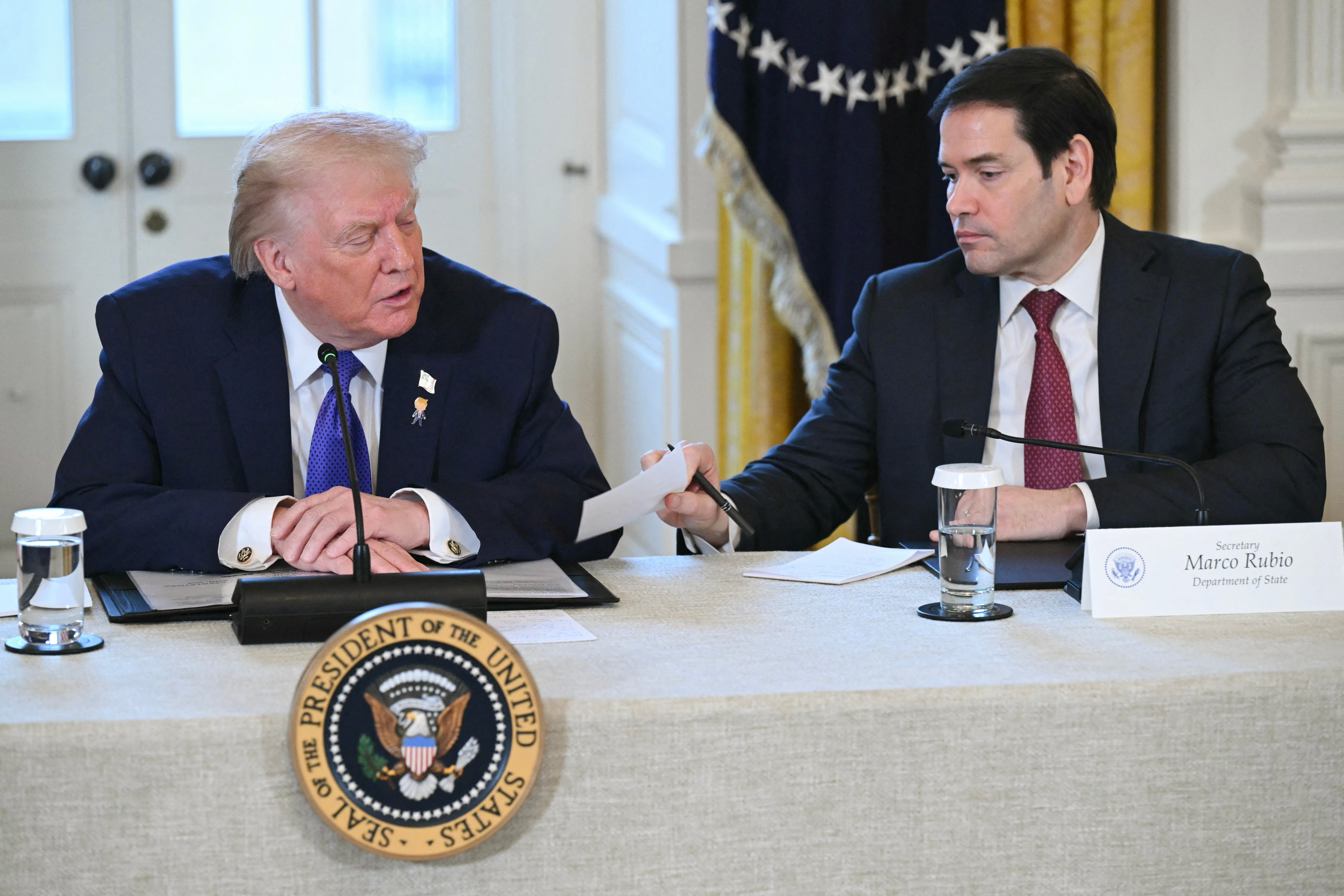
Secretary of State Marco Rubio hands a note to President Donald Trump during a meeting with U.S. oil companies executives at the White House on January 9, 2026. Photo by SAUL LOEB / AFP via Getty Images.
To hear President Donald Trump tell it, the United States is deep in negotiations with Cuban government officials as the U.S. applies maximum pressure to the island. “We’re talking to the people from Cuba, the highest people in Cuba, to see what happens,” Trump told reporters at his Mar-a-Lago resort on Sunday, February 1. “I think we’re going to make a deal with Cuba.”
Cuban leaders, meanwhile, have said they are open to negotiations on everything from human rights to democracy to tourism and direct foreign investment. Cuban President Miguel Díaz-Canel said in a recent press conference that Cuba is willing to engage in dialogue with the United States on any issue, provided talks take place without pressure or preconditions, on the basis of respect for Cuban sovereignty. Senior Cuban leaders reiterated to Drop Site that the government is serious about being open to wide-ranging talks. And Trump is no stranger to the island’s potential for American companies, having himself long held a registered trademark for a Trump Havana property that he has annually renewed.
All the evidence would seem to suggest that the opportunity for Trump to strike a historic deal is at hand. But, despite the president’s claims, there are and have been no negotiations involving high-level officials between Havana and Washington, according to five Cuban and American officials, all of whom asked for anonymity given the sensitivity of the Cuba-U.S. relationship.
When it comes to Trump’s claims of those talks, it turns out he isn’t lying. Instead, sources tell Drop Site, he’s being lied to. “He’s saying that because that’s what Marco is telling him,” said a senior Trump official, referring to an internal effort by Secretary of State Marco Rubio to make Trump believe that the U.S. and Cuba are engaged in serious negotiations without ever doing so. The idea, the source said, is that in a few weeks or months, Rubio will be able to claim that the talks were futile because of Cuban intransigence. With diplomatic off-ramps being blocked, this would make Rubio’s vision of regime change the only path forward for an administration loath to reverse course on anything.
Asked about the fact that Rubio is misleading Trump about talks that aren’t going on, the State Department’s press office stood by the claim that such negotiations are indeed happening, forwarding along comment from an administration official: “As the President stated, we are talking to Cuba, whose leaders should make a deal. Cuba is a failing nation whose rulers have had a major setback with the loss of support from Venezuela and with Mexico ceasing to send them oil.” The statement offered no evidence the talks are taking place, named no officials participating, no dates of any meetings, nor did it identify a location where the supposed talks are happening.
Trump, meanwhile, has indicated he isn’t interested in an ideological confrontation with Cuba. This, sources suggest, is one way to understand why, after kidnapping Venezuelan President Nicolás Maduro, the U.S. has made Venezuela roll back key Chávez-era oil legislation via a reform that opens up the country to foreign investment instead of changing its regime. Rubio, meanwhile, pushed hard internally for a full regime change in Venezuela, but had to settle for merely removing Maduro. Ultimately, though, for Rubio, the real prize has always been Cuba.
The Cuban-American Rubio answers to a political base in south Florida that would revolt if he struck any deal normalizing relations with the communist government—and who, ultimately, would have the power to undo him. Rubio’s rise through Florida and national politics — which now has him on the cusp of the Oval Office — has been accompanied by a string of corruptionscandals, yet with unified support back home, he has managed to emerge with a relatively clean reputation nationally. If Trump successfully lands a deal with the Cuban government that Rubio would have to sign off on, Rubio would be left to either betray his life’s cause and that of his backers in Miami, or resign in protest.
For Rubio’s opponents inside the administration, the moment represents an opportunity to make Cuba into his Waterloo.
No Dialogue
In the wake of Trump’s claims of high-level talks, confused Cuban officials insisted to Drop Site that no such talks were then underway, but that they were eager for them to start. Misinformation in the media, however, has muddied the situation.
On February 2, the day after Trump’s comments, Politico highlighted a report that the son of Raúl Castro had traveled to Mexico City for talks with the Central Intelligence Agency and asked in a headline: “Could a Castro become our man in Havana?”
The article, however, is sourced to 14YMedio, a news outlet run by Havana-based dissident blogger Yoani Sánchez, which itself based its reporting on a single, fantastical Facebook post made by a Spain-based Cuban journalist. Yet the Politico report began circulating in Washington and has been accepted as fact. Senior Cuban officials tell Drop Site there are no talks going on in Mexico or anywhere else.
“At the moment, we’ve had some exchanges of messages, but we cannot say we have set a bilateral dialogue at this moment,” Cuba’s Deputy Minister of Foreign Affairs Carlos Fernandez de Cossio affirmed in a CNN interview this past Wednesday. “Most things in Cuba dealing with the United States are linked to the highest level. It’s a large issue for us, so there’s no decision, no action taken that doesn’t involve the high level of government in Cuba.”
A “senior State Department official” told the New York Times recently that contact between the Cuban and U.S. government was “not substantive” and merely discussed migrant repatriation. Elaborating, a senior Cuban official told Drop Site that the contacts are purely technical, with the U.S. telling Cuban officials when flights with deported migrants would be heading to Havana, and Cuban officials acknowledging receipt of the message.
An article on Wednesday in the Spanish outlet ABC Internacional added to the confusion, claiming that Mexican official Efraín Guadarrama is facilitating the talks. A well-placed source with direct knowledge tells Drop Site Guadarrama is doing no such thing.
In the wake of the abduction of Venezuelan President Nicolas Maduro, top Cuban government officials have become increasingly interested in wide-ranging talks with the Trump administration—talks that could even include Rubio, a longtime foe of the government, multiple Cuban officials tell Drop Site. The only red line, they said, is that the island’s sovereignty is not up for negotiation.
Havana’s desire for talks, bordering on desperation, has been signaled to the United States through a variety of channels, including through press statements and recent interviews with the Associated Press and CNN. “Cuba reiterates its willingness to sustain a respectful and reciprocal dialogue with the Government of the United States,” the Cuban foreign ministry said in a February 1 release, “directed toward concrete outcomes, grounded in mutual interest and international law.”
The ministry added that Cuba was willing to “broaden” the scope of talks, saying the country “firmly rejects being portrayed as a threat to the security of the United States. It has never engaged in hostile actions against that country, nor will it permit its territory to be used against any other nation. Cuba, on the contrary, is prepared to resume and broaden bilateral cooperation with the United States in addressing shared transnational threats, while unwaveringly defending its sovereignty and independence.”
In an interview with Newsweek, Cuban Permanent Representative to the U.N. Ernesto Soberón Guzmán said Cuba would be happy to work with Trump on immigration, drug interdiction, health research—he noted Trump’s praise for Cuba’s relatively lower rates of autism—and other areas.
In addition to the ongoing economic crisis, the proximate cause for Cuban concern is an executive order issued on January 29 by President Donald Trump threatening heavy tariffs on “any other country that directly or indirectly sells or otherwise provides any oil to Cuba.”
Though not mentioned by name, the tariff threat is aimed at Mexico, whose state oil company has in recent years been the primary supplier of oil to the small island nation located 90 miles off the southern coast of Florida. In response, Mexico’s state oil company, PEMEX, has reportedly suspended at least one planned shipment of oil to its Cuban ally, leaving Cuba with an estimated two to three weeks’ worth of oil to keep the country running.
Overburdened, underfueled, and obsolete, Cuba’s electricity grid is barely hanging on, while the Cuban government publicly says it is preparing to administer life in the country with almost zero power. On Friday, ministers began to roll out a nationwide energyrationing plan. The measures include cutting mass transit, slashing individual gasoline allotments, and reducing in-person days for secondary school students. While Americans sat down for Super Bowl Sunday, Cuban authorities told airlines there was only one day’s supply of aviation fuel left in the country. On Monday, the U.S. intercepted an oil tanker as far away as the Indian Ocean for allegedly planning to ship fuel to Cuba.
At a lengthy press conference this past Thursday, Cuban President Miguel Díaz-Canel reiterated his country’s emphatic openness to negotiation with the United States without “pressure” or “preconditions.” Broadcasted on TV and radio around the world, Díaz-Canel’s comments were made, as one Wall Street Journal reporter observed, “with an audience of one in Washington”—Donald Trump.
“We are a country of peace,” Díaz-Canel said. “We are not a threat to the United States.”
Noah Kulwin reported from Havana, José Luis Granados Ceja reported from Mexico City, and Ryan Grim reported from Washington, D.C.
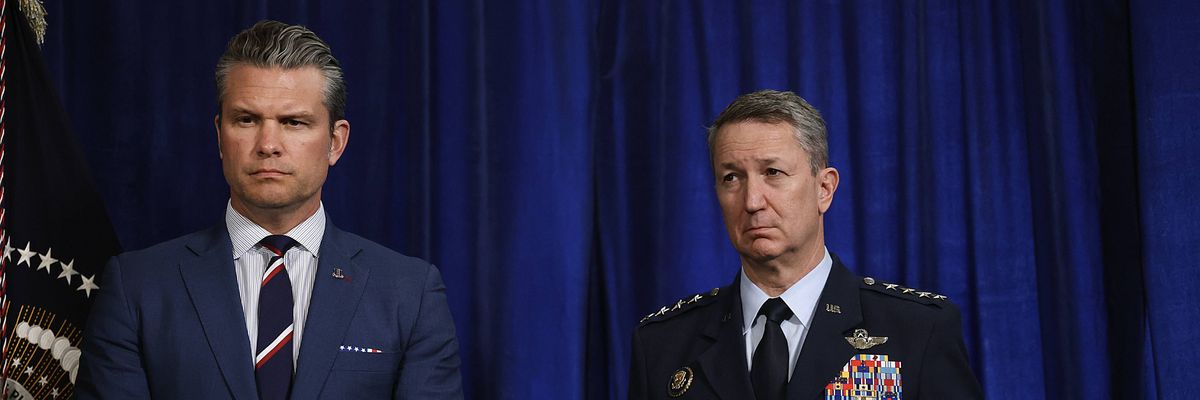
US Defense Secretary Pete Hegseth and Chairman of the Joint Chiefs of Staff Dan Caine listen as President Donald Trump addresses the media on January 3, 2026.
(Photo by Joe Raedle/Getty Images)
“Trump has no right to take us to war with Venezuela. This is reckless and illegal,” said Rep. Greg Casar. “Congress should vote immediately on a War Powers Resolution to stop him.”
Members of the US Congress on Saturday demanded emergency legislative action to prevent the Trump administration from taking further military action in Venezuela after the president threatened a “second wave” of attacks and said the US will control the South American country’s government indefinitely.
Rep. Greg Casar (D-Texas), chair of the Congressional Progressive Caucus (CPC), said that “Congress should vote immediately on a War Powers Resolution to stop” President Donald Trump, whose administration has for months unlawfully bombed boats in international waters and threatened a direct military assault on Venezuela without lawmakers’ approval.
“Trump has no right to take us to war with Venezuela. This is reckless and illegal,” said Casar. “My entire life, politicians have been sending other people’s kids to die in reckless regime change wars. Enough. No new wars.”
Another prominent CPC member, Rep. Rashida Tlaib (D-Mich.), said in response to the bombing of Venezuela and capture of its president that “these are the actions of a rogue state.”
“Trump’s illegal and unprovoked bombing of Venezuela and kidnapping of its president are grave violations of international law and the US Constitution,” Tlaib wrote on social media. “The American people do not want another regime change war abroad.”
Progressives weren’t alone in criticizing the administration’s unauthorized military action in Venezuela. Establishment Democrats, including Sen. Adam Schiff of California and others, also called for urgent congressional action in the face of Trump’s latest unlawful bombing campaign.
“Without congressional approval or the buy-in of the public, Trump risks plunging a hemisphere into chaos and has broken his promise to end wars instead of starting them,” Schiff said in a statement. “Congress must bring up a new War Powers Resolution and reassert its power to authorize force or to refuse to do so. We must speak for the American people who profoundly reject being dragged into new wars.”
Sen. Tim Kaine (D-Va.) said he will force a Senate vote next week on a bipartisan War Powers Resolution to block additional US military action in Venezuela.
“Where will this go next?” Kaine asked in a statement. “Will the president deploy our troops to protect Iranian protesters? To enforce the fragile ceasefire in Gaza? To battle terrorists in Nigeria? To seize Greenland or the Panama Canal? To suppress Americans peacefully assembling to protest his policies? Trump has threatened to do all this and more and sees no need to seek legal authorization from people’s elected legislature before putting servicemembers at risk.”
“It is long past time for Congress to reassert its critical constitutional role in matters of war, peace, diplomacy, and trade,” Kaine added. “My bipartisan resolution stipulating that we should not be at war with Venezuela absent a clear congressional authorization will come up for a vote next week.”
The lawmakers’ push for legislative action came as Trump clearly indicated that his administration isn’t done intervening in Venezuela’s internal politics—and plans to exploit the country’s vast oil reserves.
During a press conference on Saturday, Trump said that the US “is going to run” Venezuela, signaling the possibility of a troop deployment.
“We’re not afraid of boots on the ground,” the president said in response to a reporter’s question, adding vaguely that his administration is “designating various people” to run the government.
Whether the GOP-controlled Congress acts to constrain the Trump administration will depend on support from Republicans, who have largely applauded the US attack on Venezuela and capture of Maduro. In separate statements, House Speaker Mike Johnson (R-La.) and Senate Majority Leader John Thune (R-SD) described the operation as “decisive” and justified.
Ahead of Saturday’s assault, the Republican-controlled Congress rejected War Powers Resolutions aimed at preventing Trump from launching a war on Venezuela without lawmakers’ approval.
One Republican lawmaker who had raised constitutional concerns about Saturday’s actions, Sen. Mike Lee of Utah, appeared to drop them after a phone call with Secretary of State Marco Rubio.
But Sen. Andy Kim (D-NJ) noted in a statement that both Rubio and Defense Secretary Pete Hegseth “looked every senator in the eye a few weeks ago and said this wasn’t about regime change.”
“I didn’t trust them then, and we see now that they blatantly lied to Congress,” said Kim. “Trump rejected our constitutionally required approval process for armed conflict because the administration knows the American people overwhelmingly reject risks pulling our nation into another war.”
Below is a statement by the International Socialist Tendency, which the Socialist Workers Party is part of, in response to Trump’s attacks on Venezuela
1. The US raids on Venezuela on the night of 2-3 January and the kidnapping and imprisonment of President Nicolás Maduro are naked acts of imperialist aggression. Donald Trump’s declaration that ‘we are going to run Venezuela’ sums up the arrogance of US power. His justifications – that Maduro is the boss of a drug cartel, that his regime is undemocratic, etc – are, to use one of his favourite words, fake. This is about removing a regime that, especially under Hugo Chávez, has long been a thorn in Washington’s side and seizing the largest oil reserves in the world. Trump gloats: ‘We’re going to have our very large United States oil companies, the biggest anywhere in the world, go in.’ He has exposed the hollowness of his denunciations of previous US administrations’ ‘forever wars’ and attempts at regime change.
2. The assault on Venezuela must be seen against the background of Trump’s reaffirmation of the Monroe doctrine in his new National Security Strategy. This policy warning European powers to stay away from the Americas expressed the early United States’ aim to dominate the Western Hemisphere. Only in the late 19th century did Washington become strong enough to start displacing Britain, hitherto the dominant imperialist power in Latin America. This process was accompanied by war with Spain and numerous military interventions in Central America.
3. After the Second World War, the US responded to the advance of the left in Latin America by helping to engineer numerous military coups (Guatemala, Brazil, Chile, Argentina), invading the Dominican Republic and Grenada, and underwriting bloody counter-revolutionary wars (Bolivia, Guatemala, El Salvador, Nicaragua). In 1989 a US invasion removed and imprisoned the former CIA asset Manuel Noriega, President of Panama.
4. Now, however, the global dominance of US imperialism is under growing pressure. China has emerged as its greatest military and technological rival and the biggest market for Latin America’s raw materials and agricultural exports. The Trump administration has made reinforcing US domination of the Western Hemisphere and its resources its most important strategic priority. Hence the threats to Panama, Greenland, and Canada. Hence also the financial support for Javier Milei’s ultra-neoliberal government in Argentina. And hence now the attack on Venezuela.
5. By overthrowing Maduro Trump is pointing a gun at the head of every other Latin American president. If the US succeeds in imposing regime change on Venezuela, Cuba may be the next target. Trump and his Secretary of State Marco Rubio, the son of Cuban exiles, want to eradicate all remnants of revolutionary challenges to US imperialism in the Americas. Most governments will probably confine themselves to verbal protests and seek to ingratiate themselves with Trump. We demand that every state that claims to support democracy should unequivocally condemn the US intervention and take steps to isolate the aggressor.
The Trump administration’s military assault on Venezuela and apparent capture of the country’s president in the early hours of Saturday morning sparked immediate backlash from leaders in Latin America and across the globe, with lawmakers, activists, and experts accusing the US of launching yet another illegal war of aggression.
Latin American leaders portrayed the assault as a continuation of the long, bloody history of US intervention in the region, which has included vicious military coups and material support for genocidal right-wing forces.
“This is state terrorism against the brave Venezuelan people and against Our America,” Cuban President Miguel Diaz-Canel wrote in a social media post, demanding urgent action from the international community in response to the “criminal attack.”
Evo Morales, the leftist former president of Bolivia, said that “we strongly and unequivocally repudiate” the US attack on Venezuela.
“It is brutal imperialist aggression that violates its sovereignty,” Morales added. “All our solidarity with the Venezuelan people in resistance.”
Colombian President Gustavo Petro, one of the first world leaders to respond to Saturday’s developments, decried US “aggression against the sovereignty of Venezuela and of Latin America.” Petro said Colombian forces “are being deployed” to the nation’s border with Venezuela and that “all available support forces will be deployed in the event of a massive influx of refugees.”
“Without sovereignty, there is no nation,” said Petro. “Peace is the way, and dialogue between peoples is fundamental for national unity. Dialogue and more dialogue is our proposal.”
One Latin American leader, far-right Argentine president and Trump ally Javier Milei, openly celebrated the alleged US capture of Venezuelan President Nicolás Maduro, declaring on social media, “FREEDOM ADVANCES.”
Leaders and lawmakers in Europe also reacted to the US bombings. Pedro Sánchez, the prime minister of Spain, issued a cautious statement calling for “deescalation and responsibility.”
British MP Zarah Sultana was far more forceful, writing on social media that “Venezuela has the world’s largest oil reserves—and that’s no coincidence.”
“This is naked US imperialism: an illegal assault on Caracas aimed at overthrowing a sovereign government and plundering its resources,” Sultana added.
I recently attended a showing of Oliver Stone’s new documentary film, “South of the Border”, which concerns seven present-day government leaders of Latin America -– in Venezuela, Bolivia, Ecuador, Argentina, Paraguay, Cuba and Brazil — who are not in love with US foreign policy. After the film there was a discussion panel in the theatre, consisting of Stone, the two writers of the film (Tariq Ali and Mark Weisbrot) and Cynthia Arnson, Director of the Latin American Program of the Woodrow Wilson International Center for Scholars, in Washington; the discussion was moderated by Neal Conan of National Public Radio.
It perhaps was not meant to be a “debate”, but it quickly became that, with Arnson leading the “anti-communist” faction, supported somewhat by Conan’s questions and more vociferously by a segment of the audience which took sides loudly via applause and cries of approval or displeasure. Twenty years post-Cold War, anti-communism still runs deep in the American soul and psyche. Candid criticism of US foreign policy and/or capitalism is sufficient to consign a foreign government or leader to the “communist” camp whether or not that term is specifically used.
The military agreement between the United States and Colombia has caused outcry in Latin America. Many governments suspect that the US is trying to cement its military hegemony in the region and maintain its ability to intervene in the affairs of Latin American countries.
The State Department says that the deal is all about security within Colombia and does not affect other countries, but Pentagon documents show that the US has far wider and more ominous objectives.
An US air force budget justification Bill, sent to Congress last year, states that Palanquero airbase in Colombia “provides an opportunity for conducting full spectrum operations throughout south America.”
Full spectrum operations is Pentagon jargon for dominating the battle space on land, sea, air and space and can include the use of nuclear weapons.
I know Chavez well, and no one could be more reluctant than him to allow a showdown between the Venezuelan and Colombian peoples leading to bloodshed. These are two fraternal peoples, the same as Cubans living in the east, center and west end of our island. I find no other way to explain the close relationship between Venezuelans and Colombians.
The slanderous Yankee accusation that Chavez is planning a war against neighboring Colombia led an influential paper of that country to run a story last Sunday, November 15, under the headline “War Drums.” It was a pejorative and insulting editorial against the Venezuelan President asserting, among other things, that “Colombia should take very seriously the gravest threat to its national security in more than seven decades as it comes from a President with a military background…”
The electoral victory of center left regimes in at least three Latin American countries, and the search for a new ideological identity to justify their rule, led ideologues and the incumbent presidents to embrace the notion that they represent a new 21st century version of socialism (21cs).
Prominent writers, academics and regime spokespeople celebrated a totally new variant of socialism, as completely at odds with what they dubbed as the failed 20th century, Soviet-style socialism. The advocates and publicists of 21cs claims of a novel political-economic model rested on what they ascribed as a radical break with both the free market neo-liberal regimes which preceded, and the past “statist” version of socialism embodied by the former Soviet Union as well as China and Cuba.
In this paper we will proceed by examining the variety of critiques put forth by 21cs of both neo-liberalism and 20 century socialism (20cs), the authenticity of their claims of a novelty and originality, and a critical analysis of their actual performance.
I read and reread data and articles written by smart personalities, some better known than others, who publish in various media outlets drawing the information from sources nobody questions.
Everywhere in the world, the people living on this planet are taking economic, environmental and war risks due to the United States policies but no other region of the world as threatened by such grave problems as that country’s neighbors, that is, the peoples of this continent south of that hegemonic power.


 Peace and Justice Post
The Cold War is over. Long live the Cold War.
July 6, 2010I recently attended a showing of Oliver Stone’s new documentary film, “South of the Border”, which concerns seven present-day government leaders of Latin America -– in Venezuela, Bolivia, Ecuador, Argentina, Paraguay, Cuba and Brazil — who are not in love with US foreign policy. After the film there was a discussion panel in the theatre, consisting of Stone, the two writers of the film (Tariq Ali and Mark Weisbrot) and Cynthia Arnson, Director of the Latin American Program of the Woodrow Wilson International Center for Scholars, in Washington; the discussion was moderated by Neal Conan of National Public Radio.
It perhaps was not meant to be a “debate”, but it quickly became that, with Arnson leading the “anti-communist” faction, supported somewhat by Conan’s questions and more vociferously by a segment of the audience which took sides loudly via applause and cries of approval or displeasure. Twenty years post-Cold War, anti-communism still runs deep in the American soul and psyche. Candid criticism of US foreign policy and/or capitalism is sufficient to consign a foreign government or leader to the “communist” camp whether or not that term is specifically used.
Continues >>
Share this:
Tags:Afghanistan, Cold war, Communism, David Petraeus, Documentary, Hugo Chavez, Oliver Stone, Soviet Union, Stanley McChrystal, U.S. foreign policy, Venezuela, war
Posted in Commentary, imperialism, US policy, USA, war | Leave a Comment »