Posts Tagged ‘news’

Attack Iran? No! We Must Stop This Illegal Act by Trump

February 21, 2026

"No War With Iran" Protests Held Across The Country

Protesters hold signs at the US Capitol to for the Anti-Iran War Rally on January 09, 2020 in Washington DC, United States. The House adopted a war powers resolution Thursday with the aim of limiting President Donald Trump’s military actions against Iran.

(Photo by Tasos Katopodis/Getty Images)

It’s getting late, but it’s not yet too late. No war on Iran!

Kevin Martin

Feb 19, 2026 Common Dreams

President Donald Trump seems to think he is King of the World, not just the United States. Even as he convenes his “Board of Peace” (though calling it the “Board of Imperial Conquest” would be more apt) it looks like the US will soon illegally attack Iran, again, as it did last June. Congress needs to do its job representing the will of the American people, get a spine, step up to its Constitutional duty over matters of war and peace, and stop him.

The US has attacked seven countries (eight if one includes the US of A, and most people in Minneapolis and many other cities surely think so) since Trump’s recrudescence. Ongoing talks with Iran do not appear to be promising, with unrealistic US demands, especially zero nuclear energy enrichment by Tehran and the dismantling of its missile program, which would leave it vulnerable to further Israeli attacks. Trump’s “beautiful armada” including two aircraft carrier battle groups with supporting attack aircraft is the largest US military buildup in the region since the 2003 invasion of Iraq.

RECOMMENDED…

Iran newspapers focus on potential US military options

US Military Told Mideast Ally That Trump Attack on Iran is ‘Imminent’: Report

Negotiations between Iran and the US received extensive coverage newspapers in Tehran

Peace Campaigners Demand Congress Stop Trump From Waging ‘Devastating’ War on Iran

This massive (and expensive) deployment of forces is exactly what one does in planning for a large-scale military offensive against Iran, just as the region begins the Islamic holy month of Ramadan. This would go far beyond the more limited strikes that have taken place in the past, including last June’s attack that killed 1,000 people. “It harkens back to what I saw ahead of the 2003 Iraq war,” said retired Lt. Col. Daniel Davis, a senior fellow and military expert at Defense Priorities. “You don’t assemble this kind of power to send a message. In my view, this is what you do when you’re preparing to use it. What I see on the diplomatic front is just to try to keep things rolling until it’s time to actually launch the military operation.”

Lest anyone forget, this crisis is all of Trump’s making, as he abrogated the multilateral agreement, the Joint Comprehensive Plan of Action or JCPOA, negotiated under President Barack Obama, which effectively and verifiably capped Iran’s nuclear program well short of the ability to build The Bomb.

Trump should not have the last word on whether to attack Iran again. Next week, the House of Representatives will hold a vote on H. Con. Res. 38, the Iran War Powers Resolution, according to the measure’s co-sponsor US Rep Ro Khanna (D-CA). US Rep Thomas Massie (R-KY) is the other lead sponsor, and the only Republican on the resolution at present, but a vote could be close, if mostly partisan. Just a few Republican votes could make the difference.

There is no news on a Senate vote at this time, though there is a companion resolution, S. J. Res 104, introduced by Senators Tim Kaine (D-Va.) and Rand Paul (R-Ky.). Should the House resolution pass, the Senate vote might ensue quickly, as time is of the essence.

In a recent Quinnipiac poll, 70% of American voters said they oppose military action against Iran. It is time for Congress to fulfill its Constitutional authority and vote to require authorization of any military action against Iran.

It is no surprise the majority of Americans oppose a war with Iran. Similarly, most Iranians oppose a military strike on their country. Now, it’s up to us to demand that Congress do its job and pull us back from the precipice of another disastrous war. Concerned individuals should call their US Representative via the Congressional switchboard at 202.224.3121, or 833-STOP-WAR

Also, on Monday at 2:30pm ET/11:30am PT, peace and constitution-loving people can join a virtual Action Hour on Zoom, where we’ll mobilize together to demand Congress stop this unauthorized war before it starts.

The National Iranian American Council Action (NIAC) is organizing this event, co-sponsored by Peace Action & MPower Action, to equip you with immediate action you can take to urge lawmakers to oppose war and stand with the American and Iranian people. We will also be offering a brief “How to Advocate” 101 training to empower you to get face-to-face meetings with your lawmaker’s office.

Click here to sign up and join us! us!

It’s getting late, but it’s not yet too late, to stop another illegal war of aggression.

An Urgent Message From Our Co-Founder


Dear Common Dreams reader,

The U.S. is on a fast track to authoritarianism like nothing I’ve ever seen. Meanwhile, corporate news outlets are utterly capitulating to Trump, twisting their coverage to avoid drawing his ire while lining up to stuff cash in his pockets.

That’s why I believe that Common Dreams is doing the best and most consequential reporting that we’ve ever done.

Our small but mighty team is a progressive reporting powerhouse, covering the news every day that the corporate media never will. Our mission has always been simple: To inform. To inspire. And to ignite change for the common good.

Now here’s the key piece that I want all our readers to understand: None of this would be possible without your financial support.

That’s not just some fundraising cliche. It’s the absolute and literal truth. We don’t accept corporate advertising and never will. We don’t have a paywall because we don’t think people should be blocked from critical news based on their ability to pay. Everything we do is funded by the donations of readers like you.

Will you donate now to help power the nonprofit, independent reporting of Common Dreams?

Thank you for being a vital member of our community. Together, we can keep independent journalism alive when it’s needed most.

– Craig Brown, Co-founder
about:blank

about:blank

Our work is licensed under Creative Commons (CC BY-NC-ND 3.0). Feel free to republish and share widely.

Kevin Martin

Kevin Martin is the president of Peace Action and Peace Action Education Fund, with over 40 years experience as a peace and justice organizer. He is helping coordinate the Cease-Fire Now Grassroots Advocacy Network.

‘I Guess I Can Say I Am’: Trump Confirms He’s Considering Unprovoked Attack on Iran

February 20, 2026

'I Guess I Can Say I Am': Trump Confirms He's Considering Unprovoked Attack on Iran

President Donald Trump delivers remarks during a working breakfast with governors in the State Dining Room at the White House on February 20, 2026 in Washington, DC.

(Photo by Kevin Dietsch/Getty Images)

One analyst predicted Iran would close the Strait of Hormuz and attack oil installations “in the hope of driving oil prices to record levels” should the US strike.

Brad Reed, Common Dreams, Feb 20, 2026

US President Donald Trump on Friday confirmed that he’s considering launching an unprovoked military strike against Iran.

According to the New York Times, Trump was asked by reporters on Friday if he was considering attacking Iran, and he replied, “I guess I can say I am considering that.”

RECOMMENDED…

An Iranian man and women walk by an anti-American mural

Iran Vows to ‘Respond Like Never Before’ as Trump Ramps Up War Threats

Iran newspapers focus on potential US military options

US Military Told Mideast Ally That Trump Attack on Iran is ‘Imminent’: Report

The US has for weeks been sending fleets of warships, including the world’s largest aircraft carrier, to the Middle East in apparent preparation for a massive military operation against Iran.

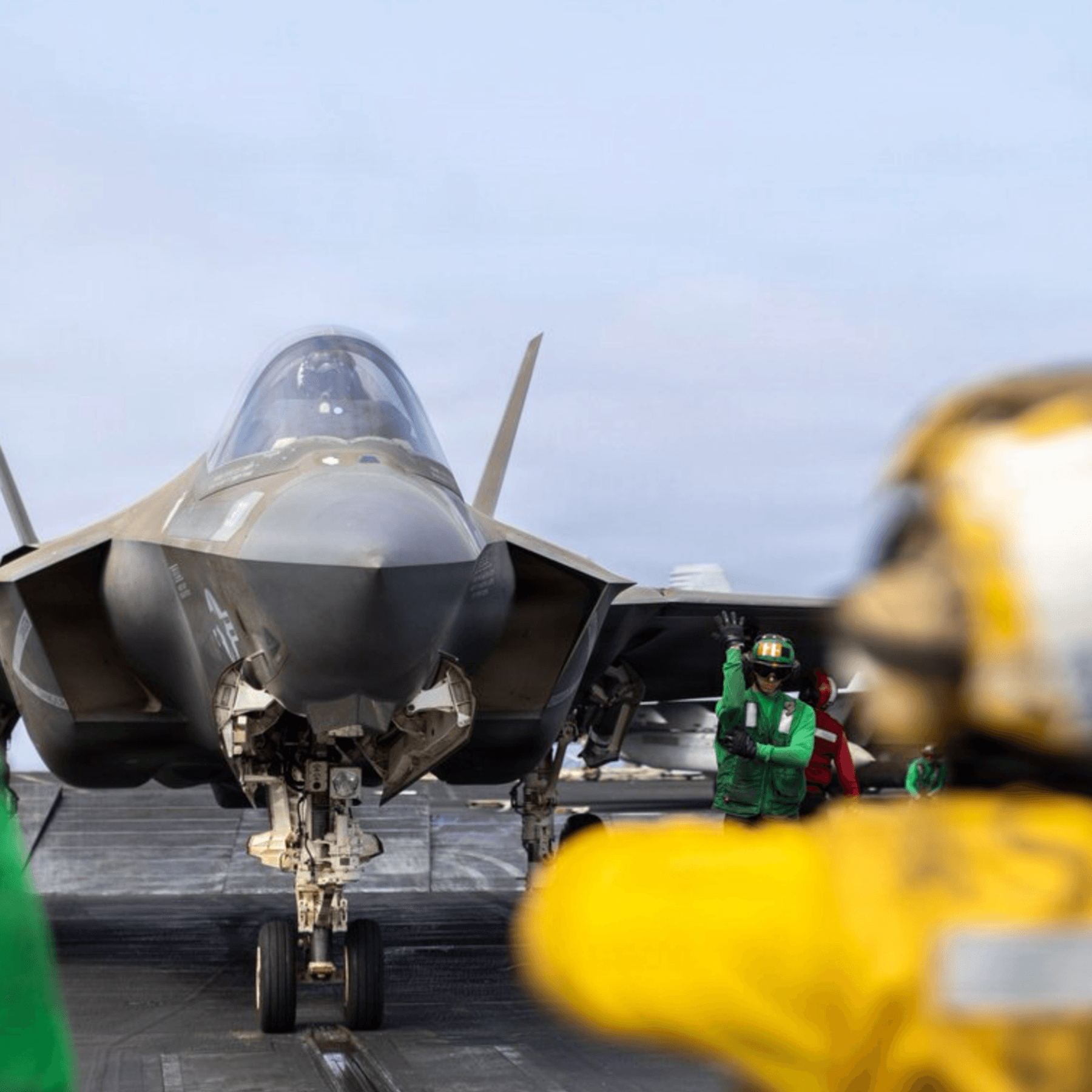
According to a Friday report from Al Jazeera, the buildup is the largest by the US Air Force in the region since the 2003 Iraq War, and it includes deployments of E-3 Sentry Airborne Warning and Control System (AWACS) aircraft, F-35 stealth strike fighters and F-22 air superiority jets, and F-15 and F-16 fighter jets.

Trump has not given any justification for launching such an attack, nor has he asked the US Congress to approve it, even though the Constitution gives the legislative branch the power to declare war.

Reps. Ro Khanna (D-Calif.) and Thomas Massie (R-Ky.) have been pushing for a vote in the US House of Representatives on a war powers resolution that would require Congress to debate and approve any act of war with Iran.

It is also not clear what goals the president would hope to achieve with the attack. A Thursday CNN report indicated that Trump is now weighing several options ranging from “more targeted strikes to sustained operations that could potentially last for weeks,” including “plans to take out Tehran’s leaders.”

Trita Parsi, co-founder and executive vice president of the Quincy Institute for Responsible Statecraft, wrote in a Friday analysis of Trump’s reported attack plans that there is little chance that the president will be able to achieve a quick victory over Iran simply because the offers he has made to its government are nonstarters.

“Since the US strategy… is to escalate until Tehran caves, and since capitulation is a non-option for Iran, the Iranians are incentivized to strike back right away at the US,” explained Parsi. “The only exit Tehran sees is to fight back, inflict as much pain as possible on the US, and hope that this causes Trump to back off or accept a more equitable deal.”

Parsi acknowledged that there is no way Iran can defeat the US militarily, but could “get close to destroying Trump’s presidency before it loses the war” through a number of maneuvers intended to spike the price of oil, including “closing the Strait of Hormuz” and attacking “oil installations in the region in the hope of driving oil prices to record levels and by that inflation in the US.”

“This is an extremely risky option for Iran,” Parsi conceded, “but one that Tehran sees as less risky than the capitulation ‘deal’ Trump is seeking to force on Iran.”

Report: Trump Close To a Major Attack on Iran That Will Be Bigger Than 12-Day War

February 19, 2026

A Trump advisor told Axios that there’s a 90% chance the US launches an attack in the coming weeks, while Israeli sources say it could happen within days

by Dave DeCamp | February 18, 2026 at 1:21 pm ET | Iran

The Trump administration is close to launching a major attack on Iran as it continues a massive buildup of military forces in the Middle East, according to a report from Axios reporter Barak Ravid.

Sources told Ravid that the potential US attack on Iran would likely be a massive multi-week operation, much bigger than the US operation to abduct Venezuelan President Nicolas Maduro. They said it would also be much broader in scope than the 12-day US-Israeli war on Iran that was launched in June 2025. Reuters also recently reported that the US was preparing for a sustained, multi-week attack on Iran.

Israeli officials said that the Israeli government, which is pushing for the US to pursue regime change in Iran, is preparing for the possibility of the attack starting in the coming days, and CNN later reported that the US military is ready to start the war as soon as this weekend. Other sources put the timeline a little later, saying the war would likely start in a few weeks.

An F/A-18F Super Hornet makes an arrested landing on the flight deck ofthe aircraft carrier USS Abraham Lincoln in the Arabian Sea, January 30, 2026 (US Navy photo)

“The boss is getting fed up,” a Trump adviser told Ravid. “Some people around him warn him against going to war with Iran, but I think there is 90% chance we see kinetic action in the next few weeks.”

The Axios report noted that there has been little public debate about the potential war amid the major US military buildup and said that Americans will likely be surprised by the scale of the coming attack.

All signs indicate that if the US bombs Iran, Tehran will not hold back in its response and could target multiple US bases and warships in the region, leaving open the possibility that the war could result in hundreds or thousands of US casualties. The conflict could also have a major impact on the global economy, as Iran could close the Strait of Hormuz, through which 31% of seaborne crude oil shipments passed in 2025.

The US and Iran held talks on Tuesday, and while the Iranian side said there was a “clear path” toward a deal, US Vice President JD Vance said that Iran was not acknowledging President Trump’s “red lines.”

Vance claimed the main US demand was that Iran must not pursue a nuclear weapon, but for many months, the administration had insisted the June 2025 US strikes on Iran “obliterated” Iran’s nuclear facilities, and there’s no sign Tehran can enrich uranium at the moment. Iran has also made clear it’s willing to enter a deal that would involve a commitment to low enrichment levels, and Iranian officials maintain they don’t seek a nuclear bomb.

The real goal of any US attack on Iran will likely be regime change or taking out Iran’s ability to fire missiles at Israel. President Trump said back in December, when he met with Israeli Prime Minister Benjamin Netanyahu at his Mar-a-lago resort in Florida, that he would support another Israeli attack on Iran if the Islamic Republic “continued” its missile program.

Huckabee Says US and Israel ‘Absolutely Aligned’ on Iran

February 17, 2026

The US ambassador also said that at some point, Iran may experience the ‘second kick of a mule,’ referring to another US attack

by Dave DeCamp, Antiwar. com, February 16, 2026 at 7:08 pm ET | Iran

US Ambassador to Israel Mike Huckabee said on Monday that the US and Israel are “absolutely aligned” on the need to “deal” with Iran as Washington continues building up its forces in the Middle East to prepare for a potential attack on the Islamic Republic.

Huckabee made the comments when addressing the Conference of Presidents of Major American Jewish Organizations in Jerusalem, where he cast doubt on the idea that the US and Iran could reach a diplomatic deal and said that another US attack on the country is likely.

“At some point, the United States has to say, enough is enough,” Huckabee said, according to Haaretz. “Either Iran makes a radical change in direction, or it experiences what we call in the South the second kick of a mule. There is no education in the second kick. If you didn’t learn the first time, you won’t learn the second.”

The US and Iran are set to hold a second round of talks in Geneva on Tuesday. Israel wants any deal to involve restrictions on Iran’s ballistic missiles, a demand designed to collapse diplomacy since Tehran’s missiles are its only form of deterrence.

According to Iranian officials, the US has dropped the demand for an agreement that includes missiles, but President Trump and other Trump administration officials continue to push the issue. Huckabee said that the US and Israel have agreed that Iran cannot “continue building vast surpluses of ballistic missiles.”

President Trump has repeatedly threatened to attack Iran if a deal isn’t reached, echoing threats he made in the lead-up to the 12-day US-Israeli war against Iran that was launched in June 2025, just days before another round of negotiations between Washington and Tehran were scheduled to be held.

Trump’s Concentration Camp Build-Out Includes Nearly $40 Billion for Warehouse Conversions

February 16, 2026

Chester New York Proposed ICE Facility

An empty warehouse is seen in Chester, New York on February 8, 2026. US Immigration and Customs Enforcement proposes a facility at a warehouse roughly two hours from New York City, but many locals and officials have objected to the plan.

(Photo by Matthew Hoen/NurPhoto via Getty Images)

“Germany’s concentration camps didn’t start as instruments of mass murder, and neither have ours,” wrote talk show host Thom Hartmann recently. “History isn’t whispering its warning: It’s shouting.”

Julia Conley

Common Dreams, Feb 13, 2026

President Donald Trump’s anti-immigration agenda has supercharged opposition in cities where he has deployed federal agents to conduct raids, and communities in states including New York and Missouri are already working to block the next step the Department of Homeland Security plans to take in its push for mass deportations: acquiring massive warehouses across the country to use as immigrant detention centers.

US immigration and Customs Enforcement documents that were provided to Republican Gov. Kelly Ayotte of New Hampshire—one of the states where ICE aims to acquire a building and retrofit it to house at least 1,000 people at a time—show that the administration plans to spend $38.3 billion on its mass detention plan.

RECOMMENDED…

Immigration Detainees Held At Texas Facility

US Military Helping Trump to Build Massive Network of ‘Concentration Camps,’ Navy Contract Reveals

Trucks carrying aid for Gaza are stuck at the Rafah crossing

US Contractor’s Proposal Exposes Trump Gaza Plan as ‘Vehicle for Mass Exploitation’

It would buy 16 buildings across the country to use as “regional processing centers” that could hold 1,000-1,500 people. Another eight detention centers would hold as many as 10,000 people at a time, with the detainees awaiting deportation.

The Washington Post reported that a review of state budget data showed that the amount of money the White House intends to pour into the project over the next several months is larger than the total annual spending of 22 US states.

“Thirty-eight billion dollars,” said Rep. Seth Moulton (D-Mass.). “That’s what Trump is spending to turn warehouses into human holding facilities. Not on schools. Not on healthcare. Not on veterans. On warehousing humans.”

Moulton also condemned ICE’s claim that the new network of detention facilities will ensure the “safe and humane civil detention” of immigrants.

At least six people died in ICE detention centers in January, and one of the deaths, that of Geraldo Lunas Campos at Camp East Montana in El Paso, Texas, was ruled a homicide.

Medical neglect and abusive treatment—including some that amounts to torture—has been reported at multiple facilities.

ICE has already spent more than $690 million purchasing at least eight warehouses in Maryland, Arizona, Georgia, Texas, Pennsylvania, and Michigan in recent weeks. Documents posted on Ayotte’s website show the agency is pursuing additional acquisitions in New Hampshire, New York, New Jersey, and Georgia.

Communities are already rallying against the plan and questioning whether the small towns ICE has selected have sufficient water and sewer infrastructure to support thousands of people detained in a warehouse.

In New York, Rep. Pat Ryan (D-NY) said last week that 25,000 people in his district have signed a petition opposing the use of a local warehouse to house immigrants and pointed to the “major corruption and graft” evident in the plan to purchase and run the warehouses.

“The site in my district that’s proposed is owned by one of Trump’s multibillionaire donors, who would directly financially benefit from this site,” said Ryan, referring to former Trump adviser Carl Icahn.

As Common Dreams reported Friday, private prison firm GEO Group raked in a record $254 million in profits last year as it secured contracts with the Trump administration to build new ICE facilities across the US.

ICE has attempted to make purchases in Oklahoma City; Kansas City, Missouri; and in Virginia, but those plans have fallen through, with the Kansas City Council passing a five-year ban on new nonmunicipal detention centers after the public learned that DHS was the potential buyer of a warehouse in the city.

Sen. Chris Van Hollen (D-Md.) has also joined his constituents in speaking out against ICE’s $100 million purchase of a warehouse in his state to house at least 1,000 people at a time.

“This administration is spitting in the face of communities from Minneapolis to Maryland and wasting our tax dollars. We won’t back down,” said Van Hollen late last month.

The details of the administration’s planned conversion of warehouses were reported less than two weeks after Pablo Manríquez of Migrant Insider revealed that a US Navy contract originally valued at $10 billion “has ballooned to a staggering $55 billion ceiling to expedite President Donald Trump’s ‘mass deportation’ agenda” and to help build “a sprawling network of migrant detention centers across the US.”

At Common Dreams last week, talk show host and author Thom Hartmann wrote that the warehouses Trump plans to use to hold people—purchased by an agency whose own data shows it has largely been detaining people with no criminal records—are best described as concentration camps like those used in Nazi Germany.

“By the end of his first year, [Adolf] Hitler had around 50,000 people held in his roughly 70 concentration camps, facilities that were often improvised in factories, prisons, castles, and other buildings,” wrote Hartmann. “By comparison, today ICE is holding over 70,000 people in 225 concentration camps across America,” with hopes to “more than double both numbers in the coming months.”

“Germany’s concentration camps didn’t start as instruments of mass murder, and neither have ours; both started as facilities for people the government’s leader said were a problem. And that’s exactly what ICE is building now,” he continued. “History isn’t whispering its warning: It’s shouting.”

US military prepares “sustained, weeks-long” war against Iran

February 15, 2026
Andre Damon@Andre__Damona, WSWS, feb 14 2026

The aircraft carrier USS Gerald R. Ford sails in formation with the guided missile destroyers USS Winston Churchill, USS Mitscher, USS Mahan, USS Bainbridge and USS Forrest Sherman in the Atlantic Ocean, Nov. 12, 2024. [Photo: Navy Petty Officer 2nd Class Jacob Mattingly ]

The US military is preparing for “sustained, weeks-long operations” against Iran if US President Donald Trump orders an attack, Reuters reported Friday, citing US officials. The planned campaign would mark a far larger US assault on Iran than anything previously carried out.

In a sustained campaign, the US military could hit “Iranian state and security facilities, not just nuclear infrastructure,” one of the officials said. The United States “fully expected Iran to retaliate, leading to back-and-forth strikes and reprisals over a period of time.”

Such a war could entail massive loss of life and have incalculable global consequences. It would be illegal under international law and take place in defiance of the popular will, with 85 percent of the American population opposed to a war against Iran, according to a YouGov poll.

Last June, the US launched “Midnight Hammer” in coordination with a 12-day Israeli bombing campaign that together killed over one thousand Iranians. Iran staged a limited retaliatory strike on a US base in Qatar. What is now being planned is qualitatively different—an air and missile campaign targeting the Iranian state itself, with the expectation of extended back-and-forth combat.

The buildup takes place just weeks after the USS Gerald R. Ford, the world’s largest and newest aircraft carrier, took part in the seizure of Venezuelan President Nicolás Maduro on January 3. The Ford, which has been at sea for more than 200 days, has now been ordered from the Caribbean to the Middle East, where it will join the USS Abraham Lincoln strike group already in the region. The same carrier used in the kidnapping of the president of Venezuela is being redeployed to wage war against Iran.

Trump, speaking to troops at Fort Bragg, North Carolina on Friday, said it had “been difficult to make a deal” with Iran. “Sometimes you have to have fear,” he declared. “That’s the only thing that really will get the situation taken care of.” Asked if he wanted regime change, Trump responded: “Seems like that would be the best thing that could happen.”

The Ford strike group includes the guided-missile cruiser Normandy and destroyers Thomas Hudner, Ramage, Carney and Roosevelt. The carrier holds more than 75 military aircraft, including F-18 Super Hornet fighters and E-2 Hawkeye early warning aircraft.

Satellite imagery analyzed by Reuters shows a massive buildup at US bases across the Middle East. At Al-Udeid air base in Qatar, the largest US facility in the region, Patriot missiles have been placed in mobile HEMTT truck launchers, giving them rapid mobility in case of an Iranian attack. The base houses an RC-135 reconnaissance aircraft, 18 KC-135 Stratotanker refueling aircraft, and seven C-17 transport planes.

At Muwaffaq Salti air base in Jordan, images from February 2 show 17 F-15E Strike Eagle fighter-bombers, eight A-10 Thunderbolt close air support aircraft, and four EA-18G Growler electronic warfare jets—where none had been visible weeks earlier. Additional forces have been deployed to Prince Sultan air base in Saudi Arabia, Diego Garcia in the Indian Ocean and Dukhan base in Oman. Approximately 112 C-17 Globemaster cargo planes have reportedly arrived or made their way toward the Gulf region.

Iran’s Revolutionary Guards have warned they could retaliate against any US military base in the region. The US maintains bases in Jordan, Kuwait, Saudi Arabia, Qatar, Bahrain, the United Arab Emirates, Oman, Turkey and on Diego Garcia. Ali Shamkhani, an adviser to Supreme Leader Ali Khamenei, warned: “We will respond decisively to any adventurism—our military readiness is high.”

The military buildup coincides with the Munich Security Conference, whose organizers titled their annual report “Under Destruction.” German Chancellor Friedrich Merz opened the conference by declaring: “This order, as flawed as it has been even in its heyday, no longer exists.” He warned that “a divide has opened up between Europe and the United States.”

But while European leaders condemned Trump’s tariffs and threats against allies, they have fully supported the US posture toward Iran. On January 29, the EU unanimously designated Iran’s Revolutionary Guards a terrorist organization—all 27 member states voting in lockstep with Washington’s escalation.

The Munich conference withdrew its invitation to Iranian Foreign Minister Abbas Araghchi, with Germany’s foreign ministry declaring his participation inappropriate. In his place, exiled Crown Prince Reza Pahlavi, son of the Shah overthrown in 1979, was given a platform. Pahlavi called for “humanitarian intervention” and an “equalizing factor”—that is, US military strikes to “neutralize the regime’s instrument of repression.” He told the conference that “help is on the way” from Trump and positioned himself as the leader of a post-regime transition.Available from Mehring BooksThe struggle against imperialism and for workers’ power in IranA pamphlet by Keith Jones

Democratic Socialists of America Congresswoman Alexandria Ocasio-Cortez spoke at the Munich Security Conference on the subject of “The Rise of Populism.” In her entire appearance at the conference, she did not say a single word about Trump’s preparations for war against Iran—the most significant military escalation of his presidency.

What she did say is revealing. She warned that Trump is “looking to withdraw the United States from the entire world so that we can turn into an age of authoritarianisms, of authoritarians… where Putin can saber rattle around Europe and try to bully around our own allies there.”

This is not opposition to war; rather Ocasio-Cortez condemned Trump as being insufficiently aggressive against “Putin”—i.e., being insufficiently committed to the war in Ukraine.

The Democrats have been silent as the administration amasses approximately 50,000 troops and the largest concentration of military firepower in the Middle East since the 2003 invasion of Iraq. Their earlier statements on Iran amounted to endorsements of regime change in response to the emergence of localized protests against the government last month. Senator Mark Warner declared on January 11, “The Iranian regime is awful, and I stand with the Iranian people.” Ocasio-Cortez tweeted that month, “The Iranian government’s violent crackdown on demonstrators is horrific.”

Far from opposing the war buildup, the Democrats have actively funded it. On January 30, the Senate passed the Consolidated Appropriations Act by a vote of 71 to 29, including $839 billion for the Pentagon—an $8.4 billion increase over the military’s own budget request. Twenty-three Democrats voted for the bill, including Senate Minority Leader Chuck Schumer, Minority Whip Dick Durbin and Vice Chair Mark Warner. In the House, the bill passed 341 to 88, with 149 Democrats voting yes and only 64 voting no. Republicans on the House Appropriations Committee hailed the legislation as “America First, Fully Funded.”

In the space of weeks, the Trump administration has kidnapped the president of Venezuela, threatened to annex Greenland, backed the Israeli genocide in Gaza and is now preparing a sustained bombing campaign against a country of 88 million people. Each of these operations targets nations whose resources Washington seeks to control as part of its escalating confrontation with China—Venezuela’s oil, Iran’s oil and natural gas and the Strait of Hormuz through which 20 percent of the world’s oil passes daily.

The working class cannot entrust the fight against imperialist war to any faction of the political establishment. The same administration threatening to devastate Iran is attacking immigrants, gutting social programs, and constructing a police state at home. Opposition to war must come from the independent mobilization of the international working class against the capitalist system that produces war, inequality and dictatorship.

Trump and Netanyahu hold Iran war conclave

February 13, 2026
wsws, Keith Jones, Feb 12, 2026

President Donald Trump listens as Israel’s Prime Minister Benjamin Netanyahu speaks during an arrival at his Mar-a-Lago club, Monday, Dec. 29, 2025, in Palm Beach, Florida. [AP Photo/Alex Brandon]

US President Donald Trump held a three-hour war council at the White House Wednesday with Israeli Prime Minister Benjamin Netanyahu to discuss plans for a massive military assault on Iran. America’s would-be dictator has repeatedly vowed that a new war would dwarf last June’s 12-day US-Israeli aerial bombardment of Iran, which killed more than a thousand Iranians, the vast majority of them civilians.

The US has surged vast amounts of military personnel and firepower to the region since the beginning of the year, while Trump and his aides have issued a steady drumbeat of bellicose threats.

Led by the USS Lincoln aircraft carrier, an American armada now surrounds Iran’s shores. Warships bristling with Tomahawk cruise missiles and F-35 and F-18 fighter jets are deployed in the Arabian Sea, at the Strait of Hormuz and further north in the Persian Gulf off Qatar. Tracking data also indicates a massive influx of Globemaster C-17 US military cargo planes arriving at US military bases across the region, bearing no doubt all manner of weapon systems, missiles and other munitions.

On Tuesday, Trump said he may soon dispatch a second “armada,” that is, a second aircraft carrier battle group to the region. According to reports, the US Navy is now poised to start seizing tankers transporting Iranian oil, ratcheting up Washington’s decades-long campaign to strangle the Iranian economy through sweeping sanctions that are themselves tantamount to an act of war.

The US started seizing tankers off Venezuela shortly before last month’s illegal attack on the South American country, the kidnapping of its president and Trump’s announcement that Washington has seized its vast oil reserves.

The pathological liar Trump claims that he is pursuing “negotiations” with Iran in the hopes of avoiding a military clash. What a monstrous fraud! The talks are a mafia-style “shakedown,” with Tehran being given the choice between capitulation and war.

Following Wednesday’s meeting with Netanyahu, Trump said his “preference” would be for a “deal,” then menacingly added, “Last time Iran decided that they were better off not making a Deal, they were hit with Midnight Hammer (the US military’s name for its June 21-22 attack on Iranian nuclear facilities). That did not work well for them.”

Earlier Wednesday, Vice President JD Vance similarly threatened Iran. At the end of a trip to Iran’s northern neighbours, Armenia andAzerbaijan, Vance told reporters that Trump has “a lot of options” to attack Iran “because we have the most powerful military in the world.”

Driven by predatory imperialist aims, this policy is not just aggressive. It is reckless and could rapidly culminate in a catastrophic war.

The massive deployment of US military power to the region has its own political and military logic. With ships carrying thousands of military personnel and billions of dollars in weaponry deployed to the region, pressure to use them will grow. The most aggressive sections of the financial elite and military-security establishment will argue that failure to act carries its own risks, from a potential preemptive Iranian attack to appearing “weak.”

In the event of Iranian counterstrikes from any action, the resort of a rattled Trump administration to the use of tactical nuclear weapons is entirely possible.

Washington is demanding Iran forsake its sovereign right under the Nuclear Non-Proliferation Treaty to a civil nuclear program; cease all support to Hamas, Hezbollah and the other members of its “Axis of Resistance”; and accept sweeping limits on its ballistic missile program. Acceptance of these demands would leave Iran defenceless and powerless in the face of US and Israeli aggression and reduce it effectively to the status of a semi-colony.

Iran is a historically oppressed country whose development has been indelibly misshaped and thwarted over the past century and a half by its encounter with first British and then US imperialism. It must be defended against imperialist aggression irrespective of the anti-working class character of its Shia clergy-led, bourgeois nationalist regime.

With the support of the Democratic Party and the pliant corporate media, Trump has advanced various pretexts to justify the escalating military aggression against Iran. From stopping nuclear proliferation to “defending” the Iranian people from state repression, each is more grotesque than the last.

Ten years ago, under the UN-backed Iran nuclear accord, Tehran agreed to dismantle most of its civil nuclear program and to subject the remainder to the most intrusive regime of International Atomic Energy Agency (IAEA) surveillance ever devised. Yet in 2018, Trump torpedoed the accord and unilaterally imposed a punishing regime of sanctions, enforced through Washington and Wall Street’s control of the world financial system, with the express aim of crashing Iran’s economy and triggering regime change.

The US ruling class and its political representatives, Democratic and Republican alike, have no more interest in the democratic rights of the workers and rural toilers of Iran than they do those of the Palestinians, or those who live under the Gulf state absolutist monarchies and the blood-soaked dictatorship of Egypt’s General el-Sisi.

Washington has never reconciled itself to its “loss of Iran” as the result of the 1979 anti-imperialist upsurge that toppled the tyrannical regime of the US-installed Shah. For decades it has relentlessly pursued regime-change through sanctions, threats, sabotage and military aggression.

The impending attack on Iran arises directly out of the bipartisan project—initiated under Biden and continued seamlessly under the second Trump administration—to violently fashion a “New Middle East,” using Israel as American imperialism’s attack dog. Since October 2023, Washington and Israel have gone on a rampage across the region, using aggression, war and, in Gaza, outright genocide to establish a Greater Israel within a Middle East under unbridled US domination.

By seizing control of the Middle East, which in addition to being the world’s most important oil-exporting region lies at the juncture of three continents containing more than 90 percent of the world’s population, American imperialism hopes to gain a stranglehold over all its great power rivals, beginning with China.

Terrified of the working class, Iran’s beleaguered bourgeois regime is incapable of making any progressive appeal to the masses of the region, let alone the workers of the world, for a joint struggle against imperialism. When Trump boasts that Tehran is desperate for a deal, he no doubt for once speaks the truth. On Wednesday, Iranian President Masoud Pezeshkian stated that the country would open up its nuclear sites for “any verification,” in an apparent attempt to reach some sort of accommodation. Available from Mehring BooksThe struggle against imperialism and for workers’ power in IranA pamphlet by Keith Jones

But the Islamic Republic’s repeated attempts to negotiate a rapprochement with Washington stretching back to the early 1990s have been rebuffed time and again.

American imperialism, meanwhile, has suffered a massive erosion of its global economic power making it only the more desperate and predatory. The gangster Trump is the personification of its harebrained ambition to rule the world.

Based on its publicly stated positions, Tehran views acceptance of Trump’s demands as regime suicide. In the event of an attack, it has vowed to strike back at US bases across the region and at Israel. On Wednesday, the 47th anniversary of the Shah’s overthrow, millions, including many who no doubt have profound grievances with the current regime, took to the streets across Iran to voice their opposition to US imperialist aggression.

The course of events in the next days and weeks remains uncertain. But Trump and US imperialism could at any time set the Middle East ablaze, recklessly initiating a regime-change war against a country of 93 million people that could rapidly engulf the entire region and draw in other great powers.

The Trump administration, moreover, is beset by crisis. It confronts mass opposition to its ICE-led terror campaign against immigrants and, more broadly, its drive to establish a presidential dictatorship, and a growing strike movement involving teachers, health sector and other industrial workers. The Epstein scandal has implicated the entire political and financial elite—and Trump, members of his cabinet and key billionaire supporters directly—in a network of venality and criminality, where obscene wealth provides impunity.

Trump could well see a foreign war against an enemy long vilified by the American media as a means of extricating himself and his administration from its myriad crises. Undoubtedly, he would seize on a war with Iran to intensify his operation dictatorship, including by labeling antiwar protesters treasonous.

War is a well-trodden path for governments and ruling classes facing intractable problems and mounting social opposition. That was the gamble many of Europe’s leaders took in 1914, most famously Nicholas II, the Russian Czar toppled in the first stage of the revolution that brought the working class to power under the Bolsheviks in October 1917.       

A jackal is never more vicious and dangerous than when it is wounded. American imperialism and the global capitalist system that it has politically and economically backstopped for most of the past century are visibly rotting on their feet. The same objective processes that are impelling imperialism, led by the United States, to aggression and world war, are fueling a global upsurge of the working class that can and must be infused with a socialist perspective.    

Workers in the United States and around the world must come to the defence of the Iranian people, demand the immediate withdrawal of all US military forces from the Middle East and the rescinding of all sanctions on Iran as part of the development of a global movement against war.

The fight against war is a fight against capitalism. It must be based on the revolutionary mobilization of the international working class. Opposition to rearmament and war must be linked to the struggle to defend workers’ living standards and social and democratic rights, oppose oligarchy and dictatorship and for social equality.     

Iran’s security chief sends urgent warning to leaders of Qatar, Saudi Arabia and Turkey after Benjamin Netanyahu met with Donald Trump

February 12, 2026

The Independent, Maryam Zakir-Hussain Thursday 12 February 2026 13:07 GMT

  • Copy link
  • Bookmark
  • CommentsGo to comments

Vance says ‘another option on the table’ if no nuclear deal reached with Iran
On The Ground

On The Ground newsletter: Get a weekly dispatch from our international correspondents

Email

*

Iran has accused Israel of sabotaging negotiations with the United States over Tehran’s nuclear programme.

Iran’s security chief Ali Larijani claimed Israel is attempting to “destabilise the region” after prime minister Benjamin Netanyahu met with Donald Trump on Wednesday.

The Israeli leader has reportedly been urging the US president impose the strictest-possible terms in any agreement reached with Tehran in nuclear talks.

Commenting on the nuclear discussions with the US, Larijani told Al Jazeera: “Our negotiations are exclusively with the United States – we are not engaged in any talks with Israel.

Iran’s security chief Ali Larijani (C) has accused Israel of sabotaging negotiations with the United States over Tehran’s nuclear programme.
Iran’s security chief Ali Larijani (C) has accused Israel of sabotaging negotiations with the United States over Tehran’s nuclear programme. (WANA)

“However, Israel has inserted itself into this process, with their intent on undermining and sabotaging these negotiations.”

He added that he believes Israel’s agenda “extends beyond its alleged concerns about Iran”, and claimed it wanted to “destabilise the region”

“They are gambling not only with Iran, but also Qatar, Saudi Arabia and Turkey,” he added, warning regional leaders to “be aware of this.”

Israel has yet to respond to the security chief’s remarks.

Following the meeting in Washington, Trump said no ‘definitive’ agreement was reached on how to move forward with Iran, but he insisted negotiations with Tehran would continue to see if a deal can be achieved.

Donald Trump met with Benjamin Netanyahu at the White House this week (file photo)
Donald Trump met with Benjamin Netanyahu at the White House this week (file photo) (Getty Images)

Netanyahu, who had been expected to press Trump to widen diplomacy with Iran beyond its nuclear program to include limits on its missile arsenal, stressed that Israel’s security interests must be taken into account but offered no sign that the president made the commitments he sought.

”The Prime Minister emphasized the security needs of the State of Israel in the context of the negotiations, and the two agreed to continue their close coordination and tight contact,” Netanyahu’s office said in a statement after Wednesday’s talks.

Trump has threatened strikes on Iran if no agreement is reached, while Tehran has vowed to retaliate, stoking fears of a wider war as the US amasses forces in the Middle East.

On Wednesday, Iran’s president Masoud Pezeshkian insisted that his nation was “not seeking nuclear weapons … and are ready for any kind of verification”.

Iran’s president Masoud Pezeshkian has insisted that his nation was "’not seeking nuclear weapon’
Iran’s president Masoud Pezeshkian has insisted that his nation was “’not seeking nuclear weapon’ (Copyright 2025 The Associated Press. All rights reserved.)

In a speech marking the 47th anniversary of the Islamic Republic, Pezeshkian said: “The high wall of mistrust that the United States and Europe have created through their past statements and actions does not allow these talks to reach a conclusion.

”At the same time, we are engaging with full determination in dialogue aimed at peace and stability in the region alongside our neighbouring countries.”

Turkish foreign minister Hakan Fidan – who has been involved in the talks between the US and Iran – also said both sides are showing flexibility.

He told the Financial Times: “It is positive that the Americans appear willing to tolerate Iranian enrichment within clearly set boundaries.

“The Iranians now recognise that they need to reach a deal with the Americans, and the Americans understand that the Iranians have certain limits. It’s pointless to try to force them.”

Iran tells US not to let Netanyahu thwart nuclear talks before Trump meeting

February 11, 2026

Satellite image courtesy shows Iran's Isfahan nuclear facility site.

Iran nuclear programme

Tehran’s intervention comes as the Israeli prime minister heads to a hastily arranged White House encounter

The Guardian, Patrick Wintour Diplomatic editor 10 Feb 2026 20.34 CET

Tehran has told the US not to allow Israel to destroy the chance of reaching an agreement over Iran’s nuclear programme amid speculation that Benjamin Netanyahu intends to use a hastily arranged White House meeting with Donald Trump on Wednesday to divert negotiations.

Iran’s intervention came as the Israeli prime minister flew to Washington to plead with Trump not to negotiate a deal with Tehran if it excludes limiting the country’s ballistic missile programme, dropping its support for proxy forces in the region and curtailing human rights abuses at home.

Netanyahu is deeply concerned that Trump’s son-in-law Jared Kushner and his special envoy, Steve Witkoff, are prepared to strike a deal confined to limiting the scope of Iran’s nuclear programme, which in Israel’s view would do nothing to rein in the long-term threat Tehran poses to the region.

Iran’s security chief, Ali Larijani, said Washington ‘must remain vigilant regarding Israel’s destructive role’.
Iran’s security chief, Ali Larijani, said Washington ‘must remain vigilant regarding Israel’s destructive role’. Photograph: Louai Beshara/AFP/Getty Images

Speaking before leaving for Washington, Netanyahu said he would “present to the president our approach around our principles on the negotiations”. He is expected to provide Trump with fresh intelligence about Iran’s military capabilities, including new long-range ballistic missiles.

Netanyahu faces a delicate task in setting out his stall because he risks being seen as challenging two of Trump’s most respected aides by mapping out a set of demands that could force the US into prolonged conflict with Iran.

He also risks angering Trump by opening up divisions in the Republican party, especially if he reminds the US president that he made repeated unfulfilled promises to come to the help of Iranian protesters.

Netanyahu’s turbulent relationship with Trump was already entering another rough patch as he continues to stall on his Gaza peace plan by barring a Palestinian technocratic body from entering the strip, and seeking in effect to annex the West Bank.

Benjamin Netanyahu
Benjamin Netanyahu. Photograph: Abir Sultan/EPA

In a sign that he knows he is treading on thin ice, Netanyahu agreed to take the US ambassador to Israel, Mike Huckabee, with him. Before heading to Washington, Huckabee said there was “an extraordinary alignment between US and Israel on Iran”, and that as far as he knew the two sides shared the same red lines.

Iran expressed its anger at Israel’s intervention. Ali Larijani, the the head of the Supreme National Security Council, the body overseeing Tehran’s negotiating strategy, said: “The Americans should think wisely and not allow him, with his posturing, to create the impression before his flight that he is going to the United States to set the framework of nuclear negotiations. They must remain vigilant regarding Israel’s destructive role.”

Larijani met the mediators between Washington and Tehran in Muscat to discuss the agenda for further talks.

An Israeli soldier walks past displaced Palestinians protesting to demand the right to return to their homes, in the Nur Shams refugee camp in Tulkarm, West Bank.

Iran’s foreign ministry spokesperson, Esmail Baghaei, said in his weekly press briefing: “Our negotiating party is America. It is up to America to decide to act independently of the pressures and destructive influences that are detrimental to the region.”

Israel’s alarm about a potential deal that undercuts its ambitions for regime change in Tehran has grown ever since the US agreed to reopen indirect talks with Iran, which started in Oman on Friday.

The Iranian government also still faces political challenges at home, with more reformist groups and academics issuing statements protesting against the suppression of dissent and, in particular, the arrest of leaders of the Reformist Front.

The front issued a further statement expressing its shock, and warning that the regime’s exclusionary approach and baseless accusations would worsen the political deadlock and “strengthen the violent and war-mongering factions supporting Israel”. It called on Iran’s president, Masoud Pezeshkian, to intervene urgently to secure the release of its leadership.

Even if the planned second round of talks are confined to Iran’s nuclear programme, as Tehran wants, there is no guarantee of success because it insists on maintaining its right to enrich uranium as fuel for nuclear power plants, something the US permitted under the 2015 deal but Trump has appeared to rule out.

Trump has sent the aircraft carrier Abraham Lincoln and three accompanying warships to the region, which are capable of hitting a huge range of Iranian military and economic sties. The US has also buttressed the air defences of US bases across the region.

The head of Iran’s atomic energy authority has said Tehran may be prepared to dilute its stock of highly enriched uranium to 60% purity, a limited concession given the 2015 deal limited it to enriching to 3.75% purity.

Epstein files: Western media must stop burying the Israel connection

February 11, 2026

Mohamad Elmasry

Middle East Eye, 9 February 2026 18:14 GMT

For all the obsessive coverage of the disgraced financier’s political dealings, mainstream outlets have skimmed past one of the biggest stories

Independent media reporting has highlighted former Israeli Prime Minister Ehud Barak's past dealings with Jeffrey Epstein (Jack Guez/AFP)

Independent media reporting has highlighted former Israeli Prime Minister Ehud Barak’s past dealings with Jeffrey Epstein (Jack Guez/AFP)

Since the release late last month of millions more files in the Jeffrey Epstein saga, western media outlets have provided nonstop coverage. Yet despite an extensive focus on the disgraced financier’s relationships with powerful figures, his links to Israeli political and intelligence circles have been largely ignored, marking a conspicuous omission.

Searches across online news archives turn up thousands of recent stories on legitimate issues of public concern, highlighting victims of Epstein’s abuse and the alleged involvement of prominent persons and groups in that abuse. 

The New York Times, PBS, NBC and CNN, among other notable outlets, have drawn from the files to publish exhaustive accounts of powerful men with ties to Epstein.

In addition to naming business, academic and sports figures, much reporting has focused on political figures, such as US President Donald Trump, former Norwegian Prime Minister Thorbjorn Jagland, and the UK’s Prince Andrew and politician Peter Mandelson.

Media coverage has also emphasised Epstein’s relationships with foreign countries, with Reuters and the Washington Post running stories about his alleged ties to Russia. Other pieces have documented Epstein’s purported links to Norway and Slovakia

New MEE newsletter: Jerusalem Dispatch

Sign up to get the latest insights and analysis on Israel-Palestine, alongside Turkey Unpacked and other MEE newsletters

But despite Epstein’s ties to Israel having been known for months – an ongoing Drop Site News investigation suggests that Epstein worked closely with former Israeli Prime Minister Ehud Barak and participated in initiatives connected to Israeli intelligence – there has been little mainstream coverage of this aspect.

Even as sites such as Middle East Eye, Al Jazeera, Mondoweiss and TRT World, among others, have devoted significant coverage to the Epstein-Israel connections, there appears to be a glaring gap in western mainstream media.

Strategic omission

There are, of course, exceptions, such as the CNN interview last November with Marjorie Taylor Greene, in which the then-US congresswoman broached Epstein’s alleged ties to Israel. But the response from CNN presenter Dana Bash was telling: she became visibly irritated, and swiftly pivoted to the topic of antisemitism

Journalism studies scholarship routinely emphasises the importance of omission. The inclusion and exclusion of information are among the primary mechanisms through which members of the media create meaning. 

So why does it seem that mainstream western media outlets are bending over backwards to avoid the Israeli elephant in the room? This dovetails with broader questions on why western media tends to sympathise with Israeli narratives. 

In the current moment, the biggest danger for journalists is not getting a story wrong – it is appearing unwilling to tell it at all

Some outlets – or at least some powerful editors and producers – might have a direct interest in shielding Israel. It is also possible that news managers are afraid of the consequences of maligning Israel, or of being perceived to be “antisemitic”. 

Scholars John Mearsheimer and Stephen Walt famously described the power of pro-Israel lobbying groups, which have long exerted considerable sway over American politics and media, helping to generate favourable coverage. Reporting that is critical of Israel often triggers pressure campaigns from these groups.

In such an environment, omission functions as a type of risk management. News editors know that even the perception of unfairness towards Israel can trigger accusations of antisemitism.

Media institutions operate within the broader sociopolitical climate. Since the start of the Gaza war in October 2023, American and British universities have come under fire for actively suppressing pro-Palestine speech and student protests critical of Israel. 

In 2024, an American university took the extraordinary step of firing a tenured professor over speech critical of Zionism, confirming how Israel-related criticism carries an unusually high professional risk – a reality that news outlets know well. 

Pivotal moment

Western journalists have long had to be careful about covering Israel. In 2018, contributor Marc Lamont Hill was fired by CNN for speaking in favour of Palestinian liberation. But sensitivities were heightened after 7 October 2023, when Hamas attacked Israeli communities and Israel launched its genocide in Gaza. 

Since the start of the violence, media figures have faced intense backlash, including firings, over speech critical of Israel’s actions in Gaza. Journalist Mehdi Hasan’s show on MSNBC was cancelled following his criticisms of Israel. 

Direct pressure is often applied by media owners, who are increasingly vocal about the need to protect Israel as it faces unprecedented global disapproval. Businessmen Larry and David Ellison have strategically acquired media assets – including TikTok’s US operations and CBS News – in an apparent bid to influence narratives about Israel. 

What were Jeffrey Epstein’s ties to Israeli intelligence? | Murtaza Hussain

Read More »

Since the acquisitions, TikTok has aggressively censored pro-Palestinian content, and CBS has shifted to a more overt pro-Israel stance. Zvika Klein, editor-in-chief of the Jerusalem Post, recently praised CBS’s new editor, Bari Weiss, for “doing more for Israel than most of us”. 

In the meantime, the Epstein files have created a public obsession, with every new detail generating a firestorm of interest, clicks, likes and shares. Serious independent news organisations and popular podcasts have reported extensively on Epstein’s ties to Israel, so the issue is unlikely to fade from the public conversation. Mainstream outlets may ultimately be forced to join in, if for no other reason than to maintain some semblance of credibility. 

After all, news audiences will soon wonder – if they do not already – why journalists readily report on Epstein’s alleged ties to Slovakia and Norway, but ignore his connections to a key western ally entangled in major conflicts with far-reaching implications. 

This is an important moment for western, and especially American, news organisations. Journalism derives its authority from its willingness to pursue uncomfortable facts that matter to the public. A growing number of observers in North America and Europe already believe that a double standard shapes how Israel is treated across western capitals. 

Media outlets should avoid feeding this suspicion, especially now, when public trust in media is at an all-time low. In the current moment, the biggest danger for journalists is not getting a story wrong – it is appearing unwilling to tell it at all.

The views expressed in this article belong to the author and do not necessarily reflect the editorial policy of Middle East Eye.

Mohamad Elmasry is Professor of Media Studies at the Doha Institute for Graduate Studies.