Posts Tagged ‘israel Lobby’

The pro-Israel lobby has swayed US presidents since Truman. It must end with Trump

August 11, 2026

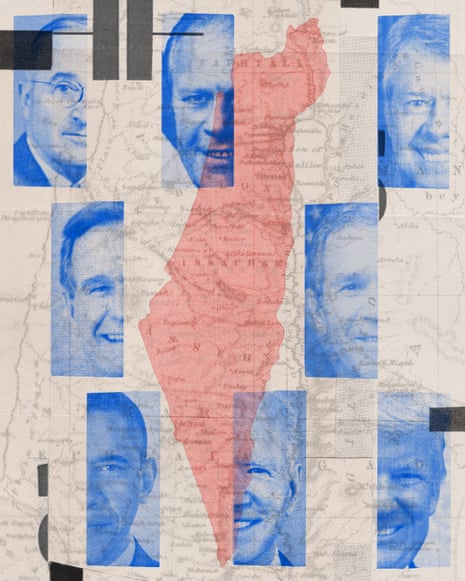
Collage of US presidents surrounding a map of Israel
Illustration: Jordan Bohannon/The Guardian/Getty Images/White House

Our new book tracks the growth over nearly eight decades, of the most powerful foreign policy lobby in US history

Ian Lustick and Eli Clifton, The Guardian, Sun 2 Aug 2026

In 1948, with war raging in Palestine, Harry Truman found himself trapped.

On one side were Zionist lobbyists and the president’s domestic political advisers, who were urging him to support the establishment of a Jewish state in as much of Palestine as possible. On the other were his top foreign policy and national security officials, led by the secretary of state, George C Marshall. Their unanimous recommendation was to prevent the establishment of a Jewish state, which they believed would trigger war in the Middle East and endanger the future of US relations with the Arab and Muslim world.

With the exception perhaps of George Washington, no diplomatic or military leader in American history had a reputation for patriotic virtue and skilled devotion to duty comparable to that of Marshall. Truman was in awe of the secretary of state, who, as chief of staff of the US armed forces, had been hailed by Winston Churchill as “the true organizer of victory” in the second world war. After the war, it had been Marshall who launched the plan named after him to rebuild Europe.

In the mid-1940s, Marshall pushed quietly but steadily against the Zionist movement’s proposals to establish a Jewish state in Palestine. He was concerned that American support would open opportunities for the Soviet Union to exploit Arab anger, put Middle Eastern oil supplies at risk in the event of a war between the Soviet Union and the United States, and require the deployment of unavailable American troops to prevent bloodshed and instability in Palestine. These were, indeed, the strongly held views of virtually all of Truman’s most important military and foreign policy advisers.

Exploiting the fact that most voters were ignorant or uncaring on the issue, the [Israel] lobby used enormous resources … to punish or reward politicians

Truman was personally and deeply moved by the suffering of Jewish survivors of the Nazi “Final Solution”, but also irritated by and at times furious with the constant hectoring to which he was subjected by campaigners for recognition of a Jewish state in Palestine, including the World Zionist Organization and a host of other Jewish delegations, friends and politicians. Despite his personal exasperation, he could not ignore them. Coming in an election year that would pit him against Governor Thomas Dewey of New York, pressures from the Zionist lobby forced him into an excruciating and embarrassing position.

With Palestine engulfed by civil war, Arab states threatening to invade and the last British soldiers about to leave the country, Truman called a meeting of his top advisers on 12 May 1948. According to Marshall’s own account of the meeting, he warned Truman against adopting the policy strongly advanced by Clark Clifford, his main political adviser, to recognize the state of Israel before it was established.
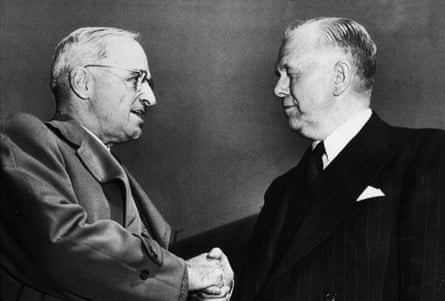
two men shake hands
President Harry Truman shakes hands with secretary of state George Marshall in Washington DC on 29 May 1947. Photograph: Hulton Archive/Getty Images

Such a move, according to Marshall, would be a “transparent dodge to win a few votes”, he said, leaving the “great dignity of the office of the President … seriously diminished”. Marshall declared he would not personally be able to vote for Truman should he bow to political pressure on the issue. A shaken Truman closed the meeting by saying he agreed with Marshall.

However, within two days, exquisitely sensitive to the tenuousness of his hold on the presidency and the power of Zionist sympathizers to throw New York’s electoral votes to the Republicans, he ordered that the US recognize Israel.


Today, the influence of the groups loosely known as the Israel lobby has only become more powerful. Truman’s bind – caught between his sense of the national interest and the domestic political price of defying a powerful lobby – was something that, in the decades to come, president after president would experience.
the flags of israel and palestine overlapping

To fast forward: Donald Trump’s decision to go to war on Iran earlier this year came after a sustained campaign by Israel to convince the US to join the disastrous operation. It also came in defiance of several of his top advisers, as well as the 45% of Republicans who hold an unfavorable view of Israel. That decision may be most quickly explained as yet another example of the erratic policymaking that define Trump’s two terms as president. But a closer examination of the experience of several of his predecessors reveals that this presidential decision is more the rule than the exception.

The fact is that from Truman to Trump, most American presidents have caved to the demands of Israel and its advocates. Driven by the fear of domestic political defeats, presidents have regularly rejected or abandoned foreign policies that both they and their most senior advisers believed were in the best interests of the US and at the expense of making meaningful progress in bringing a peaceful resolution to the Israeli-Palestinian conflict.

Our new book, Israel’s Lobby, tracks the growth over decades of the most powerful foreign policy lobby in American history. Composed of a panoply of organizations, groups and individuals who advocate American policies that explicitly favor the interests of Israel, the lobby was nurtured – and has been encouraged and guided – by Israeli governments. Exploiting the fact that most voters were ignorant or uncaring on the issue, the lobby used enormous resources and concentrated attention to punish or reward politicians at every level depending on their willingness to follow lobby instructions.

Over 20 years after the Truman episode, for example, President Gerald Ford launched what he referred to as a “reassessment” of US policy in the Middle East. The initiative had been advanced by Ford and his secretary of state, Henry Kissinger, as a way to escape from two years of embarrassing failures to move toward a comprehensive Arab-Israeli peace agreement. Both Ford and Kissinger had become intensely dissatisfied with Israeli stonewalling.
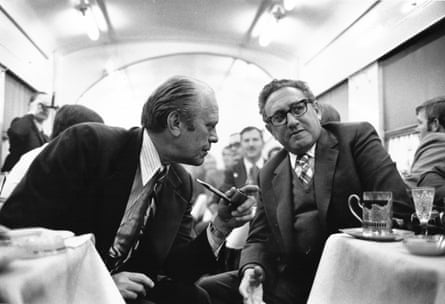
two men speak with each other in a train
President Gerald Ford talks with secretary of state Henry Kissinger, in Vladivostok, Soviet Union, on 23 November 1974. Photograph: Consolidated News Pictures/Getty Images

The reassessment was conducted by the committee of “Wise Men” convened by Kissinger: former government officials who had served as pillars of the postwar US foreign policy establishment. The unanimous recommendation of the committee was pressure on Israel to withdraw from the West Bank and Gaza Strip in order to achieve a comprehensive peace, in cooperation with the Soviet Union.

Clear indications that Ford intended to accept this recommendation triggered a powerful mobilization by leading Israel lobby organizations, such as the Conference of Presidents of Major Jewish Organizations and the American-Israel Public Affairs Committee (Aipac). The lobby’s decisive achievement was a letter drafted by Aipac and delivered to Ford demanding that the president “make it clear … that the United States, acting in its own national interests, stands firmly with Israel in the search for peace in future negotiations”, signed by 76 senators.

Ford was “mad as hell” at what he believed to be an Israeli campaign to use the lobby to obstruct diplomacy. But he was cowed. To protect his chances for election the following year, Ford rejected the unanimous recommendation from the “Wise Men”, returning instead to the step-by-step process that had so infuriated him, a process of essentially buying slices of the Sinai Peninsula – seized from Egypt in 1967 – from Israel with increasing amounts of aid and then returning them to Egypt. Ford and Kissinger also vastly increased the scale and scope of US support for Israel.

That included a sweeping new collection of US political, economic, military and diplomatic commitments made in a US-Israeli Memorandum of Agreement that, along with secret annexes, was signed on 1 September 1975. Aides to Kissinger described the guarantees and concessions made to Israel in these negotiations as “mind-boggling” and “simply incredible”. In his memoir, Ford wrote bitterly about the Aipac letter signed by three-quarters of the Senate that had ruined his diplomatic plans and cast a pall on his election campaign.

A peace dove holding an olive branch tries to fly but is weighed down by a heavy metal ball chained to its leg.

Indeed, Ford lost the election to Jimmy Carter. The lobby hoped Carter, who won 71% of the Jewish vote, would abandon aspirations for a comprehensive Middle East peace, but he was quick to disappoint. The president set his sights on a peace treaty resolving the core issues of the Arab-Israeli conflict. With high poll numbers and an American public that seemed ready for a commonsense, problem-solving president, Carter voiced his belief in March 1977 in the need for a “Palestinian homeland” as a key feature of the Middle East peace he wished to achieve.

The pro-Israel lobby immediately mobilized against Carter’s peace initiative. In a closely held 50-page memorandum for the president in early June, Carter’s senior adviser on domestic political affairs warned him that he would suffer serious consequences, including risks of failing to receive the renomination of his party, as a result of lobby opposition to his public consideration of a Palestinian homeland. Undeterred, Carter offered direct criticism of what he described in an Oval Office meeting as the prime minister Yitzhak Rabin’s increasingly inflexible positions. His differences with Menachem Begin, who became Israel’s prime minister in May 1977, were even sharper. Meanwhile Carter began intensive communications with Egyptian, Syrian and Palestinian leaders.

In October 1977, the US secretary of state, Cyrus Vance, issued a joint communique with Soviet foreign minister, Andrei Gromyko, committing the superpowers to achieving “as soon as possible a just and lasting settlement of the Arab-Israeli conflict”. Though fully expecting opposition to the president’s Middle East policy, the administration was stunned by the nearly apoplectic reaction to the US-Soviet statement by both the Israeli government and the lobby. Profoundly concerned with the political damage, Carter requested a meeting with the Israeli foreign minister, Moshe Dayan, in New York. According to Zbigniew Brzezinski, Carter’s national security adviser, who was present at the meeting, “Dayan in effect blackmailed the President by saying that unless he had assurances that we would oppose an independent West Bank and that we would give them economic and military aid, he would have to indicate our unwillingness in his public statements here in the United States … ‘I can go,’ said Dayan, ‘to the American Jews.’” Faced with this threat, Carter surrendered.

The next day, Vance and Dayan issued a joint statement summarizing a US-Israeli “working paper” prepared in the early hours of the morning. The statement affirmed negotiations would be dramatically scaled back and would not frame a Palestinian homeland as a central issue. The end result was a celebrated “separate peace” between Israel and Egypt that earned Carter, Begin and Sadat Nobel peace prizes, but also led to the isolation of Egypt in the Arab world and the assassination of Sadat. It also set the stage for Israel’s invasion of Lebanon in 1982 and settlement projects that resulted in Israel’s de facto annexation of the West Bank and Gaza Strip.
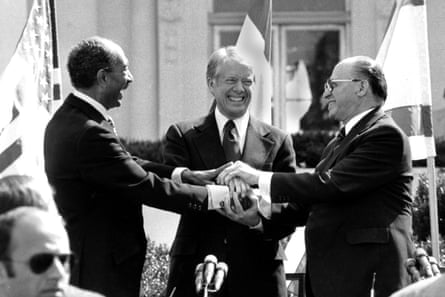
three men smile as they clasp hands
The Egyptian president, Anwar Sadat, left; US president, Jimmy Carter, center; and Israeli prime minister, Menachem Begin clasp hands on the north lawn of the White House after signing the peace treaty between Egypt and Israel, on 26 March 1979. Photograph: Bob Daugherty/AP

It is likely, 13 years later, that President George HW Bush felt just as Carter must have felt when, faced with the Israel lobby’s ferocious opposition to his Arab-Israeli peace initiatives, he made public his frustration with its influence. In a failed effort to boost the prospects for the upcoming Madrid peace conference, Bush suspended US loan guarantees amounting to what Israel was spending on housing in occupied territories and faced ferocious opposition from the Israel lobby for doing so. In a press conference he described his exasperation.

“We’re up against very strong and effective, sometimes, groups that go up to [Capitol Hill]” Bush said. “I heard today there was something like a thousand lobbyists on the hill working the other side of the question. We’ve got one lonely little guy down here doing it.”

The lobby’s ability to thwart presidential peace initiatives was on particularly powerful display again during the Obama administration. No president before him had entered the White House with such detailed knowledge of the Israeli-Palestinian dispute, such a record of personal engagement with both Jews and Palestinians, and such a sustained commitment to closer American relations with Arabs and Muslims. Fully embracing a “two-state solution” to the problem, he launched a high-profile peace initiative to be jumpstarted by a full-scale Israeli freeze on West Bank settlements.

But a storm of outrage in Israel and among leaders of Israel’s lobby in the United States, and the public feud that erupted between Barack Obama and Benjamin Netanyahu, proved more costly to the former than the latter. Obama quickly reversed course, in effect replacing his peace process envoy George Mitchell, who was closely identified as friendly to the Palestinians, with Dennis Ross, a lobby insider, whose advice to ditch the effort altogether the president quickly implemented. Instead of pressing Israel to stop settlements, Obama made a personal call to Mahmoud Abbas, president of the Palestinian Authority, threatening to pull $450m in American aid to the Palestinians if Abbas did not withdraw an anti-settlement resolution put forward at the UN security council. In Obama’s address to the United Nations, general assembly, in the first year of his second term, he shifted dramatically from language used in his previous UN speeches. Instead of criticizing Israeli settlements and pressing for a two-state solution, he identified himself with Israeli victims of Palestinian terrorism, opposed any UN action contrary to Israel’s insistence on direct negotiations between the parties, and condemned challenges to the legitimacy of Israel as a Jewish state.
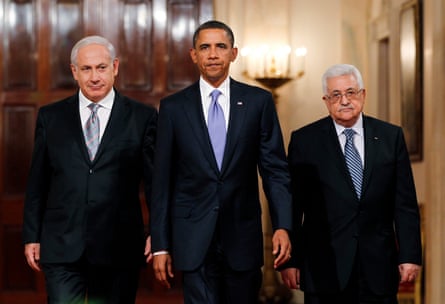
three men in suits walk in a corridor
President Barack Obama, center, arrives with the Israeli prime minister, Benjamin Netanyahu, left, and Palestinian president, Mahmoud Abbas, right, to make a statement on Middle East peace talks in the east room of the White House on 1 September 2010. Photograph: Jason Reed/Reuters

The reason for Obama’s dramatic retreat is easily inferable from his memoir, A Promised Land, in which he complains about Aipac’s ability to cow American politicians into obeisance by invoking fears of being labelled antisemitic, and emphasized his own particular vulnerability to such threats as “a Black man with a Muslim name who lived in the same neighborhood as Louis Farrakhan”.

In the wake of the genocide, the politics of the issue in America have changed as numerous Americans react with passion to Israeli onslaughts

More recently, in Joe Biden, the Israel lobby found a president who genuinely believed the Jewish state deserved the “special relationship” with the US. The firmness of that commitment was put to the test by Israel’s response to the 7 October 2023 attacks by Hamas and Islamic Jihad.

Socialized into accepting the lobby’s mantra that any “daylight” between Washington and Jerusalem would encourage Arab intransigence, and remembering the political punishment Obama received for showing “tough love” to the Israelis, Biden, quashed all recommendations from his top advisers to do something meaningful to stop the Israeli onslaught on Gazan Palestinians. When he did make limited complaints about excessive civilian casualties and implemented minor delays in American resupply of Israeli armaments, the Republican Jewish Coalition responded by slamming the administration for inserting daylight into the US-Israel relationship, while Aipac sent a detailed memorandum to members of Congress defending Israeli actions as limited, necessary and designed to reduce civilian casualties.


The experience of these administrations demonstrates the wisdom and extraordinary insight of America’s first president, George Washington. In his Farewell Address, Washington warned that the American system of government could all too easily be exploited by a group with a “passionate attachment” to a foreign country. In a system designed to rely on the mobilization of countervailing power to limit the effects of factions driven by self-interest or very particular points of view, Washington argued that since any faction committed to the interests of another country would not naturally find its influence checked by effective domestic opposition, it would therefore drive the United States into exaggerated and dangerous commitments abroad and implicate it in quarrels and wars contrary to the country’s interests.

In the wake of the genocide, the politics of the issue in America have changed as numerous Americans react with passion to Israeli onslaughts in Gaza, Lebanon and the West Bank. Biden and Kamala Harris paid heavy costs for knuckling to Israel and its lobby. Nearly a third of voters who voted for Biden in 2020 and did not vote for Harris in 2024 said that ending Israel’s violence in Gaza was the top issue influencing their voting decisions. Across both parties, support for Israel has plummeted; 60% of Americans hold an unfavorable view of Israel, and a record number of Israel critics are winning congressional primaries.

But these losses have not deterred Israel or its lobby from working to reverse Trump’s 2024 campaign promises to avoid wars in the Middle East, to pursue even closer relations between the US and Israeli militaries, and to spend millions to thwart the rise of critics of the country.

The surface of the earth spinning like a vortex with a Palestinian flag at the center.

To be sure, American supporters of Israel and its governments have every right to express their opinions and work to shape public policy, and the lobby is by no means the only vehicle for moneyed interests that warp American democracy. Moreover, American presidents have free will: the George W Bush administration was run by many who were in perfect ideological alignment with the Israeli right. An incompetent and gullible Trump is plainly responsible for yielding to Israeli pressure and dragging the US into the latest war.

But unless other groups are able to act freely with other interests in mind – and without the threat of antisemitism accusations – US policy in the Middle East will remain dangerously distorted. Both to secure and advance American interests abroad and to protect American freedoms at home, Americans must unite to prevent any foreign power from enjoying the influence over policy and public debate that Israel has exercised, both directly and through the faction operating on its behalf.

  • Eli Clifton is a co-founder and senior adviser at the Quincy Institute for Responsible Statecraft
  • Ian Lustick is professor emeritus of political science at the University of Pennsylvania specializing in Arab-Israeli relations and US foreign policy
  • This essay was adapted from the bookIsrael’s Lobby: America in the Grip of a Foreign Power , out11 August by Atria/One Signal Publishers

Philip Giraldi: Who Is In Charge of US Foreign Policy?

October 11, 2024

Is it Israel and its Powerful Lobby or The White House or No One at all?

Philip Giraldi • October 10, 2024

It probably would surprise no one to learn that there are several viewpoints among critics of the current wars devastating the Middle East regarding who is actually encouraging a growing bloody conflict which might soon involve at least six countries in the region. In simple terms, there is a school of thought that believes that Israel, backed by its various powerful diaspora lobbies, is defying world opinion to continue its slaughter of its indigenous Palestinians and neighboring Lebanese. In other words, it is all about Israel acting maliciously and badly. However, another viewpoint sees instead a neocon dominated United States foreign policy exploiting Israeli truculence and its hard right wing leadership to carry out American national objectives in the region, in a sense using Israel as its proxy and actually encouraging its bad behavior. Meanwhile, a third plausible examination of developments tends to meld the two approaches, suggesting that the US and Israel are in a conspiratorial cooperative relationship and are in full agreement regarding reducing the power of the Jewish state’s neighbors. That would make Israel the preeminent military power dominating the Persia Gulf and beyond to control a large chunk of the world’s energy resources while also benefiting American weapons manufacturers and other political and Wall Street constituencies.

The problem is that there is sufficient carefully selected evidence to support every point of view including an alternative suggestion that American foreign policy is broken, adrift and does not reflect any US national interest at all, witness the recent $8.7 billion aid package sent to a belligerent Israel when Americans were dying in North Carolina in the wake of a devastating hurricane for which FEMA only provided meager assistance because it claimed it had run out of money. The steady flow of money and weapons from the US to Israel suggests that the United States is for some reason supporting Prime Minister Benjamin Netanyahu’s expansion of the war against Hamas when the White House could have ended the war in a day by cutting off that support. Alternatively, Israel might be seen as continuing its slaughter in spite of perhaps insincere US objections because it presumes that its powerful Lobby in the US will keep Joe Biden in line with an election coming up lest it weigh in heavily to help Donald Trump. And, of course, if the two nations are acting in collusion it could all be Kabuki with Washington and Tel Aviv cynically intending to do whatever it takes reshape the Middle East to Israel’s benefit. Take your choice of which scenario fits best.

One needs to determine what actually justifies the reality of a multiplicity of fronts, to include providing political cover in the UN, where the United States is interacting to support “greatest ally and best friend” Israel while at the same time constantly verbalizing the apparently false claim that it is trying to avoid the conflict’s expanding into a major conflagration that could engulf the entire region and beyond, driving up energy costs dramatically just for starters. Such a managed co-escalation might also increase the risks and costs geometrically as more players get involved, up to and including the possibility that Israel will opt to use its nuclear weapons to “defend” itself or to attack Iran, which is where both Russia and the United States might become involved in a nuclear exchange to defend their respective “friends.”

So what is the truth and what are the lies and who in Washington and/or Tel Aviv is calling the shots in the Middle East? And what do they really intend and how do they see it all ending? There are four obvious US government players who are on the ground and meeting with the key figures in the nations involved in the fighting as well as with those ostensibly engaged in the what are being called negotiations to put an end to the killing with a ceasefire acceptable to all parties. One must concede that their task is a difficult one at best as all parties to the peace talks recognize that the United States is not an unbiased intermediary given its total commitment to support Israel politically as well as with arms and money while freely labeling the Jewish state’s neighbors and opponents alike as “terrorists” and “autocrats.” The four would be composed of two obvious officials Central Intelligence Agency (CIA) Director William Burns and Secretary of State Antony Blinken while a third and fourth are not-so-well-known, consisting of special negotiator for the president Amos Hochstein and the White House Coordinator for the Middle East Brett McGurk. Both Burns and Blinken have made numerous trips to the Middle East and Ukraine to convey the views of the president and make their own assessments of the situation on the ground after meeting with local officials. The role is rather unusual for Burns as a CIA Director normally operates behind the scenes and does not get involved in policy making, but Burns is not a typical director in that he has no background in intelligence. He was a highly regarded State Department officer who wound up as the US Ambassador to Russia. He very carefully worked through the nuances of the US-Russian relationship and was highly praised for explaining things from the Kremlin perspective so US planners would be able to understand very clearly the differing perspectives of the two nations. He described, for example, how very sensitive Russia was over the issue of Ukraine becoming part of NATO, a warning which was subsequently ignored by President Biden.

Blinken is, of course, better known as he served as Deputy Secretary of State during the Barack Obama administration and is regarded as a particularly close associate of Joe Biden. As Secretary of State he has been a very active traveler throughout both the Middle East and Ukraine. Blinken is Jewish and is regarded as a protector of Israel, which is, of course, also the President’s frequently enunciated view. After the Israeli assassination of Hezbollah leader Nasrallah he said that the “World is safer without Nasrallah…” whereas most of the world would quite reasonably prefer to see Benjamin Netanyahu removed. Blinken also appears to favor preemptively attacking Iran to eliminate its nuclear energy program even though there is no evidence that it is weapons-development related. He has recently come under pressure for lying about two State Department reports that indicated very clearly that Israel has been deliberately starving and killing the Gazans by blocking US supplied food and medicine supplies at the border. One large convoy of trucks containing enough food to feed most of the local people who were in danger of dying from starvation was deliberately held up at the border until the food became rotten and had to be destroyed. Blinken lied both to Congress and to the American people about the Israeli policy, saying that blocking food supplies by Israel was not taking place. It was a consequential lie as people died and are continuing to die because of it and Blinken has paid no price for what must surely be considered a major war crime.

The third policy planner is an unusual individual Amos Hochstein, who was born in Israel and served in the Israeli Army. He has been designated as Biden’s personal roving ambassador in the Middle East with a particular brief to work to avoid the expansion of the Gaza fighting into Lebanon against Hezbollah. In that effort, he has obviously failed as both Israel and Lebanon now consider themselves to be at war. It is presumed that Hochstein is the “active arm” in the White House campaign to shield Israel from any harm initiated by its much abused neighbors. Why anyone would select an Israeli who is a product of the Israeli Army as a negotiator of some type among the nations that the Israelis have been victimizing for the past seventy-five years has to be considered an enduring mystery. It is perhaps another gimmick move by Biden to pretend that he is neutral in the conflict while doing everything he can to turn Netanyahu free to destroy or subject all his neighbors.

Which brings us to the fourth likely top planner National Security Council Coordinator for Africa and the Middle East Brett McGurk. McGurk has been a bipartisan fixture floating around the national security and diplomatic communities for a number of years with the reputation of being a “hardliner” particularly when dealing with Arabs, which is not to say that he has learned anything beyond the fact that if one wants to survive in Washington it pays to love Israel. It is interesting to note that the Biden Administration claims that it is working hard to achieve a ceasefire in both Lebanon and Gaza but it continues to cover for Israel politically and provide it with the weapons and money to continue it genocidal activities as well as in support of its plan to occupy southern Lebanon to create a “buffer zone.” Israeli media is already reporting that real estate agents are offering attractive properties for Jewish buyers in what is still Lebanon, just as Donald Trump’s son-in-law Jared Kushner has been peddling exclusive sea front lots in Gaza. In other words, don’t believe anything coming out of the Biden Administration as evidence for anything as it appears that its “policy makers” and press spokesmen have acquired the Israeli tendency to lie about everything.

Politico has a recent piece on both Hochstein and McGurk and it does not make one feel warm and fuzzy about what the Biden administration is up to. The article is entitled: “US officials quietly backed Israel’s military push against Hezbollah -The officials urged caution and stressed the need for diplomacy. But the timing was right for such a military shift, they concluded”. It seems that the guys who are promoted by the Biden administration as peacemakers are anything but. Politico obtained insider information from a number of anonymous sources in both Washington and Israel and learned that Biden’s team has actually agreed with Israeli Prime Minister Benjamin Netanyahu’s broad strategy to shift Israel’s military focus to the north against Hezbollah. This tilt, contrary to what the White House has been preaching, produced a reaction from a number of Pentagon, intelligence and State Department officials that such a move would drag the United States into the war, which is really what Netanyahu intended, but the shift in policy was approved anyway. One senior US official noted but dismissed the flaw in a policy of calling for peace while encouraging war as “Both things can be true — the US can want diplomacy and support Israel’s larger goals against Hezbollah. There’s clearly a line that the administration is toeing, it’s just not clear what that line is.”

In spite of concerns from some in the government that a reckless Israel will go too far and ignite a major regional war that could easily spread beyond the Middle East, Politico reports how Hochstein and McGurk worked “behind the scenes” to encourage Israel and they are now describing Israel’s Lebanon operations likely to include a major land invasion as a “history-defining moment” — one that will “reshape the Middle East for the better for years to come.” That would seem to confirm that the United States and Israel are in fact collaborating and the US is fully complicit and de facto supporting the genocidal intention of Netanyahu to make a new Greater Israel largely free of Arabs. For the US, the extra benefit gained from defeating Hezbollah will be that it ultimately weakens Iran, neocon Washington’s perpetual arch enemy, which relies on Hezbollah as a proxy and a resource for projecting power. Of course, it could all go the other way and the joint American-Israeli plan could come to naught. Hezbollah notably routed invading Israeli forces in south Lebanon back in 2006 and it is better trained and equipped now than it was then. And what happens if Israeli army is in trouble and the US is forced to act on its pledge to “defend” the Jewish state, thereby leading a small war to expand and include Iran and Russia? The ball will be in your court Mr. Biden, or possibly Mr. Trump or Ms. Harris. Consider carefully how you will play it but if you really do want a ceasefire, I wouldn’t send Blinken, Hochstein and McGurk around to do the negotiating.

Philip M. Giraldi, Ph.D., is Executive Director of the Council for the National Interest, a 501(c)3 tax deductible educational foundation (Federal ID Number #52-1739023) that seeks a more interests-based U.S. foreign policy in the Middle East. Website is councilforthenationalinterest.org, address is P.O. Box 2157, Purcellville VA 20134 and its email is inform@cnionline.org.

Paul Craig Roberts: Israel Rules

December 30, 2009

By Paul Craig Roberts, Information Clearing House, Dec 29, 2009

On Christmas eve when Christians were celebrating the Prince of Peace, the New York Times delivered forth a call for war. “There’s only one way to stop Iran,” declared Alan J. Kuperman, and that is “military air strikes against Iran’s nuclear facilities.”

Kuperman is described as the “director of the Nuclear Proliferation Prevention Program at the University of Texas at Austin,” but his Christmas eve call to war relies on disinformation and contradiction, not on objective scholarly analysis.

Continues >>

For Palestinians, Every Day Is Kristallnacht

December 17, 2009
Foreign Policy Journal, December 15, 2009
by Paul Craig Roberts

Israel_stealing_palestine“Settlers attack West Bank mosque and burn holy Muslim books” was a London Times headline on December 11, 2009.

These attacks, together with the demolition of Palestinian homes, the uprooting of Palestinians’ olive groves, the innumerable checkpoints that prevent Palestinians from accessing schools, work, and medical care, the Israeli Wall that denies Palestinians access to the land stolen from them, and the isolation and blockade of the Gaza Ghetto, are part of the Israeli government’s policy of genocide for the Palestinians.

The Israel Lobby has such power over America that even former President Jimmy Carter, a good friend of Israel, is demonized for using the polite term–apartheid–for the genocide that has occurred over the decades during which American “Christian” preachers, together with bought-and-paid-for politicians, justified Israel’s policy of slow genocide for Palestine.

Israelis who still have a moral conscience–a small part of the population–endeavor to use moral protests against the inhumanity of the Israeli government. Israelis Jeff Halper and Angela Godfrey-Goldstein lead the Israeli Committee Against House Demolition (ICAHD), a non-violent, direct-action group established to oppose and resist Israeli demolition of Palestinian homes in the Occupied Territories.

Under international law an occupier by military force is forbidden to steal the occupied land. The US, however, has protected Israel’s violation of international law for decades by vetoing UN resolutions. Israel has been able to steal Palestine from the Palestinians, because the US government used its power to prevent Israel from being held accountable under international law.

In March 2003 American citizen Rachel Corrie stood in front of an Israeli bulldozer, made by Caterpillar and sent to destroy a Palestinian home. Her courageous act of defiance was regarded as an annoyance, and she was run over and murdered by the Israeli bulldozer operator. Israel suffered no consequences for its murder of an American citizen who had a moral conscience.

In the Israeli-controlled American media, we hear endlessly that Palestinians are terrorists who strap on explosives in order to kill innocent Israelis and who terrorize Israeli towns by firing rockets into them. One look at the maps above is enough to make clear who the real terrorist is. The success of Israeli propaganda in the face of totally obvious facts damns the ignorance and unconcern of the American people.

The Israeli newspaper, Haaretz, which also has a moral conscience and is intelligent to boot, wrote on December 4, 2009: “Every appointee to the American government must endure a thorough background check by the American Jewish community.” Haaretz notes that any American that the President of the United States proposes for an appointment to his government is subject to the approval of the Israel Lobby, which can blackball appointees at will.

Haaretz gives the example of Charles Freeman, whom President Obama intended to appoint as head of the National Intelligence Council. The Israel Lobby proved, again, that it was more powerful than a mere American President and prevented the appointment, citing Freeman’s “anti-israel leaning.” In other words, because Freeman was not an overboard apologist for Israel’s crimes he was unacceptable to the Israel Lobby.

Haaretz reports: “The next attempt to appoint an intelligence aide, in this case, former Republican senator Chuck Hagel, also resulted in vast criticism over his not having a pro-Israel record.” The Israel Lobby has blocked Hagel’s appointment by President Obama. Hagel doesn’t want to start a war with Iran for Israel’s benefit and was blackballed by Morton A. Klein, the president of the Zionist Organization of America. Hagel, it seems, “refused to sign a letter calling on then-president George Bush to speak about Iran’s nuclear program at the G8 summit that year.”

Now it is a Jewish daughter of a Holocaust survivor, Hannah Rosenthal, whose appointment to head the US Office to Monitor and Combat Anti-Semitism, an office that is another indication of America’s puppet state status, is under attack. Rosenthal was the head of the Jewish Council for Public Affairs during 2000-2005. Her black mark came from serving on the advisory board of the J Street Lobby, a recently-formed American Jewish organization formed in opposition to AIPAC’s murderous militarism.

The Israel Lobby’s opposition to Hannah Rosenthal shows that no moral person can survive the Israel Lobby’s blackball.

The US, “the world’s only superpower,” has no independent voice in Middle Eastern affairs. The real power rests in the hands of the settler thug, Avigdor Lieberman, Deputy Prime Minister of Israel and Minister of Foreign Affairs. This is the man who controls the Obama government’s Middle East policy. Lieberman forced the “all-powerful President of the US, Barack Omama,” to rescind his order to Israel to halt the illegal settler settlements on occupied Palestinian land. Obama was given the bird and submitted to his master.

Macho Americans who prance around as if they owned the world are nothing but the puppets of Israel. The US is not a country. It is a colony.

America, Israel’s Lackey

November 12, 2009
by Paul Craig Roberts, Antiwar.com,  November 12, 2009

It did not take the Israel Lobby long to make mincemeat out of the Obama administration’s “no new settlements” position.  Israeli prime minister Netanyahu is bragging about Israel’s latest victory over the US government as Israel continues to build illegal settlements on occupied Palestinian land.

In May President Obama read the Israelis the riot act, telling the Israeli government that he was serious about ending the Israeli conflict with the Palestinians and that a lasting peace agreement required the Israeli government to abandon all construction of new settlements in the occupied West Bank.

Continues >>


At What Cost the Israel Lobby?

October 13, 2009

As during the Kennedy era, Tel Aviv remains focused on a single goal: ensuring that its ally and patron (the US) continues a six-decade policy ensuring that Israel is not held accountable—for anything, notes Jeff Gates.

Jeff Gates, Middle East Online, Oct 13, 2009

More than 46 years ago, President John F. Kennedy sought to preclude a nuclear arms race in the Middle East. In June 1963, he wrote the last in a series of insistent letters to Israeli Prime Minister David Ben-Gurion. Those letters sought what Israel now demands of Iran: international inspections of its nuclear facilities. The key difference: Kennedy knew for certain that Israel, while portraying itself a friend and ally, repeatedly lied to Kennedy about its nuclear weapons development at the Dimona reactor in the Negev Desert.

Continues >>

How Israel Lobby Took Control Of US Foreign Policy

July 19, 2009

AIPAC becomes foreign agent dominating American foreign policy while disguised as domestic lobby.

By Jeff Gates | Information Clearing House, July 19, 2009

LOUISIANA – In the early 1960s, Senator William J. Fulbright fought to force the American Zionist Council to register as agents of a foreign government. The Council eluded registration by reorganizing as the American Israel Public Affairs Committee. AIPAC has since become what Fulbright most feared: a foreign agent dominating American foreign policy while disguised as a domestic lobby.

Israelis and pro-Israelis object when they hear that charge. How, they ask, can we so few wield such influence over so many? Answer: it’s all in the math. And in the single-issue advocacy brought to bear on US policy-making by dozens of ‘domestic’ organizations that now compose the Israel lobby, with AIPAC its most visible force.

The political math was enabled by Senator John McCain whose support for all things Israeli ensured him the GOP nomination to succeed Christian-Zionist G.W. Bush. McCain’s style of campaign finance reform proved a perfect fit for the Diaspora-based fundraising on which the lobby relies. Co-sponsored by Senator Russ Feingold of Wisconsin, this change in federal election law typifies how Israeli influence became systemic.

‘McCain-Feingold’ raised the amount (from $1,000 to $2,300) that candidates can receive from individuals in primary and general elections. A couple can now contribute a combined $9,200 to federal candidates: $4,600 in each of the primary and general elections. Primary elections, usual low-budget, are particularly easy to sway.

Importantly for the Diaspora, this change also doubled the funds candidates can receive without regard to where those contributors reside. A candidate in Iowa, say, may have only a few pro-Israeli constituents. When campaign support is provided by a nationwide network of pro-Israelis, that candidate can more easily be persuaded to support policies sought by Tel Aviv.

Diaspora-based fundraising has long been used by the lobby with force-multiplying success to shape US foreign policy. Under the guise of reform, John McCain doubled the financial resources that the lobby can deploy to elect and retain its supporters.

Fulbright was Right

The influence-peddling process works like this. Candidates are summoned for in-depth AIPAC interviews. Those found sufficiently committed to Israel’s agenda are provided a list of donors likely to “max out” their campaign contributions. Or the process can be made even easier when AIPAC-approved candidates are given the name of a “bundler.”

Bundlers raise funds from the Diaspora and bundle those contributions to present them to the candidate. No quid pro quo need be mentioned. After McCain-Feingold became law in 2003, AIPAC-identified bundlers could raise $1 million-plus for AIPAC-approved candidates simply by contacting ten like-minded supporters. Here’s the math:

The bundler and spouse “max out” for $9,200 and call ten others, say in Manhattan, Miami, and Beverly Hills. Each of them max out ($10 x $9,200) and call ten others for a total of 11. [111 x $9,200 = $1,021,200.]

Imagine the incentive to do well in the AIPAC interview. One call from the lobby and a candidate can collect enough cash to mount a credible campaign in most Congressional districts. From Tel Aviv’s perspective, that political leverage is leveraged yet again because fewer than ten percent of the 435 House races are competitive in any election cycle (typically 35 to 50).

Additional force-multipliers come from: (a) sustaining this financial focus over multiple cycles, (b) using funds to gain and retain seniority for those serving on Congressional committees key to promoting Israeli goals, and (c) opposing any candidates who question those goals.

Jewish Achievement reports that 42% of the largest political donors to the 2000 election cycle were Jewish, including four of the top five. That compares to less than 2% of Americans who are Jewish. Of the Forbes 400 richest Americans, 25% are Jewish according to Michael Steinhardt, a key funder of the Democratic Leadership Council. The DLC was led by Jewish Zionist Senator Joe Lieberman when he resigned in 2000 to run as vice president with pro-Israeli presidential candidate Al Gore.

Money was never a constraint. Pro-Israeli donors were limited only by how much they could lawfully contribute to AIPAC-screened candidates. McCain-Feingold raised a key limit. The full impact of this foreign influence has yet to be tallied. What’s known, however, is sufficient to apply the Foreign Agents Registration Act. Of the top 50 neoconservatives who advocated war in Iraq, 26 were Jewish (52%).

Harry Truman, a Christian Zionist, remains one of the more notable recipients of funds. In 1948, he was trailing badly in the polls and in fundraising. His prospects brightened dramatically in May after he recognized as a legitimate state an enclave of Jewish extremists who originally planned to settle in Argentina before putting their sights on Palestine.

That recognition was opposed by Secretary of State George C. Marshall, the Joint Chiefs of Staff, the bulk of the diplomatic corps, the fledgling Central Intelligence Agency and numerous distinguished Americans, including moderate and secular Jews concerned at the troubles that were certain to follow. Not until 1984 was it revealed that a network of Jewish Zionists had funded Truman’s campaign by financially refueling his whistle-stop campaign train with $400,000 in cash ($3 million in 2009 dollars).

To buy time on the public’s airwaves, money raised from the Israel lobby’s network is paid to media outlets largely owned or managed by members of the same network. Presidents, Senators and Congressmen come and go but those who collect the checks rack up the favors that amass lasting political influence.

The US system of government is meant to ensure that members of the House represent the concerns of Americans who reside in Congressional districts—not a nationally dispersed network (a Diaspora) committed to advancing the agenda of a foreign nation. Federal elections are meant to hold Senators accountable to constituents who reside in the states they represent—not out-of-state residents or a foreign government.

In practical effect, McCain-Feingold hastened a retreat from representative government by granting a nationwide network of foreign agents’ disproportionate influence over elections in every state and Congressional district. Campaign finance ‘reform’ enabled this network to amass even more political clout—wielding influence disproportionate to their numbers, indifferent to their place of residence and often contrary to America’s interests.

This force-multiplier is now wielded in plain sight, with impunity and under cover of free speech, free elections, free press and even the freedom of religion. Therein lies the perils of an entangled alliance that induced the US to invade Iraq and now seeks war with Iran. By allowing foreign agents to operate as a domestic lobby, the US was induced to confuse Zionist interests with its own.

Jeff Gates is a widely acclaimed author, attorney, investment banker, educator and consultant to government, corporate and union leaders worldwide. Gates’ latest book is Guilt By Association—How Deception and Self-Deceit Took America to War (2008). His previous books include Democracy at Risk: Rescuing Main Street From Wall Street and The Ownership Solution: Toward a Shared Capitalism for the 21st Century. For two decades, he was an adviser to policy-makers worldwide and Counsel to the US Senate Finance Committee (1980-87)—working with Senator Russell Long of Louisiana.

AIPAC’s Hidden Persuaders

May 18, 2009
The Israel lobby is aiming to soften up US public opinion for an attack on Iran. Americans should resist its propaganda

by Richard Silverstein | The Guardian, UK, May 18, 2009

Despite the ballyhoo of the recent Aipac national policy conference in Washington, when Israel-US bonds were feted, relations between the two countries are currently more strained than at any time since 1991. That was when the elder George Bush, as US president, fiercely lobbied Yitzchak Shamir to join in the Madrid peace conference. Relations then reached their nadir when James Baker uttered his infamous remark about Israel’s American-Jewish supporters: “Fuck the Jews, they don’t even vote for us.”

If relations continue to deteriorate in coming months, we might have to go back in time to the Suez crisis of 1956 to find a time when relations were this fraught.

A case in point is Iran. That bogey-nation was everywhere at the Aipac conference. Every keynote speech – if they weren’t directly written by that group’s staff – seemed unmistakably scripted and “on message”, dedicated to the existential threat that Iran poses not just to Israel, but the entire world.

A glossy brochure distributed at the Aipac meeting showed a map (pictured below) centred on Iran and beyond, with a dark ominous ring around Iran’s neighbours and as far away as India, Russia, Africa and eastern Europe. The message: these are the countries under imminent threat of Iranian ballistic missiles.

Aipac map
A map contained in a brochure distributed at an Aipac meeting

The brochure copy even intimates that the next step for Iran is “building a missile with range to reach US territory”. (Never mind that Iran doesn’t yet have any ballistic missile capable of carrying a nuclear weapon, nor will it have the bomb itself for anywhere from a year to five years depending on which you source you choose to believe.)

Israel is in the midst of a massive diplomatic, political and intelligence campaign, both public and covert, that could lead – if those officials behind it have their way – towards a military strike on Iran. It is a war for the hearts and minds of Americans. Or you might call it the war before the war. In intelligence circles, this Israeli project is known as perception management and defined by the department of defence as:

Actions to convey and/or deny information … to foreign audiences to influence their emotions, motives and objective reasoning as well as to intelligence systems and leaders … ultimately resulting in foreign behaviours and official actions favourable to [US] objectives. In various ways, perception management combines truth projection, operations security, cover and deception and psychological operations.

The Israelis are following the template of the Bush administration’s run-up to the Iraq war. First, the US government advocated half-hearted efforts at diplomatic engagement. Then it ratcheted up pressure through sanctions and UN resolutions. That is where the Israeli campaign stands now.

Aipac’s members carried a unified message to Capitol Hill during their lobbying of US senators and members of Congress. They demanded that Congress pass the most draconian sanctions ever proposed against Iran. They demanded that Iran be offered a limited time in which to respond to an ultimatum insisting it drop its nuclear programme.

What then? If you review Aipac’s literature and the various commentaries published either by Israeli diplomats or their supporters in the US media, they don’t specify what comes next. But any sensible person can guess that the final step will be war: “Israeli leaders have … hinted at pre-emptive military strikes if they decide that diplomacy has failed.”

The Israelis surely know that the Obama administration will never go to war against Iran. In fact, they know that Obama would not approve of Israel doing so. But I’ve become convinced, in doing the research and speaking to knowledgeable sources, that Israel is prepared at some date in the near future to attack Iran itself, even against the wishes of the US.

This of course will put Obama in an untenable position: do US forces attack the Israelis (in effect defending the Iranians) and risk the fallout that would occur in relations between the Democratic administration and American Jews? Or does he allow the Israelis to carry on to their targets and bomb Iran, accepting the bloodletting and mayhem that will inevitably result? If Israel wishes for the latter outcome, they must lay the groundwork here in the US for tacit acceptance by the American people of a third-party attack on Iran.

Indeed, they are already a good deal of the way toward this goal, as the latest polling from Rasmussen Report reveals. According to it, 49% of Americans believe that if Israel attacks Iran then the US should help Israel.

Some readers may say this is alarmist. Before I learned some of the information I gathered from sources both public and not, I also would have labelled this as overly dramatic. But Israel hasn’t shrunk, for example, from drafting opinion columns for US newspapers on the menace posed by Iran, and telling the editor that a local Jewish community leader would be attaching his name to it.

Within the US Israel exploits a willing circle of Likudist advocacy groups and thinktanks – such as the Washington Institute for Near East Peace, the Israel Project, the Jewish Institute for National Security Affairs as well as Aipac itself – that are closely scripted and co-ordinate their political message with Israeli diplomats. While some of these groups deny such a close affiliation, there is proof of scripting and amplification of the Israeli government’s agenda. And of course there may be cases in which the organisations know the needs of their patron so well that they need no prompting.

In another example, Israeli diplomats monitored and encouraged a member of Congress to host an anti-Iranian conference that would advocate Israel’s message of sanctions (and more).

Israel, along with enablers like Aipac, has not shrunk from hounding its critics. One peace activist in the US so angered Israeli authorities that he was driven from a job through a whispering campaign in the community, which also included a disparaging article leaked to a willing reporter.

The level of hubris necessary to pull this off is astonishing. Fresh off the dismissal of the Rosen-Weissman spy charges involving its own employees, Aipac is flexing its political muscle and reminding the world of its resurgence. It does this through a combination of manipulation, public lobbying and punishment of its enemies.

We in the US must be prepared to resist. We must protect ourselves from Israel’s propaganda offensive ginning up war with Iran. We must encourage President Obama to stay strong in his commitment to Israeli-Arab peace, whether or not Israel is a willing partner. Keeping our eyes on the prize of peace is going to be the hardest challenge of all, because the Netanyahu government is doing everything it can to divert the world’s attention.

Obama and the Middle East

May 13, 2009

By Gilbert Achcar | ZNet, May 12, 2009

Whether the election and inauguration of Barack Obama as 44th President of the United States will qualitatively alter U.S. Middle East policy and the regional situation remains to be seen. The fact is that Barack Obama has been much bolder with regard to U.S. relations with Latin America than he has been with regard to the Middle East during the 100 first days of his administration. This is despite the fact that, as a presidential candidate, Obama emphasized much more his difference with the Bush administration on Middle East issues, especially Iraq, than on South American issues.

Beyond the various electoral statements, the truth is that Obama ran as a candidate dedicated to bipartisan consensus in the realm of foreign policy, and singularly with regard to the Middle East. His critique of the Bush administration was restricted to the extent to which it did not fully comply with this consensus as expressed in the report of the Baker-Hamilton Iraq Study Group. To put it more precisely, Obama supported the “surge,” which conformed to the recommendations of the report, and announced that he would stick to the exit (from Iraq) strategy that it envisaged. On this, he had nothing very original to say when compared to what the Bush administration was already doing since it implemented the “surge.” Hence, the very symbolic as well as significant fact that he asked Robert Gates to remain at the helm of the Pentagon — thus repeating the kind of bipartisan gesture with regard to “Defense” that Bill Clinton made when he appointed to the same position another Republican, William Cohen, for his second term.

Where Obama differed from Bush in public statements was mainly with regard to Iran: whereas the Bush administration never really agreed to comply with the recommendation of talking to Iran that was expressed in the Baker-Hamilton report, Obama made clearly the point that this was what he would do if elected, and he got attacked for precisely that reason by all the friends of the Israel Lobby. However, since his inauguration, Obama, and his Secretary of State Hillary Clinton, have made no real substantive changes in that respect. One explanation for this is that they fear that engaging in talks with Iran at this stage might impact the forthcoming presidential election in that country in a way that would be contrary to what they deem to be U.S. interests. If this explanation is true, it implies that they will continue to “wait and see” until the election in June 2009, that is due to be held five weeks from the time of writing these lines.

After the Iranian presidential election, the Obama administration will probably move to a more serious opening in the direction of Iran, applying a carrot and stick policy — with a big carrot whereas the Bush administration only carried a big stick. They will hope for a deal with the Iranian leadership, a deal whereby Tehran would cooperate with them in stabilizing Iraq and the Middle East, each side acknowledging the interests of the other, in the same way that they are actually doing presently in Iraq, where both sides sponsor the same Maliki government in Baghdad. Such a conciliatory policy has been imposed on the U.S. government by the dire condition in which it found itself in the Middle East as a result of the disastrous policy of the Bush administration. Basically, the Obama administration faced with the Iraqi semi-debacle, at a time when its room for maneuver has been narrowed by the global economic crisis, is contemplating a reaction similar to that of the Nixon administration when it faced the Vietnam debacle. The exit strategy then was: “Vietnamize” the war, get all the troops out of Vietnam, cut a deal with Moscow and Beijing. The strategy now is: “Iraqize” the war (done through the “surge” and its reliance on the buying off of major chunks of what used to be the Sunni “insurgency” in the form of the “Awakening Councils”), get most of the troops out of Iraq (planned until 2011), cut a deal with Tehran. Both policies take place against a backdrop of severe global economic crisis.

In a sense, the new policy, if fully implemented, will require much less boldness than the one implemented by the Nixon-Kissinger team: withdrawing from Vietnam against the background of the ongoing Cold War was much more spectacular than withdrawing from Iraq in the absence of any “peer” global challenger of the United States; talking to “Red China” was much more spectacular than any conciliatory gesture toward Iran could be, all the more that it cannot be expected that Obama-Clinton will go to the same extent of sudden warming up with yesterday’s enemy as Nixon-Kissinger did in their relation with China. One important difference is that the Nixon team could play on the “triangulation” of its relations with Moscow and Beijing in light of the enmity between the two “communist” capitals. There is no situation of this kind with regard to Iran.

But the key difference is, to be sure, the role of Israel. For the Zionist state, Iran is the main enemy in the whole region, and the nuclear issue is a “red line” that would prompt the Israeli state to act militarily if it deemed that the line was crossed. We know from the revelation by The New York Times last January (David Sanger, “U.S. Rejected Aid for Israeli Raid on Iranian Nuclear Site,” NYT, January 10, 2009) that the Olmert government already asked the Bush administration for a green light to attack Iranian nuclear facilities with air strikes flying through Iraqi air space. The Olmert government wanted to take advantage of the remaining time in office of this American administration that was most cooperative with the worst plans and deeds of the Israeli state. The green light was not granted, however, for a variety of reasons related to the highly risky and uncertain character of the operation and its potential consequences in a time of unfolding global economic crisis.

The Obama administration will indeed be clearly less amenable to Israel’s hardliners than the Bush team was. And tensions between the two countries are all the likelier to unfold given that their political evolutions are presently going in opposite directions: whereas the last U.S. presidential election started a pendulum backswing after eight years of the most reactionary administration in U.S. history, the recent Israeli parliamentary election only carried on further the swing to the right that started with the election of Ariel Sharon in February 2001 in the wake of Bush’s presidential inauguration.

These are the main elements of the present picture in the Middle East: to get into other developments — the efforts of Washington’s Arab friends to foster reconciliation between Hamas and Abbas’s “Palestinian Authority,” the forthcoming parliamentary election in Lebanon, etc. — would take longer than the space of this article. However, the whole policy of the Obama administration is a pragmatic and cautious move within the guidelines described above.

Gilbert Achcar is a Professor at the School of Oriental and African Studies of the University of London. This article is based on the preface to the Iranian edition of Perilous Power: The Middle East and U.S. Foreign Policy. Dialogues on Terror, Democracy, War, and Justice by Noam Chomsky and Gilbert Achcar, edited by Stephen R. Shalom. The updated English paperback edition was published in 2008 by Paradigm Publishers.

Criminalizing Criticism of Israel

May 10, 2009

By PAUL CRAIG ROBERTS  | Counterpunch, May 10, 2009

On October 16, 2004, President George W. Bush signed the Israel Lobby’s bill, the Global Anti-Semitism Review Act.  This legislation requires the US Department of State to monitor anti-semitism world wide.

To monitor anti-semitism, it has to be defined.  What is the definition?  Basically, as defined by the Israel Lobby and Abe Foxman, it boils down to any criticism of Israel or Jews.

Rahm Israel Emanuel hasn’t been mopping floors at the White House.
As soon as he gets the Hate Crimes Prevention Act of 2009 passed, it will become a crime for any American to tell the truth about Israel’s treatment of Palestinians and theft of their lands.

It will be a crime for Christians to acknowledge the New Testament’s account of Jews demanding the crucifixion of Jesus.

It will be a crime to report the extraordinary influence of the Israel Lobby on the White House and Congress, such as the AIPAC-written resolutions praising Israel for its war crimes against the Palestinians in Gaza that were endorsed by 100 per cent  of the US Senate and 99 per cent  of the House of Representatives, while the rest of the world condemned Israel for its barbarity.

It will be a crime to doubt the Holocaust.

It will become a crime to note the disproportionate representation of Jews in the media, finance, and foreign policy.

In other words, it means the end of free speech, free inquiry, and the First Amendment to the Constitution. Any facts or truths that cast aspersion upon Israel will simply be banned.

Given the hubris of the US government, which leads Washington to apply US law to every country and organization, what will happen to the International Red Cross, the United Nations Commission on Human Rights, and the various human rights organizations that have demanded investigations of Israel’s military assault on Gaza’s civilian population?  Will they all be arrested for the hate crime of “excessive” criticism of Israel?

This is a serious question.

A recent UN report, which is yet to be released in its entirety, blames Israel for the deaths and injuries that occurred within the United Nations premises in Gaza.  The Israeli government has responded by charging that the UN report is “tendentious, patently biased,”  which puts the UN report into the State Department’s category of excessive criticism and strong anti-Israel sentiment.

Israel is getting away with its blatant use of the American government to silence its critics despite the fact that the Israeli press and Israeli soldiers have exposed the Israeli atrocities in Gaza and the premeditated murder of women and children urged upon the Israeli invaders by rabbis.  These acts are clearly war crimes.

It was the Israeli press that published the pictures of the Israeli soldiers’ T-shirts that  indicate that the willful murder of women and children is now the culture of the Israeli army.  The T-shirts are horrific expressions of barbarity.  For example, one shows a pregnant Palestinian woman with a crosshairs over her stomach and the slogan, “One shot, two kills.”  These T-shirts are an indication that Israel’s policy toward the Palestinians is one of extermination.

It has been true for years that the most potent criticism of Israel’s mistreatment of the Palestinians comes from the Israeli press and Israeli peace groups.  For example, the Israeli newspaper Haaretz and Jeff Halper of ICAHD have shown a moral conscience that apparently does not exist in the Western democracies where Israel’s crimes are covered up and even praised.

Will the American hate crime bill be applied to Haaretz and Jeff Halper?  Will American commentators who say nothing themselves but simply report what Haaretz and Halper have said be arrested for “spreading hatred of Israel, an anti-semitic act”?

Many Americans have been brainwashed by the propaganda that Palestinians are terrorists who threaten innocent Israel.  These Americans will see the censorship as merely part of the necessary war on terror.  They will accept the demonization of fellow citizens who report unpalatable facts about Israel and agree that such people should be punished for aiding and abetting terrorists.

A massive push is underway to criminalize criticism of Israel.  American university professors have fallen victim to the well organized attempt to eliminate all criticism of Israel.  Norman Finkelstein was denied tenure at a Catholic university because of the power of the Israel Lobby.  Now the Israel Lobby is after University of California  (at Santa Barbara,) professor Wiliam Robinson.  Robinson’s crime:  his course on global affairs included some reading assignments critical of Israel’s invasion of Gaza.

The Israel Lobby apparently succeeded in convincing the Obama Justice (sic) Department that it is anti-semitic to accuse two Jewish AIPAC officials, Steven Rosen and Keith Weissman, of spying.  The Israel Lobby succeeded in getting their trial delayed for four years, and now Attorney General Eric Holder has dropped charges.  Yet, Larry Franklin, the DOD official accused of giving secret material to Rosen and Weissman, is serving 12 years and 7 months in prison.

The absurdity is extraordinary.  The two Israeli agents are not guilty of receiving secrets, but the American official is guilty of giving secrets to them!  If there is no spy in the story, how was Franklin convicted of giving secrets to a spy?

Criminalizing criticism of Israel destroys any hope of America having an independent foreign policy in the Middle East that serves American rather than Israeli interests.  It eliminates any prospect of Americans escaping from their enculturation with Israeli propaganda.

To keep American minds captive, the Lobby is working to ban as anti-semitic any truth or disagreeable fact that pertains to Israel.  It is permissible to criticize every other country in the world, but it is anti-semitic to criticize Israel, and anti-semitism will soon be a universal hate-crime in the Western world.

Most of Europe has already criminalized doubting the Holocaust.  It is a crime even to confirm that it happened but to conclude that less than 6 million Jews were murdered.

Why is the Holocaust  a subject that is off limits to examination? How could a case buttressed by hard facts possibly be endangered by kooks and anti-semitics?  Surely the case doesn’t need to be protected by thought control.

Imprisoning people for doubts is the antithesis of modernity.

Dr Paul Craig Roberts was Assistant Secretary of the Treasury in the Reagan administration. He is coauthor of The Tyranny of Good Intentions.He can be reached at: PaulCraigRoberts@yahoo.com