Posts Tagged ‘India’

Modi in Israel: Strategic Partnership or Complicity in Genocide? – Analysis

February 26, 2026


By Palestine Chronicle Staff, February 26, 2026

Modi’s Israel visit strengthens military and tech ties, offering Netanyahu political cover amid Gaza genocide and regional tensions.

Key Takeaways

Modi’s two-day visit to Israel centers on defense, technology, and economic cooperation while Gaza remains under devastating assault.
The Knesset address functioned as a high-visibility endorsement of Israel during mounting genocide allegations.
India is one of Israel’s most important defense and trade partners, with bilateral trade reaching $3.62 billion in 2025.
Palestinian solidarity voices and Indian opposition figures condemned the visit as legitimizing Netanyahu’s wartime policies.
The trip carries broader geopolitical implications, intersecting with US-Iran tensions and emerging regional corridors.

The Optics

Indian Prime Minister Narendra Modi arrived in Israel to a warm public embrace from Benjamin Netanyahu, a carefully choreographed display underscoring the deepening alignment between New Delhi and Tel Aviv.

According to the Associated Press, the two-day visit is focused on strengthening “security, economic and technological cooperation,” including meetings with Netanyahu and President Isaac Herzog, an address to the Knesset, and the signing of multiple agreements.

India–Israel trade reached $3.62 billion in the 2025 fiscal year, reflecting the economic dimension of the partnership.

But the optics matter as much as the agreements. Modi’s speech to Israel’s parliament comes as Israel continues its genocidal war on Gaza — a campaign that has killed and wounded hundreds of thousands of Palestinians and devastated the besieged territory’s civilian infrastructure. In this context, a standing ovation in the Knesset is not merely a diplomatic ceremony; it is political messaging.

Israel’s government, facing growing international scrutiny over war crimes allegations, benefits enormously from high-profile visits by major powers. Modi’s appearance signals that Israel remains far from isolated, even as global outrage over Gaza intensifies.
The Speech

In his Knesset address, Modi emphasized that India and Israel are “trusted partners” whose relationship is “vital” for trade and security. He condemned the October 7, 2023 attacks and declared that “nothing can justify terrorism,” aligning himself closely with Israeli framing of the conflict.

Reuters reported that Modi reaffirmed India’s solidarity with Israel and its “firm stance against terrorism,” while Netanyahu highlighted what he called a “tremendous alliance” between the two countries. The Israeli prime minister praised India for “standing by” Israel.

Modi referenced support for a UN-backed Gaza peace initiative and spoke of dialogue and stability. Yet notably absent was any strong public criticism of Israel’s genocide in Gaza.

The speech’s structure reflects a broader shift in Indian foreign policy. Historically, India was among the strongest supporters of Palestinian self-determination in the Global South. Diplomatic relations with Israel were only formalized in 1992. Since Modi’s rise to power in 2014, however, relations with Israel have moved from cautious pragmatism to overt strategic alignment.

The ‘Partnership’

Behind the rhetoric lies the substance: arms and technology.

India has become one of Israel’s largest defense customers. Cooperation spans missile systems, surveillance technologies, air defense, drones, and cybersecurity platforms. Analysts widely recognize that Israeli defense exports to India have surged over the past decade, embedding the relationship in concrete military infrastructure.

The current visit is expected to further expand collaboration in artificial intelligence, quantum computing, cybersecurity, and joint defense production. Netanyahu has openly described the relationship as part of a broader axis of innovation and security.

For Palestinians, this is not abstract cooperation. Israel’s military technologies are developed, refined, and field-tested in the context of occupation and repeated wars on Gaza. Surveillance systems, drone capabilities, and precision-guided weaponry are inseparable from the architecture of control imposed on Palestinians.

Domestic Criticism

Modi’s visit has drawn criticism both within India and internationally. The Communist Party of India described the trip as legitimizing Netanyahu during a genocidal assault on Gaza, framing it as a betrayal of India’s anti-colonial legacy.

The critique extends beyond partisan politics. For many observers, the visit symbolizes a shift from India’s historic support for decolonization movements toward a pragmatic alignment with militarized nationalism.

Regionally, the trip unfolds amid rising US-Iran tensions and discussions around new economic corridors linking India to Europe via the Middle East. Israel’s leadership sees India as a crucial node in this emerging architecture.

But this architecture often sidelines Palestine. Trade corridors, AI partnerships, and defense agreements are negotiated at high levels, while Palestinian self-determination is treated as a peripheral issue.

Our Strategic Assessment

Modi’s visit must be understood not as a standalone diplomatic event but as part of a broader geopolitical recalibration.

First, it provides Israel with visible diplomatic reinforcement at a moment when accusations of genocide, ethnic cleansing, and systematic targeting of civilians dominate international discourse. Each high-level visit chips away at narratives of isolation.

Second, it reflects India’s long-term strategic priorities: diversification of defense partnerships, technological advancement, and regional positioning in a multipolar world. Israel offers advanced military technology and intelligence cooperation that New Delhi values deeply.

Third, the visit exposes the fragility of “balanced” diplomacy. While India continues to voice theoretical support for a two-state solution, its material alignment tells another story. Arms transfers, joint ventures, and high-profile endorsements during wartime weigh more heavily than carefully crafted statements at the United Nations.

For Palestinians, the message is sobering. Major powers may condemn settlement expansion in principle, but the structural partnerships that empower Israel’s military and technological dominance remain intact.

Finally, the regional context cannot be ignored. With US-Iran tensions mounting, Israel is eager to solidify alliances beyond Washington. India’s embrace signals that Tel Aviv retains powerful friends in Asia, even as European public opinion shifts.

In this environment, Palestinian rights risk becoming bargaining chips in larger geopolitical calculations.

Why Indian PM Modi’s Israel visit matters for Pakistan’s security

February 25, 2026

The tightening strategic embrace between New Delhi and Tel Aviv could test Pakistan’s security and diplomacy, say analysts.

India's Prime Minister Narendra Modi and Israel's Prime Minister Benjamin Netanyahu attend a welcome ceremony upon Modi's arrival at Ben Gurion International Airport in Lod, near Tel Aviv, Israel February 25, 2026. REUTERS/Shir Torem
India’s Prime Minister Narendra Modi and Israel’s Prime Minister Benjamin Netanyahu attend a welcome ceremony upon Modi’s arrival at Ben Gurion International Airport in Lod, near Tel Aviv, Israel, on February 25, 2026 [Shir Torem/Reuters]

By Abid Hussain

Published On 25 Feb 202625 Feb 2026

Share

Save

Islamabad, Pakistan – When Indian Prime Minister Narendra Modi stepped off the plane in Tel Aviv on Wednesday for his second visit to Israel, and the first by any Indian premier since his own landmark trip in 2017, the symbolism was unmistakable.

He was given a red-carpet welcome by Israeli Prime Minister Benjamin Netanyahu, a head of government who is facing an International Criminal Court arrest warrant and prosecuting a war in Gaza that much of the world has condemned as genocide.

Recommended Stories

list of 4 items

end of list

Yet Modi’s visit signalled not hesitation, but a wholehearted endorsement to expand India’s strategic embrace of Israel.

Days before his arrival, Netanyahu announced at a cabinet meeting what he described as a “hexagon of alliances”, a proposed regional framework placing India at its centre alongside Greece, Cyprus and unnamed Arab, African and Asian states.

Its declared purpose was to counter what he called “radical axes, both the radical Shia axis, which we have struck very hard, and the emerging radical Sunni axis”.

In a region where Turkiye’s President Recep Tayyip Erdogan has been among Israel’s most outspoken critics, and where Saudi Arabia and Pakistan formalised a Strategic Mutual Defence Agreement in September 2025 – all three Sunni-majority nations – the outline of what Tel Aviv may view as this “axis” is not difficult to discern.

Against that backdrop, India’s deepening alignment with Israel directly impacts – and could reshape – Islamabad’s strategic calculus in an already volatile region, say analysts.

Expanding defence and technology ties

The India-Israel relationship has accelerated sharply since Modi’s 2017 visit. India is now Israel’s largest arms customer, and the agenda this week spans defence, artificial intelligence, quantum computing and cybersecurity.

A new classified framework is expected to open exports from Israel of previously restricted military hardware to India. Among the systems reportedly under discussion is Israel’s Iron Beam, a 100kW-class high-energy laser weapon inducted into the Israeli army in December 2025. Cooperation on Iron Dome missile defence technology transfer for local manufacturing is also under consideration.

For Masood Khan, Pakistan’s former ambassador to both the United States and the United Nations, the visit marks a decisive moment.

“News coming out suggests they are going to sign a special strategic agreement, one that could be seen as a counterpart to the agreement signed by Pakistan and Saudi Arabia last year,” he said. “Israel already has such special agreements with countries like the US and Germany.”

Masood Khalid, a former Pakistani ambassador to China, pointed to this military dimension.

“We saw how Israeli drones worked in the India-Pakistan conflict against us last year,” he said, referring to India’s use of Israeli-origin platforms during the May 2025 strikes against Pakistan, when the South Asian neighbours waged an intense four-day aerial war. “Public statements from both sides speak of strengthening strategic cooperation – particularly in defence, counterterrorism, cybersecurity and AI.”

India’s defence ties with Israel are no one-way street any more. During Israel’s war on Gaza in 2024, Indian arms firms supplied rockets and explosives to Tel Aviv, an Al Jazeera investigation confirmed.

Umer Karim, an associate fellow at the Riyadh-based King Faisal Center for Research and Islamic Studies, sees the partnership as part of a wider recalibration.

“It is clear that India has entered into a strategic partnership with Israel, and at a time when both governments have been criticised for their actions, this bilateral relationship has become increasingly important for both,” he told Al Jazeera.

Netanyahu’s ‘hexagon’ and Pakistan

Netanyahu’s hexagon proposal remains undefined. He has promised an “organised presentation” at a later date.

While Israel believes it has weakened what the Israeli PM described as the “Shia axis” through its 2024-2025 campaign against Iran-aligned groups such as Hezbollah and Hamas, the “emerging radical Sunni axis” is less clearly articulated.

Analysts suggest it could refer to states and movements aligned with strands of political Islam and sharply critical of Israeli policy, including Turkiye and countries that have strengthened security ties with Riyadh and Ankara, as Pakistan has. Pakistan is also the only Muslim nation with nuclear weapons – something that has long worried Israel: In the 1980s, Israel tried to recruit India for a joint military operation against a nuclear facility in Pakistan, but backed off the plan after New Delhi abstained.

Karim was convinced about Pakistan’s place in Netanyahu’s crosshairs.

“Absolutely, Pakistan is part of this so-called radical Sunni axis,” he said, arguing that Pakistan’s strategic agreement with Riyadh and its close ties with Turkiye directly affect Israel’s calculations. “In order to counter this, Israel will increase its defence cooperation and intel sharing with Delhi.”

Khalid pointed to longstanding intelligence links.

“Intelligence sharing between Indian RAW and Israeli Mossad dates back to the sixties. So their strengthened interaction in this domain should be of serious concern for us,” he said, referring to the external intelligence agencies of India and Israel.

Others urge caution. Gokhan Ereli, an Ankara-based independent Gulf researcher, argued that Pakistan is unlikely to be an explicit target within Israel’s framing.

“In this context, Pakistan is more plausibly affected indirectly, through the alignment of Israeli, Indian and Western threat narratives, than being singled out as a destabilising actor in its own right,” he told Al Jazeera.

Khan, the former ambassador, agreed.

“I don’t perceive a direct threat, but the latent animosity is there. And when Modi is in Tel Aviv, he will try to poison Netanyahu and other leaders there to think about Pakistan in a hostile way,” he said.

Muhammad Shoaib, assistant professor of international relations at Quaid-i-Azam University, echoed that assessment.

“India’s close relations with Israel are likely to negatively impact Tel Aviv’s perception and statements on Pakistan,” he said.

The Gulf balancing act

Perhaps the most complex arena for Pakistan is the Gulf. For decades, it has relied on Gulf partners for financial support, including rolled-over loans and remittances that form a crucial pillar of its economy.

In this photo released by Pakistan's Press Information Department, Saudi Arabia's Crown Prince Mohammed bin Salman, second right, Saudi Arabia's Defence Minister Khalid bin Salman, left, Pakistan's Prime Minister Shehbaz Sharif, second left, and Pakistan's Army Chief Field Marshal Asim Munir, pose for photographs after signing a mutual defense pact, in Riyadh, Saudi Arabia, Wednesday, Sept. 17, 2025. (Press Information Department via AP)
Pakistan signed a mutual defence agreement with Saudi Arabia in September last year [File: Press Information Department via AP Photo]

After signing the Strategic Mutual Defence Agreement with Saudi Arabia last September, discussions have intensified about Turkiye joining a similar framework. Yet the United Arab Emirates, one of Pakistan’s closest Gulf partners, signed a strategic agreement with India in January 2026.

Khalid called for deeper economic integration to underpin these ties.

“Pakistan is doing well to strengthen its bilateral ties with key Middle East countries, Saudi Arabia, UAE, Qatar and Kuwait,” he said, “but apart from GCC, Pakistan also needs to promote regional cooperation, particularly with countries of Central Asia, Turkiye, Iran and Russia. Geoeconomics through greater trade and connectivity should be the basis of this regional cooperation.” The Gulf Cooperation Council consists of Bahrain, Kuwait, Oman, Qatar, Saudi Arabia and the UAE.

Complicating matters further is Iran’s central role in current regional tensions. With Washington threatening potential military action against Iran, and Israel pressing for regime change in Tehran, Pakistan has quietly sought to ease tensions by arguing for diplomacy.

“But there are two main parties – Iran and the US – and then, most importantly, Israel, which doesn’t just limit its demands to a nuclear deal,” Khan, the former diplomat said. “It wants to expand to Iran’s missile defence capabilities and regional alliances, and that may well be a sticking point. Pakistan’s aspiration is to contribute to efforts to find a diplomatic solution.”

Strategic contest

Ultimately, Pakistan’s policymakers must assess whether ties with Saudi Arabia and Turkiye are strong enough to offset the expanding India-Israel partnership.

Modi and Netanyahu frame their security doctrines around countering what they describe as “Islamic radicalism”. New Delhi has repeatedly accused Pakistan of fomenting violence against India.

Yet Khan argued that Islamabad is not without leverage.

“We have built a firewall around us by pushing back Indian aggression in May 2025, and by strengthening our ties with the US over the last year,” he said.


India’s ‘new normal’ of perpetual war will damage its democracy

May 15, 2025

The BJP whipped up war fervour in the aftermath of the Pahalgam attack. Now it cannot ‘disappoint’ with peace.

  • Apoorvanand
  • Apoorvanand teaches Hindi at the University of Delhi. He writes literary and cultural criticism.

Al-Jazeera, Published On 13 May 2025

People wave Indian flags in support of the Indian Armed Forces, following the ceasefire announcement between India and Pakistan, in Delhi, India, May 13, 2025. REUTERS/Priyanshu Singh
People wave Indian flags in support of the Indian Armed Forces, following the ceasefire announcement between India and Pakistan, in Delhi on May 13, 2025 [Priyanshu Singh/Reuters]

On May 12, two days after the announcement of a ceasefire between India and Pakistan, Indian Prime Minister Narendra Modi finally addressed the nation. He stated that the Indian army had only “paused” military action and Operation Sindoor, launched in the aftermath of the April 22 massacre in Pahalgam to target “terrorist hideouts”, had not ended.

“Now, Operation Sindoor is India’s policy against terrorism. Operation Sindoor has carved out a new benchmark in our fight against terrorism and has set up a new parameter and new normal,” he said.

Modi’s speech was clearly not meant to reassure the Indian people that the government can guarantee their safety or security and is seeking peace and stability. Instead, it was meant to warn that the country is now in a permanent warlike situation.

This new state of affairs has been called not to secure the national interest but to satisfy Modi’s nationalist support base, which was bewildered and disappointed with the announcement of the ceasefire by United States President Donald Trump. The detrimental impact that this new militarised normal will have on Indian democracy is clearly a price worth paying, according to the ruling Bharatiya Janata Party (BJP).

The truth is, the political establishment unwittingly put itself in a difficult position when it decided to capitalise politically on the aftermath of the Pahalgam attack in India-administered Kashmir and whip up war fervour.

While victims of the attack like Himanshi Narwal, who survived but lost her husband, navy officer Vinay Narwal, called for peace and warned against the targeting of Muslims and Kashmiris, the BJP called for revenge and embraced anti-Muslim rhetoric.

Sign up for Al Jazeera

Breaking News Alert

Get real-time breaking news alerts and stay up-to-date with the most important headlines from around the globe.

Please check your email to confirm your subscription
By signing up, you agree to our Privacy Policy

protected by reCAPTCHA

As a ruling party, it did not feel the need to take responsibility for failing to prevent the attack or explain the carelessness in securing tourist destinations. It immediately converted this act of killing into an act of war against India.

Actions followed the hate rhetoric swiftly. Muslims and Kashmiris were attacked in several parts of India, and arrests were made of those criticising the Indian government. In Kashmir, nine houses were blasted immediately as punishment of those who had any link with “terrorists”, and thousands were detained or arrested. People with Pakistani passports were deported, and families were broken.

Then, Operation Sindoor was announced. The Indian army’s targeting of Pakistani sites was accompanied by frenzied calls from the mainstream media for the complete obliteration of Pakistan. Major TV platforms – entirely falsely – declared the Karachi port had been destroyed and the Indian army had breached the border.

The war cries and fake news emerging from the TV studios and the frantic messaging from the IT cells of the BJP led its supporters to believe that a decisive battle against Pakistan had been launched and its fall was imminent.

In parallel, critical voices were swiftly silenced. The Indian government requested the blocking of 8,000 accounts from the social media platform X, including those of BBC Urdu, Outlook India, Maktoob Media, veteran journalist Anuradha Bhasin and political content creator Arpit Sharma.

Just when war fever had gripped the BJP’s support base, the sudden announcement of a ceasefire by the US caught them by surprise. The truce was seen as a retreat and an admission of weakness.

Some of the BJP’s online supporters turned on the foreign secretary, Vikram Misri, who had declared the ceasefire as the representative of the government of India. He was viciously attacked, and his timeline was flooded with abusive and violent messages, calling him a traitor and coward. His daughter also faced abuse.

The trolling was so severe that Misri had to lock his social media accounts. Interestingly, but unsurprisingly, we did not hear about the blocking of any social media accounts trolling him or any action by the police against them. There was no action to protect Narwal either after she faced abuse and humiliation by the same crowd for daring to call for peace.

Meanwhile, the Association for Protection of Civil Rights, which focuses on rights violations in marginalised communities, has released a report saying 184 hate crimes against Muslims – including murder, assault, vandalism, hate speech, threats, intimidation and harassment – have been reported from different parts of India since April 22.

On Saturday, Misri claimed that India was a democracy that allowed criticism of the government. But the experience of critics raising questions about the objective and efficacy of Operation Sindoor has been bitter.

Criticism of government requires parliamentary deliberation. But the government has been ignoring calls by opposition parties to convene the parliament, which means stalling democratic dialogue.

Now that the prime minister has announced the operation has not ended, total loyalty from the Indian people will be demanded. Opposition parties would feel compelled to suspend all questions to the government. Muslims would feel a burden to prove their allegiance to the nation. The government will happily blame a dire economic situation that is of its doing on the war. There will be freedom of speech, but only for those who speak in favour of the BJP.

Democracy in India thus remains in suspended animation as the country now faces a permanent enemy and a permanent war.

The views expressed in this article are the author’s own and do not necessarily reflect Al Jazeera’s editorial stance.


  • ApoorvanandApoorvanand teaches Hindi at the University of Delhi. He writes literary and cultural criticism.Apoorvanand teaches Hindi at the University of Delhi. He writes literary and cultural criticism.

Kashmir and the Indus

April 29, 2025

The Causes of Heightened Ethnic, Political and Religious Tension in Kashmir

Craig Murray, Apr 28, 2025

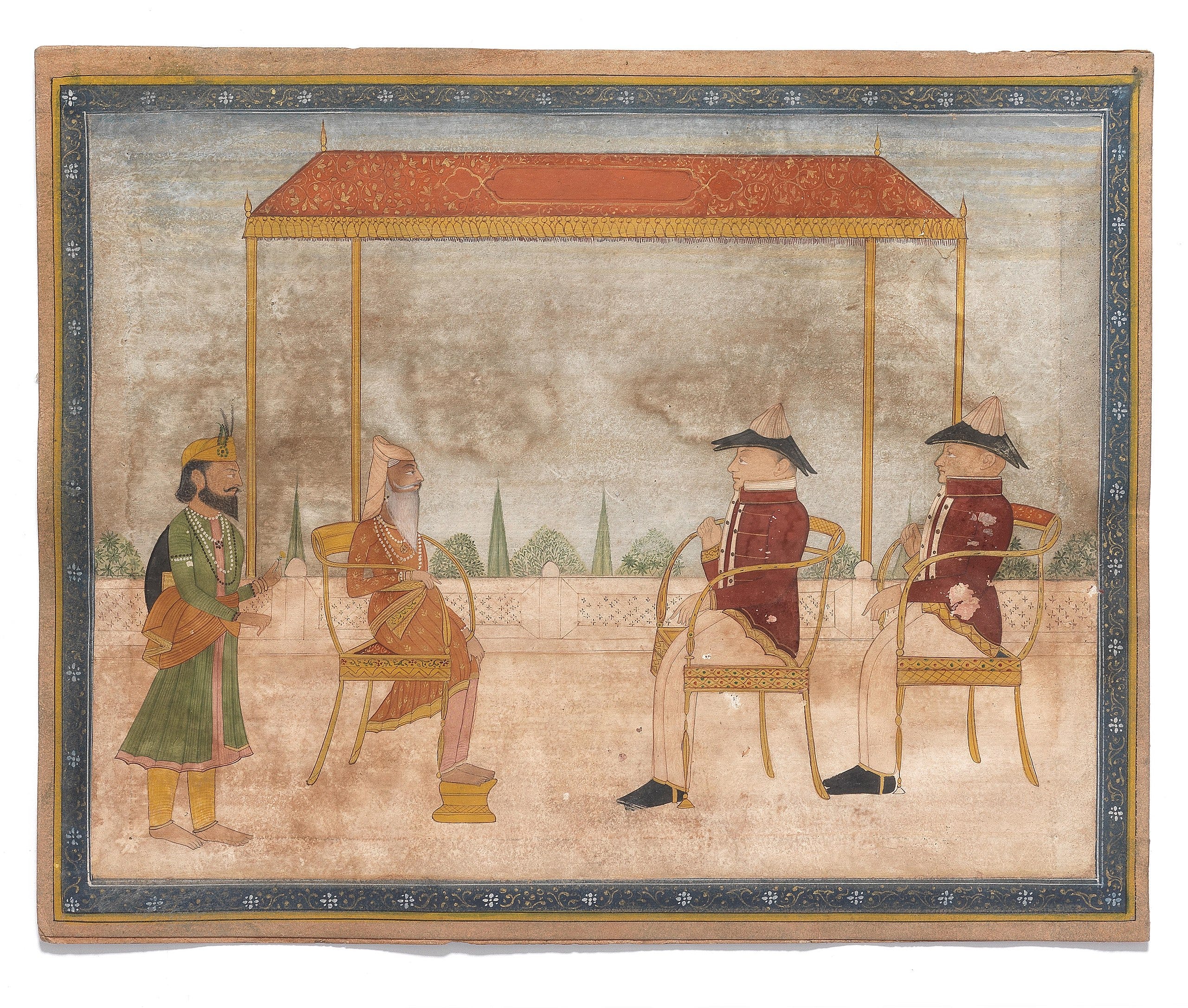
Maharaja Ranjit Singh with two British officers, artist unknown, 19th century, gouache and gold on paper.

India’s Hindutva Prime Minister, Narendra Modi, has used the Kashmir terrorism incident to abrogate the 1960s Indus Waters Treaty—a longstanding goal of Modi. The Indian version of the “terrorist attack,” most of whose victims were Muslim, has largely been accepted by Western governments without evidence.

False flags abound nowadays. You may recall that we were told that the most deadly rocket ever fired by Hamas killed only Palestinians in a hospital compound, while the most deadly rocket ever fired by Hezbollah killed only Druze children. I have at present an open mind about what occurred in Kashmir.

It is however certain that tearing up the Indus Waters Treaty is a long term Modi goal. The Indus supplies 80% of Pakistan’s agricultural water, and the supply is already insufficient, with disastrous salination of the lower reaches of the river as the sea creeps into the areas once occupied by the mighty flow. I visited the area of lower Sind five years ago and witnessed the fields encrused with white salt.

India controls the upstream flow into Pakistan of approximately 70% of the total water of the Indus, about 55% of all of Pakistan’s agricultural water.

In September 2016 in response to earlier violence in Kashmir, Modi initiated his slogan “Blood and water cannot flow together” and threatened to cut the Indus supply. He increased India’s out-take from the Ravi, Beas and Sutlej tributaries and restarted the Tulbul canal project. In both 2019 and 2022 while campaigning in Haryana, Modi made strong speeches threatening to cut off the water “wasted on Pakistan.”

In 2023 Modi issued formal notice to Pakistan of India’s desire to renegotiate the Indus Waters Treaty and repeated this in 2024 when Pakistan did not respond. On both occasions India cited “counter-terrorism” as one of three reasons for review (the others being environmental protection and hydro-electric generation). As counter-terrorism can scarcely be linked to agricultural water allocation, this illustrates Modi’s grandstanding approach.

Modi does not have the physical power to stop the Indus, but does have the ability short term to divert more of the river to Indian irrigation and storage, sufficient to cause some immediate distress in Pakistan. Indian media are already thrilled with the idea. But long term major reblancing of the river water allocation would require substantive new infrastructure in India. Such projects however would be both economically viable and likely wildly popular with Modi’s Hindutva base both for promoting Indian development and for damaging Pakistan.

In 2019, Modi revoked Article 270 of the Indian constitution which gave special autonomous status to Jammu and Kashmir, incorporating them into India proper. He did this despite the Constitution stating it could only be done with the support of the “Constituent Assembly of the State.” That body no longer existed, having been replaced by a “legislative Assembly.” Modi used another Constitutional provision to replace “Constituent Assembly” with “Legislative Assembly,” which seems fair enough. But having suspended the Legislative Assembly, he then claimed that its powers were now vested in the Governor, a Modi appointee.

Modi then agreed with himself to remove the autonomy of Indian Kashmir—a move that had no significant support among its 97% Muslim inhabitants and was accompanied by a ferocious crackdown, indeed lockdown, and the destruction of its once thriving tourism industry. He simultaneously repealed another provision preventing non Kashmiris from buying property in the region. Modi himself is therefore very much the cause of heightened ethnic, political and religious tension in Kashmir.

It is generally recognised that the situation of Kashmir, partly in India and partly in Pakistan with a small portion in China, and the Indian part occupied by deeply dissatisfied Muslims, is a result of the disastrous British partition of India of 1947. But in fact British responsibility for the disaster of modern Kashmir goes back a hundred years further than that, to 1846.

Kashmir was part of the Dourrani Afghan Empire from 1758 until 1819, when it was captured by the Sikh Empire of Maharajah Ranjit Singh. Singh was always careful to place Muslim Governors over Muslim lands, including from the Dourrani family itself. He allied with the British during the First Afghan War, and sent troops, including Kashmiri levies, to aid the British invasion in 1839. However after Ranjit Singh’s death and civil war over the succession, the British attacked the Sikh Empire to “restore stability.” Following the battle of Sobraon, the British annexed the land between the Beas and Ravi rivers, while by the Treaty of Amritsar of 1846 the British sold Jammu and Kashmir to the former Sikh wazir, Gulab Singh, for 50 lakhs of rupees.

Gulab Singh was a particularly murderous character who had played an extraordinarily Machiavellian role in the Sikh court of Ranjit Singh and his immediate successors, and had of course looted from the Sikh treaury the money he paid to the British. So he paid the British with stolen money for land the British had just stolen.

This is how the extraordinary situation arose that the Muslim territories of Kahmir and Jammu had a Hindu ruler (Gulab Singh was a Hindu Dogra). That anomaly was the direct cause of the disastrous division of the territory by the British in the Partition 100 years later.

It is extremely frequent that today’s conflicts are caused by the actions of the British Empire reverberating down and continuing their evil over generations. It is equally frequent that it is very hard to find analyses that explain the truth behind the conflicts.

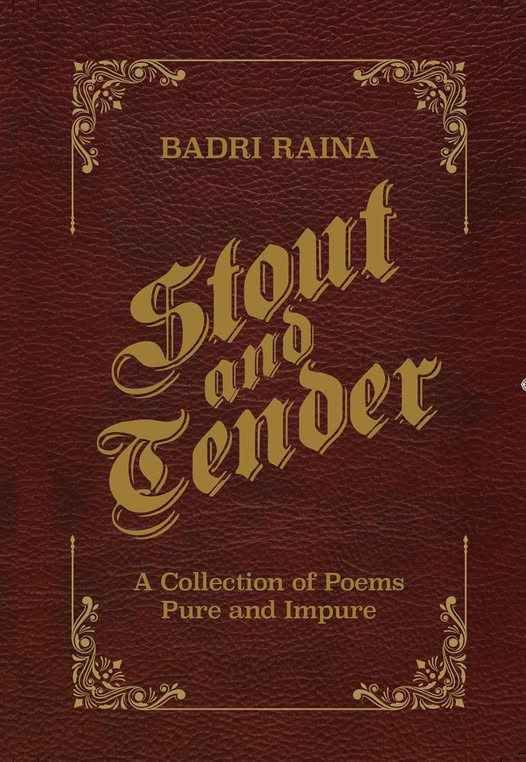
𝐑𝐞𝐯𝐢𝐞𝐰 𝐨𝐟 𝑆𝑡𝑜𝑢𝑡 𝑎𝑛𝑑 𝑇𝑒𝑛𝑑𝑒𝑟

February 21, 2025

by Nasir Khan

Indian academic Badri Raina’s book 𝑆𝑡𝑜𝑢𝑡 𝑎𝑛𝑑 𝑇𝑒𝑛𝑑𝑒𝑟 shows the poetic side of an imaginative and versatile poet, whose political articles and analyses mostly deal with Indian social and political developments which he witnessed since the horrid Partition of India in 1947, including the Princely State of Jammu and Kashmir where he had his ancestral home. As a young boy, those events and the subsequent history of Kashmir seem to have deeply impacted him and shaped his outlook.

Those who have read his political articles know he has stood stoically for the marginalised, socially and politically suppressed ethnic communities and religious minorities in a country where the far-right revanchist forces gradually got the upper hand. Raina’s work has been to defend the democratic norms of the Republic, and espouse the cause of the neglected and marginalised people. It is within this political and cultural context of the Indian subcontinent, that we can appraise his sympathies and concerns for many of his poems.

Most of his poems reflect a deep commitment to social and political causes, which he shares with many other social revolutionaries, reformers and humanists. His imagination is fertile and vivid and his vision unbound, always in tune with the realities that we all face. In his choice of words for the varying themes he writes about, he is direct and also appealing and persuasive.

In his poem, 𝑃𝑎𝑙𝑒𝑠𝑡𝑖𝑛𝑒, he touches our deep feelings as we witness what its people have faced for over a century, but are still resisting the oppressors. His two lines summarise volumes of what words can narrate:

No Atlas lifted a heavier load

than you, O Palestine!

Only a sensitive soul who knows the history and the alignment of dominant forces that control the present world order (or disorder) could have spoken in such a way. However, despite all the savagery and apathy of the ruling elites that people face globally, Raina remains true to his socialist outlook, by taking an optimistic view of the people’s struggles for freedom, equality, justice and humane values and their historical relevance.

This collection of poems in this beautifully produced paperback edition makes a substantial literary contribution for English-speaking readers to delve into. For all this, both Raina and the producer of the volume deserve our heartfelt thanks and admiration.

A brief personal note: Badri Raina and I were born in the same year and month in the Princely State of Jammu and Kashmir! He is from Srinagar, while I am from Poonch, which is now in the Pakistani-held part of Kashmir. For over two decades, we have been close comrades and brothers.

Badri Raina’s 𝑆𝑡𝑜𝑢𝑡 𝑎𝑛𝑑 𝑇𝑒𝑛𝑑𝑒𝑟: A Collection of Poems, is available on: Amazon USA and Amazon UK

Religious fanatics in India and Pakistan

January 18, 2017
Nasir Khan, January 18, 2017

(I wrote the following piece in reply to a comment by a Facebook friend.)

Both Hindu and Islamic architecture have influenced each other in many ways. By its appearance, Jejuri Temple seems to be a clear example of this interaction in architecture.

Regarding your views on the division of Hindus and Muslims, my reply is: If these people, Hindus and Muslims, regard one another as human beings first where people’s religious beliefs are left as their personal matters and nothing more, then a common human and humane bond will emerge that will allow cultural diversity but wherein all people will stand for common humanity and common political, social and economic rights and obligations.

But in India and Pakistan things are working in the reverse order. In these countries, the first consideration is towards religious identity while what is obviously common, our common humanity and our oneness as human beings, is pushed out of sight! The result is fanatics and fundamentalists in Hindus and Muslims have made living for ordinary people difficult.

The Hindutva fanatics in India have poisoned the minds of vast numbers of Hindus and have made them anti-Muslim and anti-Pakistan by their continuous propaganda. Many feel that is the only way to make India a purely Hindu state by preaching the mantra of Akhand Bharat. There is so much hatred against Muslims and Islam in Indian right-wing Hindus, which I find hard to believe.

In Pakistan, the right-wing religious and political parties have equally viciously poisoned the minds of millions of people for establishing a theocratic state instead of a modern democratic state.

Consequently, their continuous indoctrination and misleading information against the non-Muslims has relegated religious minorities in Pakistan to a secondary status. The victimisation of some innocent people for having violated the so-called blasphemy laws of Pakistan under concocted charges is a living proof of the cancerous fanaticism and primitive mindset that once flourished in the early middle ages.

Some Comments on Resolving the Kashmir Conflict

January 19, 2011

by Nasir Khan, January 19, 2011

Editor’s Note: Gorki wrote a comprehensive comment on my article ‘Resolving the Kashmir Conflict (Foreign Policy Journal, January 13, 2011 ) in which he offered his perspective and also raised some important questions. In reply, I have written the following remarks. For the sake of convenience, I have split his comment into a few parts followed by my reply:

Gorki:

Dr. Khan I find your article useful because it allows one to hear the views of the Kashmiris themselves regarding the Kashmir imbroglio.

On the face of it your statement “The best course left for India is to make a break with its previous policy, and accede to the right to self-determination of the Kashmiris. This will not weaken India; instead, it will show the strength of Indian democracy as well of the humane aspects of Indian cultural tradition…” sounds reasonable and taken in isolation such views even find many sympathetic listeners in India itself. However the Indians must keep other consideration in mind that cannot be considered imperialistic by any stretch of imagination.

Nasir:

Gorki , thank you for your balanced opinion on a number of points and the important questions you have raised in your comment. I will try to reply to some points.

My roots are in the Indian culture and I am deeply proud of our historical heritage. I am well aware of the Indian Civilisations stretching back to the time of the Indus Valley Civilisation, some five thousand years old. Merely because of the hostile Indo-Pak relations since the partition of India in 1947, the Kashmir Issue has been the main cause of tension between the two states, I have regarded both India and Pakistan as parts of the same body, the body being the subcontinent of India that holds diverse races, cultures and mores showing much diversity while geographically belonging to the same entity. We can compare the subcontinent’s position with the broad geographical areas identified with Europe. In Europe there have been many languages, diverse cultures, political and religious conflicts for well over two thousand years. Despite all that various nations and people of this continent identity themselves with Europe and its civilisations, old and new. In a similar way, as an individual I identity myself with the subcontinent. My regional identity with Kashmir and the historical connection I have with with Kashmir is only natural; it is the affinity of part with the whole. As such they are mutually interdependent, not exclusive of each other.

Gorki:

The reality is that the entire former British India is organically connected and anything that happens in one part has an echo elsewhere in the sub continent. For example when a sacred relic went missing for 17 days from the Hazrat Bal mosque in 1963; there was rioting all over India. Thus any action in or regarding Kashmir cannot be taken in isolation.

While self determination and independence by themselves are honourable goals, anyone arguing for self determination only for the Kashmiris of the valley would either have to argue on the basis of some kind of Kashmiri exceptionalism or else should be willing to accept similar demands for self determination from others such as the Sikhs in the Indian Punjab and the Baluch in Pakistan. Conceding any such demands then would risks major man made disasters like the ethnic cleansing and huge population displacements that occurred in the wake of the partition in 1947.

Nasir:

Here your formulation about the organic connection has the Spencerian undertones! We have histories of India and Indian states before the British came. When the British gradually took over different parts of India by force of arms or by their political skills (and tricks), our people and many of our rulers evinced little concern to what happened to small or big states who were being devoured by the East India Company. Some of them had treacherously sided with the Farangis against those Indian rulers who resisted the British. This is also our history.

The instance of the disappearance of a holy relic in Kashmir you cite has more to do with religious feelings and identities than with the organic connection throughout the subcontinent. Such relics can also be seen as having extra-territorial dimension and impact.

In fact, we have seen major political conflicts and killing of innocent people by the Indian state (and also by Pakistani army in the Northwest Pakistan at the bidding of the United Sates as a continuing policy of crushing and eliminating those who resist and oppose the American wars of aggression in Afghanistan and Pakistan). The vast majority of these countries has not shown much resolve to oppose the policies of their governments. But, a religious relic or what believers may call a ‘religious place’ is something different! That moves our masses, and they do what they think is serving their deities!! We know how the religious passions of ordinary people inflamed by rightist forces in India in which the Indian rulers were implicated, led to the destruction of the Babri mosque by the Hindu mobs and the killing of thousands of innocent Indian Muslims in Gujarat.

But what sort of policies a state formulates and implements has a direct bearing on the political developments of a country. The same is true in the case of India; a wise political lead by responsible politicians influences and shapes the political landscape.

Now the question of ‘Kashmiri exceptionalism’ if India and Pakistan hold plebiscite to meet the demands of the people of Jammu and Kashmir: I myself, do not regard the case of Jammu and Kashmir an exceptional one; but no doubt there is a historical context to it. The circumstances under which India extended its control over Jammu and Kashmir is much different from other princely states. At the end of the British rule in India and the partition of India by the imperial rulers, there were 562 princely states, big and small, over which the British held suzerainty or ‘paramountcy’ as in the case of the State of Jammu and Kashmir. We know how these princely states were incorporated into the two new states. How India extended its control over Jammu and Kashmir (J&K) is relevant to the whole question of the Kashmir Issue. After the military conflict and the ceasefire mediated by the United Nations, both India and Pakistan agreed to hold plebiscite that would enable the people of J&K to determine their future. That promise still remains unfilled and the consequences of that denial have been catastrophic for India, Pakistan and especially the people of J&K.

The Kashmir Conflict continues to be the unfinished task of the 1947 partition. This conflict has not disappeared; neither will it go away because the bullet has so far overridden the ballot and common sense.

Gorki:

Letting Kashmir valley join Pakistan OTOH would in essence be conceding the two nation theory; again not without risks. As you rightly pointed out, India remains a home to some 130 million Muslims. Letting the Muslims of the valley to go join Pakistan would in no way enhance the security of the non-Kashmiri Muslims elsewhere in India and if anything would make them even more insecure and strengthen the very forces of Hindutva that you pointed out threaten India’s fragile communal amity. (Ironically this is exactly what happened to the Indian Muslims of UP and Bihar who had allowed themselves to be emotionally led into voting for the AIML’s election plank of a Pakistan in 1946 which then left them high and dry).

Even within the state of Jammu and Kashmir itself, there would be major upheavals in case the current structure is tampered with. What would happen to the minority Muslims in Jammu and Ladakh?
Also if one argues that Kashmir is a homeland for the Kashmiris then what happens to other non Kashmiri populations of the valley such as the Gujjars etc.? Where would their homeland be?

Nasir:

Here you raise some important questions and also some legitimate concerns. First, the ‘two nation theory’. In fact, the partition of India was on the basis of  the two nation theory. For the sake of argument, I will say that if the people of J&K join A or B country, or decide for some other option they should have the democratic right to do so. The organic linkage you seem to emphasise in case the Valley joins Pakistan is worthy of consideration, but what Kashmiri Muslims want is their right to determine their future and to gain freedom. What that freedom entails is the freedom from Indian rule. This is their wish and to crush their aspirations the Indian state has used more than half-a-million soldiers. They have killed more than one-hundred-thousand people. It is military occupation of a country where India has committed horrific war crimes.

Who contributed to such a perspective that shaped the political history of India and led to the division of India by the British? Well, an easy way for amateurs is to have a bogeyman to explain away the historical facts and blame the Muslim leadership for all that! Even before Mr Gandhi came to India from South Africa, one of the most prominent Indian politician at that time was Mr Jinnah, who was commonly known as the ‘ambassador of Hindu-Muslim unity’. He had the vision of a democratic, united India at the end of the British raj. But alas that was not to happen because this liberal, secularist lawyer was able to see the machinations of the Hindu leadership of the Indian National Congress and other Hindu militant organisations standing for the Ram raj and the Hindu domination of the whole sub-continent.

In my political work, at no time have I ever said what the people of J&K should stand for or how they should decide about their future. Neither have I ever advocated that the people of the Kashmir Valley should join Pakistan. That is something for the affected people to decide.

The Kashmiris’ demand and their struggle for Azaadi (freedom) is not directed against any other people, ethnic or religious minorities, who make up the population of their country. The people of J&K, Muslims, Hindus, Buddhists, etc., have traditions of tolerance and inter-religious accommodation. In 1947, I was a six-year-old; I had seen how Hindus and Muslims had a shared and fraternal existence in our area. If the people of J&K are given a chance to live as free human beings and not under the terror of military power of India, then our age-old traditions of mutual respect and acceptance will reassert. That will be a good example for the Hindutva rightist forces that pose a great threat to the Indian democracy and religious minorities, Muslims being their major target.

I am also conscious of the dangers you rightly point to if the ‘current structure’ is changed. But I don’t suppose you offer your solution as the continued rejection of the demands of the Kashmiris because that safeguards some ‘ideal’ unity of India, knowing that India has carried out a militarist solution to crush the demands of the Kashmiri freedom movement. Simply put, it has been state terrorism by an occupying power. This short-sighted policy will fail in the long run as it has failed in the past.

Gorki:

You rightly mention that Kashmir is currently a big source of contention between India and Pakistan. However how certain can anybody be that this will not be the case if this issue is sorted out? Former Pakistani president, General Musharraf once said that India will remain Pakistan’s considered foe even if Kashmir issue is resolved. There are people with strong following in Pakistan who argue for waging a war on ‘Hindu India’ to conquer the Red Fort and restore the Mughal Empire. What of those?

Nasir:

If the main source of conflict between India and Pakistan is resolved according to the wishes of the people of J&K, then we expect the two neighbours will live amicably side by side and their bilateral relations and socio-cultural contacts will increase which will benefit all the people of the region. What Musharraf said is his view and it should not be taken too seriously. Apparently, the climate of hostility and mutual recriminations between India and Pakistan since the partition, people on the both sides have been fed on cheap propaganda. The nonsensical slogans to restore the Mughal Empire is the daydreaming of some Rip Van Winkles who are living in past, not in the twenty-first century.

Gorki:

I agree with you however that the current stifling atmosphere in Kashmir has to come to an end; human rights violations need to be investigated in a transparent manner and the culprits have to be vigorously prosecuted. Kashmiris need to feel that they control their political and economic destiny in their own hands. For this to happen however both the Indian state and the Kashmiri separatists have to demonstrate courage and pragmatic far sightedness.

The state has to take the above listed steps in the short run. In the long run it has not only to deliver on the economic measures promised previously but also to scrupulously avoid the mistakes of the past such as blatant rigging of elections as it did on the 80s in Kashmir and elsewhere in India.
For their part the Kashmiri separatists have to realize that the peaceful and constitutional methods of protest are in the best interest of all Kashmiris and the constitution is their best ally. India is not an empire; it is a Republic and a civic nation.
The constitution does not hold the rest of India in any special position over Kashmir; if anything it is the Kashmiris who hold a special place within the constitution.
Today if the separatists were to come to power via electoral politics, there is absolutely nothing that such a government could not do within the existing framework to better the life (or freedom) of an ordinary Kashmiri that it could do if they had complete ‘Azaadi”.

Nasir:

Some suggestions you make and the prognosis you offer are reasonable. If Kashmiris hold a special place in the Indian Constitution, then obviously Indian control over Kashmir was unlike any other princely state. That also shows that the Indian government had political considerations to accord special status to Kashmir within the Union. But what stops the Delhi government from acceding to the demands of the people of J&K to plebiscite? Why should a great power like India be so afraid to listen to the voice of the people instead of using state terror to crush them?

It is also possible that the vast majority may opt for India. Thus by a generous and courageous political move, India has the power to defuse the conflict for ever. If that happens, then those who stand for separation from India will lose and the consequences will pacify all sides. This can usher in a new era of improved inter-communal and regional relations. Religious fundamentalists and rightist forces on the both sides will not be able to exploit the religious sentiments of the people any longer. That will be a victory of the common sense over emotionalism and communal frenzy.

Gorki:

There is already a precedent of such a dramatic change in political struggle within India. In the 1980s many Sikh leaders were charged with sedition and jailed for demanding a Khalistan and burning copies of the Indian constitution as protest. Today, one of those former separatist is an all powerful Chief Minister in Punjab and there is no opposition because the remaining separatists cannot list a single point in which way the life of an average Sikh would be different in an independent Khalistan.

I do hope to hear form you.
Regards.

Nasir:

In India there are still many regional and ethnic conflicts. I don’t think the Khalistan movement ever had any justifiable political stance and I am happy it reached its cul de sac. But we should be aware of the pitfall of equating Khalistan with the Kashmir Conflict.

Finally, it has been a pleasure to respond to your wise and erudite comment.

Cordially yours

Nasir Khan

Resolving the Kashmir Conflict

January 14, 2011

by Dr. Nasir Khan, Foreign Policy Journal, January 13, 2011

Almost the whole world had condemned the Mumbai attacks of November 2008. Such terrorism had also, once again, reminded us how important it is to combat the forces of communalist terror and political violence in the Indian subcontinent. But what is often ignored or suppressed is the fact that there are deep underlying causes of the malaise that erupts in the shape of such violent actions; the unresolved Kashmir issue happens to be the one prime cause that inflames the passions and anger of millions of people.

Kashmir Conflict

However, to repeat the mantra of “war on terror” as the Bush Administration had done for the last eight years while planning and starting major wars of aggression does not bring us one inch closer to solving the problem of violence and terror in our region. On the contrary, such short-sighted propaganda gimmicks were and are meant to camouflage the wars of aggression and lay the ground for further violence and bloodshed. The basic motive is to advance imperial interests and domination. The so-called “war on terror” is no war against terror; on the contrary, it has been the continuation of the American imperial policy for its definite goals in the Middle East and beyond. Obviously any serious effort to combat terror will necessarily take into account the causes of terror, and not merely be content with the visible symptoms.

Continues >>

Nasir Khan: Will Obama help Kashmiri struggle against Indian rule?

October 30, 2010

Response to Shahid Siddiqi’s analysis of India’s occupation of Kashmir

By Nasir Khan,  Axis of Logic, Oct 30, 2010

Response by Axis of Logic reader, Nasir Khan on Obama’s November Vist to India: Help Kashmiris gain their right to self-determination.

Mr Siddiqi, I am sure you know what Obama stands for. Please let me add a bit on this score. The whole world knows him as a staunch defender of the policies of Israel who is flanked by and pushed around by Zionists. He has also earned himself the distinction of being a true successor to George W. Bush since stepping in the White House because he has not only followed the war policies of Bush but also extended the war of aggression in Afghanistan and Pakistan. He is responsible for the almost daily killings of the Pakistanis by drone missile attacks. Let us keep in view the fact that his hands are sullied with the blood of hundreds of innocent Pakistanis and there is no end in sight to such savagery. Obama does not stand for: kill first and explain later. He has a freehand in killing by his advanced technological devices and as far as he is concerned that is the end of the matter. Why? Because he represents the power of American imperialism, military-industrial complex and the corporate interests. That also means there is no inhibition or restraint on what he does. The determining factor in all this is the global military power and influence of the United States.

Will Obama do anything to stop India from its inhuman atrocities and oppression in Kashmir and seek a solution to the Kashmir Issue? I think, we should come out of such make-believe world of illusions. He wouldn’t do anything of the sort. There are many reasons for that. At present American imperialism, India’s Hindutva leadership and the Zionist rulers of Israel are close strategic and military partners. The last thing on their agenda can be solving the Kashmir Issue. They have other considerations for the region and the Middle East!

As far as the present Pakistani rulers are concerned, they are pawns in the hands of the Washington rulers. They dance to the tunes of or the crack of the whip of the Pentagon and the State Department obediently. They have allowed the United States military to use Pakistani airport Shamsi and other military facilities to launch drone attacks on Pakistanis. In return for American money and to appease the Washington rulers, Pakistani army in Waziristan has been acting  as a mercenary force killing and destroying its own people. So American drones and Pakistan army supplement each other. They are making the world safe for democracy and advancing ‘American’ values!

Source: Axis of Logic

The Following  photos are reproduced from Shahid R. Siddiqi’s article ‘Obama’s November Vist to India: Help Kashmiris gain their right to self-determination.

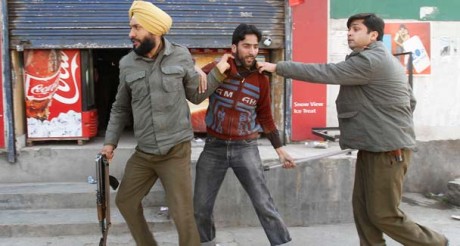
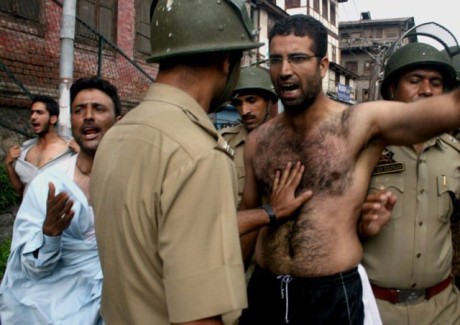
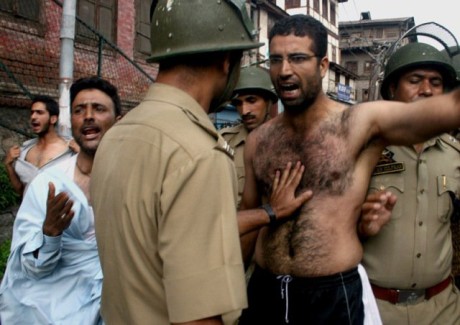
INDIAN BRUTALITY IN KASHMIR

Indian troops kill 72 Kashmiris in August: Report

September 1, 2010
Indian troops killed 72 Kashmiris including 31 teenagers and four women during August, a Kashmiri news agency reported.

World Bulletin / News Desk, Sep 1, 2010

Indian troops killed 72 Kashmiris including 31 teenagers and four women during  August, a Kashmiri news agency reported.

The Himalayan region is at the heart of a decades-long dispute between India and Pakistan, who have fought two of their three wars over the issue since they won freedom from British rule in 1947.

According to the data compiled by the Research Section of Kashmir Media Service, of those people three were killed in custody.

Kashmiris see India as an “occupier” and accuse the ruling of systematic violations, killing dozens of civilians in Himalayan region.

Tens of thousands of Muslims have been killed since pro-independent moves grew against Indian rule in 1989.

The Indian troops also damaged a residential house during the month, according to the report.

On Tuesday, Indian forces fired and wounded five civilians in Maisuma neighborhood of Srinagar. Five people were injured Monday when police fired on a group of men playing a board game, local residents said and called the shooting unprovoked.

Human rights workers have complained for years that innocent people have disappeared, been killed by government forces in staged gunbattles, and suspected rebels have been arrested and never heard from again. Authorities routinely investigate such allegations, but prosecutions have been rare.

Authorities deny any systematic violations and say all reports are investigated and the guilty punished.