Posts Tagged ‘India’

Nasir Khan: Will Obama help Kashmiri struggle against Indian rule?

October 30, 2010

Response to Shahid Siddiqi’s analysis of India’s occupation of Kashmir

By Nasir Khan,  Axis of Logic, Oct 30, 2010

Response by Axis of Logic reader, Nasir Khan on Obama’s November Vist to India: Help Kashmiris gain their right to self-determination.

Mr Siddiqi, I am sure you know what Obama stands for. Please let me add a bit on this score. The whole world knows him as a staunch defender of the policies of Israel who is flanked by and pushed around by Zionists. He has also earned himself the distinction of being a true successor to George W. Bush since stepping in the White House because he has not only followed the war policies of Bush but also extended the war of aggression in Afghanistan and Pakistan. He is responsible for the almost daily killings of the Pakistanis by drone missile attacks. Let us keep in view the fact that his hands are sullied with the blood of hundreds of innocent Pakistanis and there is no end in sight to such savagery. Obama does not stand for: kill first and explain later. He has a freehand in killing by his advanced technological devices and as far as he is concerned that is the end of the matter. Why? Because he represents the power of American imperialism, military-industrial complex and the corporate interests. That also means there is no inhibition or restraint on what he does. The determining factor in all this is the global military power and influence of the United States.

Will Obama do anything to stop India from its inhuman atrocities and oppression in Kashmir and seek a solution to the Kashmir Issue? I think, we should come out of such make-believe world of illusions. He wouldn’t do anything of the sort. There are many reasons for that. At present American imperialism, India’s Hindutva leadership and the Zionist rulers of Israel are close strategic and military partners. The last thing on their agenda can be solving the Kashmir Issue. They have other considerations for the region and the Middle East!

As far as the present Pakistani rulers are concerned, they are pawns in the hands of the Washington rulers. They dance to the tunes of or the crack of the whip of the Pentagon and the State Department obediently. They have allowed the United States military to use Pakistani airport Shamsi and other military facilities to launch drone attacks on Pakistanis. In return for American money and to appease the Washington rulers, Pakistani army in Waziristan has been acting  as a mercenary force killing and destroying its own people. So American drones and Pakistan army supplement each other. They are making the world safe for democracy and advancing ‘American’ values!

Source: Axis of Logic

The Following  photos are reproduced from Shahid R. Siddiqi’s article ‘Obama’s November Vist to India: Help Kashmiris gain their right to self-determination.

INDIAN BRUTALITY IN KASHMIR

Indian troops kill 72 Kashmiris in August: Report

September 1, 2010
Indian troops killed 72 Kashmiris including 31 teenagers and four women during August, a Kashmiri news agency reported.

World Bulletin / News Desk, Sep 1, 2010

Indian troops killed 72 Kashmiris including 31 teenagers and four women during  August, a Kashmiri news agency reported.

The Himalayan region is at the heart of a decades-long dispute between India and Pakistan, who have fought two of their three wars over the issue since they won freedom from British rule in 1947.

According to the data compiled by the Research Section of Kashmir Media Service, of those people three were killed in custody.

Kashmiris see India as an “occupier” and accuse the ruling of systematic violations, killing dozens of civilians in Himalayan region.

Tens of thousands of Muslims have been killed since pro-independent moves grew against Indian rule in 1989.

The Indian troops also damaged a residential house during the month, according to the report.

On Tuesday, Indian forces fired and wounded five civilians in Maisuma neighborhood of Srinagar. Five people were injured Monday when police fired on a group of men playing a board game, local residents said and called the shooting unprovoked.

Human rights workers have complained for years that innocent people have disappeared, been killed by government forces in staged gunbattles, and suspected rebels have been arrested and never heard from again. Authorities routinely investigate such allegations, but prosecutions have been rare.

Authorities deny any systematic violations and say all reports are investigated and the guilty punished.

The Resentment Against Indian Rule Persists in Kashmir

August 10, 2010
By Raoof Mir, Foreign Policy Journal, Aug 10, 2010

People of Kashmir carry the body of a man shot by Indian police in Srinagar on August 3, 2010 (Press TV)

Recently I was asked by one friend of mine who works as a reporter in a ‘reputed’ regional Telugu daily, the reasons for ‘gun culture’ and ‘stone pelting culture’ in the Indian administered Kashmir valley: “Why is it that people of Kashmir don’t peacefully complain about their problems to the government?”

I replied to him that it is the cynicism and the distrust of the people with the system. My friend didn’t ask me what that actually meant. I wanted to explain to him about the life of common people in Kashmir, the diabolical role of Indian army, and their impunity for human rights violations.I wanted to explain to him how a knock on the door late at night or sneaking away to smoke a cigarette at night sends spasms of anxiety through the people, afraid that this might be their last breath.

Continues >>

Kashmir death toll rises as India faces fresh protests

August 8, 2010
Women attend the funeral of Mohammad Iqbal, a Kashmiri youth, in Srinagar this week. Kashmiri separatist leaders have appealed for calm in the biggest anti-India protests in two years, which have killed dozens of people. Photograph: Fayaz Kabli/Reuters

RAHUL BEDI in New Delhi, The Irish Times, August 7, 2010

THE DEATH toll from the recent round of recurring clashes between demonstrators and the security forces in Indian-administered Kashmir province is now close to 50.

Most of the dead were shot by the security forces for defying a curfew.

Since the middle of June, the Kashmir valley has been rocked by violent agitation. Protesters, angry over decades of repressive Indian rule over their disputed Muslim-majority Himalayan province, have hurled rocks and set government buildings and vehicles alight.

The demonstrators, mostly young men, have been joined by thousands of women, some carrying sticks and stones and chanting: “We want freedom” and “Blood for blood”.

Continues >>

The only package Kashmir needs is justice

August 5, 2010

Siddharth Varadarajan, The Hindu/India, August 5, 2010

T+ ·   T-
SEEKING JUSTICE: Protesters set ablaze police vechile after two young men were killed in firing in Pampore on August 1, 2010. Photo: Nissar Ahmad
If the Prime Minister [Dr Manmohan Singh] does not take bold steps to address the grievances of the Kashmiris, there’s no telling where the next eruption will take us.

Whatever his other failings, Chief Minister Omar Abdullah deserves praise for acknowledging that the protests which have rocked the Kashmir valley these past few weeks are ‘leaderless’ and not the product of manipulation by some hidden individual or group.

This admission has been difficult for the authorities to make because its implications are unpleasant, perhaps even frightening. In security terms, the absence of a central nervous system means the expanding body of protest cannot be controlled by arresting individual leaders. And in political terms, the spectre of leaderless revolt makes the offer of ‘dialogue’ or the naming of a ‘special envoy’ for Kashmir — proposals which might have made sense last year or even last month — seem completely and utterly pointless today.

Continues >>

INDIA: DIAL M FOR MASSACRE

July 1, 2010

Clinching documentary evidence corroborates serious charges against Narendra Modi and key officials in his administration

BY TEESTA SETALVAD, Combat Communalism, June 2010

Three months ago, our covert story, SIT-ting on the Truth (March 2010) exposed the frivolous and shallow investigations of the Gujarat massacres undertaken by the high-profile Special Investigation Team (SIT) appointed by the Supreme Court and headed by former CBI director RK Raghavan. One of the major issues raised was the deliberate refusal of SIT – influenced as it was by the three officers of the Gujarat police cadre, Shivanand Jha, Geeta Johri and Ashish Bhatia – to examine available documentary evidence to pin responsibility for complicity and gross dereliction of duty by top police officers, civil servants and politicians.

Continues >>

Gujarat: All’s Not Well With Your Home, Chief Minister Modi

May 29, 2010

Tehelka Magazine, Vol. 7, Issue 22, June 5, 2010

NARENDRA MODI HAD ONCE BRAZENLY UPHELD SOHRABUDDIN’S FAKE KILLING. NOW, AS THE CBI  ARRESTS TOP COPS,THE DIRT BEGINS TO UNRAVEL IN GUJARAT, SAYS RANA AYYUB

image
image
Present continuous TEHELKA has persistently tracked the unraveling of the ‘encounter’ killings by Gujarat Police

IS THE noose tightening around Gujarat Chief Minister Narendra Modi over his administration’s alleged complicity in the 2002 massacre of Muslims? Is nemesis, as the cliché goes, finally catching up with him for a string of allegedly fake encounter killings of “terrorists” by his police? It may be too early to call curtains for arguably India’s craftiest politician that Modi has turned out to be over the last eight years. Yet, the arrest of a top police officer in Gujarat by the Central Bureau of Investigation (CBI) may well begin to unravel the Modi era.

Indeed, so thoroughly alarmed are the Bjp, Modi, and others implicated in the Muslim massacres and the encounter killings, that there is a clear last-ditch attempt at preventing the CBI from establishing the truth. The latest round started on january 12 this year when the supreme Court ordered the CBI to reinvestigate the 2005 encounter killing of Gujarat businessman sohrabuddin shaikh, his wife Kauserbi, and an associate of his, tulsi prajapati. sohrabuddin, a small time extortionist, was killed in a joint encounter by the Gujarat and Rajasthan police in November 2005 when he was travelling with his wife Kauserbi, on charges of being a Lashkar-e-tayyeba member on his way to Gujarat to assassinate Modi. A similar theory was given at the time of the Ishrat jahan encounter a year before and later proved as fake by the justice tamang Committee.

Continues >>

Crunch Time for India: Who Speaks for the People?

May 20, 2010

By Badri Raina, ZNet, May 19, 2010

Badri Raina’s ZSpace Page

I

As violence in four or five Indian states—Chattisgarh, Jharkhand, Orissa, West Bengal—comes to a boil, the State blames the Maoists and the Maoists blame the State.

The hardliners in government and outside who advocate using the army and, yes, air-power, in these regions are dubbed bloodthirsty rightists hand-in-glove with national and international corporate interests by sections of civil society opinion, and opinion-makers who counsel against a military approach to the “Maoist” problem are in turn maligned as clandestine Maoist sympathizers who are deemed to deserve all the rigours of  the  Unlawful Activities Act.

While these contentions occupy centre-stage in the media, the tribal populations in the affected regions continue to suffer from both ends. And if ever that suffering finds mention, it does so as a very subsidiary incidental   On either side of the contention, the fight seems so much more for occupying or reclaiming territory than for the  hearts and minds of the  people who have lived there for aeons.

Continues >>

Praveen Swami: The Rise of Hindutva Terrorism

May 11, 2010

South Asia Intelligence Review, Vol. 8, No. 44, ay 10, 2010

Guest Writer: Praveen Swami
Associate Editor, The Hindu, New Delhi

Eight hundred years ago, the Sufi saint Khwaja Moinuddin Chisti described what he called the highest form of worship: “to redress the misery of those in distress, to fulfil the needs of the helpless and to feed the hungry.”

Back in October, 2007, bombs ripped through the courtyard of what is without dispute South Asia’s most popular Muslim religious centre — the shrine that commemorates Chishti’s life at Ajmer Sharif, in Rajasthan. For months, Police believed the attacks had been carried out by Islamist groups, who oppose the shrine’s syncretic message. On April 30, 2010, however, Rajasthan Police investigators arrested the man they say purchased the mobile phone subscriber-identification modules (SIM) used to trigger the attack. Devendra Gupta, a long standing worker of the Hindu-nationalist Rashtriya Swayamsevak Sangh (RSS), was held along with his political associates Vishnu Prasad and Chandrashekhar Patidar. All three men are now also thought to have participated in the bombing of the Mecca Masjid in Hyderabad, Andhra Pradesh. Rajasthan Home Minister Shanti Kumar Dhariwal said the men were backed by an “organisation which tries to incite violence between Hindus and Muslims”, adding that authorities were “investigating the links of the organisation with the RSS.”

Continues >>

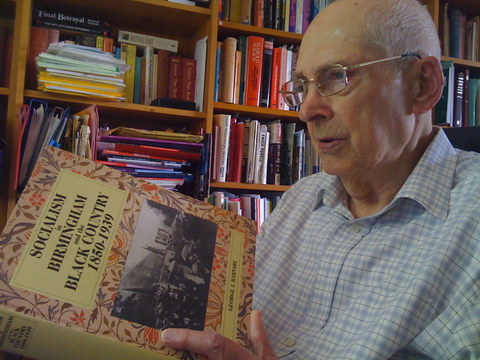
Radical Historian George Barnsby 1919–2010

April 13, 2010

By Nasir Khan

Dr George Barnsby

Dr George Barnsby, who died on April 11 at the age of 91 in Wolverhampton, was a leading radical activist and historian of the working class movement in the Black Country. Born in London in a working class family, his father died when he was only three years old. Now his mother had the sole responsibility to take care of her two infant sons in dire circumstances. The vicissitudes of his early life made George aware that the ‘station in life’ of many people was determined by their social and economic status. He certainly was not born with a silver spoon in his mouth.

He left school at 15 and did some ordinary jobs. He showed little interest in politics at that time. However, around the age of eighteen he became a reader of Daily Worker. It was the period when Nazism had emerged as the dominant voice of militarism and in many countries in Europe and the United States fascist parties emerged. Their model was the German Nazi party and their hero Adolf Hitler. When the Second World War started the young George was called up in 1939. At that time, he was 20 years old. When he went to fight for his ‘king and country’ his worldly possessions were two suits and a bicycle. He recalls in his ‘Subversive – One Third of the Autobiography of a Communist’ that for obvious reasons some people had more interest in ‘our country’ than he did!

He was sent to Burma. He experienced there inhumanity of the war and destruction caused by the Japanese. His contact with India and Indians subject to the imperial Raj gave him a broad political insight and awareness of the role of colonialism and imperialism. The Bengal Famine of 1943-44 occurred under the British rule. It is estimated that around 3 million Indians died from starvation and malnutrition. The Bengal government reacted to the disaster with little efficiency, and refused to stop the flow of rice from Bengal. George was an eye-witness to the apathy of the British rulers towards their subjects. There was no shortage of food in the British quarters either. There are still some hard questions about the role and knowledge of the British Prime Minster Winston Churchill into the affair. For instance, when the Secretary of State for India, Leo Amery, and Lord Wavell requested him an urgent release of food stocks for India, Churchill responded with a telegram to Wavell asking, if food was so scarce, ‘why Gandhi hadn’t died yet.’

The end of the Second World War saw the defeat of fascism and militarism in Germany and Japan. But no such harm came to the Spanish fascism under Franco. The Soviet Union and its Red Army in the Great Patriotic War had borne the brunt of the war on the Eastern Front. With the Allied victory, the army conscripts returned to their homes. In 1946, George was demobbed, receiving a gratuity of about £100. This sum he used to get further education. First, he matriculated from Regent Street Polytechnic before he went to the London School of Economics where he obtained a B.Sc. Honours degree there. From Birmingham University he gained an M.A. degree by writing ‘Social Conditions in the Black Country’ and then from the same university he earned a Ph.D. degree on his thesis ‘Working Class Movement in the Black Country 1750 to 1868′. His studies and committment to revolutionary Socialism that wanted to serve the interests of the working class had taken the central stage in his life. He was to struggle for these objectives for the rest of his life.

When he came to Wolverhampton in 1954, he became the secretary of the local Communist Party. This was the period when the Cold war was in full swing and in the United States anti-Communist crusade of McCarthyism had become the new credo of the Cold War allies in the West. In Britain, Communists were looked upon as traitors; they were spied upon and their telephones tapped. Obviously, George like other Communists was also regarded as subversive and he had to confront what came his way.

The range of his social, academic and political activities in the Black Country extends over vast areas. He wrote a number of histories and pamphlets on Socialism, Birmingham, Wolverhampton, Housing and the Radicals in the Black Country.

One major area of communal activity was around Bilston College of Further Education. Some teachers of the College and governors realised that many working-class people were excluded from formal institutional education who formed unqualified work force with little basic skills. Among the excluded were a disproportionate number of people from ethnic minority communities, mainly Afro-Caribbean and Asian. George was an active educator and a leading voice in the new approach to uplifting the working class people and providing them with education that met their needs. This progressive approach in a multicultural and multi-ethnic society was to counterbalance the legacy of Enoch Powell and his followers.

When American President George W. Bush and his close ally, Prime Minister Tony Blair, started their genocidal war of aggression against Iraq and the subsequent destruction of Iraq and Iraqis, George steadfastly opposed the imperial war. For him, the Anglo-American war in Iraq was a crime against humanity, a genocide, and its central figures the war criminals who need to be brought to justice. He focused on Bush and Blair and their allies, writing extensively on their policies on his website and informed the populace of the realities of the cover-up of their crimes and their incessant lies.

George Barnsby is survived by his wife Esme and two sons, William and Robert.