| Al Jazeera, June 30, 2009 | |||
Israel has approved the construction of 50 new homes in a West Bank settlement and announced plans to expropriate more Palestinian land. The move comes just hours before Israel’s defence minister, Ehud Barak, visits the US in a bid to defuse tensions over Israeli settlements on occupied Palestinian land. The land grab and new permits come despite a demand from Barack Obama, the US president, for a complete freeze to all Israeli settlement activity, and could exacerbate a rare public spat between the allies. |
Archive for the ‘imperialism’ Category
Israel permits new settlement homes
June 30, 2009
Tony Blair and Gordon Brown to blame over Iraq war, says Army report
June 29, 2009By Rupert Hamer | The Mirror/UK, June 28, 2009

A secret report by Army bosses to be presented to the Iraq war inquiry blames Tony Blair and Gordon Brown for the botched occupation of the country.
The dossier – prepared for ex-military chief General Sir Mike Jackson – criticises then Chancellor Mr Brown for withholding funds to rebuild Basra for FIVE months after our troops went in. And the 100-page document attacks Mr Blair for “uncritically” accepting flawed US plans for the March 2003 invasion, which led to tens of thousands of deaths, including those of 179 British troops.
The report – Stability Operations in Iraq – will not be officially made public because the inquiry’s head, Sir John Chilcot, ruled all documents will remain secret.
But the contents have been leaked to the Sunday Mirror.
We can reveal that a lack of cash for the operation meant British troops sent to fight in Iraq:
Used mobile phones to communicate in combat because radios did not work.
Were forced to leave wounded soldiers on the battlefield for an average of two-and-half hours before getting them to a field hospital.
Needed more “spy in the sky” aircraft to track rebel fighters.
Lacked machine guns, night- vision equipment and grenade launchers when protecting supply convoys.
Were in danger of breaching the Geneva Convention by having so few resources. The convention says occupiers must provide vital services such as humanitarian aid and water.
In a broadside at the then PM Mr Blair, the report says the battle for the hearts and minds of ordinary Iraqis was lost because of a lack of planning and the five-month delay in starting to rebuild their country.
It says: “The failures to plan… seriously hindered Coalition chances of stabilising post-Saddam Iraq. The lack of improvements to essential services and the standard of living together with disorder meant many locals who were ‘sitting on the fence’ were not persuaded to support the Coalition.”
It was only after riots in Basra in August 2003 that Mr Brown agreed to release £500million for reconstruction work, the report says.
And it contradicts six years of Government spin which claimed ordinary Iraqis backed the “liberation”, saying troops “found themselves fighting insurgents without clear support (from local people)”.
MOST DAMNING CONCLUSIONS:
Flawed US plans were rubberstamped by Blair
Brown blocked vital funding for five months
It took mass rioting in Basra to make him pay up
Chaos lost us the battle for Iraqi hearts & minds
America’s “Bases of Empire”
June 27, 2009
By Stephen Lendman | Global Research, June 27th, 2009
Besides waging perpetual wars, nothing better reveals America’s imperial agenda than its hundreds of global bases – for offense, not defense at a time the US hasn’t had an enemy since the Japanese surrendered in August 1945.
So when they don’t exist, they’re invented as former US ambassador to Saudi Arabia, Charles W. Freeman, Jr., suggested in a May 24, 2007 speech to the Washington Institute of Foreign Affairs:
“When our descendants look back on the end of the 20th century and the beginning of this one, they will be puzzled. The end of the Cold War relieved Americans of almost all international anxieties.” As the world’s sole remaining superpower, “We did not rise to the occasion.”
“We are engaged in a war, a global war on terror, a long war, we are told….How can a war with no defined ends beyond the avoidance of retreat ever reach a convenient stopping point? How can we win (any war let alone the hearts and minds of millions) with an enemy so ill-understood that we must invent a nonexistent ideology” for justification.
Quartet urges settlement freeze
June 27, 2009| Al Jazeera, June 27, 2009 |
|||
The international Quartet on Middle East peace has called on Israel to halt Jewish settlements in the Palestinian territories and open border crossings as a first step to advance peace. The Quartet, comprised of the European Union, Russia, the United States and the United Nations, made the appeal on Friday in the northeastern Italian city of Trieste. |

Memo confirms Bush and Blair knew claims Iraq had WMDs were lies
June 26, 2009By Paul Bond | wsws.org, 26 June 2009
A confidential memo obtained by the Observer, detailing a meeting between President George W. Bush and Prime Minister Tony Blair, confirms their determination to press ahead with the invasion of Iraq in 2003 without any evidence of weapons of mass destruction (WMD) and without United Nations approval.
The five-page memo, written by Blair’s foreign policy adviser Sir David Manning, is dated January 31, 2003, some two months before the invasion began. It records the thinking of Bush and Blair as it became increasingly obvious that United Nations weapons inspectors would not find the advanced weaponry, including a nuclear capability, that both leaders were using to justify military action.
The Farah Bombing: Airstrike Report Belies “Blame Taliban” Line
June 26, 2009By Gareth Porter | Counterpunch, June 26 – 28, 2009
The version of the official military investigation into the disastrous May 4 airstrike in Farah province made public last week by the Central Command was carefully edited to save the U.S. command in Afghanistan the embarrassment of having to admit that earlier claims blaming the massive civilian deaths on the “Taliban” were fraudulent.
By covering up the most damaging facts surrounding the incident, the rewritten public version of the report succeeded in avoiding media stories on the contradiction between the report and the previous arguments made by the U.S. command.
Nancy Pelosi: A Hawk in Donkey’s Clothing
June 26, 2009Pelosi has been a major force for keeping the Dems in a pro-war stance, even though the Chronicle endlessly promotes her and her SF constituents remain in denial.
by Stephen Zunes | Tikkun Mazagine, June 26, 2009
Congressional approval to continue funding of the ongoing war in Iraq, a major segment of the $90 billion supplemental appropriate package, passed on Tuesday thanks to heavy-handed pressure by House Speaker Nancy Pelosi, D-Calif., against anti-war Democrats.
This has led to great consternation here in her home district in San Francisco, where anti-war sentiment remains stronger than ever. The timing of the measure is particularly upsetting given that California’s record budget deficit has resulting in the layoffs of tens of thousands of teachers, the incipient closure of almost all of our state parks and draconian cuts in health care, housing, public transportation,the environment, social services and other critical programs. While unwilling or unable to get Congress to provide some financial support for the crisis here at home, our most powerful member of Congress was quite willing to work hard to insure continued financial support for war.
What few people outside of San Francisco realize is that despite representing one of the most liberal congressional districts in the country, Pelosi has been a strong supporter of the Iraq war for most of past seven years.
In 2002, public opinion polls showed that the only reason most Americans would support a U.S. invasion of Iraq was if they were convinced that Iraq was somehow a threat to the United States, such as possessing “weapons of mass destruction.” Unfortunately for those supporting a U.S. takeover of that oil-rich country, independent strategic analysts were arguing that the evidence strongly suggested that Iraq had rid itself of its chemical and biological weapons some years earlier.
In an apparent effort to discredit those of us who — correctly, as it turned out — were insisting that Iraq had in all likelihood already disarmed, Pelosi categorically declared on NBC’s Meet the Press in December 2002 that “Saddam Hussein certainly has chemical and biological weapons. There’s no question about that.”
By giving bipartisan credence to the Bush administration’s unprincipled use of such scare tactics to gain support for the U.S. takeover of that oil-rich country, she negated a potential advantage the Democrats would have otherwise had in the 2004 campaign. After it became apparent that administration claims about Iraq’s alleged military threat were false, the Democrats were unable to attack the Republicans for misleading the American public since their congressional leadership had also falsely claimed Iraq had weapons of mass destruction.
During the first twelve weeks of 2003, there were a series of large demonstrations against the war here in Pelosi’s district, including one on Feb. 16 that brought out a half-million people. While Lynn Woolsey and Barbara Lee — congresswomen from a neighboring districts — spoke at the rally, Pelosi was notably absent.
On the day the war began the following month, San Francisco’s downtown business district was shut down by thousands of anti-war protesters in a spontaneous act of massive civil disobedience. In response, Pelosi denounced the protesters and rushed to the defense of President George W. Bush, voting in favor of a resolution declaring the House of Representatives’ “unequivocal support and appreciation to the president … for his firm leadership and decisive action.” She personally pressed a number of skeptical Democratic lawmakers to support the resolution as well.
Pelosi also sought to discredit those who argued that Iraq was not a threat to the United States and that United Nations inspectors — which had returned to Iraq a couple of months earlier and were engaged in unfettered inspections — should have been allowed to complete their mission to confirm that Iraq had disarmed as required. She joined her Republican colleagues going on record claiming that “reliance by the United States on further diplomatic and other peaceful means alone” could not “adequately protect the national security of the United States against the continuing threat posed by Iraq.”
As a counter to those who argued that the war was a diversion of critical personnel, money, intelligence and other resources from the important battle against al-Qaida terrorists, Pelosi tried to link the secular regime of Saddam Hussein with that Islamist terrorist network by declaring that the Iraq invasion was “part of the ongoing global war on terrorism.”
Furthermore, despite a CIA report that al-Qaida terrorist Abu Musab al-Zaqarwi had not received sanctuary or any other support from the former Iraqi regime, Pelosi went on record claiming that, under Saddam “the al-Zarqawi terror network used Baghdad as a base of operations to coordinate the movement of people, money and supplies.”
In the race for the 2004 Democratic presidential nomination, Pelosi helped lead an effort to undermine the anti-war candidacy of former Vermont Gov. Howard Dean, insisting that Americans must “raise our voices against all forms of terrorism” and that “this is not the time to be sending mixed messages.”
Instead, she endorsed the hawkish Rep. Richard Gephardt, D-Mo., who co-sponsored the House resolution authorizing Bush to invade Iraq at the time and circumstances of his choosing. When Gephardt dropped out of the race, Pelosi threw her support to Sen. John Kerry, D-Mass., who was also among the minority of Democrats on Capitol Hill who had voted to authorize Bush’s war.
Pelosi’s assertions that the Iraq war was part of the “war on terror” proved costly to the Democrats in the 2004 election, which the Democrats had been expected to win, as exit polls showed that 80 percent of those who did believe that the war in Iraq was part of the war on terrorism voted to re-elect Bush and a Republican majority in both houses of Congress.
In response to the consensus of disarmament experts that the U.S. invasion of Iraq hurt the cause of nuclear nonproliferation, Pelosi voted in favor of a Republican-sponsored amendment that claimed that the elimination of Libya’s nuclear program in late 2003 “would not have been possible if not for … the liberation of Iraq by United States and coalition forces.” Her support for this Republican-sponsored measure came despite testimony by U.S. negotiators who took part in British-initiated talks with the Muammar Qaddafi regime that the outline of the deal had come prior to the invasion and that the war played no role whatsoever in the agreement.
As the armed resistance to the U.S. occupation of Iraq grew in the wake of the invasion, Pelosi dismissed the growing consensus that it was part of a popular nationalist reaction to foreign occupation and instead went on record insisting that it is simply the work of “former regime elements, foreign and Iraqi terrorists and other criminals.”
As far back as 2004, the voters of San Francisco, in a citywide referendum, voted by a nearly 2-to-1 margin calling on the United States government to withdraw all troops from Iraq. Pelosi, however, insisted on ignoring her constituents and continued to support Bush’s policies.
By 2005, as Bay Area Reps. Lynn Woolsey, Barbara Lee, Pete Stark and Sam Farr joined Democratic colleagues from across the country in signing a letter to Bush calling for the withdrawal of American troops from Iraq, Pelosi was notably absent from the list of signatories.
By this point, even prominent Republicans like James Baker and Gen. Brent Scowcroft were calling for the withdrawal of American forces, yet Pelosi held firm in her support of the war. Back in 1990, Pelosi had been an outspoken liberal critic of the George H.W. Bush administration’s militaristic policy toward Iraq. Fifteen years later, however, she was taking a position to the right of his secretary of state and national security adviser.
Defenders of Pelosi pointed out that, as assistant minority leader in October 2002, she was the only member of the Democratic leadership in either house of Congress to vote against authorizing the invasion. Furthermore, they noted how she subsequently raised some concerns regarding how the Bush administration had handled the occupation, such as not adequately preparing for the aftermath of the invasion, failing to utilize enough troops, not providing adequate training or body armor for U.S. forces and for backing such dubious exile figures as Ahmad Chalabi.
However, Pelosi refused to acknowledge that the United States should have never invaded Iraq in the first place, which had been acknowledged by religious leaders from around the globe. Nor did she ever acknowledge that the invasion was a direct violation of the United Nations Charter, which the United States — as a party to such binding international treaties — is legally required to uphold.
Historically, opposition leaders in Congress have helped expose the lies and counterproductive policies of the incumbent administration. Pelosi, however, to her party’s detriment, decided instead to defend them.
By the end of 2005, as protesters met her at virtually every public event in her district and even conservative colleagues in the House Democratic leadership, such as Rep. John Murtha of Pennsylvania, began calling for a withdrawal of American forces from Iraq, Pelosi finally spoke out in favor of an end to the war.
She continued to support unconditional funding for the war effort, however, for the next two fiscal years. It was only on the vote for last year’s fiscal budget, as anti-war sentiment in her district was reaching a fever pitch and fears of a serious challenge to her seat in the Democratic primary and/or from the Green Party nominee in November, did she finally vote against war funding.
Now, however, as public attention on the Iraq war has faded, she has reverted to her previous pro-war position. Along with her support for Israel’s wars on the Gaza Strip and on Lebanon, her backing of the Iraq war is demonstrative of her willingness to ally herself with the former Bush administration in pushing policies based on the premise that instability and extremism can be best addressed through brute military force regardless of international legal norms or high civilian casualties.
Despite all this, much of the mainstream media and leading political pundits identify Pelosi as a prominent liberal. It is but one example of how far to the right political discourse in American has gone.
© 2009 Tikkun Magazine
Stephen Zunes is Middle East editor for Foreign Policy In Focus. He is a professor of Politics at the University of San Francisco and the author of Tinderbox: U.S. Middle East Policy and the Roots of Terrorism (Common Courage Press, 2003.)
At Least 65 Killed as US Drones Attack South Waziristan Funeral Procession
June 24, 2009Mourners From Early Strike Killed in Second Attack
Jason Ditz, Antiwar.com, June 23, 2009
On Thursday, US drones launched an attack on a compound in South Waziristan, and when locals rushed to the scene to rescue survivors, they launched more missiles at them, leaving a total of 13 dead. The timing and target of the attack were controversial, as was the tactic of luring locals in with a first strike to maximize the kill count. Today, locals were involved in a funeral procession when the US struck again.
 Drones attacked what they suspected was a “militant hideout” early today, killing at least 17. When mourners gathered to offer prayers for those slain in the first attack, the drones struck again, attacking the procession it self and bringing the overall toll to at least 65, according to witnesses.
The recent attacks show a level of aggression and a willingness to target gatherings likely to contain many innocent people unseen in previous US strikes in the area. Generally speaking, most of the dozens of attacks against South Waziristan have been isolated strikes against buildings, and were not followed up with supplementary attacks on the gathering crowds.
The attacks come as the Pakistani government begins to ratchet up its own military offensive in the area. It is possible that the Pakistani military’s history of indiscriminate shelling of civilian targets and eagerness for massive kill counts is eliminating the diplomatic obstacles which have kept the deaths from the Americans’ own attacks comparatively low.
‘Dozens dead’ in US drone strike
June 23, 2009
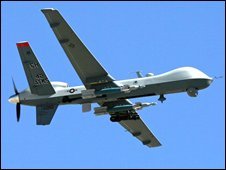
Pakistan officially objects to the strikes by pilotless US aircraft
|
At least 45 people have died in a missile strike by a US drone aircraft in Pakistan, officials there have said.
The people killed in South Waziristan region had been attending a funeral for others killed in a US drone strike earlier on Tuesday.
Intelligence officials said at least 45 people had been killed and dozens more injured in the later strike, when two missiles were fired.
But a local official told BBC News the death toll was more than 50.
The region is a stronghold of Pakistani Taliban leader Baitullah Mehsud.
Also on Tuesday, tribal leader Qari Zainuddin, who often criticised Mehsud, was shot dead by a gunman in north-western Pakistan.
Earlier this month, Zainuddin criticised Mehsud after an attack on a mosque, which killed 33 people.
The Pakistani army is preparing to launch an offensive against Taliban fighters under Mehsud’s command, who are blamed for a number of deadly attacks.
But Zainuddin’s killing is being seen as a setback for the government in its efforts to isolate Mehsud ahead of the security forces’ next phase of their anti-Taliban offensive in the tribal areas bordering Afghanistan, says the BBC’s Mike Wooldridge in Islamabad.

 Peace and Justice Post
The Elephant in the Room: Israel’s Nuclear Weapons
June 30, 2009by David Morrison | The Electronic Intifada, June 30, 2009
“Iran obtaining a nuclear weapon would not only be a threat to Israel and a threat to the United States, but would be profoundly destabilizing in the international community as a whole and could set off a nuclear arms race in the Middle East.”
By his side was Israeli Prime Minister Benjamin Netanyahu. In the room with them, there was an elephant, a large and formidably destructive elephant, which they and the assembled press pretended not to see.
Continued >>
Share this:
Tags:Iran, Israel, nuclear weapons, President Barack Obama
Posted in Commentary, imperialism, Iran, President Barack Obama, Uncategorized, Zionist Israel | Leave a Comment »