Published date: 10 February 2026 15:34 GMT | Last update:1 hour 43 mins ago
Israel used internationally prohibited thermal and thermobaric weapons, leaving thousands of Palestinian bodies “evaporated” as a result, an investigation by Al Jazeera revealed.
Civil defence teams in Gaza documented over 2,800 cases of Palestinians who just vanished since the beginning of Israel’s genocidal war, the Al Jazeera Arabic programme, The Rest of the Story, reported.
What is left of these bodies is only pieces of flesh, specks of blood or even ash.
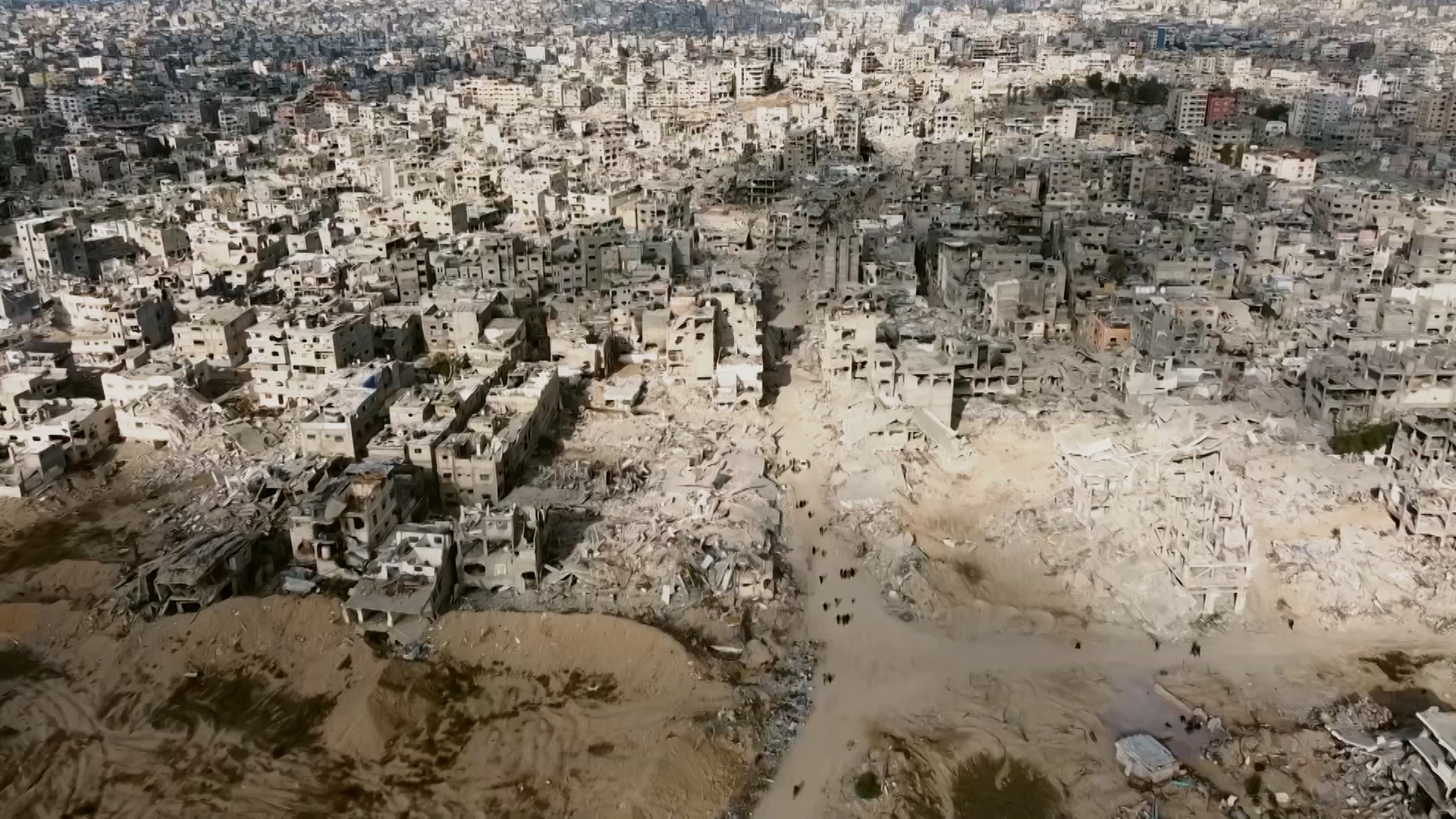
Since the start of the war on Gaza in October 2023, Israel has obliterated most of the Gaza Strip, reducing entire neighbourhoods, including schools, businesses and medical facilities, to rubble.
Israeli soldiers and combat engineers have laid explosives and triggered controlled demolitions inside countless homes, while armoured bulldozers have systematically levelled building after building.
New MEE newsletter: Jerusalem Dispatch
Sign up to get the latest insights and analysis on Israel-Palestine, alongside Turkey Unpacked and other MEE newsletters
More than mere explosives, experts and testimonies have attributed the vaporisation of people to Israel’s use of US-supplied thermal and thermobaric weapons, referred to as vacuum or aerosol bombs, capable of generating temperatures exceeding 3,500 degrees Celsius (6,332 degrees Fahrenheit).
To put into perspective, the boiling point of water is 100 degrees Celsius (212 degrees Fahrenheit).
The intense heat is often generated by tritonal, which is a mixture of TNT and aluminium powder used in American-made bombs.
Civil defence spokesperson Mahmoud Basal told Al Jazeera that teams cross reference the known number of inhabitants in a house with the recovered bodies.
“If a family tells us there were five people inside, and we only recover three intact bodies, we treat the remaining two as ‘evaporated’ only after an exhaustive search yields nothing but biological traces – blood spray on walls or small fragments like scalps,” he explained.
The director general of the Palestinian Ministry of Health in Gaza, Munir al-Bursh, noted that it is “chemically inevitable” when a human body is exposed to high temperatures to “vaporise and turn to ash” as we are made up of 80 percent water.
The investigation identified several US-manufactured munitions used in Gaza, including the MK-84 “Hammer”, BLU-109 bunker buster, and GBU-39 small diameter bomb.
The BLU-109 bunker buster was reportedly used in an attack on al-Mawasi, an area Israel previously declared a “safe zone” for forcibly displaced Palestinians in September 2024, evaporating 22 Palestinians.
Meanwhile the GBU-39 is said to have been used in an attack on al-Tabin school in eastern Gaza City. Basal confirmed finding fragments of the weaponry at sites where bodies had vanished.
In late November, Hamas called on an international committee to investigate Israel’s use of certain weapons, alleging that bodies are being “vaporised” in Gaza.
“The horrific testimonies provided by citizens and doctors in northern Gaza following the air strikes and massacres carried out against innocent civilians, and the confirmation of cases of targeting with weapons and ammunition that lead to the vaporisation of bodies strongly point to the use of internationally banned weapons by the terrorist occupation army,” the Palestinian movement said.
So far, Israel has killed more than 72,037 people and destroyed nearly 90 percent of the territory’s infrastructure.
Analysts say Israeli changes have cornered Palestinian Authority and will pave way for ethnic cleansing
A large Star of David is mounted atop a building near a watchtower in a new Israeli settlement near Beita, close to Nablus, in the occupied West Bank, 9 February 2026 (Reuters/Ammar Awad)
Published date: 9 February 2026 17:29 GMT | Last update:18 hours 4 mins ago
New Israeli measures in the occupied West Bank will cement de facto annexation and bring an end to the Oslo Accords, analysts say, dashing hopes for a Palestinian state.
Announced on Sunday, the sweeping changes expand Israel’s civil control in Areas A and B – where all major Palestinian cities and towns are located – which since the Oslo Accords of 1993 have officially been under Palestinian Authority (PA) jurisdiction.
The measures also make it easier for Jewish Israelis to privately own land in the West Bank, potentially accelerating settlement expansion.
This is achieved by scrapping a law preventing the sale of Palestinian-owned land to Jewish Israelis, easing sales regulations, and lifting the confidentiality of land registration records – a move that could facilitate forgery of land purchase documents, a tactic commonly used by settlers.
“The decision is among the most direct and dangerous steps taken [against Palestinians],” Jamal Juma, a Palestinian coordinator at the Stop the Wall campaign, told Middle East Eye.
New MEE newsletter: Jerusalem Dispatch
Sign up to get the latest insights and analysis on Israel-Palestine, alongside Turkey Unpacked and other MEE newsletters
“In effect, it signals the end of everything introduced by the Oslo Accords and strips the Palestinian Authority of its powers.”
‘The new measures effectively reduce the PA to little more than a security agent for Israel’
– Jamal Juma, coordinator at Stop the Wall campaign
Under the new unilaterally imposed arrangements, building licensing and construction in the southern West Bank city of Hebron will also be transferred from Palestinian authorities to the Israeli military.
The transfer would allow Israeli changes in the Old City of Hebron, including the Ibrahimi Mosque, which violates the 1997 Hebron Protocol agreements between Israel and the PA.
Israeli ministers and settler groups hailed the changes.
Bezalel Smotrich, the far-right minister overseeing civilian affairs in the West Bank, vowed after the changes were announced to “continue to kill the idea of a Palestinian state”.
Regavim, a pro-settler group, said the new measures “mark a clear break from the Oslo framework”.
The PA and nearly all Palestinian factions condemned the measures, calling them illegal steps aimed at deepening annexation and expanding settlements.
Eight Muslim-majority countries – Egypt, Indonesia, Jordan, Pakistan, Qatar, Saudi Arabia, Turkey and the United Arab Emirates – denounced the changes, saying they aim to “impose unlawful Israeli sovereignty” in the West Bank.
De facto annexation
For years, Israel has sought to annex the occupied West Bank, with officials and ministers publicly expressing support for such a move.
In July, Israel’s parliament passed a non-binding resolution calling for the annexation of the territory.
While the proposal carries no legal weight and does not alter the official status of the West Bank, it is widely seen as a symbolic step designed to build momentum towards future unilateral action.
Trump, the West Bank and annexation: Israel in the driver’s seat
However, facing international pressure – especially from its ally, the United States – to avoid official annexation, the current Israeli government has taken several measures that make annexation a de facto reality.
In September, Smotrich unveiled a plan to annex 82 percent of the West Bank and incorporate it into Israel.
He said the plan was prepared by the Settlement Administration within the Ministry of Defence.
The principle behind the plan is to take control of “maximum land with minimum [Palestinian] population,” gradually dismantling the PA, which serves as the internationally recognised governing body in parts of the West Bank.
Juma, a long-time campaigner against settlement expansion, said Israel is advancing annexation on the ground through three parallel and mutually reinforcing tracks: settlement expansion, Palestinian displacement, and legal and administrative restructuring.
Under the current government, which took office in early 2023, settlement expansion has reached its highest level since the UN began tracking such data in 2017.
In 2025 alone, nearly 47,390 housing units were advanced, approved, or tendered, up from around 26,170 in 2024.
By comparison, an average of 12,815 housing units were added annually between 2017 and 2022.
UN Secretary-General Antonio Guterres has described the expansion as “relentless”.
Daniella Weiss, Israel’s ‘settler godmother’, has a hotline to Netanyahu – and plans for Gaza
Juma highlighted that settlement growth is supported by an “enormous” expansion of settler-only infrastructure across the West Bank, including roads, bridges and other projects linking settlements directly to Israel proper.
The West Bank is also experiencing the largest wave of forced displacement in years, driven by military assaults in the north and settler violence.
The changes to legal and administrative frameworks are only part of the broader Israeli policy to create a de facto reality of annexation, according to Juma.
“Settlement expansion, Palestinian displacement, and legal restructuring are advancing in parallel, accelerating the annexation of the West Bank,” he said.
“The latest measures take it further by targeting the future of the Palestinian Authority and governance in the territory.”
PA ‘cornered’
One of the most significant measures introduced on Sunday is the expansion of Israeli civil control into Areas A and B of the West Bank.
Under the stated aims of protecting ancient sites, preventing water-related offences, and addressing environmental hazards, Israeli authorities would now be able to manage civilian affairs directly in major Palestinian cities.
As Israel devours the West Bank, Abbas clings on to a sinking PA
Services such as waste management and sewage are set to be coordinated directly with the Israeli military in some cities, bypassing the PA.
“The new measures effectively reduce the PA to little more than a security agent for Israel, stripping it of virtually all administrative powers,” said Juma.
He warned that the Palestinian Authority now faces an existential crisis, although it remains unclear what steps it will take.
Following the announcement, Hussein al-Sheikh, deputy president of the PA, called on the Arab League, the Organisation of Islamic Cooperation (OIC) and the UN Security Council to hold emergency sessions to “discuss and condemn” the Israeli decision and demand its reversal.
“These decisions have cornered the PA,” Juma said.
“It now has no real options: either it continues as a security agent for the occupation in every sense of the word, or it shifts towards a new Palestinian resistance plan to confront these measures.”
Hebron targeted
The new measures specifically target Hebron, introducing far-reaching changes to the city.
The city is home to approximately 200,000 Palestinians and 700 Israeli settlers.
For decades, it has been a focal point of Israeli settlement activity and is the only Palestinian city outside of East Jerusalem where settlers live within the urban centre.
Most West Bank settlers live in outlying areas, away from major Palestinian towns.
Hebron also contains the Ibrahimi Mosque, an ancient site revered by Muslims, Christians and Jews, and has long been the site of settler raids and takeover attempts.
Following a 1994 massacre at the mosque by an Israeli settler, the city was divided into two areas under the Hebron Protocol agreements: H1, controlled by Palestinians, covering roughly 80 percent of the city; and H2, controlled by the Israeli military, covering 20 percent.
‘For many years, the occupation ‘managed the conflict’ with Palestinians – but today they are moving toward resolving it through outright ethnic cleansing’
– Hisham Sharabati, researcher
The new measures transfer municipal powers in Hebron from the PA to Israeli authorities and place planning and service provision around the Ibrahimi Mosque under Israeli control, effectively dismantling the Hebron Protocol arrangements.
Hisham Sharabati, a Hebron-based researcher with the Jerusalem Legal Aid and Human Rights Centre (JLAC), told MEE that the latest move is part of a decades-long Israeli policy to ethnically cleanse the city.
“The new changes mean the settlement planning council would oversee public spaces, road construction, and services in Hebron,” he said.
“This will inevitably prioritise Israeli settlers over Palestinians, giving them legal control over areas that have long been Palestinian.”
Sharabati warned that around 35,000 Palestinians living in H2, who have long endured heavy military restrictions, are likely to be the first affected.
He also cautioned that similar measures could soon be extended to other Palestinian cities.
“There is a campaign targeting the entire Palestinian presence in the West Bank,” he said.
“This long-standing policy continues, but at an accelerated pace.
“For many years, the occupation ‘managed the conflict’ with Palestinians – but today they are moving toward resolving it through outright ethnic cleansing, paving the way for annexation.”
The Secretary of State has told the president that talks are happening with high-level Cuban officials. No such talks exist. Purported negotiations in Mexico? Actual fake news.
A crisis is rapidly developing in Cuba, as the Trump administration’s efforts to block fuel from reaching the island have become increasingly effective since an executive order threatened tariffs on any country trading with Cuba. Mexican President Claudia Sheinbaum has buckled under the pressure and halted oil deliveries to Cuba. Drop Site’s José Luis Granados Ceja reports on the catastrophic consequences of the energy starvation.
Meanwhile, back in Washington, President Trump claims that negotiations are underway to resolve the standoff. That, it turns out, is simply false—a lie being told to him by Secretary of State Marco Rubio as part of his ambitious play to overthrow the Cuban government.
The story below is written by Noah Kulwin, who reported from Havana; Granados Ceja, who reported from Mexico City; and myself. This kind of reporting isn’t cheap, but is made available to the public for free thanks to readers who fund Drop Site News.
Help us keep pushing by making a tax-deductible donation today.
If you haven’t upgraded your subscription, please consider doing so.
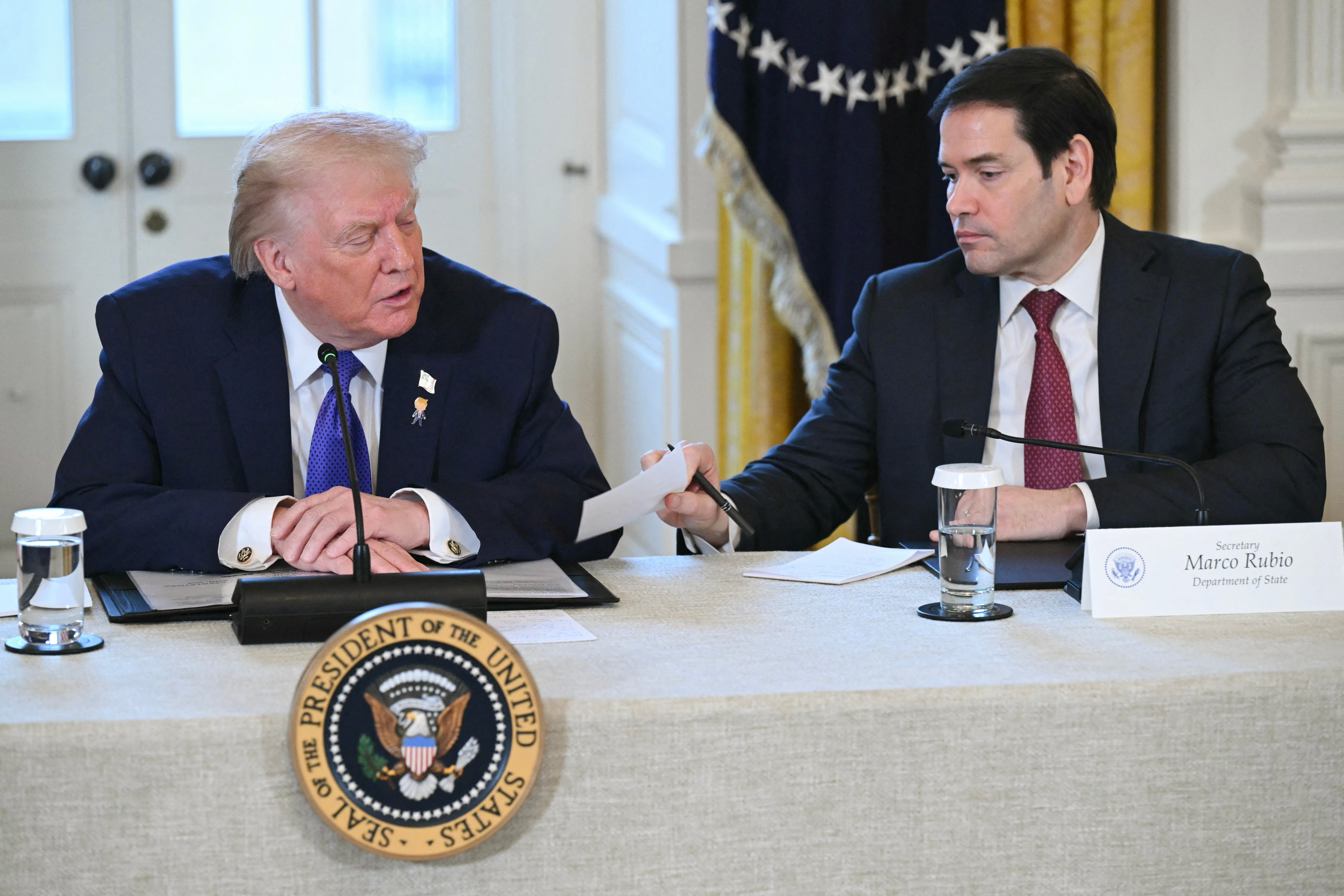
Secretary of State Marco Rubio hands a note to President Donald Trump during a meeting with U.S. oil companies executives at the White House on January 9, 2026. Photo by SAUL LOEB / AFP via Getty Images.
To hear President Donald Trump tell it, the United States is deep in negotiations with Cuban government officials as the U.S. applies maximum pressure to the island. “We’re talking to the people from Cuba, the highest people in Cuba, to see what happens,” Trump told reporters at his Mar-a-Lago resort on Sunday, February 1. “I think we’re going to make a deal with Cuba.”
Cuban leaders, meanwhile, have said they are open to negotiations on everything from human rights to democracy to tourism and direct foreign investment. Cuban President Miguel Díaz-Canel said in a recent press conference that Cuba is willing to engage in dialogue with the United States on any issue, provided talks take place without pressure or preconditions, on the basis of respect for Cuban sovereignty. Senior Cuban leaders reiterated to Drop Site that the government is serious about being open to wide-ranging talks. And Trump is no stranger to the island’s potential for American companies, having himself long held a registered trademark for a Trump Havana property that he has annually renewed.
All the evidence would seem to suggest that the opportunity for Trump to strike a historic deal is at hand. But, despite the president’s claims, there are and have been no negotiations involving high-level officials between Havana and Washington, according to five Cuban and American officials, all of whom asked for anonymity given the sensitivity of the Cuba-U.S. relationship.
When it comes to Trump’s claims of those talks, it turns out he isn’t lying. Instead, sources tell Drop Site, he’s being lied to. “He’s saying that because that’s what Marco is telling him,” said a senior Trump official, referring to an internal effort by Secretary of State Marco Rubio to make Trump believe that the U.S. and Cuba are engaged in serious negotiations without ever doing so. The idea, the source said, is that in a few weeks or months, Rubio will be able to claim that the talks were futile because of Cuban intransigence. With diplomatic off-ramps being blocked, this would make Rubio’s vision of regime change the only path forward for an administration loath to reverse course on anything.
Asked about the fact that Rubio is misleading Trump about talks that aren’t going on, the State Department’s press office stood by the claim that such negotiations are indeed happening, forwarding along comment from an administration official: “As the President stated, we are talking to Cuba, whose leaders should make a deal. Cuba is a failing nation whose rulers have had a major setback with the loss of support from Venezuela and with Mexico ceasing to send them oil.” The statement offered no evidence the talks are taking place, named no officials participating, no dates of any meetings, nor did it identify a location where the supposed talks are happening.
Trump, meanwhile, has indicated he isn’t interested in an ideological confrontation with Cuba. This, sources suggest, is one way to understand why, after kidnapping Venezuelan President Nicolás Maduro, the U.S. has made Venezuela roll back key Chávez-era oil legislation via a reform that opens up the country to foreign investment instead of changing its regime. Rubio, meanwhile, pushed hard internally for a full regime change in Venezuela, but had to settle for merely removing Maduro. Ultimately, though, for Rubio, the real prize has always been Cuba.
The Cuban-American Rubio answers to a political base in south Florida that would revolt if he struck any deal normalizing relations with the communist government—and who, ultimately, would have the power to undo him. Rubio’s rise through Florida and national politics — which now has him on the cusp of the Oval Office — has been accompanied by a string of corruptionscandals, yet with unified support back home, he has managed to emerge with a relatively clean reputation nationally. If Trump successfully lands a deal with the Cuban government that Rubio would have to sign off on, Rubio would be left to either betray his life’s cause and that of his backers in Miami, or resign in protest.
For Rubio’s opponents inside the administration, the moment represents an opportunity to make Cuba into his Waterloo.
No Dialogue
In the wake of Trump’s claims of high-level talks, confused Cuban officials insisted to Drop Site that no such talks were then underway, but that they were eager for them to start. Misinformation in the media, however, has muddied the situation.
On February 2, the day after Trump’s comments, Politico highlighted a report that the son of Raúl Castro had traveled to Mexico City for talks with the Central Intelligence Agency and asked in a headline: “Could a Castro become our man in Havana?”
The article, however, is sourced to 14YMedio, a news outlet run by Havana-based dissident blogger Yoani Sánchez, which itself based its reporting on a single, fantastical Facebook post made by a Spain-based Cuban journalist. Yet the Politico report began circulating in Washington and has been accepted as fact. Senior Cuban officials tell Drop Site there are no talks going on in Mexico or anywhere else.
“At the moment, we’ve had some exchanges of messages, but we cannot say we have set a bilateral dialogue at this moment,” Cuba’s Deputy Minister of Foreign Affairs Carlos Fernandez de Cossio affirmed in a CNN interview this past Wednesday. “Most things in Cuba dealing with the United States are linked to the highest level. It’s a large issue for us, so there’s no decision, no action taken that doesn’t involve the high level of government in Cuba.”
A “senior State Department official” told the New York Times recently that contact between the Cuban and U.S. government was “not substantive” and merely discussed migrant repatriation. Elaborating, a senior Cuban official told Drop Site that the contacts are purely technical, with the U.S. telling Cuban officials when flights with deported migrants would be heading to Havana, and Cuban officials acknowledging receipt of the message.
An article on Wednesday in the Spanish outlet ABC Internacional added to the confusion, claiming that Mexican official Efraín Guadarrama is facilitating the talks. A well-placed source with direct knowledge tells Drop Site Guadarrama is doing no such thing.
In the wake of the abduction of Venezuelan President Nicolas Maduro, top Cuban government officials have become increasingly interested in wide-ranging talks with the Trump administration—talks that could even include Rubio, a longtime foe of the government, multiple Cuban officials tell Drop Site. The only red line, they said, is that the island’s sovereignty is not up for negotiation.
Havana’s desire for talks, bordering on desperation, has been signaled to the United States through a variety of channels, including through press statements and recent interviews with the Associated Press and CNN. “Cuba reiterates its willingness to sustain a respectful and reciprocal dialogue with the Government of the United States,” the Cuban foreign ministry said in a February 1 release, “directed toward concrete outcomes, grounded in mutual interest and international law.”
The ministry added that Cuba was willing to “broaden” the scope of talks, saying the country “firmly rejects being portrayed as a threat to the security of the United States. It has never engaged in hostile actions against that country, nor will it permit its territory to be used against any other nation. Cuba, on the contrary, is prepared to resume and broaden bilateral cooperation with the United States in addressing shared transnational threats, while unwaveringly defending its sovereignty and independence.”
In an interview with Newsweek, Cuban Permanent Representative to the U.N. Ernesto Soberón Guzmán said Cuba would be happy to work with Trump on immigration, drug interdiction, health research—he noted Trump’s praise for Cuba’s relatively lower rates of autism—and other areas.
In addition to the ongoing economic crisis, the proximate cause for Cuban concern is an executive order issued on January 29 by President Donald Trump threatening heavy tariffs on “any other country that directly or indirectly sells or otherwise provides any oil to Cuba.”
Though not mentioned by name, the tariff threat is aimed at Mexico, whose state oil company has in recent years been the primary supplier of oil to the small island nation located 90 miles off the southern coast of Florida. In response, Mexico’s state oil company, PEMEX, has reportedly suspended at least one planned shipment of oil to its Cuban ally, leaving Cuba with an estimated two to three weeks’ worth of oil to keep the country running.
Overburdened, underfueled, and obsolete, Cuba’s electricity grid is barely hanging on, while the Cuban government publicly says it is preparing to administer life in the country with almost zero power. On Friday, ministers began to roll out a nationwide energyrationing plan. The measures include cutting mass transit, slashing individual gasoline allotments, and reducing in-person days for secondary school students. While Americans sat down for Super Bowl Sunday, Cuban authorities told airlines there was only one day’s supply of aviation fuel left in the country. On Monday, the U.S. intercepted an oil tanker as far away as the Indian Ocean for allegedly planning to ship fuel to Cuba.
At a lengthy press conference this past Thursday, Cuban President Miguel Díaz-Canel reiterated his country’s emphatic openness to negotiation with the United States without “pressure” or “preconditions.” Broadcasted on TV and radio around the world, Díaz-Canel’s comments were made, as one Wall Street Journal reporter observed, “with an audience of one in Washington”—Donald Trump.
“We are a country of peace,” Díaz-Canel said. “We are not a threat to the United States.”
Noah Kulwin reported from Havana, José Luis Granados Ceja reported from Mexico City, and Ryan Grim reported from Washington, D.C.
Reports from human rights organizations, digital rights defenders, and media outlets have documented that Meta—the parent company of Facebook and Instagram—has engaged in what has been described as systematic censorship of Palestinian voices and content opposing Israeli military actions. While Meta has denied intentional, systemic suppression, citing errors in automated systems, multiple investigations indicate that the suppression is a result of a combination of policy, technology, and, in some cases, direct government influence.
Jessica, a mother in Alabama, received a text on the evening of January 7.
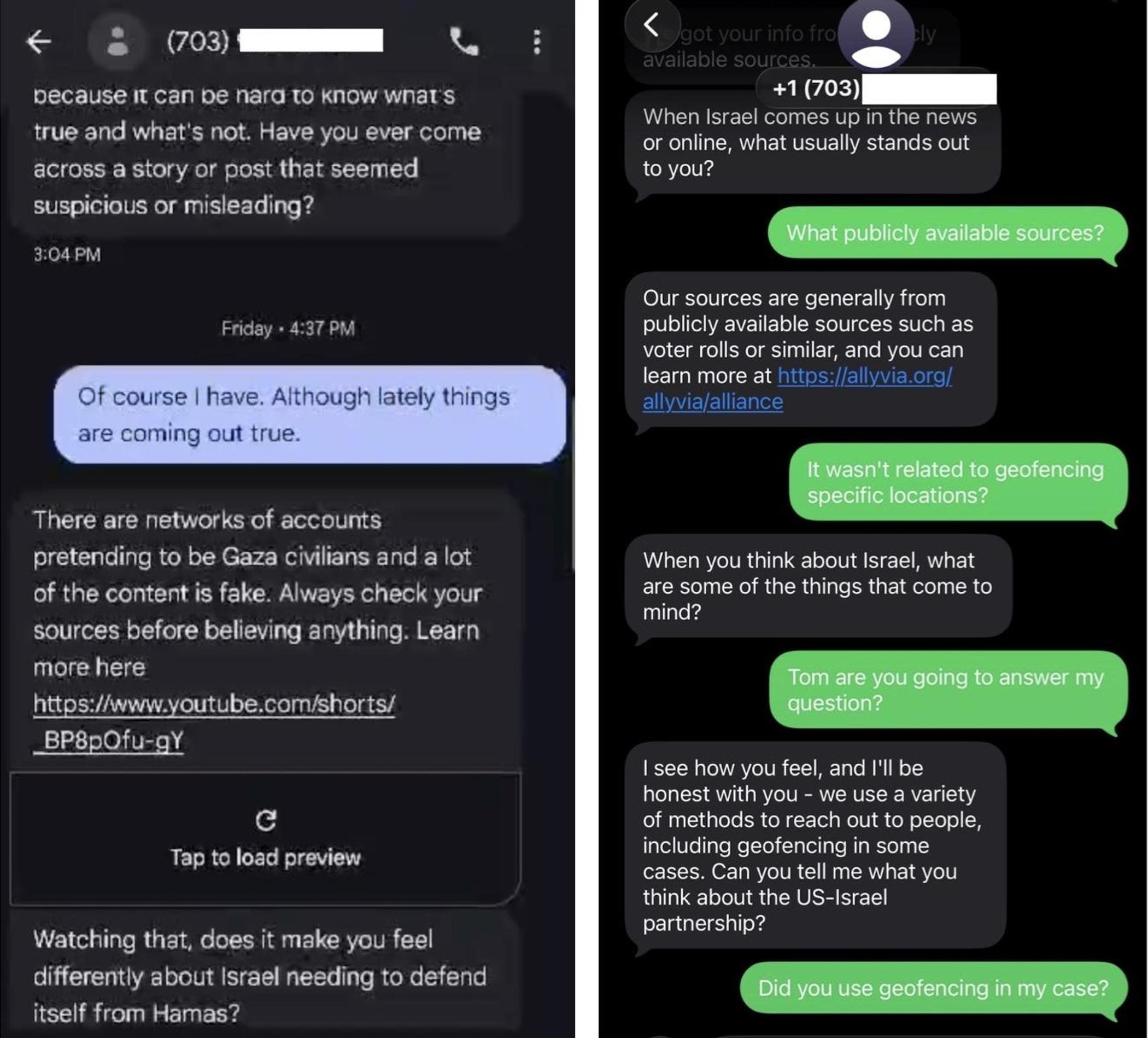
“Hi, this is John with Friends for Peace. We’re gathering views on Israel today and would like to hear yours. Got a moment to chat? Stop2End.”
Jessica wondered if she would regret sharing her views — which she describes as America First and skeptical of the U.S. relationship with Israel — but John was reassuring and offered a “listening ear” to discuss the sensitive topic.
Over the next three days, Jessica and John exchanged messages about Israel. John promoted a pro-Israel narrative, trying to convince Jessica that the U.S.-Israel relationship is about “mutual benefit and shared interests.”
The only problem is that an organization called “Friends for Peace” does not appear to exist, and it’s unlikely that “John” is a real person. Rather than a peace organization, as the name might imply, the texting campaign appears to be led by former Trump campaign manager Brad Parscale and his firm Clock Tower X, which is carrying out a $9 million contract with the government of Israel.
After Jessica told John that she gets a lot of her news from X, John responded saying she shouldn’t trust a lot of stories about Gaza. “There are networks of accounts pretending to be Gaza civilians and a lot of the content is fake. Always check your sources before believing anything. Learn more here,” he said. John then sent a YouTube video from an account called “Allies for Peace,” which claimed the narrative of suffering in Gaza was manufactured. “Bombs, starvation, collapsed buildings: all fabricated content…Don’t take every post at face value, check receipts, demand truth.”
Allies for Peace’s YouTube channel was created in late October by a firm called Clock Tower X, founded by Parscale.
And Jessica is not alone. Since November, an unspecified number of Americans have been receiving text messages from unknown numbers claiming to be from organizations called “Friends for Peace” and “Partners in Peace” asking their views on Israel, promoting Israel as a U.S. ally, and pushing links to websites and videos created by Clock Tower X.
Another source was sent a video called “Tunnels” by “Sara from Friends for Peace.” The video, which was also created by Parscale’s firm, features a clip of an episode of the Joe Rogan podcast with British commentator Douglas Murray. In the edited clip, Murray claims that “you go into a hospital [in Gaza] and you know there will be grenades or tunnel entrances building an infrastructure of terror.” Many of the comments on the video claim they were sent the link by the text message campaign. “I got this from a scam text too. Lmao” reads the top comment.
RS could not identify an organization called “Partners in Peace” or “Friends for Peace” that corresponded with the description. During one text conversation, the campaign admitted that they “use different names” for the organization.
Clock Tower X’s contract with the Israeli Ministry of Foreign Affairs, which increased from $6 million to $9 million in December, includes, “Delivery of monthly updated audience segmentation and sentiment analysis, including Gen Z and other key U.S. demographic groups,” which could correspond to the mass texting campaign. As part of the contract, Parscale’s firm is also integrating pro-Israel messaging into Salem Media Network, a conservative media conglomerate that hosts high-profile podcasts such as “The Right View with Lara Trump” and “The Dinesh D-Souza Podcast.”
Parscale is carrying out this work as part of “project 545” an Israeli campaign to “amplify Israel’s strategic communication and public diplomacy efforts.” Eran Shayovich, Parscale’s point of contact in Israel and the chief of staff at Israel’s Ministry of Foreign Affairs, posted on Linkedin about the success of the project last month. “A year and two months into a long war, when the image of the State of Israel was at one of its lowest points, and too many attempts to fight on the public diplomacy front had not been particularly successful,” he wrote. “In the past year, we began to fight back seriously.”
“Allies for Peace” uploaded its first video on YouTube — which states at the end that it was “distributed by Clock Tower X LLC on behalf of the state of Israel” — two weeks before the mass texting campaign began, further linking the effort to Parscale’s firm.
Parscale did not respond to a request for comment about his firm’s connections to the mass texting campaign.
Published date: 8 February 2026 13:43 GMT | Last update:1 day 23 mins ago
Hamas political leader Khaled Meshaal said the Palestinian movement would reject any attempt at foreign domination of Gaza.
Speaking at a conference in Qatar’s capital, Doha, Meshaal added that Hamas would also not relinquish its weapons despite calls for disarmament from Israel and the US.
“Criminalising the resistance, its weapons and those who have led it is something we should not accept,” he said.
“As long as there is an occupation, there is resistance. Resistance is the right of people under occupation. It is something nations are proud of.”
Following the implementation of a nominal ceasefire on 10 October, US President Donald Trump’s plan to end the conflict in Gaza entered its second phase in mid-January.
New MEE newsletter: Jerusalem Dispatch
Sign up to get the latest insights and analysis on Israel-Palestine, alongside Turkey Unpacked and other MEE newsletters
This phase is set to include the disarmament of Hamas and the gradual withdrawal of the Israeli army from the enclave.
According to a report in Haaretz earlier this week, Israeli officials are exploring ways for Israel to benefit economically from Gaza’s reconstruction.
Middle Eastern leaders including Netanyahu and Sisi line up to join Trump ‘Board of Peace’
Senior finance ministry officials discussed potential opportunities with senior Israeli army officers, the Israeli newspaper reported on Wednesday, including the construction of a highway in Israel connecting to Gaza.
It was suggested that countries seeking access to Gaza via Israel would pay for Israeli highway construction.
This would include a highway along the southern Route 232, which would provide better access for Palestinians travelling between Gaza and the occupied West Bank.
Israeli officials also discussed economic opportunities over the supply of electricity to Gaza.
Hamas, which has governed the territory since 2007, has ruled out disarmament, but has indicated it is open to handing over its weapons to a future Palestinian-led authority.
Governance of the territory would be temporarily transferred to a committee of 15 Palestinian technocrats, under the authority of the “Peace Council” chaired by Trump.
Meshaal said the “Peace Council” should adopt a “balanced approach” that would allow for the reconstruction of Gaza and the influx of humanitarian aid.
“We adhere to our national principles and reject the logic of guardianship, any foreign intervention, or the return of a mandate in any form,” Meshaal said.
“Palestinians must be governed by Palestinians. Gaza belongs to the people of Gaza and to Palestine. We will not accept foreign domination.”
Trump deployed the aircraft carrier USS Abraham Lincoln to the region to prepare for a potential attack on Iran
by Dave DeCamp, Antiwar. com, February 8, 2026 at 4:50 pm ET
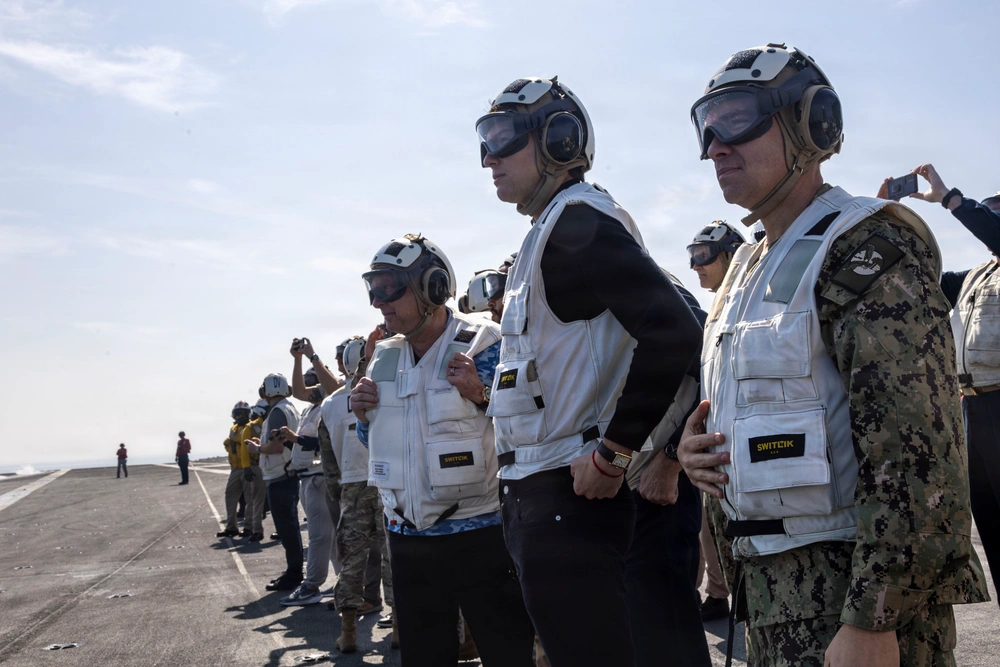
US special envoy Steve Witkoff and Jared Kushner, President Trump’s son-in-law, visited the US aircraft carrier Abraham Lincoln as it was operating in the Arabian Sea on Saturday after meeting with Iranian officials in Oman the day before.
Trump deployed the US aircraft carrier and its strike group to prepare for a potential attack on Iran, and Witkoff and Kushner’s visit to the US warship signals to Iran that the threat of a US bombing campaign is still very real despite the diplomatic engagement.
Video released by US Central Command shows Witkoff and Kushner standing on the flight deck of the Lincoln next to Adm. Brad Cooper, the commander of CENTCOM, as aircraft take off. An F-35 fighter jet from the Lincoln shot down an Iranian drone in the Arabian Sea on February 3.
Steve Witkoff, left, Jared Kushner, center, and Adm. Brad Cooper, right, observe flight operations aboard Nimitz-class aircraft carrier USS Abraham Lincoln in the Arabian Sea, February 7, 2026 (US Navy photo)
While maintaining its threat to bomb Iran, the US has also ramped up the economic pressure by imposing new Iran-related sanctions, the same day Witkoff and Kushner met with Iranian Foreign Minister Abbas Araghchi. The sanctions targeted ships and companies the US accused of transporting Iranian oil.
Ahead of the talks in Oman, US Treasury Secretary Scott Bessent boasted that the Trump administration’s “maximum pressure campaign” against Iran collapsed the country’s economy and sparkedthe protest and unrest that began at the end of December.
Any diplomatic deal with Iran would need to include sanctions relief, but it’s unclear if an agreement will be reached, as Israel is pushing for the maximalist position, which is designed to sabotage the talks and ensure war.
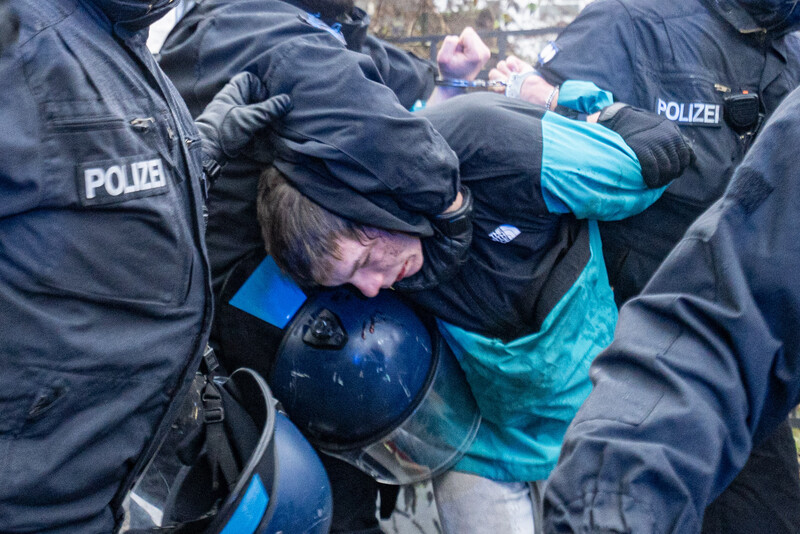
Police detain a demonstrator, as protesters march in support of Palestinian rights in front of Neukolln City Hall, Berlin, Germany, 27 December 2025. İlkin Eskipehlivan Anadolu Images
Exactly a year ago today, I was abducted from a Zurich street by plainclothes police, bundled into an unmarked car and taken to prison.
I was walking with one of my hosts toward a venue where I was scheduled to speak at an event organized by Swiss activists about Israel’s genocide in Gaza.
During my detention, Swiss intelligence officers tried to question me without my lawyer present – an apparent attempt, I told Swiss academic Pascal Lottaz in a recent interview, to manufacture grounds for my arrest retroactively.
After three days in detention, I was handcuffed, caged in a police van, taken to the airport and expelled.
The operation achieved its purpose: preventing me from participating in public events about Israel’s crimes. But it failed to intimidate or silence me.
In December, Zurich’s Administrative Court ruled that my detention violated both the Swiss constitution and the European Convention on Human Rights.
I have filed additional cases, including a criminal complaint against Nicoletta della Valle, the Israel-linked police official later identified by a parliamentary investigation as having ordered the action against me.
As I told Lottaz, what happened to me is not exceptional. It is part of a widening campaign across the so-called West to silence journalists, students and activists who expose Israel’s crimes or advocate for Palestinian rights.
You can watch our conversation on his Neutrality Studies channel in this video:
“One of the lucky ones”
Among the most shocking cases is that of Leqaa Kordia, a Palestinian woman and the last person still held in US federal detention in connection with protests at Columbia University.
On 13 March last year, Kordia attended what she believed was a routine, voluntary check-in at ICE headquarters in New Jersey.
Instead, she was transported to a detention facility in Texas, 1,500 miles away from her home, her mother and her brother with special needs who relied on her support. “Inside the ICE facility where I’m being held, conditions are filthy, overcrowded and inhumane,” Kordia wrote recently for USA Today.
“For months, I slept in a plastic shell, known as a ‘boat,’ surrounded by cockroaches and only a thin blanket.”
The food is inedible and with no halal meals available, she has lost significant weight.
“Still, I consider myself one of the lucky ones. Many women come and go through this hall of sorrows, and I try my best to help them where I can,” Kordia writes. “There are others with me who cannot afford legal representation. Some have diabetes or terminal cancer, or are wheelchair bound.”
An immigration judge has twice ordered her release. The Trump administration has blocked it using an obscure procedural loophole – a practice now being challenged in federal courts, many of which have already ruled it unconstitutional. In September, US federal judge William G. Young ruled that the Trump administration’s campaign of arresting and deporting noncitizen students and faculty over Palestine advocacy violates the First Amendment.
Last week, Young went further, finding that officials engaged in an “unconstitutional conspiracy” to suppress free speech.
The ruling focused on five prominent targets: Mahmoud Khalil, Yunseo Chung, Mohsen Mahdawi, Rumeysa Ozturk and Badar Khan Suri.
Khalil, who spent over three months in ICE custody, recently suffered a setback when a federal appeals court overturned an earlier ruling that found his detention and the effort to deport him likely unconstitutional.
Although the government cannot lawfully re-detain him while appeals continue, it continues to display contempt for due process.
“It looks like he’ll go to Algeria,” a Department of Homeland Security spokesperson said publicly.
Khalil has vowed to continue fighting through every legal avenue.
French woman imprisoned for exposing Israeli soldier
Repression is no less severe in Europe.
Last week, a court in the French city of Nice sentenced Amira Zaiter, founder of activist group Nice to Gaza, to 15 months in prison for “anti-Semitic” social media posts.
Zaiter admitted to calling Illan Choukroune, a French citizen who served in the Israeli army, a “genocidaire.”
“I will continue saying it,” Zaiter told the judge.
This is not her first conviction.
In June, a court sentenced Zaiter to six months in prison and a $7,000 fine – reduced from an original sentence of three years.
She was first arrested in November 2024 for her posts on Twitter/X and for exposing an Israeli soldier who had returned to Nice after being in Gaza, according to Civic Space Watch, an EU-funded group that monitors rights violations.
Widespread repression
In October, UN experts called on Germany to stop criminalizing, punishing and suppressing Palestine-related speech.
“We are alarmed by the persistent pattern of police violence and apparent suppression of Palestine solidarity activism by Germany,” the independent special rapporteurs said. I have had a taste of German authoritarianism myself: In 2024, German authorities threatened me with up to one year in prison and a fine if I addressed a conference in Germany from abroad via the internet.
In Australia, the government exploited the aftermath of December’s Bondi Beach attack to rush through “hate speech” laws that target Palestine solidarity.
“These laws dramatically expand state power to police speech, association and protest,” according to APAN, the Australia Palestine Solidarity Network.
“Their vague definitions and broad enforcement mechanisms create a chilling environment in which political advocacy – particularly pro-Palestinian organizing and opposition to Israel’s genocide and apartheid – is criminalized.”
British repression
Australia appears to be following Britain’s lead, where people are routinely arrested for holding signs opposing genocide and supporting Palestine Action – the protest group arbitrarily banned by the government as “terrorist.”
Meanwhile, anyone is free to hold a sign in British streets stating “I support genocide,” without fear of arrest.
Activists associated with Palestine Action continue to suffer severe persecution, including prolonged imprisonment, even though they have not been convicted of a crime.
That prompted several detainees to go on life-threatening hunger strikes in an effort to force the government to ease their conditions and cancel arms contracts with Israel.
One detainee, Umer Khalid, announced in recent days that he will stop taking fluids, after already refusing food for two weeks. Last week, Momodou Taal – a Cornell University doctoral student previously forced to leave the US over his Palestine advocacy – was detained at London’s Heathrow airport.
A British citizen, he was interrogated for hours about his political views under the repressive Terrorism Act. Police also confiscated his laptop and phone.
Taal – who has never been charged with any crime – called the interrogation, “a racist fishing expedition designed to intimidate and punish someone for advocating freedom and opposing mass slaughter.”
Expanding censorship
This repression coincides with expanding systems of censorship.
Last week saw the finalization of the forced break-up and sale of TikTok to a group controlled by Larry Ellison, a pro-Israel billionaire whose family also recently took over CBS News. Meanwhile, Jonathan Greenblatt, the head of the Anti-Defamation League – the Israel lobby group that spied for apartheid South Africa during the 1980s – was caught on camera discussing efforts to “monitor and disrupt” left-wing and Palestine solidarity groups and report them to the FBI under the pretext of combating extremism. All of this is being carried out under governments that claim democracy, free speech and human rights as their highest values – yet readily sacrifice those rights to protect a genocidal apartheid settler-colony whose leader is wanted for crimes against humanity.
Speaking at Al Jazeera Forum, Khaled Meshaal describes discussion around Hamas handing over weapons as a continuation of a long effort to neutralise Palestinian armed resistance.
Head of Hamas abroad says ‘resistance is a right’ for occupied people
Hamas’s political leader abroad, Khaled Meshaal, has rejected calls to disarm Palestinian factions in Gaza, arguing that stripping weapons from an occupied people would turn them into “an easy victim to be eliminated”.
Speaking on the second day of the Al Jazeera Forum in Doha on Sunday, Meshaal described the discussion around Hamas handing over its weapons as a continuation of a century-long effort to neutralise Palestinian armed resistance.
“In the context that our people are still under occupation, talking about disarmament is an attempt to make our people an easy victim to be eliminated and easily exterminated by Israel, which is armed with all international weaponry,” he said.
“If we want to talk about it … it is necessary to provide an environment that allows reconstruction and relief and ensures that the war does not reignite between Gaza and the Zionist entity. This is a logical approach, and Hamas — through mediators Qatar, Turkiye and Egypt, and through indirect dialogues with the Americans via the mediators — has reached, or there has been, an understanding of Hamas’s vision on that. Yes, this is something that requires great effort, not an approach of disarmament.”
United States President Donald Trump last month sought to achieve a “comprehensive” demilitarisation of Hamas, threatening the Palestinian group with repercussions if it fails to do so. Hamas has refused to give up arms as long as Israel continues to occupy Gaza.
Now Playing02:32 Israel is killing far more civilians than fighters in Gaza
Next05:25 Fighting between Sudan’s army, RSF forced more than 13 million children out of school
In the second phase of a US-mediated “ceasefire” deal between Israel and Hamas, agreed in October last year, Washington says it will tackle the disarmament of Hamas and the deployment of an international peacekeeping force.
But Israel continues to carry out near-daily deadly attacks across Gaza in violation of the “ceasefire” and has so far refused to withdraw from the so-called “Yellow Line” in eastern Gaza, an informal boundary separating more than half of the territory that remains under Israeli military control from the rest of the Strip. Israel has killed at least 576 Palestinians and wounded 1,543 others since the latest “ceasefire” started.
“The problem is not that Hamas and the resistance forces in Gaza provide guarantees; the problem is Israel, which wants to take the Palestinian weapons … and put them in the hands of militias to create chaos,” he said.
Meshaal pointed to Hamas’s proposals for an extended calm as an alternative to dismantling its military wing.
“Hamas proposed a truce of five to seven to 10 years. This is a guarantee that these weapons are not used,” he said, adding that the mediating nations, who have a “deep relationship with Hamas, can form a guarantee”.
Meshaal pointed out that if people were to go back to the origin of the conflict, the issue is one of “occupation and a people resisting occupation, with the right to self-determination and independence”.
“Resistance is a right for people under occupation; it is part of international law and the heavenly religions. Resistance is part of the memory of nations,” he added.
‘Palestinian cause must have a solution’
Meshaal said the October 7, 2023 attack on Israel was a “turning point”, arguing that the Gaza conflict forced the world to reopen a “second question” of the Palestinian cause itself.
“The [Operation Al-Aqsa] Flood and this genocidal war have shaken the world. There is now a question – the Palestinian cause must have a solution,” he said, referring to the October 2023 attack, as he welcomed a growing number of nations recognising a Palestinian state, calling the moves “insufficient”.
“The fact that 159 countries have approved or recognised the Palestinian state is good, but it is not enough. How do we turn the Palestinian state into a reality on the ground? That is the big question we are concerned with as Palestinians, as Arabs, as Muslims, and along with our friends around the world,” he said.
Gaza: A Forever War
Meshaal called on the Arab and Muslim states to move from a “defensive policy” to “offence” in the diplomatic arena.
“We want to entrench that it is a pariah entity and a burden on security, stability, and international interests; to pursue it and turn it into an entity that loses its international legitimacy completely, just like the apartheid regime in South Africa,” he added.
“We are the owners of a just cause, and the accused is the one who committed the war crime of genocide,” he said.






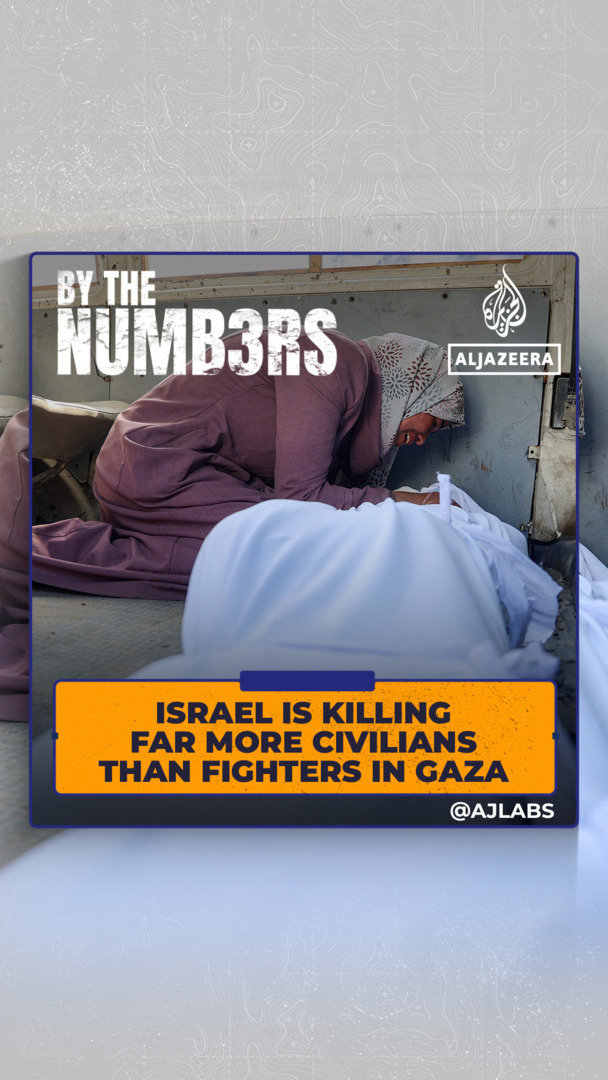
 Israel is killing far more civilians than fighters in Gaza
 Fighting between Sudan’s army, RSF forced more than 13 million children out of school

 Peace and Justice Post
You must be logged in to post a comment.