The recent fall of President Bashar al-Assad’s regime in Damascus marked a turning point in Syria’s ongoing conflict, with new reports revealing a covert Ukrainian role in aiding Syrian rebels.
Ukrainian intelligence provided strategic support, including drone technology and experienced operators, to Hayat Tahrir al-Sham (HTS), the dominant rebel faction in Idlib, Caliber.Az reports via The Washington Post.
This effort underscores Ukraine’s broader strategy to undermine Russian influence on multiple fronts amid its ongoing war with Moscow.
Approximately four to five weeks prior to the HTS-led offensive, Ukrainian operatives delivered 150 first-person-view drones and deployed 20 experienced operators to assist the rebels. Although Western intelligence sources suggest this aid played a modest role in the regime’s downfall, it was a significant demonstration of Kyiv’s intent to counter Russia in unconventional theatres such as the Middle East, Africa, and even within Russia itself.
Ukraine’s intelligence agency, the GUR, has reportedly collaborated with opposition groups in Syria under a special unit known as “Khimik,” bolstering rebel capabilities against Russian-backed Syrian forces.
Ukraine’s motivations for such actions are clear. With its homeland under siege, Kyiv is actively opening secondary fronts to stretch Russian resources and influence. A June report in the Kyiv Post detailed strikes by Ukrainian-backed Syrian rebels on Russian military installations, accompanied by video evidence of these operations.
Russian officials have expressed growing concern, with statements from representatives such as Alexander Lavrentyev and Foreign Minister Sergei Lavrov accusing Ukrainian intelligence of conducting “dirty operations” in Idlib. Despite these claims, independent verification remains scarce.
While Russia has downplayed Ukraine’s involvement, pointing to HTS’s independent drone program and prior expertise, the rapid collapse of Assad’s regime caught Moscow off guard. Russian Telegram channels have sought to minimize Kyiv’s role, suggesting Ukrainian personnel were in Syria for too short a time to significantly influence operations. However, this narrative contrasts with Ukraine’s broader pattern of covert actions against Russian forces worldwide.
Beyond Syria, Ukraine has demonstrated its capability for overseas operations in other regions. In July 2023, Ukrainian intelligence reportedly supported Malian rebels in an ambush against Wagner Group mercenaries, resulting in significant losses for the Russian paramilitary group.
Such actions highlight the GUR’s aggressive strategy, with its head, Lt. Gen. Kyrylo Budanov, affirming Ukraine’s commitment to targeting Russian military assets globally. This approach has drawn concerns from Western allies, including the Biden administration, over potential escalations.
Ukraine’s actions in Syria align with its broader strategy to disrupt Russia’s influence and partnerships. By aiding HTS, Kyiv weakened a critical Russian ally in the Middle East, further isolating Moscow. Although the Ukrainian assistance may not have been decisive, it contributed to an environment where the Assad regime’s fall became inevitable.
The parallels to other intelligence failures, such as Russia’s inability to anticipate HTS’s offensive or Israel’s surprise during Hamas’s October 2023 attack, are striking. Both underscore the challenges nations face in responding to unconventional threats.
For Ukraine, these operations serve as a testament to its resilience and resourcefulness in a protracted struggle against a powerful adversary. While not the decisive factor in Damascus, Ukraine’s covert actions signal its intent to shape the global battlefield to its advantage.
Adm. Rob Bauer previously said NATO countries should consider shifting to a ‘war economy‘
by Dave DeCamp, Antiwar. com, November 25, 2024
The head of NATO’s Military Committee has called on European businesses to prepare for a “wartime scenario” amid soaring tensions between the Western military alliance and Russia.
Dutch Adm. Rob Bauer said Western businesses must adjust to become less vulnerable to both Russia and China. “If we can make sure that all crucial services and goods can be delivered no matter what, then that is a key part of our deterrence,” Bauer said at a European Policy Centre event in Brussels, according to Reuters.
Bauer said energy supplies could be targeted or used as weapons of war. “We’re seeing that with the growing number of sabotage acts, and Europe has seen that with energy supply,” he said. “We thought we had a deal with Gazprom, but we actually had a deal with Mr Putin. And the same goes for Chinese-owned infrastructure and goods. We actually have a deal with (Chinese President) Xi (Jinping).”
US and European officials have accused Russia of weaponizing energy, but Moscow began reducing gas shipments to Europe in 2022 in response to Western sanctions meant to destroy the Russian economy.
Bauer also said Western economies were too dependent on China. “We are naive if we think the Communist Party will never use that power. Business leaders in Europe and America need to realize that the commercial decisions they make have strategic consequences for the security of their nation,” he said. “Businesses need to be prepared for a wartime scenario and adjust their production and distribution lines accordingly. Because while it may be the military who wins battles, it’s the economies that win wars.”
Last year, Bauer called for NATO countries to consider shifting to a “war economy” where civilian factories would begin producing military goods, similar to what the US did during World War II. “Those priorities should be discussed about, partially, a war economy in peacetime,” he said in January 2023.
Bauer also said at the time that NATO was “ready” for a direct confrontation with Russia. Today, that confrontation is much more likely following the US authorization of long-range strikes on Russian territory with NATO missiles, a step Moscow has made clear risks a nuclear escalation.
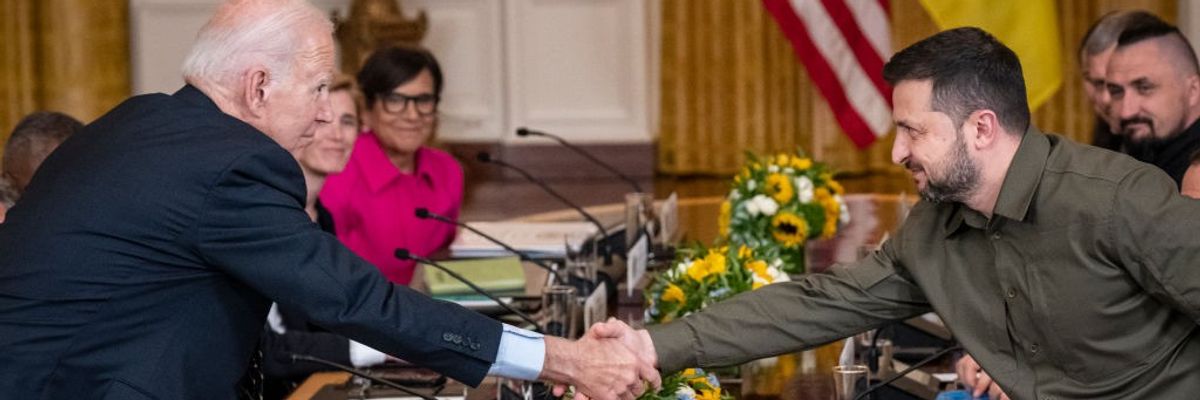
U.S. President Joe Biden shakes hands with President of Ukraine Volodymyr Zelensky after a meeting in the East Room of the White House September 21, 2023 in Washington, D.C.
(Photo by Drew Angerer/Getty Images)
Whether heralded or reviled, Biden’s supposed restraint during the Ukraine war has steadily faded, with more and more dangerous escalation in its place.
President Biden has never wavered from approving huge arms shipments to Israel during more than 13 months of mass murder and deliberate starvation of Palestinian civilians in Gaza. Biden’s crucial role earned him the name “Genocide Joe.”
That nickname might seem shrill, but it’s valid. Although Biden will not be brought to justice for serving as a key accomplice to the horrific crimes against humanity that continue in Gaza, the label sticks—and candid historians will condemn him as a direct enabler of genocide.
Biden could also qualify for another nickname, which according to Google was never published before this article: “Omnicide Joe.”
In contrast to the Genocide Joe sobriquet, which events have already proven apt, Omnicide Joe is a bit anticipatory. That’s inevitable, because if the cascading effects of his foreign policy end up as key factors in nuclear annihilation, historians will not be around to assess his culpability for omnicide—defined as “the destruction of all life or all human life.”
That definition scarcely overstates what scientists tell us would result from an exchange of nuclear weapons. Researchers have discovered that “nuclear winter” would quickly set in across the globe, blotting out sunlight and wiping out agriculture, with a human survival rate of perhaps 1 or 2 percent.
While Russia’s invasion and horrible war in Ukraine should be condemned, Biden has compounded Putin’s crimes by giving much higher priority to Washington’s cold-war mania than to negotiation for peace—or to mitigation of escalating risks of nuclear war.
With everything—literally everything—at stake, you might think that averting thermonuclear war between the world’s two nuclear superpowers, Russia and the United States, would be high on a president’s to-do list. But that hardly has been the case with Joe Biden since he first pulled up a chair at the Oval Office desk.
In fact, Biden has done a lot during the first years of this decade to inflame the realistic fears of nuclear war. His immediate predecessor Donald Trump pulled the U.S. out of two vital treaties — Intermediate-Range Nuclear Forces and Open Skies — and Biden did nothing to reinstate them. Likewise, Trump killed the Iran nuclear deal negotiated during the Obama administration, and Biden let itstay dead.
Instead of fulfilling his 2020 campaign promise to adopt a U.S. policy of no-first-use of nuclear weapons, two years ago Biden signed off on the Nuclear Posture Review policy document that explicitly declares the opposite. Last year, under the euphemism of “modernization,” the U.S. government spent $51 billion — more than every other nuclear-armed country combined — updating and sustaining its nuclear arsenal, gaining profligate momentum in a process that’s set to continue for decades to come.
Before and after Russia’s invasion of Ukraine in late February 2022, Biden showed a distinct lack of interest in actual diplomacy to prevent the war or to end it. Three days before the invasion, writing in the Financial Times, Jeffrey Sachs pointed out: “Biden has said repeatedly that the U.S. is open to diplomacy with Russia, but on the issue that Moscow has most emphasized—NATO enlargement—there has been no American diplomacy at all. [Russian President Vladimir] Putin has repeatedly demanded that the U.S. forswear NATO’s enlargement into Ukraine, while Biden has repeatedly asserted that membership of the alliance is Ukraine’s choice.”
While Russia’s invasion and horrible war in Ukraine should be condemned, Biden has compounded Putin’s crimes by giving much higher priority to Washington’s cold-war mania than to negotiation for peace—or to mitigation of escalating risks of nuclear war.
From the outset, Biden scarcely acknowledged that the survival of humanity was put at higher risk by the Ukraine war. In his first State of the Union speech, a week after the invasion, Biden devoted much of his oratory to the Ukraine conflict without saying a word about the heightened danger that it might trigger the use of nuclear weapons.
During the next three months, the White House posted more than 60 presidential statements, documents and communiques about the war in Ukraine. They all shared with his State of the Union address a stunning characteristic — the complete absence of any mention of nuclear weapons or nuclear war dangers—even though many experts gauged those dangers as being the worst they’d been since the 1962 Cuban Missile Crisis.
With everything—literally everything—at stake, you might think that averting thermonuclear war between the world’s two nuclear superpowers, Russia and the United States, would be high on a president’s to-do list.
With occasional muted references to not wanting a U.S. military clash with nuclear-armed Russia, during the last 33 months the Biden administration has said it did not want to cross its own red lines—and then has repeatedly proceeded to do so.
A week ago superhawk John Bolton, a former national security advisor to President Trump, summarized the process on CNN while bemoaning that Biden’s reckless escalation hasn’t been even more reckless: “It’s been one long public debate after another, going back to ‘Shall we supply ATACMS [ballistic missiles] to the Ukrainians at all?’ First it’s no, then there’s a debate, then there’s yes. ‘Should we supply the Ukrainians Abrams tanks?’ First it’s no, then there’s a long debate, then it’s yes. ‘Should we supply the Ukrainians with F-16s?’ First it’s no, then there’s a long debate, and it’s yes. Now, ‘Can we allow the Ukrainians to use ATACMS inside Russia?’ After a long debate, now it’s yes.”
Whether heralded or reviled, Biden’s supposed restraint during the Ukraine war has steadily faded, with more and more dangerous escalation in its place.
Biden’s recent green light for Ukraine to launch longer-range missiles into Russia is another jump toward nuclear warfare. As a Quincy Institute analyst wrote, “the stakes, and escalatory risks, have steadily crept up.” In an ominous direction, “this needlessly escalatory step has put Russia and NATO one step closer to a direct confrontation—the window to avert catastrophic miscalculation is now that much narrower.”
Like Biden and Secretary of State Antony Blinken as well as the Democratic and Republican phalanx of Ukraine war cheerleaders on Capitol Hill, Bolton doesn’t mention that recent polling shows strong support among Ukrainian people for negotiations to put a stop to the war. “An average of 52 percent of Ukrainians would like to see their country negotiate an end to the war as soon as possible,” Gallup reported last week, compared to only 38 percent who say “their country should keep fighting until victory.”
Biden and other war boosters have continued to scorn, as capitulation and accommodation to aggression, what so much of the Ukrainian population now says it wants—a negotiated settlement. Instead, top administration officials and laptop-warrior pundits in the press corps are eager to tout their own mettle by insisting that Ukrainians and Russians must keep killing and dying.
Last week, Putin “lowered the threshold for a nuclear strike in response to a broader range of conventional attacks,” Reuters reported, “and Moscow said Ukraine had struck deep inside Russia with U.S.-made ATACMS missiles…. Russia had been warning the West for months that if Washington allowed Ukraine to fire U.S., British and French missiles deep into Russia, Moscow would consider those NATO members to be directly involved in the war in Ukraine.”
For President Biden, the verdict of Genocide Joe is already in. But if, despite pleas for sanity, he turns out to fully deserve the name Omnicide Joe, none of us will be around to read about it.
Common Dreams is powered by optimists who believe in the power of informed and engaged citizens to ignite and enact change to make the world a better place.
We’re hundreds of thousands strong, but every single supporter makes the difference.
Your contribution supports this bold media model—free, independent, and dedicated to reporting the facts every day. Stand with us in the fight for economic equality, social justice, human rights, and a more sustainable future. As a people-powered nonprofit news outlet, we cover the issues the corporate media never will.
about:blank
about:blank
Our work is licensed under Creative Commons (CC BY-NC-ND 3.0). Feel free to republish and share widely.
Everything is at stake. Everything is at stake with nuclear weapons.
While working as a nuclear war planner for the Kennedy administration, Daniel Ellsberg was shown a document calculating that a U.S. nuclear attack on communist countries would result in 600 million dead. As he put it later: “A hundred Holocausts.”
That was in 1961.
Today, with nuclear arsenals vastly larger and more powerful, scientists know that a nuclear exchange would cause “nuclear winter.” And the nearly complete end of agriculture on the planet. Some estimates put the survival rate of humans on Earth at 1 or 2 percent.
No longer 100 Holocausts.
More than 1,000 Holocausts.
What might we Americans say about the actions and inaction of our leaders?
If such a nuclear war happens, of course we won’t be around for any retrospective analysis. Or regrets. So, candid introspection is in a category of now or never.
What if we did have the opportunity for hindsight? What if we could somehow hover over this planet and see what had become a global crematorium and unspeakable ordeal of human agony? Where, in words attributed to both Nikita Khrushchev and Winston Churchill, “the living would envy the dead.”
What might we Americans say about the actions and inaction of our leaders?
In 2023: The nine nuclear-armed countries spent $91 billion on their nuclear weapons. Most of that amount, $51 billion, was the United States. And our country accounted for 80 percent of the increase in nuclear weapons spending.
The United States is leading the way in the nuclear arms race. And we’re encouraged to see that as a good thing. “Escalation dominance.”
But escalation doesn’t remain unipolar. As time goes on, “Do as we say, not as we do” isn’t convincing to other nations.
China is now expanding its nuclear arsenal. That escalation does not exist in a vacuum. Official Washington pretends that Chinese policies are shifting without regard to the U.S. pursuit of “escalation dominance.” But that’s a disingenuous pretense. What the great critic of Vietnam War escalation during the 1960s, Sen. William Fulbright, called “the arrogance of power.”
Of course there’s plenty to deplore about Russia’s approach to nuclear weapons. Irresponsible threats about using “tactical” ones in Ukraine have come from Moscow. There’s now public discussion — by Russian military and political elites — of putting nuclear weapons in space.
We should face the realities of the U.S. government’s role in fueling such ominous trends, in part by dismantling key arms-control agreements. Among crucial steps, it’s long past time to restore three treaties that the United States abrogated — ABM, Intermediate-Range Nuclear Forces, and Open Skies.
On the non-proliferation front, opportunities are being spurned by Washington. For instance, as former CIA analyst Melvin Goodman wrote in September: “Iran’s Ayatollah has indicated a readiness to open discussions with the United States on nuclear matters, but the Biden administration has turned a deaf ear to such a possibility.”
That deaf ear greatly pleases Israel, the only nuclear-weapons state in the Middle East. On Sept. 22, former Defense Secretary Leon Panetta said unequivocally that Israel’s pager attack in Lebanon was “a form of terrorism.” The United States keeps arming Israel, but won’t negotiate with Iran.
The U.S. government has a responsibility to follow up on every lead, and respond to every overture. Without communication, we vastly increase the risk of devastation.
We can too easily forget what’s truly at stake.
We should face the realities of the U.S. government’s role in fueling ominous trends, in part by dismantling key arms-control agreements.
Despite diametrical differences in ideologies, in values, in ideals and systems — programs for extermination are in place at a magnitude dwarfing what occurred during the first half of the 1940s.
Today, Congress and the White House are in the grip of what Martin Luther King Jr. called “the madness of militarism.” In a toxic mix with the arrogance of power. Propelling a new and more dangerous Cold War.
And so, at the State Department, the leadership talks about a “rules-based order,” which all too often actually means: “We make the rules, we break the rules.”
Meanwhile, the Doomsday Clock set by the Bulletin of the Atomic Scientists is now just 90 seconds away from apocalyptic midnight.
Six decades ago, the Doomsday Clock was a full 12 minutes away. And President Lyndon Johnson was willing to approach Moscow with the kind of wisdom that is now absent at both ends of Pennsylvania Avenue.
Here’s what Johnson said at the end of his extensive summit meeting with Soviet Premier Alexei Kosygin in June 1967 in Glassboro, New Jersey: “We have made further progress in an effort to improve our understanding of each other’s thinking on a number of questions.”
Two decades later, President Ronald Reagan — formerly a supreme cold warrior — stood next to Soviet leader Mikhail Gorbachev and said: “We decided to talk to each other instead of about each other.”
But such attitudes would be heresy today.
As each day brings escalation toward a global nuclear inferno, standard-issue legislators on both sides of the aisle keep boosting the Pentagon budget. Huge new appropriations for nuclear weapons are voted under the euphemism of “modernization.”
And here’s a sad irony: The few members of Congress willing to urgently warn about the danger of nuclear war often stoke that danger with calls for “victory” in the Ukraine war. Instead, what’s urgently needed is a sober push for actual diplomacy to end it.
The United States should not use the Ukraine war as a rationale for pursuing a mutually destructive set of policies toward Russia. It’s an approach that maintains and worsens the daily reality on the knife-edge of nuclear war.
We don’t know how far negotiations with Russia could get on an array of pivotal issues. But refusing to negotiate is a catastrophic path.
Continuation of the war in Ukraine markedly increases the likelihood of spinning out from a regional to a Europe-wide to a nuclear war. Yet, calls for vigorously pursuing diplomacy to end the Ukraine war are dismissed out of hand as serving Vladimir Putin’s interests.
The world has gotten even closer to the precipice of a military clash between the nuclear superpowers, with a push to greenlight NATO-backed Ukrainian attacks heading deeper into Russia.
At the State Department, the leadership talks about a “rules-based order,” which all too often actually means: “We make the rules, we break the rules.”
Consider what President John Kennedy had to say, eight months after the Cuban Missile Crisis, in his historic speech at American University: “Above all, while defending our own vital interests, nuclear powers must avert those confrontations which bring an adversary to a choice of either a humiliating retreat or a nuclear war. To adopt that kind of course in the nuclear age would be evidence only of the bankruptcy of our policy, or of a collective death wish for the world.”
That crucial insight from Kennedy is currently in the dumpsters at the White House and on Capitol Hill.
And where is this all headed?
Ellsberg tried to alert members of Congress. Five years ago, in a letter that was hand-delivered to every office of Senate and House members, he wrote: “I am concerned that the public, most members of Congress, and possibly even high members of the Executive branch have remained in the dark, or in a state of denial, about the implications of rigorous studies by environmental scientists over the last dozen years.” Those studies “confirm that using even a large fraction of the existing U.S. or Russian nuclear weapons that are on high alert would bring about nuclear winter, leading to global famine and near extinction of humanity.”
In the quest for sanity and survival, isn’t it time for reconstruction of the nuclear arms-control infrastructure? Yes, the Russian war against Ukraine violates international law and “norms,” as did U.S. wars in Iraq and Afghanistan. But real diplomacy with Russia is in the interests of global security.
And some great options don’t depend on what happens at the negotiation table.
Many experts say that the most important initial step our country could take to reduce the chances of nuclear war would be a shutdown of all ICBMs.
The word “deterrence” is often heard. But the land-based part of the triad is actually the opposite of deterrence — it’s an invitation to be attacked. That’s the reality of the 400 intercontinental ballistic missiles that are on hair-trigger alert in five western states
Uniquely, ICBMs invite a counterforce attack. And they allow a president just minutes to determine whether what’s incoming is actually a set of missiles — or, as in the past, a flock of geese or a drill message that’s mistaken for the real thing.
The former Secretary of Defense William Perry wrote that ICBMs are “some of the most dangerous weapons in the world” and “they could even trigger an accidental nuclear war.”
And yet, so far, we can’t get anywhere with Congress in order to shut down ICBMs. “Oh no,” we’re told, “that would be unilateral disarmament.”
Imagine that you’re standing in a pool of gasoline, with your adversary. You’re lighting matches, and your adversary is lighting matches. If you stop lighting matches, that could be condemned as “unilateral disarmament.” It would also be a sane step to reduce the danger — whether or not the other side follows suit.
The ongoing refusal to shut down the ICBMs is akin to insisting that our side must keep lighting matches while standing in gasoline.
The chances of ICBMs starting a nuclear conflagration have increased with sky-high tensions between the world’s two nuclear superpowers. Mistaking a false alarm for a nuclear-missile attack becomes more likely amid the stresses, fatigue and paranoia that come with the protracted war in Ukraine and extending war into Russia.
Their unique vulnerability as land-based strategic weapons puts ICBMs in the unique category of “use them or lose them.” So, as Perry explained, “If our sensors indicate that enemy missiles are en route to the United States, the president would have to consider launching ICBMs before the enemy missiles could destroy them. Once they are launched, they cannot be recalled. The president would have less than 30 minutes to make that terrible decision.”
The United States should dismantle its entire ICBM force. Former ICBM launch officer Bruce Blair and Gen. James Cartwright, former vice chair of the Joint Chiefs of Staff, wrote in 2016: “By scrapping the vulnerable land-based missile force, any need for launching on warning disappears.”
The United States should dismantle its entire ICBM force.
In July, the Union of Concerned Scientists released a letter signed by more than 700 scientists. They not only called for cancelation of the Sentinel program for a new version of ICBMs — they also called for getting rid of the entire land-based arsenal.
Meanwhile, the current dispute in Congress about ICBMs has focused on whether it would be cheaper to build the cost-overrunning Sentinel system or upgrade the existing Minuteman III missiles. But either way, the matches keep being lit for a global holocaust.
During his Nobel Peace Prize speech, Martin Luther King Jr. declared: “I refuse to accept the cynical notion that nation after nation must spiral down a militaristic stairway into the hell of thermonuclear destruction.”
I want to close with some words from Ellsberg’s book “The Doomsday Machine: Confessions of a Nuclear War Planner,” summing up the preparations for nuclear war. He wrote:
“No policies in human history have more deserved to be recognized as immoral, or insane. The story of how this calamitous predicament came about, and how and why it has persisted for over half a century is a chronicle of human madness. Whether Americans, Russians and other humans can rise to the challenge of reversing these policies and eliminating the danger of near-term extinction caused by their own inventions and proclivities remains to be seen. I choose to join with others in acting as if that is still possible.”
This article is adapted from the keynote speech that the author gave at the annual conference of the Center for Arms Control and Non-Proliferation in Washington, D.C., on Sept. 24, 2024.
In his paper Luis Lazaro Tijerina fills in much-needed information to understand Russian and Syrian relationship. While discussing the salient aspects of the relationship, first, between the Soviet Union and Syria and, then, after the fall of the Soviet Union, between Russia and Syria, the author has provided a sound historical overview of the developments. To understand the present civil war in Syria in a broader historical context, his paper is of utmost importance.
In his presentation, the author has referred to some impressive and interesting material and pointed to many factors in analysing a complex political situation. Syria is an Arab country and its political and social culture is shaped by many factors. It has its ancient historical roots including the Roman rule but after the Arab conquest of Syria from the Byzantine emperor the country became a part of the expanding Arab Empire under the Caliphs. After the First World War the Ottoman Empire came to an end; its rule over the Arab provinces also ended. Western powers which emerged victorious established their colonial domination over the Middle East under the fiction of the ‘Mandatory system’. France took its share: Syria and the Lebanon.
In 1917, the Bolshevik Revolution in Russia brought into existence a new political system. Under the leadership of Vladimir Lenin the right to self-determination of the colonized people and support to the struggling masses to liberate themselves from the Western colonial rule became important pillars of the Soviet state policy. It was in this context, that the Soviet relations with Syria grew during and after the Second World war. The author has quite fairly outlined the Soviet policies towards the Middle East under Stalin. He also shows the role of the present Russian leader Putin towards Syria and his objectives in supporting the Syrian government.
The present civil war has played havoc with this once-prosperous and an old-civilised country. There are numerous factors both national, regional and international involved in the imbroglio. The Assad family, first the father and now his son, are more like the hereditary kings of Syria. But again, here we are discussing an Arab country where democracy as understood in modern political thought and practice has no roots. For kings and despots in the Middle East, political power and luxurious life-styles are the most important things; the rest is empty talk.
Russia and Syria have a deep and long, political marriage that is one of necessity, one of connivance at times, but also a historical relationship based on a respect that is bonded by both adversity and creative, political struggle. Before, I attempt to describe or make what I hope is a serious commentary on the relationship between Russia and Syria in the present time that we live in, and which involves the civil war in Syria, itself, I would like to quote the Roman historian Polybius who noted about history and empires and their causes both in peace and war that “For it is history alone which without causing us harm enables us to judge what is the best course in any situation or circumstance.” We should remember these wise words on history and the best course to follow for empire or nation-states in the modern world. Also, let us take a calm look of factual clarity at the history of these two countries whose political and social fates are wedded now for better or for worse in a time of war against terrorism and the interest of certain nation-states who seek out world hegemon, regardless of the cost of humanity in terms of lives lost. The historical relationship between the nation-state of Russia, formally the Soviet Union, and the nation-state of Syria is one of genuine collaboration through periods of internal, Syrian political crises and regional conflicts within the Middle East. Three coup d’ etat occurred during the period 1949-1953, until the Ba’ath came to power in Syria in 1954, which was keenly observed by the political and military leadership in the Soviet Union, and was only enhanced by the Suez Crises in 1956 with the Tripartite Aggression by Israel, France and Britain. Although there have been cordial culture interests between the Russian and Syrian peoples, it is has always been a friendship forged by pragmatic needs, both being economic and military in terms of mutual interests.
Within the current civil war in Syria it should be historically understood that Russia, by its very history with the Syrian Government and the Syrian people, have a political and moral obligation to help defend the legitimate interests of Syria in its struggle against modern terrorists such as ISIS or nation-states that seek to overthrow the current president of Syria and create a hegemony that would only enhance more dangerous instability in the Middle East. War being what it is among modern nation-states creates a dangerous mass of miscalculations and contradictions among the Western powers which seek to impose their will upon the Syrian state in terms of commerce, the selling of arms and regional control over a population whose aspirations are not considered. On the other side, there are those nation-states like Russian, Syria, Iran and Iraq, for instance, who are more interested in promoting the independent economic, social and cultural interests of their nation-states which is part of the process towards a more pragmatic form of international order throughout the world. Therefore, the profound historical civil war that is taking place in Syria it is in fact a dialectical part of that process towards self-determination and independent national liberation movements among all nations in the Middle East.
As ancient Roman had deep political and military interests in Greater Syria so in fact does modern Russia would have a historical political, economic and cultural ties with modern Syria. In the modernist since, it has been the Soviet and Russian experience to seek out international norms regarding the balance of power in terms of global politics and the need that causes for military intervention. With this historical perception in mind, especially since the time of Lenin when internationalism and the thrust for revolutionary social change was part of Soviet-Russian foreign policy, there was a fundamental socialist and pragmatic view to the expansionism of International law and that ran counter to the Western perception of assessing and then forcing a hegemonic military paradigm as would be advocated by Western nation-states, with the United States being Its nominal leader for such political behavior. That these two different views on the accepted means of considering world political crises as they arose, would create not only a so-called “Cold War”, but would also be the demarcation line of rancor, distrust and proxy wars between the two views regarding the approach the use of military force. This international rivalry became a bien établi behavior regarding diplomacy and war. With these un-varnished perceptions of the inevitable harsh approach to both political and military friction between these two opposing camps, it was only natural that the Soviet Union and then post-Soviet Russia would readjust her strategic, not to mention her tactical approaches, towards confronting the Western powers. As the historian, Roy Allison would admit in his work Russia, the West, and Military Intervention “After the collapse of Soviet superpower did Russian positions on these issues continue to reverberate in the international community? Russia above all has continued to impact on global rule-making through its ‘top table’ presence as a permanent member of the UN Security Council. Russia has maintained a presence also in key groupings for regional crises management, such as the contact Group for the Middle East, the Four-Party talks on the Korean Peninsula and the Six Power talks on the Iranian nuclear programme”. It is interesting to note here in the long pageantry of human history that during the time of Soviet rule in Russia, there was never an invasion by a Soviet army into the Western regions of Europe. There was an occupation of Soviet troops in Hungry and Czechoslovakia due to the uprising of dissatisfied elements of the inteligencia, workers and communist party officials who naively thought that certain Western powers would support their idealism for democratic liberalism, but such dreams or fantasies where to be short live, for the armies of Western Europe or the United States did not come to their aid. Therefore during the middle period of the twentieth century, the Western European bourgeois powers with its ally the United States, although interested and preparing for world hegemony as their imperial quest, were still using rhetoric and subtle propaganda techniques in their own going ‘cold war’ with Russia and her allies. As with the Peace of Nicias, when Athens along with her allies of Greek city-states and Sparta, with her Lachmannian confederacy of allies, signed a peace treaty in 421 BC which terminated the first half of the Peloponnesian War, so to was there an undeclared truce between the Western capitalist powers and the Soviet Union and her satellite socialist allies of Eastern Europe after the end of World War II, known to the Soviet people as the Great Patriotic War. It was during this time of a cold peace in which proxy wars and wars of economic subversion were in acted by both parties, that the Soviet Union took a deep interest in its recognition of Syria as rising political power in the Middle East.
There were many stages in which Russia took a political interest in the Middle East, including Syria or the Levant area (territory know in the modern world as Syria and Lebanon). These interest were both territorial and political in their conceptions by the Russian monocracy, then the Soviet Union and the present Russian Federation. This process of political engagement and cultural recognition between both Russia and Syria were then of a dialectical political process that has lasted through the twenty-first century, and therefore such engagment diplomatique et polticalical are complex and even subtle in nature. What is seemingly viewed through a historical timeline of events between two countries does not account for the covert, even justifiable Machiavellian and warm interactions that two countries with various and even different political interests, will have in an international relationship. The historian, Rami Ginat, gives in the beginning of his work “Syria and Doctrine of Arab Neutralism” a very seemingly view of how the Russian State has viewed the Middle East through the last three centuries by stating thus:
The Middle East has always attracted the attention of Russia in its various historical phrases—Tsarist Russia, the Soviet Union, or the present Russian Federation, because the region is the southern gateway to Russia. The eighteenth and nineteenth centuries saw the expansion of Tsarist Russia southward asresult of colonial conflict with the Ottoman Empire and Persia.… Following the Bolshevik revolution of 1917, Russia opted out of the war [World War I] … In 1919 Lenin declared “pre-War frontiers will be respected, no Turkish territory will be given to Armenia, the Dardanelles will remain Turkish and Constantinople will remain the capital of the Muslim world”.
As we see the long standing interests with Russia and the Middle East are one of a long history, only the British and French have such a long memory of history regarding their own relationship with the Middle East, while the United States has a short history with the Middle East at best, however one that has long history of spreading its war machine in Tanium in the that region of the world in modern times.
To understand the interest that the Soviet Union had with the emerging nation state of Syria after World War II, it is important to know how Stalin viewed such a regional interest outside the natural territory of the Union of Soviet Socialist Republics. Although this essay does include primary Russian diplomatic resources on the eventual political alignment between Russia and Syria in the modern world, I will attempt to draw some conjectures on the rapprochement of economic and culture détente between the two countries. During these early years, it was understood through diplomatic signals and diplomatic embassy exchanges among the various parties who took an interest in Syria’s future, that Stalin, the leader of the USSR sought out a revolutionary approach to the Middle East, and therefore was more interested in the engagment of communist revolutions being nurtured, so it was only natural that he would be concern about the build-up and sponsorship of Middle Eastern communist parties that wanted socialist governments in that region of the world. It has been argued or mention by such Middle Eastern scholars like Ginat that there was no major diplomatic changes to the way the Soviet Union viewed its policy to the Middle East until the death of Stalin. It can be argued that with the onset of the Second World War, Stalin certainly had his intelligence agents in the field in the Middle East, especially in Egypt and Syria, not to mention Iraq. Already as early as 1944, the Syrian government had imitated a serious interest in having direct diplomatic contacts with USSR, during a time, when such a move could have had dire consequences had the course of the war for the Allies and the Soviet Union had turned into defeat on the battlefield. Fortunately such was not the case, and Syrian diplomats were able to meet the first Soviet minster to Egypt, Nikolai Novikov, and although the meeting did not turn out well for the Syrian delegation, it was the first crucial step towards the official rapprochement between the Soviet Union and the nation-state of Syria. After a series of through the summer of 1944, Novikov was informed from the Soviet Government that as of 19 July, that diplomatic relations with Syria had been attain, and that a Soviet diplomatic mission would open in Damascus of that year. It was on July 31, that the Soviet Union and Syria created formal diplomatic relations, but it was not until February 10, 1946 that official diplomatic missions between the two countries was cemented with diplomatic protocols. Thus we see that the road to diplomatic recognition between the two counties was not hurried nor seamless, as a world war had brought them together in the struggle for independence on the side of Syria, and the fight to the death against Nazi fascism by the Soviet Union. What should also be noted and not overlooked is how Stalin would play a major role in such a creation of healthier relationships between those countries of the Middle East and the Soviet Union. As Ginat commented his book on the subject, and it should be understood that he was not a communist was the measure of Soviet foreign change, when he wrote:
Soviet policymakers appealed to Middle East nationalist groups to concentrate on the task of putting an end to Western influence in the region. To achieve that end, the Soviets nurtured relations with governments that were already pursuing anti-Western policies. … Stalin begin to follow the line of realpolitik in his international Affairs program. Foreign policy was, first and foremost, based on Utilitarian considerations derived from the USSSR’s growing interests in certain parts of the world… what mattered more to him [Stalin] was that they pursued anti-Western policies.
In other words, Stalin was keenly intelligent to purse a more pragmatic course of diplomatic relationships with Middle Eastern countries, including the Middle East to protect not only the frontiers of the Soviet Union, but also to consolidate the victories already achieve on the battlefield. When a leader combines military achievements with diplomatic accords that bring about regional and global stability, then that leader is remembered for such a rare talent in history. In the twenty-first century, such talent by a world statesman is not be seen as yet. However, Vladimir Putin took a page from Stalin regarding knowing when to pursue war, when it came to directing the Russian Air Forces in their engagment with targeting Daesh, also known as ISIS, and the al Nursa Front in Syria, and when to reach out to the diplomatic table among all the parties involved in a regional conflict, as when Russia and the United States brokered a truce which took place in February of 2016 during the Syrian Civil War which had begun on March 15, 2011.
We see, therefore, that from the middle of World War II to the early years of the twenty-first century, the political historical era which this author writes about could remind one much like what took place with imperial Rome and Syria in ancient times. Except both regional forces, meaning Russia and Syria are neither hegemonic in outlook nor force a direct submissive behavior from their allies like those Roman leaders who used their Roman legions unsparingly against foe and friend alike, and those Syrian governors of Greater Syria who submitted to Roman rule without question. Modern Russia who is wedded to the revolutionary Soviet Union, is a nation that ultimately forges peace or is forced to play a role on the world’s stage in fighting modern fascism and American imperialism whether they are reluctant or not about their role. Syria is still going through its birth pangs of being a regional world power through the process of the classical civil wars that Thucydides and Tacitus wrote about so boldly.
Within the modern history of the Russian and Syrian alliance, there have been tensions that have worked themselves out through a pragmatic understanding, so as to continue the historical process of independence of not only Syria’s domestic and foreign policy agendas from outside interference, especially from Western hegemony, but to insure the security of other Arab countries as well. With this in mind, when it comes to the reactionary deeds of Daesh, we must understand where the seed of such a viscous terrorist organization emerged from, that is its’ root of growth. As Yevgeny Primakov, who was not only once the head of Russia’s Foreign Intelligence Service, but also was the Foreign Minister and Prime Minister of Russia, the terrorism that expanded in the Middle East and spread outside that regions should be understood as such:
But the terror inflicted by both sides in the Middle East conflict was not the breeding ground for the international terrorism seen at the end of the twentieth century and the beginning of the twenty-first. For starters, Middle Eastern terrorism was by its nature political, not religious.
Primakov’s succinct observation of the core of terrorism not only in the Middle East, but throughout the world, is a rational and understood historical understanding of how modern aggression and wars is not one of a spiritual nature, but conflicting ideologies that emerge from economic and class contradictions.
But Primakov goes further in his analysis of the “war against terrorism” in the twenty-first century by stating emphatically that “The network known as Al-Qaeda did not arise from the Palestinian movement. Al-Qaeda was religious extremist catalyst used the United States during the cold war—with, as it turns out, no thought to the consequences. It came into being with the aid of the Central Intelligence Agency (CIA) for the purposes of fighting the Soviet army in Afghanistan”. Now, in the times that I am writing this essay, we are reaping the terrible violence of the whirl wind we created, which in turn is creating the implosion of the Western world, including that of the United States as well.
It is known through various sources that the former USSR did not pander or always take sides with Syria regarding issues like the Lebanon civil war or the struggle of various political parties and military forces that desired to control the Palestinian struggle of statehood. In fact, it Yuri Andropov, then the general secretary of the Soviet Communist Party, who in 1983, attempted to bring about a more conciliatory relationship between Syria and the Palestinian ranks that were at odds with Syrian leadership regarding the tempestuous leadership of Arafat within the Palestinian enclave. Therefore, if one attempts to see the foreign policy of the Soviet and Russia alliance with Syria, throughout the decades of the modern era, one will notice that there was always an ebb and flow between the two nation-states. The underlying destructive force therefore can be seen elsewhere regarding the war in the Middle East and regional terrorism, in that like the Trotskyites during and after the Russian revolution, American foreign policy is mitigated by the various United States presidential regimes, who have a fanaticism to “export” its American view of democracy into the borders of nation-states throughout the world. Such a modern American manifest destiny includes Syria with its historic civil war in our time which could further enflame other regions of the Middle East or provoke World War III. It is in Syria that the people will manifest themselves in the battle against Islamic terrorism, and it is in Syria that the world’s fate will be decided regarding such a war.
It is with this short paper that I have attempted to show in a subtle way how history is not created by simply the whims of individuals or capriciousness of nation-states without consequences. If we do not understand the nature of alliances which are like a find and subtle thread from the beginning to the end, then we cannot create a political course of action that brings about a period of peace, but will only bring on the holocaust of war.
This essay focuses on the right of the Chechen people to self-determination. I examine the legitimacy of the Chechens’ claim to self-determination and assess the policies of the Russian government toward the minority populations of the Caucasus. I also assess various aspects related to the legitimacy of the movements that fight for self-determination in the context of the global war on terror as well as the problem of violations of minority group rights. In this essay, I argue that current policies of the Russian government in the Caucasus do not lay the foundation for the long-lasting peace and stability in the region and are, in large part, conducive to the continuation of separatist tendencies.
Human Rights and Nation Building Policies
The right to self-determination is intimately linked to the right to free association as well as a guaranteed protection of cultural rights under universal UN conventions, whereas the concept of state sovereignty is the foundational framework on which the global peace and security are built in the modern world. Today, the conflict of principles of state sovereignty and identity group rights continues to generate and fuel a number of local wars and conflicts in many parts of the world. Moreover, some localized conflicts have been extended to other countries owing to the ideological factors that fuel them.
A battery of Patriot missiles has arrived in Poland, along with dozens of American soldiers who will spend the next two years teaching the Polish military to operate the advanced guided-missile system at a base just a few miles from the Russian border.
Though Russia had expressed its strong opposition to having a US military installation close to its border, there was no initial reaction from Moscow to the arrival of the missiles – perhaps an indication that it wants to play down the matter after failing to stop the deployment.
Editor’s Note: Despite budget crises confronting many Western nations, including the United States, the American foreign policy elite is eager to expand NATO — and Washington’s imperial umbrella — to more and more countries, including some on Russia’s doorstep.
In this guest essay, the Independent Institute’s Ivan Eland argues that this expansion means more drain on the U.S. taxpayer with few geopolitical benefits:
Former Secretary of State Madeleine Albright recently led a panel of experts in coming up with a report, “NATO 2020,” which will be used to draft a replacement for NATO’s current strategic concept, adopted in 1999.
The report essentially advocates a continuation and expansion of NATO’s quest to be all things to all people.
Unfortunately, this effort resembles the “expand or die” mantra that was applied to NATO as its primary mission — countering the Soviet Union — was tossed into the dustbin of history. Instead of expanding in territory and mission after the Cold War ended, NATO probably should have died back then and may die — or be severely crippled — by its likely loss in Afghanistan.
Several years ago, I taught political science at a technical college. Why future engineers were required to study political science is anybody’s guess, but perhaps it replaced the mandatory Soviet-era course on the history of the Communist Party.
I asked one student to come up to the front of the class to describe what he knew about Vladimir Lenin. We’re not talking here about French philosopher Michel Foucault, or even Aristotle, but a leader who had a very important role in 20th-century history — not only in Russia but all over the globe.
Writing in the 19th century, Russian anarchist Michael Bakunin said that the State is “the most flagrant, the most cynical, and the most complete negation of humanity… this explains why kings and ministers, past and present, of all times and all countries — statesmen, diplomats, bureaucrats and warriors — if judged from the standpoint of simply morality and human justice, have a hundred, a thousand times over earned their sentence to hard labor or to the gallows.”
The nuclear arsenals built by the United States and Russia and their feeble attempts at dismantling them prove Bakunin right again. Washington and Moscow’s combined stockpiles contain over 10,000 nuclear warheads, each 5 to 25 times more powerful than the bomb that flattened Hiroshima. The just signed New START Treaty will probably result in total cuts of about 800 warheads: in other words, our magnanimous leaders have agreed to reduce the nuclear power they hold in their hands, and over our heads, from one 150,000 to 140,000 times greater than the bomb dropped on Hiroshima… Thank you so much, Mr Obama.
As if this wasn’t enough, the just released US Nuclear Posture Review (NPR) tells us how those weapons might actually be used. The NPR’s key sentence is the following: “the United States will not use or threaten to use nuclear weapons against non-nuclear weapons states that are party to the NPT and in compliance with their nuclear non-proliferation obligations.”
Supporters of the NPR call it an improvement over Bush’s because it states that the United States won’t respond to a chemical or biological attack with nuclear weapons, but rather, with a “devastating conventional military response”.
However, nuclear weapons still play an important role under Obama. First, they can be used against other states that do possess them (like China and Russia) if they attack the US with conventional, biological or chemical weapons, i.e., even if they don’t attack with nuclear weapons. Second, nukes could be used against “non-state actors” like Al Qaeda, as Robert Gates explained: “all options are on the table when it comes to… non-state actors who might acquire nuclear weapons”. This implies that the country in which those terrorists are located will face nuclear retaliation no matter its standing under the NPT.
Third, countries that Washington determines not to be in compliance with the NPT are subject to nuclear attack even if they don’t possess any nuclear weapons. The reference here is to Iran and North Korea, but since Washington makes that determination not based on facts but on whether a country is “with us or against us”, in practice it means that those the United States deems to be enemies are at risk.
Sadly, Obama is not ready to adopt a “no first use policy” and is content with a situation in which he could be the first to order a nuclear strike. He also leaves about 200 nuclear weapons in five European countries (Germany, Italy, Belgium, the Netherlands and Turkey). In short, as the Federation of American Scientists’ Hans Kristensen concludes his review of the NPR, the document is a “disappointment” for those who were hoping for clear and significant reductions in the role and numbers of nuclear weapons.
The New START Treaty, on its part, calls for two kinds of reductions: nuclear warheads and delivery vehicles.
Warheads are the part of a missile or bomb that contains the nuclear explosive charge, and currently, the US has about 2,200 strategic warheads and Russia 2,600. Under New START, both must reduce their arsenals to 1,550 deployed warheads by 2017. Media reports have emphasized that the treaty will “slash nuclear stockpiles” by about 30% compared to the Moscow Treaty signed by Bush in 2002 that imposed a limit of 2,200 warheads.
The problem with this 30% figure is that it is wrong: the real warhead reductions will be less than that, in fact, probably about 10-15%. This is because of a special counting rule in the treaty by which all warheads associated with one bomber aircraft are counted as one. For example, if an American bomber carries 20 nuclear bombs, that counts as only one warhead, not 20. Therefore, it’s easy to see that the 1,550 limit will in fact “hide” many more actual warheads. How many exactly will depend on how the US and Russia allocate their cuts among submarines, land-based missiles and bombers, but estimates are that when they reach the limit of “1,550” in 2017, the US will in fact possess about 1,800 warheads and Russia slightly less than 2,200 — reductions of about 13% compared to current arsenals, not 30%.
In short, the treaty gives no incentive to get rid of nuclear bombs launched by bomber aircrafts and as such underestimates the real number of warheads deployed by both powers. Further, the treaty does not require that any warhead be destroyed: they are merely to be moved into storage, and could be brought back into operation eventually. And there is no requirement to remove the 200 US tactical nuclear weapons located in Europe.
Delivery vehicles are what brings the warheads to explode on the adversary’s territory in war and are of three kinds: bomber aircrafts, ICBMs (Intercontinental Ballistic Missiles, land-based) and SLBMs (ballistic missiles launched by submarines). The treaty imposes a limit of 700 deployed delivery vehicles for each side. But here again, reductions are small: Russia currently has about 600, so it literally has nothing to do since it is already in compliance. The US has 798 and will have to reduce this by 12%, to 700.
The New START Treaty is only a slow move towards disarmament. A top nuclear expert based in the United States summed it all up when he told this author that “as most arms control treaties, New START just codifies the changes that were going to happen anyway.”
Nevertheless, it is important to appreciate the treaty’s positive aspects. For one, it establishes a structure of verification and confidence building between the United States and Russia that will allow for future deeper reductions, and it encourages the two countries’ leaders not to renege on planned cuts in their arsenals.
A question raised both by the NPR and New START is whether or not the Obama administration will build new nuclear weapons. During his election campaign, Obama had promised not to do so. Yet, his 2011 Budget request released last February calls for a 10% increase in nuclear weapons spending next year. Has he reneged on his promises?
The answer depends on how we define the term “new nuclear weapon”. When nuclear warheads age, instead of dismantling them, their life is often extended through various modifications ranging from rebuilding some or all the parts but keeping the original warhead design, to manufacturing new untested nuclear components of new design to replace existing ones. Which ones of those changes should be referred to as yielding a “new” warhead is debatable. The NPR states that “The United States will not develop new nuclear warheads” but that it will extend the lives of aging warheads using the “full range” of available methods. Some analysts have concluded that this in practice means new warheads, and would even permit production of Bush’s Reliable Replacement Warhead (RRW) program.
But there is another way in which Obama can be said to produce new nuclear weapons: he is building new delivery vehicles for warheads, such as the F-35 Joint Strike Fighter, a replacement for the Ohio-class nuclear-armed submarine, and modernizing existing strategic ballistic missiles such as the land-based Minuteman III and submarine-based Trident II, in addition to plans to replace the nuclear-capable Air Launched Cruise Missile (ALCM). Can’t those be considered new nuclear weapons since they are new vehicles to deliver warheads?
The bottom line is this: we can argue on what constitutes a new nuclear weapon and whether or not Obama is developing them. What is certain however, is that a president truly committed to nuclear disarmament would not even extend the life of aging nuclear warheads and would destroy them before they reach the end of their shelf life. Obama is clearly not that kind of president.
It is sometimes believed that nuclear weapons contribute to maintaining a balance between super-powers, making the international system more stable. In fact, there have been many nuclear near-accidents throughout the Cold War and since then, due to systems’ malfunctioning or human errors. Maintaining nuclear arsenals in place only increases the chance that a real accident will one day happen.
For instance, during the Cuban missile crisis in 1962, the world came very close to global nuclear war, averted thanks to a Soviet submarine commander, Vasili Arkhipov, who countermanded an order to fire a nuclear-tipped torpedo at US warships off Cuba. US destroyers whose orders were to enforce a naval quarantine did not know that the Soviet submarines sent to protect their ships were carrying nuclear weapons and fired at the submarines to force them to the surface. The officers in Arkhipov’s submarine thought this meant World War III might have started, and the first captain said “We’re going to blast them now! We will die, but we will sink them all. We will not disgrace our navy”. But Arkhipov calmed him down and torpedoes were not launched: in the words of Thomas Blanton, director of the National Security Archive, “The lesson from this is that a guy called Vasili Arkhipov saved the world.”
In 1983, at a time of tension in US-Soviet relations, a newly-inaugurated Soviet early-warning system detected incoming American nuclear missiles. However, Stanislav Petrov, the Soviet officer then in charge of monitoring the system and notifying his superiors if an attack was detected, chose not to let them know for he believed the new system was simply malfunctioning. He was right: there were no incoming missiles. The Russian system had indicated otherwise due to a unique alignment of its satellite’s viewing angle with the sun, which caused sunlight to be reflected by the clouds in a way that caused the warning system to indicate that several missiles had been launched against the Soviet Union. Had Petrov chosen to alert his superiors, they could have launched a massive retaliatory strike, changing the course of history.
In 1995, Norwegian and American scientists launched a large rocket from an island off the coast of Norway to study the northern lights. Russian radars detected the rocket but mistook it for a nuclear Trident missile launched from a US submarine. For a few moments, Russia was poised to launch a full-scale nuclear attack on the United States. Reportedly, Russian military doctrine allowed 10 minutes from the time of detection to decide on a course of action. The next day, then President Yeltsin stated that he had in fact activated, for the first time, his “nuclear football”, a device allowing him to communicate with his top military advisers to review the situation.
If the world is not to wait for decades before such risks become history, the New START Treaty must be implemented, and agreements on further cuts need to be reached — fast.

 Peace and Justice Post
The Conflict in Chechnya: Confronting the Threat of State Disintegration and the Right to Self-Determination
November 30, 2010Shavkat Kasymov, Foreign Policy Journal, November 28, 2010
Abstract
This essay focuses on the right of the Chechen people to self-determination. I examine the legitimacy of the Chechens’ claim to self-determination and assess the policies of the Russian government toward the minority populations of the Caucasus. I also assess various aspects related to the legitimacy of the movements that fight for self-determination in the context of the global war on terror as well as the problem of violations of minority group rights. In this essay, I argue that current policies of the Russian government in the Caucasus do not lay the foundation for the long-lasting peace and stability in the region and are, in large part, conducive to the continuation of separatist tendencies.
Human Rights and Nation Building Policies
The right to self-determination is intimately linked to the right to free association as well as a guaranteed protection of cultural rights under universal UN conventions, whereas the concept of state sovereignty is the foundational framework on which the global peace and security are built in the modern world. Today, the conflict of principles of state sovereignty and identity group rights continues to generate and fuel a number of local wars and conflicts in many parts of the world. Moreover, some localized conflicts have been extended to other countries owing to the ideological factors that fuel them.
Continues >>
Share this:
Tags:Chechnya, Human rights, Russia, Self-Determination, Shavkat Kasymov
Posted in Commentary, Human rights | Leave a Comment »