Posts Tagged ‘Palestine’

Modi in Israel: Strategic Partnership or Complicity in Genocide? – Analysis

February 26, 2026


By Palestine Chronicle Staff, February 26, 2026

Modi’s Israel visit strengthens military and tech ties, offering Netanyahu political cover amid Gaza genocide and regional tensions.

Key Takeaways

Modi’s two-day visit to Israel centers on defense, technology, and economic cooperation while Gaza remains under devastating assault.
The Knesset address functioned as a high-visibility endorsement of Israel during mounting genocide allegations.
India is one of Israel’s most important defense and trade partners, with bilateral trade reaching $3.62 billion in 2025.
Palestinian solidarity voices and Indian opposition figures condemned the visit as legitimizing Netanyahu’s wartime policies.
The trip carries broader geopolitical implications, intersecting with US-Iran tensions and emerging regional corridors.

The Optics

Indian Prime Minister Narendra Modi arrived in Israel to a warm public embrace from Benjamin Netanyahu, a carefully choreographed display underscoring the deepening alignment between New Delhi and Tel Aviv.

According to the Associated Press, the two-day visit is focused on strengthening “security, economic and technological cooperation,” including meetings with Netanyahu and President Isaac Herzog, an address to the Knesset, and the signing of multiple agreements.

India–Israel trade reached $3.62 billion in the 2025 fiscal year, reflecting the economic dimension of the partnership.

But the optics matter as much as the agreements. Modi’s speech to Israel’s parliament comes as Israel continues its genocidal war on Gaza — a campaign that has killed and wounded hundreds of thousands of Palestinians and devastated the besieged territory’s civilian infrastructure. In this context, a standing ovation in the Knesset is not merely a diplomatic ceremony; it is political messaging.

Israel’s government, facing growing international scrutiny over war crimes allegations, benefits enormously from high-profile visits by major powers. Modi’s appearance signals that Israel remains far from isolated, even as global outrage over Gaza intensifies.
The Speech

In his Knesset address, Modi emphasized that India and Israel are “trusted partners” whose relationship is “vital” for trade and security. He condemned the October 7, 2023 attacks and declared that “nothing can justify terrorism,” aligning himself closely with Israeli framing of the conflict.

Reuters reported that Modi reaffirmed India’s solidarity with Israel and its “firm stance against terrorism,” while Netanyahu highlighted what he called a “tremendous alliance” between the two countries. The Israeli prime minister praised India for “standing by” Israel.

Modi referenced support for a UN-backed Gaza peace initiative and spoke of dialogue and stability. Yet notably absent was any strong public criticism of Israel’s genocide in Gaza.

The speech’s structure reflects a broader shift in Indian foreign policy. Historically, India was among the strongest supporters of Palestinian self-determination in the Global South. Diplomatic relations with Israel were only formalized in 1992. Since Modi’s rise to power in 2014, however, relations with Israel have moved from cautious pragmatism to overt strategic alignment.

The ‘Partnership’

Behind the rhetoric lies the substance: arms and technology.

India has become one of Israel’s largest defense customers. Cooperation spans missile systems, surveillance technologies, air defense, drones, and cybersecurity platforms. Analysts widely recognize that Israeli defense exports to India have surged over the past decade, embedding the relationship in concrete military infrastructure.

The current visit is expected to further expand collaboration in artificial intelligence, quantum computing, cybersecurity, and joint defense production. Netanyahu has openly described the relationship as part of a broader axis of innovation and security.

For Palestinians, this is not abstract cooperation. Israel’s military technologies are developed, refined, and field-tested in the context of occupation and repeated wars on Gaza. Surveillance systems, drone capabilities, and precision-guided weaponry are inseparable from the architecture of control imposed on Palestinians.

Domestic Criticism

Modi’s visit has drawn criticism both within India and internationally. The Communist Party of India described the trip as legitimizing Netanyahu during a genocidal assault on Gaza, framing it as a betrayal of India’s anti-colonial legacy.

The critique extends beyond partisan politics. For many observers, the visit symbolizes a shift from India’s historic support for decolonization movements toward a pragmatic alignment with militarized nationalism.

Regionally, the trip unfolds amid rising US-Iran tensions and discussions around new economic corridors linking India to Europe via the Middle East. Israel’s leadership sees India as a crucial node in this emerging architecture.

But this architecture often sidelines Palestine. Trade corridors, AI partnerships, and defense agreements are negotiated at high levels, while Palestinian self-determination is treated as a peripheral issue.

Our Strategic Assessment

Modi’s visit must be understood not as a standalone diplomatic event but as part of a broader geopolitical recalibration.

First, it provides Israel with visible diplomatic reinforcement at a moment when accusations of genocide, ethnic cleansing, and systematic targeting of civilians dominate international discourse. Each high-level visit chips away at narratives of isolation.

Second, it reflects India’s long-term strategic priorities: diversification of defense partnerships, technological advancement, and regional positioning in a multipolar world. Israel offers advanced military technology and intelligence cooperation that New Delhi values deeply.

Third, the visit exposes the fragility of “balanced” diplomacy. While India continues to voice theoretical support for a two-state solution, its material alignment tells another story. Arms transfers, joint ventures, and high-profile endorsements during wartime weigh more heavily than carefully crafted statements at the United Nations.

For Palestinians, the message is sobering. Major powers may condemn settlement expansion in principle, but the structural partnerships that empower Israel’s military and technological dominance remain intact.

Finally, the regional context cannot be ignored. With US-Iran tensions mounting, Israel is eager to solidify alliances beyond Washington. India’s embrace signals that Tel Aviv retains powerful friends in Asia, even as European public opinion shifts.

In this environment, Palestinian rights risk becoming bargaining chips in larger geopolitical calculations.

Why Indian PM Modi’s Israel visit matters for Pakistan’s security

February 25, 2026

The tightening strategic embrace between New Delhi and Tel Aviv could test Pakistan’s security and diplomacy, say analysts.

India's Prime Minister Narendra Modi and Israel's Prime Minister Benjamin Netanyahu attend a welcome ceremony upon Modi's arrival at Ben Gurion International Airport in Lod, near Tel Aviv, Israel February 25, 2026. REUTERS/Shir Torem
India’s Prime Minister Narendra Modi and Israel’s Prime Minister Benjamin Netanyahu attend a welcome ceremony upon Modi’s arrival at Ben Gurion International Airport in Lod, near Tel Aviv, Israel, on February 25, 2026 [Shir Torem/Reuters]

By Abid Hussain

Published On 25 Feb 202625 Feb 2026

Share

Save

Islamabad, Pakistan – When Indian Prime Minister Narendra Modi stepped off the plane in Tel Aviv on Wednesday for his second visit to Israel, and the first by any Indian premier since his own landmark trip in 2017, the symbolism was unmistakable.

He was given a red-carpet welcome by Israeli Prime Minister Benjamin Netanyahu, a head of government who is facing an International Criminal Court arrest warrant and prosecuting a war in Gaza that much of the world has condemned as genocide.

Recommended Stories

list of 4 items

end of list

Yet Modi’s visit signalled not hesitation, but a wholehearted endorsement to expand India’s strategic embrace of Israel.

Days before his arrival, Netanyahu announced at a cabinet meeting what he described as a “hexagon of alliances”, a proposed regional framework placing India at its centre alongside Greece, Cyprus and unnamed Arab, African and Asian states.

Its declared purpose was to counter what he called “radical axes, both the radical Shia axis, which we have struck very hard, and the emerging radical Sunni axis”.

In a region where Turkiye’s President Recep Tayyip Erdogan has been among Israel’s most outspoken critics, and where Saudi Arabia and Pakistan formalised a Strategic Mutual Defence Agreement in September 2025 – all three Sunni-majority nations – the outline of what Tel Aviv may view as this “axis” is not difficult to discern.

Against that backdrop, India’s deepening alignment with Israel directly impacts – and could reshape – Islamabad’s strategic calculus in an already volatile region, say analysts.

Expanding defence and technology ties

The India-Israel relationship has accelerated sharply since Modi’s 2017 visit. India is now Israel’s largest arms customer, and the agenda this week spans defence, artificial intelligence, quantum computing and cybersecurity.

A new classified framework is expected to open exports from Israel of previously restricted military hardware to India. Among the systems reportedly under discussion is Israel’s Iron Beam, a 100kW-class high-energy laser weapon inducted into the Israeli army in December 2025. Cooperation on Iron Dome missile defence technology transfer for local manufacturing is also under consideration.

For Masood Khan, Pakistan’s former ambassador to both the United States and the United Nations, the visit marks a decisive moment.

“News coming out suggests they are going to sign a special strategic agreement, one that could be seen as a counterpart to the agreement signed by Pakistan and Saudi Arabia last year,” he said. “Israel already has such special agreements with countries like the US and Germany.”

Masood Khalid, a former Pakistani ambassador to China, pointed to this military dimension.

“We saw how Israeli drones worked in the India-Pakistan conflict against us last year,” he said, referring to India’s use of Israeli-origin platforms during the May 2025 strikes against Pakistan, when the South Asian neighbours waged an intense four-day aerial war. “Public statements from both sides speak of strengthening strategic cooperation – particularly in defence, counterterrorism, cybersecurity and AI.”

India’s defence ties with Israel are no one-way street any more. During Israel’s war on Gaza in 2024, Indian arms firms supplied rockets and explosives to Tel Aviv, an Al Jazeera investigation confirmed.

Umer Karim, an associate fellow at the Riyadh-based King Faisal Center for Research and Islamic Studies, sees the partnership as part of a wider recalibration.

“It is clear that India has entered into a strategic partnership with Israel, and at a time when both governments have been criticised for their actions, this bilateral relationship has become increasingly important for both,” he told Al Jazeera.

Netanyahu’s ‘hexagon’ and Pakistan

Netanyahu’s hexagon proposal remains undefined. He has promised an “organised presentation” at a later date.

While Israel believes it has weakened what the Israeli PM described as the “Shia axis” through its 2024-2025 campaign against Iran-aligned groups such as Hezbollah and Hamas, the “emerging radical Sunni axis” is less clearly articulated.

Analysts suggest it could refer to states and movements aligned with strands of political Islam and sharply critical of Israeli policy, including Turkiye and countries that have strengthened security ties with Riyadh and Ankara, as Pakistan has. Pakistan is also the only Muslim nation with nuclear weapons – something that has long worried Israel: In the 1980s, Israel tried to recruit India for a joint military operation against a nuclear facility in Pakistan, but backed off the plan after New Delhi abstained.

Karim was convinced about Pakistan’s place in Netanyahu’s crosshairs.

“Absolutely, Pakistan is part of this so-called radical Sunni axis,” he said, arguing that Pakistan’s strategic agreement with Riyadh and its close ties with Turkiye directly affect Israel’s calculations. “In order to counter this, Israel will increase its defence cooperation and intel sharing with Delhi.”

Khalid pointed to longstanding intelligence links.

“Intelligence sharing between Indian RAW and Israeli Mossad dates back to the sixties. So their strengthened interaction in this domain should be of serious concern for us,” he said, referring to the external intelligence agencies of India and Israel.

Others urge caution. Gokhan Ereli, an Ankara-based independent Gulf researcher, argued that Pakistan is unlikely to be an explicit target within Israel’s framing.

“In this context, Pakistan is more plausibly affected indirectly, through the alignment of Israeli, Indian and Western threat narratives, than being singled out as a destabilising actor in its own right,” he told Al Jazeera.

Khan, the former ambassador, agreed.

“I don’t perceive a direct threat, but the latent animosity is there. And when Modi is in Tel Aviv, he will try to poison Netanyahu and other leaders there to think about Pakistan in a hostile way,” he said.

Muhammad Shoaib, assistant professor of international relations at Quaid-i-Azam University, echoed that assessment.

“India’s close relations with Israel are likely to negatively impact Tel Aviv’s perception and statements on Pakistan,” he said.

The Gulf balancing act

Perhaps the most complex arena for Pakistan is the Gulf. For decades, it has relied on Gulf partners for financial support, including rolled-over loans and remittances that form a crucial pillar of its economy.

In this photo released by Pakistan's Press Information Department, Saudi Arabia's Crown Prince Mohammed bin Salman, second right, Saudi Arabia's Defence Minister Khalid bin Salman, left, Pakistan's Prime Minister Shehbaz Sharif, second left, and Pakistan's Army Chief Field Marshal Asim Munir, pose for photographs after signing a mutual defense pact, in Riyadh, Saudi Arabia, Wednesday, Sept. 17, 2025. (Press Information Department via AP)
Pakistan signed a mutual defence agreement with Saudi Arabia in September last year [File: Press Information Department via AP Photo]

After signing the Strategic Mutual Defence Agreement with Saudi Arabia last September, discussions have intensified about Turkiye joining a similar framework. Yet the United Arab Emirates, one of Pakistan’s closest Gulf partners, signed a strategic agreement with India in January 2026.

Khalid called for deeper economic integration to underpin these ties.

“Pakistan is doing well to strengthen its bilateral ties with key Middle East countries, Saudi Arabia, UAE, Qatar and Kuwait,” he said, “but apart from GCC, Pakistan also needs to promote regional cooperation, particularly with countries of Central Asia, Turkiye, Iran and Russia. Geoeconomics through greater trade and connectivity should be the basis of this regional cooperation.” The Gulf Cooperation Council consists of Bahrain, Kuwait, Oman, Qatar, Saudi Arabia and the UAE.

Complicating matters further is Iran’s central role in current regional tensions. With Washington threatening potential military action against Iran, and Israel pressing for regime change in Tehran, Pakistan has quietly sought to ease tensions by arguing for diplomacy.

“But there are two main parties – Iran and the US – and then, most importantly, Israel, which doesn’t just limit its demands to a nuclear deal,” Khan, the former diplomat said. “It wants to expand to Iran’s missile defence capabilities and regional alliances, and that may well be a sticking point. Pakistan’s aspiration is to contribute to efforts to find a diplomatic solution.”

Strategic contest

Ultimately, Pakistan’s policymakers must assess whether ties with Saudi Arabia and Turkiye are strong enough to offset the expanding India-Israel partnership.

Modi and Netanyahu frame their security doctrines around countering what they describe as “Islamic radicalism”. New Delhi has repeatedly accused Pakistan of fomenting violence against India.

Yet Khan argued that Islamabad is not without leverage.

“We have built a firewall around us by pushing back Indian aggression in May 2025, and by strengthening our ties with the US over the last year,” he said.


Francesca Albanese is a powerful voice for justice, which is why the Israel lobby is trying to silence her

February 24, 2026

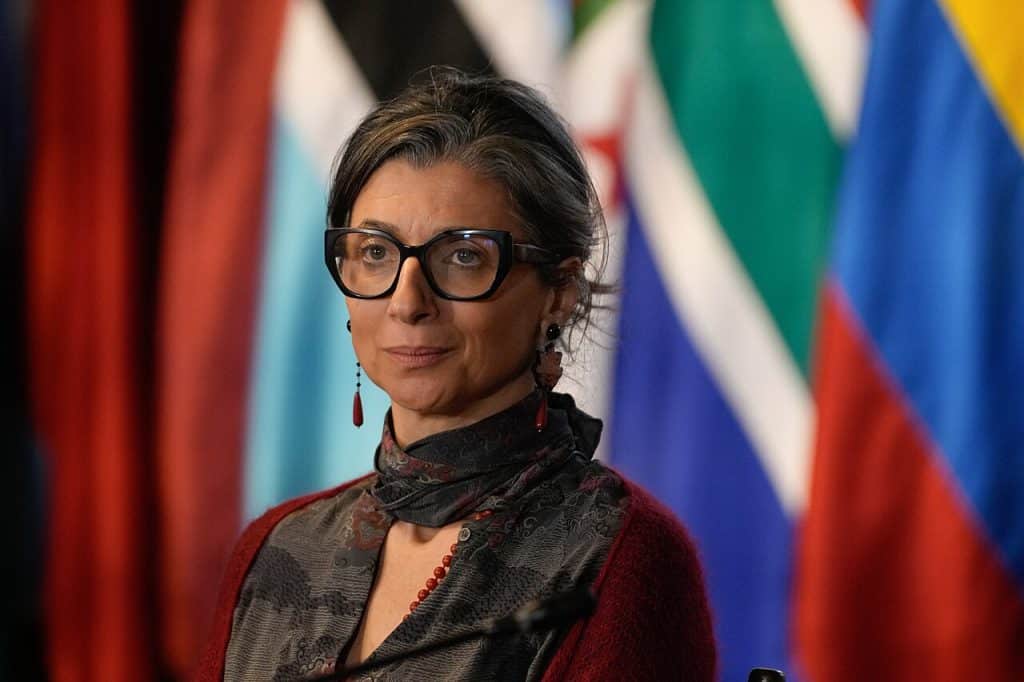
Israel lobby groups have spread doctored quotes by UN Special Rapporteur for Human Rights Francesca Albanese to defame her. Their desperate campaign is a testament to her work and the threat she poses by holding Israel accountable for genocide.

By Michael Lynk, Mondoweiss, February 24, 2026

Francesca Albanese in Bogotá, Colombia, July 2025 (Photo: Andrea Puentes - Joel González/ Presidencia de la República de Columbia) Francesca Albanese in Bogotá, Colombia, July 2025 (Photo: Andrea Puentes – Joel González/ Presidencia de la República de Columbia)
Mark Twain and Winston Churchill are both purported to have once said that a lie can travel half-way around the world before truth has had a chance to put its pants on. 

On February 7, Francesca Albanese, the current UN Special Rapporteur for human rights in Palestine, gave a short presentation by video conference to a media forum in Doha, Qatar, organized by the Al Jazeera network. She was part of a panel, which included Fatou Bensouda, the former Prosecutor of the International Criminal Court, speaking about the role of international law in addressing serious human rights violations. 

In her remarks, Albanese spoke sharply about the Israeli genocide in Gaza since October 2023. In particular, she pointed out that many Western states and corporations had not only armed Israel, but had provided it with economic and diplomatic support throughout the genocide. She also criticized much of the Western media for amplifying the rhetoric of Israel’s pro-apartheid and genocidal narrative. In her presentation, Albanese went on to say that:

“…if international law has been stabbed in the heart, it is also true that never before has the global community seen the challenges that we all face. We, who do not control large amounts of financial capital, algorithms, and weapons, we now see that we, as a humanity, have a common enemy. And freedoms, the respect for fundamental freedoms, is the last peaceful avenue, the last peaceful toolbox that we have to regain our freedom.”

What happened next created a firestorm, based entirely on slander and deception for something she never said.

Albanese’s warning that humanity is facing a common enemy was clearly directed at the international system of finance capital, large tech corporations, and weapons manufacturers that had enabled the genocide in Gaza. She contrasted that system with the rights-based principles of international law, which are designed to protect and enhance our personal and collective freedoms. 

The following day, a doctored version of Albanese’s presentation was posted on the YouTube site of UN Watch, a notorious private organization headquartered in Geneva whose raison d’être is to attack the United Nations’ scrutiny of the many human rights violations committed through Israel’s occupation of the Palestinian territory. The truncated version by UN Watch had Albanese saying: “Instead of stopping Israel, most of the world has armed, given it political excuses, political sheltering, economic and financial support.” And then the video cuts to: “we now see that we as a humanity have a common enemy.” The clear implication in the edited video was that Albanese had called Israel “the common enemy of humanity”. 

This doctored UN Watch video spread like wildfire through the official politico-system of the Global North. French Foreign Minister Jean-Noël Barrot called for Albanese’s immediate resignation for her “outrageous and reprehensible remarks which target not the Israeli government, whose policies can be criticized, but Israel as a people and as a nation, which is absolutely unacceptable.” 

The German Foreign Minister Johann Wadephul piled on, stating that: “Ms. Albanese has already made numerous missteps in the past. I condemn her recent statements on Israel. She cannot hold her position.” Antonio Tajani, the Italian Foreign Minister, said that her “behavior, statements and initiatives aren’t appropriate for the position she holds.” Similar calls were issued by the foreign ministers of Czechia and Austria

Antonio Guterres, the United Nations Secretary General, offered no defence for Albanese, even after the revelation that her alleged comments on Israel had been doctored. During a press conference at the UN headquarters in New York on February 12, Stéphane Dujarric, the official spokesperson for the Secretary General, was asked about the call by the French Foreign Minister for Albanese’s resignation. Dujarric replied laconically that: “We don’t agree with much of what she says.” 

After this initial wave of denunciations, international civil society began to fight back. Albanese, who had been voted by PassBlue as one of the United Nations’ Persons of the Year for 2024, referred to the full transcript of her presentation, and remarked: “I have never, ever, ever said ‘Israel is the common enemy of humanity.’” She pointed to the ongoing campaign of attacks on her by pro-Israeli organizations following the release of her comprehensive recent report to the United Nations on the genocide in Gaza and, in a separate report, the naming of large corporations (including Microsoft and Amazon) as potentially complicit in aiding Israel’s atrocities. 

On February 13, Agnes Callamard, the Secretary General of Amnesty International, issued a public statement condemning the five European foreign ministers who had called for Albanese’s head based on “a deliberately truncated video to misrepresent and gravely misconstrue her messages.” Callamard then contrasted the vehemence of these ministers’ attacks on Albanese with their sotto voce approach to the Israeli genocide in Gaza:

“If only these minsters had been as loud and forceful in confronting a state committing genocide, unlawful occupation and apartheid as they have in attacking a UN expert. Their cowardice and refusal to hold Israel accountable stand in stark contrast to the Special Rapporteur’s unwavering commitment to speaking truth to power.”

Strong statements of support for Albanese have also been issued by Artists for Palestine (whose 100+ signatories included the actors Mark Ruffalo and Javier Bardem, the filmmaker Spike Lee, the British pop singer Annie Lennox, the Nobel Prize Laurate for Literature Annie Ernaux and the critic Judith Butler) and through an open letter signed by 150 former European ambassadors and diplomats and former United Nations officials. The United Nations Office of the High Commissioner for Human Rights also defended Albanese, stating that it was very worried about the rise in personal attacks, threats, and misinformation directed towards UN officials and independent human rights experts. 

United Nations special rapporteurs are unpaid human rights experts appointed by the Human Rights Council for six-year mandates to publicly report on human rights violations and trends worldwide. Former UN Secretary General Kofi Annan called this system of human rights experts, known as special procedures, the “crown jewel” of the UN human rights system. The Special Rapporteur position for human rights in occupied Palestinian territory is, arguably, the most challenging of the approximately 60 UN human rights expert mandates, given the intense attacks that the rapporteurs have recently faced from Israel, the United States, and a suite of pro-Israel organizations such as UN Watch and NGO Monitor. 

UN Watch, in particular, acts as a ventriloquist for Israel’s justification of its illegal occupation and its genocide in Gaza. While presenting itself as a non-governmental human rights organization with official status at the UN, UN Watch’s primary task is to ardently defend Israel, invariably in incendiary language, through a neo-conservative and Likudnik perspective. It has consistently refused to reveal who its funders are, although independent reporting has named the American Jewish Committee and the Newton and Rochelle Becker Foundation as major sources. UN Watch’s many targets — including the most recent UN special rapporteurs on Palestine, the UN Independent Commission of Inquiry on Palestine and Israel, Amnesty International, Human Rights Watch, UNRWA, and countries that are critical of Israel — are frequently labelled as antisemitic individuals and organizations or, slightly more kindly, as being ferociously biased against Israel.

Albanese has also been fiercely attacked by Israel. In 2024, it declared her to be persona non grata, banning her from visiting the occupied Palestinian territory, in part because of her UN reports concluding that Israel was committing genocide in Gaza. In 2025, Israel released a report — drawn largely from UN Watch — where it claimed that she was linked to terrorism (because she spoke at events organized by the Palestinian human rights organizations Al-Haq) and because she supposedly spread “antisemitic rhetoric. And last week, Israel issued an extraordinary tweet on X, claiming that she is a “mouthpiece for Hamas”. This latest smear was issued despite the many times that Albanese has condemned the Hamas’ attacks on October 7 2023 as serious violations of international law because Israel civilians were killed or taken hostage.

For Albanese’s courage in previously naming the Israeli genocide and warning American corporations that their weapons and hi-tech sales to Israel might expose them to criminal liability at the International Criminal Court, American Secretary of State Marco Rubio formally sanctioned her in July 2025. He claimed that: “We will not tolerate these campaigns of political and economic warfare, which threaten our national interests and sovereignty.” 

The American sanctions against a UN human rights expert are unprecedented. They essentially freeze Albanese out of the international banking system. The sanctions have also impounded the condo that she and her husband own in Washington, prevented her from receiving reimbursement for her medical expenses from American insurance companies, and prohibited her from traveling to the United Nations headquarters in New York to deliver her annual reports. Many of her fellow UN human rights experts have publicly condemned the sanctions, pointing out that they violate international law, including the 1946 Convention on the Privileges and Immunities of the United Nations. The human rights experts added that: 

“The targeting of the Special Rapporteur cannot be separated from the egregious international crimes and human rights abuses being perpetrated against Palestinians and the longstanding efforts to delegitimise those who defend their rights.”

More than 100 film artists condemn Berlinale’s censorship of opposition to Israel’s Gaza genocide

February 20, 2026

Stefan Steinberg. WSWS, 20 Feb 2026

This year’s Berlin International Film Festival (Berlinale) has witnessed a growing conflict between a layer of artists determined to speak out against the genocide that has taken place and continues until this day in Gaza, and the Berlin festival management, together with its backers in the German government, determined to keep genocide off the agenda.

Bae Doona, left, and Jury president Wim Wenders attend the press conference for the Jury of the International Film Festival, Berlinale, in Berlin, Thursday, Feb. 12, 2026. [AP Photo/Scott A Garfitt]

An open letter released February 17, and now signed by more than 100 film artists, all of whom have attended previous Berlinales, accuses the film festival of “censoring artists who oppose Israel’s ongoing genocide against Palestinians in Gaza and the German state’s key role in enabling it.”

The signatories include Tilda Swinton, Javier Bardem, Peter Mullan, Mike Leigh, Nan Goldin, Adam McKay, Alia Shawkat, Brian Cox, Hany Abu Assad, Joshua Oppenheimer, Ken Loach, Mahdi Fleifel, Mark Ruffalo, Saleh Bakri and Sarah Friedland.

The open letter raises a serious allegation made by the Palestine Film Institute to the effect that the festival has been “policing filmmakers alongside a continued commitment to collaborate with Federal Police on their investigations.”

The letter refers to those filmmakers who spoke out on behalf of Palestinians and their rights on the Berlinale stage at the 2025 festival being aggressively reprimanded by senior festival programmers. The letter cites one film worker who told Film Workers for Palestine​: “there was a feeling of paranoia in the air, of not being protected and of being persecuted, which I had never felt before at a film festival.”

The open letter also deplores the statement made at the opening of the festival that artists should “stay out of politics”: The artists write:

We fervently disagree with ​the statement made by Berlinale​ 2026 jury president Wim Wenders​ that filmmaking is “the opposite of politics”​. You cannot separate one from the other. We are deeply concerned that the German state-funded Berlinale is helping put into practice what Irene Khan, the UN Special Rapporteur on Freedom of Expression and Opinion recently condemned as Germany’s misuse of draconian legislation “to restrict advocacy for Palestinian rights, chilling public participation and shrinking discourse in academia and the arts.”

​The letter quotes the Chinese artist and dissident Ai Weiwei who described what was happening in Germany as “doing what they did in the 1930s.”​

The public appeal points to the joint role of the US and German governments in supplying Israel with the weapons (including internationally forbidden US-made thermal and thermobaric weapons) it requires to continue its campaign of ethnic cleansing and genocide.

Noting that previous Berlinales had publicly condemned “atrocities ​carried out against​ people in Iran and Ukraine,” the letter concludes:

We call on the Berlinale to fulfil its moral duty and clearly state its opposition to Israel’s genocide, crimes against humanity and war crimes against Palestinians, and completely end its involvement in shielding Israel from criticism and calls for accountability.

In another significant development, Kaouther Ben Hania, director of the award-winning film The Voice of Hind Rajab, refused to accept the “Most Valuable Film” award handed out at the Cinema for Peace ceremony in Berlin this week after an Israeli general was recognized at the same gathering. Also in attendance at the “peace” gathering was the former US Secretary of State and war criminal Hillary Clinton.

The Voice of Hind Rajab

While Cinema for Peace is not officially a part of the Berlinale, the gathering has been held since 2002 on a yearly basis to run parallel to the film festival and attract the same audience.

In refusing to take her award, Ben Hania said: “The Israeli army killed Hind Rajab; killed her family; killed the two paramedics who came to save her, with the complicity of the world’s most powerful governments and institutions.”

“I refuse to let their deaths become a backdrop for a polite speech about peace. Not while the structures that enabled them remain untouched,” she continued.

Ben Hania added that the death of the six-year-old Hind was “not an exception, it’s part of a genocide,” and she criticized those who described large-scale civilian killings as “self-defense” or “complex circumstances” while repressing all opposition.

“Peace requires justice and accountability, not glossy slogans,” she concluded.

In response to the artists’ open letter directed toward the Berlinale, its management and supporters in the German media have gone into overdrive to defend the festival’s stance.

Festival director Tricia Tuttle issued a statement, evasively declaring: “We are representing lots of people who have different views, including lots of people who live in Germany who want a more complex understanding of Israel’s positionality than maybe the rest of the world has right now.”

In one short paragraph, Tuttle repeats the phrase complex/complexity in relation to Israel three times—the very same words Kaouther Ben Hania criticised in her award rejection speech!

What is Tuttle talking about! There is no “complexity” when it comes to taking sides on the issue of genocide.

On the one side, are the broad masses of the world’s population who increasingly regard Israel as a pariah state responsible for one of the worst acts of genocidal violence since the Holocaust. This opposition, which has taken the form of numerous mass protests, demonstrations and strikes, also extends to those countries which are the closest allies of the state of Israel, the US, Germany, Great Britain and France. 

Basel Sadra (left) and Yuval Abraham in 2025. [AP Photo/Markus Schreiber]

On the other side, are the governments listed above, together with bourgeois regimes and nominal opposition parties all over the world that continue to aid and maintain relations with the war criminals in Tel Aviv, thus making a continuation of the genocide possible.

In Germany, it should be noted, it was a Green Party Culture Minister Claudia Roth who in 2024 denounced a Berlinale jury team as antisemitic for awarding a prize to the film No Other Land, which documents the crimes of the Israeli army and government against the Palestinian population in the West Bank. More recently, a leading member of the Left Party, Andreas Büttner, raised false claims of antisemitism to close down an art exhibition held in Potsdam defending the rights of Palestinians.

The stirrings of opposition among film workers to the complicity of cultural institutions in supporting genocide is to be welcomed. At the same time, those engaged in the culture industry in Germany should take note. The comment made by a Palestine film worker cited in the open letter, “there was a feeling of paranoia in the air, of not being protected and of being persecuted, which I had never felt before at a film festival,” recalls a similar comment by UN Special Rapporteur Francesca Albanese.

A year ago, Albanese was prevented from holding lectures in Germany on the situation in Gaza. Responding to the threats and intimidation she had faced in Germany, Albanese commented: “I have to admit that about 75 hours in this country have made me pretty nervous and I cannot wait to get back to ‘peaceful’ Tunisia [where she is a resident]. I have never felt this sense of lacking oxygen that I feel here.”

This process is not restricted to Germany. Across the globe, governments and a host of official institutions are using police-state methods, recalling actions taken by fascist governments in the 1930s, to arrest, intimidate, imprison without due process and violently repress opposition to the mass slaughter in Gaza. Genocide is being normalised by these forces in order to justify new wars and new atrocities directed at the broadest layers of the world population.  

US Plans To Build a 5,000-Person Military Base in Gaza for International Force

February 20, 2026

President Trump said on Thursday that the US will also contribute $10 billion to the so-called ‘Board of Peace’

by Dave DeCamp | February 19, 2026 at 3:12 pm ET | Gaza

The Trump administration is planning to build a 5,000-person military base inside Gaza, the Guardian reported on Thursday, citing contracting records from the so-called “Board of Peace.”

The report said that the base would take up more than 350 acres of land in southern Gaza and is envisioned as a future base for the international force that may deploy to the Strip under President Trump’s plan for the Palestinian territory, though so far, only Indonesia has announced plans to commit troops to the force.

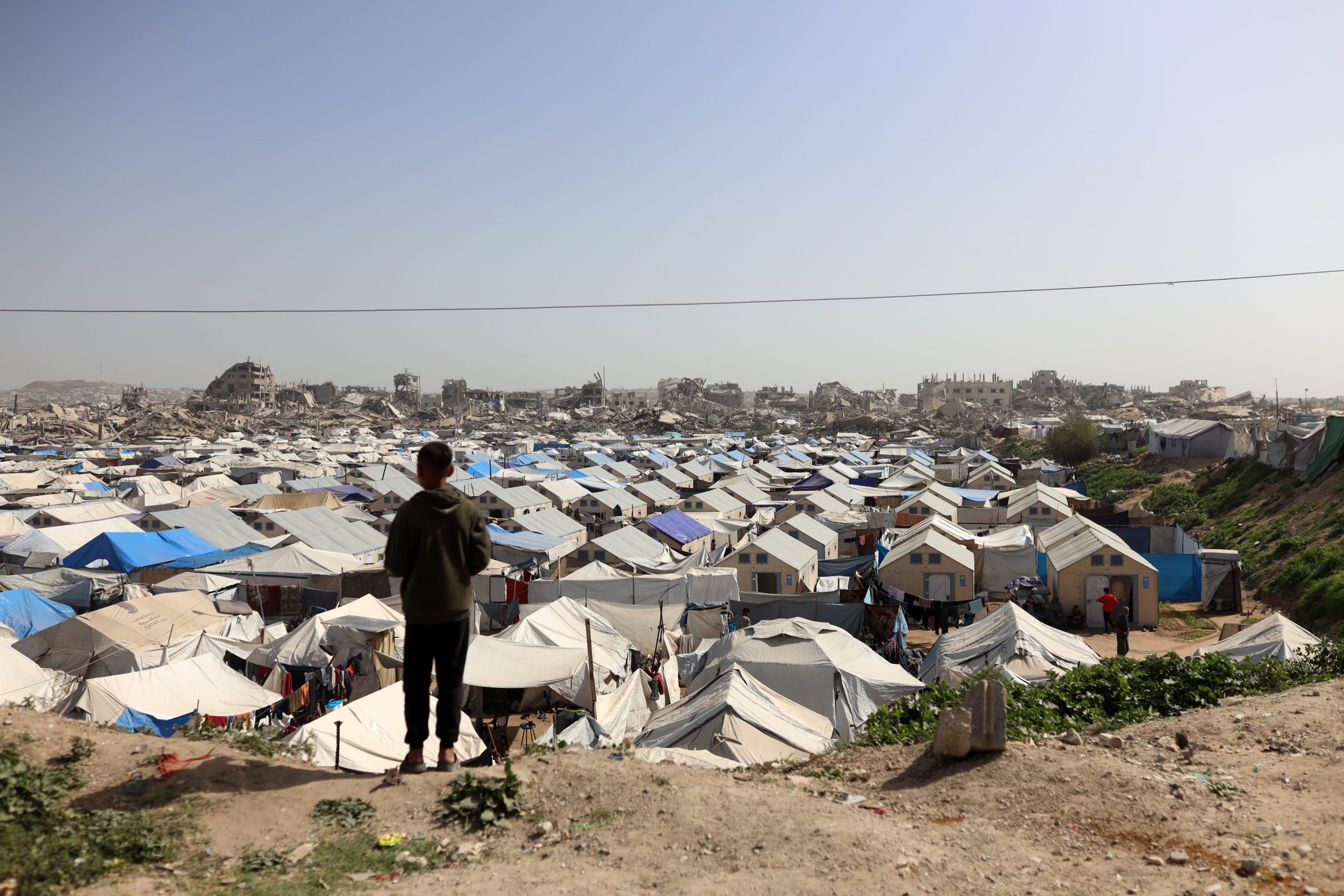
A photograph shows tents at a makeshift camp sheltering displaced Palestinians in the Zeitoun neighborhood of Gaza City, on February 16, 2026. (Photo by Majdi Fathi/NurPhoto)

The Guardian said that the plans it reviewed “call for the phased construction of a military outpost that will eventually have a footprint of 1,400 metres by 1,100 metres, ringed by 26 trailer-mounted armored watch towers, a small arms range, bunkers, and a warehouse for military equipment for operations. The entire base will be encircled with barbed wire.”

The contracting document includes protocol for what happens if construction teams come across human remains, since the bodies of at least 8,000 Palestinians are missing under the rubble. “If suspected human remains or cultural artifacts are discovered, all work in the immediate area must cease immediately, the area must be secured, and the Contracting Officer must be notified immediately for direction,” the document says.

It’s unclear how much the base would cost to build, but earlier reports suggested the US was planning to construct a major military facility on the Gaza border at a cost of between $500 million and $600 million.

Trump convened his first “Board of Peace” meeting in Washington on Thursday, which came as Israel continues to violate the ceasefire deal, killing more than 600 Palestinians in the Strip since it was signed. At the event, Trump pledged that the US would contribute $10 billion to the board.

Under Trump’s plan for Gaza, the international force is supposed to replace IDF soldiers, who continue to occupy more than 50% of the Strip. But there’s no timeline on when that would happen, and Israel is threatening to restart its full-scale genocidal war if Hamas doesn’t disarm.

The Increasing Attacks on Francesca Albanese Presage a New Dark Age

February 18, 2026

Chris Hedges

Feb 16, 2026

Full Text:

The vicious and sustained campaign mounted against Francesca Albanese, the UN Special Rapporteur on the situation of human rights in the Palestinian Territory occupied since 1967, by Israel and the U.S. now includes the German, Italian, French, Austrian and Czech foreign ministers demanding her resignation. This campaign is part of an effort by industrial nations to at once sustain the genocide in Gaza — nearly 600 Palestinians have been killed in Gaza since the sham ceasefire took effect — and silence all those who demand the international community abide by the rule of law.

The latest assault on Francesca, part of a concerted effort to discredit international bodies such as the U.N., is based on a deliberately truncated video of a talk Francesca gave in Doha on February 7 that distorts and misconstrues her words. But truth, of course, is irrelevant. The goal is to silence her and all who stand up for Palestinian rights.

Francesca was placed by the Trump administration on the Office of Foreign Assets Control list of the U.S. Treasury Department — normally used to sanction those accused of money laundering or being involved with terrorist organizations — six days after the release of her report, “From economy of occupation to economy of genocide,” which documented the global corporations that make billions of dollars from the genocide in Gaza and occupation of Palestinians.

The Office of Foreign Assets Control list — weaponized by the Trump administration to persecute Francesca and in violation of the diplomatic immunity granted to U.N. officials — bans her from entering the U.S. It prohibits any financial institution from having her as a client. A bank that engages in financial transactions with Francesca is banned from operating in dollars, faces multimillion-dollar fines and is blocked from international payment systems. This has cut her off from global banking, leaving her unable to use credit cards or book a hotel in her name. Her assets in the U.S. are frozen. It has seen her medical insurance refuse to reimburse her for medical expenses. It has resulted in institutions, including U.S. universities, human rights groups and NGOs that once collaborated with her severing ties, fearing onerous U.S. penalties. The sanctions followed those imposed in February and June of last year on The International Criminal Court’s prosecutor Karim Khan along with two judges for issuing arrest warrants for Israeli Prime Minister Benjamin Netanyahu and former Defense Minister Yoav Gallant.

By making Francesca, who receives frequent death threats, the lightening rod, these governments seek to deflect attention from the ongoing slaughter and humanitarian disaster in Gaza. They seek to mask Israel’s system of apartheid and unlawful occupation of historic Palestine. They seek to hide, most of all, their complicity with their continuing weapons shipments that fuel Israel’s genocide.

The pace of the genocide has slowed, but it has not stopped. Israel has seized 60 percent of Gaza and blocks most humanitarian aid, including fuel, food and medicine. At the same time, Israel is accelerating its seizure of the occupied West Bank, where more than 1,100 Palestinians have been killed and tens of thousands have been displaced from their homes since October 2023.

The campaign against Francesca presages a terrifying world where Western industrial nations exploit and prey upon the weak, where the law is whatever powerful nations say it is, where those who dare to speak the truth and stand up for the rule of law are relentlessly persecuted, where genocide is another tool in the arsenal to crush the aspirations and rights of the vulnerable. This is a fight we must win. If we lose, if we let voices like Francesca’s be silenced, we will usher in an age of blood and terror.


The Chris Hedges Report is a reader-supported publication. To receive new posts and support my work, consider becoming a free or paid subscriber.

Thousands of Western nationals fought Israel’s war on Gaza: What to know

February 16, 2026

Thousands of Western nationals joined the Israeli military in its genocidal war on Gaza that killed over 72,000 Palestinians.

At least 12,135 soldiers enlisted in the Israeli military hold United States passports
At least 12,135 soldiers enlisted in the Israeli military hold United States passports [File: Nasser Ishtayeh/SOPA Images/LightRocket via Getty Images]

By Yashraj Sharma

Aljazeera, 15 Feb 2026

Share

Thousands of Western nationals joined the Israeli military amid its genocidal war in Gaza, raising questions over international legal accountability for foreign nationals implicated in alleged war crimes against Palestinians.

More than 50,000 soldiers in the Israeli military hold at least one other citizenship, with a majority of them holding US or European passports, information obtained by the Israeli NGO Hatzlacha through Israel’s Freedom of Information Law has revealed.

Recommended Stories

list of 4 items

end of list

Since October 7, 2023, Israel’s genocidal war on Gaza has killed at least 72,061 people in military actions that have been dubbed war crimes and crimes against humanity by rights groups.

Rights organisations around the world have been trying to identify and prosecute foreign nationals, many of whom have posted videos of their abuse on social media, for their involvement in war crimes, particularly in Gaza.

So, what does the first such data reveal about the Israeli military? And what could be the legal implications for dual-national soldiers?

idf
An Israeli soldier pushes a Palestinian man while military bulldozers demolish three Palestinian-owned houses in Shuqba village, west of Ramallah in the Israeli-occupied West Bank on January 21, 2026 [Zain Jaafar/AFP]

Which foreign nationals enlist most in the Israeli military?

At least 12,135 soldiers enlisted in the Israeli military hold United States passports, topping the list by a huge margin. That is in addition to 1,207 soldiers who possess another passport in addition to their US and Israeli ones.

The data – shared with Al Jazeera by Israeli lawyer Elad Man, who serves as the legal counsel for Hatzlacha – shows that 6,127 French nationals serve in the Israeli military.

The Israeli military, which shared such data for the first time, noted that soldiers holding multiple citizenships are counted more than once in the breakdown.

The numbers show service members enlisted in the military as of March 2025, 17 months into Israel’s devastating war in Gaza.

Russia stands at third, with 5,067 nationals serving in the Israeli military, followed by 3,901 Ukrainians and 1,668 Germans.

The Guardian view on Israel and the West Bank: the other relentless assault upon Palestinians

February 14, 2026

Editorial

A campaign of ethnic cleansing and ‘tectonic’ new legal measures are killing the two-state solution to which other governments pay lip serviceThu 12 Feb 2026 20.05 CET

Protecting archaeological sites. Preventing water theft. The streamlining of land purchases. If anyone doubted the real purpose of the motley collection of new administrative and enforcement measures for the illegally occupied West Bank, Israel’s defence minister spelt it out: “We will continue to kill the idea of a Palestinian state,” Israel Katz said in a joint statement with the finance minister, Bezalel Smotrich.

While the world’s attention was fixed upon the annihilation in Gaza, settlers in the West Bank intensified their campaign of ethnic cleansing. More than 1,000 Palestinians have been killed there since October 2023; a fifth of them were children. Many more have been driven from their homes by relentless harassment and the destruction of infrastructure, with entire Palestinian communities erased across vast swathes of land.

The Israeli state is not merely complicit in these acts. In addition to the economic suffocation and increased military raids in the West Bank, the Guardian reported last month that settler-only units of the army are acting as “vigilante militias”. Haaretz newspaper reports that the military has ordered soldiers to prevent Palestinians from ploughing their land at the behest of settlers – not only threatening them with destitution, but paving the way for land seizure.

With Israel heading to elections in months, Benjamin Netanyahu’s far-right coalition partners are in a hurry. While they and their allies have changed the facts on the ground dramatically, and have steadily expanded Israel’s control, the bureaucratic measures adopted by the security cabinet last Sunday are “tectonic”, as one scholar notes. They ease land theft, stripping away the very limited constraints on purchase, and destroy the nominal authority of Palestinians in areas A and B.

The White House has reiterated Donald Trump’s opposition to annexation, but talks with Mr Netanyahu in Washington on Wednesday focused on Iran. To the extent that the US president thinks about Palestinians at all, he thinks about Gaza. Yet this cannot be treated separately from the West Bank. Arab and Islamic states central to his peace plan have warned that the new measures will “inflame violence, deepen the conflict and endanger regional stability and security”.

The declaration of a ceasefire in Gaza – which has not stopped the Israeli military killing Palestinians there either – has reduced the political pressure on other governments to act. There are no signs that the outrage at last Sunday’s decision will translate into action. The UK “strongly condemns” the measures. The EU said that sanctions were “still on the table” but is clearly in no hurry to act. Within Israel, only a handful dissent.

Hunger and desperation endure in Gaza while the Trump administration promotes fantastical visions of a glittering skyline. Israel has demolished the East Jerusalem headquarters of the United Nations Relief and Works Agency (Unrwa), the UN body which supports millions of Palestinian refugees, and is booting out NGOs, including Médecins Sans Frontières, from across occupied Palestine.

In 2024, the UN’s international court of justice ruled that Israel should end its illegal occupation as quickly as possible. Last year international outrage over Gaza forced multiple governments, including the UK, to recognise a Palestinian state, dragged by their publics. Those symbolic announcements look increasingly hollow. Real action cannot wait, for Israel’s government will not.

Washington’s Gaza ‘master plan’: A mere PowerPoint presentation

February 13, 2026

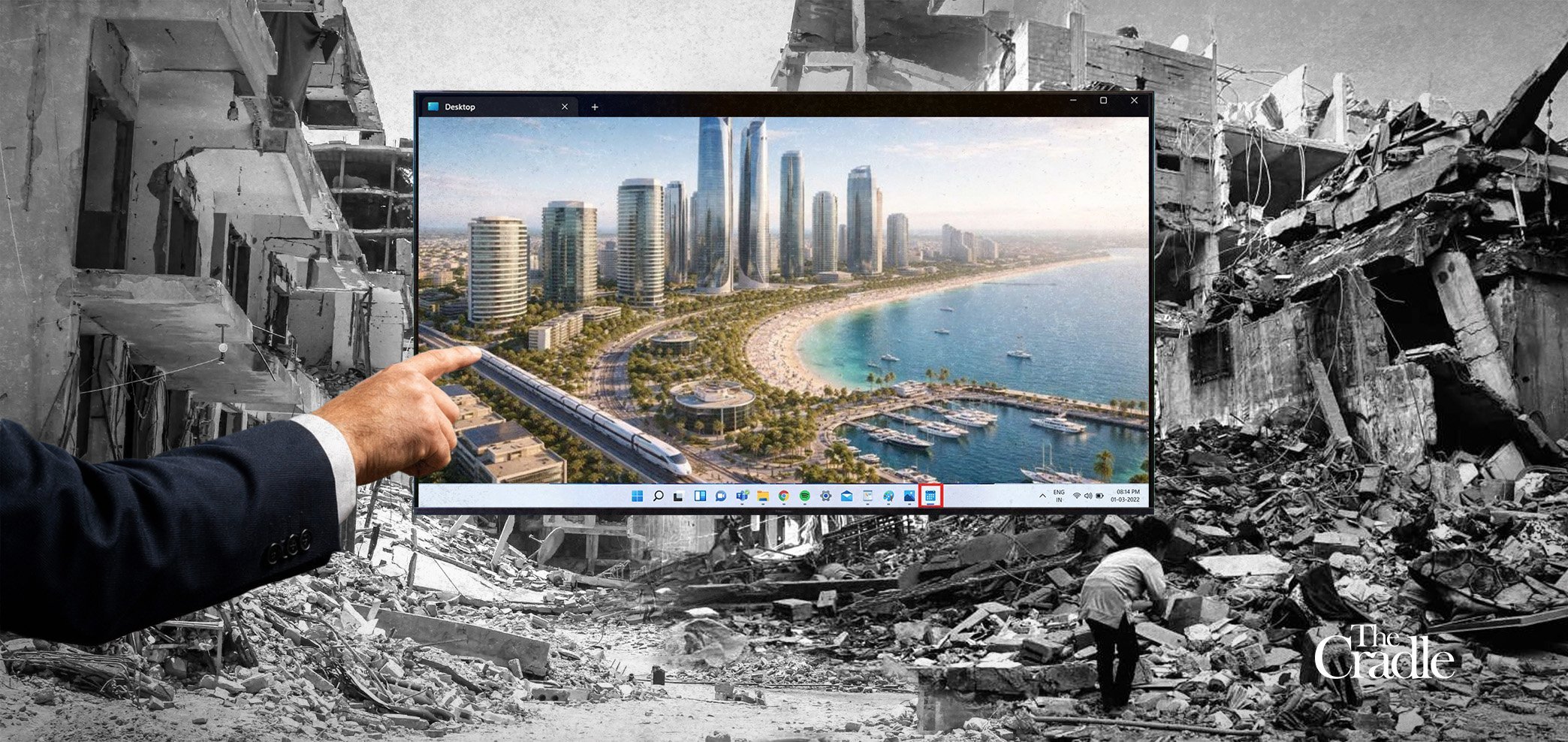
Trump allies are selling Gaza reconstruction as a futuristic AI-powered utopia that not even the Israeli army believes will happen.

The Cradle, Robert Inlakesh

FEB 10, 2026

Photo Credit: The Cradle

“We have a master plan … There is no Plan B,” remarked Jared Kushner last month, during a Board of Peace (BoP) presentation about Gaza reconstruction at the World Economic Forum (WEF) at Davos. What has become apparent is that no coherent Plan A exists either.

Although Kushner’s father-in-law, US President Donald Trump, was granted the legitimacy to build what he calls the BoP on the back of pledges to implement his “20-point peace plan” and Gaza ceasefire, the BoP’s charter is notably absent of any reference to Gaza.

Furthermore, United Nations Security Council (UNSC) resolution 2803, which legally authorized the BoP and was explicitly about the Gaza ceasefire, was deliberately vague on how any concepts proposed in the resolution would be implemented. It deliberately avoided outlining any mechanisms or obligations for reconstruction. Instead, two parallel schemes emerged.

The first was the Gaza Reconstitution, Economic Acceleration and Transformation Trust (GREAT Trust) – a 38-page document proposing to pay Palestinians $5,000 each to leave the territory. Crafted by Israeli figures previously involved in the discredited Gaza Humanitarian Foundation (GHF), the plan, which envisions “AI-powered, smart cities,” was less a roadmap for peace than a blueprint for ethnic cleansing. 

That same foundation, backed by US private military contractors (PMCs), had already drawn international condemnation for herding civilians into “aid zones” only to open fire. More than 2,000 Palestinians were killed in those operations.

PowerPoint colonialism 

Later, in December, the Wall Street Journal  (WSJ) exposed that another proposal was put into circulation among US-allied nations in the Arab and Muslim world. The 32-page PowerPoint presentation, titled “Project Sunrise,” was set forth by Kushner and US envoy Steve Witkoff.

Like the preceding proposal, the new vision outlined a similar AI-smart city model, but added even more elements, such as high-speed rail infrastructure. According to the PowerPoint slides, the total cost of this 10-year reconstruction endeavor would amount to $112.1 billion, for which the US would commit to footing 20 percent of the bill. 

Back then, Steven Cook, a senior fellow for the Middle East Program at the Council on Foreign Relations think tank, told WSJ that “they can make all the slides they want,” adding that “no one in Israel thinks they will move beyond the current situation and everyone is okay with that.” US Secretary of State Marco Rubio had even expressed his concerns over how realistic the plan will be, especially when it comes to potential foreign investment.

Then came Kushner’s presentation at Davos, which instantly made headlines and was presented as a brand new proposal called the “master plan.” According to Kushner, the project for a “new Gaza” would now only cost $25 billion

However, upon further investigation, it is clear that what Kushner was presenting was simply “Project Sunrise,” which was evident as the PowerPoint he used was filled with the same exact slides from December. In other words, nothing particularly new was being placed on the table that had not already been released over a month prior.

“New Gaza” is a lab rat colony

Speaking to The Cradle, Akram, a Gaza resident from Al-Bureij, states that the situation on the ground does not reflect any of the positivity that appears in the media. “The Israelis won’t let us even have mobile homes or proper structures to live in, they still bomb us every day, and then we see AI images of Gaza becoming richer than Israeli cities?” he says, with bitter sarcasm. He added:

“Listen, do you really think they carried out genocide for two years and destroyed all our homes, only to build us a paradise, and that this will all happen if the resistance gives up its weapons? No. They are trying to tease us, like they always did, by saying, ‘if you give up your weapons, you will become Singapore.’ Nobody believes it.”

Shortly after Akram spoke to The Cradle, Israeli Prime Minister Benjamin Netanyahu delivered a speech to a special session of the Knesset, in which he made it clear that “the next stage is not reconstruction.” Instead, he asserted that disarmament would characterize Phase 2 of the ceasefire. 

In his “master plan” presentation, Kushner claimed that the major task of clearing Gaza’s rubble would only take two to three years. Yet, according to UN figures, this task was estimated to take up to 15 years, with costs expected to exceed $650 million. 

These figures are also dated, having been produced in July 2024, so they do not account for over a year of destruction. Israel has not stopped its round-the-clock demolition of Palestinian infrastructure since the so-called ceasefire took effect on 8 October 2025.

A humanitarian NGO official working in Gaza tells The Cradle that even the ceasefire’s Civil Military Coordination Center (CMCC), ostensibly set up to enforce humanitarian standards, now functions as a system of “intimidation” that “violates basic morality.”

On 21 January, Drop Site News reported on leaked documents that revealed plans to create an “Israeli Panopticon” city, to be constructed in territory remaining under its control in southern Gaza’s Rafah. The Guardian then reported that the UAE is seeking to bankroll the project. The leaked blueprints described a “case study” city where residents would be monitored around the clock, like lab rats, and forced to submit biometrics to enter.

Rafah as the prototype prison

The UAE has been accused of backing the five ISIS-linked militant groups Israel created to fight Hamas, which it previously intended to rule over a similar style concentration camp city in Rafah. In fact, Israeli Defense Minister Israel Katz had even ordered the construction of such a “community” during the 60-day ceasefire in early 2025. The Israelis have long intended to displace 600,000 Palestinians to such a gated facility.

The Emirati connection in this scheme goes beyond its recent offer to fund such a concentration camp city; it dates all the way back to January 2024, when it officially opened six water desalination plants along the Egyptian side of the Gaza border area, coincidentally capable of supplying 600,000 people with water.

Prior to the ceasefire and the collapse of the privatized aid scheme, the plot was to use the GHF PMCs in order to lure civilians into such a city area. Once they get there, the Palestinians who enter would be under the rule of Israel’s ISIS-linked proxy militias. 

According to forensic architecture analysis, Israel is once again preparing land in order to implement such a project. Meanwhile, UG Solutions – the firm that hired the GHF’s PMCs – is again advertising job opportunities in the besieged territory.

Dispossession in disguise

Despite the dizzying array of slogans – BoP, GREAT, Sunrise, Panopticon – the outcome remains the same with no reconstruction, no sovereignty, and no end to occupation. The various schemes are less about peace and more about forcing Palestinians into containment zones policed by Tel Aviv and its regional clients.

From “Gaza Riviera” fantasies to proposals limiting reconstruction to areas under Israeli military control, what’s on offer amounts to PowerPoint projectionism. A revolving door of schemes and slogans has produced nothing substantive. Instead, the Israeli military continues its daily war of erasure on Gaza’s land, people, and future.

Even Kushner’s $25-billion fantasy is just that: a fantasy. In the three months since the UN resolution, all Washington has offered is AI-generated cityscapes and recycled decks. The only real plan on the table remains the one being implemented daily – the destruction of Gaza.

UK: High Court finds Palestine Action ban unlawful and should be ‘quashed’

February 13, 2026

Judgment follows judicial review challenging ban brought by Palestine Action’s co-founder Huda Ammori

A protestor shouts through a megaphone outside The Royal Courts of Justice, Britain’s High Court, in London on 13 February 2026 (Ben Stansall/AFP)

By Areeb Ullah

MEE, 13 February 2026 10:09 GMT

England’s High Court has ruled that the UK government’s ban on Palestine Action is “unlawful” after a months long legal battle with the British government.

Justice Victoria Sharp has told the court that the proscription of Palestine Action “did result in a very significant interference with the right of freedom of speech and freedom of assembly”.

The ruling found that the decision to proscribe the group was discriminatory, however the ban remains in force until a further order by the court.

The judgement ruled that “a very small number of Palestine Action’s activities amounted to acts of terrorism” as defined by terror legislation.

Friday’s judgment follows a judicial review challenging the July 2025 ban brought by Palestine Action co-founder Huda Ammori.

New MEE newsletter: Jerusalem Dispatch

Sign up to get the latest insights and analysis on Israel-Palestine, alongside Turkey Unpacked and other MEE newsletters

Ammori hailed the landmark ruling as a “monumental victory both for our fundamental freedoms here in Britain and in the struggle for freedom for the Palestinian people, striking down a decision that will forever be remembered as one of the most extreme attacks on free speech in recent British history”.

Ammori added that the ban resulted in “unlawful” arrests of “nearly 3,000 people – among them priests, vicars, former magistrates and retired doctors” under terrorism laws for holding signs in support of the direct action group.

“It would be profoundly unjust for the government to try to delay or stop the High Court’s proposed order quashing this ban while the futures of these thousands of people hang in the balance,” she said.

Responding to the ruling, UK director of Human Rights Watch Yasmine Ahmed said it was a “shot in the arm for British democracy at a time when it is facing a barrage of attacks by this government to undermine our rights to freedom of assembly, expression, and speech”.

“Palestine Action is not a terrorist organisation and should never have been designated a terrorist organisation,” she said.

“Today’s verdict reinforces what many of us having been saying all along – that the government’s misuse of terrorism legislation was a brazen and gross abuse of power that served to stifle legitimate criticism of Israel and those profiting from its atrocities.”

The ban, introduced in July 2025, made membership of the group, public expressions of support for it, or the display of its symbols criminal offences punishable by up to 14 years in prison under Britain’s terrorism laws.

Since the ban on Palestine Action, hundreds of people protesting the proscription and Israel’s genocide in Gaza have been arrested and charged with terror charges.

The government outlawed the group days after activists, protesting the genocide in Gaza, broke into an air force base in southern England and targeted aircraft with paint and crowbars that Palestine Action alleged were used to support the war. The British government alleged that the incident caused an estimated £7m ($9.3m) of damage to two aircraft.

In written court submissions, the Home Office argued that actions “can constitute terrorism if they involve serious property damage even if it does not involve violence against any person or endanger life”.

“Proscribed organisations are deprived of the oxygen of publicity as well as financial support,” the government submissions noted.

Meanwhile, the Home Office’s lawyer Natasha Barnes argued the ban “has not prevented people from protesting in favour of the Palestinian people or against Israel’s action in Gaza”.

This is a developing story…