By Linus Höller, Defense News, Feb 23, 2026, 11:54 AM
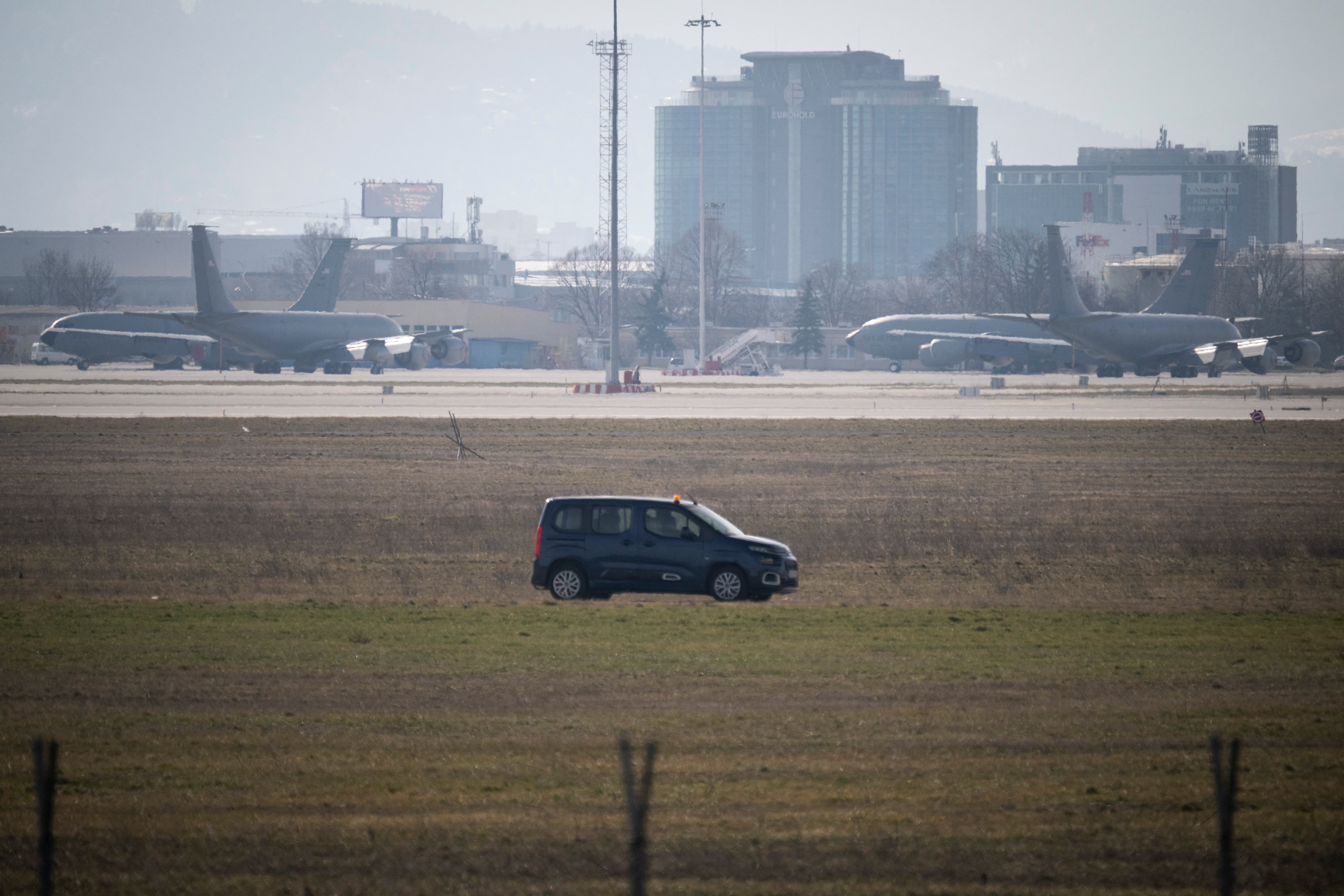
Four U.S. Air Force Boeing KC-135 Stratotanker air refueling aircraft are parked at Sofia’s Vasil Levski Airport on Feb. 19, 2026. (Nikolay Doychinov/AFP via Getty Images)
BERLIN — Bulgaria’s Sofia International Airport briefly suspended civilian air operations twice over the weekend while a fleet of American military aircraft staged at the facility, fueling speculation that Washington is positioning forces ahead of a potential strike on Iran.
A Notice to Airmen (NOTAM), verified by the Bulgarian investigative outlet Obektivno.BG, showed the airport restricted non-military operations on Feb. 23 from 01:15 to 02:50 local time and again on Feb. 24 from 01:05 to 03:35. Commercial flights are not ordinarily scheduled during this time frame.
Airport authorities attributed the brief closures to routine runway repairs and explicitly denied any link to the American military presence.
Photographs circulating on social media showed at least six KC-135 Stratotanker refueling aircraft from the 6th Air Refueling Wing at MacDill Air Force Base, Florida, along with C-17 and C-130 cargo planes and Boeing 747s typically used for troop transport, parked at the airport’s Terminal 1, according to Obektivno.BG.
Bulgaria’s Ministry of Defense confirmed the U.S. Air Force presence, describing the deployment as support for “training related to NATO’s enhanced vigilance activities,” with American personnel engaged solely in aircraft maintenance. Caretaker Foreign Minister Nadezhda Neynsky acknowledged her ministry had limited information and had ordered officials to collect additional details.
The Sofia staging is a small part of a much larger American military mobilization. The Bulgarian investigative journalists have tracked more than 120 U.S. Air Force aircraft that crossed the Atlantic within days, including four dozen F-16s, three squadrons of F-35A stealth fighters, and 12 F-22 Raptors.
Similar deployments, including F-22s staged at RAF Lakenheath, preceded last June’s Operation Midnight Hammer strikes on Iranian nuclear facilities. The USS Gerald R. Ford carrier strike group is also en route to join the USS Abraham Lincoln, which is already positioned in the Arabian Sea.
U.K. Prime Minister Keir Starmer has refused to grant Washington permission to use two critical British-controlled installations − RAF Fairford in Gloucestershire, the European forward base for U.S. heavy bombers including the B-2 and B-52, and the joint US-UK facility at Diego Garcia in the Indian Ocean − for any potential strike on Iran, The Times of London reported.
The buildup coincides with high-stakes nuclear diplomacy. American President Donald Trump, speaking at the inaugural meeting of his Board of Peace on Feb. 19, said he had given Tehran roughly ten days to reach a nuclear agreement, warning that “bad things will happen” if talks collapse. U.S. envoys Steve Witkoff and Jared Kushner met an Iranian delegation in Geneva last week, with Iran’s Foreign Minister Abbas Araghchi describing agreement on a set of “guiding principles,” though significant gaps remain between the two sides.
Bulgaria, a NATO member since 2004, maintains a Defense Cooperation Agreement with Washington signed in 2006 that permits U.S. forces to use Bulgarian military facilities.
Linus Höller is Defense News’ Europe correspondent and OSINT investigator. He reports on the arms deals, sanctions, and geopolitics shaping Europe and the world. He holds a master’s degrees in WMD nonproliferation, terrorism studies, and international relations, and works in four languages: English, German, Russian, and Spanish.
According to The Washington Post, the US has shifted at least 150 military aircraft to Europe and the Mideast over the past week as it prepares for a potential attack on Iran
Twelve US F-22 Raptor fighter jets that departed the UK on Tuesday have arrived at an Israeli Air Force base in southern Israel, Ynet has reported, as the US continues its massive military buildup in the Middle East to prepare for a potential attack on Iran.
The F-22s arrived in the UK last week, part of the more than 150 US military aircraft that have shifted to Europe and the Middle East since February 17, as tracked by The Washington Post.
An Israeli official speaking to China’s Xinhua news agency about the US F-22 deployment said that the Israeli military is preparing for all possible scenarios, including an “Iranian attack or retaliatory strike.” The US defended Israel from Iranian retaliatory strikes during the 12-Day War in June 2025, though many missiles got through US air defenses.
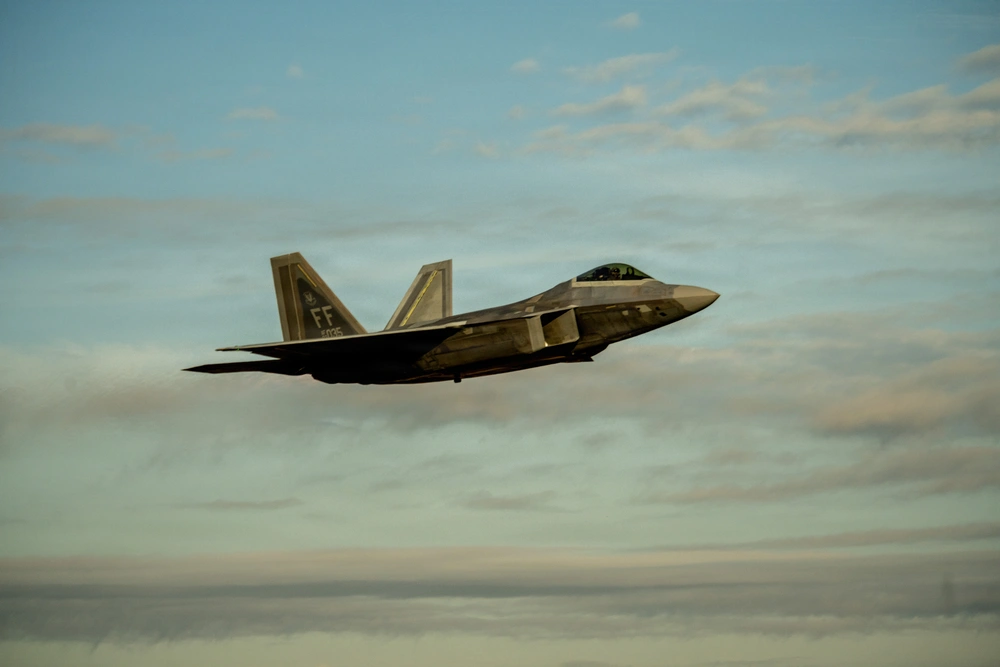
A US F-22 Raptor fighter jet takes off from the Savannah Air National Guard Base in Georgia on January 23, 2026 (US Air National Guard photo)
The Ynet report said that the aircraft carrier USS Gerald Ford is still heading east in the Mediterranean Sea and has passed Crete. Once it arrives near Israel’s coast, it will be the second US aircraft carrier positioned in the region to prepare for an attack on Iran, joining the USS Abraham Lincoln, which has been operating in the Arabian Sea.
US officials previously told The New York Times that Ford and its three destroyer escorts are likely to be initially deployed near the coast of Israel to defend Tel Aviv and other Israeli cities and towns. The US defended Israel from Iranian counterattacks during the 12-Day War, though many Iranian missiles got through US air defenses, which included US Navy destroyers firing SM-3 missiles.
The Ford was deployed to the Mediterranean after spending several months in the Caribbean, where it supported “Operation Southern Spear,” the US military mission that involved bombing small boats and the attack on Venezuela to abduct Venezuelan President Nicolas Maduro. The crew of the Ford has been on an extended deployment and will break the post-Vietnam War US carrier deployment record if it remains at sea through mid-April.
An Air Force E-3 Sentry airborne warning and control system aircraft conducts aerial operations. [Photo: Air Force Master Sgt. Matthew Plew ]
The Trump administration is assembling the largest concentration of American military force in the Middle East since the 2003 invasion of Iraq, placing the United States on the brink of a massive illegal war against Iran that could last weeks or months and engulf the entire region.
Robert Pape, a professor of political science at the University of Chicago and one of the foremost analysts of American air power, wrote on X Saturday: “This represents 40-50% of the deployable US air power in the world. Think air power on the order of the 1991 and 2003 Iraq war. And growing. Never has the US deployed this much force against a potential enemy and not launched strikes.”
The Jerusalem Post and the Media Line, in an article published Saturday, reported that there are “now four American carrier strike groups either in the wider Middle East or moving toward it. That alone changes the equation. In the surrounding waters, roughly a dozen guided-missile destroyers are spread out, some near the Strait of Hormuz, others operating closer to the Red Sea.” These publications are the only outlets to report that four carrier strike groups are involved in the buildup.
Col. Richard Kemp, a former commander of British forces in Afghanistan, told the Media Line: “As I understand it, this is the biggest military buildup in the Middle East since 2003.” He described the current scale as greater than the 12-day war in June 2025. “It could run into weeks,” he said. “It could well be a fairly long, sustained bombing campaign against Iran.” Of the force now assembled, he said: “It’s needed in order to sufficiently damage the regime. Not a token strike.”
Brig. Gen. Amir Avivi, founder of the Israel Defense and Security Forum, said the strategic objective had shifted beyond Iran’s nuclear facilities. “Now we are talking about taking down the regime. It is something completely different,” he told the Media Line. “I think in two weeks it could be done.”
The New York Times reported Sunday that the USS Gerald R. Ford, the world’s largest warship, was “steaming south of Italy in the Mediterranean Sea” and would soon be off the coast of Israel. The USS Abraham Lincoln carrier strike group is already operating in the Arabian Sea. The Times reported that US President Donald Trump discussed plans for strikes in a White House Situation Room meeting on Wednesday attended by Vice President JD Vance, Secretary of State Marco Rubio, Joint Chiefs Chairman Gen. Dan Caine, CIA Director John Ratcliffe and Chief of Staff Susie Wiles.
According to the Times, Trump has told advisers that if diplomacy or an initial targeted attack does not force Iran to capitulate, “he will consider a much bigger attack in coming months intended to drive that country’s leaders from power.”
Targets under consideration include the headquarters of Iran’s Islamic Revolutionary Guard Corps, nuclear sites and the ballistic missile program. Gen. Caine, who told Trump there was “a high likelihood of success” before the Venezuela operation, has not been able to deliver the same reassurances about Iran, “in large measure because it is a far more difficult target.”
Politico reported Thursday that the buildup had already cost an estimated $350 million to $370 million and that costs are mounting rapidly. It noted that 17 US warships now sit in the region, a significant portion of the roughly 68 warships deployed around the globe. The Wall Street Journal reported that sailors aboard the Ford have been at sea for eight months, with morale deteriorating and crew members considering leaving the Navy.
The military escalation takes place amid a deepening political crisis within the United States. On Thursday, the Supreme Court ruled 6-3 in Learning Resources, Inc. v. Trump that the International Emergency Economic Powers Act does not authorize presidential tariffs, striking down the central pillar of Trump’s trade war. Trump responded by calling the justices a “disgrace to our nation” and immediately imposing new tariffs under a different statute. It was the most significant judicial rebuke of presidential power in decades.
Edward Luce of the Financial Times commented: “Past performance suggests he could lash out in other ways. Given his instinct for unfiltered discretion, the Supreme Court’s ruling could lead to overcompensation in other spheres. US military action is the one area where the executive branch can almost always count on judicial forbearance.”
A war against Iran, a country of 90 million people that has not attacked the United States, would constitute a war of aggression, the “supreme international crime” as defined at the Nuremberg trials.
This silence is the continuation of a pattern documented throughout the buildup. Democratic Senator Mark Warner of Virginia endorsed the military threat, saying he thought it was “appropriate the president has all the options on the table.” Democratic Representative Josh Gottheimer of New Jersey explicitly opposed a bipartisan resolution by Representatives Thomas Massie and Ro Khanna that would have prohibited the use of military force against Iran without congressional authorization, declaring that “Congress must not limit our ability to protect Americans and our allies.”
Democratic Senator John Fetterman of Pennsylvania went on Newsmax to pledge his support for bombing Iran, saying of last year’s strikes: “I absolutely was fully supportive and was cheering for that Midnight Hammer.”
Neither House Minority Leader Hakeem Jeffries, Senate Minority Leader Chuck Schumer, Bernie Sanders, nor Representative Alexandria Ocasio-Cortez made any statements over the weekend on the US threats against Iran. The Democrats funded every weapon now being assembled for the attack.
The $901 billion National Defense Authorization Act passed the House in December, with 115 Democrats voting yes. In the Senate, the vast majority of Democrats voted in favor. In January, 149 House Democrats voted for $839 billion in defense appropriations.
The war drive against Iran is the latest expression of the global eruption of US imperialism. Having seized the president of Venezuela and installed a puppet regime, having threatened to seize Greenland and the Panama Canal, the Trump administration is now preparing to wage aggressive war against a nation of 90 million people to impose regime change and seize control of the Middle East’s resources and strategic chokepoints.
The Democratic Party’s complicity in these preparations exposes once again that both parties represent the interests of the same ruling class, and that no faction of the political establishment opposes the escalating global war.
Supreme Leader Ayatollah Ali Khamenei has entrusted Iran‘s top national security official with the survival of the country in the case of attacks or assassination, a report by The New York Times said.
According to the report published on Sunday, several senior officials and members of the Revolutionary Guard Corps told the daily that Khamenei has issued a series of directives aimed at securing Tehran’s governance.
This includes four layers of succession for military and government posts he appointed, alongside instructions given to senior officials to name up to four replacements.
In the case that communication with him is obstructed or he is killed, Khamenei has also delegated responsibilities to a close-knit group of confidants, based on information shared with the Times by senior officials, diplomats and military commanders.
Ali Larijani is named in the article among the handful of close political and military associates who will ensure the survival of Iran in the event of US-Israel attacks or the assassination of Tehran’s top leadership.
New MEE newsletter: Jerusalem Dispatch
Sign up to get the latest insights and analysis on Israel-Palestine, alongside Turkey Unpacked and other MEE newsletters
The security chief was appointed in August as secretary of the Supreme National Security Council, the body that holds ultimate authority over the country’s security and foreign policy decisions.
During the 12-day war with Israel in June, Khamenei named three candidates who would potentially succeed him.
While Larijani is almost certainly not among the contenders for the title of Supreme Leader, as he is not a senior Shia cleric which is necessary for the role, he is among the top candidates for managing the country if Iran’s upper echelon is wiped out, the report said.
Mohammad-Bagher Ghalibaf, the parliament speaker, and former president Hassan Rouhani are also among those listed by sources as possible leaders.
What Larijani’s return as security tsar reveals about Iran
The report also makes mention of contact between Washington and Tehran amid the unrest in Iran.
According to the Times, American envoy to the region Steve Witkoff sought to reach the country’s foreign minister, Abbas Araghchi, following US President Donald Trump’s threats to strike Iran if it killed protesters.
Araghchi then asked President Masoud Pezeshkian for authorisation to communicate back to Witkoff, but was directed by Pezeshkian to get approval from Larijani instead, underscoring his role.
The report indicates that the president appears resigned to deferring authority to Larijani.
Against this backdrop of US-Iran tensions, speculation on Khamenei’s next moves comes amid growing tensions despite diplomatic talks this week between the two countries.
The talks were a last-ditch attempt to avert threatened military action by the US, with Khamenei warning Trump on Tuesday he would not be able to “destroy” the Islamic Republic.
According to AFP, talks were being held discreetly, with diplomatic police blocking the private access road to Oman’s residence in the municipality of Cologny.
USS Gerald R. Ford [Photo: US Navy/Seaman Alyssa Joy]
The aircraft carrier USS Gerald R. Ford, the largest warship ever built, transited the Strait of Gibraltar on Friday and entered the Mediterranean, placing the United States within days of having the military force in position for a massive illegal assault on Iran.
Two US officials told Reuters on Friday that military planning had reached “an advanced stage,” with options including “targeting individuals” and “pursuing leadership change in Tehran.” Asked whether he was considering a limited strike, US President Donald Trump told reporters: “I guess I can say I am considering that.”
The New York Times reported Tuesday that the buildup had “progressed to the point” that Trump could take military action “as soon as this weekend.” More than 50 fighter jets, two carrier strike groups and dozens of refueling tankers have been deployed. B-2 bombers have been placed on higher alert.
The Wall Street Journal detailed the hardware pouring into the region: F-35 and F-22 stealth fighters, F-15Es, F-16s, EA-18G electronic warfare jets, nine destroyers armed with Tomahawk cruise missiles, and the submarine USS Georgia. The Associated Press called it “the largest force of American warships and aircraft to the Middle East in decades.”
An attack on Iran would constitute a war of aggression—the “supreme international crime”—as defined at the Nuremberg trials. Iran has not attacked the United States. There is no UN Security Council authorization. There is no congressional authorization. Trump has made clear he regards none of this as a constraint. “I don’t need international law,” he told the New York Times in January.
The threat of attack comes as Iran’s government has been desperately appealing to the Trump administration to negotiate. Iranian Foreign Minister Abbas Araghchi said Friday that a draft counterproposal would be ready “in the next two, three days” following indirect talks in Geneva this week and that a deal could be achieved “in a very short period of time.”
Iran’s diplomatic efforts will count for nothing, because for the Trump administration “diplomacy” is merely a pretext and cover for murder and extortion. Venezuelan President Nicolás Maduro sought to negotiate with the Trump administration in the months before the January raid that seized him and his wife, offering as late as the day before to discuss a deal.
The same fraud was carried out against Iran last year. The White House gave Iran a 60-day ultimatum. Five rounds of talks were held. On June 8, Special Envoy Steve Witkoff sat in a war-planning session at Camp David alongside the CIA director and defense secretary. Five days later, Israel launched Operation Rising Lion, bombing more than 100 targets and assassinating senior commanders and nuclear scientists. On June 22, seven B-2 bombers launched Operation Midnight Hammer, striking Iran’s nuclear facilities at Fordow, Natanz and Isfahan. Iran’s foreign minister told the UN: “We were attacked in the midst of an ongoing diplomatic process.”
The White House demands total capitulation—no uranium enrichment on Iranian soil, dismantling of the ballistic missile program and abandonment of regional allies. US officials say privately they see no prospect of Iran meeting these terms. The Wall Street Journal reported Friday that if Iran refuses to comply after an “initial limited military strike,” “the US would respond with a broad campaign against regime facilities—potentially aimed at toppling the Tehran regime.”
The war against Iran is a component of the eruption of American militarism all over the world. The carrier now entering the Mediterranean to attack Iran was redeployed from the Caribbean, where it took part in the seizure of Venezuelan President Maduro. The attack on Venezuela, the threatened seizure of Greenland and the Panama Canal, and the war against Iran are components of a single strategy: the use of military power to control the world’s critical resources and chokepoints in preparation for conflict with Russia and China.
There is overwhelming opposition to war with Iran. A Quinnipiac poll in January found 70 percent of voters oppose military action. A Reuters/Ipsos poll found 69 percent say the US should not get involved in Middle East military action unless directly threatened.
Despite this public opposition, the Democratic Party has systematically enabled Trump’s war preparations, because it speaks for the same constituency in the capitalist ruling class, which sees the colonial subjugation of the whole world as a means to prop up US global hegemony.
Democratic Senator Mark Warner of Virginia told MS NOW on February 14: “I think it’s appropriate the president has all the options on the table.”
On Friday, Democratic Representative Josh Gottheimer of New Jersey issued a bipartisan statement with Republican Representative Mike Lawler of New York explicitly opposing a resolution by Representatives Thomas Massie and Ro Khanna that would prohibit the use of military force against Iran without congressional authorization. “This resolution would restrict the flexibility needed to respond to real and evolving threats and risks signaling weakness at a dangerous moment,” they wrote. “Congress must not limit our ability to protect Americans and our allies.”
Democratic Senator John Fetterman of Pennsylvania declared on Newsmax on February 11 his support for bombing Iran, pledging to vote against any war powers resolution. “I absolutely was fully supportive and was cheering for that Midnight Hammer,” he said. “And, now, if that’s required for a second round, I’ll be the one Democrat to absolutely say that’s entirely appropriate.”
On Friday, as the Ford entered the Mediterranean and the administration announced plans for “leadership change” and “targeting individuals,” neither House Minority Leader Hakeem Jeffries, nor Senate Minority Leader Chuck Schumer, nor the leaders of the “progressive” wing of the Democratic Party—Senator Bernie Sanders and Representative Alexandria Ocasio-Cortez, who last weekend at the Munich Security Conference repeated the administration’s regime change talking points about Iran—issued any statement.
The Democrats have voted to fund every weapon now being assembled for this attack. The $901 billion National Defense Authorization Act passed the House 312-112 in December, with 115 Democrats voting yes. In the Senate, it passed 77-20 with the vast majority of Democrats in favor. In January, 149 House Democrats voted for $839 billion in defense appropriations.
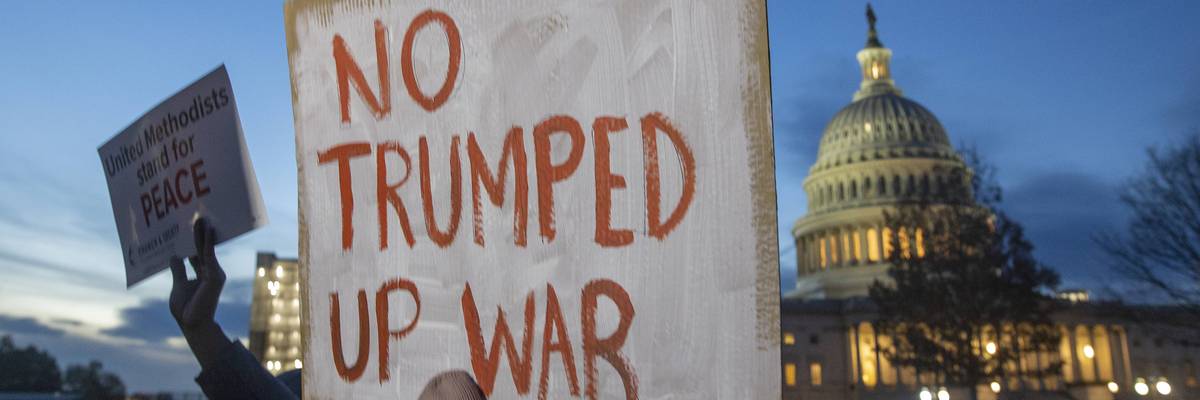
Protesters hold signs at the US Capitol to for the Anti-Iran War Rally on January 09, 2020 in Washington DC, United States. The House adopted a war powers resolution Thursday with the aim of limiting President Donald Trump’s military actions against Iran.
(Photo by Tasos Katopodis/Getty Images)
It’s getting late, but it’s not yet too late. No war on Iran!
President Donald Trump seems to think he is King of the World, not just the United States. Even as he convenes his “Board of Peace” (though calling it the “Board of Imperial Conquest” would be more apt) it looks like the US will soon illegally attack Iran, again, as it did last June. Congress needs to do its job representing the will of the American people, get a spine, step up to its Constitutional duty over matters of war and peace, and stop him.
The US has attacked seven countries (eight if one includes the US of A, and most people in Minneapolis and many other cities surely think so) since Trump’s recrudescence. Ongoing talks with Iran do not appear to be promising, with unrealistic US demands, especially zero nuclear energy enrichment by Tehran and the dismantling of its missile program, which would leave it vulnerable to further Israeli attacks. Trump’s “beautiful armada” including two aircraft carrier battle groups with supporting attack aircraft is the largest US military buildup in the region since the 2003 invasion of Iraq.
This massive (and expensive) deployment of forces is exactly what one does in planning for a large-scale military offensive against Iran, just as the region begins the Islamic holy month of Ramadan. This would go far beyond the more limited strikes that have taken place in the past, including last June’s attack that killed 1,000 people. “It harkens back to what I saw ahead of the 2003 Iraq war,” said retired Lt. Col. Daniel Davis, a senior fellow and military expert at Defense Priorities. “You don’t assemble this kind of power to send a message. In my view, this is what you do when you’re preparing to use it. What I see on the diplomatic front is just to try to keep things rolling until it’s time to actually launch the military operation.”
Lest anyone forget, this crisis is all of Trump’s making, as he abrogated the multilateral agreement, the Joint Comprehensive Plan of Action or JCPOA, negotiated under President Barack Obama, which effectively and verifiably capped Iran’s nuclear program well short of the ability to build The Bomb.
Trump should not have the last word on whether to attack Iran again. Next week, the House of Representatives will hold a vote on H. Con. Res. 38, the Iran War Powers Resolution, according to the measure’s co-sponsor US Rep Ro Khanna (D-CA). US Rep Thomas Massie (R-KY) is the other lead sponsor, and the only Republican on the resolution at present, but a vote could be close, if mostly partisan. Just a few Republican votes could make the difference.
There is no news on a Senate vote at this time, though there is a companion resolution, S. J. Res 104, introduced by Senators Tim Kaine (D-Va.) and Rand Paul (R-Ky.). Should the House resolution pass, the Senate vote might ensue quickly, as time is of the essence.
In a recent Quinnipiac poll, 70% of American voters said they oppose military action against Iran. It is time for Congress to fulfill its Constitutional authority and vote to require authorization of any military action against Iran.
It is no surprise the majority of Americans oppose a war with Iran. Similarly, most Iranians oppose a military strike on their country. Now, it’s up to us to demand that Congress do its job and pull us back from the precipice of another disastrous war. Concerned individuals should call their US Representative via the Congressional switchboard at 202.224.3121, or 833-STOP-WAR
Also, on Monday at 2:30pm ET/11:30am PT, peace and constitution-loving people can join a virtual Action Hour on Zoom, where we’ll mobilize together to demand Congress stop this unauthorized war before it starts.
The National Iranian American Council Action (NIAC) is organizing this event, co-sponsored by Peace Action & MPower Action, to equip you with immediate action you can take to urge lawmakers to oppose war and stand with the American and Iranian people. We will also be offering a brief “How to Advocate” 101 training to empower you to get face-to-face meetings with your lawmaker’s office.
The U.S. is on a fast track to authoritarianism like nothing I’ve ever seen. Meanwhile, corporate news outlets are utterly capitulating to Trump, twisting their coverage to avoid drawing his ire while lining up to stuff cash in his pockets.
That’s why I believe that Common Dreams is doing the best and most consequential reporting that we’ve ever done.
Our small but mighty team is a progressive reporting powerhouse, covering the news every day that the corporate media never will. Our mission has always been simple: To inform. To inspire. And to ignite change for the common good.
Now here’s the key piece that I want all our readers to understand: None of this would be possible without your financial support.
That’s not just some fundraising cliche. It’s the absolute and literal truth. We don’t accept corporate advertising and never will. We don’t have a paywall because we don’t think people should be blocked from critical news based on their ability to pay. Everything we do is funded by the donations of readers like you.
Will you donate now to help power the nonprofit, independent reporting of Common Dreams?
Thank you for being a vital member of our community. Together, we can keep independent journalism alive when it’s needed most.
– Craig Brown, Co-founder
about:blank
about:blank
Our work is licensed under Creative Commons (CC BY-NC-ND 3.0). Feel free to republish and share widely.
Kevin Martin is the president of Peace Action and Peace Action Education Fund, with over 40 years experience as a peace and justice organizer. He is helping coordinate the Cease-Fire Now Grassroots Advocacy Network.
President Donald Trump delivers remarks during a working breakfast with governors in the State Dining Room at the White House on February 20, 2026 in Washington, DC.
(Photo by Kevin Dietsch/Getty Images)
One analyst predicted Iran would close the Strait of Hormuz and attack oil installations “in the hope of driving oil prices to record levels” should the US strike.
US President Donald Trump on Friday confirmed that he’s considering launching an unprovoked military strike against Iran.
According to the New York Times, Trump was asked by reporters on Friday if he was considering attacking Iran, and he replied, “I guess I can say I am considering that.”
The US has for weeks been sending fleets of warships, including the world’s largest aircraft carrier, to the Middle East in apparent preparation for a massive military operation against Iran.
According to a Friday report from Al Jazeera, the buildup is the largest by the US Air Force in the region since the 2003 Iraq War, and it includes deployments of E-3 Sentry Airborne Warning and Control System (AWACS) aircraft, F-35 stealth strike fighters and F-22 air superiority jets, and F-15 and F-16 fighter jets.
Trump has not given any justification for launching such an attack, nor has he asked the US Congress to approve it, even though the Constitution gives the legislative branch the power to declare war.
Reps. Ro Khanna (D-Calif.) and Thomas Massie (R-Ky.) have been pushing for a vote in the US House of Representatives on a war powers resolution that would require Congress to debate and approve any act of war with Iran.
It is also not clear what goals the president would hope to achieve with the attack. A Thursday CNN report indicated that Trump is now weighing several options ranging from “more targeted strikes to sustained operations that could potentially last for weeks,” including “plans to take out Tehran’s leaders.”
Trita Parsi, co-founder and executive vice president of the Quincy Institute for Responsible Statecraft, wrote in a Friday analysis of Trump’s reported attack plans that there is little chance that the president will be able to achieve a quick victory over Iran simply because the offers he has made to its government are nonstarters.
“Since the US strategy… is to escalate until Tehran caves, and since capitulation is a non-option for Iran, the Iranians are incentivized to strike back right away at the US,” explained Parsi. “The only exit Tehran sees is to fight back, inflict as much pain as possible on the US, and hope that this causes Trump to back off or accept a more equitable deal.”
Parsi acknowledged that there is no way Iran can defeat the US militarily, but could “get close to destroying Trump’s presidency before it loses the war” through a number of maneuvers intended to spike the price of oil, including “closing the Strait of Hormuz” and attacking “oil installations in the region in the hope of driving oil prices to record levels and by that inflation in the US.”
“This is an extremely risky option for Iran,” Parsi conceded, “but one that Tehran sees as less risky than the capitulation ‘deal’ Trump is seeking to force on Iran.”
A Trump advisor told Axios that there’s a 90% chance the US launches an attack in the coming weeks, while Israeli sources say it could happen within days
The Trump administration is close to launching a major attack on Iran as it continues a massive buildup of military forces in the Middle East, according to a report from Axios reporter Barak Ravid.
Sources told Ravid that the potential US attack on Iran would likely be a massive multi-week operation, much bigger than the US operation to abduct Venezuelan President Nicolas Maduro. They said it would also be much broader in scope than the 12-day US-Israeli war on Iran that was launched in June 2025. Reuters also recently reported that the US was preparing for a sustained, multi-week attack on Iran.
Israeli officials said that the Israeli government, which is pushing for the US to pursue regime change in Iran, is preparing for the possibility of the attack starting in the coming days, and CNN later reported that the US military is ready to start the war as soon as this weekend. Other sources put the timeline a little later, saying the war would likely start in a few weeks.
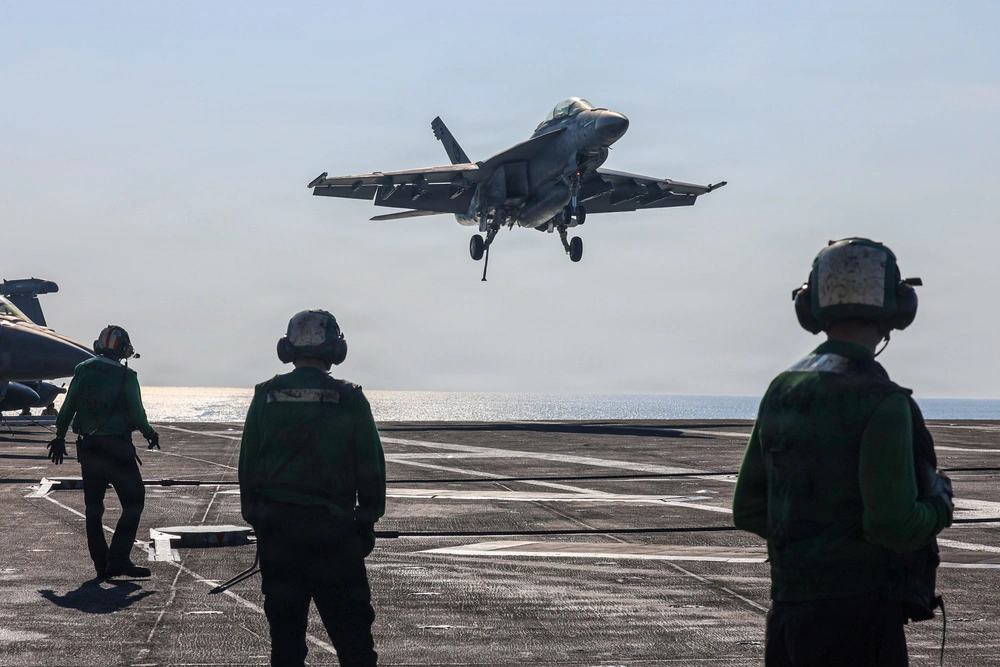
An F/A-18F Super Hornet makes an arrested landing on the flight deck ofthe aircraft carrier USS Abraham Lincoln in the Arabian Sea, January 30, 2026 (US Navy photo)
“The boss is getting fed up,” a Trump adviser told Ravid. “Some people around him warn him against going to war with Iran, but I think there is 90% chance we see kinetic action in the next few weeks.”
The Axios report noted that there has been little public debate about the potential war amid the major US military buildup and said that Americans will likely be surprised by the scale of the coming attack.
All signs indicate that if the US bombs Iran, Tehran will not hold back in its response and could target multiple US bases and warships in the region, leaving open the possibility that the war could result in hundreds or thousands of US casualties. The conflict could also have a major impact on the global economy, as Iran could close the Strait of Hormuz, through which 31% of seaborne crude oil shipments passed in 2025.
The US and Iran held talks on Tuesday, and while the Iranian side said there was a “clear path” toward a deal, US Vice President JD Vance said that Iran was not acknowledging President Trump’s “red lines.”
Vance claimed the main US demand was that Iran must not pursue a nuclear weapon, but for many months, the administration had insisted the June 2025 US strikes on Iran “obliterated” Iran’s nuclear facilities, and there’s no sign Tehran can enrich uranium at the moment. Iran has also made clear it’s willing to enter a deal that would involve a commitment to low enrichment levels, and Iranian officials maintain they don’t seek a nuclear bomb.
The real goal of any US attack on Iran will likely be regime change or taking out Iran’s ability to fire missiles at Israel. President Trump said back in December, when he met with Israeli Prime Minister Benjamin Netanyahu at his Mar-a-lago resort in Florida, that he would support another Israeli attack on Iran if the Islamic Republic “continued” its missile program.
The US ambassador also said that at some point, Iran may experience the ‘second kick of a mule,’ referring to another US attack
by Dave DeCamp, Antiwar. com, February 16, 2026 at 7:08 pm ET | Iran
US Ambassador to Israel Mike Huckabee said on Monday that the US and Israel are “absolutely aligned” on the need to “deal” with Iran as Washington continues building up its forces in the Middle East to prepare for a potential attack on the Islamic Republic.
Huckabee made the comments when addressing the Conference of Presidents of Major American Jewish Organizations in Jerusalem, where he cast doubt on the idea that the US and Iran could reach a diplomatic deal and said that another US attack on the country is likely.
“At some point, the United States has to say, enough is enough,” Huckabee said, according to Haaretz. “Either Iran makes a radical change in direction, or it experiences what we call in the South the second kick of a mule. There is no education in the second kick. If you didn’t learn the first time, you won’t learn the second.”
The US and Iran are set to hold a second round of talks in Geneva on Tuesday. Israel wants any deal to involve restrictions on Iran’s ballistic missiles, a demand designed to collapse diplomacy since Tehran’s missiles are its only form of deterrence.
According to Iranian officials, the US has dropped the demand for an agreement that includes missiles, but President Trump and other Trump administration officials continue to push the issue. Huckabee said that the US and Israel have agreed that Iran cannot “continue building vast surpluses of ballistic missiles.”
President Trump has repeatedly threatened to attack Iran if a deal isn’t reached, echoing threats he made in the lead-up to the 12-day US-Israeli war against Iran that was launched in June 2025, just days before another round of negotiations between Washington and Tehran were scheduled to be held.
The aircraft carrier USS Gerald R. Ford sails in formation with the guided missile destroyers USS Winston Churchill, USS Mitscher, USS Mahan, USS Bainbridge and USS Forrest Sherman in the Atlantic Ocean, Nov. 12, 2024. [Photo: Navy Petty Officer 2nd Class Jacob Mattingly ]
The US military is preparing for “sustained, weeks-long operations” against Iran if US President Donald Trump orders an attack, Reuters reported Friday, citing US officials. The planned campaign would mark a far larger US assault on Iran than anything previously carried out.
In a sustained campaign, the US military could hit “Iranian state and security facilities, not just nuclear infrastructure,” one of the officials said. The United States “fully expected Iran to retaliate, leading to back-and-forth strikes and reprisals over a period of time.”
Such a war could entail massive loss of life and have incalculable global consequences. It would be illegal under international law and take place in defiance of the popular will, with 85 percent of the American population opposed to a war against Iran, according to a YouGov poll.
Last June, the US launched “Midnight Hammer” in coordination with a 12-day Israeli bombing campaign that together killed over one thousand Iranians. Iran staged a limited retaliatory strike on a US base in Qatar. What is now being planned is qualitatively different—an air and missile campaign targeting the Iranian state itself, with the expectation of extended back-and-forth combat.
The buildup takes place just weeks after the USS Gerald R. Ford, the world’s largest and newest aircraft carrier, took part in the seizure of Venezuelan President Nicolás Maduro on January 3. The Ford, which has been at sea for more than 200 days, has now been ordered from the Caribbean to the Middle East, where it will join the USS Abraham Lincoln strike group already in the region. The same carrier used in the kidnapping of the president of Venezuela is being redeployed to wage war against Iran.
Trump, speaking to troops at Fort Bragg, North Carolina on Friday, said it had “been difficult to make a deal” with Iran. “Sometimes you have to have fear,” he declared. “That’s the only thing that really will get the situation taken care of.” Asked if he wanted regime change, Trump responded: “Seems like that would be the best thing that could happen.”
The Ford strike group includes the guided-missile cruiser Normandy and destroyers Thomas Hudner, Ramage, Carney and Roosevelt. The carrier holds more than 75 military aircraft, including F-18 Super Hornet fighters and E-2 Hawkeye early warning aircraft.
Satellite imagery analyzed by Reuters shows a massive buildup at US bases across the Middle East. At Al-Udeid air base in Qatar, the largest US facility in the region, Patriot missiles have been placed in mobile HEMTT truck launchers, giving them rapid mobility in case of an Iranian attack. The base houses an RC-135 reconnaissance aircraft, 18 KC-135 Stratotanker refueling aircraft, and seven C-17 transport planes.
At Muwaffaq Salti air base in Jordan, images from February 2 show 17 F-15E Strike Eagle fighter-bombers, eight A-10 Thunderbolt close air support aircraft, and four EA-18G Growler electronic warfare jets—where none had been visible weeks earlier. Additional forces have been deployed to Prince Sultan air base in Saudi Arabia, Diego Garcia in the Indian Ocean and Dukhan base in Oman. Approximately 112 C-17 Globemaster cargo planes have reportedly arrived or made their way toward the Gulf region.
Iran’s Revolutionary Guards have warned they could retaliate against any US military base in the region. The US maintains bases in Jordan, Kuwait, Saudi Arabia, Qatar, Bahrain, the United Arab Emirates, Oman, Turkey and on Diego Garcia. Ali Shamkhani, an adviser to Supreme Leader Ali Khamenei, warned: “We will respond decisively to any adventurism—our military readiness is high.”
The military buildup coincides with the Munich Security Conference, whose organizers titled their annual report “Under Destruction.” German Chancellor Friedrich Merz opened the conference by declaring: “This order, as flawed as it has been even in its heyday, no longer exists.” He warned that “a divide has opened up between Europe and the United States.”
But while European leaders condemned Trump’s tariffs and threats against allies, they have fully supported the US posture toward Iran. On January 29, the EU unanimously designated Iran’s Revolutionary Guards a terrorist organization—all 27 member states voting in lockstep with Washington’s escalation.
The Munich conference withdrew its invitation to Iranian Foreign Minister Abbas Araghchi, with Germany’s foreign ministry declaring his participation inappropriate. In his place, exiled Crown Prince Reza Pahlavi, son of the Shah overthrown in 1979, was given a platform. Pahlavi called for “humanitarian intervention” and an “equalizing factor”—that is, US military strikes to “neutralize the regime’s instrument of repression.” He told the conference that “help is on the way” from Trump and positioned himself as the leader of a post-regime transition.Available from Mehring BooksThe struggle against imperialism and for workers’ power in IranA pamphlet by Keith Jones
Democratic Socialists of America Congresswoman Alexandria Ocasio-Cortez spoke at the Munich Security Conference on the subject of “The Rise of Populism.” In her entire appearance at the conference, she did not say a single word about Trump’s preparations for war against Iran—the most significant military escalation of his presidency.
What she did say is revealing. She warned that Trump is “looking to withdraw the United States from the entire world so that we can turn into an age of authoritarianisms, of authoritarians… where Putin can saber rattle around Europe and try to bully around our own allies there.”
This is not opposition to war; rather Ocasio-Cortez condemned Trump as being insufficiently aggressive against “Putin”—i.e., being insufficiently committed to the war in Ukraine.
The Democrats have been silent as the administration amasses approximately 50,000 troops and the largest concentration of military firepower in the Middle East since the 2003 invasion of Iraq. Their earlier statements on Iran amounted to endorsements of regime change in response to the emergence of localized protests against the government last month. Senator Mark Warner declared on January 11, “The Iranian regime is awful, and I stand with the Iranian people.” Ocasio-Cortez tweeted that month, “The Iranian government’s violent crackdown on demonstrators is horrific.”
Far from opposing the war buildup, the Democrats have actively funded it. On January 30, the Senate passed the Consolidated Appropriations Act by a vote of 71 to 29, including $839 billion for the Pentagon—an $8.4 billion increase over the military’s own budget request. Twenty-three Democrats voted for the bill, including Senate Minority Leader Chuck Schumer, Minority Whip Dick Durbin and Vice Chair Mark Warner. In the House, the bill passed 341 to 88, with 149 Democrats voting yes and only 64 voting no. Republicans on the House Appropriations Committee hailed the legislation as “America First, Fully Funded.”
In the space of weeks, the Trump administration has kidnapped the president of Venezuela, threatened to annex Greenland, backed the Israeli genocide in Gaza and is now preparing a sustained bombing campaign against a country of 88 million people. Each of these operations targets nations whose resources Washington seeks to control as part of its escalating confrontation with China—Venezuela’s oil, Iran’s oil and natural gas and the Strait of Hormuz through which 20 percent of the world’s oil passes daily.
The working class cannot entrust the fight against imperialist war to any faction of the political establishment. The same administration threatening to devastate Iran is attacking immigrants, gutting social programs, and constructing a police state at home. Opposition to war must come from the independent mobilization of the international working class against the capitalist system that produces war, inequality and dictatorship.


 Peace and Justice Post
You must be logged in to post a comment.