The years 2024 and 2025 were the deadliest for reporters worldwide since records began. In those two years, Israeli attacks were responsible for 70% of the deaths
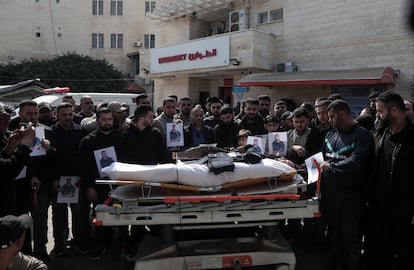
Funeral of Al Jazeera journalist Mohammad Weshah at Al Aqsa Martyrs Hospital in the central Gaza Strip on April 9.Majdi Fathi (NurPhoto/ Getty Images)
The death of Amal Khalil, 43, a Lebanese reporter for the media outlet Al Akhbar, brings up to nine the number of journalists killed by the Israeli army in seven weeks of offensive in Lebanon, according to the Committee to Protect Journalists (CPJ). The reporter’s killing occurred even though a ceasefire, which called for a 10-day cessation of hostilities by Israeli troops in Lebanon, was in effect since Thursday.
These figures add to the 264 other journalists killed in the line of duty in the context of the wars in Gaza and Iran since October 7, 2023. According to CPJ, 260 of these deaths were caused by Israel. The majority of the victims were Palestinian journalists in Gaza, although the count also includes 31 journalists killed in Yemen, 15 in Lebanon, and four in Iran in the last two and a half years. According to the Lebanese Press Editors Syndicate, the number of reporters killed in Lebanon since October 2023 stands at 27.
While Lebanon remains in shock over Khalil’s death, Beirut has announced it will seek international justice, considering the Israeli attack that killed her a war crime. The Lebanese government accuses Israel of deliberately targeting her and her colleague Zeinab Faraj. The two women had taken shelter in a house in the southern village of al-Tiri after an initial airstrike killed two people traveling in a vehicle. Shortly afterward, the building where they were located was also attacked. The Lebanese Red Cross rescued Faraj, who was taken to a hospital, but as teams searched for Khalil, an Israeli drone dropped another grenade on the building.
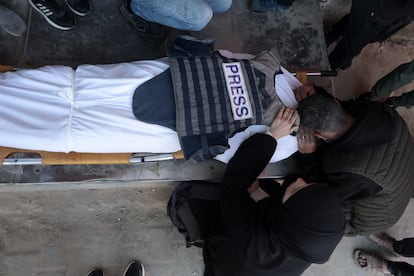
Funeral of journalist Amal Khalil, in Basariye (Lebanon), this Thursday.Aziz Taher (REUTERS)
“This is not the first time that Israel has prevented emergency services from reaching journalists injured in their strikes,” said CPJ CEO Jodie Ginsberg. “Journalists are civilians and protected under international law. Israel’s blatant disregard for such norms — and the international community’s failure to hold them accountable — is abhorrent.”
In many cases, Israeli troops justify the attacks by claiming the journalists have connections to Hamas or Hezbollah. In Khalil’s case, the Israeli army, without denying the Lebanese government’s version of events, maintains that the two journalists had just left a building used by Hezbollah for military purposes. According to a spokesperson, both vehicles had crossed the defensive line and approached Israeli troops, thus constituting “an imminent threat.”
“Targeted assassinations”
2024 and 2025 were the deadliest years for journalists worldwide since the Committee to Protect Journalists (CPJ) began documenting these cases in 1992. In both years, Israel was responsible for 70% of the recorded deaths, according to the organization. In addition to the 264 journalists who were killed, 174 were wounded and 106 imprisoned since the start of the war in Gaza.
The CPJ counts both journalists killed while carrying out their work and those whose deaths are linked to their professional activity, whether accidentally in conflict zones or as a result of deliberate attacks. According to the organization, Israeli troops have carried out more targeted killings of journalists than the military of any other government since records began. To date, the CPJ has documented 64 cases of journalists deliberately killed by Israeli forces between 2023 and 2025 in Gaza, Lebanon, Iran, and Yemen.
Among the dead was Anas Al Sharif, an Al Jazeera reporter and one of the most recognizable faces of the Gaza war. He was killed in August 2025 in an Israeli attack on the journalists’ tent where he lived with five other reporters, outside Al Shifa Hospital in Gaza City. Anticipating he might be targeted, Al Sharif had left a farewell message.
That same month, five other journalists were killed in a bombing of Nasser Hospital in Khan Younis, in the southern Gaza Strip. After an initial explosion at the building, where civilians and reporters had gathered to assess the damage, a second blast occurred and was broadcast live by several television stations.
The head of Al Jazeera’s Gaza bureau has also been targeted: he was wounded and lost several family members, including a son who was also a journalist. This April, Al Jazeera journalist Muhammad Washah was killed in an Israeli airstrike on the vehicle he and another Palestinian were driving on the coastal road in Gaza City, according to health officials cited by Reuters.
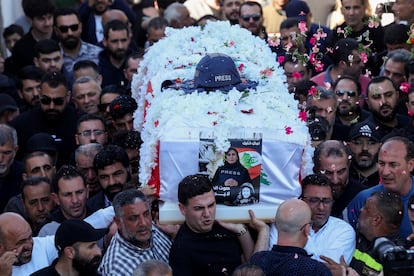
Funeral of Al Jazeera journalist Mohammad Weshah, in the center of the Gaza Strip, on April 9.Majdi Fathi (NurPhoto/ Getty Images)
In the last incident in Lebanon recorded by the CPJ before Khalil’s death, three other journalists were killed in the south of the country. An Israeli attack on a vehicle on the Jezzine road killed journalist Ali Shoaib of the Hezbollah-affiliated Al Manar TV; journalist Fatima Ftouni of Al Mayadeen TV; and her brother, freelance photojournalist Mohamad Ftouni.
War crimes
“The deliberate attacks and killings of journalists by Israeli forces constitute war crimes under international humanitarian law,” Amnesty International notes on its website.
Since October 2023, Reporters Without Borders has filed five complaints with the International Criminal Court against Israel for “war crimes against Palestinian journalists in Gaza.”
These actions are in addition to previous ones, such as the lawsuit filed by Al Jazeera in 2022 after the death of journalist Shireen Abu Akleh, who was killed in May of that year while covering a raid by Israeli troops on a refugee camp in Jenin, in the West Bank.
Sign up for our weekly newsletter to get more English-language news coverage from EL PAÍS USA Edition
Published date: 23 April 2026 15:40 BST | Last update:1 hour 50 mins ago
Amal Khalil, the seasoned journalist, was born during a years-long Israeli occupation of southern Lebanon. She was killed there four decades later by invading Israeli forces.
“Amal was present in every home. Every home in Lebanon has lost her,” Ali Khalil, her brother, said tearfully a day after she was targeted and killed by Israel.
“Amal resembles the south in all its details – its sweet breeze, its valleys, its mountains, and its old houses. She resembles all of that.”
Khalil is remembered fondly by her colleagues as generous, fearless and pioneering.
“I want to express gratitude for everything she did for us young journalists,” Hussein Chaabane, a Lebanese investigative and legal journalist, told Middle East Eye.
New MEE newsletter: Jerusalem Dispatch
Sign up to get the latest insights and analysis on Israel-Palestine, alongside Turkey Unpacked and other MEE newsletters
“She was so generous even if we were competitors. She never hesitated in sharing a contact, a key – and she had all the keys in the south.
“She knew it like the palm of her hand and she shared this love and dedication with everyone who needed it.”
Khalil, 42, was killed on Wednesday as she went to cover an earlier Israeli attack in the town of al-Tayri.
‘She knew [the south] like the palm of her hand and she shared this love and dedication with everyone who needed it’
– Hussein Chaabane, journalist
An initial strike hit a vehicle in front of Khalil and freelance photographer Zeinab Faraj, prompting the pair to take shelter in a nearby house.
A second strike then hit the house, according to the health ministry. Rescuers retrieved Faraj, who sustained a head wound, but were fired on before they could reach Khalil.
Hours later, they found Khalil dead under the rubble.
Lebanese Prime Minister Nawaf Salam described the killing as a war crime and said Lebanon would spare no efforts in pursuing the culprits internationally.
“The killing of Amal was the killing of a woman of resistance,” Lebanese filmmaker Bachir Abou Zeid told MEE.
“Israel killed her because she was a journalist of resistance, not simply because she was a journalist.”
Writer shaped by occupation
Khalil was born in 1984 in al-Baisariyah, in the Saida district of southern Lebanon.
She grew up during the civil war and Israel’s occupation of large parts of southern Lebanon, and recounted seeing occupied villages in the distance when she was a child. Her own town was retaken from Israeli forces shortly before her birth.
Khalil grew up reading As-Safir, a now defunct popular Lebanese newspaper, through which she says she learnt about everyday people’s struggles, about prisoners and the forcibly disappeared, and about the civil war.
She studied Arabic literature in the city of Saida, and – without the knowledge of her parents – travelled to Beirut, where she became involved in communist activism.
It was then that her writing career began to take off, and she wrote several pieces for al-Hasnaa magazine.
“One story I particularly remember was for the Valentine’s Day special issue, about how queer people celebrated love in a conservative society,” she recalled in an interview in January with The Public Source, a Beirut-based outlet.
Khalil joined the nascent Al-Akhbar newspaper in April 2006, a few months before the first issue went to print. She would go on to work there for 20 years.
Weeks after she joined, Israel launched a 33-day war on Lebanon – a moment which Khalil described as a turning point in her career.
She had initially joined the paper to write about women’s and cultural issues. But amid the backdrop of war, she collected the stories of those displaced and bombarded by Israel.
It was a theme that would continue throughout her professional life.
‘The pressure to break me was relentless, but I didn’t yield’
– Amal Khalil
Khalil was largely based in the city of Sour, also known as Tyre, where she pursued public interest stories.
“Going after corruption cases and social issues in the area, sparing no one – not even my family – led to confrontations,” she recounted.
“I was threatened, assaulted, and intimidated. The pressure to break me was relentless, but I didn’t yield.”
Although al-Akhbar has provided favourable coverage of Hezbollah and resistance against Israel, she said she did not write with limitations.
She recalled al-Akhbar defying a request by Hassan Nasrallah, then Hezbollah’s leader, to not publish a WikiLeaks documents about Nabih Berri, the parliament’s speaker, back in 2011.
Over time, she became al-Akhbar’s go-to field reporter for the whole of the south, covering Sour, Bint Jbeil and Nabatieh, among other areas.
Face to face with Israeli troops
Khalil knew all too well that Israeli forces have a habit of targeting Lebanese journalists.
In 2010, she wrote an obituary for her slain colleague Assaf Abu Rahhal, who was killed by Israeli shelling.
She recalled a Lebanese soldier handing her Abu Rahhal’s blood-stained ID card. “It was all that remained of Assaf. I will never forget that day,” she said.
Khalil was unwavering in her support for leftism and resistance against occupation.
In more recent years she began to produce more video content, learning to edit the films herself, even though she was insistent that she did not want to appear in them.
‘I’m here to tell the stories of the people, not to become the story myself’
– Amal Khalil
“For me, it was simple: I’m here to tell the stories of the people, not to become the story myself,” she said.
During Israel’s 2023-2024 war on Lebanon, which broke out when Hezbollah attacked Israel in solidarity with Palestinians being slaughtered in Gaza, she documented evidence of Israeli targeting of civilians and civilian infrastructure.
“From the very first day of the genocide, Amal confronted Israel through her coverage,” said Abou Zeid.
“Her documentation, her movement from one area to another, and her amplification of the story of the people in the land and the south.”
After a ceasefire was announced in February last year, she reported on Israel’s near-daily violations of the truce.
Khalil was confronted by Israeli forces on a number of occasions during her career. The closest shave, she said, was in November 2024, when Israeli forces fired volleys to drive her and colleagues back from a bulldozer.
‘Never accepted Israeli limitations’
Colleagues and friends remember that Amal refused to bow to Israeli orders or limitations on her movements.
“Not for a single moment did Amal abide by Israeli instructions about where she could go,” said Abou Zeid.
“Amal was not a journalist in the conventional sense of the profession. Her love for the land and for her people outweighed everything.”
Khalil said herself following the 2024 war that people had advised her to restrict her movements, but that her faith and her revolutionary upbringing taught her to stand “in the face of oppression”.
‘Her love for the land and for her people outweighed everything’
– Bachir Abou Zeid, filmmaker
“My alignment with the people of the south, my presence among them since the July 2006 war, has always been the right choice. They have always lived up to that faith placed in them,” she said.
“They will grow stronger, more steadfast, and more committed to this unwavering compass, toward truth, and toward Palestine.”
Rabbi Avraham Zarbiva operated a bulldozer in Gaza and has called for Israel to ‘flatten’ the Palestinian territory
by Dave DeCamp, Antiwar. com, April 22, 2026 at 4:52 pm ET | Gaza, Israel
During an independence day ceremony in Israel on Tuesday, the Israeli government honored an extremist rabbi known for bulldozing homes in Gaza and calling for Israel to “flatten” the Palestinian territory. According to The Guardian, Rabbi Avraham Zarbiv was one of fourteen people chosen by the Israeli government for their “extraordinary contribution to society and the state” to light a torch at the ceremony. Zarbiv serves as a rabbinical judge for an illegal Jewish settlement in the Israeli-occupied West Bank, and an Israeli state ombudsman recently ruled that he violated ethical guidelines by expressing “extremist views,” which included his call to flatten Gaza and boasting about the destruction of civilian homes and the IDF’s mass killing of Palestinians. “Israel, let me tell you, we have crushed them. There are tens of thousands of dead. The dogs and the cats ate them because no one collected them,” Zarbiv said in a TV interview last year. “Tens of thousands of families – they have not a piece of paper, no childhood photo, no IDs, they have nothing. No home, there is nothing. They come, they have no idea where their house is. It’s something unbelievable.” Zarbiv became well known in Israel for posting videos of himself destroying homes in Gaza, and his name has become slang for destruction. “We’re here in Beit Hanoun attacking this cursed village until we finish it,” Zarbiv said in one of his videos, which was shared by the Israeli rights group B’Tselem. “All the way to victory, to settlement. We will not give up until this village is erased.” B’Tselem strongly condemned the Israeli government’s move to honor Zarbiv. “Bestowing one of the highest civilian honors in Israel on a citizen who committed war crimes illustrates how deeply the dehumanization of Palestinians has taken root in the Israeli mainstream. It is yet another terrifying signal that genocide has officially become part of the national ethos,” the group said.
Joe Gill MEE, 21 April 2026 09:07 BST | Last update:8 hours 4 mins ago
Comparisons between the US-Israeli war on Iran, the Gaza genocide, and Hitler’s attack on the Soviet Union are being made by scholars
A picture of US President Donald Trump and Israeli Prime Minister Benjamin Netanyahu on fire during a protest against the US-Israeli military action in Iran, near the US Embassy in Manila, Philippines, 9 April 2026 (AFP)
It has long been considered offensive and antisemitic to draw comparisons between Nazi Germany and Israel, but on the specific question of Israel’s genocide in Gaza and its wars of expansion, including the war on Iran, the dam has broken.
Norman Finkelstein, the eminent American Jewish scholar and son of Holocaust survivors, drew the direct comparison between Hitler’s war in the east and the war launched by Donald Trump and Benjamin Netanyahu on Iran on 28 February in a recent Middle East Eye interview.
I have long thought the comparison is merited, for a number of reasons, beginning in 2023 with the start of the war on Gaza.
Like Hitler’s Germany, Israel’s leaders made the fatal error of not knowing when to stop, and opening up several fronts – seven at one point. Each tactical victory – against Hamas, then Hezbollah, encouraged further audacious attacks. Having waged a genocidal campaign in Gaza, colonial expansion in the West Bank, and relentless attacks on Lebanon, Syria and Yemen, Prime Minister Netanyahu turned to Iran in 2025.
Why? A messianic ideology of Jewish supremacy that drives the prime minister and the settler politicians on whom he depends. The politics of ethnonationalism, territorial expansion and hyper militarism are similar, if not identical, to the ideology of the Second World War fascist axis led by Nazi Germany. And this ideology of ethnic supremacy leads to overreach.
New MEE newsletter: Jerusalem Dispatch
Sign up to get the latest insights and analysis on Israel-Palestine, alongside Turkey Unpacked and other MEE newsletters
Trump, as a white nationalist who believes in US exceptionalism, shares the same inflated belief in unlimited US power, but is less unequivocally bent on permanent war. (Trump bears some comparison with Italian fascist dictator Benito Mussolini, whose record of failed imperial adventures more closely resembles Trump’s.)
Iran and the Soviet Union
Finkelstein, speaking of the Iran war, compared it to how the war of extermination waged by Hitler on the Soviet people inspired them to rally and defend the country. “This was the same mistake made by Trump. The more Trump turned it into a war of extermination like the Nazis did with Russia… the people rallied, it was the Soviet Union’s Great Patriotic war, a second time.”
Another parallel to the Second World War is that the West’s enemy is a revolutionary regime which is facing severe internal pressures. The Soviet Union in the 1930s was perceived as being weak due to violent internal upheaval; the similar position of Iran before the war encouraged Netanyahu and Trump to believe that a surprise attack would lead to a rapid victory.
The Soviet Union in the 1930s was perceived as being weak due to violent internal upheaval; similar to the position of Iran before the war
Both the Soviets and Iran lacked major global allies prepared to come to their defence. Like the Soviet Union, Iran had non-state groups in different countries that supported its international vision, but these groups pose a limited threat to the world’s most advanced military, and a nuclear-armed regional military power.
Like Iran, the Soviet Union had sought to avoid war by making agreements with its chief enemy, Germany, in the Nazi-Soviet pact of 1939. In the case of Iran, the 2015 nuclear deal was supposed to end the threat of conflict. But Trump ripped it up in 2018.
Both Iran and the Soviet Union had been through very difficult years preceding this frontal military attack. Iran had faced comprehensive sanctions, which helped to spark three major uprisings against the regime, in 2019, 2022 and lastly in January 2026.
The Soviet regime, while in the process of rapidly industrialising, had waged a terror campaign against kulaks, national minority groups, and swathes of the Bolshevik administration, including the officer corp of the Red Army, in which millions died – a point explicitly made by Finkelstein (although he exaggerated by saying “tens of millions” died). As a result, Hitler saw Soviet Russia as weak and vulnerable. He predicted a sweeping victory over Stalin.
As Finkelstein explained: “The first months of the war were a cake walk, disaster for the Soviets… but the Germans made one big mistake: they wanted what was called living space, lebensraum, and [that] means they had to get rid of the people living there, and so they embarked on a war of extermination… Notwithstanding the brutality of Stalin’s regime, notwithstanding collectivisation and the purge trials, which eliminated the entire military and political leadership, the people embraced the “Great Patriotic War”.
Like the Israelis and the Trump White House, the Nazis had a racial contempt for their Slavic enemies who they considered to be inferior and not able to resist the advance of the German armed forces. Trump and Netanyahu likewise consistently belittle the capacity of their enemies, believed the Iranian regime would crumble under direct assault, and see their technological and military superiority as decisive over the “Arabs” and Iran. Trump called the Iranians “animals”.
These Iranians supported the US-Israeli war. Now they realise their mistake
The killing of Supreme Leader Ali Khamenei on the first day of the war was supposed to be the knockout blow. It would be as if Hitler had a rocket system that could accurately target Stalin’s rooms in the Kremlin and wipe out the dictator and his politburo. Would that have caused the Soviet regime to collapse amid invasion? Unlikely.
The first year of the Nazis’ invasion saw a devastating series of retreats and defeats for the Soviets. The Wehrmacht rolled through Ukraine, where the famine and terror of the previous decade had drained support for the Soviets, allowing the Germans to march rapidly on to the Russian steppe; in the north the Nazis advanced through Belarus to the gates of Moscow and Leningrad, imposing a brutal siege on the latter. Hitler had every reason to think victory over the Communist regime in Russia was all but certain.
But to successfully overthrow a regime one needs to find new, pliable rulers who are able to replace the old ones. This has not proved possible in Iran, with Reza Pahlavi shown to be wholly inadequate to the task, lacking political skills and wide popular support in Iran.
Germany, and the US and Israel, overlooked the lack of strategic route to defeat their enemies in the long run. In the short to medium term, they win based on superior air power, intelligence, and destructive offensive forces, but in the longterm, the outlook is more problematic, as people constantly attacked in their own lands are certain to resist.
Iranians have come to realise that Trump and Netanyahu are not interested in their liberation – they wish to destroy the country’s independent existence and to fragment it along ethnic lines.
Iran’s new leaders
Moreover, in the case of Iran, the wiping out of the older generation of leaders and commanders has changed the calculus of the regime, brought in new commanders, and if anything ended the restraint that was the policy under Khamenei. The attacks on Gulf states, the blockade of Hormuz, and the insistence that Lebanon must be part of a lasting ceasefire deal show how much Iran, post-February, is no longer afraid to directly confront the encirclement imposed by the US and its allies.
The wiping out of the older generation of leaders has changed the calculus of the regime, ending the restraint that was the policy under Khamenei
Iran, like Russia, is a vast continental nation, and presents huge challenges for any foreign power wishing to conquer or dismember it. Hitler openly saw the Soviet Union as part of the future Third Reich, as a vast colonial territory providing resources and agricultural lands to feed the empire, while turning its people into little more than slaves. After the victories of the first year of the war in the east, things turned sour for the Nazis at Stalingrad in late 1942.
Netanyahu and other Israeli leaders long declared their intention to remove the Iranian regime, using agents on the ground, assassinations and sabotage, and imploring Iranians to rise up against the ayatollahs. But after the mass protests and brutal crackdown in January, these calls have not been heeded. Iranians have rallied to the nation.
If, however unlikely it seems, the latest US-Iran ceasefire somehow transitions to a more permanent agreement to end hostilities on Iran’s terms, it would be seen as a historic defeat for the US, on par with Vietnam. And a break with the total war that killed tens of millions in the 1940s.
As of now, the US is blockading Iran’s ports and seized an Iranian ship, while moving thousands of troops into the region. At home, Trump is on a war footing, putting the auto sector on notice to convert to weapons production, while asking Congress for a $1.5 trillion “defence” budget, the largest ever. This does not look like imminent peace, but with Trump, who knows?
When will it end?
And what about Gaza? The genocide is far from over. For the Palestinians, this question is existential.
History offers some clues. No modern genocide has lasted more than four years. Rwanda’s lasted 100 days – the fastest, most brutal, in history. Cambodia’s lasted over three years until Vietnam invaded and overthrew the Khmer Rouge. The Armenian genocide lasted just over one year. Stalin’s special operation against the Poles, Ukrainians and other national minorities lasted 16 months. The German siege of Leningrad lasted 872 days. The Holocaust, the worst of all, lasted four years.
So far the Palestinians have endured 926 days of extermination and siege. According to a 2025 household survey and joint mortality study, the Gaza death toll had reached 84,000 by January 2025 and is likely now well over 100,000, on top of 6,500 killed by Israel in Lebanon, and thousands more in Iran.
The biggest defeat of all is not in Lebanon, or Iran, but in Washington. US voters have had enough of wars and Israel
Crucially, in most cases, genocide precedes the collapse or military defeat of the perpetrator.
Israel has always relied on unconditional US support, which culminated in Washington arming a genocide, then backing not one, but two unprovoked assaults on Iran, and a prolonged war against Hezbollah. All of them failed, at appalling human cost. And now that US weapons pipeline is in jeopardy.
The vote last week in the US Senate on supplying arms to Israel was historic. Even though it passed, 40 out of 47 Democratic senators voted for Bernie Sander’s resolution blocking a batch of military aid. By contrast, last April, only 15 of the Democratic caucus’s 47 members supported similar measures. This signals a dramatic shift against Israel in Washington.
Democrats who want to be re-elected in November know they must now distance themselves, not just rhetorically, but also financially and politically, from Israel and its powerful US lobby. Aipac is still spending hundreds of millions to get its candidates elected, but the taint of lobby money is increasingly electoral poison.
Netanyahu had his golden time with Trump’s first term, then Joe Biden, and Trump two. That time is coming to an end. Most likely, he will look for a way to prolong Israel’s campaign for regional supremacy and remain in office as long as possible, but he is running out of road.
He now faces his biggest defeat of all; not in Lebanon, or Iran, but in Washington. US voters have had enough of forever wars and Israel.
In Israel, as Finkelstein warns, it is not just Netanyahu, but the whole of Israeli society that “has turned into homicidal maniacs” supporting war on Iran, ethnic cleansing in the West Bank and Lebanon, and genocide in Gaza.
The final lesson of World War Two was that fascism was defeated after its leaders’ disastrous military overreach and defeat at the hands of the Soviet Red Army and partisan resistance. Today’s fascist war leaders have learned nothing from this history.
The views expressed in this article belong to the author and do not necessarily reflect the editorial policy of Middle East Eye.
Joe Gill has worked as a journalist in London, Venezuela and Oman, for newspapers including Financial Times, Morning Star and Middle East Eye. His focus is on geopolitics, economic history, social movements, and the arts.
Direct talks in Washington for the first time in 30 years continue a long history of overtures that predate resistance and persist despite repeated Israeli attacks on civilians
Lebanese protesters gather in Martyrs’ Square in Beirut to reject direct negotiations with Israel, expressing opposition to normalisation and diplomatic engagement, on 13 April 2026 (Abdul Kader Al Bay/ZUMA Press Wire)
Since Lebanese President Joseph Aoun and Prime Minister Nawaf Salam assumed office in early 2025, mere weeks after the November 2024 ceasefire between the Lebanese resistance and the genocidal state of Israel, the new leadership, under strong US and Saudi advice, moved urgently to offer friendship and full cooperation to Israel.
Not only did they fail to protest the more than 10,000 ceasefire violations that Israel committed over the 15 months leading up to the US-Israeli aggression on Iran in late February 2026 – including thousands of air strikes, drone attacks and ground incursions that killed more than 500 people, most of them civilians – but they went as far as offering, even pleading, for direct negotiations to achieve permanent peace with the Jewish settler-colony.
Rather than blaming Israel for its ongoing crimes against the Lebanese people, the two leaders blamed Hezbollah, as if Israeli attacks were a response to the resistance, when in fact the resistance has been retaliating against unceasing Israeli aggression and occupation of Lebanese land.
Such magnanimous offers were last made by the Phalangist president of Lebanon, Bashir Gemayel, who collaborated with Israeli invaders of his country in 1982, and his brother Amin, but they were scrapped afterwards due to much opposition.
The Israeli government initially rebuffed these recent overtures, which Salam repeatedly extended until it finally agreed last week. Facing pressure from the Trump administration, Israel met with Lebanese officials in Washington this week for their first direct talks in more than 30 years, even as it continues to bomb Lebanon, including the capital, Beirut, killing upwards of 2,000 people in the past six weeks alone.
New MEE newsletter: Jerusalem Dispatch
Sign up to get the latest insights and analysis on Israel-Palestine, alongside Turkey Unpacked and other MEE newsletters
Israel has justified its multiple invasions and incursions into Lebanon since the late 1960s, which have killed tens of thousands of civilians, as efforts to defeat Palestinian resistance fighters who moved there after 1969, and who were forced to withdraw in 1982. It has since invoked the same justification to confront post-1982 Lebanese resistance to its illegal occupation of Lebanese territory, especially Hezbollah.
Yet present claims that resistance movements provoke Israeli aggression, and that Lebanese leaders must therefore normalise relations with Israel to achieve stability, obscure the historical record: Israeli relations with Lebanese political and religious figures eager to offer it friendship and cooperation date back to the 1920s, long before the settler-colony was even established, let alone the arrival of the Palestinian resistance in Lebanon or the emergence of Hezbollah.
Indeed, Aoun and Salam are part of a long chain of Lebanese politicians eager to please Israel.
Sectarian myths
In Lebanon, a common claim is that right-wing sectarian Maronite leaders only sought to befriend Israel after 1948, in response to the arrival of more than 100,000 Palestinian refugees expelled during the 1948 Zionist conquest of Palestine by Jewish colonists – the majority of them Muslim – and the resulting demographic shift.
This, however, proves to be a fabrication. Sectarian Maronite hostility towards Lebanese Muslims precedes the arrival of the Palestinians by nearly three decades.
In March 1920, Jewish Agency representative Yehoshua Hankin and Lebanese Maronite representatives signed a treaty of cooperation that also included “prominent Muslim families”, many of whom were absentee landlords who sold land in Palestine to Zionist settlers.
In March 1920, Jewish Agency representative Yehoshua Hankin and Lebanese Maronite representatives signed a treaty of cooperation that also included ‘prominent Muslim families’
Contacts between Lebanese Maronite leader Emile Edde and Zionist representatives began in the early 1930s. During this period, Edde expressed his support for establishing friendly relations with Jewish colonists and “even of a Zionist-Maronite alliance”.
Edde was elected president of Lebanon in 1936 and remained in contact with the Jewish Agency for the next two years.
Edde’s prime minister, Khayr al-Din al-Ahdab, the first Sunni Muslim to hold the position in Lebanon’s history, offered his country’s guarantees of order and security to the Jewish colonial-settlements along the Lebanese border. After leaving office and seeking to regain power, Edde resumed his contacts with the Israelis in 1948 while vacationing in France.
This was followed by the signing of the infamous political treaty between the Jewish Agency and the Maronite Patriarch Antoine Arida, on behalf of the Maronite Church, on 30 May 1946.
The treaty established guidelines for close ties between the Maronites and the Jewish colonists, based on mutual recognition of rights and nationalist aspirations, including the Jewish Agency’s recognition of Lebanon’s “Christian character” and its assurance that the Jewish colonists had no territorial ambitions in Lebanon.
In return, the Maronite Church supported Jewish immigration and the establishment of a Jewish state in Palestine.
Deepening collaboration
Edde, al-Ahdab, and the Maronite Church were not the only parties in Lebanon offering love and friendship to Israel. The Phalangists were next. Israel established relations with them at the end of 1948 in the United States, through the mediation of the Maronite priest Yusuf ‘Awad, who had contacts with representatives of the US Zionist Federation.
The main Phalangist contact was Elias Rababi, who, along with other Phalangists, held several meetings with the Zionist representatives in Europe.
Rababi informed the Israelis that if the Phalangists took over the government, they would establish diplomatic relations with Israel. In exchange, he requested funding to support Phalangist political activity and procure weapons.
While the Israelis were unconvinced of the movement’s strength, the foreign ministry nevertheless paid him $2,000.
In February 1949, three envoys of the Maronite Archbishop of Beirut, Ignatius Mubarak, arrived in Israel and met with a foreign ministry official. The three claimed that Mubarak “wished to know the position of the Israeli Government on plans for a coup in Lebanon” against President Bechara Khoury due to the latter’s support of integrating Lebanon in the Arab world.
Emile Edde and Pierre Gemayel were said to be parties to the plan. The Israelis responded by welcoming any attempt on the part of Lebanon’s Christians to “liberate themselves from the yoke of pan-Arab leaders”, but requested a detailed plan of how the coup would be staged, what forces they had backing them and the level of assistance required from Israel. The plan ultimately came to naught.
But the plan to install a pro-Israel government in Lebanon through a coup was an idea Zionists had entertained since the 1920s.
In response to former prime minister David Ben-Gurion’s 1954 proposal that Israel encourage a military coup in Lebanon to establish a Christian regime allied with Israel, then prime minister Moshe Sharett dismissed it as “nonsense“, writing in his diaries that no movement was strong enough to establish an exclusively Maronite state.
Given the proposal’s unfeasibility, Moshe Dayan, who was the army chief of staff at the time, proposed in 1955 that Israel annex Lebanon south of the Litani River.
Before resistance
Just as there is a long history of Lebanese politicians offering a loving friendship to Israel, Israeli atrocities against the Lebanese people between 1948 and 1969 were also the order of the day, long before the existence of the Palestine Liberation Organization (PLO) or Hezbollah.
During the 1948 war, even though the Lebanese army did not engage in battle with the Israelis, Zionist forces conquered southern Lebanon in what they dubbed “Operation Hiram”, occupying 15 Lebanese villages as far as the Litani River.
Zionist commander General Mordechai Makleff asked Ben-Gurion for permission to occupy Beirut, which he said could be done in 12 hours, but the latter refused, fearing international condemnation given Lebanon’s neutrality.
During their occupation of southern Lebanon, Zionist forces committed one of the worst massacres of the 1948 war in the Lebanese village of al-Hula, where they slaughtered 85 civilians on 31 October. When the Israelis invaded it again in 2024, soldiers defaced the monument to the massacre, listing the names of those killed.
Ceasefire not included: Lebanon begins ‘exploratory’ talks with Israel
In early 1949, Lebanese and Israeli officials began formal armistice negotiations at Ras al-Naqura, which proceeded “more smoothly” than with all other Arab states. Rather than express horror at Israeli atrocities committed against Lebanese civilians a few weeks earlier, Lebanese delegates privately informed the Israelis that they “were not really Arabs”. They also discussed the possibility of establishing diplomatic relations with Israel.
The Israelis withdrew from Lebanese territory in March 1949.
This week’s meeting in Washington DC was a repeat performance by the Lebanese ambassador to the US, who did not condemn Israel’s recent massacres of Lebanese civilians but reportedly shook hands with the Israelis in a two-hour private meeting away from the cameras.
None of this will halt continued Israeli attacks on Lebanese civilians, any more than the extra-friendly 1949 talks halted subsequent aggression.
In the 1950s and 1960s, long before the PLO guerrillas arrived in Lebanon, Israel attacked the country close to 200 times – including raids and shootings, stealing Lebanese cattle, burning crops in border villages and towns, destroying homes and property and kidnapping Lebanese civilians – resulting in at least 23 killed, 39 injured and 81 abducted.
In 1965, Israel bombed a dam under construction intended to divert the Banyas, Hasbani and Litani rivers in Lebanon and Syria, in response to Israeli theft of water belonging to Arab states, which it sought to divert to the Naqab desert in violation of international law. It destroyed the project.
Atrocities continue
Perhaps Israel’s most daring crime during this period was the machine-gunning of a Lebanese civilian plane in July 1950 by one of its air force fighters inside Lebanese airspace.
The attack on the plane, en route from East Jerusalem’s Qalandya airport to Beirut, killed two people and injured seven Jordanian passengers, including a five-year-old girl whose leg had to be amputated. Among those killed were Lebanese radio operator Antoine Wazir and Arab Jewish student Musa Fuad Dweik, whose head was blown off by one of the bullets.
In 1967, Israel occupied the Shib’a Farms, even though Lebanon was not a party to the war. It continues to occupy them today.
The following year, in December 1968, two days after two Palestinian refugees from Lebanon machine-gunned an Israeli passenger plane parked at Athens airport, killing a marine engineer, Israel bombed Beirut International Airport, destroying 13 civilian passenger planes worth almost $44m at the time, as well as hangars and other airport installations.
The Lebanese government is offering Israel extensive support to neutralise Hezbollah, including criminalising the only Lebanese resistance movement that ever liberated Lebanese territory from occupation
All these atrocities were committed before Palestinian guerrillas in Lebanon began to launch resistance operations against the settler-colony. Likewise, Lebanese politicians who offered cooperation with Israel did so long before these developments were later invoked to justify Israeli aggression.
Neither Aoun nor Salam is proposing anything new to the Israelis that previous Lebanese allies had not offered.
The Lebanese government is offering Israel extensive support to neutralise Hezbollah, including criminalising the only Lebanese resistance movement that ever liberated Lebanese territory from occupation and disseminating anti-Iranian propaganda.
Lebanese Justice Minister Adel Nassar posted on X this week the complete fabrication that Iran abandoned its condition for a comprehensive ceasefire that includes Lebanon in return for the Americans releasing its funds in western banks.
Yet despite all this help, nothing will sway Israel from committing more atrocities in Lebanon, and no one – not the Americans, the Saudis or the Israel-friendly Lebanese government – will be able to stop the Lebanese resistance from fighting back against this genocidal, predatory state.
Ultimately, Israel did not need to orchestrate a coup in Lebanon to secure a regime allied with it. The United States and Saudi Arabia did the job on its behalf and then some – as Israeli Ambassador to the US Yechiel Leiter, who participated in Israel’s 1982 invasion of Lebanon, affirmed when he emerged from this week’s talks declaring: “We are on the same side.”
The views expressed in this article belong to the author and do not necessarily reflect the editorial policy of Middle East Eye.
Joseph Massad is professor of modern Arab politics and intellectual history at Columbia University, New York. He is the author of many books and academic and journalistic articles. His books include Colonial Effects: The Making of National Identity in Jordan; Desiring Arabs; The Persistence of the Palestinian Question: Essays on Zionism and the Palestinians, and most recently Islam in Liberalism. His books and articles have been translated into a dozen languages.
Published date: 15 April 2026 09:04 BST | Last update:2 hours 10 mins ago
Israeli prison guards have violently assaulted Palestinian political prisoner Marwan Barghouti three times over the past month, according to his lawyer.
A campaign calling for Barghouti’s release on Tuesday described the incidents as “brutal attacks”. It said they took place while he was in solitary confinement in Megiddo and Ramon prisons, in northern and southern Israel respectively.
Barghouti was tortured “using various tools of repression and beatings, causing multiple injuries and bleeding across his body without medical treatment,” the campaign said.
It added that the prominent political figure has faced a “systematic series” of attacks that have continued since the start of Israel’s genocide on Gaza.
Israeli human rights lawyer Ben Marmarelli, who said he visited Barghouti on Sunday, detailed the alleged abuse in a post on X, describing the situation as “deeply alarming”.
New MEE newsletter: Jerusalem Dispatch
Sign up to get the latest insights and analysis on Israel-Palestine, alongside Turkey Unpacked and other MEE newsletters
He said that on 24 March, prison guards entered Barghouti’s cell with a dog, forced him to the ground, and set the dog on him repeatedly.
Barghouti was also assaulted during his transfer from Megiddo to Ganot prison the following day.
‘These are not isolated incidents. They form a clear pattern of escalating abuse’
– Ben Marmarelli, Human rights lawyer
On 8 April, he was severely beaten in Ganot and left bleeding for more than two hours. A subsequent request for medical treatment was denied.
“These are not isolated incidents. They form a clear pattern of escalating abuse: violence, medical neglect, and treatment that places him at immediate risk,” Marmarelli said.
He added that his most recent legal visit took place “under absurd conditions”, with the two forced to shout through glass to hear each other because prison phones were not working.
“This is what a legal visit looks like today: basic conditions denied, communication obstructed, and even the most elementary human and professional standards ignored.”
According to Marmarelli, despite the conditions, Barghouti remained mentally sharp and engaged with events outside prison.
“He had a great deal to say. Above all, he wanted to know more about his family and the Palestinian people, What is happening in Palestinian and Israeli scene I tried to tell him everything I know.”
Prominent figure
Barghouti, a senior figure in Fatah, has been imprisoned since 2004.
Israel targeted him for his leading role in the 2000–2005 Second Intifada.
He is serving five life sentences plus 40 years after being convicted over attacks that killed five Israelis. Barghouti refused to mount a defence during his trial, saying he did not recognise the court’s legitimacy.
Opinion polls have consistently suggested that Barghouti would win the Palestinian presidency if elections were held and he were permitted to run.
He is widely viewed as one of the few remaining unifying Palestinian leaders, despite Fatah’s deep association with the unpopular Palestinian Authority.
The 66-year-old has long been held in solitary confinement and has faced intensified assaults alongside other prominent Palestinian detainees since October 2023.
Palestinian testimonies reveal how sexual violence, including rape using objects and dogs, is approved by ‘highest levels’ of Israeli leadership
Soldiers lock a gate at Sde Teiman detention facility after Israeli military police arrived as part of an investigation into the suspected abuse of a Palestinian detainee on 29 July 2025 (Reuters)
Published date: 11 April 2026 11:53 BST | Last update:1 day 21 hours ago
Sexual torture of Palestinian detainees from Gaza in Israeli prisons is an “organised state policy”, endorsed by the “highest, political, military, and judicial authorities”, a new report has revealed.
The report, seen exclusively by Middle East Eye, is based on testimonies from Palestinian former prisoners gathered by the rights watchdog Euro-Mediterranean Human Rights Monitor.
It reveals how the scope of sexual violence of Palestinian prisoners, including rape using objects and trained military dogs, constitutes an “organised state policy”, aided and abetted by Israeli institutions and leadership.
One former detainee, a 42-year-old woman from north Gaza who was held in the notorious Sde Teiman detention centre, said she was bound naked to a metal table and repeatedly raped by two masked soldiers over the course of two days.
She recalled that she was left shackled, naked and bleeding throughout the night before the soldiers returned the next day to continue raping her.
New MEE newsletter: Jerusalem Dispatch
Sign up to get the latest insights and analysis on Israel-Palestine, alongside Turkey Unpacked and other MEE newsletters
She said she wished for death and likened her experience to “another genocide behind walls”.
Throughout her ordeal, she was filmed. Soldiers later showed her the footage while she was hung by her wrists under interrogation, threatening to publish the videos if she did not “cooperate”.
Amir, a 35-year-old Palestinian man also held at Sde Teiman, recounted how soldiers forced him to strip naked, before their dogs urinated on him and raped him.
He described how the dog “penetrated my anus in a trained manner while I was being beaten”.
“This continued for several minutes. I felt profoundly humiliated and violated.”
Khaled Mahajna, an attorney with the Commission of Detainees and Ex-Detainees Affairs, described how a soldier in Sde Teiman inserted a fire extinguisher nozzle into a Palestinian prisoner’s anus and then discharged its contents into his body, resulting in severe internal injuries and intense pain.
‘Etched into their memory’
Another former prisoner, 43-year-old Wajdi, recounted being shackled to a metal bed and repeatedly raped by soldiers and a trained dog.
“I felt severe pain in my anus and screamed, but every time I screamed, I was beaten. This continued for several minutes, while soldiers filmed and mocked me, Wajdi said.
“The soldier left after ejaculating inside me. I was left in a humiliating position. I wished for death. I was bleeding.”
He said he was then untied and raped by the dog. Later, another soldier forced his penis into the victim’s mouth and urinated on him. Over the following days, the abuse continued, with repeated rapes carried out by multiple soldiers.
“This case is particularly devastating because it reflects an accumulation of almost every form of torture, physical, psychological, and moral, layered with systematic humiliation,” Khaled Ahmed, a Euro-Med field researcher, told MEE.
“It also includes the deliberate use of multiple perpetrators and trained dogs as instruments of sexual violence. The result is not a single act of abuse, but an extended pattern of cruelty designed to destroy dignity, bodily integrity, and any sense of safety. These are acts that defy comprehension.”
Victims said the attacks were filmed and often conducted in “well-equipped institutional logistical settings… intentionally designed to enable torture and sexual violence”. The report said this evidenced the institutionalised nature of the violence.
Ahmed, who conducted some of the interviews with the victims, said the process was “by no means an easy task”.
“The soldier left after ejaculating inside me. I was left in a humiliating position. I wished for death. I was bleeding”
-Wajdi, former prisoner
“The details the survivors described and the way they relived the emotions and events were overwhelming,” Ahmed told MEE.
He described how some interviewees broke down in crying fits while recounting their stories, noting that the participants’ fear of reprisals and social stigmas around sexual abuse stopped some of them from speaking altogether.
“But what we noticed was that all of them spoke about what happened as if they were seeing it in front of them,” Ahmed told MEE.
“They remembered every detail, as though the scene had been etched into their memory and could never leave it.”
Ahmed said that most of the victims he spoke to were men, as women who experience sexual violence face a much deeper and more complex stigma in Palestinian society, “making it nearly impossible for a woman or her family to disclose that she has been assaulted”.
He noted that, while the sexual violence used against men and women is largely similar, women’s bodies in particular were used as a means to blackmail men.
“We documented several cases of sexual assault against women due to their familial ties to wanted individuals,” Ahmed said.
‘A complex crime’
Euro-Med monitor concluded that the testimonies are not isolated incidents but stand as evidence “of a policy supported by senior civilian and military leaders, either through direct orders or by tacit approval and a climate of impunity”.
It said that the scale of the abuse was made possible by legislation, military directives and emergency regulations, such as the “Unlawful Combatants Law”, which vastly expanded detention powers without judicial oversight and stripped detainees of any legal protections.
These legal mechanisms turbocharged enforced disappearances of Palestinian detainees and transformed Israeli detention centres into unaccountable “black holes” in the aftermath of 7 October 2023. Notable among them is Sde Teiman prison, where multiple reports have found torture, rape and murder to be rife, while the Red Cross and lawyers are denied access.
The report insists that responsibility for the abuse does not stop with its perpetrators; it is facilitated by the collusion of medical and legal personnel and the Israeli judicial system.
Euro-Med reported that doctors have helped to obscure incidents of torture by hiding the perpetrators’ identities, burying the victims’ injuries in medical records and issuing them “fit for interrogation” certificates.
Meanwhile, the Israeli justice system has shielded perpetrators by restricting evidence given by victims and witnesses, and reclassifying serious incidents as minor offences, resulting in the dismissal of charges.
In Israel, raping Palestinian prisoners is justified. Leaking the footage is betrayal
In March, the Israeli military announced it was dropping charges against five soldiers accused of gang-raping a Palestinian detainee at Sde Teiman, despite leaked CCTV footage showing soldiers surrounding the detainee as he was pinned against a wall.
The report said that these abuses breach the Convention on the Prevention and Punishment of the Crime of Genocide, as they have caused serious harm to group members and are aimed at preventing births within the group – “all within a larger objective of partially or fully destroying the Palestinian community in the Gaza Strip”.
It emphasised that responsibility for these crimes extends “beyond the direct perpetrators, encompassing leadership and institutions that shelter them”.
Numerous reports by rights groups and investigations by news sites, including MEE, have extensively documented the widespread use of sexual violence and rape of Palestinian detainees across the Israeli prison system.
A United Nations inquiry accused Israel of using sexualised torture and rape as “a method of war… to destabilize, dominate, oppress and destroy the Palestinian people”.
Ahmed emphasised that the proliferation of sexual violence in Israeli prisons serves a specific purpose, “because it encompasses almost all types of torture”.
“It keeps the victim trapped in a cycle of violence, unable to escape it, even after the violence has practically stopped,” Ahmed said.
“It continues to accompany the victim throughout their life. The survivor keeps experiencing both physical and psychological pain, and in many cases feelings of shame, humiliation, self-blame, inferiority, loss of dignity, and a lack of safety.”
He noted that the trauma does not stop with the victim, but spreads to their family and community.
“Especially in a conservative society where anything related to sexual assault is seen as an attack on the dignity of the entire family. It is a complex crime that deeply impacts and fractures the very fabric of society.”
Israel denies withholding supplies for Gaza’s more than 2 million residents
MADRID, April 12 (Reuters) – A second flotilla carrying humanitarian aid to Palestinians in Gaza was due to set sail on Sunday from the Spanish port of Barcelona to try to break the Israeli blockade.
About 30 boats planned to leave the Mediterranean port city laden with medical aid and other supplies on the Global Sumud Flotilla, and more vessels are expected to join along the route towards Palestine.
The Reuters Iran Briefing newsletter keeps you informed with the latest developments and analysis of the Iran war. Sign up here.
The Israeli military halted the roughly 40 boats assembled by the same organisation last October as they attempted to reach blockaded Gaza, arresting Swedish activist Greta Thunberg and more than 450 other participants.
MISSION TO ‘OPEN HUMANITARIAN CORRIDOR’
Israel, which controls all access to the Gaza Strip, denies withholding supplies for its more than 2 million residents. Yet Palestinians and international aid bodies say supplies reaching the territory are still insufficient, despite a ceasefire reached in October which included guarantees of increased aid.
Liam Cunningham, an actor who starred in the Game of Thrones television series who is supporting the flotilla but not taking part, told Reuters: “Every kilogram of aid that is on these ships is a failure because all these people on these ships giving up their time to help their fellow human beings are doing what their governments are legally obliged to do.”
The World Health Organization has said that even during armed conflicts, states are obligated under international humanitarian law to ensure that people are able to reach medical care in safety.
“This is a mission that aims to open a humanitarian corridor so the aid delivery organisations can arrive,” Saif Abukeshak, a Palestinian activist and member of the flotilla’s organising committee, told Reuters.
Swiss and Spanish activists on last year’s flotilla said they were subjected to inhumane conditions during their detention by Israeli forces – an allegation that was rejected by an Israeli foreign ministry spokesperson.
Reporting by Graham Keeley; Additional reporting by Silvio Castellanos, Horaci Garcia, Nacho Doce, Albert Gea, Michele Spatari and Amy McConaghy; Editing by David Holmes
US officials were aware that a statement from Pakistan Prime Minister Shehbaz Sharif on the US-Iran ceasefire that was issued on Tuesday included a truce in Lebanon as part of the deal, according to media reports.
The New York Times reported that the US had already seen and signed off on Sharif’s statement before he posted it. The initial post included a header that said “Draft – Pakistan’s PM Message on X,” causing speculation that the statement was actually written by the US, though a White House official denied that President Trump drafted it.
A diplomatic source familiar with the negotiations leading up to the ceasefire announcement told ITV News that Iranian and Pakistani officials ended the talks with the understanding that the US was aware that the truce also applied to Lebanon, contradicting claims from Trump and Vice President JD Vance that it did not.
Vance claimed it was a “misunderstanding” on the part of the Iranians that the ceasefire included Lebanon and said it would be “dumb” for Tehran to allow the negotiations to collapse over the issue, though he also insisted the deal includes a halt to Iranian attacks on Israel and the US’s Gulf allies in the region.
Israel not only continued its attacks on Lebanon, but it also dramatically escalated the bombardment, launching a new military operation dubbed “Operation Eternal Darkness” and killing hundreds of people across the country. According to NBC News, Trump asked Israeli Prime Minister Benjamin Netanyahu to scale down the attack, but heavy Israeli strikes continued on Thursday.
Netanyahu’s office said in a statement on Thursday that he instructed his government to open negotiations with the Lebanese government, though there’s no sign he plans to halt the bombing campaign.
Iranian Foreign Minister Abbas Araghchi affirmed in a statement on Wednesday that the ceasefire must include Lebanon or the deal will be off. “The Iran-US Ceasefire terms are clear and explicit: the US must choose—ceasefire or continued war via Israel. It cannot have both,” Araghchi wrote on X. “The world sees the massacres in Lebanon. The ball is in the US court, and the world is watching whether it will act on its commitments.”
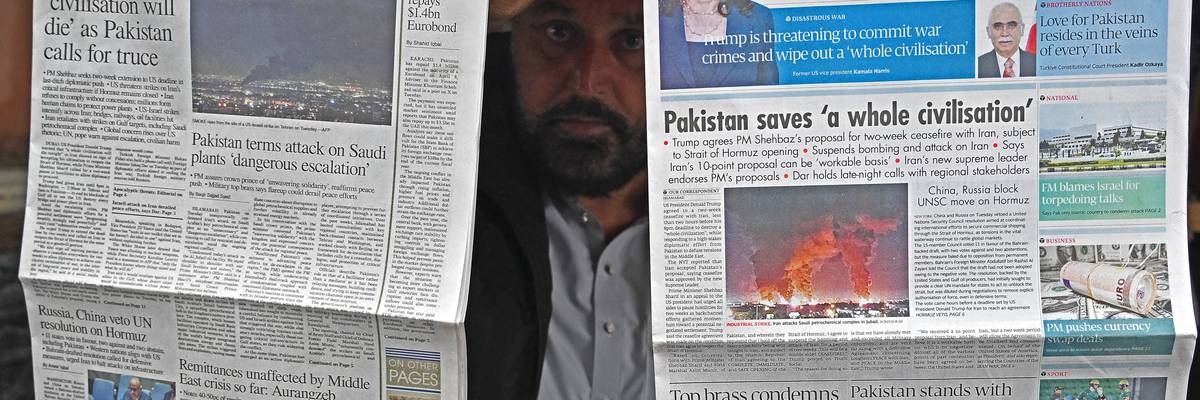
A vendor displays morning newspapers at his roadside stall in Islamabad on April 8, 2026.
(Photo by Aamir Qureshi/AFP via Getty Images)
A foreign policy expert told Common Dreams that Israel’s unprecedented attack on Lebanon, backed by the US, “appeared to be a direct attempt to blow up the ceasefire, and it worked.”
A Pakistani official said Wednesday that despite Israel’s unprecedented attack on Lebanon, it is still part of the ceasefire agreement that Pakistan’s prime minister helped to mediate the previous day, even as Israel and the US insist otherwise.
Pakistani Prime Minister Shehbaz Sharif, who played a key role in brokering the deal announced on Tuesday, said that “Iran and the United States of America, along with their allies, have agreed to an immediate ceasefire everywhere, including Lebanon and elsewhere, EFFECTIVE IMMEDIATELY.”
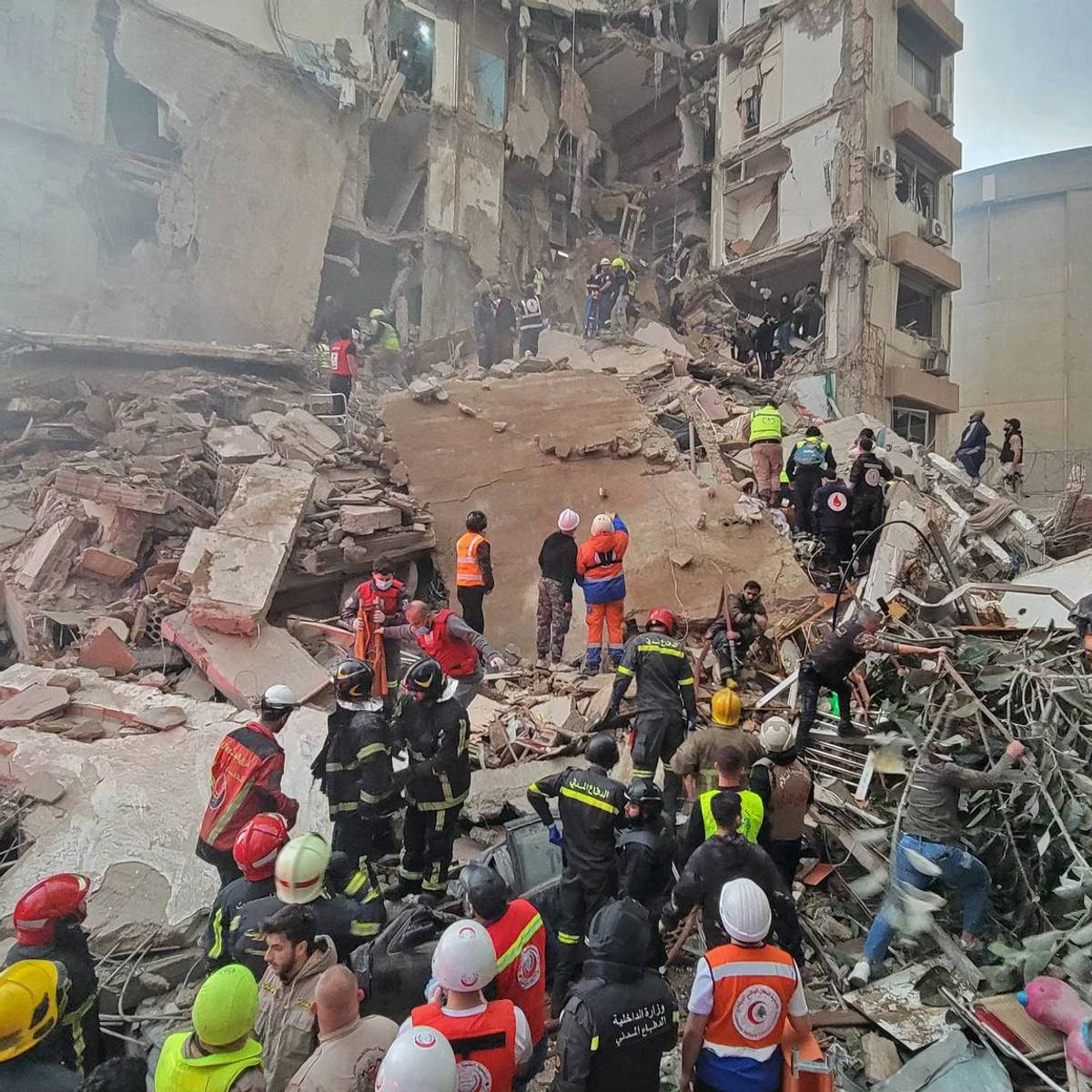
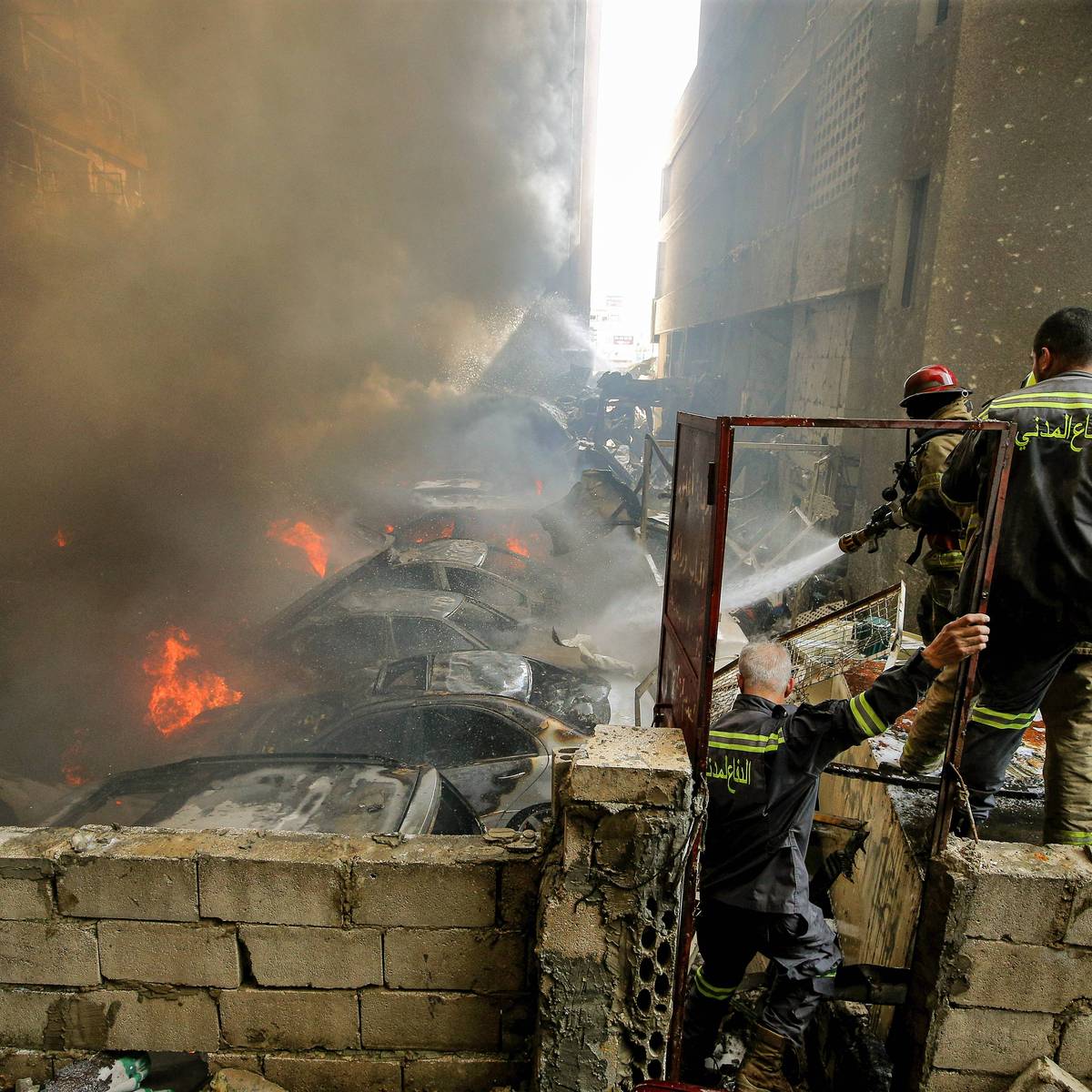
But within hours of the agreement, Israel launched what it said was its largest military operation against Lebanon yet, which killed at least 254 people and wounded 1,165 others, according to the Lebanese Health Ministry. The Israel Defense Forces acknowledged that the assault included attacks on many civilian areas.
Contrary to the mediators, Israeli Prime Minister Benjamin Netanyahudeclared that the ceasefire “does not include Lebanon.” White House Press Secretary Karoline Leavitt followed suit, confirming that the US’s position was also that “Lebanon is not part of the ceasefire,” adding that “that has been relayed to all parties involved.”
But Pakistan’s ambassador to the US, Rizwan Saeed Sheikh, said on Wednesday afternoon that this was not the agreement the parties reached on Tuesday.
He told CNN anchor Becky Anderson that the deal announced by his prime minister, which included Lebanon, “could not have been more authentic” to what the two parties agreed to, and that it was still the prime minister’s understanding that Lebanon was included.
He added that this was another instance in which a ceasefire “could be disrupted” by Israel’s actions. He also noted that “there have been instances in the past where ceasefires have been disrupted,” a possible reference to Israel’s routine violations of its previous ceasefire with Lebanon and the current one with Gaza, and its repeated assassinations of Iranian negotiators as they’ve sat down for talks with the US.
The US-Iran ceasefire is less than 24 hours old, but Israel’s attack on Wednesday has already thrown it into peril. Iran responded to the attacks on Wednesday by once again closing the Strait of Hormuz after briefly reopening the critical waterway in accordance with the deal. Iran is also reportedly considering withdrawing from the ceasefire altogether and resuming strikes against Israel.
President Donald Trump has appeared eager to declare victory and move on from the war, which has further tanked his already plummeting support at home and sparked a global economic crisis.
But Janet Abou-Elias, a researcher with the Democratizing Foreign Policy program at the Quincy Institute for Responsible Statecraft, told Common Dreams that Israel’s goals are very different.
She explained that Israel was largely sidelined from the talks that culminated in Tuesday’s ceasefire and that within Israel’s internal politics, the agreement is being portrayed as “catastrophic.”
She noted that Yair Lapid, the leader of the opposition to Netanyahu’s government, has portrayed it as “the worst political failure in our history,” and accused the prime minister of failing to achieve his goals.
“What we’ve seen since looks like Israel acting to undermine a diplomatic process over which it had lost influence,” Abou-Elias said.
She said that Israel’s attack on Lebanon on Wednesday, which it has referred to as Operation Eternal Darkness, “appeared to be a direct attempt to blow up the ceasefire, and it worked.”
According to the Human Rights Activists News Agency, a US-based human rights monitor for Iran, at least 1,701 civilians have been killed in US-Israeli attacks against Iran since the war was launched on February 28.
After Wednesday’s bombardment, Lebanon’s Health Ministry reported that the death toll in the country was now up to at least 1,739 since the war began on March 2.
“At this point, any durable end to this conflict, even a temporary one, requires Washington to rein in Israel,” Abou-Elias said. “Trump has the leverage to do it. What’s unclear is whether he has the political will to use it.”
The U.S. is on a fast track to authoritarianism like nothing I’ve ever seen. Meanwhile, corporate news outlets are utterly capitulating to Trump, twisting their coverage to avoid drawing his ire while lining up to stuff cash in his pockets.
That’s why I believe that Common Dreams is doing the best and most consequential reporting that we’ve ever done.
Our small but mighty team is a progressive reporting powerhouse, covering the news every day that the corporate media never will. Our mission has always been simple: To inform. To inspire. And to ignite change for the common good.
Now here’s the key piece that I want all our readers to understand: None of this would be possible without your financial support.
That’s not just some fundraising cliche. It’s the absolute and literal truth. We don’t accept corporate advertising and never will. We don’t have a paywall because we don’t think people should be blocked from critical news based on their ability to pay. Everything we do is funded by the donations of readers like you.
Will you donate now to help power the nonprofit, independent reporting of Common Dreams?
Thank you for being a vital member of our community. Together, we can keep independent journalism alive when it’s needed most.
– Craig Brown, Co-founder
about:blank
about:blank
Our work is licensed under Creative Commons (CC BY-NC-ND 3.0). Feel free to republish and share widely.




 Peace and Justice Post