West Bank commander boasts about high death toll and defends looser rules of engagement, including firing at unarmed Palestinians
An Israeli soldier stands on guard during an army raid at a cafe in the Rafidia neighbourhood of Nablus in the occupied West Bank on 23 April 2026 (Nasser Ishtayeh / SOPA Images via Reuters)
Published date: 4 May 2026 14:13 BST | Last update:2 days 20 hours ago
Israel’s top commander in the occupied West Bank has said the army is killing Palestinians at levels “not seen since 1967”, according to Haaretz.
Avi Bluth, head of the Israeli army’s Central Command, made the remarks in a closed forum, where he also defended looser rules of engagement allowing troops to fire at unarmed Palestinians.
He acknowledged a discriminatory approach whereby Jewish Israeli stone-throwers are not targeted while Palestinians carrying out similar acts are fired at.
“In three years, we have killed 1,500 terrorists,” he said, referring to Palestinians.
“So how is there no intifada? Why aren’t they taking to the streets? Why is the Palestinian public indifferent? Why are there no disturbances?” Bluth, a settler who has been the Israeli army commander in the West Bank since 2024, added.
New MEE newsletter: Jerusalem Dispatch
Sign up to get the latest insights and analysis on Israel-Palestine, alongside Turkey Unpacked and other MEE newsletters
“The Arabs understand that ‘if someone rises to kill you, kill him first’ is part of the rules of the Middle East, and therefore we are killing like we have not killed since 1967.”
According to the United Nations Office for the Coordination of Humanitarian Affairs (Ocha), since 7 October 2023, Israel has killed 1,081 Palestinians in the West Bank and the occupied East Jerusalem, including at least 235 children.
Bluth attributed the high number of Palestinian deaths to orders he gave, which made it easier for Israeli soldiers to open fire at civilians.
He said troops are permitted to shoot, from the knee down, at Palestinians attempting to cross the West Bank separation barrier.
“Today, there are many ‘limping memorials’ in Palestinian villages of those who tried to infiltrate and got hit, so there is a price that is paid,” Bluth said, according to Haaretz.
Preferential treatment for settlers
Bluth admitted that his subordinates do not shoot Israelis who throw stones at army forces because of “sociological implications,” while they kill Palestinians who do the same.
He added that in 2025, Israeli forces killed 42 Palestinians accused of stone-throwing, which he described as terrorism.
When shown footage of settlers throwing stones at troops, he cited an incident in which two masked Israelis were shot, noting it caused a public outcry.
Bluth’s remarks come amid growing discontent about his actions among hilltop youth, the settler militias who terrorise Palestinians communities in the West Bank, who view him as yielding to left-wing and international pressure.
Ex-Mossad chief says Israeli settler violence reminds him of the Holocaust
Last week, Haaretz reported that Bluth labelled the growing numbers of settler attacks as “terror,” and criticised hilltop youth who establish outposts without coordinating it first with the army’s command.
Bluth added that the army, with the coordination of the settlers, established some 150 outposts in Area C in the West Bank in recent years, which he alleged helped prevent Palestinian “terror” and building expansion.
Last week, Knesset Member Limor Son Har-Melech, a vocal supporter of the settler militias, called Israel Defence Minister Israel Katz to immediately fire Bluth from his post over his remarks.
Meanwhile, the Israeli NGO Peace Now reported on Sunday that the Israeli government assigned some 130 million shekels to those same settler groups under the guise of curbing settler violence.
The funds were allocated towards “reducing risk situations and expanding positive responses for youth in the Judea and Samaria area,” using the Israeli name for the West Bank.
Peace Now said the funds will, in practice, be used to strengthen the settlements and “channel millions” to their regional councils.
“The government uses every excuse to justify pouring more and more millions into settlements. This is a programme to expand settlements under the guise of combating violence,” Peace Now statement said.
“The government is directing a significant portion of the funds to the same actors and activities that currently serve as the main supporters of the outposts and farms from which the violence originates,” the NGO added, calling on the government to stop the funds and the army and police to stop the violent acts.
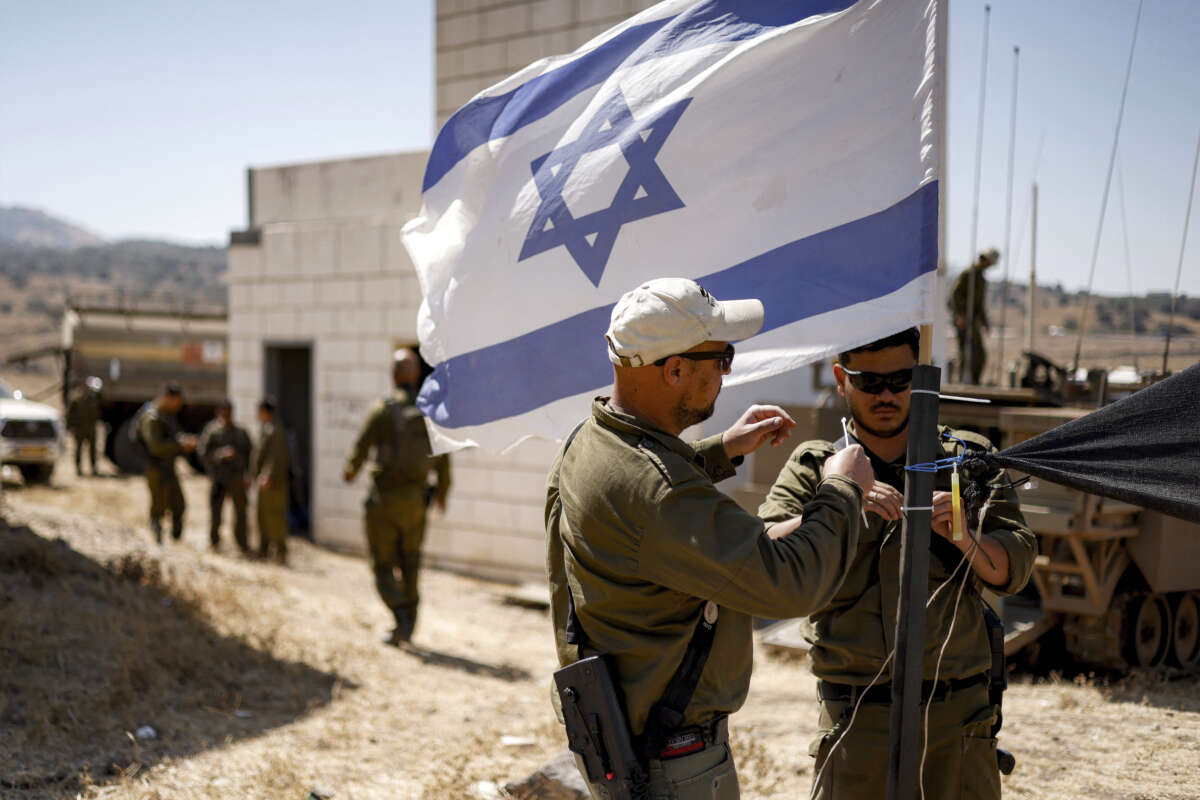
Israeli army soldiers add zip ties to the mast of an Israeli flag flying at a special area for exercises during a military drill in the Israeli-annexed Golan Heights on July 8, 2025.
Truthout is an indispensable resource for activists, movement leaders and workers everywhere. Please make this work possible with a quick donation.
Syrian journalist Oudai Efnikher is deeply familiar with life under Israeli occupation. He was born in Kafer Hareb, a village in Syria’s Golan Heights, from which he and his family were expelled after Israel seized the territory during the 1967 Six-Day War.
Now he is once again facing down Israeli forces, as they “take our land, kill our crops, and abduct our fathers.”
“This is a slow occupation, but soon, we will lose what they have not yet taken,” Efnikher told Truthout.
After Bashar al-Assad was ousted by Syrian rebels in December 2024, Israeli forces wasted no time before launching a massive aerial bombardment campaign on the country, destroying almost 80 percent of the military capacity left behind by the Assad regime.
Israeli forces also entered the demilitarized buffer zone established by a UN Security Council resolution in 1974 between the Israeli-occupied Golan Heights and the rest of Syria. They seized the territory and then established a “security buffer” beyond the last demarcation line administered by UN observer forces.
200 masked settlers descended on the West Bank on March 22, throwing Molotov cocktails and terrorizing Palestinians. By Theia Chatelle , Truthout
March 28, 2026
The area now under Israeli military control is off-limits to Syrian civilians and government forces. Farmers have been unable to tend to their land, and landowners have little hope they will ever be able to access it again
In total, Israel now occupies an additional 177 square miles of Syrian territory than it did before the fall of Assad.
“Maybe Israel will take it all. They already have a safe zone in southern Syria, so that could ultimately be the best option for Israel,” Syrian political analyst Issam Khoury told Truthout.
But what is most concerning for Efnikher is not the Israeli military’s presence in Syria, but what has become regular incursions by Israeli settlers.
On April 22, a group of roughly 40 settlers affiliated with the far right Halutzei HaBashan movement, or the Pioneers of Bashan — a reference to the name in the Torah for the fertile territory located northeast of the Sea of Galilee, which the Torah says was once ruled by the tyrant King Og before Moses defeated him — entered Syrian territory and asked the Israeli government to legalize settlement activity there.
According to Efnikher, who has been working to monitor Israeli settlement activity in Syrian territory since Assad’s fall in December 2024, this was the fifth such incursion by Israeli settlers into Syria.
According to Etkes, this is how the Israeli settlement movement functions: by “changing the facts on the ground” until what was once unthinkable becomes reality.
The settlers see themselves as fulfilling a biblical mandate. They consider this Syrian territory part of the ancient land of Israel. Still, the Israeli military condemned the incursion, calling it “a criminal offence that endangers civilians and IDF troops.” Dror Etkes, a longtime Israeli settlement monitor who led the advocacy group Peace Now’s Settlement Watch project and later founded Kerem Navot, an organization that tracks Israeli land seizures in the West Bank, says none of this comes as a surprise.
“Nothing is surprising anymore, not after Gaza,” he said. “Many things I didn’t think would happen have happened, so I think I should be pretty cautious when it comes to predicting what will happen in this country.”
Etkes watched settlers build their first outposts in the West Bank in the 1960s, and then, after the Second Intifada, the construction of the separation barrier. “If you had asked me 10 years ago, five years ago, two years ago, not to mention 50 years ago, whether half a million Jews would be living in the West Bank, whether we would have 350, 360, 370 outposts in the West Bank, of course nobody would have said yes,” he added.
According to Etkes, this is how the Israeli settlement movement functions: by “changing the facts on the ground” until what was once unthinkable becomes reality. And this, he says, is the goal of the settlement movement — whether it’s in Syria, Lebanon, Gaza, or the West Bank.
The Pioneers of Bashan is not the only settler organization entering closed military zones to pressure the Israeli government to legalize settlements in foreign territory.
In southern Lebanon, a group called Uri Tzafon has worked to build a movement to establish outposts in territory currently occupied by the Israeli military. The group has flown drones into Lebanese territory, urging residents to leave, and planted trees to cement a claim to the land.
It was the same in Gaza with the far right Tzav 9 movement, which on more than one occasion since October 7, 2023, attempted to enter the enclave and establish outposts.
Slowly, the borders of the Israeli imagination — much like the state’s own physical borders — are being expanded by the settlement movement.
Slowly, the borders of the Israeli imagination — much like the state’s own physical borders — are being expanded by the settlement movement. In many cases, these incursions have taken place with the implicit endorsement of the Israeli military.
According to both Etkes and Efnikher, it would have been impossible for the settlers to enter Syrian territory without at least the tacit approval of Israeli forces. There are hundreds of miles of fencing dividing the Israeli-controlled Golan from Syrian territory, reinforced by hundreds of thousands of mines.
Efnikher added that there are a number of gates in the fencing that allow the Israeli military to cross into and beyond the demilitarized buffer zone, which is how the Pioneers of Bashan were able to enter Syrian territory.
The Israeli military said in a statement after detaining and escorting the settlers back to Israeli-controlled territory that “settlement in Bashan is essential to preserve the achievements of the war.”
The push for these settlements is part of the project of Greater Israel, which seeks to expand Israel’s borders to what some settlers and religious nationalists claim were the boundaries of the ancient Israelite kingdom — a biblical vision, contested by mainstream archaeology, that imagines a realm stretching from the Euphrates to the Nile, encompassing parts of modern-day Saudi Arabia, Jordan, Iraq, and Egypt
But the expansionist drive is not only about land. It is also about water. Efnikher pointed to the Mantara Dam, the largest dam in Syria’s Quneitra Governorate. The dam controls water flow into the Yarmouk River, another critical water supply for southern Syria.
Before he was a journalist, Efnikher owned a restaurant overlooking the dam. It has been closed since Israeli forces expanded their occupation of the territory — a significant financial blow to him and his family, though he stressed that he is better off than most.
Israeli forces have destroyed thousands of dunams of farmland with pesticides in the process of building their outposts, and have established checkpoints — including aerial ones — to regulate the movement of Syrians near the buffer zone.
“There is a heavy psychological toll, falling heaviest on children and the elderly,” Efnikher said. “We’re talking about villages displaced since 1967 and families still affected across generations, now living through yet another occupation.”
He pointed to the West Bank as emblematic of what the Quneitra Governorate might soon become.
Israel has held control of the West Bank for so long that many Palestinians and Israelis in the territory, more than a third of whom are children, do not remember a time when it was free of Israeli outposts and settlements. Now, according to the UN’s High Commissioner for Human Rights, there are more than 279 illegal settlements and 700,000 settlers living in the West Bank.
“This is a model [they’re] trying to copy-paste in Syria and in Lebanon. It’s the same people, coming from the same places, from the same ideological greenhouses.”
The commitments of the settlement movement vary, but at its forefront are those who see it as their personal mission to restore Jewish sovereignty over the land they claim as Greater Israel, even if it must be paid for in blood.
“It’s been almost 58 years since this project started. And all of it started actually illegal[ly] or half-legal, started without official authorization. This is a model [they’re] trying to copy-paste in Syria and in Lebanon. It’s the same people, coming from the same places, from the same ideological greenhouses,” Etkes said.
Efnikher warned that Israeli forces are intensifying their incursions in the Quneitra region: They enter the villages, make arrests — by his tally, more than 70 Syrians from the Quneitra Governorate are currently held in Israeli prisons — set up checkpoints, and then withdraw.
But Efnikher fears it is only a matter of time before they stay. The presence of the Pioneers of Bashan is one troubling sign. “They are winning,” Efnikher said of the Israeli forces. Even for Etkes, there is little hope.
“Look at what they achieved in the last 58 years in the West Bank,” he said. “They have very good reasons to be very optimistic.”
Press freedom is under attack
As Trump cracks down on political speech, independent media is increasingly necessary.
Truthout produces reporting you won’t see in the mainstream: journalism from the frontlines of global conflict, interviews with grassroots movement leaders, high-quality legal analysis and more.
Our work is possible thanks to reader support. Help Truthout catalyze change and social justice — make a tax-deductible monthly or one-time donation today.
about:blank This article is licensed under Creative Commons (CC BY-NC-ND 4.0), and you are free to share and republish under the terms of the license.
Theia Chatelle is a freelance journalist and photographer covering conflict, human rights, and displacement across the Middle East, Europe, and the United States. Based in Jerusalem, she reports on war and social movements, with a focus on human-interest storytelling and investigations into state power. Her work has appeared in The Forward, The Nation, Haaretz, and the Jewish Telegraphic Agency, among other outlets. Her photography has been published by MS NOW and USA Today, among others. Chatelle holds bachelor’s and master’s degrees in American Studies from Yale University. She was a 2025 fellow at the International Women’s Media Foundation and is an alumna of the Rory Peck Trust and the Type Media Center.
Direct talks in Washington for the first time in 30 years continue a long history of overtures that predate resistance and persist despite repeated Israeli attacks on civilians
Lebanese protesters gather in Martyrs’ Square in Beirut to reject direct negotiations with Israel, expressing opposition to normalisation and diplomatic engagement, on 13 April 2026 (Abdul Kader Al Bay/ZUMA Press Wire)
Since Lebanese President Joseph Aoun and Prime Minister Nawaf Salam assumed office in early 2025, mere weeks after the November 2024 ceasefire between the Lebanese resistance and the genocidal state of Israel, the new leadership, under strong US and Saudi advice, moved urgently to offer friendship and full cooperation to Israel.
Not only did they fail to protest the more than 10,000 ceasefire violations that Israel committed over the 15 months leading up to the US-Israeli aggression on Iran in late February 2026 – including thousands of air strikes, drone attacks and ground incursions that killed more than 500 people, most of them civilians – but they went as far as offering, even pleading, for direct negotiations to achieve permanent peace with the Jewish settler-colony.
Rather than blaming Israel for its ongoing crimes against the Lebanese people, the two leaders blamed Hezbollah, as if Israeli attacks were a response to the resistance, when in fact the resistance has been retaliating against unceasing Israeli aggression and occupation of Lebanese land.
Such magnanimous offers were last made by the Phalangist president of Lebanon, Bashir Gemayel, who collaborated with Israeli invaders of his country in 1982, and his brother Amin, but they were scrapped afterwards due to much opposition.
The Israeli government initially rebuffed these recent overtures, which Salam repeatedly extended until it finally agreed last week. Facing pressure from the Trump administration, Israel met with Lebanese officials in Washington this week for their first direct talks in more than 30 years, even as it continues to bomb Lebanon, including the capital, Beirut, killing upwards of 2,000 people in the past six weeks alone.
New MEE newsletter: Jerusalem Dispatch
Sign up to get the latest insights and analysis on Israel-Palestine, alongside Turkey Unpacked and other MEE newsletters
Israel has justified its multiple invasions and incursions into Lebanon since the late 1960s, which have killed tens of thousands of civilians, as efforts to defeat Palestinian resistance fighters who moved there after 1969, and who were forced to withdraw in 1982. It has since invoked the same justification to confront post-1982 Lebanese resistance to its illegal occupation of Lebanese territory, especially Hezbollah.
Yet present claims that resistance movements provoke Israeli aggression, and that Lebanese leaders must therefore normalise relations with Israel to achieve stability, obscure the historical record: Israeli relations with Lebanese political and religious figures eager to offer it friendship and cooperation date back to the 1920s, long before the settler-colony was even established, let alone the arrival of the Palestinian resistance in Lebanon or the emergence of Hezbollah.
Indeed, Aoun and Salam are part of a long chain of Lebanese politicians eager to please Israel.
Sectarian myths
In Lebanon, a common claim is that right-wing sectarian Maronite leaders only sought to befriend Israel after 1948, in response to the arrival of more than 100,000 Palestinian refugees expelled during the 1948 Zionist conquest of Palestine by Jewish colonists – the majority of them Muslim – and the resulting demographic shift.
This, however, proves to be a fabrication. Sectarian Maronite hostility towards Lebanese Muslims precedes the arrival of the Palestinians by nearly three decades.
In March 1920, Jewish Agency representative Yehoshua Hankin and Lebanese Maronite representatives signed a treaty of cooperation that also included “prominent Muslim families”, many of whom were absentee landlords who sold land in Palestine to Zionist settlers.
In March 1920, Jewish Agency representative Yehoshua Hankin and Lebanese Maronite representatives signed a treaty of cooperation that also included ‘prominent Muslim families’
Contacts between Lebanese Maronite leader Emile Edde and Zionist representatives began in the early 1930s. During this period, Edde expressed his support for establishing friendly relations with Jewish colonists and “even of a Zionist-Maronite alliance”.
Edde was elected president of Lebanon in 1936 and remained in contact with the Jewish Agency for the next two years.
Edde’s prime minister, Khayr al-Din al-Ahdab, the first Sunni Muslim to hold the position in Lebanon’s history, offered his country’s guarantees of order and security to the Jewish colonial-settlements along the Lebanese border. After leaving office and seeking to regain power, Edde resumed his contacts with the Israelis in 1948 while vacationing in France.
This was followed by the signing of the infamous political treaty between the Jewish Agency and the Maronite Patriarch Antoine Arida, on behalf of the Maronite Church, on 30 May 1946.
The treaty established guidelines for close ties between the Maronites and the Jewish colonists, based on mutual recognition of rights and nationalist aspirations, including the Jewish Agency’s recognition of Lebanon’s “Christian character” and its assurance that the Jewish colonists had no territorial ambitions in Lebanon.
In return, the Maronite Church supported Jewish immigration and the establishment of a Jewish state in Palestine.
Deepening collaboration
Edde, al-Ahdab, and the Maronite Church were not the only parties in Lebanon offering love and friendship to Israel. The Phalangists were next. Israel established relations with them at the end of 1948 in the United States, through the mediation of the Maronite priest Yusuf ‘Awad, who had contacts with representatives of the US Zionist Federation.
The main Phalangist contact was Elias Rababi, who, along with other Phalangists, held several meetings with the Zionist representatives in Europe.
Rababi informed the Israelis that if the Phalangists took over the government, they would establish diplomatic relations with Israel. In exchange, he requested funding to support Phalangist political activity and procure weapons.
While the Israelis were unconvinced of the movement’s strength, the foreign ministry nevertheless paid him $2,000.
In February 1949, three envoys of the Maronite Archbishop of Beirut, Ignatius Mubarak, arrived in Israel and met with a foreign ministry official. The three claimed that Mubarak “wished to know the position of the Israeli Government on plans for a coup in Lebanon” against President Bechara Khoury due to the latter’s support of integrating Lebanon in the Arab world.
Emile Edde and Pierre Gemayel were said to be parties to the plan. The Israelis responded by welcoming any attempt on the part of Lebanon’s Christians to “liberate themselves from the yoke of pan-Arab leaders”, but requested a detailed plan of how the coup would be staged, what forces they had backing them and the level of assistance required from Israel. The plan ultimately came to naught.
But the plan to install a pro-Israel government in Lebanon through a coup was an idea Zionists had entertained since the 1920s.
In response to former prime minister David Ben-Gurion’s 1954 proposal that Israel encourage a military coup in Lebanon to establish a Christian regime allied with Israel, then prime minister Moshe Sharett dismissed it as “nonsense“, writing in his diaries that no movement was strong enough to establish an exclusively Maronite state.
Given the proposal’s unfeasibility, Moshe Dayan, who was the army chief of staff at the time, proposed in 1955 that Israel annex Lebanon south of the Litani River.
Before resistance
Just as there is a long history of Lebanese politicians offering a loving friendship to Israel, Israeli atrocities against the Lebanese people between 1948 and 1969 were also the order of the day, long before the existence of the Palestine Liberation Organization (PLO) or Hezbollah.
During the 1948 war, even though the Lebanese army did not engage in battle with the Israelis, Zionist forces conquered southern Lebanon in what they dubbed “Operation Hiram”, occupying 15 Lebanese villages as far as the Litani River.
Zionist commander General Mordechai Makleff asked Ben-Gurion for permission to occupy Beirut, which he said could be done in 12 hours, but the latter refused, fearing international condemnation given Lebanon’s neutrality.
During their occupation of southern Lebanon, Zionist forces committed one of the worst massacres of the 1948 war in the Lebanese village of al-Hula, where they slaughtered 85 civilians on 31 October. When the Israelis invaded it again in 2024, soldiers defaced the monument to the massacre, listing the names of those killed.
Ceasefire not included: Lebanon begins ‘exploratory’ talks with Israel
In early 1949, Lebanese and Israeli officials began formal armistice negotiations at Ras al-Naqura, which proceeded “more smoothly” than with all other Arab states. Rather than express horror at Israeli atrocities committed against Lebanese civilians a few weeks earlier, Lebanese delegates privately informed the Israelis that they “were not really Arabs”. They also discussed the possibility of establishing diplomatic relations with Israel.
The Israelis withdrew from Lebanese territory in March 1949.
This week’s meeting in Washington DC was a repeat performance by the Lebanese ambassador to the US, who did not condemn Israel’s recent massacres of Lebanese civilians but reportedly shook hands with the Israelis in a two-hour private meeting away from the cameras.
None of this will halt continued Israeli attacks on Lebanese civilians, any more than the extra-friendly 1949 talks halted subsequent aggression.
In the 1950s and 1960s, long before the PLO guerrillas arrived in Lebanon, Israel attacked the country close to 200 times – including raids and shootings, stealing Lebanese cattle, burning crops in border villages and towns, destroying homes and property and kidnapping Lebanese civilians – resulting in at least 23 killed, 39 injured and 81 abducted.
In 1965, Israel bombed a dam under construction intended to divert the Banyas, Hasbani and Litani rivers in Lebanon and Syria, in response to Israeli theft of water belonging to Arab states, which it sought to divert to the Naqab desert in violation of international law. It destroyed the project.
Atrocities continue
Perhaps Israel’s most daring crime during this period was the machine-gunning of a Lebanese civilian plane in July 1950 by one of its air force fighters inside Lebanese airspace.
The attack on the plane, en route from East Jerusalem’s Qalandya airport to Beirut, killed two people and injured seven Jordanian passengers, including a five-year-old girl whose leg had to be amputated. Among those killed were Lebanese radio operator Antoine Wazir and Arab Jewish student Musa Fuad Dweik, whose head was blown off by one of the bullets.
In 1967, Israel occupied the Shib’a Farms, even though Lebanon was not a party to the war. It continues to occupy them today.
The following year, in December 1968, two days after two Palestinian refugees from Lebanon machine-gunned an Israeli passenger plane parked at Athens airport, killing a marine engineer, Israel bombed Beirut International Airport, destroying 13 civilian passenger planes worth almost $44m at the time, as well as hangars and other airport installations.
The Lebanese government is offering Israel extensive support to neutralise Hezbollah, including criminalising the only Lebanese resistance movement that ever liberated Lebanese territory from occupation
All these atrocities were committed before Palestinian guerrillas in Lebanon began to launch resistance operations against the settler-colony. Likewise, Lebanese politicians who offered cooperation with Israel did so long before these developments were later invoked to justify Israeli aggression.
Neither Aoun nor Salam is proposing anything new to the Israelis that previous Lebanese allies had not offered.
The Lebanese government is offering Israel extensive support to neutralise Hezbollah, including criminalising the only Lebanese resistance movement that ever liberated Lebanese territory from occupation and disseminating anti-Iranian propaganda.
Lebanese Justice Minister Adel Nassar posted on X this week the complete fabrication that Iran abandoned its condition for a comprehensive ceasefire that includes Lebanon in return for the Americans releasing its funds in western banks.
Yet despite all this help, nothing will sway Israel from committing more atrocities in Lebanon, and no one – not the Americans, the Saudis or the Israel-friendly Lebanese government – will be able to stop the Lebanese resistance from fighting back against this genocidal, predatory state.
Ultimately, Israel did not need to orchestrate a coup in Lebanon to secure a regime allied with it. The United States and Saudi Arabia did the job on its behalf and then some – as Israeli Ambassador to the US Yechiel Leiter, who participated in Israel’s 1982 invasion of Lebanon, affirmed when he emerged from this week’s talks declaring: “We are on the same side.”
The views expressed in this article belong to the author and do not necessarily reflect the editorial policy of Middle East Eye.
Joseph Massad is professor of modern Arab politics and intellectual history at Columbia University, New York. He is the author of many books and academic and journalistic articles. His books include Colonial Effects: The Making of National Identity in Jordan; Desiring Arabs; The Persistence of the Palestinian Question: Essays on Zionism and the Palestinians, and most recently Islam in Liberalism. His books and articles have been translated into a dozen languages.
An Irgun poster from 1931 showing a map labelled “Land of Israel” covering the borders of both Mandatory Palestine and the Emirate of Transjordan, which the Irgun claimed in their entirety for a future Jewish state – Public Domain
Israel and the United States have launched a war of aggression against Iran that has spread across the Persian Gulf and beyond, with Israel also attacking Lebanon and invading with ground troops. The brutal assassination of Iran’s supreme Shia religious leader, Ayatollah Khamenei, along with his wife, daughter and granddaughter set the stage for the unfolding zealotry. A coordinated assault that combines airstrikes on so-called military targets, though civilian targets have been hit causing widespread casualties.
The war has been framed by its architects as a defensive necessity, but the rhetoric reveals a deeper truth: this is biblical bloodlust dressed as geopolitics, with Zionist expansionism and Christian Zionist end-times zealotry driving the aggression toward the dream of Greater Israel. US Ambassador to Israel Mike Huckabee set the tone in a February podcast with Tucker Carlson, declaring that Israel has a “biblical right” to vast swaths of the Middle East—from the Nile to the Euphrates—and adding, “It would be fine if they took it all.” This is not fringe rhetoric; it is the ideological engine of a fascist international that sees the Iran war as Armageddon’s prelude, with Trump cast as a modern Cyrus the Great anointed to usher in the apocalypse.
The vision of Greater Israel has deep roots in Zionist thought, evolving from early nationalist aspirations into a militant territorial program. Theodor Herzl, the founder of modern political Zionism, sketched expansive territorial ambitions in his private diaries of the 1890s, envisioning a Jewish homeland in historic Palestine that could stretch from the “Brook of Egypt” to the Euphrates, encompassing parts of modern Egypt, Jordan, Lebanon, Syria, and Iraq. While Herzl’s public focus in “Der Judenstaat” (1896) was pragmatic—securing any viable territory as a refuge from European antisemitism—his private notes reveal a broader imperial dream shaped by the colonial spirit of the era.
Map of Greater Israel
Ze’ev Jabotinsky, founder of Revisionist Zionism in the 1920s, radicalized this vision. His “Iron Wall” doctrine called for a fortified Jewish state on both sides of the Jordan River, including Transjordan, rejecting partition and insisting on military strength to “colonize” the land. Jabotinsky’s followers, including Menachem Begin, laid the foundation for Israel’s Likud party, whose 1977 platform declared: “Between the Sea and the Jordan there will only be Israeli sovereignty.” The 1967 Six-Day War transformed this ideology into reality, with the conquest of the West Bank, Gaza, Sinai, and Golan Heights hailed by Religious Zionists as divine redemption.
Today, ultranationalists like Itamar Ben-Gvir and Bezalel Smotrich openly advocate full annexation and Palestinian expulsion, while Benjamin Netanyahu has repeatedly framed his political mission as “historic and spiritual,” declaring in multiple speeches that the land of Israel belongs to the Jewish people by divine right and that settling “Judea and Samaria” is a sacred duty to fulfill biblical promises. This is no mere political posture; it is a messianic commitment that drives the current war of aggression on Iran and the relentless push for territorial expansion.
Christian Zionism provides the theological rocket fuel for this expansionist project. Rooted in 19th-century dispensationalism—popularized by John Nelson Darby and later the Scofield Reference Bible—Christian Zionists believe the return of Jews to Palestine fulfills Old Testament prophecies that must precede the Rapture, Tribulation, Armageddon, and Christ’s return. The 1948 establishment of Israel was celebrated as the “super-sign” of prophecy; the 1967 capture of Jerusalem and the West Bank was seen as divine restoration of “Judea and Samaria.” Huckabee, a former Baptist pastor, embodies this fervor. His Carlson interview framed Israel’s claim to biblical lands as God-given, dismissing Arab objections as irrelevant. He and other evangelical leaders hail Trump as a modern Cyrus—the Persian king who freed Jews from Babylonian exile in 539 BCE, enabling temple rebuilding. Banners in Israel proclaim “Cyrus the Great is alive!” for Trump’s embassy move, Golan recognition, Gaza genocide, and Iran aggression. Netanyahu compared Trump to Cyrus in 2018; Huckabee echoes it today. For evangelicals, Cyrus-Trump fulfills prophecy: empowering Israel hastens Armageddon, where Jews convert or perish. This theology ignores Cyrus’ historical tolerance—his cylinder is hailed as the first human rights charter—twisting it into justification for conquest. Iran’s ambassador dismissed it: “Trump is no Cyrus,” but the fantasy drives policy, casting Iran as biblical foe.
This religious zeal infects the US military command. Over 200 complaints to the Military Religious Freedom Foundation reveal commanders telling troops the Iran war is “God’s divine plan” to trigger Armageddon and Jesus’ return. One NCO reported a briefing where the commander urged, “Tell your troops this is all part of God’s divine plan,” citing Revelation and proclaiming Trump “anointed by Jesus to light the signal fire in Iran.” Christian nationalists in uniform see the war as fulfilling end-times prophecy: Iran as biblical “Persia” in the final battle. With US forces now directly engaged, this zealotry risks turning tactical strikes into an apocalyptic holy war.
This all serves the warped Zionist concept of Greater Israel: biblical borders from the Nile to the Euphrates, encompassing “Judea and Samaria” and beyond. Huckabee’s “take it all” is no slip—it’s the dream of expansionists who reject Palestinian statehood as unbiblical and the existence of Palestinians outright. Greater Israel means ethnic cleansing, as seen in Gaza’s 75,000 dead and West Bank land grabs. The “ceasefire” is a farce: over 600 Palestinians killed since October 2025, famine weaponized. Israel’s aid ban on 37 groups (Oxfam, MSF, UNRWA) threatening no witnesses as further strangulation completes the genocide.
Europe’s complicity is sycophantic. In Munich, leaders gave Rubio a standing ovation for his “Western civilization” screed—ethnocentric drivel exalting whiteness while vowing no “moral equivalence” with the colonized. One by one EU governments are jumping the hurdles of international law to somehow hold Iran responsible for the lunatic aggression of Israel and the United States. EU governments are joining with Zionist zealots to codify IHRA laws criminalizing criticism of Israel. This is the fascist international: racism, crusader zeal, Zionist supremacy fused into one.
The Fourth Reich is here—in pulpits, Pentagon briefings, and boardrooms—wrapping aggression in scripture, conquest in prophecy, and genocide in “civilization.” Christian Zionism is its theological engine; Greater Israel its territorial goal. The zealots may pray for Armageddon, but the oppressed will outlast their prophecies. Empires fall. The people rise. United we can overcome.
Berlin’s sovereignty has been deeply compromised, and no talk of ‘collective guilt’ or ‘reason of state’ can explain this away
Israeli Prime Minister Benjamin Netanyahu and German Chancellor Friedrich Merz leave after a joint news conference in Jerusalem on 7 December 2025 (Ariel Schalit/AFP)
Just one month after the announcement of a “ceasefire” in Gaza, with the whole world aware that its sole purpose was to enable Israel to continue its genocide, Germany once again spread a veil of silence over the process, launching a “normalisation offensive”.
Last November, after having met his Israeli counterpart Gideon Saar in Tel Aviv, German Foreign Minister Johann Wadephul declared that his “confidence in the peace process as a whole has grown” and that “the situation has stabilised noticeably”.
A few days later, 160 “young leaders” from Germany were not above accepting an invitation from Israel to soak up Zionist propaganda.
And in early December, German Chancellor Friedrich Merz visited Israeli Prime Minister Benjamin Netanyahu, a wanted war criminal, thus paying homage to a murderous regime that he continues to call a democracy, while assuring Berlin’s continued unconditional support for Israel’s crimes against humanity.
New MEE newsletter: Jerusalem Dispatch
Sign up to get the latest insights and analysis on Israel-Palestine, alongside Turkey Unpacked and other MEE newsletters
German police followed suit, eager to “learn from Israel” – apparently fascinated by the weapons tested on Palestinians in Gaza, which they would soon have at their disposal.
And then 2026 began, with German Interior Minister Alexander Dobrindt travelling to Israel to sign a pact on “the development of a joint ‘Cyber Dome’ system, an artificial intelligence and cyber innovation centre, drone defence cooperation, and improved civilian warning systems”. Israel, Dobrindt said, was “a premium partner”.
All this “normalisation” – the veiling of genocide by the German government, young German “leaders” and the police wishing to “learn” from war criminals and a minister making pacts with them as “premium partners” – allows for little other conclusion than that the Zionist police and surveillance regime has become a role model for Germany.
Collective guilt narrative
Indeed, Germany’s transformation is already underway. After Berlin police prohibited Palestinians and their supporters from gathering in remembrance of the Nakba under dubious justifications, the courts – both the administrative court and the high administrative court – legally confirmed this massive infringement of civil rights.
Alongside the brutal actions of Berlin’s militarised riot police against pro-Palestinian demonstrators, strongly reminiscent of those carried out by Israeli security forces against Palestinians, this should deeply concern everyone living in Germany.
After Nazi rule, nothing was more important for West Germany than “normalising” relations with the newly formed state of Israel, which had just committed crimes against humanity in the Nakba.
Pretending that everything is ‘normal’ as Israel continues its daily slaughter of Palestinians comes at a high price: the ‘normalisers’ lose their own humanity
In a 1966 interview, former Chancellor Konrad Adenauer, an enthusiastic supporter of Zionist settlement in Palestine who paid reparations to Israel, said: “We had done so much injustice to the Jews, committed such crimes against them that somehow these had to be expiated or repaired, if we were at all to regain our international standing … Furthermore, the power of the Jews even today, especially in America, should not be underestimated.”
Author Daniel Marwecki pointed out that this “illustrates the way in which the objective of German rehabilitation was closely intertwined with a central idea of modern antisemitism: that of Jewish power” – and Adenauer’s fear, as historian Tom Segev has shown, was exploited by the Zionists in these negotiations.
Marwecki also shows how the reparations had nothing to do with forgiveness on the part of Israel or German atonement. Instead, one has to conclude, Germany allowed its sovereignty to be compromised to facilitate its return to the international stage as quickly as possible, while instilling a collective sense of guilt in its own citizens, ensuring they would accept Germany’s future subservience to Israel.
When these politics of collective guilt became implausible for subsequent generations who had done nothing to feel guilty about, former Chancellor Angela Merkel in 2008 trotted out the narrative that Israel’s security was “part of Germany’s reason of state”.
Proclaimed as if by an absolutist monarch and repeated like a mantra by Germany’s loyal public and liberal media, any democratic debate on this subject was to be nipped in the bud – which is why today, any dissenting opinion on Germany’s support for Israel’s genocide can easily be criminalised.
International law discarded
Interestingly, other parts of the alleged reason of state, that might also from the experiences of Nazi rule, are never mentioned: defending the dignity of every individual, complying with international law, obeying the decisions of global courts, defending human rights by all means, and treating those who commit genocide as nothing less than war criminals.
As the old saying goes: If you dance with the devil, you don’t change the devil. The devil changes you
Nothing remains of such maxims today, as the Scholz and Merz administrations have willingly disregarded them in order to support the genocide being carried out by the regime whose “security” is so dear to Germany.
Not only has this enabled the destruction of Gaza and the killing of tens of thousands – if not hundreds of thousands – of Palestinians, but Germany has also significantly contributed to the destruction of the United Nations, the International Criminal Court, the International Court of Justice and international law, which all stand in the way of neoliberal imperialism.
As nothing remains from these high maxims but the alleged obligation to protect Israel’s security, Germany is doing the “dirty work” for the Zionist regime by “normalising” a state that commits genocide in Gaza, ethnically cleanses the occupied West Bank and East Jerusalem, that systematically neglects Palestinian citizens of Israel and now introduces the death penalty for Palestinians only, intending to execute them not for what they allegedly have done but for what they are.
Berlin is further protecting a racist ideology that feeds the fascist delusions of the vast majority of Jewish Israelis, who welcome the extermination of the Palestinian people. It is also normalising a “moral” army of war criminals, sadistic torturers and rapists reduced to their lowest instincts.
Finally, Berlin normalises paramilitary militias and fascist hordes of Zionist settlers terrorising Palestinians in the West Bank and causing a second Nakba.
While Germany behaves as if all this were “normal”, Israel has become radicalised within a specifically settler-colonial dynamic; first, as Patrick Wolfe has made clear: “Settler colonialism is inherently eliminatory but not invariably genocidal.”
What is behind Germany’s complicity in Israel’s Gaza genocide?
World-leading genocide experts as well as Francesca Albanese, the United Nations special rapporteur on human rights in the Occupied Palestinian territories, leave no doubt that Israel today is such a genocidal regime.
Second, French-Tunisian writer Albert Memmi points out that “every colonial nation carries the seeds of fascist temptation in its bosom” – and this seed has undoubtedly taken root in Israel, as Holocaust survivors also explain.
Over time, the normalisation of Germany’s relations with Israel has developed into a normalisation of all Zionist crimes, no matter how repugnant. No talk of “collective guilt” or “reason of state” can explain this away; it is a product of deeply compromised sovereignty.
The veil of silence that Germany has cast over Israel’s atrocities for decades has become a blood-soaked shroud.
Pretending that everything is “normal” as Israel continues its daily slaughter and dehumanisation of Palestinians comes at a high price: the “normalisers” lose their own humanity.
As the old saying goes: If you dance with the devil, you don’t change the devil. The devil changes you.
The views expressed in this article belong to the author and do not necessarily reflect the editorial policy of Middle East Eye.
Jurgen Mackert is Professor of Sociology at the University of Potsdam, Germany. He was a temporary Professor for the Structure of modern societies at the University of Erfurt, Germany and a visiting professor for Political Sociology at Humboldt University Berlin. His latest books include On Social Closure. Theorizing Exclusion, Exploitation, and Elimination (Oxford University Press 2024). Siedlerkolonialismus. Grundlagentexte und aktuelle Analysen (edited with Ilan Pappe; Nomos 2024).
Over two years after the start of the Israeli genocide in Gaza, retired Israeli reserve general Yitzhak Brik acknowledged sweeping military, economic and social damage, saying the campaign has failed to achieve its primary objective.
Key Takeaways
Brik said Israel failed to defeat Hamas after two years of war.
Hundreds of billions of shekels were lost economically.
Israeli soldiers face a rapidly expanding PTSD crisis.
Suicide attempts and depression rates surged among combat troops.
Ongoing multi-front deployments continue to strain the military.
Failure to Achieve War Objectives
In a Channel 13 television interview, Brik described the war as a prolonged conflict whose costs exceeded its gains.
“In reality, we have lost national and social resilience over these two years, along with hundreds of billions of shekels,” he reportedly said.
The retired general added that Israel had not succeeded in defeating Hamas, arguing that the campaign imposed heavy casualties while failing to produce a decisive outcome.
“Over the past two years, we have borne severe losses,” Brik stated, referring to both battlefield casualties and long-term physical and psychological injuries among soldiers and civilians.
He also warned of diplomatic repercussions, saying Israel had “lost credibility in the world,” and suggested Washington has intervened after viewing the war as strategically stalled.
Expanding Psychological Crisis
Parallel reports from Israeli institutions and healthcare providers indicate a growing mental-health emergency inside the military.
According to data from the Israeli Security Ministry, around 22,300 soldiers and personnel are receiving treatment for war-related injuries, with approximately 60 percent suffering from post-traumatic stress disorder.
Israel’s healthcare provider Maccabi reported that 39 percent of soldiers under its care sought psychological assistance, while 26 percent displayed symptoms of depression.
A parliamentary committee documented 279 suicide attempts between January 2024 and July 2025, with combat soldiers representing the majority of cases.
Authorities have expanded mental-health funding and alternative treatment programs, but specialists warn the scale of trauma could continue rising sharply in the coming years.
Clinical psychologist Ronen Sidi, director of combat veteran research at Emek Medical Center, also noted widespread “moral injury,” describing emotional distress linked to actions taken during combat.
Multi-Front War
The war has extended across several arenas simultaneously.
The Gaza Health Ministry confirmed that more than 72,000 Palestinians have been killed since October 2023, while thousands more have been killed in south Lebanon.
Israeli sources acknowledge over 1,100 Israeli soldiers killed during the same period. Resistance groups, however, have disputed these figures, arguing that Israeli authorities do not disclose the full extent of battlefield losses and that the real number of casualties is likely higher than officially reported.
Despite a US-backed ceasefire announced in October, Israeli occupation forces remain active across large areas of Gaza, with continued operations causing further casualties in recent months.
Israeli occupation troops also remain deployed in parts of south Lebanon and expanded areas in southern Syria.
Internal Debate over Strategic Outcomes
Brik’s remarks have intensified debate inside Israel regarding the feasibility of the war’s goals.
The retired general has long argued that prolonged ground operations against an entrenched resistance movement would produce high costs without decisive victory.
Former Israeli Defence Minister Moshe Ya’alon has compared what he described as Jewish supremacy in Israel to Nazi ideology.
Ya’alon – who, as chief of staff in 2002, said Palestinians posed a “cancer-like” threat – criticised rising settler violence in a post on X over the weekend.
The post was prompted by an attack last week by what he called “Jewish pogromists” against Palestinians near the occupied West Bank city of Hebron, in which settlers stole Palestinian-owned sheep and set property on fire.
He said “Jewish terrorists” blocked ambulances from reaching the area, delaying medical care for three Palestinians wounded in the attack, who were later taken to hospital.
Ya’alon added that despite the Israeli military telling him the incident was being handled, no action had been taken.
“No Jewish terrorist has been arrested (as in many other cases), because Israel’s police are controlled by a convicted criminal, a racist and fascist Kahanist,” he said, referring to Itamar Ben Gvir, Israel’s minister of national security.
He also alleged that the Shin Bet, Israel’s internal security agency, is controlled by a representative of “Jewish supremacy”, referring to David Zini, the newly appointed head of the agency.
‘The ideology of “Jewish supremacy”, which has become dominant in the Israeli government, resembles Nazi racial theory’
– Moshe Ya’alon, former Israeli defence minister
Zini, a former major general in the Israeli army and a religious Zionist, has previously described Palestinians as a “divine existential threat” and said that “our enemies are the enemies of the Holy One”.
Ya’alon further criticised the defence minister for preventing the use of administrative detention against “Jewish terrorists”, and Finance Minister Bezalel Smotrich – who also holds a post in the defence ministry – for “encouraging illegal outposts and equipping them with off-road vehicles in order to make Palestinians’ lives unbearable, to the point of dispossessing them of their land and settling it with Jews”.
Under international law, all Israeli settlements in the occupied Palestinian territories are illegal.
“The ideology of ‘Jewish supremacy’, which has become dominant in the Israeli government, resembles Nazi racial theory,” Ya’alon said.
He warned that should the next Israeli government not reverse course, the ideology of Jewish supremacy would “bring destruction upon our state”.
“The ‘Jewish supremacy’ government – the government of lies and betrayal, the government of messianists, draft dodgers and the corrupt – must be replaced before ruin comes.”
‘Palestinians must be fought to bitter end’
Ya’alon has had a decades-long career in the Israeli military. He took part in the 1982 invasion of Lebanon, the violent suppression of the first and second Palestinian intifadas, and the 2014 war on Gaza.
He served as the army’s chief of staff from 2002 to 2005 and as defence minister from 2013 to 2016.
Ethnic cleansing in Gaza: Why did a former Israeli army chief speak out?
In 2002, Ya’alon said: “The Palestinian threat harbours cancer-like attributes that have to be severed and fought to the bitter end.”
In 2015, he barred Breaking the Silence – an NGO of former Israeli soldiers who document army abuses – from engaging in activities with the military.
In recent years, Ya’alon has adopted a more critical tone towards the current government, accusing it of carrying out ethnic cleansing in Gaza in 2024.
“The path we are being dragged down is occupation, annexation and ethnic cleansing in the Gaza Strip – population transfer, call it what you want, and Jewish settlements,” he said in an interview with the Israeli channel Democrat TV.
Israeli forces have killed over 71,800 Palestinians since October 2023 and destroyed nearly 90 percent of the territory’s infrastructure.
More than 1,000 Palestinians have been killed in the West Bank by Israeli troops and settlers during the same period, including 217 minors.
HUNDREDS of thousands of workers and youth took action throughout Italy on Monday after Italian trade unions called a nationwide strike in support of Palestinians in Gaza and against the support given by the right-wing government of Giorgia Meloni to the genocidal Israeli regime.
While the governments of the UK, France, Australia, Canada and Portugal gave formal recognition to the Palestinian State, the Italian government has, along with Germany, resisted the overwhelming pressure from workers and youth to make even this token gesture.
While the US is the biggest provider of weapons to Israel, Germany is the second biggest supplier of arms and military equipment to the genocidal state, followed by Italy.
The staunch support of the Meloni government to Israel and its murderous drive to ethnically cleanse Palestinians from Gaza – for a war that has been massively stepped up with the bombing and ground invasion of Gaza City – has produced a mass movement by workers and youth across Italy.
On Monday, this mass opposition erupted following a call by Italian trade unions and pro-Palestinian groups for a one-day strike to force the Italian government to ‘choose whose side it is on’.
The strike demand was issued by the Autonomous Dockworkers Collective (CALP) and the Basic Union (USB) national grassroots trade union confederation.
Protests and strikes struck 81 towns and cities across Italy under the slogan ‘Let’s Block Everything’, the same slogan of the massive demonstrations in France recently, over government plans to slash workers’ pensions in order to cut 44 billion euros from the French national debt.
In Venice, thousands marched with banners reading ‘Gaza is burning, we will block everything’. Trains and buses were cancelled, schools and universities closed as transport workers, teachers and students came out on strike.
Italian dockworkers have been in the forefront of action against Zionist genocide. Last week, two container ships carrying explosives to Israel were blocked at the port of Ravenna after dockworkers reported their cargo to the authorities and refused to load them. In early August, dockworkers in Genoa prevented a Saudi-owned vessel from being loaded with Italian-made weapons destined for Israel.
Members of the dockworkers union (CALP) from Genoa are on board a boat that set off from the port on 30 August to join the Sumud Flotilla of over 70 ships loaded with medical supplies and humanitarian aid headed for Gaza to break the Israeli siege of the Strip.
50,000 workers and youth took to the streets of Genoa in a massive demonstration of support, while the dockworkers issued a warning that if the flotilla is attacked, as Israel has previously attempted, then the dockers will block all goods headed for Israel and halt all trade across Europe.
One dockworker told the rally held as the boat departed: ‘If we lose contact with our boats, with our comrades, even for just 20 minutes, we will shut down all of Europe.’
This is no idle threat. The port of Genoa is the key Mediterranean shipping hub for Italy and the EU with 2.74 million containers passing through in 2023, closing the port would indeed shut down Europe. The dockworkers and trade unions in Italy have demonstrated the enormous power of the working class.
Their actions stand in stark contrast to the complete refusal of the TUC in Britain to organise anything other than lunchtime meetings to ‘discuss’ Palestine or pass harmless motions condemning the mass murder of Palestinians. The time for simply condemning genocide in Gaza is over.
The UK, EU and US working class have the power to end Zionist genocide by forcing their trade unions to immediately call indefinite general strikes to bring down the governments that are enablers of all the war crimes and genocide being committed in Gaza, going forward to workers’ governments and socialism.
Workers’ governments will break with the Israeli regime, and not only recognise the State of Palestine but provide it with all the material support required for the victory of the Palestinian Revolution. This is the way forward!
US Ambassador to Israel Mike Huckabee said in an interview last week that the US has never asked Israel to “not apply sovereignty,” referring to the possibility of Israel annexing parts of the Israeli-occupied West Bank.
“The US has never asked Israel to not apply sovereignty,” Huckabee said, according to a September 5 post from a journalist for Israel’s Channel 14. “I have repeatedly stated that the US respects Israel as a sovereign nation and will not tell Israel what to do. This is also what Secretary Rubio has said as recently as this week.”
Israeli officials said last week that Secretary of State Marco Rubio had signaled to them that the US wouldn’t oppose Israel if it moved to annex the West Bank. He has also said publicly that annexation could be Israel’s response to Western states taking steps toward recognizing a Palestinian state.
Israeli Finance Minister Bezalel Smotrich recently outlined a proposal for annexing 82% of the West Bank and leaving six Palestinian population centers isolated as islands. He said that his plan aims for “maximum territory and minimum Arab population.”
Huckabee has also made clear that the Trump administration doesn’t oppose the recent major expansion of illegal Jewish settlements in the West Bank, which Smotrich said would “erase” the idea of a Palestinian state. Huckabee has claimed that the settlements are not illegal under international law despite their clear prohibition under the Geneva Convention of 1949, which both the US and Israel have signed and ratified.
Huckabee is a Christian Zionist, and his approach to Israel and Palestine is based on his view that God gave historic Palestine to the modern state of Israel, a theology that is rejected by the Catholic Church and most other Christian denominations. When asked in a recent interview with The Jerusalem Post about the growing skepticism of Israel among Americans, Huckabee suggested Christian pastors who didn’t teach his viewpoint were to blame.
“There are pastors in the evangelical world who have not explained to their congregations where the support for Israel comes from biblically,” he said.
The Trump administration has provided backing for the settlement expansion plan
by Dave Decamp, Antiwar. com, August 20, 2025
An Israeli committee on Wednesday gave final approval for the construction of about 3,400 housing units for the expansion of an illegal settlement in the Israeli-occupied West Bank, a step that Israeli Finance Minister Bezalel Smotrich said “erases” a Palestinian state.
The housing units will be constructed as part of the controversial E1 settlement project, which has been frozen for decades due to international opposition, since it will essentially split the West Bank in two. Smotrich, who also holds a position in the Defense Ministry that gives authority to expand settlements, first announced the plan last week.
The Israeli settlement watchdog group Peace Now said that the vote by the Higher Planning Committee of the Civil Administration, a Defense Ministry department, for final approval of the construction came at “record speed” as scheduling usually takes much longer. The settlement expansion is seen as the Israeli government’s response to several Western countries, including the UK, France, Canada, and Australia, announcing plans to recognize a Palestinian state.
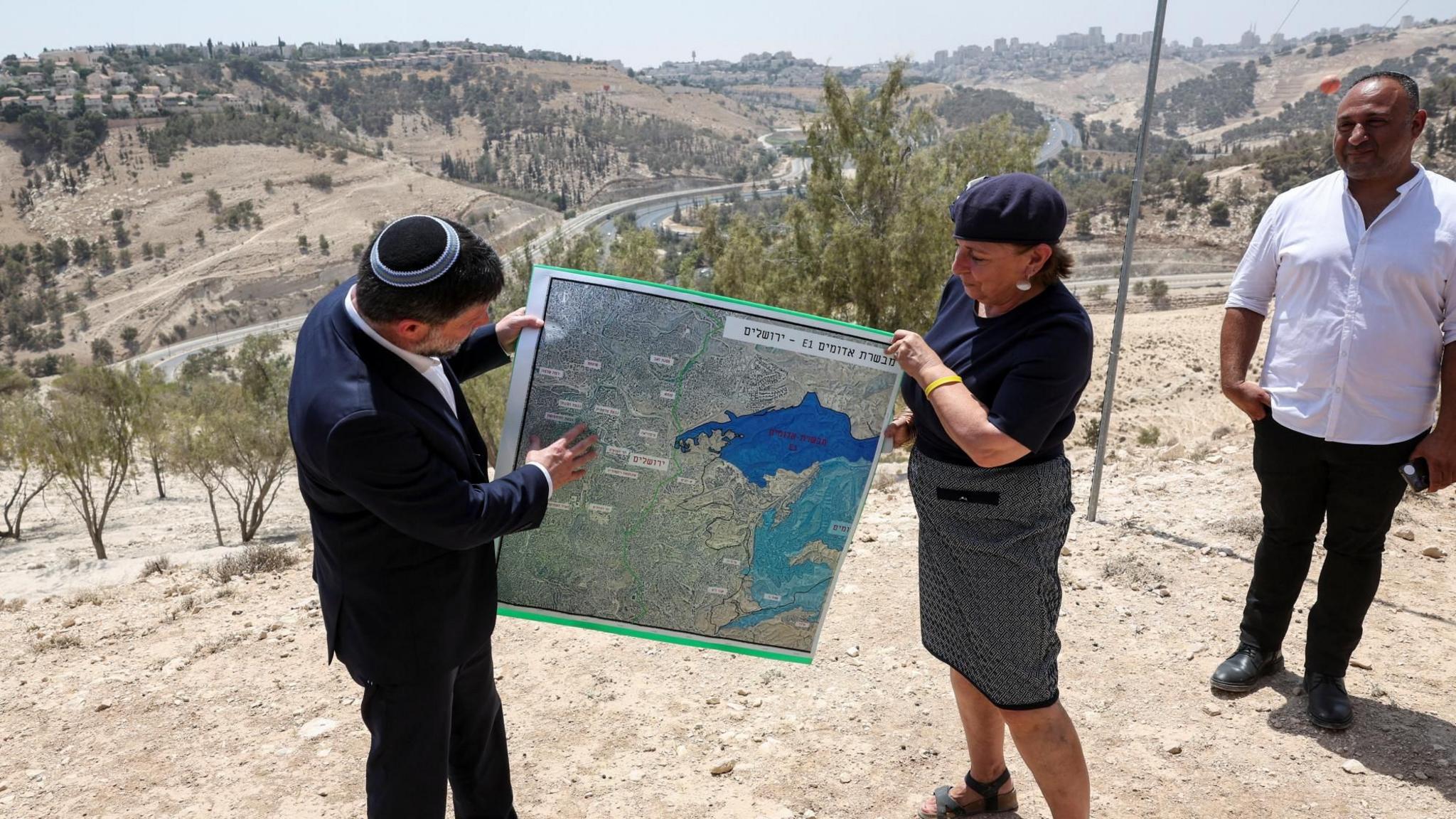
Israeli Finance Minister Bezalel Smotrich and a woman hold a map that shows the long-frozen E1 settlement scheme, that would split East Jerusalem from the occupied West Bank, on the day of a press conference near the Israeli settlement of Maale Adumim, in the Israeli-occupied West Bank, August 14, 2025. REUTERS/Ronen Zvulun
“This is a significant step that practically erases the two-state delusion and consolidates the Jewish people’s hold on the heart of the Land of Israel,” Smotrich said after the settlements were approved.
“The Palestinian state is being erased from the table not by slogans but by deeds. Every settlement, every neighborhood, every housing unit is another nail in the coffin of this dangerous idea,” he added.
Peace Now slammed the approval, saying that Smotrich and “his minority of messianic friends are establishing a delusional settlement that we will have to evacuate in any agreement.” The group added that the “entire purpose of the settlement in E1 is to sabotage a political solution and rush towards a binational apartheid state.”
The Palestinian Authority said that the plan “fragments… geographic and demographic unity, entrenching the division of the occupied West Bank into isolated areas and cantons that are disconnected from one another, turning them into something akin to real prisons.”
While historically, the US has tried to distance itself from Israeli settlement expansion since it is illegal under international law, both Trump administrations have been openly supportive of the land grabs. US Ambassador to Israel Mike Huckabee claimed that the E1 expansion was not a violation of international law and said that the US wouldn’t oppose it.
Huckabee also claimed that the Palestinian territory was part of Israel. “It’s also, I think, incumbent on all of us to recognise that Israelis have a right to live in Israel,” he said.