Posts Tagged ‘US’

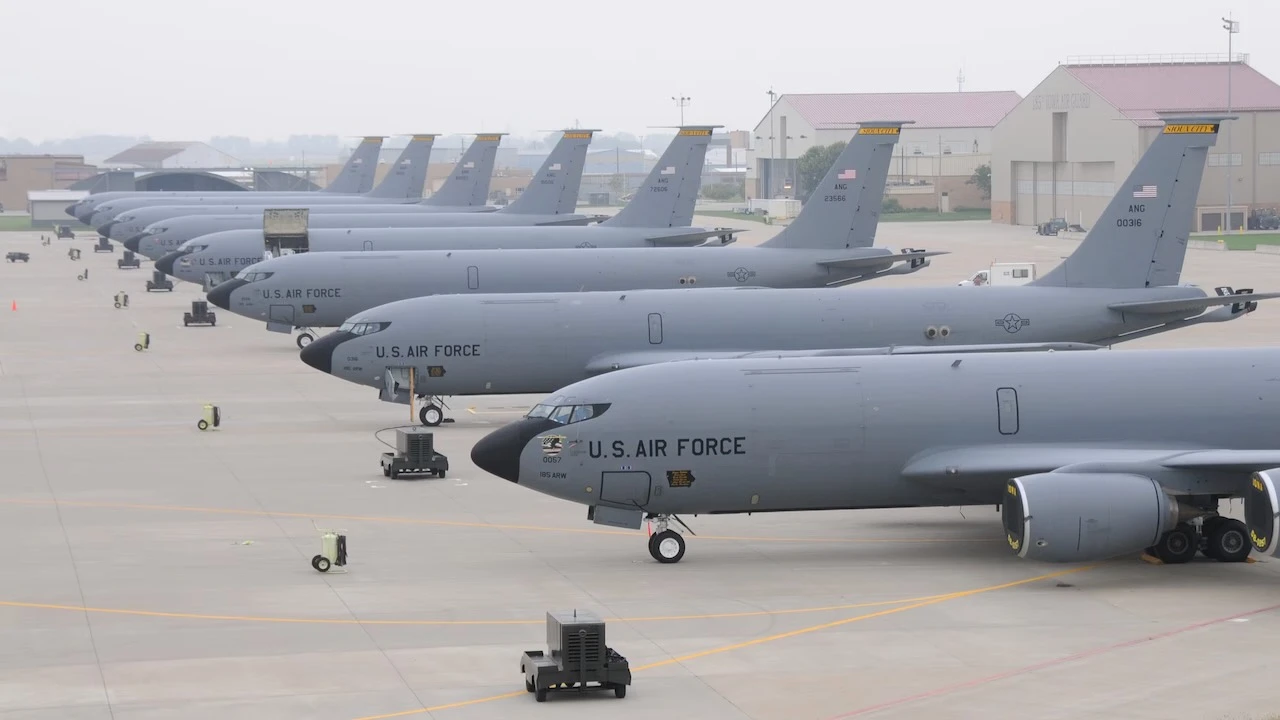
Dozens of US support aircraft spotted at Saudi Arabia’s Prince Sultan Air Base amid Iran war preparations

February 28, 2026

The buildup comes weeks after Riyadh claimed it would not allow the US to use its territory to stage a military attack on Iran

News Desk

FEB 27, 2026

(Photo credit: MSgt Vincent De Groot 185th ARW Public Affairs, Iowa Air National Guard)

Satellite imagery shows an increase in US military support aircraft, including refueling tankers and surveillance planes, at a Saudi airbase, Reuters reported on 27 February, amid Washington’s threats to launch a new war on Iran.

A high-resolution satellite image from 21 February showed at least 43 aircraft at Saudi Arabia’s Prince Sultan Airbase, a facility long used by US forces.

Four days before, satellite images showed only 27 aircraft visible. By 25 February, the number of aircraft had fallen slightly to 38.

The buildup comes one month after Riyadh claimed it would not allow the US to use its territory to stage a military attack on Iran.

The aircraft visible in the 21 February image included 13 Boeing KC-135 Stratotankers, used for aerial refueling of warplanes, and six Boeing E-3 Sentry aircraft (AWACS), used for surveillance, target detection, and tracking.

Boeing KC-135 Stratotankers were also seen on Friday at Israel’s Ben Gurion Airport in Tel Aviv.

US President Donald Trump last week threatened Iranian leaders, saying they must agree to a deal within 10 to 15 days. If not, “really bad things” would happen, Trump said.

Chinese commercial satellite imagery has also confirmed the deployment of 16 KC-135 aerial refueling tankers and MIM-104 Patriot air defense systems to Al-Udeid Air Base in Qatar.

According to Military Watch Magazine, US-made warplanes such as the F-16 rely heavily on aerial refueling for operations against major state adversaries, making the use of KC-135s critical for any large-scale attack.

Military Watch observed that E-3s carry the largest airborne radars in the world and have the ability to guide missiles fired by warplanes, ships, or ground-based systems to their targets.

However, the viability of the E-3 has increasingly been called into question, amid claims that its radars and other avionics are becoming obsolete. 

“This limits situational awareness, particularly against stealth targets such as Iran’s Shahed 191 drones, while also increasing vulnerability to electronic warfare,” the magazine added.

Israeli media observed that one set of Chinese commercial satellite images showed F-22 stealth fighter jets that the US had deployed the Ovda Air Base in southern Israel, where a Patriot air defense battery has also been deployed.

Other Chinese satellite images have documented the movement of US naval destroyers and aircraft carriers across the region, including the arrival of the USS Gerald R. Ford, the world’s largest aircraft carrier, in Crete.

Amid the buildup, Iranian and US negotiators met in Geneva this week for a third round of indirect talks.

On Friday, Iranian Foreign Minister Abbas Aragchi wrote on social media: “Further progress has been made in our diplomatic engagement with the United States.”

“This round of negotiations was the most intensive yet. The talks ended with the mutual understanding that we will continue to discuss in more detail and precision the issues that are essential to any agreement, including the lifting of sanctions and steps related to the nuclear field,” Aragchi added.

The two sides agreed to meet next week in Vienna to discuss technical details, according to Omani Foreign Minister Badr Al-Busaidi, who is mediating the talks.

Iran Demands Emergency United Nations Action Amid ‘Criminal Aggression’ by US, Israel

February 28, 2026

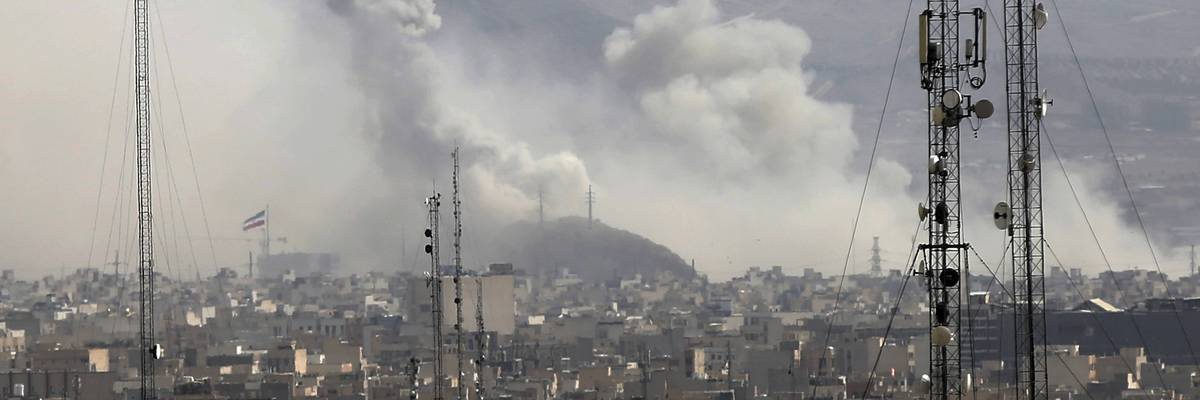
Israel launches attacks on Iran

Smoke rises over the city center after the Israeli army launched a second wave of airstrikes on Tehran, Iran on February 28, 2026.

(Photo by Fatemeh Bahrami/Anadolu via Getty Images)

“Just as we were ready for negotiations, we are more ready than ever for defense,” said the Iranian Foreign Ministry.

Jake Johnson

Feb 28, 2026

As US and Israeli bombs fell on Tehran, the Iranian Foreign Ministry on Saturday vowed that the country would defend itself against “criminal aggression” and implored the United Nations Security Council to take emergency action.

The ministry said in a lengthy statement that Saturday’s attacks, which US President Donald Trump characterized as the start of a massive military operation aimed at overthrowing the Iranian government, represent “a violation of Article 2, Paragraph 4, of the United Nations Charter and a clear armed aggression against the Islamic Republic of Iran.”

RECOMMENDED…

US Warship Downs Iranian Drone, Heightening Risk of ‘Illegal and Catastrophic War’

Mohamed ElBaradei

Trump March to War With Iran Is ‘Iraq Redux,’ Says Former Head of UN Nuclear Watchdog

“The Islamic Republic of Iran notes the grave duty of the United Nations and its Security Council to take immediate action to confront the violation of international peace and security,” reads the ministry’s statement, which noted that the US and Israeli assault began “in the midst of a diplomatic process.”

“The Iranian people are now proud that they did everything they could to prevent war,” the statement continues. “Now is the time to defend the homeland and confront the enemy’s military aggression. Just as we were ready for negotiations, we are more ready than ever for defense. The armed forces of the Islamic Republic of Iran will respond to the aggressors with authority.”

Ben Saul, the UN special rapporteur on human rights and counterterrorism, condemned US-Israeli “aggression against Iran” in a social media post, calling the assault a “violation of the most fundamental rule of international law—the ban on the use of force.”

“All responsible governments should condemn this lawlessness from two countries who excel in shredding the international order,” Saul added.

Evidence of ethnic cleansing growing in West Bank and Gaza

December 8, 2023

Increasingly brutal IDF activity, official Israeli rhetoric, and settler-led violence is making it harder to deny a policy designed to expel Palestinians

Paul R. Pillar, Responsible Statecraft, Dec 08, 2023

Even if one were to take at face value Israel’s declarations that its assault on the Gaza Strip and its two million residents is all about “destroying Hamas,” the Israeli operation is too misguided for the United States or any other power to support or condone it.

Hamas cannot be destroyed with bombs and a ground invasion, and even if it could, the operation is worsening, not enhancing, the future security of Israeli citizens.

But the Israeli declarations should not be taken at face value in any event. Other motivations are also likely behind the Israeli assault. Almost two months into the Israeli offensive, the evidence is increasingly suggesting that Israel is engaged in nothing less than ethnic cleansing of Palestinians who live in the Strip.

One is the sheer scale and indiscriminate nature of Israel’s military attacks. The leveling of entire neighborhoods and the inflicting of civilian casualties far outnumbering any military ones, with little evidence of any positive result beyond the capture and display of some empty tunnels can hardly be described as an operation sharply focused on destroying Hamas.

Consider the following numbers. Israeli officials claim that their operation in Gaza has so far killed 5,000 Hamas fighters. The officials admit that this is a squishy estimate, and the outside world has no way of knowing whether it is even close to being true. But assume for the moment that it is. By the Israeli military’s own estimates, Hamas’ military wing numbered about 30,000 fighters at the start of this war, implying there are still 25,000 yet to be eliminated. The latest estimates of the fast-rising count of total Palestinian casualties from the war so far are 16,000 dead, including more than 5,000 children.

Do the math. At the current pace and with Israel’s current methods, finishing the supposed job of destroying the Hamas military wing would entail almost 100,000 dead Palestinians, including more than 30,000 dead children. And that does not include the damage from Israel going after the rest of Hamas besides its military wing, including the senior leadership whom Israel has vowed to kill, as well as the Hamas-run civil administration of the Gaza Strip which Israel has vowed to eliminate. Nor does it consider that the rate of civilian casualties from Israeli military operations currently escalating in the southern part of the Strip — now crammed with those who had fled the north — is likely to be at least as high as from the previous operations in the north.

These numbers are not only orders of magnitude greater than anything that could be justified as a response to the brutality Hamas committed in Israel in October. They strongly suggest that in addition to eliminating Hamas, killing civilians and pushing as many Palestinians as possible out of Gaza is an Israeli objective.

The Israeli military’s claim to have used warnings to try to reduce civilian casualties has become little more than a cruel joke. Residents are ordered to flee their homes but then are bombed anyway either en route or at the location to which they were told to flee. Then they are ordered to move again—if there is any place at all they can go—and get bombed yet again. QR codes on leaflets promising information about safe zones are useless with communications knocked out and most Palestinians having no access to the internet.

Israel is not even bothering to use its previous “knock on the roof” practice of using a small munition to warn occupants of a building that it was about to be destroyed — as if it ever were acceptable to bomb someone’s home as long as they are advised a few minutes earlier that it is going to be bombed.

Further evidence of Israel’s objectives in Gaza comes from simultaneous events in the West Bank. For the last two months, Israeli settlers there, acting largely with the acquiescence of Israeli authorities, have been using violence and intimidation to drive longtime Palestinian residents out of their villages.

Then there is the rhetoric of Israeli political leaders, which some observers have described as genocidal. Examples over the past two months abound. About Gaza, Defense Minister Yoav Gallant said, “we will eliminate everything.” Meanwhile, deputy Knesset speaker Nissim Vaturi said of Palestinians in Gaza, “expel them all,” while Agriculture Minister Avi Dichter said, “we are now rolling out the Gaza nakba,” (the original nakba, or catastrophe, being the forced displacement of 750,000 Palestinians when Israel was created in 1948). Heritage Minister Amachai Eliyahu suggested that Israel should consider dropping a nuclear weapon on Gaza.

Added to all this is evidence of planning within the Israeli government. A report in October revealed a proposal from the intelligence ministry to transfer the entire population of the Gaza Strip to Egypt’s Sinai peninsula, to be housed first in tents and then in permanently constructed cities. This proposal did not explain how Israel would overcome Egypt’s strong opposition to any such population transfer, but other reports confirmed that Israeli leaders and diplomats were quietly proposing to other governments the transfer of several hundred thousand Gazans to Egypt.

The Israelis contended this would be a temporary movement for the duration of the current war, but their interlocutors rejected the idea given the likelihood that such a displacement, like earlier displacements of Palestinians, would become permanent.

More recently, Israeli Prime Minister Benjamin Netanyahu is reported to have tasked his U.S.-born Minister of Strategic Affairs, Ron Dermer, with developing a plan to “dilute” the population of the Gaza Strip to a minimum. That story was broken by the Israeli newspaper Israel Hayom, which has supported, and is considered to have good access to, Netanyahu.

As a possible reflection of such planning, other Israeli press reports that a proposal has already been quietly floated with members of the U.S. Congress to have two million Gazans move through Egypt for ultimate settlement both there and in Iraq, Turkey, and Yemen. The United States would be expected to use aid to those countries as leverage to pressure them into accepting the arrangement.

Since the Hamas attack on October 7 demonstrated that the conflict with the Palestinians could not be removed from the regional equation, the Israeli government has rejected as forcefully as ever the only avenue for ending such troubles, which is to resolve the conflict through peaceful negotiations that permit Palestinian self-determination, whether through a two-state solution or equal rights in one state.

Instead, it is increasingly looking like Israel is trying to remove the Palestinians themselves from the equation through death and displacement. Israel’s apparent strategy is no more likely to bring peace to Israelis or anyone else than its earlier gambits, as long as there are dissatisfied exiles. For just one example, think of how Israel went after the exiled Palestine Liberation Organization beginning in the 1980s and how it led to multiple wars, the rise of Lebanese Hezbollah, and the loss of almost any hope for stability in Lebanon.

The Biden administration has shown some signs of recognizing what is going on. Vice President Harris, speaking at the climate meeting in Dubai, stated that “under no circumstances will the United States permit the forced relocation of Palestinians from Gaza or the West Bank.” And the United States has begun imposing visa bans on Israeli settlers guilty of violence in the West Bank.

But those signs fall short of fully dissociating Washington from abhorrent policies and practices — a dissociation necessary to spare the United States from any more of the international opprobrium it already has incurred through its association with Israeli conduct.
US accused of backing terrorism in Pakistan

August 10, 2008

Hindustan Times, August 10, 2008

Indo-Asian News Service

Islamabad, August 05, 2008

Pakistan has accused the US of backing militancy within the country, saying this goes against the grain of the Washington-led global war against terror.Quoting “impeccable official sources”, The News reported on Tuesday that “strong evidence and circumstantial evidence of American acquiescence to terrorism inside Pakistan” was outlined by President Pervez Musharraf, army chief General Ashfaq Pervez Kayani and Inter-Services Intelligence (ISI) chief Lt. Gen. Nadeem Taj in separate meetings with two senior US officials in Islamabad on July 12.

The visit of the Chairman Joint Chiefs of Staff Admiral Michael Mullen and CIA Deputy Director Stephen R. Kappes, “carrying what were seen as India-influenced intelligence inputs had hardened the resolve of Pakistan’s security establishment to keep supreme Pakistan’s national security interest even if it meant straining ties with the US and NATO”, the newspaper said.

It quoted a senior official with direct knowledge of the meetings as saying that Pakistan’s military leadership and the president asked the American visitors “not to distinguish between a terrorist for the United States and Afghanistan and a terrorist for Pakistan”.

“For reasons best known to Langley, the CIA headquarters, as well as the Pentagon, Pakistani officials say the Americans were not interested in disrupting the Kabul-based fountainhead of terrorism in Balochistan nor do they want to allocate the marvellous Predator (unmanned armed aerial combat vehicle) resource to neutralise the kingpin of suicide bombings against the Pakistani military establishment now hiding near the Pakistan-Afghan border,” The News said.

During the meetings, the US officials were also asked why the CIA-run Predators and the US military did not swing into action when they were provided the exact location of tribal leader Baitullah Mehsud, “Pakistan’s enemy number one and the mastermind of almost every suicide operation against the Pakistan Army and the ISI since June 2006”, the newspaper added.

One such precise piece of information was made available to the CIA May 24 when Mehsud drove to a remote South Waziristan mountain post in his Toyota Land Cruiser to address the media and returned to his safe abode.

“The United States military has the capacity to direct a missile to a precise location at very short notice as it has done close to 20 times in the last few years to hit Al Qaeda targets inside Pakistan,” The News noted.

Pakistani officials, according to the newspaper, “have long been intrigued by the presence of highly encrypted communications gear with Mehsud. This communication gear enables him to collect real-time information on Pakistani troop movements from an unidentified foreign source without being intercepted by Pakistani intelligence”.

Mullen and the CIA official were in Pakistan on an unannounced visit July 12 to present what the US media claimed was evidence of the ISI’s ties with Taliban commander Maulana Sirajuddin Haqqani and the alleged involvement of Pakistani agents in the bombing of the Indian embassy in Kabul.

“Pakistani military leaders rubbished the American information and evidence on the Kabul bombing but provided some rationale for keeping a window open with Haqqani, just as the British government had decided to open talks with some Taliban leaders in southern Afghanistan last year,” The News said.

WTO Talks Collapse Amidst Developing Countries’ Reluctance to Sacrifice Food Security

July 30, 2008

truthout, 29 July 2008

by: The Center for Economic and Policy Research

Last-minute attempt to push through a WTO expansion “deal” fails.

Washington, DC – Despite trade ministers’ hopes for a last-minute deal, World Trade Organization (WTO) negotiations collapsed yet again today, and observers at the talks in Geneva say that the failure is not surprising, given the reluctance of India and other developing nations to sacrifice food security measures in the wake of the recent global spike in food prices.

Given President Bush’s lame duck status, negotiators had been called to Geneva to try to push through a last-minute deal before Bush left office. Because negotiators need about six months after a deal on the major issues to complete the details of the agreement, this possibility has now evaporated.

“Given what’s been on the table, no deal is better than a bad deal. A Doha conclusion would have had major negative impacts for workers and farmers in developing countries. The tariff cuts demanded of developing countries would have caused massive job loss, and countries would have lost the ability to protect farmers from dumping, further impoverishing millions on the verge of survival,” said Deborah James, Director of International Programs for the Center for Economic and Policy Research, who has been observing the talks in Geneva.

Continued . . .

SOMALIA: Famine Looms as Aid Workers Flee

July 27, 2008

By Najum Mushtaq | Inter Press service

NAIROBI, Jul 25 – By December this year, aid agencies estimate that the number of displaced and hungry people in need of life-saving aid in Somalia will swell to 3.5 million—nearly half the country’s population. Yet, as drought and conflict conspire to worsen the crisis, the humanitarian space to deliver food and other essential assistance in this conflict zone has all but vanished.

“At sea, ships carrying aid face the threat of piracy, on land (aid workers face) armed robbery and kidnapping,” says Abdullahi Musse, a Somali worker for an international humanitarian organisation. “Then, in the process of reaching our warehouses as well as on their way to the beneficiaries, the trucks cannot move without security escorts and have to pass through countless checkpoints which cannot be crossed without paying a ‘fee’ to a variety of armed groups.

“It is a high-risk activity with minimal guarantees of security,” says Musse.

Over the past few months, even this has become almost impossible to do. This year alone 20 aid workers, including foreigners, have been killed. Seventeen aid workers were freed after being kidnapped for ransom while 13 more are still in captivity.

All international aid workers and UN staff have been forced out by continuous fighting between Islamic insurgent groups and forces of the Transitional Federal Government (TFG) backed by Ethiopian troops. Both sides accuse each other of attacks on aid workers and vow to protect them. Added to this are professional kidnapping rings, which have been encouraged by the large ransoms paid by foreigners to release ships taken by pirates.

The UN agencies and nine international organisations still maintain a presence in Mogadishu, but they rely exclusively on local staff. Musse told IPS over the phone from Mogadishu that Somali workers, too, are now being targeted and aid delivery has completely stalled.

There are 250 informal settlements of displaced people in Mogadishu and over 200 more along the road in Afogye. The UN says that as of June, 857,000 people had been displaced from Mogadishu and are reliant on international aid. Other agricultural regions in south-central Somalia, the main theatre of conflict, have been without rain this season and food shortage is acute.

“One of the reasons why many people had fled Mogadishu and set up camps in Afgoye (45 kilometres from the capital) was that it was more accessible for aid workers than the city itself,” he says. “Many families split to get the aid they couldn’t in Mogadishu. For the last two weeks people in the Afgoye corridor settlements have also been protesting in frustration over lack of aid delivery.”

If sufficient food and other humanitarian assistance cannot be scaled up in the coming months, Oxfam International sees a severe famine in the making: “Should these conditions continue and aid agencies are not able to deliver adequate assistance, then the situation could tip over into famine in several regions of Somalia later in the year.”

In his speech at the Security Council on July 23, the secretary-general’s special representative for Somalia, Ahmed Ould-Abdalla, urged international naval escorts for WFP’s aid-carrying ships and more security for aid workers.

“I sympathise with Somali nationals who constitute more than 95 percent of aid workers in south and central Somalia. They risk their lives daily and all too often have been the innocent victims of targeted killings,” Abdalla told the Security Council Wednesday.

Continued . . .