|
|
||
 |
||
|
||
| By Deepak Tripathi | The Palestine Chronicle, August 15, 2008 The conflict between Russia and the pro-US regime of Georgia has been a decisive turning point in Russia’s relations with Washington and has taken us to the brink of a new Cold War. For the first time in almost twenty years, the West faces a resurgent Russia that has put the trauma of the breakup of the Soviet Union and the resulting chaos behind. Today’s Russia is run by a younger leadership with autocratic efficiency, confident because of its vast energy resources and determined to resist American hegemony, by force if necessary. The crisis in Georgia goes beyond the Caucasus region. Its roots lie in America’s overwhelming ambition to expand and its tendency to make colossal miscalculations under the Bush presidency. It is often said that the first casualty of war is truth. Behind the fog of disinformation coming from Washington, London, Tbilisi and, indeed, Moscow, the fact remains that the Russian invasion came after Georgia’s bombardment of the breakaway region of South Ossetia. The vast majority of residents in the enclave are Russian citizens and Moscow had deployed its peacekeepers there. Many experts in Europe are depressed over the events in Georgia and blame hardliners in the Bush administration for provoking the Georgian President, Mikheil Saakasvili, to adopt the aggressive posture that has brought this disaster. What we see in Georgia is a classic proxy war between Russia and America, which has become heavily involved in the republic since a popular revolt in late 2003 ousted Eduard Shevardnadze from power, with Western help. Today, US troops occupy Georgian military bases of the Soviet era, on the southern fringe of Russia. America provides weapons, training and intelligence to the Georgian armed forces. America’s involvement, which began under the umbrella of the ‘war on terror’ after 9/11, has since become much more. If President Bush had his way, Georgia would be granted membership of NATO as part of the alliance’s expansion around Russia. The impoverished former Soviet republic is, in effect, a pawn in the broader US design to encircle Russia. It is also located in a region which has some of the largest energy reserves in the world. For the Kremlin, the prospect of NATO coming so close to its southern borders is a step too far. Fortunately, some NATO members, most notably France and Germany, also do not see Georgia either as a full democracy or a stable country. And many in the alliance and the European Union have doubts about Saakasvili’s ability to take mature decisions. In an era when America has assumed the right to launch pre-emptive strikes, it is difficult to see the Kremlin behaving differently. The prospect of Georgia joining NATO, which might deploy nuclear weapons on Georgian territory, is simply not acceptable to Russia. Remember the Cuban missile crisis of 1962? At the time, Russian nuclear missiles, deployed just 90 miles from the coast of Florida, brought America and the Soviet Union close to a disastrous war and the Soviets were forced to back down. Does the White House not know history? Or do the neo-conservatives in the Bush administration not care? Saakasvili’s decision to order the bombardment of the Russian-majority South Ossetia gave the Kremlin a convenient cover to invade Georgia, just as the Bush administration had found it expedient to invade Iraq in March 2003 based on claims that Baghdad had weapons of mass destruction, which were never found. Russia is playing for bigger stakes now just as America did in Iraq a few years ago. About one-fifth of Georgia has fallen under Russian military occupation and the Kremlin leadership seems to be in no mood to entertain the idea of Georgia’s territorial integrity in any negotiations sponsored by the West. There are daily condemnations of Moscow in the Western capitals. However, the West is powerless to prevent the Russians doing anything they want in Georgia. This US-Russia proxy war in the Caucasus region has created a serious humanitarian crisis. President Saakasvili, the pro-US leader of Georgia, has been humiliated. Its chances of joining NATO are negligible after the latest events. They have demonstrated that the West cannot and will not intervene militarily to protect Georgia from the Russian threat. The most important clause in the NATO constitution says that an attack on one member-state will be regarded as an attack on the whole alliance, which will use all possible means to protect the member-state under threat. NATO’s inability to defend Georgia now is a defeat for the West. It is difficult to see how the alliance will accept the republic as a member. The description by President Bush of the Russian action as ‘disproportionate and unacceptable’ is laughable in the context of America’s own conduct in its foreign wars in recent years. Washington should be more worried about the damage the crisis has done to its authority in the world. Diplomacy was never a strong point of the Bush administration. The blunders in Washington and Tbilisi have made the conduct of relations with Russia much more difficult. They may also have created other problems for the next occupant of the White House, for an increasing number of countries around the world may begin look to Russia now that it has risen again. -Deepak Tripathi, a former BBC foreign correspondent and editor, is now a researcher and an author. He is writing a book on the Bush presidency. He contributed this article to PalestineChronicle.com. Contact him at: http://deepaktripathi.wordpress.com. |
Posts Tagged ‘Russia’
On the Brink of a New Cold War?
August 17, 2008
Geopolitical Chess: Background to a Mini-war in the Caucasus
August 16, 2008Immanuel Wallerstein, Commentary No. 239, Aug. 15, 2009
The world has been witness this month to a mini-war in the Caucasus, and the rhetoric has been passionate, if largely irrelevant. Geopolitics is a gigantic series of two-player chess games, in which the players seek positional advantage. In these games, it is crucial to know the current rules that govern the moves. Knights are not allowed to move diagonally.
From 1945 to 1989, the principal chess game was that between the United States and the Soviet Union. It was called the Cold War, and the basic rules were called metaphorically “Yalta.” The most important rule concerned a line that divided Europe into two zones of influence. It was called by Winston Churchill the “Iron Curtain” and ran from Stettin to Trieste. The rule was that, no matter how much turmoil was instigated in Europe by the pawns, there was to be no actual warfare between the United States and the Soviet Union. And at the end of each instance of turmoil, the pieces were to be returned to where they were at the outset. This rule was observed meticulously right up to the collapse of the Communisms in 1989, which was most notably marked by the destruction of the Berlin wall.
It is perfectly true, as everyone observed at the time, that the Yalta rules were abrogated in 1989 and that the game between the United States and (as of 1991) Russia had changed radically. The major problem since then is that the United States misunderstood the new rules of the game. It proclaimed itself, and was proclaimed by many others, the lone superpower. In terms of chess rules, this was interpreted to mean that the United States was free to move about the chessboard as it saw fit, and in particular to transfer former Soviet pawns to its sphere of influence. Under Clinton, and even more spectacularly under George W. Bush, the United States proceeded to play the game this way.
There was only one problem with this: The United States was not the lone superpower; it was no longer even a superpower at all. The end of the Cold War meant that the United States had been demoted from being one of two superpowers to being one strong state in a truly multilateral distribution of real power in the interstate system. Many large countries were now able to play their own chess games without clearing their moves with one of the two erstwhile superpowers. And they began to do so.
Two major geopolitical decisions were made in the Clinton years. First, the United States pushed hard, and more or less successfully, for the incorporation of erstwhile Soviet satellites into NATO membership. These countries were themselves anxious to join, even though the key western European countries – Germany and France – were somewhat reluctant to go down this path. They saw the U.S. maneuver as one aimed in part at them, seeking to limit their newly-acquired freedom of geopolitical action.
The second key U.S. decision was to become an active player in the boundary realignments within the former Federal Republic of Yugoslavia. This culminated in a decision to sanction, and enforce with their troops, the de facto secession of Kosovo from Serbia.
Russia, even under Yeltsin, was quite unhappy about both these U.S. actions. However, the political and economic disarray of Russia during the Yeltsin years was such that the most it could do was complain, somewhat feebly it should be added.
The coming to power of George W. Bush and Vladimir Putin was more or less simultaneous. Bush decided to push the lone superpower tactics (the United States can move its pieces as it alone decides) much further than had Clinton. First, Bush in 2001 withdrew from the 1972 U.S.-Soviet Anti-Ballistic Missile Treaty. Then he announced that the United States would not move to ratify two new treaties signed in the Clinton years: the 1996 Comprehensive Test Ban Treaty and the agreed changes in the SALT II nuclear disarmament treaty. Then Bush announced that the United States would move forward with its National Missile Defense system.
And of course, Bush invaded Iraq in 2003. As part of this engagement, the United States sought and obtained rights to military bases and overflight rights in the Central Asian republics that formerly were part of the Soviet Union. In addition, the United States promoted the construction of pipelines for Central Asian and Caucasian oil and natural gas that would bypass Russia. And finally, the United States entered into an agreement with Poland and the Czech Republic to establish missile defense sites, ostensibly to guard against Iranian missiles. Russia, however, regarded them as aimed at her.
Putin decided to push back much more effectually than Yeltsin. As a prudent player, however, he moved first to strengthen his home base – restoring effective central authority and reinvigorating the Russian military. At this point, the tides in the world-economy changed, and Russia suddenly became a wealthy and powerful controller not only of oil production but of the natural gas so needed by western European countries.
Putin thereupon began to act. He entered into treaty relationships with China. He maintained close relations with Iran. He began to push the United States out of its Central Asian bases. And he took a very firm stand on the further extension of NATO to two key zones – Ukraine and Georgia.
The breakup of the Soviet Union had led to ethnic secessionist movements in many former republics, including Georgia. When Georgia in 1990 sought to end the autonomous status of its non-Georgian ethnic zones, they promptly proclaimed themselves independent states. They were recognized by no one but Russia guaranteed their de facto autonomy.
The immediate spurs to the current mini-war were twofold. In February, Kosovo formally transformed its de facto autonomy to de jure independence. Its move was supported by and recognized by the United States and many western European countries. Russia warned at the time that the logic of this move applied equally to the de facto secessions in the former Soviet republics. In Georgia, Russia moved immediately, for the first time, to recognize South Ossetian de jure independence in direct response to that of Kosovo.
And in April this year, the United States proposed at the NATO meeting that Georgia and Ukraine be welcomed into a so-called Membership Action Plan. Germany, France, and the United Kingdom all opposed this action, saying it would provoke Russia.
Georgia’s neoliberal and strongly pro-American president, Mikhail Saakashvili, was now desperate. He saw the reassertion of Georgian authority in South Ossetia (and Abkhazia) receding forever. So, he chose a moment of Russian inattention (Putin at the Olympics, Medvedev on vacation) to invade South Ossetia. Of course, the puny South Ossetian military collapsed completely. Saakashvili expected that he would be forcing the hand of the United States (and indeed of Germany and France as well).
Instead, he got an immediate Russian military response, overwhelming the small Georgian army. What he got from George W. Bush was rhetoric. What, after all, could Bush do? The United States was not a superpower. Its armed forces were tied down in two losing wars in the Middle East. And, most important of all, the United States needed Russia far more than Russia needed the United States. Russia’s foreign minister, Sergei Lavrov, pointedly noted in an op-ed in the Financial Times that Russia was a “partner with the west on…the Middle East, Iran and North Korea.”
As for western Europe, Russia essentially controls its gas supplies. It is no accident that it was President Sarkozy of France, not Condoleezza Rice, who negotiated the truce between Georgia and Russia. The truce contained two essential concessions by Georgia. Georgia committed itself to no further use of force in South Ossetia, and the agreement contained no reference to Georgian territorial integrity.
So, Russia emerged far stronger than before. Saakashvili had bet everything he has and was now geopolitically bankrupt. And, as an ironic footnote, Georgia, one of the last U.S. allies in the coalition in Iraq, withdrew all its 2000 troops from Iraq. These troops had been playing a crucial role in Shi’a areas, and would now have to be replaced by U.S. troops, which will have to be withdrawn from other areas.
If one plays geopolitical chess, it is best to know the rules, or one gets out-maneuvered.
The Daily Show Live From The White House
August 16, 2008By Dr Paul Craig Roberts | Information Clearing House, August 15, 2008
The Bush Regime imbeciles don’t know when to stop. With the world still rolling in laughter from John McCain’s claim that “in the 21st century nations don’t invade other nations,” the moronic US secretary of state declared: “This is not 1968 and the invasion of Czechoslovakia, where Russia can threaten a neighbor, occupy a capital, overthrow a government and get away with it. Things have changed.”
This from Condi Rice who is “proud” of the Bush Regime’s invasion of Iraq.
This is not 1968. It is 40 years later, and roles have reversed. In the 21st century it is the United States that invades countries, occupies capitals, overthrows governments, and gets away with it.
The criminal Bush Regime has sent out its flunkies to huff and puff because Russia put its foot down against American hegemony on its border. Take your aggression elsewhere, the Russians said. We did not free constituent parts of our empire in order for them to become constituent parts of an American empire.
For years the Bush Regime has been fodder for the Daily Show. Condi Rice’s inane statement will keep the laughter rolling.
Putin’s war enablers: Bush and Cheney
August 15, 2008Russia’s escalating war on Georgia reveals the consequences of the Bush administration’s long assault on the international rule of law.
By Juan Cole | Salon.com, August 14, 2008
- saloncom914:http://www.salon.com/opinion/feature/2008/08/14/bush_putin/index.html
- Font: S / S+ / S++

Reuters/Kevin Lamarque
Vladimir Putin (right) of Russia and George W. Bush arrive at a summit on the Black Sea, April 5, 2008.
The run-up to the current chaos in the Caucasus should look quite familiar: Russia acted unilaterally rather than going through the U.N. Security Council. It used massive force against a small, weak adversary. It called for regime change in a country that had defied Moscow. It championed a separatist movement as a way of asserting dominance in a region it coveted.
Indeed, despite George W. Bush and Dick Cheney’s howls of outrage at Russian aggression in Georgia and the disputed province of South Ossetia, the Bush administration set a deep precedent for Moscow’s actions — with its own systematic assault on international law over the past seven years. Now, the administration’s condemnations of Russia ring hollow.
Bush said on Monday, responding to reports that Russia might attack the Georgian capital, “It now appears that an effort may be under way to depose [Georgia’s] duly elected government. Russia has invaded a sovereign neighboring state and threatens a democratic government elected by its people. Such an action is unacceptable in the 21st century.” By Wednesday, with more Russian troops on the move and a negotiated cease-fire quickly unraveling, Bush stepped up the rhetoric, announcing a sizable humanitarian-aid mission to Georgia and dispatching Secretary of State Condoleezza Rice to the region.

While U.S. leaders have tended to back Georgian President Mikheil Saakashvili, there are two sides to every dispute, and in the ethnically diverse Caucasus it may be more like a hundred sides. Abkhazia and Ossetia are claimed by Georgia, but they have their own distinctive languages, cultures and national aspirations. Both fought for independence in the early 1990s, without success, though neither was Georgia able to assert its full sovereignty over them, accepting Russian mediation and peacekeeping troops.
The separatist leaders of South Ossetia and Abkhazia now speak of Saakashvili in terms reminiscent of the way separatists in Darfur speak of Sudanese President Omar al-Bashir. Sergei Bagapsh of Abkhazia and Eduard Kokoity of South Ossetia have come out against conducting any further talks with Georgia, calling instead for Saakashvili to be tried for war crimes. Kokoity told Interfax, “There can be no talks with the organizers of genocide.” The Russian press is full of talk of putting Saakashvili on trial for ordering attacks on Ossetian civilians.
This is a tale of US expansion not Russian aggression
August 14, 2008War in the Caucasus is as much the product of an American imperial drive as local conflicts. It’s likely to be a taste of things to come
The Guardian, Thursday August 14 2008
The outcome of six grim days of bloodshed in the Caucasus has triggered an outpouring of the most nauseating hypocrisy from western politicians and their captive media. As talking heads thundered against Russian imperialism and brutal disproportionality, US vice-president Dick Cheney, faithfully echoed by Gordon Brown and David Miliband, declared that “Russian aggression must not go unanswered”. George Bush denounced Russia for having “invaded a sovereign neighbouring state” and threatening “a democratic government”. Such an action, he insisted, “is unacceptable in the 21st century”.
Could these by any chance be the leaders of the same governments that in 2003 invaded and occupied – along with Georgia, as luck would have it – the sovereign state of Iraq on a false pretext at the cost of hundreds of thousands of lives? Or even the two governments that blocked a ceasefire in the summer of 2006 as Israel pulverised Lebanon’s infrastructure and killed more than a thousand civilians in retaliation for the capture or killing of five soldiers?
You’d be hard put to recall after all the fury over Russian aggression that it was actually Georgia that began the war last Thursday with an all-out attack on South Ossetia to “restore constitutional order” – in other words, rule over an area it has never controlled since the collapse of the Soviet Union. Nor, amid the outrage at Russian bombardments, have there been much more than the briefest references to the atrocities committed by Georgian forces against citizens it claims as its own in South Ossetia’s capital Tskhinvali. Several hundred civilians were killed there by Georgian troops last week, along with Russian soldiers operating under a 1990s peace agreement: “I saw a Georgian soldier throw a grenade into a basement full of women and children,” one Tskhinvali resident, Saramat Tskhovredov, told reporters on Tuesday.
Might it be because Georgia is what Jim Murphy, Britain’s minister for Europe, called a “small beautiful democracy”. Well it’s certainly small and beautiful, but both the current president, Mikheil Saakashvili, and his predecessor came to power in western-backed coups, the most recent prettified as a “Rose revolution”. Saakashvili was then initially rubber-stamped into office with 96% of the vote before establishing what the International Crisis Group recently described as an “increasingly authoritarian” government, violently cracking down on opposition dissent and independent media last November. “Democratic” simply seems to mean “pro-western” in these cases.
The long-running dispute over South Ossetia – as well as Abkhazia, the other contested region of Georgia – is the inevitable consequence of the breakup of the Soviet Union. As in the case of Yugoslavia, minorities who were happy enough to live on either side of an internal boundary that made little difference to their lives feel quite differently when they find themselves on the wrong side of an international state border.
Such problems would be hard enough to settle through negotiation in any circumstances. But add in the tireless US promotion of Georgia as a pro-western, anti-Russian forward base in the region, its efforts to bring Georgia into Nato, the routing of a key Caspian oil pipeline through its territory aimed at weakening Russia’s control of energy supplies, and the US-sponsored recognition of the independence of Kosovo – whose status Russia had explicitly linked to that of South Ossetia and Abkhazia – and conflict was only a matter of time.
The CIA has in fact been closely involved in Georgia since the Soviet collapse. But under the Bush administration, Georgia has become a fully fledged US satellite. Georgia’s forces are armed and trained by the US and Israel. It has the third-largest military contingent in Iraq – hence the US need to airlift 800 of them back to fight the Russians at the weekend. Saakashvili’s links with the neoconservatives in Washington are particularly close: the lobbying firm headed by US Republican candidate John McCain’s top foreign policy adviser, Randy Scheunemann, has been paid nearly $900,000 by the Georgian government since 2004.
But underlying the conflict of the past week has also been the Bush administration’s wider, explicit determination to enforce US global hegemony and prevent any regional challenge, particularly from a resurgent Russia. That aim was first spelled out when Cheney was defence secretary under Bush’s father, but its full impact has only been felt as Russia has begun to recover from the disintegration of the 1990s.
Over the past decade, Nato’s relentless eastward expansion has brought the western military alliance hard up against Russia’s borders and deep into former Soviet territory. American military bases have spread across eastern Europe and central Asia, as the US has helped install one anti-Russian client government after another through a series of colour-coded revolutions. Now the Bush administration is preparing to site a missile defence system in eastern Europe transparently targeted at Russia.
By any sensible reckoning, this is not a story of Russian aggression, but of US imperial expansion and ever tighter encirclement of Russia by a potentially hostile power. That a stronger Russia has now used the South Ossetian imbroglio to put a check on that expansion should hardly come as a surprise. What is harder to work out is why Saakashvili launched last week’s attack and whether he was given any encouragement by his friends in Washington.
If so, it has spectacularly backfired, at savage human cost. And despite Bush’s attempts to talk tough yesterday, the war has also exposed the limits of US power in the region. As long as Georgia proper’s independence is respected – best protected by opting for neutrality – that should be no bad thing. Unipolar domination of the world has squeezed the space for genuine self-determination and the return of some counterweight has to be welcome. But the process of adjustment also brings huge dangers. If Georgia had been a member of Nato, this week’s conflict would have risked a far sharper escalation. That would be even more obvious in the case of Ukraine – which yesterday gave a warning of the potential for future confrontation when its pro-western president threatened to restrict the movement of Russian ships in and out of their Crimean base in Sevastopol. As great power conflict returns, South Ossetia is likely to be only a taste of things to come.
Mikhail Gorbachev: We had no choice
August 13, 2008Leaders in the Caucasus must stop flexing military muscle and develop the grounds for lasting peace
- The Guardian, Wednesday August 13 2008
The past week’s events in South Ossetia are bound to shock and pain anyone. Already, thousands of people have died, tens of thousands have been turned into refugees, and towns and villages lie in ruins. Nothing can justify this loss of life and destruction. It is a warning to all.
The roots of this tragedy lie in the decision of Georgia’s separatist leaders in 1991 to abolish South Ossetian autonomy. Each time successive Georgian leaders tried to impose their will by force – both in South Ossetia and in Abkhazia, where the issues of autonomy are similar – it only made the situation worse.
Nevertheless, it was still possible to find a political solution. Clearly, the only way to solve the South Ossetian problem on that basis is through peaceful means. The Georgian leadership flouted this key principle.
What happened on the night of August 7 is beyond comprehension. The Georgian military attacked the South Ossetian capital of Tskhinvali with multiple rocket launchers designed to devastate large areas. Russia had to respond. To accuse it of aggression against “small, defenceless Georgia” is not just hypocritical but shows a lack of humanity.
The Georgian leadership could do this only with the perceived support and encouragement of a much more powerful force. Georgian armed forces were trained by hundreds of US instructors, and its sophisticated military equipment was bought in a number of countries. This, coupled with the promise of Nato membership, emboldened Georgian leaders.
Now that the military assault has been routed, both the Georgian government and its supporters should rethink their position. When the problems of South Ossetia and Abkhazia first flared up, I proposed that they be settled through a federation that would grant broad autonomy to the two republics. This idea was dismissed, particularly by the Georgians. Attitudes gradually shifted, but after last week it will be much more difficult to strike a deal even on such a basis.
Small nations of the Caucasus do have a history of living together. It has been demonstrated that a lasting peace is possible, that tolerance and cooperation can create conditions for normal life and development. Nothing is more important. The region’s political leaders need to realise this. Instead of flexing military muscle, they should devote their efforts to building the groundwork for durable peace.
Over the past few days, some western nations have taken positions, particularly in the UN security council, that have been far from balanced. As a result, the security council was not able to act effectively from the very start of this conflict. By declaring the Caucasus, a region that is thousands of miles from the American continent, a sphere of its “national interest”, the US made a serious blunder. Of course, peace in the Caucasus is in everyone’s interest. But it is simply common sense to recognise that Russia is rooted there by common geography and centuries of history. Russia is not seeking territorial expansion, but it has legitimate interests in this region.
The international community’s long-term aim could be to create a sub-regional system of security and cooperation that would make any provocation, and the very possibility of crises such as this one, impossible. Building this type of system would be challenging and could only be accomplished with the cooperation of the region’s countries themselves. Nations outside the region could perhaps help, too – but only if they take a fair and objective stance. A lesson from recent events is that geopolitical games are dangerous anywhere, not just in the Caucasus.
· Mikhail Gorbachev was the last president of the Soviet Union; he was awarded the Nobel peace prize in 1990
© Washington Post
War in the Caucasus: Towards a Broader Russia-US Military Confrontation?
August 11, 2008|
by Michel Chossudovsky
|
|
 |
|
|
Global Research, August 10, 2008
|
|
|
During the night of August 7, coinciding with the opening ceremony of the Beijing Olympics, Georgia’s president Saakashvili ordered an all-out military attack on Tskhinvali, the capital of South Ossetia. The aerial bombardments and ground attacks were largely directed against civilian targets including residential areas, hospitals and the university. The provincial capital Tskhinvali was destroyed. The attacks resulted in some 1500 civilian deaths, according to both Russian and Western sources. “The air and artillery bombardment left the provincial capital without water, food, electricity and gas. Horrified civilians crawled out of the basements into the streets as fighting eased, looking for supplies.” (AP, August 9, 2008). According to reports, some 34,000 people from South Ossetia have fled to Russia. (Deseret Morning News, Salt Lake City, August 10, 2008) The importance and timing of this military operation must be carefully analyzed. It has far-reaching implications. Georgia is an outpost of US and NATO forces, on the immediate border of the Russian Federation and within proximity of the Middle East Central Asian war theater. South Ossetia is also at the crossroads of strategic oil and gas pipeline routes. 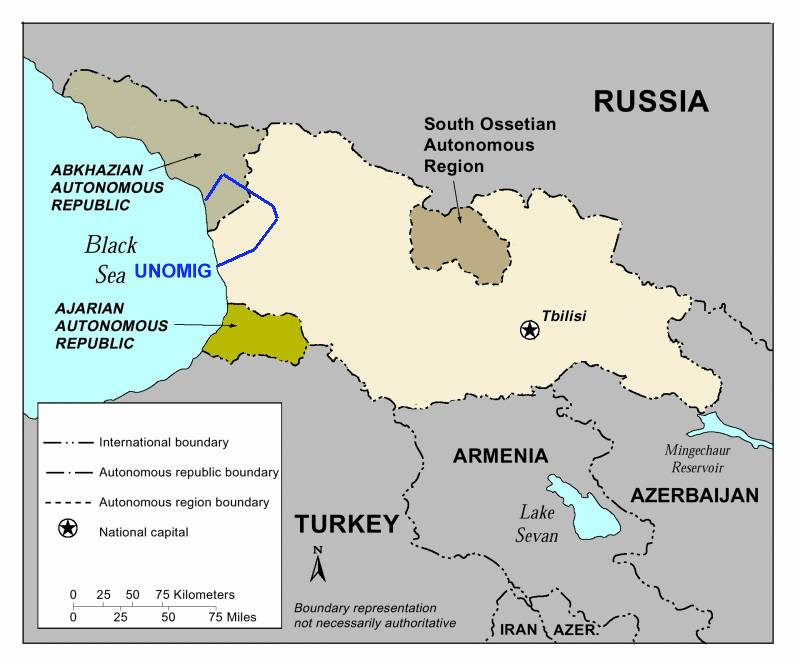
Georgia does not act militarily without the assent of Washington. The Georgian head of State is a US proxy and Georgia is a de facto US protectorate. Who is behind this military agenda? What interests are being served? What is the purpose of the military operation. There is evidence that the attacks were carefully coordinated by the US military and NATO. Moscow has accused NATO of “encouraging Georgia”. Russia’s Foreign Minister Sergey Lavrov underscored the destabilizing impacts of “foreign” military aid to Georgia: .
Moscow’s envoy to NATO, Dmitry Rogozin, sent an official note to the representatives of all NATO member countries:
According to Rogozin, Georgia had initially planned to:
Contrary to what was conveyed by Western media reports, the attacks were anticipated by Moscow. The attacks were timed to coincide with the opening of the Olympics, largely with a view to avoiding frontpage media coverage of the Georgian military operation. On August 7, Russian forces were in an advanced state readiness. The counterattack was swiftly carried out. Russian paratroopers were sent in from Russia’s Ivanovo, Moscow and Pskov airborne divisions. Tanks, armored vehicles and several thousand ground troops have been deployed. Russian air strikes have largely targeted military facilities inside Georgia including the Gori military base. The Georgian military attack was repealed with a massive show of strength on the part of the Russian military.
In this image made from television, Russian military vehicles are seen moving towards the capital of South Ossetia, Tskhinvali, on Friday, Aug. 8, 2008. (AP / APTN) Act of Provocation? US-NATO military and intelligence planners invariably examine various “scenarios” of a proposed military operation– i.e. in this case, a limited Georgian attack largely directed against civilian targets, with a view to inflicting civilian casualties. The examination of scenarios is a routine practice. With limited military capabilities, a Georgian victory and occupation of Tskhinvali, was an impossibility from the outset. And this was known and understood to US-NATO military planners. A humanitarian disaster rather than a military victory was an integral part of the scenario. The objective was to destroy the provincial capital, while also inflicting a significant loss of human life.
If the objective were to restore Georgian political control over the provincial government, the operation would have been undertaken in a very different fashion, with Special Forces occupying key public buildings, communications networks and provincial institutions, rather than waging an all out bombing raid on residential areas, hospitals, not to mention Tskhinvali’s University.
The Russian response was entirely predictable. Georgia was “encouraged” by NATO and the US. Both Washington and NATO headquarters in Brussels were acutely aware of what would happen in the case of a Russian counterattack. The question is: was this a deliberate provocation intended to trigger a Russian military response and suck the Russians into a broader military confrontation with Georgia (and allied forces) which could potentially escalate into an all out war? Georgia has the third largest contingent of coalition forces in Iraq after the US and the UK, with some 2000 troops. According to reports, Georgian troops in Iraq are now being repatriated in US military planes, to fight Russian forces. (See Debka.com, August 10, 2008) This US decision to repatriate Georgian servicemen suggests that Washington is intent upon an escalation of the conflict, where Georgian troops are to be used as cannon fodder against a massive deployment of Russian forces. US-NATO and Israel Involved in the Planning of the Attacks In mid-July, Georgian and U.S. troops held a joint military exercise entitled “Immediate Response” involving respectively 1,200 US and 800 Georgian troops. The announcement by the Georgian Ministry of Defense on July 12 stated that they US and Georgian troops were to “train for three weeks at the Vaziani military base” near the Georgian capital, Tbilisi. (AP, July 15, 2008). These exercises, which were completed barely a week before the August 7 attacks, were an obvious dress rehearsal of a military operation, which, in all likelihood, had been planned in close cooperation with the Pentagon. The war on Southern Ossetia was not meant to be won, leading to the restoration of Georgian sovereignty over South Ossetia. It was intended to destabilize the region while also triggering a US-NATO confrontation with Russia. On July 12, coinciding with the outset of the Georgia-US war games, the Russian Defense Ministry started its own military maneuvers in the North Caucasus region. The usual disclaimer by both Tblisi and Moscow: the military exercises have “nothing to do” with the situation in South Ossetia. (Ibid) Let us be under no illusions. This is not a civil war. The attacks are an integral part of the broader Middle East Central Asian war, including US-NATO-Israeli war preparations in relation to Iran. The Role of Israeli Military Advisers While NATO and US military advisers did not partake in the military operation per se, they were actively involved in the planning and logistics of the attacks. According to Israeli sources (Debka.com, August 8, 2008), the ground assault on August 7-8, using tanks and artillery was “aided by Israeli military advisers”. Israel also supplied Georgia with Hermes-450 and Skylark unmanned aerial vehicles, which were used in the weeks leading up to the August 7 attacks. Georgia has also acquired, according to a report in Rezonansi (August 6, in Georgian, BBC translation) “some powerful weapons through the upgrade of Su-25 planes and artillery systems in Israel”. According to Haaretz (August 10, 2008), Israelis are active in military manufacturing and security consulting in Georgia. Russian forces are now directly fighting a NATO-US trained Georgian army integrated by US and Israeli advisers. And Russian warplanes have attacked the military jet factory on the outskirts of Tbilisi, which produces the upgraded Su-25 fighter jet, with technical support from Israel. (CTV.ca, August 10, 2008) When viewed in the broader context of the Middle East war, the crisis in Southern Ossetia could lead to escalation, including a direct confrontation between Russian and NATO forces. If this were to occur, we would be facing the most serious crisis in US-Russian relations since the Cuban Missile crisis in October 1962. |
|


War in Georgia: The Israeli connection
August 11, 2008For past seven years, Israeli companies have been helping Gerogian army to preparer for war against Russia through arms deals, training of infantry units and security advice
Arie Egozi | YNet News, August 10, 2008 var
The fighting which broke out over the weekend between Russia and Georgia has brought Israel’s intensive involvement in the region into the limelight. This involvement includes the sale of advanced weapons to Georgia and the training of the Georgian army’s infantry forces.
The Defense Ministry held a special meeting Sunday to discuss the various arms deals held by Israelis in Georgia, but no change in policy has been announced as of yet.
“The subject is closely monitored,” said sources in the Defense Ministry. “We are not operating in any way which may counter Israeli interests. We have turned down many requests involving arms sales to Georgia; and the ones which have been approves have been duly scrutinized. So far, we have placed no limitations on the sale of protective measures.”
According to Israeli sources, Gal Hirsch gave the Georgian army advice on the establishment of elite units such as Sayeret Matkal and on rearmament, and gave various courses in the fields of combat intelligence and fighting in built-up areas.
Israel began selling arms to Georgia about seven years ago following an initiative by Georgian citizens who immigrated to Israel and became businesspeople.
“They contacted defense industry officials and arms dealers and told them that Georgia had relatively large budgets and could be interested in purchasing Israeli weapons,” says a source involved in arms exports.
The military cooperation between the countries developed swiftly. The fact that Georgia’s defense minister, Davit Kezerashvili, is a former Israeli who is fluent in Hebrew contributed to this cooperation.
“His door was always open to the Israelis who came and offered his country arms systems made in Israel,” the source said. “Compared to countries in Eastern Europe, the deals in this country were conducted fast, mainly due to the defense minister’s personal involvement.”
Among the Israelis who took advantage of the opportunity and began doing business in Georgia were former Minister Roni Milo and his brother Shlomo, former director-general of the Military Industries, Brigadier-General (Res.) Gal Hirsch and Major-General (Res.) Yisrael Ziv.
Roni Milo conducted business in Georgia for Elbit Systems and the Military Industries, and with his help Israel’s defense industries managed to sell to Georgia remote-piloted vehicles (RPVs), automatic turrets for armored vehicles, antiaircraft systems, communication systems, shells and rockets.
How the frozen conflict turned into a flash fire
August 10, 2008- Helen Womack | The Guardian, Saturday August 9 2008

A Georgian launcher fires rockets at rebels near the South Ossetia capital, Tskhinvali. Photograph: Vano Shlamov/AFP/Getty
Why has fighting broken out?
The South Ossetians and Georgians have been sniping at each other for several weeks and patience on both sides has finally snapped. South Ossetia and Georgia’s other breakaway region, Abkhazia, have enjoyed de facto independence since the early 1990s but Tbilisi has never recognised the loss of its territory. The dispute between Georgia and the two regions was called “the frozen conflict” because the issues remain unresolved, but there was no fighting. The heat began to rise this year when the west recognised Kosovo, against Russia’s advice. The South Ossetians and Abkhazians argued that if Kosovo could be independent, then so could they.
What is the basis of the region’s claim to independence?
The Ossetians are descendants of a tribe called the Alans. Like the Georgians, the Ossetians are Orthodox Christians but they have their own language. In Soviet times, the Ossetians had an autonomous region within Georgia. The Georgians say the Ossetians cooperated with the Bolsheviks and tended to be more pro-Soviet. Their ethnic kin live across the border in the Russian region of North Ossetia, so today they feel more drawn to Russia than to Georgia and many have Russian passports.
Abkhazia on the Black Sea coast was also an autonomous region of Georgia in Soviet times. It has a mixed population of Abkhaz, Mingrelians, Greeks, Armenians, Russians and Georgians and a small but significant Muslim minority. Thousands of ethnic Georgians fled their homes in Abkhazia during the civil war in the early 90s and now live as refugees in Tbilisi and Moscow.
Why has Russia become involved?
Russia says it cannot stand aside because many of the people in the breakaway regions are its citizens. Georgia accuses Russia of meddling in its internal affairs and supporting the separatists, although Russia’s peacekeepers are supposed to be in a neutral role. Georgia accuses Russia of double standards in suppressing its own separatist rebellion in Chechnya while encouraging separatists in Georgia. Russia has become more engaged in the region since Georgia expressed an interest in joining Nato, the very idea of which appalls Moscow.
What might happen next?
So far, this has been a proxy war, with Russia encouraging the separatists, but Russia and Georgia could find themselves in direct conflict. Russia’s prime minister, Vladimir Putin, today accused Georgia of aggression and warned that a response was inevitable. Georgia said Russian jets had started bombing its territory.
What are the wider implications?
The conflict could widen out further still, with former Soviet republics supporting Russia and the US and Europe backing Georgia. The root of the problem is that the world community cannot agree on rules for the independence of small regions.

 Peace and Justice Post
In Europe, as in Asia, Nato leaves a trail of catastrophe
August 20, 2008Nato is useless. It has failed to bring stability to Afghanistan, as it failed to bring it to Serbia. It just breaks crockery. Nato has proved a rotten fighting force, which in Kabul is on the brink of being sidelined by exasperated Americans. Nor is it any better at diplomacy: witness its hamfisted handling of east Europe. As the custodian of the west’s postwar resistance to the Soviet Union’s nuclear threat it served a purpose. Now it has become a diplomats’ Olympics, irrelevant but with bursts of extravagant self-importance.
Yesterday’s Nato ministerial meeting in Brussels was a fig leaf over the latest fiasco, the failure to counter the predictable Russian intervention in Georgia. Ostensibly to save Russian nationals in South Ossetia, the intervention was, in truth, to tell Georgia and Ukraine that they must not play games with the west along Russia’s frontier. Nato, which Russia would (and should) have joined after the collapse of the Soviet Union, is now a running provocation along the eastern rim of Europe.
There was no strategic need for Nato to proselytise for members, and consequent security guarantees, among the Baltic republics and border states to the south. Nor is there any strategic need for the US to place missile sites in Poland or the Czech Republic. This was mere Nato self-aggrandisement reinforcing the lobbying of the Pentagon hawks.
These moves were bound to infuriate the hypersensitive Russians, and did. There is no point in western pundits saying that the thrust of Nato close to the Russian border is quite different from the cold war location of Soviet missiles in Cuba. It seems the same to Russian nationalists.
Nor is it any good pundits remarking that Russia’s defence of Russian minorities in Georgia is quite different from Nato’s intervention to defend the Kurdish minority in Iraq or the Albanian minority in Serbia. Again, that is just how it seems to Russia.
George Bush said earlier this month that “the age of spheres of influence is over”. In that case why push that most potent sphere of influence, Nato, to the Russian border? And what of the sphere-of-influence theory that underpinned Bush’s neoconservative plan to conquer the Muslim world for democracy?
The US’s two greatest bugbears at present, Russia and Iran, both have grounds for feeling encircled by hostile forces. However badly they behave, they too are vulnerable to the politics of irrational fear. Both countries display the rudiments of democratic activity, with paranoia playing on pluralism.
The glib response of Nato’s leaders has been hawkish, that the only thing “these people” understand is tough talk and big sticks. But that just apes Russia’s attitude towards Georgia and Ukraine, which at least Russia has the power to enforce.
The west is not threatened by Russia. Turning its border into a zone of bluff and counter-bluff, so Nato can boast 10 extra flags outside its headquarters, has proved destabilising and provocative. Intelligence, like morality, is supposedly the tribute power should pay to reason. Russia is boorish and belligerent enough already. Why encourage it?
With Russia, Nato is playing with fire. In Afghanistan/Pakistan – which should always be yoked together – it is playing with dynamite. Here Osama bin Laden and Donald Rumsfeld must be laughing in unison: the former because Nato’s conduct of the war against the Taliban has been a recruiting sergeant for al-Qaida in Pakistan; the latter because everything he said about nation-building has proved true. “Get in fast and get out fast” was his strategy, and he was right.
The fall of Pervez Musharraf might be good news for Pakistan’s democrats. It is dreadful news for Nato’s proconsuls in their fortified enclaves in Kabul. The likelihood of political turbulence in Pakistan can only increase the hold that pro-Taliban tribes have over the long frontier with Afghanistan and, with it, the certainty of an escalating war.
Nato’s performance here has been dreadful. A half-hearted peacekeeper, it had displayed divided counsels, divided leadership and divided rules of engagement. It has reflected the view of the US general in Kosovo, Wesley Clark, that US units should never again be placed under international command. International command means no command at all.
A Pentagon report by General Barry McCaffrey, revealed last week, criticises the lack of command unity in Kabul. “Afghanistan is in misery,” it says. “A sensible coordination of all political and military elements of the Afghan theatre of operation does not exist.”
There is said to be a plan for a 12,000-strong reinforcement of US troops to stage a Baghdad-style “surge”, outside the remit of Nato. The idea that the rural Taliban might be susceptible to the same handling as Iraq’s urban militias may be senseless, but is on the cards. Such a surge would mean three rival armies – Afghan, Nato and American – roaming this troubled land, a gift to any enemy.
The newly triumphant coalition in Islamabad must long for the days when its Afghan backyard was quiet. The Taliban regime was funded by opium and the Saudis, and of no strategic (as opposed to terrorist) concern to the west. There were no US Predators bombing villages, no CIA phone-tapping, no suborned Pakistan intelligence officers, no outside interference. Pakistan’s sphere of influence might not be to every taste, but it was roughly stable.
We shall now have the world’s sixth largest country, and with an active nuclear arsenal, in internal turmoil because of a doomed Nato adventure on its border. Taliban units are operating freely throughout the south and east of Afghanistan and within miles of the capital, Kabul, flatly contradicting the mendacious spin of Nato spokesmen over the past two years.
Western governments seem never to learn. Counter-insurgency wars of this sort never work if they become drawn out. At best they leave broken, corrupted, failed states such as Lebanon and Kosovo – and, soon, Iraq. At worst they mean defeat. If ever America were walking into another Vietnam, it is now in Afghanistan, fast replacing Iraq as the mecca for every anti-western fanatic on earth.
Peace in Afghanistan might not matter over much. But its absence will grossly destabilise Pakistan, and that matters greatly. Is this to be another feather in Nato’s cap?
simon.jenkins@guardian.co.uk
Share this:
Tags:Afghanistan, Gen. Barry McCaffrey's report, George W. Bush, Georgia, Iran, Musharraf's fall, NATO, Pakistan, Russia, Russian minorities, United States
Posted in Commentary, USA | Leave a Comment »