Posts Tagged ‘Palestine’
𝐈𝐬𝐫𝐚𝐞𝐥𝐢 𝐅𝐨𝐫𝐜𝐞𝐬 𝐊𝐢𝐥𝐥 𝟗𝟖 𝐏𝐚𝐥𝐞𝐬𝐭𝐢𝐧𝐢𝐚𝐧𝐬 𝐢𝐧 𝐆𝐚𝐳𝐚 𝐎𝐯𝐞𝐫 𝟐𝟒 𝐇𝐨𝐮𝐫𝐬
July 29, 2025Among the dead were 25 Palestinians killed by the IDF while seeking aid
𝐓𝐫𝐮𝐦𝐩 𝐒𝐡𝐨𝐰𝐬 𝐒𝐭𝐫𝐨𝐧𝐠 𝐒𝐮𝐩𝐩𝐨𝐫𝐭 𝐟𝐨𝐫 𝐈𝐬𝐫𝐚𝐞𝐥 𝐚𝐬 𝐏𝐚𝐥𝐞𝐬𝐭𝐢𝐧𝐢𝐚𝐧𝐬 𝐢𝐧 𝐆𝐚𝐳𝐚 𝐒𝐭𝐚𝐫𝐯𝐞 𝐭𝐨 𝐃𝐞𝐚𝐭𝐡
July 28, 2025After the US and Israel quit ceasefire talks, Trump suggested it was time for Israel to ‘finish the job’
–by Dave DeCamp, Antiwar. com, July 27, 2025
President Trump has shown strong support for Israel in recent days, while much of the world has been outraged over the images of Palestinians who are starving to death due to the US-backed Israeli siege on Gaza.
After the US and Israel quit ceasefire talks, Trump blamed the lack of progress on Hamas and suggested it was time for Israel to “finish the job” in Gaza. “I think they want to die, and it’s very, very bad,” Trump said on Friday, referring to Hamas.
For its part, Hamas has said that it was surprised by the US and Israel quitting the truce talks and that it was committed to continuing the process until a deal was reached.
Trump and Netanyahu at the White House on July 7, 2025 (White House photo)
In recent weeks, Trump has been claiming that a ceasefire deal was close, but now he is appearing to suggest that Israel should escalate its genocidal war. “They’re gonna have to fight, and they’re gonna have to clean it up. You’re gonna have to get rid of [Hamas],” he said.
Israeli officials told Axios that they weren’t sure if Trump’s comments were a negotiating tactic or a “green light” for Israeli Prime Minister Benjamin Netanyahu to use even more extreme military measures. The report said the Trump administration was rethinking its Gaza strategy, but there’s no sign it’s considering putting pressure on Israel to reach a ceasefire.
Israeli officials also told Axios that Trump has applied virtually no pressure on Netanyahu to end the slaughter in Gaza in recent months. “In most calls and meetings, Trump told Bibi, ‘Do what you have to do in Gaza.’ In some cases, he even encouraged Netanyahu to go harder on Hamas,” one official said.
While meeting with European Commission President Ursula von der Leyen in Scotland on Sunday, Trump was asked about the images of starving children in Gaza. The president said people were “stealing the food,” a reference to Israel’s unfounded claims that Hamas has been stealing massive amounts of aid, then quickly pivoted to different topics.
In other comments, Trump said the issue of food shortages in Gaza was an “international problem,” not a “US problem.” But Israel is reliant on US military aid to sustain its military operations in Gaza, and Trump has the power to end the genocidal war by leveraging that support.
The Guardian view on starvation in Gaza: it will take more than words to halt Israel’s genocide
July 24, 2025Editorial
Condemnation is rightly growing. But until concrete action is taken, western allies will remain complicit with these horrifying crimes
Wed 23 Jul 2025 19.53 CEST
July has been one of the deadliest months of the war in Gaza, with Israel killing one person every 12 minutes. The UN says more than 1,000 Palestinians have died trying to get food, mostly when they attempted to collect aid from hubs.
Behind these visible deaths lies the horror of systematic starvation: “minutely engineered, closely monitored, precisely designed”, in the words of Prof Alex de Waal, an expert on humanitarian crises. More than 100 aid groups warned that it is spreading fast. At least 10 people died of hunger and malnutrition on Tuesday alone, said Gaza’s health ministry. Parents watch their children wither. Adults collapse on the street.
Never mind other essential needs – water, medical supplies, shelter. Even if food could be distributed fairly under the new system – and it cannot be – it is utterly insufficient. And even if more arrived, which might or might not happen if a ceasefire were agreed, life is not sustainable when brief periods of partial respite alternate with months of deprivation.
Starvation wreaks lifelong damage on physical and mental health, perhaps including that of future generations, and destroys societies as well as lives. People are forced to make impossible choices, such as deciding which of their children needs food most, and do desperate things, snatching food from others. These acts too leave lasting scars. While many aid groups have run out of everything, others say social breakdown has made distributing meagre supplies too dangerous for both staff and recipients. Israel blames looting by Hamas for the hunger. This, from a government which armed a criminal gang accused of seizing aid.
To deliberately inflict starvation upon a society is to take it to pieces. The genocide convention prohibits “deliberately inflicting on the group conditions of life calculated to bring about its physical destruction in whole or in part”. Even if the trickle of aid keeps most Palestinians alive – just – the deprivation can still destroy Palestinians in Gaza as a group.
Condemnation is rightly growing. On Monday, the UK and 27 other countries issued a tough statement attacking Israel for depriving Palestinians of “human dignity”. The US ambassador to Israel, Mike Huckabee, called their assertion “disgusting”. But Israel’s other allies must keep working together. What matters is not what they say. It is what they do – including whether they impose sanctions and comprehensive arms embargos, and suspend preferential trade terms. Recognition of a Palestinian state is part of a necessary response, but not the only or most important issue.
Britain was right to place sanctions on far-right ministers, reinstate funding to the UN agency for Palestinian refugees, and suspend many arms exports. But these measures came too late, and they are still much too little. Kaja Kallas, the foreign policy chief of the EU – Israel’s biggest trading partner – has said that “all options [are] on the table”. But the bloc has yet to agree on action.
Faced with the systematic destruction of Palestinian life in Gaza, other states must together produce a systematic, comprehensive and concrete response. If not now, when? What more would it take to convince them? This is first and foremost a catastrophe for Palestinians. But if states continue to allow international humanitarian law to be shredded, the repercussions will be felt by many more around the world in years to come. History will not ask whether these governments did anything to stop genocide by an ally, but whether they did all they could.
Israel’s starvation of Gaza is a cruel display of the impunity of power
July 23, 2025
Published date: 22 July 2025
Israel’s killing of starving Palestinians is built on a global order that has normalised the spectacle of violence, the silencing of dissent and the punishment of those who dare to resist

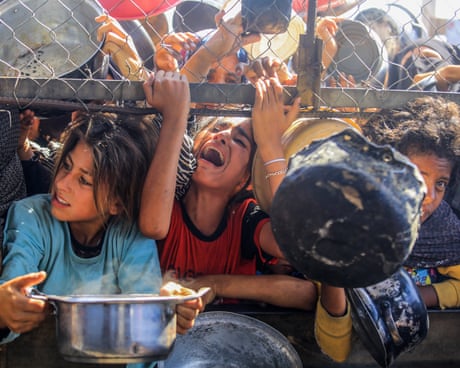
Palestinians, mostly children, push to receive a hot meal at a charity kitchen in the Mawasi area of Khan Yunis in the southern Gaza Strip on 22 July, 2025 (AFP)
A grim and powerful act of protest has taken place in Gaza.
In the midst of the Israeli–US-imposed blockade on food and humanitarian aid – a policy that has already caused many Palestinians to die – a significant public figure has himself gone on hunger strike.
On Sunday, 20 July, Mahmoud Basal, spokesperson for the Palestinian Civil Defence in Gaza and long persecuted by the Israeli occupation for documenting conditions on the ground, announced a hunger strike.
“I am Mahmoud Basal, a Palestinian citizen, a free human being,” he declared. “For days now, I have been living on scraps of food, like more than two million citizens. Due to the lack of basic food in the Gaza Strip, I declare a full hunger strike in protest against the catastrophic famine striking Gaza, and in solidarity with more than two million people who have been left to face death by starvation amid shameful global silence.”
While Israel has long used food as a weapon – measuring out the bare minimum number of calories required to keep Gaza’s population on the brink of malnutrition – we are now witnessing the radical consequences of restrictions and blockades that have been normalised over decades.
New MEE newsletter: Jerusalem Dispatch
Sign up to get the latest insights and analysis on Israel-Palestine, alongside Turkey Unpacked and other MEE newsletters
This strategy was infamously outlined in a 2008 Israeli position paper, Food Consumption in the Gaza Strip – Red Lines.
‘Unbearable loss’
Incremental yet relentless waves of dehumanising propaganda in western media and political discourse, reinforced by repeated Israeli assaults on Gaza that leave mass death and devastation in their wake, have brought us to the horrific present reality.
Now, Israeli forces target unarmed, starving people in search of food using snipers, artillery and drones – people who are then presented not as victims, but as trespassers on their own land.
Relentless propaganda and repeated Israeli assaults have brought us to this horrific present reality
On the same day Basal announced his hunger strike, poet and Pulitzer Prize-winning writer Mosab Abu Toha – displaced from his destroyed home in Beit Lahia to Egypt and, eventually, the US – posted on X: “Today was a day of unbearable loss. My cousin was killed, my wife’s brother and another cousin were wounded, and many of my friends from the neighbourhood returned with amputated limbs. These were young men – sons, fathers – who had to set out, desperate to bring back even a little food for their families.”
While Israel foments further chaos in Syria and Lebanon to divert attention and consolidate territorial control – part of a meticulously planned attempt to fully dominate the region – British surgeon Nick Maynard has reported consistent patterns of gunshot injuries at newly established aid distribution sites.
Noting “clear patterns of injury”, Dr Maynard described victims – mainly teenage boys – as being deliberately targeted in different parts of the body, depending on the day.
“On one day they’ll all be abdominal gunshot wounds, on another they’ll all be head or neck gunshot wounds, on another they’ll be arm or leg gunshot wounds…It’s almost as if a game is being played, that they’re deciding to shoot the head today, the neck tomorrow, the testicles the day after,” he said.
Campus complicity
Meanwhile, in the US, the news cycle functions as a constant distraction – through contrived political scandals, economic chaos driven by the tariff mood of the day, or congressional hearings on “antisemitism” at US universities.
At these show trials, the university administrators summoned for questioning are themselves among the institutional actors who have hollowed out academia to its core.
Why academic scholarship on Israel and Palestine threatens western elites
Research fields that develop the technical means to kill and control populations that resist, while manufacturing consent for those very policies, receive institutional priority due to corporate sponsorship.
Yet these same administrators stand accused of not doing enough to ban, silence, arrest, or otherwise suppress any expression of free speech on campus – so long as that speech supports Palestinian liberation or criticises US or Israeli policy.
All of this reinforces the false dichotomies of US institutional discourse – as if most, if not all, institutions were not aligned with the bipartisan consensus on foreign policy.
Like a deer in headlights, Chancellor Felix Matos Rodriguez of the City University of New York (CUNY) feigned ignorance under Congresswoman Elise Stefanik’s relentless interrogation, repeatedly claiming he “wasn’t aware of” or “did not know about” this or that individual or event.
Yet even before the hearings, and in hopes of appeasing the insatiable bloodlust of genocide denial, Rodriguez had already offered up four contingent CUNY professors – the most precarious segment of academic labour – as sacrificial lambs, ensuring their dismissal without cause due to their involvement in Palestine-related activism.
How did we get here?
Fading empires
The famine in Yemen, a result of the US-supported Saudi intervention and blockade that began in 2016, was neither live-streamed nor regarded as a significant component of US foreign policy.
Thus, the steadfast support of Ansar Allah, Yemen’s armed Houthi movement, for Gaza and Palestine can be made to seem “irrational” – as though there were no link between past atrocities and present resistance.
Follow Middle East Eye’s live coverage of the Israel-Palestine war
As global power shifts towards multipolarity, and new alliances form along emergent trade routes, the US and EU have entered a phase of panic familiar to fading empires.
The years leading up to the sudden outbreak of the coronavirus in 2020 were characterised by some of the most massive public displays of political protest across the globe since the 1960s.
From the Great March of Return in Gaza and the Algerian Hirak, to mass uprisings in Iraq, Lebanon’s 17 October popular uprising, the Yellow Vests in France, and demonstrations in Catalonia, Chile, Hong Kong and beyond, the world seemed on fire.
But those determined to maintain power were often more attuned to the global resonances between these movements than many of the participants themselves.
New feudal order
As with the post-9/11 moment, the policies enacted in response to the pandemic reshaped societies almost overnight: restricting basic human rituals, from funerals to visiting the sick and elderly, while enabling massive wealth transfers.
People were taught to fear one another – to fear contact, proximity and community. New digital powers and the complete relativising of the principles of free speech and unrestrained movement transformed societies almost overnight.
Changes in civil liberties, economies, supply chains, trade routes – and almost every aspect of life – seemed to bring the future, so to speak, back to the past.
There is no justification for starving and killing Palestinians in Gaza – and claiming it can’t be stopped is a lie of the highest magnitude
That past is also the Cold War past that liberal democracies and a fading US empire continue to cling to, propped up by the perpetual manufacture of existential enemies.
In 1944, anthropologist Gregory Bateson – then working for the Office of Strategic Services (OSS), precursor to the CIA – remarked: “It is very important to sponsor spectatorship among the superiors and exhibitionism among the inferiors.”
Historically denied the means to defend themselves by far more powerful states, the present anguish of unarmed Palestinians searching for food to survive yet another day – in a world that has betrayed them on every front – is a harbinger to all rational people with eyes to see, ears to hear, and minds to think, as we enter a new feudal order.
There is no justification whatsoever for the forced starvation and wanton killing of Palestinians in Gaza, now or ever. And the idea that mechanisms to stop it are unavailable or do not exist is a lie of the highest magnitude.
The day after Basal’s declaration, a young Egyptian activist at the Hague chained shut the Egyptian embassy gates, scattered flour across the pavement, and smashed eggs against the entrance in protest. In that moment of small, defiant spectacle, a whole edifice of lies appeared to fall apart.
The only conclusion we can draw is that we are witnessing a deliberate effort to showcase the impunity of power, an effort designed to annihilate the very possibility of political reciprocity, justice and law.
This monstrosity must be defeated, at any cost – and everything must be remembered, in fine detail, to hold those responsible to account.
The views expressed in this article belong to the author and do not necessarily reflect the editorial policy of Middle East Eye.
Ammiel Alcalay is a poet, novelist, translator, essayist, critic and scholar. He is the author of more than 25 books, most recently Controlled Demolition: a work in four books, and his co-translation of Nasser Rabah’s Gaza: The Poem Said Its Piece. He is Distinguished Professor at Queens College, CUNY, and the CUNY Graduate Center in New York.
Scenes from the end of Zionism: Reflections on the Jewish Anti-Zionist Congress in Vienna
July 22, 2025The first Jewish Anti-Zionist Congress, which drew 1,000 anti-Zionist Jews and their allies to Vienna, marked a significant moment in the rising tide against the settler-colonial state of Israel.
By Daniel Friedman, Mondoweiss, July 20, 2025
 A billboard outside the first Jewish Anti-Zionist Conference, which was held June 13-15, 2025, in Vienna, Austria. (Photo: Daniel Friedman)
The decision to hold the first Jewish Anti-Zionist Congress in Vienna was significant for historical reasons – being where Theodore Herzl formed the ideology that became modern Zionism, as well as Adolf Hitler’s birthplace – and for modern reasons – Austria, alongside Germany, provides unconditional support for Israel, a symptom of its guilt over the Holocaust.
Western nations’ complicity in Israel’s ongoing genocide in Gaza has left the supposed ‘rules-based’ order they claim to represent in ruins. The U.S., UK, Europe, and their allies have provided Israel with the means to act with impunity through weapons, which flow freely, and information, which certainly does not.
The Congress began just as Israel was bombing Iran, a reminder of the threat Zionism poses to global stability. Against this backdrop, over 1,000 anti-Zionist Jews and their allies from across the globe met in the Favoriten District in Vienna, June 13-15, 2025,at a time when the tide is turning, too slowly, but turning, against the settler-colonial ethnostate of Israel.
Israel still has its well-funded lobby groups, and far too many people still believe its hasbara. It seems it’s up to a plucky group of not-so-well-funded anti-fascist dissidents in keffiyehs to turn the tide. While we have the truth and international law on our side, at times our goals seem insurmountable. But as several speakers highlighted, we must keep going, and we do not have the luxury of despondency. I was there representing South African Jews for a Free Palestine (SAJFP) alongside Roshan Dadoo, the conference’s only South African speaker and coordinator of the South African Boycott, Divestment, and Sanctions (BDS) coalition.
SAJFP sent me to Austria to advocate for a united, Jewish Anti-Zionist movement that is inclusive rather than Eurocentric. Our experience in fighting apartheid as South Africans is also significant, in terms of both our successes and our failures. As United Nations Special Rapporteur Francesca Albanese pointed out via live stream: While the political system underpinning apartheid was defeated in South Africa, the economic and social systems that enabled it remained in place.

While the First Congress did not definitively represent the entirety of global anti-Zionism – hopefully, in time it will, as the follow-up Congress is already being planned for 2026 and is rumored to be taking place in Ireland – the turnout showed the movement is alive, well, and growing. Leading Jewish anti-Zionists in attendance included Israeli-born historian Ilan Pappe, U.S. journalist and filmmaker Katie Halper, and Hungarian/British Holocaust survivor Stephen Kapos.
The voice of Palestinians, crucially, was heard there too, through the presence of people such as Gazan journalist and author Ramzy Baroud, who argued that his people should become a model of resistance against imperialism worldwide. Palestinian physician, academic, and writer Dr. Ghada Karmi was there to emphasize the right of return and Europe’s role in having “created the monster” that is Israel, as was politician Awad Abdelfatah, who has worked from within the Israeli political system, advocating for one, democratic state with equal rights for all who live in it.

The need to reclaim Judaism from Zionism – once seen as a fringe movement within global Jewry as UK writer and activist Tony Greenstein reminded us during a discussion – was a constant theme at the Congress, as was the need to embrace the Yiddish concept of doikayt, or hereness, the idea that Jewish people can, have and will live peacefully with their neighbors in countries across the globe, rather than needing to escape to a physical homeland.
We were also reminded that we were there not just as Jews, but as human beings, and that there is no place for exceptionalism of any kind in this struggle. We must join forces with anti-Zionists across the globe, and our primary duty is to the Palestinian people. Their suffering was highlighted through a video that made many in attendance emotional, in which a surgeon from Gaza detailed his attempts to keep going amid Israel’s systematic dismantling of the enclave’s entire medical system.
The Congress demonstrated that some of the most effective opposition to the Zionist state comes from those born into it. Together with Pappe, others who were born in Israel or have lived there were heard. These included dissident activist Ronnie Barkan, filmmaker and academic Professor Haim Bresheeth-Žabner, and academic and activist Dalia Sarig. These voices provide hope that it’s possible to resist the propaganda that keeps most Israelis loyal to their state, regardless of its actions.
Some speakers were not Jewish or Palestinian but simply anti-Zionists, reaffirming that this is an issue of common humanity. Alongside Albanese was Egyptian journalist Rahma Zein, providing another much-needed African perspective, and French/Palestinian juror and politician Rima Hassan, who managed to join the Congress virtually, despite having just been released from detention after Israel abducted her and other activists on the Madleen Flotilla.

A declaration written with input from all speakers at The Congress seeks to capture the collective positions that were reached during the three days. The declaration condemns the genocide as well as Israel’s apartheid-driven policies, rooted in ethnic cleansing. The document documents Israel’s systematic war crimes in Gaza, “including ethnic cleansing, militarised apartheid, urbicide, scholasticide, medicide, mass starvation”, and condemns Western governments, particularly the U.S., UK, EU, Canada, Australia, and New Zealand, for enabling these actions through military and diplomatic support.
It calls for immediate sanctions, Israel’s suspension from the UN, adherence to BDS (Boycott, Divestment, Sanctions), and nuclear disarmament under IAEA oversight. The declaration also affirms Palestinians’ right to resist occupation and demands an end to Zionist claims of representing global Jewry, urging Jews worldwide to reject Zionism and stand in solidarity with Palestinian liberation.
The signatories reject Israel’s legitimacy as a Jewish state, and note that Zionism is a racist ideology that endangers both Palestinians and Jews. They call for decolonization, the right of return for Palestinian refugees (per UN Resolution 194), and the withdrawal of Israeli forces from all occupied territory since 1948.
The Congress could prove important only if all who attended absorb its message, take it back to our communities, and work hard to grow the movement. The need for greater collaboration between global anti-Zionist groups was evident, as was the need for anti-Zionist Jews to unite as one cohesive movement. Zionism is a highly funded, meticulously organized, and well-oiled machine, and we only have a chance of defeating it together.
To me, more important than anything that came out of the Congress is that it happened, that we united to continue our work, and that it symbolized a return to the roots of Judaism as a religion of peace. Despite all the damage that has been done in our name, Jews can and must be part of building a better world. I believe deep down that a day will come when we truly can celebrate our achievements as anti-Zionists, Jewish or otherwise. But who knows how long that will take? For now, all I really know is that our work has just begun.
Governments like mine have a duty to stand up to Israel. Far too many have failed
July 8, 2025Gustavo Petro

Without decisive action, we risk stripping the global legal order of its remaining protections for less-privileged nations
- Gustavo Petro is the president of Colombia
The Guardian, Tue 8 Jul 2025
Over the past 600 days, the world has watched Benjamin Netanyahu lead a campaign of devastation in Gaza, the escalation of regional conflict, and a reckless abandonment of international law at large.
Governments such as mine cannot afford to remain passive. In September 2024, when we voted for the United Nations general assembly resolution on Israel’s policies and practices in the Occupied Palestinian Territory, we assumed concrete obligations – investigations, prosecutions, sanctions, asset freezes, and cessation of imports and arms. That resolution set a deadline of 12 months for Israel to “bring to an end without delay its unlawful presence”. One hundred and twenty-four states voted in favour, including Colombia. The clock is now ticking.
In the meantime, however, far too many states have allowed strategic calculations to override our duty. While we may face threats of retribution when we stand up for international law – as South Africa discovered when the United States retaliated against its case at the international court of justice – the consequences of abdicating our responsibilities will be dire. If we fail to act now, we not only betray the Palestinian people, we become complicit in the atrocities committed by Netanyahu’s government.
Some governments have already stepped up. My government suspended coal exports to Israel, for example, recognising that economic ties cannot be divorced from moral responsibilities. South Africa, meanwhile, has taken Israel to the world’s highest court. And Malaysia has banned all Israeli-flagged cargo ships from docking at its ports. Without such decisive action, we risk turning the multilateral system into a talking shop, stripping the legal order of its remaining protections for small, developing and less privileged nations – from west Asia to right here in Latin America.
The next test for the international community is right around the corner. On 15 July, my government, alongside South Africa – the co-chairs of The Hague Group – will convene an emergency conference on Gaza, calling on ministers from states across the world to deliberate a multilateral defence of international law. Our goal is simple: to introduce concrete legal, diplomatic and economic measures that can halt Israel’s destruction – and uphold the foundational principle that no state is above the law.
The invitation is open and urgent. The indefinite postponement of the UN’s proposed International Conference for the Peaceful Settlement of the Palestinian Question, co-chaired by France and Saudi Arabia, has left a critical void in multilateral leadership, precisely when it is needed most.
The UN has declared Gaza the “hungriest place on Earth”, and its mission to send aid into Gaza as the “one of the most obstructed … in recent history”. In this dire humanitarian context, Bogotá’s emergency conference convenes states to move from condemnation to collective action. By cutting our ties of complicity – across our states’ courts, ports and factories – we can challenge Donald Trump and Netanyahu’s vision of a world where “might is right”.
The choice before us is stark and unforgiving. We can either stand firm in defence of the legal principles that seek to prevent war and conflict, or watch helplessly as the international system collapses under the weight of unchecked power politics. Let us be protagonists together – not supplicants apart.
For the billions of people in the global south who rely on international law for protection, the stakes could not be higher. The Palestinian people deserve justice. The moment demands courage. History will judge us harshly if we fail to answer its call.
- Gustavo Petro is the president of Colombia
𝐈𝐬𝐫𝐚𝐞𝐥𝐢 𝐃𝐞𝐟𝐞𝐧𝐬𝐞 𝐌𝐢𝐧𝐢𝐬𝐭𝐞𝐫 𝐎𝐫𝐝𝐞𝐫𝐬 𝐏𝐥𝐚𝐧 𝐓𝐨 𝐁𝐮𝐢𝐥𝐝 𝐂𝐨𝐧𝐜𝐞𝐧𝐭𝐫𝐚𝐭𝐢𝐨𝐧 𝐂𝐚𝐦𝐩 𝐟𝐨𝐫 𝐆𝐚𝐳𝐚’𝐬 𝐂𝐢𝐯𝐢𝐥𝐢𝐚𝐧 𝐏𝐨𝐩𝐮𝐥𝐚𝐭𝐢𝐨𝐧
July 8, 2025Israel Katz says the so-called ‘humanitarian city’ will be built on the ruins of Rafah
by Dave DeCamp, Antiwar. com, July 7, 2025
Israeli Defense Minister Israel Katz has ordered the IDF to prepare a plan to establish a camp to concentrate the entire civilian population of Gaza on the ruins of the southern Gaza city of Rafah.
According to Haaretz, Katz said that once Palestinian civilians are pushed into what he is calling a “humanitarian city,” they will not be allowed to leave. The idea is to first transfer 600,000 civilians from the al-Mawasi tent camp on the coast in southern Gaza, followed by the rest of the civilian population.
Katz said that if conditions permit, the “city” could be built during a potential 60-day ceasefire, comments that will make Hamas less likely to agree to a temporary truce. The Israeli defense minister also said that during the ceasefire, Israel will maintain control of the “Morag Corridor,” a strip of land between Rafah and Khan Younis.
Katz also suggested the camp can facilitate the government’s ultimate goal of ethnic cleansing, which it refers to as “voluntary migration,” telling reporters that Israel will implement “the emigration plan, which will happen.”
Israeli Finance Minister Bezalel Smotrich has previously said that the goal of Israel’s current military operation, dubbed Gideon’s Chariots, is to create a concentration camp south of the Morag Corridor and pressure the civilians forced into it to leave.
“The Gazan citizens will be concentrated in the south. They will be totally despairing, understanding that there is no hope and nothing to look for in Gaza, and will be looking for relocation to begin a new life in other places,” Smotrich said in May.
Katz’s comments come after Reuters reported that the controversial US-backed Gaza Humanitarian Foundation (GHF) had proposed to the US government the idea of creating camps it called “Humanitarian Transit Areas” inside Gaza or possibly outside Gaza.
The GHF plan describes the camps as “large-scale” and “voluntary” places where the Palestinian population could “temporarily reside, deradicalize, re-integrate and prepare to relocate if they wish to do so.”
Katz said Israel is seeking “international partners” to manage the zone and that four aid distribution sites would be set up inside the camp, suggesting the GHF will be involved in the plan. GHF aid sites are secured by American security contractors, who have been credibly accused of using live ammunition and stun grenades to disperse crowds of hungry Palestinian civilians.
Israeli Forces Massacre 118 Palestinians in Gaza Over 24 Hours
July 5, 2025More than 300 Palestinians have been killed in Gaza over the past three days
by Dave DeCamp, Antiwar. com, Jul 3, 2025
Gaza’s Health Ministry said on Thursday that Israeli forces killed at least 118 Palestinians and wounded 581 over the previous 24-hour period as heavy US-backed Israeli strikes continued across the Strip and Israeli troops continued to shoot people seeking aid.
Thursday marks the third day in a row that the Health Ministry reported a death toll of more than 100. Based on the ministry’s numbers, which studies have found are likely a significant undercount, Israeli forces killed 369 Palestinians over a 72 hours.
Israeli attacks on Thursday included massacres of children. According to The Associated Press, an overnight strike on tents sheltering displaced Palestinians killed 13 members of one family, including six children under the age of 12. Two children, including a six-year-old girl, were among eight people reported killed by an Israeli strike that hit near a stand selling falafel in central Gaza.
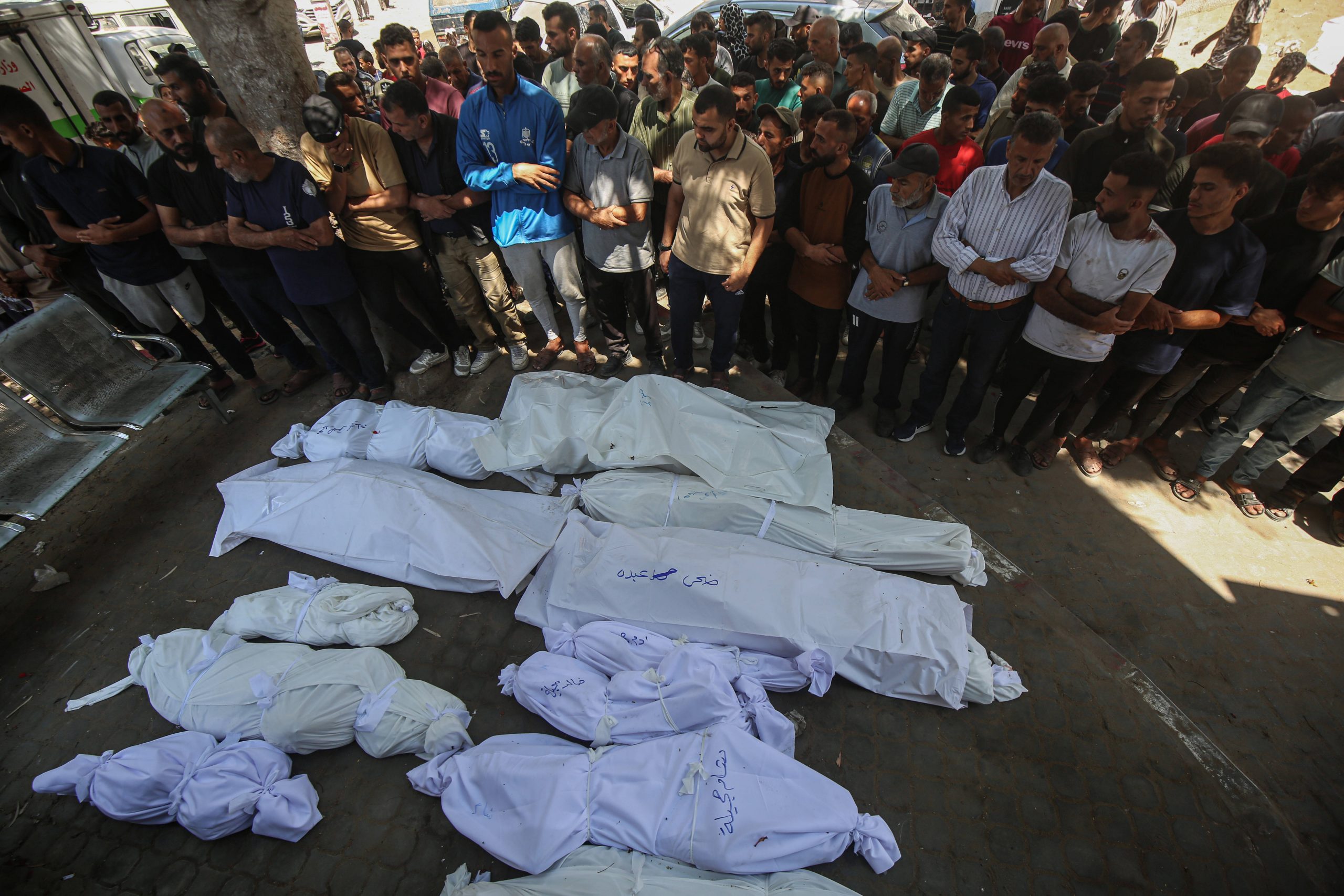
An Israeli strike on a school sheltering displaced Palestinians in Gaza City killed 15 people. The breakdown of the casualties is unclear, but photos of the funeral for the victims at Al-Shifa Hospital show several tiny bodies wrapped in shrouds.
Medical sources told AP that five Palestinians were killed by Israeli forces along roads while attempting to reach distribution sites run by the US and Israeli-backed Gaza Humanitarian Foundation (GHF), and another 40 were killed while waiting for UN aid trucks in various parts of Gaza.
The Health Ministry said that since the GHF began operating in Gaza at the end of May, 652 Palestinians have been killed while seeking aid. The aid massacres have continued despite more attention on the issue following a report from Haaretz that revealed IDF troops had been given orders to fire on unarmed people near GHF sites.
The AP also reported that American contractors posted at the aid sites have also been using live ammunition and stun grenades to disperse civilians near the distribution sites. In at least one case, one of the contractors who spoke to AP said it appeared fire from the US contractors hit an unarmed Palestinian.
The revelations about the aid killings have not impacted US support for Israel or support for the aid mechanism that has proven to be deadly. The Trump administration recently announced it was providing $30 million to the GHF.
UN rapporteur accuses Israel of ‘one of cruelest genocides’ in modern history; urges arms embargo, global disengagement
July 4, 2025Francesca Albanese says Gaza has become laboratory for Israeli weapons, calling on states to suspend all trade, investment with Israel
Beyza Binnur Donmez, AA.COM |03.07.2025 – Update : 04.07.2025
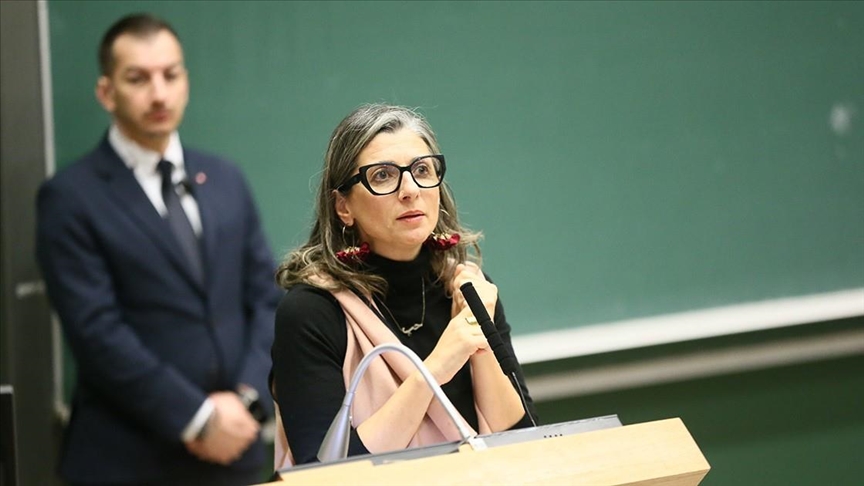
– She names 48 corporate actors, including arms manufacturers, banks, tech companies, energy giants, academic institutions, alleging they are directly linked to broader ‘economy of occupation’ sustaining Israeli actions
GENEVA
Israel is responsible for “one of the cruelest genocides in modern history,” the UN special rapporteur on the occupied Palestinian territory said on Thursday, accusing Tel Aviv of weaponizing Gaza as a testing ground and calling for sweeping international action, including a full international arms embargo and the suspension of trade and investment ties.
“The situation in the occupied Palestinian territory is apocalyptic,” Francesca Albanese told the UN Human Rights Council, presenting her latest report. “In Gaza, Palestinians continue to endure suffering beyond imagination. Israel is responsible for one of the cruelest genocides in modern history.”
Albanese said official figures count over 200,000 Palestinians killed or injured, but leading health experts estimate “the true toll is far higher.” She denounced the so-called Gaza Humanitarian Foundation – Israel’s new aid mechanism in Gaza, with hundreds of associated deaths to date – as “a death trap – engineered to kill or force the flight of a starved, bombarded, emaciated population marked for.”
Profits from genocide
She grimly highlighted the economic gains made during the war, noting that in the past 20 months, arms companies have reaped huge profits by supplying Israel with weapons used to bombard Gaza.
“Arms companies have turned near-record profits by equipping Israel with cutting-edge weaponry to unleash 85,000 tons of explosives – six times the power of Hiroshima – to destroy Gaza,” she said.
The report also pointed to 213% gains on the Tel Aviv Stock Exchange since October 2023, describing a stark contrast: “One people enriched, one people erased.”
Accusing Israel of using the war to “test new weapons, customized surveillance, lethal drones, (and) radar systems,” Albanese warned that Palestine’s defenselessness had made it “an ideal laboratory for the Israeli military-industrial complex.”
She named 48 corporate actors, including arms manufacturers, banks, tech companies, energy giants, and academic institutions, alleging that they are directly linked to a broader “economy of occupation” sustaining the Israeli state’s actions.
Among the most important firms mentioned in the report are Amazon, Microsoft, BNP Paribas, Booking, and Korean HD Hyundai, according to her report.
“Weapons and data systems brutalize and surveil Palestinians,” she said. “Colonies spread –financed by banks and insurers, powered by fossil fuels, and normalized by tourism platforms, supermarket chains, and academic institutions.”
Later in a press briefing in Geneva, Albanese said she had formally notified all companies named in her report, sharing with them “the facts that I found in violation of international law.”
She emphasized that her work went “beyond what has been done in other similar cases,” explaining: “For each of them, I have provided a detailed analysis, a case by case legal analysis, so where I found their nonconformity with international law translating into violation of the right of self-determination, other human rights violations and even war crimes or crimes against humanity, and to an extent, in which case it could be embroiled in the crime of genocide.”
According to Albanese, 18 companies responded to her findings, while the others did not. Of these 18, she said that “only a small number” engaged with her in good faith, while the rest denied their wrongdoings.
Referring to those in denial, she said: “They don’t understand international law clearly. They think that international law is there to make excuses.”
‘Responsibility to abstain’ or cut ties with ‘economy of occupation’
Under international law, she said, even a minimal connection to this system carries clear responsibility. “There is a prima facie responsibility on every state and corporate entity to completely abstain from or end their relationships with this economy of occupation.”
In a direct appeal to UN member states, Albanese called for bold steps: “Member states must impose a full arms embargo on Israel, suspend all trade agreements and investment relations, and enforce accountability, ensuring that corporate entities face legal consequences for their involvement in serious violations of international law.”
She also called on businesses to act, stressing: “Corporate entities must urgently cease all business activities and terminate relationships directly linked with, contributing to, and causing human rights violations and international crimes against the Palestinian people.”
Albanese said she no longer believed ignorance or ideology were sufficient explanations for global inaction. “In the face of genocide – so visible, so livestreamed – these explanations fall short.”
She concluded with a call for civil society to play its part, saying: “Trade unions, lawyers, civil society groups, and ordinary citizens should encourage such behavioral change from the side of businesses and governments by pressing for boycotts, divestments, sanctions, and accountability. What comes next depends on all of us.”
𝐀𝐭 𝐋𝐞𝐚𝐬𝐭 𝟗𝟓 𝐊𝐢𝐥𝐥𝐞𝐝 𝐢𝐧 𝐆𝐚𝐳𝐚 𝐚𝐬 𝐈𝐬𝐫𝐚𝐞𝐥𝐢 𝐅𝐨𝐫𝐜𝐞𝐬 𝐁𝐨𝐦𝐛 𝐂𝐚𝐟𝐞, 𝐒𝐡𝐨𝐨𝐭 𝐀𝐢𝐝 𝐒𝐞𝐞𝐤𝐞𝐫𝐬
July 1, 2025At least one journalist was killed and another was injured
by Dave DeCamp, Antiwar. com, Jun 30, 2025
Medical sources told Al Jazeera on Monday that Israeli attacks killed at least 95 Palestinians in Gaza throughout the day as Israeli forces bombed a seaside cafe and gunned down more desperate people who were seeking aid.
According to the Palestinian news agency WAFA, an Israeli airstrike hit the Al-Baqa Cafe in Gaza City, killing 33 people and injuring 50 others. Among the dead was journalist Ismail Abu Hatab, bringing the total number of Palestinian journalists killed since October 7, 2023, to 227, according to WAFA’s count.
Another journalist, Bayan Abu Sultan, was wounded in the attack, and photos and videos of the aftermath show her standing outside the cafe covered in blood. Ali Abu Ateila, a survivor of the airstrike, told The Associated Press that the cafe was struck when it was crowded with women and children.
Journalist Bayan Abu Sultan, after the Israeli airstrike on the Al-Baqa Cafe in western Gaza City on June 30, 2025 (Majdi Fathi via Reuters Connect)
“Without a warning, all of a sudden, a warplane hit the place, shaking it like an earthquake,” Ateila said. The cafe was one of the few businesses that continued to operate in Gaza and was frequently crowded as Palestinians went there to charge their phones and use the internet.
The AP also reported that at least 22 people were killed by Israeli fire while attempting to get aid in different areas of Gaza. The Nasser Hospital in Khan Younis said it received 11 bodies of Palestinians who were killed while returning from an aid site operated by the US and Israeli-backed Gaza Humanitarian Foundation (GHF) in the area. Another Palestinian was killed near an aid site in Rafah.
Gaza’s Health Ministry said that another 10 people were killed at a UN warehouse in northern Gaza. The latest aid-related killings come after a report from the Israeli newspaper Haaretz revealed that Israeli troops are being ordered to fire on unarmed Palestinians attempting to reach GHF distribution sites to drive them away or disperse them, even though they pose no threat.
Israeli forces also launched heavy attacks on the Zeitoun neighborhood in Gaza City on Monday, with residents reporting that the IDF bombed four schools that were sheltering displaced people, and at least 10 Palestinians were killed in the area. “Explosions never stopped; they bombed schools and homes. It felt like earthquakes,” Salah, a 60-year-old father of five children from Gaza City, told Reuters. “In the news we hear a ceasefire is near, on the ground, we see death and we hear explosions.”

 Peace and Justice Post
You must be logged in to post a comment.