The pro-Israel lobby group AIPAC is attacking Rep. Marjorie Taylor Greene (R-GA) after she became the first Republican member of Congress to label Israel’s actions against the Palestinians in Gaza a genocide.
According to Al Jazeera, in a fundraising email to supporters on Thursday, AIPAC called Greene’s remarks “disgusting” and accused her of betraying “American values” for calling Israel’s brutal campaign in Gaza a genocide, which aligns Greene with many human rights organizations and genocide scholars, including Israeli ones.
“You expect anti-Israel smears from Rashida Tlaib and Ilhan Omar,” AIPAC said in the email, referring to two House Democrats known for their critical view of Israel. “But now, Marjorie Taylor Greene has joined their ranks – spouting the same vile rhetoric and voting against the US-Israel alliance.”
AIPAC said Greene was now the “newest member of the anti-Israel Squad” and claimed her view was a “betrayal of American values and a dangerous distortion of the truth.”
Greene has referred to Israel’s actions as genocide at least twice in posts on X. In her first post, Greene said that it’s “the most truthful and easiest thing to say that Oct 7th in Israel was horrific and all hostages must be returned, but so is the genocide, humanitarian crisis, and starvation happening in Gaza.”
In another post, the Georgia congresswoman said many Americans are “against radical Islamic terrorism, but we are also against genocide.” She has also repeatedly referred to Israel as “nuclear-armed Israel,” making her one of the first members of Congress to directly acknowledge Israel’s secret nuclear arsenal.
AIPAC is known to spend big on pro-Israel candidates and is likely going to fund an opponent of Greene’s when she comes up for election again. The pro-Israel group has also targeted Rep. Thomas Massie (R-KY), the only other Republican in Congress to offer significant criticism of Israel and who consistently votes against aid to Israel.
Netanyahu chose to blow up the ceasefire and starve Gaza’s population in order to force a surrender from Hamas, while top military and security officials favored moving to the second phase of a ceasefire, leaked cabinet meeting minutes reveal.
Israeli Prime Minister Benjamin Netanyahu at cabinet meeting on January 22, 2023. (Photo: Israel National Photo Collection/Government Press Office)
Israel decided to starve the people of Gaza as a strategy of war and in order to sabotage the ceasefire deal, according to Israeli cabinet meeting minutes leaked on Wednesday to Israel’s Channel 13.
The document purports to show that Israeli Prime Minister Benjamin Netanyahu refused multiple proposals that would have secured the release of the remaining Israeli captives during the ceasefire between January and March 2025. Netanyahu decided to break the ceasefire, against the advice of top Israeli military and security officials, and to cut off all aid to Gaza to “force Hamas to surrender,” the leak shows.
The Israeli cabinet’s meeting, dated March 1, was to discuss the fate of the ceasefire with Hamas as the first phase of the agreement was set to expire. The prospective second phase of the ceasefire was supposed to see the beginning of talks on the permanent end of the war. The minutes released by Channel 13 show that army and intelligence officials argued for concluding the ceasefire deal, while cabinet ministers opposed it.
Major General Nitzan Alon, the Israeli army official in charge of prisoners and missing persons, reportedly argued that “the only opportunity to release the captives is to discuss the conditions of phase two,” while Ronen Bar, the chief of the Israeli internal intelligence agency (the Shabak), said that his “preferred option is to move forward with phase two,” stating that Israel could “easily” return to war later. “Let’s get everyone back first, then resume the fight,” he reportedly said.
The minutes also revealed that a senior Israeli security official told the ministers that “it is possible to secure the release of more captives, but that requires engaging in talks about phase two — ending the war.” The government, however, led by Netanyahu, rejected the proposal. He was backed by Israeli Minister of Strategic Affairs, Ron Dermer, who reportedly said that Israel was “not prepared to end the war while Hamas remains in power.” Dermer, who supports Netanyahu’s hardline position on Gaza, was named by the Prime Minister as head of the negotiating team in the ceasefire talks.
Also backing Netanyahu’s refusal was hardline Finance Minister Bezelel Smotrich, who lashed out at military and intelligence officials, insisting that they were “misleading the public” into thinking Israel could “stop the war and return to it later,” which Smotrich regarded as “ignorance.”
For his part, Israeli Defense Minister, Israel Katz, supported a partial deal, saying that, “If Hamas returns even a number of hostages — less than half — that’s excellent.”
On March 18, Israel broke the ceasefire by launching a wave of bombings on Gaza, killing 400 Palestinians, mostly civilians, in the first minutes of the onslaught. Israel also announced the complete closing of the crossing points, causing an immediate drop in available goods in the strip and cutting off the entry of humanitarian aid. The continuation of the blockade caused the spread of severe hunger, which UN agencies have qualified as famine. UNICEF has called the deaths of Palestinian children due to starvation “unconscionable”.
Israel also halted the work of UN agencies in Gaza, limiting the distribution of the little aid it began to allow in since April to the Gaza Humanitarian Foundation (GHF). The GHF is the controversial Israeli-backed and U.S.-run organization that replaced the UN in May, and has forced Palestinians to travel to four distribution centers in the southern Gaza Strip to collect aid. The centers have been described as “death traps” that use aid as “bait” to lure Palestinians into southern Gaza. There, the Israeli army opens fire on aid-seekers, resulting in numerous recorded “aid massacres.” As of the time of writing, 1,561 people have been killed at GHF sites or while waiting for aid trucks in the north, according to the Ministry of Health in Gaza.
According to the Health Ministry, some 160 Palestinians, including 90 children, have died due to malnutrition brought on by starvation.
This outcome adds to a growing list of union-led actions across Europe in solidarity with Palestine and against the ongoing genocide in Gaza, Ana Vracar reports.
Dockworkers in Genoa, Italy, protesting forced complicity of Italian ports in Gaza genocide, June 2025. (Unione Sindacale di Base via Peoples Dispatch)
Italian port workers secured a significant win last week in their ongoing resistance to militarization and arms transfers, as shipping operators decided they would not unload military cargo destined for Israel from the vessel COSCO ShippingPisces — returning the containers to their point of origin instead.
“We were informed today that the three containers carrying military equipment, destined for La Spezia and transported aboard the COSCO Pisces, will not be unloaded in either Genoa or La Spezia,” the union Unione Sindacale di Base (USB) said on July 29. “This decision marks a tangible result of union action and the pressure exerted by USB.”
Costco Pisces in the Dutch port of Rotterdam in 2019. (kees torn/Flickr/CC BY-SA 2.0)
This outcome adds to a growing list of union-led actions across Europe in solidarity with Palestine and against the ongoing genocide in Gaza, where at least 60,000 people have been killed by the Israeli occupation.
“From Greece to Liguria, as previously demonstrated with the support of French dockworkers, the network of dockworkers across Europe and the Mediterranean has shown that stopping war logistics is possible, legitimate, and necessary,” Unione Sindacale di Base wrote.
Following the announcement, a planned Aug. 5 strike was called off. However, Genoa dockworkers have pledged to continue mobilizing against the arms trade. They have also announced plans for an international assembly on Sept. 26–27, which aims to lay the groundwork for a sector-wide strike.
“We are not alone: our struggle unites Marseille, Piraeus, Hamburg, Tangier,” trade unionists declared earlier in July. “If the war comes through the ports, the response must come from the ports.”
Unione Sindacale di Base logistical workers continue to expand their campaign on the principle that strikes are a legitimate tool in the fight against war, militarization and forced worker involvement in arms trafficking.
“Law 146/1990 speaks clearly: war operations are not essential services, and a strike is legitimate if it serves to defend collective security and constitutional order,” the union noted. “Stopping arms is not just a political choice, it is a right.”
Locally, from Genoa to Brescia, workers’ actions are disrupting the chains that fuel massacres and armed conflict, USB emphasized. Their mobilization against the arms trade, including strikes, is backed by a growing international solidarity bloc.
“Dockworkers in Europe, the Mediterranean, and elsewhere will not become accomplices of the murderous state of Israel and its allies – the USA, NATO and the EU,” the All-Workers Militant Front (PAME) wrote in a statement of support to dockworkers in Italy. “They will not allow ports and infrastructure to become instruments of war for the slaughter of people by the imperialists.”
Western leaders offering recognition of Palestine instead of consequences as Gaza is obliterated is symbolism, not sovereignty
Protesters rally outside the White House against Israeli bombing of Gaza on 18 March 2025 in Washington (AFP)
Recognising the State of Palestine may seem, at first glance, like a moral turning point – a sign of western conscience reawakened amid the devastation of Gaza.
Britain’s Prime Minister Keir Starmer soon followed, pledging conditional recognition. His foreign secretary, David Lammy, spoke of Britain’s “special burden of responsibility” – a nod to the Balfour Declaration, which enabled Zionist colonisation of Palestine under British protection.
But peel back the optics, and this gesture is exposed for what it is: a facade, a diplomatic performance masking business as usual.
What’s being offered isn’t statehood. It’s a demilitarised, non-contiguous pseudo-entity with no control over borders, airspace, resources, or movement. It is a ghost administration under Israeli command, tasked with managing a shattered, occupied population. Less than the Oslo Accords and more like a glorified municipality dressed up as liberation.
New MEE newsletter: Jerusalem Dispatch
Sign up to get the latest insights and analysis on Israel-Palestine, alongside Turkey Unpacked and other MEE newsletters
And yet, Western leaders present it as bold, visionary. Why? Because this isn’t about Palestinian rights – it’s about political cover.
Absurd contradiction
France, under President Emmanuel Macron, sees the Palestinian cause as a diplomatic bridge back into the Arab and Muslim worlds, after its decline across Africa.
Macron postures as a new Charles de Gaulle, despite France’s legacy of aiding Israel’s nuclear ambitions.
Gaza, Lebanon and Yemen have exposed the cracks in the Arab facade
Saudi Arabia, meanwhile, is leveraging the recognition initiative to justify normalisation with Israel. It offers the illusion of progress while pulling Arab and Muslim countries deeper into the Abraham Accords.
It is not a commitment, but a tactic. He’s offered it conditionally – as leverage to coax Israel back to the “peace process”. If Israel cooperates, recognition is shelved. Palestinian statehood becomes a bargaining chip to be played – not a right to be affirmed.
It’s an absurd contradiction: if Starmer truly supported a two-state solution, recognising the second state would be the first logical step. But in the West, even symbolic gestures towards Palestine must pass through Tel Aviv.
And yet, even these hollow gestures have rattled Israel’s far-right coalition.
Foreign Minister Israel Katz scoffed that a Palestinian state should be built in Paris or London. US President Donald Trump threatened Canada with trade retaliation for considering recognition.
But that fury shouldn’t distract from the deeper truth: this initiative is a mirage, a tranquiliser for international conscience.
These are not rogue extremists – they are ministers of state, shaping official policy. And the West watches in silence, offering “recognition” instead of consequences.
Empty diplomacy
In the occupied West Bank, settler violence intensifies and military raids escalate. Between 1993 and 2023, the settler population grew from 250,000 to over 700,000 – despite the Oslo Accords’ promise to freeze expansion.
A state that exists only on paper, that must be approved by its occupier, is not a state. It’s a lie and recognition without action is not diplomacy – it’s complicity
Checkpoint by checkpoint, hilltop by hilltop, the land for a viable Palestinian state has been erased.
This is not a policy failure – it is policy.
It began in Madrid in 1991, and was formalised in Oslo in 1993. That so-called “peace process” replaced international law with endless negotiations, and justice with delay.
The Palestine Liberation Organisation, under pressure, recognised Israel and relinquished claim to 78 percent of historic Palestine, agreeing to negotiate over the remaining 22 percent – the West Bank, Gaza and occupied East Jerusalem.
In return, they were promised a state. But the core issues – refugees, Jerusalem, settlements, borders – were deferred indefinitely as “final status” matters. And in the meantime, Israel deepened its control.
Settlements multiplied. The apartheid wall was built. The West Bank was carved into a patchwork of isolated cantons. Gaza was blockaded, then bombed. The Palestinian Authority, born out of Oslo, became a subcontractor for Israeli security – tasked with suppressing dissent and policing its own people.
Khadija Sobh, 18, gives water to her seven-month-old daughter Janin Sobh in their tent in the Daraj neighbourhood of Gaza City on 3 August 2025 (AFP)
Instead of liberation, Palestinians got lockdown.
Instead of sovereignty, they got surveillance.
This wasn’t a peace process – it was pacification. And every time the Palestinian struggle gains momentum – whether during the First Intifada, the Second, or now with worldwide outrage over Gaza – the same script returns: revive talk of the “two-state solution”.
Not to realise it, but to bury the movement beneath another round of empty diplomacy. It’s a strategy of containment disguised as concern.
That’s what we’re witnessing now.
A virtual state
Gaza faces a manufactured famine, yet instead of halting the siege or sanctioning the siege-masters, the West retreats into the fantasy of a “virtual state”. Words replace pressure. Gestures replace justice.
France, Britain, and Germany continue to supply weapons to Israel. Political support remains ironclad – defended under the banner of Israel’s “right to exist”, even as Palestinians’ right to live is extinguished.
Instead of recognising ‘Palestine’, countries should withdraw recognition of Israel
Nothing fundamental has changed. Only the rhetoric.
The flow of arms continues.
The flow of funds continues.
The flow of lies continues.
If the West truly believed in Palestinian statehood, it would start by ending the military, financial and diplomatic support that fuels apartheid and occupation.
Recognition without consequences is not a step forward – it’s a step around the truth.
We’ve seen this game before. An endless “process” that leads nowhere – by design. Even now, in Gaza, negotiations are cover. A ceasefire was within reach last January. Israel shattered it in March. No consequences. Just a return to “talks”, while ethnic cleansing continues and officials speak of a “Jewish Gaza”.
Macron and Starmer talk of a Palestinian state while funding its erasure. They offer “recognition” that means nothing – except delay. What they propose isn’t sovereignty – it’s symbolism, a convenient fiction to pacify public outrage while cementing occupation.
But a state that exists only on paper, that must be approved by its occupier, is not a state. It’s a lie and recognition without action is not diplomacy – it’s complicity.
If the West won’t stop the genocide – if it won’t cut the weapons, halt the funding, or impose a single cost on Israeli war crimes – then its declarations are worse than meaningless. They are part of the killing machine.
So, for those pushing this fiction, let’s ask a simple question: Where exactly will this Palestinian state hold sway?
In Gaza, reduced to ashes? In the West Bank, carved up by walls and settlements? In Jerusalem, annexed and ethnically cleansed? In Jordan? In Sinai? In Saudi Arabia, as Netanyahu had mockingly suggested?
On Mars?
If it’s meant to exist on land occupied in 1967, then sanction the occupier.
If it’s to be built anywhere else, then call it what it is: a euphemism for ethnic cleansing, the crowning of genocide.
The views expressed in this article belong to the author and do not necessarily reflect the editorial policy of Middle East Eye.
Soumaya Ghannoushi is a British Tunisian writer and expert in Middle East politics. Her journalistic work has appeared in The Guardian, The Independent, Corriere della Sera, aljazeera.net and Al Quds. A selection of her writings may be found at: soumayaghannoushi.com and she tweets @SMGhannoushi.
Many Palestinians, as well as many people within the solidarity movement for Palestine, have little faith in the current state of Palestine, as it is defined by Palestinian Authority (PA).
The geographical space of this state of Palestine is not entirely clear, given the fact it is bisected by the partition offered by the Oslo Accord: to area A (which allegedly it controls), area B, (which it co-rules with Israel) and area C (ruled directly by Israel and constitutes 60% of the West Bank).
Hence geographically recognising such a state, is tantamount to recognising a disempowered political entity stretching over less than 20 percent of the West Bank (as its role in area B is almost insignificant).
No wonder, civil societies in the world have an issue with their governments’ position on Palestine, even if they decide to recognise Palestine; deeming that the Palestine the governments will recognise is the current state of Palestine.
It should be noted that the PA demands recognition of a Palestinian state that stretches over the whole of the West Bank and the Gaza Strip; a demand that is supported by those governments that had already promised to recognise the Palestinian state with Jerusalem as its capital.
From this perspective, the recognition of Palestine is of a state that is not there yet, and its foundation depends on Israel’s position, the international reaction to it and the validity of the two states solution.
Most of the political parties in Israel today are loyal to the constitutional nationality law of 2018 that stipulates clearly that there can be only one nation, the Jewish nation, and for that reason only one nation state, between the river Jordan and the Mediterranean.
In many ways this was the last nail driven into the coffin of the two states solution; a solution that has already been dead for a while.
The presence of more than 800,000 Jewish settlers in the West Bank, the total destruction of Gaza (with a real possibility of annexation of part of it to Israel) and the political trends in Israel, leave very little hope for such a solution to be seriously discussed by Israel.
Hence, those who believe that recognising Palestine will bring nearer the two states solution are unfortunately out of touch with the reality on the ground.
And it does seem that for most of the governments which have already taken this move, the recognition is part of their unconditional support for the two states’ solution.
History, however, might be kinder to them. It could record them not as supporters of the two states solution necessarily but as standing against the current Israeli wish to expunge Palestine as a nation, a homeland and as a people.
Therefore, the timing here is crucial. Since November 2022, Israel has been ruled by a very extreme rightwing government.
Its election reflected the fundamental changes that Israeli Jewish society has undergone in the 21st century.
The move to the right of the whole society meant that a new ideological and political elite are now ruling Israel.
This new elite is messianic, some parts of it prefer Israel to be a theocracy, and all its members share deep racism towards the Arabs in general and the Palestinians in particular.
If there were any signs, and there hardly were any, of a significant alternative force challenging this new Israeli orientation, they disappeared after 7 October 2023.
The vast majority of Israeli Jews condone the genocide in Gaza, the ethnic cleansing operations in the West Bank, and the increased discrimination against the Palestinian minority inside Israel.
Fresh approach
The recognition of Palestine as a state is still seen by European governments as a positive contribution to future diplomacy of peace.
However, the inevitable dynamics inside Israel, and more importantly the continued genocide in the Gaza Strip, and the ethnic cleansing operations in the West Bank, call upon Europe to play a different role, and therefore in return recognise Palestine within a fresh and new approach to the Israel/Palestine question.
The fresh approach requires the European political elite to accept the historical context of the developments on the ground.
By this I mean to acknowledge that Zionism from the outset was a European project, born out of Europe’s inability to deal with its own antisemitism and opting instead for imposing a European Jewish state on the Arab world and the Palestinians.
Israelis deem themselves as part of Europe and so does Europe. Given that the current Israel openly declares a war of destruction and elimination against the Palestinian people, it enjoys so far Europe’s indifference at best and its complicity at worst.
This destructive Israeli campaign will have far reaching implications for European society itself as well as for Europe’s relationship with the Arab and Muslim worlds.
Recognising Palestine in this context, is first and foremost acknowledging Europe’s complicity in the inception of the Zionist project and its disastrous impact on the Palestinians.
Secondly, it has to be read as a commitment to defend the Palestinians, rather than involved in a diplomacy meant to “solve the conflict”.
This is a huge challenge to the political elites of Europe, which at best are not keen to confront Israel or the pro-Israeli lobby, knowing how easily the allegation of antisemitism and holocaust denial would be thrown at them.
Therefore, to expect these politicians to commit to such a moral posture, necessitates a similar moral commitment in other areas where the political elites face strong lobbies: military expenditure, fossil energy, neo-capitalism and multinational corporations.
One cannot be too sanguine about such a prospect, but one can always hope that one day politicians will show moral courage and not regard politics as a profession but rather as a vocation.
To sum up, even those among us who are not enthusiastic supporters of the Palestine Authority campaign to elicit recognition of Palestine as a state, should differentiate between the current Palestinian state (a Bantustan) and Palestine the country (which stretches from the river to the sea).
Until now the decision of how much the state will be part of the country was exclusively entrusted in the hands of the Israelis.
It is time for the Palestinians, the indigenous people of the country, and victims of more than a century of colonialism, to lead the way in determining the future of both Israelis and Palestinians in the land of Palestine.
Ilan Pappé is professor of history and director of the European Centre for Palestine Studies at the University of Exeter in the UK. He is the author of numerous books and articles on Israel and Palestine. VIEW MORE ARTICLES
It is cold comfort that, in the very final stages of Israel’s genocide, media pundits such as Piers Morgan are finally ready to concede that a genocide may be about to happen.
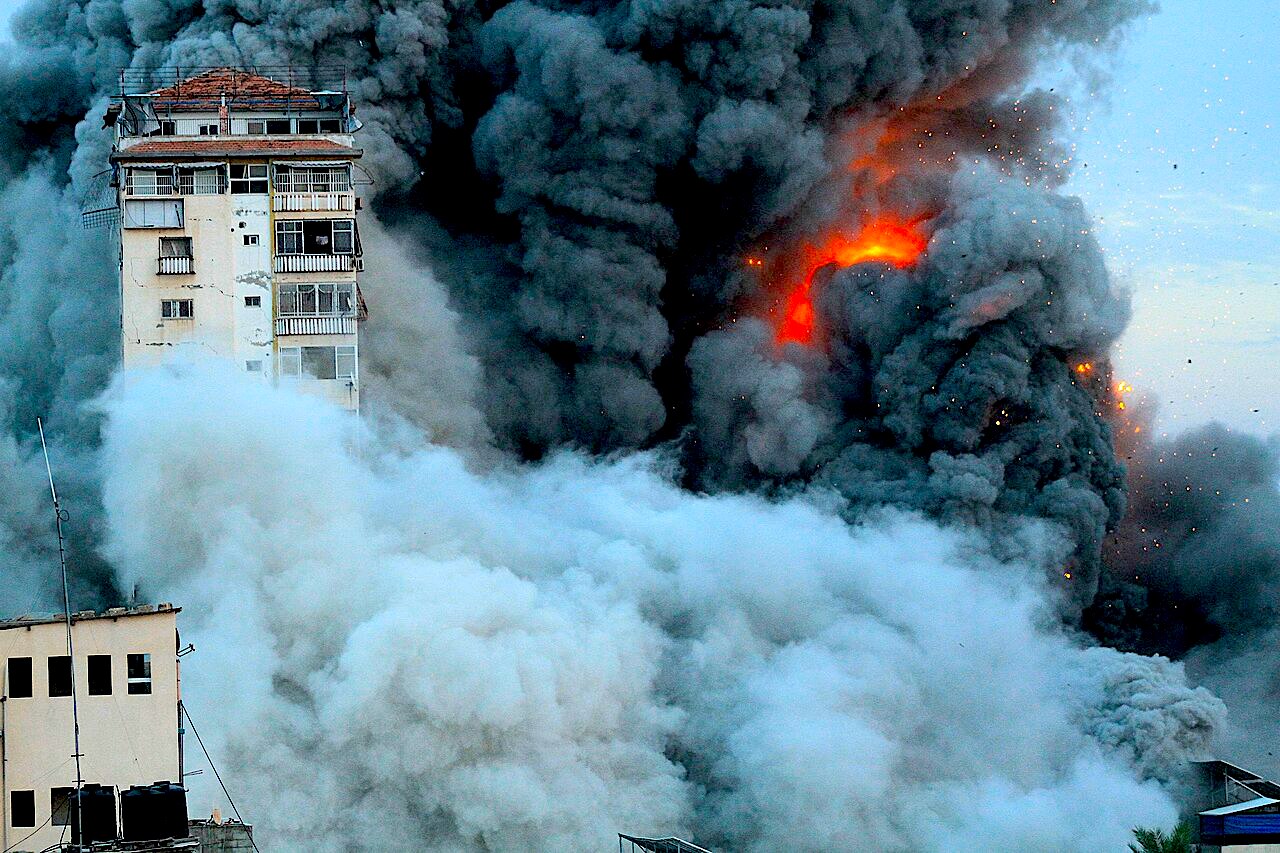
Gaza under Israeli bombardment on Oct. 7, 2023. (Ali Hamad of APAimages for WAFA, Wikimedia Commons, CC BY-SA 3.0)
Too many pundits, such as the interminably dim-witted Piers Morgan, are slowly, oh-so-slowly coming round to the idea that Israel might be committing a genocide in Gaza.
But of course, they are still dismissing as “anti-Semites” those of us who pointed out from the start that it was a genocide.
They hope to get away with this face-saving ploy only because the establishment media continues to ignore what happened before Oct. 7, 2023 — events that over many years had made clear Israel was readying to commit genocide — and would grasp a pretext when it arrived.
Here is a brief outline of some of the most pertinent factors:
1. In early 2008 — that is, 17 years ago — Deputy Defence Minister Matan Vilnai, a former senior Israeli general, threatened that Gaza would face a “Shoah” — a word until then, strictly reserved for the Holocaust.
2. He did so shortly after Israel implemented what would become a near two-decade siege of Gaza. Israel had already surrounded the enclave with a heavily militarised fence, made its territorial waters off-limits and bombed its only airport.
From then on, food was tightly rationed, in what Israeli leaders called “putting Gaza on a diet,” while swaths of the enclave were intermittently destroyed by Israeli bombing, or what Israeli leaders called “mowing the lawn.” Gaza was effectively turned into a concentration camp.
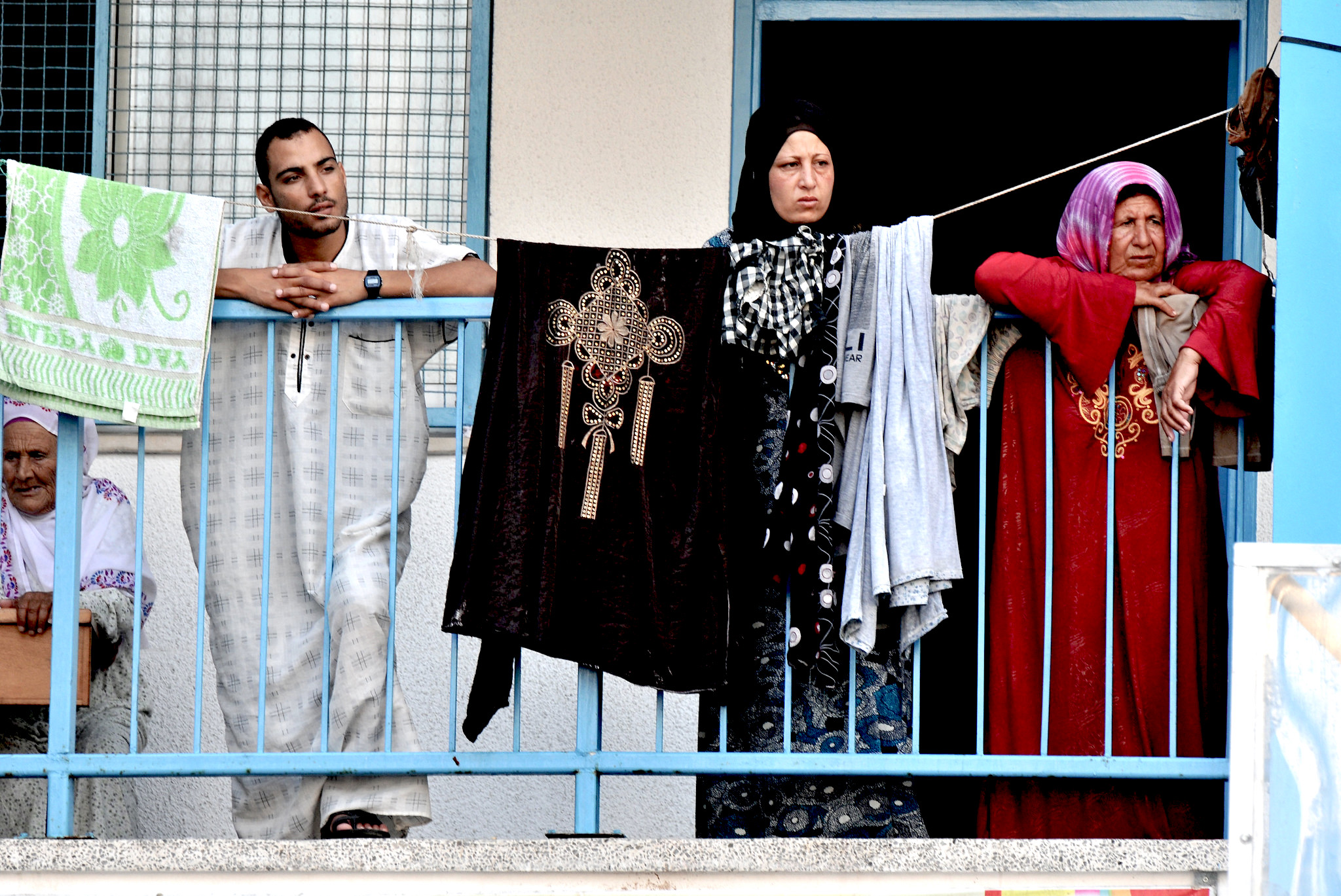
Displaced Palestinians gather at a UN school in the northern Gaza Strip after fleeing their homes in an area under heavy Israeli aerial bombardment in the besieged Palestinian territory, Aug. 26, 2014. (UN Photo/Shareef Sarhan)
3. The siege was complemented by Israel’s gradual destruction of Gaza’s means of self-sufficiency: any fishing off its coast was stopped; Israel regularly sprayed herbicide on the enclave’s agricultural land; Israel eradicated Gaza’s industrial sector by making exports almost impossible; and Israel regularly bombed Gaza’s electricity and desalination plants, limiting the essentials of water and power.
Smoke and flames rise from a power plant in Gaza that was hit by missile strikes, July 29, 2014. (UN Photo/Shareef Sarhan/CC BY-NC-ND 2.0)
4. The goal was clear: to make Gaza entirely dependent on Israel’s goodwill, of which there was almost none, and at the same time utterly dependent on aid. In tandem, Israel started waging a deceitful campaign claiming U.N. aid organisations were linked to Hamas “terror” in the hope it could use this as a rationalisation for impeding aid, as it has done with great ferocity since Oct. 7, 2023, and ultimately for taking over for itself all aid provision, as it has also managed to do in recent months with the creation of an Israeli-U.S. front group, the “Gaza Humanitarian Foundation.”
The “No Man’s Land” in what Israel calls the buffer zone along the Gaza-Israel border, 2008. (Kashfi Halford, Flickr, CC BY-NC 2.0)
5. With this as the background, the United Nations warned a decade ago that Gaza was likely to become uninhabitable by 2020. That was a major reason why Palestinians began mass protests at their concentration camp fence in 2018, which Israel responded to with lethal live fire.
In one article in the Israeli media at the time, IDF snipers boasted about shooting “42 knees in one day.” Hundreds were killed and many thousands crippled as a result. Those same snipers are currently shooting children in the head, abdomen and testicles, as British surgeon Nick Maynard, who is volunteering in Gaza, has warned.
New York City rally May 18, 2018, protests 70 years of Nakba and supports the Great Return March in Gaza. (Joe Catron/Flickr/ CC BY-NC 2.0)
Let us note too that Israel’s almost complete, and malevolent, control over Gaza — and the fact that the world had lost interest in the enclave’s desperate plight — was a major factor in Hamas and other groups launching their lethal break-out on Oct. 7, 2023.
5. In parallel to all this, and starting in 2007, Israel persuaded the U.S. to join it in a pressure campaign on Egypt: to open its single, short border with Gaza so that the enclave’s people would flood into Sinai — an act of ethnic cleansing and a blatant violation of international law. Egypt refused to submit before Oct. 7, 2023, and has continued to do so since.
In fact, forcibly removing a group from their homes through violence and by making life impossible for them where they live itself meets the legal definition of genocide — all the more obviously so if those doing the forcible removal say that is what they are doing, as Israeli leaders have been stating from the start of their genocidal slaughter and starvation campaign in Gaza.
Israel is committing a genocide to force Egypt and the Arab world to take the people of Gaza as refugees. If they refuse, Israel will continue with the genocide by killing more of Gaza’s people. If they relent, Israel will continue the genocide by dispersing what’s left of the people of Gaza to the far corners of the world. Either way, it is genocide. Either way, it must be stopped — now.
It is cold comfort indeed that, in the very final stages of Israel’s genocide, media pundits like Piers Morgan are ready to concede that a genocide may be about to happen. None of that should obscure or excuse their 21 months of complicity in the genocide that unfolded before all our eyes. They did not know because they did not want to know.
Responsibility for every dead child in Gaza, every maimed child in Gaza, every orphaned child in Gaza, every starving child in Gaza, irreversibly damaged by malnutrition, rests firmly on their shoulders.
Jonathan Cook is an award-winning British journalist. He was based in Nazareth, Israel, for 20 years. He returned to the U.K. in 2021. He is the author of three books on the Israel-Palestine conflict: Blood and Religion: The Unmasking of the Jewish State (2006), Israel and the Clash of Civilisations: Iraq, Iran and the Plan to Remake the Middle East (2008) and Disappearing Palestine: Israel’s Experiments in Human Despair (2008). If you appreciate his articles, please consider offering your financial support.
Europe’s silence has allowed the genocide of Palestinians to continue unchecked – undermining all it stands for
Josep Borrell was the high representative of the EU for foreign affairs and security policy from 2019 to 2024
The Guardian, Fri 1 Aug 2025 10.00 CEST
If they survive Donald Trump’s attacks, the international courts will not deliver their final verdict for several years. But for all those who have ears to hear and eyes to see, there can be little doubt that the Israeli government is committing genocide in Gaza, slaughtering and starving civilians after systematically destroying all the infrastructure in the territory. In the meantime, settlers and the Israeli army are every day guilty of serious, massive and repeated violations of international law and international humanitarian law in the West Bank and East Jerusalem.
Those who do not act to stop this genocide and these violations of international law, even though they have the power to do so, are complicit in them. This is unfortunately the case with the leaders of the European Union and those of its member states, who refuse to sanction Israel even though the EU has a legal obligation to do so.
The EU has many levers it could pull to exert significant influence on the Israeli government. The EU is Israel’s biggest trading partner and its main partner in investment and people-to-people exchange. It is also one of its major arms suppliers. The association agreement between the EU and Israel, established in 2000 after the Oslo accords, is the most favourable of all those concluded by the bloc with third countries. In addition to zero customs duties on its exports of goods and services and visa-free travel for its citizens, the agreement gives Israel access to several major European funding and exchange programmes such as Horizon and Erasmus.
However, article 2 of this agreement makes it conditional on Israel’s respect for international law and fundamental human rights. Whether or not to suspend it is therefore not a choice that the EU can make at will. Since the EU foreign affairs ministers found that Israel was not respecting these rights, EU leaders now have a legal obligation to suspend the agreement. Failure to do so would also be a serious violation of the association agreement with Israel.
However, despite all my efforts to this end when I was high representative of the EU, and despite the dramatic deterioration of the humanitarian situation in Gaza and the increasing violations of international law in the West Bank in recent months, the EU and most EU governments have so far failed to use any of the levers available to them to exert pressure on the Israeli government.
As a result, faced with the intransigence of Benjamin Netanyahu’s government, the EU has for more than a year and a half been unable to assert its commitment to fundamental human rights, its defence of international law and multilateralism, or its longstanding position in favour of the two-state solution. This inaction has already seriously damaged its geopolitical standing, not only in the Muslim world but across the globe. The stark contrast between the firm response of the European authorities to Russia’s aggression against Ukraine and their passivity in the face of the war in Gaza has been widely exploited by Vladimir Putin’s propaganda against the EU. And with success, as we have seen in particular in the Sahel. This European double standard has also greatly weakened support for Ukraine in many developing countries.
By persisting in not suspending the association agreement despite its clear violation by Israel, in not blocking arms deliveries to that country despite the war crimes and crimes against humanity committed in Gaza, in not banning imports from illegal settlements despite the decisions of the international court of justice to that effect, by not sanctioning Israeli ministers and political leaders who make genocidal statements, by not banning Netanyahu from using European airspace despite the arrest warrant issued by the international criminal court, and by not supporting the judges of the court and UN officials sanctioned by the United States, the EU and its member states are discrediting themselves in the eyes of the world and undermining the international law and multilateral order they are supposed to defend. While under attack from Putin in the east and Trump in the west, the EU is thus deepening its isolation by cutting itself off from the rest of the world.
The leaders of the EU and its member states will probably be called to account in the future for their complicity in the crimes against humanity committed by Netanyahu’s government. And, with hindsight, Europeans will undoubtedly judge harshly their blindness to the genocide that is taking place. However, it is urgent to limit the damage now. The EU must finally decide to sanction Israel without further delay. This is the only language that can bring Israeli leaders to stop committing crimes against humanity.
Josep Borrell was the high representative of the EU for foreign affairs and security policy from 2019 to 2024. He is president of the Barcelona Centre for International Affairs, CIDOB
The Palestinian resistance group Hamas said Saturday it will not give up its arms unless an “independent, fully sovereign” Palestinian state is established, Anadolu reports.
The statement came following reports by the Israeli daily Haaretz citing a recording attributed to US Middle East envoy Steve Witkoff: “Hamas has said that they are prepared to be demilitarized.”
“We are very, very close to a solution to end this war,” Witkoff is also heard saying, according to Haaretz.
“Commenting on reports by some media outlets quoting US envoy Steve Witkoff as saying the movement expressed willingness to disarm, we reiterate that resistance and its weapons are a national and legitimate right as long as the occupation continues — a right recognized by international laws and conventions,” Hamas said in a statement on Telegram.
The group added that such rights “cannot be relinquished except with the full attainment of our national rights, foremost being the establishment of an independent, fully sovereign Palestinian state with Jerusalem as its capital.”
Witkoff met families of Israeli hostages in Tel Aviv on Saturday, as hundreds rallied to demand a ceasefire deal that would secure their release from the Gaza Strip, Israel’s Haaretz newspaper reported.
Witkoff’s visit, his third to Hostage Square since the war began, came shortly after Palestinian groups Hamas and Islamic Jihad released footage showing two emaciated Israeli captives, Evyatar David and Rom Braslavski, prompting renewed outrage.
On Friday, Witkoff visited an aid center in southern Gaza operated by the controversial Gaza Humanitarian Foundation (GHF).
Diplomatic merchandise: Exploiting the issue of Palestinian recognition
He said the aim was to give US President Donald Trump “a clear understanding of the humanitarian situation and help craft a plan to deliver food and medical aid to the people of Gaza.”
The visit comes amid mounting criticism of US-Israeli coordination in Gaza, particularly regarding the group’s distribution model, which Palestinians say serves as a tool for displacement under the guise of humanitarian relief as well as a “death trap” for many Palestinian aid seekers, with over 1,300 killed since May while waiting for relief supplies.
Hamas on Thursday denounced the visit as a “propaganda stunt” aimed at deflecting global outrage over what rights groups and UN officials have described as Israel’s systematic starvation campaign.
Since Oct. 7, 2023, at least 169 Palestinians, including 93 children, have died of hunger-related causes, according to Gaza’s Health Ministry.
Rejecting international calls for a ceasefire, the Israeli army has pursued a brutal offensive on Gaza since Oct. 7, 2023, killing more than 60,000 Palestinians, most of them women and children.
Last November, the International Criminal Court issued arrest warrants for Israeli Prime Minister Benjamin Netanyahu and his former Defense Minister Yoav Gallant for war crimes and crimes against humanity in Gaza.
Israel also faces a genocide case at the International Court of Justice for its war on the enclave.
The prospects for negotiating a ceasefire and an end to the humanitarian disaster in the Gaza Strip appear as dim as ever. Israeli and U.S. representatives walked out of talks with Hamas in Qatar that had been mediated by the Qataris and Egyptians. Israeli Prime Minister Benjamin Netanyahu is talking about “alternative” means of achieving Israel’s goals in the territory.
President Donald Trump, echoing Netanyahu’s levying of blame on Hamas, asserted that “Hamas didn’t really want to make a deal. I think they want to die.” Trump went on to mention a need to “finish the job,” evidently referring to Israel’s continued devastating assault on the Strip and its residents.
I have been thinking for a long time about the negotiation of ceasefires. Nearly 50 years ago, I wrote a book, “Negotiating Peace: War Termination as a Bargaining Process,” which explored the diplomatic and military dynamics of how two belligerents negotiate a peace while simultaneously fighting a war.
What is taking place in Gaza now is mostly not a war, even though that term commonly is applied to the violence there. It is instead a largely unilateral assault on a population and its means of living. It is a situation in which one side, Israel, has — as Trump might put it — nearly all the cards.
The news stories emerging almost daily from Gaza are not about pitched battles between the Israeli Defense Forces (IDF) and Hamas fighters. They are mostly not about battles at all. Instead, they are about the latest large-scale killing by Israel of Gazans, mostly civilians, at a rate that has averaged about 150 deaths per day since the current round of carnage began in late 2023. Civilians are killed largely with airstrikes but also more recently through getting shot while seeking ever-scarcer food.
Mass starvation has become perhaps the most gut-wrenching part of the Gaza catastrophe, and one where Israel has again tried to shift blame onto Hamas. A longtime Israeli accusation in endeavoring to shut down the United Nations Relief and Works Agency (UNRWA)—the principal international organization with the mission of aiding Palestinian refugees, including in Gaza—is that Hamas supposedly was stealing UNRWA-supplied food. Trump has echoed that accusation.
A study by the U.S. Agency for International Development (before the Trump administration dismantled the agency) of reported incidents of loss or theft of U.S.-supplied humanitarian assistance in Gaza found no evidence that Hamas has engaged in widespread diversion of aid. More recent press reporting shows that the IDF itself has found no evidence of Hamas seizing or diverting aid.
Israel’s opposition to UNRWA has nothing to do with Hamas or with theft of humanitarian aid. It instead concerns how UNRWA — because it is a United Nations agency explicitly focused on Palestinians — constitutes an international recognition that the Palestinians are a nation and that many of them are refugees from their homeland.
The humanitarian situation in Gaza got worse once Israel succeeded in pushing UNRWA aside. The U.S.-backed and Israeli-controlled alternative aid scheme is not only woefully inadequate in meeting immediate needs but also designed as an adjunct to Israel’s ethnic cleansing objectives. The limitation of aid to a few distribution points facilitates the forced relocation of surviving Gazans into what amounts to a concentration camp, as a possible prelude to removal from the Gaza Strip altogether.
Some aid has recently been dropped into Gaza by air. Airdrops are an ineffective and inefficient way of trying to relieve the starvation. The amounts delivered are a tiny fraction of what is needed. The cost of delivery is far higher than by land. As demonstrated by an earlier U.S. effort to deliver aid this way, some of the supplies are lost because they fall into the sea or, even worse, kill people crushed by falling pallets. But for some donors, an airdrop serves as a visually dramatic conscience-calming gesture.
For Israel, it serves as a distraction from the fact that the biggest impediment to getting humanitarian aid into the Gaza Strip is Israel’s continued land blockade of the territory. Valuing that distraction, Israel itself has joined in the airdrop gesture. At the same time, however, Israel continues to allow only a trickle of aid to cross the land border, with many hundreds of truckloads left to spoil and be destroyed by the IDF.
In my decades-old book, I identified a type of war ending that is an alternative to a negotiated settlement as “extermination/expulsion,” meaning that the militarily dominant side physically obliterates its opponent or pushes it out of contested territory. Extermination/expulsion of the opponent is an appropriate label for Israel’s objective in Gaza.
The prevailing Israeli conception of the opponent, or enemy, in Gaza is the entire Palestinian population, an attitude that was already well rooted on the Israeli Right before the Hamas attack in October 2023 and has grown even stronger and wider since then. The deaths already inflicted, directly or indirectly, by the IDF have significantly advanced the extermination objective. The expulsion part has mostly been the stuff of internal Israeli deliberations, although it came more into the open when Trump gave Netanyahu’s government the gift of endorsing the ethnic cleansing with his Riviera-in-Gaza proposal.
The politics of genocide in the United States involves papering over the big gap between the opinions of the electorate and the actions of the U.S. government. While the partnership between the governments of Israel and the United States has never been stronger, the partnership between the people of Israel and the United States has never been weaker. But in the USA, consent of the governed has not been necessary to continue the axis of genocide.
For decades, countless U.S. officials have proclaimed that the bonds between the United States and Israel are unbreakable. Now, the ties that bind are laced with genocide. The two countries function as accomplices while methodical killing continues in Gaza, with both societies directly – and differently – making it all possible.
The policies of Israel’s government are aligned with the attitudes of most Jewish Israelis. In a recent survey, three-quarters of them (and 64 percent of all Israelis) said they largely agreed with the statement that “there are no innocent people in Gaza” – nearly half of whom are children.
“There is no more ‘permitted’ and ‘forbidden’ with regard to Israel’s evilness toward the Palestinians,” dissident columnist Gideon Levy wrote three months ago in the Israeli newspaper Haaretz. “It is permitted to kill dozens of captive detainees and to starve to death an entire people.” The biggest Israeli media outlets echo and amplify sociopathic voices. “Genocide talk has spread into all TV studios as legitimate talk. Former colonels, past members of the defense establishment, sit on panels and call for genocide without batting an eye.”
Last week, Levy provided an update: “The weapon of deliberate starvation is working. The Gaza ‘Humanitarian’ Foundation, in turn, has become a tragic success. Not only have hundreds of Gazans been shot to death while waiting in line for packages distributed by the GHF, but there are others who don’t manage to reach the distribution points, dying of hunger. Most of these are children and babies…. They lie on hospital floors, on bare beds, or carried on donkey carts. These are pictures from hell. In Israel, many people reject these photos, doubting their veracity. Others express their joy and pride on seeing starving babies.”
Unimpeded, a daily process continues to exterminate more and more of the 2.1 million Palestinian people who remain in Gaza – bombing and shooting civilians while blocking all but a pittance of the food and medicine needed to sustain life. After destroying Gaza’s hospitals, Israel is still targeting healthcare workers (killing at least 70 in May and June), as well as first responders and journalists.
The barbarism is in sync with the belief that “no innocent people” are in Gaza. A relevant observation came from Aldous Huxley in 1936, the same year that the swastika went onto Germany’s flag: “The propagandist’s purpose is to make one set of people forget that certain other sets of people are human.” Kristallnacht happened two years later.
Renowned genocide scholar Omer Bartov explained during an interview on Democracy Now! in mid-July that genocide is “the attempt to destroy not simply people in large numbers, but to destroy them as members of a group. The intent is to destroy the group itself. And it doesn’t mean that you have to kill everyone. It means that the group will be destroyed and that it will not be able to reconstitute itself as a group. And to my mind, this is precisely what Israel is trying to do.”
Bartov, who is Jewish and spent the first half of his life in Israel, said:
“What I see in the Israeli public is an extraordinary indifference by large parts of the public to what Israel is doing and what it’s done in the name of Israeli citizens in Gaza. In part, it has to do with the fact that the Israeli media has decided not to report on the horrors that the IDF [Israel Defense Forces] is perpetrating in Gaza. You simply will not see it on Israeli television. If some pictures happen to come in, they are presented only as material that might be used by foreign propaganda against Israel. Now, Israeli citizens can, of course, use other media resources. We can all do that. But most of them prefer not to. And I would say that while about 30 percent of the population in Israel is completely in favor of what is happening, and, in fact, is egging the government and the army on, I think the vast majority of the population simply does not want to know about it.”
In Israel, “compassion for Palestinians is taboo except among a fringe of radical activists,” Adam Shatz wrote last month in the London Review of Books. At the same time, “the catastrophe of the last two years far exceeds that of the Nakba.” The consequences “are already being felt well beyond Gaza: in the West Bank, where Israeli soldiers and settlers have presided over an accelerated campaign of displacement and killing (more than a thousand West Bank Palestinians have been killed since 7 October); inside Israel, where Palestinian citizens are subject to increasing levels of ostracism and intimidation; in the wider region, where Israel has established itself as a new Sparta; and in the rest of the world, where the inability of Western powers to condemn Israel’s conduct – much less bring it to an end – has made a mockery of the rules-based order that they claim to uphold.”
The loudest preaching for a “rules-based order” has come from the U.S. government, which makes and breaks international rules at will. During this century, in the Middle East, the U.S.-Israel duo has vastly outdone all other entities combined in the categories of killing, maiming, and terrorizing. In addition to the joint project of genocide in Gaza, and the USA’s long war on Iraq, the United States and Israel have often exercised an assumed prerogative to attack Lebanon, Syria, Yemen, and Iran, along with encore U.S. missile strikes on Iraq as recently as last year.
Israel’s grisly performance as “a new Sparta” in the region is coproduced by the Pentagon, with the military and intelligence operations of the two nations intricately entangled. The Israeli military has been able to turn Gaza into a genocide zone with at least 70 percent of its arsenal coming from the United States.
While writing an afterword about the war on Gaza for the paperback edition of War Made Invisible, I mulled over the relevance of my book’s subtitle: “How America Hides the Human Toll of Its Military Machine.” As the carnage in Gaza worsened, the reality became clearer that the Orwellian-named Israel Defense Forces and U.S. Defense Department are essentially part of the same military machine. Their command structures are different, but they are part of the same geopolitical Goliath.
“The new era in which Israel, backed by the U.S., dominates the Middle East is likely to see even more violence and instability than in the past,” longtime war correspondent Patrick Cockburn wrote this month. The lethal violence from Israeli-American teamwork is of such magnitude that it epitomizes international state terrorism. The genocide in Gaza shows the lengths to which the alliance is willing and able to go.
While public opinion is very different in Israel and the United States, the genocidal results of the governments’ policies are indistinguishable.
American public opinion about arming Israel is measurable. As early as June 2024, a CBS News poll found that 61 percent of the public said that the U.S. should not “send weapons and supplies to Israel.” Since then, support for Israel has continued to erode.
In sharp contrast, on Capitol Hill, the support for arming Israel is measurably high. When Bernie Sanders’s bills to cut off some military aid to Israel came to a vote last November, just 19 out of 100 senators voted yes. Very few of his colleagues voice anywhere near the extent of Sanders’s moral outrage as he keeps speaking out on the Senate floor.
In the House, only 26 out of 435 members have chosen to become cosponsors of H.R.3565, a bill introduced more than two months ago by Rep. Delia Ramirez that would prevent the U.S. government from sending certain bombs to Israel.
“Israel is the largest cumulative recipient of U.S. foreign assistance since World War II,” the Congressional Research Service reports. During just the first 12 months after the war on Gaza began in October 2023, Brown University’s Costs of War project found, the “U.S. spending on Israel’s military operations and related U.S operations in the region” added up to $23 billion.
The resulting profit bonanza for U.S. military contractors is notable. So is the fact that the U.S.-Israel partnership exerts great American leverage in the Middle East – where two-thirds of the world’s oil reserves are located.
The politics of genocide in the United States involves papering over the big gap between the opinions of the electorate and the actions of the U.S. government. While the partnership between the governments of Israel and the United States has never been stronger, the partnership between the people of Israel and the United States has never been weaker. But in the USA, consent of the governed has not been necessary to continue the axis of genocide.
 Israeli Prime Minister Benjamin Netanyahu at cabinet meeting on January 22, 2023. (Photo: Israel National Photo Collection/Government Press Office)












 By
By 
 Peace and Justice Post

You must be logged in to post a comment.